Market Minds Advisory
Nylon Films Market

Nylon Films Market: Barrier Packaging Demand and the Recyclability Transition

Nylon films sit between decades-old vacuum-packaged meat and cheese demand that built their barrier reputation, and brand-owner pressure to replace multi-layer barrier structures with recyclable mono-material alternatives that do not yet match performance.

Lead Analyst

Bilal Shaikh

Published

September 2026

Make Smarter Decisions with Customized Research Insights

Request a free sample report and evaluate market opportunities, growth trends, and competitive dynamics relevant to your business needs.

2025 MARKET VALUE$2.9BMarket Size 2025
2036 FORECAST VALUE$5.4BBase Case , 2026 to 2036
CAGR 2026 TO 20365.8 %Bull 7.0% / Bear 4.6%
INCREMENTAL OPPORTUNITY$2.3BNet 10- year value creation
EXPANSION MULTIPLE1.76x2036 value over 2026 base
Strategic Levers
M&A Pipeline
Regional Outlook
Country Rankings
Competitive Intelligence
Segmental Deep-dive
Call-Us : 91 93563 13602

Executive Snapshot and Market Trajectory

Nylon film built its commercial reputation on one property: puncture and oxygen barrier performance that vacuum-packaged meat and cheese buyers have relied on for decades. That same multi-layer construction is now the film's biggest liability as recyclability rules tighten. Few materials carry that exact tension so directly.
Medical and pharmaceutical packaging is growing fastest as sterile barrier requirements expand across generic drug manufacturing and medical device packaging worldwide. East Asia anchors global production on China's polyamide resin manufacturing scale, while North America and Western Europe compete on food-safety certification depth and brand-owner recycling commitments rather than pure production cost. Both regions are racing to build the certification depth this fastest-growing segment increasingly demands. Neither region is currently winning that race decisively.
Twenty producers compete across a market split between commodity food-packaging film sold on barrier performance and price, and certified medical-grade film earning meaningfully more on sterile packaging validation. Recycling infrastructure gaps for multi-layer nylon structures genuinely threaten the material's position wherever brand owners commit to mono-material packaging targets. Producers slow to reformulate risk losing share to nimbler specialty rivals. Buyers rarely compare notes across these two different pathways.
Market Definition
The market covers nylon (polyamide) film produced through cast or biaxial orientation processes, sold into food, medical, pharmaceutical, industrial lamination, and electrical insulation packaging applications. Nylon fiber, resin sold for non-film applications, and rigid nylon molded parts are excluded.
Base Year Value
$2.9B in 2025 (MMA Primary Research Dataset, August 2026)
Forecast Period
2026 to 2036, eleven discrete annual values
CAGR
5.8% base case. Bull 7.0%. Bear 4.6%.
Fastest Growth Segment
Medical and Pharmaceutical Packaging Films: 8.2% CAGR
Fastest Growth Country
India: 8.8% CAGR
Fastest Growth Region
South Asia and Pacific: 7.8% CAGR
Largest Region
East Asia: 30% of 2025 global value
Market Leaders
Amcor plc, Honeywell International, Toray Industries, Kolon Industries, Klöckner Pentaplast. Source: MMA Analysis based on company annual reports.
Primary Survey
n=3,800 procurement and R&D decision-makers, Q4 2025, six countries
Methodology
Demand-side build-up, cross-validated against public data, 47 expert interviews

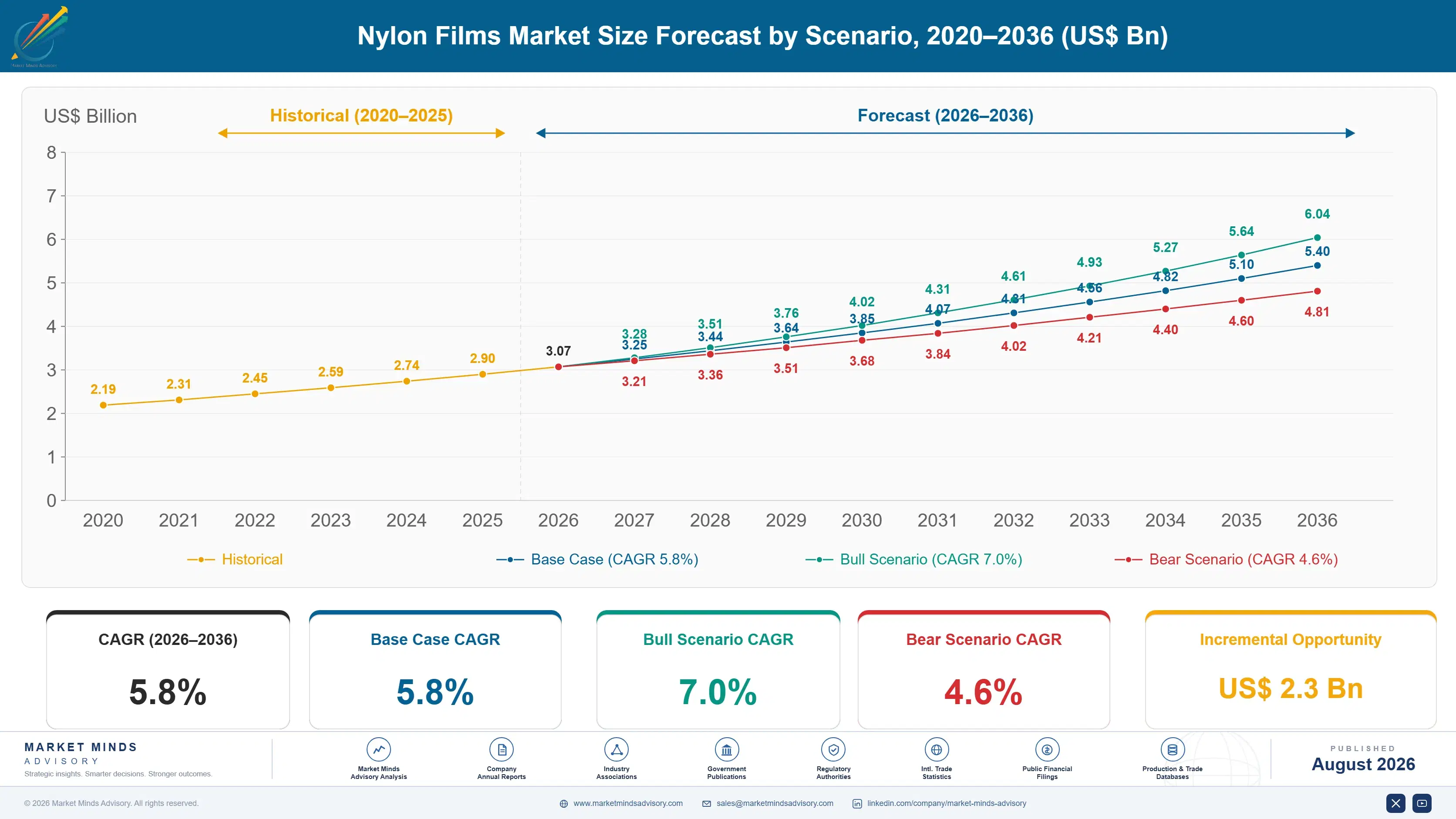
Nylon Films Market Forecast Scenarios

nylon-films-market-size-forecast-scenario-1787559098107
Between 2020 and 2025 the market grew near 4.8% a year, held back by pandemic-era processed meat supply disruption before recovering as food packaging volume normalised and medical packaging demand accelerated meaningfully across generic drug and device manufacturing globally. Medical packaging demand barely registered as a meaningful growth contributor at the start of that same five-year period.
The base case carries the market to 5.8% CAGR on three mechanisms: continued vacuum and barrier packaging demand from processed meat and cheese categories, medical and pharmaceutical packaging expansion tied to generic drug manufacturing growth in Asia, and industrial lamination demand from electronics and specialty packaging applications. None of these three mechanisms depends on any single brand owner's recyclability commitment timeline alone. Each mechanism moves largely independently of the others, which is what makes the base case durable across cycles.
The bull case at 7.0% assumes faster medical packaging capacity expansion across India and China than currently modelled. The bear case at 4.6% assumes recyclability mandates in Europe force faster substitution away from multi-layer nylon structures than currently anticipated. Neither scenario depends on any single national packaging regulation decision alone. Both remain plausible given how quickly compliance timelines have moved.

Barrier Performance Meets the Recyclability Test

Three forces converge on this market at once, and each moves on its own separate timeline. Processed meat and cheese packaging demand tracks food retail volume and cold-chain expansion, medical and pharmaceutical packaging demand tracks generic drug manufacturing capacity growth across Asia, and recyclability regulation tracks a political timeline largely independent of either underlying demand driver.
CAPACITY UTILISATION73%specialty film lines run below nameplate most of the year
AVERAGE SELLING PRICEUSD 3.60/kgblended price across food and medical grade nylon film
TOP PRODUCER SHARE15%largest single producer share of global film capacity
FEEDSTOCK COST SHARE56% of COGScaprolactam and polyamide resin cost across integrated producers
TRADE INTENSITY33%share of global output moving across a border annually
HHI CONCENTRATION460a moderately concentrated global specialty film producer base
Commercially, the market behaves like a specialty barrier materials business wearing a commodity packaging label. Grade differentiation genuinely exists, medical-grade film commanding real premiums over standard food-packaging grades, but margin still tracks caprolactam feedstock cost and multi-layer coextrusion technology more than pure brand positioning. A producer with captive PA6 resin supply competes on cost structure long before it competes on certification depth. Few producers have historically built genuine strength across both commercial models at once.
Over the next decade, medical packaging growth and recyclable structure development will decide winners more than food packaging volume alone, since food packaging demand is already a largely mature, retail-tied base. Producers investing early in mono-material recyclable nylon structures will capture brand-owner contracts that multi-layer-only competitors cannot easily replicate without significant reformulation. Food packaging volume will keep generating cash, but not decide the next decade's winners.
"Everyone loves nylon film's barrier numbers until the sustainability team asks how it gets recycled. That conversation is reshaping the entire specification process now."
Director, Packaging Materials Practice · MMA Packaging Practice · August 2026

Market Trends

Recyclable Mono-Material Nylon Structures Enter Commercial Trials

Packaging developers have begun commercializing mono-material nylon structures that replace traditional multi-layer barrier laminates with a single recyclable polyamide layer, addressing brand-owner recyclability commitments that multi-layer film cannot satisfy under most national recycling stream classifications. These structures currently carry a real performance gap in oxygen barrier and cost relative to established multi-layer film, limiting adoption to early pilot programmes with major food brands. Producers investing in mono-material development are positioning ahead of tightening European extended producer responsibility rules that increasingly penalise non-recyclable multi-layer packaging. Several large food companies have committed publicly to transitioning packaging portfolios toward recyclable structures within years.
Market Impact: Adds 22,000 tonnes by 2029

Thinner-Gauge High-Barrier Films Reduce Material Use Per Package

Film producers have developed thinner-gauge nylon structures that maintain barrier performance while cutting material use per package, responding to brand-owner cost pressure and sustainability goals around reduced packaging weight simultaneously. This gauge reduction requires precise coextrusion process control that not every producer has mastered, creating real differentiation between technically advanced and commodity-focused film makers. Converters increasingly specify these thinner grades for new packaging lines, though existing equipment calibrated for thicker film sometimes requires adjustment to run the newer material effectively. This trend is slowing volume growth measured in tonnes even as packaged unit volume keeps expanding steadily across most categories.
Market Impact: Adds USD 60 million by 2028

Market Opportunities and Growth Drivers

Processed Meat and Cheese Packaging Sustains Core Demand

Vacuum-packaged processed meat, cheese, and deli products remain the largest single application for nylon film globally, and consumption of these categories continues growing steadily across both developed and emerging retail markets. Nylon's combination of oxygen barrier and puncture resistance makes it the default specification for cook-in and retort packaging formats that competing materials struggle to match at comparable cost. Retailers and processors increasingly specify extended shelf-life packaging to reduce food waste, a trend that favours nylon's barrier properties directly over lower-performance alternatives. This demand base is unusually stable compared with most packaging materials markets, since processed food consumption changes gradually.
Market Impact: Threatens 20% of European film volume

Generic Drug Manufacturing Expansion Lifts Medical Packaging Demand

India and China have both expanded generic pharmaceutical and medical device manufacturing capacity substantially, and nylon film's sterile barrier properties make it a standard specification for blister packaging, pouches, and device sterilization packaging across this growing production base. Regulatory requirements for validated sterile barrier systems, enforced by both domestic regulators and export market authorities, require consistent film quality that commodity food-packaging grades do not reliably meet. Medical device and pharmaceutical contract manufacturers increasingly sign longer-term film supply agreements to ensure validated barrier consistency across production batches. Contract manufacturers favour suppliers documenting consistent barrier performance.
Market Impact: Cuts margin by 220 basis points

Market Restraints and Challenges

Recycling Infrastructure Gaps Threaten Multi-Layer Film Position

Multi-layer nylon barrier film cannot be recycled through most existing curbside or commercial recycling streams, since separating the distinct polymer layers required to achieve barrier performance is not commercially viable at typical recycling facility scale. The root cause is a genuine technical tradeoff between barrier performance and recyclability that packaging science has not yet fully resolved, since single-layer alternatives generally cannot match multi-layer barrier properties at comparable cost. Brand owners facing recyclability mandates in Europe are responding by piloting mono-material alternatives or shifting toward rigid packaging formats that recycling infrastructure already handles more effectively than flexible multi-layer film.
Market Impact: Adds USD 95 million in demand

Caprolactam Feedstock Volatility Compresses Non-Integrated Margins

Nylon film producers without captive caprolactam or PA6 resin supply carry direct exposure to petrochemical price swings that integrated producers partially insulate through internal polymer production. The root cause is the same benzene and cyclohexane price volatility affecting the broader nylon supply chain, transmitted directly into film production economics given the material's straightforward derivation from standard caprolactam feedstock. Smaller specialty producers are responding by signing longer-dated resin supply contracts where available and by focusing increasingly on higher-margin medical grades where price sensitivity is lower than in bulk food-packaging sales. Larger integrated producers absorb this exposure more comfortably.
Market Impact: Cuts material use per unit 15%
3 additional market trends, 4 additional growth drivers, and 2 additional restraints and challenges are covered in the full report. Contact sales@marketmindsadvisory.com to access the complete intelligence.

Segment CAGR and Growth Architecture

Segmentation follows end-use application, the single commercial logic determining film structure, certification requirements, and buyer relationship depth. Food packaging dominates by volume, while medical and electrical insulation grades are growing fastest on regulatory and technology-driven demand. Industrial lamination and agricultural applications each carry distinct buyer bases and specification cycles of their own. Buyer qualification differs across each.
nylon-films-market-market-share-analysis-1787559098635

Medical and Pharmaceutical Packaging Films

Medical and pharmaceutical packaging films grow fastest at 8.2%, about 1.41 times the overall 5.8% rate, as generic drug and medical device manufacturing capacity expands across India and China and both domestic and export-market regulators intensify sterile barrier validation requirements. Nylon's sterile barrier properties make it a standard specification for blister packaging, pouches, and device sterilization packaging where commodity food-packaging grades do not reliably meet validation standards. Contract manufacturers increasingly sign longer-term film supply agreements to ensure consistent validated barrier quality across production batches, a shift from the more transactional purchasing that characterised this segment previously. Suppliers serving this segment need pharmacopeia-grade certification and documentation capability entirely distinct from standard food-packaging qualification pathways.
CAGR 8.2%

Electrical and Electronics Insulation Films

Electrical and electronics insulation films grow second-fastest at 6.8%, driven by expanding electronics manufacturing capacity and rising demand for motor and transformer insulation materials across both industrial and electric vehicle applications. Nylon's dielectric strength and thermal stability make it a preferred specification for wire wrapping and coil insulation in applications requiring reliable performance under sustained electrical and thermal stress. Electric vehicle motor manufacturing has emerged as a genuinely new demand source for high-performance insulation film that barely existed as a meaningful category five years ago. Producers serving this segment need electrical-grade certification and consistent dielectric performance testing distinct from standard packaging film production requirements. Contract terms typically span multiple years given the certification investment required.
CAGR 6.8%
Full segment breakdown across 6 segments available in the complete report.

Regional Architecture and Country Demand Map

East Asia leads on China's polyamide resin manufacturing scale, North America and Western Europe compete on food-safety certification and recycling commitments, and South Asia and Pacific posts the fastest regional growth on medical packaging expansion. Latin America and remaining regions add demand tied mostly to food processing and import channels.

North America

Food-safety certification depth and expanding medical device manufacturing explain North America's 24% share and its 6.0% growth, anchored by Amcor and Honeywell facilities serving both processed food packaging converters and medical device makers across the country. American producers compete less on pure manufacturing cost than on validated barrier certification and proximity to converter and medical device customers, since food-contact and sterile barrier qualification typically takes considerable time. Growth here tracks medical packaging expansion more than any new food packaging volume growth, since American processed meat and cheese consumption is already broadly mature relative to emerging markets. Canadian production contributes a smaller integrated base serving similar end markets. Domestic capacity keeps expanding to serve both food and medical customers simultaneously.
Share: 24% | CAGR: 6.0% (2026 to 2036)

Western Europe

Stringent recyclability regulation explains Western Europe's 22% share and its 4.2% growth, the slowest of any region tracked here, as extended producer responsibility rules increasingly penalise non-recyclable multi-layer nylon structures. German and French food packaging converters are piloting mono-material recyclable alternatives ahead of tightening compliance deadlines, while established multi-layer film volume faces genuine substitution risk over the coming decade. Klöckner Pentaplast maintains substantial European manufacturing capacity serving both food and medical packaging customers. Growth stays modest because European producers are managing a genuine transition risk rather than capturing straightforward new demand growth. Multi-layer volume faces genuine substitution risk over the coming decade specifically. Brand owners here increasingly treat recyclable packaging as a board-level procurement priority rather than a marketing claim.
Share: 22% | CAGR: 4.2% (2026 to 2036)
Regional intelligence for 5 additional markets available in the complete report: East Asia, South Asia and Pacific, Latin America, Middle East and Africa, Eastern Europe. Contact sales@marketmindsadvisory.com.
nylon-films-market-country-cagr-analysis-1787559099152

Where Producers Can Defend Margin

Caprolactam exposure and recyclability pressure set real limits on margin in this market, but four commercial moves let producers capture more value above that ceiling regardless of feedstock position, and regardless of how quickly recyclability mandates ultimately reshape converter specification. Producers combining several of these moves are pulling ahead of single-strategy competitors. nationally. across major markets.

Develop Mono-Material Structures Ahead of Mandates

Producers investing in recyclable mono-material nylon structures now, ahead of tightening European extended producer responsibility deadlines, capture brand-owner packaging contracts before compliance timelines force a broader industry scramble. Early movers are already securing pilot programme relationships with major food brands that later entrants will find considerably harder to win once mono-material specifications become standard across the category within 3 to 5 years. This certification barrier itself becomes a durable moat once a brand relationship is fully established and validated. Later movers will find these early brand relationships considerably harder to displace once mono-material specification becomes standard.
Market Impact: Wins pilot contracts worth roughly 2 times value

Secure Captive or Long-Dated Caprolactam Supply

Producers with captive caprolactam or PA6 resin production avoid the spot-market volatility that compresses margin by roughly 220 basis points for non-integrated competitors during petrochemical price spikes. This integration requires substantial upfront capital investment, but it provides durable cost protection that pure spot-market buyers cannot match across a full commodity price cycle spanning several years. Producers without this integration face a widening cost disadvantage that pure operational efficiency cannot fully offset during future price spikes. This protection compounds in value across every subsequent commodity price cycle the producer weathers successfully over time.
Market Impact: Cuts margin volatility by roughly 220 basis points

Build Medical Validation Capability Ahead of Time

Medical and pharmaceutical packaging buyers demand the strictest sterile barrier validation and documentation in the entire market, and producers investing in dedicated validation capability capture premiums of 20% to 30% that generic food-packaging grades cannot access. The certification investment is substantial but durable, since medical buyers rarely switch suppliers once a validated relationship is established given the regulatory cost of requalifying an alternative source. Producers who delay this investment risk ceding an entire premium contract category to faster-moving specialty competitors. Buyers in this segment rarely switch suppliers once a validated relationship is fully established given requalification cost.
Market Impact: Captures a 20% to 30% price premium overall

Offer Thin-Gauge Engineering Services to Converters

Producers offering technical support helping converters run thinner nylon gauge without sacrificing barrier performance win preferred-supplier status ahead of pure price competition, since gauge reduction requires precise coextrusion process control most converters cannot develop independently. This service model deepens customer relationships and provides earlier visibility into specification changes 6 to 12 months ahead of competitors relying on transactional sales, positioning the producer favourably when converters consolidate their supplier base further. Competitors relying only on transactional sales rarely gain this same level of specification visibility. This visibility also positions the producer favourably when converters eventually consolidate their supplier base further.
Market Impact: Lifts contract retention by 12 to 18 points

Who Controls the Margin Pool

Concentration sits at a moderate CR5 of 40%, measured consistently across all participants on nylon film sales revenue. Amcor plc and Honeywell International lead on converter relationship depth and specialty barrier technology respectively, and the gap to Toray Industries and other Asian challengers reflects certification breadth rather than any single production technology advantage a challenger cannot eventually close.
Competitive activity today runs along three lines: mono-material recyclable structure development targeting tightening European regulation, medical-grade validation capability investment targeting the fastest-growing segment, and long-dated caprolactam contracting to reduce margin volatility. Producers lacking captive resin supply increasingly pursue specialty certification investment instead, given the capital intensity of matching integrated competitors on pure cost position. This shift is already reshaping how several mid-tier producers allocate capital expenditure across their portfolios.

Pressure is building from Asian producers expanding medical-grade capacity specifically to serve Indian and Chinese generic drug manufacturers, while European incumbents face tightening recyclability regulation that rewards early mono-material investment. Any producer still relying purely on multi-layer commodity film without certification or recyclability investment faces a widening growth disadvantage that pure production scale cannot offset indefinitely. That widening gap should keep accelerating as certification and recyclability investment compound further across the industry.
nylon-films-market-company-positioning-matrix-1787559099674

Competitive Moat and Risk Dimensions

AMCOR PLC

Moat: Global converter relationship depth

Amcor holds converter and brand-owner relationships across dozens of food and medical packaging accounts built over decades of supply and certification investment that new entrants cannot replicate quickly. Its diversified manufacturing footprint across multiple continents also lets it serve global packaging customers from geographically proximate facilities.
AMCOR PLC

Risk: Slower mono-material transition

Amcor's multi-layer film heritage has made its mono-material recyclable structure transition slower than smaller, more agile specialty competitors focused purely on next-generation barrier chemistry. This lag risks ceding early mover advantage in recyclable packaging to competitors willing to move faster on reformulation. Faster-moving specialty rivals are already capturing early brand-owner recyclability contracts.
HONEYWELL INTERNATIONAL

Moat: Specialty barrier technology depth

Honeywell's Aegis nylon film technology holds genuine barrier performance advantages built over years of proprietary chemistry development that competitors have struggled to replicate at comparable cost. Its broader diversified materials portfolio also provides revenue stability independent of any single packaging application's demand cycle. Few competitors can match this specific combination of chemistry depth and licensing reach.
HONEYWELL INTERNATIONAL

Risk: Limited converter-facing scale

Honeywell's technology-licensing-oriented business model means it holds less direct converter relationship depth than Amcor's decades of packaging account relationships specifically. This could limit its ability to capture volume growth as quickly as competitors with deeper existing converter account relationships. Building comparable converter reach would require years of dedicated relationship investment.

Players Tracked

Prominent Players

Amcor plc
Honeywell International
Toray Industries
Kolon Industries
Klöckner Pentaplast

Other Key Players

Taghleef Industries
Jindal Poly Films
Cosmo Films
Uflex Ltd
Winpak Ltd
Coveris Holdings
Bonset America
DuPont de Nemours
Mitsubishi Polyester Film
Toyobo Co Ltd
Hyosung Corporation
Weifang Bomei Plastic
Zhejiang Kaiying New Material
Kuraray Co Ltd
Gunze Limited

Recent Developments

FEBRUARY 2025

Amcor expands BOPA film capacity in Asia

Amcor completed a capacity expansion at a biaxially oriented nylon film facility in Asia, adding production lines ahead of rising medical and food packaging demand. The project was an organic capacity expansion funded internally, not an acquisition or joint venture, and targeted regional converter customers specifically.
Signal: Global packaging majors keep investing directly in Asian capacity rather than relying purely on export supply from other regions.
OCTOBER 2024

Honeywell signs multi-year barrier film supply agreement

Honeywell International signed a multi-year supply agreement with a major food packaging converter covering Aegis barrier film volume across several product lines. The arrangement was a commercial supply contract, not an equity transaction or joint venture, and included technical support and formulation commitments. Deliveries begin the following quarter.
Signal: Converters increasingly value technical partnership alongside supply volume rather than pure transactional purchasing terms across the industry.
JUNE 2025

Toray acquires specialty nylon film producer

Toray Industries acquired a smaller specialty nylon film producer outright, a genuine acquisition rather than a joint venture or minority stake, adding medical-grade validation capability and expanding its regional manufacturing footprint. Terms of the transaction were not disclosed. The deal closed within the same quarter.
Signal: Diversified materials companies are increasingly buying specialty validation capability rather than building it internally from scratch.

Caprolactam Feedstock and Resin Exposure

Caprolactam and PA6 resin feedstock runs 56% of cost of goods sold across nylon film producers, sourced either through integrated polymer production or purchased separately by merchant producers from benzene and cyclohexane-based supply chains. Extrusion, orientation, and quality testing add a further 18% to 24%, with packaging and logistics making up much of the remainder. Smaller merchant producers typically carry less negotiating leverage over these input categories than larger competitors.
The 2022 benzene price spike showed how directly that exposure translates into margin. Global benzene and cyclohexane prices rose sharply as petrochemical markets tightened following disruption to Russian energy exports, and industry trade data recorded caprolactam costs climbing meaningfully across the year. Non-integrated film producers buying resin on spot terms absorbed that increase directly into thinner margins, while integrated polymer producers felt considerably less impact.

Exposure separates producers cleanly by integration status. Integrated majors with captive caprolactam production absorbed relatively little of that shock, while merchant producers buying resin separately carried the full pass-through directly into their own cost structure. That gap has hardened into a durable disadvantage for non-integrated producers without long-term feedstock contracts in place. This gap has proven persistent across multiple subsequent petrochemical price cycles.
nylon-films-market-cost-volatility-analysis-1787559099870

Secure long-dated caprolactam supply contracts

Locking multi-year resin pricing removes much of the spot benzene and cyclohexane pass-through that compressed margins sharply during the 2022 shock. This approach requires upfront commitment but has proven valuable for non-integrated producers seeking cost predictability comparable to integrated competitors' captive supply position. Several larger producers now treat forward contracting as standard practice regardless of near-term pricing.

Shift product mix toward higher-margin medical grades

Producers with greater medical and pharmaceutical-grade revenue share are less exposed to feedstock volatility relative to revenue, since premium validated-grade pricing carries more room to absorb input cost increases than thin-margin food-packaging sales. This mix shift provides a genuine cushion during periods of sustained feedstock cost pressure. This mix shift reduces overall feedstock sensitivity over time.

Pursue backward integration into caprolactam production

Larger specialty producers are increasingly exploring direct caprolactam production or feedstock supply relationships to reduce dependence on spot resin purchases entirely. This approach requires substantial capital investment but offers the most durable protection against future feedstock volatility for producers with sufficient scale to justify it. Few producers pursue this path aggressively, leaving room for genuine differentiation.

Portfolio Architecture for Margin Defence

The portfolio splits into three tiers with real margin separation tied to certification depth and barrier specification rather than raw polymer cost alone. Standard food-packaging film competes largely on delivered cost against benchmark pricing, while medical and electrical grades earn meaningfully more on validation certification that commodity producers cannot easily replicate at any price point. Buyers increasingly specify tier explicitly during supplier qualification rather than treating nylon film as one undifferentiated commodity.
The tension between commodity volume and certified premium runs through every producer's segment allocation decision each year. Food-packaging volume still dominates the market by tonnage, yet margin and growth increasingly concentrate in medical and electrical grades that require certification investment and specialized manufacturing most commodity-focused producers have not built. That certification gap, more than any difference in underlying polymer chemistry, is what separates the tiers most sharply today. That gap, more than any difference in underlying chemistry, is what separates the tiers most sharply.

High-value pools concentrate specifically where regulatory validation requirements limit substitutable supply: medical-grade films commanding the strictest sterile barrier premiums, and mono-material recyclable structures rewarding producers who invested in reformulation ahead of tightening European recyclability mandates.

Volume / Commodity-Adjacent Tier

Standard food-packaging nylon film sold largely on delivered cost against benchmark pricing across major processed food packaging trade lanes. Producers compete on delivered cost and logistics reliability far more than on formulation differentiation.
Gross Margin: 12-20%

Premium / Certified Tier

Medical and pharmaceutical-grade nylon film commanding real premiums for sterile barrier validation and documentation that commodity producers cannot easily replicate. Buyers rarely switch suppliers once qualified given the multi-year certification cost involved.
Gross Margin: 26-38%

Sustainability / Regulatory / Next-Generation Tier

Mono-material recyclable nylon structures and thin-gauge high-barrier films meeting evolving brand-owner sustainability requirements. Supply remains genuinely constrained by reformulation and certification requirements most producers lack. Battery and pharmaceutical buyers in particular demand rigorous, ongoing quality documentation from every qualified supplier.
Gross Margin: 22-34%
nylon-films-market-portfolio-architecture-1787559100370

High-value Sub-segments and Strategic Watch-out

Medical and Pharmaceutical Packaging Films

High value and the fastest-growing segment at 8.2% CAGR, anchored by expanding generic drug manufacturing capacity across India and China. Premiums of 20% to 30% reflect genuine certification cost and regulatory requalification friction rather than brand positioning alone. Buyers rarely switch once a validated relationship is established given requalification cost.
Gross Margin: 26-36%

Electrical and Electronics Insulation Films

High value with strong second-fastest growth at 6.8%, driven by expanding electronics manufacturing and electric vehicle motor insulation demand. Supply remains constrained by certification requirements that generic film producers lack, sustaining real pricing power for qualified suppliers. Electric vehicle motor manufacturing keeps expanding this segment's addressable base further.
Gross Margin: 22-32%

Standard Food Packaging Films

The volume core of the market, competing on delivered cost against benchmark pricing with thin margins and intense producer rivalry across every major trade lane. Growth tracks processed food consumption directly with limited differentiation beyond barrier specification. Producers here compete almost entirely on delivered cost and barrier specification depth.
Gross Margin: 12-20%

Multi-Layer Non-Recyclable Producers

The strategic watch-out. Producers dependent purely on multi-layer commodity structures without mono-material or recyclability investment face a widening exposure to European extended producer responsibility mandates and brand-owner substitution risk over the coming decade. These producers risk losing relevance as certified segments increasingly define category leadership.
Gross Margin: 8-16%

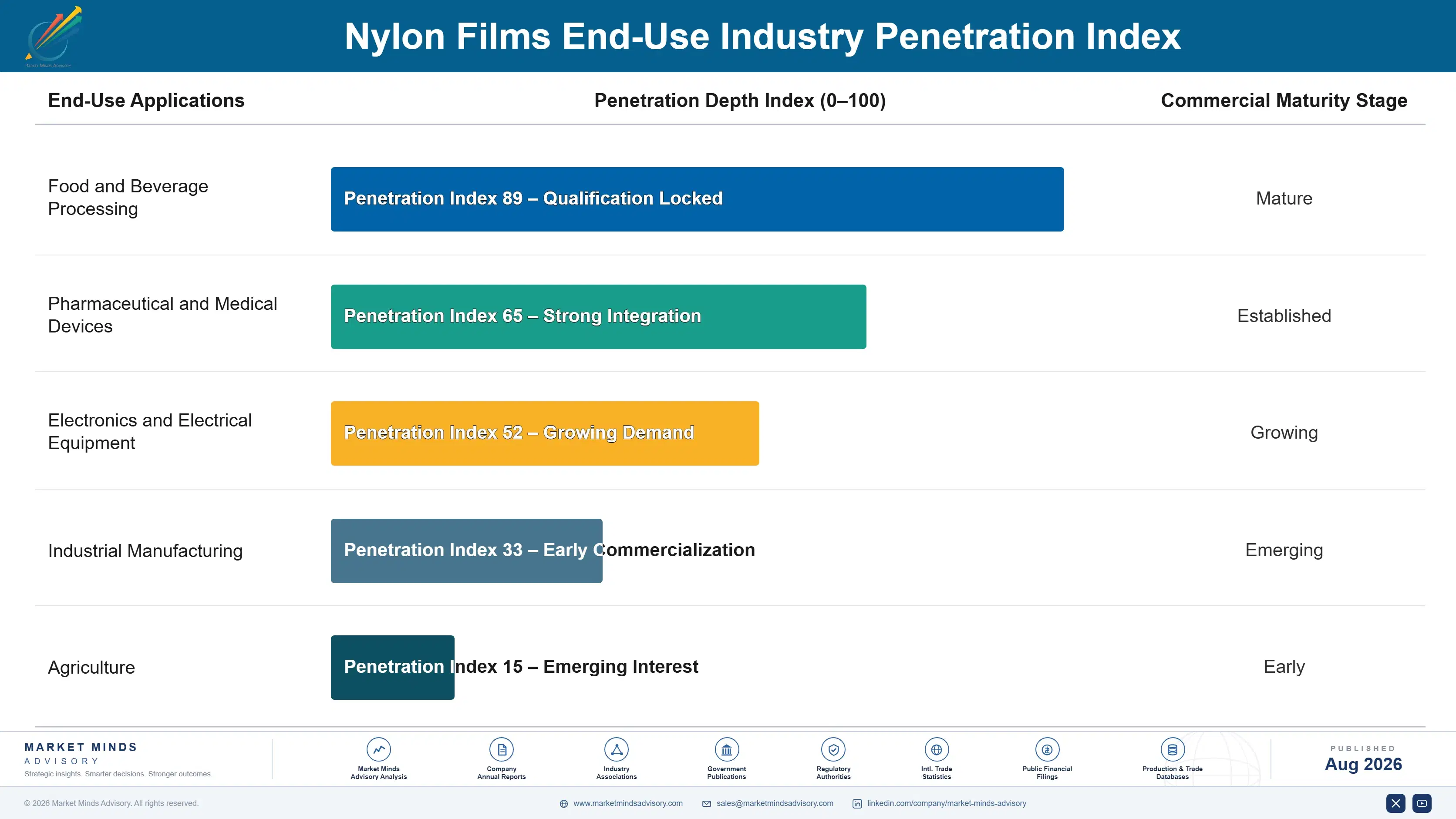
Certification Cycles and Converter Loyalty

Demand here runs on multi-year supply contracts for both medical packaging buyers and large food converters, since both require certified, consistent barrier performance validated well before production begins at scale. Contract renewal typically follows product line or sterile packaging validation cycles spanning several years rather than the annual transactional purchasing common in commodity film sales. Missing a renewal window can cost a producer years of relationship-building effort to win the account back.
Adoption depth varies sharply by end-use vertical. Medical and pharmaceutical buyers show the strongest supplier loyalty given regulatory requalification cost once a certified relationship is established, while standard food-packaging converters switch relatively freely based on price and delivery lead time alone. Electrical and electronics buyers sit closer to medical buyers, valuing certified dielectric consistency over transactional pricing.

Buyer profiles have shifted generationally as sustainability procurement moved from a compliance checkbox toward a genuine board-level priority across most major food and consumer brands. Younger packaging engineers now weigh recyclability and certification depth alongside cost and performance, a shift that favours producers with credible mono-material development over those competing purely on barrier specification alone. That shift now shapes procurement scorecards as much as it shapes technical specification sheets.
nylon-films-market-end-use-penetration-index-1787559100858

Where Certification and Recyclability Decide Outcomes

These are among the four positions where our research anticipates prominent divergence between winners and laggards over the coming forecast period. Each is grounded in the demand model, the regulatory perimeter, and the announced capacity pipeline.
01 / RECYCLABILITY TRANSITION RISK

Early mono-material investment will separate winners from legacy multi-layer producers

Producers investing in recyclable mono-material nylon structures now, ahead of tightening European extended producer responsibility deadlines, are already securing pilot programme relationships with major food brands that later entrants will find considerably harder to win once mono-material specifications become standard. This shift stems from a genuine technical barrier packaging science has not yet fully resolved, meaning early movers who solve it first capture durable brand-owner loyalty. Expect continued consolidation toward producers who committed to mono-material development years ahead of the mandate becoming binding.
02 / MEDICAL PACKAGING CERTIFICATION RACE

Early validation investment will outcompete late compliance scrambles

Medical and pharmaceutical packaging buyers demand the strictest sterile barrier validation in the entire market, and that requirement leaves little room for producers who delay building dedicated certification capability until demand is already fully proven. Certified capacity remains genuinely scarce today relative to the segment's 8.2% growth rate, sustaining real premiums for early movers who invested ahead of the requirement, and buyers rarely switch once a validated relationship is established. Producers building this capability now capture premium pricing well before broader industry investment eventually compresses that advantage.
03 / FEEDSTOCK INTEGRATION ADVANTAGE

Integrated producers will keep outcompeting merchant film sellers

Integrated polymer majors with captive caprolactam feedstock supply absorbed the 2022 benzene shock with considerably less margin damage than non-integrated merchant producers buying resin on spot terms, and that advantage persists through every subsequent feedstock price cycle. Non-integrated producers without long-term feedstock contracts face a widening cost disadvantage that pure operational efficiency cannot fully offset, and this gap compounds further whenever regional currencies or petrochemical benchmarks move unexpectedly. Expect continued consolidation toward integrated producers or those securing comparable long-term feedstock pricing certainty.
04 / ASIAN MEDICAL CAPACITY GROWTH

Indian and Chinese generic manufacturing will keep driving film demand

India and China's expanding generic pharmaceutical manufacturing capacity is the single largest driver of medical-grade nylon film demand growth, and that expansion shows no sign of slowing given continued export market demand for lower-cost generic drugs. Producers building regional certification and manufacturing capability directly in these markets will capture demand growth that exporting from distant Western facilities cannot serve as efficiently, and producers without regional presence will find this growth hard to capture remotely. Expect continued capacity investment concentrating specifically in India and China as pharmaceutical manufacturing keeps expanding.

Engagement Snapshot From the Field

A live engagement with an industry participant carrying material or product regulatory and market exposure ahead of a defining policy shift, showing how our research translates into a defensible multi-year portfolio strategy.
MARKET MINDS ADVISORY · CLIENT ENGAGEMENT SUMMARY
Nylon Films Producer Strategic Portfolio Review and Transition Roadmap 2026·Investment Scenario on Nylon Films Exposure Evaluation 2025-26
CLIENT PROFILE
A mid-sized food packaging converter supplying vacuum-packaged meat and cheese products to retailers across the United Kingdom and Germany approached MMA while facing tightening European recyclability compliance deadlines. The client reported annual nylon film purchasing volume near USD 45 million, with its entire product line built on multi-layer, non-recyclable barrier structures (client-reported, unverified by MMA).
STRATEGIC CHALLENGE
Management needed to transition toward recyclable packaging structures ahead of binding European deadlines while maintaining the barrier performance retailers required for food safety and shelf life. The commercial team wanted to switch suppliers quickly to a mono-material option, while the quality function worried that available alternatives had not yet proven equivalent barrier performance across the client's existing product range.
MMA APPROACH
MMA benchmarked available mono-material nylon structures against the client's specific barrier and shelf-life requirements across its meat and cheese product lines, then modelled the compliance timeline and cost of a phased transition versus an immediate full switch. We also assessed which of the client's product lines could tolerate current mono-material performance limitations without compromising food safety.
KEY FINDINGS
  1. Roughly 55% of the client's product lines could transition to currently available mono-material structures without any measurable shelf-life reduction, a larger share than management had assumed (client-reported, unverified by MMA).
  2. The remaining product lines required either a longer barrier development timeline or continued reliance on multi-layer structures until suppliers closed the performance gap.
  3. A phased transition prioritising the readiest product lines first met compliance deadlines for the majority of volume without risking food safety on the more demanding lines.
  4. Two qualified suppliers offered materially different mono-material formulations, giving the client genuine negotiating leverage on pricing. over its previous single-supplier arrangement, improving overall commercial terms considerably.
CLIENT PROFILE
A mid-sized food packaging converter supplying vacuum-packaged meat and cheese products to retailers across the United Kingdom and Germany approached MMA while facing tightening European recyclability compliance deadlines. The client reported annual nylon film purchasing volume near USD 45 million, with its entire product line built on multi-layer, non-recyclable barrier structures (client-reported, unverified by MMA).
STRATEGIC CHALLENGE
Management needed to transition toward recyclable packaging structures ahead of binding European deadlines while maintaining the barrier performance retailers required for food safety and shelf life. The commercial team wanted to switch suppliers quickly to a mono-material option, while the quality function worried that available alternatives had not yet proven equivalent barrier performance across the client's existing product range.
MMA APPROACH
MMA benchmarked available mono-material nylon structures against the client's specific barrier and shelf-life requirements across its meat and cheese product lines, then modelled the compliance timeline and cost of a phased transition versus an immediate full switch. We also assessed which of the client's product lines could tolerate current mono-material performance limitations without compromising food safety.
KEY FINDINGS
  1. Roughly 55% of the client's product lines could transition to currently available mono-material structures without any measurable shelf-life reduction, a larger share than management had assumed (client-reported, unverified by MMA).
  2. The remaining product lines required either a longer barrier development timeline or continued reliance on multi-layer structures until suppliers closed the performance gap.
  3. A phased transition prioritising the readiest product lines first met compliance deadlines for the majority of volume without risking food safety on the more demanding lines.
  4. Two qualified suppliers offered materially different mono-material formulations, giving the client genuine negotiating leverage on pricing. over its previous single-supplier arrangement, improving overall commercial terms considerably.
RECOMMENDED STRATEGY
Phase 1: Phase 1 (0 to 6 months): Transition the 55% of product lines suited to currently available mono-material structures immediately. Begin compliance documentation immediately. Phase 2: Phase 2 (6 to 18 months): Work with suppliers on barrier development for the remaining demanding product lines specifically. Track progress against quarterly milestones. Phase 3: Phase 3 (18 to 36 months): Complete the transition once barrier performance closes the gap for all remaining product lines.
OUTCOME
The client completed its phased transition on schedule, meeting compliance deadlines for the majority of its volume well ahead of the binding date. The phased approach also secured a reported three-year supply agreement worth USD 18 million with its primary mono-material supplier (client-reported, unverified by MMA).

Frequently Asked Questions

Foundational context covering the market sizes, CAGR, scope, country, region and competition that inform every finding below. This section is provided to cover basics and most often pre-purchase conversations, answered from the MMA Primary Research Dataset.

What is the current size of the Nylon Films Market?

The nylon films market reached USD 2.9 billion in 2025. This figure covers food, medical, industrial, and electrical nylon film sales globally across every application.

How large will the Nylon Films Market be by 2036?

The market is projected to reach USD 5.40 billion by 2036 under the base case scenario. That represents a 1.76 times expansion over the 2026 starting value.

What is the CAGR for the Nylon Films Market 2026 to 2036?

The base case CAGR is 5.8%, with a bull case of 7.0% and a bear case of 4.6%. Medical packaging growth and recyclability regulation drive most of the variance.

Which segment is growing fastest?

Medical and pharmaceutical packaging films grow fastest at 8.2% CAGR, about 1.41 times the overall market rate. Expanding generic drug manufacturing across India and China drives this growth directly.

Who are the major companies in the Nylon Films Market?

Leading producers include Amcor plc, Honeywell International, Toray Industries, Kolon Industries, and Klöckner Pentaplast. These five together hold roughly 40% of combined global market share.

Which country is growing fastest?

India posts the fastest national growth at 8.8% CAGR, driven by rapidly expanding generic pharmaceutical manufacturing capacity. Rising medical packaging validation demand anchors most of this growth.

Report Segmentation Architecture

The full report scope spans multiple orthogonal segmentation dimensions, with cross-tabulated demand data provided for each dimension pair. Coverage extends further to regional breakdowns, trend trajectories, and the competitive detail needed to support segment-level decision-making.

By Application

  • Food Packaging Films
  • Medical and Pharmaceutical Packaging Films
  • Industrial Lamination Films
  • Cook-In and Retort Packaging Films
  • Electrical and Electronics Insulation Films
  • Agricultural and Specialty Films

By End-Use Industry

  • Food and Beverage Processing
  • Pharmaceutical and Medical Devices
  • Electronics and Electrical Equipment
  • Industrial Manufacturing
  • Agriculture

By Commercial Dimension

  • Direct Producer Supply
  • Converter and Distributor Channel
  • Long-Term Contract Sales
  • Spot Market Sales

By Region

  • North America
  • Western Europe
  • East Asia
  • South Asia and Pacific
  • Latin America
  • Middle East and Africa
  • Eastern Europe

Scope, Methodology, and Coverage

Every figure in this report is reproducible from documented input assumptions. The scope below maps the historical period, the forecast horizon, the segmentation dimensions, and the countries covered, alongside the underlying primary and qualitative methodology.
Historical Period
2020 to 2025
Forecast Period
2026 to 2036
Base Year
2025 (USD billions; MMA Primary Research Dataset, August 2026)
Market Definition
This market comprises nylon (polyamide) film produced through cast or biaxial orientation processes, sold into food, medical, pharmaceutical, industrial lamination, and electrical insulation packaging applications. Nylon fiber, resin sold for non-film applications, and rigid nylon molded parts are excluded from this scope.
Quantitative Units
USD billions (current prices); metric tonnes of film volume where applicable
Segmentation Dimensions
By Application; By End-Use Industry; By Commercial Dimension; By Region
Regions Covered
North America, Western Europe, East Asia, South Asia and Pacific, Latin America, Middle East and Africa, Eastern Europe
Countries Covered
USA, China, Germany, France, UK, Japan, South Korea, India, Australia, Canada, Brazil, Mexico, Indonesia, Vietnam, Thailand, Malaysia, UAE, Saudi Arabia, South Africa, Nigeria, Turkey, Poland, Netherlands, Italy, Spain, Sweden, Switzerland, Argentina, Colombia, Singapore, and additional markets relevant to this sector
Key Companies Profiled
Amcor plc, Honeywell International, Toray Industries, Kolon Industries, Klöckner Pentaplast, Taghleef Industries, Jindal Poly Films, Cosmo Films, Uflex Ltd, Winpak Ltd, Coveris Holdings, Bonset America, DuPont de Nemours, Mitsubishi Polyester Film, Toyobo Co Ltd, Hyosung Corporation, Weifang Bomei Plastic, Zhejiang Kaiying New Material, Kuraray Co Ltd, Gunze Limited
Quantitative Methodology
Primary survey, n=3,800 respondents, Q4 2025, six countries; demand-side model with trade association cross-validation
Qualitative Methodology
47 expert interviews, Q4 2025; applied to validate demand model assumptions, identify emerging dynamics, and assess competitive positioning
Report Format
PDF and XLSX data workbook (Word format preview document)
Publisher
Market Minds Advisory
Report Code
MMA-2026-PAC-104
Published
August 2026
Contact
sales@marketmindsadvisory.com | www.marketmindsadvisory.com

Purchase the full Nylon Films Market Report (2026 to 2036).

The full MMA Nylon Films report sizes the market across six application segments, five end-use industries, four commercial channels, and seven regions through 2036. It profiles twenty producers on a consistent basis of nylon film sales revenue, scoring each on medical certification depth, mono-material readiness, and feedstock integration. Scenario models quantify how recyclability regulation, medical packaging expansion, and caprolactam price volatility move both demand and realised pricing. The report also includes delivered-cost modelling by feedstock base, a recyclability compliance exposure screen, and medical packaging segment economics built for procurement, strategy, and investment teams.
Six-segment global application demand breakdown detail
Feedstock delivered-cost bridge modelling review detail
Recyclability compliance exposure screening framework detail
Producer certification depth benchmarking review detail
Medical packaging segment economics deep detail
Regional trade flow corridor mapping review

Built For The People Who Decide

From boardroom strategy to bench-side execution, this report is read cover-to-cover by leaders shaping the next decade of their industry, turning demand scenarios, market dynamics and valuation benchmarks into decisions.
CXOs/ Presidents/ VPs/ Managers
M&A and Corporate Development
Strategy Teams and R&D Heads
Procurement and Product Directors
Regulatory and Compliance Leaders
Investor Relations and Equity Analysts