Market Minds Advisory
Nylon-6 and Nylon-66 Market

Nylon-6 and Nylon-66 Market: The dismantled intermediate bottleneck, permanent substitution and depolymerisation advantage to 2036

The intermediate bottleneck that governed one of these polymers for fifty years is being taken apart, and it is happening after the customers who left during the shortages already found somewhere else to go.

Lead Analyst

Bilal Shaikh

Published

September 2026

Make Smarter Decisions with Customized Research Insights

Request a free sample report and evaluate market opportunities, growth trends, and competitive dynamics relevant to your business needs.

2025 MARKET VALUE$33.6BMarket Size 2025
2036 FORECAST VALUE$58.7BBase Case , 2026 to 2036
CAGR 2026 TO 20365.2 %Bull 6.4% / Bear 4.0%
INCREMENTAL OPPORTUNITY$23.3BNet 10- year value creation
EXPANSION MULTIPLE1.66x2036 value over 2026 base
Strategic Levers
M&A Pipeline
Regional Outlook
Country Rankings
Competitive Intelligence
Segmental Deep-dive
Call-Us : 91 93563 13602

Executive Snapshot and Market Trajectory

Nine companies worldwide can make adiponitrile, and that bottleneck long decided what nylon 66 cost and who could buy it. Chinese capacity is dismantling it now. The polymer is becoming an ordinary engineering material priced on properties. Scarcity is no longer the story. Fifty years of that arithmetic is ending.
The awkward part is timing. Roughly 18% of the volume that left during the shortage years went to nylon 6, high-temperature polyamides and other polymers, and it has not returned, because requalifying a moulded part costs far more than the material saving justifies. Supply security arrives after the demand it would have protected has gone elsewhere permanently. Capacity now arriving serves a market that quietly shrank.
Recycled and bio-based grades grow at 7.8%, half again the market rate of 5.2%, and the chemistry favours one polymer decisively. Nylon 6 depolymerises back to caprolactam at around 94% monomer yield. Nylon 66 cannot. East Asia holds 44% of value, with 46% of world polymerisation capacity sitting in a single country. That is the first advantage nylon 6 has held on anything but price. Recycled content rules make that a purchasing criterion.
Market Definition
This report covers nylon 6 and nylon 66 supplied as polymer for resin and fibre applications, spanning automotive and transport components, textile and apparel fibre, carpet and floorcovering fibre, electrical and electronic components, engineering plastics and industrial uses, and recycled and bio-based grades. Value is measured at polymer producer level on tonnage supplied across both resin and fibre forms. Excluded are caprolactam, adipic acid and adiponitrile sold as intermediates, other polyamides including nylon 11, 12 and high-temperature grades, compounded masterbatch sold separately, and finished textiles or moulded parts.
Base Year Value
$33.6B in 2025 (MMA Primary Research Dataset, August 2026)
Forecast Period
2026 to 2036, eleven discrete annual values
CAGR
5.2% base case. Bull 6.4%. Bear 4.0%.
Fastest Growth Segment
Recycled and Bio-Based Grades: 7.8% CAGR
Fastest Growth Country
India: 8.2% CAGR
Fastest Growth Region
South Asia and Pacific: 7.2% CAGR
Largest Region
East Asia: 44% of 2025 global value
Market Leaders
BASF, Ascend Performance Materials, Invista, Domo Chemicals and Highsun Holding lead the market. Source: MMA Primary Research Dataset, July 2026.
Primary Survey
n=3,800 procurement and R&D decision-makers, Q4 2025, six countries
Methodology
Demand-side build-up, cross-validated against public data, 47 expert interviews

Nylon-6 and Nylon-66 Market Forecast Scenarios

nylon-6-and-nylon-66-market-trends-size-forecast-scenario-1787559339744
Growth ran at 3.9% between 2020 and 2025 and the two polymers behaved quite differently inside that number. Nylon 6 expanded steadily on Chinese caprolactam capacity and textile demand. Nylon 66 spent the period recovering from shortages that had already pushed automotive customers into requalifying parts, and carpet fibre volumes kept eroding against polyester across North American flooring throughout.
The 5.2% base case rests on three mechanisms. Recycled and bio-based grades at 7.8% as automotive and textile recycled content requirements arrive and depolymerisation capacity is built. Electrical and electronic components at 6.8% on connector, busbar and battery module demand. And Indian growth at 8.2%, the fastest of any country, on textile manufacture and automotive component production expanding at the same time. None of those three depends on winning back parts designed out during the shortages.
The 6.4% bull case is depolymerisation capacity scaling faster than expected, which would give recycled nylon 6 a cost and compliance position that virgin polymer cannot match. The 4.0% bear case is electric vehicle transition removing under-hood high-temperature applications faster than battery and motor components replace them, which hits nylon 66 hardest of all. Under-hood applications disappear where there is no combustion at all.

The Bottleneck Comes Apart

Two polymers that look similar on a datasheet have had completely different commercial lives, and the reason is a single intermediate. Nylon 66 needs hexamethylenediamine, which needs adiponitrile, and only nine companies in the world have ever made it at scale. That concentration meant any plant outage moved the entire market, and through the shortage years customers who could not get material simply designed it out. Chinese adiponitrile capacity is now dismantling that bottleneck, and the polymer is becoming an ordinary engineering material priced on what it does rather than on whether it can be obtained.
TOP-FIVE CONCENTRATION34%Combined position across supply held by the leading polymer producers
ADIPONITRILE PRODUCER COUNT9Companies worldwide able to make the critical nylon intermediate
CHINESE CAPACITY SHARE46%Portion of world polymerisation capacity located in one country
DEPOLYMERISATION YIELD94%Monomer recovered when the six polymer is chemically broken down
NITROUS OXIDE ABATEMENT RATE92%Share of adipic acid emissions destroyed at abated production sites
PERMANENT SUBSTITUTION LOSS18%Volume that left during shortage years and never returned
The problem is sequencing. Roughly 18% of the volume that left during those shortages went to nylon 6, high-temperature polyamides and other materials, and almost none has come back. Requalifying a moulded automotive part means new tooling trials, new validation and new approvals, which costs far more than any material price difference recovers. Supply security has arrived after the demand it would have protected already found somewhere else to live.
Nylon 6 meanwhile holds an advantage nobody designed for. It depolymerises back to caprolactam at around 94% monomer yield, and nylon 66 does not do anything comparable.
"The industry spent a decade obsessing over adiponitrile capacity and treating substitution as temporary. It was not temporary. Nobody requalifies a validated part to save a few cents a kilo, and the new capacity is arriving into a market that quietly got smaller while everyone was watching the supply side."
Director, Engineering Polymers and Fibre Intermediates Practice · MMA Chemicals and Materials Practice · August 2026

Market Trends

Chinese intermediate capacity dismantles a fifty year bottleneck

Adiponitrile has only ever been made at scale by nine companies worldwide, which gave nylon 66 an economics governed by intermediate availability rather than by polymer properties. Chinese capacity additions are removing that constraint, and with it the price premium and the supply anxiety that shaped purchasing for decades. Commercially this turns nylon 66 into an ordinary engineering polymer competing on stiffness, temperature performance and cost against nylon 6 and high-temperature grades. Producers whose position rested on scarcity rather than on capability face a genuinely different market from the one they knew.
Market Impact: Segment compounds at 6.8% annually

Depolymerisation gives one polymer a recycled content advantage

Nylon 6 breaks back down to caprolactam at around 94% monomer yield, which produces recycled polymer chemically identical to virgin material rather than a downgraded blend. Nylon 66 has no comparable route at commercial scale. As automotive and textile recycled content requirements arrive, that chemistry difference becomes a purchasing criterion rather than a laboratory curiosity. Commercially it is the first genuine advantage nylon 6 has held over nylon 66 on anything other than price, and recycled grades compound at 7.8% as depolymerisation capacity is built. Collection of suitable waste is the real constraint now.
Market Impact: Indian demand compounds at 8.2%

Market Opportunities and Growth Drivers

Electrical and electronic components absorb rising polyamide volume

Connectors, busbar insulation, circuit breaker housings and battery module components all need dimensional stability, flame retardancy and electrical properties that polyamides deliver at a cost engineering thermoplastics above them cannot match. Growth at 6.8% runs well above the market rate and it comes from electrification across vehicles, buildings and industry simultaneously rather than from any single programme. Grades here are heavily filled and compounded, which means the value sits closer to formulation than to base polymer, and producers without compounding capability capture considerably less of it. Compounding rather than polymerisation captures the value.
Market Impact: Lost 18% of volume permanently

Indian textile and automotive manufacture expand simultaneously

Indian growth at 8.2% leads every country in this market, driven by textile manufacture serving both domestic consumption and export demand alongside automotive component production expanding under domestic manufacturing incentives. Both consume polyamide heavily and neither depends on the other. Domestic caprolactam and polymer capacity is being added, though it lags demand and leaves the country importing substantial volume. Nylon 66 penetration is low relative to nylon 6, which reflects intermediate availability rather than any technical preference among Indian moulders. Domestic caprolactam and polymer capacity is being added but continues to lag consumption.
Market Impact: Carpet fibre grows only 1.6%

Market Restraints and Challenges

Shortage era substitution proves permanent rather than cyclical

Around 18% of the volume that left nylon 66 during the shortage years moved to nylon 6, high-temperature polyamides and other polymers, and it has not returned even as availability normalised. The root cause is that requalifying a moulded automotive part means fresh tooling trials, validation and customer approvals, at a cost no material price difference recovers. Commercially this means capacity now arriving serves a smaller market than the one that existed before. Producers are pursuing new applications rather than attempting to win back parts that were designed out. Winning those parts back is not a realistic objective.
Market Impact: Only 9 producers made adiponitrile

Electrification removes under-hood applications faster than it adds

Battery electric vehicles carry no engine, no air intake manifold and no fuel system, which eliminates a group of high-temperature under-hood applications where nylon 66 held genuine advantage. The root cause is that the property that justified the polymer, heat resistance under the bonnet, is no longer needed where there is no combustion. Commercially the battery and motor components replacing them favour different grades and often different polymers. Producers are targeting battery module housings, busbar insulation and structural components, which is real demand at different specifications. Specifications differ enough that the swap is not automatic.
Market Impact: Recovers 94% monomer yield
4 additional market trends, 3 additional growth drivers, and 2 additional restraints and challenges are covered in the full report. Contact sales@marketmindsadvisory.com to access the complete intelligence.

Segment CAGR and Growth Architecture

Volume is classified here by end application, since grade requirements, qualification depth and competitive alternatives differ enormously between a carpet fibre and a battery module housing. Polymer type, product form and supply channel are each handled separately in the framework below, because both polymers and both product forms serve most of these applications already.
nylon-6-and-nylon-66-market-trends-market-share-analysis-1787559340277

Recycled and Bio-Based Grades

Growing at 7.8%, half again the market rate, recycled and bio-based polyamide is where the chemistry of the two polymers finally produces a commercial difference. Nylon 6 depolymerises back to caprolactam at around 94% monomer yield, giving recycled polymer identical to virgin material rather than a mechanically recycled blend with degraded properties. Nylon 66 has no route that works comparably at scale. Automotive and textile recycled content requirements are converting that into a purchasing criterion, and Aquafil and others have built collection and depolymerisation around fishing nets and carpet waste. Feedstock collection rather than chemistry is now the binding constraint on how fast this can grow. Collection streams take years to organise and are already being contested.
CAGR 7.8%

Electrical and Electronic Components

Connectors, busbar insulation, circuit breaker housings and battery module components need dimensional stability, flame retardancy and electrical performance together, and polyamides deliver that combination below the cost of the engineering thermoplastics positioned above them. Growth at 6.8% comes from electrification across vehicles, buildings and industrial equipment at once rather than from any single programme. Grades are heavily filled and compounded, which places much of the value in formulation rather than in base polymer, and producers without compounding capability capture considerably less of what the application is worth to whoever supplies it. Flame retardancy and dielectric performance are certified rather than merely specified, which makes these positions durable once won and correspondingly difficult for any challenger to displace later.
CAGR 6.8%
Full segment breakdown across 6 segments available in the complete report.

Regional Architecture and Country Demand Map

East Asia holds 44% of value, far above the standard band, because 46% of world polymerisation capacity and the largest textile and automotive component base both sit there. North America and Western Europe both follow well below their usual bands, at 17% and 15% respectively.

East Asia

At 44% this region sits far above the standard band, holding 46% of world polymerisation capacity alongside the largest textile and automotive component manufacturing base anywhere. Chinese caprolactam capacity made nylon 6 abundant and cheap, and Chinese adiponitrile investment is now doing the same to nylon 66, which dismantles a bottleneck that Western producers relied on for decades. Highsun, Shenma, Hualu Hengsheng and Fujian Jinjiang hold substantial positions. Japanese producers including Toray, UBE and Asahi Kasei hold the technically demanding grades. Growth at 6.2% reflects capacity and demand expanding together. Depolymerisation capacity is being built alongside virgin polymer. Textile fibre volumes across the region dwarf every other application by a wide margin.
Share: 44% | CAGR: 6.2% (2026 to 2036)

North America

At 17% this region sits below the standard band, reflecting manufacturing that relocated over three decades and a carpet fibre business that polyester has taken decisively. Ascend and Invista hold significant adiponitrile and nylon 66 positions built around the intermediate advantage now being eroded. Automotive component demand is meaningful but exposed to electrification removing under-hood applications. Electrical and electronic demand is growing on grid and vehicle electrification. Growth at 4.2% sits below the market rate, held down by carpet fibre decline that no other application offsets. Nitrous oxide abatement on adipic acid production is comprehensive at major sites. Compounding capability among regional producers is meaningful but narrower than European equivalents.
Share: 17% | CAGR: 4.2% (2026 to 2036)
Regional intelligence for 5 additional markets available in the complete report: Western Europe, South Asia and Pacific, Latin America, Middle East and Africa, Eastern Europe. Contact sales@marketmindsadvisory.com.
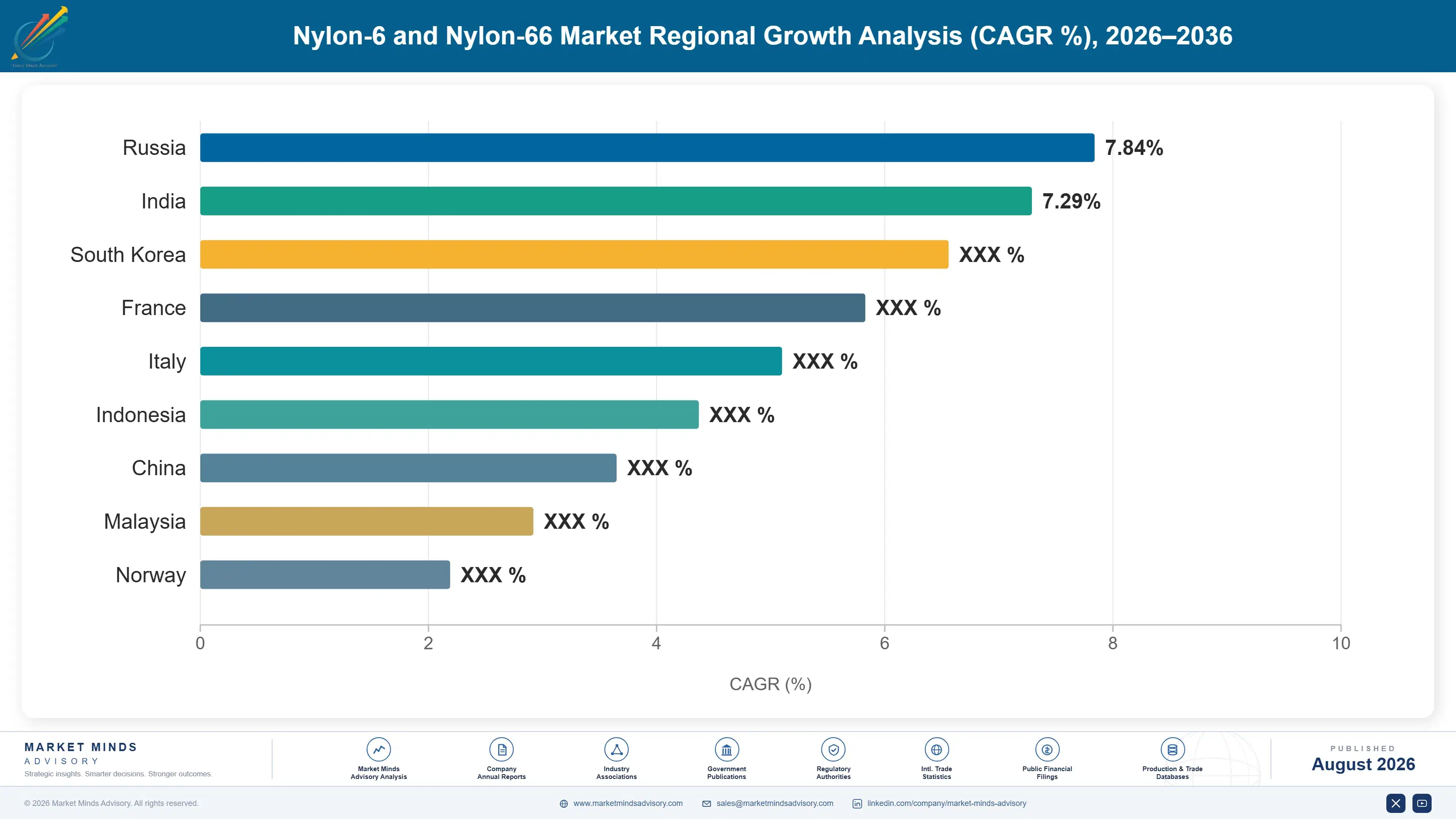
nylon-6-and-nylon-66-market-trends-country-cagr-analysis-1787559340795

Where Polyamide Value Moves Next

Four moves matter in a market where the scarcity that defined one polymer for fifty years is disappearing and the customers it drove away are not coming back. Two concern building positions that do not depend on intermediate access at all, and two concern the applications and chemistries that will still be growing in a decade.

Build depolymerisation before feedstock collection tightens

Nylon 6 returns to caprolactam at around 94% monomer yield, producing recycled polymer chemically identical to virgin rather than a degraded blend, and nylon 66 has nothing comparable at scale. Recycled content requirements are converting that into a purchasing criterion across automotive and textiles. The binding constraint is no longer chemistry but feedstock collection, since fishing nets, carpet and industrial waste have to be gathered before anything can be depolymerised. Securing collection streams early is what determines who can actually serve a segment growing at 7.8%. Building capacity ahead of secured feedstock produces an idle plant.
Market Impact: Recovers a 94% monomer yield from collected polymer

Stop chasing parts that were designed out

Roughly 18% of nylon 66 volume left during the shortage years and has not returned, because requalifying a moulded automotive part means tooling trials, validation and customer approvals costing far more than the material saving recovers. Commercial effort spent trying to win those parts back is effort not spent on applications that are actually open. Producers who accept the loss and redirect toward battery, busbar and electrical components make better use of the same sales capacity and stop losing arguments they cannot win. Arguments that cannot be won are worth abandoning early.
Market Impact: Accepts an 18% permanent loss of that volume

Capture value in compounding rather than base polymer

Electrical and electronic grades grow at 6.8% and are heavily filled and compounded, which places most of the value in formulation rather than in the polymer itself, and Chinese capacity is commoditising the base polymer at both nylon 6 and increasingly nylon 66. A producer selling unfilled pellets into a compounder captures the thinnest part of the chain. Compounding capability with flame retardant, glass filled and conductive grades captures several times the margin on the same underlying tonne. Application development capability rather than reactor investment is what the shift actually requires.
Market Impact: Serves compounded grades now growing at 6.8% yearly

Price nitrous oxide abatement as a trade advantage

Adipic acid production emits nitrous oxide and abated sites destroy roughly 92% of it, while unabated capacity elsewhere does not, which carbon border adjustment mechanisms make commercially visible rather than merely reputational. Producers with abated capacity carry a documented advantage into European sales that competitors cannot acquire quickly, since retrofitting abatement takes capital and time. Selling that as a landed cost argument rather than a sustainability claim is what converts it into actual price realisation. Retrofitting abatement takes both capital and time, so the advantage persists for several years rather than being competed away quickly.
Market Impact: Documents a 92% abatement of nitrous oxide emissions

Who Controls the Margin Pool

Five producers hold 34% of this market, measured on tonnage of polymer supplied across resin and fibre, the basis used throughout this section. Concentration is modest and falling, because Chinese capacity in both caprolactam and now adiponitrile has removed the intermediate access that previously restricted who could participate in nylon 66 at all. The barrier that made this an oligopoly is being dismantled from outside it.
Competition runs on four dimensions. Compounding capability, since filled and flame retardant grades hold the value as base polymer commoditises under Chinese capacity. Recycling and depolymerisation position, which nylon 6 producers can build and nylon 66 producers largely cannot at any scale. Automotive qualification depth across existing vehicle platforms. And emissions abatement status, which carbon border mechanisms are steadily making commercially visible.

Rankings shift toward producers with compounding and depolymerisation, and away from those whose position rested principally on intermediate access rather than on capability. Chinese producers now hold cost and capacity across both polymers rather than only nylon 6. European producers hold specialty grades alongside the toughest recycled content requirements anywhere. Japanese producers hold the most technically demanding applications.
nylon-6-and-nylon-66-market-trends-company-positioning-matrix-1787559341314

Competitive Moat and Risk Dimensions

BASF

Moat: Compounding breadth and specialty grades

The company holds deep compounding capability across filled, flame retardant and specialty polyamide grades, which is where value concentrates as base polymer commoditises under Chinese capacity expansion. Automotive qualification depth across European and global vehicle platforms takes years to replicate, and those approvals travel with the part rather than being renegotiated at every contract.
BASF

Risk: European cost and capacity base

Western European polymer capacity carries energy costs that Asian producers do not, and the region grows at 3.6%, the slowest on this table. Chinese producers now hold cost positions in both polymers rather than only nylon 6. Depolymerisation and recycled grades offer a route above that competition, but building collection infrastructure is slow and capital intensive.
ASCEND PERFORMANCE MATERIALS

Moat: Integrated nylon 66 chain

Integration across adiponitrile, hexamethylenediamine, adipic acid and polymer gives the company control of a chain that very few participants have ever assembled, supporting supply commitments through disruptions that broke merchant buyers. Compounding and specialty grade capability adds value above the base polymer where Chinese competition is sharpest.
ASCEND PERFORMANCE MATERIALS

Risk: Intermediate advantage being eroded

The adiponitrile position that underpinned nylon 66 economics for decades is losing its scarcity value as Chinese capacity arrives, and around 18% of the volume that left during shortages will not return. Nylon 66 also lacks the depolymerisation route that gives nylon 6 a recycled content advantage as those requirements tighten across automotive and textiles.

Players Tracked

Prominent Players

BASF
Ascend Performance Materials
Invista
Domo Chemicals
Highsun Holding

Other Key Players

LANXESS
DuPont
Toray Industries
UBE Corporation
Asahi Kasei
Shenma Industrial
Hualu Hengsheng
Fujian Jinjiang Technology
Aquafil
RadiciGroup
Formosa Chemicals and Fibre
Kingfa Science and Technology
Syensqo
Grupa Azoty
Zhejiang Hengyi

Recent Developments

MARCH 2025

A Chinese producer commissioned further adiponitrile capacity

A Chinese chemical producer commissioned additional adiponitrile capacity feeding domestic hexamethylenediamine and nylon 66 polymerisation, continuing the removal of an intermediate bottleneck that had constrained the polymer worldwide for decades. This was organic capital investment rather than any acquisition or joint venture. Downstream polymer capacity followed it.
Signal: Intermediate scarcity is disappearing as a competitive factor, which changes what nylon 66 producers are actually selling
JULY 2025

A recycler expanded caprolactam depolymerisation capacity

A polyamide recycler expanded chemical depolymerisation capacity converting collected nylon 6 waste back to caprolactam, citing automotive and textile recycled content commitments as the demand driver behind the investment. This was organic capital investment rather than any partnership or acquisition arrangement. Collected feedstock had been contracted first.
Signal: Feedstock collection rather than depolymerisation chemistry is now the binding constraint on recycled polyamide growth anywhere
NOVEMBER 2025

A vehicle manufacturer set polyamide recycled content requirements

A European vehicle manufacturer specified minimum recycled content for polyamide components across future platforms, with documentation traceable to the recycling route used. This was a procurement specification rather than any commercial transaction between polymer producers or their compounding partners. Suppliers were asked to document the recycling route used.
Signal: Recycled content specification favours the polymer that depolymerises cleanly, which is a chemistry difference becoming commercial

What Governs Polymer Cost

For nylon 6 caprolactam accounts for roughly 72% of polymer cost and follows benzene and cyclohexane through petrochemical markets. For nylon 66 adipic acid and hexamethylenediamine together take around 76%, with the diamine carrying adiponitrile economics behind it. Polymerisation energy adds about 9% for both. Conversion margin on unfilled polymer is thin, which is precisely why compounding matters so much to producer returns.
Benzene and cyclohexane costs moved sharply through 2022 as crude followed geopolitical disruption, while European industrial energy prices climbed far above Asian levels, with IEA data showing that gap persisting well beyond the immediate shock. BASF noted raw material and energy cost pressure across its materials operations in its Annual Report 2022. Several European polymerisation lines closed permanently rather than continue operating at those energy costs.

The disadvantage now falls on Western producers without compounding depth, and it operates through product mix rather than through unit cost. Chinese capacity has commoditised base polymer in both chemistries, so an unfilled pellet competes on delivered cost against a producer with cheaper feedstock and energy. Compounded, filled and specialty grades escape that comparison. A producer selling mostly base polymer from a high cost region has no answer.
nylon-6-and-nylon-66-market-trends-cost-volatility-analysis-1787559341509

Shift mix toward filled and flame retardant compounded grades

Base polymer competes on delivered cost against Chinese capacity with cheaper feedstock and energy, and no operating improvement closes that gap. Compounded grades sell on formulation performance rather than on tonnage, capturing several times the margin from the same underlying polymer. The shift needs application development capability rather than any production investment. Technical service organisations make the shift easier.

Secure recycled feedstock collection ahead of depolymerisation capacity

Nylon 6 depolymerisation recovers around 94% monomer yield, but only from waste that somebody has already collected and sorted. Fishing nets, carpet and industrial waste streams are contested and take years to organise. Building capacity ahead of secured feedstock produces an idle plant, and several participants have discovered exactly that. Contested streams get committed quickly once buyers appear.

Index polymer contracts to published intermediate benchmarks

Caprolactam at 72% of nylon 6 cost and adipic acid with diamine at 76% of nylon 66 cost leave conversion margin far too thin to absorb petrochemical swings. Annual fixed pricing transfers all of it to the producer. Quarterly indexed reset against published benchmarks removes that exposure and customers accept it where the mechanism is transparent.

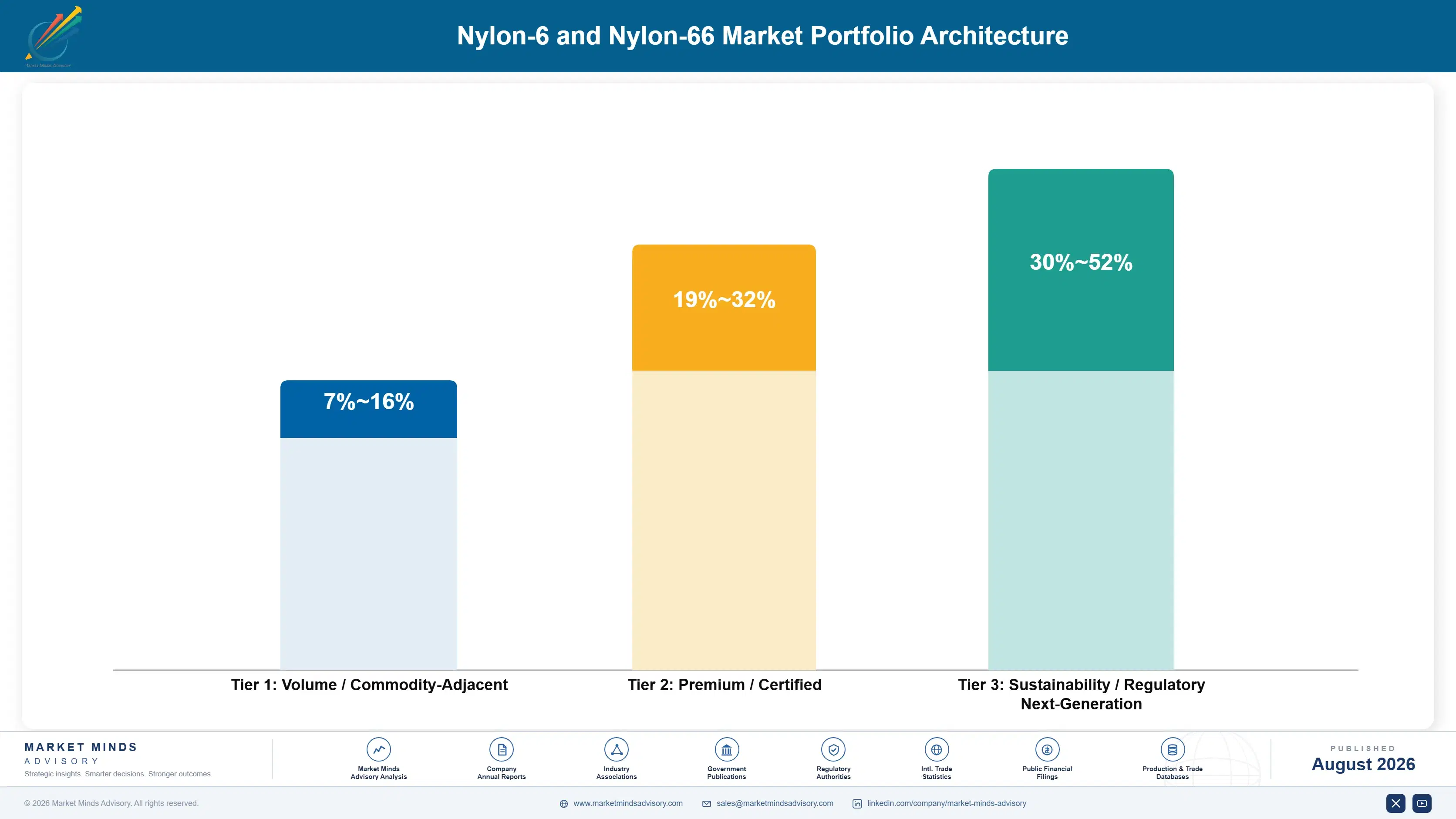
Portfolio Architecture for Margin Defence

Margin separates on compounding and recycled position rather than on polymerisation scale, which reverses how this industry has historically thought about itself. Unfilled base polymer runs at gross margins in the high single digits against Chinese capacity with cheaper feedstock and energy. Textile and carpet fibre grades run modestly better where quality consistency matters. Filled, flame retardant and electrical grades run considerably higher on formulation content. Depolymerised recycled grades run highest of all where content requirements apply.
The tension is that base polymer fills the polymerisation lines while compounded and recycled grades earn the returns, and moving toward them needs application development and collection infrastructure rather than any reactor investment. Producers weighted toward base polymer in high cost regions face arithmetic that does not improve. Several have spent a decade defending tonnage that was never defensible while under-investing in the mix that was.

High-value pools sit in compounded electrical grades, depolymerised recycled polymer and abated production serving carbon-adjusted markets. Unfilled base polymer is where Chinese capacity has already settled the question. Defending tonnage there consumed a decade of attention that the mix question needed instead.

Volume / Commodity-Adjacent

Unfilled base polymer and standard fibre grades sold on delivered cost against capacity with cheaper feedstock and energy. The nine-point range separates producers with intermediate integration and low energy cost from merchant buyers in expensive regions.
Gross Margin: 7%-16%

Premium / Certified

Glass filled, impact modified and technically specified grades where mechanical performance and consistency are validated by the customer. The thirteen-point spread reflects compounding capability and application development rather than any polymerisation advantage.
Gross Margin: 19%-32%

Sustainability / Regulatory / Next-Generation

Depolymerised recycled grades, flame retardant electrical compounds and abated production sold into carbon-adjusted markets. The twenty-two-point range is wide because feedstock security, certification depth and application qualification vary enormously between programmes.
Gross Margin: 30%-52%
nylon-6-and-nylon-66-market-trends-portfolio-architecture-1787559342006

High-value Sub-segments and Strategic Watch-out

Depolymerised Recycled Grades

Compounding at 7.8% on a 94% monomer yield that gives recycled polymer identical to virgin material. Feedstock collection rather than chemistry is the binding constraint, and collection streams take years to organise properly. Two competitors are already contracting the available regional streams. Chemistry is not the barrier.
Gross Margin: 32%-52%

Electrical Compounded Grades

Growing at 6.8% on connector, busbar and battery module demand across vehicles, buildings and industry. Value sits in flame retardant and filled formulation rather than in the base polymer underneath it. Certification makes these positions unusually durable once they are actually won. Base polymer earns far less.
Gross Margin: 28%-44%

Abated Production Supply

Adipic acid nitrous oxide abatement runs near 92% at abated sites and nowhere near it elsewhere, which carbon border mechanisms make a landed cost difference rather than a reputational claim. Retrofitting abatement takes real capital and several years to complete properly. Documentation makes it billable.
Gross Margin: 22%-38%

Unfilled Base Polymer

The reactor volume, competed on delivered cost against Chinese capacity in both chemistries now. Manage this for feedstock integration and energy cost rather than for any margin recovery that will not arrive. Cheaper feedstock and lower energy cost decide this tier entirely. No operating change closes it.
Gross Margin: 7%-16%

How Polyamide Demand Renews

Demand renews per part and per garment, which makes this an annuity attached to somebody else's production programme rather than a business with its own order cycle. A qualified automotive component consumes polymer at every build for the life of the platform, typically six to eight years, with no purchasing decision made in between. Qualification therefore matters more than pricing, and volume lost during shortages was lost for a platform generation.
Stickiness varies sharply by vertical and follows requalification cost. An automotive part validated on a specific grade cannot change material without tooling trials and fresh approvals, which makes those positions extremely durable and their loss correspondingly permanent. Electrical components sit similarly, since flame retardancy and dielectric performance are certified. Textile and carpet fibre buyers switch on price and availability at every contract with almost no friction at all.

The buyer has broadened from materials engineering toward sustainability and procurement together. Polymer selection was an engineering decision about mechanical properties and cost per part. Recycled content requirements have brought in people who ask about the recycling route and want documentation, and who will accept a material change that an engineer would not have initiated.
nylon-6-and-nylon-66-market-trends-end-use-penetration-index-1787559342495

Where To Place The Bet

These are among the four positions where our research anticipates prominent divergence between winners and laggards over the coming forecast period. Each is grounded in the demand model, the regulatory perimeter, and the announced capacity pipeline.
01 / DEPOLYMERISATION FEEDSTOCK SECURITY

Secure the waste stream before building the plant

Nylon 6 returns to caprolactam at around 94% monomer yield, producing recycled polymer chemically identical to virgin material rather than a mechanically degraded blend, and nylon 66 offers nothing comparable at any commercial scale today. Recycled content requirements across automotive and textiles are converting that chemistry difference into an actual purchasing criterion. The binding constraint has shifted from the reaction to feedstock collection, since fishing nets, carpet and industrial waste must be gathered and sorted before any of it can be depolymerised at all.
02 / SUBSTITUTION LOSS ACCEPTANCE

Redirect effort away from parts already designed out

Roughly 18% of nylon 66 volume departed during the shortage years and has not come back, because requalifying a moulded automotive component means fresh tooling trials, validation runs and customer approvals costing far more than any material price difference could ever recover for the buyer. Commercial effort spent attempting to reclaim those parts is effort not spent on applications that remain genuinely open. Producers who accept the loss and redirect toward battery, busbar and electrical components use the same sales capacity far better.
03 / COMPOUNDING VALUE CAPTURE

Sell formulation, because pellets have been commoditised

Electrical and electronic grades compound at 6.8% and are heavily filled and flame retarded, which places the majority of realised value in formulation rather than in the underlying polymer, while Chinese capacity has commoditised base material across both chemistries rather than just nylon 6. A producer selling unfilled pellets into somebody else's compounding operation captures the thinnest slice of the entire chain. Compounding capability earns several times that margin from exactly the same underlying tonne of polymer leaving the reactor.
04 / ABATEMENT TRADE POSITIONING

Sell emissions abatement as landed cost advantage

Adipic acid manufacture emits nitrous oxide and abated production sites destroy roughly 92% of it while unabated capacity elsewhere destroys very little, which carbon border adjustment mechanisms are steadily converting from a reputational matter into a measurable cost difference at the border. Producers holding abated capacity carry a documented advantage into European sales that competitors cannot acquire quickly, because retrofitting abatement takes both capital and time. Selling it as a landed cost argument rather than as a sustainability claim is what actually realises the price.

Engagement Snapshot From the Field

A live engagement with an industry participant carrying material or product regulatory and market exposure ahead of a defining policy shift, showing how our research translates into a defensible multi-year portfolio strategy.
MARKET MINDS ADVISORY · CLIENT ENGAGEMENT SUMMARY
Nylon-6 and Nylon-66 Producer Strategic Portfolio Review and Transition Roadmap 2026·Investment Scenario on Nylon-6 and Nylon-66 Exposure Evaluation 2025-26
CLIENT PROFILE
A European nylon 6 and nylon 66 producer with polymerisation capacity around 210,000 tonnes annually (client-reported, unverified by MMA), supplying automotive, textile and industrial customers across Europe. Compounding capability was limited to a narrow filled grade range. No depolymerisation position existed. Base polymer represented most of the volume shipped. Margins had compressed for four years.
STRATEGIC CHALLENGE
Base polymer margins had compressed for four years against Asian imports and management proposed a debottleneck to defend share on unit cost. Nobody had asked whether base polymer from a European site could be defended at all, or where the value in this market had actually moved. The mix question went unexamined.
MMA APPROACH
MMA compared realised margin by grade across the client's shipments rather than by customer or region, then benchmarked compounded grade pricing against the unfilled polymer feeding it. Depolymerisation feedstock availability across regional collection streams was assessed separately. Recycled content requirements in the existing automotive customer base were mapped against announced platform dates.
KEY FINDINGS
  1. Unfilled base polymer accounted for most volume and almost none of the gross margin, with compounded grades earning several times more from the identical underlying polymer.
  2. Three automotive customers had published recycled content requirements the client could not meet, covering platforms scheduled inside the debottleneck payback period being proposed.
  3. Regional nylon 6 collection feedstock was being contracted by two competitors already, and the volumes remaining would not support the depolymerisation scale needed for viability.
  4. The proposed debottleneck would have added base polymer capacity into the one product tier where the client had no defensible cost position at all against imports.
CLIENT PROFILE
A European nylon 6 and nylon 66 producer with polymerisation capacity around 210,000 tonnes annually (client-reported, unverified by MMA), supplying automotive, textile and industrial customers across Europe. Compounding capability was limited to a narrow filled grade range. No depolymerisation position existed. Base polymer represented most of the volume shipped. Margins had compressed for four years.
STRATEGIC CHALLENGE
Base polymer margins had compressed for four years against Asian imports and management proposed a debottleneck to defend share on unit cost. Nobody had asked whether base polymer from a European site could be defended at all, or where the value in this market had actually moved. The mix question went unexamined.
MMA APPROACH
MMA compared realised margin by grade across the client's shipments rather than by customer or region, then benchmarked compounded grade pricing against the unfilled polymer feeding it. Depolymerisation feedstock availability across regional collection streams was assessed separately. Recycled content requirements in the existing automotive customer base were mapped against announced platform dates.
KEY FINDINGS
  1. Unfilled base polymer accounted for most volume and almost none of the gross margin, with compounded grades earning several times more from the identical underlying polymer.
  2. Three automotive customers had published recycled content requirements the client could not meet, covering platforms scheduled inside the debottleneck payback period being proposed.
  3. Regional nylon 6 collection feedstock was being contracted by two competitors already, and the volumes remaining would not support the depolymerisation scale needed for viability.
  4. The proposed debottleneck would have added base polymer capacity into the one product tier where the client had no defensible cost position at all against imports.
RECOMMENDED STRATEGY
Phase 1: Phase one: withdraw the debottleneck proposal and redirect the capital into compounding capacity for filled and flame retardant electrical grades. Phase 2: Phase two: contract nylon 6 collection feedstock immediately, before remaining regional streams are committed to competitors already moving on them. Phase 3: Phase three: qualify recycled grades with the three automotive customers whose platform recycled content requirements are already published and firmly dated.
OUTCOME
The debottleneck was withdrawn and compounding capacity is commissioned, shifting mix toward grades earning materially better margin. Collection feedstock is contracted for a first depolymerisation line. Two automotive recycled grade qualifications are underway, and the client reports gross margin improving on lower volume (client-reported, unverified by MMA).

Frequently Asked Questions

Foundational context covering the market sizes, CAGR, scope, country, region and competition that inform every finding below. This section is provided to cover basics and most often pre-purchase conversations, answered from the MMA Primary Research Dataset.

What is the current size of the Nylon-6 and Nylon-66 Market?

The market was valued at USD 33.6 billion in 2025, rising to an estimated USD 35.35 billion in 2026. East Asia holds the largest regional share at 44% of value.

How large will the Nylon-6 and Nylon-66 Market be by 2036?

MMA forecasts USD 58.68 billion by 2036 under the base case, an expansion multiple of 1.66 times the 2026 value. That represents USD 23.33 billion of incremental value.

What is the CAGR for the Nylon-6 and Nylon-66 Market 2026 to 2036?

The base case runs at 5.2% compound annual growth between 2026 and 2036, with a bull case at 6.4% and a bear case at 4.0%. Historical growth from 2020 to 2025 was 3.9%.

Which segment is growing fastest?

Recycled and bio-based grades lead at 7.8%, half again the market rate, because nylon 6 depolymerises to caprolactam at 94% yield. Electrical components follow at 6.8%.

Who are the major companies in the Nylon-6 and Nylon-66 Market?

BASF, Ascend Performance Materials, Invista, Domo Chemicals and Highsun Holding hold 34% of supply. Compounding depth and intermediate integration rather than scale sustain those positions.

Which country is growing fastest?

India leads at 8.2%, driven by textile manufacture serving both domestic and export demand, alongside automotive component production that is expanding under domestic manufacturing incentive programmes.

Report Segmentation Architecture

The full report scope spans multiple orthogonal segmentation dimensions, with cross-tabulated demand data provided for each dimension pair. Coverage extends further to regional breakdowns, trend trajectories, and the competitive detail needed to support segment-level decision-making.

By Application

  • Automotive and Transport Components
  • Textile and Apparel Fibre
  • Carpet and Floorcovering Fibre
  • Electrical and Electronic Components
  • Engineering Plastics and Industrial
  • Recycled and Bio-Based Grades

By End-Use Industry

  • Automotive and Commercial Vehicles
  • Apparel and Technical Textiles
  • Flooring and Interior Furnishings
  • Electrical Equipment and Electronics
  • Industrial Machinery and Components
  • Consumer Goods and Packaging

By Polymer and Product Form

  • Nylon 6 Resin Grades
  • Nylon 66 Resin Grades
  • Nylon 6 Fibre and Yarn
  • Nylon 66 Fibre and Yarn
  • Compounded and Filled Grades
  • Depolymerised Recycled Polymer

By Region

  • North America
  • Western Europe
  • East Asia
  • South Asia and Pacific
  • Latin America
  • Middle East and Africa
  • Eastern Europe

Scope, Methodology, and Coverage

Every figure in this report is reproducible from documented input assumptions. The scope below maps the historical period, the forecast horizon, the segmentation dimensions, and the countries covered, alongside the underlying primary and qualitative methodology.
Historical Period
2020 to 2025
Forecast Period
2026 to 2036
Base Year
2025 (USD billions; MMA Primary Research Dataset, August 2026)
Market Definition
The market comprises nylon 6 and nylon 66 supplied as polymer for both resin and fibre applications, covering nylon 6 and nylon 66 resin grades, fibre and yarn forms, compounded and filled grades and depolymerised recycled polymer, across automotive and transport components, textile and apparel fibre, carpet and floorcovering fibre, electrical and electronic components, engineering plastics and industrial uses, and recycled and bio-based grades. Value is measured at polymer producer level on tonnage supplied. Caprolactam, adipic acid and adiponitrile sold as intermediates, other polyamides including nylon 11, 12 and high-temperature grades, separately sold masterbatch, and finished textiles or moulded parts fall outside scope.
Quantitative Units
USD billions (current prices); thousand tonnes of polymer supplied; USD per tonne by polymer, form and grade
Segmentation Dimensions
By Application; By End-Use Industry; By Polymer and Product Form; By Region
Regions Covered
North America, Western Europe, East Asia, South Asia and Pacific, Latin America, Middle East and Africa, Eastern Europe
Countries Covered
China, Japan, South Korea, Taiwan, India, Vietnam, Indonesia, Thailand, Bangladesh, Australia, United States, Canada, Mexico, Brazil, Argentina, Colombia, Germany, Italy, France, Netherlands, Belgium, Spain, United Kingdom, Poland, Czechia, Hungary, Romania, Turkey, Saudi Arabia, South Africa
Key Companies Profiled
BASF, Ascend Performance Materials, Invista, Domo Chemicals, Highsun Holding, LANXESS, DuPont, Toray Industries, UBE Corporation, Asahi Kasei, Shenma Industrial, Hualu Hengsheng, Fujian Jinjiang Technology, Aquafil, RadiciGroup, Formosa Chemicals and Fibre, Kingfa Science and Technology, Syensqo, Grupa Azoty, Zhejiang Hengyi
Quantitative Methodology
Primary survey, n=3,800 respondents, Q4 2025, six countries; demand-side model with trade association cross-validation
Qualitative Methodology
47 expert interviews, Q4 2025; applied to validate demand model assumptions, identify emerging dynamics, and assess competitive positioning
Report Format
PDF and XLSX data workbook (Word format preview document)
Publisher
Market Minds Advisory
Report Code
MMA-2026-CHM-767
Published
August 2026
Contact
sales@marketmindsadvisory.com | www.marketmindsadvisory.com

Purchase the full Nylon-6 and Nylon-66 Market Report (2026 to 2036).

The full report sizes the global nylon 6 and nylon 66 market to 2036 across six applications and seven regions, measured on tonnage of polymer supplied across resin and fibre forms. It treats shortage era substitution as permanent rather than cyclical and quantifies what the dismantling of the adiponitrile bottleneck actually changes for nylon 66 economics. Competitive analysis covers 20 producers on one consistent tonnage basis, with moat and risk assessment for the two leaders. Depolymerisation feedstock availability is mapped against announced recycled content requirements. Four quantified revenue levers close the analysis.
Six-application segment sizing with individual growth rates
Nylon 6 and nylon 66 economics separated by intermediate chain
Permanent substitution loss quantified against shortage era volumes
Depolymerisation feedstock availability mapped by collection stream
Twenty-producer competitive map on one consistent tonnage basis
Four quantified revenue levers with commercial impact ranges

Built For The People Who Decide

From boardroom strategy to bench-side execution, this report is read cover-to-cover by leaders shaping the next decade of their industry, turning demand scenarios, market dynamics and valuation benchmarks into decisions.
CXOs/ Presidents/ VPs/ Managers
M&A and Corporate Development
Strategy Teams and R&D Heads
Procurement and Product Directors
Regulatory and Compliance Leaders
Investor Relations and Equity Analysts