Market Minds Advisory
Nuclear Energy Consulting Service Market

Nuclear Energy Consulting Service Market: Nuclear Energy Consulting Service Market: The Regulator Has To Know You

The regulator has to have seen your methodology before. That is the asset, it took thirty years to build, and it does not cross a national border with you at all.

Lead Analyst

Published

September 2026

Make Smarter Decisions with Customized Research Insights

Request a free sample report and evaluate market opportunities, growth trends, and competitive dynamics relevant to your business needs.

2025 MARKET VALUE$4.6BMarket Size 2025
2036 FORECAST VALUE$14.2BBase Case , 2026 to 2036
CAGR 2026 TO 203610.8 %Bull 12.1% / Bear 9.5%
INCREMENTAL OPPORTUNITY$9.1BNet 10- year value creation
EXPANSION MULTIPLE2.79x2036 value over 2026 base
Strategic Levers
M&A Pipeline
Regional Outlook
Country Rankings
Competitive Intelligence
Segmental Deep-dive
Call-Us : 91 93563 13602

Executive Snapshot and Market Trajectory.

A safety case is accepted or rejected partly on who wrote it. A regulator that has already reviewed a firm's methodology moves faster than one meeting it for the first time, which means the scarce asset here is a track record with a specific national regulatory authority.
Small modular reactor programme advisory grows at 16.2%, half again the market rate of 10.8%, because 24 designs are pursuing regulatory review against a market that will support a handful, and every one of them pays for the same licensing work. Western Europe holds 29% of demand, above its usual band, on the British decommissioning programme and French fleet life extension rather than on anything being built. Most of that fee income is unrepeatable.
Concentration is low at 33% of advisory fees, because regulatory credibility is national and no firm holds it everywhere. The binding constraint on this sector is not demand at all: only 11% of the workforce has ever taken a reactor through licensing, the cohort that did it last is retiring, and nobody can hire experience that was never created. Thirty years of building nothing has a bill attached now.
Market Definition
The nuclear energy consulting service market covers professional advisory, engineering and technical services supplied to nuclear operators, developers, regulators and governments, spanning licensing and regulatory advisory, safety case and probabilistic assessment, new build owner's engineering, decommissioning and waste strategy, small modular reactor programme advisory, and operating fleet life extension support. Scope is measured as fee revenue from advisory engagements. Excluded are construction and installation contracting, reactor and component manufacture, fuel supply and enrichment services, plant operations and maintenance under contract, and radioactive waste disposal facility operation.
Base Year Value
$4.6B in 2025 (MMA Primary Research Dataset, September 2026)
Forecast Period
2026 to 2036, eleven discrete annual values
CAGR
10.8% base case. Bull 12.1%. Bear 9.5%.
Fastest Growth Segment
Small Modular Reactor Programme Advisory: 16.2% CAGR
Fastest Growth Country
India: 13.0% CAGR
Fastest Growth Region
South Asia and Pacific: 13.0% CAGR
Largest Region
Western Europe: 29% of 2025 global value
Market Leaders
Jacobs, Wood, Assystem, Tractebel and Amentum. Source: MMA Analysis, July 2026.
Primary Survey
n=3,800 procurement and R&D decision-makers, Q4 2025, six countries
Methodology
Demand-side build-up, cross-validated against public data, 47 expert interviews

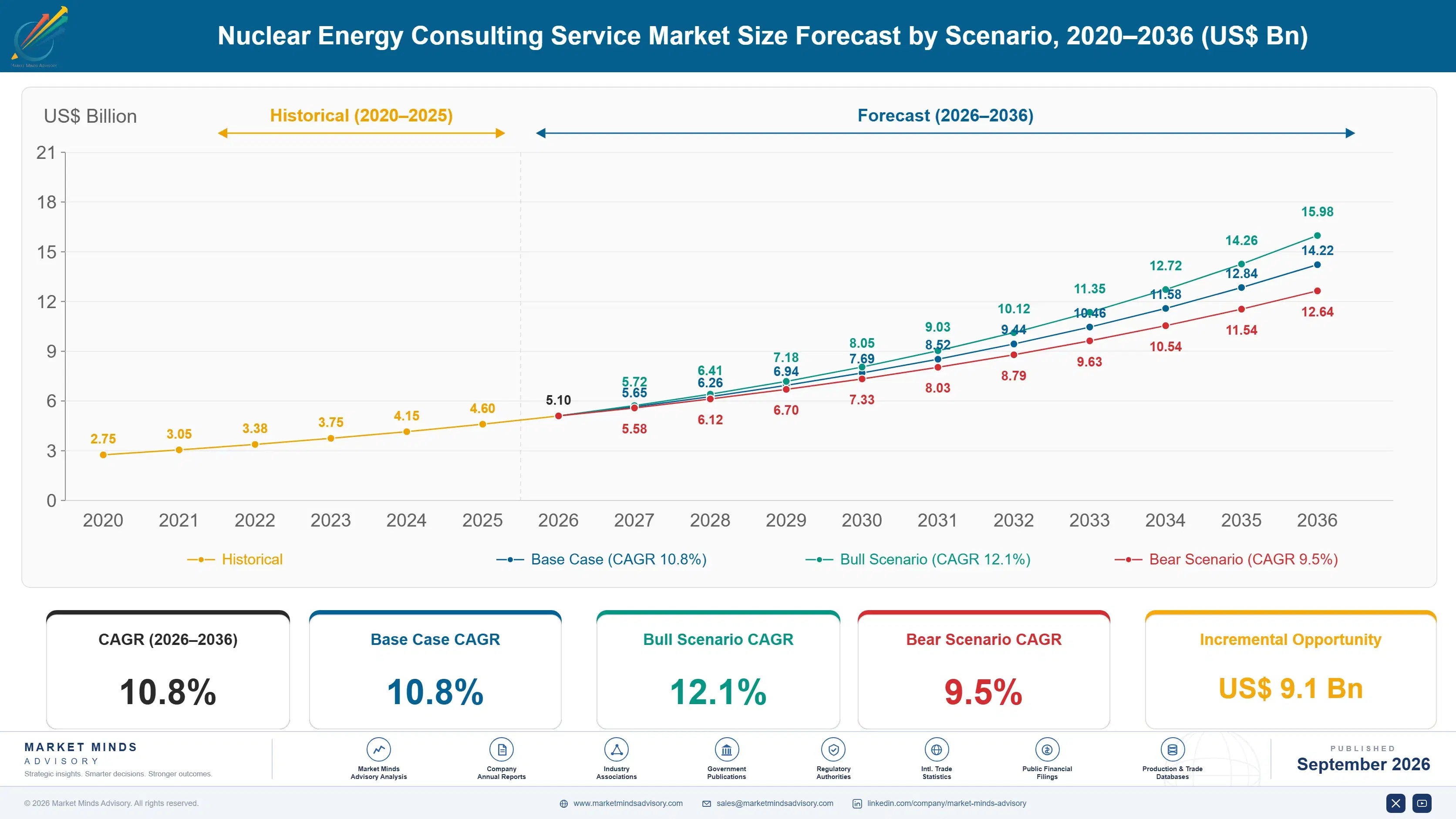
Nuclear Energy Consulting Service Market Forecast Scenarios

nuclear-energy-consulting-service-market-size-forecast-scenario-1788255483457
Between 2020 and 2025 fees compounded at 9.4% and remarkably little of that came from construction. Decommissioning ran on regardless of policy, life extension studies multiplied as operators sought sixty year approvals, and small reactor developers began paying for regulatory engagement. Actual new build reached financial close in very few places. The consultants were busier than the builders throughout the entire period.
The 10.8% base case rests on three mechanisms. Licensing work multiplies with the number of designs rather than reactors, and 24 small designs are in regulatory review against a market for far fewer. Decommissioning liabilities are funded, contracted and indifferent to energy policy. And fleet life extension requires safety cases that did not exist when these plants were first licensed. None of the three needs a single new reactor to be built anywhere.
The bull case at 12.1% turns on several small reactor designs reaching construction, which converts advisory work into owner's engineering across a project lifetime rather than a licensing exercise. The bear case at 9.5% is consolidation among developers: most of the 24 designs will not proceed, and each withdrawal removes a paying client whose fees were funding regulatory engagement that produced nothing.

Experience Nobody Can Hire

The constraint in this business is a cohort rather than a market. Only around 11% of the professional workforce has taken a reactor through licensing to approval, because the Western industry built almost nothing for three decades and those people are now retiring. That experience cannot be recruited, trained quickly or bought, and every firm competing here is bidding for the same individuals.
TOP FIVE CONCENTRATION33%Share of advisory fee revenue held by five firms
AVERAGE DAY RATEUSD 1,340Mean billed rate across licensing and safety case work
LICENSING CYCLE LENGTH6 yearsMedian time from design submission to regulatory approval
EXPERIENCED LICENSING STAFF11%Portion of workforce that has licensed a reactor before
DECOMMISSIONING FEE SHARE38%Portion of sector fees earned taking existing plant apart
DESIGNS SEEKING APPROVAL24 designsSmall reactor concepts currently pursuing regulatory review somewhere
Regulatory credibility behaves like an asset and it is stubbornly national. A safety case from a firm whose methodology a regulator has reviewed before proceeds through questions faster than an equivalent submission from a firm it has never assessed, and six year cycles make that difference enormous. Credibility earned with one national regulator transfers to another very poorly, which is why no firm holds a strong position everywhere.
The reliable money is in taking plants apart and almost nobody wants that work. Decommissioning and waste strategy generates 38% of sector fees, funded through segregated liabilities that do not respond to energy policy, contracted for decades and entirely indifferent to whether anybody builds anything. Consultants chase new build and small reactor programmes because they are interesting. The invoices are being paid by demolition.
"Everybody in this sector wants to work on the reactor that gets built and most of the fee income comes from the ones being pulled down. The firms that made peace with decommissioning have steadier revenue than anybody chasing a small modular programme that may never reach a foundation."
Director, Nuclear Advisory Practice · MMA Energy Practice · September 2026

Market Trends

Design count drives licensing work, not reactor count

Around 24 small modular and advanced reactor designs are pursuing regulatory review across various jurisdictions against a market that will realistically support a small fraction of them, and each one requires its own safety case, its own regulatory engagement and its own licensing programme. Advisory fees therefore scale with the number of developers rather than with any megawatts ever installed. That produces genuine revenue growth at 16.2% against a market rate of 10.8%, funded substantially by developers whose designs will not proceed. It is real income and it is not repeatable.
Market Impact: Produces 38% of sector fees
Life extension requires cases the originals never had

Operating reactors seeking approval for sixty or eighty year lifetimes must demonstrate ageing management, material degradation understanding and probabilistic safety assessment at a standard that did not exist when those plants were originally licensed decades ago. That is not a renewal of an old submission but a substantially new technical case built on new methodology and new data. Fleet operators across North America, France and Eastern Europe are commissioning that work simultaneously, which puts sustained demand on exactly the specialist skills the sector has least of. Nobody kept those people in reserve.
Market Impact: Rebuilds capability across 6 countries

Market Opportunities and Growth Drivers

Decommissioning liabilities are funded and contractual

Segregated decommissioning funds and statutory liabilities mean this work proceeds regardless of electricity prices, energy policy or public opinion, on programmes measured in decades rather than in budget cycles. The British programme alone represents the largest civil nuclear liability anywhere and runs substantially through advisory and framework contractors. Decommissioning generates 38% of sector fees and nothing about that is discretionary. It is the least interesting work in the sector and by a wide margin the most dependable, which very few firms structure their business around properly. Demolition pays the invoices here.
Market Impact: Holds only 11% with experience

Governments are rebuilding programmes they dismantled

Countries that stopped building nuclear plants decades ago are now setting new capacity targets while holding no institutional capability to licence, procure or oversee a reactor programme, because the agencies that once did it were closed or absorbed. Rebuilding that competence means buying it, and the only place it exists is inside consulting firms and a small number of retired individuals. Governments therefore become clients for capability rather than for advice, which is a considerably larger and stickier engagement than any technical study. Buying an institution is a longer engagement than buying advice ever is.
Market Impact: Loses clients from 24 designs

Market Restraints and Challenges

The experienced cohort cannot be replaced quickly

Only around 11% of the professional workforce has taken a reactor through licensing to approval, and that group is retiring faster than anybody can create replacements, because the experience requires a live licensing programme lasting years and there were almost none available for three decades. The root cause is a generational gap in construction that no training programme reverses. Commercial impact is firms turning down work they cannot staff, at rates they could otherwise command. Participants are responding through retiree contracting, graduate programmes with long horizons, international secondment and pairing inexperienced staff onto live submissions deliberately.
Market Impact: Serves 24 designs seeking approval

Most small reactor clients will not survive

Of 24 designs currently in regulatory review, only a small number will reach construction, and every developer that withdraws removes a paying client whose fees were funding a licensing programme that produced no plant. The root cause is that venture funded developers pay for regulatory engagement from raised capital rather than from revenue, so their spending tracks funding rounds rather than progress. Commercial impact is revenue concentration in clients with finite runway. Mitigation runs through milestone-linked fee structures, retainers weighted to early payment, government programme work and deliberate limits on exposure per developer.
Market Impact: Extends plants beyond 60 years
3 additional market trends, 4 additional growth drivers, and 2 additional restraints and challenges are covered in the full report. Contact sales@marketmindsadvisory.com to access the complete intelligence.

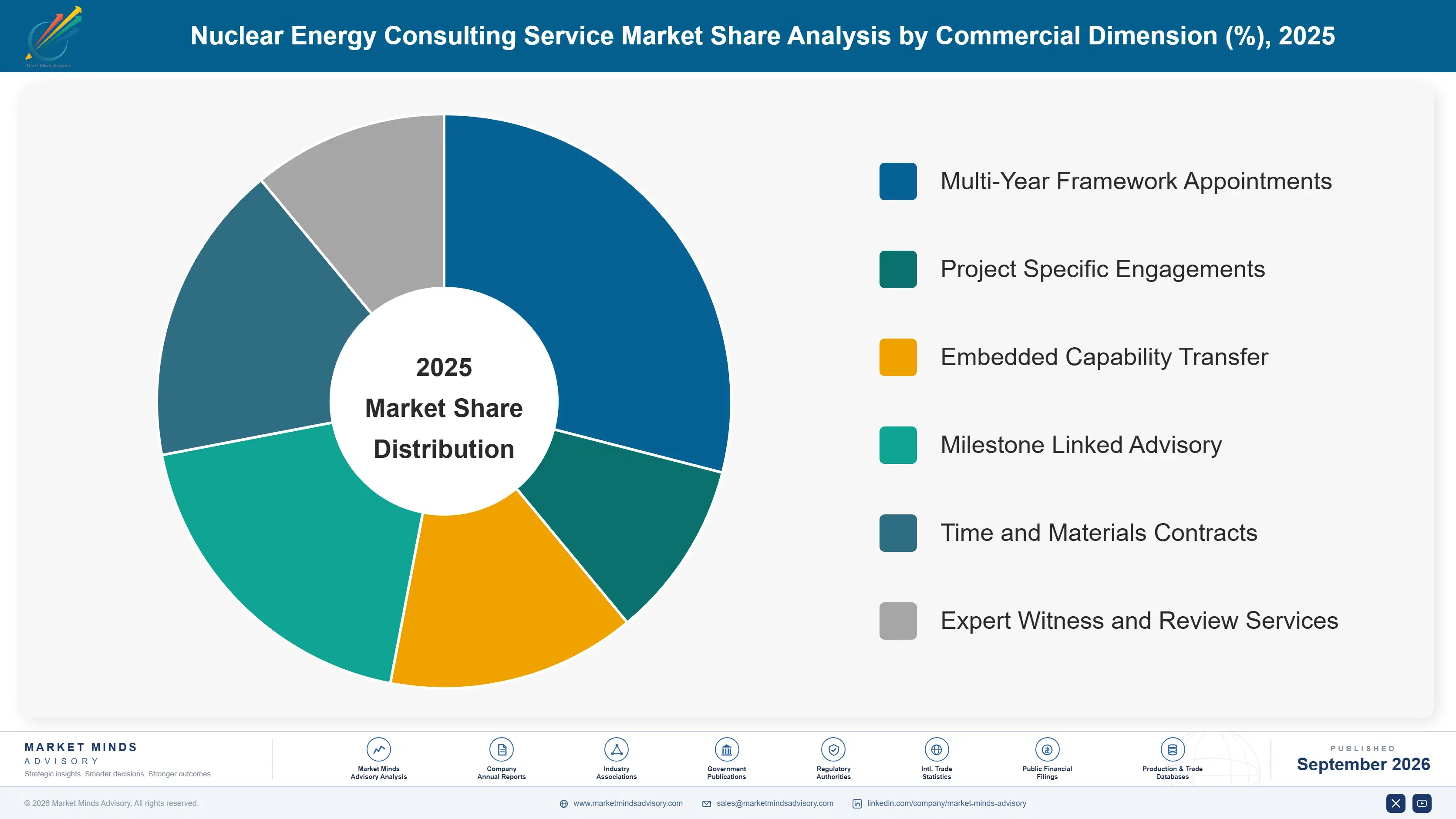
Segment CAGR and Growth Architecture

Segmentation follows service type, the dimension on which regulatory exposure, engagement length and fee rate all move together. Decommissioning and life extension carry the dependable volume on funded multi-decade programmes. Small reactor advisory and owner's engineering carry the growth, because both attach to programmes that are being created rather than managed. One is funded and the other is speculative.
nuclear-energy-consulting-service-market-market-share-analysis-1788255484038

Small Modular Reactor Programme Advisory

Small modular reactor programme advisory grows at 16.2%, half again the market rate of 10.8%, on an arithmetic that deserves stating plainly. Around 24 designs are in regulatory review across various jurisdictions and each requires its own safety case, its own regulatory engagement and its own licensing programme, so advisory demand scales with the number of developers rather than with capacity that might eventually be installed. Most of those developers are venture funded and paying from raised capital rather than revenue, which makes the fees genuine and the client base finite. Firms treating this as a durable growth segment rather than a well-paid window are misreading what is actually happening here.
CAGR 16.2%

New Build Owner's Engineering

New build owner's engineering at 11.0% is the longest and most valuable engagement type in this sector, because a firm acting for the owner sits alongside the project from procurement strategy through construction oversight to commissioning, across a decade or more. Governments and utilities commissioning a reactor for the first time in forty years hold no capability to specify, evaluate or supervise one, which makes the owner's engineer the institutional memory the client does not possess. Fee rates run above the sector average and the relationship is effectively unassailable once established. The constraint is entirely staffing, since these engagements demand exactly the experienced people the sector has least of. Staffing decides everything.
CAGR 11.0%
Full segment breakdown across 6 segments available in the complete report.

Regional Architecture and Country Demand Map

Western Europe takes 29%, above its usual band, on the British decommissioning programme and French life extension rather than construction. Eastern Europe also sits above band on new programmes. India grows fastest. Liabilities and new programmes rather than reactor construction decide almost every position on this map.

Western Europe

A 29% share above the usual band rests on liabilities rather than on ambition. The British decommissioning programme is the largest civil nuclear liability anywhere and is delivered substantially through advisory and framework contractors on multi-decade appointments, which produces dependable fee income entirely independent of whether anything gets built. French fleet life extension across a very large reactor population runs alongside it, requiring safety cases at standards that did not exist when those plants were first licensed. New build advisory exists and has produced fewer projects than announcements. Growth at 9.4% is the slowest of the seven regions on a mature and enormous base. Nothing about that income depends on anything being built anywhere.
Share: 29% | CAGR: 9.4% (2026 to 2036)

North America

Fleet life extension and regulatory engagement define this region rather than construction, and the 27% share reflects the largest operating reactor population in the world. American operators pursuing eighty year licence renewals commission substantial safety and ageing management work, and the regulator's process is documented well enough that firms can build methodology familiarity deliberately. Small reactor developers are concentrated here and paying for pre-application engagement in numbers no other region matches. Canadian regulatory process has attracted developers seeking a route that runs in parallel. Decommissioning of shut units adds steadily. Growth at 10.4% comes from an unusually broad base of activity types. Breadth here is unusual and it makes the region unusually resilient to any single policy change.
Share: 27% | CAGR: 10.4% (2026 to 2036)
Regional intelligence for 5 additional markets available in the complete report: East Asia, South Asia and Pacific, Latin America, Middle East and Africa, Eastern Europe. Contact sales@marketmindsadvisory.com.
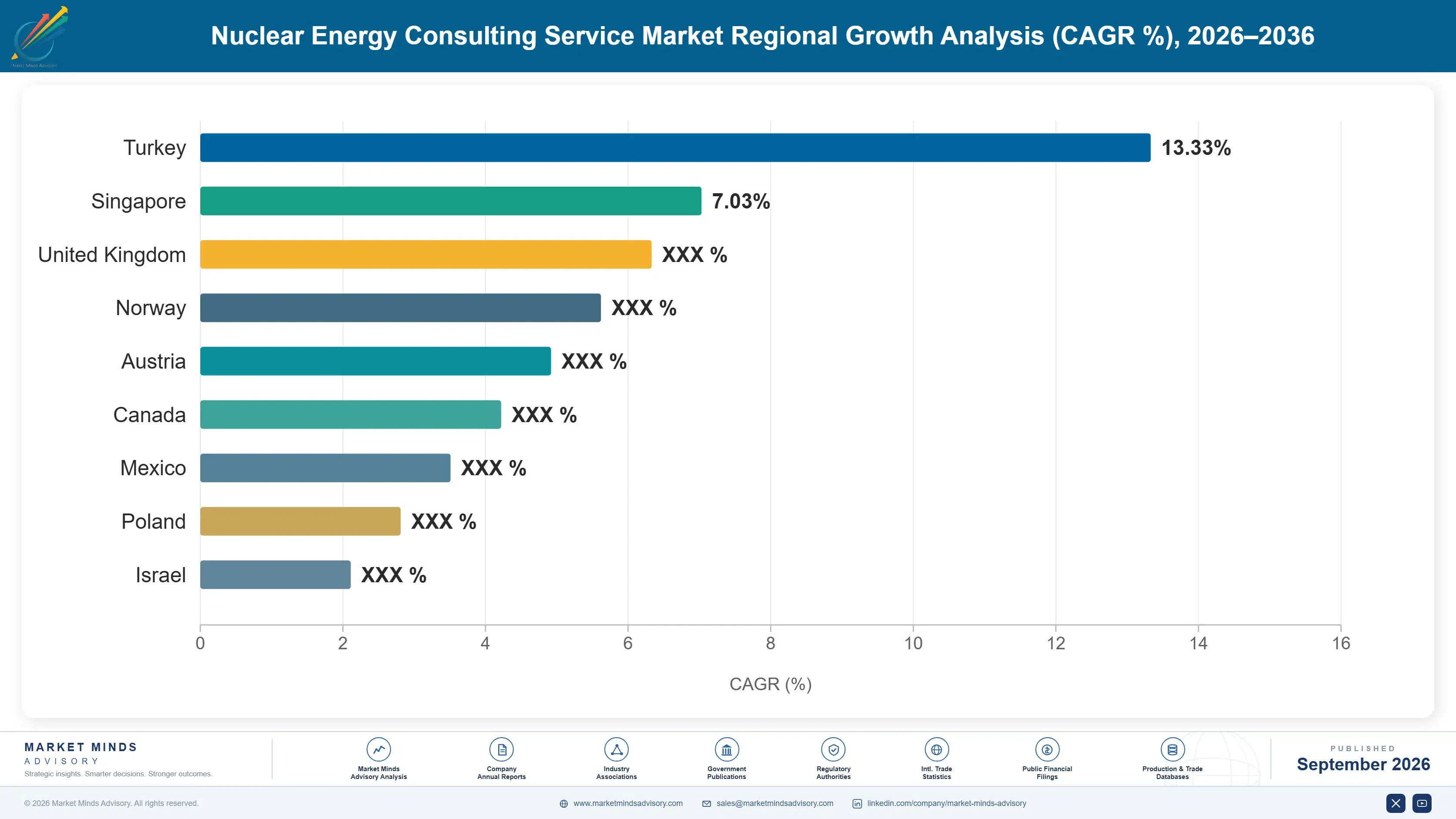
nuclear-energy-consulting-service-market-country-cagr-analysis-1788255484571

Four Moves On Scarce Experience

None of these four is about technical capability, because every serious firm here employs competent engineers and the methodologies are published. Each works on the two genuine constraints: who the regulator already trusts, and how few people have ever taken a reactor through approval. Both constraints are demographic rather than commercial, and no strategy addresses them directly.

Build methodology familiarity with one regulator deliberately

Licensing cycles run around 6 years and a regulator reviewing a familiar methodology moves through questions faster than one encountering an approach for the first time, which makes that familiarity a genuine asset with a measurable value to any client. Firms can build it deliberately by taking smaller regulatory engagements in a target jurisdiction before pursuing the large ones. It costs margin on early work and buys a position competitors cannot bid against later. Most firms enter a new market by pursuing the largest available contract instead. Firms chase the largest contract instead.
Market Impact: Shortens a 6 year licensing cycle considerably here

Contract the retired cohort before competitors do

Only 11% of the professional workforce has taken a reactor through licensing and much of that group has already retired or is close to it, which makes retainer arrangements with individuals a genuine competitive asset rather than a staffing convenience. Those arrangements cost very little relative to what the experience commands on a live submission, and they can be exclusive. Pairing retirees with capable younger engineers on real programmes is also the only mechanism that creates replacements. Firms bidding work they cannot staff are losing engagements that a retainer would have won.
Market Impact: Secures the scarce 11% that holds genuine experience

Take the decommissioning work nobody wants

Decommissioning and waste strategy generates 38% of sector fees on funded liabilities that continue regardless of energy policy, electricity prices or public opinion, across programmes measured in decades. It is unglamorous work that consultants avoid in favour of new build and small reactor programmes with better stories attached. The revenue is contractually certain, the frameworks are long and the competition is noticeably thinner. Firms structuring deliberately around this work have steadier income than anybody dependent on developers whose funding rounds decide whether next year happens. Competition here is noticeably thinner than anywhere else.
Market Impact: Targets 38% of all of the sector's fees

Sell capability building to governments, not studies

Countries setting nuclear capacity targets after decades of building nothing hold no institutional ability to licence, procure or oversee a programme, because the agencies that once did were closed. Those governments need capability transferred rather than a report delivered, which is a multi-year engagement covering regulatory framework, workforce development and owner's oversight together. Around 6 countries are in exactly that position now. The engagement is larger, longer and considerably harder to displace than any technical study, and most firms are still proposing studies. Most firms are still proposing a study instead.
Market Impact: Addresses the 6 countries now rebuilding nuclear capability

Who Controls the Margin Pool

CR5 stands at 33% of fee revenue from nuclear advisory engagements, which is the only comparable basis since nuclear work sits inside far larger engineering and consulting reporting for every participant. Concentration is low because regulatory credibility is national rather than global, and a firm dominant with one authority frequently has no position at all with the next one. No firm is strong with every authority.
Competition runs on regulator familiarity, experienced staff and framework incumbency. Familiarity decides how quickly a submission progresses and clients know it. Experienced staff decide what a firm can bid at all, since only 11% of the workforce has licensed a reactor. Framework incumbency on decommissioning programmes decides the dependable revenue. Technical methodology differentiates far less than the proposals claim. Clients now ask which individuals will be assigned.

Rankings will move on staffing rather than on winning work, because demand exceeds the sector's ability to deliver and the constraint is people who have done this before. Firms holding retiree retainers and functioning graduate pipelines will take engagements others must decline. The pressure comes from a demographic gap rather than from competitors, which no commercial strategy addresses directly. Nobody recruits out of a demographic gap.
nuclear-energy-consulting-service-market-company-positioning-matrix-1788255485100

Competitive Moat and Risk Dimensions

JACOBS

Moat: Decommissioning framework incumbency

Long-standing positions on major decommissioning framework programmes provide multi-decade fee income that continues regardless of energy policy or electricity prices, together with the site knowledge that makes displacement genuinely difficult. Incumbency on a decades-long liability programme is close to unassailable. Competitors bid against a firm that already knows the buildings, the inventory and the regulator.
JACOBS

Risk: Growth depends on scarce staff

Expanding into licensing and new build advisory means competing for the small population who have taken a reactor through approval, and scale offers no advantage since every rival bids for the same people. Turning down engagements for want of staff is the practical outcome. The constraint applies sector wide and bites hardest on firms growing fastest.
ASSYSTEM

Moat: Owner's engineering across new programmes

Deep positioning as owner's engineer on new build and newcomer country programmes places the firm inside client organisations that lack any internal capability, across engagements running a decade or more. That role is institutional memory rather than advice, which makes it exceptionally difficult to displace. Reference programmes in newcomer countries qualify the firm for the next one directly.
ASSYSTEM

Risk: Exposure to programmes that stall

Owner's engineering revenue depends on programmes actually proceeding, and nuclear projects are cancelled, deferred and reprofiled on political timetables no advisor influences. A stalled programme removes a large engagement at once rather than gradually. Diversifying toward decommissioning means competing against framework incumbents holding positions built over decades.

Players Tracked

Prominent Players

Jacobs
Wood
Assystem
Tractebel
Amentum

Other Key Players

Framatome
Westinghouse Electric Company
Bechtel
AtkinsRealis
Arup
Mott MacDonald
Cavendish Nuclear
NUVIA
Studsvik
Lloyds Register
DNV
Ricardo
ERM
WSP
Orano

Recent Developments

JANUARY 2025

Regulators opened joint review processes for small designs

Nuclear regulators in several jurisdictions extended collaborative review arrangements allowing a single design assessment to inform approval in more than one country, reducing duplicated technical work for developers pursuing multiple markets simultaneously. Advisory demand shifted toward firms holding credibility with more than one participating authority.
Signal: Joint review rewards the firms holding credibility in several jurisdictions and penalises the purely national ones.
MAY 2025

Newcomer country awarded multi-year capability building engagement

A country pursuing its first nuclear programme awarded a multi-year engagement covering regulatory framework development, workforce training and owner's oversight together, rather than commissioning a series of separate technical studies. The scope resembles building an institution far more closely than it resembles any conventional consulting work.
Signal: Governments are buying institutional capability now, and most firms are still proposing technical studies to them.
SEPTEMBER 2025

Small reactor developer withdrew after regulatory engagement

A small modular reactor developer withdrew from regulatory engagement after failing to raise a further funding round, ending advisory contracts partway through a licensing programme that had already consumed several years of specialist effort. The design will not proceed and the regulatory work produced no plant.
Signal: Venture funded clients pay well until a funding round fails, which decides the engagement rather than progress.

Salaries, Security And Insurance

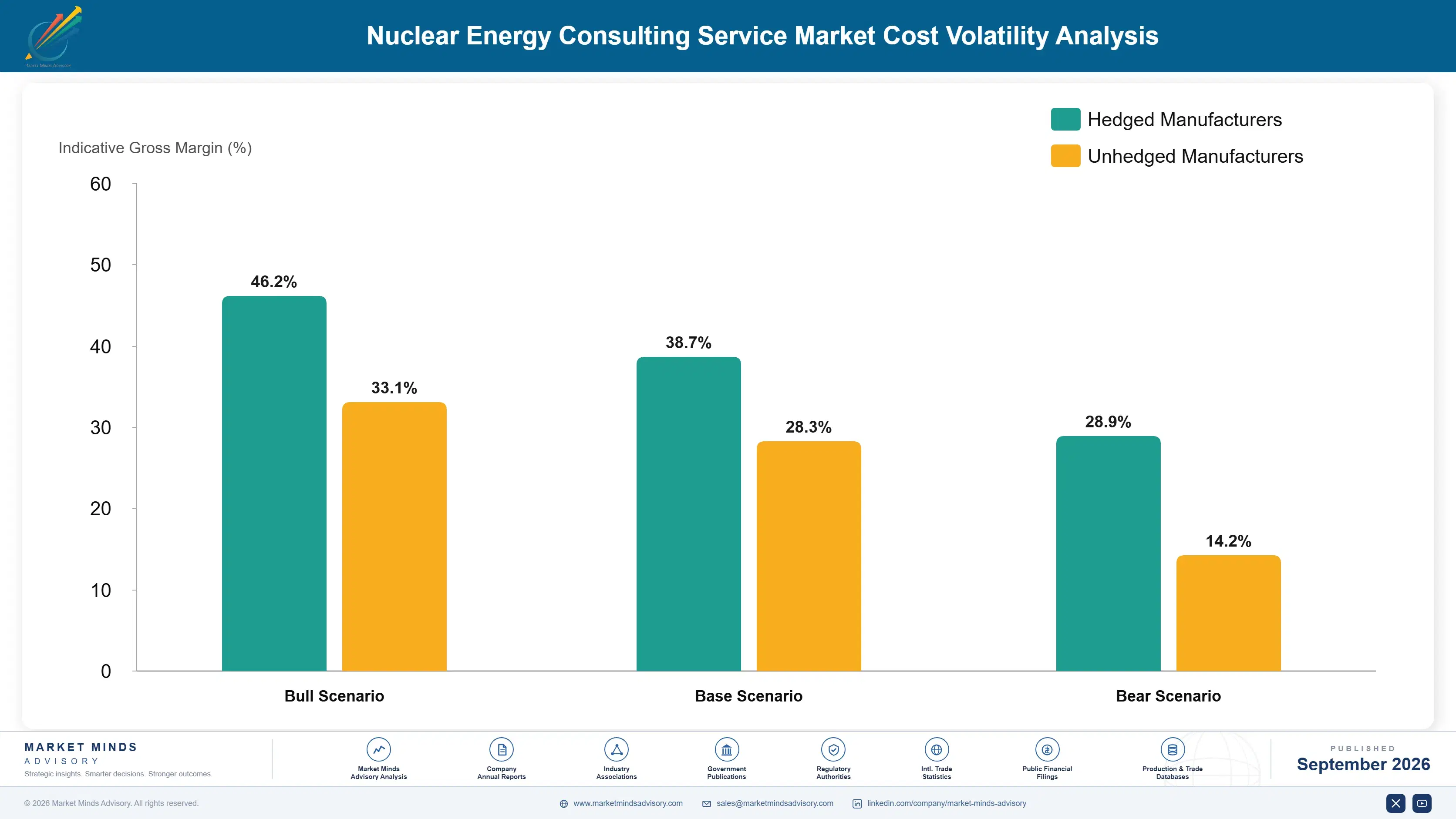
Professional salaries account for roughly 61% of delivered cost, security clearance and vetting around 8%, and professional indemnity insurance a further 7%. Recruitment and retention spending makes up much of the remainder, which is unusual in a consulting business and reflects a labour market where the scarce people are known individually to every competitor. Overheads beyond people are genuinely small.
Specialist nuclear salaries have risen faster than general engineering pay across recent years, as new build programmes, small reactor developers and government agencies competed for the same limited population. United States Bureau of Labor Statistics wage reporting recorded engineering compensation movement across the period. Firms with strong retention held margins on fixed-price engagements. Those staffing growth through recruitment paid market rates on work priced against an earlier salary assumption entirely.

The disadvantage falls on retention rather than on recruitment capability. A firm losing an experienced licensing engineer loses the regulator familiarity that individual carried, the continuity on a live submission and the training capacity for junior staff simultaneously, and replacing them costs a premium in a market where every competitor wants the same person. Recruitment is expensive and retention is cheap, and this sector spends heavily on the wrong one.
nuclear-energy-consulting-service-market-cost-volatility-analysis-1788255485295

Retain experienced staff rather than replacing them

Salaries are 61% of cost and losing an experienced licensing engineer removes regulator familiarity, submission continuity and junior training capacity in one departure. Retention spending is far cheaper than the recruitment premium a replacement commands in a market where every competitor knows the same small population by name. Firms with strong retention held margin through the last salary cycle.

Price fixed-fee work against salary escalation

Specialist nuclear salaries have risen faster than general engineering pay while multi-year advisory engagements are frequently priced once at the outset. Escalation provisions cost a negotiation and prevent a firm delivering year four of an engagement at year one rates against a wage bill that has moved considerably. Firms without them absorbed the entire difference through the last cycle.

Retain the departing cohort on standing arrangements

Only 11% of the workforce has taken a reactor through licensing and much of that group is retiring rather than moving between firms, which makes standing consultancy arrangements with individuals an inexpensive way to keep access to the experience. The cost is modest against what that experience commands on a live submission, and exclusivity is frequently available to whoever asks.

Portfolio Architecture for Margin Defence

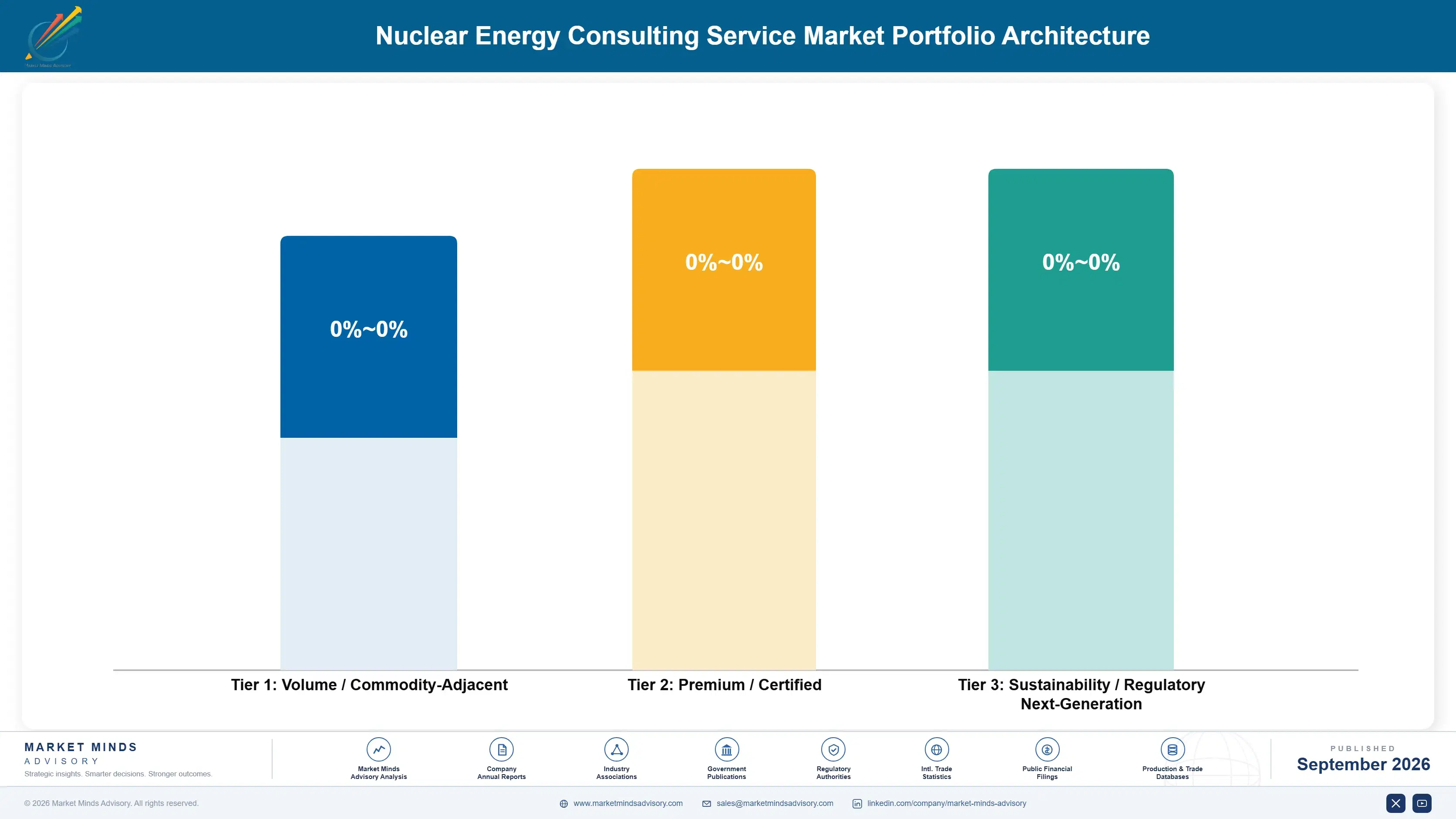
Margin here follows scarcity of the individuals assigned rather than the service described, which is not how any proposal is structured. A safety case staffed by engineers who have taken a submission through approval bills at rates a technically similar team without that history cannot command. Firms costing by grade rather than by regulatory track record are underpricing their scarcest people systematically.
Volume and premium pull against each other through staffing rather than through the market. Decommissioning and waste programmes absorb large numbers of capable engineers on dependable long framework work, and that base is what allows a firm to carry the experienced licensing specialists between the engagements that need them. A firm holding only premium licensing work cannot keep those people employed continuously and loses them.

High-value pools sit in owner's engineering, in government capability building and in the training pipeline nobody sells. The third is genuinely unclaimed: clients rebuilding national programmes need people rather than reports, and a firm placing and developing engineers inside a client organisation over years occupies a position considerably more durable than any advisory appointment. That is the most durable position available anywhere in this sector.

Volume / Commodity-Adjacent

General engineering support, documentation and technical services delivered onto decommissioning and operating plant frameworks at competitive day rates. Competes on rate and availability rather than on specialist experience. The 8 point spread reflects utilisation and whether staff are permanent or contracted.
Gross Margin: 14 to 22%

Premium / Certified

Licensing submissions, safety cases and probabilistic assessment delivered by staff whose methodology the relevant regulator has reviewed before. Regulator familiarity rather than technical capability supports the rate. The 8 point spread reflects how many of the assigned staff hold that history.
Gross Margin: 28 to 36%

Sustainability / Regulatory / Next-Generation

Owner's engineering on new programmes, government capability building and small reactor licensing advisory on multi-year appointments. Margins are high because very few firms can staff the work at all. The 16 point spread separates advisory appointments from embedded capability transfer engagements entirely.
Gross Margin: 38 to 54%
nuclear-energy-consulting-service-market-portfolio-architecture-1788255485804

High-value Sub-segments and Strategic Watch-out

Small Modular Reactor Programme Advisory

High value and high growth at 16.2%. Twenty-four designs each fund their own licensing programme against a market for far fewer, which makes the fees real and the client base finite. The 8 point spread reflects whether fees are milestone-linked or billed against a developer's funding runway.
Gross Margin: 42 to 50%

New Build Owner's Engineering

High value with strong growth at 11.0%. The firm becomes institutional memory a client does not possess, across a decade or more, which is close to undisplaceable once established. The 8 point spread reflects whether the programme has reached financial close or remains at development stage.
Gross Margin: 36 to 44%

Decommissioning and Waste Strategy

The volume core. It earns modestly and it carries funded multi-decade frameworks that let a firm keep scarce licensing specialists employed between the engagements requiring them. The 8 point spread reflects framework position, since incumbency on these long programmes is genuinely difficult to displace. Incumbency decides.
Gross Margin: 20 to 28%

Operating Fleet Life Extension Support

The strategic watch-out. Demand depends on individual reactor closure decisions taken on politics and economics that no advisor influences or predicts. The 20 point spread separates the complex ageing management cases from routine periodic review work that a great many firms can deliver. Politics decides closure.
Gross Margin: 24 to 44%

Decades, Not Engagements

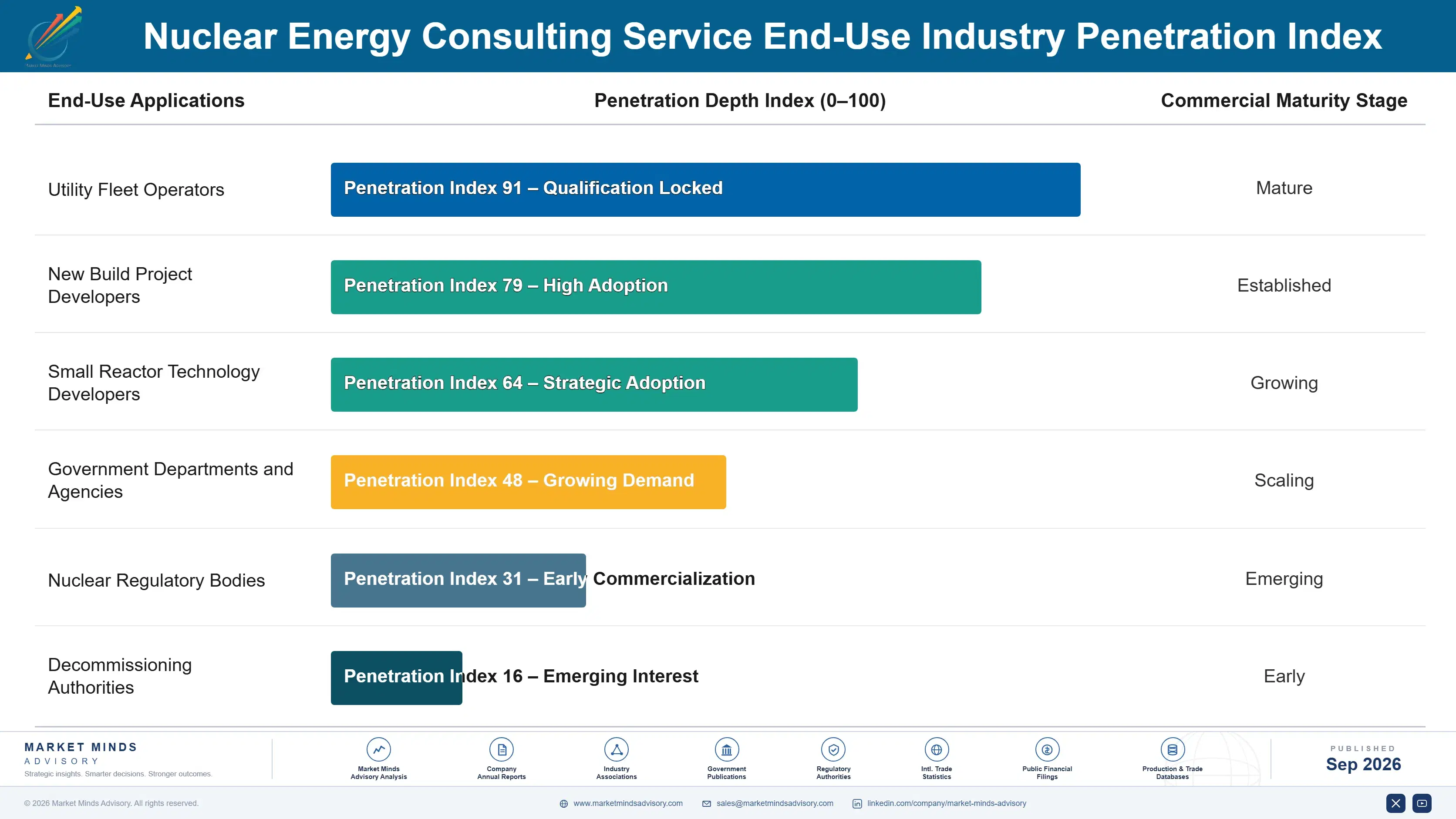
The annuity here is measured in decades and it is unusually secure once established. A decommissioning framework or owner's engineering appointment runs for years with staff embedded in the client organisation, and displacement means losing site knowledge and regulatory continuity built over years. Clients do not run those competitions casually. The revenue arrives without repeated selling and it ends only when the programme does.
Stickiness varies enormously by client type rather than by service. A government or utility running a decades-long programme retains a firm effectively permanently once embedded. A venture funded small reactor developer pays well until a funding round fails, at which point the engagement stops mid-submission regardless of progress or quality. Those two clients look similar on a fee schedule and behave nothing alike at all.

Buyer profiles have shifted from technical directors toward programme boards and government departments, and proposals have not entirely followed. A technical director asked about methodology and precedent. A programme board asks who specifically will be assigned, whether they have done this before and what happens if they leave. The second question is now decisive and most firms answer it with a capability statement rather than named individuals.
nuclear-energy-consulting-service-market-end-use-penetration-index-1788255486291

What Actually Wins Here

These are among the four positions where our research anticipates prominent divergence between winners and laggards over the coming forecast period. Each is grounded in the demand model, the regulatory perimeter, and the announced capacity pipeline.
01 / REGULATOR FAMILIARITY BUILDING

Take the small work to earn the large

Licensing cycles run around 6 years and a regulator reviewing a methodology it has assessed before moves through technical questions considerably faster than one encountering an approach for the very first time. That familiarity is a genuine asset with measurable value to a client, and it can be built deliberately by taking smaller regulatory engagements in a target jurisdiction first. It costs margin on the early work and buys a position competitors cannot bid against later, and most firms enter by chasing the largest contract instead.
02 / EXPERIENCED COHORT RETENTION

Retain the people, not the capability statement

Only around 11% of the professional workforce has taken a reactor through licensing to approval, and much of that cohort is now retiring rather than moving between employers, which makes standing arrangements with individuals a competitive asset rather than a staffing convenience. Those retainers cost very little against what the experience commands on a live submission and can frequently be made exclusive. Pairing them with capable younger engineers on real programmes is also the only mechanism that actually creates replacements anywhere.
03 / DECOMMISSIONING BASE BUILDING

Build on the work nobody finds interesting

Decommissioning and waste strategy generates 38% of sector fees on funded statutory liabilities that continue regardless of electricity prices, energy policy or public opinion, across programmes measured in decades rather than budget cycles. Consultants avoid it in favour of new build and small reactor programmes carrying far better stories and far worse revenue security. The frameworks are long, the competition is thinner and the base employs the capable engineers who let a firm carry its scarce licensing specialists between engagements.
04 / GOVERNMENT CAPABILITY TRANSFER

Sell an institution, not a report

Countries setting nuclear capacity targets after decades of building nothing hold no institutional ability to licence, procure or oversee a programme, because the agencies that once did that work were closed or absorbed long ago. Those governments need capability transferred into their own organisations rather than a study delivered to them, covering regulatory framework, workforce development and owner's oversight together over years. Around 6 countries sit in exactly that position now, and most firms are still responding with proposals for technical studies.

Engagement Snapshot From the Field

A live engagement with an industry participant carrying material or product regulatory and market exposure ahead of a defining policy shift, showing how our research translates into a defensible multi-year portfolio strategy.
MARKET MINDS ADVISORY · CLIENT ENGAGEMENT SUMMARY
Nuclear Energy Consulting Service Producer Strategic Portfolio Review and Transition Roadmap 2026·Investment Scenario on Nuclear Energy Consulting Service Exposure Evaluation 2025-26
CLIENT PROFILE
A European engineering consultancy with a nuclear practice of several hundred professionals working across decommissioning frameworks and licensing support, with annual nuclear fee revenue in the low hundreds of millions of euros and a growing volume of work it was declining for want of staff (client-reported, unverified by MMA). Attrition among experienced licensing engineers had risen sharply.
STRATEGIC CHALLENGE
The practice was turning away licensing engagements it could not staff while competitors won them, and management had responded by recruiting aggressively at market rates, which raised costs without improving delivery capacity because it was hiring the same people competitors were losing. They needed a route out of a bidding war for a fixed population.
MMA APPROACH
MMA analysed every engagement declined across three years against the specific staff constraint that caused it, and mapped the client's experienced population by regulator familiarity and by retirement horizon. Forty-seven expert interviews with licensing engineers, retired specialists, regulators, clients and competing firms established where the experience actually sat and what would move it.
KEY FINDINGS
  1. Work declined for staffing reasons exceeded 21% of addressable opportunities, and every one of those declined engagements carried rates well above the practice average.
  2. Only 9 individuals in the practice held direct experience of a completed licensing submission, and 4 of them were within three years of retirement.
  3. No competitor in the client's markets held standing arrangements with retired specialists, despite that population being readily identifiable and almost entirely unengaged by anybody.
  4. Decommissioning framework revenue was funding the practice reliably while management attention and the entire recruitment budget went almost exclusively to new build work.
CLIENT PROFILE
A European engineering consultancy with a nuclear practice of several hundred professionals working across decommissioning frameworks and licensing support, with annual nuclear fee revenue in the low hundreds of millions of euros and a growing volume of work it was declining for want of staff (client-reported, unverified by MMA). Attrition among experienced licensing engineers had risen sharply.
STRATEGIC CHALLENGE
The practice was turning away licensing engagements it could not staff while competitors won them, and management had responded by recruiting aggressively at market rates, which raised costs without improving delivery capacity because it was hiring the same people competitors were losing. They needed a route out of a bidding war for a fixed population.
MMA APPROACH
MMA analysed every engagement declined across three years against the specific staff constraint that caused it, and mapped the client's experienced population by regulator familiarity and by retirement horizon. Forty-seven expert interviews with licensing engineers, retired specialists, regulators, clients and competing firms established where the experience actually sat and what would move it.
KEY FINDINGS
  1. Work declined for staffing reasons exceeded 21% of addressable opportunities, and every one of those declined engagements carried rates well above the practice average.
  2. Only 9 individuals in the practice held direct experience of a completed licensing submission, and 4 of them were within three years of retirement.
  3. No competitor in the client's markets held standing arrangements with retired specialists, despite that population being readily identifiable and almost entirely unengaged by anybody.
  4. Decommissioning framework revenue was funding the practice reliably while management attention and the entire recruitment budget went almost exclusively to new build work.
RECOMMENDED STRATEGY
Phase 1: Phase one: place standing consultancy arrangements with identified retired specialists before any competitor approaches them, on exclusive terms where possible. Phase 2: Phase two: pair every retiree and experienced engineer with two junior staff on live submissions, since that is the only route to creating replacements. Phase 3: Phase three: stop recruiting into a bidding war for the same population and redirect that budget toward retention of the people already held.
OUTCOME
Within five quarters the practice held arrangements with eleven retired specialists and declined engagement volume had fallen by roughly half (client-reported, unverified by MMA). Attrition among experienced staff stopped. Recruitment spending was materially lower than when the work began. Two junior engineers have now completed a full submission cycle.

Frequently Asked Questions

Foundational context covering the market sizes, CAGR, scope, country, region and competition that inform every finding below. This section is provided to cover basics and most often pre-purchase conversations, answered from the MMA Primary Research Dataset.

What is the current size of the Nuclear Energy Consulting Service Market?

The global nuclear energy consulting service market was valued at USD 4.6 billion in 2025, covering advisory and engineering services to operators, developers and governments. The 2026 figure reaches USD 5.10 billion.

How large will the Nuclear Energy Consulting Service Market be by 2036?

MMA forecasts USD 14.22 billion by 2036, an increase of USD 9.12 billion over the 2026 base. That represents an expansion multiple of 2.79 times across the forecast period.

What is the CAGR for the Nuclear Energy Consulting Service Market 2026 to 2036?

The base case compound annual growth rate is 10.8%, with a bull case at 12.1% and a bear case at 9.5%. Historical growth between 2020 and 2025 ran at 9.4%.

Which segment is growing fastest?

Small modular reactor programme advisory grows at 16.2%, half again the market rate of 10.8%, because 24 designs each fund their own licensing programme. Owner's engineering follows at 11.0%.

Who are the major companies in the Nuclear Energy Consulting Service Market?

Jacobs, Wood, Assystem, Tractebel and Amentum lead on nuclear advisory fee revenue, with combined CR5 of 33%. Concentration is low because regulatory credibility is national rather than global.

Which country is growing fastest?

India grows fastest at 13.0%, on continuing indigenous construction alongside policy changes opening participation to private and foreign entities. South Asia and Pacific leads regionally at 13.0%.

Report Segmentation Architecture

The full report scope spans multiple orthogonal segmentation dimensions, with cross-tabulated demand data provided for each dimension pair. Coverage extends further to regional breakdowns, trend trajectories, and the competitive detail needed to support segment-level decision-making.

By Service Type

  • Licensing and Regulatory Advisory
  • Safety Case and Probabilistic Assessment
  • New Build Owner's Engineering
  • Decommissioning and Waste Strategy
  • Small Modular Reactor Programme Advisory
  • Operating Fleet Life Extension Support

By End-Use Industry

  • Utility Fleet Operators
  • New Build Project Developers
  • Small Reactor Technology Developers
  • Government Departments and Agencies
  • Nuclear Regulatory Bodies
  • Decommissioning Authorities

By Commercial Dimension

  • Multi-Year Framework Appointments
  • Project Specific Engagements
  • Embedded Capability Transfer
  • Milestone Linked Advisory
  • Time and Materials Contracts
  • Expert Witness and Review Services

By Region

  • North America
  • Western Europe
  • East Asia
  • South Asia and Pacific
  • Latin America
  • Middle East and Africa
  • Eastern Europe

Scope, Methodology, and Coverage

Every figure in this report is reproducible from documented input assumptions. The scope below maps the historical period, the forecast horizon, the segmentation dimensions, and the countries covered, alongside the underlying primary and qualitative methodology.
Historical Period
2020 to 2025
Forecast Period
2026 to 2036
Base Year
2025 (USD billions; MMA Primary Research Dataset, September 2026)
Market Definition
The nuclear energy consulting service market covers professional advisory, engineering and technical services supplied to nuclear operators, developers, regulators and governments, spanning licensing and regulatory advisory, safety case and probabilistic assessment, new build owner's engineering, decommissioning and waste strategy, small modular reactor programme advisory, and operating fleet life extension support. Scope is measured as fee revenue from advisory engagements. Excluded are construction and installation contracting, reactor and component manufacture, fuel supply and enrichment services, plant operations and maintenance under contract, and radioactive waste disposal facility operation.
Quantitative Units
USD billion, 2025 base year, 2026 to 2036 forecast period
Segmentation Dimensions
Service type, client organisation, commercial model, region
Regions Covered
North America, Western Europe, East Asia, South Asia and Pacific, Latin America, Middle East and Africa, Eastern Europe
Countries Covered
United States, Canada, United Kingdom, France, Finland, Sweden, Poland, Czechia, Romania, China, Japan, South Korea, India, Australia, Brazil, Argentina, United Arab Emirates, South Africa
Key Companies Profiled
20 companies across engineering consultancies, technology vendors and specialist advisers
Quantitative Methodology
Primary survey, n=3,800 respondents, Q4 2025, six countries; demand-side model with trade association cross-validation
Qualitative Methodology
47 expert interviews, Q4 2025; applied to validate demand model assumptions, identify emerging dynamics, and assess competitive positioning
Report Format
PDF and XLSX data workbook (Word format preview document)
Publisher
Market Minds Advisory
Report Code
MMA-2026-ENE-391
Published
September 2026
Contact
sales@marketmindsadvisory.com | www.marketmindsadvisory.com

Purchase the full Nuclear Energy Consulting Service Market Report (2026 to 2036).

The full MMA report on the nuclear energy consulting service market runs to detailed service and regional models across the 2026 to 2036 forecast period, with day rate benchmarks separated by service type and regulatory jurisdiction. It profiles 20 companies on a consistent nuclear advisory fee revenue basis, covering engineering consultancies, technology vendors and specialist advisers. Experienced workforce availability is analysed by jurisdiction alongside retirement horizons and the engagements it constrains. Regional chapters cover the seven MMA regions with country-level detail on the eighteen markets surveyed. Primary research draws on a quantitative survey of 3,800 respondents across six countries and 47 expert interviews conducted in Q4 2025.
Day rate benchmarks by service type and regulatory jurisdiction
Experienced workforce availability analysed against retirement horizons by market
Small reactor design pipeline tracked against developer funding status
Twenty company profiles on consistent advisory fee revenue basis
Decommissioning framework positions mapped across major liability programmes
Seven regional chapters with eighteen country detail tables

Built For The People Who Decide

From boardroom strategy to bench-side execution, this report is read cover-to-cover by leaders shaping the next decade of their industry, turning demand scenarios, market dynamics and valuation benchmarks into decisions.
CXOs/ Presidents/ VPs/ Managers
M&A and Corporate Development
Strategy Teams and R&D Heads
Procurement and Product Directors
Regulatory and Compliance Leaders
Investor Relations and Equity Analysts