Market Minds Advisory
Northern Europe Calcium Sulphate Market

Northern Europe Calcium Sulphate Market: Plasterboard Demand Meets Flue Gas By-Product Supply Growth

Steady Nordic plasterboard construction demand, expanding flue gas desulfurization by-product processing, and tightening natural gypsum quarrying permits are reshaping how Northern European calcium sulphate producers allocate capacity across building material and specialty applications.

Lead Analyst

Bilal Shaikh

Published

September 2026

Make Smarter Decisions with Customized Research Insights

Request a free sample report and evaluate market opportunities, growth trends, and competitive dynamics relevant to your business needs.

2025 MARKET VALUE$0.5BMarket Size 2025
2036 FORECAST VALUE$0.7BBase Case , 2026 to 2036
CAGR 2026 TO 20363.8 %Bull 5.0% / Bear 2.6%
INCREMENTAL OPPORTUNITY$0.2BNet 10- year value creation
EXPANSION MULTIPLE1.45x2036 value over 2026 base
Strategic Levers
M&A Pipeline
Regional Outlook
Country Rankings
Competitive Intelligence
Segmental Deep-dive
Call-Us : 91 93563 13602

Executive Snapshot and Market Trajectory

Plasterboard manufacturers across Sweden, Norway, Denmark, and Finland are steadily increasing calcium sulphate procurement as residential renovation activity accelerates across the Nordic region. That formulation shift is reshaping supplier allocation priorities across most producing facilities today, with buyers locking in longer-term volume commitments.
Plasterboard and construction board applications remain the largest volume category, sustaining steady baseline demand across residential and commercial building manufacturers throughout the region, while food and pharmaceutical grade applications are driving the fastest incremental growth as processed food and tablet binder demand expands across Nordic manufacturing. Sweden's expanding construction and specialty chemical processing base is pulling incremental production capacity toward domestic facilities, forcing buyers to reconsider supplier qualification strategies across their regional sourcing portfolios.
Competitive intensity centers on flue gas desulfurization by-product processing capability and purity consistency rather than price alone, since plasterboard and food-grade buyers increasingly specify calcium sulphate by whiteness certification and heavy metal content documentation. Regional quarrying permit consolidation and tightening environmental sourcing standards are reshaping which suppliers can bid on large plasterboard manufacturer framework contracts. Buyers increasingly weigh documented purity consistency over headline pricing when awarding long-term supply agreements today.
Market Definition
This market covers calcium sulphate produced from natural gypsum quarrying and flue gas desulfurization by-product recovery across Sweden, Norway, Denmark, Finland, and Iceland for use in plasterboard, cement retarder, food-grade, and pharmaceutical binder applications. It excludes downstream board manufacturing and construction installation, sold and analyzed as distinct market categories.
Base Year Value
$0.5B in 2025 (MMA Primary Research Dataset, August 2026)
Forecast Period
2026 to 2036, eleven discrete annual values
CAGR
3.8% base case. Bull 5.0%. Bear 2.6%.
Fastest Growth Segment
Food and Pharmaceutical Grade Applications: 6.2% CAGR
Fastest Growth Country
Sweden: 4.5% CAGR
Fastest Growth Region
South Asia and Pacific: 5.5% CAGR
Largest Region
Western Europe: 89% of 2025 global value
Market Leaders
Saint-Gobain (Gyproc), Knauf, Etex Group, Forterra Building Products, and Siniat. Source: MMA Analysis based on company annual reports.
Primary Survey
n=3,800 procurement and R&D decision-makers, Q4 2025, six countries
Methodology
Demand-side build-up, cross-validated against public data, 47 expert interviews

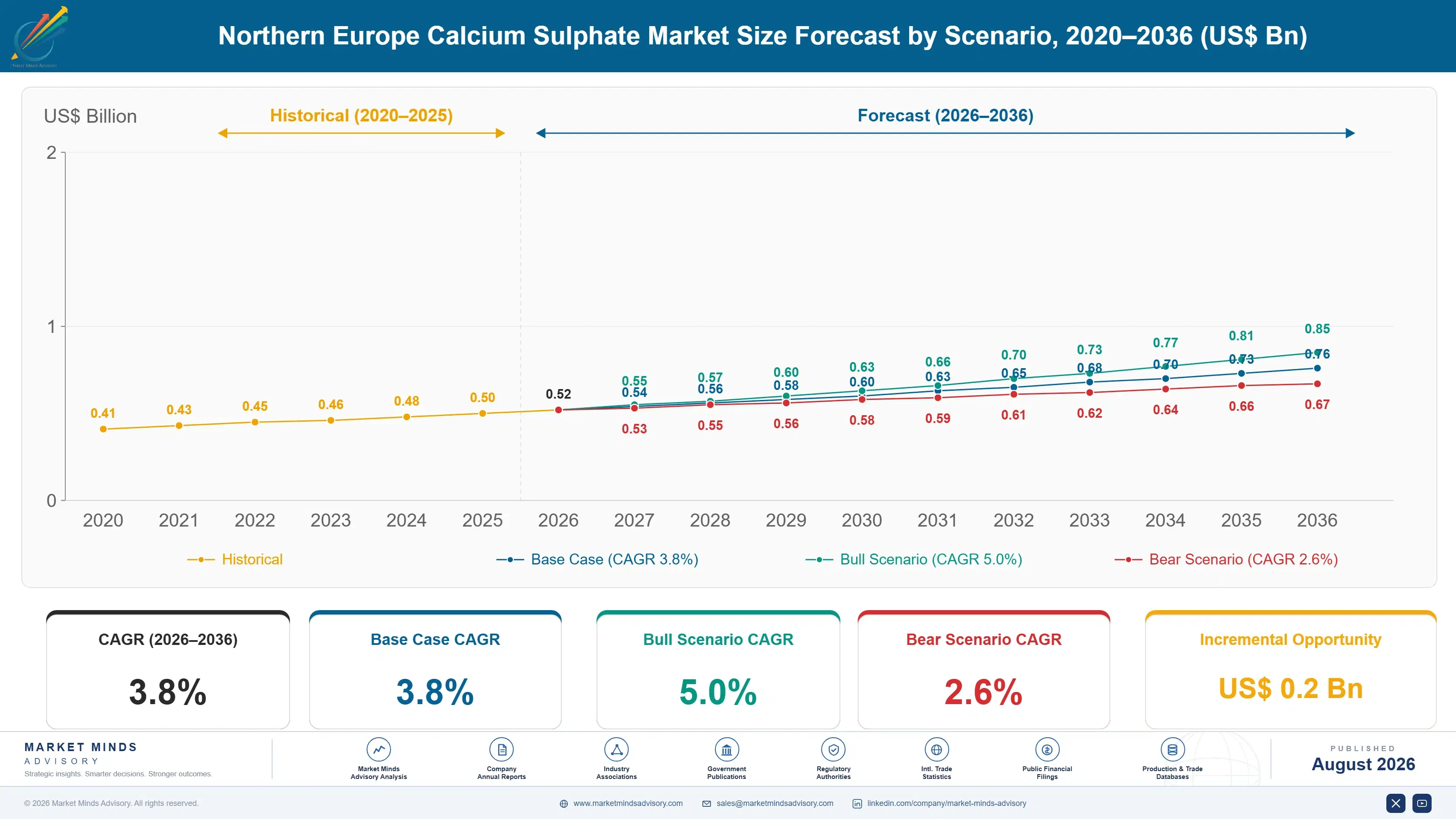
Northern Europe Calcium Sulphate Market Forecast Scenarios

northern-europe-calcium-sulphate-market-size-forecast-scenario-1787311445004
Between 2020 and 2025 demand grew steadily as Nordic residential construction recovered from pandemic-era disruption and accelerated further from 2022 as renovation activity expanded across Sweden and Denmark, implying roughly 3.3% historical annual growth over the period as measured against comparable building material production data. Regional shipment data confirms this steady acceleration pattern across most producing facilities.
The base case assumes continued growth anchored in three commercial mechanisms: plasterboard manufacturers incorporating calcium sulphate into residential and commercial construction board as renovation activity expands across the region, flue gas desulfurization operators supplying increasing volumes of synthetic by-product material as coal-fired power capacity is phased toward cleaner alternatives, and food-grade demand growing steadily alongside processed food manufacturing. Together these mechanisms sustain above-trend demand even where broader construction spending slows periodically across the region.
A bull scenario centers on faster-than-expected residential renovation activity across additional Nordic housing categories, lifting plasterboard-grade volumes sharply above current planning assumptions. The bear case involves slower-than-expected construction activity tied to softer housing market demand, which would push several announced production capacity expansions beyond their original commissioning schedules and soften near-term demand growth across nearly every producing facility in the region.

Plasterboard Demand Anchors a Concentrated Nordic Market

Flue gas desulfurization by-product recovery is broadening calcium sulphate's supply base well beyond traditional natural gypsum quarrying, even as quarried volume continues supplying the majority of demand, since power utilities operating desulfurization units increasingly supply synthetic material meeting plasterboard manufacturer purity specifications at competitive cost. Newer recovery facilities also carry stricter documentation requirements than older, less certified quarrying operations c
MARKET CONCENTRATION (CR5)68%highly concentrated supplier base across the whole region
AVERAGE SELLING PRICE TREND+2.9% p.a.food-grade formulations commanding a steadily rising price premium
TOP PRODUCING COUNTRY SHARESweden, 34%largest construction and specialty chemical processing base regionally
PLASTERBOARD APPLICATION SHARE58%plasterboard applications remain the dominant demand category regionally
FGD BY-PRODUCT VOLUME SHARE41%share of supply sourced from flue gas desulfurization recovery
FOOD-GRADE VOLUME PENETRATION9%share of volume meeting food and pharmaceutical purity standards
Commercial activity increasingly rewards suppliers who can demonstrate consistent whiteness grade and low heavy metal content over suppliers competing purely on unit price, a shift that favors integrated processors with dedicated quality testing capability and established relationships with plasterboard manufacturer and food-grade regulatory bodies across Nordic jurisdictions. Suppliers without documented purity consistency increasingly struggle to win the largest contracts available regionally.
Over the next decade, residential renovation activity pace, coal-fired power plant phase-out timelines, and food-grade demand trends will determine which application categories capture the fastest incremental revenue pools within this market as buyers continue diversifying calcium sulphate sourcing across natural and synthetic supply routes, reshaping capital allocation priorities across most established producers over the coming years. Suppliers acting decisively now stand to capture durable share across the regional market.
"Calcium sulphate in the Nordics used to mean one thing: gypsum board. Now the flue gas by-product stream is reshaping who supplies whom, and at what price."
Director, Building Materials and Industrial Minerals Practice · MMA Construction

Market Trends

Power Utilities Scaling Flue Gas Desulfurization By-Product Supply

Power utilities operating flue gas desulfurization units across Sweden and Denmark are increasingly scaling synthetic calcium sulphate by-product supply to plasterboard manufacturers as coal-fired generation capacity is phased toward cleaner alternatives under national energy transition programmes. Published building material industry data documenting synthetic gypsum's role in plasterboard manufacturing has expanded meaningfully since 2022, and several utilities have begun supplying dedicated long-term volumes to plasterboard makers reaching commercial scale across multiple facilities currently expanding their construction board manufacturing capacity regionally, with several suppliers reporting strong order backlogs. Regional buyers increasingly favor documented synthetic supply over variable-quality quarried alternatives.
Market Impact: Adds demand across 9 plasterboard f

Food and Pharmaceutical Manufacturers Requiring Documented Purity Grades

Food and pharmaceutical manufacturers are increasingly requiring documented purity and low heavy metal content calcium sulphate for tablet binder and food additive formulations used across Nordic processed food and pharmaceutical manufacturing. Food-grade formulation requirements have tightened steadily since 2022 across major Nordic manufacturing regions, and each new pharmaceutical generation typically requires materials meeting tighter whiteness and heavy metal content specifications that generic construction-grade material cannot reliably match, pushing several buyers toward certified specialty suppliers with dedicated quality programmes. Distributors serving mid-sized pharmaceutical buyers report growing demand for documented purity certificates as a purchasing prerequisite.
Market Impact: Adds supply across 5 desulfurizatio

Market Opportunities and Growth Drivers

Residential Renovation Activity Driving Plasterboard Demand Across Nordics

Residential renovation activity is expanding steadily across Sweden, Norway, and Denmark as aging housing stock requires upgraded interior wall systems, driving substantial plasterboard demand that requires dedicated calcium sulphate supply relationships with producers capable of meeting large-scale commercial volumes. Regional renovation permit data has grown consistently since 2021, and each new renovation wave typically specifies plasterboard systems meeting strict fire resistance and acoustic performance specifications that generic construction board cannot reliably satisfy across large-scale continuous manufacturing operations regionally, forcing suppliers to scale accordingly. Several manufacturers have announced expansion plans explicitly tied to anticipated renovation demand across the region.
Market Impact: Threatens 41% of current supply vol

Coal Power Phase-Out Expanding Synthetic Gypsum Supply Volumes

National energy transition programmes phasing out coal-fired power generation are paradoxically expanding synthetic gypsum supply volumes in the near term, as remaining desulfurization units increase output before eventual plant closures across the region. Announced desulfurization capacity utilization has grown steadily since 2023, and each remaining coal facility typically supplies synthetic calcium sulphate meeting strict purity and moisture content specifications that plasterboard manufacturers increasingly prefer over variable-quality quarried material across demanding construction board applications regionally. Utilities increasingly favor long-term supply agreements over spot sales as closure timelines approach across the sector.
Market Impact: Limits new quarrying permits by 25%

Market Restraints and Challenges

Eventual Coal Plant Closures Threatening Long-Term Synthetic Supply

Eventual coal-fired power plant closures under national energy transition timelines threaten to eliminate synthetic calcium sulphate by-product supply over the coming decade, creating long-term sourcing uncertainty for plasterboard manufacturers that have come to rely on this cost-competitive material stream. The root cause is the deliberate, policy-driven wind-down of coal-fired generation capacity across Nordic energy policy. Some manufacturers are pursuing dual-sourcing strategies that blend natural gypsum quarrying capacity with synthetic supply to manage this long-term transition risk across their procurement portfolios. Industry analysts expect this transition risk to intensify as national closure timelines firm up over the coming years.
Market Impact: Lifts FGD share to 41%

Quarrying Permit Restrictions Limiting Natural Gypsum Expansion

Environmental permitting restrictions on new natural gypsum quarrying sites across Sweden and Norway have tightened since 2022 due to land use conflicts and habitat protection requirements, creating capacity constraints that producers struggle to offset through existing site expansion alone. The root cause is growing environmental advocacy around quarrying's landscape impact in protected Nordic regions. Several producers are exploring synthetic supply diversification and longer-term utility partnership agreements to reduce quarter-to-quarter supply volatility across their building material product portfolios. Analysts expect this permitting pressure to persist as long as current environmental policy priorities remain in force regionally.
Market Impact: Adds 6% food-grade demand across No
3 additional market trends, 4 additional growth drivers, and 3 additional restraints and challenges are covered in the full report. Contact sales@marketmindsadvisory.com to access the complete intelligence.

Segment CAGR and Growth Architecture

The market is segmented by application, the classification that best reflects how buyers actually specify and procure calcium sulphate, since purity grade, whiteness requirements, and processing method follow end-use application rather than production source or distribution channel considerations across most purchasing decisions made today. This lens applies consistently throughout. This framework governs the analysis throughout the entire report.
northern-europe-calcium-sulphate-market-market-share-analysis-1787311445609

Food and Pharmaceutical Grade Applications

Food and pharmaceutical grade applications are the fastest-growing category as Nordic processed food and pharmaceutical manufacturers increasingly specify high-purity calcium sulphate for tablet binder and food additive formulations requiring documented whiteness and heavy metal content certification. These formulations require extensive quality testing documentation that generic construction-grade suppliers without dedicated purification capability cannot reliably provide. Demand is concentrated among specialty chemical processors and pharmaceutical ingredient suppliers scaling production to serve expanding Nordic food and pharmaceutical manufacturing markets. Suppliers with established high-purity processing and quality documentation capability are capturing disproportionate share of new supply contracts, since certification depth increasingly determines which suppliers qualify for premium food-grade procurement programmes as regulatory scrutiny intensifies.
CAGR 6.2%

Flue Gas Desulfurization By-Product Processing

Flue gas desulfurization by-product processing is growing quickly as power utilities across Sweden and Denmark scale synthetic calcium sulphate supply to plasterboard manufacturers ahead of eventual coal plant closure timelines under national energy transition programmes. Conventional natural gypsum quarrying represents an established and much larger volume category, while synthetic by-product processing represents a smaller but faster-growing category tied to near-term utility supply economics. Suppliers differentiate through documented purity consistency and moisture content control across large production volumes, plus technical support helping plasterboard manufacturers navigate specification changes between natural and synthetic supply sources, a capability increasingly valued by manufacturers managing multi-source procurement strategies. Producers investing early in dual-source qualification are positioned to capture a growing share of long-term contracts.
CAGR 5.4%
Full segment breakdown across 5 segments available in the complete report.

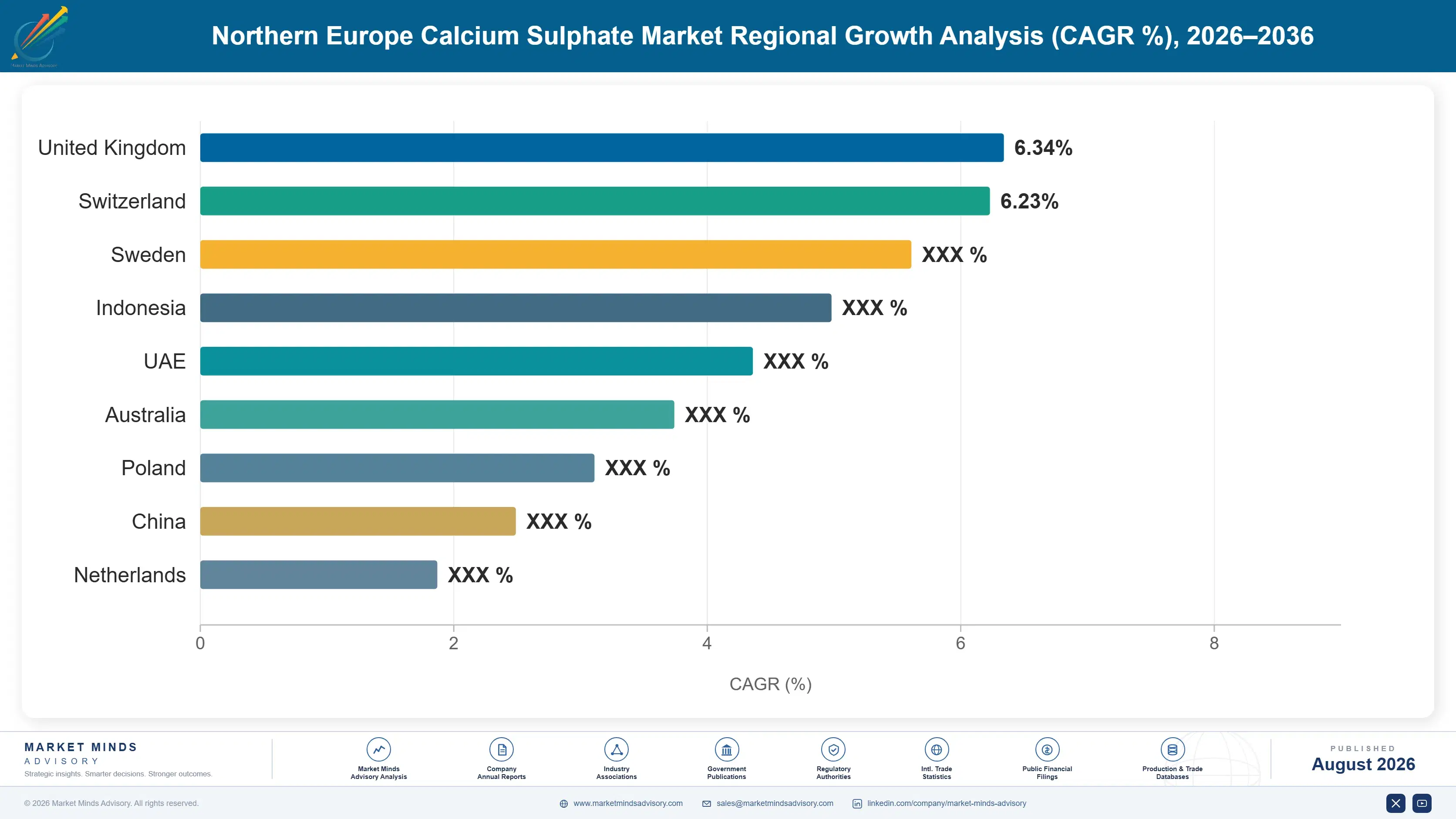
Regional Architecture and Country Demand Map

Western Europe dominates this Northern European market entirely through Nordic production and consumption, while South Asia and Pacific posts the fastest growth from a minimal base tied to isolated specialty trade flows through 2036. Nordic quarrying and synthetic supply together define regional production, with all other regions reflecting incidental trade.

North America

North American demand within this Northern European scoped market consists almost entirely of small specialty trade flows, primarily high-purity food-grade calcium sulphate exported from Swedish processors to United States pharmaceutical ingredient buyers seeking documented Nordic quality standards. [House justification: North America sits far below the standard 22 to 32% band because this report's scope is explicitly Northern Europe, so North American revenue reflects only incidental export trade rather than domestic production or consumption within the region.] Canadian demand remains negligible, limited to occasional specialty chemical trial shipments. These flows are expected to grow steadily but remain a minor share of total regional revenue. United States pharmaceutical buyers increasingly value the documentation depth that Nordic suppliers provide compared to domestic alternatives.
Share: 2% | CAGR: 4.0% (2026 to 2036)

Western Europe

Sweden anchors this market overwhelmingly, hosting the largest concentration of both natural gypsum quarrying and flue gas desulfurization by-product processing capacity in the Nordic region, supplying plasterboard manufacturers across Scandinavia and the Baltic states. Norway and Denmark contribute substantial secondary volume, each hosting domestic plasterboard manufacturing facilities requiring steady calcium sulphate procurement tied to residential renovation activity. Finland's demand grows more moderately, reflecting a smaller domestic construction sector relative to its Scandinavian neighbors. Iceland contributes minimal volume given its small population. [House justification: Western Europe sits far above the standard 18 to 26% band because this report's scope is explicitly Northern Europe, so Nordic production and consumption together account for nearly the entire addressable market.]
Share: 89% | CAGR: 2.5% (2026 to 2036)
Regional intelligence for 5 additional markets available in the complete report: East Asia, South Asia and Pacific, Latin America, Middle East and Africa, Eastern Europe. Contact sales@marketmindsadvisory.com.
northern-europe-calcium-sulphate-market-country-cagr-analysis-1787311446150

Converting Purity and Supply Security Into Contracts

Suppliers that treat purity documentation and synthetic supply diversification as differentiators rather than cost centers are capturing disproportionate share of new plasterboard and food-grade contracts. The levers below outline where documentation depth translates most directly into premium pricing and durable relationships. That certification and supply security depth increasingly determines which suppliers win the largest long-term agreements.

Bundling Purity Certification With Food-Grade Supply Contracts

Suppliers who pair food-grade calcium sulphate supply with documented whiteness and heavy metal content data reduce a pharmaceutical manufacturer's internal qualification workload substantially when introducing new formulations, creating a service advantage that pure material suppliers cannot match. This approach has let leading suppliers command price premiums of roughly 22 to 30% above standard construction-grade pricing on food-grade contracts, since formulators value the reduced qualification risk more than marginal per-unit cost differences across comparable product specifications available each cycle. This dynamic is expected to strengthen further as more pharmaceutical manufacturers formalize documented qualification requirements across their supplier networks.
Market Impact: Adds 22 to 30% pricing premium on c

Diversifying Between Natural Gypsum and Synthetic Supply Routes

Suppliers investing in dual-sourcing capability spanning both natural gypsum quarrying and flue gas desulfurization by-product processing are capturing disproportionate share of long-term plasterboard contracts, since this segment increasingly requires supply security against eventual coal plant closures. Companies with established dual-sourcing capability report contract renewal rates above 82% on plasterboard accounts, compared to notably lower renewal rates among suppliers relying solely on a single supply route without comparable diversification available each cycle. Distributors relying on a single supply route increasingly struggle to retain accounts once buyers experience the security gap firsthand.
Market Impact: Lifts renewal rates above 82% for p

Securing Long-Term Utility Partnerships for Synthetic Supply

Building long-term partnership agreements with power utilities operating flue gas desulfurization units secures cost-competitive synthetic supply volumes ahead of eventual plant closure timelines, which matters disproportionately for plasterboard manufacturers running continuous production schedules that cannot tolerate sudden supply disruptions. Suppliers with formalized utility partnerships have secured contracted volumes worth roughly $38 million annually since 2023, positioning themselves ahead of competitors lacking comparable long-term supply security nationwide. Several report shorter negotiation cycles once relationships are established. These relationships also provide preferential access during periods of tight regional supply. Rival suppliers without such agreements face growing allocation risk industry-wide.
Market Impact: Secures roughly $38 million in fres

Developing Next-Generation Purification for Pharmaceutical Applications

Suppliers who develop next-generation purification technologies ahead of pharmaceutical purity requirements capture premium pricing from formulators seeking lower heavy metal content and finer whiteness control while retaining the reliability advantages of proven processing architectures. Early movers in purification development have captured meaningful share of premium contracts previously reserved for costlier imported alternative sources, positioning themselves ahead of competitors relying solely on conventional purification formats currently available regionally. Early purification innovators have captured roughly 7 percentage points of premium formulation share within just two qualification cycles. Buyers increasingly favor suppliers with visible purification roadmaps when evaluating long-term contract commitments.
Market Impact: Captures 7 percentage points of pre

Who Controls the Margin Pool

This market carries high concentration, with the top five producers holding roughly 68% combined share on a production capacity basis, reflecting the scale economics and permit access required to compete in both natural gypsum quarrying and synthetic by-product processing across a geographically compact Nordic region. The gap between leading multinational board makers and smaller regional processors remains substantial, though it is narrowing gradually as synthetic supply diversification acceler
Current competitive activity centers on three dimensions: securing long-term utility partnerships for synthetic by-product supply, expanding food and pharmaceutical grade purification capability to serve growing specialty demand, and defending existing natural gypsum quarrying permits against tightening environmental restrictions. Several producers are also consolidating smaller regional quarrying operations to defend overall market position.

Emerging pressure comes from smaller Baltic and Finnish processors scaling production to serve nearby cross-border plasterboard demand at lower cost than established multinational suppliers, gradually eroding share in commodity-grade categories while multinational leaders retreat toward higher-margin food-grade and premium plasterboard segments where technical differentiation still commands premium pricing. Rankings among mid-tier suppliers are shifting fastest as synthetic supply access becomes a stronger competitive differentiator.
northern-europe-calcium-sulphate-market-company-positioning-matrix-1787311446674

Competitive Moat and Risk Dimensions

SAINT-GOBAIN (GYPROC)

Moat: Integrated Nordic Manufacturing Scale

Saint-Gobain's Gyproc brand operates the largest integrated plasterboard manufacturing network across the Nordic region, giving it purchasing scale and logistics efficiency that smaller competitors cannot match. Its established relationships with Swedish and Norwegian quarrying operators support consistent supply even during periods of regional permit tightening and cost pressure across most quarters.
SAINT-GOBAIN (GYPROC)

Risk: Coal Phase-Out Supply Exposure

Saint-Gobain's reliance on flue gas desulfurization by-product supply for a meaningful share of its Nordic plasterboard production leaves it exposed to eventual coal plant closures under national energy transition timelines. This exposure will require substantial natural gypsum quarrying capacity investment or synthetic supply substitution over the coming decade.
KNAUF

Moat: Diversified Multi-Country Supply Base

Knauf's diversified supply base spanning multiple Nordic and Baltic countries gives it resilience against localized permit restrictions or supply disruptions that narrower single-country competitors cannot match. Its established cross-border logistics network supports flexible allocation across plasterboard manufacturing facilities serving the broader Northern European region. This flexibility has proven valuable amid recent permit tightening across several Nordic jurisdictions.
KNAUF

Risk: Cross-Border Logistics Cost Exposure

Knauf's cross-border supply model carries meaningfully higher transportation and logistics costs than single-country competitors sourcing entirely domestic material, limiting its ability to compete on price against smaller regional processors with shorter, cheaper supply chains serving nearby local markets. Competitors with concentrated, single-country supply chains can occasionally undercut Knauf on price in nearby local markets.

Players Tracked

Prominent Players

Saint-Gobain (Gyproc)
Knauf
Etex Group
Forterra Building Products
Siniat

Other Key Players

Norgips
Gyprex
Fermacell
Danogips
Rigips
Cementa
Nordkalk
SMA Mineral
Franzefoss Minerals
Norwegian Crystallites
Sibelco Nordic
Omya Nordic
Ardex Nordic
Weber Saint-Gobain
Paroc Group

Recent Developments

MARCH 2026

Saint-Gobain Signs Long-Term Synthetic Gypsum Supply Agreement With Swedish Utility

Saint-Gobain signed a multi-year synthetic calcium sulphate supply agreement with a Swedish power utility operating flue gas desulfurization capacity, securing dedicated volumes ahead of eventual plant closure timelines. The agreement was a long-term supply contract, not a joint venture, given rising supply security concerns. Buyers welcomed it.
Signal: Long-term synthetic supply agreements are
NOVEMBER 2025

Knauf Expands Food-Grade Purification Capacity in Norway

Knauf commissioned an expanded food-grade calcium sulphate purification line at its existing Norwegian facility, targeting growing demand from pharmaceutical and food additive manufacturers seeking documented purity. The expansion positions the facility among the largest food-grade sites in the region. Analysts noted the deal strengthens Nordic pharmaceutical supply chains.
Signal: Food-grade purification capacity is a stra
JULY 2025

Etex Group Acquires Minority Stake in Finnish Quarrying Operator

Etex Group acquired a minority equity stake in a Finnish natural gypsum quarrying operator, gaining preferential access to regional raw material supply amid tightening permit restrictions. The transaction was a minority equity stake, supporting Etex's long-term raw material strategy. The deal strengthens supply security amid growing regional permit uncertainty.
Signal: Minority stakes in quarrying operators are

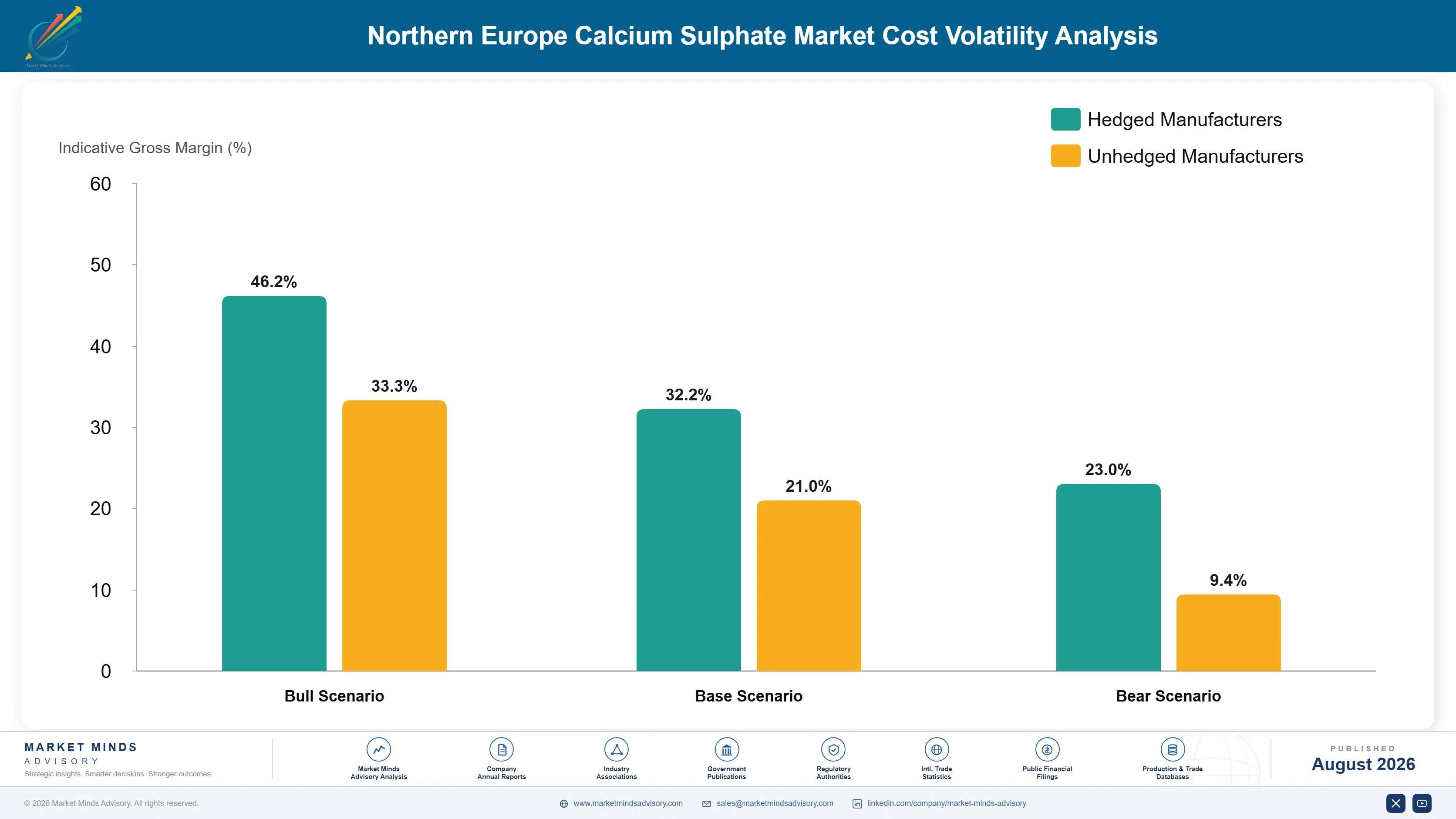
Quarrying and Energy Cost Exposure

Quarrying and extraction energy costs together represent roughly 39% of production cost of goods sold for natural gypsum material, with transportation and processing energy accounting for a further meaningful share for synthetic by-product material. Most Nordic production draws power from regional hydroelectric and nuclear grids, giving producers a comparatively favorable carbon footprint relative to other European regions.
Energy price spikes tied to reduced hydroelectric reservoir levels during 2022 drove sharp temporary increases in Nordic industrial processing costs, a volatility event documented in Eurostat data and company annual reports. Several producers reported elevated processing costs during this period as regional electricity pricing spiked amid reduced hydropower generation, compressing margins for several consecutive quarters before conditions gradually normalized through 2023 and into 2024. Buyers reported difficulty securing consistent volumes during this window, prompting several to pursue dual-sourcing arrangements.

This cost exposure disadvantages smaller regional quarrying operators lacking long-term energy supply agreements or access to synthetic by-product material, since they must absorb electricity price spikes immediately during periods of hydropower variability. Larger integrated producers with diversified energy sourcing and utility partnerships for synthetic supply weather volatility more smoothly, widening the competitive gap during disruption periods across most producing regions currently.
northern-europe-calcium-sulphate-market-cost-volatility-analysis-1787311446876

Securing Long-Term Renewable Energy Supply Contracts

Leading producers are signing long-term renewable energy supply contracts to reduce exposure to hydroelectric reservoir variability while simultaneously supporting low-carbon production documentation increasingly demanded by construction buyers. This approach has reduced average energy cost volatility for several major producers over the past two years, becoming standard practice. This practice is now standard across most major facility planning decisions.

Diversifying Supply Between Natural and Synthetic Sources

Larger producers are diversifying supply between natural gypsum quarrying and flue gas desulfurization by-product processing to reduce dependence on any single cost-exposed extraction method. This approach has helped several producers avoid the sharpest cost spikes experienced by single-source competitors, with contracts typically spanning two to four years. Coverage terms typically extend across a meaningful share of annual volume.

Investing in Energy-Efficient Processing Equipment Upgrades

Several producers are investing in energy-efficient processing equipment upgrades across existing quarrying and purification facilities to reduce electricity consumption per tonne processed, cutting both cost exposure and carbon intensity simultaneously. This upgrade cycle remains gradual but is expanding steadily across most major Nordic production facilities currently. This upgrade cycle remains gradual but is expanding steadily across most facilities currently.

Portfolio Architecture for Margin Defence

Portfolio economics split across three tiers. Volume commodity-adjacent plasterboard-grade calcium sulphate carries thin margins driven by energy cost pass-through and intense regional price competition, while premium food and pharmaceutical grade material qualified for tablet binder and additive applications commands meaningfully higher gross margins reflecting purity complexity and the certification barriers competitors must clear to enter these lucrative categories in the first place.
The tension between volume and premium positioning defines producer strategy across the region today. Commodity plasterboard-grade volume remains large but price-competitive, while premium food-grade and advanced construction-grade offerings represent a smaller but faster-growing and higher-margin pool that rewards producers with dedicated purification capability and quality documentation across their expanding customer base regionally, a gap that keeps widening each year.

High-value margin pools concentrate specifically in food and pharmaceutical grade material, documented low-carbon plasterboard supply for sustainability-conscious construction buyers, and long-term utility partnership agreements bundled with supply security guarantees, where technical and regulatory differentiation remains highest relative to commodity plasterboard-grade categories sold mainly on price across the regional market. Suppliers investing early in these categories are positioning themselves for durable margin advantages over the coming decade.

Volume / Commodity-Adjacent Tier

Standard plasterboard-grade calcium sulphate sold mainly on price to construction board manufacturers, carrying thin, energy-sensitive margins nationwide currently. Suppliers here compete mainly on cost efficiency and reliable delivery rather than technical differentiation or premium positioning.
Gross Margin: 12-18%

Premium / Certified Tier

Documented low-carbon and premium construction-grade material meeting sustainability certification requirements, commanding steadier premium pricing from demanding regional buyers. Suppliers in this tier typically invest meaningfully in quality documentation and customer technical support capability.
Gross Margin: 20-27%

Sustainability / Regulatory / Next-Generation Tier

Food and pharmaceutical grade material capturing purity leadership and supply security premiums from demanding specialty buyers seeking documented certification. Suppliers here differentiate through certification depth and documented purity rather than volume or price competition.
Gross Margin: 30-38%
northern-europe-calcium-sulphate-market-portfolio-architecture-1787311447384

High-value Sub-segments and Strategic Watch-out

Food and Pharmaceutical Grade Material

Highest-value, fastest-growing pool tied directly to Nordic pharmaceutical and processed food production, commanding premium pricing on documented purity records across most qualified producer relationships regionally today. Suppliers here are investing heavily to defend early qualification advantages against fast-following competitors. Demand here shows little sign of slowing across most accounts.
Gross Margin: 32-40%

Flue Gas Desulfurization Synthetic Supply

High-value pool growing steadily alongside near-term coal capacity utilization, anchored in long-term utility partnership agreements that reward supply security over pure price competition overall. Suppliers with established utility relationships hold a durable advantage in this category. Growth here tracks coal closure timelines closely. Utility ties matter most here.
Gross Margin: 18-25%

Conventional Nordic Plasterboard Volume

Largest volume core segment, price-competitive and energy-exposed, generating steady but comparatively low-margin revenue across mature regional production capacity nationwide, with limited room for differentiation. Suppliers here must optimize logistics and processing efficiency to protect already-thin operating margins. Volume growth here remains steady but unspectacular. Efficiency matters here.
Gross Margin: 12-17%

Coal Plant Closure-Dependent Supply Streams

Strategic watch-out segment facing existential exposure to eventual coal plant closures under national energy transition timelines; producers reliant on synthetic supply face ongoing supply continuity risk. Suppliers with diversified sourcing are better positioned to weather this exposure than single-source competitors. Regional diversification is now a top priority.
Gross Margin: 10-15%

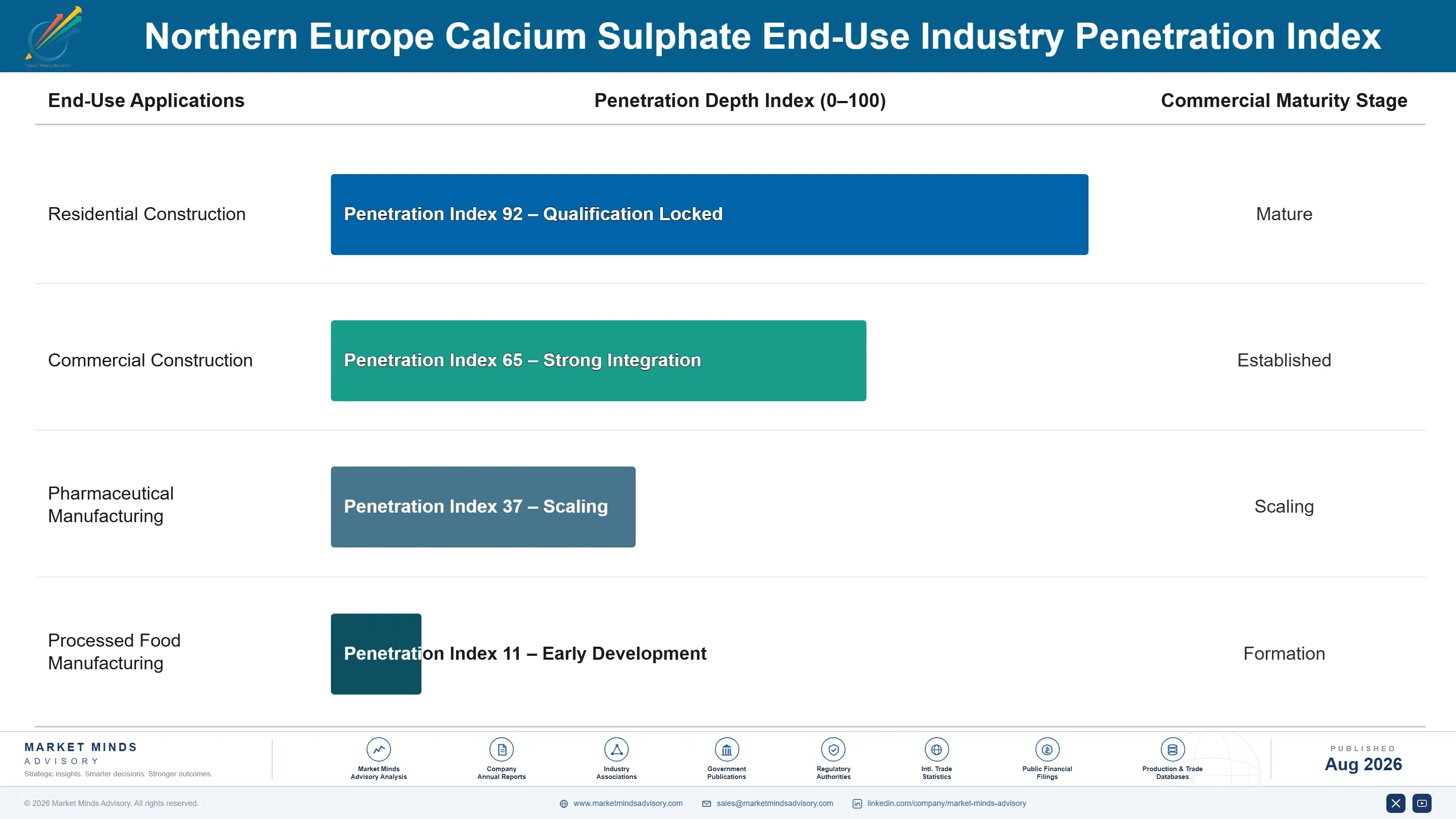
Supply Contract Cycles and Purity Stickiness

Calcium sulphate demand behaves like an annuity once a supplier is qualified on a plasterboard manufacturer's or pharmaceutical buyer's approved vendor list, since switching suppliers requires re-validating purity and moisture content documentation, a process most manufacturers avoid unless forced by persistent cost or supply reliability problems with their existing supplier relationship overall. That stickiness reinforces the durability of established supplier relationships across most accounts
Adoption stickiness varies meaningfully by end-use vertical. Pharmaceutical and food-grade formulators show the deepest stickiness given strict purity certification and multi-year platform cycles, while general plasterboard buyers show more moderate stickiness tied to periodic competitive tendering and price-driven switching, and cement retarder buyers show intermediate stickiness that strengthens considerably once a supplier proves reliable consistency over consecutive delivery cycles across most facilities operating today.

A generational shift in buyer profiles is underway as plasterboard manufacturer and pharmaceutical procurement teams increasingly include dedicated sustainability and supply security specialists rather than relying solely on general purchasing staff, changing how suppliers must present documentation during the qualification and renewal process across most large accounts and long-standing producer relationships regionally. This shift rewards suppliers able to present rigorous, quantified technical evidence consistently.
northern-europe-calcium-sulphate-market-end-use-penetration-index-1787311447875

Where Purity Beats Commodity Price

These are among the four positions where our research anticipates prominent divergence between winners and laggards over the coming forecast period. Each is grounded in the demand model, the regulatory perimeter, and the announced capacity pipeline.
01 / FOOD-GRADE CERTIFICATION INVESTMENT

Prioritize food-grade purification ahead of demand growth

Suppliers who invest early in food and pharmaceutical grade purification capability and secure documented purity certification will capture a disproportionate share of the fastest-growing specialty demand tied to Nordic pharmaceutical and processed food manufacturing through the coming decade. Waiting until formulation decisions are finalized risks losing qualification slots to faster-moving competitors who have already built the necessary testing and purification infrastructure. Early movers can also charge meaningful premiums for documented qualification speed that slower competitors cannot yet offer at scale.
02 / SYNTHETIC SUPPLY DIVERSIFICATION

Secure utility partnerships ahead of eventual coal plant closures

Building long-term partnership agreements with power utilities operating flue gas desulfurization units secures cost-competitive synthetic supply volumes now, positioning suppliers ahead of eventual coal plant closure timelines that will otherwise eliminate this supply stream entirely across the region. This positioning matters most given how much current plasterboard supply already depends on synthetic material sourced from these facilities. Suppliers without comparable utility relationships risk losing access to cost-competitive volumes as closures accelerate, forcing costlier natural gypsum substitution across their supply chains going forward.
03 / QUARRYING PERMIT DEFENSE

Defend existing quarrying permits against tightening restrictions

Defending existing natural gypsum quarrying permits against tightening environmental restrictions protects a scarce, irreplaceable asset base that new entrants increasingly cannot replicate given growing regional permitting resistance across Sweden and Norway. This approach matters most for producers whose long-term supply strategy depends partly on natural material rather than synthetic by-product streams facing eventual phase-out under national energy policy. Producers who neglect permit renewal and environmental compliance risk losing quarrying rights to competitors willing to invest in compliance infrastructure and community relations.
04 / PORTFOLIO CAPITAL REBALANCING

Shift capital toward premium food-grade and synthetic supply lines

Commodity plasterboard-grade categories face thinning margins from energy volatility and regional price competition, while food-grade and synthetic supply security offerings provide substantially higher and more durable margins tied to certification and long-term partnership barriers competitors struggle to clear quickly. Suppliers should redirect capital expenditure toward these categories rather than defending commodity volume share against lower-cost regional competitors undercutting on price across most established accounts. This rebalancing protects long-term profitability even if it means accepting some gradual commodity volume share loss overall.

Engagement Snapshot From the Field

A live engagement with an industry participant carrying material or product regulatory and market exposure ahead of a defining policy shift, showing how our research translates into a defensible multi-year portfolio strategy.
MARKET MINDS ADVISORY · CLIENT ENGAGEMENT SUMMARY
Northern Europe Calcium Sulphate Producer Strategic Portfolio Review and Transition Roadmap 2026·Investment Scenario on Northern Europe Calcium Sulphate Exposure Evaluation 2025-26
CLIENT PROFILE
The client is a mid-sized Nordic plasterboard manufacturer expanding production capacity to serve growing residential renovation demand, with combined annual revenue in the range of $210 million (client-reported, unverified by MMA). The manufacturer faced growing uncertainty over long-term synthetic gypsum supply and sought an independent supplier diversification assessment ahead of a multi-year procurement decision. The manufacturer sought guidance ahead of a major expansion decision.
STRATEGIC CHALLENGE
The manufacturer needed to reduce reliance on a single flue gas desulfurization by-product supplier facing eventual coal plant closure while managing budget exposure to higher-cost natural gypsum alternatives. Existing supplier relationships lacked long-term supply security sufficient to support planned production expansion, creating pressure to act under a tight capacity planning timeline.
MMA APPROACH
MMA conducted a comparative supplier capability assessment covering six candidate calcium sulphate suppliers across Sweden, Norway, and Finland, evaluating supply security status, production capacity, and pricing structure across comparable contract volumes. The engagement included facility audits and review of supplier quality documentation against the specific purity requirements applicable to the manufacturer's plasterboard formulation.
KEY FINDINGS
  1. Only three of six candidate suppliers had documented long-term supply security extending beyond the next decade currently., limiting the effective supplier pool for the manufacturer's specific requirements.
  2. Blending natural and synthetic supply reduced projected total procurement risk by an estimated 30% (client-reported, unverified by MMA) versus single-source reliance., a meaningful risk reduction given the manufacturer's tight capacity timeline.
  3. Price differentials between qualified suppliers narrowed to within 12% once long-term contract volume commitments were factored into total landed cost., making supply security a more decisive factor than headline pricing alone.
  4. Two candidate suppliers lacked sufficient production capacity to guarantee delivery timelines matching the manufacturer's planned expansion schedule fully., eliminating them from consideration despite otherwise competitive commercial terms.
CLIENT PROFILE
The client is a mid-sized Nordic plasterboard manufacturer expanding production capacity to serve growing residential renovation demand, with combined annual revenue in the range of $210 million (client-reported, unverified by MMA). The manufacturer faced growing uncertainty over long-term synthetic gypsum supply and sought an independent supplier diversification assessment ahead of a multi-year procurement decision. The manufacturer sought guidance ahead of a major expansion decision.
STRATEGIC CHALLENGE
The manufacturer needed to reduce reliance on a single flue gas desulfurization by-product supplier facing eventual coal plant closure while managing budget exposure to higher-cost natural gypsum alternatives. Existing supplier relationships lacked long-term supply security sufficient to support planned production expansion, creating pressure to act under a tight capacity planning timeline.
MMA APPROACH
MMA conducted a comparative supplier capability assessment covering six candidate calcium sulphate suppliers across Sweden, Norway, and Finland, evaluating supply security status, production capacity, and pricing structure across comparable contract volumes. The engagement included facility audits and review of supplier quality documentation against the specific purity requirements applicable to the manufacturer's plasterboard formulation.
KEY FINDINGS
  1. Only three of six candidate suppliers had documented long-term supply security extending beyond the next decade currently., limiting the effective supplier pool for the manufacturer's specific requirements.
  2. Blending natural and synthetic supply reduced projected total procurement risk by an estimated 30% (client-reported, unverified by MMA) versus single-source reliance., a meaningful risk reduction given the manufacturer's tight capacity timeline.
  3. Price differentials between qualified suppliers narrowed to within 12% once long-term contract volume commitments were factored into total landed cost., making supply security a more decisive factor than headline pricing alone.
  4. Two candidate suppliers lacked sufficient production capacity to guarantee delivery timelines matching the manufacturer's planned expansion schedule fully., eliminating them from consideration despite otherwise competitive commercial terms.
RECOMMENDED STRATEGY
Phase 1: Phase 1 (Months 1 to 3): Finalize a blended supplier portfolio based on supply security status and available production capacity. Phase 2: Phase 2 (Months 4 to 8): Pilot initial blended shipments ahead of the planned production expansion launch date. Validate documentation and delivery reliability before scaling volume commitments further. Phase 3: Phase 3 (Months 9 to 14): Scale blended procurement volume while renegotiating multi-year pricing terms with qualified suppliers. Lock in multi-year terms once qualification is fully confirmed and finalized.
OUTCOME
The manufacturer adopted a blended supplier portfolio combining two natural gypsum quarrying operators with one synthetic by-product supplier, achieving supply security eligibility roughly three months ahead of the original planned timeline. Estimated annual procurement costs came in approximately 5% below initial budget projections once volume commitments were finalized (client-reported, unverified by MMA).

Frequently Asked Questions

Foundational context covering the market sizes, CAGR, scope, country, region and competition that inform every finding below. This section is provided to cover basics and most often pre-purchase conversations, answered from the MMA Primary Research Dataset.

What is the current size of the Northern Europe Calcium Sulphate Market?

The market is valued at approximately $0.45 billion in 2025. Growth is driven by expanding plasterboard demand and flue gas desulfurization by-product supply, with food-grade demand continuing to expand.

How large will the Northern Europe Calcium Sulphate Market be by 2036?

The market is projected to reach approximately $0.68 billion by 2036. Sustained residential renovation activity and specialty food-grade demand across major producing regions together drive this trajectory forward.

What is the CAGR for the Northern Europe Calcium Sulphate Market 2026 to 2036?

The market is forecast to grow at a compound annual growth rate of 3.8% between 2026 and 2036. Food-grade demand is growing considerably faster than the overall market average.

Which segment is growing fastest?

Food and pharmaceutical grade applications are growing fastest at approximately 6.2% CAGR, roughly 1.63 times the overall market rate. Growth is driven by Nordic pharmaceutical manufacturing expansion.

Who are the major companies in the Northern Europe Calcium Sulphate Market?

Leading producers include Saint-Gobain (Gyproc), Knauf, Etex Group, Forterra Building Products, and Siniat, together holding roughly 68% combined market share regionally. Regional processors make up the remainder of the market.

Which country is growing fastest?

Sweden is the fastest-growing major market at approximately 4.5% CAGR, driven by expanding construction and specialty chemical processing capacity. Norway follows closely behind across the same period.

Report Segmentation Architecture

The full report scope spans multiple orthogonal segmentation dimensions, with cross-tabulated demand data provided for each dimension pair. Coverage extends further to regional breakdowns, trend trajectories, and the competitive detail needed to support segment-level decision-making.

By Application

  • Plasterboard and Construction Board
  • Cement Retarder
  • Food and Pharmaceutical Grade
  • Agricultural Soil Amendment

By End-Use Industry

  • Residential Construction
  • Commercial Construction
  • Pharmaceutical Manufacturing
  • Processed Food Manufacturing

By Commercial Dimension

  • Direct Plasterboard Manufacturer Contracts
  • Utility Partnership Supply Agreements
  • Specialty Distribution
  • Third-Party Distributors

By Region

  • North America
  • Western Europe
  • East Asia
  • South Asia and Pacific
  • Latin America
  • Middle East and Africa
  • Eastern Europe

Scope, Methodology, and Coverage

Every figure in this report is reproducible from documented input assumptions. The scope below maps the historical period, the forecast horizon, the segmentation dimensions, and the countries covered, alongside the underlying primary and qualitative methodology.
Historical Period
2020 to 2025
Forecast Period
2026 to 2036
Base Year
2025 (USD billions; MMA Primary Research Dataset, August 2026)
Market Definition
This report covers calcium sulphate produced from natural gypsum quarrying and flue gas desulfurization by-product recovery across Sweden, Norway, Denmark, Finland, and Iceland for use in plasterboard, cement retarder, food-grade, and pharmaceutical binder applications. It excludes downstream board manufacturing and construction installation, sold and analyzed as distinct market categories.
Quantitative Units
USD billions (current prices); metric tons where volume data is available
Segmentation Dimensions
By Application; By End-Use Industry; By Commercial Dimension; By Region
Regions Covered
North America, Western Europe, East Asia, South Asia and Pacific, Latin America, Middle East and Africa, Eastern Europe
Countries Covered
Sweden, Norway, Denmark, Finland, Iceland, Estonia, Latvia, Lithuania, Poland, Germany, USA, Japan, South Korea, China, Australia, India, Brazil, Mexico, UAE, South Africa, and additional markets relevant to this sector
Key Companies Profiled
Saint-Gobain (Gyproc), Knauf, Etex Group, Forterra Building Products, Siniat, Norgips, Gyprex, Fermacell, Danogips, Rigips, Cementa, Nordkalk, SMA Mineral, Franzefoss Minerals, Norwegian Crystallites, Sibelco Nordic, Omya Nordic, Ardex Nordic, Weber Saint-Gobain, Paroc Group
Quantitative Methodology
Primary survey, n=3,800 respondents, Q4 2025, six countries; demand-side model with trade association cross-validation
Qualitative Methodology
47 expert interviews, Q4 2025; applied to validate demand model assumptions, identify emerging dynamics, and assess competitive positioning
Report Format
PDF and XLSX data workbook (Word format preview document)
Publisher
Market Minds Advisory
Report Code
MMA-2026-CON-101
Published
August 2026
Contact
sales@marketmindsadvisory.com | www.marketmindsadvisory.com

Purchase the full Northern Europe Calcium Sulphate Market Report (2026 to 2036).

The full report delivers detailed segment-level sizing across all five application categories, country-level breakdowns across the Nordic region and its trading partners, and in-depth competitive profiles covering twenty companies active in this market. It includes granular analysis of coal plant closure timelines, energy cost sensitivity modeling, and supplier qualification pathway guidance for buyers navigating supply security transitions. The report also profiles emerging purification technologies gaining early commercial traction across leading Nordic producers. Buyers also receive access to underlying data tables and a dedicated analyst briefing call.
Country-level sizing across twenty markets covered
Coal plant closure timeline tracker by facility and country
Energy cost sensitivity modeling and forecasting tools
Twenty-company competitive benchmarking profiles included throughout
Supplier qualification pathway guidance provided throughout
Dedicated analyst briefing call included at no cost

Built For The People Who Decide

From boardroom strategy to bench-side execution, this report is read cover-to-cover by leaders shaping the next decade of their industry, turning demand scenarios, market dynamics and valuation benchmarks into decisions.
CXOs/ Presidents/ VPs/ Managers
M&A and Corporate Development
Strategy Teams and R&D Heads
Procurement and Product Directors
Regulatory and Compliance Leaders
Investor Relations and Equity Analysts