

Market Minds Advisory
North America Potassium Formate Market

North America Potassium Formate Market: Return-and-reprocess economics, deicer conversion and secondary coolant growth to 2036

Most of this fluid comes back after use, gets cleaned and goes out again, which means anybody sizing the market from barrels deployed on a rig is counting the same tonnes repeatedly.

Lead Analyst

Bilal Shaikh

Published

September 2026

Make Smarter Decisions with Customized Research Insights

Request a free sample report and evaluate market opportunities, growth trends, and competitive dynamics relevant to your business needs.

2025 MARKET VALUE$0.7BMarket Size 2025
2036 FORECAST VALUE$1.3BBase Case , 2026 to 2036
CAGR 2026 TO 20365.6 %Bull 6.8% / Bear 4.4%
INCREMENTAL OPPORTUNITY$0.6BNet 10- year value creation
EXPANSION MULTIPLE1.72x2036 value over 2026 base
Strategic Levers
M&A Pipeline
Regional Outlook
Country Rankings
Competitive Intelligence
Segmental Deep-dive
Call-Us : 91 93563 13602

Executive Snapshot and Market Trajectory

Around 93% of the formate brine sent down a well comes back, gets cleaned and goes out again. About 62% of supply moves under return and reprocess terms rather than outright sale. Consumption is therefore a small fraction of the fluid in circulation. Barrel counts measure activity, not demand here.
Heat transfer and secondary refrigerant duty grows at 8.4%, half again the market rate of 5.6%, as supermarket and industrial refrigeration moves toward indirect systems needing a low-toxicity coolant that will not freeze or corrode. Animal feed acidifiers follow at 7.0%. North America holds 32% of value on cold-climate aviation and offshore drilling together. Western Europe follows at 26% on North Sea completions.
What the price actually buys in drilling is reservoir productivity. Potassium formate reaches 1.57 specific gravity as a clear solids-free fluid, so it holds well pressure without the weighting solids that plug the formation. In a high pressure well that difference shows up in production rates, which is why an expensive fluid keeps winning against cheap alternatives. Cheaper chloride brines keep losing these applications despite the headline cost gap. Expensive fluid keeps beating cheap ones.
Market Definition
This report covers potassium formate supplied in solid and solution grades, spanning drilling and completion fluids, airport and runway deicing, road and infrastructure deicing, heat transfer and secondary refrigerants, animal feed acidifiers, and leather textile and industrial processing. The market is assessed globally with North America as the analytical centre throughout, and value is measured at producer level on tonnage supplied on a dry equivalent basis. Excluded are sodium and calcium formate, cesium formate, formic acid sold as such, glycol and acetate deicing products, and fluid management services billed separately from the chemical.
Base Year Value
$0.7B in 2025 (MMA Primary Research Dataset, August 2026)
Forecast Period
2026 to 2036, eleven discrete annual values
CAGR
5.6% base case. Bull 6.8%. Bear 4.4%.
Fastest Growth Segment
Heat Transfer and Secondary Refrigerants: 8.4% CAGR
Fastest Growth Country
China: 7.8% CAGR
Fastest Growth Region
South Asia and Pacific: 7.4% CAGR
Largest Region
North America: 32% of 2025 global value
Market Leaders
Sinomine Specialty Fluids, Perstorp, BASF, LANXESS and ADDCON lead the market. Source: MMA Primary Research Dataset, July 2026.
Primary Survey
n=3,800 procurement and R&D decision-makers, Q4 2025, six countries
Methodology
Demand-side build-up, cross-validated against public data, 47 expert interviews

North America Potassium Formate Market Forecast Scenarios

north-america-potassium-formate-market-size-forecast-scenario-1787559316680
Growth ran at 4.6% between 2020 and 2025 and drilling activity dominated the shape of it. Offshore high pressure programmes paused through 2020 and recovered unevenly, while airport deicing volume tracked flight schedules and winter severity rather than any commercial development. Underneath both, the conversion of large airports away from urea based products continued steadily toward completion.
The 5.6% base case rests on three mechanisms. Secondary refrigerant duty at 8.4% as indirect refrigeration systems spread through food retail and industrial cooling. Animal feed acidifiers at 7.0% as formates replace antibiotic growth promoters across swine and poultry production. And Chinese growth at 7.8%, the fastest of any country, on refrigeration, feed and industrial demand expanding at once. None of those three depends on drilling activity at all, which is a considerable improvement on where this market's growth used to come from.
The 6.8% bull case is high pressure offshore drilling activity rising enough to expand the fluid pool rather than merely recirculating it. The 4.4% bear case is potassium hydroxide cost climbing on potash and chlor-alkali markets, since the alkali sits at 57% of production cost and there is very little conversion margin to absorb any of it.

The Same Tonnes, Counted Twice

Potassium formate is expensive enough per barrel that nobody throws it away, and the commercial model built around that fact confuses almost every attempt to size this market. Roughly 93% of what goes down a well comes back to be filtered, adjusted and redeployed, and about 62% of supply moves under return and reprocess arrangements rather than outright sale. The fluid a service company has in circulation is therefore many times the tonnage anybody actually produces in a year, and counting barrels deployed on rigs measures activity rather than chemical demand.
TOP-FIVE CONCENTRATION48%Combined position across supply held by the leading producers
BRINE RECOVERY RATE93%Portion of drilling fluid recovered and returned for reprocessing
MAXIMUM BRINE DENSITY1.57 sgWeight the clear solids-free fluid reaches without any additives
RUNWAY DEICER CONVERSION84%Share of large airports moved away from urea based products
POTASSIUM HYDROXIDE COST SHARE57%Portion of production cost attributable to the alkali input
FLUID RENTAL SHARE62%Portion supplied under return and reprocess terms rather than sale
The reason operators pay for it at all is physics rather than chemistry. The brine reaches 1.57 specific gravity while remaining clear and free of solids, which means it can hold back formation pressure without the barite or other weighting agents that lodge in the rock and reduce what the well produces afterwards. In a high pressure high temperature completion that difference appears directly in flow rates. The operator is buying production, and priced against production the fluid is cheap.
Away from the rig the applications are unglamorous and steadier. Airport deicing converted off urea because ammonia runoff created toxicity receiving waters could not absorb.
"People look at how much formate brine is out on rigs and conclude the market is enormous. Almost all of it has been down a well before and will go down another one. The chemical business is the top-up, the losses and the new pool, and that is a much smaller and much better business than the barrel count suggests."
Director, Oilfield Chemicals and Speciality Salts Practice · MMA Chemicals and Materials Practice · August 2026

Market Trends

Return and reprocess terms separate fluid volume from chemical demand

Roughly 93% of formate brine used in drilling and completion returns for filtering, adjustment and redeployment, and about 62% of supply moves under arrangements where the fluid is returned rather than sold outright. The consequence is that the pool in circulation vastly exceeds annual production, and demand consists of top-up, losses downhole and expansion of the pool itself. Commercially this rewards producers who operate the reprocessing rather than only the manufacture, since the recurring revenue sits in fluid management rather than in the tonnes originally supplied. Barrel counts on rigs measure activity, not chemical demand.
Market Impact: Reaches 1.57 specific gravity
Indirect refrigeration systems adopt low-toxicity secondary coolants

Food retail and industrial refrigeration is moving toward indirect architectures where a primary refrigerant charge stays in the plant room and a secondary fluid circulates to the cooling load, which sharply reduces the refrigerant inventory a site carries. Potassium formate brines suit that duty because they stay liquid at low temperature, carry heat well and present far less toxicity and corrosion risk than the alternatives. Growth at 8.4% is the fastest in this market, and adoption follows refrigeration system design decisions rather than anything happening in chemical supply. The fluid is charged once and topped up thereafter.
Market Impact: Segment compounds at 7.0% annually

Market Opportunities and Growth Drivers

High pressure completions need weight without weighting solids

Potassium formate brine reaches 1.57 specific gravity as a clear solids-free fluid, which lets an operator hold back formation pressure without barite or other particulates that lodge in the rock and cut what the well produces once it is brought online. In high pressure high temperature completions that difference shows directly in flow rates, so the operator is purchasing production rather than purchasing fluid. Priced against a well's output the brine is inexpensive, which is why cheaper chloride alternatives keep losing these applications despite the headline cost gap. Experienced operators know this without being told.
Market Impact: Conversion reaches 84% complete

Feed acidifiers replace antibiotic growth promoters in livestock

Formate salts acidify feed and suppress pathogenic bacteria in swine and poultry digestion, which made them a practical substitute as antibiotic growth promoters were withdrawn across European and increasingly American and Asian production. Growth at 7.0% follows livestock production and regulatory withdrawal together rather than any price advantage. The application is unglamorous and steady, consuming material continuously with no recovery at all, which makes it commercially different from the drilling business and considerably easier to forecast from year to year. Compounders switch supplier readily on price and specification. Volume is steady and unusually easy to forecast.
Market Impact: Alkali drives 57% of cost

Market Restraints and Challenges

Deicer conversion approaches completion at large airports

About 84% of large airports have already moved away from urea based runway products, driven by ammonia toxicity and oxygen demand in runoff that receiving waters could not absorb. The root cause of the slowdown is simply arithmetic: the conversion that drove a decade of growth is largely finished at the airports big enough to matter. Commercially this leaves remaining volume at smaller regional fields where budgets are tighter and winters shorter. Producers are pursuing road and infrastructure deicing in environmentally sensitive locations, which is a smaller and more fragmented opportunity.
Market Impact: Recovers 93% of deployed fluid

Alkali cost dominates and passes through faster than contracts

Potassium hydroxide accounts for roughly 57% of production cost and follows potash and chlor-alkali markets that have nothing to do with formate demand. The root cause is that a simple neutralisation product carries very thin conversion margin, leaving almost no capacity to absorb input movement. Commercially, annual contracts with deicing authorities and feed compounders transfer that exposure straight onto the producer. Some are moving to indexed pricing with quarterly reset, and by-product formate routes from pentaerythritol production offer a partial hedge for those with access. Neither customer type accepts mid-term adjustment readily.
Market Impact: Segment compounds at 8.4% annually
4 additional market trends, 3 additional growth drivers, and 2 additional restraints and challenges are covered in the full report. Contact sales@marketmindsadvisory.com to access the complete intelligence.

Segment CAGR and Growth Architecture

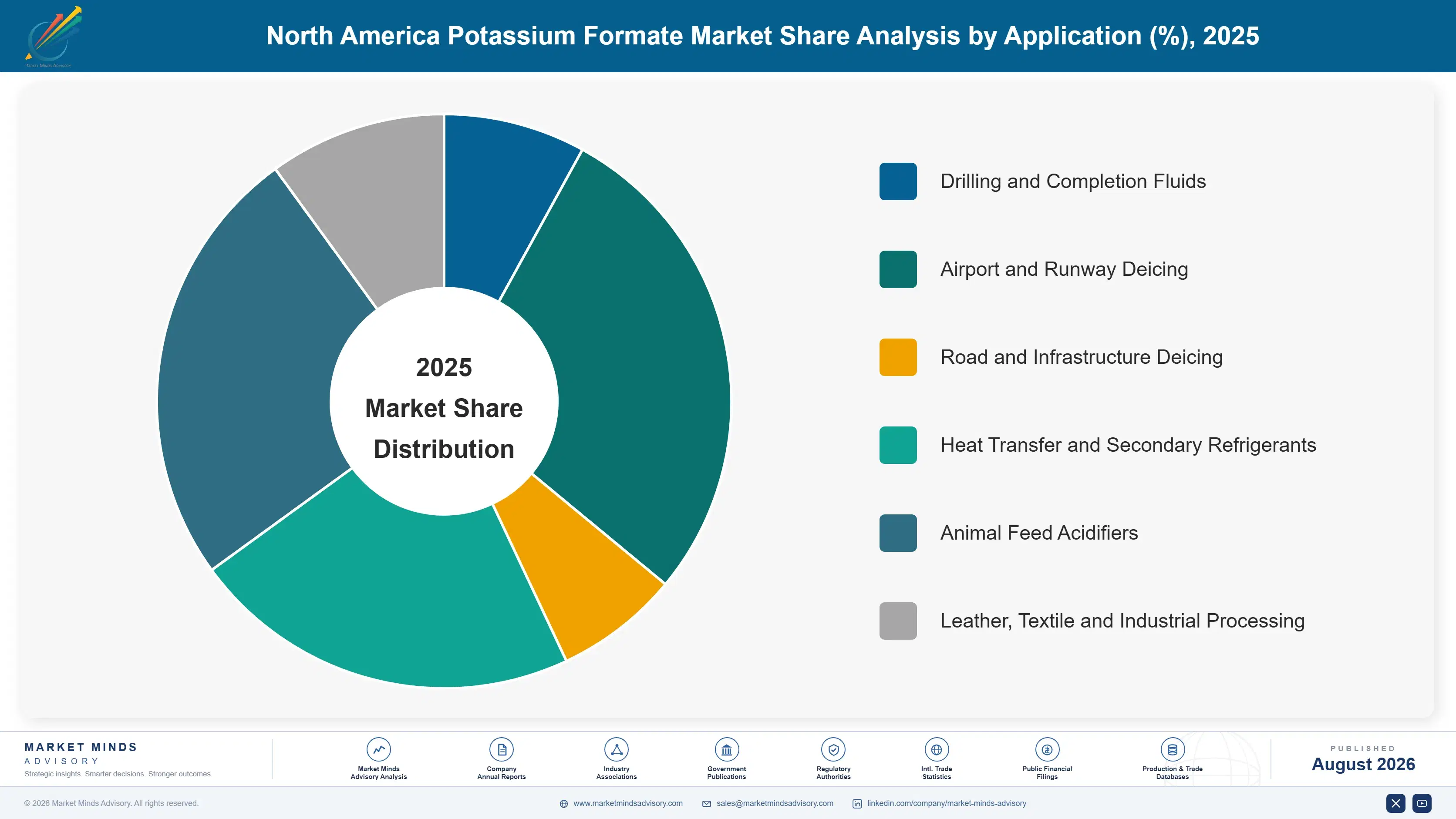
Volume is classified here by end application, since purity, concentration and commercial structure differ enormously between a completion brine returned for reprocessing and a feed acidifier consumed outright. Product form, supply arrangement and customer type are each handled separately in the framework below, because a single grade frequently serves several different applications after adjustment.
north-america-potassium-formate-market-market-share-analysis-1787559317209

Heat Transfer and Secondary Refrigerants

Growing at 8.4%, half again the market rate, potassium formate brines serve as secondary coolants in indirect refrigeration systems where a primary refrigerant charge stays confined to the plant room and a circulating fluid carries cooling out to the load. That architecture cuts the refrigerant inventory a site holds, which matters increasingly as rules tighten around what can be charged into a system. The fluid stays liquid well below freezing, transfers heat efficiently and presents far less toxicity and corrosion risk than glycol or chloride alternatives. Adoption follows refrigeration system design decisions rather than anything happening in chemical markets, and the fluid is charged once and topped up thereafter. Draining a working plant to change coolant is rare.
CAGR 8.4%

Animal Feed Acidifiers

Formate salts acidify feed and suppress pathogenic bacteria through the digestive tract, which made them a practical replacement as antibiotic growth promoters were withdrawn from European livestock production and then progressively elsewhere. Growth at 7.0% follows livestock output and regulatory withdrawal together rather than any pricing dynamic within the chemical itself. The application consumes material outright with no recovery whatsoever, which makes it commercially quite different from drilling and considerably easier to forecast year to year. Feed compounders buy on specification and price, switching readily between suppliers, so the relationships are far less durable than oilfield ones. Antibiotic withdrawal happened earliest across European production and continues progressively elsewhere. Regional adoption therefore varies far more than livestock numbers alone would predict.
CAGR 7.0%
Full segment breakdown across 6 segments available in the complete report.

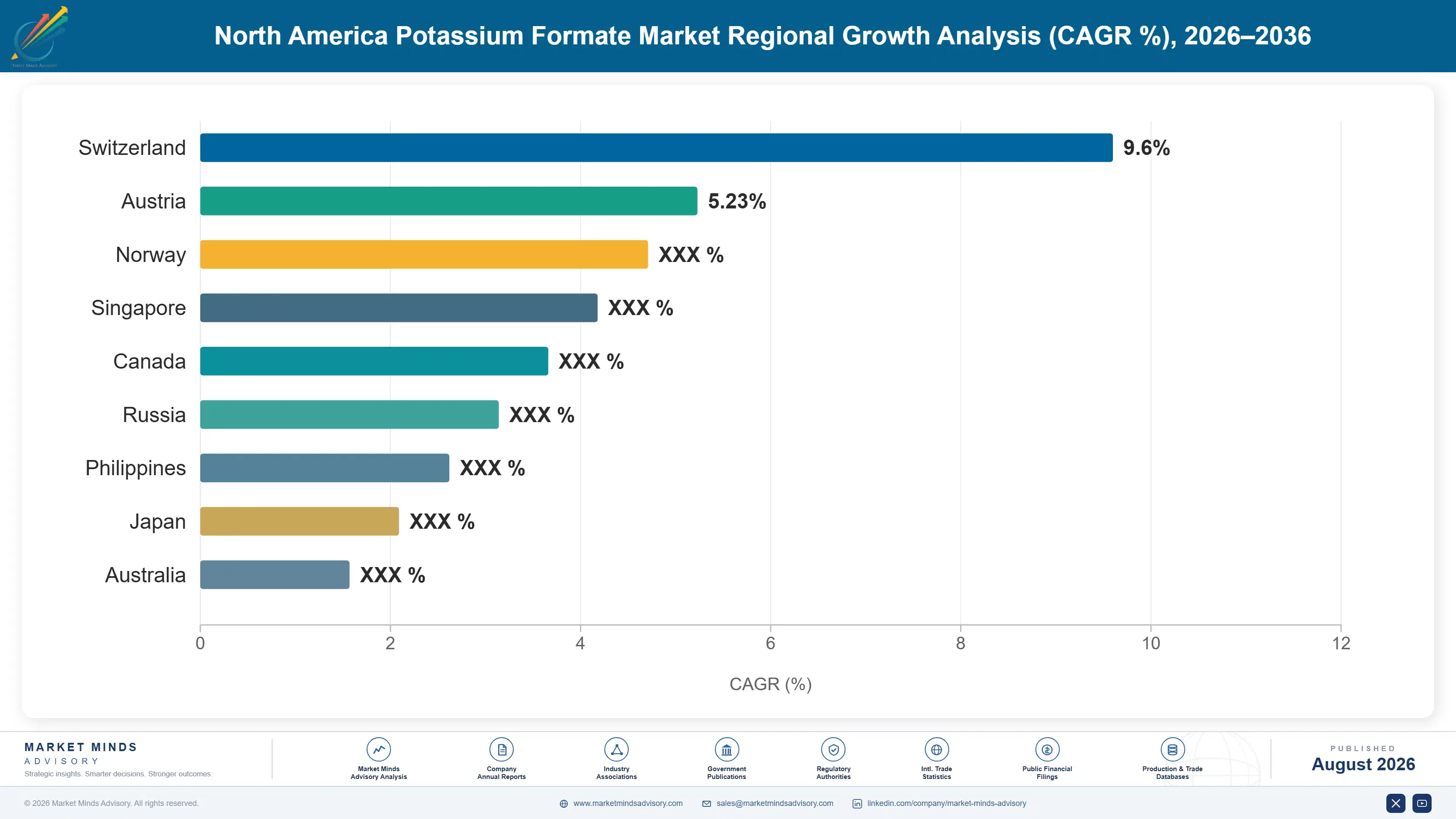
Regional Architecture and Country Demand Map

North America holds 32% of value on cold-climate aviation and high pressure offshore drilling together, which is the strongest genuine combination of applications found anywhere in this market. Western Europe follows at 26% on North Sea completions and on Nordic airport deicing operating side by side.

North America

This region leads on a combination nowhere else assembles: an extensive cold-climate airport network requiring runway deicing, high pressure offshore completions in the Gulf of Mexico, and road deicing across states where chloride runoff is restricted near water supplies. Airport conversion away from urea is roughly complete at the large fields and continues at regional ones. Fluid rental and reprocessing arrangements are well established through service companies operating out of Gulf Coast bases. Feed acidifier adoption is expanding as antibiotic withdrawal progresses. Growth at 5.8% sits close to the market rate. Secondary coolant specification is still largely unaddressed by formate producers here, with refrigeration contractors defaulting to glycol because nobody has approached them.
Share: 32% | CAGR: 5.8% (2026 to 2036)

Western Europe

North Sea high pressure high temperature completions established formate brine use commercially and remain a significant pool, though drilling activity there is mature and declining slowly. Nordic airports convert early and comprehensively on environmental grounds, and Scandinavian winters make the volumes meaningful. Perstorp and ADDCON hold strong regional production positions built from formic acid chemistry. Feed acidifier use is furthest advanced anywhere, since antibiotic growth promoter withdrawal happened here first. Growth at 4.2% is the weakest on this table and reflects mature drilling alongside completed deicer conversion. Secondary coolant adoption in indirect refrigeration is furthest advanced here, supported by refrigerant rules that reward reducing the primary charge held on any single site.
Share: 26% | CAGR: 4.2% (2026 to 2036)
Regional intelligence for 5 additional markets available in the complete report: East Asia, South Asia and Pacific, Latin America, Middle East and Africa, Eastern Europe. Contact sales@marketmindsadvisory.com.
north-america-potassium-formate-market-country-cagr-analysis-1787559317727

Where Formate Value Actually Sits

Four moves matter in a product where most of the tonnage currently in use has already been sold once and simply keeps coming back. Two concern owning the recurring economics rather than the original sale, and two concern the applications that consume the chemical outright and therefore behave much more like an ordinary chemical business.

Own the reprocessing, not only the manufacture

Around 93% of drilling brine returns for filtering and adjustment, and roughly 62% of supply moves under return and reprocess terms rather than outright sale, which places the recurring revenue in fluid management rather than in the original tonnes. A producer who manufactures and hands the fluid to somebody else's reprocessing operation captures one sale and then watches the same material generate revenue for years. Owning both ends converts a commodity transaction into an annuity attached to a well programme. Reprocessing capability is what turns a commodity sale into an annuity.
Market Impact: Captures revenue across the 93% of recovered fluid

Sell against well productivity, never against brine price

Formate brine costs several times a chloride alternative per barrel and reaches 1.57 specific gravity while staying clear and free of solids, which avoids the formation damage that reduces what a well produces after completion. Priced against the production gained, the fluid is inexpensive. Producers who quote barrel cost against cheaper brines are arguing on the only ground where they lose, and operators who have run both fluids in comparable wells already understand the difference perfectly well. Operators who have run both fluids in comparable wells understand the difference perfectly well.
Market Impact: Justifies pricing against a 1.57 specific gravity fluid

Build position in secondary coolant duty early

Indirect refrigeration architectures grow at 8.4% here as food retail and industrial cooling reduce the primary refrigerant charge held on site, and potassium formate brine suits the secondary loop better than glycol or chloride on toxicity, corrosion and low temperature behaviour together. Specification happens at system design, which means the decision is made once and the fluid is topped up for the life of the plant. Producers who reach refrigeration system designers rather than end users capture positions that persist for well over a decade. Most formate producers have never called on a refrigeration designer.
Market Impact: Serves refrigeration duty now growing at 8.4% yearly

Grow the consumed applications alongside the recovered ones

Animal feed acidifiers grow at 7.0% and consume material outright with no recovery at all, which makes the revenue behave like ordinary chemical demand rather than like a fluid pool. That predictability is genuinely valuable against a drilling business whose tonnage depends on completion activity and pool expansion. Feed compounders buy on specification and switch readily, so the margins are thinner, but the volume is steady and it fills plant capacity that oilfield demand alone leaves running unevenly. Utilisation smoothing is worth more than the margin difference suggests. Feed volume is genuinely predictable year to year.
Market Impact: Adds steady volume that is growing at 7.0%

Who Controls the Margin Pool

Five producers hold 48% of this market, measured on tonnage supplied on a dry equivalent basis, the basis used throughout this section. Concentration reflects formic acid chemistry access more than any manufacturing difficulty, since the reaction itself is straightforward neutralisation. Producers with formic acid integration or by-product formate streams from pentaerythritol manufacture hold cost positions that merchant buyers of both inputs cannot approach. Neutralisation itself presents no barrier.
Competition runs on four dimensions. Reprocessing capability, which decides whether a participant captures recurring fluid revenue or only the first sale of the tonnes. Formic acid and alkali integration, given potassium hydroxide sits at 57% of production cost. Technical support for high pressure completions, where the customer is genuinely buying well productivity. And distribution into deicing and feed channels, which look nothing whatever like oilfield selling.

Rankings shift toward participants combining manufacture with fluid management, and toward those building secondary coolant positions directly with refrigeration designers rather than end users. Service companies hold the operator relationships throughout drilling and are unlikely to surrender them. Chinese producers hold cost positions across feed and industrial grades and are expanding steadily into export markets.
north-america-potassium-formate-market-company-positioning-matrix-1787559318248

Competitive Moat and Risk Dimensions

SINOMINE SPECIALTY FLUIDS

Moat: Integrated fluid management position

The business combines formate brine supply with the reprocessing and fluid management that returns roughly 93% of deployed volume, which converts a chemical sale into recurring revenue attached to a drilling programme. Technical capability in high pressure high temperature completions supports selling against well productivity rather than against barrel cost, which is the argument that actually wins these applications.
SINOMINE SPECIALTY FLUIDS

Risk: Concentration in drilling activity

The position depends heavily on high pressure completion activity, which is cyclical and concentrated in a limited number of basins. Secondary refrigerant duty growing at 8.4% and feed acidifiers at 7.0% consume material outright and behave far more predictably. Producers with positions across both recovered and consumed applications carry considerably steadier plant loading through a drilling downturn.
PERSTORP

Moat: Formic acid chemistry integration

Integration back into formic acid and formate chemistry covers a substantial part of the input burden this product carries and supports a broad formate portfolio across feed, deicing and industrial applications. Deep positions in European feed acidifiers, established as antibiotic growth promoters were withdrawn, give the company steady consumed volume that does not depend on any drilling cycle at all.
PERSTORP

Risk: Limited fluid management participation

Recurring revenue in drilling sits with whoever reprocesses the returned brine rather than with whoever manufactured it, and around 62% of supply moves under those arrangements. A producer supplying tonnes into somebody else's fluid management operation captures the first sale only. European drilling and deicing demand is also the slowest growing on this table at 4.2%.

Players Tracked

Prominent Players

Sinomine Specialty Fluids
Perstorp
BASF
LANXESS
ADDCON

Other Key Players

Nouryon
Kemira
Shandong Baoyuan Chemical
Gujarat Narmada Valley Fertilizers and Chemicals
Zhejiang Lanxi Sanhe Chemical
Feicheng Acid Chemicals
Tianjin Zhongxin Chemtech
Anhui Asia-Pacific Chemical
TETRA Technologies
Halliburton
SLB
Clariant
Luxi Chemical
Hawkins
Shandong Rifu Chemical

Recent Developments

FEBRUARY 2025

An operator recovered a completion brine pool for redeployment

An offshore operator completed recovery and reprocessing of a formate brine pool from a finished high pressure programme, redeploying the treated fluid to a subsequent well rather than purchasing fresh volume. This was an operational decision rather than any commercial transaction between chemical producers. Volumes involved were substantial.
Signal: Recovered pools displace new tonnes entirely, which is why fluid volume and chemical demand diverge so widely
JUNE 2025

A refrigeration contractor specified formate brine on a retail programme

A refrigeration contractor specified potassium formate secondary coolant across an indirect system programme for a food retail chain, citing low toxicity and low temperature performance against glycol alternatives. This was a design specification rather than any partnership or transaction involving chemical suppliers. Glycol had been the default specification previously.
Signal: Secondary coolant decisions are made once at system design and then persist for the life of the plant
OCTOBER 2025

A producer commissioned additional potassium formate solution capacity

A chemical producer commissioned additional potassium formate solution capacity aimed at feed acidifier and industrial demand rather than oilfield supply, citing steadier consumption in applications where material is used outright. This was organic capital investment rather than any acquisition arrangement. Feed and refrigeration customers were named as targets.
Signal: Consumed applications are now being targeted deliberately to balance plant loading against genuinely cyclical drilling demand

What Sets Producer Cost

Potassium hydroxide accounts for roughly 57% of production cost and tracks potash and chlor-alkali markets that have no relationship to formate demand at all. Formic acid adds around 24%, and producers with by-product formate streams from pentaerythritol manufacture avoid a large part of that burden entirely. Reaction energy and evaporation are modest. Conversion margin is thin throughout.
Potash prices rose sharply through 2022 following supply disruption from major producing regions, and European chlor-alkali costs climbed with industrial energy prices at the same time. Perstorp noted raw material and energy cost pressure across its operations in its Annual Report 2022. Producers on annual deicing authority and feed compounder contracts absorbed most of the movement, since neither customer type accepts mid-term price adjustment readily.

The disadvantage falls on merchant producers buying both inputs, and it shows as margin volatility rather than as a persistent cost gap. A producer with formic acid integration or a by-product formate stream carries a permanently different cost base through an input spike. Smaller regional producers feel this most acutely, since they lack both integration and the purchasing scale to secure favourable alkali terms during a tight period.
north-america-potassium-formate-market-cost-volatility-analysis-1787559318442

Secure formic acid through integration or by-product streams

Formic acid at roughly 24% of cost is avoidable for producers with pentaerythritol by-product formate access or upstream integration, and that difference persists through every input cycle rather than appearing only in tight periods. Merchant buyers of both principal inputs carry the volatility twice over. The advantage compounds when alkali prices move at the same time.

Index deicing and feed contracts to published alkali benchmarks

Potassium hydroxide at 57% of cost leaves conversion margin far too thin to absorb potash and chlor-alkali movement, and annual fixed contracts transfer that exposure entirely to the producer. Indexed pricing with quarterly reset moves it back. Deicing authorities resist because their own budgets are annual, which makes this a genuine negotiation rather than a formality.

Balance plant loading between recovered and consumed applications

Oilfield demand depends on completion activity and pool expansion, which makes it lumpy and cyclical, while feed acidifiers and secondary coolants consume material outright and behave predictably. Loading a plant across both smooths utilisation considerably. Producers serving only drilling carry capital through troughs that better-balanced competitors run straight through. Utilisation smoothing is worth more than it first looks.

Portfolio Architecture for Margin Defence

Margin separates on whether a participant captures recurring fluid economics or only the original sale, which is an unusual dividing line for a salt. Industrial and leather processing grades run at gross margins in the low teens against regional producers competing on delivered cost. Feed acidifier grades run modestly better on specification and consistency requirements. Deicing supply runs better again on approval and logistics. Fluid management attached to drilling brine runs highest, because the same tonnes generate revenue repeatedly.
The tension is that consumed applications fill the plant steadily while the recovered ones earn the returns, and capturing recovered economics requires reprocessing facilities and service company relationships rather than any manufacturing investment. Producers weighted toward feed and industrial grades face regional cost competition without any recurring revenue behind it. Several have concluded that reprocessing sits too far from their capability, which is a defensible view and an expensive one.

High-value pools sit in fluid management, secondary coolant specification and high pressure completion support. Industrial and leather grades are where regional producers compete hardest and where nothing about this product's special properties matters at all. Regional competitors keep that volume on delivered cost alone.

Volume / Commodity-Adjacent

Industrial processing, leather and textile grades sold on delivered cost against regional producers. The eight-point range separates producers with formic acid integration or by-product access from merchant buyers of both principal inputs.
Gross Margin: 11%-19%

Premium / Certified

Feed acidifier and deicing grades where specification, approval status and winter logistics reliability matter beyond the chemical itself. The twelve-point spread reflects approval breadth and supply reliability rather than any production advantage.
Gross Margin: 22%-34%

Sustainability / Regulatory / Next-Generation

Drilling fluid management with reprocessing, and secondary coolant specification into refrigeration system design. The twenty-two-point range is wide because recurring revenue capture and technical support depth vary enormously between participants and programmes.
Gross Margin: 32%-54%
north-america-potassium-formate-market-portfolio-architecture-1787559318935

High-value Sub-segments and Strategic Watch-out

Drilling Fluid Management

Around 93% of deployed brine returns for reprocessing and 62% moves under return terms, so the same tonnes earn repeatedly. Whoever runs the reprocessing captures that annuity rather than whoever manufactured the salt. Reprocessing capability rather than manufacturing capacity is what decides who wins here.
Gross Margin: 34%-54%

Secondary Coolant Specification

Compounding at 8.4% as indirect refrigeration reduces primary refrigerant charge on site. Specification happens once at system design and the fluid is topped up for the life of the plant thereafter. Reaching the refrigeration system designers matters far more than reaching any end user. Plant life is the horizon.
Gross Margin: 32%-46%

Feed Acidifier Supply

Growing at 7.0% and consumed outright with no recovery, which makes it behave like ordinary chemical demand. Steady volume that fills plant capacity oilfield activity leaves running unevenly through a cycle. Feed compounders switch readily, so margins stay thinner here than they do in oilfield work.
Gross Margin: 22%-34%

Industrial and Leather Grades

The commodity volume, competed on delivered cost against regional producers where none of this product's distinctive properties earn anything. Manage this for input integration rather than for margin improvement. Input integration is the only genuine commercial lever available in this particular tier. Margin will not improve.
Gross Margin: 11%-19%

How Formate Demand Renews

Demand renews on two entirely different clocks and reporting them together produces figures that describe nothing. Drilling brine renews only as losses downhole, contamination and pool expansion require, since roughly 93% comes back after every well. Feed acidifiers and industrial grades renew continuously with production and never return at all. A producer serving both has a business whose volume behaves one way and whose revenue behaves another, and treating it as a single market misleads badly.
Stickiness varies sharply by vertical and follows how the purchase decision gets made. Secondary coolant specified into a refrigeration system design is effectively permanent, because changing it means draining and recharging a working plant. Drilling fluid relationships run through service companies and persist across programmes. Feed compounders switch supplier on specification and price at contract renewal, and they do so regularly without any hesitation at all.

The buyer differs completely by application, which producers organised around a single sales approach handle badly. Oilfield selling is a technical conversation about formation damage with a drilling engineer. Deicing is a tender to an airport authority. Feed is a commodity negotiation, and secondary coolant a specification argument with a designer who buys nothing.
north-america-potassium-formate-market-end-use-penetration-index-1787559319421

Where To Place The Bet

These are among the four positions where our research anticipates prominent divergence between winners and laggards over the coming forecast period. Each is grounded in the demand model, the regulatory perimeter, and the announced capacity pipeline.
01 / FLUID MANAGEMENT CAPTURE

Own the reprocessing or sell the tonnes once

Roughly 93% of formate brine deployed in drilling and completion returns for filtering, adjustment and redeployment, and about 62% of total supply moves under return and reprocess terms rather than any outright sale of the chemical. That places the recurring revenue firmly in fluid management rather than in the original manufacture of the salt. A producer who makes the tonnes and hands them to somebody else's reprocessing operation captures a single transaction and then watches the identical material earn for years afterwards.
02 / PRODUCTIVITY BASED SELLING

Argue formation damage, never barrel cost

Potassium formate brine costs several times a chloride alternative per barrel while reaching 1.57 specific gravity as a clear solids-free fluid, which avoids the weighting particulates that lodge in the rock and reduce what a well produces after completion. Measured against the production actually gained, the fluid is inexpensive rather than expensive. Producers who quote barrel cost against cheaper brines are conducting the argument on the only ground where they reliably lose, and any experienced operator already understands the difference perfectly well without persuasion.
03 / COOLANT DESIGN SPECIFICATION

Reach the system designer, not the operator

Indirect refrigeration architectures grow at 8.4% here as food retail and industrial cooling cut the primary refrigerant charge held on site, and potassium formate brine beats glycol and chloride alternatives on toxicity, corrosion behaviour and low temperature performance simultaneously. The specification decision happens once during system design and then the fluid is simply topped up for the working life of the plant. Producers who reach refrigeration designers rather than the end users capture specification positions that routinely last well beyond a decade without further selling effort.
04 / CONSUMED VOLUME BALANCE

Load the plant with demand that never returns

Animal feed acidifiers compound at 7.0% and consume material outright with no recovery whatsoever, which makes that revenue behave like ordinary chemical demand rather than like a circulating fluid pool that expands only occasionally. Predictability of that kind is genuinely valuable against a drilling business whose tonnage depends on completion activity and pool growth. Margins are thinner because compounders switch readily, but the volume fills plant capacity which oilfield demand alone leaves running unevenly through every drilling cycle without exception.

Engagement Snapshot From the Field

A live engagement with an industry participant carrying material or product regulatory and market exposure ahead of a defining policy shift, showing how our research translates into a defensible multi-year portfolio strategy.
MARKET MINDS ADVISORY · CLIENT ENGAGEMENT SUMMARY
North America Potassium Formate Producer Strategic Portfolio Review and Transition Roadmap 2026·Investment Scenario on North America Potassium Formate Exposure Evaluation 2025-26
CLIENT PROFILE
A North American potassium formate producer with annual capacity around 34,000 tonnes on a dry equivalent basis (client-reported, unverified by MMA), supplying oilfield service companies, airport authorities and feed compounders. No reprocessing capability existed. Formic acid was purchased entirely on merchant terms. Plant utilisation swung sharply with drilling activity. Reprocessing sat entirely with service companies.
STRATEGIC CHALLENGE
Oilfield revenue had fallen through a drilling slowdown while the fluid the client had supplied years earlier remained in circulation generating revenue for somebody else. Management proposed price reductions to win volume back. Nobody had examined where the recurring value in this product actually accrued. The recurring value had never been traced.
MMA APPROACH
MMA traced the client's historic oilfield tonnage into the circulating pool and quantified the reprocessing revenue those same tonnes had subsequently generated for service companies. Reprocessing investment was costed against that flow. Secondary coolant and feed acidifier demand within existing distribution reach was sized separately as plant loading. Competitor positions were benchmarked alongside.
KEY FINDINGS
  1. Brine the client had manufactured several years earlier was still in active circulation, and the reprocessing revenue attached to it had exceeded the original sale value considerably.
  2. Price reduction on new tonnes would not have recovered any of that recurring value, because the pool in circulation already met most completion demand without fresh chemical at all.
  3. Refrigeration contractors within the client's region were specifying glycol secondary coolants by default, having never been approached by any formate producer about the alternative.
  4. Feed acidifier demand across regional poultry and swine compounders was sufficient to stabilise plant loading through drilling troughs at margins above industrial grades.
CLIENT PROFILE
A North American potassium formate producer with annual capacity around 34,000 tonnes on a dry equivalent basis (client-reported, unverified by MMA), supplying oilfield service companies, airport authorities and feed compounders. No reprocessing capability existed. Formic acid was purchased entirely on merchant terms. Plant utilisation swung sharply with drilling activity. Reprocessing sat entirely with service companies.
STRATEGIC CHALLENGE
Oilfield revenue had fallen through a drilling slowdown while the fluid the client had supplied years earlier remained in circulation generating revenue for somebody else. Management proposed price reductions to win volume back. Nobody had examined where the recurring value in this product actually accrued. The recurring value had never been traced.
MMA APPROACH
MMA traced the client's historic oilfield tonnage into the circulating pool and quantified the reprocessing revenue those same tonnes had subsequently generated for service companies. Reprocessing investment was costed against that flow. Secondary coolant and feed acidifier demand within existing distribution reach was sized separately as plant loading. Competitor positions were benchmarked alongside.
KEY FINDINGS
  1. Brine the client had manufactured several years earlier was still in active circulation, and the reprocessing revenue attached to it had exceeded the original sale value considerably.
  2. Price reduction on new tonnes would not have recovered any of that recurring value, because the pool in circulation already met most completion demand without fresh chemical at all.
  3. Refrigeration contractors within the client's region were specifying glycol secondary coolants by default, having never been approached by any formate producer about the alternative.
  4. Feed acidifier demand across regional poultry and swine compounders was sufficient to stabilise plant loading through drilling troughs at margins above industrial grades.
RECOMMENDED STRATEGY
Phase 1: Phase one: stop discounting new oilfield tonnage against a circulating pool that price cannot displace, and hold margin on the volume still being supplied. Phase 2: Phase two: invest in brine reprocessing capability so the client captures recurring revenue from fluid it has already manufactured rather than surrendering it. Phase 3: Phase three: build a specification channel to refrigeration contractors and grow feed acidifier volume to stabilise plant loading through drilling cycles.
OUTCOME
Oilfield discounting stopped with no volume loss, since price was not the binding factor. Reprocessing capability is commissioned and generating recurring revenue. Two refrigeration contractors have specified formate coolant, and the client reports utilisation considerably steadier through the cycle (client-reported, unverified by MMA). Discounting pressure disappeared entirely.

Frequently Asked Questions

Foundational context covering the market sizes, CAGR, scope, country, region and competition that inform every finding below. This section is provided to cover basics and most often pre-purchase conversations, answered from the MMA Primary Research Dataset.

What is the current size of the North America Potassium Formate Market?

The global market was valued at USD 0.72 billion in 2025, rising to an estimated USD 0.76 billion in 2026. North America holds the largest regional share at 32% of value.

How large will the North America Potassium Formate Market be by 2036?

MMA forecasts USD 1.31 billion by 2036 under the base case, an expansion multiple of 1.72 times the 2026 value. That represents USD 0.55 billion of incremental value.

What is the CAGR for the North America Potassium Formate Market 2026 to 2036?

The base case runs at 5.6% compound annual growth between 2026 and 2036, with a bull case at 6.8% and a bear case at 4.4%. Historical growth from 2020 to 2025 was 4.6%.

Which segment is growing fastest?

Heat transfer and secondary refrigerants lead at 8.4%, half again the market rate, as indirect refrigeration systems spread through food retail. Animal feed acidifiers follow at 7.0%.

Who are the major companies in the North America Potassium Formate Market?

Sinomine Specialty Fluids, Perstorp, BASF, LANXESS and ADDCON hold 48% of supply. Formic acid integration and fluid management capability rather than scale sustain those positions.

Which country is growing fastest?

China leads at 7.8%, driven by indirect refrigeration adoption in food retail, feed acidifier use across the world's largest swine herd, and industrial processing demand together.

Report Segmentation Architecture

The full report scope spans multiple orthogonal segmentation dimensions, with cross-tabulated demand data provided for each dimension pair. Coverage extends further to regional breakdowns, trend trajectories, and the competitive detail needed to support segment-level decision-making.

By Application

  • Drilling and Completion Fluids
  • Airport and Runway Deicing
  • Road and Infrastructure Deicing
  • Heat Transfer and Secondary Refrigerants
  • Animal Feed Acidifiers
  • Leather, Textile and Industrial Processing

By End-Use Industry

  • Oil and Gas Exploration
  • Aviation and Airport Operations
  • Transport Infrastructure
  • Commercial and Industrial Refrigeration
  • Livestock and Aquaculture Feed
  • Leather and Textile Manufacturing

By Supply Arrangement

  • Outright Chemical Sale
  • Return and Reprocess Fluid Supply
  • Managed Fluid Pool Contracts
  • Distributor and Blender Channel
  • Seasonal Deicing Tender Supply

By Region

  • North America
  • Western Europe
  • East Asia
  • South Asia and Pacific
  • Latin America
  • Middle East and Africa
  • Eastern Europe

Scope, Methodology, and Coverage

Every figure in this report is reproducible from documented input assumptions. The scope below maps the historical period, the forecast horizon, the segmentation dimensions, and the countries covered, alongside the underlying primary and qualitative methodology.
Historical Period
2020 to 2025
Forecast Period
2026 to 2036
Base Year
2025 (USD billions; MMA Primary Research Dataset, August 2026)
Market Definition
The market comprises potassium formate supplied in solid and solution grades across drilling and completion fluids, airport and runway deicing, road and infrastructure deicing, heat transfer and secondary refrigerants, animal feed acidifiers, and leather textile and industrial processing, under outright sale, return and reprocess, managed pool, distributor and seasonal tender arrangements. The market is assessed globally with North America as the analytical centre, and value is measured at producer level on tonnage supplied on a dry equivalent basis. Sodium and calcium formate, cesium formate, formic acid sold as such, glycol and acetate deicing products, and separately billed fluid management services fall outside scope.
Quantitative Units
USD billions (current prices); thousand tonnes dry equivalent; USD per tonne by application and grade
Segmentation Dimensions
By Application; By End-Use Industry; By Supply Arrangement; By Region
Regions Covered
North America, Western Europe, East Asia, South Asia and Pacific, Latin America, Middle East and Africa, Eastern Europe
Countries Covered
United States, Canada, Mexico, Brazil, Argentina, Colombia, Norway, United Kingdom, Netherlands, Germany, Sweden, Finland, Denmark, France, Italy, Spain, Poland, Czechia, Romania, Estonia, China, Japan, South Korea, India, Thailand, Vietnam, Australia, Saudi Arabia, United Arab Emirates, Turkey
Key Companies Profiled
Sinomine Specialty Fluids, Perstorp, BASF, LANXESS, ADDCON, Nouryon, Kemira, Shandong Baoyuan Chemical, Gujarat Narmada Valley Fertilizers and Chemicals, Zhejiang Lanxi Sanhe Chemical, Feicheng Acid Chemicals, Tianjin Zhongxin Chemtech, Anhui Asia-Pacific Chemical, TETRA Technologies, Halliburton, SLB, Clariant, Luxi Chemical, Hawkins, Shandong Rifu Chemical
Quantitative Methodology
Primary survey, n=3,800 respondents, Q4 2025, six countries; demand-side model with trade association cross-validation
Qualitative Methodology
47 expert interviews, Q4 2025; applied to validate demand model assumptions, identify emerging dynamics, and assess competitive positioning
Report Format
PDF and XLSX data workbook (Word format preview document)
Publisher
Market Minds Advisory
Report Code
MMA-2026-CHM-756
Published
August 2026
Contact
sales@marketmindsadvisory.com | www.marketmindsadvisory.com

Purchase the full North America Potassium Formate Market Report (2026 to 2036).

The full report sizes the global potassium formate market to 2036 across six applications and seven regions with North America as the analytical centre, measured on dry equivalent tonnage at producer level. It separates circulating fluid volume from actual chemical demand, which is the single largest correction available to anybody sizing this market from oilfield activity. Competitive analysis covers 20 participants on one consistent tonnage basis, with moat and risk assessment for the two leaders. Recovered and consumed applications are modelled on separate renewal clocks throughout. Four quantified revenue levers close the analysis.
Six-application segment sizing with individual growth rates
Circulating fluid pool separated from actual chemical demand
Recovered and consumed applications modelled on distinct renewal clocks
Alkali and formic acid cost exposure mapped by integration route
Twenty-participant competitive map on one dry equivalent basis
Four quantified revenue levers with commercial impact ranges

Built For The People Who Decide

From boardroom strategy to bench-side execution, this report is read cover-to-cover by leaders shaping the next decade of their industry, turning demand scenarios, market dynamics and valuation benchmarks into decisions.
CXOs/ Presidents/ VPs/ Managers
M&A and Corporate Development
Strategy Teams and R&D Heads
Procurement and Product Directors
Regulatory and Compliance Leaders
Investor Relations and Equity Analysts