Market Minds Advisory
North America Riot Control Equipment Market

North America Riot Control Equipment Market: North America Riot Control Equipment: Documentation Requirements, Consent Decrees And The Shelf Life Nobody Tracks

Procurement in this market is now written by lawyers rather than by equipment officers, and what agencies buy is defensibility in a subsequent inquiry as much as any operational capability.

Lead Analyst

Published

September 2026

Make Smarter Decisions with Customized Research Insights

Request a free sample report and evaluate market opportunities, growth trends, and competitive dynamics relevant to your business needs.

2025 MARKET VALUE$2.3BMarket Size 2025
2036 FORECAST VALUE$4.7BBase Case , 2026 to 2036
CAGR 2026 TO 20366.6 %Bull 7.8% / Bear 5.4%
INCREMENTAL OPPORTUNITY$2.2BNet 10- year value creation
EXPANSION MULTIPLE1.89x2036 value over 2026 base
Strategic Levers
M&A Pipeline
Regional Outlook
Country Rankings
Competitive Intelligence
Segmental Deep-dive
Call-Us : 91 93563 13602

Executive Snapshot and Market Trajectory.

What agencies buy here changed after the litigation did. Equipment that cannot demonstrate who deployed it, when and under what authorisation has become a liability rather than a capability, and procurement documents now say so explicitly. The buying question moved somewhere most suppliers were not organised for.
Documentation, recording and deployment tracking systems grow fastest at 9.9%, because consent decrees and settlement agreements impose recording and reporting obligations that no munition or launcher satisfies on its own. Chemical agent and impact munition volumes have meanwhile flattened. Around 61% of current procurement specifies deployment tracking, which almost none of it did a decade ago. No consent decree anywhere has ever been relaxed on this point, and none likely will.
Concentration sits at 44%, and it is being reshaped by policy rather than by competition. Several jurisdictions restricted or banned specific munition categories outright, which removed established product lines from the addressable market entirely. Suppliers who read that as a temporary political phase rather than a permanent change have lost positions they will not recover. Requalifying into a category a jurisdiction has banned is simply not available.
Market Definition
Revenue from equipment procured by North American law enforcement, corrections and public safety agencies for crowd management and civil disturbance response, covering chemical irritant agents and delivery systems, kinetic impact munitions and launchers, protective equipment and shields, barriers, vehicles and area denial systems, acoustic and directed energy devices, and documentation, recording and deployment tracking systems. Excludes firearms and lethal ammunition, general patrol equipment, military procurement, and correctional restraints not used in crowd management.
Base Year Value
$2.3B in 2025 (MMA Primary Research Dataset, August 2026)
Forecast Period
2026 to 2036, eleven discrete annual values
CAGR
6.6% base case. Bull 7.8%. Bear 5.4%.
Fastest Growth Segment
Documentation, Recording and Deployment Tracking Systems: 9.9% CAGR
Fastest Growth Country
India: 8.6% CAGR
Fastest Growth Region
South Asia and Pacific: 8.6% CAGR
Largest Region
North America: 64% of 2025 global value
Market Leaders
Axon Enterprise, Combined Systems, Safariland, Point Blank Enterprises and Byrna Technologies lead on North American crowd management equipment revenue. Source: company annual reports and MMA Primary Research Dataset, July 2026.
Primary Survey
n=3,800 procurement and R&D decision-makers, Q4 2025, six countries
Methodology
Demand-side build-up, cross-validated against public data, 47 expert interviews

North America Riot Control Equipment Market Forecast Scenarios

north-america-north-america-riot-control-system-ma-size-forecast-scenario-1788025533133
The 2020 to 2025 period reshaped this market more thoroughly than any technology could have. Widespread civil disturbance produced heavy equipment consumption and then produced litigation, consent decrees and legislative restriction that permanently changed what agencies may procure and deploy. Several product categories were restricted outright in significant jurisdictions. Revenue compounded near 5.4%, with composition shifting far more than the total across the period.
Three mechanisms carry the base case. Documentation and deployment tracking requirements written into consent decrees and settlement agreements create demand independent of any operational need. Protective equipment replacement continues on service life cycles regardless of policy. And accountability-compatible less-lethal alternatives are being procured to replace categories that jurisdictions restricted, which is substitution demand rather than growth. None of the three depends on any civil disturbance actually occurring anywhere at all, which is the point.
The bull catalyst is federal accountability standards applying documentation requirements uniformly across agencies, which would convert a patchwork of consent decrees into a national procurement specification. The bear risk is further categorical restriction: a jurisdiction banning chemical irritants outright removes a substantial revenue line with no replacement product currently qualified to occupy it. No replacement exists.

Procurement Written By Lawyers

The buyer in this market stopped being an equipment officer some years ago. Agencies operating under consent decrees and settlement agreements, roughly 137 of them, procure against accountability requirements written by counsel rather than operational specifications written by trainers. Roughly 61% of procurement now requires that a deployment be recorded, attributed to an individual and reconstructable afterwards. A device that cannot do that is a liability regardless.
MARKET CONCENTRATION CR544%Share of regional equipment revenue held by leading suppliers
DEPLOYMENT TRACKING SPECIFIED61%Share of procurement requiring recorded and attributable use data
AGENCIES UNDER DECREE137Departments operating under consent or settlement accountability agreements
MUNITION SHELF LIFE5 yearsTypical service period before chemical agent stock requires replacement
RESTRICTED CATEGORY SHARE18%Former revenue removed by categorical restriction across major jurisdictions
TRAINING COST SHARE23%Portion of programme spend on instruction rather than equipment itself
Categorical restriction is the second thing that changed. Several jurisdictions banned or heavily restricted specific munition types outright, removing around 18% of former revenue from the addressable market with no phase-out and no replacement product qualified to occupy the space. Suppliers who treated that as a passing political mood rather than a permanent narrowing have lost positions they are unlikely to recover, since requalifying into a restricted category is not possible.
What has not changed is the unglamorous part. Chemical agent stock reaches the end of useful life after roughly five years and has to be replaced whether or not it was used, which produces steady recurring demand nobody discusses. Training absorbs 23% of programme spend. Agencies underfunding instruction while purchasing equipment produce exactly the deployment incidents that generate the next consent decree.
"This is the only equipment market I follow where the deciding question at procurement is what a plaintiff's expert will say about the device in three years. Suppliers who answer that question well are winning against products that perform better."
Director, Public Safety Equipment Practice · MMA Public Safety Equipment Practice · August 2026

Market Trends

Accountability Requirements Replaced Operational Specifications In Procurement

Around 61% of procurement now requires that a deployment be recorded, attributed to an individual and reconstructable afterwards, which is a legal requirement rather than an operational one. Agencies under consent decrees write those terms into purchasing documents because settlement obligations oblige them to. Suppliers whose products cannot produce that evidence are excluded regardless of performance. The buying decision moved from the training division to legal counsel, and most suppliers took years to notice. Nobody in this market sells a device on operational performance alone any more at all now.
Market Impact: Covers 137 agencies under decree
Categorical Restriction Removed Product Lines Permanently

Several jurisdictions restricted or banned specific munition categories outright, taking roughly 18% of former revenue out of the addressable market with no phase-out period and no qualified replacement. Requalifying into a restricted category is not available as a commercial route, which makes the loss permanent rather than cyclical. Suppliers who read the restrictions as a passing political phase kept investing in product lines that no longer had buyers in significant jurisdictions. A product line that becomes unlawful in a major jurisdiction does not come back, and no amount of investment changes that arithmetic.
Market Impact: Replaces stock every 5 years

Market Opportunities and Growth Drivers

Consent Decree Obligations Create Demand Independent Of Operations

Around 137 agencies operate under consent decrees or settlement agreements imposing recording, reporting and review obligations that equipment has to support directly. That demand exists whether or not an agency expects to deploy anything, because the obligation attaches to capability rather than to use. Documentation and tracking systems grow at 9.9% against a market rate of 6.6% on exactly that basis. It is the most reliable demand mechanism anywhere in this market. Obligations attached to capability rather than to use produce demand that survives quiet years entirely intact, which is rare.
Market Impact: Fragments across 137 decree agencies

Chemical Agent Shelf Life Produces Recurring Replacement Demand

Chemical irritant stock reaches the end of useful service life after roughly five years and has to be replaced whether or not a single canister was ever deployed, which produces recurring revenue entirely independent of civil disturbance activity. Agencies holding inventory against contingency face the same replacement cycle as those using it. The demand is unglamorous, predictable and rarely discussed, and it carries suppliers through periods when nothing operational is happening at all. Agencies rarely track expiry against a schedule and usually discover it during an audit of their inventory.
Market Impact: Keeps concentration around 44%

Market Restraints and Challenges

Jurisdictional Patchwork Prevents Any Single Product Strategy

What one jurisdiction requires another restricts, and a supplier serving agencies across North America must maintain product lines that are unlawful in part of the territory it sells into. The root cause is that restriction is enacted locally while manufacture and qualification are national. Commercially it fragments production runs and raises unit cost. Mitigation runs through modular product families sharing components across configurations, regional inventory management, and early engagement with legislatures drafting restrictions rather than reacting afterwards. A national manufacturer cannot build a national product strategy under those conditions at all.
Market Impact: Specifies tracking in 61% of buys

Reputational Exposure Deters Capable Suppliers Entirely

Manufacturers in adjacent equipment markets decline to enter this one because a deployment incident attaches their name to litigation, news coverage and investor questions that no revenue line justifies. The root cause is that the product is used in circumstances that generate public scrutiny by definition. Commercially it limits competition and capital, which suits incumbents and slows product development. Mitigation runs through accountability-led product design, transparent deployment data, and training programmes that reduce incident frequency measurably. Very few markets are protected by the reluctance of competitors to be associated with them.
Market Impact: Removed 18% of former revenue
4 additional market trends, 3 additional growth drivers, and 2 additional restraints and challenges are covered in the full report. Contact sales@marketmindsadvisory.com to access the complete intelligence.

Segment CAGR and Growth Architecture

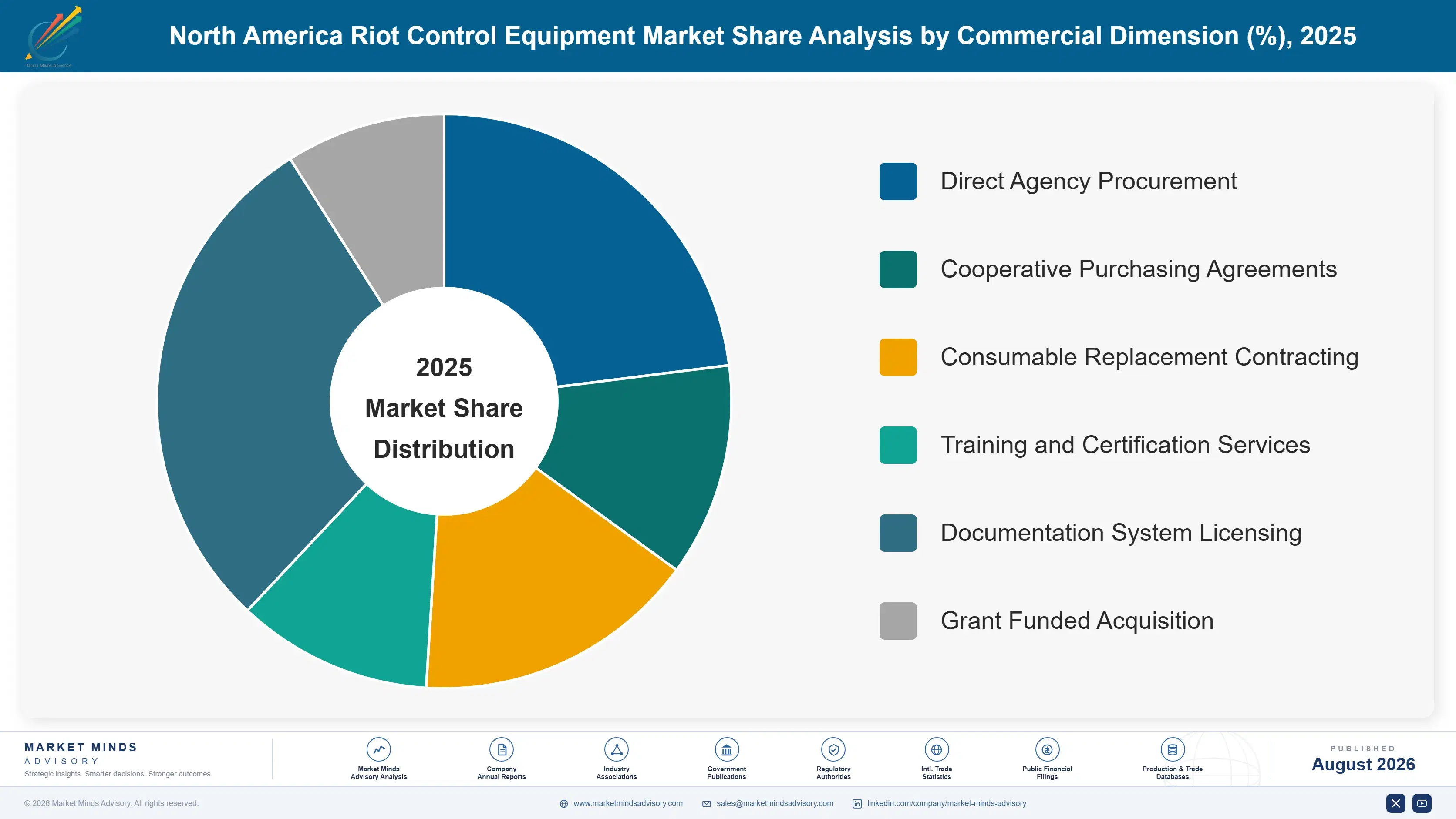
Segmentation follows equipment category, because each carries a different regulatory exposure, a different replacement cycle and a different position in the accountability requirements now governing procurement. Six categories describe the market completely, from protective equipment replaced on service life through to documentation systems that exist because settlement agreements oblige agencies to install them in the first place.
north-america-north-america-riot-control-system-ma-market-share-analysis-1788025533689

Documentation, Recording and Deployment Tracking Systems

The fastest category grows at 9.9%, half again the market rate of 6.6%, and litigation rather than operations explains every point of it. Around 137 agencies operate under consent decrees imposing recording, attribution and review obligations that no munition or launcher satisfies by itself, and roughly 61% of current procurement now specifies deployment tracking explicitly. The demand exists whether or not an agency expects to deploy anything at all, because the obligation attaches to holding the capability rather than to using it. That makes this the most reliable revenue line in the market and the one least connected to anything happening on a street. Nothing else in this market behaves that way.
CAGR 9.9%

Protective Equipment, Shields and Personal Protection

Protective equipment grows at 7.4% on replacement cycles that continue regardless of policy, restriction or civil disturbance activity. Helmets, shields, body protection and respiratory equipment reach end of service life on manufacturer schedules and agency policy, and none of it attracts the categorical restriction that has removed other product lines from the market entirely. It carries no reputational exposure worth speaking of either, which makes it the one category capable manufacturers from adjacent markets will still compete in. The demand is steady, the procurement is straightforward, and the margins reflect exactly how uncontroversial the product is. Steady demand of that kind is worth more than it looks in a market this exposed.
CAGR 7.4%
Full segment breakdown across 6 segments available in the complete report.

Regional Architecture and Country Demand Map

This is a regionally scoped market, so the procurement sits within North America. The seven-region split therefore describes where manufacture, component supply, accountability practice and competing product approaches originate rather than distributing the underlying agency spending itself. The seven-region split explains supply rather than demand here.

North America

Out-of-band note: this region holds 64% against a band of 22 to 32% because the market is defined as procurement by North American agencies, so the home region necessarily dominates. Around 137 departments operate under consent decrees or settlement agreements that write accountability terms directly into purchasing documents. Categorical restriction varies enormously between jurisdictions, which fragments product strategy across a single national supply base. Canadian procurement follows similar accountability expectations through provincial oversight rather than through federal consent decree arrangements. The gap between what one jurisdiction requires and what its neighbour prohibits is the defining commercial problem for anybody selling across this region, and it shows no sign of closing.
Share: 64% | CAGR: 6.8% (2026 to 2036)

Western Europe

Out-of-band note: the 13% share reflects manufacture, component supply and product approach rather than demand located here. European manufacturers supply chemical agents, launchers and protective equipment into North American agencies, and several hold long-standing positions built before accountability requirements reshaped procurement. European crowd management doctrine emphasises negotiated management and de-escalation, and equipment designed around that approach has found buyers among agencies rebuilding practice under decree obligations. Regulatory divergence between the two markets is widening rather than narrowing. Doctrine imported alongside equipment is unusual in this market and commercially useful, because an agency rebuilding practice under a decree wants a supplier who can explain a different approach rather than simply sell a different device.
Share: 13% | CAGR: 5.0% (2026 to 2036)
Regional intelligence for 5 additional markets available in the complete report: East Asia, South Asia and Pacific, Middle East and Africa, Latin America, Eastern Europe. Contact sales@marketmindsadvisory.com.
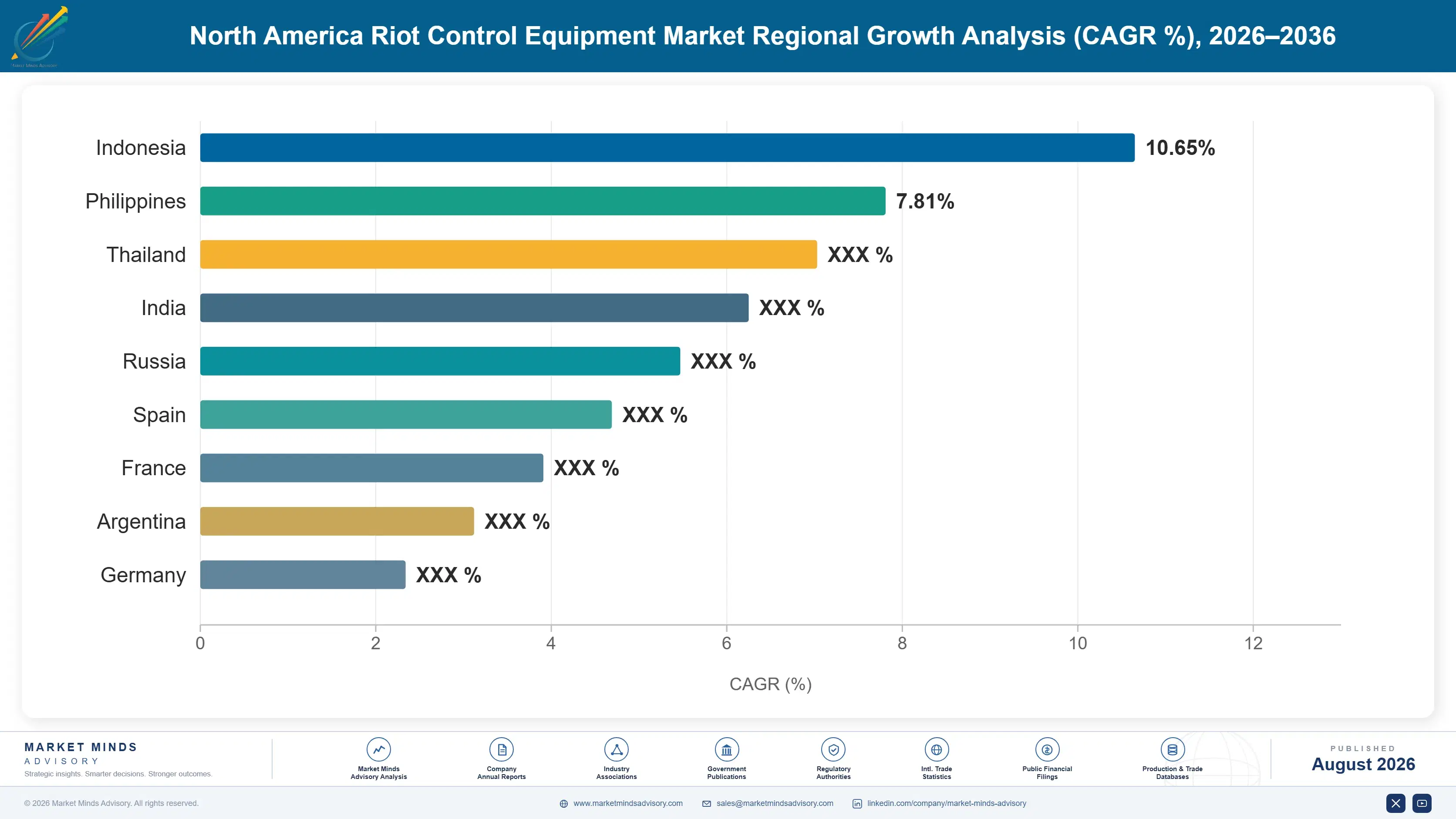
north-america-north-america-riot-control-system-ma-country-cagr-analysis-1788025534215

Where Crowd Management Margin Sits

Four levers work on accountability positioning, recurring consumable demand and legislative engagement rather than on device performance, which no longer decides procurement outcomes by itself. Documentation integration, shelf life management, training programmes and restriction anticipation each address something a supplier controls now. None of the four requires a better device than anybody else already makes.

Build Documentation Into Every Product Line

Roughly 61% of procurement now specifies that deployment be recorded, attributed and reconstructable, and a device that cannot do that is excluded regardless of how well it performs. Adding deployment tracking to an existing munition or launcher line costs perhaps 2 million dollars in development. Suppliers who did it early are winning against better-performing products that cannot answer the question. The requirement will broaden rather than narrow, since no consent decree has ever been relaxed on this point. Exclusion for lacking documentation is routinely recorded as a pricing loss instead.
Market Impact: Meets the 61% of procurement now specifying tracking

Sell The Shelf Life Cycle Deliberately

Chemical agent stock expires after roughly 5 years whether deployed or not, and most agencies discover expired inventory during an audit rather than managing it against a schedule. Suppliers offering inventory tracking, scheduled replacement and disposal handling convert an irregular purchase into a contracted cycle. The revenue exists already and simply arrives unpredictably. Agencies welcome the arrangement because expired stock is itself an accountability finding that nobody wants appearing in a review. Converting an unpredictable purchase into a 5 year contracted cycle changes the revenue quality entirely for both parties.
Market Impact: Contracts the entire 5 year stock replacement cycle

Package Training With Equipment Rather Than Separately

Training absorbs 23% of programme spend and is routinely underfunded relative to equipment, which produces the deployment incidents that generate the next consent decree and the next restriction. Suppliers bundling certified instruction with equipment address the customer's actual exposure rather than its purchasing line. Margins on instruction exceed equipment margins considerably. It also positions the supplier as part of the accountability answer rather than as part of the problem being investigated. Instruction margins run about 2 times equipment margins at comparable suppliers across this whole market, without any manufacturing investment.
Market Impact: Addresses the 23% training share of programme spend

Engage Legislatures Before Restrictions Are Drafted

Categorical restriction has already removed around 18% of former revenue permanently, and suppliers have consistently learned of proposed restrictions after they were drafted rather than during. Engagement at the drafting stage shapes definitions, exemptions and transition periods that decide whether a product line survives at all. The work is unglamorous public affairs rather than sales. Suppliers treating restriction as an unforeseeable political event are describing something that was foreseeable for at least 3 years beforehand. Nobody in this market has treated public affairs as a commercial function yet at all.
Market Impact: Protects against a further 18% permanent revenue loss

Who Controls the Margin Pool

Concentration sits around 44% across the five largest participants measured on North American crowd management equipment revenue, and it is held there by reputational exposure as much as by any barrier to entry. Capable manufacturers in adjacent equipment markets decline to enter because a deployment incident attaches their name to litigation and coverage that no revenue line justifies. That suits incumbents considerably.
Competition runs on accountability capability, category exposure and training depth. Accountability capability decides whether a product can be bought at all under decree obligations, which is now the first filter rather than the last. Category exposure decides how much of a portfolio survives the next restriction. Training depth decides whether an agency's deployment record generates further obligations or avoids them.

Pressure is arriving from technology suppliers rather than munition manufacturers. Firms whose core capability is recording, evidence management and deployment data have entered from adjacent public safety markets holding exactly what procurement now requires. Traditional munition manufacturers hold products those firms cannot make and cannot demonstrate accountability the way they can. Rankings will shift toward participants combining both, since very few currently do.
north-america-north-america-riot-control-system-ma-company-positioning-matrix-1788025534740

Competitive Moat and Risk Dimensions

AXON ENTERPRISE

Moat: Evidence management across agency workflows

Axon holds evidence management and deployment recording capability across agency workflows that consent decree obligations now require directly, and around 61% of procurement specifies exactly that. Its position was built in adjacent public safety markets and transfers into crowd management without needing new customer relationships. Competitors must build the software layer rather than acquiring a customer already using it.
AXON ENTERPRISE

Risk: Limited traditional munition portfolio

Chemical agents, kinetic impact munitions and launchers remain substantial revenue lines that traditional manufacturers supply and this position does not cover. Agencies still procure both, frequently in the same programme. Building or acquiring munition capability carries the reputational exposure that has kept adjacent manufacturers out of this market entirely.
COMBINED SYSTEMS

Moat: Munition depth and agency relationships

Combined Systems holds a broad chemical agent and less-lethal munition portfolio with long-standing agency relationships and qualification history that new entrants cannot assemble quickly. Recurring shelf life replacement on roughly five year cycles produces revenue independent of civil disturbance activity. Reputational exposure that deters competitors from entering protects the position it already occupies.
COMBINED SYSTEMS

Risk: Exposure to categorical restriction

A portfolio concentrated in chemical agents and impact munitions is precisely what jurisdictions have restricted, and roughly 18% of former revenue has already gone permanently. Further restriction removes revenue with no requalification route available afterwards. Documentation capability that procurement now requires has to be added rather than being inherent to the products.

Players Tracked

Prominent Players

Axon Enterprise
Combined Systems
Safariland
Point Blank Enterprises
Byrna Technologies

Other Key Players

Pepperball Technologies
Security Devices International
Defense Technology
Federal Signal
Mace Security International
Amtec Less-Lethal Systems
NonLethal Technologies
Rheinmetall Denel Munition
Condor Non-Lethal Technologies
ISPRA by E Schwartz
Verney-Carron
Genasys
Paraclete Armor
Streicher Mobile Fueling
Lamperd Less Lethal

Recent Developments

JUNE 2024

Jurisdiction restricted specific munition categories without transition period

A major jurisdiction enacted restrictions prohibiting agency use of specific chemical irritant and impact munition categories with immediate effect and no phase-out period, removing established product lines from that addressable market entirely. This was legislative action rather than any acquisition, merger or commercial arrangement between suppliers.
Signal: Restriction without transition removes revenue permanently, since requalifying into a banned category is simply not possible.
NOVEMBER 2024

Consent decree specified deployment recording as procurement requirement

A settlement agreement between a federal authority and a metropolitan agency specified that crowd management equipment must record deployment with individual attribution and produce reviewable data, writing an accountability obligation directly into future purchasing requirements. This was a legal settlement rather than any commercial transaction between suppliers.
Signal: Accountability terms entering settlement agreements makes them procurement specifications rather than merely policy aspirations for agencies.
MARCH 2025

Technology supplier entered crowd management from adjacent public safety

A public safety technology supplier extended evidence management and deployment recording capability into crowd management equipment, entering from an adjacent market while holding customer relationships that munition manufacturers had to build separately. This was organic market entry rather than any acquisition, merger or joint venture arrangement.
Signal: Entry from adjacent markets works because agencies already using the software need no new supplier relationship.

What This Equipment Costs Agencies

Programme cost divides four ways and equipment is smaller than agencies expect. Equipment and munition purchase absorbs roughly 41% of programme spend, training and certification near 23%, documentation systems and data retention near 21%, and storage, handling and disposal the remaining 15%. Agencies budgeting for equipment alone and treating the rest as overhead consistently underfund exactly the elements that consent decree obligations examine most closely.
Chemical precursor and specialty polymer pricing moved sharply across recent years and raised munition cost accordingly, since qualified inputs come from very few suppliers with limited substitution available. Axon Enterprise and Byrna Technologies have both discussed input cost and supply conditions across recent reporting periods. Data retention cost has meanwhile grown steadily, because recording obligations specify retention periods that agencies must fund for years after any deployment occurs.

Exposure varies by portfolio rather than by geography. Suppliers concentrated in consumable munitions carry direct precursor and polymer exposure against agency budgets set annually. Documentation and software suppliers carry data retention cost that scales with customer count rather than with any commodity. Suppliers holding training programmes recover cost across a service line that reprices more freely than any equipment contract does.
north-america-north-america-riot-control-system-ma-cost-volatility-analysis-1788025534934

Precursor supply qualification ahead of price movement

Chemical precursors and specialty polymers for munition manufacture come from very few qualified suppliers, and substitution requires requalification that takes months nobody has scheduled. Qualifying alternatives before pricing moves costs comparatively little against the exposure carried on consumable lines. Most manufacturers begin only after a price increase has already been absorbed against fixed agency contracts.

Data retention costed into documentation system pricing

Recording obligations specify retention periods that agencies must fund for years after any deployment, and suppliers pricing documentation systems on installation alone absorb that cost themselves. Pricing retention explicitly is straightforward and routinely omitted from bids. Agencies accept it readily, because the retention obligation is theirs and they would rather see it costed than discover it later.

Training revenue offsetting consumable margin compression

Training absorbs 23% of programme spend, carries margins above equipment and reprices far more freely than munition contracts set annually against agency budgets. Suppliers holding instruction programmes recover input cost movement there rather than absorbing it on consumables. Participants selling equipment alone have no such recovery available and carry the whole of that exposure themselves.

Portfolio Architecture for Margin Defence

The portfolio separates by regulatory exposure rather than by technology. Chemical agents and impact munitions are the historical revenue core and the most exposed position in this market: roughly 18% of former revenue has already gone to categorical restriction with no requalification route, and further restriction is a matter of which jurisdiction rather than whether. It is a question of which jurisdiction, not whether.
Margin concentrates in documentation systems and in training. Both address the agency's actual exposure rather than its equipment requirement, both carry margins above hardware, and both grow on obligations that no consent decree has ever relaxed. Documentation grows at 9.9% against a market rate of 6.6%, and roughly 61% of procurement now specifies it as a condition rather than a preference. Neither has been relaxed anywhere yet.

The overlooked pool is shelf life management. Chemical stock expires after about five years whether used or not, most agencies discover expired inventory during an audit, and suppliers offering tracking and scheduled replacement convert irregular purchasing into contracted revenue. The demand already exists and simply arrives unpredictably. Nobody is selling against it deliberately. Somebody will eventually notice that.

Volume / Commodity-Adjacent

Chemical irritant agents, impact munitions and launcher hardware sold on recurring consumable cycles. Range spans seven points because precursor cost exposure and jurisdictional restriction affect participants very differently across their portfolios.
Gross Margin: 14-21%

Premium / Certified

Protective equipment, shields, barriers and specialist vehicles procured on service life replacement cycles. Range spans nine points because volume agreements and agency contract structures vary considerably between suppliers in this tier.
Gross Margin: 22-31%

Sustainability / Regulatory / Next-Generation

Documentation and deployment tracking systems, data retention services and certified training programmes. Range spans fifteen points because software economics and instruction services are barely comparable businesses inside one tier. Retention pricing separates them.
Gross Margin: 31-46%
north-america-north-america-riot-control-system-ma-portfolio-architecture-1788025535426

High-value Sub-segments and Strategic Watch-out

Documentation, Recording and Deployment Tracking Systems

High value and high growth at 9.9%, created by settlement obligations rather than by any operational requirement anywhere. The thirteen point range separates suppliers holding agency workflow positions from those adding recording modules to existing munition and launcher lines. No decree has ever relaxed this.
Gross Margin: 33-46%

Protective Equipment, Shields and Personal Protection

High value with moderate growth at 7.4%, replaced on service life cycles that continue regardless of restriction or policy change. The nine point range reflects contract structure, since volume agreements price very differently from individual departmental purchasing arrangements. Categorical restriction has never touched this category.
Gross Margin: 22-31%

Chemical Agents and Impact Munitions

The historical revenue core and the most exposed position anybody holds in this market today. Recurring consumable demand on shelf life cycles, direct precursor cost exposure, and roughly a fifth of former revenue already removed by categorical restriction. Further restriction is a question of where.
Gross Margin: 14-21%

Jurisdictional Restriction Risk

The strategic watch-out rather than a growth pool. Restriction arrives without transition periods, removes revenue permanently because requalification is impossible, and suppliers consistently learn of proposed measures only after they have been drafted. Nobody in this market has yet treated public affairs as a commercial discipline.
Gross Margin: Variable

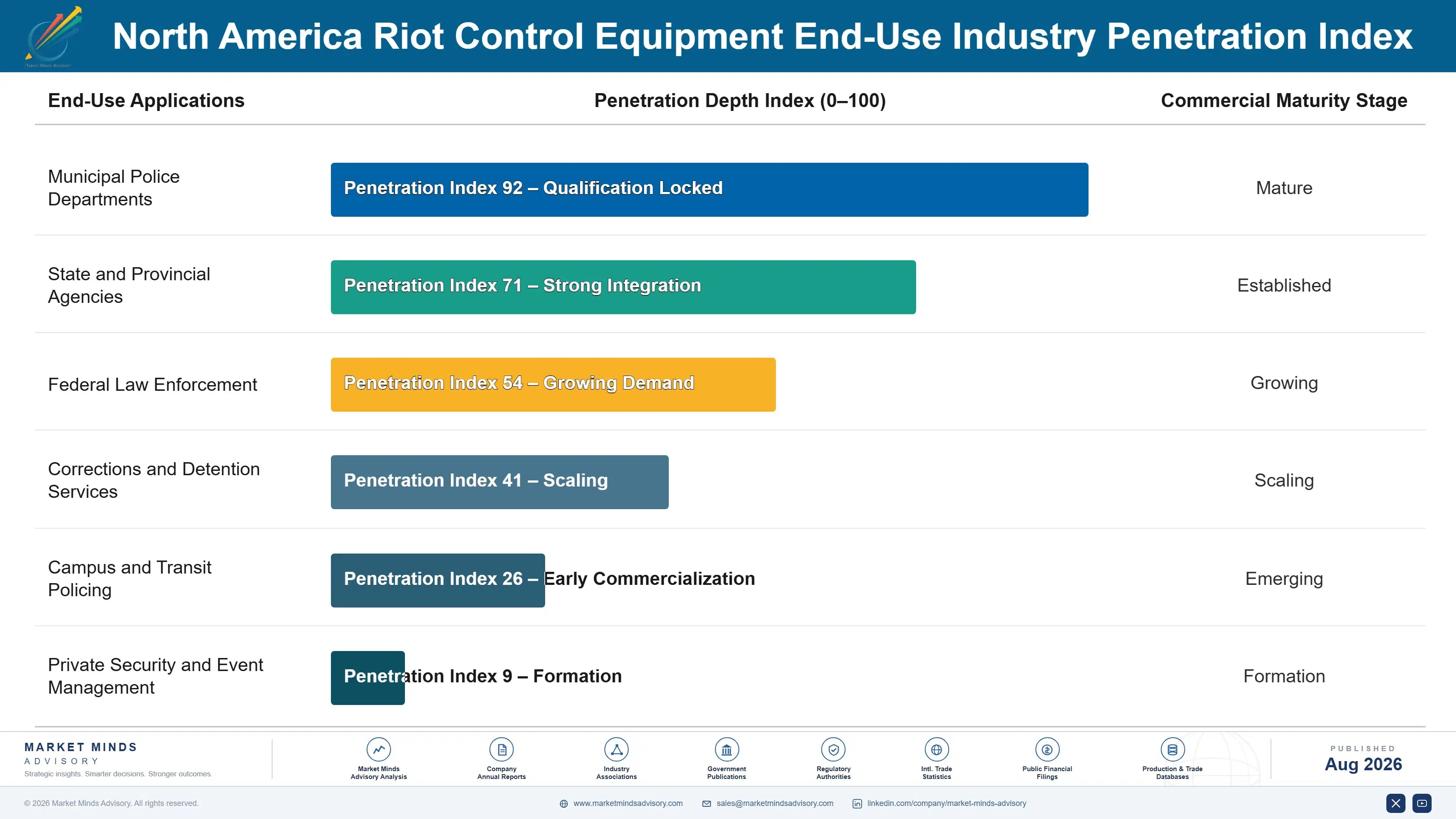
Why Agency Positions Persist

Documentation systems produce annuity economics that equipment sales never approach. An agency operating a recording and evidence platform under a consent decree keeps it as long as the obligation stands, funds retention for years afterwards, and cannot change supplier without a migration its oversight authority must accept. Roughly 61% of procurement now specifies that capability, and the obligation attaches to the agency rather than to operational tempo.
Stickiness varies enormously by category. Documentation positions are close to permanent for the reasons above. Munition and consumable positions turn over on price and qualification at each replacement cycle, since agencies buy against specification rather than relationship. Protective equipment sits between the two, replaced on service life with incumbency worth something but not much. Training relationships persist because instructor familiarity with an agency's own policy is genuinely hard to replace.

The buyer has changed more here than in any comparable equipment market. Procurement was written by training divisions specifying operational capability, and is now written or reviewed by legal counsel specifying what a deployment record must show. Suppliers whose commercial approach was built around demonstrating device performance find that conversation has moved somewhere they are not organised to participate in.
north-america-north-america-riot-control-system-ma-end-use-penetration-index-1788025535916

Where Suppliers Should Commit Now

These are among the four positions where our research anticipates prominent divergence between winners and laggards over the coming forecast period. Each is grounded in the demand model, the regulatory perimeter, and the announced capacity pipeline.
01 / DOCUMENTATION CAPABILITY INTEGRATION

A device that cannot be reconstructed cannot be bought

Roughly 61% of all procurement now requires that a deployment be recorded, attributed to an individual and reconstructable afterwards, and a device unable to do that is excluded regardless of how well it actually performs in operational terms. Adding deployment tracking to an existing munition or launcher line costs perhaps two million dollars in development work altogether, which is not very much. Suppliers who did it early are now winning consistently against demonstrably better-performing products that simply cannot answer that particular question.
02 / SHELF LIFE CONTRACT CONVERSION

Expiry is recurring revenue nobody is selling against

Chemical agent stock expires after roughly five years whether or not it was ever deployed, and most agencies discover expired inventory during an audit rather than managing it against any schedule they maintain. Suppliers who offer inventory tracking, scheduled replacement and disposal handling convert an irregular purchase into a contracted cycle worth considerably more to both sides. The revenue already exists and simply arrives unpredictably, and agencies welcome the arrangement because expired stock is itself an accountability finding in itself.
03 / TRAINING PROGRAMME BUNDLING

Instruction addresses the exposure equipment cannot

Training absorbs 23% of programme spend and is routinely underfunded relative to equipment, which produces exactly the deployment incidents that generate the next consent decree and the next categorical restriction that follows after that. Suppliers bundling certified instruction with equipment address the customer's genuine underlying exposure rather than merely its purchasing line item that year. Margins on instruction exceed equipment margins by a considerable distance, and it positions the supplier inside the accountability answer rather than inside the problem being examined.
04 / LEGISLATIVE ENGAGEMENT DISCIPLINE

Restriction was foreseeable for years before it arrived

Categorical restriction has already removed around 18% of former revenue permanently and without warning, and suppliers have consistently learned of the proposed measures after drafting rather than during the process that actually produced them. Engagement at the drafting stage shapes the definitions, exemptions and transition periods that decide whether a product line survives the legislation at all afterwards. The work here is unglamorous public affairs rather than sales, and treating restriction as unforeseeable describes something that was visible for years.

Engagement Snapshot From the Field

A live engagement with an industry participant carrying material or product regulatory and market exposure ahead of a defining policy shift, showing how our research translates into a defensible multi-year portfolio strategy.
MARKET MINDS ADVISORY · CLIENT ENGAGEMENT SUMMARY
North America Riot Control Equipment Producer Strategic Portfolio Review and Transition Roadmap 2026·Investment Scenario on North America Riot Control Equipment Exposure Evaluation 2025-26
CLIENT PROFILE
A manufacturer of chemical irritant agents and impact munitions supplying agencies across North America, with a protective equipment line and no documentation or training capability at all. Revenue had been flat for three years while the addressable market narrowed through categorical restriction, and management had treated each restriction as an isolated political event rather than as a pattern worth planning against.
STRATEGIC CHALLENGE
The board needed to establish how much of its portfolio remained exposed to further restriction, and whether building documentation capability justified the investment against defending existing munition lines. It also faced a decision on whether to enter training services, which operations leadership regarded as a distraction from manufacturing and legal counsel regarded as overdue.
MMA APPROACH
MMA mapped the client's portfolio against enacted and proposed restrictions across every jurisdiction it sells into, quantifying revenue already lost and revenue currently exposed. It modelled documentation capability development against continued munition investment. Expert interviews with agency procurement staff, legal counsel, trainers and competing suppliers established what now decides purchasing outcomes and why.
KEY FINDINGS
  1. Roughly a quarter of remaining revenue sat in categories already proposed for restriction in at least one significant jurisdiction the client actively sells into.
  2. The client had been excluded from eleven procurements in two years for lacking deployment tracking, and had recorded the losses as pricing failures throughout.
  3. Agencies interviewed would purchase shelf life management as a service, and none had ever been offered it by the client or by any competitor.
  4. Training margins at comparable suppliers ran well above the client's manufacturing margins, and required no manufacturing investment or any additional production capacity at all.
CLIENT PROFILE
A manufacturer of chemical irritant agents and impact munitions supplying agencies across North America, with a protective equipment line and no documentation or training capability at all. Revenue had been flat for three years while the addressable market narrowed through categorical restriction, and management had treated each restriction as an isolated political event rather than as a pattern worth planning against.
STRATEGIC CHALLENGE
The board needed to establish how much of its portfolio remained exposed to further restriction, and whether building documentation capability justified the investment against defending existing munition lines. It also faced a decision on whether to enter training services, which operations leadership regarded as a distraction from manufacturing and legal counsel regarded as overdue.
MMA APPROACH
MMA mapped the client's portfolio against enacted and proposed restrictions across every jurisdiction it sells into, quantifying revenue already lost and revenue currently exposed. It modelled documentation capability development against continued munition investment. Expert interviews with agency procurement staff, legal counsel, trainers and competing suppliers established what now decides purchasing outcomes and why.
KEY FINDINGS
  1. Roughly a quarter of remaining revenue sat in categories already proposed for restriction in at least one significant jurisdiction the client actively sells into.
  2. The client had been excluded from eleven procurements in two years for lacking deployment tracking, and had recorded the losses as pricing failures throughout.
  3. Agencies interviewed would purchase shelf life management as a service, and none had ever been offered it by the client or by any competitor.
  4. Training margins at comparable suppliers ran well above the client's manufacturing margins, and required no manufacturing investment or any additional production capacity at all.
RECOMMENDED STRATEGY
Phase 1: Phase one: add deployment tracking to the two highest volume munition lines and requalify them against current accountability procurement requirements. Phase 2: Phase two: launch shelf life management as a contracted service across the existing agency base rather than waiting for replacement orders. Phase 3: Phase three: build certified training capability and establish legislative engagement before the next restriction round is drafted in any jurisdiction.
OUTCOME
The client reported winning four of the next nine procurements after adding deployment tracking (client-reported, unverified by MMA). Shelf life contracts were signed with a meaningful share of the agency base. Training capability was under development, and legislative engagement began in two jurisdictions considering further restriction.

Frequently Asked Questions

Foundational context covering the market sizes, CAGR, scope, country, region and competition that inform every finding below. This section is provided to cover basics and most often pre-purchase conversations, answered from the MMA Primary Research Dataset.

What is the current size of the North America Riot Control Equipment Market?

The market is valued at USD 2.3 billion in 2025, measured as revenue from crowd management and civil disturbance equipment procured by North American agencies.

How large will the North America Riot Control Equipment Market be by 2036?

MMA forecasts USD 4.65 billion by 2036, up from USD 2.45 billion in 2026. That represents incremental revenue of USD 2.19 billion and an expansion multiple of 1.89 times.

What is the CAGR for the North America Riot Control Equipment Market 2026 to 2036?

The base case CAGR is 6.6%, with a bull case of 7.8% and a bear case of 5.4%. Documentation and accountability requirements supply most of that growth.

Which segment is growing fastest?

Documentation, recording and deployment tracking systems grow at 9.9%, half again the market rate of 6.6%, because consent decrees impose obligations no munition satisfies by itself.

Who are the major companies in the North America Riot Control Equipment Market?

Axon Enterprise, Combined Systems, Safariland, Point Blank Enterprises and Byrna Technologies lead on regional equipment revenue, holding around 44% between them across the whole regional market.

Which country is growing fastest?

India grows fastest at 8.6%, driven by manufacture of chemical agents, launchers and protective equipment expanding into export supply alongside a substantial domestic market of its own.

Report Segmentation Architecture

The full report scope spans multiple orthogonal segmentation dimensions, with cross-tabulated demand data provided for each dimension pair. Coverage extends further to regional breakdowns, trend trajectories, and the competitive detail needed to support segment-level decision-making.

By Equipment Category

  • Chemical Irritant Agents and Delivery Systems
  • Kinetic Impact Munitions and Launchers
  • Protective Equipment, Shields and Personal Protection
  • Barriers, Vehicles and Area Denial Systems
  • Acoustic and Directed Energy Devices
  • Documentation, Recording and Deployment Tracking Systems

By End-Use Industry

  • Municipal Police Departments
  • State and Provincial Agencies
  • Federal Law Enforcement
  • Corrections and Detention Services
  • Campus and Transit Policing
  • Private Security and Event Management

By Commercial Dimension

  • Direct Agency Procurement
  • Cooperative Purchasing Agreements
  • Consumable Replacement Contracting
  • Training and Certification Services
  • Documentation System Licensing
  • Grant Funded Acquisition

By Region

  • North America
  • Western Europe
  • East Asia
  • South Asia and Pacific
  • Middle East and Africa
  • Latin America
  • Eastern Europe

Scope, Methodology, and Coverage

Every figure in this report is reproducible from documented input assumptions. The scope below maps the historical period, the forecast horizon, the segmentation dimensions, and the countries covered, alongside the underlying primary and qualitative methodology.
Historical Period
2020 to 2025
Forecast Period
2026 to 2036
Base Year
2025 (USD billions; MMA Primary Research Dataset, August 2026)
Market Definition
Revenue from equipment procured by North American law enforcement, corrections and public safety agencies for crowd management and civil disturbance response, spanning chemical irritant agents and delivery systems, kinetic impact munitions and launchers, protective equipment, shields and personal protection, barriers, vehicles and area denial systems, acoustic and directed energy devices, and documentation, recording and deployment tracking systems. Direct agency procurement, cooperative purchasing, consumable replacement contracting, training and certification services, documentation licensing and grant funded acquisition are all included. Firearms and lethal ammunition, general patrol equipment, military procurement, and correctional restraints not used in crowd management are excluded.
Quantitative Units
USD billions, agency equipment and service procurement revenue
Segmentation Dimensions
Equipment category, procuring agency type, commercial contracting model, region of origin
Regions Covered
North America, Western Europe, East Asia, South Asia and Pacific, Middle East and Africa, Latin America, Eastern Europe
Countries Covered
United States, Canada, Mexico, United Kingdom, France, Germany, Czechia, Poland, Israel, China, Japan, India, Australia, Brazil
Key Companies Profiled
Axon Enterprise, Combined Systems, Safariland, Point Blank Enterprises, Byrna Technologies, Pepperball Technologies, Defense Technology, Federal Signal, Genasys, Condor Non-Lethal Technologies
Quantitative Methodology
Primary survey, n=3,800 respondents, Q4 2025, six countries; demand-side model with trade association cross-validation
Qualitative Methodology
47 expert interviews, Q4 2025; applied to validate demand model assumptions, identify emerging dynamics, and assess competitive positioning
Report Format
PDF and XLSX data workbook (Word format preview document)
Publisher
Market Minds Advisory
Report Code
MMA-2026-TEC-481
Published
August 2026
Contact
sales@marketmindsadvisory.com | www.marketmindsadvisory.com

Purchase the full North America Riot Control Equipment Market Report (2026 to 2036).

The full report treats this as the accountability market it has become rather than the equipment market it used to be. It quantifies how much procurement now specifies deployment tracking, sizes the revenue already removed by categorical restriction, and separates recurring shelf life demand from event-driven purchasing across the participant base. Segment analysis covers all six equipment categories, with particular attention to documentation systems where settlement obligations rather than operational need explain the entire growth rate. Competitive assessment ranks twenty participants on North American crowd management equipment revenue.
Six equipment category segmentation with growth rates
Accountability requirements traced across agency procurement documents
Twenty participant assessment on regional equipment revenue
Categorical restriction exposure mapped by product line
Shelf life replacement demand separated from event purchasing
Training and documentation margins compared against equipment

Built For The People Who Decide

From boardroom strategy to bench-side execution, this report is read cover-to-cover by leaders shaping the next decade of their industry, turning demand scenarios, market dynamics and valuation benchmarks into decisions.
CXOs/ Presidents/ VPs/ Managers
M&A and Corporate Development
Strategy Teams and R&D Heads
Procurement and Product Directors
Regulatory and Compliance Leaders
Investor Relations and Equity Analysts