Market Minds Advisory
North America & Europe Renal Function Test Market

North America & Europe Renal Function Test Market: Point-of-Care Testing Reaches the Primary Care Clinic

Point-of-care creatinine and eGFR testing is moving chronic kidney disease screening out of centralized laboratories into primary care clinics across North America and Europe, forcing laboratory-dependent diagnostics companies to defend volume against a convenient alternative.

Lead Analyst

Alice Ballenger

Published

September 2026

Make Smarter Decisions with Customized Research Insights

Request a free sample report and evaluate market opportunities, growth trends, and competitive dynamics relevant to your business needs.

2025 MARKET VALUE$2.2BMarket Size 2025
2036 FORECAST VALUE$5.4BBase Case , 2026 to 2036
CAGR 2026 TO 20368.5 %Bull 9.8% / Bear 7.2%
INCREMENTAL OPPORTUNITY$3.0BNet 10- year value creation
EXPANSION MULTIPLE2.26x2036 value over 2026 base
Strategic Levers
M&A Pipeline
Regional Outlook
Country Rankings
Competitive Intelligence
Segmental Deep-dive
Call-Us : 91 93563 13602

Executive Snapshot and Market Trajectory

Point-of-care creatinine and eGFR testing is bringing chronic kidney disease screening directly into primary care visits across North America and Europe, a genuine convenience shift that reduces the diagnostic delay centralized laboratory testing has always carried for a disease that benefits enormously from earlier detection. That model works.
Demand concentrates around three test categories: serum creatinine and BUN testing, urine albumin-to-creatinine ratio testing for diabetic and hypertensive screening, and novel biomarker tests for acute kidney injury detection. Point-of-care testing devices are growing fastest as primary care practices adopt on-site testing, closing the centralized turnaround gap. North America holds the largest share on concentrated diagnostic testing volume and reimbursement infrastructure. Reimbursement clarity continues improving across both regions steadily.
Competitive intensity concentrates among large diversified diagnostics companies running both centralized laboratory and point-of-care testing platforms, while specialist point-of-care device makers compete on accuracy and workflow simplicity at the bedside. Regulatory scrutiny over point-of-care test accuracy standards is intensifying across both regions, forcing every device maker to demonstrate laboratory-comparable performance before primary care adoption can scale meaningfully. Smaller device makers without comparable validation data increasingly compete only for niche accounts specifically. That gap keeps widening.
Market Definition
The North America and Europe renal function test market covers diagnostic tests and testing platforms used to assess kidney function, including serum creatinine and BUN testing, eGFR calculation and reporting, urine albumin-to-creatinine ratio testing, cystatin C testing, point-of-care renal testing devices, and novel acute kidney injury biomarker tests, specifically within North America and Europe. It excludes renal function testing volume in other world regions, dialysis and renal replacement therapy services, and broader metabolic panels where creatinine is one component among many unrelated analytes.
Base Year Value
$2.2B in 2025 (MMA Primary Research Dataset, August 2026)
Forecast Period
2026 to 2036, eleven discrete annual values
CAGR
8.5% base case. Bull 9.8%. Bear 7.2%.
Fastest Growth Segment
Point-of-Care Renal Function Testing Devices: 13.5% CAGR
Fastest Growth Country
Poland: 11.8% CAGR
Fastest Growth Region
South Asia and Pacific: 10.5% CAGR
Largest Region
North America: 45% of 2025 global value
Market Leaders
Roche Diagnostics, Abbott Laboratories, Siemens Healthineers, Beckman Coulter Inc., QuidelOrtho Corporation. Source: MMA Analysis based on company annual reports.
Primary Survey
n=3,800 procurement and R&D decision-makers, Q4 2025, six countries
Methodology
Demand-side build-up, cross-validated against public data, 47 expert interviews

North America & Europe Renal Function Test Market Forecast Scenarios

north-america-europe-renal-function-test-market-size-forecast-scenario-1787306365077
Between 2020 and 2025 the market grew at roughly 7.7% a year, steady rather than volatile, as rising chronic kidney disease prevalence and expanding diabetes and hypertension screening protocols both drove sustained testing volume growth across primary care and specialist settings alike. That steady baseline growth reflected mature, well-established screening protocols already embedded across both regions' healthcare systems.
The base case carries the market to a 8.5% CAGR on three mechanisms. First, point-of-care testing keeps expanding into primary care settings as device accuracy improves and reimbursement pathways mature across both regions. Second, chronic kidney disease screening guidelines keep broadening eligible populations as diabetes and hypertension prevalence continue rising. Third, novel acute kidney injury biomarker adoption keeps growing in hospital settings as clinical evidence supporting earlier intervention accumulates steadily.
The bull case reaches 9.8% if point-of-care testing accuracy improves fast enough to fully displace centralized laboratory testing for routine screening applications within the forecast window. The bear case falls to 7.2% if reimbursement policy for point-of-care testing remains inconsistent across the two regions long enough to slow primary care adoption meaningfully. That divergence rests largely on how quickly point-of-care accuracy validation reaches primary care purchasing committees.

Point-of-Care Accuracy Is Becoming the Real Competitive Test

Three forces converge on this market at once. Chronic kidney disease prevalence keeps rising as diabetes and hypertension populations age across both regions, point-of-care testing accuracy keeps closing the gap with centralized laboratory performance, and screening guidelines keep expanding eligible populations beyond patients already diagnosed with kidney-related risk factors. Companies unable to demonstrate laboratory-comparable point-of-care accuracy risk losing primary care accounts to bett
MARKET CONCENTRATION (CR5)52%Top five companies hold a clear majority position
AVERAGE POINT-OF-CARE COST$18/testBedside testing carries meaningful premium over centralized laboratory processing
TOP PRODUCING COUNTRY SHARE29%United States leads regional diagnostic testing manufacturing volume
CKD SCREENING COVERAGE RATE54%Eligible diabetic and hypertensive patients receiving recommended testing climbed steadily
TRADE INTENSITY38%Over a third of testing platform volume crosses regional borders
REAGENT COST SHARE31% of COGSEnzymatic and immunoassay reagent inputs dominate production cost
Commercially, the market splits between centralized laboratory testing, priced competitively at high volume through hospital and reference laboratory contracts, and point-of-care testing, priced at a premium per test but sold on convenience and immediate clinical actionability that centralized testing cannot match. That point-of-care category commands disproportionate margin relative to its unit volume share of the overall market. That margin gap is widening as primary care practices increasingly prioritize convenience and same-visit clinical actionability.
Over the next decade the defining question is whether point-of-care testing accuracy and cost structure improve enough to displace meaningful centralized laboratory volume, or whether centralized testing retains its cost advantage for routine, non-urgent screening while point-of-care testing captures only the acute and immediate-decision use cases where speed genuinely changes clinical management.
"Every point-of-care device maker in this space wants to tell you they can replace the central lab entirely, and that is not true yet for routine screening where cost per test still favors batch processing heavily. Where point-of-care genuinely wins is the acute setting, where a result in minutes instead of hours actually changes what a physician does next."
Director, In Vitro Diagnostics Practice · MMA Healthcare / In Vitro Diagnostics

Market Trends

Point-of-Care Creatinine Testing Expands Into Primary Care Clinics

Point-of-care creatinine and eGFR testing devices, historically confined largely to hospital and urgent care settings, have moved into mainstream primary care clinics across both North America and Europe since 2023, as device accuracy has improved enough to satisfy regulatory and clinical confidence requirements for routine screening use. Abbott and Roche have both expanded point-of-care platform offerings specifically targeting primary care workflow, letting physicians make same-visit medication dosing decisions for patients on renally-cleared drugs rather than waiting days for centralized laboratory results. Adoption remains concentrated among larger primary care networks with capital available for new diagnostic equipment investment.
Market Impact: Adds 2 to 3 million yearly
Novel AKI Biomarkers Gain Hospital Adoption for Earlier Detection

Novel biomarker tests for acute kidney injury, including NGAL and KIM-1 testing, have moved from research settings into commercial hospital laboratory adoption as clinical evidence accumulates showing these markers can detect kidney injury hours before traditional creatinine elevation becomes apparent. This earlier detection window matters clinically because acute kidney injury intervention effectiveness declines meaningfully with treatment delay, giving hospitals a genuine outcomes-based reason to adopt testing that costs more per test than traditional creatinine measurement alone. Hospital laboratory directors increasingly cite this earlier detection window directly when justifying the additional testing cost to procurement committees.
Market Impact: Covers 60% of eligible visits

Market Opportunities and Growth Drivers

Rising Diabetes and Hypertension Prevalence Expands Screening Population

Diabetes and hypertension prevalence continue rising steadily across both North America and Europe according to national health surveillance tracking, and both conditions represent the leading risk factors driving chronic kidney disease screening guideline recommendations across major medical societies in both regions. Each additional diagnosed diabetic or hypertensive patient represents recurring annual renal function screening demand tied directly to clinical guideline compliance rather than any single technology adoption cycle, giving testing volume a demographically anchored growth driver considerably more predictable than most other diagnostic categories tied to discrete acute care episodes.
Market Impact: Adds 5% to 10% variability

Expanding Point-of-Care Reimbursement Supports Primary Care Adoption

Medicare and a growing number of European national health systems have expanded reimbursement coverage for point-of-care renal function testing performed during a primary care visit, giving practices a clearer commercial pathway to justify point-of-care equipment investment than existed when testing costs went largely unreimbursed directly to the practice. Each newly covered reimbursement code represents recurring, billable testing revenue tied directly to enrolled patient screening volume, giving point-of-care device makers a demand driver considerably more durable than one dependent purely on discretionary practice capital budget decisions alone. That reimbursement clarity increasingly determines which markets device makers prioritize for early commercial launch.
Market Impact: Adds 8 to 14 months delay

Market Restraints and Challenges

Point-of-Care Accuracy Still Trails Centralized Laboratory Testing

Point-of-care creatinine testing devices, while improved considerably in recent years, still carry measurement variability meaningfully higher than centralized laboratory enzymatic and Jaffe method testing for the most demanding clinical applications, and the root cause is that miniaturized point-of-care sensor technology inherently faces greater environmental and calibration sensitivity than controlled laboratory instrumentation operating under stable conditions. This accuracy gap limits point-of-care adoption for applications requiring the highest precision, including certain medication dosing decisions where small measurement error carries real clinical consequence. Manufacturers are mitigating the gap through improved sensor calibration technology and more frequent quality control protocols specifically.
Market Impact: Reaches over 8,000 primary clinics

Reimbursement Inconsistency Across Countries Slows Adoption Pace

Point-of-care testing reimbursement policy varies considerably across both North America and the many distinct national health systems within Europe, and the root cause is that each payer and national health authority sets its own coverage criteria independently, creating a fragmented approval landscape device makers must navigate market by market rather than through any single unified pathway. This fragmentation slows point-of-care adoption across the full defined market, forcing companies to prioritize which national markets to pursue first. Manufacturers are mitigating the barrier by building dedicated regulatory and reimbursement teams focused on each major national market.
Market Impact: Cuts detection 12 to 24 hours
3 additional market trends, 4 additional growth drivers, and 3 additional restraints and challenges are covered in the full report. Contact sales@marketmindsadvisory.com to access the complete intelligence.

Segment CAGR and Growth Architecture

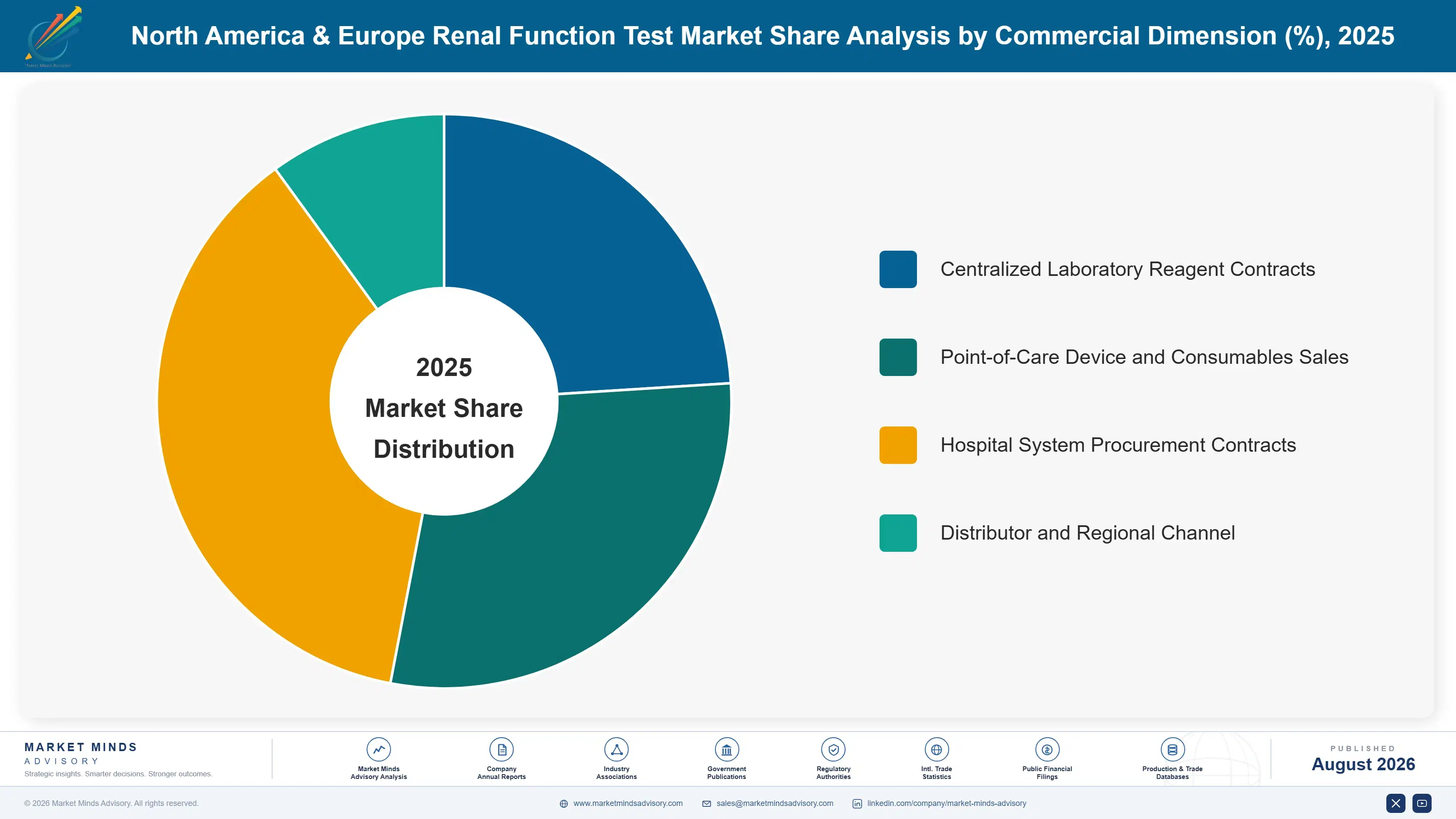
Segmentation follows test type, a single analytical logic distinguishing how each test measures or reports kidney function. Testing location and reimbursement channel are treated as separate commercial dimensions, not parallel segments within this test-based framework. Each test carries its own analytical method, achievable turnaround, and clinical actionability window, so commercial position tracks measurement approach rather than end setting.
north-america-europe-renal-function-test-market-market-share-analysis-1787306365617

Point-of-Care Renal Function Testing Devices

Point-of-care testing devices grow fastest at 13.5%, about 1.59 times the overall rate, as primary care clinics and urgent care settings adopt on-site creatinine and eGFR testing to close the diagnostic delay centralized laboratory turnaround time has always created. These devices command premium per-test pricing that reflects genuine convenience value, letting physicians make same-visit clinical decisions rather than waiting days for centralized results to return. Abbott and Roche both lead commercial deployment across primary care networks in both regions. Adoption remains constrained for the most precision-demanding applications, where centralized laboratory testing retains a meaningful accuracy advantage current point-of-care sensor technology has not yet fully closed. That accuracy gap represents the segment's clearest remaining barrier to broader clinical adoption.
CAGR 13.5%

Novel Acute Kidney Injury Biomarker Tests

Novel AKI biomarker tests, including NGAL and KIM-1 testing that detect kidney injury hours before traditional creatinine elevation becomes measurable, grow at 11.5%, the second-fastest category, as hospital adoption increases following accumulating clinical evidence that earlier detection genuinely improves acute kidney injury treatment outcomes. These tests command substantial premium pricing over traditional creatinine measurement, reflecting genuine clinical value in time-sensitive acute care settings where earlier intervention matters most. Adoption remains concentrated in larger hospital systems with intensive care and cardiac surgery volume high enough to justify the additional testing cost against documented outcome improvement specifically. Hospitals investing early in this testing category increasingly position themselves as regional referral centers for the most complex acute cases.
CAGR 11.5%
Full segment breakdown across 6 segments available in the complete report.

Regional Architecture and Country Demand Map

This report's defined scope covers North America and Europe exclusively; North America holds the largest share within that scope, Western Europe follows closely, and regions outside the defined coverage carry minimal reported share by design, not by omission. Eastern Europe grows fastest among the regions this report covers directly.

North America

United States chronic kidney disease screening volume anchors the largest renal function testing market this report covers, supported by Medicare and commercial payer reimbursement infrastructure for both centralized laboratory and expanding point-of-care testing that most European national health systems have not yet matched at comparable scale. Abbott and Beckman Coulter both run substantial domestic manufacturing and clinical research operations, maintaining close relationships with the primary care networks driving point-of-care adoption. Canada's smaller but stable diagnostic testing sector follows similar reimbursement and adoption patterns to its southern neighbor. Note: this share sits above the standard 22 to 32% global band because this report's defined scope is North America and Europe exclusively, concentrating share within a narrower two-region universe.
Share: 45% | CAGR: 7.8% (2026 to 2036)

Western Europe

Germany and France both maintain well-developed centralized laboratory testing infrastructure, with national health systems covering renal function testing broadly while point-of-care reimbursement has expanded more unevenly across different national health authorities within the region. The United Kingdom's National Health Service has invested in point-of-care testing pilots specifically for primary care chronic kidney disease screening, supporting steady adoption growth tied to public health screening initiatives. Roche, headquartered in Switzerland, anchors substantial regional diagnostic manufacturing capability serving both domestic and broader European markets directly. Note: this share sits slightly above the standard 18 to 26% global band given the defined North America and Europe scope of this report, which concentrates measured share within these two regions specifically.
Share: 28% | CAGR: 7.0% (2026 to 2036)
Regional intelligence for 5 additional markets available in the complete report: East Asia, South Asia and Pacific, Latin America, Middle East and Africa, Eastern Europe. Contact sales@marketmindsadvisory.com.
north-america-europe-renal-function-test-market-country-cagr-analysis-1787306366136

Where Diagnostics Companies Can Defend Margin

Four commercial moves separate companies capturing durable premium value from those competing purely on commodity testing pricing: point-of-care accuracy investment, primary care network partnerships, novel biomarker evidence generation, and cross-border reimbursement navigation. Each move converts a technical or regulatory advantage into a defensible commercial position competitors without matching validation depth or navigation reach cannot easily replicate quickly.

Invest in Point-of-Care Accuracy to Close the Laboratory Gap

Physicians remain appropriately cautious about point-of-care testing for the most clinically demanding applications until accuracy data proves genuinely comparable to centralized laboratory performance, and companies investing in improved sensor calibration and quality control technology build the clinical trust that drives sustained primary care adoption rather than limited pilot use. Companies with the strongest published comparative accuracy data increasingly win primary care network contracts that competitors offering comparable hardware but weaker validation evidence cannot secure. Companies with the strongest validation data report cutting practice adoption decision time by 25% to 35% relative to less-documented competitors.
Market Impact: Cuts practice adoption decision tim

Build Dedicated Primary Care Network Partnerships

Point-of-care testing adoption scales far faster through direct partnerships with large primary care networks and health systems than through fragmented individual practice sales, and companies dedicating specific commercial resources to network-level partnerships capture disproportionate volume relative to competitors still selling practice by practice. These network partnerships also typically span multiple years and provide predictable, forecastable revenue that individual practice relationships, subject to more frequent turnover, cannot match as reliably. Network partnerships of this scale typically span 3 to 5 years and generate meaningfully more predictable revenue than fragmented individual practice relationships.
Market Impact: Network contracts span 3 to 5 years

Generate Clinical Evidence Supporting Novel Biomarker Adoption

Hospital adoption of novel AKI biomarker testing depends on published clinical evidence demonstrating genuine outcomes improvement, not merely earlier detection alone, and companies investing in rigorous outcomes studies build the evidence base hospital procurement committees actually require before approving premium biomarker testing costs over traditional creatinine measurement. This evidence investment pays off across multiple hospital system conversations, since credible published outcomes data becomes a reusable commercial asset supporting broader adoption conversations. Companies with strong published outcomes data typically command 40% to 60% pricing premiums over traditional creatinine testing overall. today.
Market Impact: Commands 40% to 60% premium with st

Build Dedicated Regulatory Teams for Cross-Border Navigation

Reimbursement fragmentation across North America and the many distinct European national health systems represents a genuine commercial barrier, and companies building dedicated regulatory and reimbursement navigation teams for each major national market capture adoption faster than competitors treating cross-border expansion as a single unified effort that fragmented reality does not actually support. This specialized navigation capability becomes a durable competitive advantage as companies accumulate market-specific regulatory expertise competitors entering later must rebuild from scratch. Companies with dedicated navigation teams typically shorten market entry timelines by 8 to 14 months relative to those handling expansion reactively.
Market Impact: Shortens market entry timelines by

Who Controls the Margin Pool

Concentration sits at a high CR5 of 52%, with a real gap separating large diversified diagnostics companies from smaller specialist point-of-care device makers. Roche and Abbott compete on testing menu breadth and point-of-care platform depth, while Siemens Healthineers and Beckman Coulter anchor strong positions in centralized laboratory automation and hospital system relationships respectively. Smaller manufacturers compete on price for standard reagent testing.
Current competitive activity runs along three lines: point-of-care accuracy improvement, where Abbott and Roche race to close the gap with centralized laboratory performance; novel biomarker clinical evidence generation, increasingly central to hospital procurement decisions for AKI testing; and cross-border reimbursement navigation, as companies work to scale consistently across fragmented national payer landscapes. All participants are assessed on one consistent basis, annual revenue from renal function testing products within North America and Europe.

Pressure is building from two directions. Point-of-care specialists are capturing genuine primary care mindshare and gradually claiming volume that centralized laboratory testing historically controlled entirely. Meanwhile reimbursement fragmentation across European national markets continues slowing consistent regional scaling for companies without dedicated market-by-market regulatory capability. Rankings over the next five years will shift toward companies combining point-of-care depth with cross-border reimbursement expertise.
north-america-europe-renal-function-test-market-company-positioning-matrix-1787306366664

Competitive Moat and Risk Dimensions

ROCHE DIAGNOSTICS

Moat: Broadest integrated renal test menu

Roche's testing menu spans centralized laboratory creatinine, cystatin C, and urine ACR testing alongside expanding point-of-care platforms, letting it serve hospital and primary care accounts as a single-vendor relationship covering the full renal function testing spectrum few narrower competitors can match at comparable breadth. That breadth advantage compounds as hospital systems increasingly prefer consolidated vendor relationships.
ROCHE DIAGNOSTICS

Risk: Reagent lock-in regulatory scrutiny

Roche's closed reagent and instrument system model, while commercially durable, has drawn periodic regulatory and customer scrutiny over pricing practices tied to instrument lock-in, and any meaningful regulatory action limiting this commercial model could pressure margins across its substantial installed testing platform base. That scrutiny could intensify further as regulators worldwide pay closer attention to diagnostics pricing practices broadly.
ABBOTT LABORATORIES

Moat: Point-of-care creatinine testing leadership

Abbott's early and sustained investment in point-of-care creatinine and eGFR testing technology has given it some of the industry's most mature commercial point-of-care platforms, positioning it as the preferred primary care network partner as this category continues expanding beyond hospital and urgent care settings specifically.
ABBOTT LABORATORIES

Risk: Diagnostics segment cyclicality exposure

Abbott's broader diagnostics segment includes categories with meaningfully more cyclical demand than steady renal function testing volume, and any broader segment-level margin pressure from those more volatile categories could constrain capital available for continued point-of-care renal testing investment even as underlying demand remains strong. That exposure could widen further if broader diagnostics segment volatility persists longer than management currently anticipates.

Players Tracked

Prominent Players

Roche Diagnostics
Abbott Laboratories
Siemens Healthineers
Beckman Coulter Inc.
QuidelOrtho Corporation

Other Key Players

Bio-Rad Laboratories
Randox Laboratories
Sysmex Corporation
bioMerieux
Thermo Fisher Scientific
Werfen Group
DiaSorin S.p.A.
Nova Biomedical
Radiometer
Instrumentation Laboratory
ELITechGroup
Sekisui Diagnostics
Trinity Biotech
Mindray Medical
Horiba Medical

Recent Developments

MARCH 2025

Roche launches next-generation cystatin C assay for improved eGFR accuracy

Roche introduced an updated cystatin C assay designed to improve eGFR calculation accuracy specifically for patient populations where creatinine-based estimation is known to be less reliable. This was an organic product launch, not an acquisition or partnership, developed through internal research and development investment over several years of clinical collaboration.
Signal: A major incumbent refreshing its cystatin
SEPTEMBER 2024

Siemens Healthineers signs supply agreement with major European hospital network

Siemens Healthineers signed a multi-year testing platform supply agreement with a major European hospital network covering multiple countries and facility locations. This was a commercial supply agreement, not a joint venture or acquisition, securing recurring reagent and instrument revenue across the network's testing volume. Both parties expect further expansion.
Signal: A multi-country supply deal shows incumben
JANUARY 2025

Abbott acquires point-of-care renal biomarker start-up

Abbott completed the acquisition of a privately held company developing next-generation point-of-care renal biomarker testing technology, adding complementary capability to its existing point-of-care platform portfolio. This was an acquisition, not a joint venture or minority investment, giving Abbott full ownership and control of the acquired technology and team.
Signal: Continued acquisition activity confirms po

Enzymatic and Immunoassay Reagents Drive Cost

Enzymatic creatinine reagents and immunoassay components for cystatin C and novel biomarker testing together account for roughly thirty-one percent of production COGS, sourced from a concentrated group of specialty biochemical manufacturers with meaningful barriers to entry given the enzyme engineering and antibody development expertise required. Point-of-care device electronics add a further cost layer specific to the growing testing category.
The clearest recent volatility event traces to 2021 and 2022, when the Advanced Medical Technology Association documented widespread specialty reagent and semiconductor component shortages industry-wide, driven by surging pandemic-era diagnostic testing demand competing for the same limited global supplier capacity. Several diagnostics manufacturers reported multi-month component backlogs during the worst of the shortage, directly constraining point-of-care device availability across both regions during that period. Those constraints reshaped how manufacturers now plan safety stock across both regions going forward.

Exposure varies by manufacturer scale and sourcing relationships. Large diversified manufacturers with direct, long-term reagent and component supply agreements weathered the shortage with meaningfully less disruption than smaller specialist point-of-care device makers dependent on distributor inventory and spot purchasing. Manufacturers serving hospital novel biomarker testing accounts faced exposure, since fewer qualified antibody suppliers could meet precision requirements during the tightest period.
north-america-europe-renal-function-test-market-cost-volatility-analysis-1787306366863

Secure Direct Reagent Supply Agreements With Manufacturers

Larger manufacturers are increasingly negotiating direct multi-year supply agreements with specialty reagent and antibody producers, securing priority allocation and more predictable pricing ahead of future shortage events rather than relying on spot market purchasing during periods of industry-wide constraint. This mirrors sourcing discipline already standard across other precision diagnostics manufacturing categories facing comparable seasonal demand concentration.

Qualify Multiple Component Suppliers Across Regions

Manufacturers are qualifying second and third sourcing options for critical reagent and electronic component categories across different geographic regions rather than relying on single-supplier relationships, reducing exposure to any one facility disruption or capacity allocation decision favoring larger buyers. Smaller manufacturers are increasingly pooling purchasing volume through industry consortia to negotiate comparable allocation priority.

Invest in Reagent Formulation Efficiency to Cut Input Volume

Several manufacturers are reformulating assay chemistry to reduce reagent volume required per test without compromising accuracy, cutting raw material exposure per unit even as formulation development itself requires meaningful upfront research investment. That reformulation effort increasingly favors manufacturers with strong chemistry expertise consistently over those relying purely on bulk reagent purchasing scale alone today.

Portfolio Architecture for Margin Defence

The portfolio splits into three tiers with real margin separation. Volume centralized laboratory testing competes largely on price and reliable high-throughput processing for routine screening applications, earning modest margins defended through production scale. Certified premium point-of-care and novel biomarker testing earns substantially more because clinicians pay for demonstrated accuracy and clinical actionability few competitors can match. That gap widens further as primary care buyers
The tension between centralized volume and point-of-care premium positioning shapes company strategy directly: centralized testing keeps laboratory contracts running and builds broad hospital relationships, but companies that let centralized volume crowd out point-of-care investment risk losing the fastest-growing, highest-margin primary care category to more focused competitors. Companies that manage this balance well capture both the volume and the margin across their combined portfolio.

High-value pools concentrate in point-of-care primary care testing and novel AKI biomarker testing, where convenience and clinical actionability justify premium pricing few centralized-only competitors can match. The emerging combined point-of-care and predictive analytics tier currently earns unevenly as companies absorb technology investment against still-developing clinical adoption. That unevenness should ease as combined platforms accumulate more mature clinical and commercial validation over time.

Volume / Commodity-Adjacent Tier

Standard centralized laboratory creatinine and BUN testing sold on price for routine screening applications across hospital systems., where production scale and reliable supply determine which companies can sustain acceptable margin under hospital cost pressure.
Gross Margin: 20-34%

Premium / Certified Tier

Point-of-care testing devices and cystatin C assays commanding premium pricing from primary care practices prioritizing convenience and accuracy., who pay durable premiums for demonstrated accuracy rather than risk delayed clinical decision-making at the point of care.
Gross Margin: 38-54%

Sustainability / Regulatory / Next-Generation Tier

Novel AKI biomarker tests and integrated predictive analytics still absorbing evidence investment against developing hospital adoption., where companies are betting evidence generation capital on testing categories they expect hospitals to demand as standard within several years.
Gross Margin: 35-58%
north-america-europe-renal-function-test-market-portfolio-architecture-1787306367365

High-value Sub-segments and Strategic Watch-out

Point-of-Care Primary Care Testing

High value and high growth as primary care adoption expands, commanding durable premium pricing once accuracy validation fully supports broader reimbursement across both defined regions. Companies with the strongest validated accuracy increasingly win primary care contracts competitors without comparable evidence cannot secure at all today.
Gross Margin: 42-56%

Novel AKI Biomarker Testing

High value with strong current growth as hospital adoption expands, priced above traditional creatinine testing while remaining accessible to mainstream hospital laboratory budgets. Adoption is broadening steadily beyond the largest academic hospitals into mainstream community hospital systems seeking comparable outcomes improvement consistently across the sector.
Gross Margin: 38-52%

Standard Centralized Laboratory Testing

The volume core, sold on price to hospital and reference laboratory systems, defended mainly through production scale and thin per-test margin discipline. Competitive pressure here concentrates on production efficiency and reliable supply rather than the accuracy differentiation reshaping premium and biomarker tiers specifically overall today.
Gross Margin: 20-34%

Legacy Manual Testing Methods

The strategic watch-out, facing continued displacement as automated centralized and point-of-care alternatives increasingly outperform on both speed and consistency. Companies still dependent on this declining tier should be actively redirecting investment toward automated alternatives rather than defending methods laboratories increasingly find too slow and labor-intensive for modern testing volume demands.
Gross Margin: 10-26%

How Renal Testing Demand Actually Recurs

Demand here runs on recurring annual or semi-annual screening consumption tied directly to guideline-driven clinical protocols rather than discrete purchase events. A diabetic or hypertensive patient requires ongoing renal function monitoring for the remainder of their clinical management, making a single guideline-driven testing relationship worth years of recurring volume rather than a standalone transaction. That pattern gives companies predictable, multi-year revenue visibility.
Adoption depth varies sharply by setting. Hospital systems integrate testing platforms deeply into standardized clinical protocols once validated, making supplier switching costly and rare once a platform is written into approved laboratory workflow. Primary care practices adopting point-of-care testing, by contrast, evaluate device options more flexibly based on cost and workflow fit, creating more frequent switching opportunities between competing point-of-care device manufacturers. That difference forces companies to split strategy accordingly.

Buyer profiles are shifting generationally as younger primary care physicians, trained during residency on point-of-care testing workflows, increasingly expect on-site testing capability as standard practice infrastructure rather than an optional add-on. Older physicians trained primarily on centralized laboratory referral models are adapting more gradually, but that generational shift is accelerating steadily as point-of-care accuracy continues improving and gaining broader clinical acceptance.
north-america-europe-renal-function-test-market-end-use-penetration-index-1787306367860

Where Renal Testing Value Concentrates Next

These are among the four positions where our research anticipates prominent divergence between winners and laggards over the coming forecast period. Each is grounded in the demand model, the regulatory perimeter, and the announced capacity pipeline.
01 / POINT-OF-CARE ACCURACY INVESTMENT

Close the laboratory accuracy gap before scale matters most

Primary care adoption of point-of-care testing depends entirely on physicians trusting the results enough to make same-visit clinical decisions, and companies investing in improved sensor calibration now are building the credibility that drives sustained adoption rather than limited pilot use that quietly stalls. This is a multi-year investment with a payoff that compounds as published comparative accuracy data accumulates and primary care networks increasingly cite specific validated performance in purchasing decisions. Companies moving slowly here will find themselves permanently behind competitors who closed this gap first.
02 / PRIMARY CARE NETWORK PARTNERSHIPS

Pursue network-level contracts over fragmented practice sales

Point-of-care adoption scales dramatically faster through primary care network partnerships than through practice-by-practice sales efforts, and companies dedicating specific commercial resources to network-level relationships capture disproportionate volume relative to competitors still selling one practice at a time. These network contracts also provide the predictable, multi-year revenue visibility that fragmented individual practice relationships cannot match reliably, making network partnership pursuit a genuinely defensive as well as offensive commercial priority. Companies that build this network capability now will define which vendors dominate primary care relationships over the next several years.
03 / NOVEL BIOMARKER EVIDENCE GENERATION

Fund outcomes studies before hospital procurement demands them

Hospital adoption of novel AKI biomarker testing requires published evidence of genuine outcomes improvement, not merely earlier detection capability alone, and companies investing in rigorous outcomes studies now are building the evidence base procurement committees will increasingly require before approving premium biomarker testing costs. This investment compounds as each published study makes the next hospital system's purchasing decision easier to secure, building a durable evidence-based reputation advantage over time. Companies that fund this evidence generation early will own the credibility question long before competitors even begin their own studies.
04 / CROSS-BORDER REIMBURSEMENT NAVIGATION

Build market-specific regulatory expertise as a durable moat

Reimbursement fragmentation across North America and Europe's many distinct national health systems will not resolve into a single unified pathway anytime soon, and companies building dedicated, market-specific regulatory and reimbursement navigation capability now accumulate expertise that later entrants must rebuild from scratch at real cost and delay. This specialized navigation capability becomes a genuine competitive moat precisely because the fragmentation itself is unlikely to simplify within the forecast period. Companies without this specialized capability will keep losing time and share to competitors who invested in navigation expertise early.

Engagement Snapshot From the Field

A live engagement with an industry participant carrying material or product regulatory and market exposure ahead of a defining policy shift, showing how our research translates into a defensible multi-year portfolio strategy.
MARKET MINDS ADVISORY · CLIENT ENGAGEMENT SUMMARY
North America & Europe Renal Function Test Producer Strategic Portfolio Review and Transition Roadmap 2026·Investment Scenario on North America & Europe Renal Function Test Exposure Evaluation 2025-26
CLIENT PROFILE
A regional primary care network operating 40 clinic locations across three countries approached MMA while evaluating point-of-care renal function testing adoption to support expanding chronic kidney disease screening protocols. The client reported an approved technology budget of roughly USD 3.2 million for the initiative, with no prior point-of-care testing experience across its clinical operations (client-reported, unverified by MMA).
STRATEGIC CHALLENGE
Clinical leadership wanted to adopt point-of-care testing to close the diagnostic delay centralized laboratory referral had always created, but needed to weigh accuracy concerns for the network's diabetic patient population against the operational convenience benefits of same-visit testing capability. The board wanted a defensible technology decision before the next budget cycle, not another quarter of internal clinical debate.
MMA APPROACH
MMA benchmarked comparative accuracy data and total cost of ownership across four point-of-care device manufacturers against the client's specific patient population and prior laboratory testing volume, modeled financing options against the approved budget, and assessed each manufacturer's reimbursement support capability across the client's three countries of operation. We also interviewed clinical staff directly to confirm real-world workflow concerns the quantitative model alone could not capture.
KEY FINDINGS
  1. One manufacturer's published comparative accuracy data specifically addressed performance in diabetic populations with elevated protein levels, a gap two competing manufacturers had not adequately validated in their own published studies.
  2. Total cost of ownership over a projected five-year period favored point-of-care adoption once reduced follow-up visit costs and improved screening completion rates were fully accounted for in the comparison.
  3. Reimbursement support varied meaningfully across the client's three countries, making cross-border regulatory support a genuinely material factor in the final vendor selection decision.
  4. Deploying point-of-care testing in phases by clinic volume, rather than network-wide simultaneously, reduced implementation risk while still capturing the largest share of eligible screening volume early (client-reported, unverified by MMA).
CLIENT PROFILE
A regional primary care network operating 40 clinic locations across three countries approached MMA while evaluating point-of-care renal function testing adoption to support expanding chronic kidney disease screening protocols. The client reported an approved technology budget of roughly USD 3.2 million for the initiative, with no prior point-of-care testing experience across its clinical operations (client-reported, unverified by MMA).
STRATEGIC CHALLENGE
Clinical leadership wanted to adopt point-of-care testing to close the diagnostic delay centralized laboratory referral had always created, but needed to weigh accuracy concerns for the network's diabetic patient population against the operational convenience benefits of same-visit testing capability. The board wanted a defensible technology decision before the next budget cycle, not another quarter of internal clinical debate.
MMA APPROACH
MMA benchmarked comparative accuracy data and total cost of ownership across four point-of-care device manufacturers against the client's specific patient population and prior laboratory testing volume, modeled financing options against the approved budget, and assessed each manufacturer's reimbursement support capability across the client's three countries of operation. We also interviewed clinical staff directly to confirm real-world workflow concerns the quantitative model alone could not capture.
KEY FINDINGS
  1. One manufacturer's published comparative accuracy data specifically addressed performance in diabetic populations with elevated protein levels, a gap two competing manufacturers had not adequately validated in their own published studies.
  2. Total cost of ownership over a projected five-year period favored point-of-care adoption once reduced follow-up visit costs and improved screening completion rates were fully accounted for in the comparison.
  3. Reimbursement support varied meaningfully across the client's three countries, making cross-border regulatory support a genuinely material factor in the final vendor selection decision.
  4. Deploying point-of-care testing in phases by clinic volume, rather than network-wide simultaneously, reduced implementation risk while still capturing the largest share of eligible screening volume early (client-reported, unverified by MMA).
RECOMMENDED STRATEGY
Phase 1: Phase 1 (0 to 4 months): Deploy point-of-care testing at the ten highest-volume clinic locations with the strongest reimbursement support already confirmed. Phase 2: Phase 2 (4 to 12 months): Expand deployment across remaining clinic locations while completing reimbursement navigation in the client's third country. Phase 3: Phase 3 (12 to 24 months): Track screening completion and clinical outcomes data to support potential expansion into additional chronic disease screening protocols.
OUTCOME
The primary care network began Phase 1 deployment on schedule, reporting an estimated improvement in chronic kidney disease screening completion rates of roughly 25 percentage points at the first ten deployed locations. The phased rollout approach also kept the initiative within its originally approved technology budget (client-reported, unverified by MMA).

Frequently Asked Questions

Foundational context covering the market sizes, CAGR, scope, country, region and competition that inform every finding below. This section is provided to cover basics and most often pre-purchase conversations, answered from the MMA Primary Research Dataset.

What is the current size of the North America & Europe Renal Function Test Market?

The North America and Europe renal function test market was valued at USD 2.2 billion in 2025. Growth is driven by point-of-care testing expansion, rising chronic kidney disease prevalence, and novel biomarker adoption.

How large will the North America & Europe Renal Function Test Market be by 2036?

The market is projected to reach USD 5.40 billion by 2036 under the base case scenario. That reflects an expansion multiple of roughly 2.26 times the 2026 value.

What is the CAGR for the North America & Europe Renal Function Test Market 2026 to 2036?

The base case CAGR is 8.5%, with a bull case of 9.8% and a bear case of 7.2%. Point-of-care accuracy improvement speed is the main swing factor between scenarios.

Which segment is growing fastest?

Point-of-care renal function testing devices grow fastest at 13.5% CAGR, roughly 1.59 times the overall market rate. Novel acute kidney injury biomarker tests follow as the second-fastest segment at 11.5%.

Who are the major companies in the North America & Europe Renal Function Test Market?

Leading companies include Roche Diagnostics, Abbott Laboratories, Siemens Healthineers, Beckman Coulter Inc., and QuidelOrtho Corporation. The top five hold a combined 52% of the market.

Which country is growing fastest?

Poland is the fastest-growing country at 11.8% CAGR within this report's defined scope, driven by expanding national health insurance coverage and rising private healthcare investment. Growing diagnostics infrastructure investment anchors much of that growth.

Report Segmentation Architecture

The full report scope spans multiple orthogonal segmentation dimensions, with cross-tabulated demand data provided for each dimension pair. Coverage extends further to regional breakdowns, trend trajectories, and the competitive detail needed to support segment-level decision-making.

By Test Type

  • Serum Creatinine and BUN Tests
  • eGFR Calculation and Reporting Services
  • Urine Albumin-to-Creatinine Ratio Tests
  • Cystatin C Tests
  • Point-of-Care Renal Function Testing Devices
  • Novel Acute Kidney Injury Biomarker Tests

By End-Use Setting

  • Hospital and Reference Laboratories
  • Primary Care Clinics
  • Urgent Care and Emergency Settings
  • Dialysis and Nephrology Centers

By Commercial Dimension

  • Centralized Laboratory Reagent Contracts
  • Point-of-Care Device and Consumables Sales
  • Hospital System Procurement Contracts
  • Distributor and Regional Channel

By Region

  • North America
  • Western Europe
  • East Asia
  • South Asia and Pacific
  • Latin America
  • Middle East and Africa
  • Eastern Europe

Scope, Methodology, and Coverage

Every figure in this report is reproducible from documented input assumptions. The scope below maps the historical period, the forecast horizon, the segmentation dimensions, and the countries covered, alongside the underlying primary and qualitative methodology.
Historical Period
2020 to 2025
Forecast Period
2026 to 2036
Base Year
2025 (USD billions; MMA Primary Research Dataset, August 2026)
Market Definition
The North America and Europe renal function test market comprises diagnostic tests and testing platforms used to assess kidney function, including serum creatinine and BUN testing, eGFR calculation and reporting, urine albumin-to-creatinine ratio testing, cystatin C testing, point-of-care renal testing devices, and novel acute kidney injury biomarker tests, specifically within North America and Europe. Renal function testing volume in other world regions, dialysis and renal replacement therapy services, and broader metabolic panels where creatinine is one component among many unrelated analytes are excluded.
Quantitative Units
USD billions (current prices); test volume within North America and Europe where applicable
Segmentation Dimensions
By Test Type; By End-Use Setting; By Commercial Dimension; By Region
Regions Covered
North America, Western Europe, East Asia, South Asia and Pacific, Latin America, Middle East and Africa, Eastern Europe
Countries Covered
USA, Canada, Germany, France, UK, Italy, Spain, Netherlands, Sweden, Switzerland, Poland, Czech Republic, and additional North American and European markets relevant to this sector
Key Companies Profiled
Roche Diagnostics, Abbott Laboratories, Siemens Healthineers, Beckman Coulter Inc., QuidelOrtho Corporation, Bio-Rad Laboratories, Randox Laboratories, Sysmex Corporation, bioMerieux, Thermo Fisher Scientific, Werfen Group, DiaSorin S.p.A., Nova Biomedical, Radiometer, Instrumentation Laboratory, ELITechGroup, Sekisui Diagnostics, Trinity Biotech, Mindray Medical, Horiba Medical
Quantitative Methodology
Primary survey, n=3,800 respondents, Q4 2025, six countries; demand-side model with trade association cross-validation
Qualitative Methodology
47 expert interviews, Q4 2025; applied to validate demand model assumptions, identify emerging dynamics, and assess competitive positioning
Report Format
PDF and XLSX data workbook (Word format preview document)
Publisher
Market Minds Advisory
Report Code
MMA-2026-HLT-801
Published
August 2026
Contact
sales@marketmindsadvisory.com | www.marketmindsadvisory.com

Purchase the full North America & Europe Renal Function Test Market Report (2026 to 2036).

The full MMA North America and Europe Renal Function Test Market report sizes demand across six test types, four end-use settings, four commercial dimensions, and the two defined regions through 2036. It profiles twenty companies on a consistent revenue basis, scoring each on point-of-care accuracy, primary care network reach, and cross-border reimbursement navigation depth. Scenario models quantify how point-of-care accuracy improvement and reimbursement expansion move both demand and realizable pricing. The report includes delivered-cost modeling by test type and a company accuracy-readiness screen built for procurement and clinical strategy teams. Regional testing volume tracking rounds out the coverage for laboratory and primary care strategy teams.
Test type cost-curve modeling across all major categories
Point-of-care accuracy validation tracking by manufacturer
Chronic kidney disease screening guideline forecasts by country
Primary care network partnership benchmarking across vendors
Cross-border reimbursement navigation tracking by market
Point-of-care adoption scenarios under bull and bear cases

Built For The People Who Decide

From boardroom strategy to bench-side execution, this report is read cover-to-cover by leaders shaping the next decade of their industry, turning demand scenarios, market dynamics and valuation benchmarks into decisions.
CXOs/ Presidents/ VPs/ Managers
M&A and Corporate Development
Strategy Teams and R&D Heads
Procurement and Product Directors
Regulatory and Compliance Leaders
Investor Relations and Equity Analysts