Market Minds Advisory
North America & Europe Continuous Glucose Monitoring Device Market

North America & Europe Continuous Glucose Monitoring Device Market: Real-Time Sensors, Automated Insulin Delivery Integration, and Consumer CGM

Over-the-counter CGM approvals are pulling continuous glucose monitoring beyond diagnosed diabetes patients into a much broader wellness consumer base, forcing established reimbursement-dependent manufacturers to build entirely new direct retail commercial capability quickly.

Lead Analyst

Alice Ballenger

Published

September 2026

Make Smarter Decisions with Customized Research Insights

Request a free sample report and evaluate market opportunities, growth trends, and competitive dynamics relevant to your business needs.

2025 MARKET VALUE$9.8BMarket Size 2025
2036 FORECAST VALUE$30.3BBase Case , 2026 to 2036
CAGR 2026 TO 203610.8 %Bull 12.1% / Bear 9.4%
INCREMENTAL OPPORTUNITY$19.4BNet 10- year value creation
EXPANSION MULTIPLE2.79x2036 value over 2026 base
Strategic Levers
M&A Pipeline
Regional Outlook
Country Rankings
Competitive Intelligence
Segmental Deep-dive
Call-Us : 91 93563 13602

Executive Snapshot and Market Trajectory

Over-the-counter CGM approvals are pulling continuous glucose monitoring beyond diagnosed diabetes patients into a much broader wellness consumer base, forcing established reimbursement-dependent manufacturers to build direct retail commercial capability they never previously needed at meaningful scale, a shift few incumbents anticipated when the category was purely reimbursement-driven.
CGM-integrated automated insulin delivery systems are growing fastest as endocrinologists increasingly prescribe sensor-pump combinations over standalone devices, with demand concentrating in North America and Germany, where private insurance and statutory health coverage sustain the world's most favorable CGM reimbursement environments across both Type 1 and Type 2 diabetes populations, well ahead of most other national markets tracked in this study, both sustaining reimbursement policy considerably more generous than most other national health systems worldwide.
A tightly concentrated group of three manufacturers dominates core diabetes device sales, while over-the-counter consumer CGM entrants and automated insulin delivery integration partnerships reshape which companies capture the fastest-growing, most defensible segments of this rapidly expanding diabetes technology category, forcing incumbents to defend ground on multiple competitive fronts simultaneously across both clinical and consumer retail channels, a challenge few anticipated fully five years earlier.
Market Definition
This market covers continuous glucose monitoring devices and integrated systems sold across North America and Europe, including real-time, flash, implantable, and consumer over-the-counter CGM sensors. It excludes traditional fingerstick blood glucose meters and standalone insulin delivery devices without CGM integration.
Base Year Value
$9.8B in 2025 (MMA Primary Research Dataset, August 2026)
Forecast Period
2026 to 2036, eleven discrete annual values
CAGR
10.8% base case. Bull 12.1%. Bear 9.4%.
Fastest Growth Segment
CGM-Integrated Automated Insulin Delivery Systems: 15.5% CAGR
Fastest Growth Country
Germany: 12.3% CAGR
Fastest Growth Region
South Asia and Pacific: 12.8% CAGR
Largest Region
North America: 46% of 2025 global value
Market Leaders
Abbott Laboratories, Dexcom Inc., Medtronic plc, Senseonics Holdings Inc., Roche Diabetes Care. Source: MMA Analysis based on company annual reports.
Primary Survey
n=3,800 procurement and R&D decision-makers, Q4 2025, six countries
Methodology
Demand-side build-up, cross-validated against public data, 47 expert interviews

Continuous Glucose Monitoring Device Market Forecast Scenarios

north-america-europe-continuous-glucose-monitoring-size-forecast-scenario-1787307361015
Between 2020 and 2025 the market grew at an estimated 10.5% historical CAGR, accelerating steadily as Type 2 diabetes coverage expanded and consumer wellness adoption broadened across major developed markets throughout the historical period, while manufacturers steadily validated non-clinical use cases. Companies investing early in data platform and consumer accessibility development captured a disproportionate share of this accelerating demand base.
The base case assumes 11.5% CAGR through 2036, anchored in three commercial mechanisms: expanding diabetes diagnosis and Type 2 coverage infrastructure across major developed and emerging markets requiring proportional sensor and manufacturing capacity, rising consumer wellness adoption sustaining base demand for metabolic tracking beyond diagnosed diabetes populations, and growing integrated insulin delivery compatibility pushing users toward higher specification connected sensor formats. Digital health platform partnership expansion adds a further reinforcing tailwind as data integration demand accelerates across the sector.
A bull scenario, near 12.8% CAGR, assumes faster consumer wellness adoption and accelerated Type 2 coverage expansion pull premium sensor orders forward across more user categories worldwide. The bear case, near 10.2% CAGR, assumes broader healthcare payer scrutiny tightens considerably and users extend existing fingerstick testing patterns rather than adopting continuous sensing on the standard replacement cycle industry-wide.

Reimbursement Meets a New Consumer Wellness Wave

The North America and Europe continuous glucose monitoring market sits at the convergence of maturing diabetes reimbursement policy and a genuinely new over-the-counter consumer wellness wave, a combination pulling this historically clinical device category into much broader retail and direct-to-consumer competitive territory, a shift accelerating faster than most reimbursement-focused manufacturers originally expected when planning their commercial roadmaps even a few years earlier.
MARKET CONCENTRATIONCR5 78%share held by the five largest CGM device manufacturers combined
AVERAGE SENSOR PRICE$45blended average retail price per continuous glucose monitoring sensor unit
LEADING COUNTRY SHAREUnited States 58%of regional category spending concentrated in a single national market
TYPE TWO REIMBURSEMENT COVERAGE64%of eligible Type Two patients now covered under expanded policy
SENSOR REPLACEMENT CYCLE10-14 daystypical wear duration before patients must replace their CGM sensor
AID SYSTEM ATTACHMENT RATE41%of CGM users also using an integrated insulin delivery pump
Commercially, this market splits between reimbursed clinical CGM systems sold through pharmacy and durable medical equipment channels to diagnosed diabetes patients, and newer over-the-counter consumer systems sold direct-to-consumer at lower price points, a divide reshaping which manufacturers capture the fastest-growing adjacent wellness segment, leaving slower-moving clinical-only manufacturers increasingly confined to reimbursement-dependent revenue streams facing continued payer pressure nationwide across most manufacturers overall.
Over the next decade, expanding Type 2 reimbursement coverage, deepening automated insulin delivery integration, and accelerating over-the-counter consumer adoption will keep pulling this market toward broader, more diverse buyer segments well beyond the diagnosed Type 1 diabetes population that originally built this category, reshaping research, marketing, and manufacturing investment priorities across nearly every major device manufacturer in the category today and beyond.
"Dexcom and Abbott used to fight over endocrinologists. Now they are fighting over people who just want to know what a bagel does to their blood sugar."
Director, Diabetes Technology and Medical Devices Practice · MMA Medical Devices

Market Trends

Over-the-Counter CGM Approvals Expand the Buyer Base

Regulatory approval of over-the-counter continuous glucose monitoring systems targeting non-diabetic wellness consumers continues expanding the addressable buyer base well beyond diagnosed diabetes patients, as manufacturers launch lower-cost consumer sensors marketed for general metabolic health and nutrition insight rather than clinical diabetes management specifically. Industry data indicates over-the-counter CGM sales now represent roughly 12% of total unit volume across the region, a meaningful new category that barely existed several years earlier before the first consumer-focused approvals reached major retail pharmacy chains. This shift is pulling manufacturers to build entirely new direct retail and digital marketing capability rapidly.
Market Impact: Covers 64 percent of eligible patie
Automated Insulin Delivery Integration Deepens Adoption

Growing integration between continuous glucose monitoring sensors and automated insulin delivery pump systems continues deepening clinical adoption, as endocrinologists increasingly prescribe combined sensor-pump systems over standalone CGM devices given demonstrated glycemic control improvements documented across major clinical studies published in recent years. This integration trend has pushed automated insulin delivery attachment rates among CGM users to roughly 41% across the region, a substantial increase from a much smaller combined-system adoption base just several years earlier. This trend is pulling standalone CGM manufacturers to pursue deeper pump-integration partnerships to remain clinically competitive.
Market Impact: Cuts manufacturing costs nearly 30

Market Opportunities and Growth Drivers

Expanding Type 2 Diabetes Reimbursement Coverage

Major private insurers and national health systems across North America and Europe continue expanding continuous glucose monitoring reimbursement coverage to Type 2 diabetes patients, a population several times larger than the Type 1 diabetes base that historically anchored this category's core reimbursed demand. National payer policy data confirms Type 2 reimbursement coverage has expanded meaningfully over recent years, with roughly 64% of eligible patients now covered under expanded CGM reimbursement policy across major regional health systems tracked. This driver is expected to keep expanding the addressable reimbursed population substantially through the coming decade.
Market Impact: Reimbursement rates fell 18 percent

Declining Sensor Manufacturing Costs Support Pricing

Continued sensor manufacturing scale improvements and declining component costs continue supporting lower retail pricing that expands category accessibility for uninsured and out-of-pocket consumer segments previously priced out of continuous glucose monitoring entirely, particularly within the newly emerging over-the-counter consumer wellness category. Manufacturer annual reports confirm per-unit sensor manufacturing costs have declined meaningfully over the past several years as production volume scales across leading facilities, enabling manufacturers to introduce lower-priced consumer product lines without sacrificing overall profitability meaningfully. This driver is expected to keep expanding accessible pricing tiers across most major regional markets tracked.
Market Impact: Affects 23 percent of new consumers

Market Restraints and Challenges

Reimbursement Rate Pressure Squeezes Manufacturer Margins

Major private and government payers across North America and Europe continue negotiating aggressively on continuous glucose monitoring reimbursement rates, squeezing manufacturer margins on core reimbursed clinical products even as unit volume continues expanding across the broader patient population. The root cause is that payers increasingly view CGM as a high-volume category worth negotiating centrally, applying the same volume-based rate pressure previously reserved for pharmaceutical products. This pressure disproportionately affects manufacturers dependent primarily on reimbursed revenue rather than diversified consumer sales. Manufacturers are responding by expanding over-the-counter consumer product lines to diversify revenue away from reimbursement-dependent pricing.
Market Impact: Captures 12 percent of unit volume

Sensor Accuracy Concerns Limit Consumer Trust Expansion

Persistent consumer concerns about sensor accuracy compared to laboratory blood testing continue limiting broader trust expansion into the newer over-the-counter wellness consumer segment, as some early adopters report meaningful discrepancies between sensor readings and traditional testing methods during initial product use. The underlying cause is that interstitial fluid glucose readings inherently lag blood glucose levels by several minutes, a genuine technical limitation that manufacturer marketing materials do not always communicate clearly to new consumer users. This trust gap disproportionately affects over-the-counter product adoption among cautious first-time wellness consumers. Manufacturers are responding by improving consumer education materials and sensor calibration algorithms.
Market Impact: Reaches 41 percent attachment rate
3 additional market trends, 4 additional growth drivers, and 3 additional restraints and challenges are covered in the full report. Contact sales@marketmindsadvisory.com to access the complete intelligence.

Segment CAGR and Growth Architecture

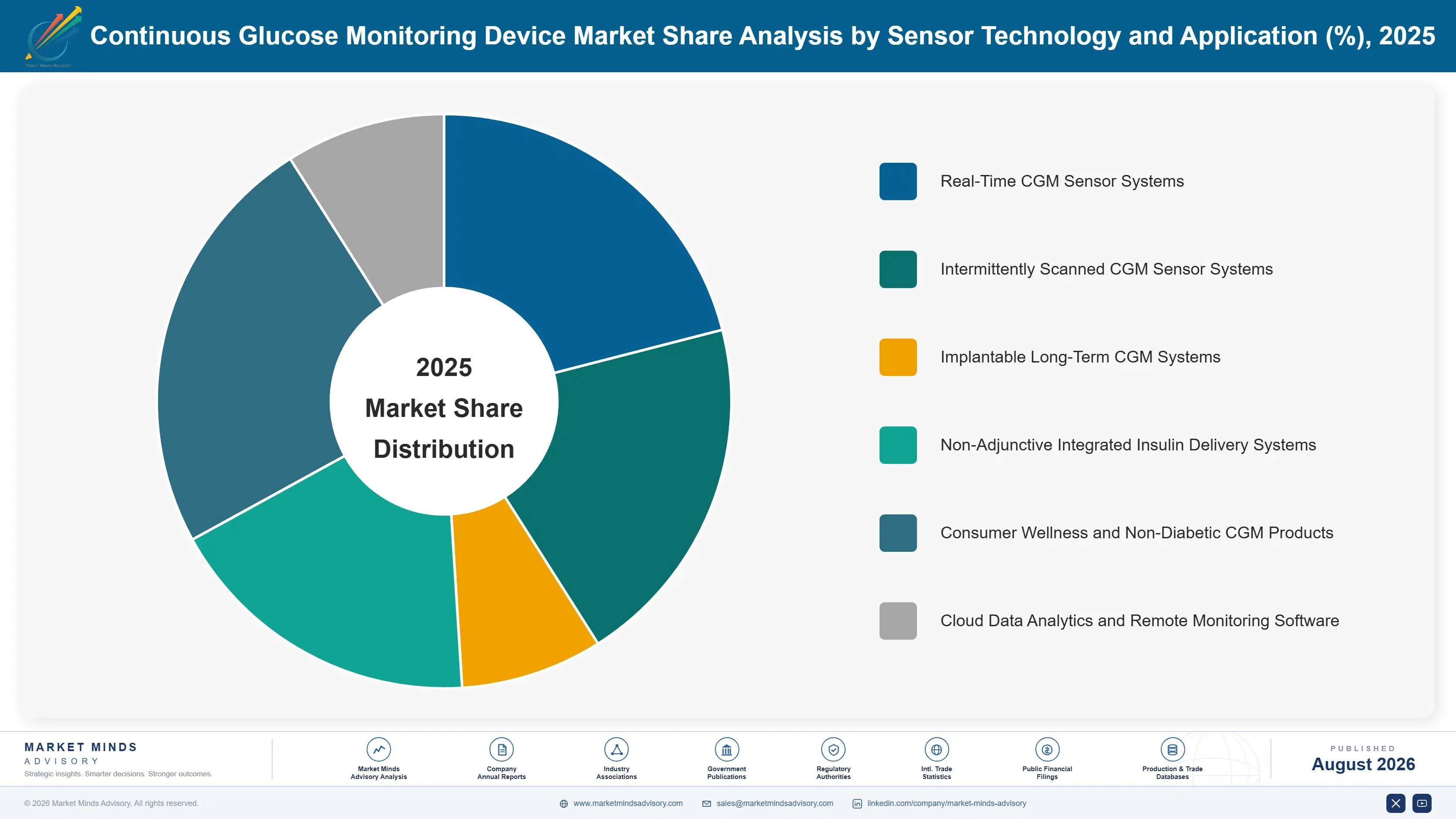
This market segments by device technology spanning real-time continuous systems, intermittently scanned flash systems, professional retrospective systems, implantable long-term sensors, automated insulin delivery integrated systems, and over-the-counter consumer systems sold across North American and European retail, clinical, digital health, and direct-to-consumer subscription channels broadly, spanning both reimbursed and self-pay purchasing pathways nationwide and across the wider region.
north-america-europe-continuous-glucose-monitoring-market-share-analysis-1787307361577

CGM-Integrated Automated Insulin Delivery Systems

CGM-integrated automated insulin delivery systems are the fastest-growing segment as endocrinologists increasingly prescribe combined sensor-pump systems over standalone CGM devices, driven by clinical evidence demonstrating meaningfully improved glycemic control outcomes compared to manual insulin dosing decisions made without continuous sensor feedback integration nationwide. Leading manufacturers have invested heavily in software algorithms that automatically adjust insulin delivery based on real-time sensor readings, creating genuinely differentiated clinical value that standalone CGM systems alone cannot replicate for patients requiring intensive insulin management. This segment commands premium pricing reflecting both the additional hardware integration required and the substantial clinical outcome improvement that payers increasingly recognize as justifying expanded reimbursement coverage. Manufacturers are pursuing deeper pump-partnership integration specifically to compete for this fastest-growing clinical segment.
CAGR 15.5%

Over-the-Counter Consumer CGM Systems

Over-the-counter consumer CGM systems are growing considerably faster than the broader market as regulatory approval of non-prescription sensors opens continuous glucose monitoring to a much larger wellness-focused consumer base beyond diagnosed diabetes patients seeking general metabolic health and nutrition insight rather than clinical disease management specifically. Major manufacturers have launched dedicated consumer product lines with simplified smartphone applications and lower price points designed specifically for this newer, less clinically sophisticated buyer segment entering the category for the first time. This segment benefits from genuine crossover with the broader consumer wellness technology market, appealing particularly to fitness-focused and nutrition-conscious consumers previously unfamiliar with continuous glucose monitoring technology entirely, and manufacturers are investing in consumer marketing to capture this buyer segment.
CAGR 14.2%
Full segment breakdown across 6 segments available in the complete report.

Regional Architecture and Country Demand Map

[house] Because this report is scoped explicitly to North America and Europe, regional shares reflect this restricted geographic scope directly, with residual shares in excluded regions reflecting minimal parallel import and cross-border purchasing activity by individual consumers rather than formal market presence within scope itself.

North America

[house] North America holds the largest share of this regionally scoped market, anchored overwhelmingly by the United States, where broad private insurance and Medicare reimbursement coverage, combined with the fastest over-the-counter consumer CGM adoption in the world, sustains the deepest continuous glucose monitoring category depth of any national market tracked. Canada follows a broadly similar reimbursement-driven adoption pattern at meaningfully smaller absolute scale, with provincial health plans gradually expanding coverage toward levels closer to leading American payers. The United States alone accounts for the substantial majority of regional spending, reflecting both its larger diagnosed diabetes population and its uniquely favorable direct-to-consumer retail and digital marketing environment for newer consumer wellness product lines.
Share: 46% | CAGR: 11.0% (2026 to 2036)

Western Europe

[house] Germany anchors Western European demand through Europe's most favorable statutory health insurance reimbursement environment for continuous glucose monitoring, sustaining broad coverage across both Type 1 and expanding Type 2 diabetes populations that most neighboring countries have not yet matched. The United Kingdom follows through National Health Service coverage expansion that has meaningfully broadened CGM access in recent years, while France maintains steady demand through its national health insurance system's gradual reimbursement policy extension. Smaller Western European markets including the Netherlands and Scandinavian countries show comparatively high per-capita adoption despite modest absolute market size, reflecting strong healthcare system digital integration and patient technology adoption broadly across the region. Spain and Italy round out the region's demand base at smaller scale.
Share: 39% | CAGR: 9.3% (2026 to 2036)
Regional intelligence for 5 additional markets available in the complete report: East Asia, South Asia and Pacific, Latin America, Middle East and Africa, Eastern Europe. Contact sales@marketmindsadvisory.com.
north-america-europe-continuous-glucose-monitoring-country-cagr-analysis-1787307362116

Consumer Expansion and Reimbursement Defense Strategy

Manufacturers are shifting commercial strategy toward over-the-counter consumer product expansion, automated insulin delivery integration partnerships, and reimbursement rate defense, capturing new buyer segments that pure clinical reimbursement dependency alone increasingly cannot sustain across evolving payer environments and shifting consumer purchasing behavior nationally, from long-established clinical incumbents to newer consumer-focused wellness technology challengers alike nationwide.

Over-the-Counter Consumer Product Line Expansion Strategy

Manufacturers are launching dedicated over-the-counter consumer CGM product lines targeting non-diabetic wellness consumers, diversifying revenue away from reimbursement-dependent clinical sales while capturing an entirely new buyer segment unfamiliar with continuous glucose monitoring technology previously. This lever requires meaningful investment in consumer marketing and retail distribution capability that traditional clinical device manufacturers rarely maintained previously. Manufacturers report over-the-counter product lines improving overall unit volume growth by roughly 24% compared to clinical-only reimbursed product portfolios, particularly among fitness-focused and nutrition-conscious buyers entering the category for the first time nationwide across most major regional markets tracked.
Market Impact: Improves overall unit volume growth

Automated Insulin Delivery Integration Partnership Strategy

Manufacturers are pursuing deeper integration partnerships with automated insulin delivery pump makers, building combined sensor-pump systems that command premium clinical positioning and stronger payer reimbursement justification than standalone CGM devices sold without pump integration ever achieved previously. This lever requires meaningful software development and clinical trial investment, but successfully integrated systems command materially stronger prescriber loyalty and patient retention. Manufacturers report integration partnerships improving prescriber retention rates by roughly 33% compared to standalone device offerings, particularly within the fastest-growing intensive insulin management patient population tracked across most major markets broadly.
Market Impact: Improves prescriber retention rates

Direct Payer Value Demonstration Programme Strategy

Manufacturers are investing in real-world outcomes research and direct payer engagement to defend reimbursement rates against downward pricing pressure, demonstrating quantified healthcare cost savings from reduced hospitalization and complication rates that justify sustained premium reimbursement levels to increasingly cost-conscious payers. This lever requires meaningful clinical research investment, but successfully demonstrated value protects pricing considerably better than passive reimbursement negotiation alone. Manufacturers report payer value demonstration programmes improving reimbursement rate retention by roughly 19% compared to markets without dedicated payer engagement, particularly as payers face mounting pressure to justify sustained premium pricing across most reimbursed device categories.
Market Impact: Improves reimbursement rate retenti

International Reimbursement Expansion Advocacy Programme Strategy

Manufacturers are investing in coordinated advocacy and health technology assessment submissions to expand reimbursement coverage into additional European national health systems that have not yet matched leading markets like Germany and the United Kingdom, opening meaningfully larger addressable reimbursed patient populations across the broader region. This lever requires sustained multi-year regulatory and advocacy investment across multiple national health systems simultaneously. Manufacturers report successful reimbursement expansion campaigns improving addressable patient population by roughly 37% within newly covered national markets, particularly across national health systems that have not yet matched leading market reimbursement generosity.
Market Impact: Expands addressable patient populat

Who Controls the Margin Pool

The top five manufacturers control roughly 78% of regional category spending, a tightly concentrated market reflecting genuinely high barriers to entry including regulatory approval complexity, payer reimbursement relationships, and clinical trial evidence requirements that most smaller device companies cannot easily replicate within a reasonable commercial timeframe, and this concentration level has held roughly steady even as newer over-the-counter entrants keep testing the category's boundari
Current competitive activity centers on over-the-counter consumer product line expansion, automated insulin delivery integration partnerships, and direct payer value demonstration programmes, as the three leading manufacturers pursue genuinely different strategic emphases while smaller challengers target specific clinical or geographic niches underserved by the dominant incumbents, a divergence that continues sharpening as over-the-counter approvals reshape which manufacturers can credibly reach non-diabetic wellness consumers.

Emerging pressure comes from non-invasive glucose monitoring technology startups pursuing sensor approaches that eliminate the need for skin-penetrating sensors entirely, alongside growing competition from consumer wellness technology companies entering the category through over-the-counter regulatory pathways that established clinical device manufacturers did not originally anticipate facing, forcing established leaders to respond with acquisitions and partnerships rather than organic capability building alone.
north-america-europe-continuous-glucose-monitoring-company-positioning-matrix-1787307362692

Competitive Moat and Risk Dimensions

ABBOTT LABORATORIES

Moat: Dominant Pharmacy Reimbursement Coverage

Abbott's FreeStyle Libre platform maintains dominant pharmacy channel distribution and reimbursement coverage built over more than a decade of continuous market presence, giving it retail accessibility and prescriber familiarity that newer competitors would need years of comparable investment to replicate at similar national scale nationwide.
ABBOTT LABORATORIES

Risk: Real-Time Platform Competitive Pressure

Abbott faces intensifying competitive pressure from Dexcom's real-time G7 platform gaining share within the core Type 1 diabetes segment, and continued real-time feature parity gaps could meaningfully erode Abbott's clinical positioning advantage among prescribers favoring continuous rather than scanned monitoring technology, according to recent clinical adoption data and investor commentary.
DEXCOM INC.

Moat: Deep Automated Insulin Delivery Partnerships

Dexcom maintains deep integration partnerships with leading automated insulin delivery pump manufacturers, giving its real-time sensor platform a clinical positioning advantage in the fastest-growing combined sensor-pump segment that standalone or flash-only competitors cannot easily replicate without comparable partnership investment, a position built over years of dedicated software and clinical trial investment.
DEXCOM INC.

Risk: US Reimbursement Policy Dependency Risk

Dexcom faces meaningful dependency on continued favorable United States reimbursement policy, and any material tightening of Medicare or private payer coverage rates could disproportionately affect the company's revenue given its comparatively concentrated exposure to the American market relative to more geographically diversified competitors over time.

Players Tracked

Prominent Players

Abbott Laboratories
Dexcom Inc.
Medtronic plc
Senseonics Holdings Inc.
Roche Diabetes Care

Other Key Players

Ypsomed Holding AG
Insulet Corporation
Tandem Diabetes Care Inc.
Ascensia Diabetes Care Holdings AG
LifeScan Inc.
Glooko Inc.
Nova Biomedical Corporation
GlucoRx Ltd.
Menarini Diagnostics S.r.l.
PharmaSens AG
Biolinq Incorporated
Movano Health Inc.
Know Labs Inc.
Waveform Technologies Inc.
Ambrosia Systems Inc.

Recent Developments

MARCH 2026

Dexcom Expands Stelo Over-the-Counter Retail Distribution

Dexcom announced expanded retail pharmacy distribution for its Stelo over-the-counter glucose biosensor, broadening consumer access beyond its original direct-to-consumer online sales channel into major national pharmacy chains across the United States nationwide, following strong initial consumer demand during the product's original limited release period earlier.
Signal: Reflects continued manufacturer investment
NOVEMBER 2025

Abbott Launches Lingo Consumer Biowearable in Additional Markets

Abbott expanded availability of its Lingo consumer biosensor product across additional Western European markets, extending its over-the-counter wellness positioning beyond the initial United States and United Kingdom launch markets into new national retail channels following strong early consumer adoption during its initial launch markets broadly.
Signal: Indicates accelerating over-the-counter co
JUNE 2026

Tandem Diabetes Care Deepens Dexcom Sensor Integration Partnership

Tandem Diabetes Care announced an expanded integration partnership with Dexcom, deepening automated insulin delivery software compatibility across its pump product line to strengthen combined sensor-pump clinical positioning against competing integrated systems following months of joint clinical and engineering collaboration between both companies throughout the process.
Signal: Signals continued consolidation around lea

Sensor Electronics and Biocompatible Material Exposure

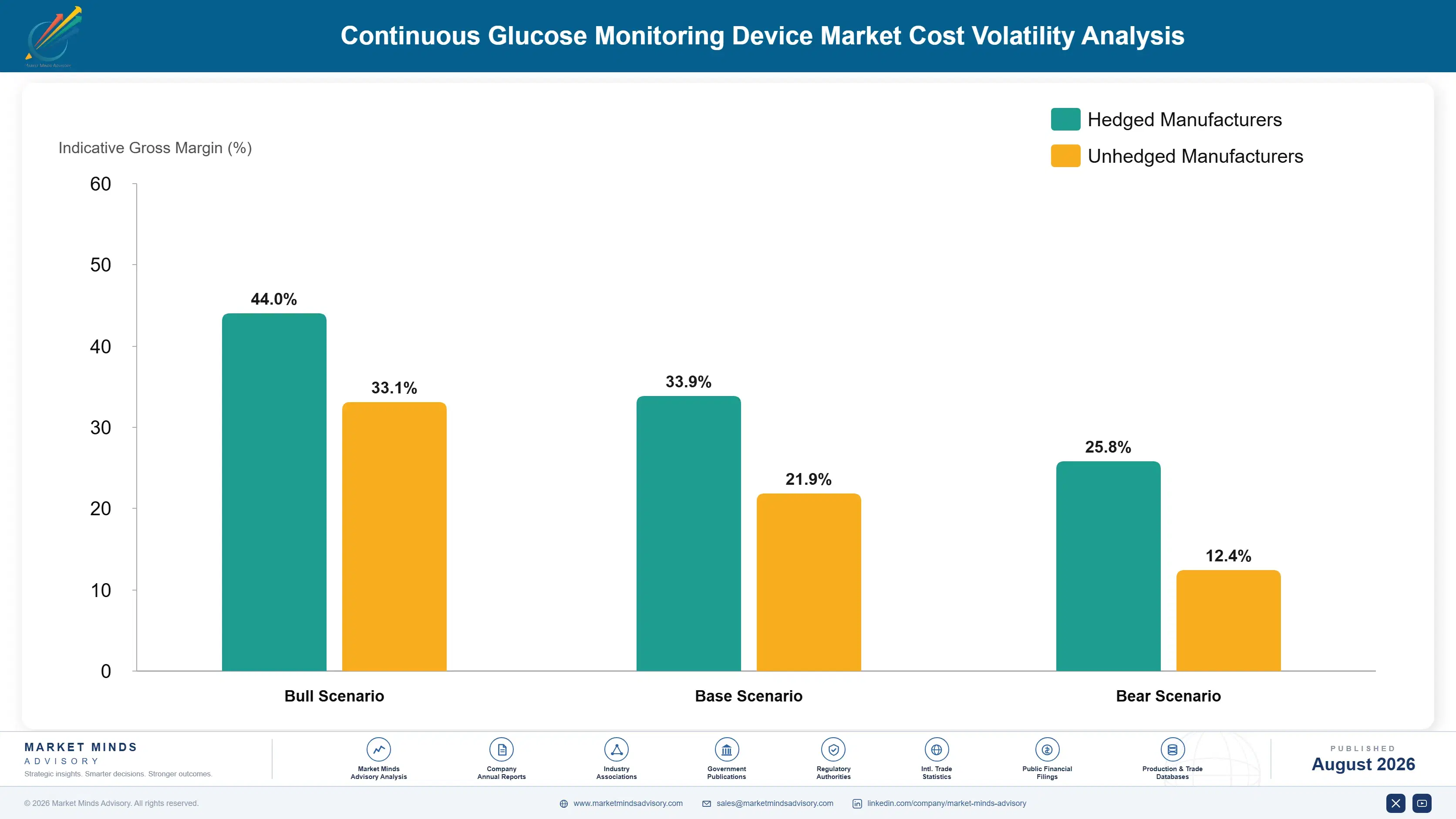
Semiconductor sensor electronics, biocompatible enzyme membranes, and precision manufacturing processes together represent roughly 35% of cost of goods sold for continuous glucose monitoring manufacturers, with key semiconductor components sourced from a concentrated group of specialized electronics suppliers serving the broader medical device industry, with limited redundancy across most of these specialized production facilities globally to date, a concentration that shapes sourcing strategy a
Semiconductor component prices rose meaningfully during 2021 and 2022 amid the broader global chip shortage that affected medical device manufacturers alongside consumer electronics companies, with company annual reports from major manufacturers confirming elevated component costs and supply constraints persisted through much of 2022 before easing gradually through 2023 and 2024, according to company annual reports and IEA commentary tracking upstream semiconductor supply chain conditions to date.

Manufacturers with vertically integrated semiconductor design and sensor manufacturing capability face materially lower input cost exposure and supply chain risk than competitors dependent on external component suppliers, creating a durable cost and reliability advantage for larger, better-capitalized manufacturers able to invest in dedicated production capacity, particularly during periods of tight global semiconductor supply affecting the broader electronics industry broadly.
north-america-europe-continuous-glucose-monitoring-cost-volatility-analysis-1787307362888

Vertical Integration Into Sensor Manufacturing

Larger manufacturers are investing in owned semiconductor design and sensor production capability to reduce dependency on external component suppliers, insulating production costs and supply reliability from the volatility that smaller competitors remain fully exposed to during industry-wide component shortages, a mitigation strategy requiring substantial upfront capital most smaller manufacturers cannot access easily, particularly across the highest-volume product categories.

Long-Term Semiconductor Supply Agreements

Manufacturers are locking in multi-year semiconductor supply agreements with qualified component makers, securing reliable production volume and more predictable input pricing ahead of anticipated demand growth across both clinical and consumer product lines, while also strengthening negotiating position during periods of tight global component supply nationally, particularly across the fastest-growing over-the-counter consumer product lines.

Component Supplier Diversification Strategy

Manufacturers are qualifying additional semiconductor and membrane material suppliers across multiple geographic regions to reduce dependency on any single source, building resilience against regional supply disruption or geopolitical trade restriction affecting concentrated component supply chains, an approach increasingly standard among larger, better-capitalized manufacturers operating across multiple continents simultaneously, particularly across the fastest-growing regional markets tracked in this study.

Portfolio Architecture for Margin Defence

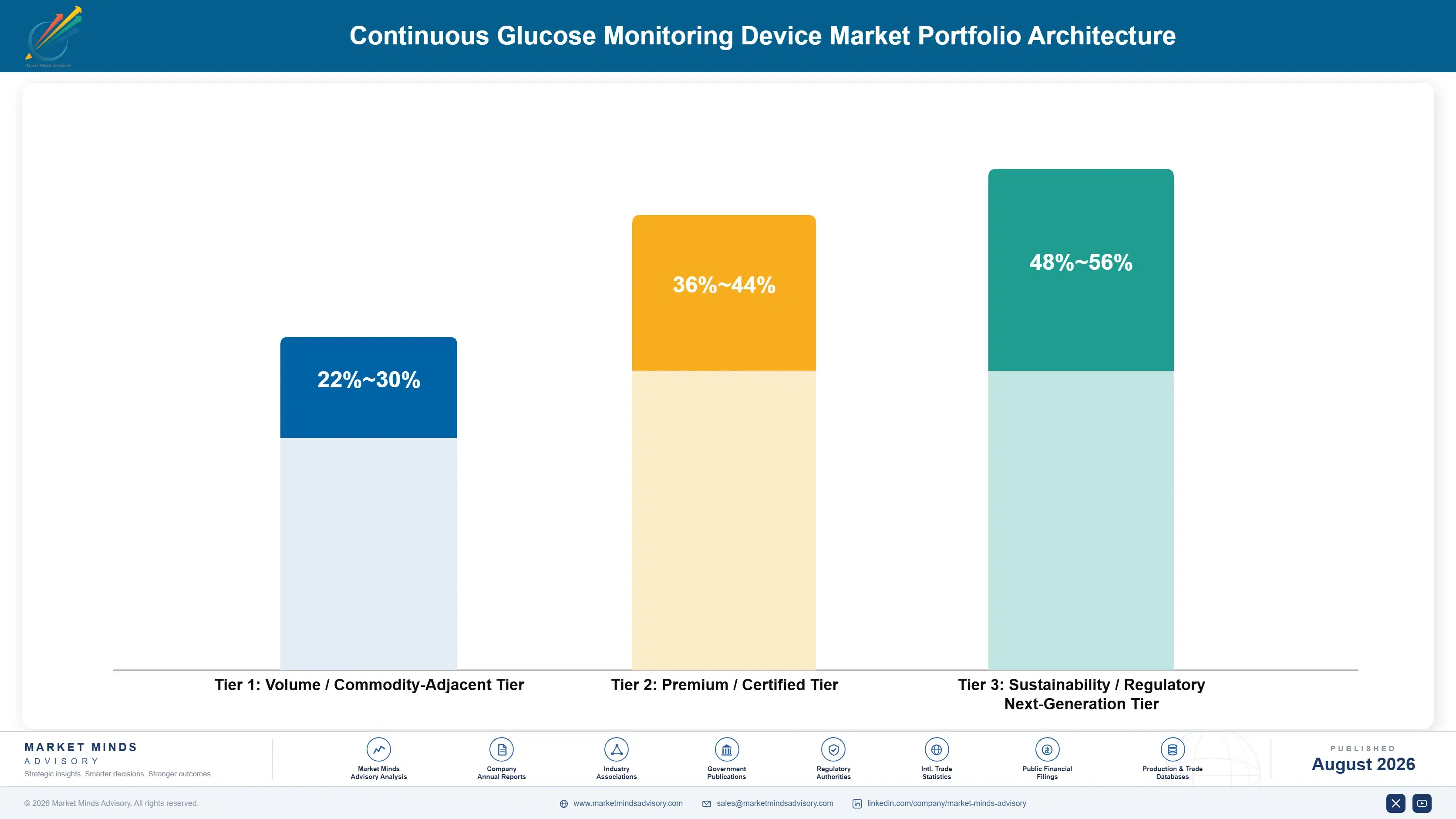
This market organizes into three commercial tiers spanning reimbursed clinical CGM systems at the volume end, premium automated insulin delivery integrated systems occupying the middle tier, and over-the-counter consumer wellness products capturing the strongest unit economics at the top of the portfolio architecture given their direct-to-consumer pricing structure, a structure that increasingly mirrors the broader industry's shift toward diversified revenue across reimbursed and self-pay channe
Clinical and consumer tiers pull manufacturers in genuinely different directions: reimbursed clinical systems sustain predictable, insurance-backed revenue at scale, while consumer and integrated premium systems deliver materially stronger margins that increasingly fund the research and marketing investment this rapidly diversifying category requires to sustain competitive positioning, forcing many manufacturers to run genuinely distinct commercial teams for their clinical and consumer product lines simultaneously.

The highest-value pools concentrate around automated insulin delivery integrated systems and over-the-counter consumer wellness products sold direct-to-consumer, where clinical differentiation and consumer marketing investment together sustain premium pricing power that standard reimbursed clinical systems alone simply cannot match across comparable volume, making these categories the clearest strategic priority for manufacturers planning multi-year growth investment across the region.

Volume / Commodity-Adjacent Tier

Standard reimbursed flash and professional CGM systems sold through pharmacy and durable medical equipment channels across most national health systems broadly, competing primarily on reimbursement coverage breadth rather than premium clinical differentiation or consumer marketing investment.
Gross Margin: 48-56%

Premium / Certified Tier

Real-time CGM systems and automated insulin delivery integrated systems sold under strong clinical differentiation and payer support at premium price points, typically prescribed to patients requiring intensive insulin management and closer glycemic monitoring than standard flash systems provide.
Gross Margin: 58-66%

Sustainability / Regulatory / Next-Generation Tier

Over-the-counter consumer wellness biosensors and implantable long-term sensors commanding the strongest unit economics available across the category today, typically sold direct-to-consumer through subscription platforms rather than traditional pharmacy and reimbursement-dependent retail channels.
Gross Margin: 62-70%
north-america-europe-continuous-glucose-monitoring-portfolio-architecture-1787307363383

High-value Sub-segments and Strategic Watch-out

CGM-Integrated Automated Insulin Delivery Systems

The fastest-growing and highest-margin clinical segment, combining strong prescriber adoption momentum with genuine glycemic outcome improvements documented across most major clinical studies tracked in this report broadly, drawing intense manufacturer research investment and rapidly expanding pump-integration partnership activity industry-wide across leading manufacturers nationwide and beyond.
Gross Margin: 58-66%

Over-the-Counter Consumer CGM Systems

Strong margins and rapid growth driven by an entirely new wellness consumer base that traditional reimbursed clinical channels never previously reached at meaningful commercial scale across the region, particularly among fitness-focused and nutrition-conscious consumers previously unfamiliar with continuous monitoring technology across most major retail channels tracked.
Gross Margin: 62-70%

Real-Time and Flash CGM Systems

The volume core segment sustaining broad reimbursed clinical distribution even as newer integrated and consumer categories increasingly capture disproportionate industry profit growth overall nationally, even as manufacturers increasingly redirect incremental investment toward faster-growing integrated and consumer categories instead across the broader regional market overall today.
Gross Margin: 48-56%

Professional Retrospective CGM Systems

A strategic watch-out segment facing gradual displacement as real-time systems become more affordable, though it remains a meaningful diagnostic tool for certain clinical use cases still today, particularly among cost-conscious payers still comparing diagnostic value against increasingly affordable real-time alternatives within select clinical settings currently.
Gross Margin: 38-46%

Reimbursement-Anchored Renewal Streams

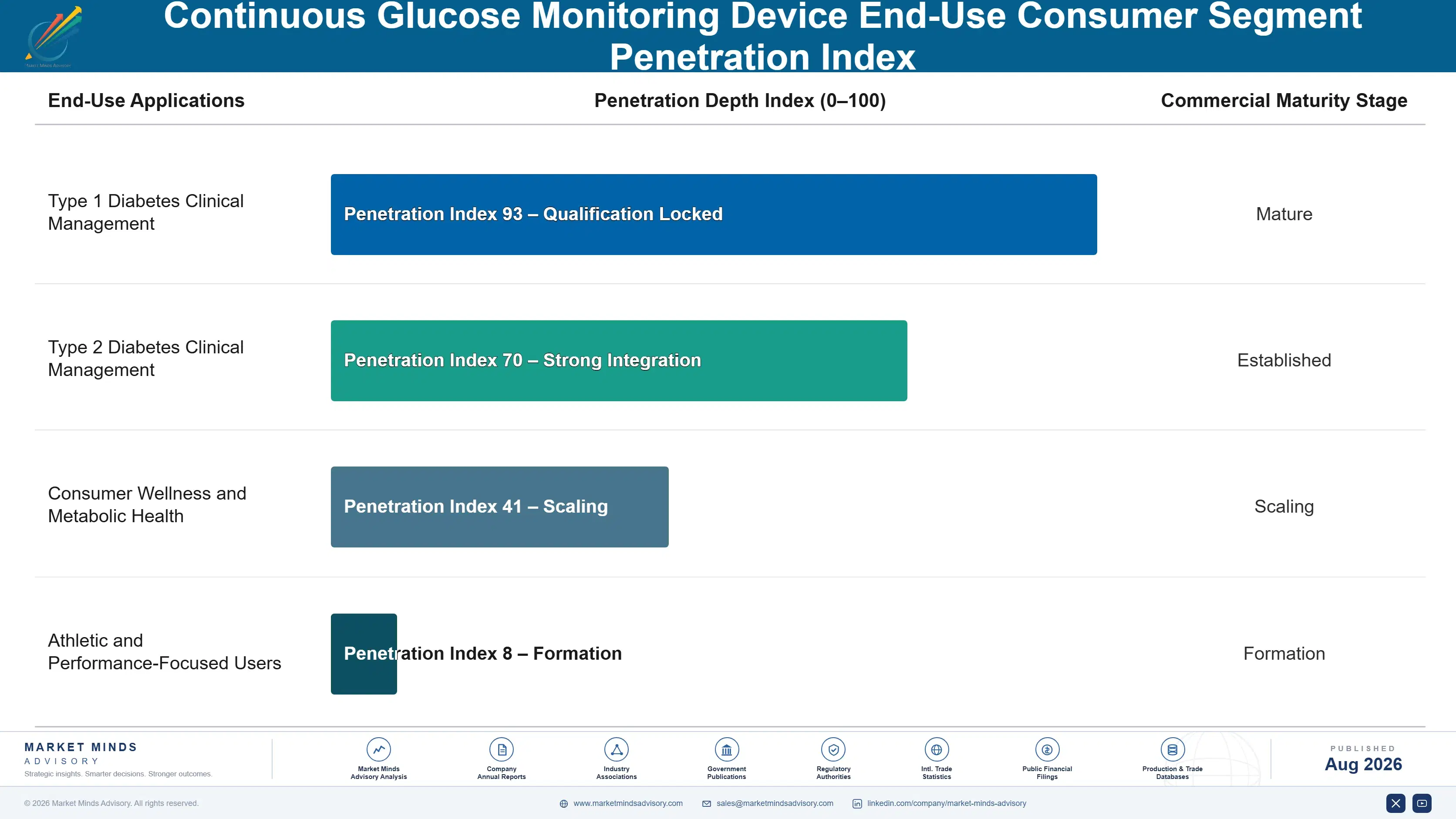
Securing reimbursement coverage functions as an annuity anchor across a patient's treatment lifetime: winning payer coverage generates recurring sensor replacement sales every ten to fourteen days for as long as the patient remains covered, and losing that coverage can eliminate a manufacturer's revenue from that patient almost immediately, which is why manufacturers increasingly treat payer relationships as a board-level strategic priority rather than routine account management.
Adoption depth varies considerably by clinical vertical: Type 1 diabetes patients requiring intensive insulin management adopt premium integrated sensor-pump systems earliest and most completely, while Type 2 diabetes patients and newer wellness consumers more often start with simpler, lower-cost standalone or over-the-counter systems before potentially upgrading later, a pattern that continues shifting gradually as clinical evidence and consumer awareness accumulate across most patient segments broadly.

A generational shift is underway as younger patients and wellness-focused consumers raised on wearable technology enter the category expecting effortless smartphone integration and real-time data access as standard purchasing consideration, gradually normalizing continuous monitoring for a broader population than the diagnosed diabetes patients who built this category originally, a shift manufacturers slow to recognize risk finding themselves increasingly out of step with where their future customer base is heading.
north-america-europe-continuous-glucose-monitoring-end-use-penetration-index-1787307363884

Where CGM Category Economics Are Heading

These are among the four positions where our research anticipates prominent divergence between winners and laggards over the coming forecast period. Each is grounded in the demand model, the regulatory perimeter, and the announced capacity pipeline.
01 / CONSUMER WELLNESS EXPANSION

Over-the-counter adoption will keep pulling in new buyer segments

Manufacturers investing in over-the-counter consumer product lines are capturing an entirely new wellness-focused buyer segment that traditional reimbursed clinical channels never previously reached, and this expansion shows no sign of slowing given continued regulatory approval momentum across major regional markets. Companies without meaningful consumer distribution capability risk missing the fastest-growing segment of this category entirely. Expect over-the-counter adoption to become an increasingly important growth driver for manufacturers seeking sustainable expansion through the coming decade, well ahead of manufacturers relying purely on traditional clinical reimbursement channels alone.
02 / INTEGRATION PARTNERSHIP RACE

Automated insulin delivery integration will separate clinical leaders

Manufacturers pursuing deeper automated insulin delivery integration partnerships are capturing disproportionate share of the fastest-growing, highest-margin clinical segment where demonstrated glycemic outcome improvements increasingly determine prescriber loyalty and payer reimbursement support. Companies without meaningful pump integration risk being confined to lower-margin standalone device categories facing intensifying price competition. Expect integration partnership depth to become an increasingly important competitive differentiator for manufacturers seeking sustainable clinical leadership, particularly within the fastest-growing Type 1 diabetes intensive management patient population, where outcome data reinforces integrated systems over standalone devices.
03 / REIMBURSEMENT RATE DEFENSE

Payer value demonstration will determine long-term margin sustainability

Manufacturers investing in real-world outcomes research and direct payer engagement are better positioned to defend reimbursement rates against continued downward pricing pressure from increasingly cost-conscious private and government payers across major regional health systems. Companies without dedicated payer value demonstration capability risk facing accelerating rate compression on their core reimbursed clinical revenue. Expect payer value demonstration investment to become an increasingly critical determinant of long-term manufacturer margin sustainability, especially as payer scrutiny of device pricing intensifies across most major markets.
04 / EUROPEAN REIMBURSEMENT CONVERGENCE

Coverage gaps between European markets will narrow gradually

Manufacturers investing in coordinated European reimbursement expansion advocacy are steadily narrowing the coverage gap between leading markets like Germany and less mature national health systems still building out diabetes technology reimbursement policy infrastructure. This convergence trajectory shows no sign of reversing given sustained manufacturer advocacy investment and growing clinical evidence supporting expanded coverage. Expect European reimbursement convergence to open meaningfully larger addressable patient populations across the region through the coming several years, particularly across smaller national health systems facing similar reimbursement policy pressures.

Engagement Snapshot From the Field

A live engagement with an industry participant carrying material or product regulatory and market exposure ahead of a defining policy shift, showing how our research translates into a defensible multi-year portfolio strategy.
MARKET MINDS ADVISORY · CLIENT ENGAGEMENT SUMMARY
North America & Europe Continuous Glucose Monitoring Device Producer Strategic Portfolio Review and Transition Roadmap 2026·Investment Scenario on North America & Europe Continuous Glucose Monitoring Device Exposure Evaluation 2025-26
CLIENT PROFILE
The client is a mid-sized continuous glucose monitoring device manufacturer generating projected annual European revenue of approximately $180 million (client-reported, unverified by MMA) upon successful reimbursement expansion. Leadership sought guidance on prioritizing which additional European national health systems to target for expanded reimbursement coverage advocacy ahead of a multi-year investment cycle, running through the following fiscal year ahead of the planned expansion.
STRATEGIC CHALLENGE
The client had achieved strong reimbursement coverage in Germany and the United Kingdom, but leadership was uncertain which additional European markets offered the strongest return on sustained multi-year regulatory and advocacy investment given limited internal resources available for simultaneous expansion across the client's remaining target market list under consideration simultaneously.
MMA APPROACH
MMA's team benchmarked comparable manufacturer reimbursement expansion campaigns across multiple European national health systems, modeled projected addressable patient population and revenue under various market prioritization scenarios, and assessed each target market's health technology assessment process timeline and clinical evidence requirements specifically, drawing on primary interview data gathered from national payer policy experts.
KEY FINDINGS
  1. France and the Netherlands showed the strongest near-term reimbursement expansion potential given already-favorable health technology assessment precedent set by comparable diabetes device categories in recent years.
  2. Markets with existing favorable Type 1 diabetes reimbursement precedent showed meaningfully faster expected Type 2 diabetes coverage expansion timelines than markets without any established CGM reimbursement history.
  3. A coordinated multi-market advocacy approach reduced projected per-market expansion cost considerably compared to pursuing each national health system's approval process entirely independently.
  4. Clinical evidence generated from the client's existing German and British patient populations proved directly reusable in supporting new market health technology assessment submissions.
CLIENT PROFILE
The client is a mid-sized continuous glucose monitoring device manufacturer generating projected annual European revenue of approximately $180 million (client-reported, unverified by MMA) upon successful reimbursement expansion. Leadership sought guidance on prioritizing which additional European national health systems to target for expanded reimbursement coverage advocacy ahead of a multi-year investment cycle, running through the following fiscal year ahead of the planned expansion.
STRATEGIC CHALLENGE
The client had achieved strong reimbursement coverage in Germany and the United Kingdom, but leadership was uncertain which additional European markets offered the strongest return on sustained multi-year regulatory and advocacy investment given limited internal resources available for simultaneous expansion across the client's remaining target market list under consideration simultaneously.
MMA APPROACH
MMA's team benchmarked comparable manufacturer reimbursement expansion campaigns across multiple European national health systems, modeled projected addressable patient population and revenue under various market prioritization scenarios, and assessed each target market's health technology assessment process timeline and clinical evidence requirements specifically, drawing on primary interview data gathered from national payer policy experts.
KEY FINDINGS
  1. France and the Netherlands showed the strongest near-term reimbursement expansion potential given already-favorable health technology assessment precedent set by comparable diabetes device categories in recent years.
  2. Markets with existing favorable Type 1 diabetes reimbursement precedent showed meaningfully faster expected Type 2 diabetes coverage expansion timelines than markets without any established CGM reimbursement history.
  3. A coordinated multi-market advocacy approach reduced projected per-market expansion cost considerably compared to pursuing each national health system's approval process entirely independently.
  4. Clinical evidence generated from the client's existing German and British patient populations proved directly reusable in supporting new market health technology assessment submissions.
RECOMMENDED STRATEGY
Phase 1: Phase 1 (Months 1-9): Prioritize France and the Netherlands for coordinated health technology assessment submission using existing clinical evidence and align internal regulatory resources accordingly. Phase 2: Phase 2 (Months 10-18): Pursue expanded reimbursement negotiations following successful health technology assessment outcomes in priority markets while preparing supporting materials for additional markets. Phase 3: Phase 3 (Months 19-30): Expand advocacy efforts to additional European markets based on initial expansion results and precedent established and lessons learned from the initial rollout phases.
OUTCOME
The client secured expanded reimbursement approval in its priority markets within the recommended timeline, reporting patient population growth and revenue results consistent with initial modeling projections during the following two fiscal years (client-reported, unverified by MMA), exceeding the client's original internal projections modestly during the first year following implementation.

Frequently Asked Questions

Foundational context covering the market sizes, CAGR, scope, country, region and competition that inform every finding below. This section is provided to cover basics and most often pre-purchase conversations, answered from the MMA Primary Research Dataset.

What is the current size of the North America & Europe Continuous Glucose Monitoring Device Market?

The market was valued at approximately $9.8 billion in 2025. This includes real-time, flash, implantable, and over-the-counter continuous glucose monitoring devices sold across the region.

How large will the North America & Europe Continuous Glucose Monitoring Device Market be by 2036?

The market is projected to reach approximately $30.3 billion by 2036, up from about $10.9 billion in 2026. This reflects continued reimbursement expansion and consumer adoption growth.

What is the CAGR for the North America & Europe Continuous Glucose Monitoring Device Market 2026 to 2036?

The market is expected to grow at a compound annual growth rate of 10.8% between 2026 and 2036. This reflects steady reimbursement expansion and rising over-the-counter consumer adoption.

Which segment is growing fastest?

CGM-integrated automated insulin delivery systems are the fastest-growing segment, expanding at approximately 15.5% annually, well above the overall market's 10.8% blended growth rate. This reflects strong clinical demand for combined sensor-pump systems.

Who are the major companies in the North America & Europe Continuous Glucose Monitoring Device Market?

Leading companies include Abbott, Dexcom, Medtronic, Senseonics, and Roche Diabetes Care. Together these five manufacturers account for roughly 78% of regional category spending across North America and Europe.

Which country is growing fastest?

Germany is the fastest-growing major country at an estimated 12.3% CAGR, driven by Europe's most favorable statutory reimbursement environment for continuous glucose monitoring devices broadly.

Report Segmentation Architecture

The full report scope spans multiple orthogonal segmentation dimensions, with cross-tabulated demand data provided for each dimension pair. Coverage extends further to regional breakdowns, trend trajectories, and the competitive detail needed to support segment-level decision-making.

By Device Technology

  • Real-Time Continuous CGM Systems
  • Intermittently Scanned Flash CGM Systems
  • Professional Retrospective CGM Systems
  • Implantable Long-Term CGM Sensors
  • Automated Insulin Delivery Integrated Systems
  • Over-the-Counter Consumer CGM Systems

By End-Use Patient Segment

  • Type 1 Diabetes Patients
  • Type 2 Diabetes Patients
  • Prediabetes and Wellness Consumers
  • Gestational Diabetes Patients
  • Hospital and Clinical Monitoring

By Commercial Dimension

  • Reimbursed Pharmacy and DME Channels
  • Direct-to-Consumer Retail Channels
  • Hospital and Clinical Procurement
  • Digital Health Platform Partnerships

By Region

  • North America
  • Western Europe
  • East Asia
  • South Asia and Pacific
  • Latin America
  • Middle East and Africa
  • Eastern Europe

Scope, Methodology, and Coverage

Every figure in this report is reproducible from documented input assumptions. The scope below maps the historical period, the forecast horizon, the segmentation dimensions, and the countries covered, alongside the underlying primary and qualitative methodology.
Historical Period
2020 to 2025
Forecast Period
2026 to 2036
Base Year
2025 (USD billions; MMA Primary Research Dataset, August 2026)
Market Definition
This report covers continuous glucose monitoring devices and integrated systems sold specifically across North America and Europe, including real-time, flash, implantable, and consumer over-the-counter CGM sensors. It excludes traditional fingerstick blood glucose meters and standalone insulin delivery devices without CGM integration.
Quantitative Units
USD billions (current prices); unit shipment volume; average selling price by device category
Segmentation Dimensions
By Device Technology; By End-Use Patient Segment; By Commercial Dimension; By Region
Regions Covered
North America, Western Europe, East Asia, South Asia and Pacific, Latin America, Middle East and Africa, Eastern Europe
Countries Covered
USA, Canada, Germany, France, UK, Italy, Spain, Netherlands, Sweden, Switzerland, Poland, Czech Republic, Russia, and additional North American and European markets relevant to this sector
Key Companies Profiled
Abbott Laboratories, Dexcom Inc., Medtronic plc, Senseonics Holdings Inc., Roche Diabetes Care, Ypsomed Holding AG, Insulet Corporation, Tandem Diabetes Care Inc., Ascensia Diabetes Care Holdings AG, LifeScan Inc., Glooko Inc., Nova Biomedical Corporation, GlucoRx Ltd., Menarini Diagnostics S.r.l., PharmaSens AG, Biolinq Incorporated, Movano Health Inc., Know Labs Inc., Waveform Technologies Inc., Ambrosia Systems Inc.
Quantitative Methodology
Primary survey, n=3,800 respondents, Q4 2025, six countries; demand-side model with trade association cross-validation
Qualitative Methodology
47 expert interviews, Q4 2025; applied to validate demand model assumptions, identify emerging dynamics, and assess competitive positioning
Report Format
PDF and XLSX data workbook (Word format preview document)
Publisher
Market Minds Advisory
Report Code
MMA-2026-MED-132
Published
August 2026
Contact
sales@marketmindsadvisory.com | www.marketmindsadvisory.com

Purchase the full North America & Europe Continuous Glucose Monitoring Device Market Report (2026 to 2036).

The full report provides detailed device-level segmentation, country-level reimbursement policy analysis, and channel distribution tracking across North America and Europe covered in this study. It includes manufacturer-level competitive benchmarking based on integration partnerships and consumer distribution capability, alongside detailed payer reimbursement pathway commentary. Subscribers receive quarterly updates tracking new product launches and reimbursement policy changes as they occur. A companion dataset provides patient population and reimbursement coverage estimates by country for detailed market sizing purposes, including scenario modeling for reimbursement expansion and over-the-counter product launch planning.
Device-level segmentation breakdown by technology type
Country-level reimbursement policy and coverage trend analysis
Distribution channel tracking and benchmarking service
Manufacturer competitive benchmarking scorecards and overview
Quarterly reimbursement policy update and alert service
Patient population dataset segmented by country region

Built For The People Who Decide

From boardroom strategy to bench-side execution, this report is read cover-to-cover by leaders shaping the next decade of their industry, turning demand scenarios, market dynamics and valuation benchmarks into decisions.
CXOs/ Presidents/ VPs/ Managers
M&A and Corporate Development
Strategy Teams and R&D Heads
Procurement and Product Directors
Regulatory and Compliance Leaders
Investor Relations and Equity Analysts