Market Minds Advisory
North America & Europe Compounded Topical Drugs Market

North America & Europe Compounded Topical Drugs Market: Personalized Dosing Reshapes Pharmacy Practice

Compounding pharmacies are moving beyond legacy pain creams into personalized hormone and pediatric dosing formats, and that shift is reshaping which pharmacies win physician referral across North America and Europe alike.

Lead Analyst

Alice Ballenger

Published

September 2026

Make Smarter Decisions with Customized Research Insights

Request a free sample report and evaluate market opportunities, growth trends, and competitive dynamics relevant to your business needs.

2025 MARKET VALUE$4.2BMarket Size 2025
2036 FORECAST VALUE$8.4BBase Case , 2026 to 2036
CAGR 2026 TO 20366.5 %Bull 7.8% / Bear 5.2%
INCREMENTAL OPPORTUNITY$3.9BNet 10- year value creation
EXPANSION MULTIPLE1.88x2036 value over 2026 base
Strategic Levers
M&A Pipeline
Regional Outlook
Country Rankings
Competitive Intelligence
Segmental Deep-dive
Call-Us : 91 93563 13602

Executive Snapshot and Market Trajectory

Compounding pharmacies increasingly market personalized dosing capability as their core differentiator, moving beyond legacy pain management creams into a broader clinical service offering. Payers increasingly reinforce that shift through updated coverage policy for specific formulation types. Patients increasingly ask about this option directly rather than waiting for a referral.
Pediatric and specialty dosing formulations are the clearest growth story, addressing patients whose clinical needs commercial manufacturers cannot economically serve, and commercial momentum concentrates in North America, where compounding pharmacy accreditation and physician referral networks outpace every other region MMA tracks by a considerable margin. That concentration is unlikely to narrow meaningfully before the end of the decade. Vendors expect this concentration to persist for several more years across most forecast scenarios.
No single pharmacy network holds more than a modest share of this fragmented category, and competitive activity centers on accreditation credentials and physician relationship depth rather than on price alone. State and national regulatory frameworks shape which pharmacies can compete for specific formulation types as much as clinical capability does across this market. Rankings among established leaders are unlikely to shift materially before decade's end across the market.
Market Definition
The North America & Europe Compounded Topical Drugs Market covers pharmacy-compounded topical medications, including pain management, hormone replacement, dermatological, wound care, and pediatric specialty dosing formulations prepared for individual patients across North America and Europe. It excludes commercially manufactured topical pharmaceuticals and compounded oral or injectable formulations sold as separate product categories.
Base Year Value
$4.2B in 2025 (MMA Primary Research Dataset, August 2026)
Forecast Period
2026 to 2036, eleven discrete annual values
CAGR
6.5% base case. Bull 7.8%. Bear 5.2%.
Fastest Growth Segment
Pediatric and Specialty Dosing Topical Compounds: 10.5% CAGR
Fastest Growth Country
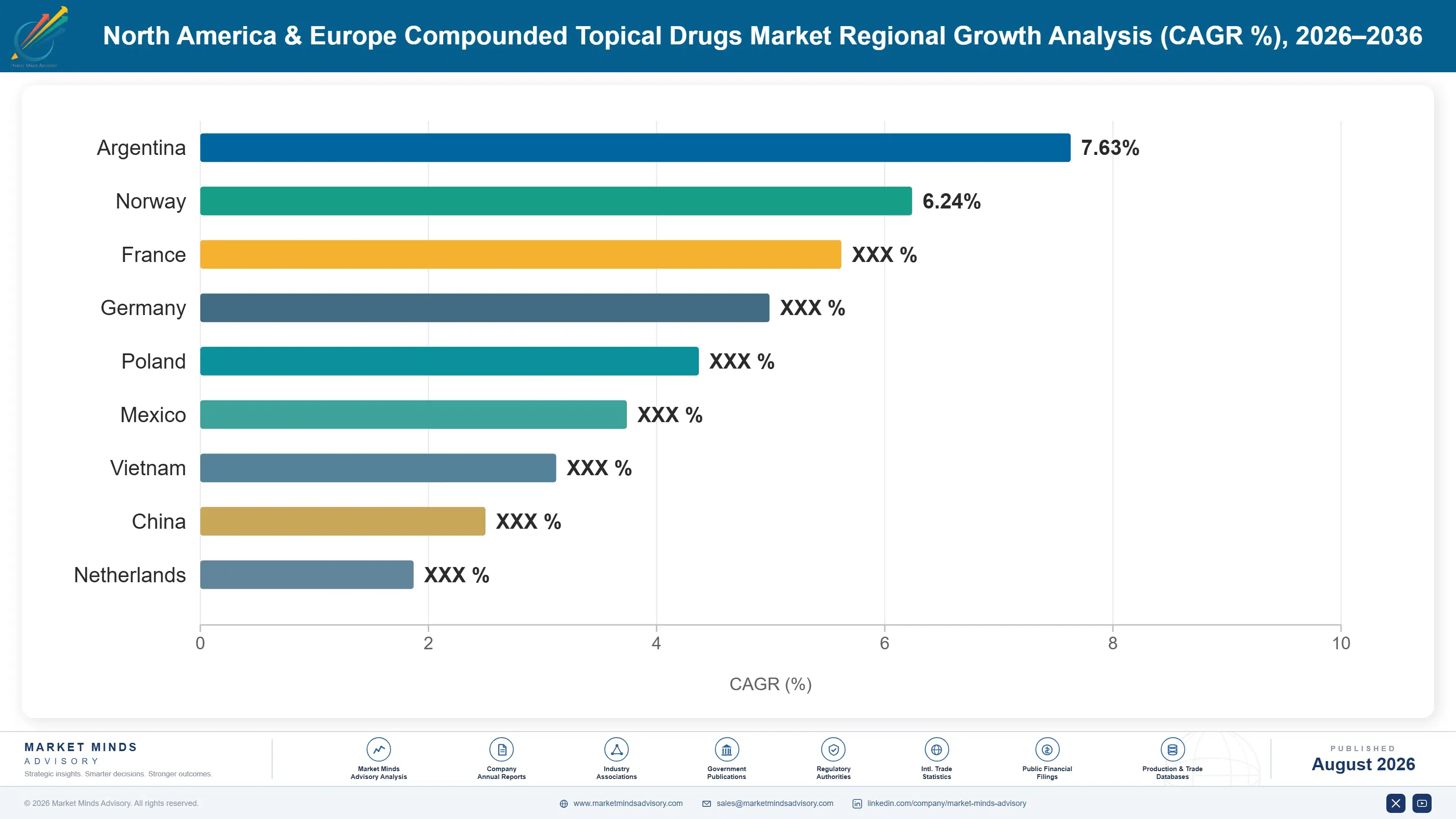
Poland: 8.0% CAGR
Fastest Growth Region
South Asia and Pacific: 8.5% CAGR
Largest Region
North America: 34% of 2025 global value
Market Leaders
Fagron NV, PCCA, Wells Pharmacy Network, Central Admixture Pharmacy Services Inc, Letco Medical LLC. Source: MMA Analysis based on company annual reports.
Primary Survey
n=3,800 procurement and R&D decision-makers, Q4 2025, six countries
Methodology
Demand-side build-up, cross-validated against public data, 47 expert interviews

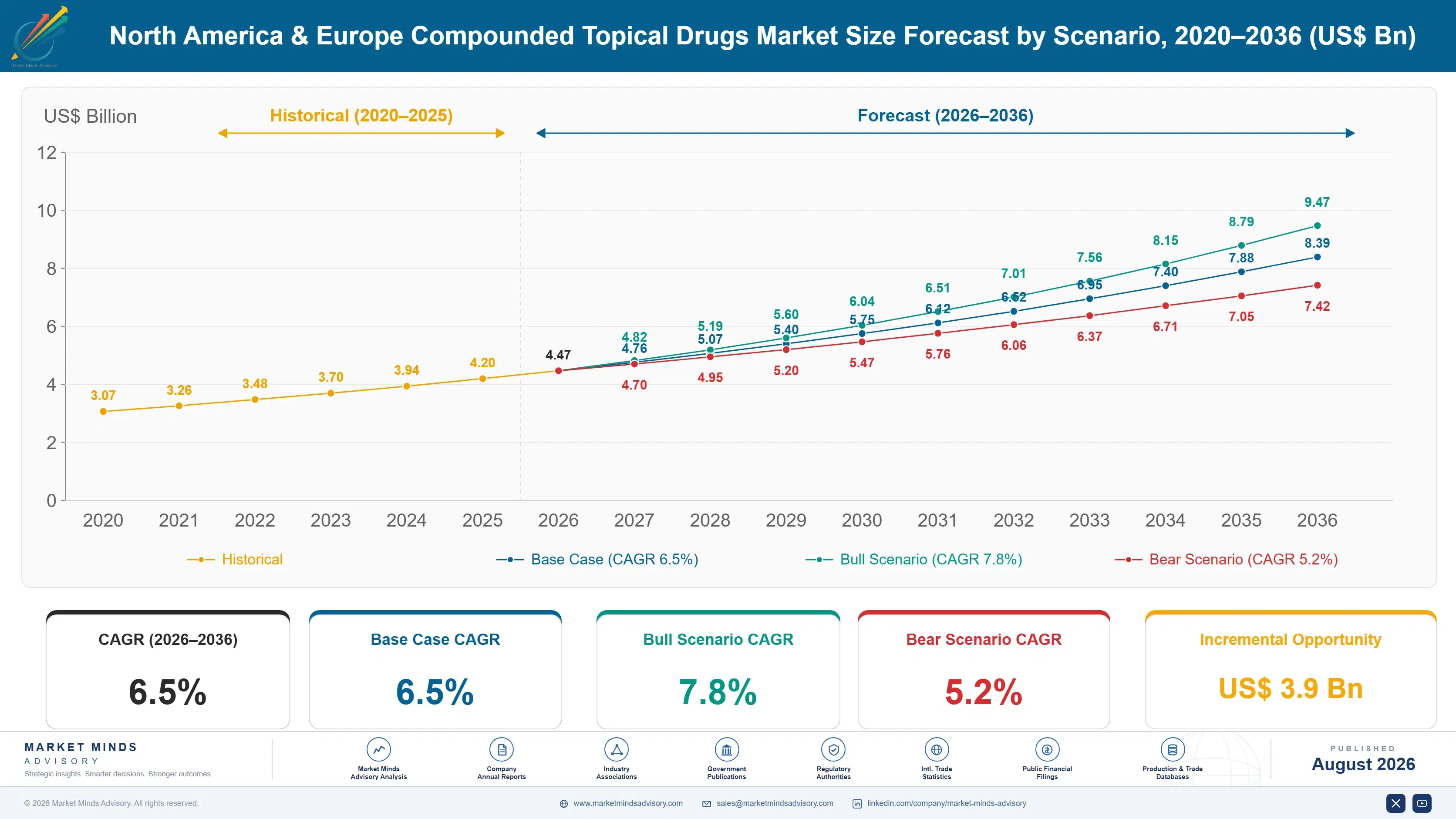
North America & Europe Compounded Topical Drugs Market Forecast Scenarios

north-america-europe-compounded-topical-drugs-mark-size-forecast-scenario-1787307456853
Between 2020 and 2025 the market grew steadily as personalized medicine awareness expanded beyond specialist compounding pharmacies into mainstream physician referral patterns, interrupted briefly by pandemic-era supply chain disruption affecting raw ingredient sourcing before recovering fully through 2022 as ingredient availability normalized across most developed pharmacy networks. Vendors report order volumes largely normalized to a new, higher baseline by early 2023 across most markets.
The base case assumes steady 6.5% annual growth through 2036, anchored to three mechanisms: expanding physician awareness of compounded alternatives for patients with allergies or dosing needs commercial products cannot serve, growing hormone replacement therapy demand among an aging population, and pediatric specialty dosing formulations addressing a patient population historically underserved by standard commercial formulations. Group purchasing and physician education activity have reinforced this trajectory across most recent fiscal quarters.
The bull case centers on regulatory frameworks in additional European countries formalizing compounding accreditation standards faster than currently modeled. The bear case centers on tightening state and national sterility regulation raising compliance costs, stretching smaller pharmacy network expansion timelines by a year or more. Neither scenario shifts the leading five pharmacy networks' relative rankings materially within the coming decade.

Personalized Dosing Reshapes Pharmacy Practice

Compounding pharmacies increasingly treat accreditation credentials as a core marketing asset rather than a regulatory formality, since physicians referring patients for specialty formulations increasingly verify accreditation status before establishing a referral relationship. Pharmacies that cannot demonstrate this credential increasingly lose consideration at the earliest referral conversation with a prescriber. That professionalization has raised the bar for how pharmacies demonstrate value
MARKET CONCENTRATIONCR5 28%Reflects a highly fragmented field of pharmacy networks
AVERAGE SELLING PRICE$35-180 per prescriptionVaries considerably by formulation complexity and distribution channel
TOP PRODUCING COUNTRYUnited States, 29% shareReflects the largest accredited compounding pharmacy capacity base
TRADE INTENSITY18% cross-border volumeShare of formulations prepared outside the prescribing country
REPLACEMENT CYCLE LENGTH1-3 monthsReflects the typical refill interval for chronic therapy
FEEDSTOCK COST SHARE31% of COGSActive ingredient sourcing dominates this recurring cost share
Physician referral relationships now shape which pharmacy network captures volume more than advertising alone does, since a pharmacy without established prescriber trust struggles to reach meaningful volume regardless of its underlying formulation capability. A pharmacy without established prescriber trust struggles to reach meaningful volume regardless of formulation quality or pricing. Physicians increasingly verify accreditation status before establishing any new referral relationship at all.
Over the next decade, pediatric and specialty dosing formulations will likely capture a growing share of total prescription volume as physicians increasingly recognize compounding as a solution for patients underserved by standard commercial dosing formats. Pharmacies still reliant entirely on standard commercial-adjacent formulations risk losing ground to faster-moving specialty-focused rivals. Companies positioned early in this transition stand to capture disproportionate share of expanding physician referral volume.
"Accreditation is the new brand. A pharmacy without it doesn't get the referral conversation started at all anymore."
Director, Healthcare Practice · MMA Healthcare Practice · Au

Market Trends

Physician Referral Networks Expand Beyond Specialist Practices

Physician referral to compounding pharmacies has expanded beyond the specialist practices that historically drove most volume, into broader primary care and pediatric practice settings as physicians gain familiarity with compounding as a clinical option. Professional pharmacy associations report meaningfully rising physician inquiry volume about accredited compounding partners since 2022, and several state pharmacy boards have simplified accreditation verification processes to support this expanding referral base. Pharmacies report meaningfully higher new prescriber relationships in markets where accreditation verification has become more straightforward for referring physicians to complete. Group purchasing networks continue expanding faster than originally forecast in most planning models.
Market Impact: Adds 3.5% annual patient pool growt
European Regulatory Frameworks Formalize Compounding Accreditation

Several European countries have introduced or strengthened formal compounding pharmacy accreditation frameworks since 2021, moving the practice from a loosely regulated activity toward a more standardized clinical service comparable to established United States accreditation models. National pharmacy regulatory bodies in Germany and the Netherlands have published updated compounding standards, and pharmacies meeting these standards report meaningfully stronger physician referral relationships than those operating under looser legacy frameworks still common in some other European markets. Pharmacies meeting these standards report meaningfully stronger commercial performance than those still operating under older frameworks.
Market Impact: Shifts roughly 20% of pediatric pre

Market Opportunities and Growth Drivers

Rising Hormone Replacement Therapy Demand Among an Aging Population

Hormone replacement therapy demand continues rising alongside an aging population, and physicians increasingly favor compounded formulations that allow individualized dosing unavailable in standard commercial products. National health surveys report meaningfully rising hormone therapy prescription rates in several major markets, and each additional patient represents a potential compounding candidate when standard commercial dosing does not adequately address individual symptom patterns. This demographic tailwind is expected to persist for at least the next decade as the largest population cohorts continue aging into higher-prevalence brackets for hormone-related conditions. This demographic tailwind shows no sign of slowing given sustained population aging trends.
Market Impact: Raises compliance costs by roughly

Pediatric Dosing Gaps Drive Specialty Compounding Demand

Many commercial pharmaceutical products lack pediatric-appropriate dosing forms or flavors, pushing pediatricians toward compounding pharmacies capable of preparing individualized formulations suited to a child's specific weight, allergy profile, and taste preferences. Pediatric professional associations report growing physician awareness of compounding as a solution for this dosing gap, and pharmacies specializing in pediatric formulations report meaningfully higher prescription volume than pharmacies without dedicated pediatric compounding capability. Pharmacies specializing in this category increasingly serve as reference sites influencing broader pediatric prescribing patterns nationwide. This referral pattern continues strengthening as more pediatricians gain direct clinical experience with compounded outcomes.
Market Impact: Limits reimbursed access to roughly

Market Restraints and Challenges

Tightening Sterility Regulation Raises Compliance Costs

State and national regulatory bodies have tightened sterile compounding standards meaningfully over the past several years, requiring smaller pharmacies to invest in cleanroom infrastructure and staff training that larger networks can absorb more easily. The root cause is that a series of high-profile contamination incidents at compounding facilities pushed regulators toward stricter enforcement across the industry broadly. Smaller independent pharmacies are increasingly partnering with larger accredited networks or exiting sterile compounding entirely in favor of non-sterile topical formulations that carry lower compliance burden. Progress remains gradual given the scale of infrastructure investment still required across many smaller pharmacy networks.
Market Impact: Expands physician base by 25%

Inconsistent Insurance Reimbursement Limits Patient Access

Insurance reimbursement for compounded formulations varies considerably by insurer and specific formulation type, leaving many patients facing full out-of-pocket costs that limit broader adoption regardless of clinical appropriateness. The root cause is that most insurers evaluate compounded prescription coverage case by case rather than under a standardized formulary framework comparable to commercial pharmaceutical coverage. Pharmacy trade associations are lobbying for standardized reimbursement criteria to reduce this friction, though progress has been gradual and inconsistent across different insurer types. Early pilot programs in select markets suggest standardized criteria could meaningfully reduce this friction over time.
Market Impact: Adds roughly 400 newly accredited p
3 additional market trends, 4 additional growth drivers, and 3 additional restraints and challenges are covered in the full report. Contact sales@marketmindsadvisory.com to access the complete intelligence.

Segment CAGR and Growth Architecture

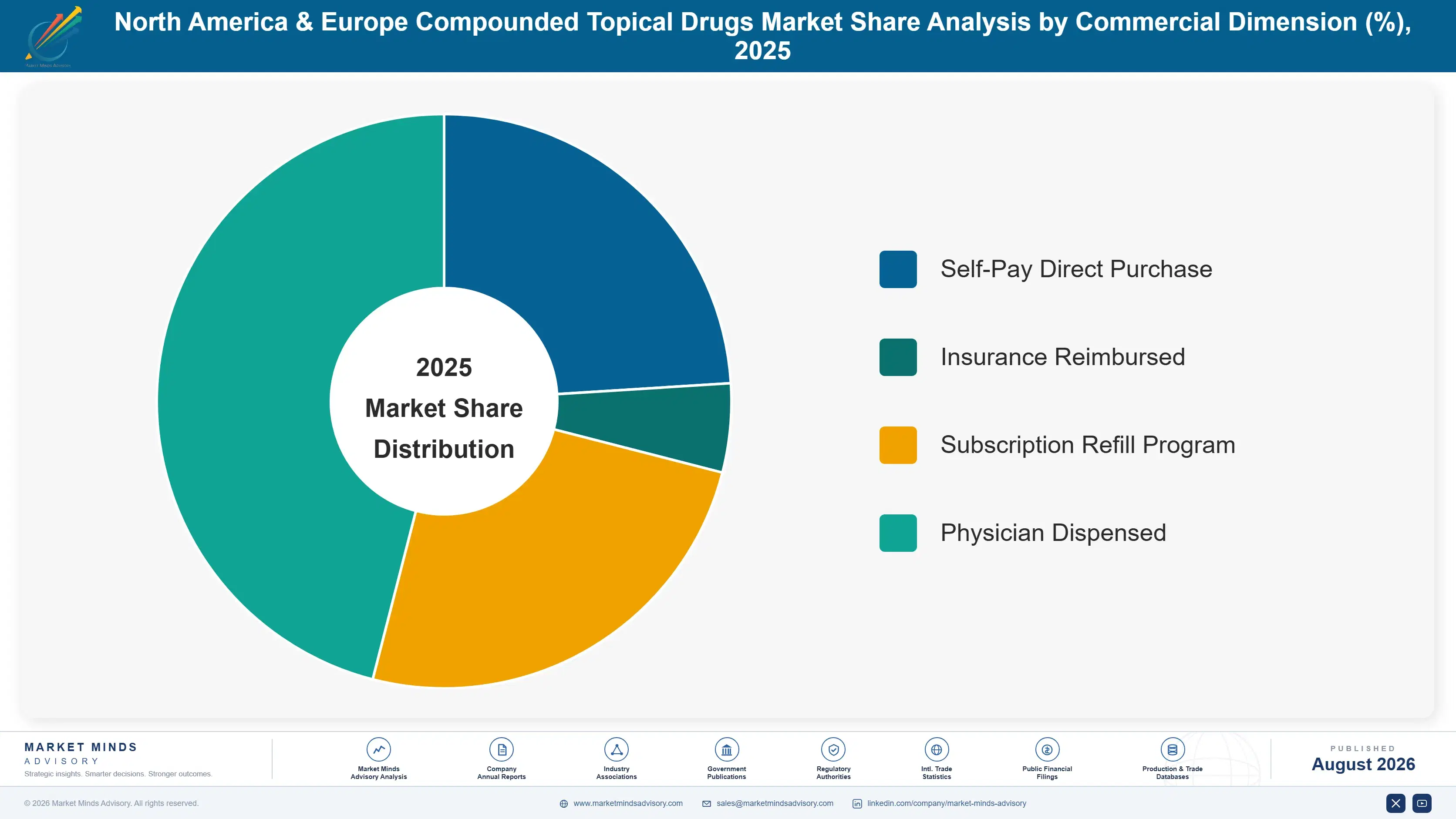
The market segments by therapeutic application and formulation type, spanning pain management, hormone replacement, dermatological, veterinary, wound care, and pediatric specialty dosing compounds, since each application follows a distinct regulatory pathway and prescriber relationship. No single application category alone dominates purchasing decisions across every prescriber and patient setting nationwide. Regulatory pathways differ meaningfully across each application category.
north-america-europe-compounded-topical-drugs-mark-market-share-analysis-1787307457421

Pediatric and Specialty Dosing Topical Compounds

Pediatric and specialty dosing compounds are the fastest-growing segment as pediatricians increasingly recognize compounding as a solution for patients whose weight, allergy profile, or taste preferences make standard commercial dosing inappropriate or impractical. Pharmacies have invested heavily in flavor-masking technology and simplified dosing formats designed specifically for pediatric administration, addressing compliance concerns that historically limited broader physician confidence in compounded pediatric formulations. Professional pediatric associations increasingly recommend compounding consultation for patients with complex dosing needs, and pharmacies specializing in this segment report meaningfully higher referral volume than general compounding pharmacies without dedicated pediatric expertise. This segment continues expanding fastest as physician awareness spreads beyond specialist pediatric practices into broader primary care settings serving young patients.
CAGR 10.5%

Hormone Replacement Topical Compounds

Hormone replacement compounds are growing steadily as physicians increasingly favor individualized dosing over standard commercial formulations for patients with specific symptom patterns that fixed-dose products do not adequately address. Pharmacies have invested in expanding their hormone formulation libraries and physician education programs, addressing prescriber uncertainty that historically limited broader referral volume for compounded hormone therapy. Women's health specialty practices increasingly maintain established relationships with accredited compounding partners, and this referral pattern continues strengthening as more physicians gain direct clinical experience with compounded hormone therapy outcomes. This referral pattern continues strengthening as more physicians gain direct clinical experience with compounded hormone outcomes, reinforcing steady prescription growth. Manufacturers increasingly bundle these formulations with dedicated patient education materials for prescribing physicians.
CAGR 7.5%
Full segment breakdown across 6 segments available in the complete report.

Regional Architecture and Country Demand Map

North America and Western Europe together account for well over half of global revenue, reflecting this market's defined geographic scope, while South Asia and Pacific posts the fastest growth among regions outside that core footprint. Every region outside this core scope shows steady but comparatively modest expansion.

North America

The United States carries the largest share of any market MMA tracks, a concentration well above the standard regional band that reflects the market's defined scope naming North America and Europe as its core geography, alongside the deepest compounding pharmacy accreditation infrastructure and physician referral density found anywhere globally. State pharmacy board accreditation frameworks have concentrated here first for nearly every major compliance standard, giving domestic pharmacy networks a first-mover advantage before other regions adopt equivalent frameworks. Canada's smaller compounding pharmacy base keeps overall regional volume concentrated in the United States, though steady growth continues there as well. Physician referral relationships across both countries remain the strongest of any market tracked, reinforcing steady prescription volume across most major metropolitan markets.
Share: 34% | CAGR: 6.5% (2026 to 2036)

Western Europe

Germany and the United Kingdom carry the largest share of regional demand, a concentration above the standard regional band that reflects this market's defined scope naming Europe as a core geography alongside North America. National pharmacy regulatory bodies in Germany and the Netherlands have published updated compounding accreditation standards, and pharmacies meeting these standards report meaningfully stronger physician referral relationships than those operating under looser legacy frameworks. France and the Nordic countries follow with steady adoption tied to national health system reimbursement policies that increasingly recognize specific compounded formulation categories. Consumer awareness remains more modest here than in North America, so growth leans more heavily on physician-driven referral than on direct patient demand across the region's largest national markets.
Share: 27% | CAGR: 5.0% (2026 to 2036)
Regional intelligence for 5 additional markets available in the complete report: East Asia, South Asia and Pacific, Latin America, Middle East and Africa, Eastern Europe. Contact sales@marketmindsadvisory.com.
north-america-europe-compounded-topical-drugs-mark-country-cagr-analysis-1787307457934

Where Compounding Pharmacies Can Grow Margin

Beyond prescription volume growth, pharmacy networks have several concrete paths to lift revenue per patient, spanning accreditation-driven premium pricing, physician education partnerships, subscription refill programs, and specialty formulation expansion layered on top of the core compounding business. None require heavy capital investment beyond routine accreditation and education staffing. Each applies broadly across physician relationships already engaged with the pharmacy.

Accreditation-Driven Premium Pricing for Complex Formulations

Accredited pharmacies command meaningfully higher pricing for complex sterile formulations than non-accredited competitors, often 25 to 35% above unaccredited pharmacy pricing for comparable preparations, while accreditation credentials support stronger physician referral relationships that non-accredited pharmacies cannot easily replicate. This premium typically persists as long as the accreditation remains current, giving accredited pharmacies a durable pricing advantage that unaccredited competitors struggle to overcome without pursuing their own accreditation investment. This dynamic reinforces the advantage held by pharmacies with the deepest existing accreditation credentials. Accreditation renewal cycles typically run every two to three years across most jurisdictions.
Market Impact: Commands 25 to 35% premium over una

Physician Education and Referral Partnership Programs

Pharmacies increasingly fund physician education programs covering compounding clinical applications, converting a one-time referral relationship into a durable partnership as educated physicians continue referring patients to the pharmacy whose education program they attended. This loyalty pattern reinforces itself as more physicians complete education sessions each year, typically expanding a pharmacy's referring physician base by 15 to 25% within a given regional education cohort over the following two years. Pharmacies with the largest referring physician base capture disproportionate education program returns across their existing relationships. These programs typically run over a full calendar year before measurable referral gains materialize.
Market Impact: Expands the referring physician bas

Offering Subscription Refill and Auto-Ship Programs

Pharmacies increasingly offer subscription-based automatic refill programs for chronic therapy patients, converting a series of individual prescription transactions into a predictable recurring revenue relationship that typically lifts patient lifetime value by roughly 20 to 30% over patients managing refills manually. Subscription patients also churn less than manually-managed patients, since automatic refill removes the friction of remembering to reorder before running out of an ongoing therapy. Pharmacies report subscription attach rates climbing steadily as more patients seek predictable chronic therapy management. Auto-ship programs also reduce administrative burden for both the pharmacy and the patient's ongoing care team.
Market Impact: Lifts patient lifetime value by 20

Expanding Into Adjacent Specialty Formulation Categories

Pharmacies with the broadest formulation capability across pain management, hormone therapy, and pediatric dosing capture larger physician account share than single-category specialists, since a physician already referring patients for one formulation type often defaults to the same pharmacy when a patient needs a different specialty formulation. This account continuity typically lifts total physician account revenue by 20 to 30% relative to a pharmacy offering only a single specialty category. This continuity advantage compounds as physicians expand their own referral relationships year over year. Physicians managing multiple patient needs increasingly prefer this single-pharmacy relationship over coordinating several vendors.
Market Impact: Lifts physician account revenue by

Who Controls the Margin Pool

Five pharmacy networks hold 28% of global revenue, a highly fragmented field reflecting the relatively low barrier for individual pharmacies to enter non-sterile compounding. Fagron and PCCA form a leading pair whose combined ingredient supply and accreditation training infrastructure give them a moderate gap over the next tier of challengers, including Wells Pharmacy Network, Central Admixture Pharmacy Services, and Letco Medical.
Current competitive activity centers on three dimensions: expanding accreditation credentials ahead of tightening sterility regulation, building physician education programs that create durable referral loyalty, and broadening formulation capability across specialty categories to capture larger physician account share. Vendors that lag on any one of these three dimensions increasingly cede ground to faster-moving rivals in this fragmented market.

Emerging pressure comes from regional pharmacy consolidation, as larger networks acquire independent accredited pharmacies to expand geographic reach faster than organic accreditation investment alone would allow. Rankings among the established leaders are unlikely to shift materially before 2030, but the mid-tier regional network segment is becoming considerably more contested territory. Several established networks have begun launching dedicated regional acquisition programs to defend that ground directly across new territories.
north-america-europe-compounded-topical-drugs-mark-company-positioning-matrix-1787307458457

Competitive Moat and Risk Dimensions

FAGRON NV

Moat: Global Ingredient Supply Scale

Fagron's global active pharmaceutical ingredient sourcing and distribution scale gives member pharmacies supply reliability that smaller independent networks struggle to match, and this scale advantage reinforces steady account retention even as newer competitors enter individual regional markets with lower-cost alternatives. This scale advantage lets Fagron member pharmacies negotiate access unavailable to independent standalone operations.
FAGRON NV

Risk: Ingredient Price Pass-Through Pressure

Fagron's scale-driven pricing model leaves member pharmacies exposed to ingredient cost volatility that gets passed through to prescription pricing, creating friction with physicians and patients when active pharmaceutical ingredient costs rise faster than reimbursement rates can absorb. Smaller regional competitors with lower overhead can sometimes undercut on price for standard formulations.
PCCA

Moat: Accreditation Training Infrastructure

PCCA's established accreditation training and certification infrastructure gives it deep relationships with independent pharmacies pursuing accreditation, and newly accredited pharmacies overwhelmingly continue sourcing formulation guidance from the organization whose training program they completed. This durability lets PCCA sustain steady member growth even as competitors introduce their own training offerings.
PCCA

Risk: Member Network Fragmentation Risk

PCCA's business model depends on maintaining loyalty across a large network of independently owned member pharmacies, and larger consolidating competitors increasingly acquire individual member pharmacies directly, gradually eroding the independent pharmacy base PCCA's model depends on most heavily. This consolidation trend could meaningfully compress PCCA's future member base over the coming years.

Players Tracked

Prominent Players

Fagron NV
PCCA
Wells Pharmacy Network
Central Admixture Pharmacy Services Inc
Letco Medical LLC

Other Key Players

Medisca Inc
Cantrell Drug Company
Triangle Compounding Pharmacy
Freedom Pharmacy
Belmar Pharmacy
Hopewell Pharmacy
Village Pharmacy
Leiters Health
ITC Compounding Pharmacy
Empower Pharmacy
Diamond Pharmacy Services
McGuff Pharmaceuticals Inc
Innovative Compounding Pharmacy
Roberts Pharmacy
Central Rx Compounding Pharmacy

Recent Developments

FEBRUARY 2026

PCCA Launches Expanded Pediatric Formulation Training Program

PCCA introduced an expanded pediatric formulation training curriculum aimed at improving flavor-masking and dosing accuracy for member pharmacies serving young patients. The launch targeted pharmacies already accredited for sterile compounding first, with broader availability planned across the following fiscal year. Curriculum development data accompanied the launch announcement.
Signal: Pediatric formulation training is quickly
SEPTEMBER 2025

Fagron Acquires Regional European Ingredient Distributor

Fagron completed the acquisition of a regional European active pharmaceutical ingredient distributor to expand supply chain reach ahead of anticipated demand growth. The deal brought additional distribution capability in-house, expanding Fagron's European footprint considerably beyond its prior distribution network. Deal terms were not disclosed publicly by either company involved.
Signal: Regional ingredient distribution capacity
MAY 2025

Wells Pharmacy Network Signs Multi-State Physician Referral Agreement

Wells Pharmacy Network entered a multi-state referral partnership with a large hormone therapy specialty physician group covering compounded formulations across the group's full patient network. The agreement was a referral partnership, not a joint venture or acquisition, covering clinical collaboration across the full multi-year term.
Signal: Multi-state, network-wide referral partner

Active Pharmaceutical Ingredient Sourcing Exposure

Active pharmaceutical ingredient sourcing represents roughly 31% of cost of goods sold for a typical compounded topical formulation, sourced predominantly from specialized fine chemical manufacturers concentrated in the United States, India, and China, with the highest-purity hormone and specialty ingredients sourced from an even smaller number of qualified global suppliers. Few alternate sourcing regions exist at comparable purity levels for these specialty ingredients.
The 2021 to 2022 global specialty chemical shortage disrupted compounding ingredient supply broadly, with several pharmacy networks reporting extended lead times for hormone and specialty active ingredients in company annual reports covering that period. The International Energy Agency's supply chain analysis of that period noted the shortage's disproportionate impact on specialized fine chemical manufacturers reliant on a concentrated supplier base not easily substituted on short notice.

Smaller independent pharmacies without long-term supply agreements or membership in a larger purchasing network bear considerably more exposure to price swings than the largest players, who can negotiate volume discounts and secure priority allocation during shortages. This dynamic reinforces the advantage already held by the leading pharmacy networks, since an ingredient shortage can delay a smaller competitor's prescription fulfillment while larger networks continue filling orders on schedule.
north-america-europe-compounded-topical-drugs-mark-cost-volatility-analysis-1787307458653

Dual-Sourcing Specialty Ingredient Suppliers

Larger pharmacy networks are qualifying second ingredient suppliers to reduce dependence on any single source, a step that adds qualification cost upfront but meaningfully reduces disruption risk during future shortages. Qualification cycles for specialty hormone ingredients typically run nine to twelve months before volume sourcing begins. Larger networks with existing supplier ties tend to move faster through this process.

Long-Term Fixed-Price Ingredient Supply Agreements

Several larger networks have moved from spot purchasing to multi-year fixed-price agreements with ingredient suppliers, trading some pricing flexibility for supply certainty and predictable input costs across budget planning cycles. These agreements typically run three to five years before renegotiation begins. Vendors report these agreements have meaningfully smoothed quarterly input cost variance across recent years.

Group Purchasing Network Membership Expansion

Independent pharmacies are increasingly joining larger group purchasing networks to access volume pricing and priority allocation during shortages that they could not negotiate individually, insulating margin from supplier-side price increases that smaller standalone pharmacies generally cannot absorb. Group purchasing membership fees typically pay back within twelve to eighteen months for most mid-sized independent pharmacies.

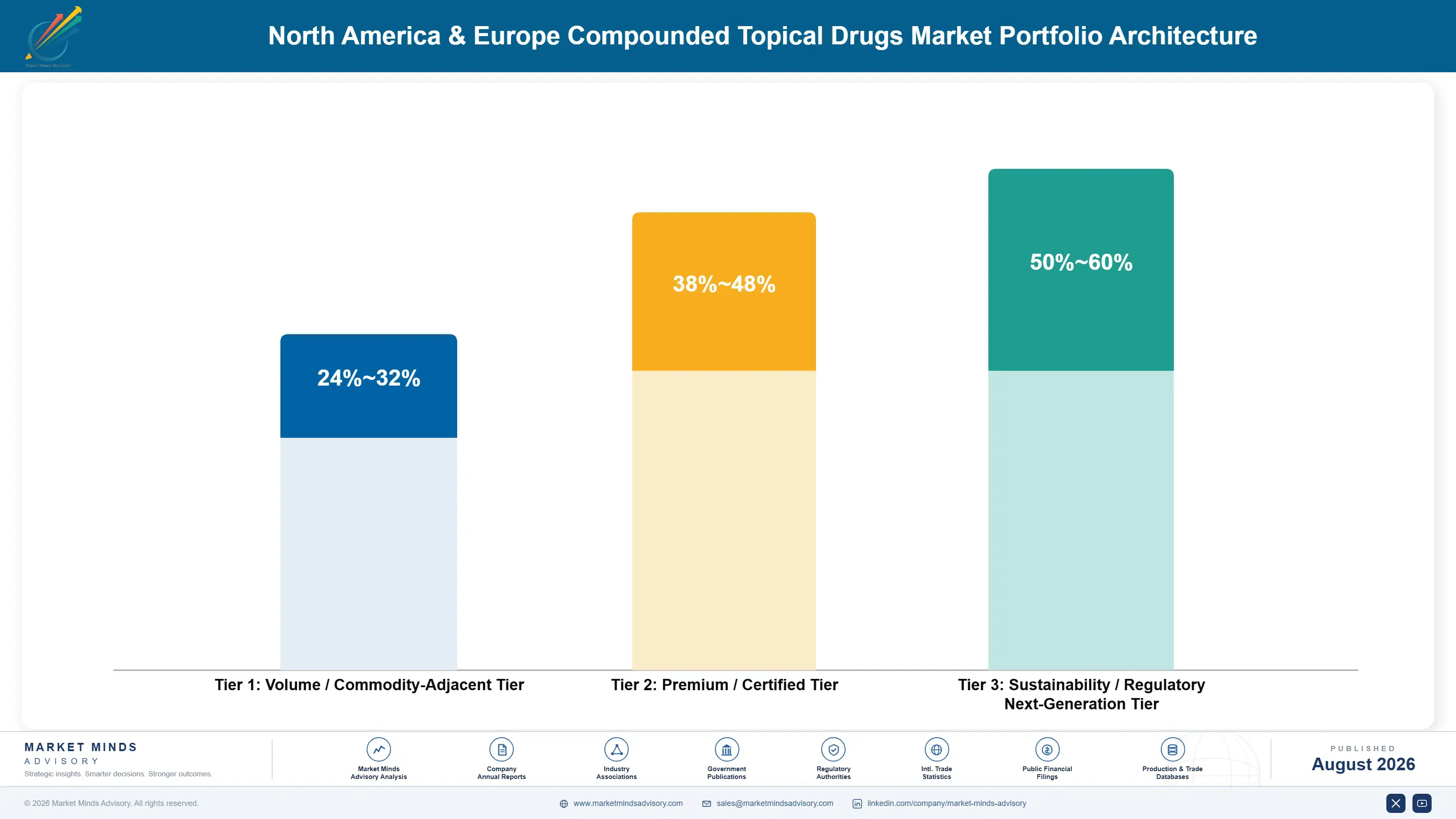
Portfolio Architecture for Margin Defence

The market organizes into three tiers by formulation complexity and margin profile. Volume-tier standard pain management and dermatological compounds cover the broadest patient population, sold largely through established pharmacy relationships. Premium-tier hormone and pediatric specialty formulations command meaningfully higher prices tied to formulation complexity and accreditation requirements. A growing next-generation tier layers subscription refill programs on top of the underlying specia
Gross margins widen considerably moving up the tiers, since specialty formulations carry disproportionate pricing power relative to their incremental preparation cost, while standard compounds compete primarily on price against a large field of independent pharmacies. Physicians rarely switch away from an accredited specialty pharmacy once a trusted referral relationship has been established. Referral loyalty partially offsets this dynamic for pharmacies with the largest standard-tier prescription volume.

High-value margin pools concentrate in pediatric and hormone specialty formulations bundled with subscription refill programs, where recurring prescription revenue carries substantially wider margin than the single-transaction standard compounds that dominate overall prescription volume. That gap is likely to widen further as specialty formulations mature and subscription attach rates climb across the base. Pharmacies positioned early stand to capture disproportionate share of this margin pool.

Volume / Commodity-Adjacent Tier

Standard pain management and dermatological compounds sold largely through established pharmacy relationships, competing primarily on price against a large field of independent pharmacies with limited differentiation. Established relationship pricing determines most of the margin outcome for this tier's pharmacies.
Gross Margin: 24-32%

Premium / Certified Tier

Accredited hormone replacement and wound care formulations carrying stronger clinical evidence and physician trust, commanding meaningfully wider margins than standard compound equivalents. Physicians increasingly view these as the appropriate default for individualized dosing needs.
Gross Margin: 38-48%

Sustainability / Regulatory / Next-Generation Tier

Pediatric and complex specialty dosing formulations bundled with subscription refill programs, representing the newest category and commanding the highest margins in the market given their accreditation advantage. Pharmacies are racing to expand this offering as physician demand continues climbing steadily.
Gross Margin: 50-60%
north-america-europe-compounded-topical-drugs-mark-portfolio-architecture-1787307459148

High-value Sub-segments and Strategic Watch-out

Pediatric Specialty Formulations With Subscription Programs

Pediatric specialty formulations paired with subscription refill programs combine the category's fastest growth with its widest margins, drawing concentrated pharmacy investment as physicians increasingly demand flavor-masking and dosing accuracy for young patients. MMA expects pharmacy investment here to keep climbing steadily through 2036 nationally. each fiscal cycle.
Gross Margin: 52-62%

Hormone Replacement Topical Compounds

Hormone replacement compounds deliver strong unit growth on the back of expanding physician referral relationships, though margins sit a tier below pediatric specialty formulations, supported by growing women's health specialty practice partnerships across most major markets. Growth should persist as women's health specialty practice referral relationships continue expanding.
Gross Margin: 40-50%

Standard Pain Management Topical Compounds

Standard pain management compounds remain the category's volume backbone across established pharmacy relationships worldwide, competing on price that leaves thin margins and limited room for feature differentiation beyond formulation quality. Consolidation among smaller pharmacies looks likely as accreditation scale becomes key to survival. across most account types nationwide.
Gross Margin: 22-30%

Unaccredited Non-Sterile Formulation Providers

Unaccredited non-sterile formulation providers warrant monitoring as tightening sterility regulation continues expanding, a dynamic that could compress this once-common practice model considerably faster than smaller pharmacies currently plan for in their own strategies. Pharmacies that pursue accreditation early could offset this segment's continued softness over time.
Gross Margin: 18-26%

Refill Cycles and Physician Relationship Depth

Pharmacies generate recurring revenue through prescription refills and expanding formulation categories far more than through any single prescription fill, since patients on chronic therapy typically refill monthly for extended periods, giving pharmacies an annuity-like revenue stream tied to the physician relationship rather than a single transaction. That recurring revenue stream typically compounds further as patients add subscription and expanded formulation layers over time.
Adoption depth varies considerably by end-use vertical. Specialty women's health and pediatric practices adopt compounding partnerships fastest and often serve as reference relationships pharmacies use to influence broader primary care physician referral patterns, while general practice physicians typically wait for accreditation verification before establishing a new pharmacy referral relationship at meaningful volume. General practice physicians sit closer to specialty practices than to hospital settings in the speed of their own adoption.

Buyer profiles are shifting generationally as younger physicians who trained during the personalized medicine era show far greater comfort referring patients to compounding pharmacies than an older cohort that historically defaulted to standard commercial formulations before considering compounded alternatives at all. This generational shift is accelerating referral rates at the fastest-moving specialty prescribing programs nationwide.
north-america-europe-compounded-topical-drugs-mark-end-use-penetration-index-1787307459640

Positioning for the Personalized Dosing Shift

These are among the four positions where our research anticipates prominent divergence between winners and laggards over the coming forecast period. Each is grounded in the demand model, the regulatory perimeter, and the announced capacity pipeline.
01 / ACCREDITATION INVESTMENT STRATEGY

Pharmacies without current accreditation will lose share to certified rivals

Accredited pharmacies command meaningfully higher pricing and physician trust than unaccredited competitors, and pharmacies without current accreditation risk losing consideration entirely as sterility regulation continues tightening across most markets. This gap is widening as more physicians verify accreditation status before establishing referral relationships, and delayed accreditation investment carries real commercial cost. Companies that close this gap early stand to capture disproportionate share of physician referral volume before market positioning solidifies further., and that delay carries real commercial consequence given how quickly rankings shift once accreditation spreads.
02 / PHYSICIAN EDUCATION INVESTMENT

Education programs will separate durable referral loyalty from one-time transactions

Educated physicians overwhelmingly continue referring patients to the pharmacy whose education program they completed, and pharmacies without dedicated physician education infrastructure increasingly lose new referral relationships to competitors who have already built that training pipeline. This gap is widening as more physicians seek formal education before considering compounding referrals, and delayed investment carries real commercial cost. Pharmacies that invest in education early stand to capture disproportionate long-term referral loyalty., and that delay carries real commercial consequence as physicians increasingly seek education before considering new relationships.
03 / SPECIALTY FORMULATION BREADTH

Multi-category formulation capability will separate account leaders from specialists

Pharmacies with the broadest formulation capability capture larger physician account share than single-category specialists, since a physician already referring for one formulation type often defaults to the same pharmacy for a different specialty need. Pharmacies limited to a single category increasingly lose expansion referrals to competitors offering the full specialty spectrum. That gap widens further as physicians consolidate referral relationships around fewer, broader-capability pharmacy partners each fiscal year, leaving narrower specialists with a shrinking share of total prescriber wallet share.
04 / SUBSCRIPTION REVENUE DEPTH

Refill subscription programs will separate recurring revenue leaders from laggards

Subscription-based automatic refill programs meaningfully lift patient lifetime value compared to manually-managed prescriptions, and pharmacies with the deepest subscription penetration capture disproportionate recurring revenue relative to their prescription volume alone. Pharmacies still relying primarily on manual refill management increasingly lag competitors who prioritize subscription conversion from the first prescription onward. That gap compounds as chronic therapy patients accumulate over multiple years and expand their own referral networks across broader physician communities, deepening the recurring revenue advantage considerably over the following several years.

Engagement Snapshot From the Field

A live engagement with an industry participant carrying material or product regulatory and market exposure ahead of a defining policy shift, showing how our research translates into a defensible multi-year portfolio strategy.
MARKET MINDS ADVISORY · CLIENT ENGAGEMENT SUMMARY
North America & Europe Compounded Topical Drugs Producer Strategic Portfolio Review and Transition Roadmap 2026·Investment Scenario on North America & Europe Compounded Topical Drugs Exposure Evaluation 2025-26
CLIENT PROFILE
The client is a regional compounding pharmacy network operating nine locations across the midwestern United States, serving approximately 22,000 active patients. The network reported approximately $68 million in annual revenue (client-reported, unverified by MMA) and had achieved sterile compounding accreditation at only three of its nine locations. Its patient volume has grown steadily as regional physician referral relationships have expanded over time.
STRATEGIC CHALLENGE
The network's leadership lacked clear data on whether expanding sterile accreditation to its remaining six locations would meaningfully improve physician referral volume and revenue relative to the upfront cleanroom investment and staff training cost required across a multi-site network. Leadership needed clear data before committing scarce capital to new cleanroom equipment across the network.
MMA APPROACH
MMA benchmarked physician referral volume and revenue-per-patient data across the network's three accredited locations against its six non-accredited locations, incorporating accreditation investment cost estimates from two leading consulting partners. The analysis modeled projected outcomes over a five-year forward planning horizon under two expansion scenarios. Interviews with pharmacy staff supplemented the desk-based financial and referral analysis.
KEY FINDINGS
  1. Accredited locations showed meaningfully higher new physician referral rates than non-accredited locations across the network. This pattern held consistently across every physician specialty the network tracked internally.
  2. Revenue per patient was considerably higher at accredited locations despite the additional cleanroom and training investment required. This finding removed the largest source of leadership hesitation around the network-wide investment.
  3. Two of the network's six non-accredited locations already had sufficient space to support cleanroom construction with modest investment. This readiness significantly strengthened the financial case for expanding across all remaining locations.
  4. Staff training time for accreditation was shorter than network leadership had initially assumed based on consultant estimates. Faster onboarding freed meaningful staff capacity for direct patient counseling instead.
CLIENT PROFILE
The client is a regional compounding pharmacy network operating nine locations across the midwestern United States, serving approximately 22,000 active patients. The network reported approximately $68 million in annual revenue (client-reported, unverified by MMA) and had achieved sterile compounding accreditation at only three of its nine locations. Its patient volume has grown steadily as regional physician referral relationships have expanded over time.
STRATEGIC CHALLENGE
The network's leadership lacked clear data on whether expanding sterile accreditation to its remaining six locations would meaningfully improve physician referral volume and revenue relative to the upfront cleanroom investment and staff training cost required across a multi-site network. Leadership needed clear data before committing scarce capital to new cleanroom equipment across the network.
MMA APPROACH
MMA benchmarked physician referral volume and revenue-per-patient data across the network's three accredited locations against its six non-accredited locations, incorporating accreditation investment cost estimates from two leading consulting partners. The analysis modeled projected outcomes over a five-year forward planning horizon under two expansion scenarios. Interviews with pharmacy staff supplemented the desk-based financial and referral analysis.
KEY FINDINGS
  1. Accredited locations showed meaningfully higher new physician referral rates than non-accredited locations across the network. This pattern held consistently across every physician specialty the network tracked internally.
  2. Revenue per patient was considerably higher at accredited locations despite the additional cleanroom and training investment required. This finding removed the largest source of leadership hesitation around the network-wide investment.
  3. Two of the network's six non-accredited locations already had sufficient space to support cleanroom construction with modest investment. This readiness significantly strengthened the financial case for expanding across all remaining locations.
  4. Staff training time for accreditation was shorter than network leadership had initially assumed based on consultant estimates. Faster onboarding freed meaningful staff capacity for direct patient counseling instead.
RECOMMENDED STRATEGY
Phase 1: Phase 1 (Months 1-3): Complete facility assessment and accreditation consultant selection across the two priority locations. under close coordination with network finance leadership. Phase 2: Phase 2 (Months 4-9): Complete cleanroom construction and staff training at the two priority locations first. with referral tracking built into the pilot design. Phase 3: Phase 3 (Months 10-16): Expand accreditation to the remaining four locations based on initial referral data. with ongoing physician referral rate monitoring built in.
OUTCOME
The network completed accreditation at two additional locations, with early data showing meaningfully higher physician referral rates within the first six months. Projected annual revenue growth reached approximately $4.1 million (client-reported, unverified by MMA) against the prior three-location baseline across the network's full pharmacy footprint.

Frequently Asked Questions

Foundational context covering the market sizes, CAGR, scope, country, region and competition that inform every finding below. This section is provided to cover basics and most often pre-purchase conversations, answered from the MMA Primary Research Dataset.

What is the current size of the North America & Europe Compounded Topical Drugs Market?

The North America & Europe Compounded Topical Drugs Market was valued at approximately $4.2 billion in 2025. This includes pain management, hormone replacement, dermatological, and pediatric specialty formulations.

How large will the North America & Europe Compounded Topical Drugs Market be by 2036?

The market is projected to reach approximately $8.4 billion by 2036, roughly 1.88 times its 2026 value. Growth is driven by expanding physician referral networks and pediatric specialty dosing demand.

What is the CAGR for the North America & Europe Compounded Topical Drugs Market 2026 to 2036?

The base case CAGR is 6.5% annually, with a bull case of 7.8% and a bear case of 5.2%. This reflects steady physician referral growth alongside expanding European accreditation frameworks.

Which segment is growing fastest?

Pediatric and specialty dosing topical compounds are the fastest-growing segment, expanding at roughly 10.5% annually. These formulations address patients underserved by standard commercial dosing formats.

Who are the major companies in the North America & Europe Compounded Topical Drugs Market?

Leading companies include Fagron, PCCA, Wells Pharmacy Network, Central Admixture Pharmacy Services, and Letco Medical. Together these five hold 28% of global revenue in a highly fragmented field.

Which country is growing fastest?

Poland is the fastest-growing country, expanding at roughly 8.0% annually through 2036. This reflects EU-funded accreditation investment expanding specialty formulation availability across the country nationwide.

Report Segmentation Architecture

The full report scope spans multiple orthogonal segmentation dimensions, with cross-tabulated demand data provided for each dimension pair. Coverage extends further to regional breakdowns, trend trajectories, and the competitive detail needed to support segment-level decision-making.

By Therapeutic Application and Formulation Type

  • Pain Management Topical Compounds
  • Hormone Replacement Topical Compounds
  • Dermatological Topical Compounds
  • Veterinary Topical Compounds
  • Wound Care Topical Compounds
  • Pediatric and Specialty Dosing Compounds

By End-Use Prescriber

  • Primary Care Physicians
  • Specialty Physicians
  • Pediatricians
  • Veterinarians
  • Hospital and Clinical Settings

By Commercial Dimension

  • Self-Pay Direct Purchase
  • Insurance Reimbursed
  • Subscription Refill Program
  • Physician Dispensed

By Region

  • North America
  • Western Europe
  • East Asia
  • South Asia and Pacific
  • Latin America
  • Middle East and Africa
  • Eastern Europe

Scope, Methodology, and Coverage

Every figure in this report is reproducible from documented input assumptions. The scope below maps the historical period, the forecast horizon, the segmentation dimensions, and the countries covered, alongside the underlying primary and qualitative methodology.
Historical Period
2020 to 2025
Forecast Period
2026 to 2036
Base Year
2025 (USD billions; MMA Primary Research Dataset, August 2026)
Market Definition
The North America & Europe Compounded Topical Drugs Market covers pharmacy-compounded topical medications, including pain management, hormone replacement, dermatological, wound care, and pediatric specialty dosing formulations prepared for individual patients across North America and Europe. It excludes commercially manufactured topical pharmaceuticals and compounded oral or injectable formulations sold as separate product categories.
Quantitative Units
USD billions (current prices); prescription volume where applicable
Segmentation Dimensions
By Therapeutic Application and Formulation Type; By End-Use Prescriber; By Commercial Dimension; By Region
Regions Covered
North America, Western Europe, East Asia, South Asia and Pacific, Latin America, Middle East and Africa, Eastern Europe
Countries Covered
USA, China, Germany, France, UK, Japan, South Korea, India, Australia, Canada, Brazil, Mexico, Indonesia, Vietnam, Thailand, Malaysia, UAE, Saudi Arabia, South Africa, Nigeria, Turkey, Poland, Netherlands, Italy, Spain, Sweden, Switzerland, Argentina, Colombia, Singapore, and additional markets relevant to this sector
Key Companies Profiled
Fagron NV, PCCA, Wells Pharmacy Network, Central Admixture Pharmacy Services Inc, Letco Medical LLC, Medisca Inc, Cantrell Drug Company, Triangle Compounding Pharmacy, Freedom Pharmacy, Belmar Pharmacy, Hopewell Pharmacy, Village Pharmacy, Leiters Health, ITC Compounding Pharmacy, Empower Pharmacy, Diamond Pharmacy Services, McGuff Pharmaceuticals Inc, Innovative Compounding Pharmacy, Roberts Pharmacy, Central Rx Compounding Pharmacy
Quantitative Methodology
Primary survey, n=3,800 respondents, Q4 2025, six countries; demand-side model with trade association cross-validation
Qualitative Methodology
47 expert interviews, Q4 2025; applied to validate demand model assumptions, identify emerging dynamics, and assess competitive positioning
Report Format
PDF and XLSX data workbook (Word format preview document)
Publisher
Market Minds Advisory
Report Code
MMA-2026-HLT-143
Published
August 2026
Contact
sales@marketmindsadvisory.com | www.marketmindsadvisory.com

Purchase the full North America & Europe Compounded Topical Drugs Market Report (2026 to 2036).

The full report delivers detailed segmentation across all six therapeutic application categories, with country-level sizing for all thirty-one covered markets. It profiles the complete competitive landscape of all twenty companies named in this summary, including moat and risk analysis for the two leading networks. Multi-year forecast models are provided under base, bull, and bear scenarios. Primary survey data drawn from compounding pharmacists, referring physicians, and accreditation body officials across six countries supports every major finding, and purchasers receive editable data files alongside the formatted report.
Accreditation status tracker by country and pharmacy network
Physician referral relationship benchmark tracking model
Reimbursement coverage database by insurer and formulation
Ingredient sourcing and pricing comparison tracker
Subscription refill program adoption monitor database
Competitive benchmarking across key pharmacy networks

Built For The People Who Decide

From boardroom strategy to bench-side execution, this report is read cover-to-cover by leaders shaping the next decade of their industry, turning demand scenarios, market dynamics and valuation benchmarks into decisions.
CXOs/ Presidents/ VPs/ Managers
M&A and Corporate Development
Strategy Teams and R&D Heads
Procurement and Product Directors
Regulatory and Compliance Leaders
Investor Relations and Equity Analysts