Market Minds Advisory
North America and Europe Animal Feed Minerals Market

North America and Europe Animal Feed Minerals Market: Bioavailability Replaces Bulk as the Selling Point

Livestock nutritionists across North America and Europe are shifting mineral premixes from inorganic salts toward chelated organic forms as regulators tighten mineral excretion limits and producers chase measurable feed efficiency gains.

Lead Analyst

Lisa Gevelber

Published

September 2026

Make Smarter Decisions with Customized Research Insights

Request a free sample report and evaluate market opportunities, growth trends, and competitive dynamics relevant to your business needs.

2025 MARKET VALUE$6.8BMarket Size 2025
2036 FORECAST VALUE$10.5BBase Case , 2026 to 2036
CAGR 2026 TO 20364.0 %Bull 5.2% / Bear 2.8%
INCREMENTAL OPPORTUNITY$3.4BNet 10- year value creation
EXPANSION MULTIPLE1.48x2036 value over 2026 base
Strategic Levers
M&A Pipeline
Regional Outlook
Country Rankings
Competitive Intelligence
Segmental Deep-dive
Call-Us : 91 93563 13602

Executive Snapshot and Market Trajectory

Global animal feed minerals reached USD 6.8 billion in 2025, and North America and Europe together account for the clear majority of that value, reflecting this report's deliberate focus on the two regions with the most advanced regulatory and nutritional standards for livestock mineral supplementation worldwide today and historically.
Chelated and organic trace minerals grow fastest at 6.8%, about 1.70 times the overall 4.0% rate, as nutritionists replace inorganic mineral salts with better-absorbed organic forms to meet both performance targets and tightening mineral excretion regulation across the European Union specifically and increasingly beyond. Germany posts the quickest national growth as stricter national fortification standards accelerate reformulation across the country's large and technically sophisticated livestock sector.
Competition sits at a moderate CR5 of 40%, split between diversified agricultural ingredient majors and specialized trace mineral technology companies with narrower but technically defensible product lines built on decades of published nutritional research and clinical trials. Regulatory tightening on mineral excretion limits in both the European Union and United States, alongside continued organic trace mineral adoption, are the two forces deciding where the category's margin concentrates over the next decade.
Market Definition
The animal feed minerals market covers macrominerals, trace minerals, and mineral premixes formulated for livestock, poultry, and aquaculture nutrition, including both inorganic mineral salts and chelated or organic trace mineral forms. It excludes vitamins, amino acids, and other non-mineral feed additives sold under separate ingredient categories.
Base Year Value
$6.8B in 2025 (MMA Primary Research Dataset, August 2026)
Forecast Period
2026 to 2036, eleven discrete annual values
CAGR
4.0% base case. Bull 5.2%. Bear 2.8%.
Fastest Growth Segment
Chelated and Organic Trace Minerals: 6.8% CAGR
Fastest Growth Country
Germany: 5.5% CAGR
Fastest Growth Region
South Asia and Pacific: 6.0% CAGR
Largest Region
North America: 34% of 2025 global value
Market Leaders
Cargill Inc, Nutreco, Zinpro Corporation, Phibro Animal Health, Novus International. Source: MMA Analysis based on company annual reports.
Primary Survey
n=3,800 procurement and R&D decision-makers, Q4 2025, six countries
Methodology
Demand-side build-up, cross-validated against public data, 47 expert interviews

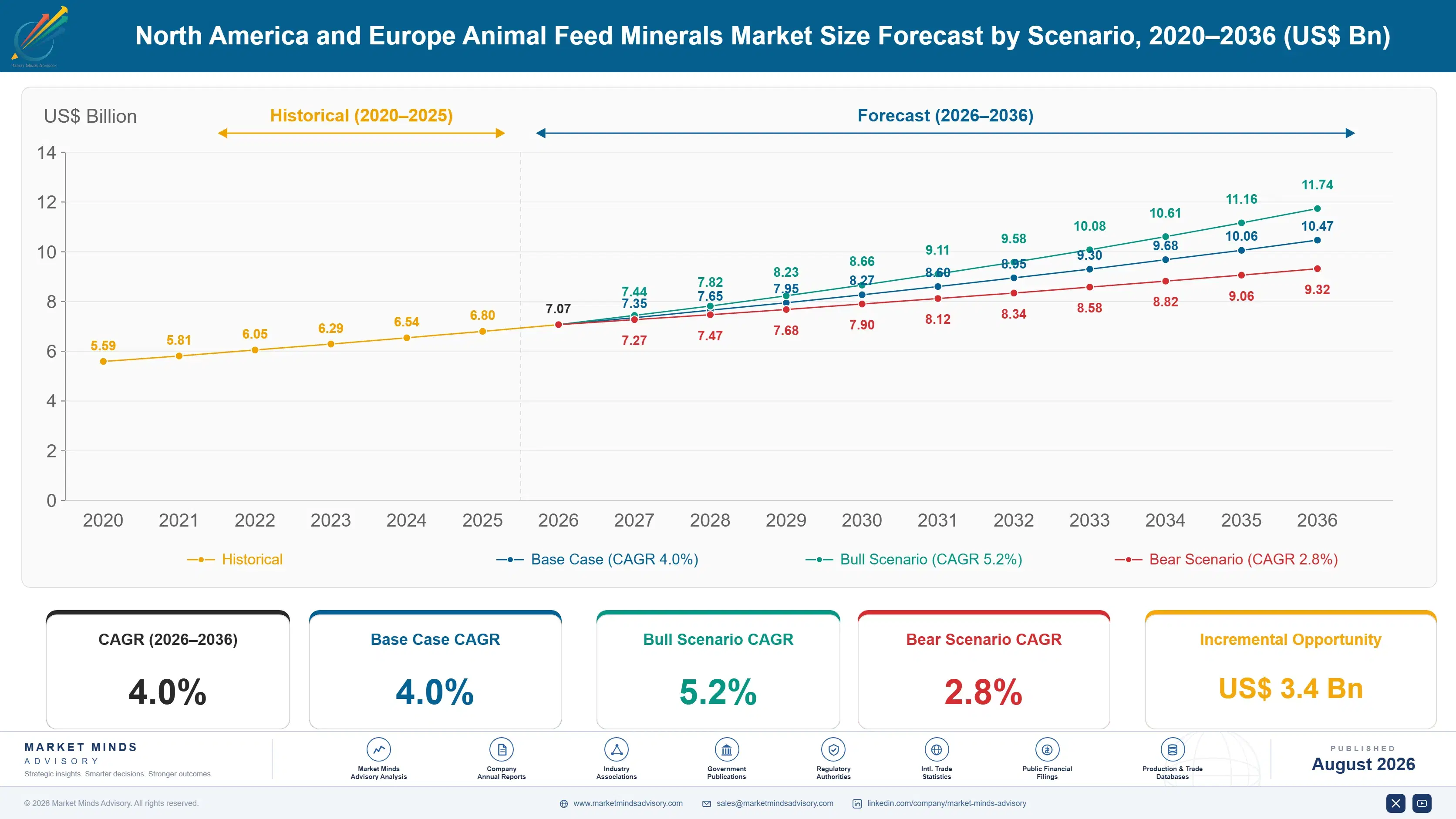
North America and Europe Animal Feed Minerals Market Forecast Scenarios

north-america-europe-animal-feed-minerals-market-size-forecast-scenario-1787461273133
Between 2020 and 2025 the market grew near 3.5% annually, a mature pace typical of an established agricultural input category where volume tracks livestock population more than any specific formulation trend. Organic trace mineral adoption began accelerating late in the period as European Union mineral excretion regulation tightened and more producers sought measurable feed conversion improvements.
The base case carries the market to 4.0% through 2036 on three mechanisms. First, European Union and United States regulatory tightening on mineral excretion keeps pushing volume from inorganic salts toward better-absorbed organic and chelated forms. Second, precision livestock nutrition adoption keeps expanding, with producers increasingly tailoring mineral premixes to specific herd performance data rather than generic formulations. Third, aquaculture feed mineral demand keeps growing steadily across both regions as fish farming operations scale and mineral nutrition science for aquatic species matures.
The bull case reaches 5.2% if European Union excretion limits tighten faster than currently scheduled, compressing the organic mineral transition timeline across the region. The bear case falls to 2.8% if livestock herd sizes in both regions continue their gradual multi-year decline, a pattern already visible in several major dairy and cattle-producing countries facing land use and environmental pressure.

A Mature Input Reformulating Around Bioavailability

Animal feed minerals rarely draw attention outside nutrition labs and formulation software, yet they quietly decide feed conversion ratios, reproductive performance, and increasingly, a farm's regulatory compliance standing on mineral excretion across two continents. The category has spent the past decade shifting from a bulk commodity business toward one where bioavailability science genuinely differentiates suppliers across nearly every major livestock segment.
MARKET CONCENTRATIONCR5: 40%Split between diversified majors and specialized technology firms
AVERAGE SELLING PRICEUSD 1.20 to 8.50 per kgReflects wide gap between bulk minerals and chelated forms
TOP PRODUCING REGION SHARENorth America: 34%Anchored by large-scale livestock production and premix manufacturing scale
CAPACITY UTILISATION78% to 88%Reflects a mature category with modest incremental capacity growth
MINERAL SHARE OF COGS45% to 55%Zinc, copper, and phosphate pricing dominates cost structure
REPLACEMENT CYCLE LENGTH2 to 4 yearsTime between major nutritionist premix reformulation cycles typically
Commercially, the market increasingly rewards chelation and formulation technology over raw mineral sourcing scale alone, a genuine shift from decades past. A specialized trace mineral technology company with strong bioavailability data can command premium pricing against diversified competitors selling comparable inorganic salts, since nutritionists increasingly specify by absorption efficiency rather than elemental mineral content alone on a feed tag or label anywhere.
Over the next decade, the pace of mineral excretion regulation in both the European Union and United States will decide how quickly the remaining inorganic-to-organic transition completes across the two regions this report covers in genuine depth. Suppliers with established organic trace mineral technology and regulatory relationships already built are positioned to capture that transition first regardless of how quickly it unfolds across either market.
"Nobody markets a bag of zinc oxide as exciting, and they shouldn't. What is genuinely interesting is that the same element, delivered in a different chemical form, now sells for eight times more because a nutritionist can prove the animal actually absorbs it."
Director, Agricultural and Animal Nutrition Practice · MMA Agricultural and Animal Nutrition Ingredients Practice · August 2026

Market Trends

Nutritionists Shift Formulations Toward Chelated Trace Minerals

Livestock nutritionists across North America and Europe are steadily replacing inorganic trace mineral salts, such as zinc oxide and copper sulfate, with chelated or proteinated organic forms that demonstrate meaningfully higher bioavailability in digestibility trials. This shift follows years of published research showing organic trace minerals require lower inclusion rates to achieve comparable blood and tissue mineral status, reducing both mineral excretion and feed cost per unit of absorbed nutrient. Zinpro and Novus International have built substantial businesses around this chemistry, and diversified competitors including Cargill have expanded their own organic lines to avoid ceding this segment.
Market Impact: Cuts copper inclusion up to 40%

Precision Livestock Nutrition Software Refines Mineral Dosing

Farm management software increasingly integrates herd performance and health data directly into mineral premix formulation, allowing nutritionists to adjust dosing for specific herds rather than applying generic regional formulations across an entire operation and full portfolio of farms. This precision approach is reducing average mineral inclusion rates in mature dairy and swine operations that have adopted the technology, while simultaneously improving measured performance outcomes compared to standardized formulations. Suppliers integrating directly with major farm management software platforms are capturing formulation relationships that pure ingredient sales alone would not otherwise secure.
Market Impact: Improves feed conversion 3% to 5%

Market Opportunities and Growth Drivers

European Union Tightens Mineral Excretion Limits

The European Union has progressively tightened maximum permitted mineral inclusion levels for copper and zinc in livestock feed, citing soil and water contamination concerns documented in European Food Safety Authority scientific opinions, forcing formulators to find ways to deliver equivalent nutritional benefit at lower mineral inclusion. This regulatory pressure has directly accelerated adoption of organic trace mineral forms, which achieve comparable animal performance at meaningfully lower inclusion rates than inorganic salts require. Producers operating across multiple member states must now navigate a regulatory environment considerably stricter than most other markets, creating a genuine advantage for suppliers with proven low-inclusion formulations.
Market Impact: Costs 3 to 8 times more

United States Feed Efficiency Focus Sustains Premium Mineral Demand

United States livestock producers facing sustained margin pressure from volatile grain and energy costs increasingly view mineral nutrition as a lever for improving feed conversion ratios rather than a fixed cost to minimize, sustaining demand for premium organic and chelated mineral formulations even at meaningfully higher per-unit pricing than commodity inorganic alternatives. This shift reflects broader adoption of precision nutrition economics across large-scale American dairy and beef operations, where nutritionists increasingly justify premium mineral spend through documented feed conversion improvements rather than mineral cost alone. Larger integrated producers are adopting this approach fastest.
Market Impact: Herd counts declined 8% overall

Market Restraints and Challenges

Organic Trace Minerals Carry Meaningfully Higher Unit Cost

Chelated and organic trace mineral forms cost substantially more per unit of elemental mineral than inorganic salts, a persistent economic barrier for cost-sensitive livestock operations, particularly in commodity poultry and swine production where margins run thin. The root cause is the additional chelation or proteination processing step required to bind the mineral to an organic carrier molecule, a manufacturing process considerably more complex than simply milling a raw inorganic salt. This restricts organic mineral adoption to operations that can document a clear feed conversion return or that face binding regulatory inclusion limits forcing the switch.
Market Impact: Lifts organic mineral share 15 points

Livestock Herd Consolidation Slows Volume Growth in Mature Markets

Both North American and European livestock herd populations have declined gradually over the past decade in several major dairy and cattle-producing regions, driven by land use pressure, environmental regulation, and farm consolidation that reduces total animal headcount even as remaining operations grow larger individually. The root cause is a deliberate rebalancing of livestock production toward fewer, larger, more efficient operations rather than any decline in overall meat and dairy consumption across either region. This caps underlying volume growth for mineral suppliers regardless of pricing or formulation innovation, since total headcount ultimately bounds total mineral demand.
Market Impact: Cuts mineral waste roughly 12%
3 additional market trends, 3 additional growth drivers, and 4 additional restraints and challenges are covered in the full report. Contact sales@marketmindsadvisory.com to access the complete intelligence.

Segment CAGR and Growth Architecture

Segmentation follows mineral chemistry, a single formulation dimension shared across every feed mineral product sold into livestock nutrition programs across the world today. Each chemistry carries distinct bioavailability, regulatory, and cost characteristics, so commercial position tracks the underlying mineral form itself rather than the specific livestock species, geography, or buyer type it ultimately serves.
north-america-europe-animal-feed-minerals-market-market-share-analysis-1787461273670

Chelated and Organic Trace Minerals

Chelated and organic trace minerals grow fastest at 6.8%, about 1.70 times the overall 4.0% rate, as nutritionists replace inorganic salts with better-absorbed organic forms to meet both performance targets and tightening European Union mineral excretion regulation. Growth concentrates most heavily in dairy and swine operations, where documented feed conversion improvements most directly offset the segment's meaningfully higher per-unit cost relative to inorganic alternatives. Zinpro and Novus International lead this segment on decades of bioavailability research, a technical moat that newer entrants find difficult to replicate quickly without comparable clinical trial investment. Regulatory tightening in Europe is accelerating adoption faster than in the United States, where the switch remains driven primarily by voluntary performance economics rather than binding inclusion limits.
CAGR 6.8%

Selenium and Iodine Sources

Selenium and iodine sources grow at 5.5% as reproductive performance and immune function research increasingly highlights these micronutrients as underappreciated levers in livestock health, particularly in dairy herds across North America and Europe facing fertility and calving challenges each season. Organic selenium yeast forms are gaining share within this segment specifically, offering meaningfully better bioavailability than inorganic sodium selenite at a cost premium considerably smaller than the gap seen in zinc and copper chelation formulations. Growth concentrates in dairy and breeding operations where reproductive outcomes carry direct economic value, more so than in commodity broiler production where the return on premium mineral formulation is harder to document precisely and consistently.
CAGR 5.5%
Full segment breakdown across 6 segments available in the complete report.

Regional Architecture and Country Demand Map

North America and Europe together carry the large majority of global value here today, reflecting this report's deliberate regional focus and the two regions' unusually advanced livestock mineral regulation. North America holds the largest single regional share, with Western Europe close behind it in second place.

North America

North America's 34% share exceeds the standard 22 to 32% band, justified directly by this report's explicit North America and Europe regional focus and by the United States' position as the world's largest single livestock feed mineral market. The United States anchors regional demand through an extensive dairy, beef, swine, and poultry sector operating under increasingly precision-oriented nutrition programs that specify mineral form as carefully as inclusion rate. Canada follows a broadly similar regulatory and nutritional pattern at smaller scale, with a substantial dairy and beef sector of its own. Growth here outpaces most mature agricultural input categories specifically because organic trace mineral adoption keeps expanding the addressable premium segment within an otherwise stable livestock population base.
Share: 34% | CAGR: 4.8% (2026 to 2036)

Western Europe

Western Europe's 28% share exceeds the standard 18 to 26% band, justified directly by this report's regional focus and by the European Union's uniquely strict mineral excretion regulation, which has made the region a genuine proving ground for organic trace mineral adoption globally. Germany, France, and the Netherlands drive regional demand through large, technically sophisticated dairy and swine sectors operating under some of the strictest feed mineral regulation anywhere, pushing formulators toward chelated and organic forms faster than most other global markets. Growth outpaces North America specifically because regulatory tightening, rather than voluntary economics alone, is compressing the region's remaining inorganic-to-organic transition timeline. Southern European markets add smaller but steadily growing demand tied to expanding intensive livestock operations.
Share: 28% | CAGR: 2.6% (2026 to 2036)
Regional intelligence for 5 additional markets available in the complete report: East Asia, South Asia and Pacific, Latin America, Middle East and Africa, Eastern Europe. Contact sales@marketmindsadvisory.com.
north-america-europe-animal-feed-minerals-market-country-cagr-analysis-1787461274189

Capturing Margin as Minerals Go Organic

The inorganic-to-organic mineral transition is the clearest margin opportunity this category has seen in decades, rewarding suppliers who can prove bioavailability rather than simply supply elemental content at scale across the market. The four moves below target where participants across the value chain can capture that transition's genuine value most effectively over the coming years.

Publish Peer-Reviewed Bioavailability Trial Data Broadly

Nutritionists increasingly specify mineral formulations by documented bioavailability rather than elemental content alone, making published, peer-reviewed digestibility trial data a genuine competitive requirement rather than a marketing nicety for organic trace mineral suppliers operating today across both regions. Companies investing in rigorous third-party trials are winning formulation specifications at premium pricing 3 to 8 times above inorganic alternatives, while competitors relying only on internal data face growing skepticism from increasingly sophisticated nutrition consultants. This research investment compounds over time as published trials continue supporting sales long after the initial study concludes.
Market Impact: Supports pricing 3 to 8 times above inorganic salts

Integrate Directly With Farm Management Software Platforms

Precision nutrition software increasingly drives mineral premix specification decisions at large dairy and swine operations, and suppliers integrating their formulation data directly into these platforms are capturing formulation relationships that pure ingredient sales conversations alone would not otherwise secure with these accounts. This integration reduces average mineral waste by roughly 12% for the operations that adopt it, a genuine efficiency story suppliers can use to justify premium formulation pricing beyond simple elemental cost comparisons. Early movers integrating with the leading software platforms are building switching costs competitors will find difficult to overcome later.
Market Impact: Cuts customer mineral waste by roughly 12% annually

Develop Lower-Cost Proteination Manufacturing Processes Faster

The persistent cost gap between organic and inorganic trace minerals, running 3 to 8 times higher per unit for organic forms, excludes cost-sensitive commodity poultry and swine operations from adopting organic formulations regardless of documented performance benefits they might otherwise value. Suppliers developing lower-cost proteination or chelation manufacturing processes that narrow this gap are opening a substantially larger addressable market among operations that have so far stayed with inorganic salts purely on cost grounds. This manufacturing innovation requires real process engineering investment but expands total addressable volume meaningfully beyond premium-only accounts.
Market Impact: Could expand addressable volume by 25% or more

Build Regulatory Affairs Capability Across EU Member States

European Union mineral excretion regulation varies somewhat in implementation timeline and enforcement intensity across all 27 member states, and suppliers with dedicated regulatory affairs capability navigating this variation are winning formulation contracts faster than competitors managing compliance centrally from outside the region entirely and at greater distance. This capability matters increasingly as excretion limits continue tightening, since formulators without local regulatory relationships risk delayed product approval or formulation changes relative to competitors already positioned ahead of new requirements. This investment pays back through faster market access across a genuinely fragmented regulatory landscape.
Market Impact: Cuts regulatory approval delays by 4 to 6 months

Who Controls the Margin Pool

Concentration sits at a moderate CR5 of 40%, split between diversified agricultural ingredient majors including Cargill and Nutreco, and specialized trace mineral technology companies including Zinpro and Novus International with narrower product lines. The gap between Zinpro, the organic trace mineral leader, and diversified generalist competitors is meaningful in that segment. All participants are assessed on one basis: revenue attributable to animal feed mineral product lines.
Current competitive activity runs along three lines. Bioavailability research investment increasingly differentiates specialized trace mineral suppliers from diversified competitors selling comparable inorganic salts without comparable clinical substantiation. Farm management software integration is emerging as a genuine advantage for suppliers embedding formulation data directly into precision nutrition platforms. Regulatory affairs capability across European Union member states is becoming a meaningful differentiator as excretion regulation tightens unevenly.

Emerging pressure comes from diversified competitors expanding organic trace mineral capability to avoid ceding this higher-margin segment entirely to specialized technology companies with decades of research investment behind them. Rankings over the next five years will likely shift toward whichever companies combine credible bioavailability research with regulatory affairs depth, since that addresses both the category's technical requirements and its increasingly fragmented compliance landscape.
north-america-europe-animal-feed-minerals-market-company-positioning-matrix-1787461274707

Competitive Moat and Risk Dimensions

ZINPRO CORPORATION

Moat: Deep chelation research leadership

Zinpro's decades of published bioavailability research and its proprietary Availa chelated mineral technology give it a research credibility that diversified competitors entering organic trace minerals more recently cannot quickly replicate, supporting premium pricing across its core dairy and swine accounts throughout North America and Europe.
ZINPRO CORPORATION

Risk: Narrow trace mineral concentration

Zinpro's business remains concentrated specifically in trace mineral nutrition, leaving it more exposed than diversified competitors if the broader organic mineral transition slows down meaningfully or if larger companies with wider ingredient portfolios out-invest it in research and formulation technology over the coming several years.
CARGILL INC

Moat: Integrated ingredient supply scale

Cargill's direct ownership across grain, phosphate, and mineral supply chains gives it cost and reliability advantages that specialized pure-play mineral technology companies cannot easily match, particularly for large integrated livestock and feed manufacturing accounts seeking genuine single-supplier simplicity across multiple ingredient categories and geographic regions.
CARGILL INC

Risk: Thinner margins on commodity minerals

Cargill's substantial commodity mineral business carries thinner margins than specialized organic trace mineral formulations, and the company must continue investing quite heavily in its own organic mineral capability to avoid losing the category's higher-margin segments to more focused competitors entirely over the coming several years.

Players Tracked

Prominent Players

Cargill Inc
Nutreco
Zinpro Corporation
Phibro Animal Health
Novus International

Other Key Players

BASF SE
Kemin Industries
Alltech
DSM-Firmenich
Adisseo
Yara International
Mosaic Company
ICL Group
Balchem Corporation
Selko
Impextraco
Anpario plc
Pancosma
Innov Ad
Nutrex NV

Recent Developments

FEBRUARY 2025

Zinpro Expands Chelation Manufacturing Capacity in the United States

Zinpro commissioned additional chelated trace mineral manufacturing capacity at its Minnesota facility to meet growing dairy and swine demand across North America. The expansion was funded from Zinpro's own capital budget as an organic capacity addition, not an acquisition or partnership. Full production ramp is expected within twelve months.
Signal: Confirms organic trace mineral demand now justifies dedicated new manufacturing investment, not simply routine capacity expansion overall.
JUNE 2025

Novus International and a European Feed Software Firm Form Integration Partnership

Novus International entered a partnership with a European precision livestock nutrition software provider to integrate its organic trace mineral formulation data directly into the platform. The partnership combines Novus's mineral technology with the partner's farm management software reach. Initial integration is targeted for early 2026.
Signal: Signals that software integration, not ingredient quality alone, is now a genuine and consistently growing differentiator overall.
OCTOBER 2025

Cargill Acquires European Specialty Mineral Formulator

Cargill acquired a mid-sized German specialty mineral premix formulator to expand its organic trace mineral capability across European Union markets facing tightening excretion regulation. The acquired company brought established regulatory relationships that Cargill previously lacked in the region. Integration is expected to complete within nine months of close.
Signal: Confirms diversified majors now see specialized European formulators as direct, genuinely worthwhile acquisition targets going forward.

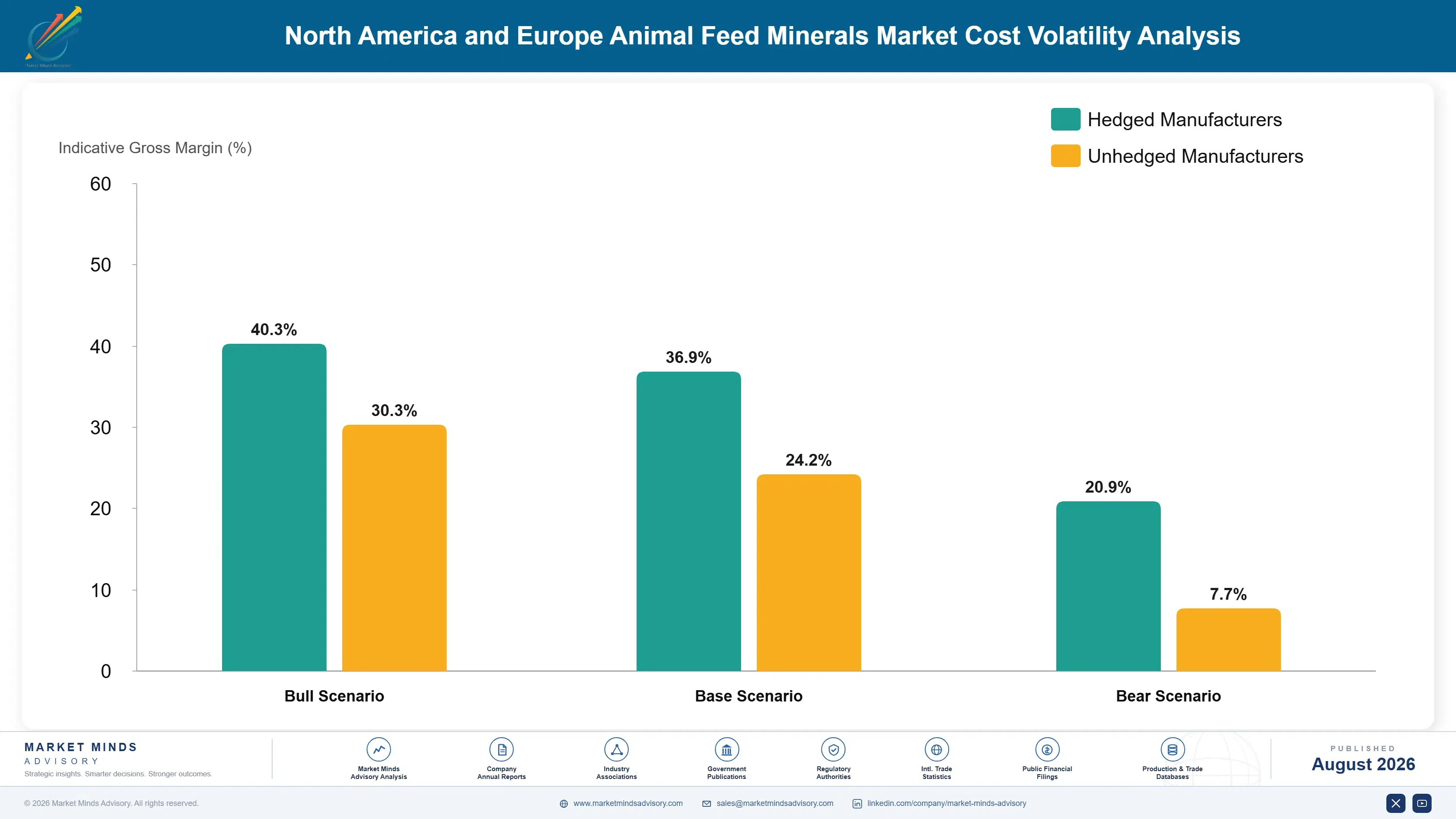
Zinc, Copper, and Phosphate Feedstock Exposure

Zinc, copper, manganese, and phosphate rock together account for 45% to 55% of cost of goods sold across feed mineral manufacturers, sourced from a concentrated set of global mining operations in Chile, Peru, China, and Morocco that supply the raw minerals underlying both inorganic salts and organic forms. This concentration leaves the category exposed to mining disruption and pricing volatility.
A 2022 to 2023 zinc price surge, driven by smelter capacity constraints and documented in London Metal Exchange trading data, pushed feed-grade zinc mineral costs up meaningfully within a single year, squeezing margins for formulators without hedged forward supply positions. Producers with diversified sourcing across multiple mining regions absorbed that spike more smoothly than those dependent on a single supplier. Prices partially normalized over the following year.

Exposure varies by manufacturer integration and hedging sophistication. Larger diversified suppliers with commodity trading capability hedge forward mineral purchases more effectively than smaller specialized formulators buying on the spot market, who face sharper margin compression during price spikes. Geography matters too: European formulators face somewhat different phosphate sourcing risk than American producers given different established supplier relationships across Moroccan sources.
north-america-europe-animal-feed-minerals-market-cost-volatility-analysis-1787461274904

Diversify Raw Mineral Sourcing Across Mining Regions

Manufacturers qualifying zinc, copper, and phosphate supply from multiple mining regions simultaneously reduce dependence on any single country's mining disruption or export policy change in a given calendar year and growing season. This adds supplier qualification complexity but meaningfully smooths aggregate input cost volatility across a full multi-year sourcing and planning cycle and horizon.

Hedge Forward Mineral Purchases Through Commodity Contracts

Larger manufacturers with commodity trading capability are locking forward pricing on zinc, copper, and phosphate purchases to protect against the price spikes that have periodically hit unhedged buyers during periods of tight smelter or mining capacity across the industry. This requires genuine trading expertise but delivers meaningfully more predictable input costs over multi-year planning horizons.

Increase Recycled and Secondary Mineral Source Usage

Some manufacturers are qualifying recycled zinc and copper from secondary metal recovery streams as a partial input source, reducing dependence on primary mining supply and its associated price volatility across multiple growing regions and countries. This requires additional quality control investment but genuinely diversifies the underlying feedstock base over time and across supply chains.

Portfolio Architecture for Margin Defence

The portfolio splits into three tiers with meaningful margin separation tied to mineral chemistry and bioavailability documentation rather than raw feedstock cost alone. Commodity inorganic mineral salts compete mainly on price and delivery reliability, while chelated and organic trace mineral forms command durable premiums tied to documented bioavailability and regulatory compliance value.
The tension between volume and premium is sharpening as regulatory tightening and precision nutrition adoption expand organic mineral demand faster than the underlying livestock population itself grows, pulling supplier investment toward the higher-margin segment even though inorganic minerals remain the larger volume base globally today. Companies that maintain a foothold in both chemistries preserve optionality, while those chasing only organic premium volume risk losing the stable cash flow that commodity mineral sales still reliably provide.

High-value margin pools concentrate specifically in chelated trace minerals and organic selenium forms, both requiring genuine bioavailability research investment that commodity mineral suppliers must build or acquire rather than simply extend from existing capability. Commodity inorganic mineral salts, by contrast, remain a large but slow-growing volume base offering thin, stable margins rather than genuine expansion opportunity for most participants going forward.

Volume / Commodity-Adjacent Tier

Standard inorganic mineral salts sold primarily on price and delivery reliability into commodity poultry and swine operations across both focus regions and well beyond them, largely unchanged for many decades now.
Gross Margin: 10-18%

Premium / Certified Tier

Documented bioavailability chelated trace minerals and organic selenium forms serving dairy and premium livestock operations across both focus regions with proven, well-established performance requirements and considerable clinical substantiation behind them.
Gross Margin: 26-38%

Sustainability / Regulatory / Next-Generation Tier

Next-generation low-inclusion organic formulations meeting the strictest European Union excretion limits, representing the newest and most technically demanding corner of the entire portfolio available across both key focus regions today.
Gross Margin: 30-44%
north-america-europe-animal-feed-minerals-market-portfolio-architecture-1787461275406

High-value Sub-segments and Strategic Watch-out

Chelated Trace Minerals for Dairy

High value and high growth, driven by documented reproductive and feed conversion benefits in dairy operations across both regions this report specifically covers in considerable depth. Suppliers with strong bioavailability research are capturing this segment's fastest-growing formulation contracts across both North America and Europe simultaneously.
Gross Margin: 30-44%

Organic Selenium and Iodine Forms

High value with strong growth, tied to reproductive performance research in dairy and breeding operations across both regions this report specifically covers in considerable depth and detail. Organic selenium yeast increasingly displaces inorganic sodium selenite across premium accounts in both North America and Europe simultaneously.
Gross Margin: 28-40%

Standard Inorganic Mineral Salts

The volume core, serving cost-sensitive commodity poultry and swine operations across both regions and well beyond their national borders entirely and quite consistently over recent time. Steady growth tracks livestock population rather than any specific formulation or bioavailability trend emerging currently in the broader market.
Gross Margin: 10-18%

High-Inclusion Legacy Copper and Zinc Salts

The strategic watch-out, facing accelerating exclusion as European Union excretion limits tighten further each regulatory cycle and enforcement round across nearly every single member state nationwide and quite consistently over time. Remaining demand concentrates in markets with less stringent enforcement standards currently in place today.
Gross Margin: 8-14%

Formulation Cycles Tied to Herd Data

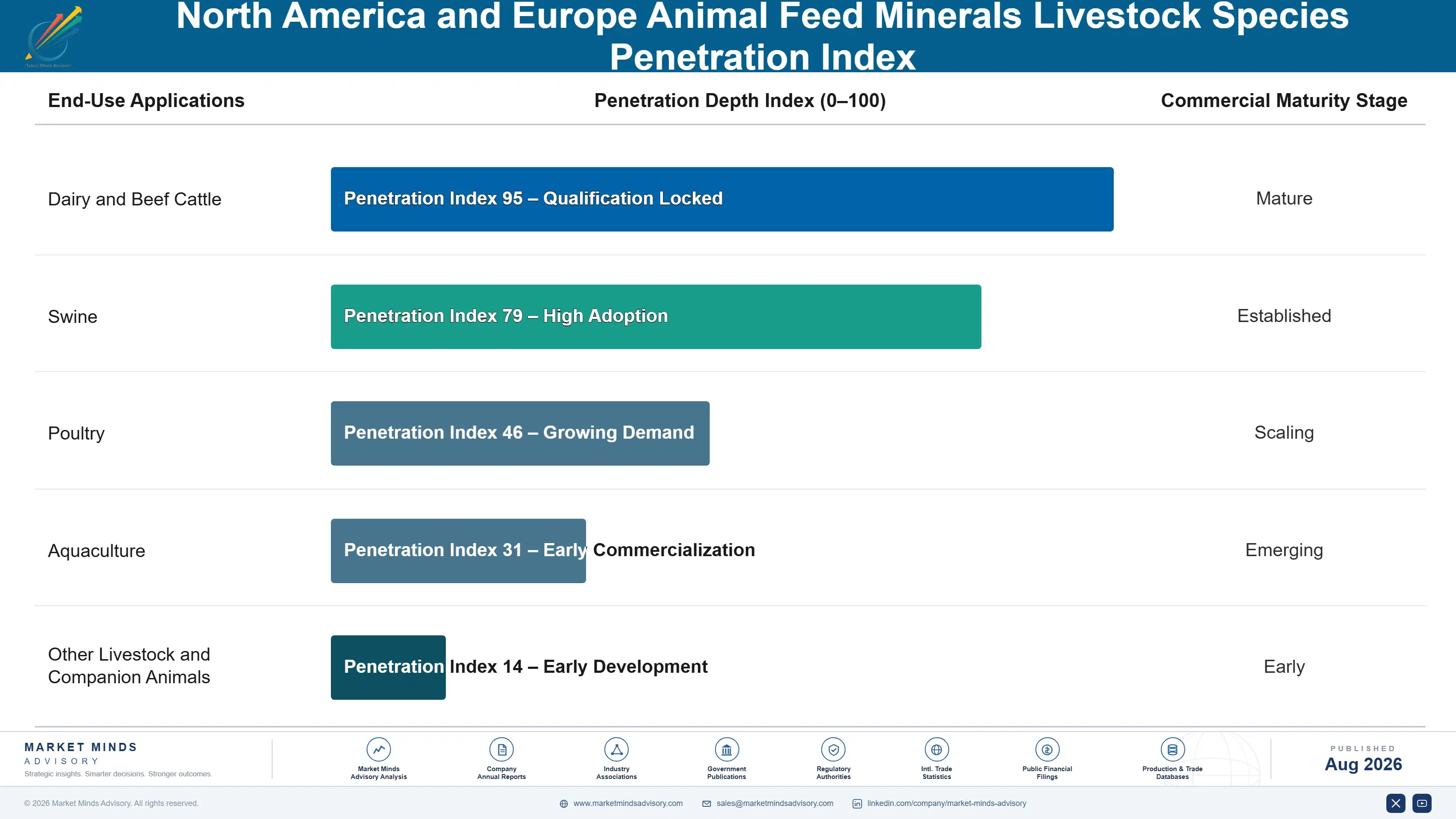
Demand compounds through formulation cycles tied to documented herd performance data rather than simple repeat commodity purchasing. Once a nutritionist validates a mineral formulation against a herd's performance and health outcomes, switching suppliers means repeating a validation cycle that typically runs one to two production seasons. That lock-in makes won formulations closer to an annuity than a spot sale, since a nutritionist rarely revisits a working formulation absent a regulatory mandate or performance shortfall.
Adoption depth varies sharply by livestock species and operation scale. Large dairy operations show the deepest formulation lock-in, given the direct economic link between mineral nutrition and both milk yield and reproductive performance that nutritionists track closely. Commodity poultry and swine operations show more price-driven switching behavior, given thinner margins and less individualized performance tracking. Beef cattle operations sit between the two, with loyalty varying by operation scale.

Generational buyer shifts are reshaping who makes these formulation decisions. Younger nutritionists entering the profession increasingly rely on precision software and published bioavailability data rather than legacy supplier relationships that shaped earlier generations of farm nutrition consultants. This shift favors suppliers investing in transparent, published research over those relying primarily on established distributor relationships built over decades.
north-america-europe-animal-feed-minerals-market-end-use-penetration-index-1787461275897

Where Mineral Suppliers Should Focus Next

These are among the four positions where our research anticipates prominent divergence between winners and laggards over the coming forecast period. Each is grounded in the demand model, the regulatory perimeter, and the announced capacity pipeline.
01 / BIOAVAILABILITY RESEARCH INVESTMENT

Publish Trial Data Before Skepticism Becomes the Default

Nutritionists increasingly specify mineral formulations by documented bioavailability rather than elemental content alone, and suppliers without published, peer-reviewed trial data are losing formulation specifications to competitors with credible third-party research behind their claims and market reputation. This research investment compounds over time, since published trials continue supporting sales conversations long after the initial study concludes and competitors catch up. Suppliers relying only on internal data should treat independent research investment as an urgent priority rather than a discretionary marketing expense.
02 / REGULATORY AFFAIRS DEPTH

Build EU Compliance Capability Ahead of Further Tightening

European Union mineral excretion regulation continues tightening and varies in implementation across member states, and suppliers with dedicated regulatory affairs capability are winning formulation contracts faster than competitors managing compliance centrally from outside the region entirely and remotely. This gap will likely widen as excretion limits tighten further in coming regulatory cycles, rewarding suppliers who invest in local regulatory relationships now rather than later. Companies without this capability risk losing formulation contracts to better-prepared competitors regardless of underlying product quality.
03 / MANUFACTURING COST INNOVATION

Narrow the Organic-Inorganic Cost Gap to Expand Volume

The persistent cost gap between organic and inorganic trace minerals excludes cost-sensitive commodity poultry and swine operations from adopting organic formulations regardless of documented performance benefits those operations might otherwise value quite highly and rather consistently. Suppliers developing lower-cost proteination processes that narrow this gap open a substantially larger addressable market beyond premium dairy and swine accounts alone. This manufacturing innovation requires real process engineering investment but meaningfully expands total addressable volume for whoever achieves it first in the category.
04 / SOFTWARE PLATFORM INTEGRATION

Embed Formulation Data Into Precision Nutrition Platforms

Precision nutrition software increasingly drives mineral premix specification decisions at large dairy and swine operations, and suppliers integrating formulation data directly into these platforms are capturing relationships that ingredient sales conversations alone would not otherwise secure with these key accounts. This integration also reduces customer mineral waste meaningfully, a genuine efficiency story that justifies premium pricing beyond simple elemental cost comparisons. Suppliers slow to pursue software integration risk losing formulation influence entirely to competitors already embedded in the tools nutritionists use daily.

Engagement Snapshot From the Field

A live engagement with an industry participant carrying material or product regulatory and market exposure ahead of a defining policy shift, showing how our research translates into a defensible multi-year portfolio strategy.
MARKET MINDS ADVISORY · CLIENT ENGAGEMENT SUMMARY
North America and Europe Animal Feed Minerals Producer Strategic Portfolio Review and Transition Roadmap 2026·Investment Scenario on North America and Europe Animal Feed Minerals Exposure Evaluation 2025-26
CLIENT PROFILE
A regional German dairy cooperative representing several hundred member farms approached MMA while planning a mineral premix reformulation to comply with tightening European Union copper and zinc inclusion limits. The client reported aggregate annual milk revenue near USD 240 million across its member farms and had relied on the same inorganic mineral supplier for over a decade (client-reported, unverified by MMA).
STRATEGIC CHALLENGE
Management needed to reformulate mineral premixes across hundreds of member farms to meet new regulatory limits without sacrificing the milk yield and reproductive performance the cooperative's herds had achieved under the existing formulation over many years. The cooperative's technical staff had limited direct experience evaluating organic trace mineral suppliers at this scale.
MMA APPROACH
MMA benchmarked bioavailability data and delivered cost across four candidate organic trace mineral suppliers under the cooperative's specific herd performance targets and regulatory constraints. We modeled the reformulation cost and expected performance impact across a representative sample of member farms with varying herd sizes. We also assessed each supplier's regulatory documentation readiness given the new compliance deadline.
KEY FINDINGS
  1. Two of the four candidate suppliers offered published trial data directly applicable to the cooperative's predominant dairy breed and housing conditions, unlike the others (client-reported, unverified by MMA).
  2. The incumbent inorganic supplier's proposed low-inclusion alternative fell short of the new regulatory limit in three of five tested inclusion scenarios modeled.
  3. Switching to the recommended organic supplier increased per-cow mineral cost but modeled favorably against documented reproductive performance improvements observed in comparable herds elsewhere.
  4. Member farms varied significantly in readiness to adopt a new formulation, requiring a phased rollout rather than a single cooperative-wide switch date.
CLIENT PROFILE
A regional German dairy cooperative representing several hundred member farms approached MMA while planning a mineral premix reformulation to comply with tightening European Union copper and zinc inclusion limits. The client reported aggregate annual milk revenue near USD 240 million across its member farms and had relied on the same inorganic mineral supplier for over a decade (client-reported, unverified by MMA).
STRATEGIC CHALLENGE
Management needed to reformulate mineral premixes across hundreds of member farms to meet new regulatory limits without sacrificing the milk yield and reproductive performance the cooperative's herds had achieved under the existing formulation over many years. The cooperative's technical staff had limited direct experience evaluating organic trace mineral suppliers at this scale.
MMA APPROACH
MMA benchmarked bioavailability data and delivered cost across four candidate organic trace mineral suppliers under the cooperative's specific herd performance targets and regulatory constraints. We modeled the reformulation cost and expected performance impact across a representative sample of member farms with varying herd sizes. We also assessed each supplier's regulatory documentation readiness given the new compliance deadline.
KEY FINDINGS
  1. Two of the four candidate suppliers offered published trial data directly applicable to the cooperative's predominant dairy breed and housing conditions, unlike the others (client-reported, unverified by MMA).
  2. The incumbent inorganic supplier's proposed low-inclusion alternative fell short of the new regulatory limit in three of five tested inclusion scenarios modeled.
  3. Switching to the recommended organic supplier increased per-cow mineral cost but modeled favorably against documented reproductive performance improvements observed in comparable herds elsewhere.
  4. Member farms varied significantly in readiness to adopt a new formulation, requiring a phased rollout rather than a single cooperative-wide switch date.
RECOMMENDED STRATEGY
Phase 1: Phase 1 (0 to 3 months): Select the recommended organic trace mineral supplier and finalize the fully compliant reformulation plan. Phase 2: Phase 2 (3 to 9 months): Roll out the new formulation across member farms in three sequential waves by herd size. Phase 3: Phase 3 (9 to 14 months): Complete the full cooperative-wide transition and finalize all remaining regulatory compliance documentation needed fully.
OUTCOME
The cooperative completed the phased transition within the fourteen-month timeline, achieving full regulatory compliance across all member farms well ahead of the deadline. Early performance data from the first rollout wave showed reproductive performance holding steady against pre-reformulation benchmarks across most participating farms (client-reported, unverified by MMA).

Frequently Asked Questions

Foundational context covering the market sizes, CAGR, scope, country, region and competition that inform every finding below. This section is provided to cover basics and most often pre-purchase conversations, answered from the MMA Primary Research Dataset.

What is the current size of the North America and Europe Animal Feed Minerals Market?

The global market stood at approximately USD 6.8 billion in 2025, according to MMA's primary research dataset. North America and Europe, the focus of this report, together carry the majority of that value.

How large will the North America and Europe Animal Feed Minerals Market be by 2036?

MMA projects the global market will reach approximately USD 10.47 billion by 2036 under the base case scenario. This represents roughly 1.48 times the 2026 market entry value.

What is the CAGR for the North America and Europe Animal Feed Minerals Market 2026 to 2036?

The base case CAGR is 4.0%, with a bull case of 5.2% and a bear case of 2.8%. The range reflects uncertainty around the pace of EU excretion regulation.

Which segment is growing fastest?

Chelated and organic trace minerals grow fastest at 6.8%, about 1.70 times the overall market rate. Regulatory tightening and bioavailability research are the primary drivers.

Who are the major companies in the North America and Europe Animal Feed Minerals Market?

Leading companies include Cargill Inc, Nutreco, Zinpro Corporation, Phibro Animal Health, and Novus International. These five companies together hold an estimated 40% of the market on a feed mineral revenue basis.

Which country is growing fastest?

Germany posts the fastest national growth at 5.5% CAGR, driven by strict national fortification and excretion standards. This outpaces the broader Western European regional average.

Report Segmentation Architecture

The full report scope spans multiple orthogonal segmentation dimensions, with cross-tabulated demand data provided for each dimension pair. Coverage extends further to regional breakdowns, trend trajectories, and the competitive detail needed to support segment-level decision-making.

By Mineral Chemistry

  • Calcium and Phosphorus Sources
  • Sodium and Chloride Sources
  • Trace Mineral Salts
  • Chelated and Organic Trace Minerals
  • Magnesium and Sulfur Sources
  • Selenium and Iodine Sources

By Livestock Species

  • Dairy and Beef Cattle
  • Swine
  • Poultry
  • Aquaculture
  • Other Livestock and Companion Animals

By Commercial Dimension

  • Direct Premix Manufacturer Supply
  • Feed Mill and Compounder Supply
  • Cooperative and Integrator Supply
  • Distributor Supply

By Region

  • North America
  • Western Europe
  • East Asia
  • South Asia and Pacific
  • Latin America
  • Middle East and Africa
  • Eastern Europe

Scope, Methodology, and Coverage

Every figure in this report is reproducible from documented input assumptions. The scope below maps the historical period, the forecast horizon, the segmentation dimensions, and the countries covered, alongside the underlying primary and qualitative methodology.
Historical Period
2020 to 2025
Forecast Period
2026 to 2036
Base Year
2025 (USD billions; MMA Primary Research Dataset, August 2026)
Market Definition
The animal feed minerals market comprises macrominerals, trace minerals, and mineral premixes formulated for livestock, poultry, and aquaculture nutrition, including both inorganic mineral salts and chelated or organic trace mineral forms. It excludes vitamins, amino acids, and other non-mineral feed additives sold under separate ingredient categories.
Quantitative Units
USD billions (current prices); metric tonnes of mineral volume where applicable
Segmentation Dimensions
By Mineral Chemistry; By Livestock Species; By Commercial Dimension; By Region
Regions Covered
North America, Western Europe, East Asia, South Asia and Pacific, Latin America, Middle East and Africa, Eastern Europe
Countries Covered
USA, China, Germany, France, UK, Japan, South Korea, India, Australia, Canada, Brazil, Mexico, Indonesia, Vietnam, Thailand, Malaysia, UAE, Saudi Arabia, South Africa, Nigeria, Turkey, Poland, Netherlands, Italy, Spain, Sweden, Switzerland, Argentina, Colombia, Singapore, and additional markets relevant to this sector
Key Companies Profiled
Cargill Inc, Nutreco, Zinpro Corporation, Phibro Animal Health, Novus International, BASF SE, Kemin Industries, Alltech, DSM-Firmenich, Adisseo, Yara International, Mosaic Company, ICL Group, Balchem Corporation, Selko, Impextraco, Anpario plc, Pancosma, Innov Ad, Nutrex NV
Quantitative Methodology
Primary survey, n=3,800 respondents, Q4 2025, six countries; demand-side model with trade association cross-validation
Qualitative Methodology
47 expert interviews, Q4 2025; applied to validate demand model assumptions, identify emerging dynamics, and assess competitive positioning
Report Format
PDF and XLSX data workbook (Word format preview document)
Publisher
Market Minds Advisory
Report Code
MMA-2026-AGR-158
Published
August 2026
Contact
sales@marketmindsadvisory.com | www.marketmindsadvisory.com

Purchase the full North America and Europe Animal Feed Minerals Market Report (2026 to 2036).

The full MMA North America and Europe Animal Feed Minerals report sizes the global market across six mineral chemistries, five livestock species categories, and seven regions through 2036, with particular depth on the United States, Canada, Germany, France, and the wider European Union. It profiles 20 participants on a consistent feed mineral revenue basis, scoring each on bioavailability research, regulatory affairs depth, and software integration capability. Scenario models quantify how EU excretion regulation and precision nutrition adoption move demand and pricing. The report also includes delivered raw mineral cost modeling, a regulatory compliance timeline tracker, and an organic-inorganic cost gap analysis built for nutrition, procurement, and formulation teams.
Six-chemistry segmentation with detailed growth forecasts
Zinc, copper, and phosphate feedstock risk assessment
EU excretion regulation compliance tracking tool
Organic versus inorganic mineral cost gap model
Regional livestock mineral demand mapping tool
Twenty-company competitive benchmarking scorecard and assessment

Built For The People Who Decide

From boardroom strategy to bench-side execution, this report is read cover-to-cover by leaders shaping the next decade of their industry, turning demand scenarios, market dynamics and valuation benchmarks into decisions.
CXOs/ Presidents/ VPs/ Managers
M&A and Corporate Development
Strategy Teams and R&D Heads
Procurement and Product Directors
Regulatory and Compliance Leaders
Investor Relations and Equity Analysts