Market Minds Advisory
North America Employee Recognition Software Market

North America Employee Recognition Software Market: North America Employee Recognition Software Market. Peer Recognition, Rewards, and Retention Analytics Platforms Through 2036

Persistent labor market tightness and the highest voluntary quit rates in decades push North American employers toward recognition software as a measurable retention lever rather than a discretionary reflecting sustained enterprise investment.

Lead Analyst

Published

September 2026

Make Smarter Decisions with Customized Research Insights

Request a free sample report and evaluate market opportunities, growth trends, and competitive dynamics relevant to your business needs.

2025 MARKET VALUE$1.4BMarket Size 2025
2036 FORECAST VALUE$3.7BBase Case , 2026 to 2036
CAGR 2026 TO 20369.5 %Bull 10.7% / Bear 8.3%
INCREMENTAL OPPORTUNITY$2.2BNet 10- year value creation
EXPANSION MULTIPLE2.48x2036 value over 2026 base
Strategic Levers
M&A Pipeline
Regional Outlook
Country Rankings
Competitive Intelligence
Segmental Deep-dive
Call-Us : 91 93563 13602

Executive Snapshot and Market Trajectory.

North American employers are adopting recognition software as a measurable retention lever as persistent labor market tightness and elevated voluntary quit rates make employee departure a genuine financial concern reflecting sustained enterprise investment across employee retention and engagement programs as adoption continues expanding reflecting sustained enterprise investment across employee.
AI-driven retention analytics platforms represent the fastest-growing category as employers seek predictive insight into flight risk rather than reactive recognition alone. Standard peer-to-peer recognition tools still account for the largest share of overall spending given broad adoption across corporate and retail employers. The United States accounts for the largest demand concentration, reflecting its scale as the largest single labor market and deepest HR technology budget concentration in the region reflecting sustained enterprise investment across employee.
Competition splits between established HR technology platform vendors expanding recognition into broader engagement suites and newer specialist firms building narrow, deeply analytical retention prediction tools. Rising employee turnover cost awareness and evolving workplace wellbeing measurement standards both shape which vendors can serve multinational enterprises across the United States and Canada simultaneously across the region reflecting sustained enterprise investment across employee retention and.
Market Definition
This report covers software platforms that enable peer-to-peer and manager-to-employee recognition, rewards distribution, and retention analytics for employers across the United States and Canada. It excludes general payroll and benefits administration software and standalone employee survey tools without integrated recognition functionality reflecting sustained.
Base Year Value
$1.4B in 2025 (MMA Primary Research Dataset, September 2026)
Forecast Period
2026 to 2036, eleven discrete annual values
CAGR
9.5% base case. Bull 10.7%. Bear 8.3%.
Fastest Growth Segment
AI-Driven Retention Analytics Platforms: 13.5% CAGR
Fastest Growth Country
Canada: 10.5% CAGR
Fastest Growth Region
South Asia and Pacific: 11.5% CAGR
Largest Region
North America: 84% of 2025 global value
Market Leaders
Workhuman Inc, Achievers Solutions Inc, Bonusly Inc, Nectar HR Inc, Awardco Inc. Source: MMA Primary Research Dataset, July 2026.
Primary Survey
n=3,800 procurement and R&D decision-makers, Q4 2025, six countries
Methodology
Demand-side build-up, cross-validated against public data, 47 expert interviews

North America Employee Recognition Software Market Forecast Scenarios

north-america-employee-recognition-software-market-size-forecast-scenario-1790001433624
The 2020 to 2025 period saw accelerating adoption as pandemic-era remote work first highlighted the recognition gap facing distributed teams, with adoption momentum continuing well beyond the original remote work justification as elevated voluntary turnover kept retention a board-level concern reflecting sustained enterprise investment across employee retention and engagement programs as adoption continues expanding across corporate offices, retail chains, and.
MMA's base case assumes continued high-single-digit growth driven by three commercial mechanisms: expanding AI-driven retention analytics adoption as employers seek predictive flight risk insight, growing employee turnover cost awareness driving retention-focused HR technology investment across labor-intensive industries, and rising integration between recognition platforms and broader performance management systems across enterprise HR technology stacks reflecting sustained enterprise investment across employee retention and engagement programs as adoption continues expanding across corporate offices, retail chains, and healthcare employers supporting.
The bull case centers on faster-than-expected AI retention analytics adoption pulling premium platform upgrades forward across mainstream employers. The bear case centers on HR technology budget consolidation, with several large employers already reducing the number of point-solution engagement vendors they maintain across their technology stack reflecting sustained enterprise investment across employee retention and engagement programs as adoption continues expanding across corporate offices, retail.

Retention Analytics Redefines Recognition Software Value

Recognition platform spending concentrates in standard peer-to-peer tools today, though AI-driven retention analytics platforms are the fastest-growing category as employers seek predictive flight risk insight. Established HR technology vendors maintain the strongest enterprise relationships given deep integration with existing payroll and performance management systems reflecting sustained enterprise investment across employee retention and engagement programs as adoption continues expanding across corporate offices, retail.
MARKET CONCENTRATIONCR5 36%Fragmented across HR technology platforms and specialist recognition firms.
AVERAGE CONTRACT VALUE$58 per employee annuallyReflects platform depth, reward marketplace breadth, and analytics sophistication.
TOP DEPLOYING COUNTRY SHAREUnited States 82%Concentrated among the largest single labor market and deepest.
NET REVENUE RETENTION118% averageIndicates strong expansion revenue from existing enterprise customer accounts.
VOLUNTARY TURNOVER REDUCTION16 percentage points averageReflects measurable retention improvement following platform deployment broadly reflecting.
AVERAGE CONTRACT TERM2 to 3 yearsMatches typical enterprise HR technology procurement and renewal cycles.
Vendors increasingly bundle predictive analytics with core recognition licensing, shifting revenue mix toward premium retention-tier subscription pricing rather than pure per-employee licensing. This mirrors a broader shift across HR technology from basic functionality toward data-driven retention measurement pricing tiers reflecting sustained enterprise investment across employee retention and engagement programs as adoption continues expanding across corporate offices, retail chains, and healthcare.
Employers weigh predictive analytics sophistication against implementation simplicity, since fully automated retention prediction requires more careful configuration than basic peer-to-peer recognition alone. The vendors succeeding most combine analytics depth with implementation methodologies that compress deployment time across multi-location rollouts reflecting sustained enterprise investment across employee retention and engagement programs as adoption continues expanding across corporate offices, retail chains, and healthcare employers supporting consistent.
"HR leaders used to treat recognition budgets as the first thing cut in a downturn, now the turnover math makes cutting."
Director, Employee Engagement and Workplace Technology Practice · MMA Technology: Employee Engagement and Recognition Software Platforms Practice · September 2026

Market Trends

AI Retention Analytics Predicts Employee Flight Risk Proactively reflecting.

Vendors are increasingly deploying AI algorithms that analyze recognition patterns, engagement scores, and other workforce signals to predict which employees show elevated flight risk, letting managers intervene proactively rather than learning about dissatisfaction only after a resignation letter arrives. Several major HR technology vendors have launched dedicated retention prediction modules over the past two years, recognizing that reactive exit interviews arrive too late to influence outcomes that predictive intervention could have prevented entirely. This capability has proven particularly valuable for large employers managing thousands of employees where manager attention alone cannot reliably catch every at-risk situation reflecting sustained.
Market Impact: Cuts hiring costs by 30 percent.
Manager Coaching Tools Translate Analytics Into Retention Action reflecting.

Recognition platforms increasingly bundle manager coaching tools that translate retention analytics into specific recommended actions, such as suggesting a particular recognition gesture or check-in conversation, rather than simply flagging at-risk employees without actionable guidance for time-constrained frontline managers. This coaching layer has become an increasingly important vendor differentiator as employers recognize that raw analytics dashboards alone rarely translate into consistent manager behavior change without specific guided prompts. Vendors report meaningfully higher retention outcomes at employers that adopt the full coaching workflow rather than analytics dashboards alone reflecting sustained enterprise investment across employee retention and engagement programs as adoption.
Market Impact: Reduces frontline turnover by 20 percent.

Market Opportunities and Growth Drivers

Persistent Labor Market Tightness Drives Retention Technology Investment reflecting.

Persistent labor market tightness across several North American sectors, particularly healthcare, skilled trades, and frontline retail, continues driving employer investment in retention-focused technology including recognition platforms shown to measurably reduce voluntary departure rates. Human resources leadership increasingly presents recognition platform investment in direct financial terms tied to replacement hiring cost avoidance rather than as a soft engagement nice-to-have, helping secure budget approval from finance stakeholders previously skeptical of engagement technology spending. This driver has proven particularly durable as labor market tightness in several sectors keeps replacement hiring costs elevated reflecting sustained enterprise investment across employee retention and engagement.
Market Impact: Reduces vendor counts by 20 percent.

Frontline Workforce Turnover Costs Drive Retail Sector Adoption reflecting.

Elevated frontline workforce turnover costs across retail and hospitality sectors continue driving recognition platform adoption specifically targeted at hourly frontline employees, a workforce segment that traditional recognition programs designed for salaried office workers historically underserved. Retail and hospitality employers increasingly specify mobile-first recognition platforms accessible without a corporate email address or desktop computer access, addressing a meaningful adoption barrier for frontline workforce recognition that office-oriented platforms could not address. This driver has proven particularly durable given continued elevated turnover rates across frontline retail and hospitality positions nationally reflecting sustained enterprise investment across employee retention and engagement programs as.
Market Impact: Delays renewal decisions by 4 months.

Market Restraints and Challenges

HR Technology Budget Consolidation Pressures Point Solution Vendors reflecting.

Large employers increasingly consolidate HR technology spending toward fewer strategic platform vendors rather than maintaining numerous specialized point solutions, creating pressure on standalone recognition vendors lacking broader HR platform capability. The root cause is procurement teams seeking to reduce vendor management overhead and integration complexity across a sprawling HR technology portfolio built up over many years of point-solution purchasing. The commercial impact falls hardest on smaller specialist vendors without adjacent product lines to bundle. Specialist vendors are mitigating by pursuing deeper integration partnerships with major HR platform vendors rather than competing head-on for consolidated budget reflecting sustained enterprise.
Market Impact: Predicts flight risk 90 days ahead.

Measuring Retention Impact Attribution Proves Methodologically Difficult reflecting sustained.

Employers increasingly demand clear evidence connecting recognition platform investment to measurable retention outcomes, but isolating recognition program impact from other concurrent HR initiatives including compensation changes proves methodologically difficult, creating budget justification friction for HR leaders advocating continued or expanded investment. The root cause is that retention outcomes depend on numerous simultaneous factors including compensation, management quality, and broader workplace culture that confound efforts to isolate recognition program contribution specifically. The commercial impact slows renewal and expansion decisions for vendors unable to provide compelling attribution evidence. Vendors are mitigating by developing more sophisticated analytics correlating platform usage with.
Market Impact: Improves manager response by 35 points.
3 additional market trends, 4 additional growth drivers, and 3 additional restraints and challenges are covered in the full report. Contact sales@marketmindsadvisory.com to access the complete intelligence.

Segment CAGR and Growth Architecture

Employee recognition software spans standard peer-to-peer tools, AI-driven retention analytics, and frontline mobile platforms, each serving distinct workforce segments. AI-driven retention analytics now grows fastest as predictive insight gains adoption broadly reflecting sustained enterprise investment across employee retention and engagement programs as adoption continues expanding across corporate offices, retail chains, and healthcare employers supporting.
north-america-employee-recognition-software-market-market-share-analysis-1790001434497

AI-Driven Retention Analytics Platforms

AI-driven retention analytics platforms lead all categories at a 13.5 percent CAGR, roughly 1.42 times the overall market rate, as vendors increasingly deploy algorithms that analyze recognition patterns, engagement scores, and other workforce signals to predict which employees show elevated flight risk, letting managers intervene proactively rather than learning about dissatisfaction only after a resignation letter arrives. Several major HR technology vendors have launched dedicated retention prediction modules over the past two years, recognizing that reactive exit interviews arrive too late to influence outcomes that predictive intervention could have prevented entirely. This capability has proven particularly valuable for large employers managing thousands of employees where manager attention alone cannot reliably catch every at-risk situation across the organization reflecting.
CAGR 13.5%

Frontline Mobile Recognition Platforms

Frontline mobile recognition platforms grow at 11.5 percent annually as elevated frontline workforce turnover costs across retail and hospitality sectors continue driving recognition platform adoption specifically targeted at hourly frontline employees, a workforce segment that traditional recognition programs designed for salaried office workers historically underserved. Retail and hospitality employers increasingly specify mobile-first recognition platforms accessible without a corporate email address or desktop computer access, addressing a meaningful adoption barrier for frontline workforce recognition that office-oriented platforms could not address previously. This driver has proven particularly durable given continued elevated turnover rates across frontline retail and hospitality positions nationally, supporting sustained vendor investment in mobile-native platform development reflecting sustained enterprise investment across employee retention and engagement programs as adoption.
CAGR 11.5%
Full segment breakdown across 7 segments available in the complete report.

Regional Architecture and Country Demand Map

North America dominates overwhelmingly because this report is explicitly scoped to the North American market by definition, with all other regions reflecting only minor multinational spillover volume reflecting sustained enterprise investment across employee retention and engagement programs as adoption continues expanding reflecting sustained enterprise investment across employee.

North America

The United States anchors this region overwhelmingly as the largest single labor market and deepest HR technology budget concentration globally, with persistent labor market tightness across healthcare, skilled trades, and frontline retail sectors driving sustained recognition platform adoption. Canada shows the fastest comparative growth rate in this report as its own labor market tightness and recognition platform adoption expand from a comparatively smaller existing base. [House note: this region's share reflects the report's explicit North American market scope rather than the standard global regional band, since North America constitutes the core addressable market by definition for this report.] This concentration defines the market itself reflecting sustained enterprise investment across employee retention and engagement programs as adoption.
Share: 84% | CAGR: 9.5% (2026 to 2036)

Western Europe

The United Kingdom and Germany receive a small share of demand tied to European multinational enterprises deploying the same recognition platform used at their North American subsidiary offices for consistent global engagement measurement. France contributes negligible additional demand tied to similar patterns. [House note: this report is explicitly scoped to the North American employee recognition market by definition, so Western Europe and all non-North American regions reflect only residual multinational spillover rather than a genuine addressable market, explaining shares far below standard regional bands.] This share remains intentionally small reflecting sustained enterprise investment across employee retention and engagement programs as adoption continues expanding across corporate offices, retail chains, and healthcare employers.
Share: 5% | CAGR: 8.0% (2026 to 2036)
Regional intelligence for 5 additional markets available in the complete report: East Asia, South Asia and Pacific, Latin America, Middle East and Africa, Eastern Europe. Contact sales@marketmindsadvisory.com.
north-america-employee-recognition-software-market-country-cagr-analysis-1790001435302

Where Vendors Can Capture Additional Value reflecting.

Vendors capture disproportionate value by shifting mix toward AI retention analytics premium tiers and frontline mobile platform licensing that command higher rates beyond standard per-employee licensing alone reflecting sustained enterprise investment across employee retention and engagement programs as adoption continues expanding across corporate offices, retail chains, and healthcare employers supporting consistent reflecting sustained enterprise investment across.

Price Retention Analytics As A Premium Subscription Tier reflecting.

Vendors offering a dedicated retention analytics subscription tier bundling predictive flight risk scoring capture an estimated 30 percent higher average contract value than basic peer-to-peer licensing alone, since employers pay meaningfully more for demonstrable turnover cost avoidance. This pricing model aligns vendor revenue growth directly with the retention value employers actually seek, reducing renewal friction and supporting stronger net revenue retention reflecting sustained enterprise investment across employee retention and engagement programs as adoption continues expanding across corporate offices, retail chains, and healthcare employers supporting consistent subscription growth across HR technology vendor.
Market Impact: Adds approximately 30 percent higher contract value reflecting.

Expand Frontline Mobile Platform Licensing For Retail Employers reflecting.

Vendors expanding mobile-first frontline recognition platform licensing tailored specifically for hourly retail and hospitality workers are generating additional revenue worth over 55 million dollars combined annually, since this workforce segment previously went underserved by office-oriented recognition platforms requiring corporate email access. This licensing expansion captures a meaningfully larger addressable workforce than office-only platforms alone reflecting sustained enterprise investment across employee retention and engagement programs as adoption continues expanding across corporate offices, retail chains, and healthcare employers supporting consistent subscription growth across HR technology vendor networks reinforcing demand visibility reflecting sustained enterprise investment across.
Market Impact: Generated over 55 million dollars in licensing reflecting.

Offer Manager Coaching Consulting For Retention Outcome Improvement reflecting.

Vendors offering dedicated manager coaching consulting services helping HR leadership translate retention analytics into consistent manager behavior change are winning engagements expanding at roughly 15 percent annually, since employers increasingly demand compelling attribution evidence connecting platform investment to measurable outcomes. This consulting layer generates meaningfully higher margin than software licensing alone reflecting sustained enterprise investment across employee retention and engagement programs as adoption continues expanding across corporate offices, retail chains, and healthcare employers supporting consistent subscription growth across HR technology vendor networks reinforcing demand visibility for vendors planning reflecting sustained enterprise investment across.
Market Impact: Expanding roughly 15 percent annually industry-wide reflecting sustained.

Who Controls the Margin Pool

Market concentration sits at a relatively low CR5 of 36 percent, reflecting a field fragmented across established HR technology platform vendors and numerous specialist recognition firms. Workhuman leads through its deep social recognition mechanics expertise and strong North American enterprise relationships, holding a moderate gap over the nearest challenger reflecting sustained enterprise investment across employee retention and engagement.
Current competitive activity centers on AI retention analytics capability as vendors race to serve employers seeking predictive flight risk insight. Established HR technology vendors compete primarily on breadth of platform integration, while specialist recognition firms compete on depth of predictive analytics sophistication and frontline mobile accessibility reflecting sustained enterprise investment across employee retention and engagement programs as adoption continues expanding across corporate.

Emerging pressure comes from broader HR platform vendors expanding recognition modules into their existing performance management and payroll suites, pressuring standalone recognition specialists on bundled pricing. Ranking shifts are most likely if a major HR platform vendor successfully bundles free or discounted recognition software with broader HR suite contracts, shifting purchasing preference toward integrated vendor solutions reflecting sustained enterprise investment across employee retention and engagement programs.
north-america-employee-recognition-software-market-company-positioning-matrix-1790001435929

Competitive Moat and Risk Dimensions

WORKHUMAN INC

Moat: Social Recognition Science Leadership.

Workhuman holds deep expertise specifically in social peer-to-peer recognition mechanics and analytics, giving it strong positioning among enterprises prioritizing genuine social engagement over pure transactional reward redemption. Its research publication activity around recognition science reinforces its credibility with HR leadership evaluating vendors reflecting sustained enterprise investment across employee.
WORKHUMAN INC

Risk: Narrower Frontline Mobile.

Workhuman's platform historically emphasized office-based salaried employee recognition more than frontline mobile accessibility, potentially limiting its appeal among retail and hospitality employers prioritizing hourly workforce reach in their platform selection decisions reflecting sustained enterprise investment across employee retention and engagement programs as adoption continues expanding.
ACHIEVERS SOLUTIONS INC

Moat: Enterprise Analytics Platform Depth.

Achievers Solutions holds strong analytics platform depth connecting recognition activity to measurable engagement and retention outcomes, appealing to enterprise HR leadership seeking compelling attribution evidence to justify continued platform investment to finance stakeholders reflecting sustained enterprise investment across employee retention and engagement programs as reflecting sustained enterprise.
ACHIEVERS SOLUTIONS INC

Risk: Higher Implementation Complexity.

Achievers Solutions' analytics depth requires more careful implementation configuration than simpler peer-to-peer competitors, potentially extending deployment timelines for mid-market customers lacking dedicated HR technology implementation resources reflecting sustained enterprise investment across employee retention and engagement programs as adoption continues expanding across corporate offices, retail reflecting sustained enterprise.

Players Tracked

Prominent Players

Workhuman Inc
Achievers Solutions Inc
Bonusly Inc
Nectar HR Inc
Awardco Inc

Other Key Players

Motivosity Inc
Kudos Inc
Blueboard Inc
Fond Technologies Inc
Bucketlist Rewards Inc
Guusto Inc
WorkTango Inc
Reward Gateway Limited
O.C. Tanner Company
Terryberry Company
Xexec Limited
Perkbox Group Limited
Applause (Zoom Video Communications)
Engagement Multiplier Inc
15Five Inc

Recent Developments

MARCH 2026

Achievers Solutions Inc: Product Launch

Achievers Solutions launched an expanded AI retention analytics module offering predictive flight risk scoring and manager coaching recommendations, expanding its position in the fast-growing retention prediction category ahead of smaller competitors reflecting sustained enterprise investment across employee retention and engagement programs as adoption continues reflecting sustained enterprise.
Signal: Signals recognition vendors racing to embed predictive analytics ahead of specialist competitors reflecting sustained enterprise reflecting sustained.
SEPTEMBER 2025

Awardco Inc: Strategic Partnership

Awardco entered a partnership agreement with a major retail chain to expand its frontline mobile recognition platform across thousands of hourly employees, strengthening its position in the growing frontline workforce recognition category significantly reflecting sustained enterprise investment across employee retention and engagement programs as reflecting sustained enterprise.
Signal: Signals vendors expanding frontline mobile reach amid elevated retail turnover concerns reflecting sustained enterprise reflecting sustained enterprise.
JANUARY 2026

Workhuman Inc: Acquisition

Workhuman acquired a smaller retention analytics firm to add predictive flight risk capability directly into its existing social recognition platform, reducing reliance on third-party analytics partners across its enterprise customer base reflecting sustained enterprise investment across employee retention and engagement programs as adoption continues reflecting sustained enterprise.
Signal: Signals social recognition specialists acquiring analytics capability to compete broadly reflecting sustained enterprise investment reflecting sustained enterprise.

Cloud Hosting And AI Talent Exposure.

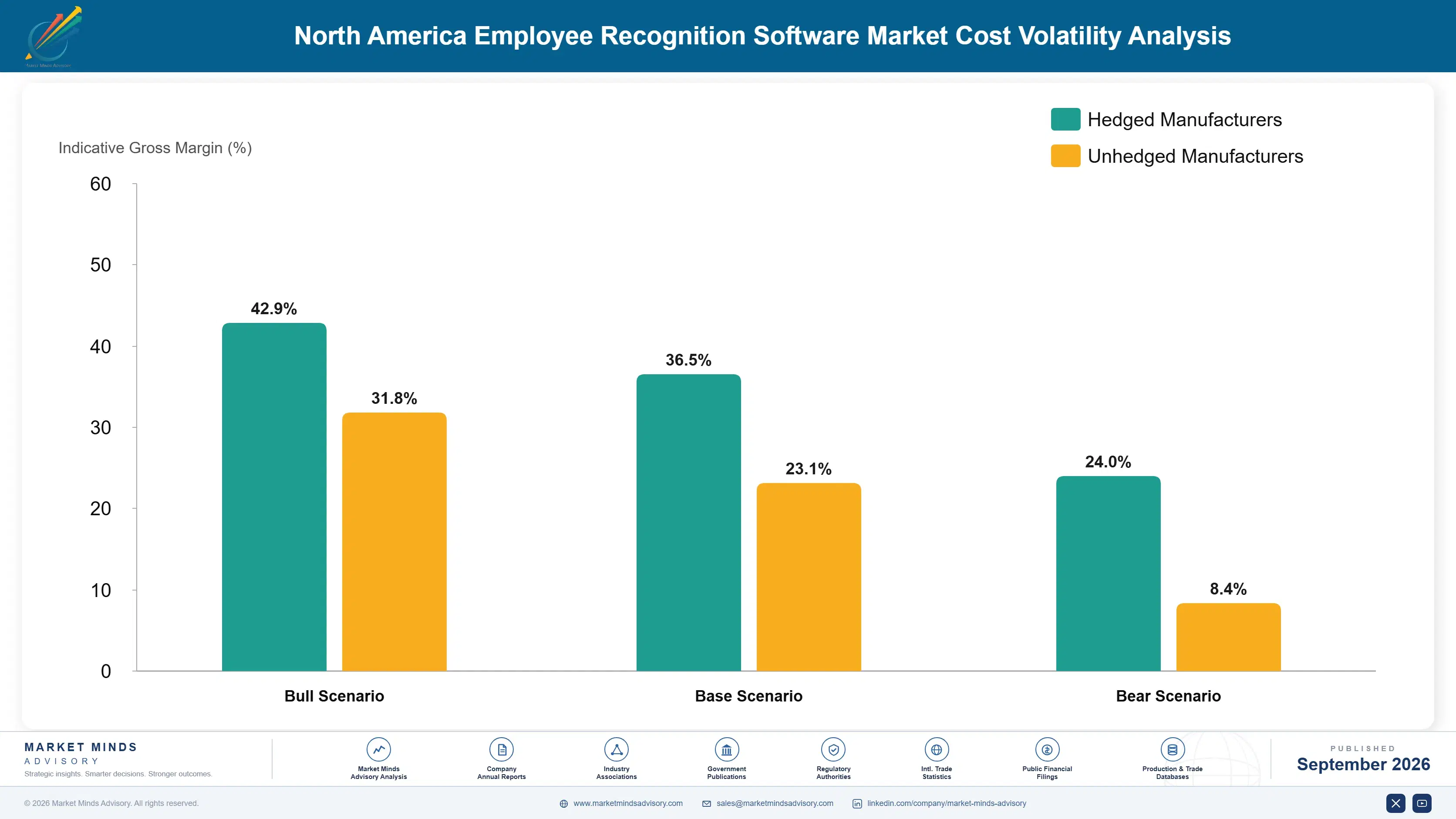
Cloud infrastructure hosting and AI model inference costs represent the largest input cost for recognition platform vendors, running an estimated 22 to 28 percent of cost of goods sold, sourced predominantly from major hyperscale cloud providers. Specialized HR technology and AI engineering talent compensation adds a substantial additional cost pressure reflecting sustained enterprise investment across employee retention.
AI model inference pricing showed meaningful volatility during 2024 as demand for generative AI capability surged across enterprise software broadly, according to company annual report disclosures from major cloud infrastructure providers. Several vendors reported margin compression as inference costs rose faster than they could pass through to customers under existing fixed-price subscription agreements reflecting sustained enterprise investment across employee retention and engagement programs as adoption continues expanding across corporate.

Smaller vendors face a meaningful competitive disadvantage since they lack the negotiating leverage to secure favorable cloud infrastructure pricing agreements, unlike Workhuman and Achievers Solutions which operate substantial proprietary infrastructure or hold enterprise cloud discount agreements. This exposure varies by business model, with vendors reselling inference capacity on thin margins facing the sharpest cost pressure reflecting sustained enterprise investment across employee retention and engagement programs as adoption continues.
north-america-employee-recognition-software-market-cost-volatility-analysis-1790001436127

Negotiate Multi-Year Cloud Infrastructure Discount Agreements reflecting sustained.

Leading vendors increasingly negotiate multi-year cloud infrastructure discount agreements with guaranteed usage commitments, reducing exposure to spot pricing volatility for AI inference workloads. This requires predictable usage forecasting but provides meaningful cost stability for long-term subscription pricing planning across the enterprise customer base reflecting sustained enterprise investment across employee retention and engagement programs as adoption.

Develop Smaller Specialized Models For Routine Tasks reflecting.

Vendors are increasingly developing smaller, specialized language models optimized for routine flight risk scoring tasks rather than relying exclusively on large general-purpose models for every predictive decision. This approach reduces inference cost substantially for high-volume routine tasks while reserving larger models for genuinely complex retention scenarios reflecting sustained enterprise investment across employee retention and engagement programs as.

Portfolio Architecture for Margin Defence

Portfolio economics split between commodity-adjacent standard peer-to-peer licensing carrying moderate margins and premium AI retention analytics or frontline mobile tiers commanding substantially higher gross margins tied to predictive sophistication. Volume plays chase employee count while premium plays extract value through analytics fees and mobile licensing layered atop base licensing reflecting sustained enterprise investment across employee retention and engagement programs as adoption continues expanding.
The tension between chasing employee count volume and defending premium analytics positioning defines strategic choices across the vendor landscape. Vendors pursuing mainstream mid-market accounts must accept moderate per-employee margins in exchange for customer count scale, while enterprise-focused specialists sacrifice volume for durable premium per-contract economics tied to predictive depth reflecting sustained enterprise investment across employee retention and engagement programs as adoption continues expanding.

High-value margin pools concentrate in AI retention analytics fees, frontline mobile platform licensing, and manager coaching consulting rather than in base peer-to-peer licensing itself, reinforcing why vendors increasingly treat core recognition as a platform for higher-margin predictive value-add reflecting sustained enterprise investment across employee retention and engagement programs as adoption continues expanding across corporate offices, retail chains, reflecting sustained enterprise investment.

Standard Peer-To-Peer Recognition Licensing

Mass-market recognition licensing sold at accessible price points to mid-market customers, prioritizing employee count volume over per-contract margin capture reflecting sustained enterprise investment across employee retention and engagement programs as.
Gross Margin: 52-60%

AI-Driven Retention Analytics Subscriptions

Advanced platforms with predictive flight risk scoring and manager coaching recommendations, sold to enterprises requiring demonstrable retention outcomes and cost avoidance reflecting sustained enterprise investment across employee retention and engagement programs as.
Gross Margin: 64-74%

Frontline Mobile And Consulting Services

Frontline mobile platform licensing and manager coaching consulting representing the fastest-growing and highest margin portion of vendor revenue mix today reflecting sustained enterprise investment across employee retention reflecting sustained enterprise.
Gross Margin: 56-66%
north-america-employee-recognition-software-market-portfolio-architecture-1790001436632

High-value Sub-segments and Strategic Watch-out

AI Retention Analytics Premium Add-Ons

Small today but expanding rapidly as employers seek predictive flight risk insight, generating high-margin recurring revenue with minimal additional capital requirement per employee reflecting sustained enterprise investment across employee retention and engagement programs as adoption continues expanding across corporate offices, retail chains, and healthcare reflecting sustained.
Gross Margin: 64-74%

Frontline Mobile Platform Licensing

A substantial and steadily expanding segment as retail and hospitality employers seek mobile-first accessibility, generating durable recurring revenue tied to frontline workforce reach reflecting sustained enterprise investment across employee retention and engagement programs as adoption continues expanding across corporate offices, retail chains, and healthcare reflecting sustained.
Gross Margin: 50-60%

Standard Peer-To-Peer Recognition Licensing

The largest volume segment today, anchored by broad mid-market customer adoption, though margin per contract remains comparatively lower relative to AI and mobile segments reflecting sustained enterprise investment across employee retention and engagement programs as adoption continues expanding across corporate offices, retail chains, and reflecting sustained.
Gross Margin: 52-60%

Legacy Annual Awards Ceremony Programs

A strategic watch-out segment given accelerating employer migration toward continuous digital recognition delivery. Vendors must manage this transition carefully to avoid losing customers reflecting sustained enterprise investment across employee retention and engagement programs as adoption continues expanding across corporate offices, retail chains, and healthcare reflecting sustained.
Gross Margin: 35-43%

Recurring Analytics Revenue Beyond Licensing reflecting.

Recognition software naturally produces annuity economics through subscription licensing renewed annually, but vendors increasingly layer AI retention analytics fees and frontline mobile licensing on top to generate revenue growth beyond flat employee-count-based renewal, a strategy that mirrors expansion revenue models common across broader enterprise software reflecting sustained enterprise investment across employee retention and engagement programs as adoption continues expanding across.
Adoption stickiness varies considerably by end-use vertical. Enterprises with extensive retention analytics integration show the deepest stickiness once HR workflows depend on a specific vendor's predictive scoring and manager coaching tools, since switching requires extensive data migration and manager retraining. Mid-market customers show shallower stickiness, often switching vendors at contract renewal based on price alone reflecting sustained enterprise investment across employee retention and engagement programs as.

Generational buyer shifts are also underway. Younger HR leaders show markedly stronger comfort delegating retention risk assessment to AI systems than older cohorts, who historically insisted on manual manager judgment alone. Procurement decision authority is simultaneously shifting from generalist HR administration toward dedicated people analytics and workforce planning leadership, changing how vendors must position their sales approach reflecting sustained enterprise investment across employee retention and engagement programs.
north-america-employee-recognition-software-market-end-use-penetration-index-1790001437131

Where MMA Sees The Opportunity reflecting.

These are among the four positions where our research anticipates prominent divergence between winners and laggards over the coming forecast period. Each is grounded in the demand model, the regulatory perimeter, and the announced capacity pipeline.
01 / RETENTION ANALYTICS INVESTMENT.

Prioritize AI Retention Analytics Over Generic Recognition Features reflecting sustained.

AI-driven retention analytics platforms are winning share fastest as employers seek predictive flight risk insight that lets managers intervene proactively rather than learning about dissatisfaction only after resignation. Vendors that delay building predictive analytics capability risk losing enterprise accounts to competitors already positioned as retention prediction leaders ahead of the next HR technology refresh cycle. MMA views retention analytics as the single highest priority development investment for vendors over the next three years given the pace of category growth reflecting sustained enterprise investment across employee retention and.
02 / FRONTLINE MOBILE PLATFORM.

Build Frontline Mobile Capability To Capture Underserved Workforce reflecting sustained.

Retail and hospitality employers increasingly specify mobile-first recognition platforms accessible without corporate email addresses, addressing a workforce segment that traditional office-oriented platforms historically underserved. Vendors that build dedicated frontline mobile capability will capture disproportionate share of this substantial underserved market relative to competitors focused purely on salaried office employees. MMA views frontline mobile expansion as a durable growth lever rather than a secondary product consideration for recognition vendors reflecting sustained enterprise investment across employee retention and engagement programs as adoption continues expanding across corporate offices, retail.
03 / RETENTION ATTRIBUTION ANALYTICS DEVELOPMENT.

Build Attribution Analytics To Justify Continued HR Investment reflecting.

Employers increasingly demand clear evidence connecting recognition platform investment to measurable retention outcomes, but isolating recognition program impact from other concurrent HR initiatives proves methodologically difficult without sophisticated analytics capability. Vendors that develop compelling attribution evidence tools will secure renewal and expansion decisions more reliably than competitors unable to demonstrate measurable return on investment. MMA views attribution analytics as increasingly essential infrastructure rather than an optional reporting feature for vendors competing on outcomes reflecting sustained enterprise investment across employee retention and engagement programs as adoption continues expanding across.
04 / HR PLATFORM PARTNERSHIP DEFENSE.

Pursue HR Platform Integration Partnerships Against Consolidation reflecting sustained enterprise.

Large employers increasingly consolidate HR technology spending toward fewer strategic platform vendors, creating pressure on standalone recognition vendors lacking broader HR platform capability or adjacent product lines to bundle. Specialist vendors that pursue deep integration partnerships with major HR platform vendors rather than competing head-on for consolidated budget will preserve revenue more effectively than those insisting on standalone positioning. MMA views partnership strategy as more viable than direct competition for specialist vendors facing budget consolidation pressure reflecting sustained enterprise investment across employee retention and engagement programs as.

Engagement Snapshot From the Field

A live engagement with an industry participant carrying material or product regulatory and market exposure ahead of a defining policy shift, showing how our research translates into a defensible multi-year portfolio strategy.
MARKET MINDS ADVISORY · CLIENT ENGAGEMENT SUMMARY
North America Employee Recognition Software Producer Strategic Portfolio Review and Transition Roadmap 2026·Investment Scenario on North America Employee Recognition Software Exposure Evaluation 2025-26
CLIENT PROFILE
The client is a national healthcare system operating hospitals and clinics across several states, evaluating recognition software vendors to address persistently elevated nursing and clinical staff turnover rates following several years of acute labor market tightness in healthcare reflecting sustained enterprise investment across employee retention and engagement programs as adoption continues reflecting sustained enterprise investment across employee retention.
STRATEGIC CHALLENGE
The client needed to determine whether AI-driven retention analytics could reliably identify at-risk clinical staff early enough for meaningful intervention, given the complex and demanding nature of healthcare frontline work schedules reflecting sustained enterprise investment across employee retention and engagement programs as adoption continues expanding across corporate offices, retail chains,.
MMA APPROACH
MMA combined its primary healthcare employer survey data with expert interviews across nursing leadership and competing recognition vendors to benchmark predictive analytics accuracy and intervention effectiveness across comparable healthcare system deployments reflecting sustained enterprise investment across employee retention and engagement programs as adoption continues expanding across corporate offices, retail chains,.
KEY FINDINGS
  1. Predictive flight risk scoring identified at-risk nursing staff significantly earlier than traditional exit interview-based detection reflecting sustained enterprise investment across employee reflecting sustained enterprise.
  2. Manager coaching prompts tied to specific analytics flags meaningfully improved intervention consistency across different nursing units reflecting sustained enterprise investment across reflecting sustained enterprise.
  3. Frontline mobile accessibility proved essential given clinical staff limited access to desktop computers during typical shift schedules reflecting sustained enterprise investment reflecting sustained enterprise.
  4. Retention improvements were most pronounced among staff who received recognition within the same week as flagged risk indicators reflecting sustained enterprise reflecting sustained enterprise.
CLIENT PROFILE
The client is a national healthcare system operating hospitals and clinics across several states, evaluating recognition software vendors to address persistently elevated nursing and clinical staff turnover rates following several years of acute labor market tightness in healthcare reflecting sustained enterprise investment across employee retention and engagement programs as adoption continues reflecting sustained enterprise investment across employee retention.
STRATEGIC CHALLENGE
The client needed to determine whether AI-driven retention analytics could reliably identify at-risk clinical staff early enough for meaningful intervention, given the complex and demanding nature of healthcare frontline work schedules reflecting sustained enterprise investment across employee retention and engagement programs as adoption continues expanding across corporate offices, retail chains,.
MMA APPROACH
MMA combined its primary healthcare employer survey data with expert interviews across nursing leadership and competing recognition vendors to benchmark predictive analytics accuracy and intervention effectiveness across comparable healthcare system deployments reflecting sustained enterprise investment across employee retention and engagement programs as adoption continues expanding across corporate offices, retail chains,.
KEY FINDINGS
  1. Predictive flight risk scoring identified at-risk nursing staff significantly earlier than traditional exit interview-based detection reflecting sustained enterprise investment across employee reflecting sustained enterprise.
  2. Manager coaching prompts tied to specific analytics flags meaningfully improved intervention consistency across different nursing units reflecting sustained enterprise investment across reflecting sustained enterprise.
  3. Frontline mobile accessibility proved essential given clinical staff limited access to desktop computers during typical shift schedules reflecting sustained enterprise investment reflecting sustained enterprise.
  4. Retention improvements were most pronounced among staff who received recognition within the same week as flagged risk indicators reflecting sustained enterprise reflecting sustained enterprise.
RECOMMENDED STRATEGY
Phase 1: Phase one: deploy predictive analytics and mobile recognition capability at the highest-turnover hospital locations first reflecting sustained enterprise investment across. Phase 2: Phase two: train nursing managers on coaching prompts tied to specific analytics flags for consistent intervention reflecting sustained enterprise investment. Phase 3: Phase three: expand deployment system-wide based on pilot retention improvement and staff satisfaction results reflecting sustained enterprise investment across employee retention.
OUTCOME
The client deployed the platform across its highest-turnover hospital locations, reporting a 21 percent reduction in nursing staff turnover within two quarters (client-reported, unverified by MMA), and subsequently expanded the platform system-wide across all facilities reflecting sustained enterprise investment across employee retention and engagement programs as adoption.

Frequently Asked Questions

Foundational context covering the market sizes, CAGR, scope, country, region and competition that inform every finding below. This section is provided to cover basics and most often pre-purchase conversations, answered from the MMA Primary Research Dataset.

What is the current size of the North America Employee Recognition Software Market?

The North American employee recognition software market is valued at 1.35 billion dollars in 2025, the base year for this report's forecast period reflecting reflecting sustained.

How large will the North America Employee Recognition Software Market be by 2036?

MMA projects the market will reach approximately 3.67 billion dollars by 2036, driven by AI retention analytics and labor market tightness reflecting sustained enterprise reflecting sustained.

What is the CAGR for the North America Employee Recognition Software Market 2026 to 2036?

The market is forecast to grow at a compound annual growth rate of 9.5 percent between 2026 and 2036 under MMA's base case scenario reflecting sustained.

Which segment is growing fastest?

AI-driven retention analytics platforms lead at a 13.5 percent CAGR, roughly 1.42 times the overall market rate, driven by predictive insight reflecting sustained enterprise investment.

Who are the major companies in the North America Employee Recognition Software Market?

Workhuman, Achievers Solutions, Bonusly, Nectar HR, and Awardco hold leading positions across enterprise and specialist segments reflecting sustained enterprise investment across employee reflecting sustained enterprise investment.

Which country is growing fastest?

Canada leads at a 10.5 percent CAGR, supported by its own labor market tightness and recognition platform adoption expanding from a smaller base reflecting sustained.

Report Segmentation Architecture

The full report scope spans multiple orthogonal segmentation dimensions, with cross-tabulated demand data provided for each dimension pair. Coverage extends further to regional breakdowns, trend trajectories, and the competitive detail needed to support segment-level decision-making.

By Product Type

  • Standard Peer-To-Peer Recognition Tools
  • AI-Driven Retention Analytics Platforms
  • Frontline Mobile Recognition Platforms
  • Manager Coaching Tools
  • Reward Marketplace Systems
  • Attribution Consulting Services

By End-Use Industry

  • Corporate Offices
  • Retail Chains
  • Healthcare Employers
  • Hospitality and Food Service
  • Manufacturing Employers
  • Financial Services

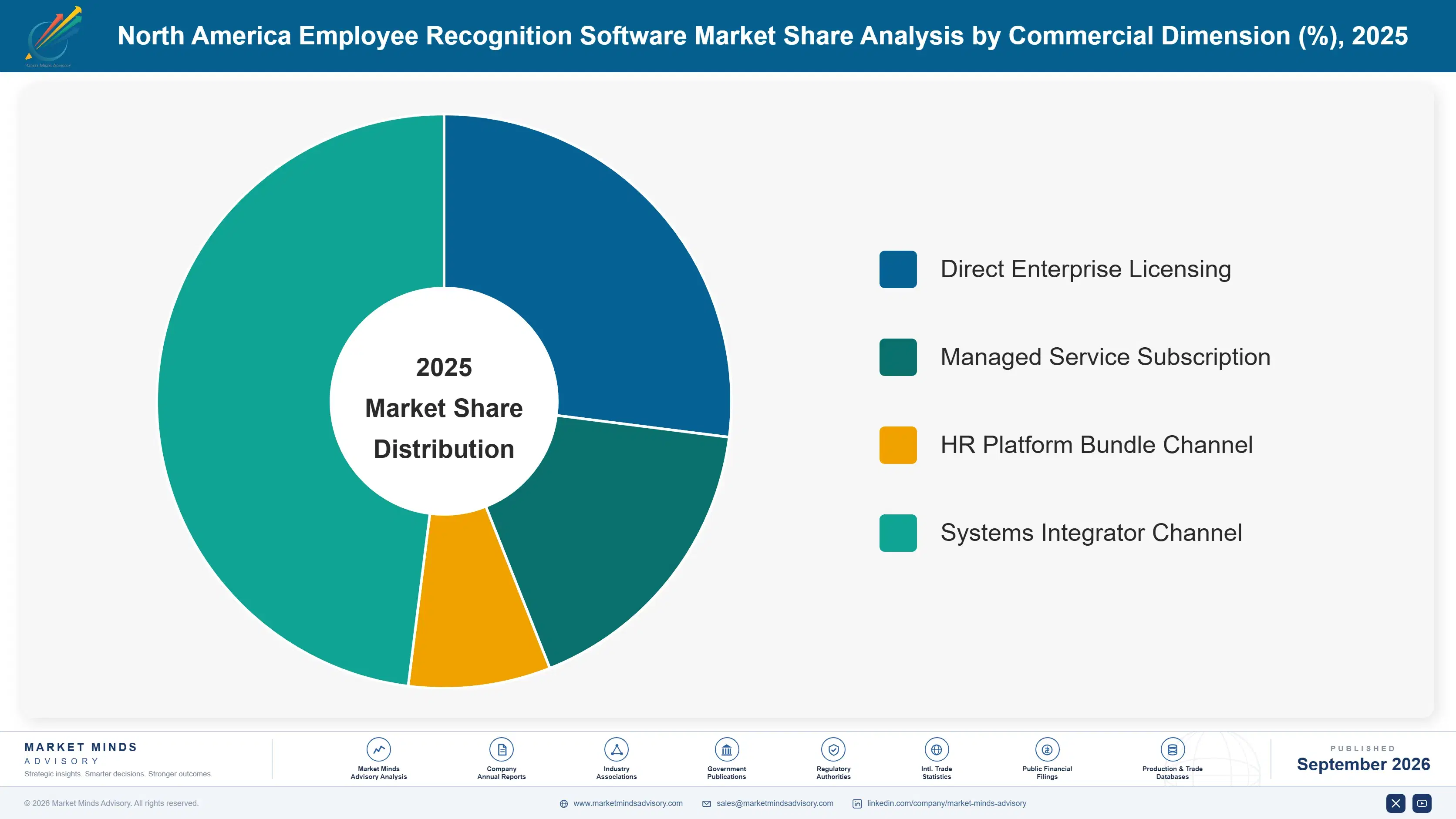
By Commercial Dimension

  • Direct Enterprise Licensing
  • Managed Service Subscription
  • HR Platform Bundle Channel
  • Systems Integrator Channel

By Region

  • North America
  • Western Europe
  • East Asia
  • South Asia and Pacific
  • Latin America
  • Middle East and Africa
  • Eastern Europe

Scope, Methodology, and Coverage

Every figure in this report is reproducible from documented input assumptions. The scope below maps the historical period, the forecast horizon, the segmentation dimensions, and the countries covered, alongside the underlying primary and qualitative methodology.
Historical Period
2020 to 2025
Forecast Period
2026 to 2036
Base Year
2025 (USD billions; MMA Primary Research Dataset, September 2026)
Market Definition
This report covers software platforms that enable peer-to-peer and manager-to-employee recognition, rewards distribution, and retention analytics for employers across the United States and Canada. It excludes general payroll and benefits administration software and standalone employee survey tools without integrated recognition functionality reflecting sustained.
Quantitative Units
USD billions, per-employee licensing where cited
Segmentation Dimensions
Product Type, End-Use Industry, Commercial Dimension, Region
Regions Covered
North America, Western Europe, East Asia, South Asia and Pacific, Latin America, Middle East and Africa, Eastern Europe
Countries Covered
United States, Canada
Key Companies Profiled
20
Quantitative Methodology
Primary survey, n=3,800 respondents, Q4 2025, six countries; demand-side model with trade association cross-validation
Qualitative Methodology
47 expert interviews, Q4 2025; applied to validate demand model assumptions, identify emerging dynamics, and assess competitive positioning
Report Format
PDF and XLSX data workbook (Word format preview document)
Publisher
Market Minds Advisory
Report Code
MMA-2026-TEC-658
Published
September 2026
Contact
sales@marketmindsadvisory.com | www.marketmindsadvisory.com

Purchase the full North America Employee Recognition Software Market Report (2026 to 2036).

The full report provides comprehensive coverage of the North American employee recognition software market across all segments, countries, and competitive dynamics outlined in this summary. It includes detailed vendor profiles, pricing benchmarks, and quantified segment-level forecasts through 2036. These findings draw on MMA's primary survey of 3,800 respondents and 47 expert interviews conducted in the fourth quarter of 2025. Subscribers receive quarterly data updates tracking retention outcome trends and competitive positioning shifts as the market evolves. Country-level appendices break out detail across the United States and Canada covered in this study.
Segment-level revenue forecasts through 2036 reflecting sustained.
Twenty vendor competitive profiles and benchmarking reflecting.
Country-level market sizing across North America reflecting.
Quarterly data updates through subscription access reflecting.
Primary survey data across six countries reflecting.
Expert interview transcripts and analyst commentary reflecting.

Built For The People Who Decide

From boardroom strategy to bench-side execution, this report is read cover-to-cover by leaders shaping the next decade of their industry, turning demand scenarios, market dynamics and valuation benchmarks into decisions.
CXOs/ Presidents/ VPs/ Managers
M&A and Corporate Development
Strategy Teams and R&D Heads
Procurement and Product Directors
Regulatory and Compliance Leaders
Investor Relations and Equity Analysts