Market Minds Advisory
North America Commercial Refrigeration Equipment Market

North America Commercial Refrigeration Equipment Market: Charge limits, architecture change and the service workforce gap to 2036

A five hundred gram charge limit on flammable refrigerant now decides whether a store gets self-contained cases or a carbon dioxide rack, and almost nobody is forecasting it that way.

Lead Analyst

David Horsley

Published

September 2026

Make Smarter Decisions with Customized Research Insights

Request a free sample report and evaluate market opportunities, growth trends, and competitive dynamics relevant to your business needs.

2025 MARKET VALUE$42.4BMarket Size 2025
2036 FORECAST VALUE$87.4BBase Case , 2026 to 2036
CAGR 2026 TO 20366.8 %Bull 8.0% / Bear 5.6%
INCREMENTAL OPPORTUNITY$42.1BNet 10- year value creation
EXPANSION MULTIPLE1.93x2036 value over 2026 base
Strategic Levers
M&A Pipeline
Regional Outlook
Country Rankings
Competitive Intelligence
Segmental Deep-dive
Call-Us : 91 93563 13602

Executive Snapshot and Market Trajectory

American rules now cap new retail food refrigeration at a global warming potential of 150, which the incumbent refrigerant misses by a factor of twenty six. This is not a refrigerant swap. It is a change of equipment architecture, and the industry keeps modelling it as the former.
Centralised rack and condensing systems grow at 10.2%, half again the market rate of 6.8%, because carbon dioxide transcritical racks running near 90 bar are the only compliant answer wherever a store is too large for self-contained cases. That threshold is set by a 500 gram limit on flammable hydrocarbon charge, not by store format or by anybody's preference. Capital cost runs well above the systems being replaced.
North America grows at 8.0%, faster than any other developed region, precisely because it transitioned late and now faces a compliance deadline out of step with the eight-year remodel cycle. Western Europe grows slowest at 5.2%, having already done this work under earlier rules. The brake nobody models is service: the technician workforce runs about 27% short. Retailers will not specify equipment nobody nearby can maintain. One runs near 90 bar, the other is flammable.
Market Definition
This report covers commercial refrigeration equipment supplied for food retail, foodservice and institutional use, spanning display cases and merchandisers, walk-in coolers and freezers, reach-in and under-counter cabinets, ice machines and beverage dispensing, centralised rack and condensing systems, and refrigerated vending and specialty cabinets. The market is assessed globally with North America as the analytical centre throughout, and value is measured at equipment manufacturer level. Excluded are transport and container refrigeration, domestic appliances, industrial process cooling and cold storage warehouse plant, refrigerants sold as such, and installation or maintenance services.
Base Year Value
$42.4B in 2025 (MMA Primary Research Dataset, August 2026)
Forecast Period
2026 to 2036, eleven discrete annual values
CAGR
6.8% base case. Bull 8.0%. Bear 5.6%.
Fastest Growth Segment
Centralised Rack and Condensing Systems: 10.2% CAGR
Fastest Growth Country
India: 9.6% CAGR
Fastest Growth Region
South Asia and Pacific: 8.8% CAGR
Largest Region
East Asia: 30% of 2025 global value
Market Leaders
Carrier, Daikin Industries, Panasonic, Epta and Dover Corporation lead the market. Source: MMA Primary Research Dataset, July 2026.
Primary Survey
n=3,800 procurement and R&D decision-makers, Q4 2025, six countries
Methodology
Demand-side build-up, cross-validated against public data, 47 expert interviews

North America Commercial Refrigeration Equipment Market Forecast Scenarios

north-america-commercial-refrigeration-equipment-m-size-forecast-scenario-1787559272383
Growth ran at 5.4% between 2020 and 2025 and the period divided sharply in two. Foodservice equipment demand collapsed through 2020 and rebounded hard, while food retail refrigeration held steady throughout because grocery kept trading. Toward the end of the period the American refrigerant rules were finalised, and equipment specification began shifting before any deadline had actually arrived anywhere.
The 6.8% base case rests on three mechanisms. Compliance-driven replacement of central systems at 10.2%, which is the most expensive equipment in any store and the most affected by the rules. North American demand at 8.0%, running ahead of every other developed region because the deadline arrived out of sync with capital planning. And Indian growth at 9.6%, the fastest of any country, on organised retail and cold chain expansion together.
The 8.0% bull case is the replacement wave compressing further as retailers pull refits forward to avoid competing for scarce installation capacity. The 5.6% bear case is the service technician shortfall near 27% slowing specification of carbon dioxide systems, since equipment that cannot be serviced locally does not get bought regardless of what the rules require.

Architecture, Not Refrigerant

The American rules cap new retail food refrigeration at a global warming potential of 150, and the refrigerant most of the installed base runs on sits around twenty six times that. Everyone in the industry knows this. What gets discussed far less is that there is no drop-in answer, so the rule does not change a refrigerant, it changes what equipment a store contains. Three architectures qualify: self-contained cabinets on hydrocarbon refrigerant, carbon dioxide transcritical racks, or systems built for the newer mildly flammable blends. They are not interchangeable and they cost very different amounts.
TOP-FIVE CONCENTRATION38%Combined position across supply held by the leading equipment manufacturers
REGULATORY GWP CEILING150Warming potential limit new retail refrigeration equipment must meet
HYDROCARBON CHARGE LIMIT500 gMaximum flammable refrigerant permitted in a self-contained cabinet
TRANSCRITICAL SYSTEM PRESSURE90 barOperating pressure carbon dioxide systems reach on the high side
TECHNICIAN WORKFORCE GAP27%Shortfall against service demand across the installed refrigeration base
SUPERMARKET REMODEL CYCLE8 yearsInterval between major store refits under normal capital planning
The choice between them is decided by a number that rarely appears in market commentary. Flammable hydrocarbon charge in a self-contained cabinet is limited to 500 grams, which is enough to cool a case and nowhere near enough to run a store. Below that threshold a retailer can distribute refrigeration into individual plug-in cases and skip the machine room entirely. Above it the store needs a centralised rack, and in practice that means carbon dioxide operating near 90 bar.
Both routes demand skills the service workforce does not currently have, and that workforce is running roughly 27% short of what the installed base already requires.
"Every forecast I see treats this as a refrigerant transition, and the retailers I speak to are making a machine room decision. Whether you can fit under five hundred grams of propane decides your entire store architecture, your capital cost and who can service it. That is not a chemistry question."
Director, Commercial Refrigeration and Cold Chain Practice · MMA Construction and Industrial Equipment Practice · August 2026

Market Trends

Charge limits decide store architecture rather than refrigerant choice

A 500 gram limit on flammable hydrocarbon charge in self-contained cabinets sets the boundary between two entirely different store designs. Below it a retailer distributes refrigeration into plug-in cases and eliminates the machine room, piping and remote condensers altogether. Above it the store requires a centralised rack, which in practice means carbon dioxide running near 90 bar with the pressure-rated components that implies. Commercially the two routes differ by a wide margin in capital cost, installation time and service requirement, and a manufacturer selling only one of them cannot serve half the market.
Market Impact: Regional demand compounds at 8.0%
Compliance deadlines fall out of step with remodel planning

Supermarket capital planning runs on a remodel cycle of roughly eight years, and the American compliance dates do not align with it for most chains. Retailers therefore face equipment replacement outside the refit they had budgeted, which pulls demand forward into a compressed window rather than spreading it evenly. Commercially this creates a genuine bubble in North American equipment demand and a matching squeeze on installation capacity. Retailers who move early secure contractor availability, and those who wait will be bidding against everybody else for the same scarce crews. Contractor availability is already tightening in several regions.
Market Impact: Indian demand compounds at 9.6%

Market Opportunities and Growth Drivers

Late transition makes North America the fastest developed market

North American demand grows at 8.0%, ahead of every other developed region, for the straightforward reason that the region transitioned late and now faces a compressed compliance window. Western Europe completed the equivalent work under earlier rules and grows at 5.2% as a result, which inverts the usual pattern in equipment markets. Commercially this concentrates replacement volume in one region over a defined period, and manufacturers with North American production and installation partners capture disproportionate value from a wave that will not repeat. The wave will not repeat, which makes timing more important than share.
Market Impact: Workforce runs 27% short

Organised retail and cold chain expand across Asian markets

Indian growth at 9.6% leads every country in this market, driven by organised grocery retail displacing traditional trade and by cold chain investment reaching food processing and distribution that previously operated without it. Chinese convenience retail and foodservice continue expanding on a much larger base. Neither market carries the refrigerant compliance pressure driving North American replacement, so growth there is genuine new installation rather than substitution. Equipment specification favours lower capital cost formats, which suits self-contained cabinets over centralised systems. Ambient conditions across both regions favour hydrocarbon cabinets over carbon dioxide racks wherever charge limits permit.
Market Impact: Efficiency drops above 90 bar

Market Restraints and Challenges

Service technician shortage brakes adoption of compliant systems

The refrigeration service workforce runs roughly 27% short of what the installed base already demands, and both compliant architectures make the problem worse rather than better. Carbon dioxide systems operate near 90 bar and hydrocarbon systems are flammable, so each requires training and certification the existing workforce largely lacks. The root cause is an ageing trade with weak recruitment into it. Commercially, equipment that cannot be serviced locally does not get specified whatever the rules say. Manufacturers are funding training programmes and building remote diagnostics to reduce site visits. Recruitment into the trade remains persistently weak.
Market Impact: Set by a 500 gram limit

Carbon dioxide efficiency falls away in hot ambient conditions

Transcritical carbon dioxide systems lose efficiency as ambient temperature rises, which is why they were adopted first across northern Europe and why the American south is the harder case. The root cause is the fluid's low critical temperature, which forces the system into transcritical operation exactly when cooling demand peaks. Commercially this raises running cost in precisely the regions with the most stores per capita. Manufacturers are addressing it with parallel compression, ejectors and adiabatic gas coolers, all of which add capital cost and complexity. Store density in exactly those regions is the highest anywhere.
Market Impact: Disrupts an 8 year refit cycle
4 additional market trends, 3 additional growth drivers, and 2 additional restraints and challenges are covered in the full report. Contact sales@marketmindsadvisory.com to access the complete intelligence.

Segment CAGR and Growth Architecture

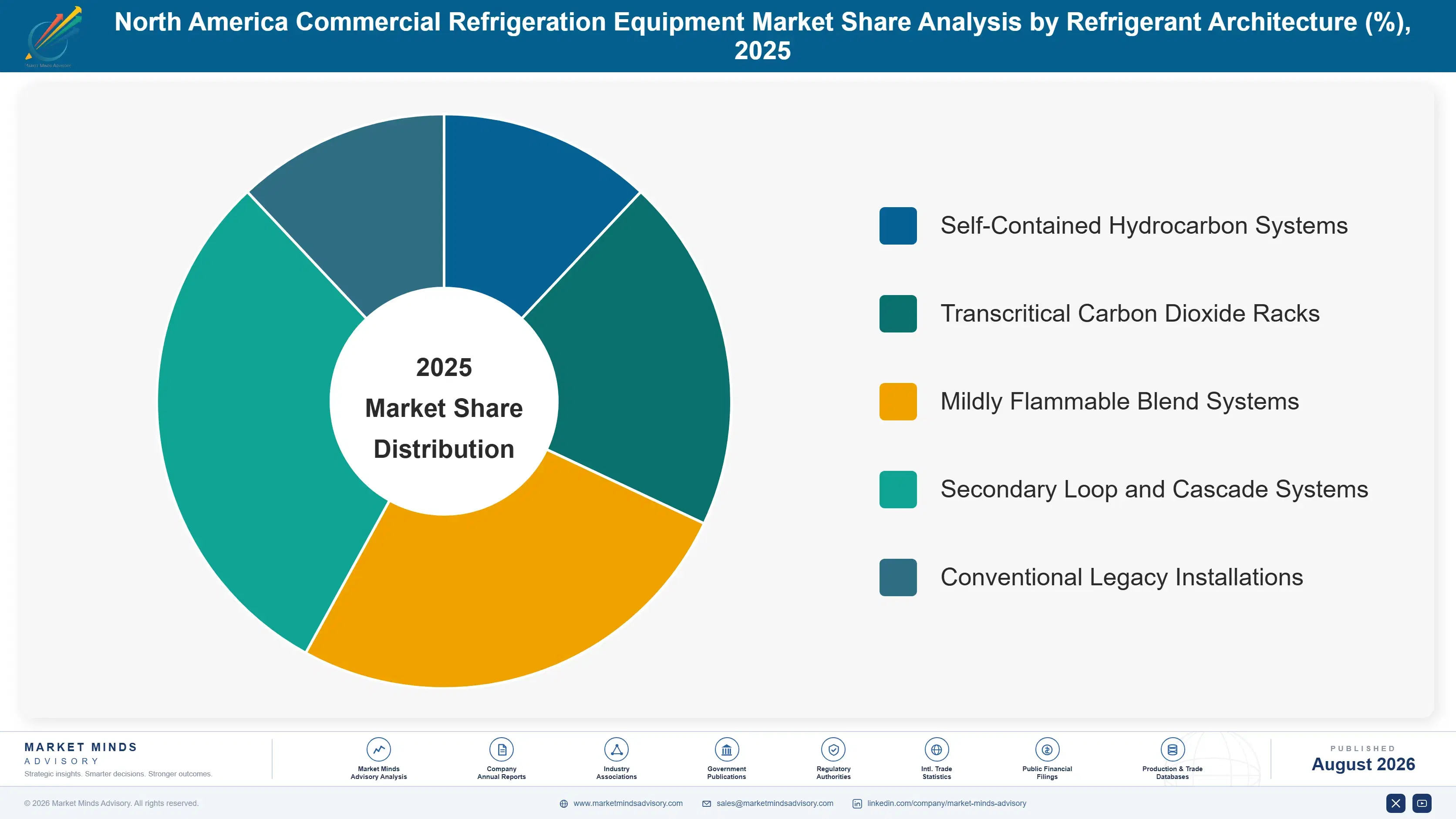
Value is classified here by equipment category, since capital cost, installation requirement and compliance exposure all differ enormously between a plug-in cabinet and a machine room rack. Refrigerant architecture, end customer type and sales channel are each handled separately in the framework below, because one equipment category is now built in several compliant configurations.
north-america-commercial-refrigeration-equipment-m-market-share-analysis-1787559272934

Centralised Rack and Condensing Systems

Growing at 10.2%, half again the market rate, centralised systems carry the heaviest compliance exposure in any store because they hold the largest refrigerant charge and cannot use hydrocarbons above the 500 gram limit at all. Carbon dioxide transcritical operating near 90 bar is the practical answer for most large formats, and it requires pressure-rated components, different controls and a machine room built for it. Capital cost runs well above the systems being replaced. Installation takes longer and demands contractor capability that is genuinely scarce, which is why retailers who commit early secure crews that late movers will be competing hard to find. Hot ambient conditions add adiabatic assistance and further cost again.
CAGR 10.2%

Display Cases and Merchandisers

Display cases carry the visible refrigeration in any food retail store and growth at 6.4% reflects both compliance replacement and continued format expansion across convenience and grocery. The compliance route here splits sharply: cases under the 500 gram hydrocarbon charge limit can be built self-contained and plugged in, removing the machine room dependency entirely, while larger multi-deck cases connect to a centralised system. Self-contained formats are gaining share because they decouple the store refit from the machine room project, which shortens installation and lets a retailer phase capital spending across several years instead of committing it all at once. Multi-deck and low temperature formats remain tied to a centralised system whatever the retailer would prefer.
CAGR 6.4%
Full segment breakdown across 6 segments available in the complete report.

Regional Architecture and Country Demand Map

East Asia holds 30% of value on retail and foodservice scale, with North America close behind at 26% and growing fastest of all the developed regions because compliance deadlines arrived there late. Western Europe follows at 20%, having already completed the equivalent work a decade earlier.

East Asia

Chinese convenience retail, supermarket and foodservice expansion generates the largest single pool of equipment demand anywhere, and it is genuine new installation rather than compliance replacement. Domestic manufacturers including Haier and Hisense supply most of that volume at price points international manufacturers do not contest on standard cabinets. Japanese and Korean demand is mature and technically demanding, with Panasonic, Hoshizaki and Fukushima Galilei holding strong positions in foodservice and convenience formats. Refrigerant rules across the region are tightening but without the compressed deadline pressure North America faces. Growth at 7.8% reflects retail format expansion. Hot ambient conditions across southern China favour hydrocarbon cabinets. Service capability for pressure systems is developing alongside the installed base rather than ahead of it.
Share: 30% | CAGR: 7.8% (2026 to 2036)

North America

Compliance deadlines under American refrigerant rules make this the fastest growing developed region at 8.0%, since a replacement wave is being forced through a window that does not match the eight-year remodel cycle most chains plan against. Southern states face the harder engineering case, because carbon dioxide efficiency falls away in high ambient conditions and store density is highest exactly there. Installation contractor capacity is the practical constraint rather than equipment availability. Canadian conditions favour carbon dioxide systems more readily, and Mexican retail is expanding on lower capital cost self-contained formats. Corporate engineering and sustainability functions now hold effective veto over equipment specification, which has changed who a manufacturer needs to convince and on what evidence.
Share: 26% | CAGR: 8.0% (2026 to 2036)
Regional intelligence for 5 additional markets available in the complete report: Western Europe, South Asia and Pacific, Latin America, Middle East and Africa, Eastern Europe. Contact sales@marketmindsadvisory.com.
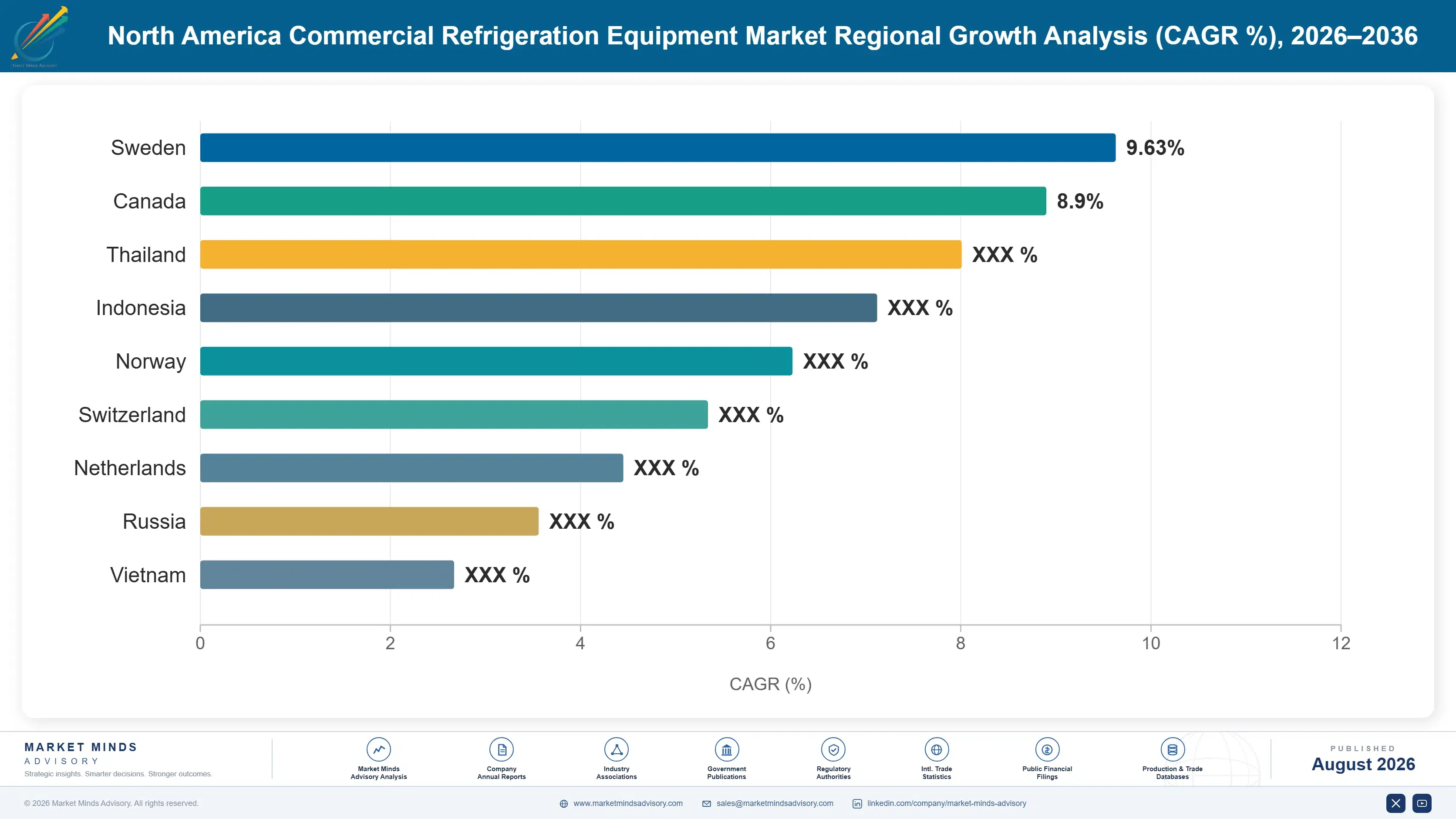
north-america-commercial-refrigeration-equipment-m-country-cagr-analysis-1787559273490

Where Refrigeration Value Concentrates Now

Four moves matter in an equipment market where regulation has changed what a store actually contains rather than merely what circulates inside the pipework. Two concern serving both compliant architectures rather than betting on one of them, and the other two concern the installation and service constraints that will decide who actually captures the replacement wave.

Offer both architectures instead of choosing one

The 500 gram hydrocarbon charge limit splits this market into self-contained cabinet stores and centralised carbon dioxide stores, and the split runs through individual chains rather than between them, since a retailer sizes format by format. A manufacturer offering only plug-in cabinets or only rack systems is excluded from roughly half the specification conversations it enters. Building both costs less than losing the account, because retailers increasingly award refrigeration for a whole estate rather than store by store. Estate awards are increasingly decided across a whole portfolio at once. Half the conversation is lost otherwise.
Market Impact: Covers both sides of a 500 gram limit

Lock installation capacity before the deadline squeeze

Compliance dates fall outside the eight-year remodel cycle for most chains, which compresses replacement into a narrow window and makes contractor availability the binding constraint rather than equipment supply. Manufacturers who secure installation partners on committed terms now can promise delivery dates that competitors cannot match later. Retailers know this and are already asking about it in tenders. The manufacturer who answers the installation question convincingly frequently wins on that alone, whatever the equipment comparison says. The 8 year remodel cycle no longer governs replacement timing, so contractor demand arrives as a spike.
Market Impact: Beats an 8 year cycle now badly disrupted

Solve high ambient carbon dioxide performance properly

Transcritical carbon dioxide loses efficiency as ambient temperature rises and store density across the American south is the highest in the region, which puts the hardest engineering case exactly where the most equipment is needed. Parallel compression, ejectors and adiabatic gas coolers all address it at added capital cost around 15% above a basic transcritical rack. A manufacturer with demonstrated southern performance data rather than northern European references removes the objection that stalls these decisions most often. European reference sites answer a different engineering question entirely. Retailers want measured summer data from their own climate.
Market Impact: Addresses roughly 15% in added capital cost alone

Fund technician training as a sales investment

The service workforce runs about 27% short of current demand and neither compliant architecture is serviceable by an untrained technician, since one runs near 90 bar and the other is flammable. Retailers will not specify equipment they cannot get serviced locally, whatever the regulation requires of them. Manufacturers funding certification programmes and building remote diagnostics are removing the objection that most often delays a decision, and they are doing it in a way competitors cannot quickly copy. The investment also builds a service attachment position competitors cannot easily take later.
Market Impact: Addresses a 27% shortfall in the service workforce

Who Controls the Margin Pool

Five manufacturers hold 38% of this market, measured on equipment revenue at manufacturer level, the basis used throughout this section. Concentration is moderate because cabinet manufacture is regionally fragmented while centralised systems are not, and the compliance transition is pulling value toward the concentrated end. Regional cabinet builders compete effectively on price and lead time and have very little to offer on rack systems.
Competition runs on four dimensions. Architecture breadth across self-contained and centralised compliant systems, since retailers increasingly award entire estates rather than individual stores. Installation partner capacity, which is the binding constraint right through the replacement window. High ambient carbon dioxide performance, which decides southern specifications outright. And service network reach, because equipment nobody in the area can maintain simply does not get bought.

Rankings shift toward manufacturers holding both architectures and committed installation capacity, and away from cabinet specialists with no rack offering at all. European manufacturers hold carbon dioxide operating experience earned a decade earlier than anybody else. American manufacturers hold the retail relationships and the installed base visibility. Chinese producers hold cabinet volume and are moving upward into compliant formats steadily.
north-america-commercial-refrigeration-equipment-m-company-positioning-matrix-1787559274015

Competitive Moat and Risk Dimensions

CARRIER

Moat: Architecture breadth and reach

The company offers both self-contained and centralised compliant systems alongside the service network to maintain them, which matters when retailers award refrigeration across a whole estate containing formats on either side of the hydrocarbon charge limit. Installed base depth also gives it visibility into replacement timing that competitors bidding cold do not have.
CARRIER

Risk: Installation capacity through the wave

The binding constraint through the compliance window is contractor availability rather than equipment supply, and scale does not automatically secure it. Competitors who commit to installation partners early can promise dates that a larger manufacturer without those commitments cannot match. Retailers are already asking the question in tenders, and the answer increasingly decides awards.
EPTA

Moat: Carbon dioxide experience depth

European operators completed this transition under earlier rules, and the company built genuine transcritical carbon dioxide capability through it rather than in response to a deadline. That experience covers controls, commissioning and the operating problems that only appear after installation, which is exactly what North American retailers are trying to buy without having to discover it themselves first.
EPTA

Risk: High ambient performance references

Carbon dioxide efficiency falls away as ambient temperature rises, and experience earned across northern Europe answers a different engineering question than the American south poses. Retailers there want southern performance data rather than European references. Manufacturers with demonstrated hot climate installations remove an objection that European experience alone does not address.

Players Tracked

Prominent Players

Carrier
Daikin Industries
Panasonic
Epta
Dover Corporation

Other Key Players

Hussmann
Danfoss
Emerson Electric
Illinois Tool Works
Ali Group
Middleby
Hoshizaki
Fukushima Galilei
Arneg
Liebherr
AHT Cooling Systems
Haier Smart Home
Hisense
True Manufacturing
Frigoglass

Recent Developments

FEBRUARY 2025

A grocery chain committed an estate to self-contained cabinets

A North American grocery operator committed a substantial part of its estate to self-contained hydrocarbon cabinets rather than centralised carbon dioxide racks, citing installation speed and the removal of machine room dependency. Store formats were sorted by cabinet size. This was a procurement decision rather than any transaction between manufacturers.
Signal: Retailers now choose store architecture on installation practicality rather than on any refrigerant efficiency argument alone
JUNE 2025

A manufacturer secured committed installation contractor capacity

An equipment manufacturer signed multi-year capacity commitments with refrigeration installation contractors ahead of the compliance replacement window, aiming to guarantee delivery dates through a period of expected contractor scarcity. This was a commercial supply agreement rather than any acquisition or equity arrangement. Terms extended across several years of work.
Signal: Installation capacity rather than equipment supply is becoming the constraint that decides who wins estate awards
OCTOBER 2025

A manufacturer published hot climate transcritical performance data

A manufacturer released measured efficiency data for adiabatic and ejector-assisted carbon dioxide systems operating in high ambient southern conditions, addressing the performance objection that has slowed specification there. This was a technical disclosure rather than any commercial transaction with another party. Data covered a full summer operating season.
Signal: Southern performance evidence rather than northern European reference sites is what actually unblocks these specification decisions

What Drives Equipment Cost

Steel, aluminium and copper together account for roughly 34% of manufactured cost, with copper particularly significant in heat exchangers and piping. Compressors and electronic controls add around 28% and are bought in rather than made. Pressure-rated components for carbon dioxide systems cost considerably more than the equivalent parts for conventional refrigerants, which is why compliant rack systems carry capital cost well above what they replace.
Copper and steel prices moved sharply through 2021 and 2022 alongside general commodity inflation, and compressor lead times extended well beyond normal as electronics shortages propagated through the supply chain. Carrier noted material cost and supply chain pressure across its refrigeration operations in its Annual Report 2022. Manufacturers holding fixed-price project quotes absorbed most of it, and several manufacturers shortened quotation validity periods sharply afterwards.

The disadvantage falls on manufacturers without pressure-component supply relationships, and it shows as lead time rather than as unit cost. Carbon dioxide systems need valves, vessels and fittings rated well above conventional refrigeration practice, from a supplier base that is narrower than the general components market. A manufacturer without those relationships quotes longer delivery, which loses awards in a window where retailers are racing a compliance date.
north-america-commercial-refrigeration-equipment-m-cost-volatility-analysis-1787559274209

Contract pressure-rated component supply ahead of the replacement wave

Carbon dioxide systems require valves, vessels and fittings rated far above conventional refrigeration practice, from a narrower supplier base than general components. Securing that supply on committed terms before the compliance window opens protects delivery dates when competitors are quoting extended lead times. Retailers racing a deadline award on delivery certainty as much as on price.

Index project quotations to published metal benchmarks

Metals at roughly 34% of manufactured cost make a fixed-price quotation held open for months an unhedged commodity position. Indexing to published copper, steel and aluminium benchmarks with a defined validity period transfers the exposure appropriately. Retailers accept it where the mechanism is transparent, and reject open-ended escalation clauses that give no visibility. Transparency is what makes it acceptable.

Standardise rack designs to compress engineering and commissioning

Bespoke rack engineering consumes design hours and commissioning time that a compressed replacement window simply does not allow. Standardised transcritical platforms sized in steps rather than designed per store cut both, and they let installation crews repeat work they already know. That matters more than usual when contractor capacity is the binding constraint on the whole programme.

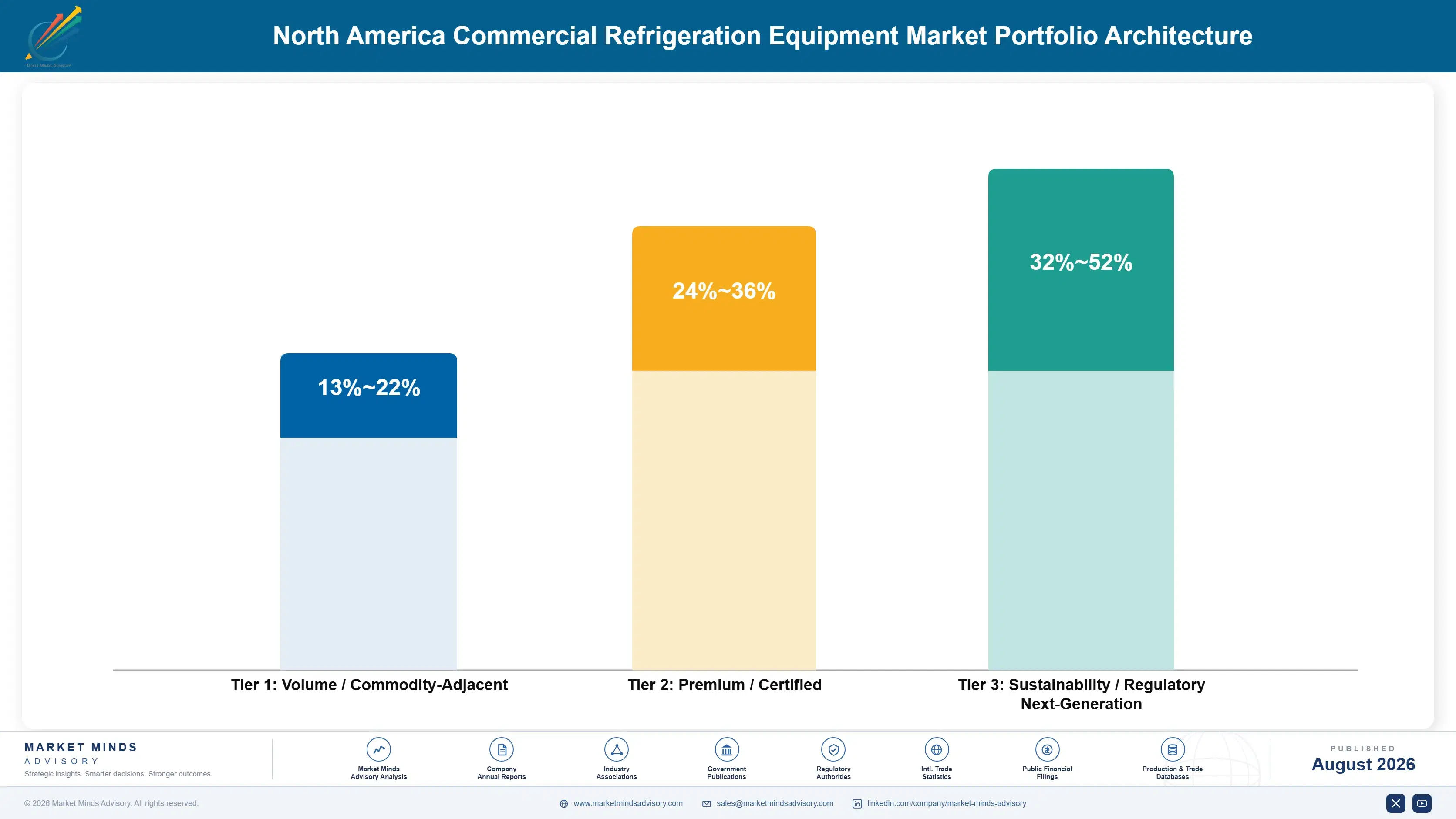
Portfolio Architecture for Margin Defence

Margin separates on architecture and service attachment rather than on manufacturing scale, which is a change from how this industry looked a decade ago. Standard cabinets and merchandisers run at gross margins in the mid teens against regional builders competing on price and lead time. Walk-in and foodservice equipment runs modestly better on configuration requirements. Compliant carbon dioxide rack systems run considerably higher on engineering content. Service contracts and remote monitoring attached to installed equipment run higher still.
The tension is that cabinet volume fills the factories while rack systems and service attachment earn the returns, and moving toward the latter requires engineering capability and a technician network rather than any production investment. Manufacturers weighted toward cabinets face regional price competition that compliance does not shield them from at all. Several are discovering that the replacement wave rewards exactly the capabilities they chose not to build.

High-value pools sit in compliant rack systems, attached service and hot ambient engineering. Standard cabinet manufacture is where regional builders compete hardest and where the compliance wave changes almost nothing. Regional builders will keep taking that volume on price and lead time, and no regulation is going to stop them doing it.

Volume / Commodity-Adjacent

Standard cabinets, merchandisers and reach-in units competing on delivered price and lead time against regional builders. The nine-point range separates manufacturers with scale purchasing on metals and compressors from those buying components at prevailing market terms.
Gross Margin: 13%-22%

Premium / Certified

Walk-in systems, foodservice equipment and configured cabinet programmes where specification and installation coordination matter beyond the box itself. The twelve-point spread reflects engineering and project capability rather than any manufacturing advantage.
Gross Margin: 24%-36%

Sustainability / Regulatory / Next-Generation

Compliant carbon dioxide rack systems, hot ambient engineered configurations and attached service contracts. The twenty-point range is wide because engineering content, ambient conditions and service attachment vary enormously between individual retail programmes.
Gross Margin: 32%-52%
north-america-commercial-refrigeration-equipment-m-portfolio-architecture-1787559274702

High-value Sub-segments and Strategic Watch-out

Compliant Rack Systems

Compounding at 10.2% because centralised systems carry the heaviest compliance exposure and cannot use hydrocarbons above the charge limit. Capital cost runs well above what they replace, and installation capability is genuinely scarce. Engineering content rather than manufacturing scale is what earns the margin here.
Gross Margin: 34%-52%

Attached Service and Monitoring

The workforce runs 27% short, so remote diagnostics that reduce site visits carry real value to a retailer. Attachment at point of sale is far easier than winning service on installed equipment somebody else supplied. Remote diagnostics reduce the site visits nobody has spare technicians for.
Gross Margin: 36%-50%

Self-Contained Hydrocarbon Cabinets

Growing because staying under the 500 gram charge limit removes machine room dependency and lets a retailer phase capital across years. Format sizing rather than any refrigerant preference decides where these can be used. Capital phasing across several budget years is the real commercial argument.
Gross Margin: 22%-34%

Standard Cabinet Manufacture

The factory volume, competed on delivered price and lead time against regional builders whom compliance does not disadvantage at all. Manage this for component purchasing scale rather than for any margin recovery. Compliance changes almost nothing whatever about this particular competitive position. Purchasing scale decides it.
Gross Margin: 13%-22%

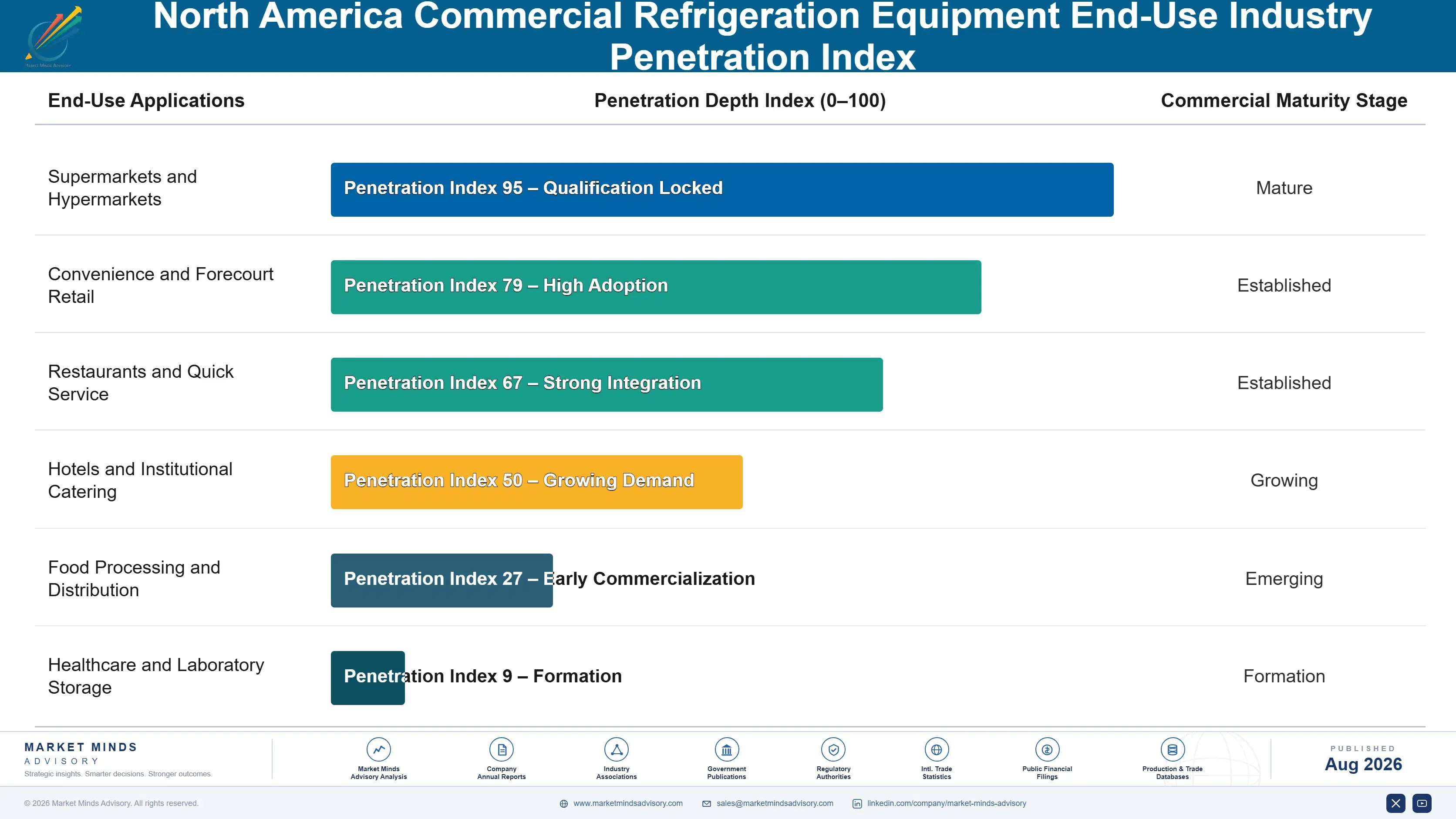
How Equipment Demand Renews

Demand normally renews on the remodel cycle, which runs about eight years and makes this a reasonably predictable capital goods business underneath the noise. Compliance has broken that rhythm across North America by forcing replacement outside the refit a retailer had budgeted for. The result is a wave rather than a cycle, and the volume being pulled forward is volume that will not appear later, which manufacturers extrapolating current order intake into the 2030s should think carefully about.
Stickiness runs through service attachment and estate standardisation rather than through equipment preference. A retailer who standardises an estate on one manufacturer's rack platform and controls gains operating consistency that makes switching expensive across hundreds of stores. Foodservice operators specify by outlet and switch readily on price and availability. Convenience formats sit in between, standardising where the chain is corporate and fragmenting where it is franchised.

The buyer has moved from store operations toward corporate engineering and sustainability functions together. Refrigeration was specified by the people running the estate on capital cost and reliability. Compliance has brought in engineering teams evaluating architecture and sustainability teams tracking refrigerant inventory, and both now hold effective veto over a purchase.
north-america-commercial-refrigeration-equipment-m-end-use-penetration-index-1787559275195

Where To Place The Bet

These are among the four positions where our research anticipates prominent divergence between winners and laggards over the coming forecast period. Each is grounded in the demand model, the regulatory perimeter, and the announced capacity pipeline.
01 / DUAL ARCHITECTURE COVERAGE

Sell both sides of the charge limit

The 500 gram limit on flammable hydrocarbon charge divides this market into self-contained cabinet stores and centralised carbon dioxide stores, and that division runs through individual retail chains rather than neatly between them, because a retailer sizes the answer format by format. A manufacturer offering only plug-in cabinets or only rack systems is excluded from roughly half of every specification conversation it enters. Building both capabilities costs materially less than losing estate awards that are increasingly decided across a whole portfolio at once.
02 / INSTALLATION CAPACITY SECURING

Commit contractor capacity before everyone needs it

Compliance dates fall outside the eight-year remodel cycle most chains plan against, which compresses replacement into a narrow window and makes installation contractor availability the binding constraint rather than equipment manufacturing capacity. Manufacturers who secure installation partners on committed terms now can promise delivery dates that competitors will simply be unable to match once the squeeze arrives. Retailers already ask about this in tenders, and a convincing answer frequently decides the award regardless of how the underlying equipment comparison actually reads on the technical merits.
03 / HOT AMBIENT ENGINEERING

Prove southern performance, not northern references

Transcritical carbon dioxide efficiency falls away as ambient temperature rises, and store density across the American south is the highest in the region, which places the hardest engineering case in precisely the location needing the most equipment. Parallel compression, ejectors and adiabatic gas coolers each address it at roughly 15% additional capital cost above a basic transcritical rack. A manufacturer holding measured southern performance data rather than northern European reference sites removes the single objection that stalls these decisions most reliably.
04 / SERVICE WORKFORCE INVESTMENT

Train the technicians who will maintain your equipment

The refrigeration service workforce runs roughly 27% short of what the installed base already requires, and neither compliant architecture can be maintained by an untrained technician, since one operates near 90 bar and the other is flammable. Retailers will not specify equipment they cannot have serviced locally, whatever any regulation requires them to install. Manufacturers funding certification programmes and building remote diagnostics remove the objection that delays these decisions most often, and competitors cannot replicate a trained regional technician base at anything like short notice.

Engagement Snapshot From the Field

A live engagement with an industry participant carrying material or product regulatory and market exposure ahead of a defining policy shift, showing how our research translates into a defensible multi-year portfolio strategy.
MARKET MINDS ADVISORY · CLIENT ENGAGEMENT SUMMARY
North America Commercial Refrigeration Equipment Producer Strategic Portfolio Review and Transition Roadmap 2026·Investment Scenario on North America Commercial Refrigeration Equipment Exposure Evaluation 2025-26
CLIENT PROFILE
A regional grocery operator running 310 stores across the American southeast (client-reported, unverified by MMA), facing refrigerant compliance deadlines across an estate built largely on conventional centralised systems. Capital planning ran on an eight-year remodel cycle. No refrigeration architecture decision had been taken. Store formats varied considerably in size across the portfolio. Compliance dates were fixed.
STRATEGIC CHALLENGE
Engineering had recommended transcritical carbon dioxide across the estate on the basis of European reference installations. Nobody had tested whether that performed acceptably in southeastern ambient conditions, or whether smaller formats could stay under the hydrocarbon charge limit and skip the machine room entirely. The recommendation had gone untested against local conditions or against store format economics.
MMA APPROACH
MMA modelled running cost for carbon dioxide, hydrocarbon self-contained and blended architectures against measured southeastern ambient profiles rather than European data. Store formats were sorted by whether individual cases could sit under the 500 gram charge limit. Installation contractor availability across the region was assessed against the compliance timetable and competing retailer demand.
KEY FINDINGS
  1. Roughly 40% of the estate consisted of formats small enough for self-contained hydrocarbon cabinets, which removed the machine room project entirely and cut installation time substantially per store.
  2. Transcritical carbon dioxide running cost in southeastern conditions exceeded the European reference case by a wide margin unless adiabatic assistance was fitted, which the original recommendation had not costed.
  3. Regional installation contractor capacity was already being committed by two competing chains, leaving a narrowing window before crews would be unavailable at any reasonable price.
  4. Phasing self-contained conversions ahead of rack replacements spread capital across three budget years rather than concentrating it, without breaching any compliance date.
CLIENT PROFILE
A regional grocery operator running 310 stores across the American southeast (client-reported, unverified by MMA), facing refrigerant compliance deadlines across an estate built largely on conventional centralised systems. Capital planning ran on an eight-year remodel cycle. No refrigeration architecture decision had been taken. Store formats varied considerably in size across the portfolio. Compliance dates were fixed.
STRATEGIC CHALLENGE
Engineering had recommended transcritical carbon dioxide across the estate on the basis of European reference installations. Nobody had tested whether that performed acceptably in southeastern ambient conditions, or whether smaller formats could stay under the hydrocarbon charge limit and skip the machine room entirely. The recommendation had gone untested against local conditions or against store format economics.
MMA APPROACH
MMA modelled running cost for carbon dioxide, hydrocarbon self-contained and blended architectures against measured southeastern ambient profiles rather than European data. Store formats were sorted by whether individual cases could sit under the 500 gram charge limit. Installation contractor availability across the region was assessed against the compliance timetable and competing retailer demand.
KEY FINDINGS
  1. Roughly 40% of the estate consisted of formats small enough for self-contained hydrocarbon cabinets, which removed the machine room project entirely and cut installation time substantially per store.
  2. Transcritical carbon dioxide running cost in southeastern conditions exceeded the European reference case by a wide margin unless adiabatic assistance was fitted, which the original recommendation had not costed.
  3. Regional installation contractor capacity was already being committed by two competing chains, leaving a narrowing window before crews would be unavailable at any reasonable price.
  4. Phasing self-contained conversions ahead of rack replacements spread capital across three budget years rather than concentrating it, without breaching any compliance date.
RECOMMENDED STRATEGY
Phase 1: Phase one: convert the smaller formats to self-contained hydrocarbon cabinets immediately, since these require no machine room work and release contractor capacity for later stores. Phase 2: Phase two: commit regional installation contractor capacity under multi-year terms before competing chains absorb what remains available in the market. Phase 3: Phase three: specify adiabatic-assisted transcritical racks for the large formats, costing the assistance properly rather than working from European reference figures.
OUTCOME
Self-contained conversions are complete across the smaller formats ahead of schedule. Contractor capacity is committed through the compliance window. Large format rack specification now includes adiabatic assistance, and the client reports total programme cost below the original single-architecture estimate (client-reported, unverified by MMA). Contractor rates were locked before the squeeze.

Frequently Asked Questions

Foundational context covering the market sizes, CAGR, scope, country, region and competition that inform every finding below. This section is provided to cover basics and most often pre-purchase conversations, answered from the MMA Primary Research Dataset.

What is the current size of the North America Commercial Refrigeration Equipment Market?

The global market was valued at USD 42.4 billion in 2025, rising to an estimated USD 45.28 billion in 2026. East Asia holds the largest regional share at 30% of value.

How large will the North America Commercial Refrigeration Equipment Market be by 2036?

MMA forecasts USD 87.43 billion by 2036 under the base case, an expansion multiple of 1.93 times the 2026 value. That represents USD 42.15 billion of incremental value.

What is the CAGR for the North America Commercial Refrigeration Equipment Market 2026 to 2036?

The base case runs at 6.8% compound annual growth between 2026 and 2036, with a bull case at 8.0% and a bear case at 5.6%. Historical growth from 2020 to 2025 was 5.4%.

Which segment is growing fastest?

Centralised rack and condensing systems lead at 10.2%, half again the market rate, because they carry the heaviest compliance exposure. Display cases follow at 6.4%.

Who are the major companies in the North America Commercial Refrigeration Equipment Market?

Carrier, Daikin Industries, Panasonic, Epta and Dover Corporation hold 38% of the market. Architecture breadth and service reach rather than manufacturing scale sustain those positions.

Which country is growing fastest?

India leads at 9.6%, driven by organised grocery retail displacing traditional trade and by cold chain investment reaching food processing and distribution that previously ran without refrigeration.

Report Segmentation Architecture

The full report scope spans multiple orthogonal segmentation dimensions, with cross-tabulated demand data provided for each dimension pair. Coverage extends further to regional breakdowns, trend trajectories, and the competitive detail needed to support segment-level decision-making.

By Equipment Category

  • Display Cases and Merchandisers
  • Walk-In Coolers and Freezers
  • Reach-In and Under-Counter Cabinets
  • Ice Machines and Beverage Dispensing
  • Centralised Rack and Condensing Systems
  • Refrigerated Vending and Specialty Cabinets

By End-Use Industry

  • Supermarkets and Hypermarkets
  • Convenience and Forecourt Retail
  • Restaurants and Quick Service
  • Hotels and Institutional Catering
  • Food Processing and Distribution
  • Healthcare and Laboratory Storage

By Refrigerant Architecture

  • Self-Contained Hydrocarbon Systems
  • Transcritical Carbon Dioxide Racks
  • Mildly Flammable Blend Systems
  • Secondary Loop and Cascade Systems
  • Conventional Legacy Installations

By Region

  • North America
  • Western Europe
  • East Asia
  • South Asia and Pacific
  • Latin America
  • Middle East and Africa
  • Eastern Europe

Scope, Methodology, and Coverage

Every figure in this report is reproducible from documented input assumptions. The scope below maps the historical period, the forecast horizon, the segmentation dimensions, and the countries covered, alongside the underlying primary and qualitative methodology.
Historical Period
2020 to 2025
Forecast Period
2026 to 2036
Base Year
2025 (USD billions; MMA Primary Research Dataset, August 2026)
Market Definition
The market comprises commercial refrigeration equipment supplied for food retail, foodservice and institutional use, including display cases and merchandisers, walk-in coolers and freezers, reach-in and under-counter cabinets, ice machines and beverage dispensing, centralised rack and condensing systems, and refrigerated vending and specialty cabinets, across self-contained hydrocarbon, transcritical carbon dioxide, mildly flammable blend, secondary loop and conventional architectures. The market is assessed globally with North America as the analytical centre, and value is measured at equipment manufacturer level. Transport and container refrigeration, domestic appliances, industrial process cooling, cold storage warehouse plant, refrigerants sold as such, and installation or maintenance services fall outside scope.
Quantitative Units
USD billions (current prices); equipment units shipped; USD per unit by category and architecture
Segmentation Dimensions
By Equipment Category; By End-Use Industry; By Refrigerant Architecture; By Region
Regions Covered
North America, Western Europe, East Asia, South Asia and Pacific, Latin America, Middle East and Africa, Eastern Europe
Countries Covered
United States, Canada, Mexico, Brazil, Argentina, Chile, Colombia, China, Japan, South Korea, Taiwan, India, Indonesia, Thailand, Vietnam, Australia, Germany, France, Italy, Spain, Netherlands, United Kingdom, Sweden, Poland, Romania, Czechia, Saudi Arabia, United Arab Emirates, Egypt, South Africa
Key Companies Profiled
Carrier, Daikin Industries, Panasonic, Epta, Dover Corporation, Hussmann, Danfoss, Emerson Electric, Illinois Tool Works, Ali Group, Middleby, Hoshizaki, Fukushima Galilei, Arneg, Liebherr, AHT Cooling Systems, Haier Smart Home, Hisense, True Manufacturing, Frigoglass
Quantitative Methodology
Primary survey, n=3,800 respondents, Q4 2025, six countries; demand-side model with trade association cross-validation
Qualitative Methodology
47 expert interviews, Q4 2025; applied to validate demand model assumptions, identify emerging dynamics, and assess competitive positioning
Report Format
PDF and XLSX data workbook (Word format preview document)
Publisher
Market Minds Advisory
Report Code
MMA-2026-CON-319
Published
August 2026
Contact
sales@marketmindsadvisory.com | www.marketmindsadvisory.com

Purchase the full North America Commercial Refrigeration Equipment Market Report (2026 to 2036).

The full report sizes the global commercial refrigeration equipment market to 2036 across six equipment categories and seven regions with North America as the analytical centre, measured at manufacturer level. It treats the refrigerant transition as a change of store architecture rather than a refrigerant substitution, which is the correction most forecasting in this category needs. Competitive analysis covers 20 manufacturers on one consistent revenue basis, with moat and risk assessment for the two leaders. Installation contractor capacity and service workforce availability are quantified as adoption constraints. Four quantified revenue levers close the analysis.
Six-category equipment sizing with individual growth rates
Store architecture split modelled against hydrocarbon charge limits
Compliance replacement wave mapped against retail remodel cycles
Installation and service workforce constraints quantified by region
Twenty-manufacturer competitive map on one consistent revenue basis
Four quantified revenue levers with commercial impact ranges

Built For The People Who Decide

From boardroom strategy to bench-side execution, this report is read cover-to-cover by leaders shaping the next decade of their industry, turning demand scenarios, market dynamics and valuation benchmarks into decisions.
CXOs/ Presidents/ VPs/ Managers
M&A and Corporate Development
Strategy Teams and R&D Heads
Procurement and Product Directors
Regulatory and Compliance Leaders
Investor Relations and Equity Analysts