Market Minds Advisory
North America BOPET Films Market

North America BOPET Films Market: The visible capacity cycle, mono-material conversion and recyclate competition to 2036

Film lines take two years to build and the machine builders are few enough to count, so this industry can see its own capacity cycle coming and reliably prices as though it cannot.

Lead Analyst

Bilal Shaikh

Published

September 2026

Make Smarter Decisions with Customized Research Insights

Request a free sample report and evaluate market opportunities, growth trends, and competitive dynamics relevant to your business needs.

2025 MARKET VALUE$16.2BMarket Size 2025
2036 FORECAST VALUE$28.9BBase Case , 2026 to 2036
CAGR 2026 TO 20365.4 %Bull 6.6% / Bear 4.2%
INCREMENTAL OPPORTUNITY$11.8BNet 10- year value creation
EXPANSION MULTIPLE1.69x2036 value over 2026 base
Strategic Levers
M&A Pipeline
Regional Outlook
Country Rankings
Competitive Intelligence
Segmental Deep-dive
Call-Us : 91 93563 13602

Executive Snapshot and Market Trajectory

A BOPET line runs about 24 months from order to commissioning and the machine builders capable of supplying one can be counted on a hand. This industry can see its own capacity cycle two years out. It prices as though it cannot. The operating rate near 74% is the result.
Mono-material and heat-sealable structures grow at 8.1%, half again the market rate of 5.4%, because European packaging rules and American state recycling law are pushing brand owners off polyester and polyethylene laminates onto all-polyester construction. That raises film content per pack rather than merely switching supplier. Only 11% of flexible packaging has converted so far. Brand owner deadlines are already fixed in law rather than aspirational. Coating capability decides who can quote at all.
North America holds 18% of a market where East Asia holds 40%, and the region imports most of its thin gauge film while producing thicker industrial grades domestically. The squeeze nobody planned for is recyclate: food-contact approved post-consumer polyester carries roughly a 42% premium, and film converters are bidding for it against bottle recyclers who have legislative mandates behind them. That contest is not one film wins.
Market Definition
This report covers biaxially oriented polyethylene terephthalate film supplied in all commercial gauges, spanning flexible packaging laminations, industrial and release films, electrical and electronic insulation, photovoltaic backsheet, mono-material and heat-sealable structures, and imaging labels and thermal transfer. The market is assessed globally with North America as the analytical centre throughout, and value is measured at film producer level on tonnage supplied. Excluded are cast polyester film, biaxially oriented polypropylene and polyamide films, polyester resin and chip sold as such, and converted laminates or finished packaging.
Base Year Value
$16.2B in 2025 (MMA Primary Research Dataset, August 2026)
Forecast Period
2026 to 2036, eleven discrete annual values
CAGR
5.4% base case. Bull 6.6%. Bear 4.2%.
Fastest Growth Segment
Mono-Material and Heat-Sealable Structures: 8.1% CAGR
Fastest Growth Country
India: 8.6% CAGR
Fastest Growth Region
South Asia and Pacific: 7.4% CAGR
Largest Region
East Asia: 40% of 2025 global value
Market Leaders
Toray Industries, Mitsubishi Chemical, SK microworks, Polyplex and Jindal Poly Films lead the market. Source: MMA Primary Research Dataset, July 2026.
Primary Survey
n=3,800 procurement and R&D decision-makers, Q4 2025, six countries
Methodology
Demand-side build-up, cross-validated against public data, 47 expert interviews

North America BOPET Films Market Forecast Scenarios

north-america-bopet-films-market-size-forecast-scenario-1787559254092
Growth ran at 4.2% between 2020 and 2025 and the average conceals two quite different periods inside it. Packaging demand surged through 2020 and 2021 while capacity was tight, margins reached levels that triggered a wave of line orders, and those lines commissioned together from 2023 onward into demand that had already normalised. Photovoltaic backsheet meanwhile began losing volume to glass-glass module construction.
The 5.4% base case rests on three mechanisms. Mono-material conversion at 8.1%, which raises polyester content per pack rather than simply moving volume between suppliers. Electrical and electronic insulation at 6.4% on motor, capacitor and battery insulation demand. And Indian growth at 8.6%, the fastest of any country, on packaging consumption and capacity expansion happening together across the same domestic market. Backsheet demand meanwhile keeps eroding as glass-glass module construction spreads.
The 6.6% bull case is mono-material conversion accelerating past regulatory deadlines as brand owners standardise packaging globally rather than by region. The 4.2% bear case is the next capacity wave landing on schedule, since machine builder order books already indicate where lines commission and the industry has never once priced ahead of that information. Order books already show where those lines land.

The Cycle Everyone Can See

Most commodity industries argue about whether their cycle is forecastable. This one is, and that is what makes its behaviour so remarkable. A BOPET line takes roughly 24 months from order to commissioning, the machine builders capable of supplying one number in single digits, and their order intake is discussed openly at every industry conference. Everybody therefore knows two years ahead roughly how much capacity is arriving and when. Lines still get ordered in clusters whenever margins improve, they still commission together, and the operating rate still sits near 74%.
TOP-FIVE CONCENTRATION32%Combined position across supply held by the leading film producers
LINE CONSTRUCTION LEAD TIME24 monthsPeriod between ordering a film line and commissioning it
GLOBAL OPERATING RATE74%Share of installed film capacity actually running across the year
RESIN COST SHARE68%Portion of production cost attributable to polyester chip input
MONO-MATERIAL STRUCTURE SHARE11%Portion of flexible packaging converted to all-polyester construction
FOOD-CONTACT RECYCLATE PREMIUM42%Pricing above virgin chip for approved post-consumer material
What is genuinely new sits in packaging structure rather than in capacity. European packaging rules and American state recycling legislation are pushing brand owners away from polyester and polyethylene laminates toward all-polyester construction, because a mixed-polymer pack cannot be recycled through any existing stream. Replacing the polyethylene sealant layer with a heat-sealable polyester film raises the amount of BOPET in the pack. Around 11% has converted so far, which leaves the mechanism early.
The complication is where the recyclate comes from. Food-contact approved post-consumer polyester runs about 42% above virgin chip, and film buyers bid for it against bottle recyclers backed by legislative content mandates.
"The capacity cycle in this business is published in advance and the industry treats every downturn as weather. If you know when the lines commission, you know when the margin goes, and you can contract around it. Almost nobody does, and the ones who do quietly outperform through every trough."
Director, Films and Flexible Packaging Materials Practice · MMA Packaging and Converting Materials Practice · August 2026

Market Trends

Mono-material conversion raises polyester content per pack

European packaging rules and American state recycling legislation both push brand owners off polyester and polyethylene laminate structures, because a mixed-polymer pack has no recycling stream that will accept it. Replacing the polyethylene sealant with heat-sealable polyester creates an all-polyester pack and increases BOPET content rather than simply moving volume between film suppliers. Around 11% of flexible packaging has converted. Commercially this is the only mechanism in the market that grows demand instead of redistributing it, and heat-sealable grades require capability that standard line configurations do not deliver. Brand owner deadlines are fixed rather than aspirational.
Market Impact: Segment compounds at 6.4% annually
Photovoltaic backsheet demand erodes as module construction changes

Glass-glass module construction has been displacing backsheet modules across utility-scale solar installation, driven by durability warranties and bifacial energy yield rather than by any material cost argument. BOPET sits at the core of a conventional backsheet and has no place in a glass-glass module at all. Growth in the segment has fallen to 1.4%, well below the market rate. Commercially this removes a demand pool the film industry counted on through the last capacity cycle, and forecasts built before the shift still circulate widely. Bifacial yield rather than cost is driving the change.
Market Impact: Indian demand compounds at 8.6%

Market Opportunities and Growth Drivers

Electrical insulation demand grows with motors and batteries

Traction motors, industrial drives, capacitors and battery cell insulation all consume thin BOPET for its dielectric strength and dimensional stability at temperature, and none of those applications is slowing. Growth at 6.4% runs above the market rate and the gauges involved sit below what standard packaging lines produce comfortably. Capable capacity is genuinely narrower than headline numbers suggest, since a line optimised for twelve micron packaging film does not simply switch to producing four micron capacitor grade material on request. Qualification with a motor or capacitor manufacturer runs thorough and slow.
Market Impact: Operating rate stuck near 74%

Indian capacity and consumption expand inside the same market

Indian packaging consumption is rising with modern retail and packaged food penetration while domestic producers add film capacity at the same time, which makes it the only large market where demand growth and supply growth are occurring together rather than trading across borders. Country growth at 8.6% leads this market. Polyplex, Jindal, SRF, Uflex and Cosmo all operate substantial capacity there. The combination keeps Indian film competitive on export markets even when domestic demand is strong. Antidumping measures in several destination markets shape where that film can actually be sold.
Market Impact: Recyclate carries a 42% premium

Market Restraints and Challenges

Capacity clusters despite fully visible construction lead times

Film line orders cluster whenever margins improve, and since construction runs roughly 24 months every cluster commissions together into demand that has since normalised. The root cause is that each producer evaluates its own project against current margins rather than against the industry order book, which is public and easily obtained. Commercially this holds the operating rate near 74% and makes margin cyclical rather than trend. Some producers now contract volume ahead of known commissioning dates, which is the only defence that has ever worked here. Reading the order book costs nothing at all.
Market Impact: Converts 11% of flexible packaging

Film competes for recyclate against mandated bottle recycling

Food-contact approved post-consumer polyester trades around 42% above virgin chip, and film producers bid for it against bottle-to-bottle recyclers who hold legislative recycled content mandates behind their purchasing. The root cause is that approval for food contact is scarce while demand for it is now written into law in several jurisdictions. Commercially film loses that competition on most days. Producers are pursuing chemically recycled polyester and film-to-film collection streams, both of which remain small and considerably more expensive than they need to be. Approval volumes are not expanding at anything like the rate demand is.
Market Impact: Segment growth falls to 1.4%
4 additional market trends, 3 additional growth drivers, and 2 additional restraints and challenges are covered in the full report. Contact sales@marketmindsadvisory.com to access the complete intelligence.

Segment CAGR and Growth Architecture

Volume is classified here by end application, since gauge capability, surface treatment and clarity requirements all follow what the film is actually used for rather than how it was made. Film thickness, production route and supply channel are each handled separately in the framework below, because one line configuration commonly serves several applications at once.
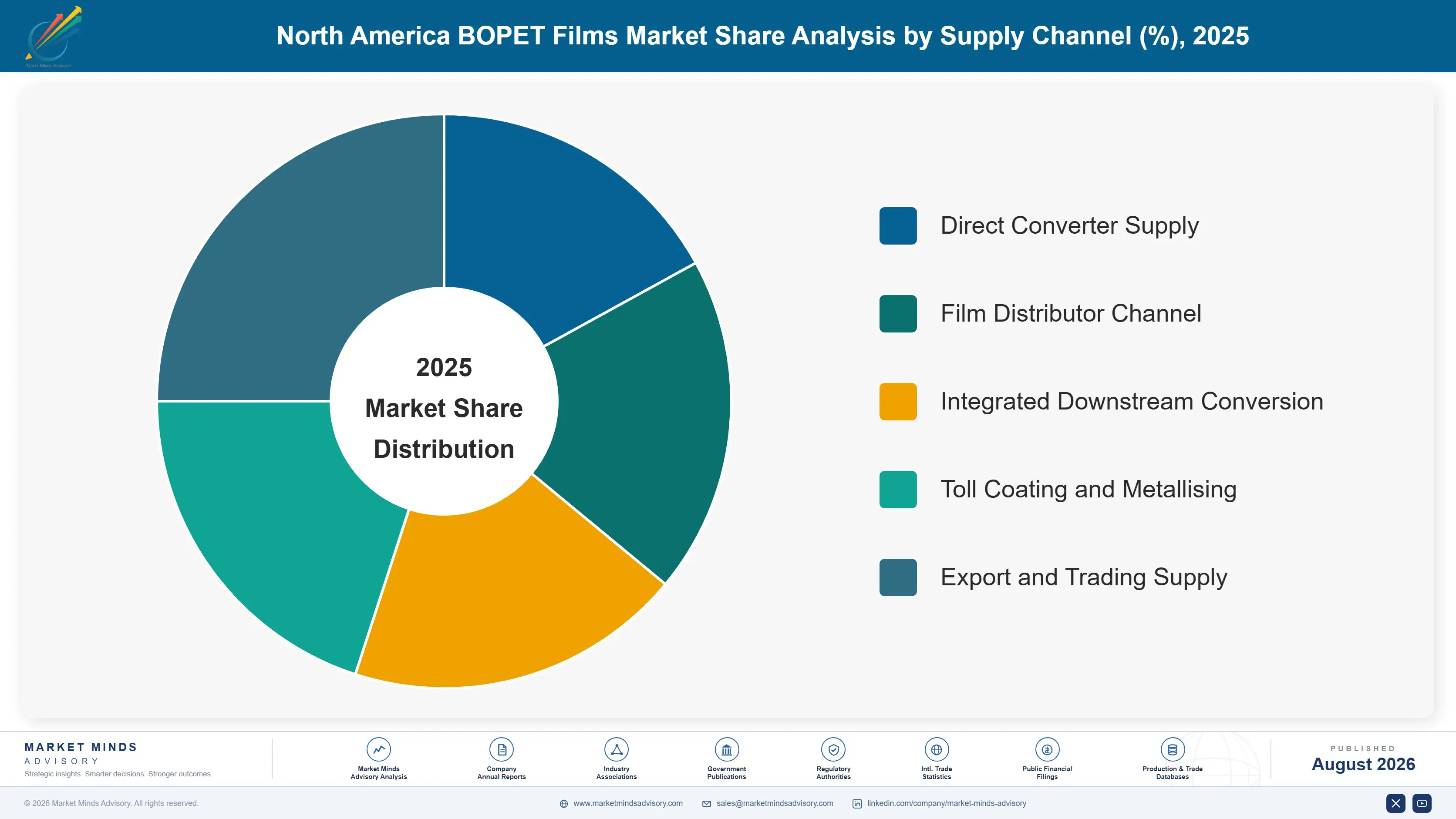
north-america-bopet-films-market-market-share-analysis-1787559254623

Mono-Material and Heat-Sealable Structures

Growing at 8.1%, half again the market rate, this segment covers heat-sealable and coated BOPET grades that replace the polyethylene sealant layer in a flexible pack and produce an all-polyester structure a recycling stream will actually accept. European packaging rules and American state legislation are driving it rather than any cost or performance advantage, since the mono-material pack usually costs more. Around 11% of flexible packaging has converted, leaving the mechanism early. The grades demand sealing performance and coefficient of friction control that standard packaging film has never needed, which narrows the field of producers able to serve it properly. Brand owners rather than converters now specify these structures. Deadlines are already fixed in law.
CAGR 8.1%

Electrical and Electronic Insulation

Traction motors, industrial drives, film capacitors and battery cell insulation consume thin BOPET for dielectric strength and dimensional stability at elevated temperature, and growth at 6.4% follows electrification across transport and industry alike. Gauges here run well below packaging film and in capacitor grades reach a few microns, which requires line configuration, resin cleanliness and winding control that a packaging line cannot simply be adjusted into. Capable capacity is therefore narrower than industry totals imply. Qualification with a motor or capacitor manufacturer is thorough and the resulting positions last for years. Because these gauges sit outside packaging line capability entirely, the segment does not experience the packaging capacity cycle. That gives a margin floor through every wave.
CAGR 6.4%
Full segment breakdown across 6 segments available in the complete report.

Regional Architecture and Country Demand Map

East Asia holds 40% of value because film capacity and packaging conversion both concentrate there, well above the standard regional band and stated here as an exception. North America follows at 18% and imports most of its thin gauge requirement rather than producing any of it domestically.

East Asia

At 40% this region sits well above the standard band, because both film capacity and flexible packaging conversion concentrate here at a scale nothing else approaches. Chinese producers operate the largest installed base and drive the global capacity cycle almost single-handedly through their ordering behaviour. Japanese and Korean producers hold the thin gauge and specialty positions, with Toray, Mitsubishi Chemical and SK microworks supplying capacitor and electronic grades that packaging-configured lines cannot make. Mono-material conversion here follows export customer requirements rather than domestic rules. Growth at 6.4% reflects packaging expansion and electronics demand together. Recyclate availability across the region is constrained in the same way it is everywhere. Coating capability for heat-sealable grades is expanding quickly among the larger producers.
Share: 40% | CAGR: 6.4% (2026 to 2036)

North America

At 18% this region sits below the standard band, since a considerable share of thin gauge film is imported while domestic capacity concentrates in thicker industrial and packaging grades. Antidumping measures on Indian and Chinese film have shaped trade flows here for years and continue to determine which origins compete for which gauges. State-level recycling legislation is driving mono-material conversion faster than federal policy would suggest, with several states setting packaging requirements independently. Growth at 4.8% sits below the market rate and reflects mature packaging consumption alongside declining backsheet demand. Regional motor and capacitor manufacture is served almost entirely by imported thin gauge film. Mexican converting serves North American brand owners under their specifications directly.
Share: 18% | CAGR: 4.8% (2026 to 2036)
Regional intelligence for 5 additional markets available in the complete report: Western Europe, South Asia and Pacific, Latin America, Middle East and Africa, Eastern Europe. Contact sales@marketmindsadvisory.com.
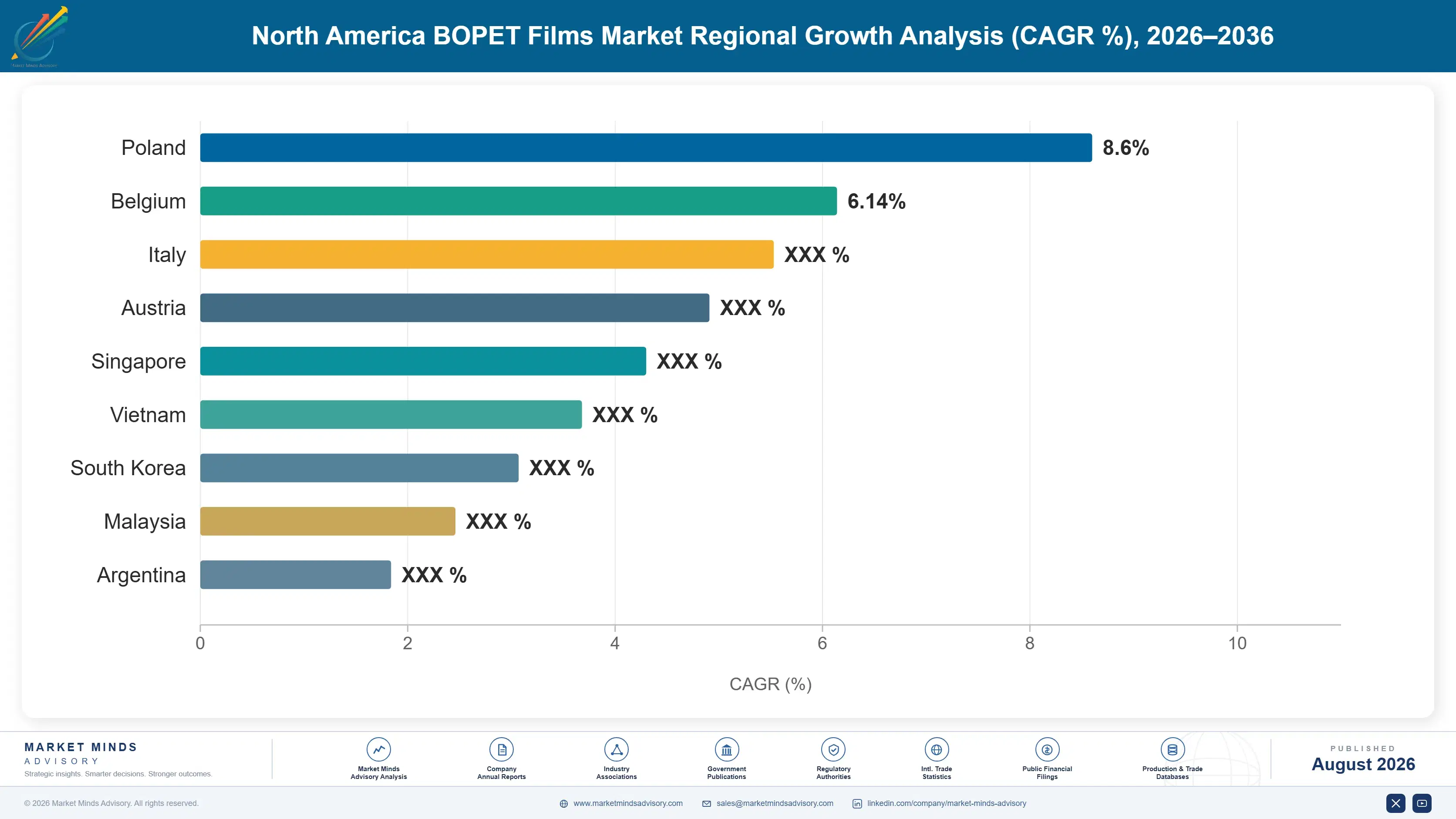
north-america-bopet-films-market-country-cagr-analysis-1787559255138

Where Film Margin Survives The Cycle

Four moves matter in a business whose capacity cycle is published two years ahead and whose growth now comes from packaging structure rather than packaging volume. Two concern trading the cycle rather than being surprised by it, and two concern the grades that command pricing regardless of what the operating rate happens to be.

Contract volume against known commissioning dates

Film lines run roughly 24 months from order to commissioning and machine builder order books are public, so the timing of the next capacity wave is knowable rather than speculative. Producers who lock customer volume on multi-year terms before those lines start, and buyers who stay short into them, both outperform. The operating rate sitting near 74% is the cost of nobody doing this. It requires only that somebody in the commercial team reads the order book and acts on what it says. Buyers gain the mirror image of the same information.
Market Impact: Defends against a 74% industry operating rate today

Build heat-sealable capability ahead of the deadlines

Mono-material conversion runs at 8.1% and only 11% of flexible packaging has moved so far, which leaves most of the mechanism ahead rather than behind. Heat-sealable and coated grades demand sealing performance and friction control that standard packaging film has never had to deliver, and coating capability is what separates producers who can quote from those who cannot. Brand owners are qualifying suppliers now against regulatory dates that are already fixed, and a producer without the grade simply is not in the conversation. Coating capability rather than base film capacity is the qualifying test.
Market Impact: Serves conversion that is growing at 8.1% yearly

Take thin gauge positions the packaging lines cannot reach

Electrical and electronic insulation grows at 6.4% and capacitor grades run to a few microns, requiring line configuration, resin cleanliness and winding control that a line built for twelve micron packaging film cannot be adjusted into. Capable capacity is far narrower than industry totals suggest, which means this segment does not experience the packaging capacity cycle at all. Qualification with motor and capacitor manufacturers is thorough and the resulting positions hold for years rather than contract periods. A producer holding both gauges spreads capital recovery across a segment whose pricing holds firm exactly when packaging film pricing does not.
Market Impact: Serves thin gauge grades growing at 6.4% yearly

Secure recyclate supply outside the bottle stream

Food-contact approved post-consumer polyester carries roughly a 42% premium and film producers lose the bidding to bottle recyclers holding legislative content mandates. Chemically recycled polyester and dedicated film-to-film collection both bypass that competition entirely, and both are small enough today that early positions are cheap to take. Producers waiting for the recyclate market to loosen are waiting for legislation to relax, which is not the direction any of it is moving in any jurisdiction that matters. Early positions in either route cost very little to establish today, and both bypass a bidding contest that legislation guarantees film will keep losing.
Market Impact: Avoids paying a 42% premium on food recyclate

Who Controls the Margin Pool

Five producers hold 32% of supply, measured on tonnage of BOPET film supplied, the basis used throughout this section. That is modest concentration for a capital-intensive process industry, and it is exactly why the capacity cycle behaves as it does: no participant holds enough share to influence the aggregate, so each evaluates its own line project against current margins rather than against what everybody else has already ordered.
Competition runs on four dimensions. Gauge capability, since thin electronic grades and standard packaging film are effectively separate businesses running on differently configured lines. Coating and heat-sealable capability, which decides participation in mono-material conversion entirely. Resin integration, given polyester chip sits at 68% of production cost. And trade position, because antidumping measures determine which origins can serve which destination markets at all.

Rankings shift toward producers with coating capability and thin gauge lines, and away from those holding only standard packaging capacity into the next commissioning wave. Indian producers hold cost and export competitiveness across multiple origins. Japanese and Korean producers hold the electronic grades that packaging capacity cannot touch. Chinese capacity sets the cycle for everybody, whether they participate in the ordering or not.
north-america-bopet-films-market-company-positioning-matrix-1787559255658

Competitive Moat and Risk Dimensions

TORAY INDUSTRIES

Moat: Thin gauge and specialty depth

The company holds the deepest capability in thin electronic and capacitor grade film, where line configuration, resin cleanliness and winding control put the product beyond what packaging-configured capacity can produce at all. Those grades sit outside the packaging capacity cycle entirely, which gives the business a margin floor that standard film producers simply do not have during a commissioning wave.
TORAY INDUSTRIES

Risk: Cost position on standard grades

Standard packaging film competes against Indian and Chinese capacity with cost positions that Japanese production cannot match, and that portion of the portfolio absorbs the full force of each capacity cycle. Mono-material conversion is meanwhile creating a new grade class where coating capability rather than thin gauge expertise decides participation, and several competitors have moved earlier on it.
POLYPLEX

Moat: Multi-country capacity and trade access

Production sites across several countries give the company access to markets that antidumping measures would otherwise close to a single-origin exporter, which matters enormously in a product where trade remedies have shaped flows for two decades. Downstream coating and metallising operations also capture value beyond base film and support participation in mono-material structures.
POLYPLEX

Risk: Standard packaging grade exposure

The portfolio weights toward packaging film rather than electronic grades, which means the business absorbs the capacity cycle rather than sitting above it, and the next commissioning wave is already visible in machine builder order books. Producers holding thin gauge insulation capacity carry demand growing at 6.4% that packaging capacity additions cannot touch.

Players Tracked

Prominent Players

Toray Industries
Mitsubishi Chemical
SK microworks
Polyplex
Jindal Poly Films

Other Key Players

Uflex
DuPont Teijin Films
Kolon Industries
Terphane
Garware Hi-Tech Films
SRF Limited
Toyobo
Nan Ya Plastics
Cosmo Films
Ester Industries
Jiangsu Shuangxing Color Plastic
Sichuan EM Technology
Shaoxing Weiming
Vacumet
Oben Group

Recent Developments

MARCH 2025

A brand owner set a mono-material deadline across its flexible range

A global consumer goods manufacturer set a fixed date for converting its flexible packaging portfolio to all-polyester structures, citing European packaging rules and American state legislation together. This was a procurement and specification decision rather than any commercial transaction between film producers themselves. Converters were notified separately.
Signal: Brand owner deadlines convert regulatory direction into fixed qualification windows that film producers either meet or miss entirely
JULY 2025

A producer commissioned coating capacity for heat-sealable grades

A film producer commissioned dedicated coating capacity for heat-sealable polyester grades aimed at mono-material packaging structures, following brand owner qualification requirements it could not previously satisfy. This was organic capital investment rather than any acquisition, merger or joint venture arrangement. Qualification trials began immediately afterwards.
Signal: Coating capability rather than base film capacity now determines who participates in the only genuinely growing application
NOVEMBER 2025

A machine builder reported film line orders returning to growth

A film machinery supplier reported rising order intake for biaxial orientation lines after a subdued period, with commissioning dates falling across a concentrated window roughly two years out. This was an order book disclosure rather than any transaction involving film producers directly. Delivery slots extended well into the following year.
Signal: The next capacity wave is now visible in the order book, the only advance warning this industry gets

What Governs Film Economics

Polyester chip accounts for roughly 68% of production cost and tracks paraxylene and monoethylene glycol, both of which follow petrochemical markets rather than film demand. Energy for melting, orientation and heat setting adds around 13% and is genuinely significant, since biaxial orientation is an energy-intensive process. Capital recovery matters greatly at an operating rate near 74%.
Polyester chip costs moved sharply through 2022 as paraxylene followed crude and European energy prices climbed far above Asian levels, with IEA data showing that gap persisting well beyond the immediate disruption. Toray recorded raw material and energy cost pressure across its films operations in its Annual Report 2022. Producers on annual converter contracts absorbed most of it, and several European lines closed permanently rather than continue operating at those energy costs.

The disadvantage falls on producers holding only standard packaging capacity, and it operates through utilisation rather than unit cost. When a commissioning wave lands, packaging film prices fall to whatever clears the market while thin gauge electronic grades hold their pricing entirely. A producer with both spreads capital recovery across a stable segment. One with packaging capacity alone carries the whole cycle on a single product line.
north-america-bopet-films-market-cost-volatility-analysis-1787559255854

Read the machine builder order book into commercial planning

Film lines take roughly 24 months to build and machine builder order intake is discussed openly, so the next capacity wave is knowable rather than speculative. Contracting customer volume on multi-year terms before commissioning dates arrive is the only defence that has ever held. It costs nothing beyond somebody actually tracking the information. Buyers can use the identical information.

Hold a thin gauge position outside the packaging cycle

Capacitor and insulation grades run to a few microns and require line configuration, resin cleanliness and winding control that packaging lines cannot deliver, so those grades do not experience packaging capacity waves at all. Holding capacity in both spreads capital recovery across a segment whose pricing stays firm when packaging film pricing does not.

Index converter pricing to published polyester chip benchmarks

Chip at 68% of cost leaves conversion margin far too thin to absorb petrochemical movement, and annual fixed pricing transfers that exposure entirely onto the film producer. Indexing to published paraxylene and chip benchmarks with quarterly reset removes it. Converters resist because their own brand owner contracts run annually, which makes this a genuine negotiation.

Portfolio Architecture for Margin Defence

Margin separates on gauge and coating capability rather than on scale, which is not obvious in a business that looks like a volume game from outside. Standard packaging film runs at gross margins in the high single digits through a commissioning wave and recovers only when utilisation does. Industrial and release grades run modestly better on specification requirements. Heat-sealable and coated mono-material grades run considerably higher today. Thin electronic and capacitor grades run highest and barely move through the cycle at all.
The tension is that standard packaging volume fills the lines while the differentiated grades earn the returns, and moving between them needs coating equipment or a differently configured line rather than any commercial decision. Producers weighted toward packaging capacity face the next wave with nothing above it, and funding coating or thin gauge investment from trough margins is exactly as difficult as it sounds. Several have deferred it through two cycles now.

High-value pools sit in mono-material coated grades, thin electronic film and recyclate-secured supply. Standard packaging film is where the capacity cycle is decided and where nobody wins for long. Two full cycles of evidence on that point are now available.

Volume / Commodity-Adjacent

Standard packaging film sold on gauge specification against every origin that can ship into the market. The nine-point range separates producers with resin integration and cheap energy from those buying chip and power entirely at prevailing market rates.
Gross Margin: 7%-16%

Premium / Certified

Industrial, release and metallising grades where surface treatment and dimensional consistency are specified and measured by the converter. The twelve-point spread reflects finishing capability rather than any difference in the base film itself.
Gross Margin: 19%-31%

Sustainability / Regulatory / Next-Generation

Heat-sealable mono-material grades, thin electronic and capacitor film, and recyclate content supply. The twenty-point range is wide because qualification depth and recyclate availability vary enormously between producers and between individual customer programmes.
Gross Margin: 28%-48%
north-america-bopet-films-market-portfolio-architecture-1787559256359

High-value Sub-segments and Strategic Watch-out

Mono-Material Coated Grades

Compounding at 8.1% with only 11% of flexible packaging converted, which leaves most of the mechanism ahead. Coating capability rather than base film capacity decides who can quote, and brand owner deadlines are already fixed. Brand owners rather than converters now specify these structures directly.
Gross Margin: 30%-46%

Thin Electronic and Capacitor Film

Growing at 6.4% on motor, drive and battery insulation demand at gauges packaging lines cannot produce. Capable capacity is far narrower than industry totals imply, and this segment sits outside the packaging cycle entirely. Qualification runs long and the positions that result hold for years.
Gross Margin: 34%-48%

Recyclate Content Supply

Food-contact recyclate carries roughly a 42% premium and film loses the bidding to mandated bottle recyclers. Chemically recycled and film-to-film routes bypass that contest and remain cheap to position in today. Legislation guarantees film keeps losing that bottle contest. Take a position early rather than waiting for it.
Gross Margin: 22%-40%

Standard Packaging Film

The line volume, priced to clear whenever a commissioning wave lands and recovering only with utilisation. Manage this for contract timing against known commissioning dates rather than for any margin improvement. Contract timing against known commissioning dates is the only lever that has ever worked here.
Gross Margin: 7%-16%

How Film Demand Renews

Demand renews with converter line hours and produces a steady annuity underneath a violently cyclical price, which is why volume and value in this market tell completely different stories. A laminating line consumes film continuously and reorders on a predictable cycle regardless of what the price does. Cyclicality is entirely in margin rather than offtake, and producers who confuse the two build capacity against forecasts that were never the problem.
Adoption depth varies sharply by vertical and it tracks qualification difficulty. Capacitor and motor manufacturers qualify a specific film against dielectric and dimensional requirements and run it for years, which makes those relationships extraordinarily durable. Mono-material packaging qualification is thorough because sealing performance decides whether the pack works at all. Standard laminate film changes supplier on landed price at every contract, since the specification is met by many origins.

The buyer has broadened from converter procurement toward brand owner packaging teams, and that has caught film producers out. Film was sold to a laminator on price and gauge. Mono-material conversion means the brand owner now specifies the structure, and the film producer is being evaluated by people who have never bought film and are working to a legislative deadline.
north-america-bopet-films-market-end-use-penetration-index-1787559256848

Where To Place The Bet

These are among the four positions where our research anticipates prominent divergence between winners and laggards over the coming forecast period. Each is grounded in the demand model, the regulatory perimeter, and the announced capacity pipeline.
01 / CYCLE TIMING DISCIPLINE

Contract ahead of commissioning dates you can already see

Biaxial orientation lines take roughly 24 months from order to commissioning and the handful of machine builders capable of supplying them discuss order intake openly at every industry gathering, which makes the next capacity wave knowable rather than speculative. Producers who lock customer volume on multi-year terms before those lines start up, and buyers who deliberately stay short into them, both outperform through every trough. The operating rate near 74% is simply the accumulated cost of an industry that refuses to act on information it already holds.
02 / MONO-MATERIAL COATING CAPABILITY

Own the coating before the brand owner deadlines land

Mono-material conversion compounds at 8.1% and only about 11% of flexible packaging has converted, which places most of the mechanism ahead rather than behind and makes it the single application in this market that grows demand instead of redistributing it. Heat-sealable grades require sealing performance and friction control that standard packaging film has never had to deliver. Brand owners are qualifying suppliers now against regulatory dates already fixed in law, and a producer without coating capability is not part of that conversation at all.
03 / THIN GAUGE POSITIONING

Hold capacity the packaging cycle cannot reach

Electrical and electronic insulation grows at 6.4% and capacitor grades run to a few microns, requiring line configuration, resin cleanliness and winding control that a line built for twelve micron packaging film cannot be adjusted into whatever the commercial pressure. Capable capacity is therefore far narrower than published industry totals imply, and those grades do not experience the packaging capacity cycle at all. A producer holding both spreads capital recovery across a segment whose pricing stays firm precisely when packaging film pricing does not.
04 / RECYCLATE ROUTE SELECTION

Stop bidding against legislated bottle recycling demand

Food-contact approved post-consumer polyester trades around 42% above virgin chip because bottle-to-bottle recyclers hold legislative recycled content mandates behind their purchasing and film producers simply do not. Chemically recycled polyester and dedicated film-to-film collection streams both bypass that competition entirely, and both remain small enough that early positions cost very little to establish. Producers waiting for the recyclate market to loosen are effectively waiting for content legislation to be relaxed, which is emphatically not the direction any jurisdiction that matters is currently moving in.

Engagement Snapshot From the Field

A live engagement with an industry participant carrying material or product regulatory and market exposure ahead of a defining policy shift, showing how our research translates into a defensible multi-year portfolio strategy.
MARKET MINDS ADVISORY · CLIENT ENGAGEMENT SUMMARY
North America BOPET Films Producer Strategic Portfolio Review and Transition Roadmap 2026·Investment Scenario on North America BOPET Films Exposure Evaluation 2025-26
CLIENT PROFILE
A North American BOPET producer operating two packaging-configured lines with combined capacity around 78,000 tonnes (client-reported, unverified by MMA), supplying laminators across the United States, Canada and Mexico. No coating capability existed. No thin gauge electronic capacity existed. Customer contracts ran annually at fixed price throughout the book. Utilisation had fallen through two successive cycles.
STRATEGIC CHALLENGE
Margins had compressed through two successive capacity waves and management proposed a third line to defend share on unit cost. Nobody had checked the machine builder order book against the proposed commissioning date, or asked what the business would consist of when the next wave arrived after that one. Neither question had been asked.
MMA APPROACH
MMA reconstructed the global commissioning schedule from machine builder order intake and traced it against the client's proposed start-up date. Coating investment for heat-sealable grades was costed against brand owner conversion deadlines already published. Thin gauge capability was assessed separately, and the annual fixed contract book was tested against polyester chip movement.
KEY FINDINGS
  1. The proposed line would have commissioned inside the same window as a substantial wave of Asian capacity already on order, arriving into precisely the conditions that had compressed margin twice before.
  2. Three brand owner customers had published mono-material conversion deadlines the client could not serve without coating capability, representing more volume than the new line would have added.
  3. Annual fixed pricing against polyester chip at 68% of cost had cost more across one adverse year than the entire margin gap the capacity expansion was meant to close.
  4. Thin gauge insulation demand from regional motor manufacturers was being served entirely by imports, at pricing well above anything the client's packaging grades achieved.
CLIENT PROFILE
A North American BOPET producer operating two packaging-configured lines with combined capacity around 78,000 tonnes (client-reported, unverified by MMA), supplying laminators across the United States, Canada and Mexico. No coating capability existed. No thin gauge electronic capacity existed. Customer contracts ran annually at fixed price throughout the book. Utilisation had fallen through two successive cycles.
STRATEGIC CHALLENGE
Margins had compressed through two successive capacity waves and management proposed a third line to defend share on unit cost. Nobody had checked the machine builder order book against the proposed commissioning date, or asked what the business would consist of when the next wave arrived after that one. Neither question had been asked.
MMA APPROACH
MMA reconstructed the global commissioning schedule from machine builder order intake and traced it against the client's proposed start-up date. Coating investment for heat-sealable grades was costed against brand owner conversion deadlines already published. Thin gauge capability was assessed separately, and the annual fixed contract book was tested against polyester chip movement.
KEY FINDINGS
  1. The proposed line would have commissioned inside the same window as a substantial wave of Asian capacity already on order, arriving into precisely the conditions that had compressed margin twice before.
  2. Three brand owner customers had published mono-material conversion deadlines the client could not serve without coating capability, representing more volume than the new line would have added.
  3. Annual fixed pricing against polyester chip at 68% of cost had cost more across one adverse year than the entire margin gap the capacity expansion was meant to close.
  4. Thin gauge insulation demand from regional motor manufacturers was being served entirely by imports, at pricing well above anything the client's packaging grades achieved.
RECOMMENDED STRATEGY
Phase 1: Phase one: withdraw the third line proposal and redirect the capital toward coating capacity for heat-sealable mono-material grades ahead of published brand owner deadlines. Phase 2: Phase two: move the contract book onto quarterly polyester chip indexed pricing, accepting a negotiation with converters whose own contracts run annually. Phase 3: Phase three: evaluate a thin gauge line configuration serving regional insulation demand currently supplied entirely through imports at premium pricing.
OUTCOME
The line proposal was withdrawn and coating capacity is commissioned, with two brand owner conversions qualified ahead of deadline. Chip indexing now covers most of the contract book. Thin gauge evaluation is proceeding, and the client reports margin improving without any capacity addition (client-reported, unverified by MMA).

Frequently Asked Questions

Foundational context covering the market sizes, CAGR, scope, country, region and competition that inform every finding below. This section is provided to cover basics and most often pre-purchase conversations, answered from the MMA Primary Research Dataset.

What is the current size of the North America BOPET Films Market?

The global market was valued at USD 16.2 billion in 2025, rising to an estimated USD 17.07 billion in 2026. East Asia holds the largest regional share at 40% of value.

How large will the North America BOPET Films Market be by 2036?

MMA forecasts USD 28.89 billion by 2036 under the base case, an expansion multiple of 1.69 times the 2026 value. That represents USD 11.82 billion of incremental value.

What is the CAGR for the North America BOPET Films Market 2026 to 2036?

The base case runs at 5.4% compound annual growth between 2026 and 2036, with a bull case at 6.6% and a bear case at 4.2%. Historical growth from 2020 to 2025 was 4.2%.

Which segment is growing fastest?

Mono-material and heat-sealable structures lead at 8.1%, half again the market rate, because all-polyester packs raise film content per pack. Electrical insulation follows at 6.4%.

Who are the major companies in the North America BOPET Films Market?

Toray Industries, Mitsubishi Chemical, SK microworks, Polyplex and Jindal Poly Films hold 32% of supply. Gauge capability and coating rather than scale sustain those positions.

Which country is growing fastest?

India leads at 8.6%, driven by packaging consumption and domestic film capacity expanding inside the same market rather than trading across borders to reach each other.

Report Segmentation Architecture

The full report scope spans multiple orthogonal segmentation dimensions, with cross-tabulated demand data provided for each dimension pair. Coverage extends further to regional breakdowns, trend trajectories, and the competitive detail needed to support segment-level decision-making.

By Film Type and Gauge

  • Standard Packaging Gauge Film
  • Thin and Ultra-Thin Electronic Film
  • Heat-Sealable and Coated Grades
  • Metallisable and Barrier Base Film
  • Release and Liner Grades
  • Recycled Content Film

By End-Use Industry

  • Flexible Packaging Conversion
  • Electrical and Electronic Manufacturing
  • Photovoltaic Module Production
  • Industrial Tapes and Release Liners
  • Printing, Labels and Imaging
  • Automotive and Transport Components

By Supply Channel

  • Direct Converter Supply
  • Film Distributor Channel
  • Integrated Downstream Conversion
  • Toll Coating and Metallising
  • Export and Trading Supply

By Region

  • North America
  • Western Europe
  • East Asia
  • South Asia and Pacific
  • Latin America
  • Middle East and Africa
  • Eastern Europe

Scope, Methodology, and Coverage

Every figure in this report is reproducible from documented input assumptions. The scope below maps the historical period, the forecast horizon, the segmentation dimensions, and the countries covered, alongside the underlying primary and qualitative methodology.
Historical Period
2020 to 2025
Forecast Period
2026 to 2036
Base Year
2025 (USD billions; MMA Primary Research Dataset, August 2026)
Market Definition
The market comprises biaxially oriented polyethylene terephthalate film supplied in all commercial gauges and grades, including standard packaging film, thin and ultra-thin electronic film, heat-sealable and coated grades, metallisable base film, release and liner grades, and recycled content film, across flexible packaging laminations, industrial and release films, electrical and electronic insulation, photovoltaic backsheet, mono-material and heat-sealable structures, and imaging labels and thermal transfer. The market is assessed globally with North America as the analytical centre, and value is measured at film producer level on tonnage supplied. Cast polyester film, polypropylene and polyamide films, polyester resin sold as such, and converted laminates fall outside scope.
Quantitative Units
USD billions (current prices); thousand tonnes of film supplied; USD per tonne by gauge and grade
Segmentation Dimensions
By Film Type and Gauge; By End-Use Industry; By Supply Channel; By Region
Regions Covered
North America, Western Europe, East Asia, South Asia and Pacific, Latin America, Middle East and Africa, Eastern Europe
Countries Covered
United States, Canada, Mexico, Brazil, Argentina, Colombia, China, Japan, South Korea, Taiwan, India, Thailand, Indonesia, Vietnam, Australia, Germany, Italy, Netherlands, France, Spain, United Kingdom, Belgium, Poland, Romania, Czechia, Turkey, Saudi Arabia, United Arab Emirates, Egypt, South Africa
Key Companies Profiled
Toray Industries, Mitsubishi Chemical, SK microworks, Polyplex, Jindal Poly Films, Uflex, DuPont Teijin Films, Kolon Industries, Terphane, Garware Hi-Tech Films, SRF Limited, Toyobo, Nan Ya Plastics, Cosmo Films, Ester Industries, Jiangsu Shuangxing Color Plastic, Sichuan EM Technology, Shaoxing Weiming, Vacumet, Oben Group
Quantitative Methodology
Primary survey, n=3,800 respondents, Q4 2025, six countries; demand-side model with trade association cross-validation
Qualitative Methodology
47 expert interviews, Q4 2025; applied to validate demand model assumptions, identify emerging dynamics, and assess competitive positioning
Report Format
PDF and XLSX data workbook (Word format preview document)
Publisher
Market Minds Advisory
Report Code
MMA-2026-PAC-209
Published
August 2026
Contact
sales@marketmindsadvisory.com | www.marketmindsadvisory.com

Purchase the full North America BOPET Films Market Report (2026 to 2036).

The full report sizes the global BOPET film market to 2036 across six applications and seven regions with North America as the analytical centre, measured on tonnage supplied at film producer level. It reconstructs the capacity commissioning schedule from machine builder order intake rather than treating the cycle as unforecastable, which is the correction this industry most needs. Competitive analysis covers 20 producers on one consistent tonnage basis, with moat and risk assessment for the two leaders. Mono-material conversion is sized against published brand owner deadlines. Four quantified revenue levers close the analysis.
Six-application segment sizing with individual growth rates
Capacity commissioning schedule reconstructed from machine builder order books
Mono-material conversion sized against published brand owner deadlines
Recyclate competition modelled against legislated bottle recycling demand
Twenty-producer competitive map on one consistent tonnage basis
Four quantified revenue levers with commercial impact ranges

Built For The People Who Decide

From boardroom strategy to bench-side execution, this report is read cover-to-cover by leaders shaping the next decade of their industry, turning demand scenarios, market dynamics and valuation benchmarks into decisions.
CXOs/ Presidents/ VPs/ Managers
M&A and Corporate Development
Strategy Teams and R&D Heads
Procurement and Product Directors
Regulatory and Compliance Leaders
Investor Relations and Equity Analysts