Market Minds Advisory
Nonwoven Polyester Fabric Market

Nonwoven Polyester Fabric Market: Automotive Lightweighting and the Filtration Build-Out

Nonwoven polyester fabric rides two demand curves: automotive makers substituting heavier materials for lightweight PET nonwovens across interiors, and filtration buyers scaling capacity for battery and air applications traditional textiles were never built to serve.

Lead Analyst

Bilal Shaikh

Published

September 2026

Make Smarter Decisions with Customized Research Insights

Request a free sample report and evaluate market opportunities, growth trends, and competitive dynamics relevant to your business needs.

2025 MARKET VALUE$9.7BMarket Size 2025
2036 FORECAST VALUE$19.2BBase Case , 2026 to 2036
CAGR 2026 TO 20366.4 %Bull 7.6% / Bear 5.2%
INCREMENTAL OPPORTUNITY$8.9BNet 10- year value creation
EXPANSION MULTIPLE1.86x2036 value over 2026 base
Strategic Levers
M&A Pipeline
Regional Outlook
Country Rankings
Competitive Intelligence
Segmental Deep-dive
Call-Us : 91 93563 13602

Executive Snapshot and Market Trajectory

Nonwoven polyester fabric has quietly become the default lightweight material across two very different industries at once. Automotive makers use it to cut vehicle weight, while filtration manufacturers use it to capture particles that woven textiles were never engineered to trap.
Filtration media is growing fastest as air quality regulation and battery manufacturing both scale simultaneously, pulling volume into a segment that barely registered a decade ago. East Asia anchors global production on China's dominant PET fiber manufacturing base, while North America and Western Europe compete on automotive-grade certification depth rather than sheer manufacturing scale alone. Both regions are racing to build the specification depth this fastest-growing segment increasingly demands.
Twenty producers compete across a market split between commodity geotextile and furniture-grade fabric sold largely on price, and certified automotive and filtration-grade material earning meaningfully more on specification depth. PET resin price volatility genuinely compresses margin for non-integrated producers faster than for those with captive polymer supply. Producers with captive polymer supply are increasingly favoured by buyers seeking predictable long-term pricing. Buyers of each grade rarely compare notes across the two very different qualification pathways.
Market Definition
The market covers nonwoven fabric manufactured from polyester fiber through spunbond, meltblown, or needle-punch processes, sold into automotive, geotextile, filtration, furniture, and hygiene applications. Woven polyester textiles and nonwoven fabrics made from other polymers such as polypropylene are excluded.
Base Year Value
$9.7B in 2025 (MMA Primary Research Dataset, August 2026)
Forecast Period
2026 to 2036, eleven discrete annual values
CAGR
6.4% base case. Bull 7.6%. Bear 5.2%.
Fastest Growth Segment
Filtration Media: 8.5% CAGR
Fastest Growth Country
India: 9.2% CAGR
Fastest Growth Region
South Asia and Pacific: 8.5% CAGR
Largest Region
East Asia: 30% of 2025 global value
Market Leaders
Freudenberg Performance Materials, Berry Global Inc, Toray Industries, Fitesa, Kolon Industries. Source: MMA Analysis based on company annual reports.
Primary Survey
n=3,800 procurement and R&D decision-makers, Q4 2025, six countries
Methodology
Demand-side build-up, cross-validated against public data, 47 expert interviews

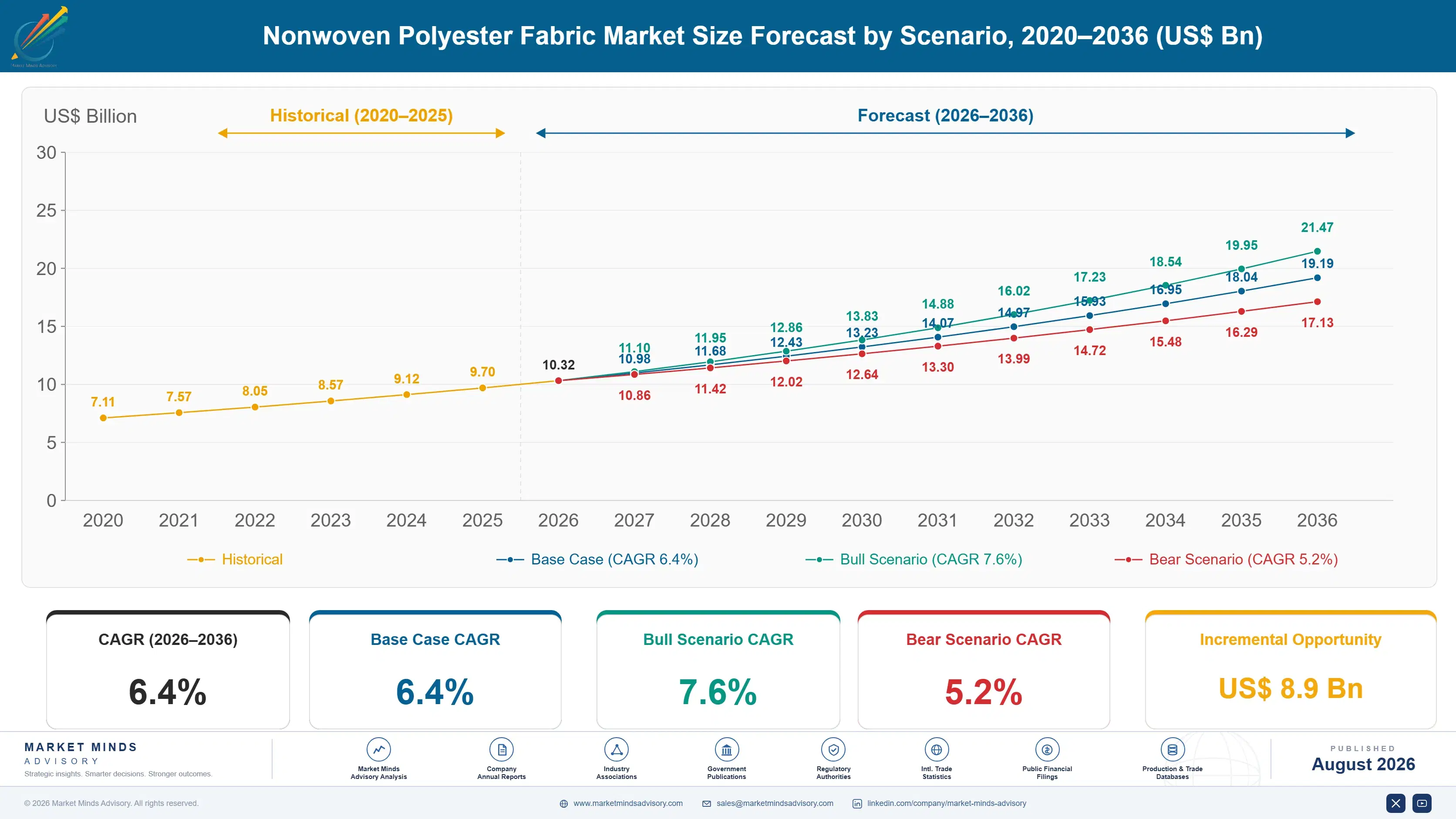
Nonwoven Polyester Fabric Market Forecast Scenarios

nonwoven-polyester-fabric-market-trends-size-forecast-scenario-1787555208882
Between 2020 and 2025 the market grew near 5.4% a year, held back by pandemic-era automotive production halts before recovering as vehicle output normalised and filtration demand accelerated meaningfully across both industrial and battery manufacturing applications globally. Filtration demand alone barely registered as a meaningful growth contributor at the start of that same five-year period.
The base case carries the market to 6.4% CAGR on three mechanisms: continued automotive lightweighting substitution toward nonwoven interior components, filtration capacity expansion tied to air quality regulation and battery manufacturing growth, and geotextile demand from global infrastructure investment programmes across both developed and emerging markets. None of these three mechanisms depends on any single national automotive market's production cycle alone. Each mechanism moves largely independently of the others, which is exactly what makes the base case durable across cycles.
The bull case at 7.6% assumes faster battery manufacturing capacity expansion pulls filtration media demand forward well ahead of schedule. The bear case at 5.2% assumes PET resin price volatility and automotive production slowdowns in key markets slow substitution momentum more than currently modelled. Neither scenario depends on any single national automotive or infrastructure policy decision alone.

Lightweighting Meets the Filtration Build-Out

Three forces converge on this market at once, and each moves on its own separate schedule. Automotive lightweighting substitution tracks vehicle production and material specification cycles, filtration demand tracks air quality regulation and battery manufacturing capacity that move on entirely different timelines, and geotextile demand tracks infrastructure spending that follows government budget cycles rather than any industrial trend.
CAPACITY UTILISATION76%production lines run below nameplate most of the year
AVERAGE SELLING PRICEUSD 2.40/kgblended price across automotive and filtration grade fabric
TOP PRODUCER SHARE13%largest single producer share of global production capacity
FEEDSTOCK COST SHARE55% of COGSPET resin and polymer input cost across integrated producers
TRADE INTENSITY38%share of global output moving across a border annually
HHI CONCENTRATION410a moderately fragmented global producer base today
Commercially, the market behaves like a specialty materials business wearing a commodity textile label. Grade differentiation genuinely exists, automotive-certified fabric commanding real premiums over standard geotextile grades, but margin still tracks polymer feedstock cost and production process technology more than pure branding or marketing investment. A producer with captive PET resin supply competes on cost structure long before it competes on certification depth. Few producers have historically built genuine strength across both commercial models at once.
Over the next decade, filtration capacity and automotive certification will decide winners more than geotextile volume growth alone, since geotextile demand is already a largely mature, infrastructure-tied base. Producers investing early in battery and air filtration grade production will capture growth that commodity-focused competitors cannot easily replicate without significant process reinvestment. Geotextile volume will keep generating cash, but not decide the next decade's winners.
"Nobody thinks about nonwoven polyester until their car interior or their battery pack needs it, and by then the producer who got the certification years ago already has the contract."
Director, Industrial Materials Practice · MMA Chemicals and Materials Practice · August 2026

Market Trends

Battery Manufacturing Drives New Filtration Nonwoven Demand

Lithium-ion battery manufacturing requires specialized nonwoven separator and filtration media to manage electrolyte flow and prevent contamination during cell assembly, a genuinely new application that barely existed as a meaningful demand source five years ago. Battery gigafactory construction across North America, Europe, and Asia has expanded rapidly, and each new facility represents multi-year filtration media demand tied to that plant's production ramp rather than any short-term industrial cycle. Producers serving this segment need cleanroom-grade manufacturing and contamination control that standard geotextile production lines were never designed to provide. This demand source is largely independent of traditional automotive and geotextile cycles.
Market Impact: Adds 38,000 tonnes by 2029
Recycled PET Nonwovens Gain Share Under Sustainability Pressure

Automotive OEMs and furniture manufacturers increasingly specify recycled PET content in nonwoven interior and upholstery components, driven by corporate sustainability commitments and, in Europe, tightening extended producer responsibility regulation around vehicle recyclability. Recycled PET nonwoven fabric now meets automotive-grade performance specifications that were unavailable just several years ago, removing a technical barrier that previously limited adoption to lower-specification applications only. Producers with recycled feedstock sourcing and processing capability are winning OEM contracts specifically citing sustainability credentials as a procurement criterion alongside traditional cost and performance factors. This shift is reshaping feedstock sourcing strategy across the automotive supply chain specifically.
Market Impact: Adds USD 210 million in orders

Market Opportunities and Growth Drivers

Automotive Lightweighting Substitutes Nonwoven for Heavier Materials

Automotive manufacturers continue substituting nonwoven polyester fabric for heavier woven textiles and foam components across headliners, carpet backing, and trunk liners, directly supporting fuel efficiency and electric vehicle range targets that heavier interior materials would otherwise undermine. Each gram removed from vehicle interior weight contributes measurably to range and efficiency targets that automakers now track closely across every trim level. Nonwoven suppliers with automotive-grade certification and long-standing OEM relationships are capturing this substitution fastest, since qualification for new automotive interior materials typically takes years. This trend applies across combustion and electric platforms alike.
Market Impact: Cuts margin by 250 basis points

Infrastructure Investment Sustains Geotextile Demand Globally

Government infrastructure spending on roads, railways, and erosion control continues across both developed and emerging markets, and nonwoven polyester geotextiles serve as standard reinforcement and separation material in modern civil engineering projects worldwide. This demand base is unusually predictable compared with most industrial materials markets, since infrastructure spending is typically budgeted and contracted years in advance of actual construction activity beginning. Indian and Southeast Asian infrastructure investment has expanded particularly quickly, creating meaningful new geotextile demand from a smaller existing base than mature developed markets. Producers with established specification credentials capture disproportionate tender share.
Market Impact: Caps hygiene segment share at 8%

Market Restraints and Challenges

PET Resin Price Volatility Compresses Non-Integrated Margins

Nonwoven polyester fabric producers without captive PET resin or PTA-MEG feedstock supply carry direct exposure to petrochemical price swings that integrated producers partially insulate through internal polymer production. The root cause is the same crude oil and paraxylene price volatility affecting the broader polyester supply chain, transmitted directly into nonwoven fabric production economics given the material's straightforward derivation from standard PET resin. Smaller specialty producers are responding by signing longer-dated resin supply contracts where available and by focusing increasingly on higher-margin automotive and filtration grades where price sensitivity is lower than in bulk geotextile or furniture-grade sales.
Market Impact: Adds 45,000 tonnes of demand

Polypropylene Competition Limits Hygiene Segment Growth

Polypropylene nonwovens hold a meaningful cost advantage over polyester in hygiene and disposable applications, limiting polyester's addressable share in categories where polypropylene's lower cost and adequate performance already satisfy most buyer requirements. The root cause is straightforward material economics, since polypropylene resin typically costs less than PET resin and hygiene applications rarely require polyester's specific durability or heat-resistance advantages. Polyester nonwoven producers are responding by concentrating hygiene segment investment on niche applications requiring polyester-specific properties rather than competing broadly against entrenched polypropylene incumbents on pure cost. Producers are finding niche medical applications where polyester's advantages justify the cost gap.
Market Impact: Lifts recycled content share 12%
4 additional market trends, 3 additional growth drivers, and 2 additional restraints and challenges are covered in the full report. Contact sales@marketmindsadvisory.com to access the complete intelligence.

Segment CAGR and Growth Architecture

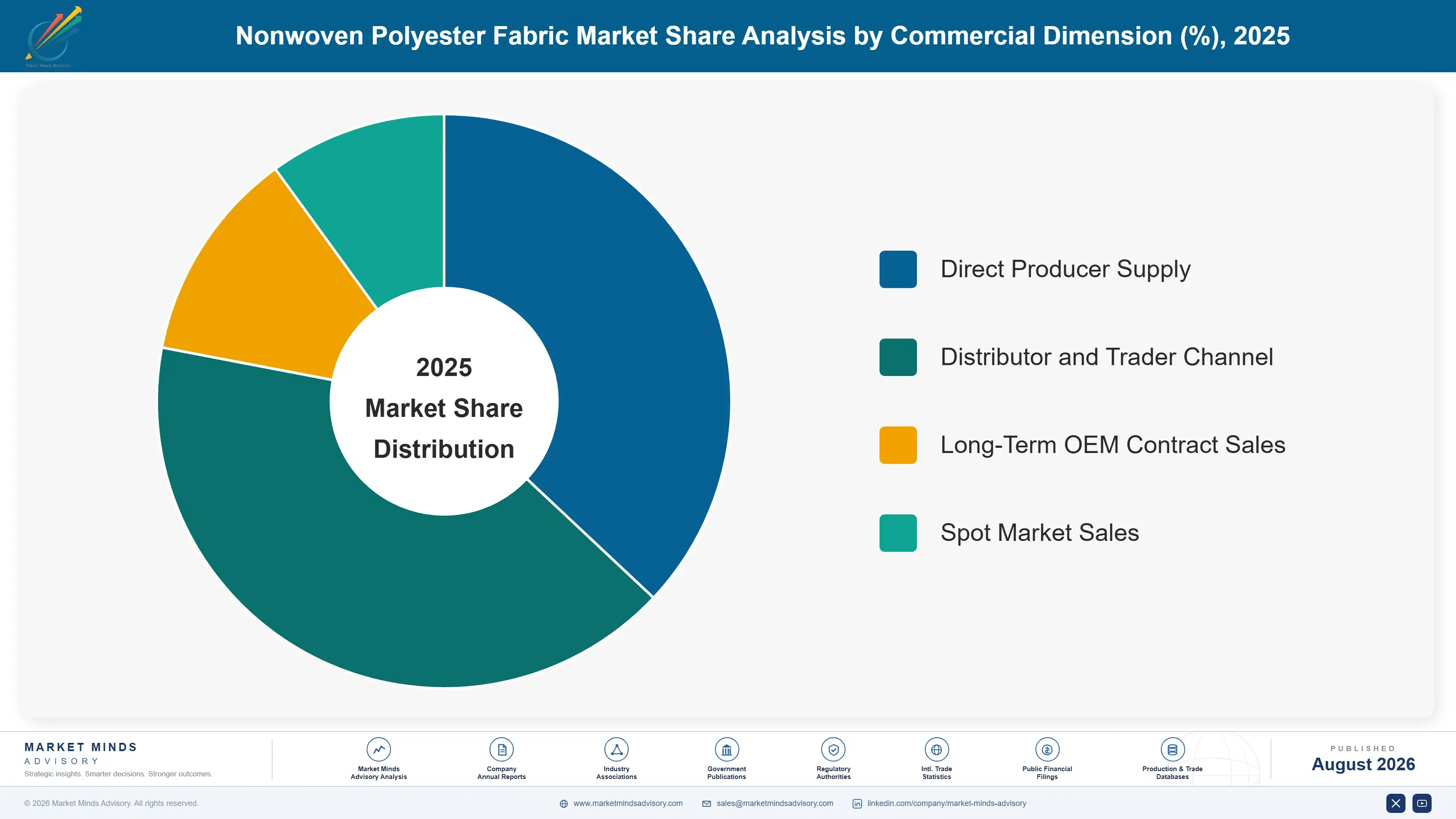
Segmentation follows end-use application, the single commercial logic determining fabric weight, certification requirements, and buyer relationship structure. Automotive and geotextile applications dominate by volume, while filtration and medical grades are growing fastest on regulatory and technology-driven demand. Furniture and hygiene applications each carry distinct buyer bases of their own. Buyer qualification pathways differ meaningfully across each category.
nonwoven-polyester-fabric-market-trends-market-share-analysis-1787555209414

Filtration Media

Filtration media grows fastest at 8.5%, about 1.33 times the overall 6.4% rate, as battery manufacturing capacity expansion and tightening air quality regulation both scale simultaneously across major industrial economies. Lithium-ion battery separator and filtration applications represent a genuinely new demand source barely present five years ago, requiring cleanroom-grade manufacturing and contamination control that standard geotextile production lines were never designed to provide. Industrial air filtration demand has also expanded as environmental regulation tightens particulate emission standards across manufacturing facilities in both developed and emerging markets. Producers serving this segment need specification certification and quality documentation considerably more rigorous than commodity geotextile or furniture-grade fabric, favouring established specialty producers over new entrants lacking comparable technical infrastructure.
CAGR 8.5%

Hygiene and Medical Nonwovens

Hygiene and medical nonwovens grow second-fastest at 7.5%, driven primarily by medical-grade applications including surgical gowns, drapes, and sterile packaging where polyester's specific durability and heat-resistance properties offer genuine advantages over competing polypropylene alternatives. Hospital and healthcare system demand for disposable medical textiles has grown steadily as infection control protocols tighten across both developed and emerging healthcare systems. Standard hygiene applications like diapers and feminine care remain dominated by lower-cost polypropylene nonwovens, limiting polyester's addressable share to specific medical-grade niches. Producers serving this segment need medical-grade certification and sterile manufacturing capability distinct from standard industrial nonwoven production entirely. Contract terms in this segment typically span multiple years given the certification investment required from both buyer and supplier.
CAGR 7.5%
Full segment breakdown across 6 segments available in the complete report.

Regional Architecture and Country Demand Map

East Asia leads on China's dominant PET fiber manufacturing base, North America and Western Europe compete on automotive certification depth, and South Asia and Pacific posts the fastest regional growth on infrastructure expansion, though both still trail East Asia's overall manufacturing scale by a wide margin.

North America

Automotive certification depth and expanding battery gigafactory construction explain North America's 24% share and its 6.8% growth, anchored by Freudenberg and Berry Global facilities serving both Detroit automotive OEMs and new battery manufacturing sites across the country. American producers compete less on pure manufacturing cost than on qualification depth and proximity to automotive assembly plants, since automotive interior material qualification typically takes years and favours established, geographically close suppliers. Battery gigafactory construction tied to electric vehicle supply chain investment has added meaningful new filtration demand over recent years. Growth here tracks both automotive lightweighting and battery manufacturing expansion more than any geotextile or furniture-grade volume growth. Domestic capacity keeps expanding to serve both segments simultaneously across several states.
Share: 24% | CAGR: 6.8% (2026 to 2036)

Western Europe

Stringent automotive recyclability regulation explains Western Europe's 21% share and its 5.0% growth, the slowest of any region tracked here given a mature, already-qualified automotive supplier base. German and French automotive OEMs increasingly specify recycled PET content in nonwoven interior components, driven by extended producer responsibility rules around vehicle end-of-life recyclability. Freudenberg Performance Materials maintains substantial European manufacturing capacity serving both automotive and filtration customers across the continent. Growth stays modest because European automotive production itself has grown slowly, though recycled content specification is adding real incremental value per unit sold even without corresponding volume growth. Filtration demand tied to European battery gigafactory construction is emerging as a genuine second growth driver.
Share: 21% | CAGR: 5.0% (2026 to 2036)
Regional intelligence for 5 additional markets available in the complete report: East Asia, South Asia and Pacific, Latin America, Middle East and Africa, Eastern Europe. Contact sales@marketmindsadvisory.com.
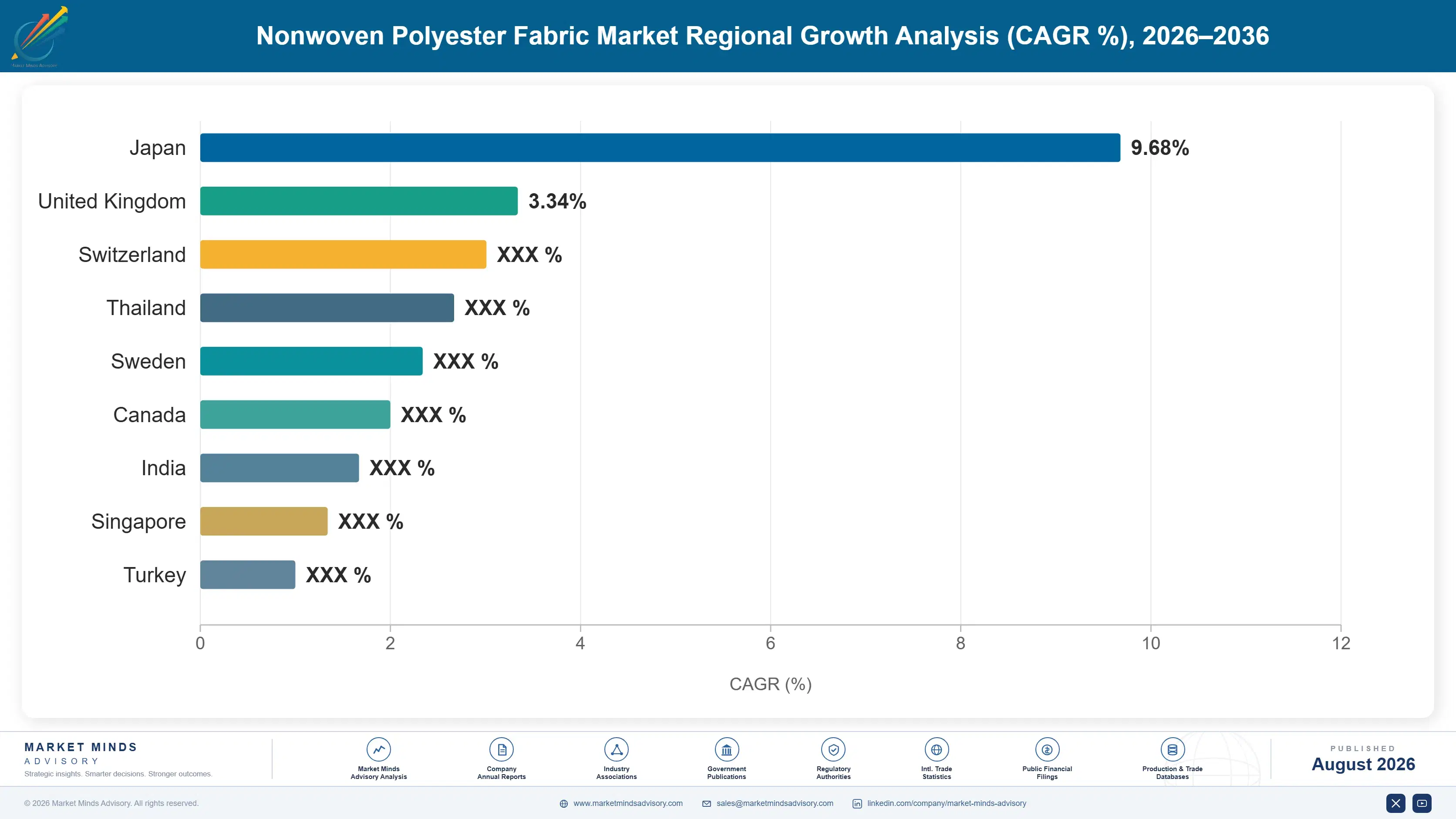
nonwoven-polyester-fabric-market-trends-country-cagr-analysis-1787555209926

Where Producers Can Defend Margin

PET resin exposure and certification depth set real limits on margin in this market, but four commercial moves let producers capture more value above that ceiling regardless of feedstock position, and regardless of how any single automotive or infrastructure cycle unfolds. nationally, and producers combining several of these moves are pulling ahead of single-strategy competitors.

Build Battery Filtration Certification Ahead of Demand

Producers investing in cleanroom-grade manufacturing and contamination control certification now are capturing battery gigafactory filtration contracts that standard geotextile-grade producers cannot service at all. This investment requires real capital and quality system development, but battery manufacturers rarely switch qualified suppliers once a relationship is established given the contamination risk of requalifying an alternative source, and early movers are securing multi-year supply agreements worth roughly 3 times standard geotextile contract value. Competitors entering later will find contamination-sensitive customers reluctant to switch once a supplier relationship is fully validated. The certification barrier itself becomes a durable moat once established.
Market Impact: Wins contracts worth roughly 3 times geotextile value

Secure Captive or Long-Dated PET Resin Supply

Producers with captive PET resin production or long-dated feedstock contracts avoid the spot-market volatility that compresses margin by roughly 250 basis points for non-integrated competitors during petrochemical price spikes. This integration requires substantial upfront capital investment, but it provides durable cost protection that pure spot-market buyers cannot match across a full commodity price cycle spanning several years. Producers without this integration face a widening cost disadvantage that pure operational efficiency cannot fully offset during future price spikes. This protection compounds in value across every subsequent commodity price cycle the producer weathers successfully.
Market Impact: Cuts margin volatility by roughly 250 basis points

Qualify Recycled PET Content for Automotive Contracts

Producers with recycled feedstock sourcing and processing capability are winning automotive OEM contracts specifically citing sustainability credentials, capturing share from competitors still relying purely on virgin PET resin. This qualification requires investment in recycled material sourcing and processing consistency, but it directly addresses tightening European extended producer responsibility regulation that will intensify meaningfully across 2027 to 2030 in additional automotive markets. Producers who delay this qualification risk ceding an entire sustainability-driven contract category to faster-moving competitors. This positioning also strengthens relationships with OEMs actively tracking supplier sustainability performance across their entire component base.
Market Impact: Wins roughly 12% more recycled content contracts overall

Expand Geotextile Specification Credentials in Emerging Markets

Producers with established civil engineering specification credentials capture disproportionate share of large public infrastructure tenders, particularly across India and Southeast Asia where infrastructure investment is expanding fastest from a smaller existing base. This credential-building requires sustained investment in technical documentation and relationship-building with civil engineering authorities over 3 to 5 years, but it positions early movers ahead of competitors entering these fast-growing markets later without comparable specification history. Producers who delay this investment will find established relationships increasingly difficult to displace once local leaders are established. Technical relationships built this way rarely transfer easily to competitors entering after specification credentials are set.
Market Impact: Captures an outsized share of 8.5% regional growth

Who Controls the Margin Pool

Concentration sits at a moderate CR5 of 36%, measured consistently across all participants on nonwoven polyester fabric production capacity. Freudenberg Performance Materials and Toray Industries lead on automotive and filtration certification depth respectively, and the gap to Berry Global and other diversified challengers reflects specification breadth rather than any single production technology advantage a challenger cannot eventually close.
Competitive activity today runs along three lines: battery filtration certification investment targeting the fastest-growing segment, recycled PET content qualification for automotive OEM sustainability requirements, and geotextile specification credential-building in fast-growing emerging infrastructure markets. Producers lacking captive PET resin supply increasingly pursue long-dated feedstock contracts instead, given the capital intensity of matching integrated competitors on pure cost position.

Pressure is building from Asian producers expanding battery filtration capacity specifically to serve regional gigafactory construction, while European incumbents face tightening recyclability regulation that rewards early recycled content investment. Any producer still competing purely on commodity geotextile or furniture-grade volume without certification investment faces a widening margin disadvantage that pure production scale cannot offset indefinitely. That widening gap should keep accelerating as certification and sustainability investment compound across the industry.
nonwoven-polyester-fabric-market-trends-company-positioning-matrix-1787555210446

Competitive Moat and Risk Dimensions

FREUDENBERG PERFORMANCE MATERIALS

Moat: Automotive certification breadth

Freudenberg holds automotive interior material qualifications across dozens of OEM platforms built over decades of relationship and certification investment that new entrants cannot replicate quickly. Its diversified manufacturing footprint across North America, Europe, and Asia also lets it serve global automotive customers from geographically proximate facilities.
FREUDENBERG PERFORMANCE MATERIALS

Risk: Slower filtration segment pivot

Freudenberg's automotive-centric heritage has made its pivot into battery filtration certification slower than filtration-native competitors like Toray, who already maintain deep technical expertise in membrane and filtration media production. This lag risks ceding the fastest-growing segment of the entire market to competitors with more established filtration technology depth.
TORAY INDUSTRIES

Moat: Filtration and materials technology depth

Toray holds deep materials science expertise across fibers, films, and filtration membranes that gives it a genuine technical advantage in battery separator and industrial filtration nonwoven applications competitors cannot easily replicate. Its broader diversified chemicals portfolio also provides revenue stability independent of any single nonwoven application's demand cycle.
TORAY INDUSTRIES

Risk: Less automotive interior depth

Toray's filtration and technical materials focus means it holds less established automotive interior qualification depth than Freudenberg's decades of OEM platform relationships specifically. This could limit its ability to capture automotive lightweighting substitution demand as quickly as competitors with deeper existing automotive account relationships. Building comparable depth would require years of dedicated OEM relationship investment.

Players Tracked

Prominent Players

Freudenberg Performance Materials
Berry Global Inc
Toray Industries
Fitesa
Kolon Industries

Other Key Players

Ahlstrom
DuPont de Nemours
Johns Manville
Fibertex Nonwovens
TenCate Geosynthetics
Asahi Kasei Corporation
Toyobo Co Ltd
Far Eastern New Century Corporation
Hyosung Corporation
Indorama Ventures
Suominen Corporation
Glatfelter Corporation
PFNonwovens
Sandler AG
TWE Group

Recent Developments

FEBRUARY 2025

Freudenberg expands automotive nonwoven capacity

Freudenberg Performance Materials completed a capacity expansion at an automotive-grade nonwoven manufacturing facility, adding production lines ahead of rising lightweighting demand. The project was an organic capacity expansion funded internally, not an acquisition or joint venture, and targeted electric vehicle interior applications specifically. Production ramp is expected within two quarters.
Signal: Established automotive suppliers keep investing directly in dedicated capacity rather than relying on shared production lines.
OCTOBER 2024

Toray signs multi-year filtration media supply agreement

Toray Industries signed a multi-year filtration media supply agreement with a major battery manufacturer covering separator and contamination control material for several gigafactory sites. The arrangement was a commercial supply contract, not an equity transaction or joint venture, and included volume commitments tied to battery production schedules.
Signal: Battery manufacturers are locking in multi-year filtration supply well ahead of broader gigafactory capacity ramp-up globally.
JUNE 2025

Berry Global acquires geotextile nonwovens producer

Berry Global Inc acquired a smaller geotextile nonwovens producer outright, a genuine acquisition rather than a joint venture or minority stake, expanding its infrastructure-focused product portfolio and regional manufacturing footprint in a fast-growing emerging market. Terms of the transaction were not separately disclosed by either company.
Signal: Diversified nonwoven conglomerates are increasingly acquiring specialist geotextile capability rather than building it internally from scratch.

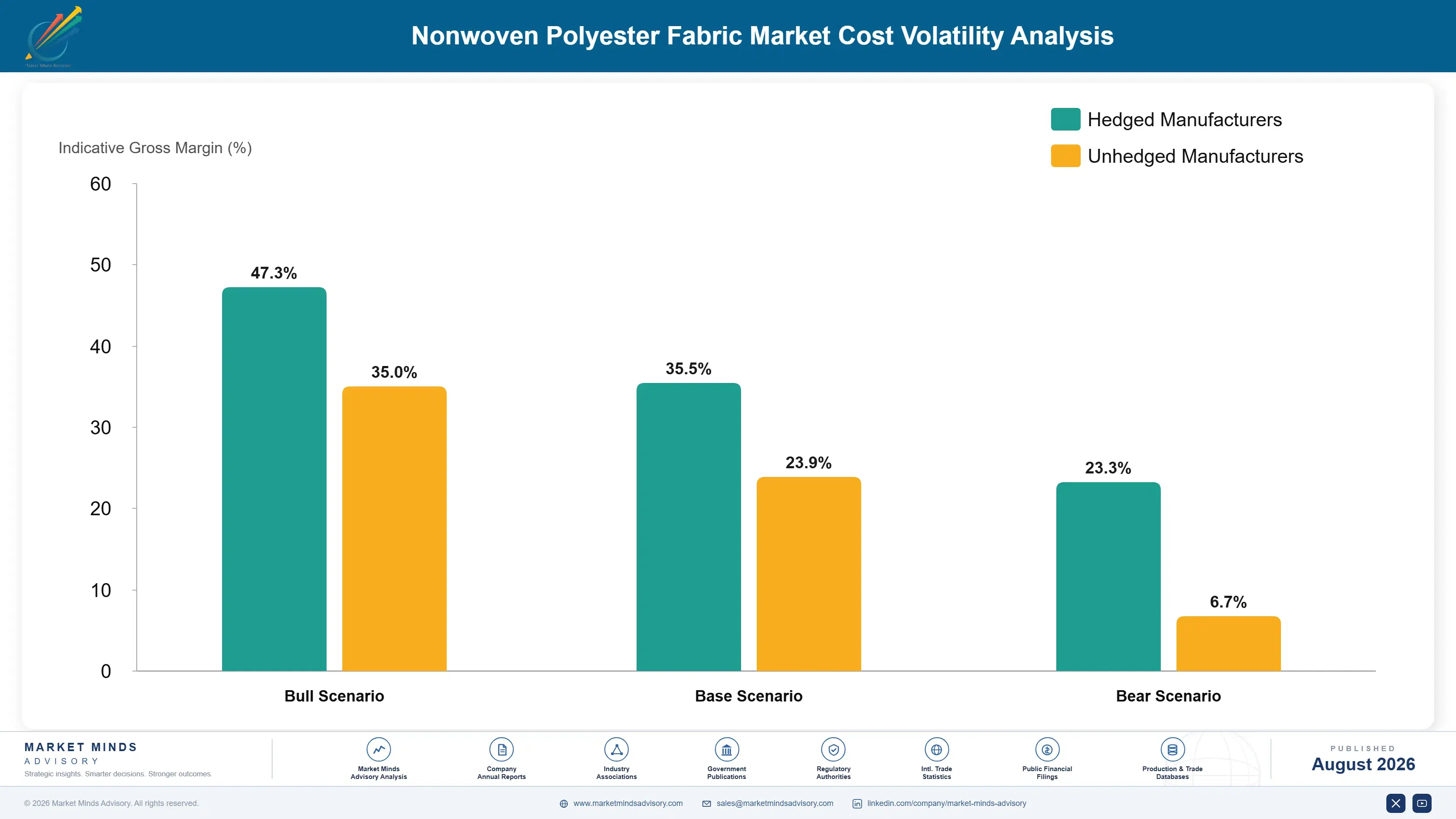
PET Resin and Polymer Feedstock Exposure

PET resin and polymer feedstock runs 55% of cost of goods sold across nonwoven fabric producers, sourced either through integrated polymer production or purchased separately by merchant producers from paraxylene and MEG-based supply chains. Fiber spinning, bonding, and finishing add a further 20% to 26%, with packaging and logistics making up much of the remainder.
The 2022 crude oil and paraxylene price spike showed how directly that exposure translates into margin. Brent crude and paraxylene prices rose sharply as global petrochemical markets tightened following the disruption to Russian energy exports, and industry trade data recorded PET resin costs climbing meaningfully across the year. Non-integrated nonwoven producers buying resin on spot terms absorbed that increase directly into thinner fabric margins, while integrated polymer producers felt considerably less impact.

Exposure separates producers cleanly by integration status. Integrated majors with captive PET resin production absorbed relatively little of that shock, while merchant producers buying resin separately carried the full pass-through directly into their own cost structure. That gap has hardened into a durable disadvantage for non-integrated producers without long-term feedstock contracts in place. This gap has proven persistent across multiple subsequent petrochemical price cycles since.
nonwoven-polyester-fabric-market-trends-cost-volatility-analysis-1787555210640

Secure long-dated PET resin supply contracts

Locking multi-year resin pricing removes much of the spot crude oil and paraxylene pass-through that compressed margins sharply during the 2022 shock. This approach requires upfront commitment but has proven valuable for non-integrated producers seeking cost predictability comparable to integrated competitors' captive supply position. Several larger producers now treat forward contracting as standard practice regardless of near-term pricing.

Shift product mix toward higher-margin certified grades

Producers with greater automotive and filtration-grade revenue share are less exposed to feedstock volatility relative to revenue, since premium certified-grade pricing carries more room to absorb input cost increases than thin-margin geotextile or furniture-grade sales. This mix shift provides a genuine cushion during periods of sustained feedstock cost pressure. This mix shift reduces overall feedstock sensitivity over time.

Increase recycled PET feedstock share where qualified

Recycled PET feedstock is often priced independently of crude oil and paraxylene benchmarks, giving producers that qualify recycled content a partial hedge against virgin resin volatility. Regulatory recycled content requirements in Europe are accelerating this shift regardless of cost motivation, making early investment a dual-purpose hedge and compliance tool. Few producers pursue this path, leaving room for differentiation.

Portfolio Architecture for Margin Defence

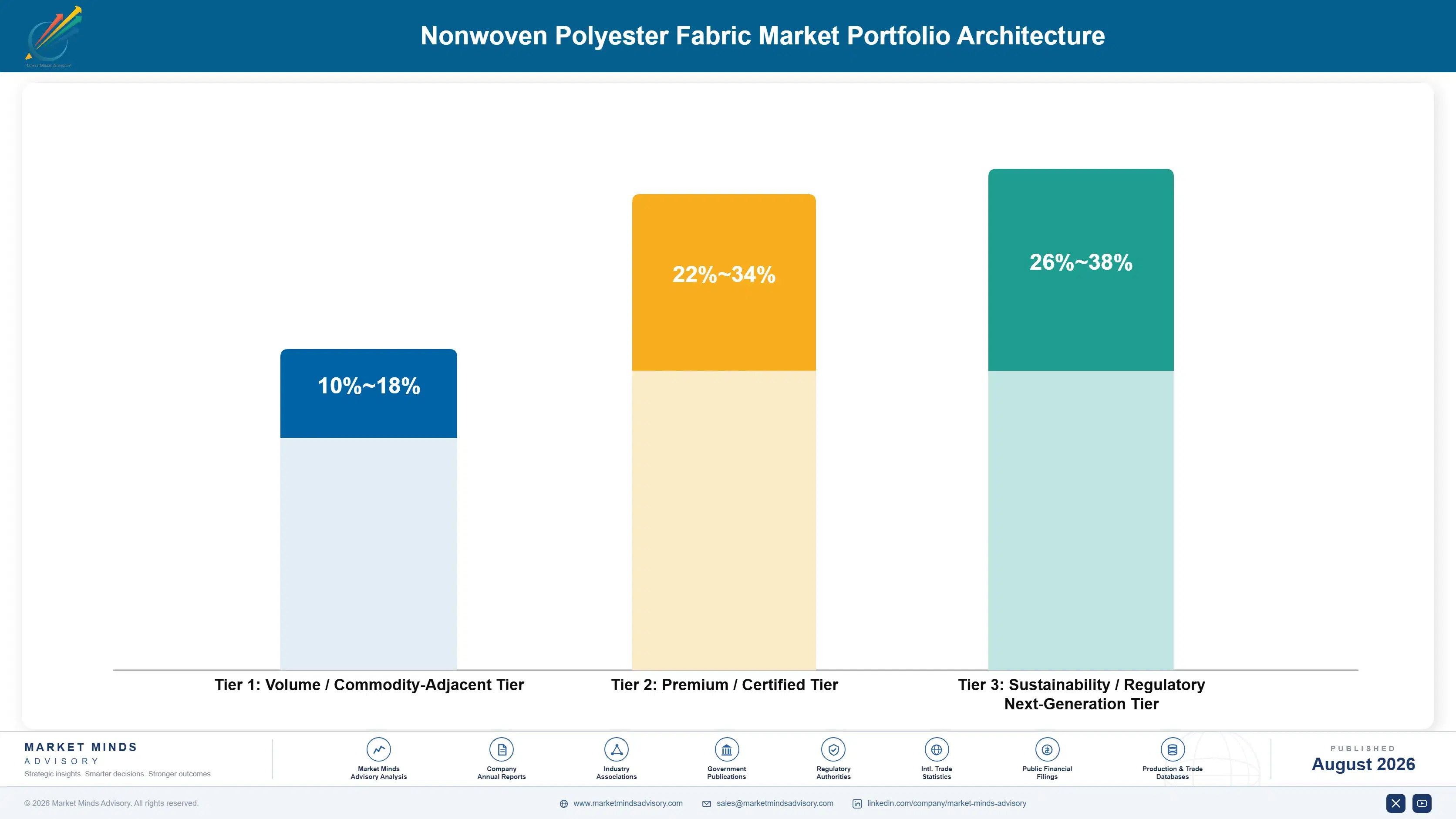
The portfolio splits into three tiers with real margin separation tied to certification depth and application specification rather than raw polymer cost alone. Commodity geotextile and furniture-grade fabric competes largely on delivered cost against benchmark pricing, while certified automotive and filtration-grade material earns meaningfully more on qualification depth that commodity producers cannot easily replicate at any price point. Buyers increasingly specify grade explicitly during supplier qualification rather than treating nonwoven fabric as one undifferentiated material. Buyers rarely switch tiers once qualified given the certification cost involved.
The tension between commodity volume and certified premium runs through every producer's segment allocation decision each year. Geotextile and furniture-grade volume still dominates the market by tonnage, yet margin and growth increasingly concentrate in automotive and filtration grades that require certification investment and specialized manufacturing most commodity-focused producers have not built. That certification gap, more than any difference in underlying polymer chemistry, is what separates the tiers most sharply today.

High-value pools concentrate specifically where regulatory or technical specification limits substitutable supply: battery filtration media commanding the strictest cleanroom certification premiums, and automotive-grade fabric rewarding producers who invested in OEM qualification years ahead of any specific platform award.

Volume / Commodity-Adjacent Tier

Commodity geotextile and furniture-grade nonwoven fabric sold largely on delivered cost against benchmark pricing across major infrastructure and furniture trade lanes. Producers here compete on delivered cost and logistics reliability far more than on brand differentiation.
Gross Margin: 10-18%

Premium / Certified Tier

Automotive-certified nonwoven fabric commanding real premiums for OEM qualification depth and proven interior application performance history. Buyers rarely switch suppliers once qualified given the multi-year certification cost involved. OEM platform renewal cycles reinforce this loyalty over many years.
Gross Margin: 22-34%

Sustainability / Regulatory / Next-Generation Tier

Battery filtration media and recycled-content automotive fabric meeting cleanroom certification and extended producer responsibility requirements. Supply here remains genuinely constrained by cleanroom and sustainability certification requirements most producers lack. Battery manufacturers in particular demand rigorous, ongoing quality documentation.
Gross Margin: 26-38%
nonwoven-polyester-fabric-market-trends-portfolio-architecture-1787555211137

High-value Sub-segments and Strategic Watch-out

Filtration Media

High value and the fastest-growing segment at 8.5% CAGR, anchored by battery gigafactory construction and tightening air quality regulation across major industrial economies. Margins remain wide as producers work through cleanroom certification investment specific to this newer application. Early movers are locking in gigafactory relationships first.
Gross Margin: 24-36%

Automotive Interior Applications

High value with steady, visible growth tied to lightweighting substitution across both internal combustion and electric vehicle platforms. OEM qualification depth rewards producers who invested years ahead of any platform award, and multi-platform certification compounds as OEMs consolidate supplier relationships. Later entrants face steeper hurdles once standards are firmly set.
Gross Margin: 22-34%

Geotextiles and Civil Engineering

The volume core of the market, competing on delivered cost against benchmark pricing across major infrastructure trade lanes worldwide. Growth tracks government infrastructure spending directly with limited differentiation beyond specification credentials. Producers here compete almost entirely on delivered cost and specification credential depth. Little differentiation exists beyond delivery and price.
Gross Margin: 10-18%

Non-Certified Commodity-Only Producers

The strategic watch-out. Producers without automotive or filtration certification depend entirely on lower-margin geotextile and furniture-grade work, facing a widening margin disadvantage against certified competitors capturing premium segment growth. These producers risk losing relevance as certified segments increasingly define category leadership. Retail-only positioning alone no longer sustains competitive standing here.
Gross Margin: 6-14%

Certification Cycles and OEM Switching Cost

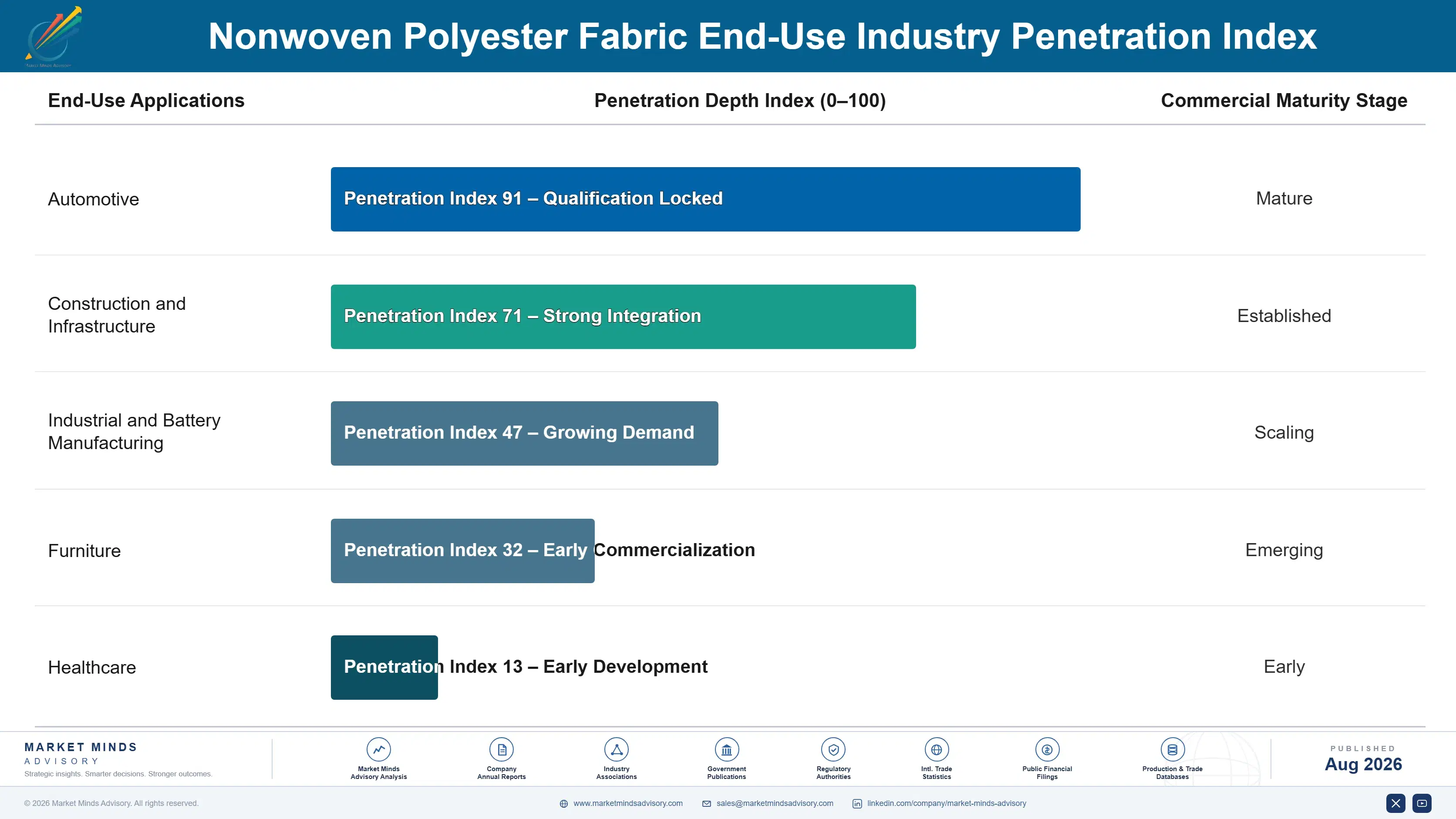
Demand here runs on multi-year OEM qualification and platform supply contracts for automotive and filtration segments, since both require certified, consistent material performance validated years before production begins. Contract renewal typically follows vehicle platform or battery facility production cycles spanning several years rather than the annual transactional purchasing common in commodity geotextile sales. Missing a renewal window can cost a producer years of relationship-building effort to win the account back.
Adoption depth varies sharply by end-use vertical. Automotive and battery filtration buyers show the strongest supplier loyalty given multi-year qualification cost and the operational risk of switching mid-platform, while geotextile and furniture-grade buyers switch relatively freely based on price and delivery lead time alone. Civil engineering infrastructure buyers sit closer to automotive buyers, valuing established specification credentials over transactional pricing.

Buyer profiles have shifted generationally as automotive sustainability procurement moved from a compliance checkbox toward a genuine board-level priority across most major manufacturers. Younger procurement teams now weigh recycled content and certification depth alongside cost, a shift that favours producers with credible sustainability and technical qualification over those competing purely on commodity price. That shift now shapes supplier scorecards as much as it shapes technical specification sheets.
nonwoven-polyester-fabric-market-trends-end-use-penetration-index-1787555211627

Where Certification Depth Decides Outcomes

These are among the four positions where our research anticipates prominent divergence between winners and laggards over the coming forecast period. Each is grounded in the demand model, the regulatory perimeter, and the announced capacity pipeline.
01 / BATTERY FILTRATION INVESTMENT

Early cleanroom certification will keep capturing the fastest-growing segment

Producers investing in cleanroom-grade manufacturing and contamination control certification are capturing battery gigafactory filtration contracts that standard geotextile-grade producers cannot service at all, and that gap will not close quickly given the technical and quality system investment involved. Battery manufacturers rarely switch qualified suppliers once a relationship is established given the contamination risk of requalifying an alternative source, and competitors reacting only once demand becomes obvious will find capacity already claimed. Expect continued investment concentrating among producers who committed to this capability years ahead of the segment's current growth.
02 / AUTOMOTIVE LIGHTWEIGHTING SUBSTITUTION

Certified OEM relationships will keep compounding across vehicle platforms

Automotive interior material qualification typically takes years to complete, and producers holding existing OEM certifications across multiple platforms enjoy renewal advantages new entrants find extremely difficult to overcome regardless of price competitiveness. This substitution trend applies across both combustion and electric vehicle platforms, giving certified producers a broader base than powertrain-specific demand alone would suggest, and competitors entering later face a steeper climb since qualification timelines cannot be compressed regardless of capital committed. Expect continued consolidation toward producers with the deepest existing certification portfolios.
03 / RECYCLED CONTENT QUALIFICATION

Early recycled PET investment will outcompete late compliance scrambles

European extended producer responsibility regulation around vehicle recyclability will keep tightening, and producers who qualified recycled PET content ahead of that tightening are already winning automotive contracts citing sustainability credentials specifically. Compliant recycled-grade capacity remains scarce today relative to automotive demand, sustaining premiums for early movers across the supply chain, though producers who wait until mandates force broader adoption will find the early-mover premium largely gone. Expect broader industry investment in recycled content qualification to eventually compress this advantage as mandated volume forces wider adoption across the supply base.
04 / EMERGING MARKET INFRASTRUCTURE GROWTH

Early Indian and Southeast Asian entrants will build durable share

Indian and Southeast Asian infrastructure investment is expanding geotextile demand from a considerably smaller base than mature developed markets, and producers with established civil engineering specification credentials are capturing disproportionate share of large public infrastructure tenders in these fast-growing markets. This opportunity depends on sustained technical relationship-building with civil engineering authorities rather than simple product export, and producers without comparable specification history should expect a considerably longer path to winning comparable tender volume. Expect continued producer investment concentrating specifically in these regions as infrastructure spending keeps expanding.

Engagement Snapshot From the Field

A live engagement with an industry participant carrying material or product regulatory and market exposure ahead of a defining policy shift, showing how our research translates into a defensible multi-year portfolio strategy.
MARKET MINDS ADVISORY · CLIENT ENGAGEMENT SUMMARY
Nonwoven Polyester Fabric Producer Strategic Portfolio Review and Transition Roadmap 2026·Investment Scenario on Nonwoven Polyester Fabric Exposure Evaluation 2025-26
CLIENT PROFILE
An automotive interior nonwoven fabric supplier serving several major North American and European OEMs approached MMA while evaluating diversification into battery filtration media given slowing automotive production growth. The client reported annual revenue near USD 240 million, with more than 90% of sales concentrated in automotive interior applications prior to any diversification effort (client-reported, unverified by MMA).
STRATEGIC CHALLENGE
Management wanted to diversify into battery filtration media to capture faster-growing gigafactory demand, but lacked cleanroom manufacturing experience or existing relationships with battery manufacturers. The growth team wanted to enter quickly given the segment's growth rate, while operations worried that underinvesting in genuine cleanroom certification would result in failed qualification attempts that damaged the company's reputation with new customers.
MMA APPROACH
MMA benchmarked the client's existing manufacturing capability against battery filtration cleanroom and certification requirements, then modelled the capital investment and timeline needed for credible qualification against several target battery manufacturer customers. We also assessed the client's existing automotive relationships for any transferable technical credibility that could accelerate the diversification timeline specifically.
KEY FINDINGS
  1. The client's more than 90% automotive concentration left it meaningfully exposed to any single automotive production slowdown, a risk considerably larger than management had previously quantified (client-reported, unverified by MMA).
  2. Existing automotive cleanroom experience from certain interior component lines transferred partially to battery filtration requirements, shortening the qualification timeline moderately compared with starting from zero.
  3. A phased entry targeting one battery manufacturer initially reduced execution risk considerably compared with the multi-customer simultaneous launch the growth team had originally proposed.
  4. Full cleanroom certification investment paid back within a reasonable timeframe given the multi-year contract value battery manufacturers typically commit to once qualified.
CLIENT PROFILE
An automotive interior nonwoven fabric supplier serving several major North American and European OEMs approached MMA while evaluating diversification into battery filtration media given slowing automotive production growth. The client reported annual revenue near USD 240 million, with more than 90% of sales concentrated in automotive interior applications prior to any diversification effort (client-reported, unverified by MMA).
STRATEGIC CHALLENGE
Management wanted to diversify into battery filtration media to capture faster-growing gigafactory demand, but lacked cleanroom manufacturing experience or existing relationships with battery manufacturers. The growth team wanted to enter quickly given the segment's growth rate, while operations worried that underinvesting in genuine cleanroom certification would result in failed qualification attempts that damaged the company's reputation with new customers.
MMA APPROACH
MMA benchmarked the client's existing manufacturing capability against battery filtration cleanroom and certification requirements, then modelled the capital investment and timeline needed for credible qualification against several target battery manufacturer customers. We also assessed the client's existing automotive relationships for any transferable technical credibility that could accelerate the diversification timeline specifically.
KEY FINDINGS
  1. The client's more than 90% automotive concentration left it meaningfully exposed to any single automotive production slowdown, a risk considerably larger than management had previously quantified (client-reported, unverified by MMA).
  2. Existing automotive cleanroom experience from certain interior component lines transferred partially to battery filtration requirements, shortening the qualification timeline moderately compared with starting from zero.
  3. A phased entry targeting one battery manufacturer initially reduced execution risk considerably compared with the multi-customer simultaneous launch the growth team had originally proposed.
  4. Full cleanroom certification investment paid back within a reasonable timeframe given the multi-year contract value battery manufacturers typically commit to once qualified.
RECOMMENDED STRATEGY
Phase 1: Phase 1 (0 to 9 months): Complete cleanroom certification investment while pursuing qualification with one target battery manufacturer. Begin supplier audits within the first thirty days. Phase 2: Phase 2 (9 to 18 months): Secure the first production contract and use it as a reference qualification for additional target customers. Phase 3: Phase 3 (18 to 36 months): Expand to two or three additional battery manufacturer relationships using the established reference credibility.
OUTCOME
The client completed cleanroom certification and secured its first battery filtration production contract within the planned timeline, reducing its automotive revenue concentration meaningfully within the first year. The diversification also secured a reported multi-year contract worth USD 35 million in projected volume from its second battery manufacturer customer (client-reported, unverified by MMA).

Frequently Asked Questions

Foundational context covering the market sizes, CAGR, scope, country, region and competition that inform every finding below. This section is provided to cover basics and most often pre-purchase conversations, answered from the MMA Primary Research Dataset.

What is the current size of the Nonwoven Polyester Fabric Market?

The nonwoven polyester fabric market reached USD 9.7 billion in 2025. This figure covers automotive, geotextile, filtration, furniture, and hygiene applications sold globally across every region.

How large will the Nonwoven Polyester Fabric Market be by 2036?

The market is projected to reach USD 19.19 billion by 2036 under the base case scenario. That represents a 1.86 times expansion over the 2026 starting value.

What is the CAGR for the Nonwoven Polyester Fabric Market 2026 to 2036?

The base case CAGR is 6.4%, with a bull case of 7.6% and a bear case of 5.2%. Battery filtration growth and automotive production cycles drive most of the variance.

Which segment is growing fastest?

Filtration media grows fastest at 8.5% CAGR, about 1.33 times the overall market rate. Battery manufacturing expansion and air quality regulation both drive this growth directly.

Who are the major companies in the Nonwoven Polyester Fabric Market?

Leading producers include Freudenberg Performance Materials, Berry Global Inc, Toray Industries, Fitesa, and Kolon Industries. These five together hold roughly 36% combined production capacity share.

Which country is growing fastest?

India posts the fastest national growth at 9.2% CAGR, driven by expanding infrastructure investment and domestic automotive manufacturing. Geotextile demand anchors most of this growth.

Report Segmentation Architecture

The full report scope spans multiple orthogonal segmentation dimensions, with cross-tabulated demand data provided for each dimension pair. Coverage extends further to regional breakdowns, trend trajectories, and the competitive detail needed to support segment-level decision-making.

By Application

  • Automotive Interior Applications
  • Geotextiles and Civil Engineering
  • Filtration Media
  • Furniture and Bedding Components
  • Hygiene and Medical Nonwovens
  • Agricultural and Packaging Applications

By End-Use Industry

  • Automotive
  • Construction and Infrastructure
  • Industrial and Battery Manufacturing
  • Furniture
  • Healthcare

By Commercial Dimension

  • Direct Producer Supply
  • Distributor and Trader Channel
  • Long-Term OEM Contract Sales
  • Spot Market Sales

By Region

  • North America
  • Western Europe
  • East Asia
  • South Asia and Pacific
  • Latin America
  • Middle East and Africa
  • Eastern Europe

Scope, Methodology, and Coverage

Every figure in this report is reproducible from documented input assumptions. The scope below maps the historical period, the forecast horizon, the segmentation dimensions, and the countries covered, alongside the underlying primary and qualitative methodology.
Historical Period
2020 to 2025
Forecast Period
2026 to 2036
Base Year
2025 (USD billions; MMA Primary Research Dataset, August 2026)
Market Definition
This market comprises nonwoven fabric manufactured from polyester fiber through spunbond, meltblown, or needle-punch processes, sold into automotive, geotextile, filtration, furniture, and hygiene applications. Woven polyester textiles and nonwoven fabrics made from other polymers such as polypropylene are excluded from this scope.
Quantitative Units
USD billions (current prices); metric tonnes of nonwoven fabric volume where applicable
Segmentation Dimensions
By Application; By End-Use Industry; By Commercial Dimension; By Region
Regions Covered
North America, Western Europe, East Asia, South Asia and Pacific, Latin America, Middle East and Africa, Eastern Europe
Countries Covered
USA, China, Germany, France, UK, Japan, South Korea, India, Australia, Canada, Brazil, Mexico, Indonesia, Vietnam, Thailand, Malaysia, UAE, Saudi Arabia, South Africa, Nigeria, Turkey, Poland, Netherlands, Italy, Spain, Sweden, Switzerland, Argentina, Colombia, Singapore, and additional markets relevant to this sector
Key Companies Profiled
Freudenberg Performance Materials, Berry Global Inc, Toray Industries, Fitesa, Kolon Industries, Ahlstrom, DuPont de Nemours, Johns Manville, Fibertex Nonwovens, TenCate Geosynthetics, Asahi Kasei Corporation, Toyobo Co Ltd, Far Eastern New Century Corporation, Hyosung Corporation, Indorama Ventures, Suominen Corporation, Glatfelter Corporation, PFNonwovens, Sandler AG, TWE Group
Quantitative Methodology
Primary survey, n=3,800 respondents, Q4 2025, six countries; demand-side model with trade association cross-validation
Qualitative Methodology
47 expert interviews, Q4 2025; applied to validate demand model assumptions, identify emerging dynamics, and assess competitive positioning
Report Format
PDF and XLSX data workbook (Word format preview document)
Publisher
Market Minds Advisory
Report Code
MMA-2026-CHM-289
Published
August 2026
Contact
sales@marketmindsadvisory.com | www.marketmindsadvisory.com

Purchase the full Nonwoven Polyester Fabric Market Report (2026 to 2036).

The full MMA Nonwoven Polyester Fabric report sizes the market across six application segments, five end-use industries, four commercial channels, and seven regions through 2036. It profiles twenty producers on a consistent basis of nonwoven production capacity, scoring each on automotive certification depth, filtration cleanroom readiness, and recycled content capability. Scenario models quantify how battery manufacturing expansion, automotive lightweighting, and PET resin volatility move both demand and realised pricing. The report also includes delivered-cost modelling by feedstock base, a certification depth benchmarking screen, and battery filtration segment economics built for procurement, strategy, and investment teams.
Six-segment global application demand breakdown detail
Feedstock delivered-cost bridge modelling review detail
Certification depth benchmarking screening framework detail
Producer capacity and technology benchmarking review
Battery filtration segment economics deep detail
Regional trade flow corridor mapping review

Built For The People Who Decide

From boardroom strategy to bench-side execution, this report is read cover-to-cover by leaders shaping the next decade of their industry, turning demand scenarios, market dynamics and valuation benchmarks into decisions.
CXOs/ Presidents/ VPs/ Managers
M&A and Corporate Development
Strategy Teams and R&D Heads
Procurement and Product Directors
Regulatory and Compliance Leaders
Investor Relations and Equity Analysts