Market Minds Advisory
Non-Woven Fabrics Market

Non-Woven Fabrics Market: Spunbond, Meltblown, and Spunlace Manufacturing Technologies

Sustained filtration and medical demand following the pandemic manufacturing buildout is keeping meltblown capacity utilization elevated, forcing converters to defend hygiene margins against resin cost volatility that spunbond commodity pricing cannot absorb.

Lead Analyst

Bilal Shaikh

Published

September 2026

Make Smarter Decisions with Customized Research Insights

Request a free sample report and evaluate market opportunities, growth trends, and competitive dynamics relevant to your business needs.

2025 MARKET VALUE$48.5BMarket Size 2025
2036 FORECAST VALUE$94.0BBase Case , 2026 to 2036
CAGR 2026 TO 20366.2 %Bull 7.4% / Bear 4.9%
INCREMENTAL OPPORTUNITY$42.5BNet 10- year value creation
EXPANSION MULTIPLE1.82x2036 value over 2026 base
Strategic Levers
M&A Pipeline
Regional Outlook
Country Rankings
Competitive Intelligence
Segmental Deep-dive
Call-Us : 91 93563 13602

Executive Snapshot and Market Trajectory

Sustained filtration and medical demand following the pandemic manufacturing buildout is keeping meltblown capacity utilization elevated, forcing converters to defend hygiene margins against resin cost volatility that spunbond commodity pricing cannot absorb across nearly every major national market, a shift few converters anticipated when the category was purely hygiene-driven.
Meltblown non-woven fabrics are growing fastest as filtration and medical device demand continues expanding, with production concentrating in East Asia and South Asia, where large integrated manufacturing bases and rapidly growing hygiene product consumption sustain the world's deepest non-woven fabric production volume across most end-use categories, well ahead of every other region tracked in this study, where large integrated manufacturing bases sustain category depth few other regions can match at comparable scale.
Competition remains moderately fragmented across a mix of large diversified materials conglomerates and specialized regional converters, while resin price volatility and filtration-grade certification requirements reshape which manufacturers can sustain margin across this genuinely broad multi-application category within an already fragmented, price-sensitive competitive landscape, forcing even long-established manufacturers to defend market position against fast-moving technical-focused rivals entering adjacent categories that they had rarely needed to build before now.
Market Definition
This market covers non-woven fabric materials produced through spunbond, meltblown, needle-punched, spunlace, wetlaid, and airlaid manufacturing processes used across hygiene, medical, filtration, automotive, and industrial applications. It excludes woven and knitted textile fabrics, paper products, and finished consumer products manufactured from non-woven materials entirely.
Base Year Value
$48.5B in 2025 (MMA Primary Research Dataset, August 2026)
Forecast Period
2026 to 2036, eleven discrete annual values
CAGR
6.2% base case. Bull 7.4%. Bear 4.9%.
Fastest Growth Segment
Meltblown Non-Woven Fabrics: 8.5% CAGR
Fastest Growth Country
India: 8.2% CAGR
Fastest Growth Region
South Asia and Pacific: 8.1% CAGR
Largest Region
East Asia: 32% of 2025 global value
Market Leaders
Berry Global Group Inc., Freudenberg Performance Materials, Kimberly-Clark Corporation, Fitesa S.A., Toray Industries Inc. Source: MMA Analysis based on company annual reports.
Primary Survey
n=3,800 procurement and R&D decision-makers, Q4 2025, six countries
Methodology
Demand-side build-up, cross-validated against public data, 47 expert interviews

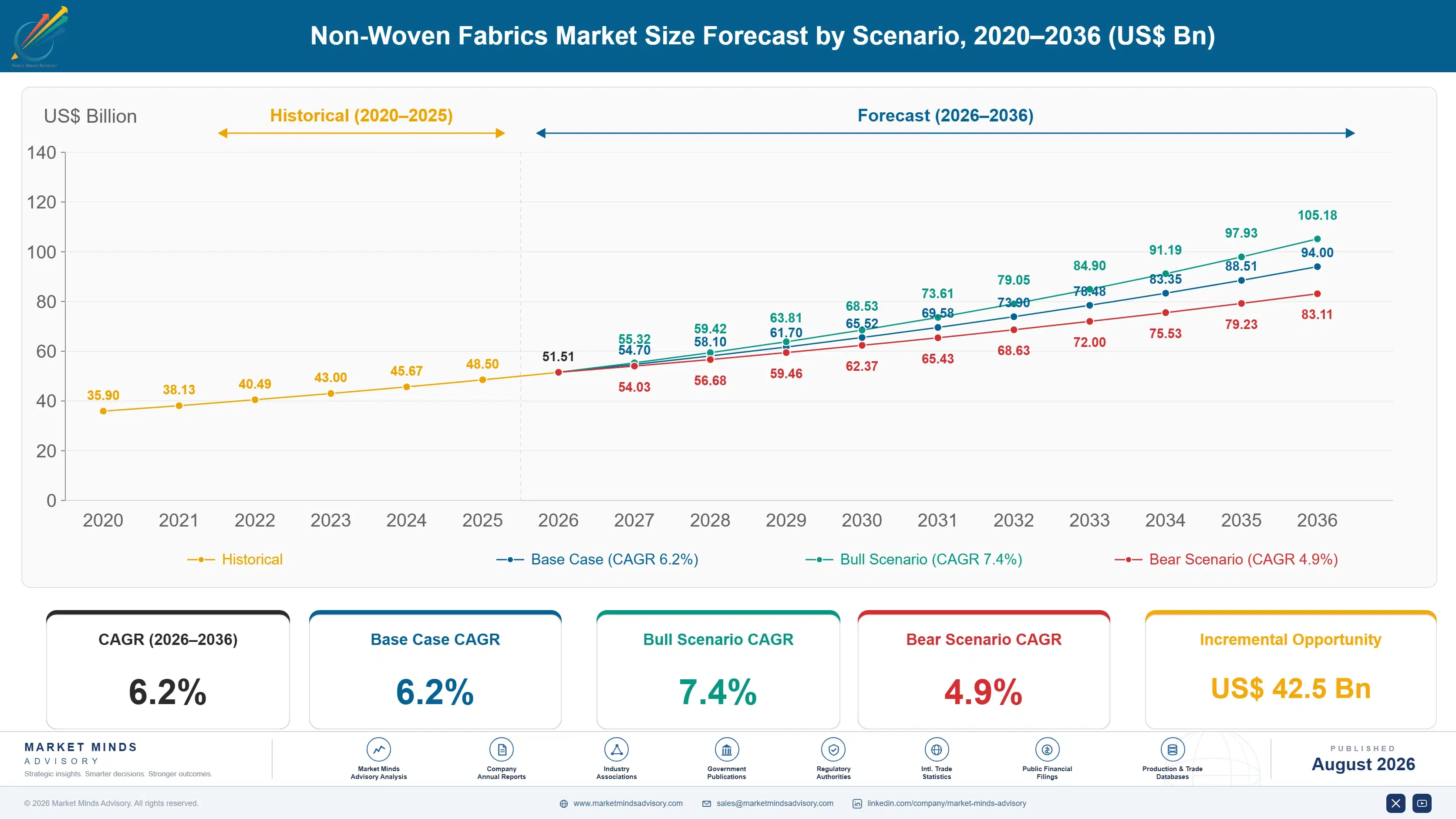
Non-Woven Fabrics Market Forecast Scenarios

non-woven-fabrics-market-size-forecast-scenario-1787308057262
Non-woven fabrics market spending grew at roughly 5.6% annually between 2020 and 2025, as pandemic-driven filtration and medical demand surges and steady hygiene product consumption growth drove strong category expansion across most major manufacturing regions tracked in this study, a pattern that has held steady even as individual application categories diverged meaningfully in underlying growth trajectory.
The base case assumes continued filtration and medical demand growth, expanding hygiene product consumption in emerging markets, and steady automotive and industrial applications, sustaining a 6.2% blended annual growth rate through 2036 as manufacturers balance capacity investment against persistent resin pricing pressure. These three mechanisms reinforce each other: filtration demand sustains premium mix, hygiene growth widens the buyer pool, and industrial applications anchor steady baseline volume across most major manufacturing regions tracked in this study.
A bull scenario assumes faster-than-expected filtration and medical demand growth pulls meltblown capacity utilization well ahead of current projections across major manufacturing markets. The bear case centers on resin price volatility and hygiene product commoditization that could meaningfully compress manufacturer margins across the broader category, lifting growth toward 7.4% if demand accelerates. The bear case pulls growth down toward 4.9% instead if commoditization intensifies faster than expected.

Filtration Demand Meets a Diversifying Commodity Category

The non-woven fabrics market sits at the convergence of sustained pandemic-era filtration and medical manufacturing capacity and a genuinely broad, diversifying end-use application base, a combination pulling this historically hygiene-centered category into more technically differentiated, multi-industry competitive territory across most major manufacturing regions, a shift accelerating faster than most hygiene-focused manufacturers originally expected when planning multi-year investment budgets
MARKET CONCENTRATIONCR5 32%share held by the five largest non-woven fabric manufacturers combined
AVERAGE FABRIC PRICE$2.10 per kgblended average selling price across standard spunbond non-woven fabric grades
LEADING COUNTRY SHAREChina 26%of global category production in a single manufacturing base
RESIN SHARE OF COGS54%of manufacturing cost attributable to polypropylene and polyester resin
MELTBLOWN CAPACITY UTILISATION76%average operating capacity across dedicated meltblown production facilities globally
HYGIENE APPLICATION SHARE41%of fabric volume consumed by hygiene and personal care applications
Commercially, this market splits between high-volume commodity spunbond fabric sold on price to hygiene and industrial bundling customers, and specialized meltblown and technical fabrics sold at meaningfully higher price points to filtration, medical, and automotive customers, a divide reshaping manufacturer product mix, leaving slower-moving hygiene-only manufacturers increasingly confined to thin-margin, price-competitive volume categories nationwide as this bifurcation continues deepening across most manufacturing regions tracked.
Over the next decade, sustained filtration and medical demand, expanding hygiene product consumption in emerging markets, and growing automotive and industrial technical applications will keep pulling manufacturer investment toward diversified, application-specific fabric production across most major end-use categories and customer segments tracked in this study, reshaping research, manufacturing, and commercial investment priorities across nearly every major non-woven fabric producer globally across research and manufacturing planning alike.
"Everyone remembers non-wovens as the material behind surgical masks. Fewer people realize it is also inside their car door panels, their coffee filters, and half the diapers sold worldwide."
Director, Materials and Industrial Textiles Practice · MMA Chemicals and Materia

Market Trends

Sustained Filtration Demand Keeps Meltblown Capacity Elevated

Continued filtration application demand across medical, industrial, and consumer air and liquid filtration categories continues sustaining elevated meltblown production capacity utilization well beyond the pandemic-era demand surge that originally drove substantial capacity expansion across most major manufacturing regions. Industry data indicates meltblown capacity utilization remains meaningfully elevated compared to pre-pandemic baseline levels, reflecting genuinely sustained rather than temporary demand growth across filtration and medical applications. This shift is pulling manufacturers without dedicated meltblown production capability to invest rapidly or risk missing this durably higher-margin segment entirely across most major filtration and medical customer accounts broadly.
Market Impact: Expands medical demand by 16 percen
Hygiene Product Consumption Expands in Emerging Markets

Continued rising disposable income and changing consumer habits across emerging Asian and Latin American markets continue expanding hygiene product consumption, including diapers, feminine hygiene products, and adult incontinence products, all of which rely extensively on non-woven fabric components across most major growth markets tracked in this study. Consumer goods industry data confirms hygiene product penetration rates have expanded meaningfully across several major emerging markets over the past several years, directly expanding the addressable non-woven fabric market. This trend is pulling manufacturers to expand hygiene-grade production capacity as broader consumption growth continues nationally.
Market Impact: Expands automotive content 14 perce

Market Opportunities and Growth Drivers

Expanding Global Medical Device and PPE Demand

Continued global medical device manufacturing growth and sustained personal protective equipment demand, driven by ongoing healthcare system preparedness investment following the pandemic, continue driving demand for medical-grade non-woven fabrics used in surgical gowns, masks, and sterile packaging applications across most major healthcare markets tracked in this study. Healthcare industry data confirms medical-grade non-woven fabric demand has remained meaningfully elevated compared to pre-pandemic baseline levels across most major regional healthcare systems. This driver is expected to keep sustaining above-average growth in medical-grade applications through the coming decade broadly across most major regional healthcare markets tracked.
Market Impact: Margins compressed by 11 percent

Rising Automotive Technical Non-Woven Applications Nationwide

Continued automotive manufacturing growth and increasing vehicle interior and acoustic insulation content, particularly across electric vehicle platforms requiring specialized noise dampening materials, continue driving demand for technical non-woven fabrics used across most major automotive manufacturing regions tracked in this study. Automotive industry data confirms technical non-woven fabric content per vehicle has grown considerably over the past several years, directly expanding the addressable market for specialized automotive-grade fabric formats. This driver is expected to keep sustaining above-average growth in automotive technical applications through the coming decade broadly nationally and internationally nationwide today.
Market Impact: Regional overcapacity reaches 22 pe

Market Restraints and Challenges

Resin Price Volatility Compresses Manufacturer Margins

Continued volatility in polypropylene and polyester resin pricing, driven by broader petrochemical feedstock market fluctuation, continues compressing manufacturer margins across the commodity segment, where limited pricing power prevents manufacturers from fully passing through input cost increases to price-sensitive hygiene and industrial customers. The root cause is that non-woven fabric manufacturing remains fundamentally a converting business with limited product differentiation in commodity spunbond grades, leaving manufacturers exposed directly to upstream petrochemical market conditions largely outside their control. This pressure disproportionately affects smaller manufacturers lacking hedging capability. Manufacturers are responding by pursuing technical and specialty fabric differentiation to reduce commodity pricing exposure.
Market Impact: Sustains 76 percent capacity utilis

Overcapacity Risk From Pandemic-Era Investment Cycles

Substantial meltblown and medical-grade production capacity added during the pandemic-era demand surge continues creating genuine overcapacity risk in specific regional markets where demand growth has not kept pace with the capacity expansion originally justified by temporary crisis-level filtration demand. The underlying cause is that many manufacturers invested in meltblown capacity expansion during a period of exceptional demand that has since moderated toward a more sustainable, though still elevated, baseline level. This risk disproportionately affects manufacturers in regions where capacity expansion outpaced genuine underlying demand growth. Manufacturers are responding by pursuing export markets and application diversification to absorb excess capacity.
Market Impact: Grows hygiene consumption 17 percen
3 additional market trends, 4 additional growth drivers, and 3 additional restraints and challenges are covered in the full report. Contact sales@marketmindsadvisory.com to access the complete intelligence.

Segment CAGR and Growth Architecture

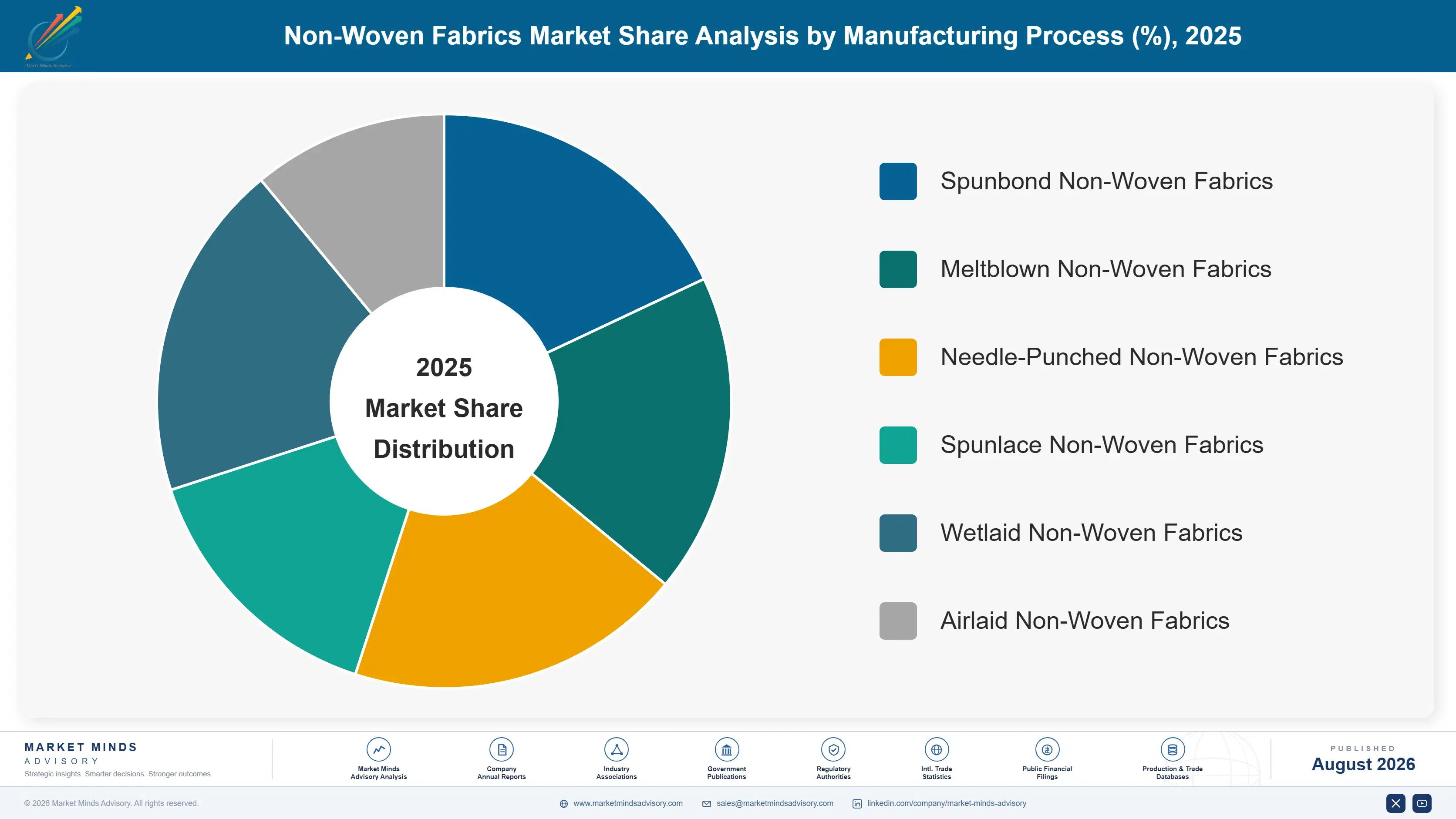
This market segments by manufacturing process spanning spunbond, meltblown, needle-punched, spunlace, wetlaid, and airlaid non-woven fabrics used across hygiene, medical, filtration, automotive, and industrial applications broadly nationwide and internationally through diverse converter and brand owner distribution channels spanning both commodity and premium technical categories across most major manufacturing regions tracked in this broader study.
non-woven-fabrics-market-market-share-analysis-1787308057799

Meltblown Non-Woven Fabrics

Meltblown non-woven fabrics are the fastest-growing segment as filtration and medical device demand continues expanding globally, driving strong demand for fine-fiber fabric structures engineered for particle filtration efficiency that standard spunbond fabric was never designed to achieve across most major filtration and medical application markets tracked in this study. Leading manufacturers have invested heavily in specialized meltblown production equipment and electret charging technology that maximizes filtration efficiency for respiratory protection and industrial air filtration applications requiring certified performance standards. This segment commands substantially higher pricing than standard spunbond formats, reflecting both the specialized equipment investment required and genuine customer willingness to pay for certified filtration performance. Manufacturers are pursuing expanded meltblown production capacity to compete for this fastest-growing segment.
CAGR 8.5%

Spunlace Non-Woven Fabrics

Spunlace non-woven fabrics are growing considerably faster than the broader market as wet wipes and premium hygiene product demand continues expanding globally, driving strong demand for hydroentangled fabric structures engineered for softness and absorbency that standard spunbond fabric cannot match for these specific consumer-facing applications tracked in this study. Leading manufacturers have invested significantly in hydroentanglement processing capability that produces genuinely cloth-like fabric texture increasingly demanded by premium wipes and personal care product manufacturers across most major consumer markets. This segment benefits from genuine crossover with the broader consumer wellness and convenience product trend that sustains demand even during periods of broader economic softness affecting more discretionary categories. Manufacturers are investing in hydroentanglement capacity to compete for this differentiated segment.
CAGR 7.8%
Full segment breakdown across 6 segments available in the complete report.

Regional Architecture and Country Demand Map

[house] East Asia leads global non-woven fabric production given China's dominant integrated manufacturing base, breaching the typical regional band, while South Asia sustains exceptionally fast hygiene-driven growth breaching its band as well given genuinely exceptional category formalization and abroad, well beyond the leading markets alone.

North America

The United States anchors North American demand through extensive hygiene product manufacturing infrastructure and substantial medical-grade non-woven fabric production capacity built out considerably during the pandemic-era demand surge across most major domestic manufacturing facilities. Canada follows a broadly similar consumption pattern driven by comparable hygiene and industrial demand at meaningfully smaller absolute scale relative to its larger neighbor. Meltblown production capacity has expanded meaningfully across the region as domestic filtration and medical device manufacturers continue prioritizing supply chain resilience following pandemic-era import disruption experiences. Resin price volatility continues affecting manufacturer margins across most standard commodity spunbond product categories broadly. Mexico contributes growing additional demand as nearshoring manufacturing investment expands regional hygiene and automotive supply chain needs.
Share: 22% | CAGR: 6.2% (2026 to 2036)

Western Europe

Germany and Italy anchor Western European demand through substantial hygiene product and technical non-woven manufacturing sectors that sustain steady production volume across both consumer and industrial application categories tracked in this study. France maintains steady demand through its own established hygiene and medical product manufacturing base, while the United Kingdom shows growing demand for filtration and technical fabric applications following expanded domestic manufacturing investment. Smaller Western European markets including the Netherlands and Scandinavian countries show comparatively high per-capita technical fabric consumption relative to their population size, reflecting strong automotive and industrial manufacturing presence across the broader region. Spain contributes additional demand through its expanding hygiene product manufacturing base, reflecting steady regional investment across most Southern European markets.
Share: 19% | CAGR: 5.0% (2026 to 2036)
Regional intelligence for 5 additional markets available in the complete report: East Asia, South Asia and Pacific, Latin America, Middle East and Africa, Eastern Europe. Contact sales@marketmindsadvisory.com.
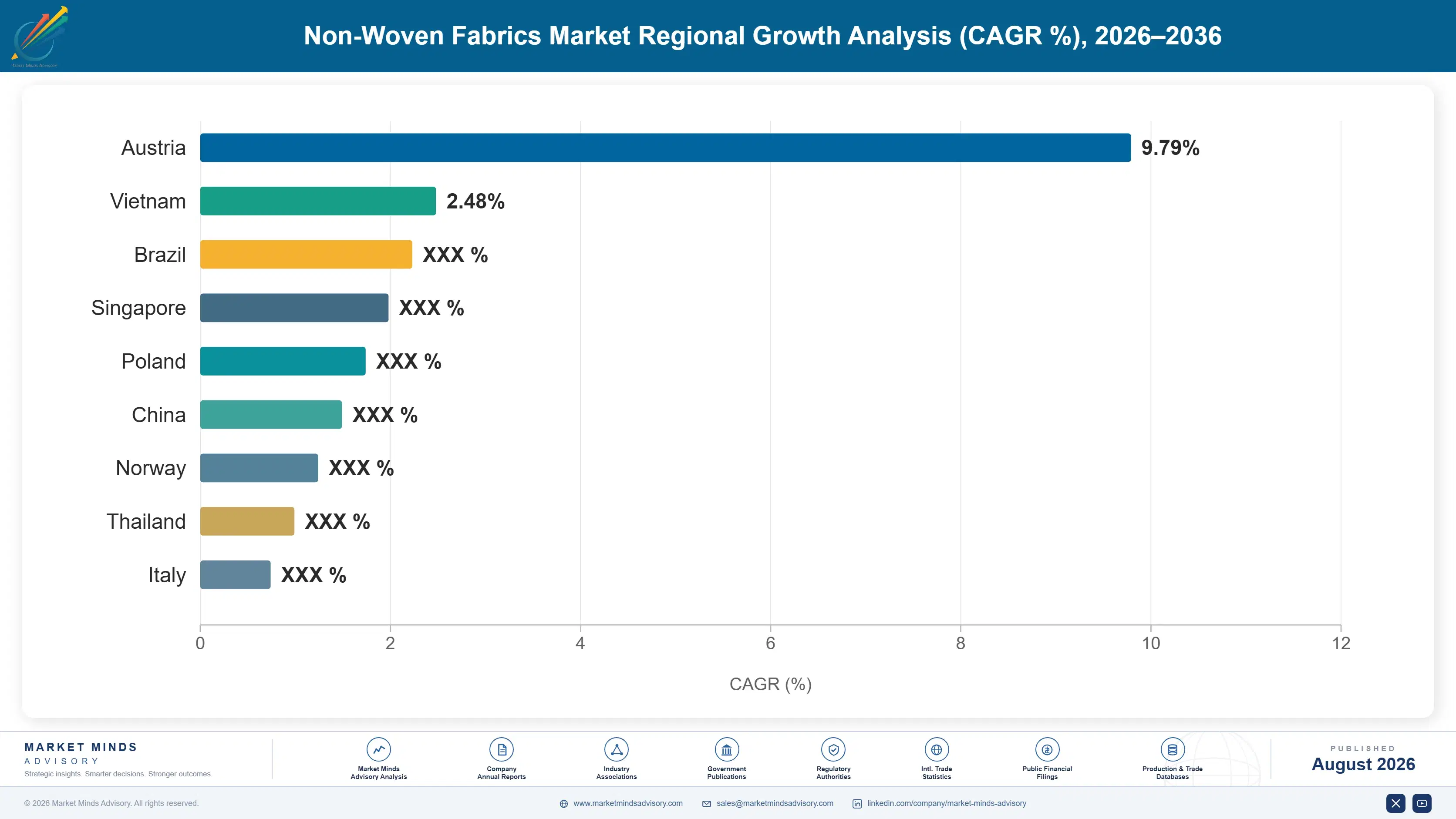
non-woven-fabrics-market-country-cagr-analysis-1787308058321

Technical Application and Filtration Certification Strategy

Manufacturers are shifting commercial strategy toward meltblown capacity investment, technical automotive and filtration certification, and direct brand partnership development, capturing premium pricing power that standard commodity spunbond fabric alone increasingly cannot sustain across resin-price-volatile major manufacturing markets globally, from large conglomerates to smaller regional converters seeking to escape commodity pricing pressure and internationally nationwide.

Meltblown Capacity Investment Programme Strategy Nationwide

Manufacturers are investing in dedicated meltblown production capacity and electret charging technology that maximizes filtration performance, capturing premium pricing that standard spunbond fabric cannot command given its comparatively limited filtration efficiency for medical and industrial air filtration applications. This lever requires substantial capital investment in specialized equipment, but successfully expanded capacity captures durable, long-term filtration and medical customer relationships. Manufacturers report meltblown capacity investment improving average selling price realization by roughly 26% compared to standard commodity fabric portfolios across most major filtration and medical customer accounts tracked nationally and beyond today.
Market Impact: Improves price realization by rough

Automotive OEM Technical Certification Investment Strategy

Manufacturers are investing in automotive original equipment manufacturer certification and testing capability that enables their products to meet stringent automotive interior and acoustic insulation specifications, capturing premium pricing and durable, multi-year supply relationships that standard industrial fabric offerings cannot command given their comparatively limited automotive-specific validation. This lever requires meaningful multi-year qualification investment, but successfully qualified manufacturers capture durable automotive supply relationships. Manufacturers report OEM certification investment improving contract duration by roughly 23% compared to non-qualified supply arrangements across most major automotive manufacturing regions tracked in this report broadly today.
Market Impact: Improves contract duration by rough

Direct Hygiene Brand Partnership Development Strategy

Manufacturers are building direct partnership relationships with major hygiene and personal care brand owners, co-developing customized fabric formulations that meet specific softness, absorbency, and sustainability requirements while securing longer-term supply agreements than commodity spot-market transactions traditionally provided across the broader category historically. This lever requires meaningful technical collaboration investment, but successfully established partnerships generate materially more predictable, higher-margin revenue than transactional commodity sales. Manufacturers report direct partnership strategies improving contract revenue predictability by roughly 25% compared to spot-market commodity sales across most partnership regions tracked in this study nationally today.
Market Impact: Improves revenue predictability by

Resin Hedging and Long-Term Supply Contract Strategy

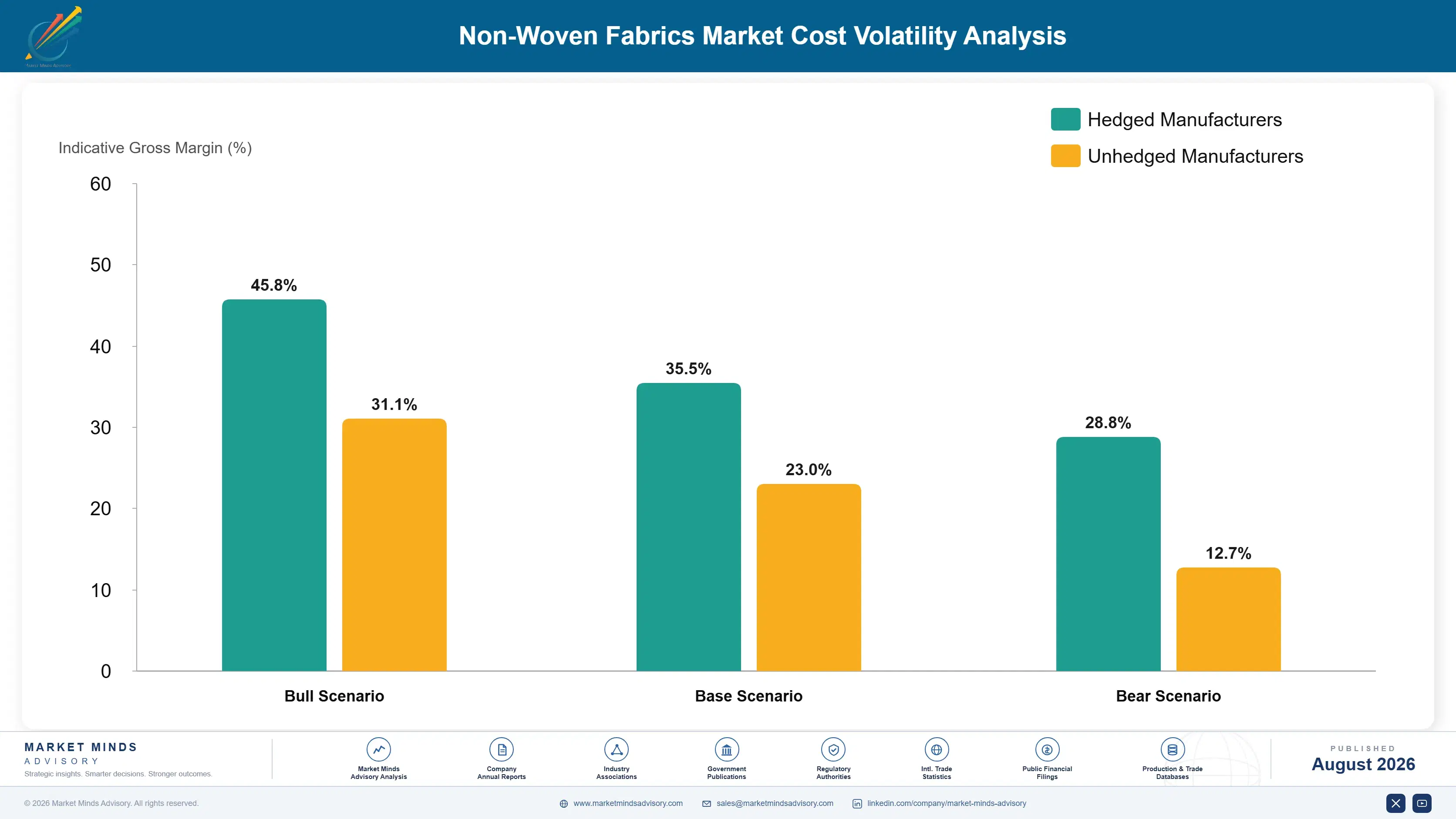
Manufacturers are expanding resin hedging programmes and negotiating long-term supply contracts with petrochemical producers to stabilize input costs and protect margin against the commodity resin price volatility that has historically compressed manufacturer profitability across the broader non-woven fabric category during periods of feedstock market disruption. This lever requires meaningful financial and procurement sophistication, but successfully hedged manufacturers sustain considerably steadier margins than competitors exposed fully to spot-market resin pricing. Manufacturers report resin hedging strategies improving margin stability by roughly 16% during periods of elevated feedstock volatility across most major manufacturing regions tracked broadly.
Market Impact: Improves margin stability by roughl

Who Controls the Margin Pool

The top five manufacturers control roughly 32% of global category spending, a moderately fragmented concentration reflecting the category's mix of large diversified materials conglomerates competing across multiple manufacturing processes and end-use applications, and a substantial long tail of smaller regional converters competing primarily on price within specific national hygiene and industrial markets across most major markets tracked in this report and beyond.
Current competitive activity centers on meltblown capacity investment, automotive OEM technical certification, and direct hygiene brand partnership development, as leading manufacturers pursue genuinely different strategic emphases depending on whether they compete primarily in commodity hygiene or premium technical and filtration fabric categories across most major manufacturing regions and technical certification pathways tracked in this study nationwide.

Emerging pressure comes from regional converters in East Asia and South Asia investing in expanded manufacturing capacity to serve growing domestic hygiene demand, alongside specialty materials companies developing next-generation bio-based and biodegradable non-woven alternatives that could eventually reshape which companies lead the fastest-growing sustainability-focused segment specifically, forcing established leaders to respond with acquisitions and capacity investment rather than organic capability alone within the fastest-growing sustainability-driven segments tracked.
non-woven-fabrics-market-company-positioning-matrix-1787308058841

Competitive Moat and Risk Dimensions

BERRY GLOBAL GROUP INC.

Moat: Extensive Multi-Process Manufacturing Scale

Berry Global maintains an extensive global spunbond and meltblown manufacturing footprint spanning dozens of facilities across major end-use markets, giving it cost advantages and supply reliability that smaller regional converters would need years of comparable investment to replicate at similar international scale nationwide nationwide today.
BERRY GLOBAL GROUP INC.

Risk: Polypropylene Resin Price Volatility

Berry Global faces meaningful exposure to volatile polypropylene resin pricing given its high-volume commodity non-woven production base, and continued feedstock price disruption could meaningfully compress margins within its largest, least-differentiated product categories relative to more specialized competitors over time nationally across most regions and beyond today.
FREUDENBERG PERFORMANCE MATERIALS

Moat: Deep Automotive and Filtration Relationships

Freudenberg benefits from deep technical engineering expertise and long-established automotive and filtration original equipment manufacturer qualification relationships built over decades of continuous investment, giving it market access that newer entrants cannot easily replicate without comparable certification timelines nationwide and abroad, reflecting years of dedicated certification investment.
FREUDENBERG PERFORMANCE MATERIALS

Risk: Automotive Production Cycle Exposure

Freudenberg faces meaningful exposure to cyclical automotive and industrial production volume fluctuations affecting core technical non-woven demand, and continued automotive production softness in major manufacturing regions could meaningfully compress the company's technical fabric revenue relative to more diversified competitors over time nationally overall and beyond.

Players Tracked

Prominent Players

Berry Global Group Inc.
Freudenberg Performance Materials
Kimberly-Clark Corporation
Fitesa S.A.
Toray Industries Inc.

Other Key Players

Avgol Ltd.
PFNonwovens a.s.
Fibertex Nonwovens A/S
Suominen Corporation
Asahi Kasei Corporation
DuPont de Nemours Inc.
Johns Manville Corporation
Glatfelter Corporation
TWE Group
First Quality Enterprises Inc.
Sandler AG
Jacob Holm Industries
Ahlstrom Oyj
Mogul Nonwoven Fabrics
Union Industries Corporation

Recent Developments

MARCH 2026

Berry Global Expands Meltblown Production Capacity in Ohio

Berry Global announced expanded meltblown production capacity at its Ohio facility, broadening electret-charged filtration fabric output to meet sustained medical and industrial air filtration customer demand across major accounts nationwide nationwide, following months of internal capital planning and equipment procurement coordination broadly and beyond today.
Signal: Reflects continued large manufacturer inve
OCTOBER 2025

Freudenberg Signs Automotive Platform Supply Agreement

Freudenberg secured a multi-year automotive acoustic insulation fabric supply agreement with a major electric vehicle manufacturer, expanding its qualified technical fabric product line across the manufacturer's expanding vehicle production platforms under newly established terms following an extended qualification process involving several vehicle platform engineering teams.
Signal: Indicates continued manufacturer investmen
JANUARY 2026

Suominen Launches Sustainable Spunlace Wipes Substrate Line

Suominen launched a new biodegradable spunlace non-woven fabric line designed for wet wipes applications, targeting personal care brand owners seeking sustainable alternatives within the fastest-growing premium hygiene fabric segment tracked in this report following months of internal formulation development and pilot customer testing nationally today.
Signal: Signals continued manufacturer investment

Polypropylene Resin and Fiber Extrusion Exposure

Polypropylene and polyester resin, along with specialized fiber extrusion and finishing processing, together represent roughly 54% of cost of goods sold for non-woven fabric manufacturers, with resin sourced from a concentrated group of petrochemical producers whose output tracks broader crude oil feedstock market conditions, where limited redundancy across production capacity shapes long-term sourcing strategy for most manufacturers regardless of scale today.
Resin prices rose meaningfully during 2021 and 2022 amid broader petrochemical supply chain disruption and elevated pandemic-era demand for meltblown filtration materials, with company annual reports from major manufacturers confirming elevated resin costs persisted through much of 2022 before moderating gradually through 2023 and 2024 to date, with 2022 marking the peak of disruption across most producing regions tracked in this study broadly to date broadly.

Manufacturers without long-term resin supply contracts or vertically integrated petrochemical relationships face materially higher input cost exposure and margin volatility than better-capitalized competitors, creating a durable cost stability advantage for larger companies able to invest in dedicated procurement infrastructure, particularly as national tender and OEM qualification processes increasingly require verified reliable supply chain commitments nationally and internationally broadly.
non-woven-fabrics-market-cost-volatility-analysis-1787308059035

Long-Term Resin Supply Contracts With Fixed Terms

Larger manufacturers are locking in multi-year resin supply contracts with petrochemical producers, stabilizing input costs and securing reliable supply volume ahead of anticipated demand growth, reducing exposure to spot-market price swings that periodically disrupt smaller converters lacking comparable contract leverage nationwide, a mitigation strategy requiring substantial procurement sophistication most smaller manufacturers cannot access easily.

Vertical Integration Into Petrochemical Relationships

Manufacturers affiliated with larger diversified chemicals conglomerates benefit from internal resin sourcing relationships that insulate production costs from open-market volatility, a durable advantage that standalone independent converters generally cannot access without comparable integration across most major production facilities tracked in this report, positioning better-capitalized manufacturers favorably as broader technical demand continues expanding nationally today.

Alternative Fiber and Recycled Content Sourcing

Manufacturers are qualifying recycled polymer and alternative fiber sources as supplementary feedstock, reducing dependency on virgin resin pricing while simultaneously supporting sustainability positioning that regulated institutional and government customers increasingly require of suppliers across most major manufacturing regions and demand categories tracked broadly, reducing exposure to spot-market feedstock price swings that periodically disrupt smaller, less-capitalized competitors nationwide.

Portfolio Architecture for Margin Defence

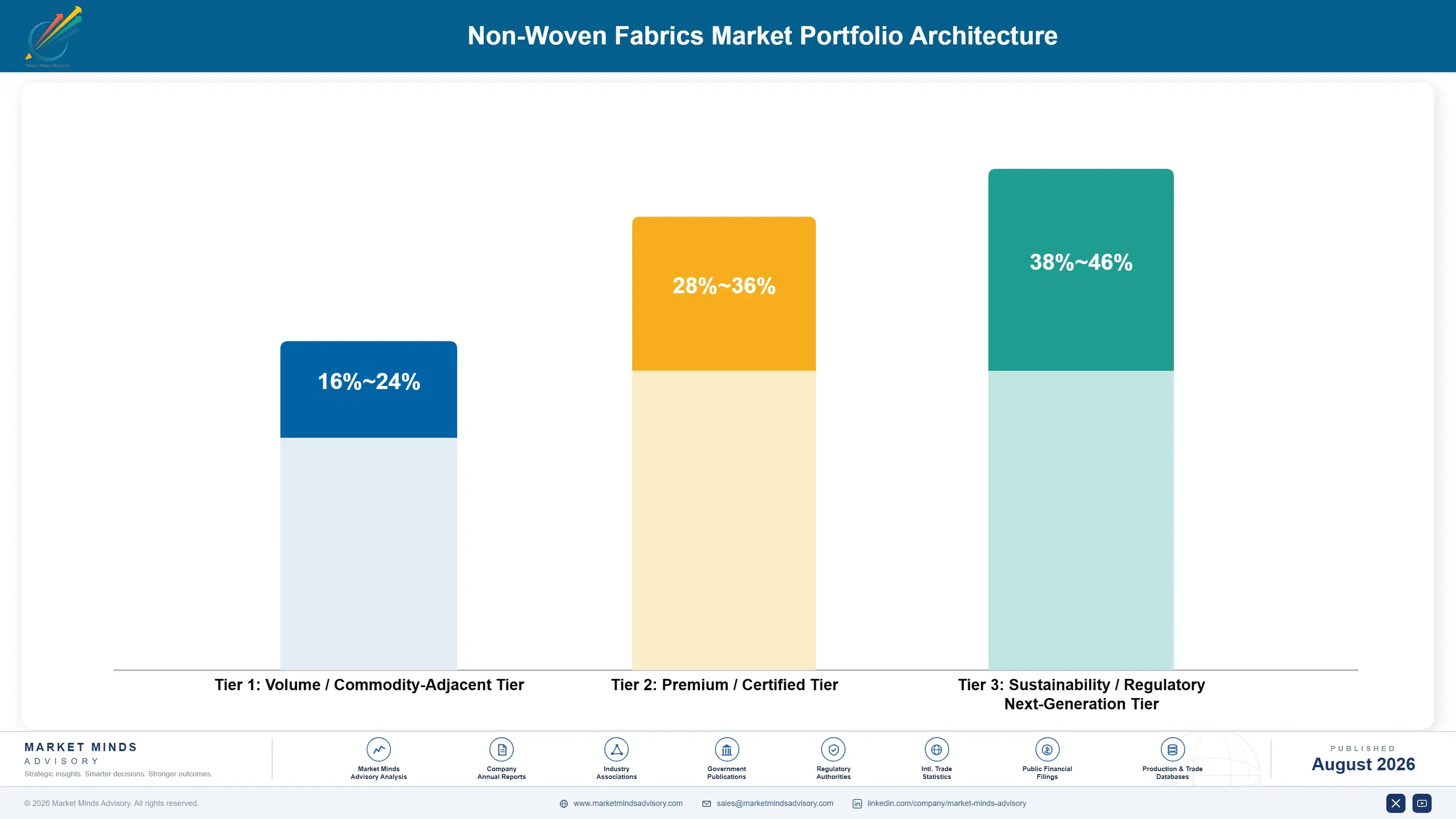
This market organizes into three commercial tiers spanning standard spunbond hygiene fabric at the volume end, technical automotive and industrial fabric in the middle tier, and certified medical and filtration-grade meltblown fabric capturing the strongest margins at the top of the portfolio architecture given certification barriers, a structure that increasingly mirrors the broader industry's shift toward certification-driven premiumization across most major manufacturing regions today.
Hygiene and technical tiers pull manufacturers in genuinely different directions: standard spunbond fabric sustains broad hygiene product distribution at thin, commoditized margins, while technical and filtration-grade fabric delivers materially stronger margins that increasingly fund the equipment and certification investment this diversifying category requires, forcing many manufacturers to run genuinely distinct commercial and technical teams for each tier simultaneously broadly.

The highest-value pools concentrate around certified medical and filtration-grade meltblown fabric sold to healthcare and industrial customers, where certification credibility and specialized equipment investment together sustain premium pricing power that standard commodity spunbond fabric simply cannot match across comparable production volume, making these categories the clearest strategic priority for manufacturers planning multi-year capital investment across the industry and across the wider region.

Volume / Commodity-Adjacent Tier

Standard spunbond hygiene fabric sold on price to diaper, feminine hygiene, and general bundling customers across most manufacturing regions broadly, competing primarily on unit price and delivery reliability rather than certification credentials or technical differentiation.
Gross Margin: 16-24%

Premium / Certified Tier

Technical automotive and industrial fabric sold under moderate certification to specialized manufacturing accounts nationally across most regions today, typically requiring durability and acoustic testing that standard commodity converters rarely maintain in-house.
Gross Margin: 28-36%

Sustainability / Regulatory / Next-Generation Tier

Certified medical and filtration-grade meltblown fabric commanding the strongest performance certification premium available across the industry today, typically sold under long-term qualification agreements rather than transactional commodity pricing dynamics broadly.
Gross Margin: 38-46%
non-woven-fabrics-market-portfolio-architecture-1787308059531

High-value Sub-segments and Strategic Watch-out

Meltblown Filtration and Medical Fabrics

The fastest-growing and highest-margin segment, combining strong sustained filtration demand momentum with genuine customer willingness to pay premium pricing for certified performance broadly, drawing intense manufacturer research investment and rapidly expanding certification activity across the industry nationwide today, drawing sustained investment across most major manufacturers tracked.
Gross Margin: 38-46%

Spunlace Premium Hygiene Fabrics

Strong margins and steady growth driven by wet wipes and premium personal care demand that sustains category momentum even during broader economic softness affecting other categories nationwide, particularly among premium personal care brands seeking measurable softness and absorbency differentiation and internationally today across most channels.
Gross Margin: 30-38%

Standard Spunbond Hygiene Fabrics

The volume core segment sustaining broad hygiene product distribution even as premium categories increasingly capture disproportionate industry profit growth nationally overall today, even as manufacturers increasingly redirect incremental investment toward faster-growing meltblown and spunlace categories instead overall broadly, anchoring baseline manufacturer revenue across most product portfolios broadly.
Gross Margin: 16-24%

Needle-Punched Industrial Fabrics

A strategic watch-out segment facing moderate growth pressure, requiring manufacturers to defend volume against alternative geotextile and industrial material technologies gaining adoption steadily, particularly across applications where alternative geosynthetic materials increasingly compete on cost grounds and abroad currently, requiring careful investment prioritization across the coming several years.
Gross Margin: 18-26%

Application-Specific Renewal Contract Streams

Winning a long-term supply contract with a major hygiene brand owner or automotive OEM functions as an annuity anchor across the multi-year agreement period: securing contract inclusion generates recurring fabric sales throughout the guaranteed volume commitment, and losing that contract to a lower-priced or more capable competitor can eliminate a manufacturer's account almost immediately within a single procurement cycle affecting broader multi-year supply relationships.
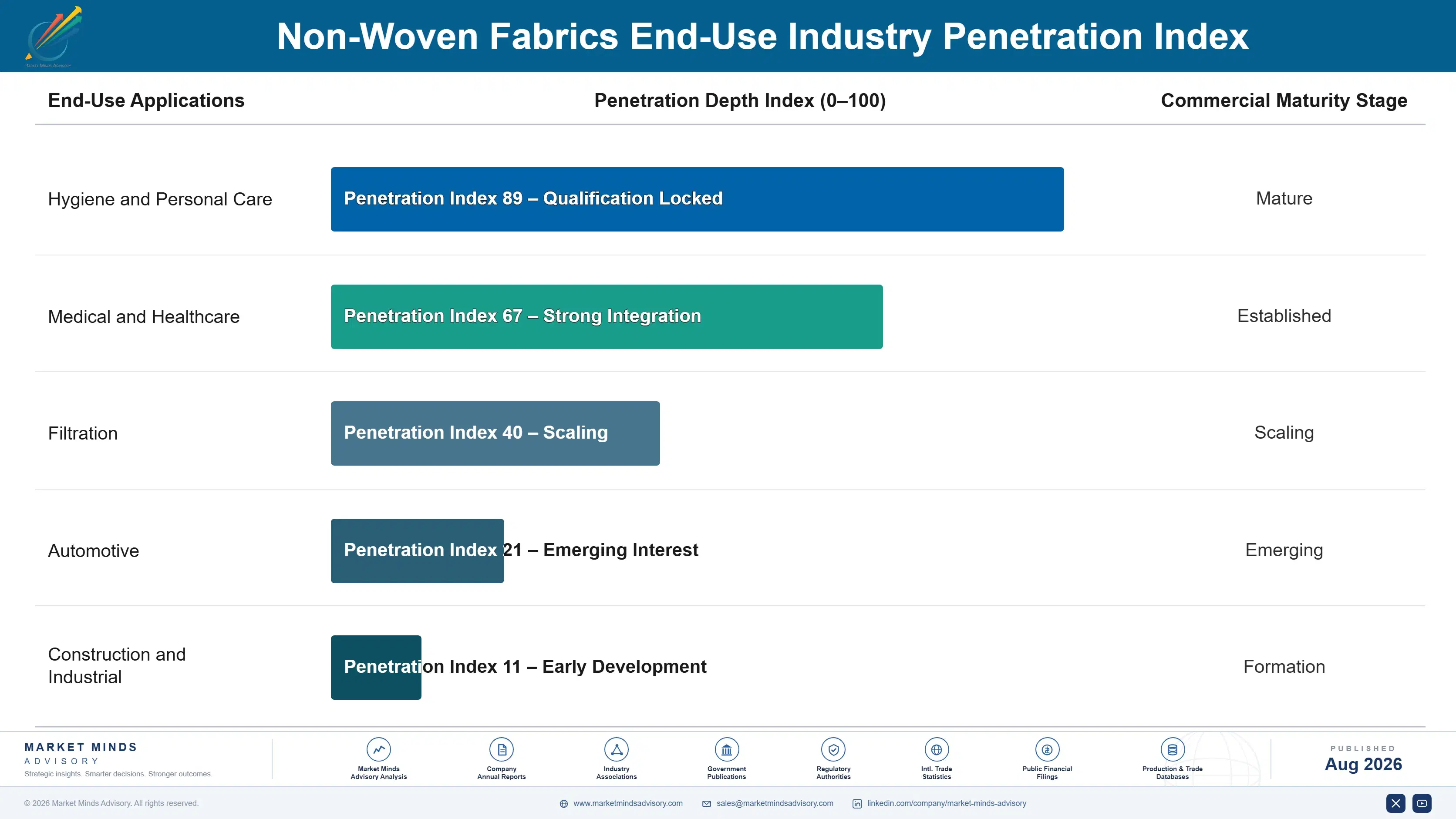
Adoption depth varies considerably by end-use vertical: medical device and filtration customers requiring certified, reliable fabric performance adopt meltblown and technical grades earliest and most completely, while general hygiene and industrial customers more often continue purchasing standard spunbond fabric until specific application requirements force transition, a pattern that continues shifting gradually as certification and technical validation accumulate across most manufacturing regions broadly.

A generational shift is underway as younger procurement engineers trained during the pandemic-era filtration demand surge enter purchasing roles expecting certified, application-specific fabric as standard consideration, gradually normalizing a category that older procurement generations historically evaluated almost entirely through the lens of hygiene fabric alone, a shift manufacturers slow to recognize risk finding themselves increasingly disconnected from where procurement decision-making is heading.
non-woven-fabrics-market-end-use-penetration-index-1787308060020

Where Non-Woven Fabric Economics Are Heading

These are among the four positions where our research anticipates prominent divergence between winners and laggards over the coming forecast period. Each is grounded in the demand model, the regulatory perimeter, and the announced capacity pipeline.
01 / MELTBLOWN CAPACITY INVESTMENT

Sustained filtration demand will separate technical leaders from commodity players

Manufacturers investing in dedicated meltblown capacity and filtration certification are capturing disproportionate share of the fastest-growing, highest-margin technical segments where sustained filtration demand increasingly determines which companies can defend premium pricing power. Companies without meaningful meltblown investment risk being confined to commoditized hygiene categories facing intensifying price competition. Expect meltblown capacity investment to become the single most important competitive differentiator for manufacturers seeking sustainable premium positioning through the coming decade, well ahead of manufacturers relying purely on legacy hygiene production alone.
02 / AUTOMOTIVE CERTIFICATION RACE

OEM qualification will determine technical segment leadership

Manufacturers investing in automotive OEM certification are capturing disproportionate share of the fastest-growing technical fabric segment, where demonstrated reliability and qualification history increasingly determine which suppliers win multi-year vehicle platform contracts over unqualified competitors. Companies without meaningful qualification investment risk being confined to lower-margin industrial categories facing intensifying price competition. Expect OEM qualification depth to become an increasingly important determinant of automotive segment leadership, where demonstrated reliability history increasingly determines which suppliers win multi-year platform contracts over unqualified rivals nationally.
03 / HYGIENE BRAND PARTNERSHIP ADVANTAGE

Direct brand partnerships will strengthen customer retention broadly

Manufacturers building direct hygiene brand partnerships are sustaining considerably stronger customer retention than competitors offering standard commodity supply without collaborative product development capability, and this advantage compounds further as premium hygiene product categories continue expanding across major consumer markets. Companies without meaningful partnership capability face persistently weaker customer loyalty regardless of underlying fabric pricing competitiveness. Expect partnership depth to become an increasingly important determinant of long-term customer relationship durability across most major consumer markets and hygiene product categories tracked nationally.
04 / REGIONAL MANUFACTURING SHIFT

East Asian and South Asian capacity will keep pulling production eastward

Continued East Asian and South Asian manufacturing capacity expansion is steadily pulling global non-woven fabric production toward the region, reflecting both proximity to major petrochemical feedstock sources and rapidly growing domestic hygiene and industrial demand across these markets. This trajectory shows no sign of reversing given sustained regional manufacturing investment and demand growth outpacing most other global regions. Expect East Asian and South Asian production share to continue expanding meaningfully throughout the current forecast period across most major fabric categories.

Engagement Snapshot From the Field

A live engagement with an industry participant carrying material or product regulatory and market exposure ahead of a defining policy shift, showing how our research translates into a defensible multi-year portfolio strategy.
MARKET MINDS ADVISORY · CLIENT ENGAGEMENT SUMMARY
Non-Woven Fabrics Producer Strategic Portfolio Review and Transition Roadmap 2026·Investment Scenario on Non-Woven Fabrics Exposure Evaluation 2025-26
CLIENT PROFILE
The client is a mid-sized regional non-woven fabric converter generating projected annual revenue of approximately $145 million (client-reported, unverified by MMA) upon successful meltblown diversification. Leadership sought guidance on prioritizing meltblown capacity investment ahead of intensifying commoditization pressure affecting its core spunbond hygiene product lines, running through the following two fiscal quarters ahead of the planned transition.
STRATEGIC CHALLENGE
The client had historically competed almost entirely in commodity spunbond hygiene fabric, and leadership was uncertain whether investing in meltblown capacity would generate sufficient premium pricing and customer diversification to justify the substantial upfront equipment investment required for the transition across the client's broader commodity-focused product portfolio within a limited capital budget.
MMA APPROACH
MMA's team benchmarked comparable converter meltblown diversification strategies, modeled projected margin improvement and customer acquisition under various capacity investment scenarios, and assessed the client's existing manufacturing footprint for meltblown conversion feasibility and regional filtration customer demand specifically, drawing on primary interview data gathered from regional medical device buyers across the client's core target markets nationwide.
KEY FINDINGS
  1. Comparable converters that invested in meltblown capacity achieved meaningfully higher average selling prices within eighteen months of launching filtration-grade product lines under new premium positioning.
  2. Regional medical device and industrial filtration manufacturers within the client's service territory showed strong near-term demand for qualified local meltblown fabric suppliers given supply chain resilience priorities.
  3. The client's existing manufacturing facility required only moderate modification to accommodate meltblown production lines, reducing projected capital investment considerably compared to greenfield facility construction.
  4. A phased capacity investment strategy targeting the highest-demand filtration categories first reduced projected investment risk considerably compared to pursuing comprehensive meltblown diversification simultaneously.
CLIENT PROFILE
The client is a mid-sized regional non-woven fabric converter generating projected annual revenue of approximately $145 million (client-reported, unverified by MMA) upon successful meltblown diversification. Leadership sought guidance on prioritizing meltblown capacity investment ahead of intensifying commoditization pressure affecting its core spunbond hygiene product lines, running through the following two fiscal quarters ahead of the planned transition.
STRATEGIC CHALLENGE
The client had historically competed almost entirely in commodity spunbond hygiene fabric, and leadership was uncertain whether investing in meltblown capacity would generate sufficient premium pricing and customer diversification to justify the substantial upfront equipment investment required for the transition across the client's broader commodity-focused product portfolio within a limited capital budget.
MMA APPROACH
MMA's team benchmarked comparable converter meltblown diversification strategies, modeled projected margin improvement and customer acquisition under various capacity investment scenarios, and assessed the client's existing manufacturing footprint for meltblown conversion feasibility and regional filtration customer demand specifically, drawing on primary interview data gathered from regional medical device buyers across the client's core target markets nationwide.
KEY FINDINGS
  1. Comparable converters that invested in meltblown capacity achieved meaningfully higher average selling prices within eighteen months of launching filtration-grade product lines under new premium positioning.
  2. Regional medical device and industrial filtration manufacturers within the client's service territory showed strong near-term demand for qualified local meltblown fabric suppliers given supply chain resilience priorities.
  3. The client's existing manufacturing facility required only moderate modification to accommodate meltblown production lines, reducing projected capital investment considerably compared to greenfield facility construction.
  4. A phased capacity investment strategy targeting the highest-demand filtration categories first reduced projected investment risk considerably compared to pursuing comprehensive meltblown diversification simultaneously.
RECOMMENDED STRATEGY
Phase 1: Phase 1 (Months 1-9): Install meltblown production capacity targeting the client's highest-demand regional filtration and medical customer accounts first and equipment vendors. Phase 2: Phase 2 (Months 10-18): Launch certified filtration products commercially and pursue expanded medical device customer relationships while monitoring early customer adoption closely. Phase 3: Phase 3 (Months 19-28): Expand meltblown capacity to additional filtration categories based on initial results and demand growth and broader competitive market feedback gathered along the way.
OUTCOME
The client installed its meltblown production capacity and launched its certified filtration product line within the recommended timeline, reporting margin improvement and customer diversification results consistent with initial modeling projections (client-reported, unverified by MMA), exceeding the client's original internal projections modestly during the first year following full deployment.

Frequently Asked Questions

Foundational context covering the market sizes, CAGR, scope, country, region and competition that inform every finding below. This section is provided to cover basics and most often pre-purchase conversations, answered from the MMA Primary Research Dataset.

What is the current size of the Non-Woven Fabrics Market?

The market was valued at approximately $48.5 billion in 2025. This includes spunbond, meltblown, and other non-woven fabric formats used across global hygiene, medical, and industrial applications.

How large will the Non-Woven Fabrics Market be by 2036?

The market is projected to reach approximately $94.0 billion by 2036, up from about $51.5 billion in 2026. This reflects strong filtration and hygiene demand growth.

What is the CAGR for the Non-Woven Fabrics Market 2026 to 2036?

The market is expected to grow at a compound annual growth rate of 6.2% between 2026 and 2036. This reflects sustained filtration demand and expanding hygiene consumption.

Which segment is growing fastest?

Meltblown non-woven fabrics are the fastest-growing segment, expanding at approximately 8.5% annually, well above the market's 6.2% blended growth rate. This reflects sustained filtration demand.

Who are the major companies in the Non-Woven Fabrics Market?

Leading companies include Berry Global, Freudenberg, Kimberly-Clark, Fitesa, and Toray Industries. Together these five manufacturers account for roughly 32% of global category spending globally today.

Which country is growing fastest?

India is the fastest-growing major country at an estimated 8.2% CAGR, driven by rapidly expanding hygiene product consumption and organized manufacturing growth and abroad nationwide.

Report Segmentation Architecture

The full report scope spans multiple orthogonal segmentation dimensions, with cross-tabulated demand data provided for each dimension pair. Coverage extends further to regional breakdowns, trend trajectories, and the competitive detail needed to support segment-level decision-making.

By Manufacturing Process

  • Spunbond Non-Woven Fabrics
  • Meltblown Non-Woven Fabrics
  • Needle-Punched Non-Woven Fabrics
  • Spunlace Non-Woven Fabrics
  • Wetlaid Non-Woven Fabrics
  • Airlaid Non-Woven Fabrics

By End-Use Industry

  • Hygiene and Personal Care
  • Medical and Healthcare
  • Filtration
  • Automotive
  • Construction and Industrial

By Commercial Dimension

  • Direct Manufacturer Supply Contracts
  • Automotive OEM Qualification Programmes
  • Converter Distribution Channels
  • Spot Market Commodity Sales

By Region

  • North America
  • Western Europe
  • East Asia
  • South Asia and Pacific
  • Latin America
  • Middle East and Africa
  • Eastern Europe

Scope, Methodology, and Coverage

Every figure in this report is reproducible from documented input assumptions. The scope below maps the historical period, the forecast horizon, the segmentation dimensions, and the countries covered, alongside the underlying primary and qualitative methodology.
Historical Period
2020 to 2025
Forecast Period
2026 to 2036
Base Year
2025 (USD billions; MMA Primary Research Dataset, August 2026)
Market Definition
This report covers non-woven fabric materials produced through spunbond, meltblown, needle-punched, spunlace, wetlaid, and airlaid manufacturing processes used across hygiene, medical, filtration, automotive, and industrial applications. It excludes woven and knitted textile fabrics, paper products, and finished consumer products manufactured from non-woven materials entirely.
Quantitative Units
USD billions (current prices); production volume in metric tons; average selling price per kilogram
Segmentation Dimensions
By Manufacturing Process; By End-Use Industry; By Commercial Dimension; By Region
Regions Covered
North America, Western Europe, East Asia, South Asia and Pacific, Latin America, Middle East and Africa, Eastern Europe
Countries Covered
USA, China, Germany, France, UK, Japan, South Korea, India, Australia, Canada, Brazil, Mexico, Indonesia, Vietnam, Thailand, Malaysia, UAE, Saudi Arabia, South Africa, Nigeria, Turkey, Poland, Netherlands, Italy, Spain, Sweden, Switzerland, Argentina, Colombia, Singapore, and additional markets relevant to this sector
Key Companies Profiled
Berry Global Group Inc., Freudenberg Performance Materials, Kimberly-Clark Corporation, Fitesa S.A., Toray Industries Inc., Avgol Ltd., PFNonwovens a.s., Fibertex Nonwovens A/S, Suominen Corporation, Asahi Kasei Corporation, DuPont de Nemours Inc., Johns Manville Corporation, Glatfelter Corporation, TWE Group, First Quality Enterprises Inc., Sandler AG, Jacob Holm Industries, Ahlstrom Oyj, Mogul Nonwoven Fabrics, Union Industries Corporation
Quantitative Methodology
Primary survey, n=3,800 respondents, Q4 2025, six countries; demand-side model with trade association cross-validation
Qualitative Methodology
47 expert interviews, Q4 2025; applied to validate demand model assumptions, identify emerging dynamics, and assess competitive positioning
Report Format
PDF and XLSX data workbook (Word format preview document)
Publisher
Market Minds Advisory
Report Code
MMA-2026-CHM-142
Published
August 2026
Contact
sales@marketmindsadvisory.com | www.marketmindsadvisory.com

Purchase the full Non-Woven Fabrics Market Report (2026 to 2036).

The full report provides detailed process-level segmentation, country-level production capacity analysis, and channel distribution tracking across major global manufacturing regions covered in this study. It includes manufacturer-level competitive benchmarking based on meltblown capacity and certification capability, alongside detailed filtration and automotive demand commentary. Subscribers receive quarterly updates tracking new capacity investments and OEM qualification agreements as they occur. A companion dataset provides production capacity estimates by country for detailed market sizing purposes, including scenario modeling for meltblown capacity investment and automotive OEM qualification planning broadly.
Process-level segmentation breakdown by fabric category
Country-level production capacity and trend analysis
Distribution channel tracking and benchmarking service
Manufacturer competitive benchmarking scorecards and overview
Quarterly capacity investment and qualification update service
Production capacity dataset segmented by country region

Built For The People Who Decide

From boardroom strategy to bench-side execution, this report is read cover-to-cover by leaders shaping the next decade of their industry, turning demand scenarios, market dynamics and valuation benchmarks into decisions.
CXOs/ Presidents/ VPs/ Managers
M&A and Corporate Development
Strategy Teams and R&D Heads
Procurement and Product Directors
Regulatory and Compliance Leaders
Investor Relations and Equity Analysts