Market Minds Advisory
Non-Tacky Transfer Paper Market

Non-Tacky Transfer Paper Market: Reuse economics, silicone migration and digital film substitution to 2036

Converters buy this product on price per square metre when the number that actually decides their cost is how many times each sheet can be run before the pattern gives out.

Lead Analyst

Bilal Shaikh

Published

September 2026

Make Smarter Decisions with Customized Research Insights

Request a free sample report and evaluate market opportunities, growth trends, and competitive dynamics relevant to your business needs.

2025 MARKET VALUE$1.2BMarket Size 2025
2036 FORECAST VALUE$2.5BBase Case , 2026 to 2036
CAGR 2026 TO 20366.4 %Bull 7.6% / Bear 5.2%
INCREMENTAL OPPORTUNITY$1.1BNet 10- year value creation
EXPANSION MULTIPLE1.86x2036 value over 2026 base
Strategic Levers
M&A Pipeline
Regional Outlook
Country Rankings
Competitive Intelligence
Segmental Deep-dive
Call-Us : 91 93563 13602

Executive Snapshot and Market Trajectory

A texture release paper runs about six times before the embossed pattern degrades past acceptance. Cost per finished metre is therefore price divided by cycles, and almost nobody in this market quotes it that way. Converters compare price per square metre and buy the wrong paper regularly.
Digital direct-to-film adjacent formats grow at 9.6%, half again the market rate of 6.4%, because film-based transfer needs no cutting or weeding and handles full colour, which took small-run garment decoration away from conventional heat transfer within about five years. East Asia holds 42% of value on synthetic leather and textile decoration manufacture. Vietnamese growth at 10.2% leads every country here. Automotive interiors add demanding volume alongside that. Base sheet remains largely imported.
Synthetic leather takes 39% of coated area, and the technical dividing line running through it is silicone. Silicone release coatings work extremely well and migrate onto the transferred surface, which then cannot be overprinted, bonded or lacquered. Silicone-free grades carry roughly a 34% premium and are the only option wherever the surface gets decorated afterwards. Buyers find that out during overprinting, with the material already made.
Market Definition
This report covers non-tacky transfer and release papers used for heat transfer and pattern transfer without a tack coat, spanning synthetic leather release and texture, textile heat transfer and garment decoration, sublimation transfer, industrial laminate and surface decoration, digital direct-to-film adjacent formats, and labels graphics and specialty transfer. Value is measured at coater level on square metres of coated paper supplied. Excluded are pressure-sensitive label release liners, uncoated specialty base paper sold as such, polyester and other plastic transfer films, and heat transfer inks, powders or adhesives.
Base Year Value
$1.2B in 2025 (MMA Primary Research Dataset, August 2026)
Forecast Period
2026 to 2036, eleven discrete annual values
CAGR
6.4% base case. Bull 7.6%. Bear 5.2%.
Fastest Growth Segment
Digital Direct-to-Film Adjacent Formats: 9.6% CAGR
Fastest Growth Country
Vietnam: 10.2% CAGR
Fastest Growth Region
South Asia and Pacific: 8.4% CAGR
Largest Region
East Asia: 42% of 2025 global value
Market Leaders
Ahlstrom, Sappi, Felix Schoeller, Lintec Corporation and Loparex lead the market. Source: MMA Primary Research Dataset, July 2026.
Primary Survey
n=3,800 procurement and R&D decision-makers, Q4 2025, six countries
Methodology
Demand-side build-up, cross-validated against public data, 47 expert interviews

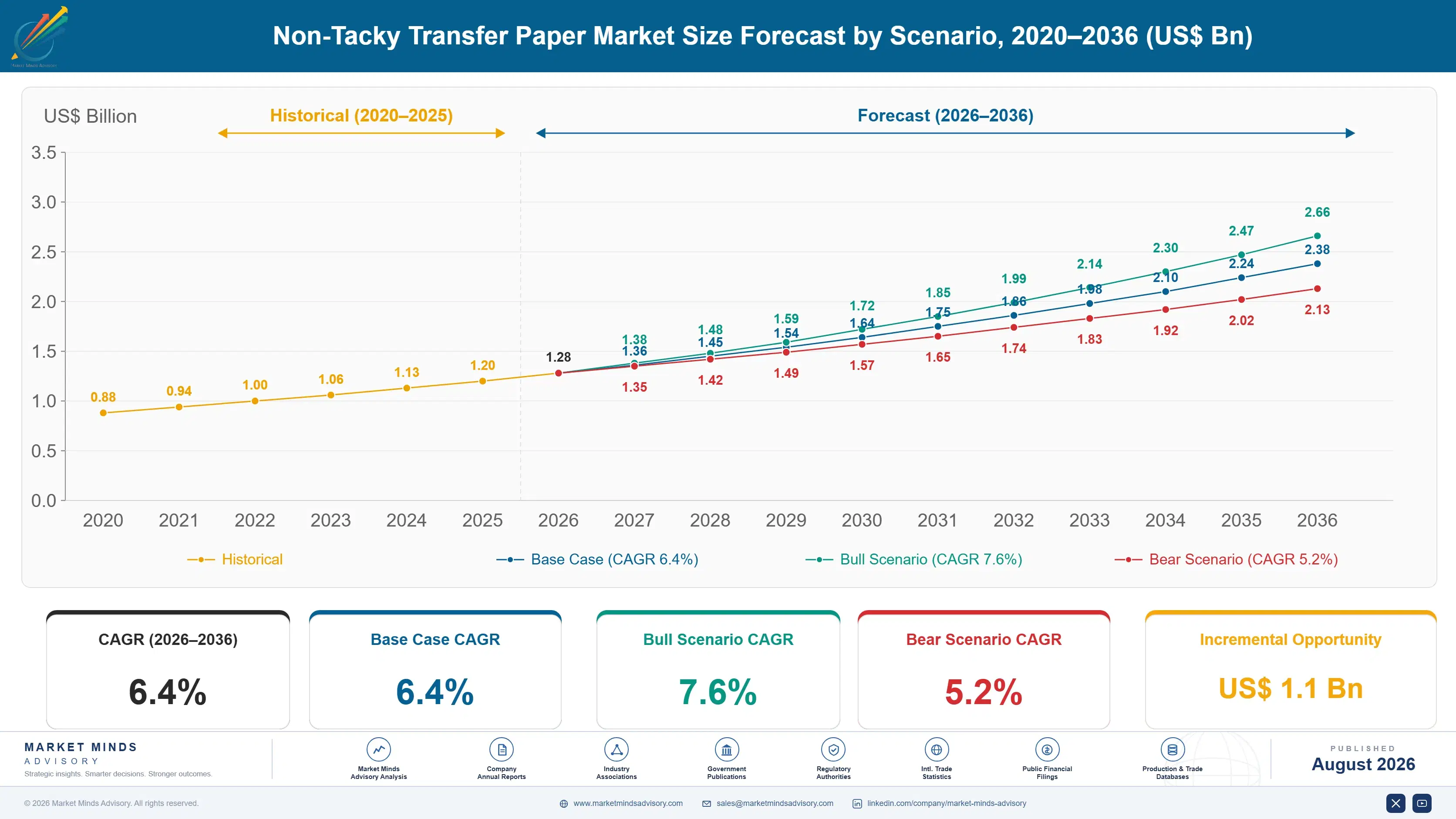
Non-Tacky Transfer Paper Market Forecast Scenarios

non-tacky-transfer-paper-market-size-forecast-scenario-1787555968437
Growth ran at 5.2% between 2020 and 2025 and the mix moved considerably more than the headline. Synthetic leather release volume tracked footwear and upholstery manufacture as it kept relocating across Southeast Asia. Conventional cut-and-weed garment transfer meanwhile lost small-run work to direct-to-film printing at a speed that surprised most of the industry, while sublimation held its own in polyester sportswear.
The 6.4% base case rests on three mechanisms. Digital film-adjacent formats at 9.6%, taking short-run decoration that conventional transfer cannot serve economically. Southeast Asian footwear and garment relocation, with Vietnamese growth at 10.2% leading every country as production keeps shifting there. And silicone-free grades at a 34% premium, required wherever a transferred surface is decorated after release rather than before. Automotive interior programmes add demanding volume that runs for years once awarded.
The 7.6% bull case is synthetic leather displacing more genuine leather in automotive interiors, which would lift texture paper volume across a demanding application. The 5.2% bear case is base paper tightening, since roughly 61% is imported specialty sheet from a limited number of mills able to hold dimensional stability near 190 degrees. Ordinary paper machines cannot hold that specification at all.

The Number Nobody Quotes

This is a consumable that gets used more than once, which changes the arithmetic entirely and which the market persistently ignores. A texture release paper for synthetic leather survives around six passes before the embossed pattern loses definition and the coated fabric starts showing it. Real cost is purchase price divided by cycles achieved. A sheet priced twenty per cent higher that runs eight times instead of five costs meaningfully less per finished metre, and converters buy the cheaper one anyway because procurement compares price per square metre and nobody in the tender documents mentions cycles.
TOP-FIVE CONCENTRATION44%Combined position across supply held by the leading coating producers
RELEASE PAPER REUSE CYCLES6Times a texture paper survives before the pattern degrades
SYNTHETIC LEATHER APPLICATION SHARE39%Portion of area consumed making coated fabric surfaces
TRANSFER TEMPERATURE RANGE190 CPeak heat the base sheet must survive without curling
SILICONE-FREE PREMIUM34%Pricing above conventional release coating for overprintable grades
BASE PAPER IMPORT SHARE61%Portion of specialty base sheet sourced from other countries
The technical division that matters runs through the release coating. Silicone works beautifully and migrates, leaving a trace on the transferred surface that prevents subsequent printing, bonding or lacquering, which is fine for a finished decorative surface and fatal for one that gets decorated afterwards. Silicone-free chemistries carry roughly a 34% premium and exist entirely because of that. Buyers who discover the problem at the overprinting stage have already produced the material.
Underneath sits a base paper constraint. The sheet must hold dimensional stability near 190 degrees without curling, which few mills can make, and around 61% of it is imported.
"This whole industry sells by the square metre and its customers pay by the cycle, and the gap between those two things is where most of the value gets destroyed. Any supplier willing to guarantee a cycle count would reorganise the market around themselves within about three years."
Director, Speciality Papers and Converting Practice · MMA Packaging and Converting Materials Practice · August 2026

Market Trends

Direct-to-film printing takes short-run garment decoration quickly

Film-based transfer using printed polyester and hot-melt powder needs no cutting or weeding, handles full colour photographic artwork and works on almost any fabric, which took small-run garment decoration away from conventional heat transfer paper within roughly five years of arriving. Growth in film-adjacent formats runs at 9.6%, the fastest here. Conventional cut-and-weed transfer retains longer runs and specific finishes it does better. Suppliers who dismissed the format early lost decoration accounts that will not return, since the workflow advantage is genuine rather than promotional. Small decoration shops buy this through distributors in modest quantities.
Market Impact: Vietnamese demand compounds at 10.2%
Silicone-free release grades separate on overprintability

Silicone release coatings perform excellently and migrate onto the transferred surface, leaving residue that prevents later printing, bonding or lacquering, which is irrelevant for a finished decorative face and disqualifying for one decorated afterwards. Silicone-free chemistries carry roughly a 34% premium and exist purely to solve that. Commercially this splits the market by what happens downstream rather than by the transfer itself, and converters who discover the incompatibility during overprinting have already committed material and machine time to the run. Automotive interior programmes almost always fall into that second category.
Market Impact: Supports 39% synthetic leather share

Market Opportunities and Growth Drivers

Footwear and garment manufacture keeps relocating into Southeast Asia

Footwear, sportswear and garment production continues shifting from Chinese coastal provinces into Vietnam, Indonesia and Bangladesh on labour cost and tariff considerations, and synthetic leather and decoration consumption travels with it. Vietnamese growth at 10.2% leads every country in this market. Regional coating capability is developing but base paper still arrives imported, which leaves converters there exposed on supply while they grow fastest. The relocation has been underway for a decade and shows no sign of reversing under current trade conditions. Bangladeshi garment decoration is growing quickly from a small base.
Market Impact: Cycle life ranges 4 to 8

Automotive interiors adopt synthetic leather across more models

Vehicle manufacturers keep specifying synthetic leather across mid-range and premium interiors on cost, consistency and animal welfare grounds together, and each surface requires texture release paper to give it grain. Automotive specification is considerably more demanding than footwear on grain consistency and colour fastness, which narrows the qualified supplier field and supports pricing. Volumes per model programme are substantial and run for years once awarded. Qualification takes long enough that incumbency in this application is unusually valuable to hold. Grain libraries built for one manufacturer rarely transfer to another, which deepens the incumbency further still.
Market Impact: Imports 61% of base sheet

Market Restraints and Challenges

Reuse cycle variability makes true cost invisible at purchase

A texture release paper runs around six cycles on average, and the spread between suppliers is wide enough to swamp any price difference between them. The root cause is that cycle life depends on coating adhesion, base paper stability and the converter's own line conditions together, so no supplier can promise a number that holds across every customer. Commercially this pushes purchasing toward price per square metre, which rewards the wrong suppliers. Some producers now run trials measuring cycles on the customer's actual line before quoting. That trial work costs money and wins accounts that price alone never would.
Market Impact: Adjacent formats compound at 9.6%

Specialty base paper comes from very few capable mills

The base sheet must hold dimensional stability near 190 degrees without curling, cockling or losing caliper, and roughly 61% of what coaters use is imported from a small number of mills in Japan, Finland, Germany and China with the fibre selection and calendering to make it. The root cause is that ordinary paper machines cannot hold the required density and moisture profile. Commercially this leaves coaters exposed on a critical input. Several are qualifying second sources and a few have contracted mill capacity directly. Requalifying a base sheet takes months of trials and customer revalidation.
Market Impact: Grades carry a 34% premium
4 additional market trends, 3 additional growth drivers, and 2 additional restraints and challenges are covered in the full report. Contact sales@marketmindsadvisory.com to access the complete intelligence.

Segment CAGR and Growth Architecture

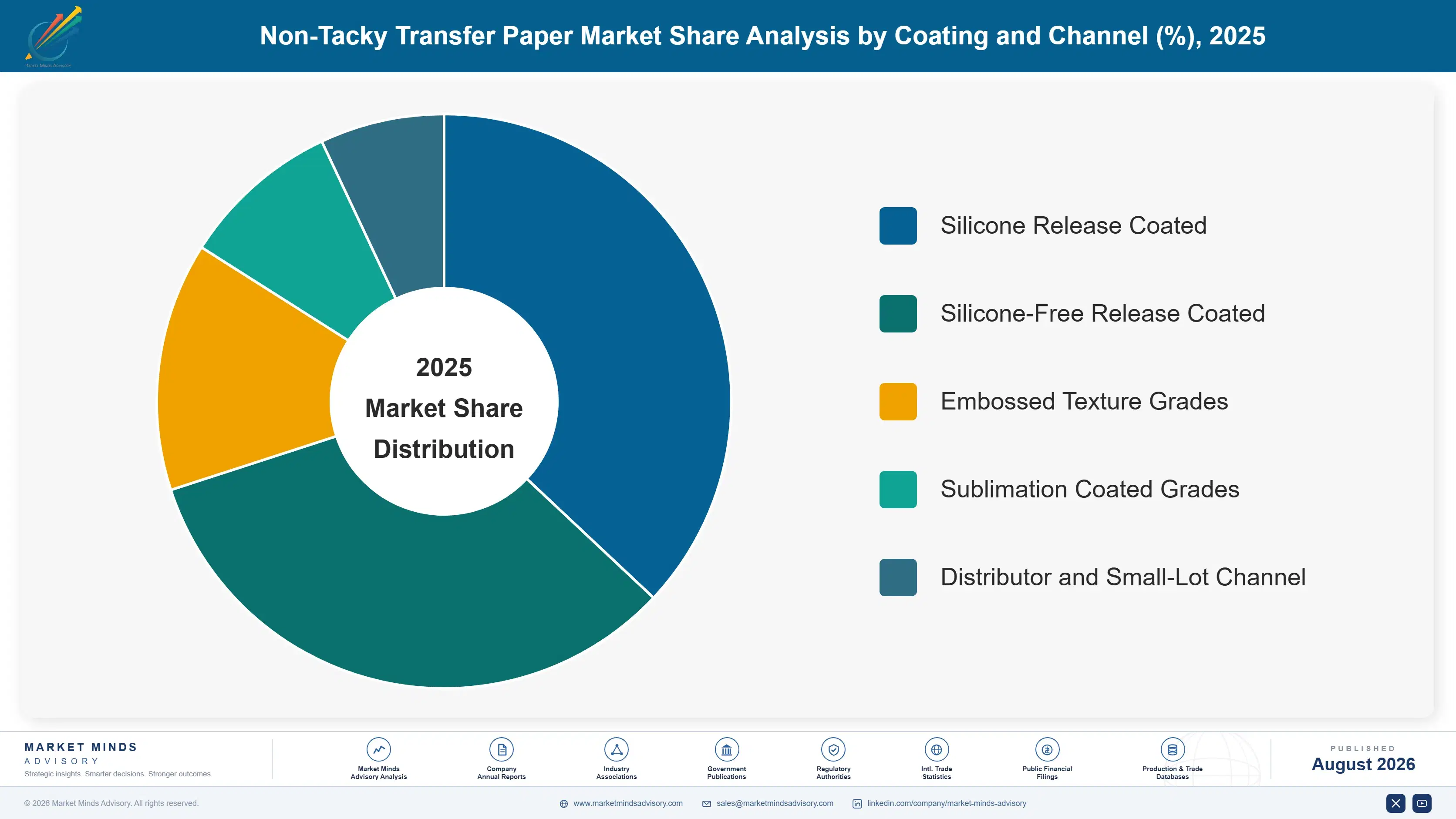
Area is classified here by end application, since release chemistry, cycle requirement and dimensional specification all follow what the paper is transferring onto rather than how it was actually made. Coating type, base paper grade and supply channel are each handled separately in the framework below, because one coating serves several applications without any change at all.
non-tacky-transfer-paper-market-market-share-analysis-1787555968973

Digital Direct-to-Film Adjacent Formats

Growing at 9.6%, half again the market rate, this segment covers the transfer papers and coated carriers used alongside direct-to-film garment decoration, which prints onto polyester film, applies hot-melt powder and transfers without any cutting or weeding at all. That workflow advantage is real rather than promotional, and it took short-run garment decoration from conventional heat transfer within about five years. Buyers are small decoration shops purchasing through distributors in modest quantities and switching readily on availability. Suppliers organised around long industrial rolls and annual contracts have generally served this channel badly, and lost accounts accordingly. The workflow advantage is not going to reverse, so conventional transfer will not recover this volume.
CAGR 9.6%

Sublimation Transfer

Sublimation transfer papers carry disperse dye onto polyester sportswear, flags, soft signage and hard-substrate promotional items, and growth at 7.0% follows polyester apparel consumption alongside soft signage displacing rigid display materials in retail environments. Coating weight and ink holdout govern transfer efficiency directly, since dye left in the paper is dye that never reached the fabric. Buyers measure that and specify it tightly. High-speed digital printing has raised the demands on drying behaviour and dimensional stability, which has quietly separated capable suppliers from those selling on price alone. Soft signage in particular has grown well beyond apparel demand, and it specifies dimensional stability more tightly than garment work ever did because large format registration is unforgiving.
CAGR 7.0%
Full segment breakdown across 6 segments available in the complete report.

Regional Architecture and Country Demand Map

East Asia holds 42% of value because synthetic leather and textile decoration manufacture concentrate there, far above the standard regional band and stated here as an exception. North America follows at 16% on garment decoration and industrial laminate demand, also outside its band and noted as an exception.

East Asia

At 42% this region sits far above the standard band, because synthetic leather production, textile decoration and footwear manufacture all concentrate here at volumes no other region approaches. Chinese coaters including Guangdong Guanhao and Zhejiang Sunlight supply most regional demand at prices international producers do not attempt to match on standard grades. Japanese and Korean producers hold the technically demanding positions in automotive texture papers and silicone-free chemistries where specification rather than cost decides. Base paper capability is genuinely deep here. Growth at 7.4% reflects synthetic leather and decoration expanding together. Korean producers hold strong positions in electronics-grade release work. Coating capacity across the region considerably exceeds what any other continent operates, and it keeps expanding.
Share: 42% | CAGR: 7.4% (2026 to 2036)

South Asia and Pacific

At 13% this region sits above the standard band, reflecting the footwear, garment and sportswear manufacture that keeps relocating here from Chinese coastal provinces. Vietnamese growth at 10.2% leads every country in this market on exactly that shift. Indian textile decoration and synthetic leather production are both expanding, supported by domestic apparel demand alongside export manufacture. Regional coating capability is developing while base paper still arrives imported, which leaves converters exposed on a critical input during the period they are growing fastest of anywhere. Indonesian and Bangladeshi decoration demand follows the same relocation pattern at smaller scale. Australian demand is limited to signage and decoration rather than any manufacturing base worth speaking of.
Share: 13% | CAGR: 8.4% (2026 to 2036)
Regional intelligence for 5 additional markets available in the complete report: North America, Western Europe, Latin America, Middle East and Africa, Eastern Europe. Contact sales@marketmindsadvisory.com.
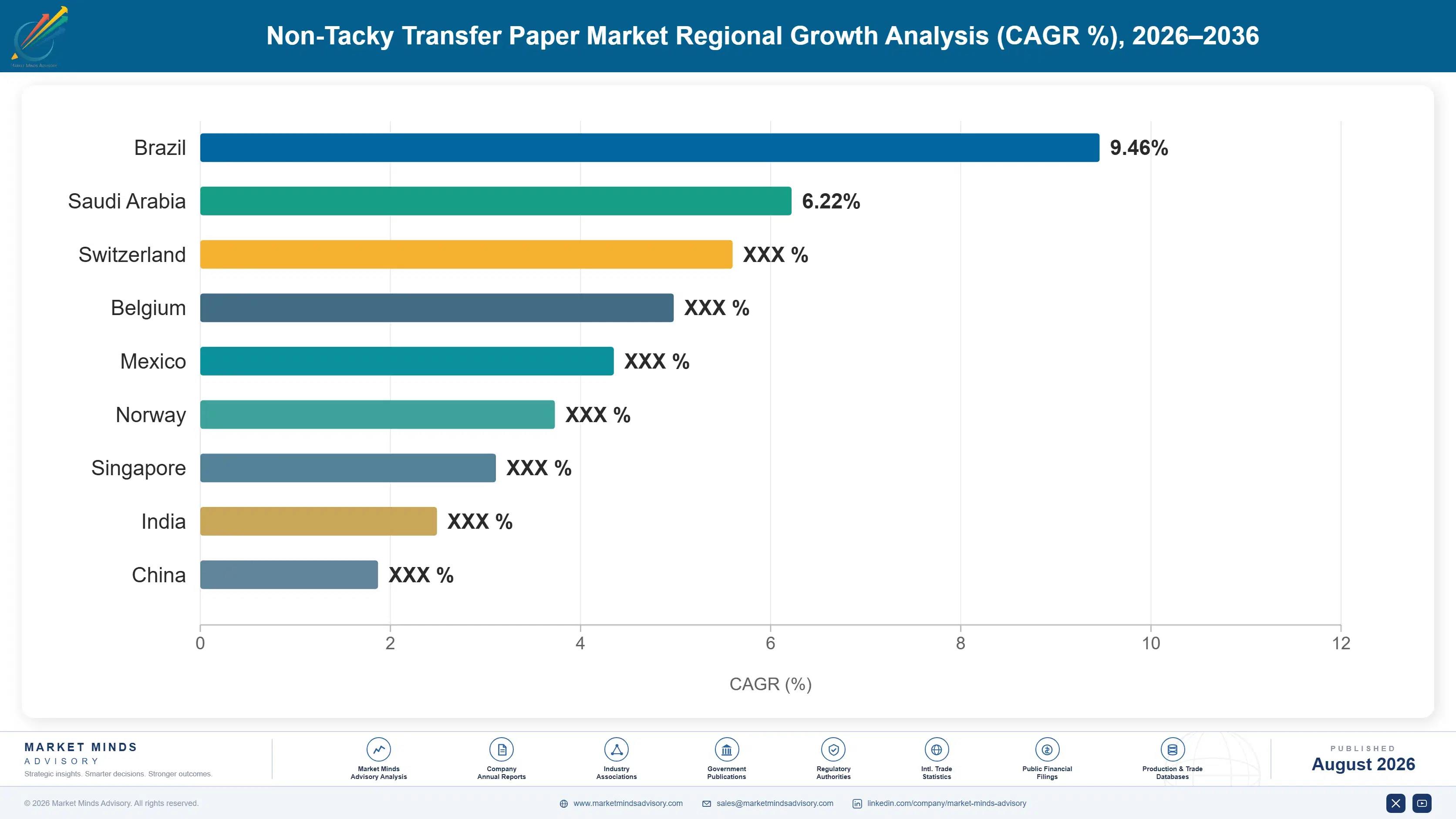
non-tacky-transfer-paper-market-country-cagr-analysis-1787555969484

Where Coating Margin Actually Lands

Four moves matter in a product sold by the square metre and consumed by the cycle. Two concern closing that gap so a supplier gets paid for actual performance rather than for coated area, and the other two concern the segments and the inputs that decide whether any position holds once that gap has been closed.

Sell guaranteed cycles instead of square metres

A texture release paper averages around six cycles and the spread between suppliers is wide enough to swamp any price difference between them, yet purchasing compares price per square metre because that is the number on the quote. Running measured cycle trials on the customer's own line converts the conversation entirely. A supplier whose paper genuinely lasts eight cycles against a competitor's five can price twenty per cent higher and still cut the customer's cost per finished metre substantially. Trials cost a few thousand dollars and settle an argument worth 20% of annual contract value.
Market Impact: Prices against 6 measured cycles rather than area

Build silicone-free capability for overprintable surfaces

Silicone migration leaves residue that prevents printing, bonding or lacquering on the transferred surface, which disqualifies conventional release paper wherever decoration happens after transfer rather than before. Silicone-free chemistries carry roughly a 34% premium for exactly that reason. Converters generally discover the incompatibility during overprinting, when material and machine time are already committed and the supplier who warned them looks considerably better than the one who did not. Automotive interior programmes fall into that category almost universally, since the grain is transferred first and the surface finished afterwards. Qualification protects the position once it is won.
Market Impact: Serves grades priced 34% above conventional release coatings

Serve the film decoration channel through distribution

Direct-to-film adjacent formats grow at 9.6%, faster than anything else here, and the buyers are small decoration shops ordering modest quantities through distributors rather than industrial converters signing annual contracts. Suppliers organised around long rolls and tender processes have served that channel badly and lost accounts to competitors who simply made ordering easy. The workflow advantage driving the format is genuine, which means the volume is not coming back to conventional transfer. Distributor stocking arrangements and small pack sizes are what these buyers actually need, and both are trivial for anyone willing to bother.
Market Impact: Serves a channel that is growing at 9.6%

Contract specialty base paper before it tightens

Around 61% of base sheet is imported from a small number of mills able to hold dimensional stability near 190 degrees without curling or losing caliper, and ordinary paper machines cannot make it. A coater without a second qualified source stops coating when that supply moves, regardless of order book. Qualifying alternative base paper requires trial runs and customer revalidation, which takes months nobody has once the disruption has already started. Contracting mill capacity directly is the strongest version of this and a few coaters have already done it. Trial cost is modest against a stoppage.
Market Impact: Secures the 61% of base sheet now imported

Who Controls the Margin Pool

Five coaters hold 44% of supply, measured on square metres of coated transfer paper supplied, the basis used throughout this section. Concentration follows release chemistry capability and base paper access rather than coating capacity, since coating equipment is widely available while the formulation and the qualified base sheet behind it are not. Chinese producers hold most standard grade volume on cost. Standard grade pricing reflects that directly.
Competition runs on four dimensions. Release chemistry depth, particularly silicone-free grades where downstream decoration is required and conventional coatings simply disqualify themselves. Cycle life performance, which decides real customer cost even though very few suppliers actually sell on it. Base paper sourcing security across a limited mill population. And channel reach, since the fastest-growing segment buys through distributors in genuinely small quantities.

Rankings shift toward suppliers willing to guarantee cycle performance and toward those serving the film decoration channel properly rather than dismissing it. European coaters hold the most advanced chemistry alongside the slowest-growing home market anywhere. Chinese producers hold standard grade volume and are moving upward into automotive texture work, which is where specification still protects the incumbents for now.
non-tacky-transfer-paper-market-company-positioning-matrix-1787555970007

Competitive Moat and Risk Dimensions

AHLSTROM

Moat: Release chemistry and base integration

The company combines specialty base paper capability with release coating formulation depth including silicone-free grades, which removes the input exposure that leaves independent coaters vulnerable when imported base sheet tightens. That integration also supports the technically demanding automotive texture work where grain consistency and colour fastness govern qualification rather than delivered price.
AHLSTROM

Risk: European base and Asian growth

The strongest positions sit in Western Europe, which grows at 4.8% and is the slowest region here, while East Asia at 42% and Southeast Asia at 13% carry the volume and the growth. Chinese producers hold standard grade cost positions that cannot be matched. Serving Asian converters properly needs local coating rather than exported rolls.
LINTEC CORPORATION

Moat: Asian proximity and specification depth

The company sits inside the region holding 42% of demand with release technology strong enough to serve automotive and electronics-grade applications rather than only standard synthetic leather work. Proximity to Chinese, Korean and Southeast Asian converters shortens qualification cycles and freight, both of which matter for a bulky product sold by the square metre.
LINTEC CORPORATION

Risk: Standard grade cost competition

Chinese coaters compete effectively on standard synthetic leather and decoration grades where release performance is adequate and price decides, and they are moving steadily upward into more demanding specifications. Defending on technical capability works only while the specification gap holds. The film decoration channel meanwhile buys through distribution that industrial suppliers rarely serve well.

Players Tracked

Prominent Players

Ahlstrom
Sappi
Felix Schoeller
Lintec Corporation
Loparex

Other Key Players

Mondi
UPM Raflatac
Nippon Paper Papylia
Oji Holdings
Asia Pulp and Paper
Guangdong Guanhao High-Tech
Zhejiang Sunlight Paper
Coveme
Neenah Coldenhove
Beaver Paper and Graphic Media
Hansol Paper
Jiangyin Kaiyuan
Siliconature
Rayven
Cham Paper Group

Recent Developments

JANUARY 2025

A coater launched cycle-guaranteed texture release grades

A European coater introduced synthetic leather texture papers sold with a contractually guaranteed minimum cycle count, following line trials conducted at customer sites rather than under laboratory conditions. This was a commercial product launch rather than any acquisition, merger or joint venture arrangement. Terms varied by grain pattern.
Signal: Selling guaranteed cycles rather than square metres reframes the purchase around the number that actually decides customer cost
JUNE 2025

A Vietnamese converter commissioned release coating capacity

A Vietnamese converter commissioned domestic release coating capacity serving footwear and garment manufacture relocating into the country, continuing to import the specialty base sheet the coating requires. This was organic capital investment rather than any partnership or acquisition involving an established coater. Footwear customers drove the timing.
Signal: Regional coating capability grows while base paper stays imported, which concentrates supply exposure at exactly the fastest growing point
OCTOBER 2025

A supplier expanded silicone-free release coating capacity

A specialty paper supplier expanded silicone-free release coating capacity aimed at applications requiring printing, bonding or lacquering after transfer, where conventional silicone residue prevents adhesion. This was organic capital investment rather than any acquisition, merger or partnership with another company. Automotive interior customers were the stated target.
Signal: Downstream decoration requirements rather than the transfer step itself increasingly determine which release chemistry a converter can use

What Sets Coater Economics

Specialty base paper accounts for roughly 54% of coater cost, and around 61% of it arrives imported from a limited number of mills. Release coating chemistry adds about 18%, with silicone-free systems costing considerably more than conventional silicone. Coating energy, drying and curing take around 11%. Waste from web breaks and coating defects matters more than its percentage suggests.
Specialty paper and chemical costs rose sharply through 2022 as European energy prices climbed, and IEA data show industrial gas there far above Asian levels for an extended period. Ahlstrom noted raw material and energy cost pressure across its specialty operations in its Annual Report 2022. Coaters holding annual customer pricing absorbed most of it, and several European producers lost standard grade volume to Asian competitors permanently as a result.

The disadvantage falls on independent coaters without base paper security, and it shows as availability rather than cost. A coater whose single qualified base source diverts capacity stops coating entirely, since requalifying takes trial runs and customer revalidation lasting months. Integrated producers making their own base sheet avoid this completely. Southeast Asian coaters are most exposed, growing fastest while importing every metre of base paper they use.
non-tacky-transfer-paper-market-cost-volatility-analysis-1787555970202

Qualify a second base paper source before supply moves

Roughly 61% of base sheet is imported from mills that can hold dimensional stability near 190 degrees, and few others can make it. Qualifying an alternative needs trial runs and customer revalidation lasting months, which nobody has available once a disruption has begun. Doing that work while supply is comfortable is the entire mitigation.

Price coated grades against measured cycle performance

Base paper and chemistry together run near 72% of cost, so a coater selling on price per square metre competes on inputs it does not control. Pricing against measured cycles achieved on the customer's own line shifts the comparison onto performance. Customers accept it where trial data supports the claim and reject it flatly where it does not.

Cut coated waste before chasing input cost reductions

Scrapped coated paper carries base sheet and release chemistry already paid for, which makes a point of waste reduction worth several points of purchasing improvement. Web break frequency, coating weight uniformity and edge trim are where it accumulates. Most coaters track the tonnage and very few translate it into the input cost it actually represents.

Portfolio Architecture for Margin Defence

Margin separates on release chemistry and application demand rather than on coating scale, since coating equipment is widely available and the formulation behind it is not. Standard synthetic leather and decoration grades run at gross margins in the mid teens against Chinese coaters competing hard on delivered cost. Sublimation and industrial laminate grades run better on coating weight and holdout requirements. Automotive texture and silicone-free grades run considerably higher, because qualification narrows the field and specification rather than price decides.
The tension is that standard grades fill the coater while specification grades earn the return, and moving between them requires chemistry development and customer qualification rather than any equipment investment. Producers weighted toward standard volume face Chinese cost competition that will not ease. Funding chemistry work from those margins is slow, and several European coaters have lost the volume that was meant to pay for it.

High-value pools sit in silicone-free grades, automotive texture work and cycle-guaranteed supply. Standard synthetic leather release is where cost competition has already settled the question for anybody without a chemistry position. Chemistry capability is the only thing separating a defensible position from a slow retreat on price.

Volume / Commodity-Adjacent

Standard synthetic leather release and general decoration grades sold on delivered price against Chinese coaters. The nine-point range separates producers with integrated base paper and low energy cost from independents importing sheet and buying power at market.
Gross Margin: 13%-22%

Premium / Certified

Sublimation and industrial laminate grades where coating weight, ink holdout and dimensional stability are specified and measured by the buyer. The thirteen-point spread reflects coating control capability rather than any difference in base paper used.
Gross Margin: 25%-38%

Sustainability / Regulatory / Next-Generation

Silicone-free release grades, automotive texture papers and cycle-guaranteed supply. The twenty-point range is wide because qualification depth, downstream decoration requirements and guarantee terms vary enormously between individual customers and programmes.
Gross Margin: 36%-56%
non-tacky-transfer-paper-market-portfolio-architecture-1787555970705

High-value Sub-segments and Strategic Watch-out

Silicone-Free Release Grades

Carrying roughly a 34% premium because silicone residue prevents printing, bonding and lacquering after transfer. Converters usually discover the incompatibility mid-run, which makes the supplier who warned them look considerably better than the one who did not. Downstream decoration alone decides whether a coating qualifies.
Gross Margin: 38%-56%

Automotive Texture Papers

Grain consistency and colour fastness requirements narrow the qualified field sharply, and programmes run for years once awarded. Qualification takes long enough that incumbency here is unusually valuable and unusually difficult for a challenger to break. Grain libraries very rarely transfer between manufacturers at all.
Gross Margin: 36%-50%

Film Decoration Channel

Growing at 9.6% through distributors serving small decoration shops in modest quantities. Industrial suppliers organised around long rolls and tender processes have served it badly, which is why the accounts keep going elsewhere. Distributor stocking and small pack sizes are all it takes. Nobody has bothered.
Gross Margin: 28%-42%

Standard Synthetic Leather Release

The coater volume, competed on delivered price against Chinese producers with cost positions nobody matches. Manage this for base paper security and coated waste reduction rather than for margin that is not returning. Coated waste carries inputs already paid for, which makes it worth more attention than purchasing improvements are.
Gross Margin: 13%-22%

How Coated Demand Renews

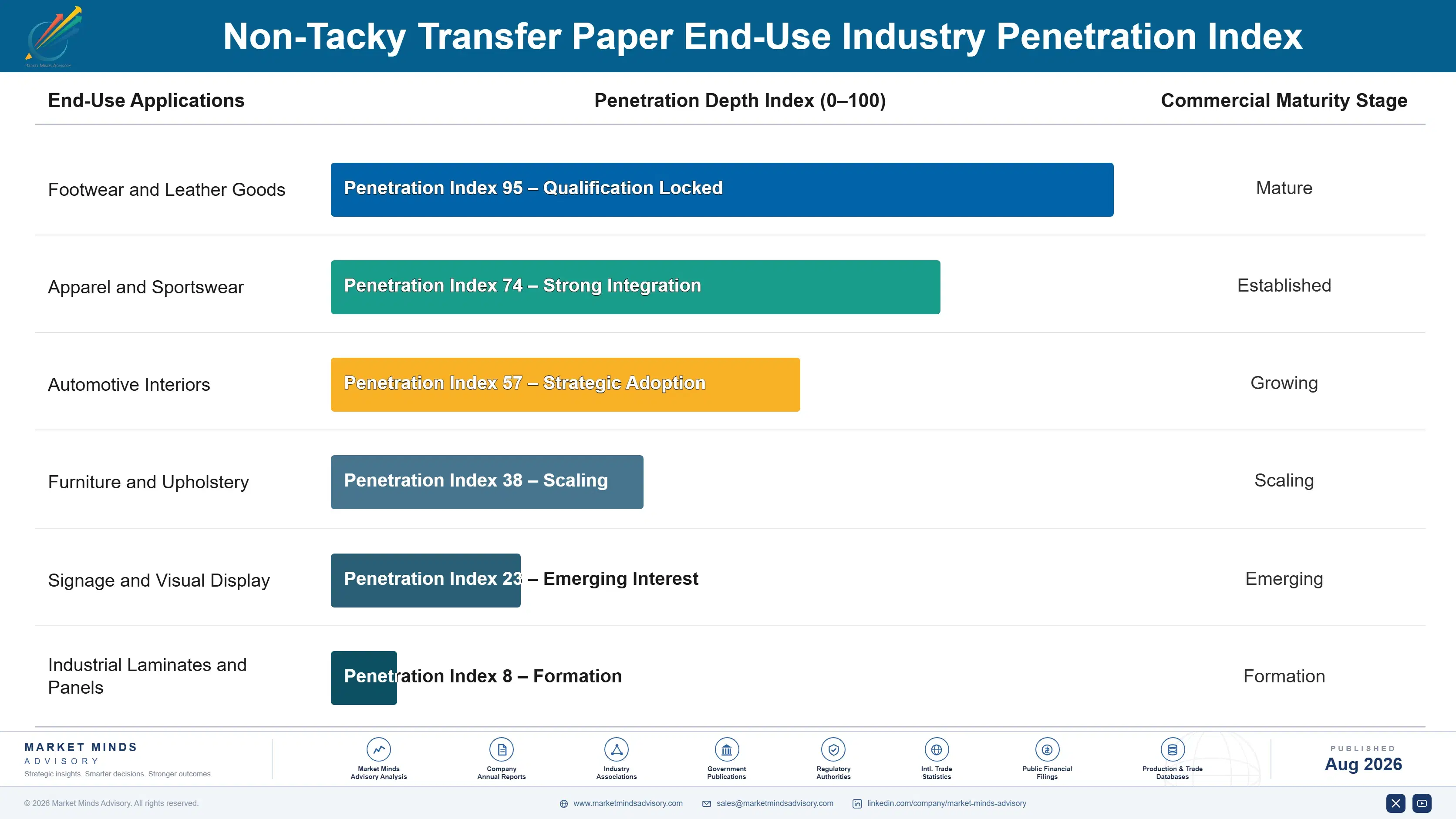
Demand renews with converting line hours, but the reuse cycle sits between production and purchasing and distorts the relationship badly. A synthetic leather line consumes release paper continuously and reorders when cycle life expires, so demand depends jointly on how much the customer produces and on how well the paper performs. A supplier improving cycle life reduces its own volume while improving the customer's economics, which nobody discusses openly.
Adoption depth varies sharply by vertical and it tracks qualification difficulty. Automotive texture programmes qualify a specific paper against grain and fastness requirements and run it for years, which makes those relationships extremely durable. Sublimation buyers measure ink holdout and switch on measurement. Small decoration shops buying through distributors change supplier on availability and price with no qualification at all, which is why the fastest-growing channel is also the least loyal.

The buyer has moved partly from purchasing toward production engineering, at least where cycle life gets measured properly. Release paper was a consumable bought on price per square metre by procurement. In the converters who have done the arithmetic it now involves the people who track cost per finished metre and understand what a cycle is worth.
non-tacky-transfer-paper-market-end-use-penetration-index-1787555971196

Where To Place The Bet

These are among the four positions where our research anticipates prominent divergence between winners and laggards over the coming forecast period. Each is grounded in the demand model, the regulatory perimeter, and the announced capacity pipeline.
01 / CYCLE GUARANTEED SELLING

Get paid for performance, not for coated area

Texture release paper averages around six reuse cycles and the spread between suppliers is wide enough to overwhelm any price difference that appears on a quotation, yet purchasing compares price per square metre because that is the figure the tender asks for. Running measured cycle trials on the customer's own production line changes the entire basis of the conversation. A paper genuinely lasting eight cycles against a competitor's five can price twenty per cent higher while still cutting the customer's real cost substantially.
02 / OVERPRINTABLE CHEMISTRY POSITION

Solve the problem discovered during overprinting

Silicone release coatings migrate onto the transferred surface and leave residue preventing any subsequent printing, bonding or lacquering, which matters not at all for a finished decorative face and disqualifies the paper completely wherever decoration happens after transfer. Silicone-free chemistries carry roughly a 34% premium for precisely that reason and nothing else. Converters typically discover the incompatibility partway through a production run, with material and machine time already committed, which is what makes the supplier's warning worth very nearly as much as the product itself.
03 / FILM CHANNEL COVERAGE

Make ordering easy for small decoration shops

Direct-to-film adjacent formats compound at 9.6%, faster than anything else in this market, and the buyers are small garment decoration businesses purchasing modest quantities through distributors rather than industrial converters negotiating annual tonnage contracts with a sales team. Suppliers organised entirely around long industrial rolls have served that channel poorly and lost accounts to competitors who simply made ordering straightforward. The workflow advantage behind the format is entirely genuine rather than promotional, which means none of that volume is coming back to conventional transfer paper.
04 / BASE SHEET SECURITY

Qualify the second source while supply is comfortable

Roughly 61% of specialty base sheet is imported from a small number of mills capable of holding dimensional stability near 190 degrees without curling or losing caliper, and ordinary paper machines simply cannot produce it to that standard. A coater with one qualified source stops coating altogether when that mill diverts capacity, regardless of how full the order book happens to be. Qualifying an alternative requires trial runs and full customer revalidation taking months that nobody has available once a disruption has already started.

Engagement Snapshot From the Field

A live engagement with an industry participant carrying material or product regulatory and market exposure ahead of a defining policy shift, showing how our research translates into a defensible multi-year portfolio strategy.
MARKET MINDS ADVISORY · CLIENT ENGAGEMENT SUMMARY
Non-Tacky Transfer Paper Producer Strategic Portfolio Review and Transition Roadmap 2026·Investment Scenario on Non-Tacky Transfer Paper Exposure Evaluation 2025-26
CLIENT PROFILE
An Asian release paper coater producing around 96 million square metres annually (client-reported, unverified by MMA), supplying synthetic leather converters and decoration customers across three regional markets. All specialty base paper was imported from a single qualified mill. Silicone-free capability did not exist. Pricing ran entirely on square metres. Margins had compressed for three years.
STRATEGIC CHALLENGE
Standard grade margins had compressed for three consecutive years against Chinese competition, and management proposed a coating capacity expansion to defend share on unit cost. Nobody had tested whether the client's papers actually outperformed on cycle life, or what that would be worth if they did. Neither question had been tested.
MMA APPROACH
MMA ran measured cycle trials on four customer production lines comparing the client's grades against competitor material under real operating conditions rather than laboratory ones. Silicone-free chemistry investment was costed against the applications requiring overprintability. Base paper exposure was quantified against the single qualified source and alternative mills assessed. Competitor pricing was benchmarked alongside.
KEY FINDINGS
  1. Client papers averaged seven cycles against a competitor average of five on the same lines, a difference worth considerably more to the customer than the entire price gap being argued over.
  2. No customer had ever measured cycles systematically, and all four had been buying on price per square metre while assuming performance across suppliers was broadly equivalent.
  3. Two automotive interior programmes within reach required overprintable surfaces the client could not serve at all without silicone-free coating capability it did not possess.
  4. The single qualified base paper mill had reallocated capacity twice in two years, forcing production interruptions the client had absorbed rather than treated as a sourcing failure.
CLIENT PROFILE
An Asian release paper coater producing around 96 million square metres annually (client-reported, unverified by MMA), supplying synthetic leather converters and decoration customers across three regional markets. All specialty base paper was imported from a single qualified mill. Silicone-free capability did not exist. Pricing ran entirely on square metres. Margins had compressed for three years.
STRATEGIC CHALLENGE
Standard grade margins had compressed for three consecutive years against Chinese competition, and management proposed a coating capacity expansion to defend share on unit cost. Nobody had tested whether the client's papers actually outperformed on cycle life, or what that would be worth if they did. Neither question had been tested.
MMA APPROACH
MMA ran measured cycle trials on four customer production lines comparing the client's grades against competitor material under real operating conditions rather than laboratory ones. Silicone-free chemistry investment was costed against the applications requiring overprintability. Base paper exposure was quantified against the single qualified source and alternative mills assessed. Competitor pricing was benchmarked alongside.
KEY FINDINGS
  1. Client papers averaged seven cycles against a competitor average of five on the same lines, a difference worth considerably more to the customer than the entire price gap being argued over.
  2. No customer had ever measured cycles systematically, and all four had been buying on price per square metre while assuming performance across suppliers was broadly equivalent.
  3. Two automotive interior programmes within reach required overprintable surfaces the client could not serve at all without silicone-free coating capability it did not possess.
  4. The single qualified base paper mill had reallocated capacity twice in two years, forcing production interruptions the client had absorbed rather than treated as a sourcing failure.
RECOMMENDED STRATEGY
Phase 1: Phase one: shelve the capacity expansion and reprice existing grades against measured cycle performance, using the trial data already generated on customer lines. Phase 2: Phase two: invest in silicone-free release coating capability and pursue the two identified automotive interior programmes requiring overprintable transferred surfaces. Phase 3: Phase three: qualify a second specialty base paper mill immediately, accepting trial and revalidation cost while supply conditions remain comfortable.
OUTCOME
Cycle-based repricing held margin on three of four accounts and recovered pricing on the fourth. Silicone-free capacity is commissioned and one automotive programme has qualified. A second base paper source is approved, and the client reports no further production interruptions (client-reported, unverified by MMA). Capital spending fell well below plan.

Frequently Asked Questions

Foundational context covering the market sizes, CAGR, scope, country, region and competition that inform every finding below. This section is provided to cover basics and most often pre-purchase conversations, answered from the MMA Primary Research Dataset.

What is the current size of the Non-Tacky Transfer Paper Market?

The market was valued at USD 1.24 billion in 2025, rising to an estimated USD 1.32 billion in 2026. East Asia holds the largest regional share at 42% of value.

How large will the Non-Tacky Transfer Paper Market be by 2036?

MMA forecasts USD 2.45 billion by 2036 under the base case, an expansion multiple of 1.86 times the 2026 value. That represents USD 1.13 billion of incremental value.

What is the CAGR for the Non-Tacky Transfer Paper Market 2026 to 2036?

The base case runs at 6.4% compound annual growth between 2026 and 2036, with a bull case at 7.6% and a bear case at 5.2%. Historical growth from 2020 to 2025 was 5.2%.

Which segment is growing fastest?

Digital direct-to-film adjacent formats lead at 9.6%, half again the market rate, because film transfer needs no cutting or weeding. Sublimation transfer follows at 7.0%.

Who are the major companies in the Non-Tacky Transfer Paper Market?

Ahlstrom, Sappi, Felix Schoeller, Lintec Corporation and Loparex hold 44% of supply. Release chemistry depth and base paper access rather than coating capacity sustain those positions.

Which country is growing fastest?

Vietnam leads at 10.2%, driven by footwear, sportswear and garment manufacture continuing to relocate there from Chinese coastal provinces on labour cost and tariff grounds.

Report Segmentation Architecture

The full report scope spans multiple orthogonal segmentation dimensions, with cross-tabulated demand data provided for each dimension pair. Coverage extends further to regional breakdowns, trend trajectories, and the competitive detail needed to support segment-level decision-making.

By Application

  • Synthetic Leather Release and Texture
  • Textile Heat Transfer and Garment Decoration
  • Sublimation Transfer
  • Industrial Laminate and Surface Decoration
  • Digital Direct-to-Film Adjacent Formats
  • Labels, Graphics and Specialty Transfer

By End-Use Industry

  • Footwear and Leather Goods
  • Apparel and Sportswear
  • Automotive Interiors
  • Furniture and Upholstery
  • Signage and Visual Display
  • Industrial Laminates and Panels

By Coating and Channel

  • Silicone Release Coated
  • Silicone-Free Release Coated
  • Embossed Texture Grades
  • Sublimation Coated Grades
  • Distributor and Small-Lot Channel

By Region

  • North America
  • Western Europe
  • East Asia
  • South Asia and Pacific
  • Latin America
  • Middle East and Africa
  • Eastern Europe

Scope, Methodology, and Coverage

Every figure in this report is reproducible from documented input assumptions. The scope below maps the historical period, the forecast horizon, the segmentation dimensions, and the countries covered, alongside the underlying primary and qualitative methodology.
Historical Period
2020 to 2025
Forecast Period
2026 to 2036
Base Year
2025 (USD billions; MMA Primary Research Dataset, August 2026)
Market Definition
The market comprises non-tacky transfer and release papers used for heat transfer and pattern transfer without a tack coat, supplied in silicone coated, silicone-free, embossed texture and sublimation coated grades across synthetic leather release and texture, textile heat transfer and garment decoration, sublimation transfer, industrial laminate and surface decoration, digital direct-to-film adjacent formats, and labels graphics and specialty transfer. Value is measured at coater level on square metres of coated paper supplied. Pressure-sensitive label release liners, uncoated specialty base paper sold as such, polyester and other plastic transfer films, and heat transfer inks, powders or adhesives fall outside scope.
Quantitative Units
USD billions (current prices); million square metres coated paper; USD per square metre by grade and application
Segmentation Dimensions
By Application; By End-Use Industry; By Coating and Channel; By Region
Regions Covered
North America, Western Europe, East Asia, South Asia and Pacific, Latin America, Middle East and Africa, Eastern Europe
Countries Covered
China, Japan, South Korea, Taiwan, Vietnam, India, Indonesia, Thailand, Bangladesh, Australia, United States, Canada, Mexico, Brazil, Argentina, Colombia, Germany, Italy, Finland, Netherlands, Spain, France, United Kingdom, Poland, Czechia, Romania, Turkey, Egypt, Morocco, South Africa
Key Companies Profiled
Ahlstrom, Sappi, Felix Schoeller, Lintec Corporation, Loparex, Mondi, UPM Raflatac, Nippon Paper Papylia, Oji Holdings, Asia Pulp and Paper, Guangdong Guanhao High-Tech, Zhejiang Sunlight Paper, Coveme, Neenah Coldenhove, Beaver Paper and Graphic Media, Hansol Paper, Jiangyin Kaiyuan, Siliconature, Rayven, Cham Paper Group
Quantitative Methodology
Primary survey, n=3,800 respondents, Q4 2025, six countries; demand-side model with trade association cross-validation
Qualitative Methodology
47 expert interviews, Q4 2025; applied to validate demand model assumptions, identify emerging dynamics, and assess competitive positioning
Report Format
PDF and XLSX data workbook (Word format preview document)
Publisher
Market Minds Advisory
Report Code
MMA-2026-PAC-202
Published
August 2026
Contact
sales@marketmindsadvisory.com | www.marketmindsadvisory.com

Purchase the full Non-Tacky Transfer Paper Market Report (2026 to 2036).

The full report sizes the global non-tacky transfer paper market to 2036 across six applications and seven regions, measured on square metres of coated paper at coater level. It models reuse cycle economics explicitly, since cost per finished metre rather than price per square metre is what actually governs converter purchasing decisions. Competitive analysis covers 20 coaters on one consistent area basis, with moat and risk assessment for the two leaders. Silicone-free demand is sized against downstream decoration requirements. Four quantified revenue levers close the analysis.
Six-application segment sizing with individual growth rates
Reuse cycle economics modelled against price per square metre
Silicone-free demand sized by downstream decoration requirement
Specialty base paper sourcing exposure mapped by mill origin
Twenty-coater competitive map on one consistent area basis
Four quantified revenue levers with commercial impact ranges

Built For The People Who Decide

From boardroom strategy to bench-side execution, this report is read cover-to-cover by leaders shaping the next decade of their industry, turning demand scenarios, market dynamics and valuation benchmarks into decisions.
CXOs/ Presidents/ VPs/ Managers
M&A and Corporate Development
Strategy Teams and R&D Heads
Procurement and Product Directors
Regulatory and Compliance Leaders
Investor Relations and Equity Analysts