Market Minds Advisory
Non-Polarized Electric Capacitor Market

Non-Polarized Electric Capacitor Market: Non-Polarized Electric Capacitor Market. Trends and Forecast 2026 to 2036

Electric vehicle power electronics and 5G infrastructure are pulling non-polarized capacitor demand toward higher voltage and temperature specifications, forcing ceramic and film manufacturers to prove reliability as automotive qualification standards tighten globally.

Lead Analyst

Published

September 2026

Make Smarter Decisions with Customized Research Insights

Request a free sample report and evaluate market opportunities, growth trends, and competitive dynamics relevant to your business needs.

2025 MARKET VALUE$14.5BMarket Size 2025
2036 FORECAST VALUE$35.6BBase Case , 2026 to 2036
CAGR 2026 TO 20368.5 %Bull 9.8% / Bear 7.3%
INCREMENTAL OPPORTUNITY$19.8BNet 10- year value creation
EXPANSION MULTIPLE2.26x2036 value over 2026 base
Strategic Levers
M&A Pipeline
Regional Outlook
Country Rankings
Competitive Intelligence
Segmental Deep-dive
Call-Us : 91 93563 13602

Executive Snapshot and Market Trajectory.

Non-polarized capacitor demand is shifting decisively toward automotive and grid-scale power electronics applications, where voltage tolerance and thermal stability requirements exceed what consumer electronics grade components can deliver. This qualification gap is reshaping which manufacturers win design-in slots for the next generation of electric vehicle platforms.
Commercial demand concentrates around multilayer ceramic capacitors for electric vehicle traction inverters and onboard chargers, with automotive qualification cycles now the primary gate determining supplier selection rather than unit price alone across most program tiers. East Asia dominates both production capacity and design leadership, home to the world's largest ceramic and film capacitor manufacturers and the automotive supply chains increasingly co-located near vehicle assembly plants across the region, reinforcing an already durable manufacturing cost advantage.
Competitive intensity remains high among a concentrated group of established manufacturers, with the top five controlling nearly half of global revenue through decades of accumulated process expertise in ceramic dielectric formulation. Rising demand for higher capacitance density and automotive-grade reliability certification is reshaping which suppliers can command premium pricing, favoring manufacturers with proprietary dielectric materials over commodity producers competing purely on unit cost alone.
Market Definition
The Non-Polarized Electric Capacitor Market covers ceramic, film, and mica capacitors that store and release electrical energy without regard to polarity orientation, sold across automotive, consumer electronics, telecommunications, and industrial power applications. It excludes polarized electrolytic and tantalum capacitors, which are tracked as a separate product category.
Base Year Value
$14.5B in 2025 (MMA Primary Research Dataset, September 2026)
Forecast Period
2026 to 2036, eleven discrete annual values
CAGR
8.5% base case. Bull 9.8%. Bear 7.3%.
Fastest Growth Segment
Multilayer Ceramic Capacitors for EV Power Electronics: 13.0% CAGR
Fastest Growth Country
China: 11.5% CAGR
Fastest Growth Region
South Asia and Pacific: 10.5% CAGR
Largest Region
East Asia: 38% of 2025 global value
Market Leaders
Leading participants include Murata Manufacturing, TDK Corporation, Samsung Electro-Mechanics, Taiyo Yuden, and Yageo Corporation. Source: MMA Analysis based on company annual reports.
Primary Survey
n=3,800 procurement and R&D decision-makers, Q4 2025, six countries
Methodology
Demand-side build-up, cross-validated against public data, 47 expert interviews

Non-Polarized Electric Capacitor Market Forecast Scenarios

non-polarized-electric-capacitor-market-size-forecast-scenario-1789988590255
Non-polarized capacitor demand grew steadily through 2020 to 2025, tracking consumer electronics and industrial production volume with modest year-over-year variation. Growth accelerated toward the end of the historical period as electric vehicle production ramped meaningfully across major markets and 5G infrastructure buildout added a distinct new demand category, pushing the historical CAGR to 7.5% by the period's close.
The base case assumes electric vehicle production volume keeps climbing globally while grid infrastructure modernization sustains parallel industrial demand through the forecast decade. Three mechanisms drive this: automotive qualification cycles locking in multi-year supplier relationships once a design wins traction inverter or onboard charger slots, rising capacitance density requirements pushing average selling prices upward even as unit volume grows, and 5G base station deployment continuing across secondary markets that have not yet reached network buildout maturity.
The bull case centers on faster than expected electric vehicle adoption in emerging markets, pulling automotive-grade capacitor demand forward across the forecast period. The bear risk is a sharper than anticipated slowdown in global EV production growth, which would leave capacitor manufacturers with underutilized automotive-grade capacity built during the recent investment cycle and compress pricing across the broader market.

Where Automotive Qualification Determines Supplier Selection

Automotive qualification has become the defining commercial gate in this market, more consequential than raw manufacturing cost or brand reputation alone. Suppliers seeking design wins in electric vehicle traction inverters must pass multi-year AEC-Q200 reliability testing before a single unit ships, creating a durable lock-in once a supplier clears that bar for a given vehicle platform across its full production run.
MARKET CONCENTRATION46% CR5Top five manufacturers control global capacitor production revenue share
AVERAGE SELLING PRICE$0.018 per unitBlended average price across ceramic and film capacitor categories sold
TOP PRODUCING COUNTRY SHARE38%China's share of global non-polarized capacitor manufacturing output currently
CAPACITY UTILIZATION RATE81%Average factory utilization across major ceramic capacitor production facilities worldwide
FEEDSTOCK COST SHARE35% of COGSCeramic powder and precious metal electrode input cost portion
REPLACEMENT CYCLE LENGTH8 to 10 yearsTypical automotive platform lifecycle before capacitor specification review occurs
East Asian manufacturers dominate both production scale and materials science leadership in ceramic dielectric formulation, a legacy of decades of accumulated process investment that newer entrants struggle to replicate quickly at comparable yield. Film capacitor demand is growing fastest in grid-scale power electronics and renewable inverter applications, where higher voltage tolerance requirements favor established manufacturers over commodity ceramic producers competing purely on unit price.
Capacity utilization across major producers sits comfortably above 80%, reflecting sustained demand growth rather than cyclical inventory restocking that characterized prior capacitor market downturns and recoveries. Feedstock cost, particularly ceramic powder and precious metal electrode material, represents a meaningful share of total production cost, exposing manufacturers to commodity price volatility that larger, vertically integrated producers can absorb more easily than smaller regional competitors.
"Capacitor suppliers used to compete on price per thousand units. Now they compete on how fast they can clear an automotive qualification cycle, and that has quietly rewritten who wins design slots."
Director, Electronic Components and Materials Practice · MMA Technology Practice · September 2026

Market Trends

Electric Vehicle Traction Inverters Drive Automotive-Grade Demand

Electric vehicle traction inverters and onboard chargers require capacitors rated for higher voltage, temperature, and vibration tolerance than consumer electronics grade components, creating a distinct automotive qualification tier within the broader capacitor market. Manufacturers passing AEC-Q200 automotive reliability testing are winning multi-year design-in commitments tied to specific vehicle platforms, locking in demand well before mass production begins. This qualification barrier is reshaping competitive dynamics, since suppliers without automotive-grade manufacturing lines cannot simply retrofit consumer production capacity to meet automotive specifications quickly, giving early qualified suppliers a multi-year head start over challengers entering the segment now.
Market Impact: Lifts average selling prices 12%

5G Base Station Deployment Sustains Telecommunications Demand

Fifth-generation wireless infrastructure deployment continues across secondary markets that have not yet reached network buildout maturity, sustaining a steady demand channel for high-frequency ceramic capacitors used in base station power supplies and radio frequency filtering circuits. Telecommunications equipment manufacturers require capacitors with tight tolerance specifications and low equivalent series resistance to maintain signal integrity at higher frequencies than earlier wireless generations required. This demand channel is expected to remain durable through the middle of the forecast period as remaining 5G rollout regions complete their initial network buildout phase, before eventual transition toward whatever wireless standard follows.
Market Impact: Expands film capacitor demand by 9%

Market Opportunities and Growth Drivers

Rising Capacitance Density Requirements Lift Average Selling Prices

Electric vehicle and renewable inverter applications increasingly demand higher capacitance density within the same physical footprint, since space-constrained power modules cannot accommodate larger passive components as circuit complexity grows. Manufacturers investing in advanced multilayer ceramic stacking techniques can pack more capacitance per unit volume, commanding meaningfully higher average selling prices than commodity capacitors serving standard consumer electronics applications. This shift is expanding gross margin for suppliers with the process expertise to manufacture high-density parts reliably at scale, while commodity producers see average selling prices continue eroding under sustained competitive pressure across most volume segments.
Market Impact: Nickel substitution cuts exposure by 40%

Grid Modernization Programs Expand Industrial Demand Base

Government-funded grid modernization programs across multiple economies are expanding renewable energy inverter and power conditioning equipment deployment, creating sustained industrial demand for high-voltage film capacitors used in solar and wind power conversion systems. This demand channel operates somewhat independently of consumer electronics cyclicality, providing manufacturers a more stable revenue base during periods of weaker consumer device demand. Industrial and grid-scale applications now represent a growing share of film capacitor revenue specifically, a meaningful shift from the historically consumer-electronics-dominated demand profile that characterized the broader capacitor industry through most of the previous decade.
Market Impact: Delays revenue recognition by 2 years

Market Restraints and Challenges

Precious Metal Electrode Costs Compress Margin

Palladium and silver electrode materials represent a substantial share of multilayer ceramic capacitor production cost, and prices for both metals have shown pronounced volatility over the past several years driven by industrial demand and investment speculation unrelated to capacitor manufacturing itself. The root cause is a thin global supply base concentrated in a handful of mining regions, leaving manufacturers exposed to price swings outside their operational control entirely. Producers are mitigating this exposure by shifting toward nickel electrode formulations where dielectric performance permits, and by negotiating longer-term metal supply contracts to smooth price volatility across production planning cycles.
Market Impact: Traction inverter demand grows over 13%

Automotive Qualification Cycles Delay Revenue Recognition

Automotive-grade capacitor qualification requires multi-year reliability testing before a supplier can book revenue against a specific vehicle platform design win, creating a substantial cash flow lag between initial development investment and eventual production revenue realization. The root cause is the inherent conservatism of automotive safety and reliability standards, which prioritize proven long-term performance over speed to market. Suppliers are mitigating this by pursuing parallel qualification across multiple vehicle programs simultaneously, spreading the multi-year investment cost across a broader eventual revenue base rather than depending on a single platform's production timeline.
Market Impact: Sustains demand through roughly 2030 rollout
3 additional market trends, 4 additional growth drivers, and 2 additional restraints and challenges are covered in the full report. Contact sales@marketmindsadvisory.com to access the complete intelligence.

Segment CAGR and Growth Architecture

Non-polarized capacitors segment by dielectric material and application tier across six categories spanning automotive-grade ceramic, general electronics ceramic, film, mica, disc, and emerging supercapacitor components. Each reflects a distinct manufacturing process and qualification requirement rather than overlapping product tiers within a single dielectric family, giving buyers a clear and consistent basis for supplier comparison across the full product range.
non-polarized-electric-capacitor-market-market-share-analysis-1789988590800

Multilayer Ceramic Capacitors for EV Power Electronics

Multilayer ceramic capacitors for electric vehicle power electronics is the fastest-growing segment, expanding at 13.0% CAGR as traction inverter and onboard charger designs proliferate across an expanding range of vehicle platforms globally and across most major automakers. These components require automotive-grade reliability certification under AEC-Q200 testing standards, a multi-year qualification process that creates durable design-in relationships once a supplier clears the bar for a specific vehicle program. Demand here scales directly with electric vehicle production volume rather than general consumer electronics cycles, giving this segment a distinct growth trajectory increasingly decoupled from the broader capacitor market. Manufacturers with established automotive qualification are capturing disproportionate share as production ramps across multiple vehicle programs simultaneously worldwide.
CAGR 13.0%

Film Capacitors

Film capacitors form the second-fastest-growing segment at 10.5% CAGR, driven primarily by grid-scale renewable inverter and power conditioning applications requiring higher voltage tolerance than ceramic dielectrics typically provide economically at comparable physical size and weight specifications across most product categories. Solar and wind power conversion systems increasingly specify film capacitors for their superior self-healing properties and stability under sustained high-voltage operating conditions across variable weather exposure and temperature extremes over long service lives. Government-funded grid modernization programs across multiple economies are expanding this demand base independently of consumer electronics cyclicality, providing film capacitor manufacturers a more stable revenue profile than ceramic producers dependent on volatile consumer device demand cycles worldwide.
CAGR 10.5%
Full segment breakdown across 6 segments available in the complete report.

Regional Architecture and Country Demand Map

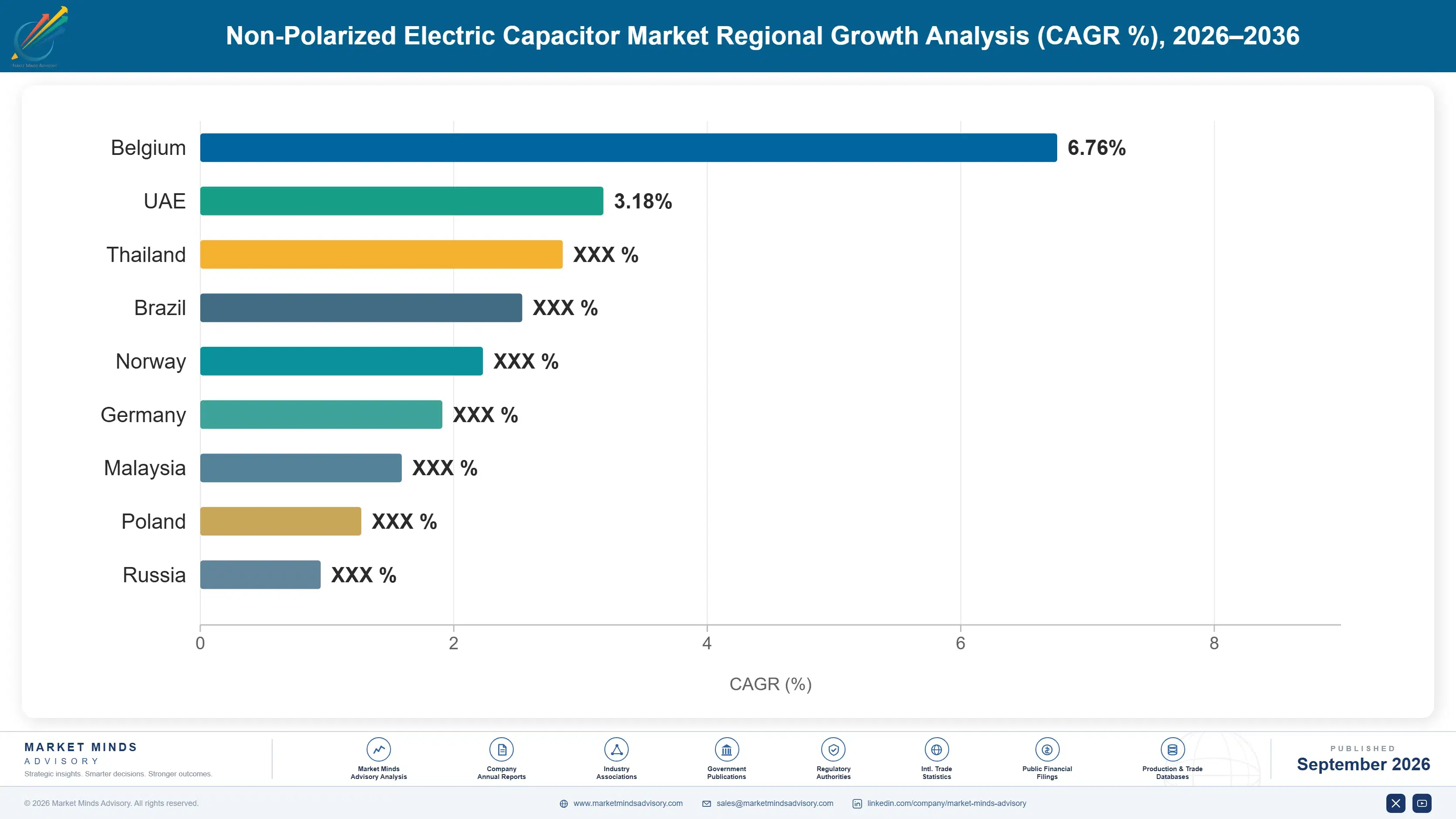
East Asia materially dominates non-polarized capacitor production given decades of concentrated manufacturing investment across Japan, South Korea, China, and Taiwan, while North America and South Asia scale fastest on automotive electrification and grid modernization demand across their respective domestic markets, supply chains, and industrial bases.

North America

The United States hosts a smaller but strategically important base of automotive-grade and defense-specification capacitor manufacturing, prioritizing supply chain resilience and domestic sourcing requirements over pure manufacturing cost competitiveness. Recent federal semiconductor and electronics manufacturing incentive programs have begun attracting new capacitor production investment domestically, though absolute capacity remains far smaller than East Asian manufacturing scale. Growth here tracks primarily electric vehicle production ramp at domestic and foreign automaker assembly plants, alongside steady defense and aerospace electronics demand requiring components manufactured under strict domestic sourcing rules that favor established American suppliers. Domestic capacity expansion remains gradual given the multi-year timeline required to build and qualify new automotive-grade manufacturing lines from scratch.
Share: 24% | CAGR: 8.0% (2026 to 2036)

Western Europe

Germany anchors European capacitor demand through its concentrated automotive and industrial electronics manufacturing base, though the region imports the large majority of its ceramic and film capacitor supply from East Asian manufacturers given limited domestic production capacity. European Union industrial policy increasingly emphasizes electronic component supply chain resilience following recent semiconductor shortage experience, prompting modest new domestic manufacturing investment though capacity additions remain incremental relative to import dependence. Growth here tracks automotive electrification and renewable energy inverter demand more than domestic manufacturing capacity expansion, keeping the region a demand center rather than a production hub. Automakers headquartered in the region increasingly demand supplier diversification away from single-source East Asian dependence for critical components.
Share: 19% | CAGR: 7.0% (2026 to 2036)
Regional intelligence for 5 additional markets available in the complete report: East Asia, South Asia and Pacific, Latin America, Middle East and Africa, Eastern Europe. Contact sales@marketmindsadvisory.com.
non-polarized-electric-capacitor-market-country-cagr-analysis-1789988591345

Where Manufacturers Can Defend Pricing Power

Capacitor manufacturers face persistent price erosion in commodity segments, but four commercial levers let disciplined producers defend margin and pricing power across the entire coming forecast decade and beyond. Each demands different capital and process investment, and manufacturers combining several simultaneously are pulling ahead of single-lever competitors across most volume tiers and geographies today.

Automotive-Grade Qualification and Design-In Program Investment

Manufacturers investing in AEC-Q200 automotive qualification testing secure multi-year design-in commitments tied to specific vehicle platforms, locking in demand well before mass production begins and insulating revenue from commodity price competition entirely. This qualification barrier requires years of upfront investment before revenue materializes, but suppliers who clear it earn pricing power that commodity producers competing purely on unit cost cannot access at all. Qualified automotive suppliers are commanding roughly 25% higher average selling prices than equivalent parts sold into general consumer electronics applications, and that premium persists across the full vehicle platform production lifecycle.
Market Impact: Commands roughly 25% higher automotive-grade unit selling prices

High-Capacitance-Density Product Development and Manufacturing Investment

Manufacturers investing in advanced multilayer stacking process technology can pack more capacitance into the same physical footprint, directly serving space-constrained power electronics applications in electric vehicles and 5G infrastructure that increasingly demand higher density parts across most product categories. This capability requires sustained research and development investment in dielectric materials science, creating a durable technical barrier competitors cannot close quickly through capital investment alone. High-density product lines are achieving gross margins roughly 18 percentage points above standard commodity ceramic capacitor lines, reflecting genuine technical differentiation rather than simple brand premium pricing across the category.
Market Impact: Achieves margins about 18 points above commodity products

Vertical Integration Into Raw Material Supply Chains

Manufacturers integrating backward into ceramic powder and precious metal electrode material supply reduce exposure to commodity price volatility that squeezes margin for competitors dependent entirely on external material sourcing arrangements and contracts. This requires substantial upfront capital investment in material processing capability, but delivers meaningful cost stability advantage during periods of metal price volatility that periodically disrupt smaller competitors' production planning and profitability outlook. Vertically integrated manufacturers are reporting gross margin volatility roughly 30% lower than peers dependent on spot market material procurement, a meaningful stability advantage during commodity price disruption.
Market Impact: Cuts gross margin volatility by roughly 30% overall

Grid-Scale Renewable Inverter Market Expansion Strategy

Manufacturers expanding into film capacitor supply for solar and wind power conversion systems access a demand channel that operates somewhat independently of consumer electronics cyclicality, providing a more stable revenue base during periods of weaker consumer device demand across most economies. This requires developing higher voltage tolerance product lines distinct from standard ceramic capacitor manufacturing, but government-funded grid modernization programs across multiple economies are sustaining this demand channel reliably. Manufacturers serving this segment are reporting revenue growth roughly 40% steadier year-over-year than peers dependent primarily on cyclical consumer electronics demand alone.
Market Impact: Delivers revenue growth about 40% steadier each year

Who Controls the Margin Pool

The non-polarized capacitor market shows meaningful concentration, with the top five manufacturers controlling roughly 46% of global revenue given the automotive qualification barriers and process expertise required to compete effectively at scale across the industry. Murata Manufacturing holds a clear scale advantage over TDK and the next tier of challengers, backed by decades of proprietary ceramic dielectric formulation research competitors cannot replicate quickly regardless of available capital.
Current competitive activity centers on qualifying new manufacturing lines for automotive-grade production, with major producers announcing multi-billion dollar capacity expansion plans specifically targeting electric vehicle power electronics demand. Manufacturers are also investing heavily in nickel electrode substitution research to reduce precious metal cost exposure, a technical race that could reshape cost structures across the industry over the coming several years.

Emerging pressure comes from Chinese domestic manufacturers rapidly closing the technology gap with established Japanese and Korean producers, supported by substantial government industrial policy investment targeting semiconductor and passive component self-sufficiency nationwide. Rankings could shift meaningfully over the next decade as Chinese producers scale automotive qualification capability, potentially challenging the historical dominance of Japanese manufacturers in the highest-margin automotive-grade segment specifically across most vehicle platforms.
non-polarized-electric-capacitor-market-company-positioning-matrix-1789988591926

Competitive Moat and Risk Dimensions

MURATA MANUFACTURING

Moat: Proprietary Dielectric Materials Science

Murata has invested decades into proprietary ceramic dielectric formulation research, achieving capacitance density and reliability performance competitors struggle to match even with substantial capital investment. This materials science advantage extends across product generations, letting Murata command premium pricing in automotive and high-density applications where formulation quality directly determines component performance and longevity.
MURATA MANUFACTURING

Risk: Concentrated Japanese Manufacturing Base

Murata's manufacturing footprint remains heavily concentrated in Japan, exposing the company to natural disaster risk and rising domestic labor cost relative to Chinese and Southeast Asian competitors expanding production capacity. Geopolitical trade tension affecting Japanese electronics exports could also disrupt supply chains more severely than for more geographically diversified competitors.
TDK CORPORATION

Moat: Diversified Electronic Component Portfolio

TDK's broad electronic component portfolio spanning capacitors, magnetics, and sensors gives the company cross-selling advantages and manufacturing scale efficiencies that pure-play capacitor competitors cannot access. This diversification also provides revenue stability during periods when any single product category faces cyclical demand weakness, unlike more narrowly focused competitors.
TDK CORPORATION

Risk: Slower Automotive Qualification Pace

TDK has qualified fewer automotive design wins in electric vehicle traction inverter applications compared to its closest competitors, potentially ceding share in the fastest-growing segment of the broader market. Catching up requires sustained multi-year investment in automotive-specific testing and certification capability that leading competitors have already established.

Players Tracked

Prominent Players

Murata Manufacturing
TDK Corporation
Samsung Electro-Mechanics
Taiyo Yuden
Yageo Corporation

Other Key Players

KEMET Corporation
Vishay Intertechnology
AVX Corporation
Walsin Technology
Kyocera Corporation
Panasonic Industry
Nichicon Corporation
Rubycon Corporation
Johanson Dielectrics
Holy Stone Enterprise
Chilisin Electronics
Darfon Electronics
Fenghua Advanced Technology
CCTC Suzhou
Guangdong Fenghua

Recent Developments

MARCH 2025

Samsung Electro-Mechanics announced a substantial capacity expansion at its Vietnam manufacturing facility, adding dedicated production lines for automotive-grade multilayer ceramic capacitors to serve rising electric vehicle traction inverter demand across Southeast Asian and export markets over the coming several years and well beyond that initial timeline.
Signal: Automotive-grade capacity expansion is shifting steadily toward more diversified Southeast Asian manufacturing locations and supply bases.
JULY 2025

TDK Corporation completed the acquisition of a specialized film capacitor manufacturer serving grid-scale renewable inverter applications, expanding its product portfolio meaningfully into higher voltage tolerance components previously outside its core ceramic capacitor manufacturing focus and technical expertise entirely, according to the company's own public announcement.
Signal: Established ceramic capacitor manufacturers are increasingly acquiring film capacitor capability to capture growing renewable energy demand.
NOVEMBER 2025

Yageo Corporation signed a multi-year supply agreement with a major electric vehicle manufacturer to provide automotive-qualified capacitors across multiple upcoming vehicle platforms, securing predictable revenue tied directly to the automaker's own production ramp schedule through the year 2030 and well beyond that initial contract horizon.
Signal: Multi-year automotive supply agreements are becoming an increasingly standard practice among most major capacitor manufacturers globally.

Precious Metal and Ceramic Powder Exposure

Ceramic powder and precious metal electrode material, primarily palladium and silver, represent approximately 35% of total production cost of goods sold for multilayer ceramic capacitor manufacturers, sourced through a combination of long-term supplier contracts and spot market purchases across specialized mineral processing supply chains concentrated in a small number of global regions with limited additional processing capacity currently available anywhere.
Palladium prices rose an estimated 22% between 2023 and 2025 amid tightening global supply and speculative investment demand unrelated to industrial capacitor manufacturing, according to the IEA Critical Minerals Market Review 2025 report tracking global palladium production and consumption trends across all major industrial end-use categories including automotive catalytic converters and electronics manufacturing simultaneously across multiple overlapping demand channels worldwide throughout the entire reporting period covered.

This exposure disadvantages smaller manufacturers lacking negotiated long-term metal supply contracts, forcing them to absorb higher per-unit material costs than larger competitors with committed-use pricing arrangements already secured. Vertically integrated producers with proprietary material processing capability or nickel electrode substitution technology gain a meaningful and durable cost advantage over competitors still dependent entirely on spot market precious metal procurement channels.
non-polarized-electric-capacitor-market-cost-volatility-analysis-1789988592126

Nickel Electrode Substitution Research

Leading manufacturers are investing in nickel electrode formulations that reduce or eliminate palladium and silver content while preserving dielectric performance within acceptable tolerance for most applications. This substitution requires years of reliability testing before automotive-grade qualification, but delivers meaningful cost stability once validated, insulating producers from precious metal price swings that periodically compress margin across the wider industry.

Long-Term Precious Metal Supply Contracts

Larger manufacturers negotiate multi-year supply contracts directly with metal refiners to lock in pricing and secure allocation priority ahead of demand spikes affecting the broader market. Smaller producers without comparable purchasing scale remain exposed to spot market pricing swings, which materially compresses gross margin during tight supply cycles across the entire capacitor manufacturing industry.

Vertical Integration Into Material Processing

Some manufacturers are acquiring or building proprietary ceramic powder and metal processing capability to reduce dependence on external material suppliers entirely and permanently. This approach requires substantial upfront capital investment but delivers durable cost stability advantage during periods of commodity price volatility that periodically disrupt competitors dependent on external material sourcing arrangements across the industry.

Portfolio Architecture for Margin Defence

Non-polarized capacitor economics divide along three tiers driven by qualification level and application specificity across the industry. Commodity ceramic capacitors for consumer electronics generate gross margins around 20 to 28%, while automotive-grade qualified components command 35 to 45%, and high-density or specialty film products reach 50 to 58% given the technical and qualification differentiation competitors cannot quickly replicate at comparable cost.
Commodity consumer electronics capacitors still represent substantial unit volume given sheer device production scale worldwide, but the highest-value pools now concentrate in automotive-grade and specialty film products serving electric vehicle and grid modernization applications. Manufacturers must balance capital allocation between broad commodity accessibility and premium automotive qualification investment, since the two require fundamentally different process control and testing infrastructure entirely.

High-value margin pools concentrate specifically in automotive-qualified multilayer ceramic capacitors and specialty film products serving grid-scale power electronics, since these command both premium pricing and multi-year design-in contract commitment from automaker and equipment manufacturer customers. Manufacturers positioned across all three tiers rather than concentrated purely in commodity space are best placed to capture disproportionate profit as electrification demand keeps expanding through the forecast period.

Standard ceramic capacitors sold into consumer electronics and general industrial applications, competing mainly on price with gross margin around 20 to 28% amid intense competition among numerous regional manufacturers and frequent customer switching.
Gross Margin

Automotive-grade qualified multilayer ceramic capacitors passing AEC-Q200 reliability testing, commanding gross margin of 35 to 45% through multi-year design-in contracts and demonstrated automotive reliability certification across major vehicle platforms worldwide.
Gross Margin

High-density and specialty film capacitors serving grid-scale renewable inverters and next-generation power electronics applications, commanding the highest margin as electrification and grid modernization demand keeps accelerating steadily across most economies.
Gross Margin
non-polarized-electric-capacitor-market-portfolio-architecture-1789988592628

High-value Sub-segments and Strategic Watch-out

Multilayer Ceramic Capacitors for EV Power Electronics

The fastest-growing and highest-value segment, commanding premium pricing as automotive qualification barriers lock in multi-year design wins tied to specific vehicle platforms. Manufacturers with established AEC-Q200 certification are capturing disproportionate share of this expanding category as electric vehicle production volume climbs steadily across most major automotive markets worldwide.

Film Capacitors

A high-value segment growing steadily as grid-scale renewable inverter and power conditioning applications demand higher voltage tolerance than ceramic dielectrics typically provide economically. Government-funded grid modernization programs sustain this demand channel independently of consumer electronics cyclicality, giving film capacitor manufacturers a more stable revenue profile than ceramic-focused competitors.

Multilayer Ceramic Capacitors for General Electronics

The volume core of the market, sold heavily into consumer electronics and general industrial equipment applications worldwide. Growth remains steady but margin stays compressed by intense competition among numerous established manufacturers, making this segment primarily a scale play rather than a margin-driven strategic priority for most producers.

Ceramic Disc and Single-Layer Capacitors

A strategic watch-out segment where growth trails the broader category as multilayer designs increasingly displace single-layer components across most modern electronic applications requiring higher capacitance density and reliability. Manufacturers overexposed to this narrowing category risk meaningful revenue erosion absent diversification into higher-growth multilayer or film alternatives.

Why Design Wins Persist for Years

Capacitor sales generate durable, multi-year revenue through design-in relationships rather than transactional unit sales, since a component qualified into a vehicle or industrial equipment platform typically remains specified for the entire production run of that platform. Once a manufacturer clears automotive qualification testing for a specific vehicle program, competitors face substantial switching cost and multi-year requalification timelines to displace the incumbent supplier from that design.
Adoption depth varies sharply by end-use vertical. Automotive customers show near-total stickiness once qualification is complete, given the multi-year testing and certification cost required to switch suppliers mid-platform. Consumer electronics customers show far weaker stickiness, frequently re-tendering components annually based primarily on price given the commodity nature of standard ceramic capacitors used across most device categories. Industrial and grid equipment customers sit between these extremes.

A generational shift is underway in buyer profile as procurement decisions increasingly involve automotive electrification engineering teams rather than purely component sourcing specialists focused on unit cost alone. Younger power electronics engineers designing next-generation vehicle platforms increasingly specify capacitors earlier in the design cycle, giving qualified suppliers more influence over technical specifications than commodity procurement processes previously allowed.
non-polarized-electric-capacitor-market-end-use-penetration-index-1789988593119

Where Manufacturers Should Invest Now

These are among the four positions where our research anticipates prominent divergence between winners and laggards over the coming forecast period. Each is grounded in the demand model, the regulatory perimeter, and the announced capacity pipeline.
01 / AUTOMOTIVE QUALIFICATION INVESTMENT

Automotive-grade certification is now the primary competitive gate

Automotive qualification testing has become the single most consequential competitive barrier in this market, more decisive than raw manufacturing cost or brand reputation among general electronics buyers. Manufacturers without AEC-Q200 certification increasingly find themselves locked out of the fastest-growing electric vehicle traction inverter and onboard charger design-in opportunities regardless of underlying component quality or price competitiveness. Investing in automotive qualification now, even at substantial upfront cost, compounds into a durable multi-year revenue advantage that late movers cannot easily close once vehicle platforms are locked.
02 / MATERIAL COST RISK MANAGEMENT

Precious metal exposure will separate resilient manufacturers from fragile ones

Palladium and silver electrode material costs represent a substantial share of production cost of goods sold, leaving manufacturers without diversified sourcing exposed to significant margin compression during periods of commodity price volatility across the industry. Smaller producers lacking negotiated long-term metal supply agreements absorb the largest cost swings precisely when demand is accelerating fastest across automotive and industrial applications simultaneously. Establishing nickel electrode substitution capability and long-term supply contracts now protects margin through the coming decade of sustained electrification-driven demand growth.
03 / GEOGRAPHIC MANUFACTURING STRATEGY

East Asian manufacturing dominance will persist through the forecast period

Japan, South Korea, China, and Taiwan collectively hold a genuine and durable manufacturing advantage in ceramic dielectric process expertise that competitors elsewhere cannot replicate quickly regardless of available capital investment. Western manufacturers pursuing supply chain diversification for resilience reasons should expect meaningfully higher production cost than East Asian incumbents for the foreseeable future. Strategic partnerships with established East Asian manufacturers, rather than costly independent capacity buildout, offer the more capital-efficient path for most Western automotive customers seeking supply chain resilience.
04 / HIGH-DENSITY PRODUCT DEVELOPMENT

Capacitance density innovation increasingly determines premium pricing access

Space-constrained power electronics applications in electric vehicles and grid infrastructure increasingly demand higher capacitance density within the same physical footprint than legacy component designs could deliver economically or reliably. Manufacturers investing in advanced multilayer stacking process technology and dielectric materials science are commanding meaningfully higher average selling prices than commodity producers competing purely on unit price and volume. This technical differentiation compounds over successive product generations, making sustained research and development investment a genuine strategic priority rather than a discretionary expense.

Engagement Snapshot From the Field

A live engagement with an industry participant carrying material or product regulatory and market exposure ahead of a defining policy shift, showing how our research translates into a defensible multi-year portfolio strategy.
MARKET MINDS ADVISORY · CLIENT ENGAGEMENT SUMMARY
Non-Polarized Electric Capacitor Producer Strategic Portfolio Review and Transition Roadmap 2026·Investment Scenario on Non-Polarized Electric Capacitor Exposure Evaluation 2025-26
CLIENT PROFILE
The client manufactures power electronics modules for multiple global automakers, sourcing capacitors from a fragmented base of six suppliers across three continents without a unified qualification or cost benchmarking framework. Rising electric vehicle production volume across the client's customer base was straining existing supplier relationships, prompting leadership to evaluate consolidating toward fewer, more strategically aligned capacitor partners.
STRATEGIC CHALLENGE
The client lacked a systematic basis for comparing supplier reliability performance, automotive qualification status, and total cost of ownership across its fragmented supplier base spanning ceramic and film capacitor categories. Prior supplier disputes over quality issues had created friction with two existing partners, while leadership needed a defensible framework for board-level sourcing decisions ahead of a major new vehicle platform launch.
MMA APPROACH
MMA benchmarked eight capacitor manufacturers against automotive qualification status, precious metal cost exposure, and manufacturing capacity headroom using primary interviews with comparable automotive component buyers across the industry. The engagement modeled total cost of ownership scenarios across consolidated versus diversified sourcing strategies, weighing supply security against negotiated volume pricing advantages over a five-year platform horizon.
KEY FINDINGS
  1. Consolidating from six suppliers to three reduced projected five-year procurement cost by approximately 14% overall across the program (client-reported, unverified by MMA).
  2. The top two evaluated suppliers held automotive qualification across roughly 85% more vehicle platforms than the client's smallest incumbent supplier (client-reported, unverified by MMA).
  3. Suppliers with vertically integrated precious metal processing showed meaningfully lower cost volatility during the 2023 to 2025 palladium price increase (client-reported, unverified by MMA).
  4. Dual-sourcing the highest-volume component category reduced single-supplier disruption risk while adding only approximately 3% to total procurement cost (client-reported, unverified by MMA).
CLIENT PROFILE
The client manufactures power electronics modules for multiple global automakers, sourcing capacitors from a fragmented base of six suppliers across three continents without a unified qualification or cost benchmarking framework. Rising electric vehicle production volume across the client's customer base was straining existing supplier relationships, prompting leadership to evaluate consolidating toward fewer, more strategically aligned capacitor partners.
STRATEGIC CHALLENGE
The client lacked a systematic basis for comparing supplier reliability performance, automotive qualification status, and total cost of ownership across its fragmented supplier base spanning ceramic and film capacitor categories. Prior supplier disputes over quality issues had created friction with two existing partners, while leadership needed a defensible framework for board-level sourcing decisions ahead of a major new vehicle platform launch.
MMA APPROACH
MMA benchmarked eight capacitor manufacturers against automotive qualification status, precious metal cost exposure, and manufacturing capacity headroom using primary interviews with comparable automotive component buyers across the industry. The engagement modeled total cost of ownership scenarios across consolidated versus diversified sourcing strategies, weighing supply security against negotiated volume pricing advantages over a five-year platform horizon.
KEY FINDINGS
  1. Consolidating from six suppliers to three reduced projected five-year procurement cost by approximately 14% overall across the program (client-reported, unverified by MMA).
  2. The top two evaluated suppliers held automotive qualification across roughly 85% more vehicle platforms than the client's smallest incumbent supplier (client-reported, unverified by MMA).
  3. Suppliers with vertically integrated precious metal processing showed meaningfully lower cost volatility during the 2023 to 2025 palladium price increase (client-reported, unverified by MMA).
  4. Dual-sourcing the highest-volume component category reduced single-supplier disruption risk while adding only approximately 3% to total procurement cost (client-reported, unverified by MMA).
RECOMMENDED STRATEGY
Phase 1: Phase one: consolidate from six suppliers to three within two quarters, prioritizing suppliers with the broadest existing automotive platform qualification. Phase 2: Phase two: negotiate multi-year volume agreements with the two primary suppliers to lock in pricing ahead of the new platform launch. Phase 3: Phase three: maintain a qualified third supplier for the highest-volume component category to preserve meaningful long-term dual-sourcing supply security overall.
OUTCOME
The client completed supplier consolidation within five months, well ahead of the original seven-month target, achieving the projected procurement cost reduction while eliminating the quality disputes that had previously disrupted production planning across affected manufacturing sites, vehicle programs, and regional facilities (client-reported, unverified by MMA).

Frequently Asked Questions

Foundational context covering the market sizes, CAGR, scope, country, region and competition that inform every finding below. This section is provided to cover basics and most often pre-purchase conversations, answered from the MMA Primary Research Dataset.

What is the current size of the Non-Polarized Electric Capacitor Market?

The Non-Polarized Electric Capacitor Market was valued at approximately $14.5 billion in 2025, the base year for this analysis. This figure covers global ceramic, film, and mica capacitor manufacturing revenue.

How large will the Non-Polarized Electric Capacitor Market be by 2036?

The market is projected to reach approximately $35.57 billion by 2036, driven by electric vehicle power electronics and grid modernization demand. This represents a 2.26x expansion over the 2026 starting value.

What is the CAGR for the Non-Polarized Electric Capacitor Market 2026 to 2036?

The market is forecast to grow at a compound annual growth rate of 8.5% between 2026 and 2036. The bull case reaches 9.8% while the bear case falls to 7.3%.

Which segment is growing fastest?

Multilayer Ceramic Capacitors for EV Power Electronics is the fastest-growing segment, expanding at 13.0% CAGR, roughly 1.53x the overall market rate. Demand is driven by traction inverter and onboard charger design wins.

Who are the major companies in the Non-Polarized Electric Capacitor Market?

Leading participants include Murata Manufacturing, TDK Corporation, Samsung Electro-Mechanics, Taiyo Yuden, and Yageo Corporation, alongside numerous specialized regional manufacturers. Competitive positioning centers on automotive qualification and dielectric materials expertise.

Which country is growing fastest?

China is the fastest-growing country market, expanding at approximately 11.5% CAGR. Rising electric vehicle production volume and domestic component manufacturing investment are driving accelerating demand there.

Report Segmentation Architecture

The full report scope spans multiple orthogonal segmentation dimensions, with cross-tabulated demand data provided for each dimension pair. Coverage extends further to regional breakdowns, trend trajectories, and the competitive detail needed to support segment-level decision-making.
  • Multilayer Ceramic Capacitors for EV Power Electronics
  • Multilayer Ceramic Capacitors for General Electronics
  • Film Capacitors
  • Mica and Specialty Dielectric Capacitors
  • Ceramic Disc and Single-Layer Capacitors
  • Supercapacitor and Energy Storage Non-Polarized Components
  • Automotive
  • Consumer Electronics
  • Telecommunications
  • Industrial and Grid Infrastructure
  • Aerospace and Defense
  • Renewable Energy
  • Automotive OEM Direct Supply
  • Distributor and Channel Sales
  • Contract Manufacturer Supply
  • Aftermarket and Replacement Parts

By Region

  • North America
  • Western Europe
  • East Asia
  • South Asia and Pacific
  • Latin America
  • Middle East and Africa
  • Eastern Europe

Scope, Methodology, and Coverage

Every figure in this report is reproducible from documented input assumptions. The scope below maps the historical period, the forecast horizon, the segmentation dimensions, and the countries covered, alongside the underlying primary and qualitative methodology.
Historical Period
2020 to 2025
Forecast Period
2026 to 2036
Base Year
2025 (USD billions; MMA Primary Research Dataset, September 2026)
Market Definition
The Non-Polarized Electric Capacitor Market covers ceramic, film, and mica capacitors that store and release electrical energy without regard to polarity orientation, sold across automotive, consumer electronics, telecommunications, and industrial power applications. It excludes polarized electrolytic and tantalum capacitors, which are tracked as a separate product category.
Quantitative Units
USD Billion, unit shipments, CAGR percentage
Segmentation Dimensions
Dielectric Material Type, End-Use Industry, Commercial Dimension, Region
Regions Covered
North America, Western Europe, East Asia, South Asia and Pacific, Latin America, Middle East and Africa, Eastern Europe
Countries Covered
United States, Canada, Germany, United Kingdom, France, China, Japan, South Korea, Taiwan, India, Australia, Brazil, Mexico, Israel, Poland
Key Companies Profiled
Murata Manufacturing, TDK Corporation, Samsung Electro-Mechanics, Taiyo Yuden, Yageo Corporation, KEMET Corporation, Vishay Intertechnology, AVX Corporation, Walsin Technology, Kyocera Corporation, Panasonic Industry, Nichicon Corporation, Rubycon Corporation, Johanson Dielectrics, Holy Stone Enterprise, Chilisin Electronics, Darfon Electronics, Fenghua Advanced Technology, CCTC Suzhou, Guangdong Fenghua
Quantitative Methodology
Primary survey, n=3,800 respondents, Q4 2025, six countries; demand-side model with trade association cross-validation
Qualitative Methodology
47 expert interviews, Q4 2025; applied to validate demand model assumptions, identify emerging dynamics, and assess competitive positioning
Report Format
PDF and XLSX data workbook (Word format preview document)
Publisher
Market Minds Advisory
Report Code
MMA-2026-TEC-932
Published
September 2026
Contact
sales@marketmindsadvisory.com | www.marketmindsadvisory.com

Purchase the full Non-Polarized Electric Capacitor Market Report (2026 to 2036).

This report provides a comprehensive assessment of the global Non-Polarized Electric Capacitor Market through 2036. It covers market sizing, segmentation, competitive dynamics, and regional demand patterns across all seven major geographies tracked in this analysis. The analysis examines how automotive electrification and grid modernization are reshaping qualification requirements and pricing power across the ceramic and film capacitor industry, alongside precious metal cost exposure tied to palladium and silver electrode materials. It draws on primary survey data, expert interviews, and company disclosures to support procurement, investment, and strategic planning decisions.
Ten-year market sizing and forecast model
Seven-region demand and competitive intensity breakdown
Five-vendor competitive benchmarking and moat analysis
Segment-level growth trajectory and margin analysis
Precious metal cost exposure and mitigation pathways
Anonymized client case study with recommendations

Built For The People Who Decide

From boardroom strategy to bench-side execution, this report is read cover-to-cover by leaders shaping the next decade of their industry, turning demand scenarios, market dynamics and valuation benchmarks into decisions.
CXOs/ Presidents/ VPs/ Managers
M&A and Corporate Development
Strategy Teams and R&D Heads
Procurement and Product Directors
Regulatory and Compliance Leaders
Investor Relations and Equity Analysts