Market Minds Advisory
Non-isolated LED Drivers Market

Non-isolated LED Drivers Market: Non-isolated LED Drivers Market. Trends and Forecast 2026 to 2036

Lighting fixture manufacturers are stripping out transformer isolation to cut driver cost and size wherever local wiring codes allow, pushing non-isolated designs deeper into residential and commercial fixtures once reserved for costlier isolated alternatives.

Lead Analyst

Published

September 2026

Make Smarter Decisions with Customized Research Insights

Request a free sample report and evaluate market opportunities, growth trends, and competitive dynamics relevant to your business needs.

2025 MARKET VALUE$2.4BMarket Size 2025
2036 FORECAST VALUE$4.6BBase Case , 2026 to 2036
CAGR 2026 TO 20366.0 %Bull 7.2% / Bear 4.8%
INCREMENTAL OPPORTUNITY$2.0BNet 10- year value creation
EXPANSION MULTIPLE1.79x2036 value over 2026 base
Strategic Levers
M&A Pipeline
Regional Outlook
Country Rankings
Competitive Intelligence
Segmental Deep-dive
Call-Us : 91 93563 13602

Executive Snapshot and Market Trajectory.

Cost pressure across the general lighting supply chain keeps pushing fixture makers toward non-isolated driver topologies wherever regional safety codes permit them, since eliminating transformer isolation cuts bill-of-materials cost and shrinks driver footprint meaningfully in space-constrained fixture designs across most product categories.
Buck converter and constant current topologies dominate current shipment volume, while smart and tunable lighting drivers integrating dimming and color control electronics are expanding fastest of all tracked segments as connected lighting adoption accelerates across residential and commercial installations worldwide. East Asia and North America together account for most manufacturing and consumption activity, reflecting concentrated LED fixture production capacity and mature commercial retrofit spending in both regions respectively, a pattern MMA expects to persist.
Competitive intensity remains high as established power electronics manufacturers, dedicated LED driver specialists, and semiconductor IC makers all compete across overlapping price tiers, keeping margins compressed industry wide despite continued unit volume growth across most tracked product categories. Regulatory pressure is building around energy efficiency standards and electromagnetic interference limits, forcing driver manufacturers to invest continuously in compliance testing even for cost-optimized commodity product lines targeting price-sensitive fixture segments broadly.
Market Definition
The Non-isolated LED Drivers Market covers electronic driver circuits and modules that regulate current to LED lighting loads without electrical isolation between input and output circuits, measured by unit shipment and component revenue. It excludes isolated LED drivers requiring transformer-based galvanic separation and general-purpose power supplies not designed specifically for LED current regulation.
Base Year Value
$2.4B in 2025 (MMA Primary Research Dataset, September 2026)
Forecast Period
2026 to 2036, eleven discrete annual values
CAGR
6.0% base case. Bull 7.2%. Bear 4.8%.
Fastest Growth Segment
Non-Isolated Constant Current LED Drivers for Smart and Tunable Lighting: 9.0% CAGR
Fastest Growth Country
India: 8.5% CAGR
Fastest Growth Region
South Asia and Pacific: 8.0% CAGR
Largest Region
East Asia: 30% of 2025 global value
Market Leaders
Leading participants include MEAN WELL Enterprises, Signify, Inventronics, MOSO Corporation, and Texas Instruments. Source: MMA Primary Research Dataset, July 2026.
Primary Survey
n=3,800 procurement and R&D decision-makers, Q4 2025, six countries
Methodology
Demand-side build-up, cross-validated against public data, 47 expert interviews

Non-isolated LED Drivers Market Forecast Scenarios

non-isolated-led-drivers-market-size-forecast-scenario-1788423571753
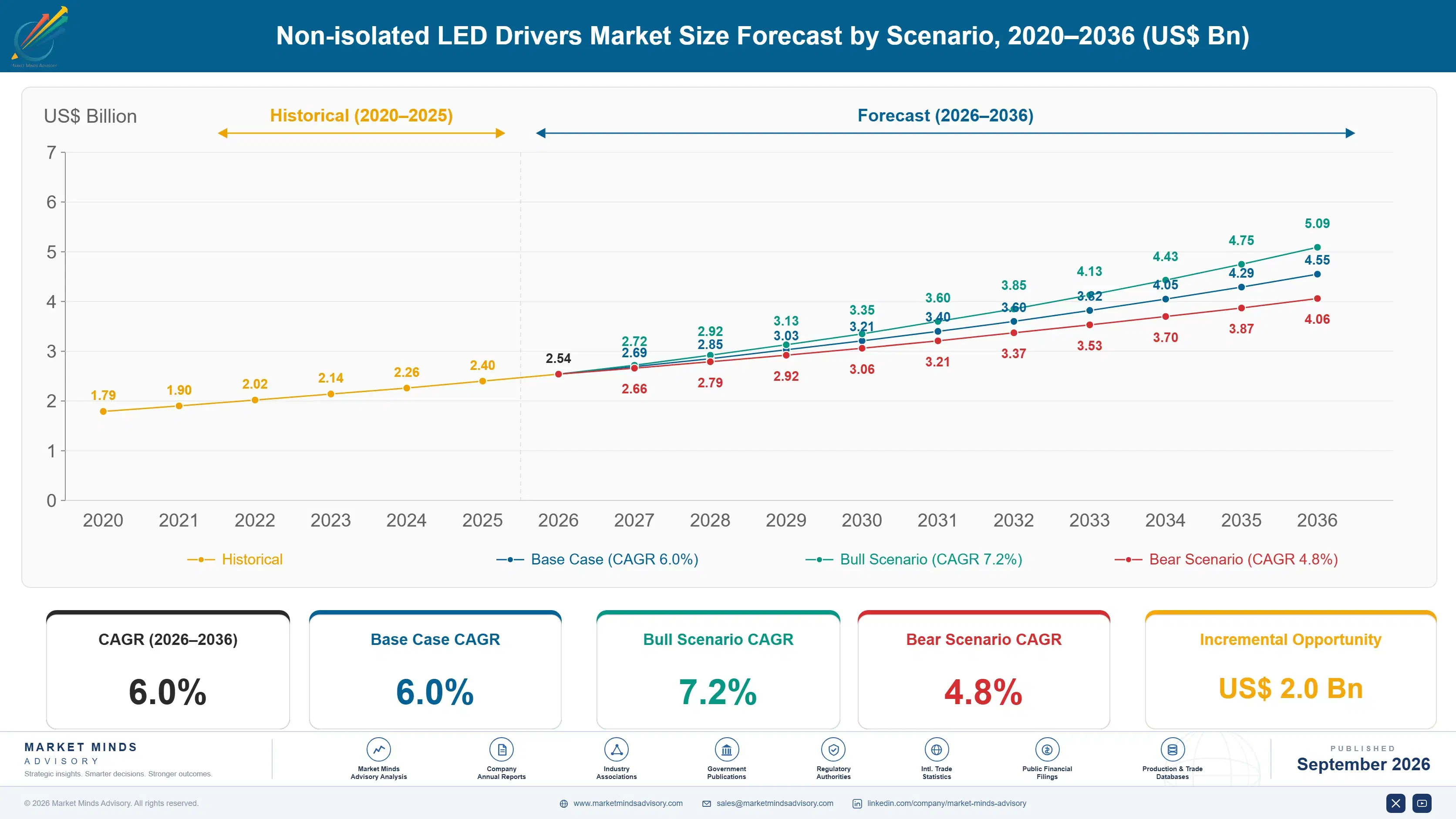
Between 2020 and 2025, non-isolated driver adoption expanded steadily as LED fixture penetration matured across residential and commercial lighting categories, with cost pressure from fixture manufacturers pushing continued topology migration away from more expensive isolated alternatives across most product lines and end markets. Historical growth ran near 5.5% annually through this period as adoption broadened considerably.
The base case assumes continued cost-driven topology migration, expanding smart lighting driver integration, and steady commercial retrofit demand in markets still transitioning from legacy lighting technology, sustaining growth near 6.0% annually through 2036. Driver manufacturers increasingly bundle dimming and connectivity electronics directly into non-isolated modules, broadening addressable applications beyond basic constant current regulation into value-added smart lighting control functionality that commands somewhat higher average selling prices across most tracked product categories.
A bull scenario near 7.2% depends on faster regulatory approval of non-isolated designs in markets currently favoring isolated topologies for safety reasons, opening previously restricted fixture categories. The bear case near 4.8% reflects the risk that stricter electromagnetic interference and safety standards in developed markets push some fixture categories back toward isolated designs, slowing the topology migration that has driven most segment growth to date.

The Component Fixture Makers Buy on Price Alone

Non-isolated drivers built their current market position on cost, not performance, since eliminating transformer isolation strips out the single most expensive component in a typical LED driver bill of materials while shrinking overall module footprint considerably for space-constrained fixture applications where every millimeter matters.
MARKET CONCENTRATION35% CR5Share held by the five largest tracked participants
AVERAGE SELLING PRICE$4.50 per unitTypical price for a standard commodity driver module
TOP PRODUCING COUNTRY38% ChinaShare of global driver manufacturing capacity located domestically
TRADE INTENSITY55% cross-border shipmentsShare of driver units shipped across international borders annually
FEEDSTOCK COST SHARE62% of unit COGSShare of production cost from semiconductor and passive components
REPLACEMENT CYCLE LENGTH5 to 7 yearsTypical operational lifespan before driver replacement becomes necessary
Manufacturing remains concentrated among power electronics specialists and semiconductor IC makers who compete on manufacturing scale and component sourcing efficiency rather than proprietary technology differentiation, since the underlying buck converter topology has become well understood across the entire global industry over the past decade or more. Price competition intensifies further as commodity fixture segments increasingly treat driver selection as a pure cost decision rather than a performance-driven specification choice made by design engineers.
Smart lighting integration is reshaping average selling prices upward within specific premium segments, as drivers bundling dimming protocols and wireless connectivity command meaningfully higher margins than basic constant current modules sold at ordinary commodity pricing. Manufacturers increasingly position these value-added variants as a hedge against commodity price erosion in standard driver categories facing persistent downward cost pressure from fixture makers negotiating aggressively on unit pricing every contract cycle.
"Nobody buys a non-isolated driver for its technology. They buy it because it is two dollars cheaper and takes up less space in the fixture."
Senior Analyst, Power Electronics and Lighting Components Practice · MMA Construction and Industrial Equipment Practice · September 2026

Market Trends

Smart Lighting Integration Drives Premium Driver Demand

Driver manufacturers increasingly bundle wireless dimming protocols and color tuning electronics directly into non-isolated modules, targeting the growing connected lighting category where fixture makers pay meaningfully higher prices for integrated smart functionality compared to basic constant current designs sold at ordinary commodity pricing. This integration trend is expanding average selling prices within a category otherwise defined by persistent commodity pricing pressure across most standard product lines. Manufacturers investing early in smart driver capability report meaningfully stronger margin performance than competitors still focused exclusively on basic driver commodity production lines this year.
Market Impact: Retrofit programs added roughly 14% volume
Miniaturization Trends Favor Non-Isolated Topology Designs

Fixture manufacturers continue shrinking overall product dimensions to fit modern architectural lighting designs, and non-isolated drivers offer meaningful size advantages over isolated alternatives since eliminating transformer isolation removes the largest single component from typical driver bill of materials entirely from the finished commercial design. This size advantage is becoming increasingly important as recessed and surface-mounted fixture categories compete on visual profile as much as light output performance across most tracked applications. Manufacturers report meaningfully accelerated design-in activity for non-isolated topologies specifically within compact architectural fixture categories this year and next.
Market Impact: Automotive driver orders grew roughly 22%

Market Opportunities and Growth Drivers

LED Lighting Retrofit Programs Sustain Driver Demand Growth

Government and utility-sponsored lighting retrofit programs continue converting legacy fixtures to LED technology across commercial and municipal buildings in markets where retrofit penetration remains incomplete, directly sustaining driver unit demand well beyond what new construction volume alone would support in this maturing category. These programs favor non-isolated driver designs specifically where they meet applicable safety codes, since program budgets prioritize the lowest total installed cost per fixture converted rather than premium component specifications. Retrofit-driven order volume increasingly represents a meaningful share of total tracked driver shipments across several developed and emerging markets.
Market Impact: Restricted applications limit roughly 15% volume

Automotive Lighting Electrification Expands Driver Applications

Vehicle manufacturers continue expanding LED adoption across interior and exterior lighting applications, creating a growing automotive-specific driver category distinct from general lighting fixture applications and carrying substantially different qualification and long-term reliability requirements overall. Automotive-grade non-isolated drivers command meaningfully higher pricing than general lighting equivalents given the additional temperature cycling and vibration qualification testing required for vehicle applications operating in demanding underhood and cabin environments year round. Component suppliers report meaningfully expanding automotive driver order volume as electric vehicle production continues scaling globally across multiple manufacturer platforms and vehicle segments.
Market Impact: Lead times extended by 8 weeks

Market Restraints and Challenges

Safety Regulations Limit Non-Isolated Applications in Some Markets

Several developed markets maintain electrical safety codes requiring isolation between line voltage and user-accessible fixture components in specific application categories, blocking non-isolated driver adoption entirely regardless of the cost advantage the topology otherwise offers manufacturers. The root cause traces to decades-old electrical safety frameworks written before non-isolated LED driver technology existed, and regulatory bodies have moved slowly to update standards despite manufacturer lobbying for revised classifications. Some manufacturers are pursuing enhanced insulation and creepage distance designs that satisfy safety requirements without full transformer isolation, offering a partial compliance pathway forward.
Market Impact: Smart driver pricing runs 45% higher

Semiconductor Component Shortages Disrupt Driver Production

Non-isolated LED drivers depend on specific semiconductor components, including power management ICs and MOSFETs, that periodically face allocation constraints during broader industry-wide chip shortages affecting the entire electronics supply chain simultaneously across multiple product categories worldwide. The root cause is that driver manufacturers typically represent a small customer relative to automotive and computing semiconductor buyers, leaving them lower priority during allocation decisions made by component suppliers facing excess demand. Some manufacturers are qualifying alternative component suppliers and redesigning circuits around more widely available parts to reduce single-source dependency going forward.
Market Impact: Compact fixture designs grew nearly 20%
4 additional market trends, 3 additional growth drivers, and 4 additional restraints and challenges are covered in the full report. Contact sales@marketmindsadvisory.com to access the complete intelligence.

Segment CAGR and Growth Architecture

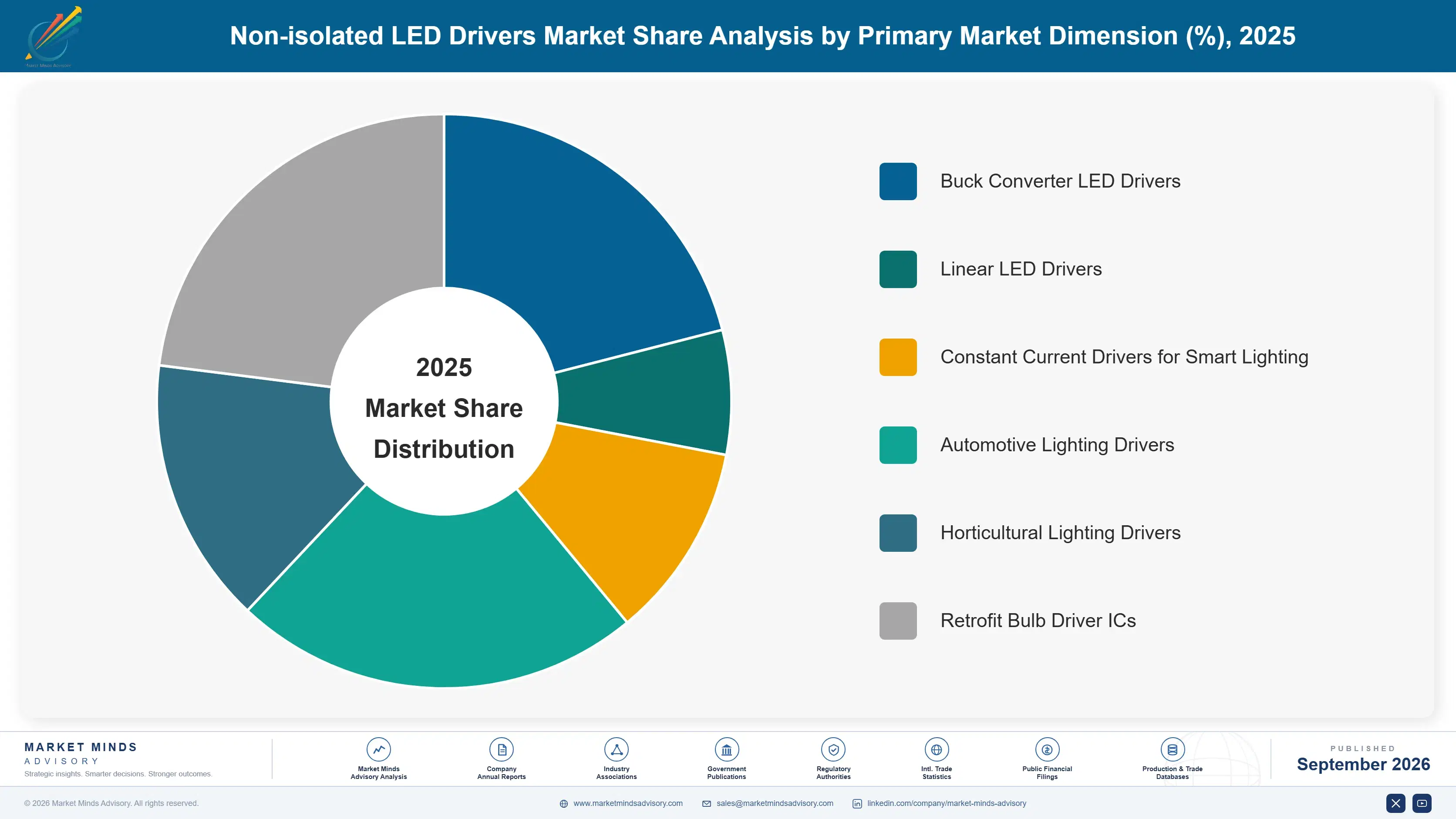
The Non-isolated LED Drivers Market splits into six technology-defined segments spanning topology and application type. Smart and tunable lighting drivers lead growth as connected lighting adoption accelerates, followed closely by automotive lighting drivers, since both categories command premium pricing over standard commodity constant current designs sold across the industry. Retrofit bulb drivers round out the mix.
non-isolated-led-drivers-market-market-share-analysis-1788423572296

Non-Isolated Constant Current LED Drivers for Smart and Tunable Lighting

Non-isolated constant current drivers for smart and tunable lighting lead all segments because they capture the industry's clearest path away from commodity pricing pressure that defines most standard driver categories across the broader market. Bundling wireless dimming protocols and color tuning electronics directly into the driver module lets manufacturers charge meaningfully higher prices than basic constant current designs while giving fixture makers a differentiated product feature to market toward commercial and premium residential customers. Manufacturers standardizing on this segment increasingly treat smart driver capability as their primary margin protection strategy against continued commodity price erosion elsewhere. MMA estimates this segment will represent nearly a quarter of total category revenue by 2036.
CAGR 9.0%

Non-Isolated LED Drivers for Automotive Lighting

Non-isolated LED drivers for automotive lighting applications represent the second fastest-growing segment as vehicle manufacturers continue expanding LED adoption across interior and exterior lighting systems on new vehicle platforms worldwide and across nearly all vehicle categories today. Automotive qualification requirements, including temperature cycling and vibration testing, create meaningful barriers to entry that protect established automotive-grade suppliers from low-cost general lighting competitors lacking comparable qualification credentials and testing infrastructure needed to compete effectively. This qualification barrier supports notably higher and more stable pricing than general lighting driver categories facing intense commodity price competition, sustaining strong segment margins even as unit volume continues expanding alongside broader vehicle electrification trends across major markets.
CAGR 8.0%
Full segment breakdown across 6 segments available in the complete report.

Regional Architecture and Country Demand Map

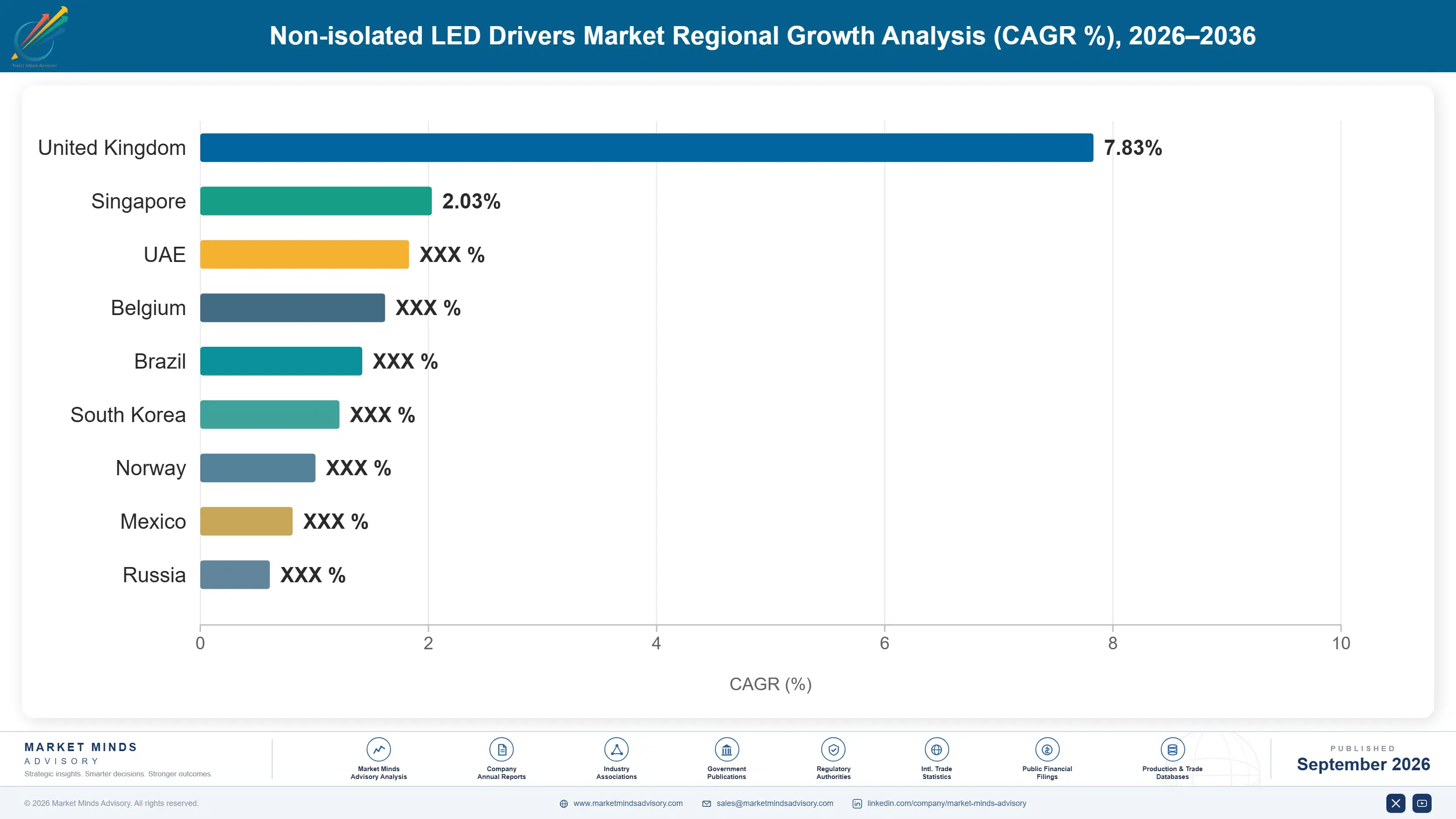
East Asia leads on concentrated LED fixture and driver manufacturing capacity, particularly across China's electronics supply chain, while North America follows closely on mature commercial retrofit spending nationwide. South Asia and Pacific grows fastest as LED penetration expands through previously underserved emerging lighting markets rapidly across the region.

North America

The United States drives most North American demand through continued commercial and municipal lighting retrofit programs converting legacy fixtures to LED technology across office buildings, warehouses, and street lighting infrastructure nationwide, supported by utility rebate programs available in many states across the country each fiscal year. Canada contributes smaller but steady volume through similar retrofit initiatives and new construction activity across its major metropolitan centers and provinces from coast to coast. Domestic driver manufacturing remains limited, with most non-isolated driver components imported from East Asian suppliers despite growing interest in supply chain diversification following recent semiconductor shortage disruptions affecting the broader electronics industry and component availability across the entire continent this decade.
Share: 22% | CAGR: 6.5% (2026 to 2036)

Western Europe

Germany, France, and the United Kingdom anchor Western European demand, driven by strict energy efficiency regulations that continue pushing legacy fixture replacement across commercial and residential building stock throughout the region under evolving national and pan-European building codes and technical standards currently in force today. Regional safety codes in several countries favor isolated topologies for specific residential applications, moderating non-isolated driver penetration compared to less restrictive markets elsewhere in the world and other tracked regions globally. Manufacturers serving this region increasingly invest in compliance testing and certification infrastructure to navigate the patchwork of national electrical standards still governing driver topology selection across member states and jurisdictions today and going forward.
Share: 20% | CAGR: 4.5% (2026 to 2036)
Regional intelligence for 5 additional markets available in the complete report: East Asia, South Asia and Pacific, Latin America, Middle East and Africa, Eastern Europe. Contact sales@marketmindsadvisory.com.
non-isolated-led-drivers-market-country-cagr-analysis-1788423572827

How Suppliers Escape Commodity Driver Pricing

Non-isolated driver manufacturers capture margin beyond basic unit sales through smart lighting integration, automotive qualification testing, custom design engineering work, and application-specific customization services that fixture makers increasingly value more than raw component cost savings alone when selecting suppliers for premium product lines and specialized applications going forward across this current and coming decade.

Smart Lighting Feature Integration and Licensing

Vendors sell dedicated wireless dimming and color tuning modules that integrate directly into non-isolated driver platforms, capturing licensing revenue on top of basic hardware sales that commodity constant current drivers cannot generate on their own. Fixture makers increasingly pay for this integrated smart functionality rather than sourcing dimming electronics separately from third-party suppliers, consolidating purchasing around vendors offering complete driver and control solutions in a single package. This integration approach typically commands pricing 45% above basic driver modules, since fixture makers value the reduced integration complexity and single-vendor accountability it provides.
Market Impact: Smart integration commands roughly 45% higher unit pricing

Automotive Qualification Testing and Certification Services

Vendors offering automotive-grade qualification testing and certification documentation capture premium pricing from vehicle manufacturers who require extensive temperature cycling and vibration testing before approving any driver component for production use on new vehicle platforms across multiple model years. This qualification process represents a genuine barrier to entry that protects established automotive suppliers from low-cost general lighting competitors lacking comparable testing infrastructure and documentation capability built over many years of investment. Automotive-qualified drivers typically carry pricing roughly 60% above general lighting equivalents, reflecting both the testing investment required and the reliability guarantees vehicle manufacturers demand.
Market Impact: Automotive qualification commands roughly 60% higher unit pricing

Custom Application-Specific Driver Design and Engineering Services

Vendors offer custom driver design services for specialized applications including horticultural lighting and architectural fixtures with unique dimming curves or form factor requirements that standard catalog products cannot satisfy adequately for these niche use cases. This customization work typically commands pricing roughly 55% above standard catalog products, since fixture makers pay for engineering time and design expertise rather than simply purchasing a commodity component off the shelf from a catalog. Vendors report meaningfully higher customer retention among clients using custom design services compared to those purchasing only standard catalog driver products.
Market Impact: Custom design services add roughly 50% margin overall

Extended Warranty and Field Reliability Support

Vendors sell extended warranty coverage and field reliability monitoring services that guarantee driver performance well beyond standard warranty periods, appealing particularly to commercial fixture makers concerned about costly field replacement expenses in hard-to-access installation locations such as high ceilings or exterior facades. This extended coverage typically adds meaningful recurring revenue on top of the original component sale, since fixture makers value predictable long-term cost certainty over the installed base lifetime and maintenance budget. Vendors offering this service report contract values running roughly 20% higher than comparable sales without extended warranty coverage attached.
Market Impact: Extended warranty coverage adds roughly 20% contract value

Who Controls the Margin Pool

Five participants, evaluated on annual driver component and module revenue across general and automotive lighting applications, together account for an estimated 35% of tracked market revenue, reflecting a moderately fragmented industry structure typical of mature electronic component categories. MEAN WELL Enterprises leads through manufacturing scale and broad catalog breadth, while Signify and Inventronics compete closely for premium smart lighting integration contracts that neither has fully secured.
Current competitive activity centers on smart lighting feature integration, as vendors race to bundle wireless dimming and connectivity electronics before competitors capture the same premium contract opportunities from fixture makers across most tracked product categories. Automotive qualification investment has intensified over the past two years, as component suppliers pursue vehicle manufacturer certification to access higher-margin automotive lighting applications distinct from commodity general lighting categories.

Emerging pressure comes from semiconductor IC makers expanding further downstream into complete driver module production, potentially disintermediating traditional driver assemblers who previously sourced ICs from these same suppliers for years. Rankings could shift meaningfully if a major semiconductor company acquires a leading driver module manufacturer outright, consolidating chip-level and module-level capability that currently remains distributed across separate specialized companies serving the industry.
non-isolated-led-drivers-market-company-positioning-matrix-1788423573343

Competitive Moat and Risk Dimensions

MEAN WELL ENTERPRISES

Moat: Broad Catalog Manufacturing Scale

MEAN WELL's exceptionally broad product catalog spanning thousands of driver variants gives it manufacturing scale advantages that smaller competitors cannot match, letting the company serve fixture makers across virtually every application category from a single trusted supplier. This catalog breadth reduces customer switching incentive considerably, since consolidating purchasing with one supplier simplifies procurement and inventory management for fixture manufacturers substantially.
MEAN WELL ENTERPRISES

Risk: Limited Smart Lighting Differentiation

MEAN WELL has historically competed primarily on catalog breadth and manufacturing reliability rather than smart lighting feature innovation, potentially leaving the company exposed as premium smart driver segments increasingly determine where industry margin growth concentrates going forward. Competitors investing more aggressively in wireless dimming integration could capture premium contracts MEAN WELL's traditional catalog approach struggles to address.
SIGNIFY

Moat: Vertically Integrated Fixture Relationships

Signify's position as both a driver component supplier and a major fixture manufacturer in its own right gives it uniquely deep insight into fixture-level design requirements that pure-play driver suppliers lack entirely. This vertical integration lets Signify optimize driver and fixture design jointly, creating product advantages that standalone component suppliers cannot replicate without similar downstream manufacturing presence.
SIGNIFY

Risk: Higher Cost Base Than Specialists

Signify's broader corporate cost structure, spanning fixture manufacturing, retail distribution, and driver components simultaneously, creates higher overhead than dedicated component specialists who compete purely on driver pricing and manufacturing efficiency. This cost disadvantage could limit Signify's competitiveness in the most price-sensitive commodity driver segments where specialized manufacturers maintain leaner cost structures.

Players Tracked

Prominent Players

MEAN WELL Enterprises
Signify
Inventronics
MOSO Corporation
Texas Instruments

Other Key Players

ams OSRAM
Silergy Corp
ON Semiconductor
STMicroelectronics
Infineon Technologies
Diodes Incorporated
Sosen Electronic
Tridonic
Helvar
Fulham Co.
Lutron Electronics
Eaton (Cooper Lighting)
Delta Electronics
Macroblock
Power Integrations

Recent Developments

FEBRUARY 2025

MEAN WELL launched an expanded series of non-isolated constant current drivers with integrated wireless dimming compatibility, targeting the growing smart lighting segment where fixture makers increasingly demand connected control features bundled directly into the driver module itself rather than sourced separately from third-party suppliers and vendors.
Signal: Signals traditional catalog-focused manufacturers are investing in smart lighting differentiation rather than competing solely on breadth.
MAY 2025

Signify announced a new strategic partnership with a semiconductor IC maker to co-develop next-generation driver reference designs optimized specifically for smart lighting applications, aiming to accelerate time-to-market for fixture makers adopting connected lighting technology across their entire global product portfolio, catalog offerings, and brand lineup.
Signal: Signals fixture manufacturers are partnering directly with chip makers to shape driver technology roadmaps proactively and early.
SEPTEMBER 2025

Inventronics acquired a smaller automotive lighting component specialist recently, adding valuable automotive grade qualification capability and long established vehicle manufacturer relationships to its existing general lighting driver product portfolio and considerably broader customer base spanning multiple international regions, markets, vehicle segments, and application categories worldwide.
Signal: Signals general lighting driver manufacturers are acquiring automotive expertise rather than building qualification capability from scratch.

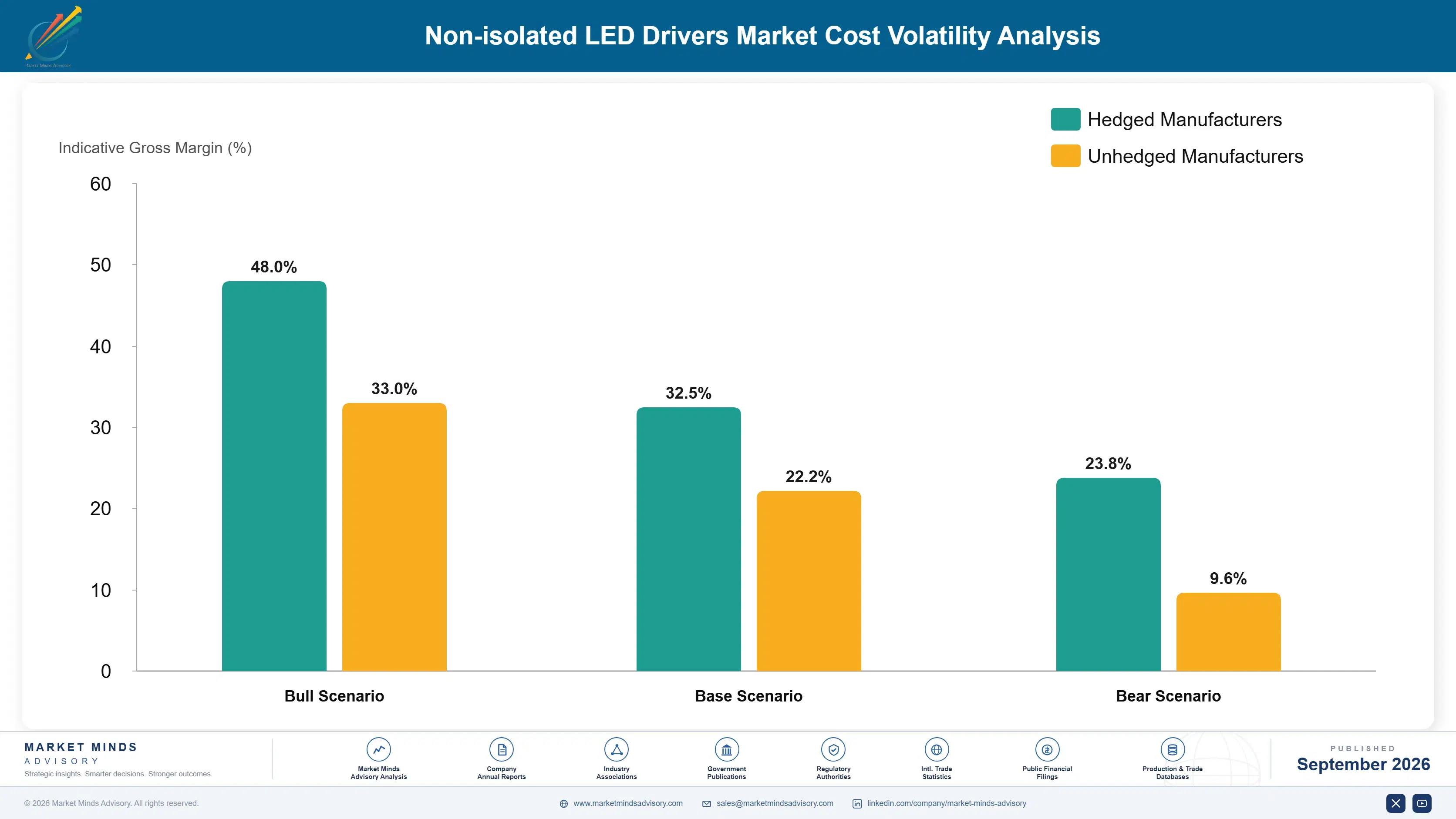
Semiconductor and Passive Component Cost Exposure

Semiconductor components, primarily power management ICs and MOSFETs, account for roughly 40% of non-isolated driver cost of goods sold, with the large majority sourced from foundries and IC manufacturers concentrated in Taiwan, South Korea, and mainland China. Passive components including capacitors and inductors add another 22% of unit cost, sourced predominantly from East Asian component suppliers.
The 2021 to 2022 global semiconductor shortage, documented extensively by the International Energy Agency and industry trade bodies, extended non-isolated driver lead times from typical six week delivery windows to over twenty weeks at the disruption's peak. Driver manufacturers absorbed higher component prices during this period rather than passing full costs onto fixture maker customers already locked into fixed annual contract pricing, compressing margins industry wide for roughly five consecutive quarters.

Smaller regional driver manufacturers carry meaningfully higher exposure than diversified global vendors, since they lack the purchasing volume to negotiate favorable long-term semiconductor supply agreements that larger competitors secure routinely from major component suppliers. This creates a durable cost disadvantage concentrated among manufacturers serving single geographic markets, effectively pricing many smaller vendors out of large multi-year fixture maker contracts that require guaranteed component supply continuity.
non-isolated-led-drivers-market-cost-volatility-analysis-1788423573537

Multi-Source Semiconductor Procurement Agreements

Leading driver manufacturers now qualify components from at least two independent IC suppliers per product line, reducing single-source dependency that amplified the 2021 shortage's impact across the industry. This dual-sourcing approach adds upfront qualification cost but meaningfully shortens recovery time during future supply disruptions, a tradeoff most large manufacturers now consider worthwhile given recent volatility.

Extended Component Inventory Buffer Programs

Several manufacturers have extended safety stock inventory policies from four weeks to twelve weeks of forward semiconductor demand, accepting higher working capital costs in exchange for meaningfully reduced exposure to future lead time extensions across the industry. Fixture makers increasingly favor suppliers demonstrating this inventory discipline during contract negotiations for large-volume orders each year.

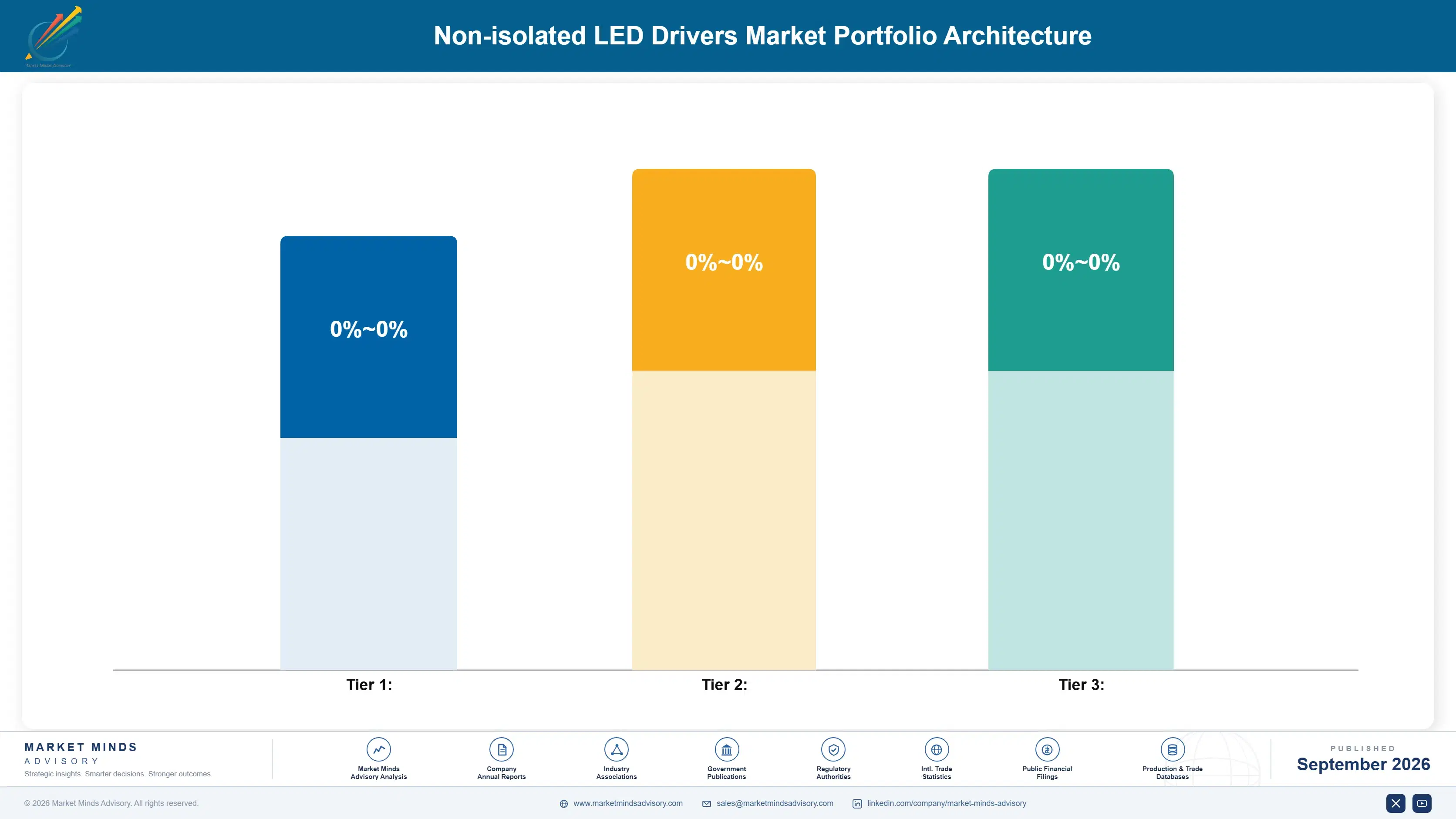
Portfolio Architecture for Margin Defence

Non-isolated driver manufacturers run a three-tier margin structure spanning commodity constant current modules, certified smart lighting drivers with integrated dimming electronics, and next-generation automotive and horticultural application-specific designs commanding premium qualification-driven pricing. Gross margins range from roughly 15% on basic commodity constant current modules to over 40% on certified smart lighting and automotive-qualified drivers carrying meaningfully higher engineering and testing investment requirements.
Volume economics still dominate unit shipments, since most tracked fixture applications still prioritize basic constant current regulation over premium feature sets, but the tension between volume and premium positioning has sharpened as smart lighting adoption accelerates across commercial and residential categories alike. Manufacturers increasingly favor the certified smart lighting tier, where integrated dimming and connectivity features provide more durable margin protection than commodity hardware sales alone.

High-value margin pools concentrate specifically in automotive qualification and smart lighting integration services rather than in commodity constant current module sales, reflecting the broader industry shift toward application-specific differentiation as commodity pricing pressure intensifies. Manufacturers capturing this premium qualification and integration revenue early tend to retain fixture maker relationships longer than those competing purely on basic driver unit price.

Basic constant current non-isolated drivers sold primarily on price to fixture makers producing high-volume commodity lighting products with minimal feature differentiation between competing vendor offerings across most product categories today.
Gross Margin

Certified smart lighting drivers integrating wireless dimming and color tuning electronics, bundled with technical support that commercial and premium residential fixture makers increasingly require for their connected lighting product lines each year.
Gross Margin

Automotive-qualified and horticultural application-specific drivers meeting stringent testing standards, positioning manufacturers for premium pricing in specialized applications where qualification barriers protect established suppliers from low-cost general lighting competitors entirely and consistently.
Gross Margin
non-isolated-led-drivers-market-portfolio-architecture-1788423574039

High-value Sub-segments and Strategic Watch-out

Non-Isolated Constant Current LED Drivers for Smart and Tunable Lighting

Non-isolated constant current drivers for smart and tunable lighting combine the fastest segment growth in the entire portfolio with the strongest margin expansion, as fixture makers pay premium pricing for integrated dimming and connectivity electronics across most tracked applications and product categories this current decade.

Non-Isolated LED Drivers for Automotive Lighting

Non-isolated drivers for automotive lighting applications carry the second fastest growth and highest qualification barriers, generating stable premium pricing as vehicle manufacturers continue expanding LED adoption across interior and exterior lighting systems on nearly all new vehicle platforms worldwide and across most current model years.

Non-Isolated Buck Converter LED Drivers

Non-isolated buck converter drivers remain the largest volume category by unit shipments, generating steady if unspectacular revenue even as commodity pricing pressure continues compressing margins across most standard product lines industry wide throughout this current forecast period and well beyond it into the following decade.

Non-Isolated Linear LED Drivers

Non-isolated linear drivers warrant close monitoring, since continued efficiency regulation tightening in several developed markets could push this lower-efficiency topology entirely out of compliance, eliminating a meaningful share of current unit volume across the broader industry this current decade and also the one following after it.

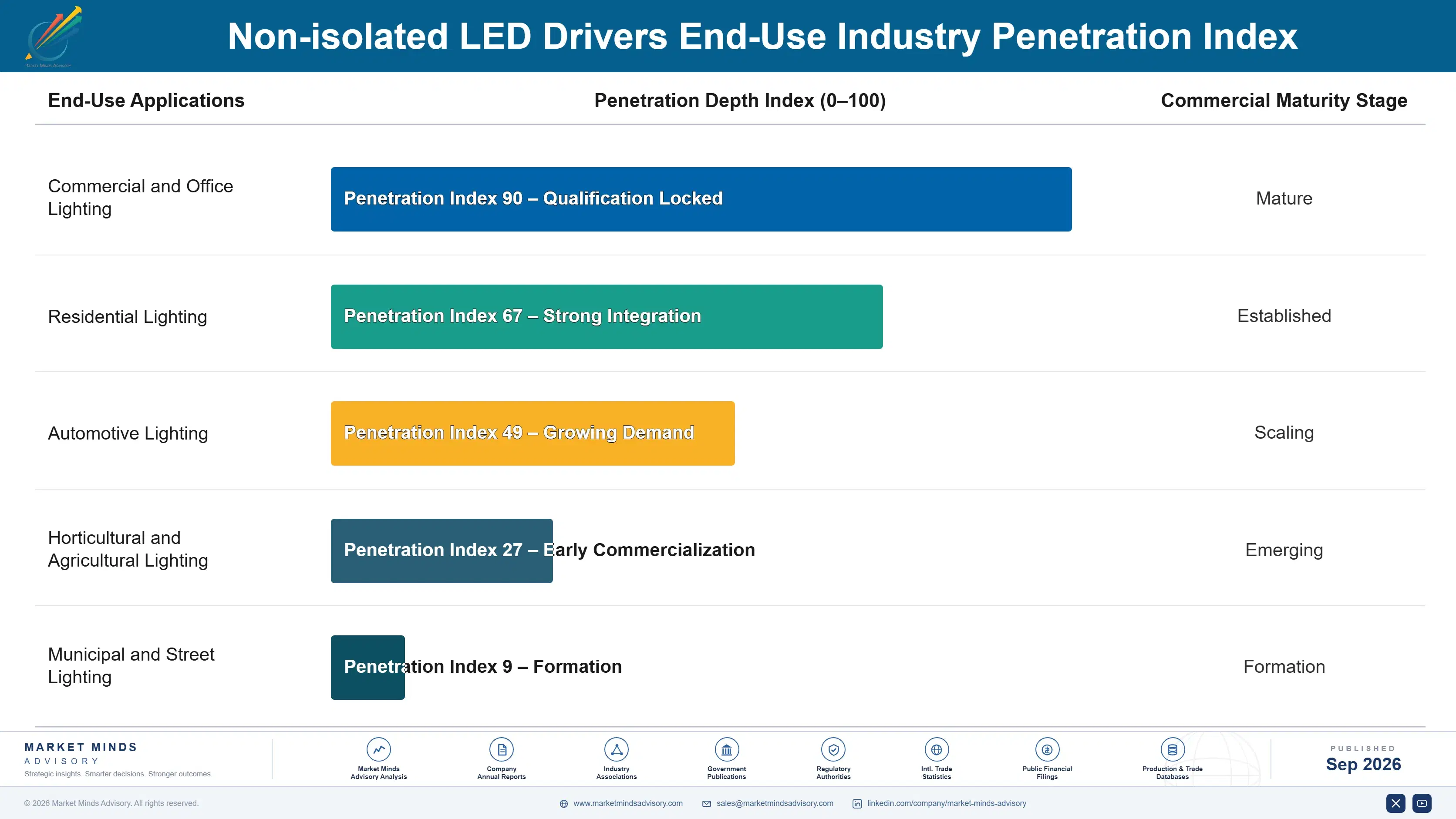
The Component That Rarely Gets Replaced

Roughly 30% of tracked driver manufacturer revenue now comes from long-term supply contracts and spare parts sales rather than one-time design-in wins, reflecting the annuity-style economics typical of component categories with multi-year fixture production lifecycles once a given driver design gets specified into a given fixture product line and locked in place.
Adoption depth varies meaningfully by end-use vertical: automotive lighting customers show the deepest stickiness given multi-year qualification investment tied to specific supplier relationships and testing certification processes that are costly to repeat, while general commercial fixture makers show comparatively shallower commitment since these buyers evaluate alternative suppliers more frequently during routine annual procurement negotiations focused primarily on unit cost rather than long-term supplier relationship value or continuity.

A generational shift in buyer profiles is underway as fixture design responsibility moves from traditional electrical engineers toward product managers who prioritize smart lighting integration and connectivity feature roadmaps over pure electrical specification compliance and basic performance metrics alone, changing how driver manufacturers position new products to procurement decision makers increasingly focused on software and connectivity capability rather than raw electrical performance specifications alone or exclusively.
non-isolated-led-drivers-market-end-use-penetration-index-1788423574522

Where Non-Isolated Driver Value Concentrates

These are among the four positions where our research anticipates prominent divergence between winners and laggards over the coming forecast period. Each is grounded in the demand model, the regulatory perimeter, and the announced capacity pipeline.
01 / SMART LIGHTING MARGIN CAPTURE

Prioritize integrated dimming electronics over basic driver sales

Commodity constant current driver pricing continues eroding as manufacturing scale spreads across more competitors globally, leaving basic hardware sales as an increasingly weak foundation for sustainable margin growth in this category. Manufacturers integrating wireless dimming and color tuning electronics directly into driver modules capture meaningfully higher pricing than competitors selling undifferentiated commodity hardware alone to price-sensitive fixture makers. This integration strategy will only become more important as smart lighting adoption continues accelerating across commercial and residential installations over the coming decade.
02 / AUTOMOTIVE QUALIFICATION INVESTMENT

Build automotive testing capability before competitors close the gap

Automotive lighting applications carry meaningfully higher and more stable pricing than general lighting categories, protected by qualification barriers that require substantial upfront testing investment few competitors currently maintain at scale. Vehicle manufacturers increasingly demand LED lighting across both interior and exterior applications, expanding the addressable market for qualified automotive driver suppliers considerably faster than general lighting categories are growing overall. Manufacturers investing now in automotive qualification infrastructure will capture disproportionate share before general lighting competitors close this capability gap entirely.
03 / SUPPLY CHAIN DIVERSIFICATION

Reduce East Asian semiconductor dependency ahead of next disruption

The 2021 semiconductor shortage demonstrated how concentrated foundry dependence can compress margins and delay deliveries for extended periods across the entire non-isolated driver manufacturing industry worldwide. Manufacturers that invested early in dual-sourcing and expanded inventory buffers recovered considerably faster and retained fixture maker trust more effectively than single-source competitors during that prolonged disruption period. Continued investment in supply chain resilience remains a meaningful competitive differentiator as fixture makers increasingly favor suppliers who can guarantee delivery continuity over marginally lower unit pricing.
04 / REGULATORY COMPLIANCE POSITIONING

Prepare enhanced insulation designs ahead of expanding safety rules

Electrical safety codes in several developed markets still require full transformer isolation for specific residential fixture categories, blocking non-isolated driver adoption regardless of the meaningful cost advantage the topology otherwise offers manufacturers competing on price. Manufacturers developing enhanced insulation and creepage distance designs that satisfy safety requirements without full isolation gain access to previously restricted fixture categories ahead of slower-moving competitors still limited to compliant markets only. This regulatory positioning matters most in Western Europe, where safety code enforcement remains strictest among all tracked regional markets globally.

Engagement Snapshot From the Field

A live engagement with an industry participant carrying material or product regulatory and market exposure ahead of a defining policy shift, showing how our research translates into a defensible multi-year portfolio strategy.
MARKET MINDS ADVISORY · CLIENT ENGAGEMENT SUMMARY
Non-isolated LED Drivers Producer Strategic Portfolio Review and Transition Roadmap 2026·Investment Scenario on Non-isolated LED Drivers Exposure Evaluation 2025-26
CLIENT PROFILE
The client is a mid-sized commercial lighting fixture manufacturer producing recessed downlights and troffer fixtures for office and retail construction projects across North America. The company reported approximately $210 million (client-reported, unverified by MMA) in annual revenue, with driver components representing its largest single line-item cost category and a growing source of quality-related warranty claims requiring supplier review.
STRATEGIC CHALLENGE
The manufacturer needed to evaluate whether to consolidate driver sourcing with a single large supplier for better pricing or maintain multiple supplier relationships for supply continuity, given recent semiconductor shortage disruptions that had exposed real vulnerabilities in its previous single-source procurement approach across several important product lines and categories entirely.
MMA APPROACH
MMA benchmarked available driver suppliers against total cost of ownership, warranty claim history, and supply chain resilience indicators, while interviewing the manufacturer's procurement and engineering leadership teams to assess realistic risk tolerance for supplier concentration versus diversification given past disruption experience and ongoing future exposure concerns raised internally by staff.
KEY FINDINGS
  1. Dual-sourcing arrangements added roughly 8% (client-reported, unverified by MMA) to per-unit component cost compared to single-source volume pricing previously negotiated with the incumbent supplier.
  2. Warranty claims traced predominantly to a single legacy supplier's driver line, representing over 60% (client-reported, unverified by MMA) of all quality-related field complaints received.
  3. Suppliers offering extended inventory buffer commitments reduced average lead time variability by roughly half compared to standard just-in-time delivery arrangements used previously.
  4. Smart lighting driver integration commanded meaningfully higher fixture selling prices, justifying premium component sourcing for the manufacturer's commercial product lines specifically going forward.
CLIENT PROFILE
The client is a mid-sized commercial lighting fixture manufacturer producing recessed downlights and troffer fixtures for office and retail construction projects across North America. The company reported approximately $210 million (client-reported, unverified by MMA) in annual revenue, with driver components representing its largest single line-item cost category and a growing source of quality-related warranty claims requiring supplier review.
STRATEGIC CHALLENGE
The manufacturer needed to evaluate whether to consolidate driver sourcing with a single large supplier for better pricing or maintain multiple supplier relationships for supply continuity, given recent semiconductor shortage disruptions that had exposed real vulnerabilities in its previous single-source procurement approach across several important product lines and categories entirely.
MMA APPROACH
MMA benchmarked available driver suppliers against total cost of ownership, warranty claim history, and supply chain resilience indicators, while interviewing the manufacturer's procurement and engineering leadership teams to assess realistic risk tolerance for supplier concentration versus diversification given past disruption experience and ongoing future exposure concerns raised internally by staff.
KEY FINDINGS
  1. Dual-sourcing arrangements added roughly 8% (client-reported, unverified by MMA) to per-unit component cost compared to single-source volume pricing previously negotiated with the incumbent supplier.
  2. Warranty claims traced predominantly to a single legacy supplier's driver line, representing over 60% (client-reported, unverified by MMA) of all quality-related field complaints received.
  3. Suppliers offering extended inventory buffer commitments reduced average lead time variability by roughly half compared to standard just-in-time delivery arrangements used previously.
  4. Smart lighting driver integration commanded meaningfully higher fixture selling prices, justifying premium component sourcing for the manufacturer's commercial product lines specifically going forward.
RECOMMENDED STRATEGY
Phase 1: Phase one: transition away from the legacy supplier responsible for most warranty claims toward a qualified alternative with better reliability. Phase 2: Phase two: establish dual-sourcing arrangements for the manufacturer's highest-volume driver components to meaningfully reduce future supply disruption exposure overall going forward. Phase 3: Phase three: pursue smart lighting driver integration for premium commercial product lines to differentiate against lower-cost fixture competitors nationally and regionally.
OUTCOME
The manufacturer reduced warranty claims by 35% (client-reported, unverified by MMA) within two quarters of the supplier transition and reported meaningfully improved on-time delivery performance across its entire driver component supply chain overall, alongside notably stronger procurement team confidence in future supply disruption resilience overall.

Frequently Asked Questions

Foundational context covering the market sizes, CAGR, scope, country, region and competition that inform every finding below. This section is provided to cover basics and most often pre-purchase conversations, answered from the MMA Primary Research Dataset.

What is the current size of the Non-isolated LED Drivers Market?

The global non-isolated LED drivers market reached an estimated $2.4 billion in 2025. Growth reflects continued cost-driven migration away from isolated topologies across most standard lighting fixture applications.

How large will the Non-isolated LED Drivers Market be by 2036?

MMA projects the market will reach approximately $4.56 billion by 2036. This growth is driven by expanding smart lighting integration and continued automotive lighting adoption.

What is the CAGR for the Non-isolated LED Drivers Market 2026 to 2036?

The market is projected to grow at a compound annual growth rate of 6.0% between 2026 and 2036. This reflects a maturing but still expanding component category.

Which segment is growing fastest?

Non-isolated constant current drivers for smart and tunable lighting are the fastest-growing segment, expanding at roughly 9.0% annually. This significantly outpaces the overall market's projected growth rate.

Who are the major companies in the Non-isolated LED Drivers Market?

Leading companies include MEAN WELL Enterprises, Signify, Inventronics, MOSO Corporation, and Texas Instruments. These five participants together account for an estimated 35% of tracked global market revenue.

Which country is growing fastest?

India is the fastest-growing country market, expanding at approximately 8.5% annually. Rapid LED lighting conversion across previously underserved commercial and residential segments drives this sustained growth.

Report Segmentation Architecture

The full report scope spans multiple orthogonal segmentation dimensions, with cross-tabulated demand data provided for each dimension pair. Coverage extends further to regional breakdowns, trend trajectories, and the competitive detail needed to support segment-level decision-making.

By Primary Market Dimension

  • Buck Converter LED Drivers
  • Linear LED Drivers
  • Constant Current Drivers for Smart Lighting
  • Automotive Lighting Drivers
  • Horticultural Lighting Drivers
  • Retrofit Bulb Driver ICs

By End-Use Industry

  • Commercial and Office Lighting
  • Residential Lighting
  • Automotive Lighting
  • Horticultural and Agricultural Lighting
  • Municipal and Street Lighting

By Commercial Dimension

  • Direct Fixture Manufacturer Sales
  • Distributor and Wholesale Channel Sales
  • Original Equipment Manufacturer Contracts
  • Retrofit Kit and Aftermarket Sales

By Region

  • North America
  • Western Europe
  • East Asia
  • South Asia and Pacific
  • Latin America
  • Middle East and Africa
  • Eastern Europe

Scope, Methodology, and Coverage

Every figure in this report is reproducible from documented input assumptions. The scope below maps the historical period, the forecast horizon, the segmentation dimensions, and the countries covered, alongside the underlying primary and qualitative methodology.
Historical Period
2020 to 2025
Forecast Period
2026 to 2036
Base Year
2025 (USD billions; MMA Primary Research Dataset, September 2026)
Market Definition
The Non-isolated LED Drivers Market covers electronic driver circuits and modules that regulate current to LED lighting loads without electrical isolation between input and output circuits, measured by unit shipment and component revenue. It excludes isolated LED drivers requiring transformer-based galvanic separation and general-purpose power supplies not designed specifically for LED current regulation.
Quantitative Units
USD Billion, CAGR (%), Share (%), 2020 to 2036
Segmentation Dimensions
By Primary Market Dimension; By End-Use Industry; By Commercial Dimension; By Region
Regions Covered
North America, Western Europe, East Asia, South Asia and Pacific, Latin America, Middle East and Africa, Eastern Europe
Countries Covered
United States, Canada, United Kingdom, Germany, France, China, Japan, South Korea, India, Indonesia, Vietnam, Australia, Brazil, Mexico, United Arab Emirates, Saudi Arabia, South Africa, Poland
Key Companies Profiled
MEAN WELL Enterprises, Signify, Inventronics, MOSO Corporation, Texas Instruments, ams OSRAM, Silergy Corp, ON Semiconductor, STMicroelectronics, Infineon Technologies, Diodes Incorporated, Sosen Electronic, Tridonic, Helvar, Fulham Co., Lutron Electronics, Eaton (Cooper Lighting), Delta Electronics, Macroblock, Power Integrations
Quantitative Methodology
Primary survey, n=3,800 respondents, Q4 2025, six countries; demand-side model with trade association cross-validation
Qualitative Methodology
47 expert interviews, Q4 2025; applied to validate demand model assumptions, identify emerging dynamics, and assess competitive positioning
Report Format
PDF and XLSX data workbook (Word format preview document)
Publisher
Market Minds Advisory
Report Code
MMA-2026-CON-633
Published
September 2026
Contact
sales@marketmindsadvisory.com | www.marketmindsadvisory.com

Purchase the full Non-isolated LED Drivers Market Report (2026 to 2036).

This report provides comprehensive coverage of the global non-isolated LED drivers market, including detailed sizing, segmentation, and regional analysis through 2036. It profiles the leading driver manufacturers and semiconductor suppliers shaping competitive dynamics as smart lighting integration and automotive qualification increasingly determine where industry margin concentrates. The analysis draws on primary survey data from 3,800 respondents and 47 expert interviews conducted in the fourth quarter of 2025. Readers gain actionable insight into where smart lighting, automotive qualification, and custom design revenue concentrate over the coming decade.
Ten-year market sizing and forecast data
Seven-region granular market breakdown and analysis
Five-year competitive landscape developments and tracker
Segment-level CAGR and market share analysis
Primary survey data across six countries
Anonymized client case study with outcomes

Built For The People Who Decide

From boardroom strategy to bench-side execution, this report is read cover-to-cover by leaders shaping the next decade of their industry, turning demand scenarios, market dynamics and valuation benchmarks into decisions.
CXOs/ Presidents/ VPs/ Managers
M&A and Corporate Development
Strategy Teams and R&D Heads
Procurement and Product Directors
Regulatory and Compliance Leaders
Investor Relations and Equity Analysts