Market Minds Advisory
Non-Cushioned Mailer Market

Non-Cushioned Mailer Market: Recycled Content Mandates Reshape a Commodity Category

Binding recycled content mandates and apparel e-commerce volume growth are pulling non-cushioned mailer demand toward compliant recycled and compostable film, forcing converters built for virgin poly mailers to secure scarce recycled resin fast.

Lead Analyst

Bilal Shaikh

Published

September 2026

Make Smarter Decisions with Customized Research Insights

Request a free sample report and evaluate market opportunities, growth trends, and competitive dynamics relevant to your business needs.

2025 MARKET VALUE$9.8BMarket Size 2025
2036 FORECAST VALUE$19.6BBase Case , 2026 to 2036
CAGR 2026 TO 20366.5 %Bull 7.7% / Bear 5.3%
INCREMENTAL OPPORTUNITY$9.2BNet 10- year value creation
EXPANSION MULTIPLE1.88x2036 value over 2026 base
Strategic Levers
M&A Pipeline
Regional Outlook
Country Rankings
Competitive Intelligence
Segmental Deep-dive
Call-Us : 91 93563 13602

Executive Snapshot and Market Trajectory

Non-cushioned mailer demand keeps growing steadily on apparel and general e-commerce volume, but the real story is material composition. Recycled content mandates are turning cheap virgin poly film into a category where scarce recycled resin now decides margin. That repricing is happening faster than converters expected. Investors have noticed too.
Compostable and bio-based mailers grow fastest as apparel brands chase genuine sustainability positioning, followed closely by recycled-content poly mailers meeting binding regulatory thresholds. East Asia holds the largest share on concentrated apparel export manufacturing and massive e-commerce parcel volume. That manufacturing concentration keeps deepening as regional converters expand capacity. Retailers increasingly favor converters who can deliver both compliant volume and durability reliably at scale. That trend shows no sign of slowing.
Competitive intensity concentrates among diversified flexible packaging companies with integrated resin sourcing capability, while specialist recycled-content and compostable mailer converters defend narrower, technically demanding positions. Recycled content regulation is reshaping purchasing decisions across the industry, forcing converters without secured recycled resin supply to compete for an increasingly constrained feedstock pool. Converters without secured feedstock increasingly find themselves excluded from the highest-value compliance-driven contracts entirely.
Market Definition
The non-cushioned mailer market covers flat, unpadded flexible shipping mailers manufactured from virgin poly film, recycled-content poly film, paper and kraft materials, or compostable bio-based film, used for apparel, documents, and non-fragile e-commerce goods. It excludes padded and cushioned mailers containing bubble or foam liners, rigid shipping boxes, and mailer formats designed primarily for fragile or breakable goods.
Base Year Value
$9.8B in 2025 (MMA Primary Research Dataset, August 2026)
Forecast Period
2026 to 2036, eleven discrete annual values
CAGR
6.5% base case. Bull 7.7%. Bear 5.3%.
Fastest Growth Segment
Compostable and Bio-Based Mailers: 12.5% CAGR
Fastest Growth Country
Vietnam: 11.5% CAGR
Fastest Growth Region
South Asia and Pacific: 8.5% CAGR
Largest Region
East Asia: 28% of 2025 global value
Market Leaders
Sealed Air Corporation, ProAmpac, Inteplast Group, Novolex Holdings LLC, International Plastics Inc. Source: MMA Analysis based on company annual reports.
Primary Survey
n=3,800 procurement and R&D decision-makers, Q4 2025, six countries
Methodology
Demand-side build-up, cross-validated against public data, 47 expert interviews

Non-Cushioned Mailer Market Forecast Scenarios

non-cushioned-mailer-market-size-forecast-scenario-1787307785351
Between 2020 and 2025 the market grew at roughly 5.5% a year, accelerating as apparel e-commerce volume expanded and early recycled content mandates began reshaping brand owner packaging specification decisions toward the end of the period. That acceleration caught several converters without secured recycled resin scrambling to catch up. That scramble reshaped how quickly converters justified recycled resin sourcing investment industry-wide.
The base case carries the market to a 6.5% CAGR on three mechanisms. First, recycled content mandates keep expanding across additional jurisdictions, forcing conversion to compliant film on regulatory rather than purely voluntary timelines. Second, apparel and general e-commerce parcel volume keeps growing as online retail penetration continues expanding globally. Third, brand sustainability commitments keep pushing specification toward compostable and bio-based mailers that virgin poly film cannot match. These three mechanisms reinforce each other steadily across most major markets.
The bull case reaches 7.7% if additional jurisdictions adopt recycled content mandates faster than currently scheduled, accelerating conversion timelines industry-wide. The bear case falls to 5.3% if recycled resin cost pressure meaningfully slows converter capacity expansion investment relative to the pace regulatory deadlines actually require. That divergence rests largely on recycled resin supply availability. That divergence rests on timing.

Recycled Resin Scarcity Is Rewriting Margin Economics

Three forces converge on this market at once. Recycled content mandates keep expanding to additional jurisdictions on fixed regulatory timelines, apparel and e-commerce parcel volume keeps growing alongside continued online retail expansion, and brand sustainability commitments keep pushing specification toward compostable film. Converters without secured recycled resin supply agreements risk losing bidding access to brand owners facing compliance deadlines. Converters unable to satisfy all thre
MARKET CONCENTRATION (CR5)26%Top five converters hold well under a third share
AVERAGE MAILER PRICE$0.05/unitRecycled-content mailers command premium over virgin film equivalents
TOP PRODUCING COUNTRY SHARE24%China leads installed non-cushioned mailer manufacturing capacity globally
CAPACITY UTILISATION81%Production lines run near full continuous operating schedules
TRADE INTENSITY21%Roughly a fifth of mailer volume crosses national borders
RESIN COST SHARE49% of COGSVirgin and recycled polyethylene resin dominate production cost
Commercially, the market splits between standard virgin poly mailers, priced competitively and sold largely on cost against paper alternatives, and recycled-content and compostable mailers, priced at meaningful premium and sold on regulatory compliance and brand sustainability positioning increasingly demanded by apparel and e-commerce customers. That compliant category commands disproportionate growth relative to its unit volume share of the overall market. That margin gap is widening as apparel buyers increasingly prioritize documented compliance readiness.
Over the next decade the defining question is whether recycled and compostable mailers fully displace virgin poly film across most e-commerce applications globally, or whether cost and feedstock scarcity keep virgin film entrenched in jurisdictions without binding regulatory mandates rather than becoming the universal default packaging choice everywhere.
"This category used to be the simplest packaging decision a brand owner ever made, just a bag with an adhesive strip. Now a fashion brand's sustainability team wants documented recycled content percentages before they will even sample a converter's mailer, and that single requirement has quietly reordered who wins the largest apparel accounts."
Director, E-Commerce Packaging and Flexible Materials Practice · MMA Packaging /

Market Trends

Recycled Content Mandates Force Scarce Resin Supply Competition

The European Union's packaging and packaging waste regulation and an expanding number of American state laws now require binding minimum recycled content thresholds in flexible poly mailers, forcing converters to secure recycled resin supply agreements years ahead of compliance deadlines rather than sourcing feedstock reactively on spot markets. Sealed Air and ProAmpac have both signed long-term recycled resin offtake agreements with reprocessors specifically to secure compliant feedstock ahead of binding deadlines. Converters without secured supply risk losing bidding access to brand owners facing regulatory compliance requirements entirely. That exclusion risk compounds as more jurisdictions finalize enforcement timelines yearly.
Market Impact: Adds 4 to 7 mandates yearly
Apparel E-Commerce Growth Sustains Mailer Volume

Continued apparel and general merchandise e-commerce volume growth keeps expanding demand for lightweight, non-cushioned mailers protecting soft goods that do not require cushioning during transit, a category distinct from cushioned protective packaging and growing independently alongside continued online retail expansion. Novolex and Inteplast have both expanded mailer production capacity specifically targeting apparel brand customers seeking recycled-content and compostable alternatives. Apparel brands increasingly evaluate mailer suppliers on sustainability credentials alongside pure cost, giving compliant converters a genuine competitive advantage over virgin-film-only competitors. That sustainability preference increasingly shapes which converters win the largest multi-year apparel contracts.
Market Impact: Adoption rose 16% to 24%

Market Opportunities and Growth Drivers

Expanding Recycled Content Regulation Creates Fixed-Timeline Demand

Regulatory bans and recycled content mandates targeting flexible plastic packaging, tracked across an expanding list of national and subnational jurisdictions, create genuinely fixed-timeline demand that brand owners cannot indefinitely defer the way voluntary sustainability initiatives often get deprioritized during budget pressure. Each newly enacted mandate represents recurring, multi-year conversion demand tied directly to that jurisdiction's e-commerce shipping volume, giving compliant converters a regulatory-anchored growth driver considerably more predictable and less discretionary than most other packaging material transitions dependent purely on brand owner voluntary commitment alone. That regulatory anchor gives converters unusually reliable capacity planning visibility.
Market Impact: Limits substitution to 60-72%

Brand Sustainability Commitments Expand Compostable Adoption

Major apparel and consumer brands increasingly commit to sustainability targets exceeding minimum regulatory requirements, driven by consumer preference research and competitive positioning pressure among peer brands pursuing similar public commitments ahead of any binding mandate specifically targeting their packaging category. Each brand owner adopting compostable mailers ahead of regulatory mandate represents genuinely voluntary demand layered on top of the regulatory-driven conversion wave, expanding the addressable market beyond jurisdictions with binding mandates specifically into markets where conversion remains discretionary but increasingly common. Converters serving these voluntary accounts increasingly build reputational credibility that strengthens their position when regulatory-driven customers evaluate supplier options.
Market Impact: Adds 3% to 6% cost pressure

Market Restraints and Challenges

Recycled Film Still Trails Virgin Plastic on Certain Properties

Recycled-content poly film, while improved considerably in recent years, still trails virgin plastic alternatives on tear strength and seal integrity for certain heavy-load apparel applications, and the root cause is that recycled polyethylene resin inherently carries more molecular chain degradation than virgin resin regardless of processing technology applied during reprocessing. This performance gap limits recycled content adoption for applications involving heavier apparel items or longer transit distances, where converters must specify higher recycled content thresholds carefully to avoid seal failures. Manufacturers are mitigating the gap through improved resin blending technology that addresses strength retention without compromising recycled content compliance.
Market Impact: Covers 20-30% mandated content

Extended Producer Responsibility Fees Raise Compliance Cost

Extended producer responsibility schemes, now implemented across an expanding number of jurisdictions, require brand owners and converters to fund packaging collection and recycling infrastructure through per-unit fees scaled to a mailer's actual recyclability, and the root cause is that regulators are shifting recycling system funding from public budgets toward the packaging producers generating the waste stream directly. This cost pressure compresses margin for converters serving fee-liable brand owners, particularly in categories with thin existing margin like standard virgin poly mailers. Converters are mitigating the impact through recycled content investment that reduces per-unit fee exposure alongside resin cost specifically.
Market Impact: Volume rose 18% to 26%
3 additional market trends, 4 additional growth drivers, and 3 additional restraints and challenges are covered in the full report. Contact sales@marketmindsadvisory.com to access the complete intelligence.

Segment CAGR and Growth Architecture

Segmentation follows base material and recycled content composition, a single manufacturing-based logic distinguishing feedstock source and end-of-life pathway. End-use application and distribution channel are treated as separate commercial dimensions, not parallel segments here. Feedstock source and end-of-life pathway vary meaningfully across these categories, shaping which converters can credibly compete for each application type today.
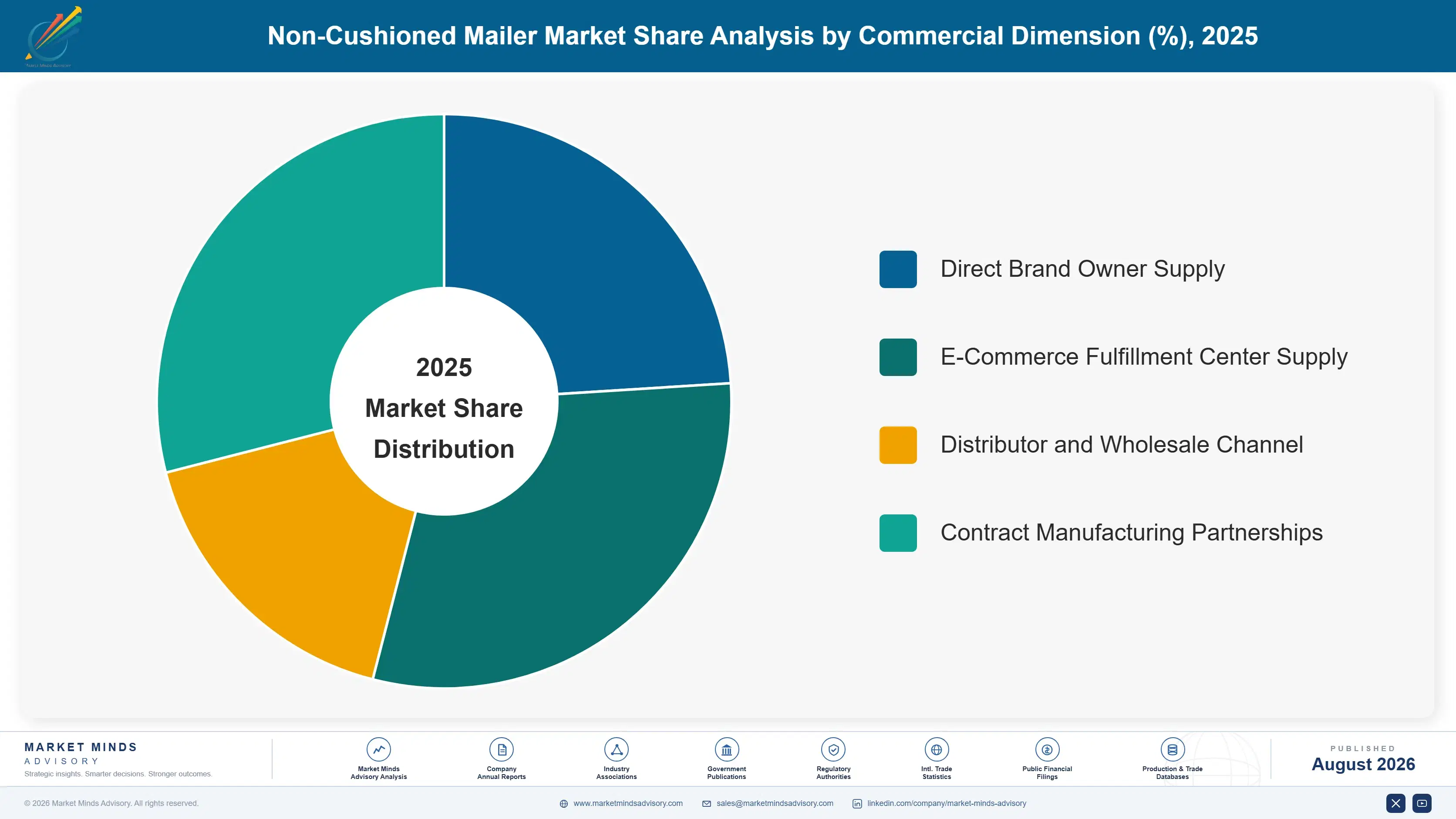
non-cushioned-mailer-market-market-share-analysis-1787307785882

Compostable and Bio-Based Mailers

Compostable and bio-based mailers grow fastest at 12.5%, about 1.92 times the overall rate, as apparel and beauty brand owners increasingly chase genuine sustainability positioning that recycled-content plastic mailers cannot fully deliver given their continued reliance on petrochemical feedstock. These mailers command substantial premium pricing over recycled-content poly that reflects both genuine manufacturing cost differences and the compostability certification value brand owners pay for directly. ProAmpac leads commercial capacity expansion, having invested heavily in compostable film production lines since 2023 specifically targeting apparel and beauty brand customers. Adoption is fastest among premium and sustainability-focused brand owners, while mainstream brand adoption continues growing more gradually alongside broader consumer acceptance. That certification dependency increasingly determines which converters win the largest accounts.
CAGR 12.5%

Recycled-Content Poly Mailers

Recycled-content poly mailers, manufactured with post-consumer recycled polyethylene resin blended to meet binding regulatory thresholds, grow at 10.8%, the second-fastest category, as expanding recycled content mandates force conversion on regulatory timelines rather than voluntary schedules across an increasing number of jurisdictions. This category commands meaningful premium pricing over virgin poly mailers that reflects both genuine recycled resin cost and the regulatory compliance value brand owners pay for directly. Sealed Air maintains substantial recycled-content mailer production capacity serving both apparel and general e-commerce customers directly. Growth here reflects genuine regulatory-driven substitution across the broadest addressable customer base within the category. Converters investing early in seal integrity testing increasingly capture the premium accounts competitors cannot yet match.
CAGR 10.8%
Full segment breakdown across 6 segments available in the complete report.

Regional Architecture and Country Demand Map

East Asia leads on concentrated apparel export manufacturing and massive e-commerce parcel volume, North America follows on recycled content mandate-driven conversion, and South Asia and Pacific grows fastest among major regions. Latin America and the Middle East grow steadily off smaller current bases, while Eastern Europe trails the regional average.

North America

United States state-level recycled content mandates, enacted across a growing number of states with varying compliance timelines, drive substantial conversion demand as apparel and general merchandise brand owners scramble to meet deadlines that differ meaningfully from state to state. Novolex and Inteplast both run substantial domestic manufacturing capacity, serving apparel, general merchandise, and document mailer customers from facilities across the country. Canada's smaller but stable packaging market follows similar regulatory-driven conversion patterns, though generally trailing American state-level mandate enactment specifically. Growth trails East Asia and South Asia and Pacific because the region's manufacturing base is already extensively built out, leaving mandate compliance rather than manufacturing capacity expansion as the primary driver going forward.
Share: 25% | CAGR: 5.9% (2026 to 2036)

Western Europe

The European Union's packaging and packaging waste regulation has driven comprehensive recycled content conversion across member states, with binding compliance deadlines that have already reshaped procurement decisions at major apparel retailers and e-commerce platforms throughout the region substantially. Germany and France both maintain well-developed flexible packaging manufacturing capacity, with Sealed Air's substantial European operations anchoring regional supply serving both domestic and export markets across the continent. The United Kingdom's post-Brexit regulatory framework has largely maintained comparable recycled content targets, sustaining consistent regional demand for compliant film. Growth trails East Asia and South Asia and Pacific as the region's regulatory-driven conversion is already substantially complete relative to faster-growing emerging markets. That regulatory clarity guides other markets.
Share: 20% | CAGR: 5.0% (2026 to 2036)
Regional intelligence for 5 additional markets available in the complete report: East Asia, South Asia and Pacific, Latin America, Middle East and Africa, Eastern Europe. Contact sales@marketmindsadvisory.com.
non-cushioned-mailer-market-country-cagr-analysis-1787307786394

Where Mailer Converters Can Defend Margin

Four commercial moves separate converters capturing durable regulatory-driven growth from those competing purely on commodity pricing: recycled resin sourcing timing, compostable formulation development, brand partnership depth, and resin diversification strategy. Each move converts a technical or timing advantage into a defensible commercial position competitors without matching sourcing readiness or formulation depth cannot easily replicate quickly.

Secure Recycled Resin Supply Ahead of Mandate Deadlines

Brand owners facing binding recycled content deadlines need converters who can actually deliver compliant volume, and converters securing long-term recycled resin offtake agreements ahead of confirmed mandate enforcement dates capture disproportionate share of compliance-driven contracts as customers lock in supply relationships well before deadlines force urgent decisions. This is a genuine sourcing race, and converters who wait for mandates to fully materialize before securing supply risk losing accounts to competitors already contracted and ready. Converters with secured supply typically capture 30% to 45% of the resulting compliance-driven volume before competitors can match sourcing.
Market Impact: Early movers capture 30% to 45% of

Develop Compostable Formulations to Capture Premium Positioning

Brand owners pursuing genuine sustainability positioning beyond regulatory minimums increasingly seek compostable mailer options, and converters investing in compostable film formulation technology that matches virgin plastic durability while meeting compostability certification capture premium business competitors without comparable formulation technology cannot serve. This technology investment differentiates beyond pure recycled content compliance, addressing the specific durability objection that otherwise limits compostable mailer adoption meaningfully. Converters with proven compostable formulations report expanding their addressable premium application range by 20% to 30% relative to competitors without comparable capability. Converters without proven durability formulations increasingly lose premium bids to better-equipped competitors.
Market Impact: Expands addressable applications by

Build Deep Brand Partnership Relationships for Premium Positioning

Apparel and beauty brand owners pursuing voluntary sustainability commitments beyond regulatory minimums increasingly seek converter partners who can support broader packaging strategy conversations rather than pure transactional supply relationships, and converters building this deeper partnership capability capture premium compostable and recycled-content business that transactional competitors cannot access as easily. This partnership approach also builds switching costs, since a brand owner's packaging specification and sustainability messaging often becomes tied to the specific converter relationship over time. Converters building this partnership depth report commanding 18% to 28% pricing premiums over competitors offering purely transactional supply relationships.
Market Impact: Commands 18% to 28% premium for par

Diversify Resin Sourcing to Manage Recycled Content Volatility

Recycled polyethylene resin price and availability volatility creates genuine margin risk for converters dependent on single-source or spot market resin purchasing, and converters building diversified sourcing relationships across recycled resin suppliers in multiple regions weather cost volatility with meaningfully less margin disruption than competitors dependent on concentrated sourcing relationships facing the same market conditions. Converters pursuing diversified sourcing report reducing margin volatility by 8% to 15% during price spikes relative to competitors dependent on single-region concentrated resin sourcing relationships that leave them fully exposed when recycling markets move sharply and unpredictably.
Market Impact: Reduces margin volatility by 8% to

Who Controls the Margin Pool

Concentration sits at a modest CR5 of 26%, with a gap separating diversified flexible packaging companies from specialist recycled-content and compostable mailer converters. Sealed Air and ProAmpac compete on manufacturing scale and recycled resin sourcing depth, while Inteplast and Novolex anchor strong positions in general merchandise volume and compostable innovation respectively. Numerous smaller regional converters compete on price for standard virgin poly mailer volume.
Current competitive activity runs along three lines: recycled resin sourcing security, where converters race to lock in compliant feedstock ahead of mandate deadlines; compostable formulation development, increasingly central to capturing premium sustainability-focused demand; and brand partnership building, as converters compete for voluntary demand beyond regulatory minimums. All participants are assessed on one consistent basis, annual revenue from non-cushioned mailer products.

Pressure is building from two directions. Converters with strong recycled resin sourcing security are capturing disproportionate compliance-driven share, a dynamic slower-moving competitors cannot easily counter through pricing alone. Meanwhile Chinese manufacturers are scaling both price-competitive and increasingly technically capable production, pressuring Western incumbents in cost-sensitive segments. Rankings over the next five years will shift toward converters combining sourcing security with genuine compostable formulation depth.
non-cushioned-mailer-market-company-positioning-matrix-1787307786912

Competitive Moat and Risk Dimensions

SEALED AIR CORPORATION

Moat: Broadest global mailer portfolio

Sealed Air's global manufacturing footprint and product breadth spanning virgin, recycled-content, and compostable mailer formats let it serve multinational brand owners as a single-vendor relationship few narrower competitors can match, particularly valuable as brand owners consolidate packaging vendor relationships across regions. That relationship breadth compounds as brand owners increasingly prefer fewer, more capable global vendor partnerships.
SEALED AIR CORPORATION

Risk: Legacy virgin film exposure remains

Sealed Air's substantial installed base of virgin poly mailer production faces mounting recycled content regulation risk across the European Union and an expanding number of American states, exposing a meaningful share of its commodity mailer revenue to conversion pressure its recycled and compostable product development has not yet fully addressed.
PROAMPAC

Moat: Deep compostable formulation expertise

ProAmpac's early and sustained investment in compostable film formulation technology gives it a defensible position in the fastest-growing premium mailer category that funds continued expansion into adjacent sustainable packaging formats few narrower competitors can match. That formulation advantage compounds as compostability certification requirements tighten across additional jurisdictions.
PROAMPAC

Risk: Premium category concentration risk

ProAmpac's growing revenue concentration in compostable formats, while highly defensible, leaves it more exposed than diversified competitors to any sustained shift in compostable certification standards or alternative sustainable material adoption within that specific narrow category over the coming decade. That narrow exposure could meaningfully slow ProAmpac's growth if certification standards shift unexpectedly.

Players Tracked

Prominent Players

Sealed Air Corporation
ProAmpac
Inteplast Group
Novolex Holdings LLC
International Plastics Inc.

Other Key Players

Berry Global Group Inc.
Coveris Holdings
Polybags Ltd
Veritiv Corporation
RAJA Group
Uline Inc.
Papier Mettler KG
TIPA Corp Ltd
EcoEnclose LLC
Better Packaging Co.
Interpath Packaging
Signode Industrial Group
Intertape Polymer Group
Poly-America LP
Nordenia International AG

Recent Developments

MARCH 2025

ProAmpac expands compostable mailer production capacity

ProAmpac commissioned expanded compostable film production capacity specifically targeting apparel and beauty brand customers seeking certified plastic-free mailer alternatives. This was an organic capacity expansion funded from existing capital, not an acquisition or partnership, reflecting sustained demand growth from brand owners seeking genuine sustainability positioning.
Signal: Continued capacity investment in compostab
SEPTEMBER 2024

Novolex signs supply agreement with major apparel retailer

Novolex signed a multi-year supply agreement with a major national apparel retailer chain to convert its virgin poly mailer inventory to recycled-content alternatives ahead of state regulatory compliance deadlines. This was a commercial supply agreement, not a joint venture or acquisition, securing recurring volume across the retailer's e-commerce fulfillment network.
Signal: Large apparel conversion contracts show ma
JANUARY 2025

Sealed Air acquires recycled resin reprocessing facility

Sealed Air completed the acquisition of a privately held recycled polyethylene reprocessing facility to secure compliant feedstock supply for production ahead of regulatory compliance deadlines. This was an acquisition, not a joint venture or minority investment, giving Sealed Air full ownership and control of the acquired facility and reprocessing capacity.
Signal: Continued acquisition activity in recycled

Recycled Resin Drives Production Cost

Virgin and recycled polyethylene resin inputs together account for roughly forty-nine percent of production COGS, sourced from a mix of petrochemical producers for virgin resin and recycling reprocessors for recycled content, concentrated in North America, Western Europe, and increasingly China, where reprocessing capacity has expanded steadily since 2020. Freight cost from reprocessing facilities to converter plants adds a further modest cost layer specifically.
The clearest recent volatility event traces to 2022 and 2023, when recycled polyethylene pricing rose sharply relative to virgin resin as binding European Union and American state recycled content mandates approached implementation, a divergence documented by national trade statistics agencies that caught several converters without secured supply agreements exposed to steep spot market premiums. Converters without long-term offtake agreements reported meaningful margin compression during this period specifically.

Exposure varies by converter scale and sourcing relationships. Larger converters with direct, long-term recycled resin offtake agreements and diversified sourcing across multiple regions weathered the volatility with meaningfully less disruption than smaller converters dependent on spot market purchasing. Converters serving apparel accounts under fixed multi-year contracts faced particular pressure to maintain pricing commitments despite raw material cost increases across the category.
non-cushioned-mailer-market-cost-volatility-analysis-1787307787106

Secure Long-Term Recycled Resin Offtake Agreements

Converters are increasingly signing multi-year offtake agreements directly with recycling reprocessors, reducing exposure to spot market recycled resin price volatility and securing compliant feedstock volume ahead of binding mandate deadlines across multiple jurisdictions. This approach reduces long-term supply risk meaningfully. Converters without such agreements increasingly find themselves priced out of compliance-driven bidding opportunities across major markets.

Invest Directly in Recycling Reprocessing Capacity

Some larger converters are investing directly in recycling reprocessing infrastructure, capturing feedstock margin previously earned by third-party reprocessors while securing guaranteed supply independent of external market volatility. This vertical integration increasingly favors converters with sufficient capital to fund infrastructure investment ahead of demand. That integration advantage compounds as external recycling market volatility continues rising steadily.

Invest in Resin-Efficient Film Design to Reduce Input Volume

Some converters are optimizing film thickness and gusset design to reduce resin volume required per unit while maintaining tear strength and seal integrity, cutting raw material exposure per mailer even as design optimization requires meaningful upfront engineering investment. That efficiency gain increasingly favors converters with strong film engineering expertise over those relying purely on bulk resin purchasing scale alone.

Portfolio Architecture for Margin Defence

The portfolio splits into three tiers with real margin separation. Standard virgin poly mailers compete largely on price against paper alternatives, earning modest margins defended through production scale. Recycled-content and compostable mailers earn substantially more because customers pay for regulatory compliance and sustainability positioning conventional virgin film alone cannot deliver. That gap widens as customers demand documented compliance readiness before committing budget. Converte
The tension between virgin volume and premium recycled or compostable positioning shapes converter strategy directly: virgin mailers keep production lines running and build broad customer relationships, but converters that let virgin volume crowd out recycled resin sourcing investment risk losing the fastest-growing, highest-margin categories to more capability-focused competitors. Converters that manage this balance well capture both broad customer presence and premium margin.

High-value pools concentrate in compostable and recycled-content mailers, where regulatory compliance value and sustainability positioning justify premium economics few commodity-focused competitors can match. The emerging bio-based formulation tier currently earns unevenly as converters absorb development cost against still-developing commercial adoption. That unevenness should ease as formulation technologies mature and gain broader commercial validation.

Volume / Commodity-Adjacent Tier

Standard virgin poly mailers sold on price against paper alternatives to mainstream apparel and general merchandise customers, where production scale determines acceptable margin. Freight cost proximity to fulfillment centers matters as much as unit price here.
Gross Margin: 12-24%

Premium / Certified Tier

Recycled-content and compostable mailers commanding premium pricing from customers prioritizing regulatory compliance and sustainability positioning, who pay durable premiums for compliance rather than risk noncompliance penalties. Regulatory-driven customers pay these premiums without hesitation given compliance risk exposure.
Gross Margin: 30-44%

Sustainability / Regulatory / Next-Generation Tier

Bio-based formulations and next-generation compostable technology still absorbing development investment against developing commercial adoption, where converters are betting development capital on formats they expect regulators to mandate within several years.
Gross Margin: 16-42%
non-cushioned-mailer-market-portfolio-architecture-1787307787610

High-value Sub-segments and Strategic Watch-out

Regulatory-Driven Recycled Content Mailers

High value and high growth as binding recycled content mandates expand across jurisdictions, commanding durable premium pricing once compliance timelines force conversion decisions industry-wide. Converters with the strongest resin sourcing security increasingly win contracts competitors slower to invest simply cannot secure. That gap widens further each additional quarter.
Gross Margin: 32-46%

Premium Compostable Apparel Mailers

High value with strong current growth as apparel and beauty brands seek premium sustainable presentation packaging, priced above standard recycled content while remaining accessible to mainstream brand budgets. Adoption is broadening steadily beyond early sustainability leaders into mainstream apparel brand tiers. Momentum keeps building steadily each quarter.
Gross Margin: 30-44%

Standard Virgin Poly Mailers

The volume core, sold on price to mainstream apparel and general merchandise customers, defended mainly through production scale and thin per-unit margin discipline across facilities. Competitive pressure here concentrates on production efficiency and cost rather than the sustainability differentiation reshaping premium tiers overall today. overall today.
Gross Margin: 12-24%

Legacy Non-Compliant Virgin Formats

The strategic watch-out, facing mounting extended producer responsibility fee exposure as recycled and compostable alternatives increasingly become the standard expectation for compliant mailer specification. Converters still dependent on this declining tier should be actively redirecting investment toward compliant alternatives rather than defending formats facing rising compliance costs.
Gross Margin: 6-16%

How Mailer Demand Actually Recurs

Demand here runs on continuous consumption tied directly to apparel and general e-commerce shipment volume rather than discrete purchase events. An apparel brand converted to compliant mailers consumes matched packaging with every order shipped, making a single conversion contract worth years of recurring volume rather than a standalone transaction. That recurring pattern gives converters unusually predictable, multi-year revenue visibility once a conversion contract is signed. That predictabili
Adoption depth varies sharply by customer type. Large apparel and e-commerce brands integrate compliant mailers deeply into standardized fulfillment specifications once converted, making supplier switching costly and rare absent a compelling cost or performance reason. Smaller and general merchandise customers, by contrast, evaluate suppliers more flexibly based on cost, creating more frequent switching opportunities between competing converters.

Buyer profiles are shifting generationally as younger packaging procurement professionals, trained on sustainability-first specification frameworks, increasingly treat recycled content and compostability as the default choice rather than an alternative requiring special justification. Older procurement teams trained primarily on cost-first specification are adapting more gradually, but that generational shift is accelerating as regulatory deadlines force conversion decisions across the industry broadly.
non-cushioned-mailer-market-end-use-penetration-index-1787307788096

Where Mailer Value Concentrates Next

These are among the four positions where our research anticipates prominent divergence between winners and laggards over the coming forecast period. Each is grounded in the demand model, the regulatory perimeter, and the announced capacity pipeline.
01 / RECYCLED RESIN SOURCING TIMING

Secure compliant supply ahead of confirmed deadline pressure

Brand owners facing binding compliance deadlines need converters ready to deliver compliant volume on schedule, and converters securing recycled resin supply ahead of confirmed mandate enforcement dates capture the conversion wave before competitors catch up. This is a genuine sourcing race with real consequences for companies that wait too long to commit capital. Converters moving decisively now will own the relationships that regulatory deadlines are about to make urgently valuable across an expanding list of jurisdictions., a race with real consequences for hesitant converters.
02 / COMPOSTABLE FORMULATION INVESTMENT

Close the durability gap before it becomes a category ceiling

Compostable film's remaining durability limitations genuinely cap its addressable heavy-load application range, and converters investing in formulation technology that closes this gap capture applications competitors cannot serve credibly. This technology investment differentiates beyond pure recycled content compliance. Companies treating compostable formulation as secondary to raw capacity expansion are underestimating how directly it determines total addressable premium market size., and that ceiling grows more consequential each year as regulatory deadlines push more apparel and general merchandise categories toward requiring compliant mailer substitution entirely across additional jurisdictions.
03 / PREMIUM PARTNERSHIP DEVELOPMENT

Build brand partnerships beyond transactional supply relationships

Brand owners pursuing voluntary sustainability commitments increasingly seek converter partners for broader packaging strategy conversations, not pure transactional supply, and converters building this deeper capability capture premium business transactional competitors cannot access. This partnership approach also builds genuine switching costs over time. Companies still selling purely on price and specification sheets are missing the relationship depth that increasingly determines premium account retention long-term., and that gap only widens as brand owners increasingly demand deeper packaging strategy partnership commitment over multi-year planning cycles.
04 / RESIN SOURCING DIVERSIFICATION

Diversify sourcing before the next recycled resin price cycle

Recycled resin volatility is a persistent feature of a category dependent on recycling markets outside converter control, and converters still dependent on concentrated sourcing relationships remain exposed to margin compression every time recycling markets move sharply. Diversifying sourcing now, rather than reactively after the next price spike, protects margin durably. This is a defensive priority every converter serving fixed-price apparel contracts should treat as non-negotiable given how exposed unprotected margin becomes., and converters serving fixed-price apparel contracts without this protection carry real exposure every time recycling markets move sharply.

Engagement Snapshot From the Field

A live engagement with an industry participant carrying material or product regulatory and market exposure ahead of a defining policy shift, showing how our research translates into a defensible multi-year portfolio strategy.
MARKET MINDS ADVISORY · CLIENT ENGAGEMENT SUMMARY
Non-Cushioned Mailer Producer Strategic Portfolio Review and Transition Roadmap 2026·Investment Scenario on Non-Cushioned Mailer Exposure Evaluation 2025-26
CLIENT PROFILE
A mid-size apparel retailer shipping roughly 4 million e-commerce orders annually approached MMA while planning conversion from virgin poly mailers to recycled-content alternatives ahead of an approaching state-level compliance deadline. The client reported roughly USD 3.8 million in annual mailer packaging spending across its fulfillment network, with no prior recycled-content supplier relationship established (client-reported, unverified by MMA).
STRATEGIC CHALLENGE
Management needed to select a converter capable of delivering full fulfillment volume by the compliance deadline while managing the cost increase recycled content represented over virgin resin, all without disrupting existing warehouse packing line workflows across multiple fulfillment centers. The board wanted a defensible converter decision before the compliance deadline arrived.
MMA APPROACH
MMA benchmarked production capacity and delivery timeline commitments across five recycled-content mailer converters against the client's specific volume requirements and deadline, modeled total cost of conversion including the price differential versus virgin resin, and assessed each converter's track record delivering comparable-scale conversions for other apparel retailers. We also interviewed warehouse operations staff to confirm real-world packing line constraints the quantitative model alone could not capture.
KEY FINDINGS
  1. Only two of five benchmarked converters could credibly commit to delivering the client's full fulfillment volume within the compliance deadline timeline given their current and planned capacity.
  2. The cost differential versus virgin resin was meaningfully lower than the client's initial internal estimate once volume-based pricing was properly negotiated against a multi-year commitment.
  3. One converter's prior experience converting a comparably sized apparel retailer provided a proven implementation playbook that reduced projected operational disruption risk considerably.
  4. Sequencing the conversion by fulfillment center rather than attempting a single simultaneous network-wide changeover reduced supply chain risk while still meeting the compliance deadline comfortably (client-reported, unverified by MMA).
CLIENT PROFILE
A mid-size apparel retailer shipping roughly 4 million e-commerce orders annually approached MMA while planning conversion from virgin poly mailers to recycled-content alternatives ahead of an approaching state-level compliance deadline. The client reported roughly USD 3.8 million in annual mailer packaging spending across its fulfillment network, with no prior recycled-content supplier relationship established (client-reported, unverified by MMA).
STRATEGIC CHALLENGE
Management needed to select a converter capable of delivering full fulfillment volume by the compliance deadline while managing the cost increase recycled content represented over virgin resin, all without disrupting existing warehouse packing line workflows across multiple fulfillment centers. The board wanted a defensible converter decision before the compliance deadline arrived.
MMA APPROACH
MMA benchmarked production capacity and delivery timeline commitments across five recycled-content mailer converters against the client's specific volume requirements and deadline, modeled total cost of conversion including the price differential versus virgin resin, and assessed each converter's track record delivering comparable-scale conversions for other apparel retailers. We also interviewed warehouse operations staff to confirm real-world packing line constraints the quantitative model alone could not capture.
KEY FINDINGS
  1. Only two of five benchmarked converters could credibly commit to delivering the client's full fulfillment volume within the compliance deadline timeline given their current and planned capacity.
  2. The cost differential versus virgin resin was meaningfully lower than the client's initial internal estimate once volume-based pricing was properly negotiated against a multi-year commitment.
  3. One converter's prior experience converting a comparably sized apparel retailer provided a proven implementation playbook that reduced projected operational disruption risk considerably.
  4. Sequencing the conversion by fulfillment center rather than attempting a single simultaneous network-wide changeover reduced supply chain risk while still meeting the compliance deadline comfortably (client-reported, unverified by MMA).
RECOMMENDED STRATEGY
Phase 1: Phase 1 (0 to 2 months): Finalize the supply agreement with the selected converter and begin fulfillment center sequencing planning. Phase 2: Phase 2 (2 to 6 months): Execute the phased regional conversion, prioritizing fulfillment centers in the state with the earliest compliance deadline. Phase 3: Phase 3 (6 to 10 months): Complete conversion across all remaining fulfillment centers and evaluate performance against the original packaging benchmark.
OUTCOME
The apparel retailer began Phase 1 implementation on schedule, reporting that the negotiated volume pricing kept the total conversion cost within the client's original approved budget. The retailer also reported positive customer feedback related to its sustainability positioning following the conversion (client-reported, unverified by MMA).

Frequently Asked Questions

Foundational context covering the market sizes, CAGR, scope, country, region and competition that inform every finding below. This section is provided to cover basics and most often pre-purchase conversations, answered from the MMA Primary Research Dataset.

What is the current size of the Non-Cushioned Mailer Market?

The non-cushioned mailer market was valued at USD 9.8 billion in 2025. Growth is driven by expanding recycled content mandates, apparel e-commerce volume growth, and brand sustainability commitments.

How large will the Non-Cushioned Mailer Market be by 2036?

The market is projected to reach USD 19.60 billion by 2036 under the base case scenario. That reflects an expansion multiple of roughly 1.88 times the 2026 value.

What is the CAGR for the Non-Cushioned Mailer Market 2026 to 2036?

The base case CAGR is 6.5%, with a bull case of 7.7% and a bear case of 5.3%. Recycled content mandate expansion speed is the main swing factor between scenarios.

Which segment is growing fastest?

Compostable and bio-based mailers grow fastest at 12.5% CAGR, roughly 1.92 times the overall market rate. Recycled-content poly mailers follow as the second-fastest segment at 10.8%.

Who are the major companies in the Non-Cushioned Mailer Market?

Leading converters include Sealed Air Corporation, ProAmpac, Inteplast Group, Novolex Holdings LLC, and International Plastics Inc. The top five hold a combined 26% of the market.

Which country is growing fastest?

Vietnam is the fastest-growing country at 11.5% CAGR, driven by rapidly expanding apparel export manufacturing and accelerating e-commerce shipment volume. Domestic converters anchor much of that growth.

Report Segmentation Architecture

The full report scope spans multiple orthogonal segmentation dimensions, with cross-tabulated demand data provided for each dimension pair. Coverage extends further to regional breakdowns, trend trajectories, and the competitive detail needed to support segment-level decision-making.

By Material and Recycled Content Composition

  • Virgin Poly Mailers
  • Recycled-Content Poly Mailers
  • Paper and Kraft Mailers
  • Apparel and Soft Goods Mailers
  • Document and Flat Mailers
  • Compostable and Bio-Based Mailers

By End-Use Industry

  • Apparel and Fashion
  • General Merchandise E-Commerce
  • Documents and Office Supplies
  • Beauty and Personal Care
  • Books and Media

By Commercial Dimension

  • Direct Brand Owner Supply
  • E-Commerce Fulfillment Center Supply
  • Distributor and Wholesale Channel
  • Contract Manufacturing Partnerships

By Region

  • North America
  • Western Europe
  • East Asia
  • South Asia and Pacific
  • Latin America
  • Middle East and Africa
  • Eastern Europe

Scope, Methodology, and Coverage

Every figure in this report is reproducible from documented input assumptions. The scope below maps the historical period, the forecast horizon, the segmentation dimensions, and the countries covered, alongside the underlying primary and qualitative methodology.
Historical Period
2020 to 2025
Forecast Period
2026 to 2036
Base Year
2025 (USD billions; MMA Primary Research Dataset, August 2026)
Market Definition
The non-cushioned mailer market comprises flat, unpadded flexible shipping mailers manufactured from virgin poly film, recycled-content poly film, paper and kraft materials, or compostable bio-based film, used for apparel, documents, and non-fragile e-commerce goods. Padded and cushioned mailers containing bubble or foam liners, rigid shipping boxes, and mailer formats designed primarily for fragile or breakable goods are excluded.
Quantitative Units
USD billions (current prices); unit volume of mailers produced where applicable
Segmentation Dimensions
By Material and Recycled Content Composition; By End-Use Industry; By Commercial Dimension; By Region
Regions Covered
North America, Western Europe, East Asia, South Asia and Pacific, Latin America, Middle East and Africa, Eastern Europe
Countries Covered
USA, China, Vietnam, Germany, France, UK, Japan, South Korea, India, Australia, Canada, Brazil, Mexico, Indonesia, Thailand, Malaysia, UAE, Saudi Arabia, South Africa, Nigeria, Turkey, Poland, Netherlands, Italy, Spain, Sweden, Switzerland, Argentina, Colombia, Singapore, and additional markets relevant to this sector
Key Companies Profiled
Sealed Air Corporation, ProAmpac, Inteplast Group, Novolex Holdings LLC, International Plastics Inc., Berry Global Group Inc., Coveris Holdings, Polybags Ltd, Veritiv Corporation, RAJA Group, Uline Inc., Papier Mettler KG, TIPA Corp Ltd, EcoEnclose LLC, Better Packaging Co., Interpath Packaging, Signode Industrial Group, Intertape Polymer Group, Poly-America LP, Nordenia International AG
Quantitative Methodology
Primary survey, n=3,800 respondents, Q4 2025, six countries; demand-side model with trade association cross-validation
Qualitative Methodology
47 expert interviews, Q4 2025; applied to validate demand model assumptions, identify emerging dynamics, and assess competitive positioning
Report Format
PDF and XLSX data workbook (Word format preview document)
Publisher
Market Minds Advisory
Report Code
MMA-2026-PAC-809
Published
August 2026
Contact
sales@marketmindsadvisory.com | www.marketmindsadvisory.com

Purchase the full Non-Cushioned Mailer Market Report (2026 to 2036).

The full MMA Non-Cushioned Mailer Market report sizes demand across six material and recycled content composition categories, five end-use industries, four commercial dimensions, and seven regions through 2036. It profiles twenty companies on a consistent revenue basis, scoring each on resin sourcing security, compostable formulation depth, and brand partnership breadth. Scenario models quantify how recycled content mandate expansion and resin sourcing volatility move both demand and realizable pricing. The report includes delivered-cost modeling by application category and a converter compliance-readiness screen built for apparel and general merchandise procurement teams.
Mailer cost-curve modeling across all major applications
Recycled content mandate tracking and compliance deadline database by jurisdiction
Apparel and general merchandise demand forecasts by country
Compostable formulation and durability benchmarking across converters
Resin sourcing cost exposure modeling by converter scale
Regulatory conversion scenarios under bull and bear cases

Built For The People Who Decide

From boardroom strategy to bench-side execution, this report is read cover-to-cover by leaders shaping the next decade of their industry, turning demand scenarios, market dynamics and valuation benchmarks into decisions.
CXOs/ Presidents/ VPs/ Managers
M&A and Corporate Development
Strategy Teams and R&D Heads
Procurement and Product Directors
Regulatory and Compliance Leaders
Investor Relations and Equity Analysts