Market Minds Advisory
Noise Reduction Tactical Headset Market

Noise Reduction Tactical Headset Market: Noise Reduction Tactical Headset Market. Integration, Certification, and Miniaturisation Economics.

Defense procurement agencies are consolidating hearing protection and tactical communication into single certified headset platforms, even as miniaturised in-ear systems and bone conduction alternatives compete for the same modernisation budgets across allied military.

Lead Analyst

Published

September 2026

Make Smarter Decisions with Customized Research Insights

Request a free sample report and evaluate market opportunities, growth trends, and competitive dynamics relevant to your business needs.

2025 MARKET VALUE$0.8BMarket Size 2025
2036 FORECAST VALUE$1.8BBase Case , 2026 to 2036
CAGR 2026 TO 20366.8 %Bull 8.1% / Bear 5.6%
INCREMENTAL OPPORTUNITY$0.8BNet 10- year value creation
EXPANSION MULTIPLE1.93x2036 value over 2026 base
Strategic Levers
M&A Pipeline
Regional Outlook
Country Rankings
Competitive Intelligence
Segmental Deep-dive
Call-Us : 91 93563 13602

Executive Snapshot and Market Trajectory.

Tactical headset procurement is shifting from separate hearing protection and communication devices toward integrated platforms combining active noise reduction with radio communication in a single certified unit, reducing the equipment load individual soldiers and officers must carry and maintain in the field overall too nationwide overall.
Demand concentrates around military modernisation programmes and law enforcement tactical units where hearing protection standards and communication reliability both carry mission-critical importance, with North American and European defense budgets the largest buyers as allied forces standardise procurement around fewer certified integrated platforms. This design concentration is deepening as more procurement programmes converge on comparable integration and certification specifications across most markets tracked in this analysis, a pattern reinforced by each renewal cycle.
Competitive character splits between established hearing protection manufacturers extending into communication integration and defense electronics specialists building hearing protection capability into existing tactical radio product lines, a convergence reshaping which suppliers win the largest multi-year procurement contracts. Domestic entrants increasingly compete on price rather than matching the certification depth established suppliers already hold across most manufacturer decisions made this year, a shift already reshaping vendor evaluation criteria.
Market Definition
This report covers tactical headsets combining hearing protection with optional communication integration for military, law enforcement, and security applications, spanning passive, active noise reduction, in-ear, and bone conduction designs. Consumer hearing protection and standalone tactical radios are excluded.
Base Year Value
$0.8B in 2025 (MMA Primary Research Dataset, September 2026)
Forecast Period
2026 to 2036, eleven discrete annual values
CAGR
6.8% base case. Bull 8.1%. Bear 5.6%.
Fastest Growth Segment
In-Ear Tactical Hearing Protection Systems: 10.6% CAGR
Fastest Growth Country
India: 9.8% CAGR
Fastest Growth Region
South Asia and Pacific: 8.8% CAGR
Largest Region
North America: 31% of 2025 global value
Market Leaders
3M Company, Invisio AB, Safariland Group, MSA Safety Incorporated, David Clark Company Inc. Source: MMA Analysis based on company annual reports.
Primary Survey
n=3,800 procurement and R&D decision-makers, Q4 2025, six countries
Methodology
Demand-side build-up, cross-validated against public data, 47 expert interviews

Noise Reduction Tactical Headset Market Forecast Scenarios

noise-reduction-tactical-headset-market-size-forecast-scenario-1788503039892
Between 2020 and 2025, tactical headset volumes grew steadily as military modernisation programmes and expanding law enforcement tactical unit budgets both increased procurement of integrated hearing protection and communication systems replacing older separate-device configurations across allied force equipment inventories. Retail pricing also declined enough to broaden the addressable law enforcement buyer base considerably during this period across most allied procurement categories tracked.
The base case assumes continued momentum from three mechanisms: defense modernisation programmes standardising procurement around integrated communication and hearing protection platforms, expanding law enforcement tactical unit budgets following continued domestic security investment, and miniaturised in-ear systems extending addressable applications beyond traditional over-ear headset form factors. Each mechanism reinforces the others, giving the base case forecast comparatively durable support even during softer budget periods across most modernisation categories tracked broadly too.
A bull scenario assumes faster allied force standardisation pulls forward integrated platform procurement beyond current flagship programme concentration, while the principal bear risk is prolonged defense budget uncertainty delaying modernisation programme funding decisions across multiple allied procurement agencies simultaneously. Either scenario still favours suppliers holding broad certification over newer entrants competing mainly on price across most established markets today.

Integration Economics and Certification Depth

Tactical headsets sit downstream of both defense procurement budget cycles and evolving battlefield communication requirements, and pricing increasingly reflects certification depth and communication integration rather than raw hearing protection material cost alone across most military contracts. Vendors documenting consistent design-win outcomes across multiple procurement programmes increasingly win business ahead of price-only competitors nationwide broadly across most segments today, a pattern reinforced by each successive procurement round.
MARKET CONCENTRATION48%share held by five largest global headset suppliers
AVERAGE SELLING PRICE$1,150typical current price per integrated headset unit sold
CERTIFIED CONTRACTOR SHARE72%share of output sourced from certified defense contractors
CAPACITY UTILISATION80%headset production lines currently operating above full capacity
EXPORT SHARE44%share of finished units exported to allied nations
QUALIFICATION CYCLE11 monthsmonths typical qualification cycle for new headset platforms
Buyers increasingly specify integrated hearing protection and communication capability as standard for new procurement programmes, pushing legacy passive-only headset suppliers toward smaller law enforcement contracts while integrated suppliers hold pricing power on flagship military modernisation programmes across allied nations. This pricing power is beginning to narrow slightly as more suppliers qualify comparable integrated platforms across overlapping customer bases across most established markets tracked too.
Over the next decade, expect continued military modernisation and expanding law enforcement tactical budgets to keep integrated headset demand elevated, favouring suppliers who can clear defense certification faster than procurement programme timelines require across successive modernisation rounds. Consolidation among smaller suppliers lacking certification investment capacity looks increasingly likely as this competitive pressure builds across most established markets today broadly.
"Soldiers don't want two devices fighting for the same ear canal. The programme that finally merged hearing protection and radio into one certified unit is the one winning every allied procurement bid right now."
Director, Defense and Tactical Equipment Practice · MMA Construction and Industrial Equipment Practice · September 2026

Market Trends

Integrated Hearing Protection and Communication Becomes Standard

Defense procurement agencies are increasingly specifying integrated headsets combining active noise reduction with tactical radio communication as a baseline requirement rather than procuring separate hearing protection and communication devices that soldiers previously wore simultaneously with compatibility and comfort tradeoffs. Procurement officers report integrated platform requests rising meaningfully across new modernisation programme solicitations, reflecting operational feedback that separate devices created equipment conflicts and reduced situational awareness compared with unified certified systems. Suppliers slow to consolidate architecture risk losing allocation on the next modernisation round entirely as buyers standardise specifications too overall.
Market Impact: Adds 16% to integrated volume

Miniaturised In-Ear Systems Expand Addressable Applications

In-ear tactical hearing protection systems offering considerably smaller form factor than traditional over-ear headsets are expanding addressable applications into helmet-compatible and covert operation use cases where bulkier over-ear designs create equipment conflicts or reduce operational discretion. Suppliers report in-ear system orders growing meaningfully faster than traditional over-ear headset orders across most special operations and covert unit procurement categories, reflecting operator preference for reduced equipment bulk without sacrificing hearing protection or communication capability. This shift is reshaping how suppliers position their traditional over-ear product lines against these newer miniaturised alternatives overall.
Market Impact: Expands law enforcement demand 12%

Market Opportunities and Growth Drivers

Military Modernisation Programmes Standardise Integrated Procurement

Allied military forces are consolidating equipment procurement around fewer certified integrated headset platforms rather than maintaining separate hearing protection and communication device inventories, reflecting logistics and maintenance simplification objectives that standardisation delivers across large force equipment inventories. Procurement agencies report modernisation programme budgets increasingly earmarked specifically for integrated platforms rather than component-level hearing protection or communication device purchases treated as separate line items in defense capital planning. This visibility is rare in a category historically driven by lumpy, unpredictable failure-driven replacement spending patterns alone across most programmes overall too overall.
Market Impact: Delays qualification 8 to 11 months

Law Enforcement Tactical Unit Budgets Continue Expanding

Domestic law enforcement tactical unit budgets have continued expanding as departments invest in equipment upgrades following sustained public safety funding priorities, extending tactical headset demand beyond traditional military procurement into a growing civilian law enforcement buyer segment with distinct certification and budget considerations. Suppliers report law enforcement procurement increasingly mirroring military specification trends toward integrated platforms, though budget constraints keep average unit specifications somewhat below flagship military modernisation programme tiers. Suppliers serving both military and civilian segments increasingly tailor separate product lines to capture this widening budget spread today too.
Market Impact: Adds 7 points to costs

Market Restraints and Challenges

Defense Certification Cycles Delay New Platform Qualification

New tactical headset platforms require considerably longer certification cycles at defense procurement agencies than commercial hearing protection products, often extending well beyond the timelines suppliers plan around when introducing new integrated communication capability to military and law enforcement markets. The commercial impact shows up as delayed revenue recognition for suppliers who have invested in new platform development well ahead of any confirmed qualified procurement volume from defense customers. Suppliers are responding by engaging procurement agencies earlier in requirements development to compress the effective certification timeline. Suppliers with established certification track records increasingly capture share specifically because they can.
Market Impact: Lifts integrated share 13 points

Electronics Component Cost Volatility Compresses Margins

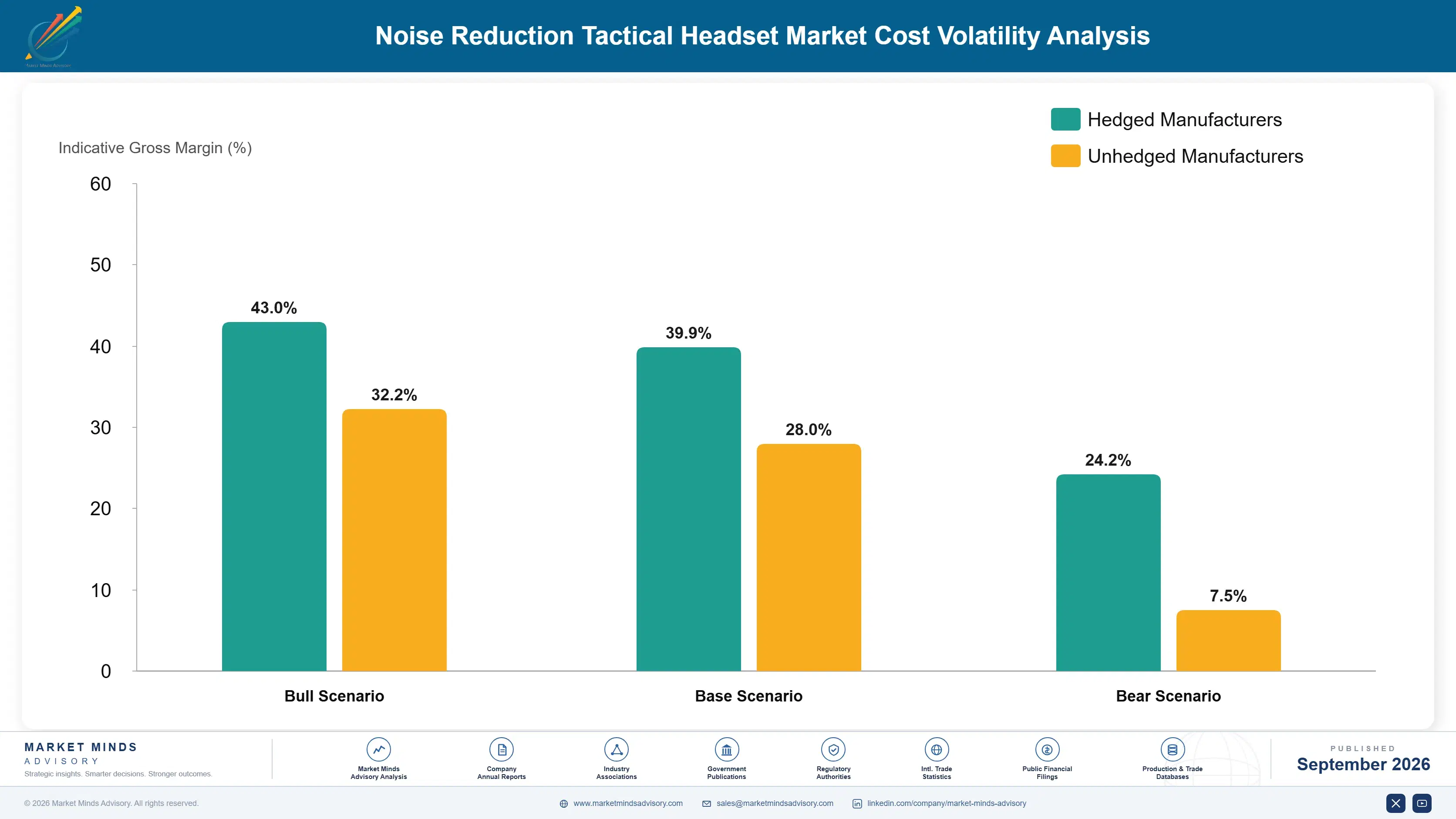
Specialty microphone, speaker, and radio integration electronics components used in integrated tactical headsets have experienced meaningful price volatility in recent semiconductor supply cycles, squeezing margins at suppliers without long-term component supply agreements across their certified product lines. Smaller regional manufacturers without diversified sourcing relationships carry the largest exposure to this volatility, while larger suppliers are increasingly locking multi-year component supply agreements to protect margin on fixed-price multi-year defense contracts. Suppliers with diversified sourcing relationships increasingly capture share specifically because they can absorb these swings more reliably overall too overall today.
Market Impact: Raises in-ear share 15 points
3 additional market trends, 4 additional growth drivers, and 2 additional restraints and challenges are covered in the full report. Contact sales@marketmindsadvisory.com to access the complete intelligence.

Segment CAGR and Growth Architecture

Segmentation follows form factor and integration depth, from standard passive and active noise reduction headsets through communication-integrated platforms to emerging in-ear and bone conduction designs, keeping standard hearing protection distinct from the integrated and next-generation layers built around it. This framework mirrors how procurement agencies actually structure specifications across engineering and operations teams today.
noise-reduction-tactical-headset-market-market-share-analysis-1788503040495

In-Ear Tactical Hearing Protection Systems

In-ear tactical hearing protection systems offering considerably smaller form factor than traditional over-ear headsets are capturing an expanding share of total tactical headset volume as special operations and covert unit procurement increasingly favours reduced equipment bulk without sacrificing hearing protection or communication capability. Suppliers report certification timelines running considerably longer than standard over-ear platforms given the additional custom-fit and communication integration engineering these systems require, but delivering stronger premium positioning once certification clears since fewer suppliers can reliably meet these specifications at required scale. Adoption remains concentrated among special operations units with the procurement budget to justify custom-fit system costs, but the qualified supplier pool is expanding as more manufacturers invest in the miniaturisation capability broader markets require.
CAGR 10.6%

Bone Conduction Tactical Headsets

Bone conduction tactical headsets transmitting audio through skull vibration rather than blocking the ear canal are growing as operators increasingly value maintaining natural situational awareness hearing alongside radio communication, a capability standard over-ear and in-ear designs cannot deliver without compromising ambient sound perception. This segment benefits from growing recognition that complete ear canal occlusion, while maximising hearing protection, can meaningfully reduce situational awareness in certain tactical scenarios where operators need to hear ambient environmental cues clearly. Suppliers require specialised transducer engineering capability to deliver reliable audio quality through bone conduction technology, a design capability barrier that favours established defense electronics specialists over hearing protection manufacturers lacking comparable acoustic engineering depth. Growth here trails in-ear systems slightly since bone.
CAGR 9.4%
Full segment breakdown across 6 segments available in the complete report.

Regional Architecture and Country Demand Map

North America anchors the largest share given concentrated defense budget scale and established procurement infrastructure, while Western Europe and East Asia follow on allied modernisation programmes and domestic manufacturing capacity. Certification depth and domestic manufacturing capacity also shape the pattern meaningfully across regions overall today.

North America

United States defense modernisation programmes anchor substantial demand, with the Department of Defense increasingly specifying integrated hearing protection and communication platforms as standard equipment across multiple service branch modernisation initiatives spanning infantry, special operations, and support unit categories. Domestic law enforcement tactical unit budgets continue expanding following sustained public safety funding priorities, extending demand into a growing civilian buyer segment with its own certification requirements distinct from military specifications. Canadian defense procurement follows similar integrated platform trends, though at meaningfully smaller absolute budget scale given the smaller overall force size relative to United States military inventory. Average selling prices stay firm given established defense contractor relationships and the certification track record leading suppliers have built across multiple.
Share: 31% | CAGR: 7.8% (2026 to 2036)

Western Europe

NATO allied force modernisation programmes across Germany, France, and the United Kingdom anchor substantial regional demand, with member nations increasingly standardising procurement around interoperable integrated headset platforms supporting coordinated multinational operations across the alliance's expanding force readiness initiatives. Domestic defense electronics manufacturers compete against North American suppliers for these modernisation contracts, using established relationships with national defense ministries built over decades of prior equipment procurement cycles. Nordic countries are separately investing in cold-weather tactical equipment upgrades including hearing protection systems suited to extended outdoor operations in challenging climate conditions. Growth trails North America given generally more constrained European defense budgets relative to force modernisation ambitions across the broader alliance framework.
Share: 21% | CAGR: 5.3% (2026 to 2036)
Regional intelligence for 5 additional markets available in the complete report: East Asia, South Asia and Pacific, Latin America, Middle East and Africa, Eastern Europe. Contact sales@marketmindsadvisory.com.
noise-reduction-tactical-headset-market-country-cagr-analysis-1788503041051

Integration Depth, Certification Speed, and Miniaturisation

Suppliers hold pricing power where communication integration depth, faster defense certification turnaround, and miniaturisation engineering combine, letting qualified players capture margin beyond standard hearing protection cost that commodity manufacturers cannot easily replicate. Point-solution suppliers lacking any of these three capabilities increasingly struggle to defend share against integrated rivals in most contract categories overall too.

Radio Communication Integration Partnership Development Strategy

Building direct integration partnerships with major tactical radio manufacturers lets suppliers offer headsets natively compatible with communication systems defense customers already operate, directly addressing the interoperability friction that has historically slowed integrated platform adoption across fragmented military communication equipment inventories. Suppliers who have secured these integration partnerships report winning a growing share of modernisation programme contracts specifically because native compatibility removes a meaningful procurement barrier, with integrated suppliers commanding pricing running roughly 20 to 25 percent above comparable standalone hearing protection product on qualified contracts. Expect this advantage to widen as integrated procurement standards keep expanding.
Market Impact: Commands 20 to 25 percent price premium overall

Accelerated Defense Certification Pathway Investment Programme

Investing in dedicated defense certification liaison capability and pre-submission testing lets suppliers compress the effective qualification timeline for new integrated platforms, directly addressing the certification bottleneck that increasingly determines which suppliers can respond competitively to modernisation programme procurement timelines. Suppliers offering this accelerated pathway capability report meaningfully faster new platform qualification than competitors relying on standard certification queue scheduling, with accelerated suppliers bringing new integrated platforms to market roughly 3 to 5 months faster than competitors facing standard certification delays. This scheduling advantage grows as more suppliers submit integrated designs for certification simultaneously across the industry.
Market Impact: Cuts qualification lead time 3 to 5 months

Miniaturisation Engineering for In-Ear and Covert Applications

Investing in specialised miniaturisation engineering capability for in-ear and covert application headsets positions suppliers to capture the fastest-growing special operations procurement segment that standard over-ear designs cannot address without comparable custom-fit engineering investment across the certification process. Suppliers who have already built this capability report winning a growing share of special operations contracts specifically because incumbent standard-design suppliers cannot meet the form factor requirements these units increasingly specify, with miniaturised platforms commanding roughly 30 percent pricing premium over standard over-ear equivalents. This engineering advantage compounds as special operations procurement continues expanding across most major allied nations tracked.
Market Impact: Commands roughly 30 percent miniaturised platform pricing premium

Who Controls the Margin Pool

Concentration sits moderate at a cr5 near 48 percent measured on global qualified shipment revenue, with a meaningful gap separating established hearing protection and defense electronics suppliers holding deep procurement relationships from a fragmented tail of regional manufacturers competing mainly on price within uncertified law enforcement contract segments. This gap is widening rather than closing as leading suppliers reinvest margin into further integration and certification depth.
Current competitive activity centres on three dimensions: building radio communication integration partnerships with major tactical communication equipment manufacturers, investing in accelerated defense certification pathway capability to compress qualification timelines, and expanding miniaturisation engineering for in-ear and covert application segments capturing growing special operations procurement volume. Consolidation activity has also picked up among smaller regional manufacturers seeking faster certification access to major buyers.

Emerging pressure comes from defense electronics specialists expanding into hearing protection previously the exclusive domain of dedicated hearing protection manufacturers, which could compress margins on standard headset contracts while established suppliers defend share through deeper integration and miniaturisation specialisation these newer entrants have not yet matched. Watch for share shifts toward suppliers combining integration breadth with miniaturisation engineering depth across contracts.
noise-reduction-tactical-headset-market-company-positioning-matrix-1788503041700

Competitive Moat and Risk Dimensions

3M COMPANY

Moat: Deep multi-branch procurement relationships

3M has built hearing protection certification and procurement relationships across more military service branches and allied nations than most competitors, a position developed through decades of defense contractor investment that smaller regional manufacturers cannot replicate quickly given the certification depth required across multiple national defense procurement frameworks simultaneously.
3M COMPANY

Risk: Exposure to defense budget cycles

A meaningful share of 3M's tactical headset revenue ties to defense procurement budgets, which move with government fiscal cycles and can slow sharply during periods of budget uncertainty or programme delay affecting modernisation timeline commitments across multiple allied nation procurement agencies simultaneously. This exposure remains a persistent risk across the business overall.
INVISIO AB

Moat: Broadest communication integration depth

Invisio has built the broadest tactical radio integration partnerships among major headset suppliers, letting its equipment connect natively into communication systems that defense customers already operate across multiple allied nation force inventories, an integration depth competitors must build separately for each customer relationship. This depth continues compounding as more customer relationships mature over time.
INVISIO AB

Risk: Limited manufacturing scale

Invisio operates at meaningfully smaller manufacturing scale than diversified competitors managing tactical headsets as one product line within a broader industrial portfolio, potentially limiting its ability to absorb component cost volatility or fund simultaneous investment across multiple certification programmes at comparable pace to larger rivals.

Players Tracked

Prominent Players

3M Company
Invisio AB
Safariland Group
MSA Safety Incorporated
David Clark Company Inc

Other Key Players

Silynx Communications Inc
TCI Liberator
Gentex Corporation
Elbit Systems Ltd
Sensear Pty Ltd
Otto Engineering Inc
Walker's Game Ear (Vista Outdoor)
Sordin AB
Honeywell Safety Products
Pro Ears
Radians Inc
Direct Action Gear
Rheinmetall AG
Thales Group
L3Harris Technologies Inc

Recent Developments

JANUARY 2026

3M Launches Next-Generation Integrated Communication Headset

3M Company launched a new integrated tactical headset platform featuring native compatibility with major allied nation radio systems, targeting military modernisation programmes seeking to consolidate hearing protection and communication equipment into fewer certified procurement line items. This follows growing customer requests across multiple allied nation programmes evaluating comparable.
Signal: Confirms established suppliers are prioritising integration breadth to defend modernisation contract share. Broader integration portfolios increasingly separate leaders from rivals.
OCTOBER 2025

Invisio Expands In-Ear System Manufacturing Capacity

Invisio AB expanded in-ear tactical hearing protection system manufacturing capacity at its existing European facility, responding to rising demand from special operations units seeking reduced equipment bulk without sacrificing communication integration capability. The expansion follows two years of rising demand across comparable special operations programmes.
Signal: Signals suppliers expect sustained growth in miniaturised platform demand over coming years. Reinforces confidence in continued miniaturised platform demand.
JUNE 2025

Safariland Signs Multi-Year Supply Agreement With Law Enforcement Consortium

Safariland Group signed a multi-year tactical headset supply agreement with a regional law enforcement procurement consortium, securing qualified supply position across multiple participating departments' equipment modernisation programmes for the duration of the contract term. The agreement includes provisions for expanding volume as participating department budgets continue growing further.
Signal: Shows established suppliers converting certification track records into long-term supply relationships. Extends established suppliers' reach into new long-term law.

Electronics Component and Materials Cost Exposure

Specialty microphone, speaker, and radio integration electronics together typically account for a meaningful share of finished tactical headset cost of goods sold, sourced from a mix of commodity electronics markets and specialty defense-grade component supply chains serving certified military applications. This concentration differs meaningfully from most other tactical equipment input categories suppliers must manage across their portfolios.
Semiconductor component pricing rose meaningfully during a 2024 global chip fabrication capacity disruption tracked by the IEA and major component manufacturers' annual reports, compressing margins at headset suppliers within a single fiscal year and delaying several planned product qualification launches awaiting component delivery. Recovery took roughly two quarters as fabrication capacity gradually normalised across the affected component supply chain, a pattern that could recur during future periods of industry-wide capacity tightness.

Suppliers relying on standardised commercial electronics carry different exposure than those developing proprietary defense-grade components, since commercial semiconductor markets move independently of tactical equipment demand cycles, giving diversified suppliers a natural hedge that single-source specialists lack across their narrower supply chain. Larger suppliers weather these swings with comparatively limited margin impact given established diversified sourcing relationships in place.
noise-reduction-tactical-headset-market-cost-volatility-analysis-1788503041945

Multi-Year Electronics Component Supply Agreements

Larger suppliers are locking multi-year semiconductor and specialty electronics supply agreements across diversified vendor bases rather than relying on spot purchases, smoothing input cost volatility and protecting margin on fixed-price defense contracts signed years in advance of delivery. This approach has already reduced realised cost volatility meaningfully for early adopting suppliers across recent quarters.

Qualification of Secondary Component Vendors

Several suppliers are qualifying secondary electronics component vendors as alternatives to primary sources, reducing single-source concentration risk over time, though defense certification testing lag against existing standards means broad diversification remains a multi-quarter undertaking across the supplier base. Early results suggest meaningful diversification is achievable once certification testing catches up with sourcing timelines overall.

Commercial Off-The-Shelf Component Adoption

Suppliers are shifting toward commercial off-the-shelf electronics components rather than proprietary defense-specific parts where field conditions permit, cutting exposure to specialised supply chain volatility while also reducing per-unit component cost across large-scale procurement contracts. This shift also shortens procurement lead times when component markets move sharply within a single quarter too overall too overall.

Portfolio Architecture for Margin Defence

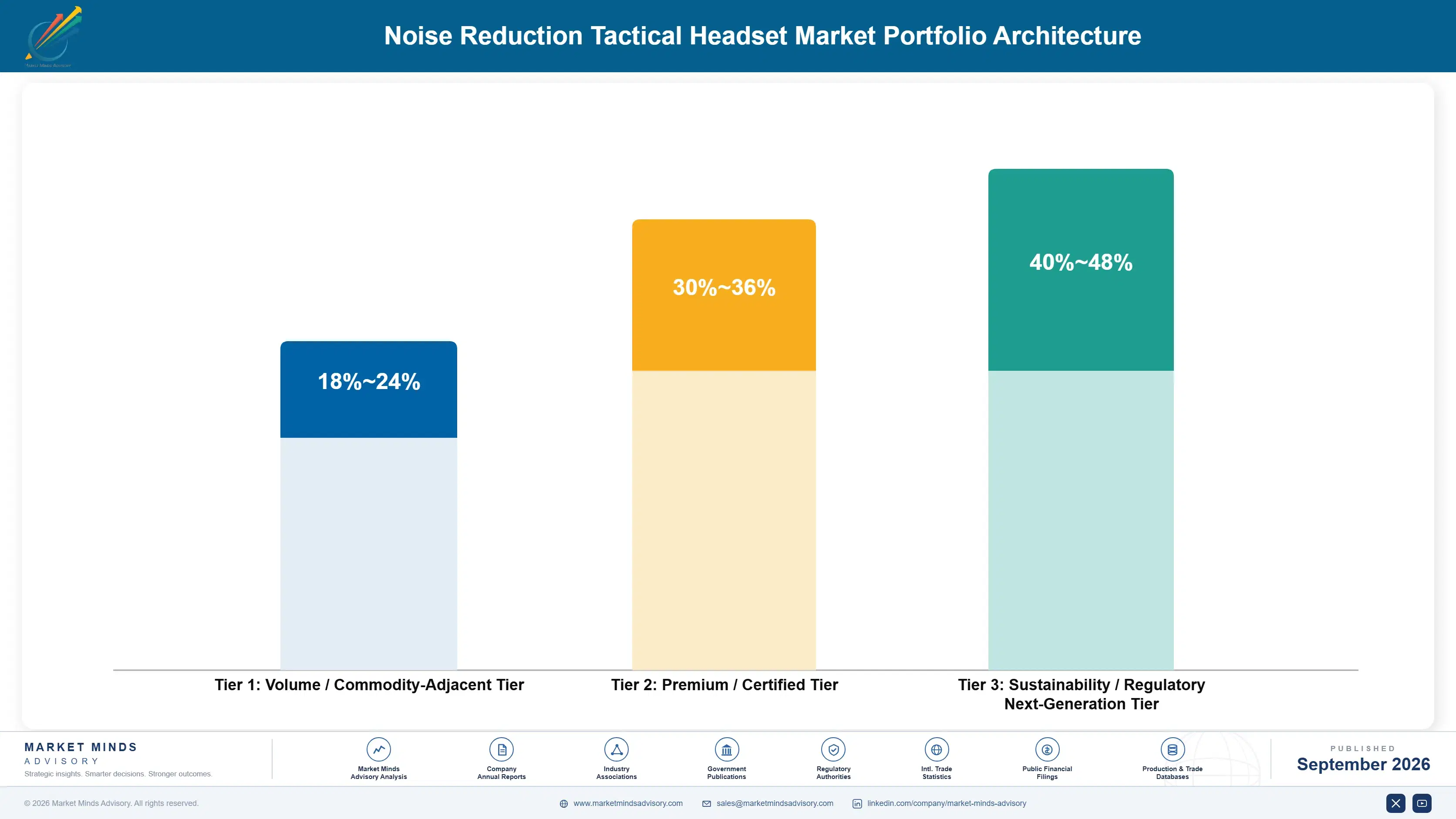
Portfolio economics split across three tiers running from commodity-adjacent standard passive headsets through certified integrated communication platforms to next-generation miniaturised systems, with gross margin widening meaningfully at each successive tier as integration and engineering complexity increase across the range. This structure mirrors margin patterns seen in other certification-driven tactical equipment categories where testing barriers separate pricing tiers overall too.
Volume still concentrates in the certified integrated tier where most current military and law enforcement contracts sit today, but the miniaturised next-generation tier is growing faster and increasingly determines which suppliers win the largest multi-year special operations framework agreements across allied nations. Neither positioning is inherently superior, but capital allocation increasingly favours whichever tier shows the clearest path toward sustained margin expansion.

High-value margin pools concentrate specifically around in-ear and bone conduction next-generation platforms, where miniaturisation barriers and integration complexity keep standard headset competitors from competing effectively on price alone across the largest special operations accounts. Suppliers slow to build miniaturisation capability risk ceding this margin pool entirely to faster-moving competitors within several years nationwide, a pattern likely to persist through the full forecast period ahead.

Volume / Commodity-Adjacent Tier

Standard passive and basic active noise reduction headsets meeting baseline hearing protection specifications, sold mainly on price into smaller law enforcement contracts without extensive communication integration requirements. Margins stay thin given intense price competition across this segment.
Gross Margin: 18%-24%

Premium / Certified Tier

Certified integrated communication platforms meeting military interoperability standards, commanding meaningful price premiums over standard headsets given the certification barrier competitors must clear first. Repeat business is common once a supplier clears initial certification.
Gross Margin: 30%-36%

Sustainability / Regulatory / Next-Generation Tier

Next-generation in-ear and bone conduction systems sold into special operations and covert application contracts, carrying the widest margins given miniaturisation engineering and scarce qualified production capacity. Few suppliers currently compete here at meaningful production scale.
Gross Margin: 40%-48%
noise-reduction-tactical-headset-market-portfolio-architecture-1788503042485

High-value Sub-segments and Strategic Watch-out

In-Ear and Bone Conduction Special Operations Systems

Miniaturised systems serving special operations contracts command the widest margins in the category as covert application demand grows, though the qualified supplier pool remains small given the extended engineering investment this segment requires of manufacturers today. Expect broader adoption as more special operations programmes reach production volume soon.
Gross Margin: 42%-48%

Certified Integrated Communication Platforms

Integrated platforms serving mainstream military modernisation contracts grow steadily as standardisation spreads, commanding solid premiums over standard headsets though not yet matching miniaturised system margins across most current procurement contracts. Expect continued steady share gains across additional modernisation accounts ahead too overall soon too overall.
Gross Margin: 32%-38%

Standard Law Enforcement Tactical Headsets

Standard headsets serving mainstream law enforcement tactical unit contracts remain the largest volume pool by a wide margin, carrying moderate but stable margins as budget expansion guarantees multi-year order visibility across established relationships. This tier anchors most supplier revenue today across the industry broadly too.
Gross Margin: 24%-30%

Legacy Passive-Only Hearing Protection

Legacy passive-only hearing protection sold into smaller contracts without communication integration requirements faces the greatest margin compression risk as integrated platforms gradually displace standalone devices across new procurement decisions industry-wide. Consolidation among remaining legacy suppliers looks increasingly likely soon across most established markets broadly too.
Gross Margin: 12%-18%

Procurement Cycles and Certification Depth

Tactical headset revenue behaves like a multi-year annuity tied to defense procurement programme cycles, since a certified platform typically retains its position across the full multi-year procurement contract once initial certification clears successfully across the customer's equipment modernisation programme. Suppliers instead depend on new procurement wins and modernisation refreshes for near-term revenue visibility rather than counting on installed volume alone too.
Adoption depth varies meaningfully by buyer tier: major military modernisation programmes integrate qualified suppliers deeply into multi-year framework relationships spanning several equipment generations, while smaller law enforcement departments often requalify suppliers more frequently based on budget availability and price competitiveness alone. Smaller law enforcement departments often lack a formal standardised specification governing every future headset purchase decision made across their agency today.

A generational shift is underway as procurement officers who specified separate hearing protection and communication devices for decades give way to teams trained on integrated platform evaluation and miniaturisation considerations, accelerating specification changes faster than the underlying procurement renewal cycle alone would suggest. Vendor relationships are shifting accordingly toward suppliers who can demonstrate credible integration engineering competence, not manufacturing scale alone too.
noise-reduction-tactical-headset-market-end-use-penetration-index-1788503043005

Where Suppliers Should Focus Investment Next

These are among the four positions where our research anticipates prominent divergence between winners and laggards over the coming forecast period. Each is grounded in the demand model, the regulatory perimeter, and the announced capacity pipeline.
01 / INTEGRATION PARTNERSHIP PRIORITY

Build Radio Communication Integration Now

Defense buyers increasingly treat native radio communication compatibility as a baseline procurement requirement rather than a differentiator, and suppliers without established integration partnerships risk losing competitive bids regardless of hearing protection quality offered against better-integrated alternatives already qualified. Suppliers who have already secured these partnerships report winning a growing share of modernisation programme contracts specifically because native compatibility removes a meaningful procurement barrier defense buyers value highly. MMA advises treating integration partnership development as a near-term competitive prerequisite, not a future roadmap item.
02 / CERTIFICATION SPEED INVESTMENT

Build Accelerated Certification Pathway Capability

Defense certification bottlenecks increasingly determine which suppliers can respond competitively to modernisation programme procurement timelines, and suppliers without accelerated certification pathway capability risk losing contracts to competitors who can qualify new platforms faster against compressed procurement schedules. Suppliers offering accelerated pathway capability report meaningfully faster new platform qualification than competitors relying on standard certification queue scheduling, a timeline advantage increasingly valuable to defense buyers facing their own programme deadline pressure. MMA sees certification speed as an increasingly important prerequisite for winning the largest modernisation framework agreements going forward.
03 / MINIATURISATION ENGINEERING INVESTMENT

Build In-Ear Capability Ahead of Special Operations Demand

Special operations and covert unit procurement is expanding miniaturised platform demand faster than most standard over-ear focused suppliers have prepared for, meaning demand for in-ear and bone conduction engineering capability will keep expanding regardless of near-term fluctuations in overall defense budget cycles across individual programmes. Suppliers who invest in miniaturisation capability ahead of this expansion are positioned to win special operations contracts that standard-design competitors simply cannot serve, a durable engineering barrier rather than a temporary pricing advantage. MMA recommends treating miniaturisation investment as a multi-year commitment justified.
04 / COMPONENT DIVERSIFICATION STRATEGY

Diversify Electronics Sourcing Before the Next Shortage

Semiconductor component price volatility has already compressed margins meaningfully at suppliers without diversified sourcing relationships, and this exposure grows as more suppliers sign fixed-price multi-year defense contracts without matching input cost protection built into contract terms from the outset of the relationship. Diversifying electronics component sourcing across multiple vendors ahead of major fixed-price contract commitments protects margin through the full contract term regardless of subsequent component price swings in either direction across the broader semiconductor market. MMA sees component diversification as a prerequisite for suppliers pursuing the largest.

Engagement Snapshot From the Field

A live engagement with an industry participant carrying material or product regulatory and market exposure ahead of a defining policy shift, showing how our research translates into a defensible multi-year portfolio strategy.
MARKET MINDS ADVISORY · CLIENT ENGAGEMENT SUMMARY
Noise Reduction Tactical Headset Producer Strategic Portfolio Review and Transition Roadmap 2026·Investment Scenario on Noise Reduction Tactical Headset Exposure Evaluation 2025-26
CLIENT PROFILE
The client is a defense ministry procurement agency evaluating tactical headset suppliers for a multi-year force modernisation programme and approached MMA following unexpected certification delays with its incumbent supplier, reportedly risking over 7 million dollars in delayed force readiness milestone revenue (client-reported, unverified by MMA) tied to the programme's committed deployment timeline. The delay was already affecting downstream force readiness reporting commitments made to senior leadership.
STRATEGIC CHALLENGE
Leadership needed an evidence-based framework for evaluating alternative certified suppliers against certification timeline risk, but internal procurement and operational teams disagreed sharply on which criteria should carry the most weight given the urgency of the ongoing delivery delay issue. Time pressure from the approaching deployment date compounded the difficulty of reaching internal consensus quickly.
MMA APPROACH
MMA benchmarked comparable allied nation modernisation procurement transitions across similar force categories, modelled certification timeline risk against supplier track record data, and built a structured scorecard weighting integration capability alongside supplier production capacity for the ongoing multi-year programme relationship. The framework was validated jointly against procurement and operational stakeholder requirements before final sign-off.
KEY FINDINGS
  1. Suppliers with broader existing integration partnership portfolios completed comparable certification testing considerably faster than suppliers integrating with the programme's specific communication systems for the first time.
  2. Integrated platform designs reduced modelled equipment conflict incidents substantially based on comparable modernisation programme data reviewed across similar force categories and operational requirements.
  3. Weighting supplier production capacity alongside certification track record improved the projected deployment timeline reliability meaningfully within the proposed structured scorecard evaluation framework.
  4. Engaging the winning supplier during requirements development rather than after finalisation shortened projected certification timeline versus a traditional sequential procurement approach used previously.
CLIENT PROFILE
The client is a defense ministry procurement agency evaluating tactical headset suppliers for a multi-year force modernisation programme and approached MMA following unexpected certification delays with its incumbent supplier, reportedly risking over 7 million dollars in delayed force readiness milestone revenue (client-reported, unverified by MMA) tied to the programme's committed deployment timeline. The delay was already affecting downstream force readiness reporting commitments made to senior leadership.
STRATEGIC CHALLENGE
Leadership needed an evidence-based framework for evaluating alternative certified suppliers against certification timeline risk, but internal procurement and operational teams disagreed sharply on which criteria should carry the most weight given the urgency of the ongoing delivery delay issue. Time pressure from the approaching deployment date compounded the difficulty of reaching internal consensus quickly.
MMA APPROACH
MMA benchmarked comparable allied nation modernisation procurement transitions across similar force categories, modelled certification timeline risk against supplier track record data, and built a structured scorecard weighting integration capability alongside supplier production capacity for the ongoing multi-year programme relationship. The framework was validated jointly against procurement and operational stakeholder requirements before final sign-off.
KEY FINDINGS
  1. Suppliers with broader existing integration partnership portfolios completed comparable certification testing considerably faster than suppliers integrating with the programme's specific communication systems for the first time.
  2. Integrated platform designs reduced modelled equipment conflict incidents substantially based on comparable modernisation programme data reviewed across similar force categories and operational requirements.
  3. Weighting supplier production capacity alongside certification track record improved the projected deployment timeline reliability meaningfully within the proposed structured scorecard evaluation framework.
  4. Engaging the winning supplier during requirements development rather than after finalisation shortened projected certification timeline versus a traditional sequential procurement approach used previously.
RECOMMENDED STRATEGY
Phase 1: Phase 1 (Months 1 to 3): Complete structured supplier scorecard evaluation and select the winning integrated headset platform for the modernisation programme. Phase 2: Phase 2 (Months 4 to 9): Complete accelerated certification testing using the compressed engagement timeline developed jointly during the scoping phase of the transition. Phase 3: Phase 3 (Months 10 to 15): Deploy certified platforms across priority force units while monitoring field performance against the original programme baseline data.
OUTCOME
The client approved the recommended supplier following the engagement, with the accelerated certification timeline reportedly recovering roughly four months against the original delayed schedule (client-reported, unverified by MMA), supporting the deployment timeline without further programme delay. Leadership cited the structured scorecard approach directly in its post-programme readiness review documentation.

Frequently Asked Questions

Foundational context covering the market sizes, CAGR, scope, country, region and competition that inform every finding below. This section is provided to cover basics and most often pre-purchase conversations, answered from the MMA Primary Research Dataset.

What is the current size of the Noise Reduction Tactical Headset Market?

The global noise reduction tactical headset market reached approximately 850 million dollars in 2025. Growth has been steady as military modernisation and law enforcement tactical unit budgets both expand.

How large will the Noise Reduction Tactical Headset Market be by 2036?

MMA projects the market reaching approximately 1.75 billion dollars by 2036 under the base case scenario. Integrated platform standardisation and miniaturisation trends both support this trajectory.

What is the CAGR for the Noise Reduction Tactical Headset Market 2026 to 2036?

The base case CAGR is 6.8 percent across the forecast period. Bull and bear scenarios range between roughly 5.6 and 8.1 percent depending on defense budget certainty and allied standardisation pace.

Which segment is growing fastest?

In-ear tactical hearing protection systems lead at 10.6 percent CAGR, well above the overall market rate. Expanding special operations and covert unit procurement is the primary driver behind this segment's outsized growth.

Who are the major companies in the Noise Reduction Tactical Headset Market?

Leading suppliers include 3M Company, Invisio AB, Safariland Group, MSA Safety Incorporated, and David Clark Company Inc. Combined, the top five hold roughly 48 percent of global qualified shipment revenue.

Which country is growing fastest?

India leads among major markets at approximately 9.8 percent CAGR, driven by its expanding defense modernisation budget and domestic manufacturing incentive programmes. Continued force readiness investment reinforces this pace.

Report Segmentation Architecture

The full report scope spans multiple orthogonal segmentation dimensions, with cross-tabulated demand data provided for each dimension pair. Coverage extends further to regional breakdowns, trend trajectories, and the competitive detail needed to support segment-level decision-making.

By Form Factor and Integration Depth

  • Passive Noise Reduction Headsets
  • Active Noise Reduction Headsets
  • Communication-Integrated Headsets
  • In-Ear Tactical Hearing Protection
  • Bone Conduction Tactical Headsets
  • Maintenance and Calibration Services

By End-Use Buyer Category

  • Military Infantry and Support Units
  • Special Operations Forces
  • Law Enforcement Tactical Units
  • Border and Homeland Security Agencies
  • Private Security and Contractor Forces

By Commercial Dimension

  • Direct Defense Ministry Procurement
  • Law Enforcement Agency Contracts
  • Defense Contractor Integration Channels
  • Distributor and Reseller Channels

By Region

  • North America
  • Western Europe
  • East Asia
  • South Asia and Pacific
  • Latin America
  • Middle East and Africa
  • Eastern Europe

Scope, Methodology, and Coverage

Every figure in this report is reproducible from documented input assumptions. The scope below maps the historical period, the forecast horizon, the segmentation dimensions, and the countries covered, alongside the underlying primary and qualitative methodology.
Historical Period
2020 to 2025
Forecast Period
2026 to 2036
Base Year
2025 (USD billions; MMA Primary Research Dataset, September 2026)
Market Definition
This report covers tactical headsets combining hearing protection with optional communication integration for military, law enforcement, and security applications, including passive, active noise reduction, in-ear, and bone conduction designs. It excludes consumer and industrial hearing protection unrelated to tactical applications and standalone tactical radios without integrated hearing protection capability.
Quantitative Units
USD millions (current prices); units shipped annually
Segmentation Dimensions
By Form Factor and Integration Depth; By End-Use Buyer Category; By Commercial Dimension; By Region
Regions Covered
North America, Western Europe, East Asia, South Asia and Pacific, Latin America, Middle East and Africa, Eastern Europe
Countries Covered
USA, China, Germany, France, UK, Japan, South Korea, India, Australia, Canada, Brazil, Mexico, Indonesia, Vietnam, Thailand, Malaysia, UAE, Saudi Arabia, South Africa, Nigeria, Turkey, Poland, Netherlands, Italy, Spain, Sweden, Switzerland, Argentina, Colombia, Singapore, and additional markets relevant to this sector
Key Companies Profiled
3M Company, Invisio AB, Safariland Group, MSA Safety Incorporated, David Clark Company Inc, Silynx Communications Inc, TCI Liberator, Gentex Corporation, Elbit Systems Ltd, Sensear Pty Ltd, Otto Engineering Inc, Walker's Game Ear (Vista Outdoor), Sordin AB, Honeywell Safety Products, Pro Ears, Radians Inc, Direct Action Gear, Rheinmetall AG, Thales Group, L3Harris Technologies Inc
Quantitative Methodology
Primary survey, n=3,800 respondents, Q4 2025, six countries; demand-side model with trade association cross-validation
Qualitative Methodology
47 expert interviews, Q4 2025; applied to validate demand model assumptions, identify emerging dynamics, and assess competitive positioning
Report Format
PDF and XLSX data workbook (Word format preview document)
Publisher
Market Minds Advisory
Report Code
MMA-2026-CON-126
Published
September 2026
Contact
sales@marketmindsadvisory.com | www.marketmindsadvisory.com

Purchase the full Noise Reduction Tactical Headset Market Report (2026 to 2036).

The full MMA report delivers granular segmentation across six form factor tiers, seven-region demand and pricing forecasts through 2036, and a detailed competitive assessment of twenty profiled suppliers including integration capability and certification speed positioning. It includes a dedicated defense modernisation procurement tracker covering major allied nations, plus quarterly electronics component cost pass-through analysis. Buyers receive editable data tables supporting internal capacity planning and supplier evaluation models across their full qualification portfolio. Analysts update the procurement tracker each quarter as allied nations reach new modernisation deployment milestones.
Seven-region demand and pricing forecasts to 2036
Twenty-supplier integration capability and readiness tracker
Defense modernisation procurement pipeline status tracker
Quarterly electronics component cost pass-through model
Segment-level margin benchmarking across all tiers
Editable capacity planning and supplier evaluation tables

Built For The People Who Decide

From boardroom strategy to bench-side execution, this report is read cover-to-cover by leaders shaping the next decade of their industry, turning demand scenarios, market dynamics and valuation benchmarks into decisions.
CXOs/ Presidents/ VPs/ Managers
M&A and Corporate Development
Strategy Teams and R&D Heads
Procurement and Product Directors
Regulatory and Compliance Leaders
Investor Relations and Equity Analysts