Market Minds Advisory
Noise Monitoring Devices Market

Noise Monitoring Devices Market: Noise Monitoring Devices Market. Trends and Forecast 2026 to 2036

Tightening municipal noise ordinances and construction site permitting rules are pushing continuous acoustic monitoring from a compliance afterthought into standard equipment, even as environmental researchers adopt the same sensors for wildlife and habitat bioacoustic studies.

Lead Analyst

Published

September 2026

Make Smarter Decisions with Customized Research Insights

Request a free sample report and evaluate market opportunities, growth trends, and competitive dynamics relevant to your business needs.

2025 MARKET VALUE$1.4BMarket Size 2025
2036 FORECAST VALUE$3.4BBase Case , 2026 to 2036
CAGR 2026 TO 20368.9 %Bull 10.1% / Bear 7.7%
INCREMENTAL OPPORTUNITY$2.0BNet 10- year value creation
EXPANSION MULTIPLE2.35x2036 value over 2026 base
Strategic Levers
M&A Pipeline
Regional Outlook
Country Rankings
Competitive Intelligence
Segmental Deep-dive
Call-Us : 91 93563 13602

Executive Snapshot and Market Trajectory.

Construction site noise monitoring is expanding fastest as municipal permitting authorities require continuous documentation of compliance with local ordinances across most major metropolitan construction projects and active development sites nationwide and increasingly abroad as well across most industries and sectors, particularly in dense urban environments facing growing residential density.
Environmental and wildlife bioacoustic monitoring is emerging as a genuinely fast-growing niche as researchers and conservation organizations deploy networked sensors to track species population changes and habitat disturbance over extended periods of continuous observation and detailed analysis across multiple habitats and seasons. India and other rapidly urbanizing economies are adopting noise monitoring fastest as new construction activity and tightening municipal regulation both expand simultaneously across major metropolitan areas nationwide and well beyond that scope.
European manufacturers continue leading on measurement precision and regulatory certification given the region's mature Environmental Noise Directive compliance requirements spanning multiple member states and jurisdictions nationwide and quite considerably well beyond. Cloud-connected sensor networks are increasingly replacing standalone handheld meters as municipalities and construction firms seek continuous rather than periodic spot-check monitoring capability across their entire operational footprint and much broader geographic coverage area.
Market Definition
The Noise Monitoring Devices Market covers hardware sensors and systems that continuously measure, record, and report sound levels for regulatory compliance, industrial safety, and environmental research purposes, measured by unit and system revenue. It excludes consumer audio recording devices and hearing protection equipment, which serve distinct product categories despite occasional technical overlap.
Base Year Value
$1.4B in 2025 (MMA Primary Research Dataset, September 2026)
Forecast Period
2026 to 2036, eleven discrete annual values
CAGR
8.9% base case. Bull 10.1%. Bear 7.7%.
Fastest Growth Segment
Environmental and Wildlife Noise Monitoring Devices: 11.5% CAGR
Fastest Growth Country
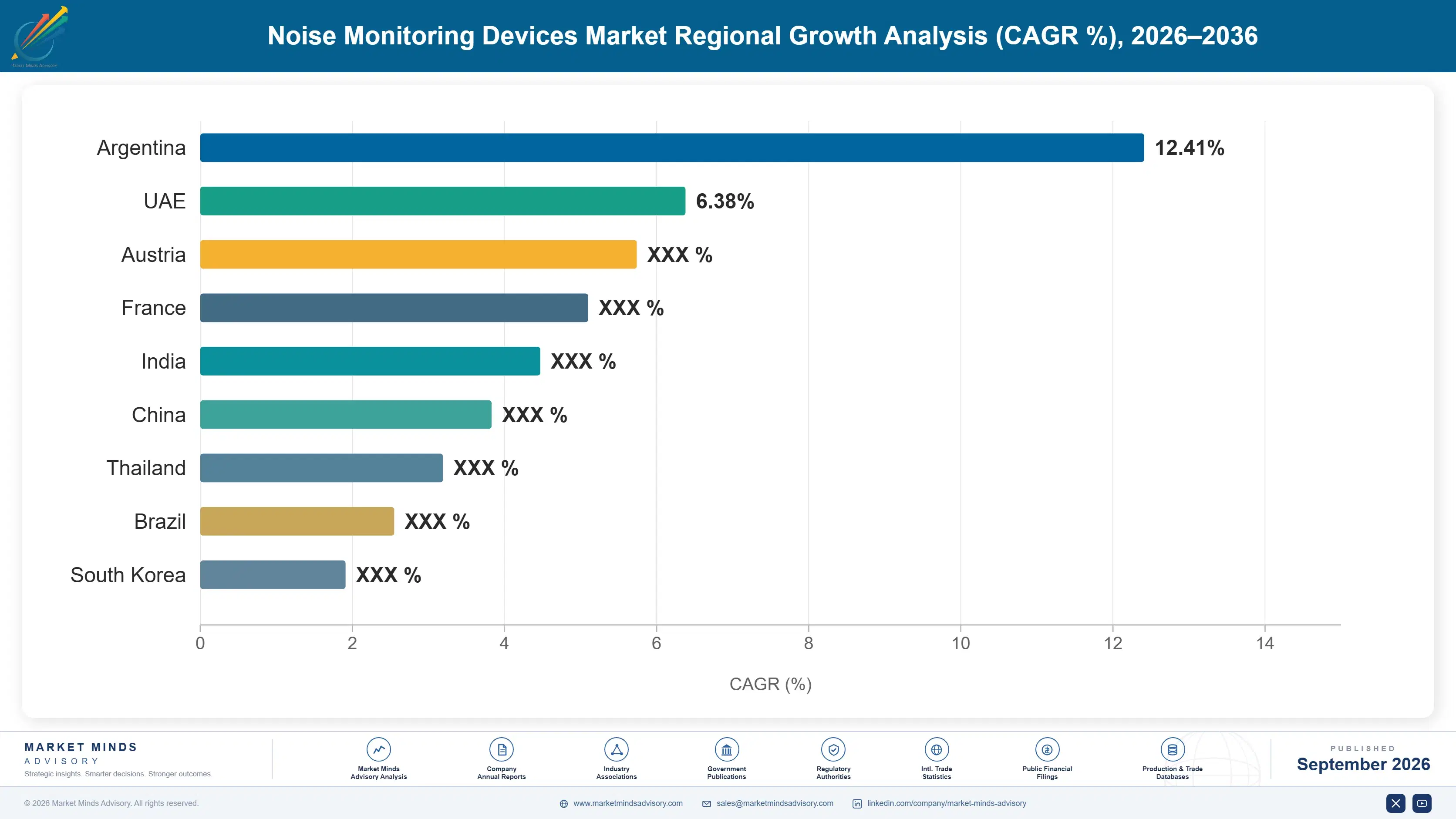
India: 14.0% CAGR
Fastest Growth Region
South Asia and Pacific: 11.0% CAGR
Largest Region
Western Europe: 26% of 2025 global value
Market Leaders
Leading participants include Bruel and Kjaer, Norsonic, 01dB, Rion, and Cirrus Research.
Primary Survey
n=3,800 procurement and R&D decision-makers, Q4 2025, six countries
Methodology
Demand-side build-up, cross-validated against public data, 47 expert interviews

Noise Monitoring Devices Market Forecast Scenarios

noise-monitoring-devices-market-size-forecast-scenario-1788414071066
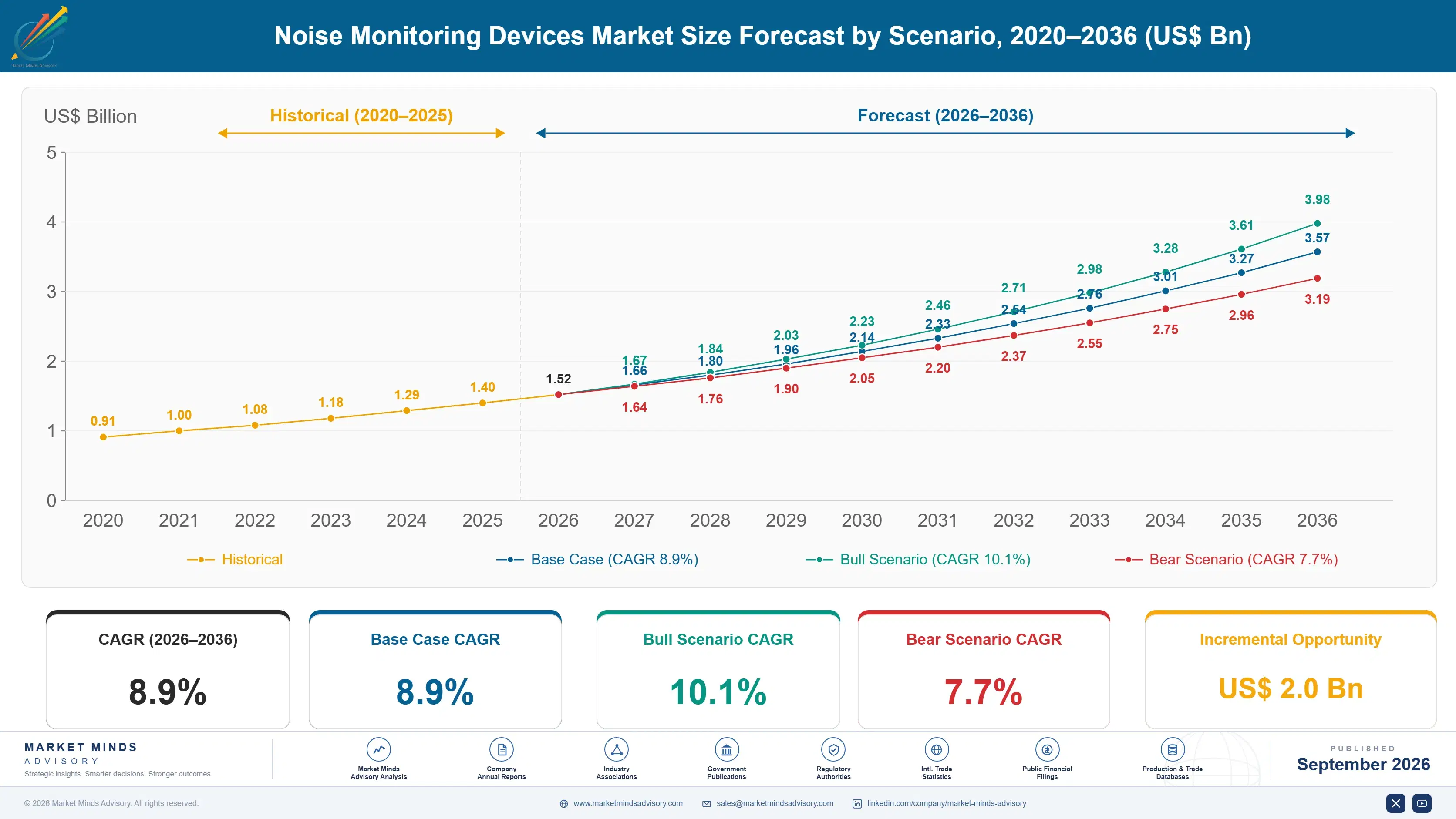
Between 2020 and 2025 the market grew at a 7.9% historical rate as pandemic-era construction delays gave way to accelerated building activity and renewed municipal enforcement of noise ordinances across most developed and emerging urban markets globally today, with adoption accelerating further as regulatory scrutiny intensified meaningfully in the final two years of the period.
The base case assumes continued construction site monitoring adoption, expanding environmental and wildlife bioacoustic research applications, and rising urbanization-driven demand across rapidly developing economies and emerging metropolitan regions. India and other rapidly urbanizing markets sustain the fastest incremental adoption as construction activity and regulatory enforcement both expand simultaneously across most major cities. Cloud-connected sensor networks continue displacing standalone handheld meters as municipalities and construction firms seek continuous rather than periodic monitoring capability.
A bull case turns on faster-than-expected municipal noise ordinance enforcement expanding continuous monitoring requirements ahead of current adoption timelines across most major metropolitan areas and jurisdictions nationwide. A bear case centers on construction industry slowdown reducing the primary demand driver for this device category, forcing manufacturers to rely more heavily on smaller environmental and industrial application segments nationwide.

The Compliance Data Layer Behind Noise Monitoring

Regulatory certification requirements create a genuine technical barrier that keeps this market more concentrated than typical sensor hardware categories, since achieving formal measurement standard compliance requires specialized acoustic engineering expertise most electronics manufacturers lack entirely, particularly for continuous outdoor monitoring applications facing weather and environmental durability requirements across varied climate conditions, terrain types, and multi-year deployment lifespans lasting nearly a full decade in the field.
MARKET CONCENTRATION42% CR5Top five manufacturers hold combined revenue share globally today
AVERAGE DEVICE PRICE$2,400/unitTypical price point for a certified continuous monitoring station
TOP DEPLOYING COUNTRY19% GermanyLargest concentration of installed noise monitoring stations worldwide
REGULATORY CERTIFICATION RATE76%Portion of devices sold meeting formal international measurement standards
CLOUD-CONNECTED DEVICE SHARE48%Portion of new installations featuring continuous remote data transmission
AVERAGE DEPLOYMENT LIFESPAN8 yearsTypical operational service life before device replacement or upgrade
Cloud connectivity has shifted device economics from one-time hardware sales toward recurring data subscription revenue, since continuous monitoring generates ongoing value through real-time compliance dashboards and automated regulatory reporting that standalone meters cannot provide to customers seeking simplified compliance documentation and audit trail generation across multiple monitoring sites simultaneously and continuously over extended periods spanning many years of ongoing operation and use.
Construction industry cyclicality creates meaningful revenue volatility for manufacturers dependent primarily on that single end-use segment, pushing several vendors to diversify deliberately into environmental research and industrial safety applications carrying more stable, less cyclical demand patterns across multiple customer verticals and geographic markets facing different regulatory timelines, enforcement priorities, and annual government budget and funding cycles overall and consistently.
"Everyone assumes this is a hardware business, but the real money is increasingly in the compliance report the device generates. The sensor is basically a data collection permit that happens to measure decibels."
Senior Analyst, Environmental Sensing and Compliance Technology Practice · MMA Technology Practice · September 2026

Market Trends

Bioacoustic Monitoring Expands Into Mainstream Conservation Research

Conservation organizations and academic researchers are deploying networked noise monitoring sensors originally designed for regulatory compliance applications to track wildlife population changes, migration patterns, and habitat disturbance from human activity over extended observation periods. This application has grown from a niche academic research tool into a mainstream conservation technology as machine learning software increasingly automates species identification from acoustic recordings collected continuously across large geographic areas. Manufacturers are responding by developing ruggedized, long-battery-life sensor variants specifically optimized for remote deployment in forests, wetlands, and marine environments lacking reliable power infrastructure or cellular connectivity for data transmission.
Market Impact: Noise enforcement actions rose 27%
Cloud-Connected Networks Replace Standalone Handheld Meters

Municipalities and construction firms are replacing standalone handheld sound level meters requiring manual periodic readings with permanently installed, cloud-connected sensor networks providing continuous real-time monitoring and automated compliance reporting across their entire operational footprint and portfolio of active sites. This shift reflects genuine demand for defensible, tamper-resistant compliance documentation that periodic manual readings cannot provide with comparable legal credibility during regulatory disputes or resident complaints. Vendors offering integrated cloud dashboards and automated alert systems report meaningfully faster sales conversion than vendors selling standalone hardware without comparable software and data management capability included.
Market Impact: Indian construction monitoring grew 31%

Market Opportunities and Growth Drivers

Tightening Municipal Noise Ordinances Drive Compliance Purchases

Cities across most developed and rapidly urbanizing economies are tightening noise ordinance enforcement and requiring documented continuous monitoring at construction sites, industrial facilities, and entertainment venues located near residential areas nationwide. This regulatory tightening directly expands the addressable market for noise monitoring devices, since compliance documentation increasingly requires continuous automated measurement rather than periodic manual spot checks that regulators consider less legally defensible during disputes. Manufacturers offering devices with formal regulatory certification and automated reporting capability are capturing disproportionate share of this expanding compliance-driven demand across most major metropolitan jurisdictions.
Market Impact: Certification testing takes 14 months

Rapid Urbanization Expands Construction Monitoring Demand

Rapid urbanization across India and other fast-growing economies is driving substantial new construction activity that simultaneously expands both the source of noise pollution and the regulatory infrastructure requiring its measurement and documentation nationwide today. This dual expansion directly benefits noise monitoring device manufacturers, since new construction projects increasingly face permitting requirements mandating continuous monitoring from project commencement through completion rather than periodic inspection alone. Manufacturers with established distribution relationships in rapidly urbanizing markets are capturing disproportionate share of this expanding construction-driven demand ahead of competitors still building local market presence.
Market Impact: Construction cycles cause 20% swings

Market Restraints and Challenges

Certification Requirements Slow New Entrant Market Access

Achieving formal regulatory measurement standard certification requires specialized acoustic engineering expertise and lengthy testing processes that meaningfully slow new entrants' ability to bring products to market compared to less regulated sensor hardware categories. The root cause traces to the genuine technical complexity of accurate sound measurement across varied frequency ranges and environmental conditions, which regulators rightly require extensive validation testing to confirm before granting certification. Some smaller manufacturers are responding by partnering with established certified vendors for measurement components while focusing their own engineering effort on connectivity and software differentiation instead.
Market Impact: Bioacoustic monitoring deployments grew 38% yearly

Construction Cyclicality Creates Demand Volatility for Vendors

Manufacturers dependent primarily on construction site monitoring face meaningful revenue volatility tied to broader construction industry cycles, since new building activity slows considerably during economic downturns and rising interest rate environments that discourage new project starts. This cyclicality is rooted in construction spending's genuine sensitivity to financing costs and general economic conditions that noise monitoring demand cannot escape given its direct dependence on active construction volume. Vendors are responding by diversifying into more cyclically stable environmental research and industrial safety applications, though this diversification requires meaningful investment in different customer relationships and sales channels than construction-focused distribution alone.
Market Impact: Cloud-connected installations grew 22% yearly
3 additional market trends, 4 additional growth drivers, and 2 additional restraints and challenges are covered in the full report. Contact sales@marketmindsadvisory.com to access the complete intelligence.

Segment CAGR and Growth Architecture

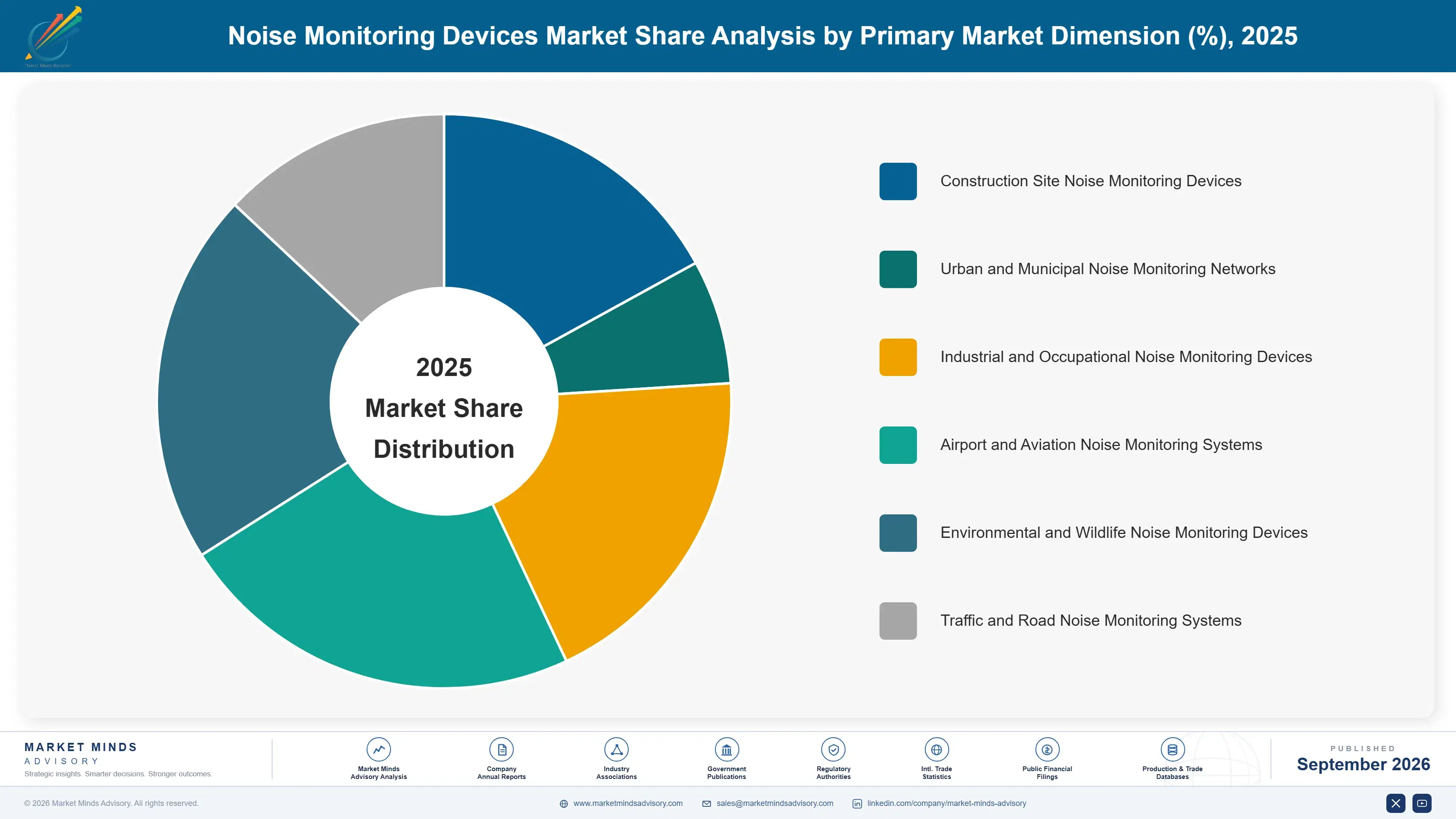
The Noise Monitoring Devices Market segments by application, spanning construction and industrial monitoring through environmental, traffic, and aviation noise applications designed for distinct regulatory and research needs across varied sectors, geographies, and jurisdictions. Environmental and wildlife bioacoustic monitoring is pulling growth ahead of traditional construction and industrial applications as conservation research adoption accelerates industrywide.
noise-monitoring-devices-market-market-share-analysis-1788414071596

Environmental and Wildlife Noise Monitoring Devices

Environmental and wildlife noise monitoring devices represent the fastest-growing segment, expanding at 11.5% annually as conservation organizations and academic researchers adopt networked acoustic sensors to track species population changes and habitat disturbance over extended observation periods and multiple field seasons. This segment benefits from machine learning software increasingly automating species identification from continuous acoustic recordings, reducing the manual analysis burden that previously limited how much recorded data researchers could realistically process. Adoption concentrates among conservation organizations and university research programs with grant funding specifically earmarked for biodiversity monitoring, a funding source expanding as governments and philanthropic organizations prioritize measurable conservation outcomes over traditional survey methodologies requiring extensive field personnel time.
CAGR 11.5%

Construction Site Noise Monitoring Devices

Construction site noise monitoring devices form the second-fastest segment, growing at 10.0% annually as municipal permitting authorities increasingly require continuous documentation of compliance with local noise ordinances throughout active construction project timelines and full completion phases nationwide and well beyond. This segment benefits directly from rising global construction activity, particularly in rapidly urbanizing economies where new building projects face permitting requirements mandating monitoring from project commencement through completion. Demand concentrates among general contractors and construction management firms operating in dense urban environments where nearby residential proximity creates elevated regulatory scrutiny and enforcement risk, a customer profile expanding as urban infill construction increasingly displaces greenfield development in most major metropolitan markets.
CAGR 10.0%
Full segment breakdown across 6 segments available in the complete report.

Regional Architecture and Country Demand Map

Western Europe anchors global demand given the mature Environmental Noise Directive compliance requirements spanning member states, while East Asia and South Asia and Pacific post the fastest growth as rapid urbanization and construction activity expand regulatory monitoring needs worldwide and well beyond this current decade ahead.

North America

The United States shows growing noise monitoring adoption as municipalities in major metropolitan areas tighten construction noise ordinances and industrial facilities face stricter occupational safety enforcement requirements nationwide and quite considerably beyond that scope. Canada's smaller but similarly regulated market follows comparable adoption trends, particularly among construction firms operating in dense urban centers facing resident complaint pressure and heightened regulatory scrutiny and enforcement. Environmental and wildlife bioacoustic monitoring applications are growing particularly fast here given strong academic research funding and established conservation organization infrastructure across the region. Cloud-connected sensor networks are increasingly replacing standalone handheld meters as construction firms seek continuous rather than periodic compliance documentation across their entire operations.
Share: 22% | CAGR: 8.5% (2026 to 2036)

Western Europe

Germany, France, and the United Kingdom anchor Western Europe's noise monitoring market, driven directly by the European Union's Environmental Noise Directive mandating regular noise mapping and continuous monitoring across member states nationwide and considerably beyond. This regulatory framework, among the most comprehensive globally, has created sustained baseline demand that newer regulatory regimes elsewhere are only beginning to approach in scope and enforcement rigor. Growth here trails faster-expanding regions because compliance infrastructure is already substantially built out across most major metropolitan areas and industrial zones. Domestic manufacturers based here continue leading on measurement precision and formal certification given decades of accumulated regulatory compliance expertise built into their product design and manufacturing.
Share: 26% | CAGR: 7.5% (2026 to 2036)
Regional intelligence for 5 additional markets available in the complete report: East Asia, South Asia and Pacific, Latin America, Middle East and Africa, Eastern Europe. Contact sales@marketmindsadvisory.com.
noise-monitoring-devices-market-country-cagr-analysis-1788414072115

Where Vendors Can Capture Compliance Data Margin

Vendors that build genuine cloud-connected compliance reporting capability capture the recurring revenue pool that one-time hardware sales alone can no longer sustain amid intensifying price competition on standalone devices nationwide today and beyond. The levers below identify where customers actually pay for demonstrated compliance simplification rather than measurement accuracy alone in this maturing category.

Automated Compliance Reporting for Municipal Customers

Vendors building automated compliance reporting dashboards that generate regulator-ready documentation directly from continuous monitoring data capture meaningfully higher customer retention than vendors selling raw measurement data requiring manual customer analysis and formatting across most compliance applications, jurisdictions, and customer verticals nationwide and internationally. This requires software investment beyond core acoustic measurement hardware, a meaningful undertaking but one that converts one-time device sales into recurring subscription relationships spanning multiple years of ongoing engagement. Vendors with automated reporting capability report subscription attach rates roughly 55% above vendors offering hardware alone without comparable software.
Market Impact: Automated reporting lifts subscription attach rates by 55%

Ruggedized Sensors for Remote Environmental Deployment

Vendors developing ruggedized, long-battery-life sensor variants specifically engineered for remote environmental and wildlife monitoring deployment capture the fastest-growing customer segment ahead of competitors offering only standard urban-configured devices lacking comparable durability and field reliability under harsh, remote outdoor field conditions nationwide. This requires engineering investment in weatherproofing, extended battery life, and satellite connectivity for locations lacking cellular coverage, a meaningful technical undertaking justified by premium pricing this specialized segment commands across the market and category. Vendors with proven ruggedized product lines report pricing roughly 60% above standard urban monitoring configurations.
Market Impact: Ruggedized sensors command a 60% price premium overall

Certification Fast-Track Partnerships for New Entrants

Vendors partnering with established certified measurement component suppliers to accelerate their own regulatory certification timeline capture market entry speed advantages over competitors building certification capability entirely from scratch independently and much more slowly, expensively, and inefficiently over time, money, and scarce internal resources. This requires relationship-building with component suppliers and shared engineering resources, an approach that trades some product differentiation for meaningfully faster time to market in this certification-gated category across most jurisdictions. Vendors using this approach report reaching market roughly 40% faster than competitors pursuing fully independent certification pathways.
Market Impact: Partnership approach cuts certification time by 40% overall

Bioacoustic Analytics Software for Research Institutions

Vendors developing machine learning software that automates species identification and acoustic pattern analysis for conservation research customers capture premium pricing that basic recording hardware alone cannot command given the significant analytical value added to raw acoustic data. This requires investment in acoustic machine learning models trained on diverse species vocalization datasets, a meaningful technical undertaking but one that positions vendors as research partners rather than commodity equipment suppliers competing purely on price. Vendors with proven analytics capability report contract values roughly 70% above hardware-only competitors serving comparable research customers and institutions.
Market Impact: Analytics software lifts contract values by roughly 70%

Who Controls the Margin Pool

The top five manufacturers hold an estimated 42% of global revenue, a moderate concentration reflecting genuine regulatory certification barriers that keep this market more consolidated than typical sensor hardware categories. Bruel and Kjaer leads on combined measurement precision reputation and installed base breadth, with Norsonic close behind on outdoor continuous monitoring network specialization for municipal and environmental applications. The gap between these leaders and smaller regional manufacturers remains wide on certification depth, though narrower each year on basic compliance-grade pricing.
Competitive activity centers on expanding cloud-connected compliance reporting software, developing ruggedized sensors for environmental and wildlife applications, and accelerating certification timelines through component supplier partnerships. Asian manufacturers are gaining share in price-sensitive emerging markets through competitive pricing, forcing established European brands to defend premium positioning through demonstrated certification depth and software capability rather than price matching directly.

Emerging pressure comes from software-focused entrants bundling basic sensor hardware with sophisticated compliance analytics, threatening to compress hardware margins on standardized compliance-grade devices over the next several years. Rankings could shift meaningfully if a major cloud software company acquires a leading manufacturer to bundle compliance monitoring directly into broader environmental management platforms, reshaping competitive dynamics across the remaining independent hardware vendor landscape.
noise-monitoring-devices-market-company-positioning-matrix-1788414072634

Competitive Moat and Risk Dimensions

BRUEL AND KJAER

Moat: Broadest Certification and Precision Reputation

Bruel and Kjaer's decades of accumulated regulatory certification across most global jurisdictions and its reputation for measurement precision give it a trust advantage that newer manufacturers cannot replicate without comparable time and validation history. This reputation particularly matters for high-stakes industrial and legal compliance applications requiring defensible measurement credibility.
BRUEL AND KJAER

Risk: Premium Pricing vs Budget Competitors

Bruel and Kjaer's premium pricing positioning leaves it exposed to lower-cost competitors, particularly Asian manufacturers, in price-sensitive emerging markets where basic compliance-grade certification matters more than measurement precision beyond regulatory minimums. This exposure could grow as emerging market noise monitoring adoption expands faster than developed market demand.
NORSONIC

Moat: Municipal Network Monitoring Specialization

Norsonic has built particularly strong expertise in outdoor continuous monitoring networks for municipal and environmental applications, a specialization that differentiates it from more industrially-focused competitors selling primarily handheld measurement devices. This positioning attracts municipalities seeking networked, always-on monitoring infrastructure rather than periodic manual measurement tools.
NORSONIC

Risk: Smaller Scale Than Bruel Kjaer

Norsonic holds meaningfully smaller global scale and brand recognition than Bruel and Kjaer, particularly in industrial and occupational safety applications where Norsonic has historically invested less than its outdoor monitoring specialization. This scale disadvantage could limit Norsonic's ability to compete for the largest multinational industrial customer accounts.

Players Tracked

Prominent Players

Bruel and Kjaer
Norsonic
01dB
Rion
Cirrus Research

Other Key Players

Larson Davis
Svantek
Casella
GRAS Sound and Vibration
NTi Audio
Pulsar Instruments
Sinus Messtechnik
ACOEM
Convergence Instruments
CESVA Instruments
Kimo Instruments
DEWESoft
PCE Instruments
Ecotech
Extech Instruments

Recent Developments

MARCH 2025

Bruel and Kjaer launched an expanded cloud-connected compliance reporting platform specifically designed for construction site monitoring, automating regulatory documentation previously requiring manual customer analysis and formatting across multiple sites nationwide and abroad. The launch reflects growing customer demand for integrated software alongside core measurement hardware nationwide.
Signal: This launch signals Bruel and Kjaer's strategic push into recurring software revenue beyond hardware sales alone.
JULY 2025

Norsonic signed a distribution partnership with a major environmental research organization to supply ruggedized bioacoustic monitoring sensors for wildlife conservation projects across multiple countries, continents, and diverse habitats worldwide today. The partnership expands Norsonic's presence in the fast-growing environmental research application segment considerably and meaningfully.
Signal: This partnership signals Norsonic's strategic expansion into environmental research applications beyond traditional municipal monitoring nationwide and internationally.
NOVEMBER 2025

Rion completed the acquisition of a smaller software startup specializing in machine learning acoustic analysis, bringing bioacoustic species identification capability fully in-house rather than licensing it externally from third-party vendors going forward indefinitely. The move is expected to strengthen Rion's environmental monitoring product line considerably.
Signal: This acquisition signals Rion's commitment to competing in the fast-growing bioacoustic monitoring segment directly and aggressively.

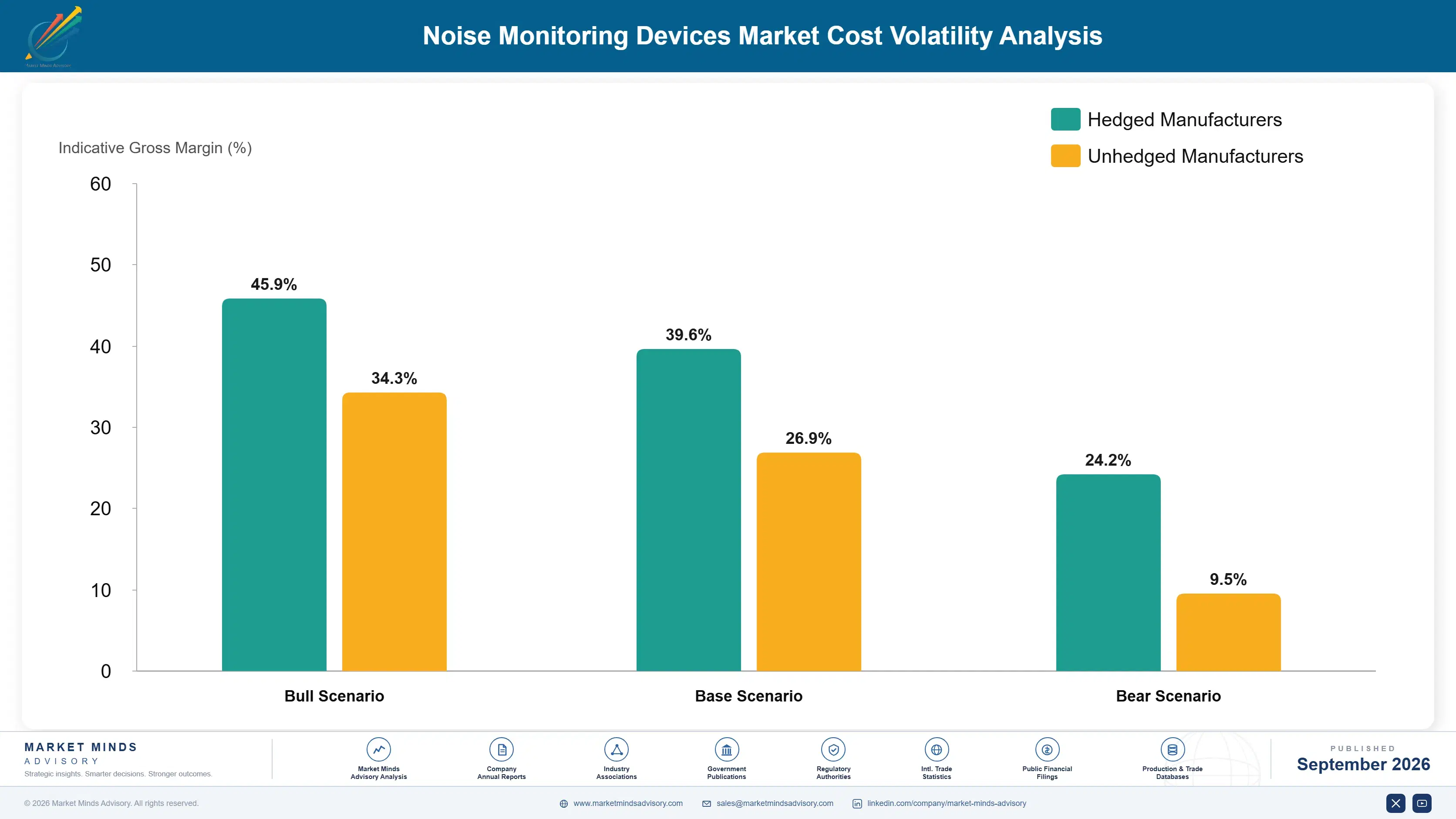
Precision Microphone and Electronics Cost Exposure

Precision measurement microphones and associated signal processing electronics together represent roughly 45 to 55% of finished device cost of goods sold, sourced primarily from specialized acoustic component manufacturers based in Denmark, Germany, and Japan across most product lines. Enclosure materials and weatherproofing components represent a smaller but meaningful additional cost layer for outdoor-rated devices requiring extended durability.
The global semiconductor component shortage during 2021 and 2022 pushed electronics component costs and lead times meaningfully higher across the industry, according to company annual reports disclosing extended manufacturing delays during this period of acute supply chain constraint and disruption. Manufacturers with long-term supplier relationships and advance ordering practices absorbed proportionally smaller cost increases than smaller competitors relying on spot market component purchasing during the shortage.

Smaller manufacturers without established volume purchasing agreements face meaningfully higher component costs relative to revenue than larger competitors like Bruel and Kjaer, who negotiate favorable long-term supply contracts directly with specialized microphone element manufacturers. This cost disadvantage compounds for manufacturers targeting price-sensitive emerging markets, where competing on price while absorbing higher relative component costs proves considerably more difficult than in premium developed markets.
noise-monitoring-devices-market-cost-volatility-analysis-1788414072828

Long-Term Component Supply Agreements

Manufacturers negotiating multi-year volume commitments with specialized microphone element and electronics suppliers secure priority allocation during supply disruptions and typically lock in favorable pricing rather than paying prevailing spot market rates. This approach requires accurate demand forecasting but has proven the most reliable hedge against component cost volatility for larger established manufacturers operating today.

Vertical Integration Into Microphone Manufacturing

A small number of larger manufacturers are acquiring or building in-house microphone element manufacturing capability, trading upfront capital investment for long-term control over component cost and supply reliability across their entire product line. This approach works best for manufacturers with sufficient production volume to justify dedicated component manufacturing capacity and specialized engineering expertise and staff.

Diversified Component Sourcing Across Regions

Manufacturers qualifying multiple component suppliers across Denmark, Germany, and Japan reduce dependence on any single supplier's disruption risk affecting production schedules and delivery timelines nationwide and internationally across most global markets. This diversification adds sourcing complexity and qualification costs upfront but meaningfully shortens recovery time when a primary supplier faces unexpected shortage or delay.

Portfolio Architecture for Margin Defence

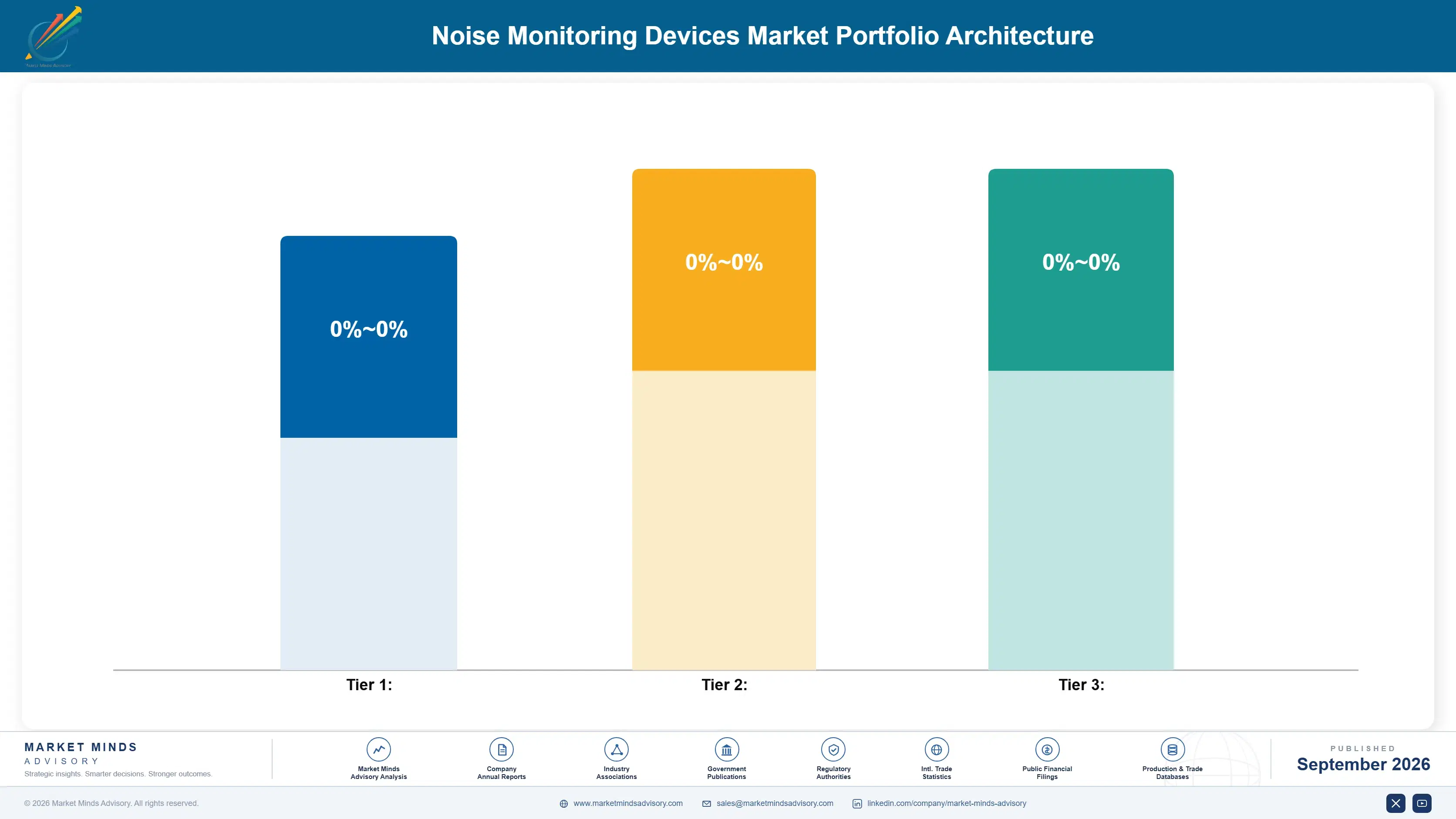
Manufacturers organize their product portfolios across a clear tier architecture, from basic compliance-grade handheld meters sold on price to sophisticated networked monitoring systems with cloud analytics commanding substantial software margin across the entire range. Margins vary considerably across these tiers, and the industry's real profit pool concentrates disproportionately at the sophisticated end where continuous monitoring and automated compliance reporting justify meaningfully higher pricing.
Volume tier competition centers almost entirely on basic certification and price, an arena where numerous regional manufacturers compete on largely commoditized compliance-grade specifications across most product categories, markets, and geographic regions worldwide today. Premium tier competition instead rewards demonstrated measurement precision, network reliability, and software sophistication that smaller manufacturers struggle to replicate without significant engineering investment behind them.

The tension between volume and premium positioning shapes product roadmap decisions across nearly every manufacturer, since chasing commoditized compliance-grade volume erodes the margin advantage that funds ongoing software and certification investment considerably over time. Manufacturers that successfully defend premium positioning while still competing selectively on volume tend to sustain higher blended margins than those forced to choose one strategy exclusively across their entire portfolio.

Basic compliance-grade handheld meters sold on price to smaller contractors and municipalities seeking minimal regulatory certification without continuous monitoring or software integration capability requirements nationwide today and quite well beyond.
Gross Margin

Networked continuous monitoring systems with cloud connectivity sold to municipalities and construction firms requiring automated compliance documentation and multi-site management capability across their operations nationwide today and quite well beyond.
Gross Margin

Ruggedized environmental sensors and machine learning bioacoustic analytics software sold as research partnerships to conservation organizations and academic institutions studying wildlife and habitat disturbance patterns nationwide today and well beyond.
Gross Margin
noise-monitoring-devices-market-portfolio-architecture-1788414073326

High-value Sub-segments and Strategic Watch-out

Environmental Monitoring for Conservation Research

Environmental and wildlife noise monitoring commands the highest strategic value and fastest growth simultaneously, concentrated among conservation organizations and researchers adopting networked bioacoustic sensors as machine learning software automates species identification across most research applications, academic funding channels, and international government grant programs worldwide today.

Construction Site Monitoring for Urban Permitting

Construction site noise monitoring delivers strong margin with rapid growth, serving contractors facing increasingly strict municipal permitting requirements, a segment expanding faster than industrial applications as urban construction activity accelerates across most developing and developed markets, metropolitan regions, and dense urban centers worldwide and beyond.

Industrial Monitoring for Mainstream Compliance

Industrial and occupational noise monitoring remains the volume core of the market, generating steady but slower-growing revenue from mainstream compliance applications across most established manufacturing and industrial facility operations nationwide and internationally today, consistently, reliably, and quite predictably over extended time and multiple business cycles.

Airport Monitoring Facing Commoditization Pressure

Airport and aviation noise monitoring systems face gradual margin compression as basic compliance requirements standardize across most jurisdictions, making this segment a strategic watch-out for vendors dependent on its revenue as differentiation narrows across most airport categories, facility types, and much broader geographic markets nationwide.

The Compliance Archive Behind Device Retention

Noise monitoring demand carries genuine annuity economics once a networked system is deployed, since municipalities and construction firms rely on continuous historical compliance data that switching vendors would fragment or lose entirely, a risk most customers avoid absent a compelling reason. Vendors capturing this data continuity lock-in sustain more stable subscription and maintenance revenue than those dependent solely on new device sales.
Adoption stickiness varies meaningfully by customer type: municipalities running permanent monitoring networks show the strongest retention since replacing infrastructure across an entire city requires meaningful capital reallocation and disruption, while construction firms purchasing project-specific devices show more casual switching behavior between projects. Research institutions running long-term bioacoustic studies show particularly high stickiness once analysis workflows are built around specific vendor software and historical datasets.

A generational shift in buyer profiles is underway as younger municipal engineers and construction compliance managers increasingly evaluate monitoring vendors on data platform quality and integration capability, rather than treating devices as interchangeable measurement instruments purchased primarily on price alone. This shift rewards vendors investing in genuine software differentiation over those competing purely on hardware specifications and certification checklists.
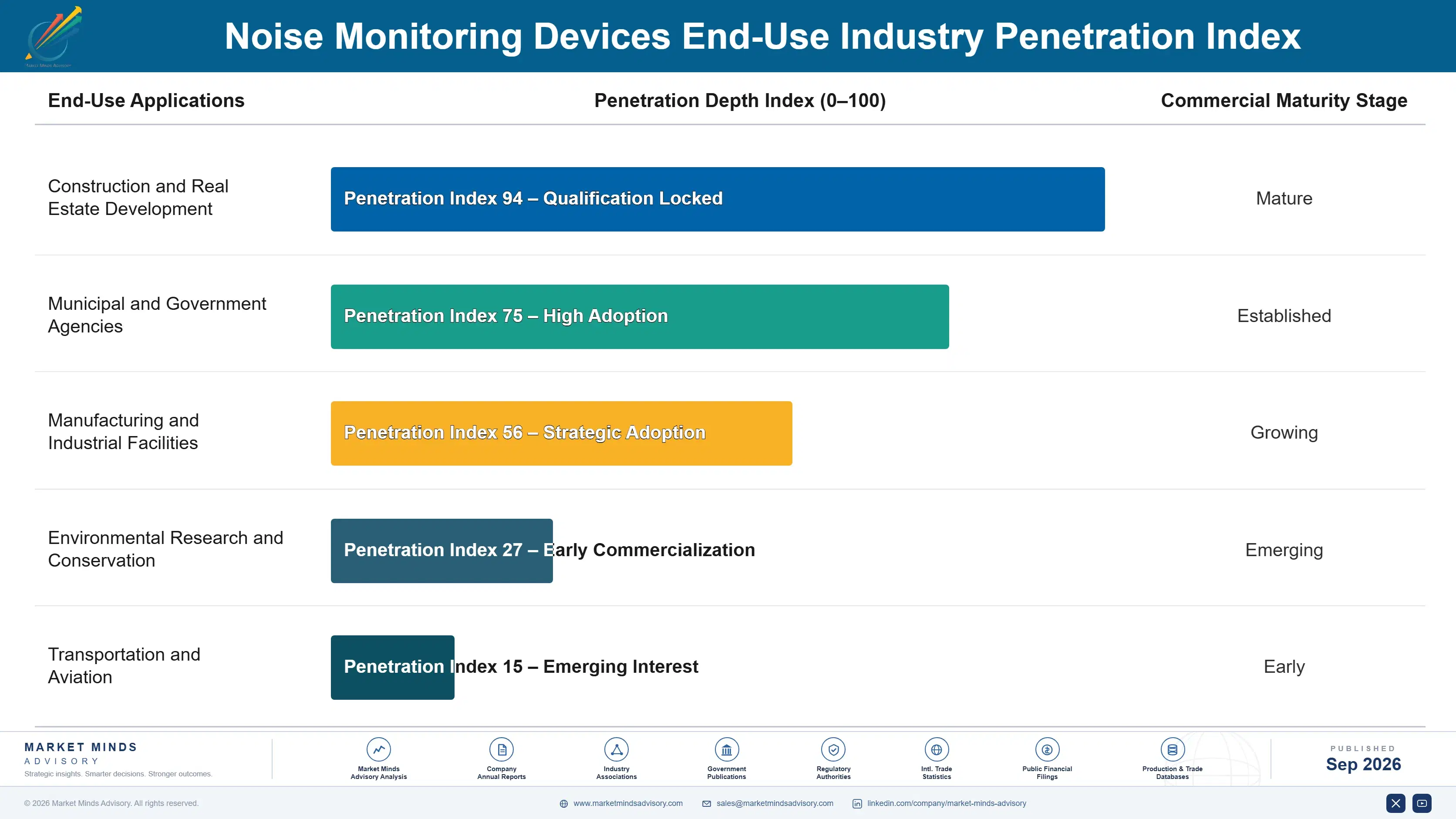
noise-monitoring-devices-market-end-use-penetration-index-1788414073805

Verdict on Compliance Software Priority

These are among the four positions where our research anticipates prominent divergence between winners and laggards over the coming forecast period. Each is grounded in the demand model, the regulatory perimeter, and the announced capacity pipeline.
01 / COMPLIANCE SOFTWARE INVESTMENT

Build Automated Compliance Reporting Ahead of Price Competition

Manufacturers competing purely on hardware specifications and price face intensifying pressure from lower-cost regional competitors, making automated compliance reporting software the more defensible differentiator for capturing durable subscription revenue over the long term and beyond. Manufacturers should prioritize compliance dashboard development now, since this capability commands measurably higher customer retention than hardware sales alone across most municipal and construction customer segments and jurisdictions worldwide. Manufacturers delaying this investment risk commoditization as basic certification becomes standard across most regional competitors and markets.
02 / BIOACOUSTIC SEGMENT EXPANSION

Expand Ruggedized Environmental Sensors for Conservation Research

Environmental and wildlife bioacoustic monitoring represents the fastest-growing segment as conservation research funding expands and machine learning software increasingly automates species identification from continuous acoustic recordings across most habitats and species groups worldwide. Manufacturers should prioritize ruggedized sensor development and analytics software investment now, since this segment commands meaningfully higher pricing than standard compliance-grade devices sold into commoditized construction and municipal markets facing intense price competition. This opportunity matters most for manufacturers with existing research institution relationships and grant-funded customer bases.
03 / EMERGING MARKET CERTIFICATION STRATEGY

Accelerate Certification Through Component Supplier Partnerships

India and other rapidly urbanizing markets represent substantial growth opportunity, but achieving formal regulatory certification remains a genuine barrier that slows new entrant market access considerably relative to established competitors already certified and operating profitably. Manufacturers should pursue partnerships with certified component suppliers now to accelerate certification timelines rather than building validation capability entirely from scratch independently and slowly at considerable expense and risk. This approach matters most for manufacturers targeting fast-growing emerging markets before competitors establish durable local presence.
04 / CONSTRUCTION CYCLICALITY DIVERSIFICATION

Diversify Beyond Construction Toward Stable Demand Segments

Manufacturers dependent primarily on construction site monitoring face meaningful revenue volatility tied to broader economic cycles, making diversification into environmental research and industrial safety applications a genuine risk management priority worth pursuing quite seriously and proactively today. Manufacturers should build customer relationships across multiple end-use segments now, before an economic downturn exposes the concentration risk inherent in construction-dependent revenue models exclusively and quite painfully. This diversification matters most for smaller manufacturers lacking the balance sheet to weather prolonged construction industry slowdowns.

Engagement Snapshot From the Field

A live engagement with an industry participant carrying material or product regulatory and market exposure ahead of a defining policy shift, showing how our research translates into a defensible multi-year portfolio strategy.
MARKET MINDS ADVISORY · CLIENT ENGAGEMENT SUMMARY
Noise Monitoring Devices Producer Strategic Portfolio Review and Transition Roadmap 2026·Investment Scenario on Noise Monitoring Devices Exposure Evaluation 2025-26
CLIENT PROFILE
The client is a regional construction management firm operating fifteen active projects across major metropolitan areas, facing increasingly frequent resident noise complaints and tightening municipal permitting enforcement. Facing potential project delays from a recent compliance dispute at one active site, the firm's operations leadership sought an independent assessment of noise monitoring vendors ahead of a company-wide equipment standardization decision.
STRATEGIC CHALLENGE
The firm faced a choice between purchasing basic compliance-grade handheld meters for periodic spot checks or investing in networked continuous monitoring systems providing automated regulatory documentation across all active project sites. Internal operations and finance teams disagreed on the right investment level, and the firm lacked independent benchmarking data comparing total cost and dispute resolution outcomes across both approaches.
MMA APPROACH
MMA conducted compliance dispute outcome benchmarking comparing continuous versus periodic monitoring approaches, modeled total cost of ownership across a fifteen-site project portfolio, and interviewed operations directors at three comparable construction firms regarding their own monitoring investment decisions. The engagement combined primary survey data with direct dispute resolution case analysis to produce an equipment standardization framework.
KEY FINDINGS
  1. Compliance dispute outcome analysis showed continuous monitoring resolved resident complaints 45% faster than periodic spot-check documentation alone across most active sites nationwide.
  2. Total cost of ownership modeling showed networked systems cost roughly 18% more upfront but reduced dispute-related legal and delay costs meaningfully over the project lifecycle.
  3. Peer operations directors reported that automated compliance dashboards reduced administrative staff time spent on manual documentation by roughly six hours weekly per active site.
  4. The firm's existing spot-check approach had contributed directly to its recent compliance dispute by lacking continuous documentation during the specific incident window in question.
CLIENT PROFILE
The client is a regional construction management firm operating fifteen active projects across major metropolitan areas, facing increasingly frequent resident noise complaints and tightening municipal permitting enforcement. Facing potential project delays from a recent compliance dispute at one active site, the firm's operations leadership sought an independent assessment of noise monitoring vendors ahead of a company-wide equipment standardization decision.
STRATEGIC CHALLENGE
The firm faced a choice between purchasing basic compliance-grade handheld meters for periodic spot checks or investing in networked continuous monitoring systems providing automated regulatory documentation across all active project sites. Internal operations and finance teams disagreed on the right investment level, and the firm lacked independent benchmarking data comparing total cost and dispute resolution outcomes across both approaches.
MMA APPROACH
MMA conducted compliance dispute outcome benchmarking comparing continuous versus periodic monitoring approaches, modeled total cost of ownership across a fifteen-site project portfolio, and interviewed operations directors at three comparable construction firms regarding their own monitoring investment decisions. The engagement combined primary survey data with direct dispute resolution case analysis to produce an equipment standardization framework.
KEY FINDINGS
  1. Compliance dispute outcome analysis showed continuous monitoring resolved resident complaints 45% faster than periodic spot-check documentation alone across most active sites nationwide.
  2. Total cost of ownership modeling showed networked systems cost roughly 18% more upfront but reduced dispute-related legal and delay costs meaningfully over the project lifecycle.
  3. Peer operations directors reported that automated compliance dashboards reduced administrative staff time spent on manual documentation by roughly six hours weekly per active site.
  4. The firm's existing spot-check approach had contributed directly to its recent compliance dispute by lacking continuous documentation during the specific incident window in question.
RECOMMENDED STRATEGY
Phase 1: Phase one: deploy networked monitoring systems at the three highest-risk active project sites within the first six full weeks of the engagement. Phase 2: Phase two: expand deployment across all fifteen active project sites within four full months of the initial rollout and pilot phase. Phase 3: Phase three: standardize networked monitoring as default equipment for all future project bids within eight full months of the initial launch.
OUTCOME
The firm completed fleet-wide deployment within five months and reported zero compliance disputes across its project portfolio in the twelve months following implementation, compared to three disputes in the prior year before the engagement began, exceeding leadership expectations considerably across the entire firm (client-reported, unverified by MMA).

Frequently Asked Questions

Foundational context covering the market sizes, CAGR, scope, country, region and competition that inform every finding below. This section is provided to cover basics and most often pre-purchase conversations, answered from the MMA Primary Research Dataset.

What is the current size of the Noise Monitoring Devices Market?

The Noise Monitoring Devices Market reached 1.35 billion dollars in 2025. Tightening municipal noise ordinances and construction permitting rules continue to drive adoption across most developed and emerging urban markets.

How large will the Noise Monitoring Devices Market be by 2036?

The market is projected to reach approximately 3.45 billion dollars by 2036. This more than doubles the 2026 base as environmental and construction applications both accelerate.

What is the CAGR for the Noise Monitoring Devices Market 2026 to 2036?

The market is forecast to grow at an 8.9% compound annual rate between 2026 and 2036. This compares with a 7.9% historical rate recorded between 2020 and 2025.

Which segment is growing fastest?

Environmental and Wildlife Noise Monitoring Devices is the fastest growing segment, expanding at 11.5% annually. That is roughly 1.3 times the overall market rate as conservation research adoption accelerates.

Who are the major companies in the Noise Monitoring Devices Market?

Leading participants include Bruel and Kjaer, Norsonic, 01dB, Rion, and Cirrus Research. Together the top five hold an estimated 42% combined share on a revenue basis.

Which country is growing fastest?

India is the fastest growing country market, expanding at 14.0% annually. Rapid urbanization and expanding construction activity are driving adoption from a smaller existing base.

Report Segmentation Architecture

The full report scope spans multiple orthogonal segmentation dimensions, with cross-tabulated demand data provided for each dimension pair. Coverage extends further to regional breakdowns, trend trajectories, and the competitive detail needed to support segment-level decision-making.

By Primary Market Dimension

  • Construction Site Noise Monitoring Devices
  • Urban and Municipal Noise Monitoring Networks
  • Industrial and Occupational Noise Monitoring Devices
  • Airport and Aviation Noise Monitoring Systems
  • Environmental and Wildlife Noise Monitoring Devices
  • Traffic and Road Noise Monitoring Systems

By End-Use Industry

  • Construction and Real Estate Development
  • Municipal and Government Agencies
  • Manufacturing and Industrial Facilities
  • Environmental Research and Conservation
  • Transportation and Aviation

By Commercial Dimension

  • Hardware Unit Sales
  • Cloud Subscription and Data Services
  • Rental and Project-Based Deployment
  • Research Partnership Contracts

By Region

  • North America
  • Western Europe
  • East Asia
  • South Asia and Pacific
  • Latin America
  • Middle East and Africa
  • Eastern Europe

Scope, Methodology, and Coverage

Every figure in this report is reproducible from documented input assumptions. The scope below maps the historical period, the forecast horizon, the segmentation dimensions, and the countries covered, alongside the underlying primary and qualitative methodology.
Historical Period
2020 to 2025
Forecast Period
2026 to 2036
Base Year
2025 (USD billions; MMA Primary Research Dataset, September 2026)
Market Definition
The Noise Monitoring Devices Market covers hardware sensors and systems that continuously measure, record, and report sound levels for regulatory compliance, industrial safety, and environmental research purposes, measured by unit and system revenue. It excludes consumer audio recording devices and hearing protection equipment, which serve distinct product categories despite occasional technical overlap.
Quantitative Units
USD Billion, CAGR (%), Share (%), 2020 to 2036
Segmentation Dimensions
By Primary Market Dimension; By End-Use Industry; By Commercial Dimension; By Region
Regions Covered
North America, Western Europe, East Asia, South Asia and Pacific, Latin America, Middle East and Africa, Eastern Europe
Countries Covered
United States, Canada, Germany, France, United Kingdom, China, Japan, South Korea, India, Australia, Vietnam, Indonesia, Brazil, Mexico, Chile, Colombia, Saudi Arabia, United Arab Emirates, South Africa, Egypt, Poland, and additional markets relevant to this sector.
Key Companies Profiled
Bruel and Kjaer, Norsonic, 01dB, Rion, Cirrus Research, Larson Davis, Svantek, Casella, GRAS Sound and Vibration, NTi Audio, Pulsar Instruments, Sinus Messtechnik, ACOEM, Convergence Instruments, CESVA Instruments, Kimo Instruments, DEWESoft, PCE Instruments, Ecotech, Extech Instruments
Quantitative Methodology
Primary survey, n=3,800 respondents, Q4 2025, six countries; demand-side model with trade association cross-validation
Qualitative Methodology
47 expert interviews, Q4 2025; applied to validate demand model assumptions, identify emerging dynamics, and assess competitive positioning
Report Format
PDF and XLSX data workbook (Word format preview document)
Publisher
Market Minds Advisory
Report Code
MMA-2026-TEC-602
Published
September 2026
Contact
sales@marketmindsadvisory.com | www.marketmindsadvisory.com

Purchase the full Noise Monitoring Devices Market Report (2026 to 2036).

This report provides a comprehensive assessment of the global Noise Monitoring Devices Market, covering demand drivers, segmentation, regional dynamics, and competitive positioning through the year 2036. It draws on MMA's primary quantitative survey of 3,800 respondents and 47 qualitative expert interviews, both conducted independently in Q4 2025 across six countries. The analysis quantifies device economics, component cost exposure, and revenue capture opportunities available to manufacturers competing across product tiers. Buyers receive a full segmentation framework, detailed company profiles, and a strategic verdict section designed to support product strategy and market entry decisions.
Ten-year global market sizing and forecast model
Six-segment MECE market segmentation framework overview
Seven-region demand share and growth analysis
Twenty-company competitive benchmarking and profiling review
Revenue lever and margin capture analysis
Anonymised client engagement case study review

Built For The People Who Decide

From boardroom strategy to bench-side execution, this report is read cover-to-cover by leaders shaping the next decade of their industry, turning demand scenarios, market dynamics and valuation benchmarks into decisions.
CXOs/ Presidents/ VPs/ Managers
M&A and Corporate Development
Strategy Teams and R&D Heads
Procurement and Product Directors
Regulatory and Compliance Leaders
Investor Relations and Equity Analysts