Market Minds Advisory
No-Fat Peanut Butter Market

No-Fat Peanut Butter Market: Protein Culture Reshaping a Pantry Staple

Fitness-driven consumers are replacing traditional peanut butter with defatted, powdered no-fat formats to cut calories while preserving protein, pushing brands toward flavor innovation as the category outgrows its bodybuilding-supplement niche.

Lead Analyst

Lisa Gevelber

Published

September 2026

Make Smarter Decisions with Customized Research Insights

Request a free sample report and evaluate market opportunities, growth trends, and competitive dynamics relevant to your business needs.

2025 MARKET VALUE$0.6BMarket Size 2025
2036 FORECAST VALUE$2.1BBase Case , 2026 to 2036
CAGR 2026 TO 203612.4 %Bull 13.7% / Bear 11.1%
INCREMENTAL OPPORTUNITY$1.4BNet 10- year value creation
EXPANSION MULTIPLE3.22x2036 value over 2026 base
Strategic Levers
M&A Pipeline
Regional Outlook
Country Rankings
Competitive Intelligence
Segmental Deep-dive
Call-Us : 91 93563 13602

Executive Snapshot and Market Trajectory

No-fat peanut butter has moved from a niche bodybuilding supplement into a mainstream pantry staple, as calorie-conscious and high-protein diet consumers seek the peanut flavor they already love without the fat content traditional peanut butter carries, reshaping shelf strategy across grocery and specialty retailers nationwide.
Flavored formats are growing fastest as brands add chocolate, cinnamon, and vanilla variants to a category long dominated by plain powder, expanding at roughly 19.8 percent annually against the category's 12.4 percent baseline. North America commands the overwhelming majority of global demand given its origin as a fitness-culture product, while South Asia and Pacific grows fastest as India's expanding protein-conscious urban middle class discovers the format for the first time.
Competitive intensity has risen as legacy peanut butter manufacturers acquire or launch competing defatted lines to avoid ceding the fastest-growing peanut spread segment entirely to specialized challenger brands that pioneered the category from its earliest supplement-store days. Reformulation toward genuinely appealing taste and texture, rather than the chalky powder consumers once tolerated, now separates winners from also-rans across most retail channels tracked in this report, including club, specialty, and e-commerce formats sold nationwide today.
Market Definition
The no-fat peanut butter market covers defatted, powdered, and reconstituted peanut spreads and blends formulated to retain peanut protein and flavor while removing the majority of natural peanut oil content. It excludes traditional full-fat peanut butter, peanut oil products, and generic protein powders not derived from peanuts.
Base Year Value
$0.6B in 2025 (MMA Primary Research Dataset, August 2026)
Forecast Period
2026 to 2036, eleven discrete annual values
CAGR
12.4% base case. Bull 13.7%. Bear 11.1%.
Fastest Growth Segment
Flavored No-Fat Peanut Butter Spreads: 19.8% CAGR
Fastest Growth Country
India: 17.8% CAGR
Fastest Growth Region
South Asia and Pacific: 14.6% CAGR
Largest Region
North America: 35% of 2025 global value
Market Leaders
Bell Plantation (PB2), Betty Lou's, PBfit (Nuts 'N More), Krema Products, and Nuts.com lead by retail and e-commerce revenue. Source: MMA Analysis based on company disclosures and retail scan data.
Primary Survey
n=3,800 procurement and R&D decision-makers, Q4 2025, six countries
Methodology
Demand-side build-up, cross-validated against public data, 47 expert interviews

No-Fat Peanut Butter Market Forecast Scenarios

no-fat-peanut-butter-market-trends-size-forecast-scenario-1787375045185
Between 2020 and 2025, no-fat peanut butter demand accelerated as home fitness culture and high-protein diet trends expanded well beyond dedicated gym-goers into mainstream households managing weight. E-commerce distribution scaled quickly for a category once confined to specialty supplement retailers. The segment posted an estimated 11.0 percent historical CAGR, trailing the forecast rate as flavor innovation now broadens appeal.
MMA's base case projects 12.4 percent annual growth through 2036, anchored in three commercial mechanisms. First, flavor innovation continues converting first-time trial buyers into repeat purchasers at a meaningfully higher rate than the original plain-powder format ever achieved. Second, mainstream grocery distribution keeps expanding beyond the specialty and supplement aisles where the category began. Third, recipe and baking use cases are pulling incremental purchase occasions from home cooks seeking a lower-calorie peanut ingredient for everyday cooking.
The bull case rests on major national diet and wellness programs formally endorsing defatted peanut protein as a recommended lower-calorie protein source, which could push category penetration well beyond current fitness-driven adoption. The principal bear risk is that flavor and texture improvements plateau before closing the taste gap with traditional peanut butter, capping conversion among casual buyers.

Flavor Innovation and the Mainstream Pantry Pivot

Household purchasing behavior for this category has shifted decisively from a supplement-aisle purchase toward an everyday grocery decision. Consumers now compare protein content, added sugar, and flavor variety before choosing a brand, a scrutiny level that barely existed when the category consisted of a handful of plain powder options sold mainly through specialty retailers a decade earlier, before flavor innovation reshaped the entire competitive landscape.
MARKET CONCENTRATIONCR5 44%top five brands hold considerable combined category revenue share
AVERAGE PRICE PREMIUM1.6x traditionalno-fat formats command a durable sustained retail premium
E-COMMERCE CHANNEL SHARE47%online retail remains the single most important distribution channel
REPEAT PURCHASE RATE52%flavored formats drive notably stronger household repurchase loyalty overall
REFORMULATION CYCLE LENGTH14 monthscompetitive pressure keeps shortening typical flavor refresh timing cycles
FAT REDUCTION LEVEL85-90%products remove the large majority of natural peanut oil content
Retail economics reward brands that solve the taste and texture problem that limited the category's early growth. Mass grocery chains have expanded dedicated shelf space for no-fat peanut butter as flavored formats prove they can retain repeat buyers, forcing manufacturers to invest in genuine culinary development rather than treating the format as a supplement afterthought. Buyers at major chains now request flavor pipeline plans before renewing annual shelf allocations.
Over the next decade, mainstream flavor variety and baking-use positioning will matter as much as the core fat-reduction claim. Brands that solve everyday versatility, spreadability, and taste parity with traditional peanut butter stand to capture disproportionate share as the category matures beyond its fitness-culture origins into a genuinely mainstream pantry staple category.
"The category spent a decade selling to people who already wanted it badly enough to tolerate chalky texture. The real growth starts now, selling to everyone else."
Director, Food and Protein Nutrition Practice · MMA Food and Protein Nutrition Practice · August 2026

Market Trends

Flavored Formats Displace Plain Powder as Category Anchor

Chocolate, cinnamon, vanilla, and seasonal flavor variants have overtaken plain powdered peanut butter as the category's primary growth driver, since flavor variety converts trial buyers into repeat purchasers at a substantially higher rate than the original supplement-style plain format ever achieved on its own. Retailers report that stores carrying at least three flavor variants see category sales roughly double those carrying plain powder alone, a gap wide enough that most major brands have expanded flavor lineups considerably. Manufacturers investing in genuine culinary development, rather than simple sweetener addition, have captured outsized growth relative to competitors still selling primarily unflavored formats.
Market Impact: Adds 41% general-wellness buyer share

Baking and Recipe Positioning Opens New Purchase Occasions

Brands are increasingly marketing no-fat peanut butter as a lower-calorie baking and recipe ingredient rather than solely a spread, opening purchase occasions among home cooks who never considered the format for anything beyond direct consumption. Recipe content marketing, including protein baking blogs and social media creators, has driven meaningful trial among consumers outside the traditional fitness-focused buyer base. This positioning shift has proven particularly effective among home bakers seeking to reduce fat content in cookies and protein bars without sacrificing peanut flavor, expanding the addressable buyer base considerably beyond the category's original core.
Market Impact: Lifts e-commerce channel share to 47%

Market Opportunities and Growth Drivers

High-Protein Diet Trends Broaden Beyond Fitness Enthusiasts

High-protein, calorie-conscious eating patterns have expanded well beyond dedicated gym-goers into mainstream households managing weight or general wellness goals, creating a substantially larger addressable buyer base than the category's original fitness-supplement audience. Registered dietitians increasingly recommend defatted peanut protein as an accessible, familiar-tasting protein source for clients managing calorie budgets, a credibility channel the category lacked during its early years as a niche bodybuilding product. Survey data suggests roughly 41 percent of current buyers now cite general wellness rather than dedicated fitness training as their primary purchase motivation, up sharply from a decade earlier.
Market Impact: Excludes 29% of taste-sensitive shoppers

E-Commerce Subscription Models Scale Repeat Purchase

Direct-to-consumer subscription and auto-replenishment programs have scaled quickly for a category well suited to recurring purchase, since no-fat peanut butter is consumed steadily by committed households rather than purchased impulsively. Brands with mature subscription programs report household lifetime value meaningfully higher than single-purchase customers acquired through retail alone, reinforcing e-commerce as the category's most profitable and fastest-scaling acquisition channel by a wide margin. Roughly 47 percent of category sales now flow through e-commerce channels, the highest share of any peanut butter adjacent category tracked in this report, and a share that continues climbing each successive quarter.
Market Impact: Excludes 37% of budget-focused households

Market Restraints and Challenges

Taste and Texture Gap Still Limits Mainstream Conversion

Despite meaningful flavor and formulation improvements, a persistent minority of consumers still find no-fat peanut butter's texture noticeably different from traditional full-fat peanut butter, limiting conversion among casual buyers not already motivated by calorie or protein goals. The root cause is the fundamental removal of natural peanut oil, which traditional formulation science has not yet fully replicated using alternative binding and moisture agents currently available at commercial scale. Several manufacturers are piloting new emulsification techniques and partial-fat blend formats aimed at narrowing this gap without sacrificing the core low-fat positioning that defines the category.
Market Impact: Adds 2x category sales versus plain-only

Premium Pricing Limits Value-Conscious Household Adoption

No-fat peanut butter typically costs notably more per ounce than traditional peanut butter, a premium that value-conscious households purchasing peanut butter as a routine calorie-dense staple often cannot justify without a specific dietary motivation. The root cause is the additional processing required to defat and reconstitute peanuts into a shelf-stable spreadable format, a step traditional peanut butter production skips entirely. Several manufacturers are piloting larger bulk-size formats and simplified packaging to bring per-ounce pricing closer to traditional alternatives for budget-conscious shoppers who currently view the format as an occasional treat rather than a routine staple purchase.
Market Impact: Expands addressable buyer base 34%
3 additional market trends, 4 additional growth drivers, and 3 additional restraints and challenges are covered in the full report. Contact sales@marketmindsadvisory.com to access the complete intelligence.

Segment CAGR and Growth Architecture

Product format is the dimension that determines shelf placement, use occasion, and pricing tier, so MMA segments the market by delivery format rather than by flavor, protein content, or distribution channel. Six formats span the category, from bulk foodservice bases through the fastest-growing flavored spreads commanding premium shelf pricing across nearly every retail channel.
no-fat-peanut-butter-market-trends-market-share-analysis-1787375045773

Flavored No-Fat Peanut Butter Spreads

Flavored spreads are the fastest-growing format because they solve the taste fatigue problem that plain powdered products cannot overcome, converting first-time trial buyers into repeat purchasers at a substantially higher rate than unflavored formats ever achieved. Chocolate and cinnamon variants have driven most of the early growth, but seasonal and limited-edition flavors are increasingly used to re-engage lapsed buyers and generate social media attention around new launches. Retailers now treat flavor lineup breadth as a key criterion during annual shelf resets, rewarding brands that invest in genuine culinary development over those relying on a single core product. Roughly 1.6 times the category's overall growth rate, this segment now commands the steepest retail velocity of any no-fat peanut butter format sold.
CAGR 19.8%

Peanut Protein Powder Blends

Peanut protein powder blends form the second-fastest-growing format, anchored in expanding use as a baking and smoothie ingredient rather than solely a direct spread, appealing to home cooks and fitness consumers alike who want a versatile, lower-calorie protein source. These blends benefit from a longer shelf life and lower shipping weight than reconstituted spreads, giving e-commerce brands a genuine cost advantage in a category where shipping economics matter considerably. Foodservice and bakery adoption has emerged as a particularly strong growth channel, since commercial kitchens value the format's consistency and extended storage stability across busy service periods. Producers increasingly bundle protein powder blends with recipe content to simplify consumer adoption and encourage broader everyday usage beyond dedicated fitness routines.
CAGR 15.2%
Full segment breakdown across 6 segments available in the complete report.

Regional Architecture and Country Demand Map

North America commands the overwhelming majority of global demand given its origin as a fitness-culture product and its decade-long head start, while South Asia and Pacific grows fastest as India's expanding protein-conscious urban middle class discovers the format for the very first time this decade.

North America

This category originated as a United States fitness-supplement product, and North America's outsized 35 percent global share reflects that founding advantage: the region's decade-long head start in flavor development, retail distribution, and brand recognition means most global manufacturing, marketing, and product innovation still concentrates here even as international demand grows steadily elsewhere. Gym culture, protein-tracking apps, and mainstream diet program endorsement all originated domestically and continue reinforcing category awareness well beyond what population share alone would predict for a region this size. Canada has followed a similar adoption trajectory, though at a smaller absolute scale than the United States market that anchors regional demand across nearly every retail channel tracked.
Share: 35% | CAGR: 12.6% (2026 to 2036)

Western Europe

Fitness and wellness culture shapes this region's growth path, with the United Kingdom and Germany leading regional adoption among health-club members and home fitness enthusiasts following American diet trends with a meaningful lag behind their original adoption curve. Growth concentrates in e-commerce and specialty health food retail rather than mass grocery, reflecting a consumer base still building awareness of the format relative to North American shoppers who encountered it years earlier. Scandinavian markets lead regional innovation in sustainably sourced peanut ingredients, often previewing sourcing trends that later spread to Germany and France. Private label penetration remains low given the category's continued reliance on established branded credibility over store-brand alternatives still building trust.
Share: 19% | CAGR: 10.8% (2026 to 2036)
Regional intelligence for 5 additional markets available in the complete report: East Asia, South Asia and Pacific, Latin America, Middle East and Africa, Eastern Europe. Contact sales@marketmindsadvisory.com.
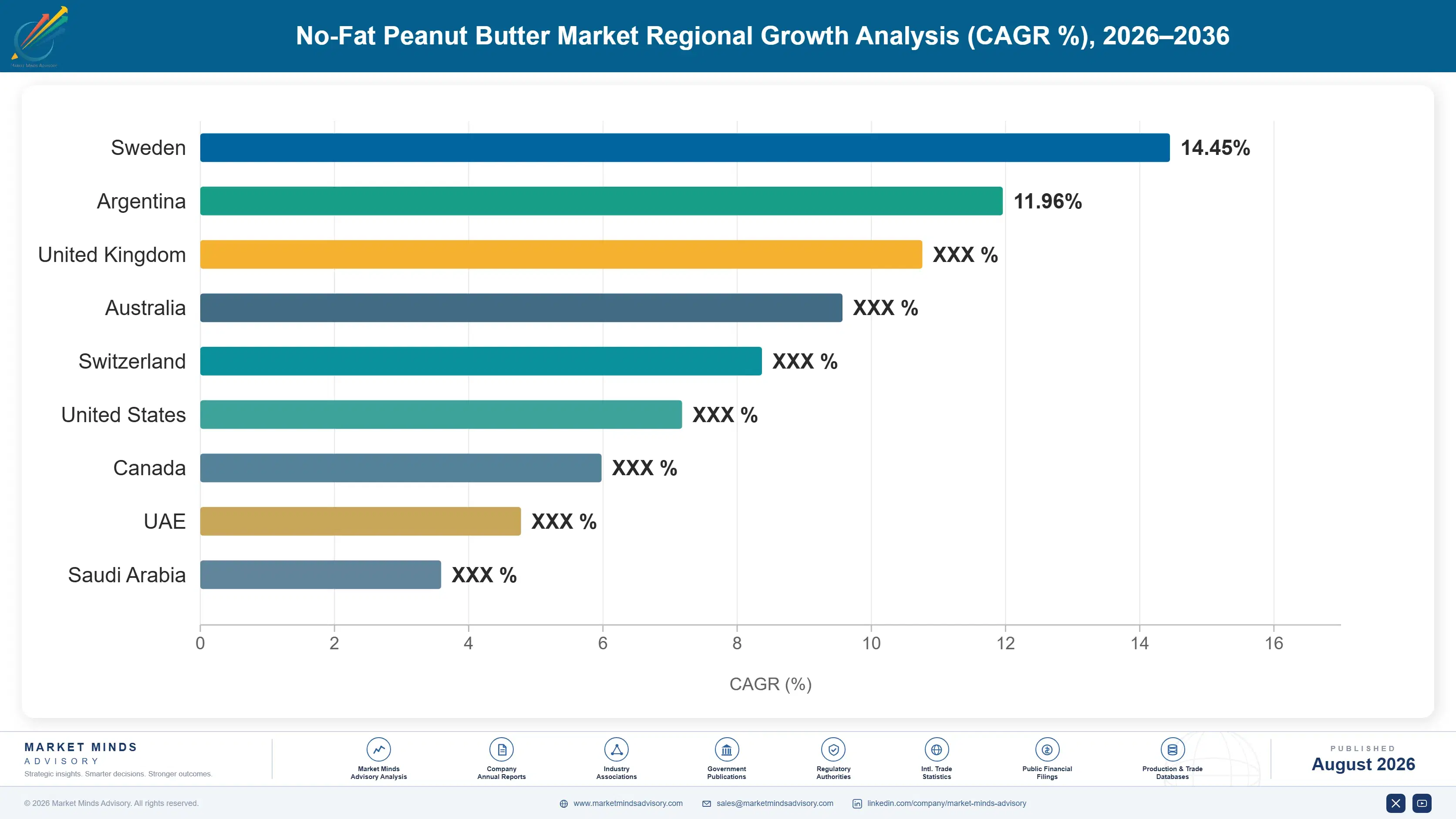
no-fat-peanut-butter-market-trends-country-cagr-analysis-1787375046289

Converting Trial Buyers Into Category Loyalists

Four commercial levers separate brands earning durable category loyalty from those competing on novelty alone: flavor pipeline investment, subscription retention, mainstream retail expansion, and recipe and baking positioning that broadens the buyer base beyond dedicated fitness enthusiasts, each requiring sustained upfront investment before margin gains become clearly visible on a quarterly income statement or report.

Invest in a Continuous Flavor Innovation Pipeline

Brands that maintain a continuous pipeline of new and seasonal flavors, rather than relying on a static core lineup, convert trial buyers into repeat purchasers at a substantially higher rate and generate recurring social media attention around each new limited-edition launch throughout the year. The ongoing formulation investment is real, but brands with active flavor pipelines report retail velocity roughly 2 times higher than single-flavor competitors selling otherwise comparable products at similar price points. Several leading brands now run quarterly limited-edition flavor calendars specifically to sustain repeat purchase interest among existing loyal customers.
Market Impact: Lifts retail velocity by roughly 2 times overall

Build Direct Subscription and Auto-Replenishment Programs

Subscription models convert an occasional supplement purchase into a recurring grocery habit, and brands with mature auto-replenishment programs report household lifetime value roughly 2.1 times that of single-purchase customers acquired through retail alone. Building this capability requires direct-to-consumer logistics and billing infrastructure that many smaller challenger brands still lack in-house today, creating an opening for digitally native entrants to establish direct relationships first. Retention economics improve further when brands bundle multiple flavors into a single rotating subscription box, reducing flavor fatigue that otherwise drives churn over time among long-tenured subscribers.
Market Impact: Raises household lifetime value 2.1 times overall each year

Expand Beyond Specialty Retail Into Mass Grocery

Brands that secure permanent mainstream grocery shelf placement, rather than remaining confined to specialty supplement and health food retail, capture demand from the much larger population of casual buyers who would never seek out a dedicated supplement store in the first place. Securing this placement requires demonstrating retail velocity and consistent supply at a scale many smaller brands have not yet reached organically without outside capital. Brands that cleared this bar report total addressable household reach roughly 3 times larger than specialty-only distribution alone delivers, reshaping their entire growth trajectory.
Market Impact: Expands addressable household reach roughly 3 times over

Position the Product for Baking and Recipe Use

Brands that market no-fat peanut butter as a lower-calorie baking and recipe ingredient, rather than solely a direct spread, tap purchase occasions among home cooks who never considered the format for anything beyond snacking on its own. This positioning requires recipe content investment and partnerships with baking and protein cooking influencers that pure spread marketing does not require at all under normal circumstances. Brands investing in this positioning report purchase frequency roughly 28 percent higher than those marketing the product purely as a spread alone, without any recipe-driven context or seasonal baking tie-ins.
Market Impact: Raises purchase frequency by 28 points nationwide overall

Who Controls the Margin Pool

The top five brands hold a combined 44 percent of category revenue, a moderately high concentration for a category this young, reflecting first-mover advantages built during the format's original niche supplement years and the flavor pipeline investment that followed. The gap between the leading brand and the fifth-ranked player remains meaningful, since flavor pipeline depth and distribution reach take years to replicate credibly.
Current competitive activity centers on three fronts: legacy peanut butter manufacturers launching competing defatted lines to avoid ceding the category, specialized challenger brands racing to expand flavor pipelines and mainstream retail placement, and e-commerce subscription programs scaling to lock in recurring purchase relationships across a growing loyal customer base. Baking and recipe positioning has also intensified as brands seek purchase occasions beyond direct spread consumption alone.

Emerging pressure is coming from private label and mainstream grocery store-brand entrants now testing defatted peanut butter formats as the category proves durable demand beyond its original niche origins. Rankings are most likely to shift among mid-tier specialized brands lacking either the flavor innovation budget of category leaders or the distribution scale of newly entering legacy manufacturers with far greater resources.
no-fat-peanut-butter-market-trends-company-positioning-matrix-1787375046821

Competitive Moat and Risk Dimensions

BELL PLANTATION (PB2 FOODS)

Moat: Category-originating brand recognition

Bell Plantation's PB2 brand effectively created this category, giving it a first-mover brand recognition advantage that newer entrants cannot easily replicate regardless of marketing spend. Decades of association with the format among fitness-focused early adopters continue reinforcing this position, particularly among consumers who discovered the category through PB2 specifically.
BELL PLANTATION (PB2 FOODS)

Risk: Slower flavor innovation pace

PB2's legacy product line was built around plain and simple chocolate flavors before flavor variety became the category's primary growth driver, leaving it exposed as newer, flavor-forward challenger brands capture younger buyers. Retooling a long-established core lineup takes longer than launching new formulas from scratch, creating an opening for faster-moving competitors.
PBFIT (NUTS 'N MORE)

Moat: Mainstream retail distribution reach

PBfit has secured broader mainstream grocery distribution than most specialized competitors, moving the category beyond specialty supplement retail into everyday grocery aisles more successfully than most rivals. This distribution reach gives it access to casual buyers that e-commerce-only competitors cannot easily capture through digital marketing alone.
PBFIT (NUTS 'N MORE)

Risk: Limited direct-to-consumer relationship

PBfit's mainstream retail-first strategy limits its direct-to-consumer subscription relationship depth relative to competitors built around e-commerce from inception, a gap that matters as subscription economics increasingly drive category profitability across the broader competitive set. Building comparable direct-to-consumer capability would require a meaningful strategic shift the company has approached cautiously so far.

Players Tracked

Prominent Players

Bell Plantation (PB2 Foods)
PBfit (Nuts 'N More)
Betty Lou's, Inc.
Krema Products Company
Nuts.com

Other Key Players

Hormel Foods Corporation (Justin's)
The J.M. Smucker Company
Conagra Brands, Inc.
Protein Plus Foods LLC
Naked Nutrition LLC
MySlimFix (Slim Fast Foods)
NuGo Nutrition
Legendary Foods LLC
Crazy Richard's Peanut Butter Company
Once Again Nut Butter Collective
Wild Friends Foods, Inc.
Nuts & Berries International
PB Crave, LLC
ProGranola LLC
Peanut Butter & Co.

Recent Developments

JUNE 2025

Bell Plantation Launches Seasonal Flavor Calendar Program

Bell Plantation launched a quarterly limited-edition flavor calendar for its PB2 brand, adding pumpkin spice and peppermint mocha variants to a lineup previously concentrated in plain and chocolate formats sold year-round across its full national retail and e-commerce distribution network spanning most major grocery chains.
Signal: Signals the category originator is finally chasing a flavor-driven growth strategy directly rather than resisting it any longer
MARCH 2025

PBfit Expands Distribution Into Major Warehouse Club Chains

PBfit secured expanded distribution across major warehouse club retail chains, adding bulk-size formats specifically designed to bring per-ounce pricing closer to traditional peanut butter for value-conscious households shopping at club-format retailers nationwide, a channel the brand had not previously entered at meaningful scale before this expansion.
Signal: Confirms mainstream retail expansion is now central to the category's broader growth strategy for most major brands
SEPTEMBER 2024

Hormel Foods Acquires Emerging No-Fat Peanut Butter Challenger Brand

Hormel Foods acquired a venture-backed no-fat peanut butter startup to add defatted protein spreads to its portfolio, expanding beyond traditional full-fat peanut butter positioning into the faster-growing segment ahead of several other large packaged food competitors weighing similar acquisition targets in the same fast-growing space.
Signal: Shows legacy food manufacturers buying growth rather than building internally from scratch on their own entirely

Peanut Processing Sets the Cost Floor

Raw peanuts and the specialized defatting and reconstitution processing required to remove natural oil content together represent roughly 46 percent of cost of goods sold, sourced primarily from United States, Chinese, and Argentine peanut growing regions with periodically volatile harvest yields. Flavor ingredient costs, particularly cocoa for chocolate variants, add a further meaningful cost layer that has grown as flavored formats expand across the category.
Peanut prices rose sharply in 2023 after weather-related crop damage across major United States growing regions tightened global supply, an event the USDA's agricultural commodity price tracking and several manufacturers' annual reports both referenced when explaining margin compression that year. Flavored format manufacturers faced additional pressure from cocoa price volatility during the same period, compounding cost increases across the category's fastest-growing and most competitively contested segment.

Exposure varies sharply by player type: brands with long-term peanut supply contracts and in-house processing capacity absorbed volatility more easily than smaller manufacturers dependent on contract processing and spot market peanut purchasing, who faced steeper margin compression. Vertically integrated leaders used scale purchasing agreements to smooth cost swings that hit smaller regional competitors much harder.
no-fat-peanut-butter-market-trends-cost-volatility-analysis-1787375047018

Lock Multi-Year Peanut Supply Contracts

Leading manufacturers now lock multi-year fixed-price contracts directly with peanut growers across multiple growing regions, reducing exposure to any single harvest's weather-related supply disruption. This adds modest contracting cost but has prevented the steepest cost spikes during recent volatility, and several brands report the practice paid for itself within two years of initial adoption.

Diversify Peanut Sourcing Across Growing Regions

Some manufacturers are diversifying peanut sourcing across United States, Argentine, and Chinese growing regions rather than concentrating in a single geography, reducing exposure to any one region's weather or crop disease disruption. Early movers report both cost stability and supply security benefits from this diversified approach, alongside meaningfully improved forecasting accuracy for future planning.

Hedge Cocoa and Flavor Ingredient Costs Forward

Manufacturers producing flavored formats increasingly hedge cocoa and other flavor ingredient costs through forward purchasing agreements, protecting margin on the category's fastest-growing segment against commodity price swings. Several large brands have expanded this practice since the 2023 volatility event affected multiple ingredient categories simultaneously across the entire portfolio, prompting a broader review of forward-purchasing policy.

Portfolio Architecture for Margin Defence

Three tiers structure this category's margin economics. Volume plain powder formats compete on price with thin margins, premium flavored spreads earn a meaningful markup on taste innovation and branding, and next-generation baking-positioned and subscription-exclusive products command the steepest prices by solving a specific use-occasion problem consumers actively seek out and discuss with fellow enthusiasts online in dedicated communities regularly.
Tension between volume and premium tiers is intensifying as mainstream retailers compress shelf space for undifferentiated plain powder while expanding flavored and premium bays. Manufacturers straddling both tiers face difficult portfolio choices, since the operational capabilities required, flavor R&D versus manufacturing scale efficiency, pull in genuinely different directions that rarely reward companies trying to excel at both simultaneously across their entire product portfolio and distribution footprint.

High-value margin pools concentrate in flavored subscription-exclusive formats addressing specific taste preferences and dietary goals, where buyers show the least price sensitivity. Baking and recipe-positioned formats represent a fast-growing high-value pool as this historically underserved use case finally gets dedicated manufacturing and marketing attention from both established category leaders and well-funded regional challengers entering the space more aggressively each year.

Volume / Commodity-Adjacent Tier

Plain powdered formats sold primarily through mass grocery and value retail on price and shelf visibility, competing directly with growing private label alternatives that increasingly match core formulation quality at lower prices.
Gross Margin: 26-34%

Premium / Certified Tier

Flavored spreads and blends sold through mainstream and specialty retail at a clear premium, targeting fitness and wellness-conscious shoppers seeking genuine variety and consistent, reliable formulation quality across every purchase.
Gross Margin: 40-50%

Sustainability / Regulatory / Next-Generation Tier

Subscription-exclusive and baking-positioned formats with documented recipe use cases, increasingly sold through direct-to-consumer relationships at premium pricing well above mainstream retail averages nationwide today across most channels this report tracks closely.
Gross Margin: 52-62%
no-fat-peanut-butter-market-trends-portfolio-architecture-1787375047535

High-value Sub-segments and Strategic Watch-out

Flavored Subscription-Exclusive Spreads

This segment combines the category's highest growth rate with its richest margins, as limited-edition flavors sold exclusively through subscription channels justify premium pricing that loyal buyers readily pay for exclusivity and novelty they cannot find anywhere else, reinforcing brand loyalty each and every single quarter.
Gross Margin: 56-64%

Baking and Recipe-Positioned Protein Blends

Growing fast but still building margin scale, this segment benefits from solving the versatility problem that pure spread positioning cannot address, though recipe content investment currently compresses near-term profitability relative to mature formats already established in the category and its core loyal customer base of repeat buyers.
Gross Margin: 38-46%

Mainstream Plain and Chocolate Powder

The category's volume anchor, mainstream formats retain the largest revenue base even as growth slows relative to newer flavors, sustaining category cash flow while margins stay comparatively thin against premium alternatives across most producing regions this report tracks in careful, ongoing detail throughout every quarter.
Gross Margin: 28-35%

Private-Label Store-Brand No-Fat Spreads

Retailers are expanding store-brand no-fat peanut butter lines to capture margin from price-sensitive households, a watch-out for branded manufacturers as private label quality gaps narrow and retailer negotiating leverage grows across major grocery accounts nationwide heading into future contract renewal cycles each and every year.
Gross Margin: 20-27%

Repeat Purchase Economics by Buyer Type

No-fat peanut butter behaves like an annuity once a household establishes a routine, since committed buyers rarely revert to full-fat alternatives after adjusting to the format's taste and texture, and expanding into flavored variants extends household purchase frequency without any incremental acquisition cost across the household's entire remaining relationship with the brand and its full flavor lineup.
Adoption depth varies meaningfully by vertical: fitness-focused buyers show near-universal trial and high daily compliance, while casual wellness buyers see lower trial rates paired with less frequent but still meaningful purchase once flavor variety and baking positioning give them a reason to return to the category repeatedly over time rather than treating it as a passing trial purchase they abandon quickly.

Younger millennial and Gen Z consumers discover the category through social media fitness and recipe content far more actively than through traditional advertising, producing enthusiastic early adopters who then influence household purchasing broadly across their extended social and family networks over time. This generational shift rewards brands investing early in social content over those relying on legacy supplement-aisle positioning alone, reshaping which brands capture the next decade of category growth.
no-fat-peanut-butter-market-trends-end-use-penetration-index-1787375048033

Where MMA Sees Category Momentum Next

These are among the four positions where our research anticipates prominent divergence between winners and laggards over the coming forecast period. Each is grounded in the demand model, the regulatory perimeter, and the announced capacity pipeline.
01 / FLAVOR PIPELINE INVESTMENT

Fund continuous flavor innovation before category matures further

Flavor variety has replaced plain powder as the category's primary growth driver, and brands still relying on a static core lineup risk losing shelf space and repeat buyers to competitors running active seasonal calendars within the next several purchasing cycles across nearly every retail account. The formulation investment required is real but manageable relative to the retail velocity gains available to early movers who commit to the pipeline now rather than later. MMA views continuous flavor investment as the single highest-leverage decision facing mid-tier brands in this category today.
02 / MAINSTREAM DISTRIBUTION PUSH

Expand beyond specialty retail into mass grocery within two years

The category's addressable buyer base has expanded well beyond dedicated fitness enthusiasts, and brands still confined to specialty supplement retail are leaving a much larger casual buyer population uncaptured by competitors already securing mainstream shelf space across major accounts. Building this distribution requires demonstrating consistent supply and retail velocity that smaller brands have not always achieved at the scale mainstream buyers require of every supplier. MMA expects the mainstream distribution window to narrow considerably as legacy manufacturers accelerate their own category entry.
03 / SUBSCRIPTION INFRASTRUCTURE BUILD

Build direct-to-consumer subscription capability as a defensive necessity

Brands dependent solely on retail distribution remain exposed to shelf reset volatility that direct-to-consumer subscription relationships largely avoid, particularly as flavor variety keeps expanding across the category and buyer expectations rise accordingly. Building this capability requires meaningful logistics and billing infrastructure investment that smaller manufacturers often lack the capital to build in-house today without outside investment. MMA recommends treating subscription infrastructure as a defensive necessity rather than optional growth experimentation, given how quickly digitally native challengers have already scaled past slower rivals.
04 / RECIPE POSITIONING EXPANSION

Position the product for baking use ahead of slower-moving competitors

Recipe and baking positioning taps an entirely new purchase occasion that pure spread marketing cannot reach, and brands investing early in this positioning are converting home cooks who never previously considered the format for anything beyond direct consumption or fitness routines. This requires genuine recipe content investment and influencer partnerships that competitors focused purely on spread marketing have not yet built at comparable scale. MMA advises building this positioning now rather than waiting for competitors to establish the recipe-use association first.

Engagement Snapshot From the Field

A live engagement with an industry participant carrying material or product regulatory and market exposure ahead of a defining policy shift, showing how our research translates into a defensible multi-year portfolio strategy.
MARKET MINDS ADVISORY · CLIENT ENGAGEMENT SUMMARY
No-Fat Peanut Butter Producer Strategic Portfolio Review and Transition Roadmap 2026·Investment Scenario on No-Fat Peanut Butter Exposure Evaluation 2025-26
CLIENT PROFILE
The client operates a direct-to-consumer fitness nutrition brand generating approximately 22 million dollars (client-reported, unverified by MMA) in annual no-fat peanut butter revenue, sold primarily through its own e-commerce subscription platform to a loyal fitness-focused customer base built over several years. The brand sought to evaluate expansion into mainstream grocery retail ahead of a planned growth capital raise.
STRATEGIC CHALLENGE
Subscription growth had plateaued as the brand's addressable e-commerce audience matured, and leadership lacked a clear framework for evaluating mainstream retail expansion against continued digital-only growth investment across the existing subscriber base. Competing brands had already secured meaningful grocery shelf placement in several key regional markets ahead of the client.
MMA APPROACH
MMA conducted a structured audit of the client's flavor portfolio and subscription economics against category benchmarks, cross-referencing findings against primary survey data from comparable direct-to-consumer nutrition brands facing similar channel decisions in recent years. The engagement produced a phased retail expansion roadmap balancing channel conflict, margin, and capital allocation considerations carefully.
KEY FINDINGS
  1. The client's flavor lineup breadth already exceeded category average considerably, positioning it well for a mainstream retail shelf reset happening this year.
  2. Subscription customer acquisition cost had risen 34 percent over eighteen months as digital advertising competition intensified sharply across the entire category overall.
  3. Comparable brands that expanded into mainstream retail reported subscription cannibalization well below leadership's initial internal projections for the client's own broader business.
  4. Regional grocery chains expressed strong interest in flavor variety exclusives as a category differentiation strategy against growing private label entrants moving nationwide.
CLIENT PROFILE
The client operates a direct-to-consumer fitness nutrition brand generating approximately 22 million dollars (client-reported, unverified by MMA) in annual no-fat peanut butter revenue, sold primarily through its own e-commerce subscription platform to a loyal fitness-focused customer base built over several years. The brand sought to evaluate expansion into mainstream grocery retail ahead of a planned growth capital raise.
STRATEGIC CHALLENGE
Subscription growth had plateaued as the brand's addressable e-commerce audience matured, and leadership lacked a clear framework for evaluating mainstream retail expansion against continued digital-only growth investment across the existing subscriber base. Competing brands had already secured meaningful grocery shelf placement in several key regional markets ahead of the client.
MMA APPROACH
MMA conducted a structured audit of the client's flavor portfolio and subscription economics against category benchmarks, cross-referencing findings against primary survey data from comparable direct-to-consumer nutrition brands facing similar channel decisions in recent years. The engagement produced a phased retail expansion roadmap balancing channel conflict, margin, and capital allocation considerations carefully.
KEY FINDINGS
  1. The client's flavor lineup breadth already exceeded category average considerably, positioning it well for a mainstream retail shelf reset happening this year.
  2. Subscription customer acquisition cost had risen 34 percent over eighteen months as digital advertising competition intensified sharply across the entire category overall.
  3. Comparable brands that expanded into mainstream retail reported subscription cannibalization well below leadership's initial internal projections for the client's own broader business.
  4. Regional grocery chains expressed strong interest in flavor variety exclusives as a category differentiation strategy against growing private label entrants moving nationwide.
RECOMMENDED STRATEGY
Phase 1: Phase 1 (Months 1-3): Audit the entire flavor portfolio and subscription economics against category benchmarks in full careful detail first. Phase 2: Phase 2 (Months 4-9): Launch pilot mainstream retail placement in two regional grocery chains with exclusive flavors offered there initially. Phase 3: Phase 3 (Months 10-15): Scale the successful retail placements nationally while protecting core subscription revenue very carefully throughout the rollout.
OUTCOME
Within fifteen months of implementation, the client reported (client-reported, unverified by MMA) a 19 percent increase in total category revenue with subscription cannibalization limited to roughly 4 percent of prior digital sales. Leadership adopted the phased framework as its standard approach for future channel expansion decisions.

Frequently Asked Questions

Foundational context covering the market sizes, CAGR, scope, country, region and competition that inform every finding below. This section is provided to cover basics and most often pre-purchase conversations, answered from the MMA Primary Research Dataset.

What is the current size of the No-Fat Peanut Butter Market?

The no-fat peanut butter market was valued at approximately $0.58 billion in 2025. Growth is driven by flavor innovation and expanding mainstream grocery distribution beyond its fitness-supplement origins.

How large will the No-Fat Peanut Butter Market be by 2036?

MMA projects the market will reach approximately $2.09 billion by 2036, up from $0.65 billion in 2026. This represents an incremental opportunity of roughly $1.44 billion over the forecast period.

What is the CAGR for the No-Fat Peanut Butter Market 2026 to 2036?

The market is projected to grow at a 12.4 percent compound annual growth rate between 2026 and 2036. Bull and bear scenarios range from 11.1 to 13.7 percent annually.

Which segment is growing fastest?

Flavored no-fat peanut butter spreads are growing fastest at 19.8 percent annually, roughly 1.6 times the category average, driven by taste variety that converts trial buyers into repeat purchasers.

Who are the major companies in the No-Fat Peanut Butter Market?

Bell Plantation (PB2), PBfit, Betty Lou's, Krema Products, and Nuts.com lead the category. Together the top five hold a moderately high combined share reflecting first-mover advantages.

Which country is growing fastest?

India leads country-level growth at 17.8 percent annually as its expanding protein-conscious urban middle class discovers the format for the very first time this decade.

Report Segmentation Architecture

The full report scope spans multiple orthogonal segmentation dimensions, with cross-tabulated demand data provided for each dimension pair. Coverage extends further to regional breakdowns, trend trajectories, and the competitive detail needed to support segment-level decision-making.

By Product Format

  • Powdered/Defatted Peanut Butter
  • Reconstituted Spreads
  • Peanut Protein Powder Blends
  • Flavored No-Fat Spreads
  • Bars and Bites
  • Bulk Foodservice Base

By End-Use Industry

  • Retail Grocery
  • E-Commerce and Direct-to-Consumer
  • Specialty and Health Food Retail
  • Foodservice and Bakery
  • Fitness and Supplement Retail

By Commercial Dimension

  • Fitness-Focused Buyers
  • General Wellness Buyers
  • Baking and Recipe Use
  • Subscription and Auto-Replenishment

By Region

  • North America
  • Western Europe
  • East Asia
  • South Asia and Pacific
  • Latin America
  • Middle East and Africa
  • Eastern Europe

Scope, Methodology, and Coverage

Every figure in this report is reproducible from documented input assumptions. The scope below maps the historical period, the forecast horizon, the segmentation dimensions, and the countries covered, alongside the underlying primary and qualitative methodology.
Historical Period
2020 to 2025
Forecast Period
2026 to 2036
Base Year
2025 (USD billions; MMA Primary Research Dataset, August 2026)
Market Definition
This report covers defatted, powdered, and reconstituted peanut spreads and blends formulated to retain peanut protein and flavor while removing the majority of natural peanut oil content. It excludes traditional full-fat peanut butter, peanut oil products, and generic protein powders not derived from peanuts.
Quantitative Units
USD billions (current prices); volume in metric tons and million units where applicable
Segmentation Dimensions
By Product Format; By End-Use Industry; By Commercial Dimension; By Region
Regions Covered
North America, Western Europe, East Asia, South Asia and Pacific, Latin America, Middle East and Africa, Eastern Europe
Countries Covered
USA, China, Germany, France, UK, Japan, South Korea, India, Australia, Canada, Brazil, Mexico, Indonesia, Vietnam, Thailand, Malaysia, UAE, Saudi Arabia, South Africa, Nigeria, Turkey, Poland, Netherlands, Italy, Spain, Sweden, Switzerland, Argentina, Colombia, Singapore, and additional markets relevant to this sector
Key Companies Profiled
Bell Plantation (PB2 Foods), PBfit (Nuts 'N More), Betty Lou's, Inc., Krema Products Company, Nuts.com, Hormel Foods Corporation (Justin's), The J.M. Smucker Company, Conagra Brands, Inc., Protein Plus Foods LLC, Naked Nutrition LLC, MySlimFix (Slim Fast Foods), NuGo Nutrition, Legendary Foods LLC, Crazy Richard's Peanut Butter Company, Once Again Nut Butter Collective, Wild Friends Foods, Inc., Nuts & Berries International, PB Crave, LLC, ProGranola LLC, Peanut Butter & Co.
Quantitative Methodology
Primary survey, n=3,800 respondents, Q4 2025, six countries; demand-side model with trade association cross-validation
Qualitative Methodology
47 expert interviews, Q4 2025; applied to validate demand model assumptions, identify emerging dynamics, and assess competitive positioning
Report Format
PDF and XLSX data workbook (Word format preview document)
Publisher
Market Minds Advisory
Report Code
MMA-2026-AGR-113
Published
August 2026
Contact
sales@marketmindsadvisory.com | www.marketmindsadvisory.com

Purchase the full No-Fat Peanut Butter Market Report (2026 to 2036).

The full report delivers a comprehensive 200-plus page analysis of the global no-fat peanut butter market, including detailed segmentation by product format, end-use channel, and commercial dimension across all seven world regions tracked in this study. It provides company profiles for twenty key and emerging brands, benchmarked against a consistent revenue and retail velocity basis throughout. Buyers receive access to MMA's underlying primary survey dataset spanning 3,800 respondents and 47 expert interviews conducted in Q4 2025. Custom data cuts and direct analyst inquiry access are available for enterprise licensees upon request.
Twenty detailed company profiles with moat and risk analysis
Seven-region market sizing data through 2036
Primary survey dataset, n equals 3,800 respondents
Forty-seven expert interview transcript summary excerpts
Format-level CAGR and regional share breakdowns
Quarterly market update subscription add-on option

Built For The People Who Decide

From boardroom strategy to bench-side execution, this report is read cover-to-cover by leaders shaping the next decade of their industry, turning demand scenarios, market dynamics and valuation benchmarks into decisions.
CXOs/ Presidents/ VPs/ Managers
M&A and Corporate Development
Strategy Teams and R&D Heads
Procurement and Product Directors
Regulatory and Compliance Leaders
Investor Relations and Equity Analysts