Market Minds Advisory
No-Fat Cake Market

No-Fat Cake Market: Crumb Structure Without Fat, Protein Positioning and the Shelf Life Problem Nobody Solved

Fat does four jobs in a cake and removing it breaks all of them at once, which is why the products that finally worked stopped selling absence and started selling protein content instead.

Lead Analyst

Lisa Gevelber

Published

September 2026

Make Smarter Decisions with Customized Research Insights

Request a free sample report and evaluate market opportunities, growth trends, and competitive dynamics relevant to your business needs.

2025 MARKET VALUE$1.4BMarket Size 2025
2036 FORECAST VALUE$2.9BBase Case , 2026 to 2036
CAGR 2026 TO 20366.8 %Bull 7.9% / Bear 5.6%
INCREMENTAL OPPORTUNITY$1.4BNet 10- year value creation
EXPANSION MULTIPLE1.93x2036 value over 2026 base
Strategic Levers
M&A Pipeline
Regional Outlook
Country Rankings
Competitive Intelligence
Segmental Deep-dive
Call-Us : 91 93563 13602

Executive Snapshot and Market Trajectory

Fat does four separate jobs in a cake: it tenderises crumb, carries flavour, retains moisture and controls how the thing feels in the mouth. Removing it breaks all four at once, which is why this category spent two decades producing food nobody wanted to finish.
Protein-fortified products carry the growth because they sell an addition rather than an absence, and a protein number on the front of a pack does commercial work that fat-free claims never managed. Single-serve formats grow nearly as fast on portion control doing the nutritional work instead. North America holds the largest share on established better-for-you bakery retail and on a consumer genuinely used to reading nutrition panels.
Concentration reads at 29% for the top five, low because bakery remains regional and fresh distribution limits how far anybody reaches. Shelf life is the technical problem that still constrains the category, since fat contributes materially to moisture retention and its removal shortens acceptable life without careful humectant and hydrocolloid work that many producers have not done. Sports nutrition entrants carry protein credibility established bakers cannot simply assert, and that gap is widening.
Market Definition
This market covers cakes and cake products formulated without added fat or meeting fat-free labelling thresholds, spanning protein-fortified no-fat cakes, single-serve and portioned formats, whole cakes and loaf products, no-fat cake mixes for home baking, and foodservice no-fat cake supply. Reduced-fat and low-fat products above fat-free thresholds, sugar-free cakes not also fat-free, biscuits and cookies, and general better-for-you snacks are excluded.
Base Year Value
$1.4B in 2025 (MMA Primary Research Dataset, August 2026)
Forecast Period
2026 to 2036, eleven discrete annual values
CAGR
6.8% base case. Bull 7.9%. Bear 5.6%.
Fastest Growth Segment
Protein-Fortified No-Fat Cakes: 10.2% CAGR
Fastest Growth Country
India: 10.4% CAGR
Fastest Growth Region
South Asia and Pacific: 9.1% CAGR
Largest Region
North America: 30% of 2025 global value
Market Leaders
Grupo Bimbo, Hostess Brands, Finsbury Food Group, Weston Foods and Yamazaki Baking lead on no-fat cake revenue. Source: MMA Primary Research Dataset, July 2026.
Primary Survey
n=3,800 procurement and R&D decision-makers, Q4 2025, six countries
Methodology
Demand-side build-up, cross-validated against public data, 47 expert interviews

No-Fat Cake Market Forecast Scenarios

no-fat-cake-market-trends-forecast-size-forecast-scenario-1787375287899
Growth ran at 5.7% annually between 2020 and 2025, and the category changed character completely partway through. Early volume came from fat-free positioning aimed at dieting consumers, which stalled as that framing fell out of favour and consumers grew sceptical of products defined by what they lacked. Protein positioning replaced it, and the growth that followed came from an entirely different buyer.
The base case at 6.8% rests on three mechanisms. Protein fortification continues converting the category from an absence proposition into an addition one, which reaches consumers who were never interested in fat-free anything. Single-serve formats keep expanding through convenience and workplace channels where portion control does the nutritional work. And Indian and Southeast Asian packaged bakery grows quickly as organised retail displaces unbranded local production across urban markets. None of the three requires a new claim.
The bull case at 7.9% turns on hydrocolloid and humectant formulation closing the shelf life gap, which would open ambient distribution that fresh-only products cannot reach. The bear case at 5.6% reflects consumer rejection of highly formulated products generally, since the ingredient list required to make a no-fat cake palatable is long and reads badly against clean-label expectations.

Removing Fat Breaks Four Things At Once

Fat is doing four jobs in a conventional cake and none of them are obvious until it is gone. It tenderises the crumb by interrupting gluten development, it carries fat-soluble flavour compounds, it retains moisture across shelf life, and it produces the mouthfeel that makes cake feel like cake rather than like sweetened bread. Removing it breaks all four simultaneously.
TOP FIVE CONCENTRATION29%Low, since bakery remains regional and fresh distribution limits reach
SHELF LIFE GAP9 daysReduction against comparable conventional cake at ambient conditions
PROTEIN FORMAT SHARE37%Portion of value in products carrying a protein claim
PRICE PREMIUM46%Retail advantage over comparable conventional cake products typically
SINGLE-SERVE SHARE41%Portion of volume sold in individually portioned formats
INGREDIENT COST SHARE39% of COGSIngredient contribution to finished product manufactured cost overall
The category spent two decades trying to sell the absence and mostly failed. What changed was reframing: a protein claim is an addition rather than a subtraction, it is a nutrition declaration statable plainly on pack, and it reaches a buyer adding something to their diet rather than removing it. Roughly 37% of category value now carries a protein claim and that share keeps rising.
Shelf life remains the unsolved constraint. Fat contributes materially to moisture retention, and no-fat products run around nine days shorter at ambient conditions than comparable conventional cake unless humectant and hydrocolloid systems are properly designed. That keeps much of the category in fresh and chilled distribution, which limits reach and raises cost, and it is why single-serve convenience formats have done disproportionately well.
"Fat-free cake failed for twenty years because it was selling a subtraction to people who buy cake as a reward. Putting twelve grams of protein on the front changed nothing about the recipe and everything about who picked it up."
Director, Bakery and Better-For-You Foods Practice · MMA Bakery and Confectionery Practice · August 2026

Market Trends

Protein Claims Replace Fat-Free Positioning As The Selling Argument

Fat-free positioning asks a consumer to buy something for what it does not contain, which turns out to work badly in a category people buy as a reward rather than as nutrition. A protein claim is a nutrition declaration statable plainly on pack, it appeals to a buyer adding something rather than avoiding something, and it commands pricing the earlier framing never sustained. Roughly 37% of category value now carries a protein claim, and the reformulation required is modest against the commercial effect. The buyer is simply not the same person any more.
Market Impact: Portioned formats take 41% of volume
Single-Serve Formats Avoid The Direct Shelf Comparison Entirely

A whole no-fat cake sitting beside a conventional one on a supermarket shelf loses that comparison most of the time, because the buyer is choosing on appearance and expectation rather than on a nutrition panel. Single-serve products in convenience, foodservice and workplace channels avoid the comparison completely, since the decision is about one item at one moment. Portion control also does much of the nutritional work, which frees formulation to prioritise eating quality. Roughly 41% of volume now sits in these formats. Convenience turnover also makes short shelf life almost irrelevant.
Market Impact: India grows at 10.4% annually

Market Opportunities and Growth Drivers

Workplace And Convenience Channels Reward Portioned Better-For-You Formats

Workplace catering, convenience retail and foodservice all buy single items rather than household baskets, which suits portioned no-fat cake far better than grocery shelf competition ever did. Buyers in these channels specify against nutritional criteria that increasingly appear in corporate wellbeing policies and public sector catering standards. That produces contracted volume rather than promotional shelf placement. Roughly 41% of category volume now moves through portioned formats, and those channels have grown considerably faster than grocery retail. Public sector catering standards increasingly write the same criteria into their tender documents. Contracted volume behaves nothing like a shelf listing.
Market Impact: Shelf life falls by 9 days

Indian Packaged Bakery Displaces Unbranded Local Production Quickly

Indian urban bakery consumption has historically run through local unbranded producers selling fresh daily, and organised retail is displacing that steadily with packaged product carrying nutrition labelling for the first time. Indian demand grows near 10.4% annually as a result. Better-for-you positioning converts unusually well among younger urban consumers who read nutrition panels in a way previous generations did not. Domestic manufacturers are formulating for regional taste preferences rather than importing Western products unchanged. Nutrition labelling on packaged product is itself new to many of these buyers. Domestic producers formulate for regional taste rather than importing.
Market Impact: Lists run 3 times longer typically

Market Restraints and Challenges

Fat Removal Shortens Shelf Life And Limits Distribution Reach

Fat contributes materially to moisture retention, and no-fat products run around nine days shorter at ambient conditions than comparable conventional cake. The root cause is physical rather than formulation error, since fat physically slows moisture migration through crumb. Commercially this confines much of the category to fresh and chilled distribution, which raises cost and limits geographic reach considerably. Participants are responding with humectant and hydrocolloid systems, modified atmosphere packaging, and format choices that accept shorter life in fast-turning channels. Fresh and chilled supply chains cost considerably more per unit delivered.
Market Impact: Protein claims cover 37% of value

Ingredient Declarations Read Badly Against Clean-Label Expectations

Making a no-fat cake palatable requires emulsifiers, hydrocolloids, humectants and often protein isolates, which produces an ingredient list considerably longer than a conventional cake made from butter, flour, sugar and eggs. The root cause is that fat was doing work that now requires several ingredients to replicate. Commercially this exposes the category to consumers who read declarations and prefer short ones. Participants are responding with simplified systems, fruit-based moisture solutions, and positioning that leads on protein rather than on formulation. Leading on protein moves the conversation away from the declaration entirely.
Market Impact: Single-serve holds 41% of volume
3 additional market trends, 2 additional growth drivers, and 4 additional restraints and challenges are covered in the full report. Contact sales@marketmindsadvisory.com to access the complete intelligence.

Segment CAGR and Growth Architecture

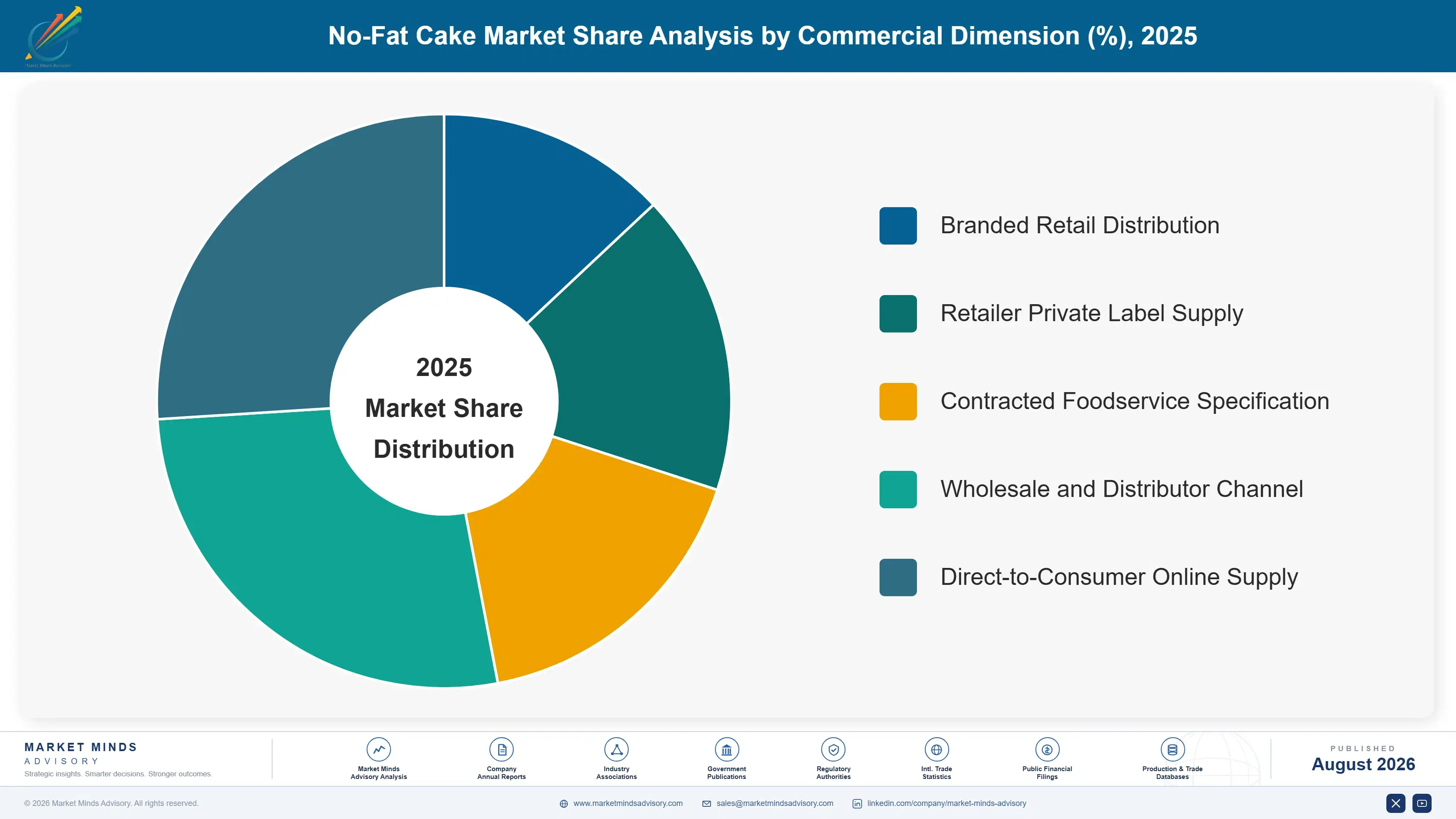
Five product formats divide this market on how the cake is presented and sold rather than on flavour or cake style. That reflects how the category actually competes, since format determines which channel a product reaches, whether it faces direct comparison against conventional cake, and how much the shelf life constraint genuinely matters. Format decides more than recipe does.
no-fat-cake-market-trends-forecast-market-share-analysis-1787375288433

Protein-Fortified No-Fat Cakes

Growing at 10.2% and the fastest part of this market. Protein-fortified no-fat cakes sell on the number on the front of the pack rather than on the absence of fat, which is a genuinely different commercial proposition and a far more effective one. A protein claim is a nutrition declaration that can be stated plainly, it appeals to a buyer who is adding something rather than avoiding something, and it commands pricing that fat-free positioning alone has never sustained. Whey and milk protein isolates carry most of the formulation. The technical difficulty is that protein toughens crumb structure considerably, which is why so many early products in this segment were genuinely unpleasant to eat.
CAGR 10.2%

Single-Serve and Portioned Formats

Growing at 9.2% on individually portioned no-fat cakes and slices sold through convenience, foodservice and workplace channels where the buyer is making a single decision about a single item rather than filling a household basket. Portion control does much of the nutritional work here, which means formulation can prioritise eating quality over headline numbers in a way whole-cake products cannot. Convenience distribution also removes the direct shelf comparison against conventional cake that whole-cake formats always lose. Shelf life is the binding technical constraint, since fat contributes to moisture retention and its removal shortens acceptable shelf life considerably without careful humectant work. Fast channel turnover makes that constraint far less binding.
CAGR 9.2%
Full segment breakdown across 5 segments available in the complete report.

Regional Architecture and Country Demand Map

North America holds 30% of global value on established better-for-you bakery retail and consumers genuinely used to reading nutrition panels. East Asia follows at 23% on packaged bakery scale, while South Asia and Pacific grows fastest as organised retail displaces unbranded local production. Clean-label resistance shapes Western Europe.

North America

Better-for-you bakery is more established here than anywhere and American consumers read nutrition panels as ordinary practice, which is the precondition for a category defined by what is on one. Protein positioning works particularly well against a population already buying protein bars, shakes and fortified snacks without any prompting. Convenience and workplace channels are well developed and buy portioned formats in contracted volume. Fat-free labelling thresholds are clearly defined under Food and Drug Administration rules, which removes ambiguity about what a product may claim. Canadian demand follows American formats closely with slightly tighter labelling requirements applying throughout. Protein positioning works against a population already buying fortified snacks without prompting. Labelling thresholds are clearly defined.
Share: 30% | CAGR: 7.2% (2026 to 2036)

East Asia

Packaged bakery is enormous across this region and Japanese convenience store distribution in particular sells single-serve cake at a scale nothing in the West approaches, which suits portioned no-fat formats naturally. Japanese consumers also accept formulated products without the clean-label resistance found in Western Europe. Chinese packaged bakery has grown quickly and better-for-you positioning is developing among younger urban consumers. Korean demand is smaller and heavily weighted toward convenience channels. Shelf life expectations across the region are demanding, which makes the moisture retention problem more commercially consequential here than in fresh-distribution markets elsewhere. Convenience turnover across the region makes short shelf life commercially manageable in practice. Formulated products meet little consumer resistance here.
Share: 23% | CAGR: 7.9% (2026 to 2036)
Regional intelligence for 5 additional markets available in the complete report: Western Europe, South Asia and Pacific, Latin America, Middle East and Africa, Eastern Europe. Contact sales@marketmindsadvisory.com.
no-fat-cake-market-trends-forecast-country-cagr-analysis-1787375288950

Where No-Fat Cake Margin Is Won

Four positions separate businesses growing in this category from those still defending a fat-free claim nobody responds to: leading on protein rather than absence, weighting toward portioned formats, solving the moisture retention problem properly, and winning contracted workplace and foodservice specifications instead of grocery shelf space. Only the third of those requires genuine technical work.

Lead On Protein Content Rather Than Fat Absence

A protein claim is a nutrition declaration statable plainly on pack and it reaches a consumer adding something rather than avoiding something, which is a completely different buyer from the one fat-free positioning was aimed at. Products leading on protein realise roughly 46% premium pricing over conventional cake where fat-free framing sustained almost nothing. Reformulation cost is modest against that effect, though protein toughens crumb and the texture work is real. The commercial gain arrives faster than the technical difficulty suggests. Protein toughens crumb, so the texture work has to be done properly.
Market Impact: Realises roughly 46% premium over conventional cake products

Weight Portfolio Toward Portioned Single-Serve Formats

A whole no-fat cake beside a conventional one on a grocery shelf loses that comparison most of the time, because the buyer chooses on appearance and expectation rather than on any nutrition panel. Portioned formats in convenience and workplace channels avoid the comparison entirely and already carry roughly 41% of category volume. Portion control also does much of the nutritional work, which frees formulation to prioritise eating quality over headline numbers. That is a considerably easier product to make well. Grocery shelf competition is a contest this category mostly loses.
Market Impact: Reaches the 41% of volume in portioned formats

Solve Moisture Retention Before Chasing Ambient Distribution

No-fat products run around nine days shorter at ambient conditions than comparable conventional cake because fat physically slows moisture migration through crumb. Humectant and hydrocolloid systems close most of that gap, and closing it opens ambient distribution that fresh-only products cannot reach at any cost. Producers solving it properly extend geographic reach by 40% to 55% without adding a single production site. The formulation work is genuine and it is done once rather than continuously. Ambient reach is worth more than another point of retail listing anywhere. Fresh-only distribution costs considerably more per unit delivered.
Market Impact: Extends geographic distribution reach by up to 55%

Win Contracted Workplace And Foodservice Specifications

Workplace catering and public sector foodservice increasingly specify against nutritional criteria written into wellbeing policies, which produces contracted volume rather than promotional shelf placement subject to review every quarter. Suppliers holding those specifications realise 22% to 30% higher contribution than grocery volume because there is no promotional depth and no private label sitting alongside. Winning one takes months of tendering and nutritional documentation, and losing one takes a contract cycle rather than a price cut. Regional bakers rarely hold the nutritional documentation these tenders require. Public sector standards increasingly write the same criteria in.
Market Impact: Delivers 30% higher contribution than grocery shelf volume

Who Controls the Margin Pool

Concentration reads at 29% for the top five measured on no-fat cake revenue, the basis used throughout this section, and it is low because bakery remains a regional business wherever fresh distribution matters. Grupo Bimbo holds the broadest geographic position by some margin. Hostess and Weston bring North American scale, Finsbury serves British retail and foodservice, and Yamazaki dominates Japanese convenience distribution.
Competition runs on three fronts. Protein formulation capability is the first and increasingly the decisive one, since it converts an absence proposition into an addition. Portioned format capability is the second, and it determines which channels a producer can serve at all. Shelf life engineering is the third, and it governs how far a product can physically travel. None of the three is a promotional argument.

Pressure arrives from two directions. Sports nutrition and protein snack brands are entering bakery formats with protein credibility that established bakers cannot simply claim. Separately, retailer private label is developing better-for-you bakery ranges quickly. Rankings will shift toward producers combining protein formulation with portioned format capability rather than those holding either capability on its own. Holding either capability alone is no longer sufficient here.
no-fat-cake-market-trends-forecast-company-positioning-matrix-1787375289476

Competitive Moat and Risk Dimensions

GRUPO BIMBO

Moat: Distribution reach and scale

Direct store delivery networks across the Americas and beyond put products in front of consumers at a frequency and geographic spread that no regional baker can match, which matters enormously in a category where shelf life limits how far anything travels. Manufacturing scale also absorbs the formulation and packaging cost that better-for-you products carry above conventional lines.
GRUPO BIMBO

Risk: Conventional portfolio cannibalisation

Growing better-for-you volume displaces conventional cake the group also sells at higher volume and frequently better margin, which limits how hard it can push the category internally. Protein-credible entrants from sports nutrition also carry positioning that a mainstream bakery brand finds genuinely difficult to claim convincingly with the same consumers.
YAMAZAKI BAKING

Moat: Convenience channel distribution depth

Japanese convenience store distribution sells single-serve bakery at a scale and frequency nothing in Western markets approaches, and portioned formats are exactly where no-fat products perform best commercially. Shelf life engineering capability built for a demanding convenience supply chain also addresses the moisture retention problem that constrains this category everywhere else.
YAMAZAKI BAKING

Risk: Limited international category presence

Heavy weighting toward Japanese and East Asian markets leaves the business largely absent from North American better-for-you bakery where the category is most developed and protein positioning most established. Japanese domestic demographics also cap volume growth in the core market regardless of how well any individual product performs.

Players Tracked

Prominent Players

Grupo Bimbo
Hostess Brands
Finsbury Food Group
Weston Foods
Yamazaki Baking

Other Key Players

Flowers Foods
Aryzta
Lantmännen Unibake
Dr. Oetker
Premier Foods
McKee Foods
Britannia Industries
ITC Limited
Want Want China
Orion Corporation
Lotte Wellfood
Barilla Group
Vandemoortele
Bakkavor Group
Otis Spunkmeyer

Recent Developments

MARCH 2025

Protein cake range launched into workplace catering contracts

A bakery manufacturer launched a protein-fortified no-fat cake range aimed specifically at workplace catering rather than grocery retail, entering a channel that specifies against nutritional criteria in contracted volume instead of competing for promotional shelf placement quarter by quarter. Contracts run across a three-year term.
Signal: Contracted nutritional specification is a far better commercial position than competing for grocery shelf space quarterly
JULY 2025

Humectant system extends ambient shelf life for fat-free bakery

An ingredient supplier introduced a humectant and hydrocolloid system closing most of the moisture retention gap in fat-free bakery, allowing ambient distribution of products that had previously required fresh or chilled supply chains and limited geographic reach considerably. Two manufacturers adopted the system within the year.
Signal: Moisture retention rather than taste has been the practical limit on where these products can travel
NOVEMBER 2025

Sports nutrition brand enters portioned bakery with protein positioning

A sports nutrition company launched portioned protein cake products through convenience and gym channels, bringing protein credibility that established bakery brands have found difficult to claim and reaching a consumer who was never buying fat-free anything. Distribution runs through gym and convenience networks. Bakery incumbents were not consulted.
Signal: Protein credibility travels into bakery far more easily than any bakery credibility ever travels into protein

What Drives No-Fat Cake Cost

Ingredients account for roughly 39% of manufactured cost, with whey and milk protein isolates the largest line in fortified products and far more expensive than the fat they replace. Flour, sugar and egg make up the base recipe. Packaging adds around 17%, high because barrier films extend the shelf life the formulation cannot. Labour and energy reach roughly 19%, distribution close to 14%.
Whey and milk protein isolate pricing rose sharply through 2022 and 2023 on dairy herd contraction and competing demand from sports nutrition, with United States Department of Agriculture dairy data showing the underlying movement, and fortified bakery producers absorbed much of it where retail pricing offered no headroom. Baking energy costs rose in parallel across European operations according to International Energy Agency data. Both fed straight into manufactured cost.

The disadvantage mechanism is that shelf life limitation converts directly into distribution cost, and it falls hardest on producers who have not solved moisture retention. A product requiring fresh or chilled supply reaches a fraction of the territory an ambient one does, at higher cost per unit. Exposure varies by format, since portioned products in fast-turning convenience channels tolerate short life far better than whole cakes in grocery.
no-fat-cake-market-trends-forecast-cost-volatility-analysis-1787375289672

Contract protein isolate supply on annual committed volume

Whey and milk protein isolates are the largest ingredient line in fortified products and price on dairy markets that sports nutrition demand moves far more than bakery does. Annual committed volume secures predictable cost and allocation during the tightness that periodically follows herd contraction. The commitment carries volume risk if demand softens, which is the honest price of predictability.

Invest in humectant systems to reduce packaging dependence

Barrier films and modified atmosphere packaging currently compensate for what the formulation cannot do, and packaging runs near 17% of manufactured cost as a result. Humectant and hydrocolloid work that genuinely retains moisture reduces that dependence and extends reach at the same time. The development takes months and the benefit recurs across every unit made afterwards.

Weight production toward fast-turning portioned channels

Portioned products in convenience and workplace channels turn quickly enough that shorter shelf life costs little, while whole cakes in grocery need life that formulation cannot easily provide. Weighting output toward fast channels sidesteps the constraint rather than solving it. The limit is that channel mix follows demand rather than preference, so this manages exposure rather than removing it.

Portfolio Architecture for Margin Defence

Portfolio economics here divide on format and claim rather than on recipe. Whole no-fat cakes competing on a grocery shelf against conventional equivalents lose that comparison most of the time, because the buyer is choosing on appearance and expectation rather than reading a panel, and promotional depth is the only remaining lever. Private label is developing quickly in exactly that position.
The middle tier is portioned product in convenience and impulse channels. Single-serve formats avoid the direct comparison entirely, portion control does much of the nutritional work, and fast turnover means shorter shelf life costs almost nothing. Margins reach the high twenties and the channel has grown considerably faster than grocery across every developed market. Turnover rather than formulation solves the problem here.

Above both sits protein-fortified product in contracted workplace and foodservice supply. A protein claim supports pricing near 46% above conventional cake, contracted nutritional specification removes promotional pressure entirely, and there is no private label sitting alongside on a shelf. Margins reach the low forties. The position requires protein formulation capability and tendering discipline that most regional bakers have never developed. Regional bakers rarely hold both capabilities together.

Volume / Commodity-Adjacent

Whole no-fat cakes competing on grocery shelf against conventional equivalents. The range reflects promotional depth and private label pressure rather than product quality, and the direct comparison is usually lost.
Gross Margin: 14 to 21%

Premium / Certified

Portioned single-serve formats through convenience and impulse channels. The range reflects channel margin structure and whether the producer supplies directly or through a wholesaler taking margin between them. Turnover solves shelf life.
Gross Margin: 24 to 32%

Sustainability / Regulatory / Next-Generation

Protein-fortified product supplied under contracted workplace and foodservice specification. The wide range reflects protein inclusion cost against contract pricing, which varies considerably between public and corporate buyers. Few bakers hold both capabilities.
Gross Margin: 36 to 45%
no-fat-cake-market-trends-forecast-portfolio-architecture-1787375290180

High-value Sub-segments and Strategic Watch-out

Contracted Foodservice Protein Supply

High value and high growth together. Nutritional specification produces contracted volume with no promotional pressure and no private label alongside. The wide range reflects protein inclusion cost against contract pricing between public and corporate buyers. Tendering discipline is what most regional bakers lack. Documentation is the barrier.
Gross Margin: 36 to 45%

Protein-Fortified Retail Products

High value on strong growth, selling an addition rather than an absence to a completely different buyer. The range reflects protein isolate cost against shelf pricing, which dairy markets move far more than bakery demand does. The buyer was never interested in fat-free anything. Dairy markets move that cost.
Gross Margin: 30 to 38%

Portioned Convenience Formats

The volume core of this category and where the shelf life constraint costs least. Fast turnover makes short life almost irrelevant. The range reflects channel margin structure and whether supply runs direct or through wholesale intermediaries. Fast turnover makes short shelf life almost irrelevant. Direct supply pays better.
Gross Margin: 24 to 32%

Whole Cake Grocery Shelf Ranges

The strategic watch-out. The direct comparison against conventional cake is usually lost, private label is developing quickly, and promotional depth is the only lever left. The range reflects promotional spending rather than any product merit. The comparison against conventional cake is usually lost. Promotion is the only lever.
Gross Margin: 14 to 21%

How No-Fat Cake Demand Repeats

Repeat purchase in this category depends almost entirely on whether somebody finished the first one, which sounds obvious and explains two decades of commercial failure. Cake is bought as a reward, and a reward that disappoints is not repeated. Products that solved crumb and mouthfeel properly generate repeat behaviour close to conventional bakery, while the ones that did not generate a single trial purchase and nothing afterwards.
Stickiness varies sharply by channel. Contracted workplace and foodservice supply holds best, since a specification runs for a contract term regardless of individual preference on any given day. Protein products bought as part of a fitness routine hold well, because the purchase is habitual and functional rather than indulgent. Convenience impulse holds moderately. Grocery whole-cake purchase holds worst, moving on promotion and display prominence.

The buyer profile has changed completely. Early demand came from dieting consumers, mostly women, buying a compromise product because the alternative was going without. Today's growth comes from a protein buyer who is often male, frequently younger, and not restricting anything at all. That consumer would never have picked up a fat-free cake and did not need to be persuaded that fat is bad.
no-fat-cake-market-trends-forecast-end-use-penetration-index-1787375290670

Where To Compete And Why

These are among the four positions where our research anticipates prominent divergence between winners and laggards over the coming forecast period. Each is grounded in the demand model, the regulatory perimeter, and the announced capacity pipeline.
01 / PROTEIN CLAIM LEADERSHIP

Sell addition, never sell absence

Fat-free positioning asks a consumer to buy something for what it lacks, which works badly in a category people buy as a reward rather than as nutrition and explains two decades of commercial disappointment. A protein claim is a nutrition declaration statable plainly and reaches a buyer adding something instead. Products leading on protein realise roughly 46% premium pricing where fat-free framing sustained almost nothing at all across the same shelves, and the reformulation cost is modest against that effect.
02 / PORTIONED FORMAT WEIGHTING

Avoid the shelf comparison entirely

A whole no-fat cake beside a conventional one loses that comparison most of the time, because the buyer chooses on appearance and expectation rather than reading any nutrition panel at the shelf. Portioned formats in convenience and workplace channels avoid the comparison completely and already carry roughly 41% of category volume. Portion control also does much of the nutritional work, which frees formulation to prioritise eating quality over headline numbers and produces a product that people actually finish rather than abandon.
03 / MOISTURE RETENTION ENGINEERING

Shelf life decides where you sell

No-fat products run around nine days shorter at ambient conditions because fat physically slows moisture migration through crumb, which is a physical constraint rather than any formulation failure. Humectant and hydrocolloid systems close most of that gap, and closing it opens ambient distribution that fresh-only products cannot reach at any price. Producers solving it properly extend geographic reach by 40% to 55% without commissioning a single additional production site, which makes the formulation work unusually good value against what it opens up.
04 / FOODSERVICE SPECIFICATION WINNING

Contracts beat promotional shelf space

Workplace catering and public sector foodservice increasingly specify against nutritional criteria written into wellbeing policies, producing contracted volume rather than promotional shelf placement reviewed every quarter by a category buyer. Suppliers holding those specifications realise 22% to 30% higher contribution than grocery volume, since no promotional depth and no private label sit alongside. Winning one takes months of tendering and proper nutritional documentation that regional bakers rarely have, and losing one takes a contract cycle rather than a single price cut.

Engagement Snapshot From the Field

A live engagement with an industry participant carrying material or product regulatory and market exposure ahead of a defining policy shift, showing how our research translates into a defensible multi-year portfolio strategy.
MARKET MINDS ADVISORY · CLIENT ENGAGEMENT SUMMARY
No-Fat Cake Producer Strategic Portfolio Review and Transition Roadmap 2026·Investment Scenario on No-Fat Cake Exposure Evaluation 2025-26
CLIENT PROFILE
A European regional bakery manufacturer with annual revenue near $118 million (client-reported, unverified by MMA), roughly 58% of it from better-for-you cake ranges sold into grocery retail across four countries. The business held modern production capacity and reasonable retail listings, but its range led entirely on fat-free claims and carried no protein-fortified products at all.
STRATEGIC CHALLENGE
Grocery volume had been flat for three years while promotional depth kept rising, and private label better-for-you ranges were matching the client's positioning at lower shelf pricing. Management needed to decide between defending grocery listings, reformulating toward protein positioning, or building into workplace and foodservice channels the business had never served.
MMA APPROACH
MMA modelled contribution by format and channel across four years of the client's own sales data, benchmarked protein-positioned competitors on realised pricing and repeat purchase, and assessed foodservice tendering requirements with catering buyers. Twenty expert interviews with retail category buyers, workplace catering managers and consumers who had tried and abandoned the category tested each route.
KEY FINDINGS
  1. Consumers who abandoned the client's products cited texture and dryness rather than taste, and almost none of them had read the fat-free claim that the entire range was built around.
  2. Protein-positioned competitors realised roughly 38% higher shelf pricing on products with materially similar fat content, and their repeat purchase ran at nearly double the client's rate.
  3. Workplace catering buyers in two countries were actively seeking nutritionally specified bakery and had found few suppliers able to produce the documentation their policies required.
  4. The client's existing humectant system already supported ambient distribution, which nobody at the company had recognised as a commercial advantage worth building a channel strategy around.
CLIENT PROFILE
A European regional bakery manufacturer with annual revenue near $118 million (client-reported, unverified by MMA), roughly 58% of it from better-for-you cake ranges sold into grocery retail across four countries. The business held modern production capacity and reasonable retail listings, but its range led entirely on fat-free claims and carried no protein-fortified products at all.
STRATEGIC CHALLENGE
Grocery volume had been flat for three years while promotional depth kept rising, and private label better-for-you ranges were matching the client's positioning at lower shelf pricing. Management needed to decide between defending grocery listings, reformulating toward protein positioning, or building into workplace and foodservice channels the business had never served.
MMA APPROACH
MMA modelled contribution by format and channel across four years of the client's own sales data, benchmarked protein-positioned competitors on realised pricing and repeat purchase, and assessed foodservice tendering requirements with catering buyers. Twenty expert interviews with retail category buyers, workplace catering managers and consumers who had tried and abandoned the category tested each route.
KEY FINDINGS
  1. Consumers who abandoned the client's products cited texture and dryness rather than taste, and almost none of them had read the fat-free claim that the entire range was built around.
  2. Protein-positioned competitors realised roughly 38% higher shelf pricing on products with materially similar fat content, and their repeat purchase ran at nearly double the client's rate.
  3. Workplace catering buyers in two countries were actively seeking nutritionally specified bakery and had found few suppliers able to produce the documentation their policies required.
  4. The client's existing humectant system already supported ambient distribution, which nobody at the company had recognised as a commercial advantage worth building a channel strategy around.
RECOMMENDED STRATEGY
Phase 1: Phase one: reformulate the core range toward protein positioning, since the commercial effect is large and the technical work is texture rather than any new process. Phase 2: Phase two: pursue workplace catering tenders in the two countries where buyers are actively looking, using nutritional documentation the reformulation will already require. Phase 3: Phase three: narrow grocery listings to portioned formats and exit whole-cake shelf competition where private label is matching the positioning.
OUTCOME
The client reformulated eleven lines to protein positioning within nine months and lifted realised pricing by roughly 31% on those products (client-reported, unverified by MMA). Three workplace catering contracts were won, foodservice reached 19% of volume from nothing, and blended gross margin improved by about seven points while grocery listings were cut by a quarter.

Frequently Asked Questions

Foundational context covering the market sizes, CAGR, scope, country, region and competition that inform every finding below. This section is provided to cover basics and most often pre-purchase conversations, answered from the MMA Primary Research Dataset.

What is the current size of the No-Fat Cake Market?

The global no-fat cake market was valued at $1.40 billion in 2025, reaching an estimated $1.50 billion in 2026. That covers cakes formulated without added fat or meeting fat-free labelling thresholds.

How large will the No-Fat Cake Market be by 2036?

MMA forecasts the market reaching $2.90 billion by 2036, an increase of $1.40 billion over the 2026 base. That represents an expansion multiple of 1.93 times across the forecast period.

What is the CAGR for the No-Fat Cake Market 2026 to 2036?

The base case compound annual growth rate is 6.8%, with a bull case of 7.9% and a bear case of 5.6%. Historical growth between 2020 and 2025 ran at 5.7% annually.

Which segment is growing fastest?

Protein-fortified no-fat cakes grow at 10.2%, a full 1.50 times the market rate, because they sell an addition rather than an absence. Single-serve and portioned formats follow at 9.2%.

Who are the major companies in the No-Fat Cake Market?

Grupo Bimbo, Hostess Brands, Finsbury Food Group, Weston Foods and Yamazaki Baking lead on no-fat cake revenue. Together they account for roughly 29%, which is low for packaged bakery.

Which country is growing fastest?

India grows fastest at 10.4% annually as organised retail displaces unbranded local bakery and younger urban consumers read nutrition panels. China follows on packaged bakery growth.

Report Segmentation Architecture

The full report scope spans multiple orthogonal segmentation dimensions, with cross-tabulated demand data provided for each dimension pair. Coverage extends further to regional breakdowns, trend trajectories, and the competitive detail needed to support segment-level decision-making.

By Product Format

  • Protein-Fortified No-Fat Cakes
  • Single-Serve and Portioned Formats
  • Whole Cakes and Loaf Products
  • No-Fat Cake Mixes for Home Baking
  • Foodservice No-Fat Cake Supply

By End-Use Industry

  • Grocery and Supermarket Retail
  • Convenience and Impulse Retail
  • Workplace and Corporate Catering
  • Public Sector and Institutional Catering
  • Coffee Shops and Casual Dining
  • Gym, Fitness and Sports Nutrition Retail

By Commercial Dimension

  • Branded Retail Distribution
  • Retailer Private Label Supply
  • Contracted Foodservice Specification
  • Wholesale and Distributor Channel
  • Direct-to-Consumer Online Supply

By Region

  • North America
  • Western Europe
  • East Asia
  • South Asia and Pacific
  • Latin America
  • Middle East and Africa
  • Eastern Europe

Scope, Methodology, and Coverage

Every figure in this report is reproducible from documented input assumptions. The scope below maps the historical period, the forecast horizon, the segmentation dimensions, and the countries covered, alongside the underlying primary and qualitative methodology.
Historical Period
2020 to 2025
Forecast Period
2026 to 2036
Base Year
2025 (USD billions; MMA Primary Research Dataset, August 2026)
Market Definition
This report covers cakes and cake products formulated without added fat or meeting fat-free labelling thresholds in their jurisdiction, spanning protein-fortified no-fat cakes, single-serve and portioned formats, whole cakes and loaf products, no-fat cake mixes for home baking, and foodservice supply, across grocery, convenience, catering, wholesale and direct channels. Reduced-fat and low-fat products sitting above fat-free thresholds, sugar-free cakes that are not also fat-free, biscuits, cookies and pastries, and general better-for-you snack products are excluded from the sizing.
Quantitative Units
USD billions at manufacturer realised value; volume in thousand tonnes; realised pricing in USD per kilogram.
Segmentation Dimensions
By product format; by end-use industry; by commercial dimension; by region.
Regions Covered
North America, Western Europe, East Asia, South Asia and Pacific, Latin America, Middle East and Africa, Eastern Europe
Countries Covered
United States, Canada, Mexico, Brazil, Argentina, United Kingdom, Germany, France, Netherlands, Italy, Spain, Poland, Turkey, Saudi Arabia, China, Japan, South Korea, India, Australia, South Africa.
Key Companies Profiled
Grupo Bimbo, Hostess Brands, Finsbury Food Group, Weston Foods, Yamazaki Baking, Flowers Foods, Aryzta, Lantmännen Unibake, Dr. Oetker, Premier Foods, McKee Foods, Britannia Industries, ITC Limited, Bakkavor Group and others.
Quantitative Methodology
Primary survey, n=3,800 respondents, Q4 2025, six countries; demand-side model with trade association cross-validation
Qualitative Methodology
47 expert interviews, Q4 2025; applied to validate demand model assumptions, identify emerging dynamics, and assess competitive positioning
Report Format
PDF and XLSX data workbook (Word format preview document)
Publisher
Market Minds Advisory
Report Code
MMA-2026-AGR-145
Published
August 2026
Contact
sales@marketmindsadvisory.com | www.marketmindsadvisory.com

Purchase the full No-Fat Cake Market Report (2026 to 2036).

The full report sizes the no-fat cake market across five product formats, six end-use channels and seven regions, with tonnage and realised pricing detail behind every value estimate. It profiles twenty companies on protein formulation capability, portioned format reach and shelf life engineering. Regional chapters cover labelling thresholds, clean-label sentiment and channel structure by market. Cost analysis quantifies protein isolate, packaging and distribution exposure by format. Formulation analysis maps humectant and hydrocolloid systems against the ambient shelf life each one actually delivers in practice across formats.
Tonnage and realised pricing by product format
Fat-free labelling thresholds compared across major jurisdictions
Shelf life performance by formulation and packaging system
Protein positioning adoption and pricing effect measured
Competitive position assessments across twenty companies
Foodservice nutritional specification requirements and tendering analysis

Built For The People Who Decide

From boardroom strategy to bench-side execution, this report is read cover-to-cover by leaders shaping the next decade of their industry, turning demand scenarios, market dynamics and valuation benchmarks into decisions.
CXOs/ Presidents/ VPs/ Managers
M&A and Corporate Development
Strategy Teams and R&D Heads
Procurement and Product Directors
Regulatory and Compliance Leaders
Investor Relations and Equity Analysts