Market Minds Advisory
Nixtamalized Corn Flour Market

Nixtamalized Corn Flour Market: Effluent enforcement, fresh masa conversion and white corn sourcing to 2036

Dry flour has been slowly taking share from fresh masa for forty years now, and the thing finally accelerating that shift is not taste or price but municipal wastewater enforcement.

Lead Analyst

Lisa Gevelber

Published

September 2026

Make Smarter Decisions with Customized Research Insights

Request a free sample report and evaluate market opportunities, growth trends, and competitive dynamics relevant to your business needs.

2025 MARKET VALUE$6.8BMarket Size 2025
2036 FORECAST VALUE$12.6BBase Case , 2026 to 2036
CAGR 2026 TO 20365.8 %Bull 7.0% / Bear 4.6%
INCREMENTAL OPPORTUNITY$5.5BNet 10- year value creation
EXPANSION MULTIPLE1.76x2036 value over 2026 base
Strategic Levers
M&A Pipeline
Regional Outlook
Country Rankings
Competitive Intelligence
Segmental Deep-dive
Call-Us : 91 93563 13602

Executive Snapshot and Market Trajectory

Roughly 47% of tortilla output still comes from fresh wet masa ground at small traditional mills. What is finally converting that to dry flour is not flavour or cost. It is nejayote, the alkaline steep water the process discharges at around pH 12, and the municipal enforcement now reaching it.
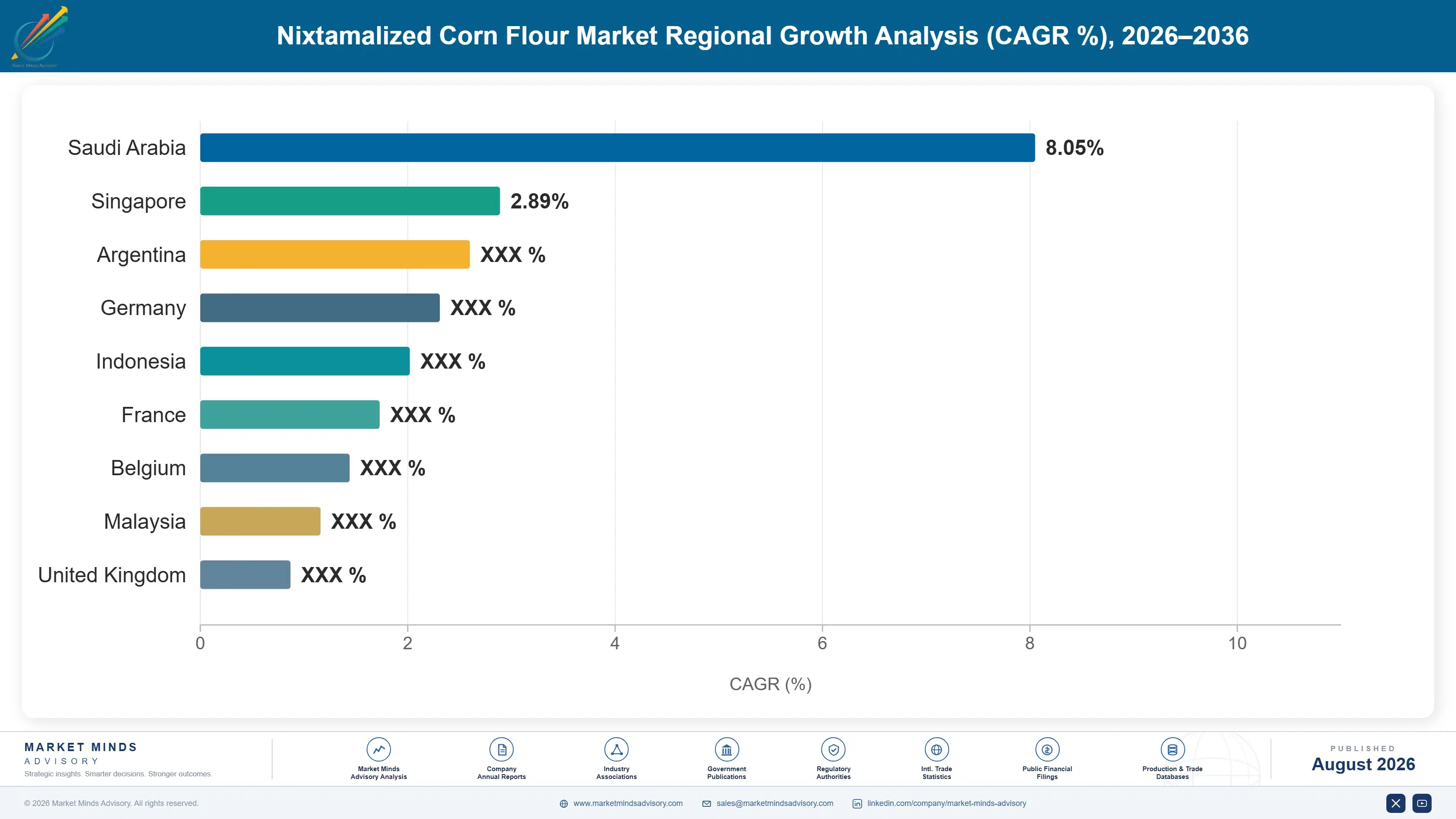
Gluten-free and specialty formats grow at 8.7%, half again the market rate of 5.8%, because nixtamalized corn flour is naturally free of gluten and the category has carried it well beyond Mexican cuisine into snacks, baking blends and prepared foods. Latin America holds 38% of value, and North America follows at 32% on tortilla and chip consumption. British growth at 8.8% leads every country here.
Five millers hold 64% of dry flour supply, which is high for a food staple and reflects the capital and effluent treatment a nixtamalization line demands. White food-grade corn trades around 18% above yellow feed corn in a thinner market that does not follow the futures board closely, and sourcing it well is a genuine commercial skill. Availability rather than price is what stops a mill. Contracting has to precede planting by a season.
Market Definition
This report covers nixtamalized corn flour, the dry alkaline-cooked maize flour known as masa harina, supplied across tortillas and flatbreads, tortilla chips and snacks, tamales and traditional foods, industrial food ingredients, gluten-free and specialty formats, and foodservice and institutional channels. Value is measured at miller level on tonnage of dry flour supplied. Excluded are fresh wet masa produced at tortillerias for immediate use, precooked non-nixtamalized corn flour used for arepas, ordinary corn meal and grits, corn starch and its derivatives, and finished tortillas or chips sold as consumer products.
Base Year Value
$6.8B in 2025 (MMA Primary Research Dataset, August 2026)
Forecast Period
2026 to 2036, eleven discrete annual values
CAGR
5.8% base case. Bull 7.0%. Bear 4.6%.
Fastest Growth Segment
Gluten-Free and Specialty Formats: 8.7% CAGR
Fastest Growth Country
United Kingdom: 8.8% CAGR
Fastest Growth Region
South Asia and Pacific: 7.8% CAGR
Largest Region
Latin America: 38% of 2025 global value
Market Leaders
Gruma, Grupo Minsa, Cargill, Bunge and Harinera del Valle lead the market. Source: MMA Primary Research Dataset, July 2026.
Primary Survey
n=3,800 procurement and R&D decision-makers, Q4 2025, six countries
Methodology
Demand-side build-up, cross-validated against public data, 47 expert interviews

Nixtamalized Corn Flour Market Forecast Scenarios

nixtamalized-corn-flour-market-size-forecast-scenario-1787555950034
Growth ran at 4.8% between 2020 and 2025 and the composition shifted more than the rate did. North American tortilla and chip consumption kept expanding beyond its original demographic base, while Mexican conversion from fresh masa to dry flour continued at the same slow pace it has held for decades. European and Asian demand grew fastest in percentage terms from a very small base.
The 5.8% base case rests on three mechanisms. Effluent enforcement pushing small tortillerias off fresh nixtamal, since a mill handling a few tonnes daily cannot treat wastewater at pH 12. Gluten-free and specialty formats at 8.7%, carrying the flour into applications with no Mexican connection whatsoever. And international adoption, with British growth at 8.8% leading every country as retail and foodservice expand Mexican formats. Chip manufacture converted long ago and cannot revert.
The 7.0% bull case is effluent enforcement tightening faster than expected across Mexico and Central America, which would convert fresh masa volume in years rather than decades. The 4.6% bear case is white food-grade corn tightening on acreage shifts toward yellow, since the premium already sits near 18% and millers cannot substitute. Growers plant white maize only against contracts already signed.

The Wastewater Doing The Converting

Dry masa flour has been taking share from fresh wet masa since the 1950s and it is still only about halfway there, with roughly 47% of tortilla output made the traditional way at small neighbourhood mills. Consumers prefer the fresh product and the small mills are cheap to run, which is why decades of commercial pressure moved the line so slowly. What is moving it now sits in a drain. Nixtamalization discharges nejayote, an alkaline steep water leaving the process near pH 12 with a heavy organic load, and around twelve kilolitres of water go through each tonne of maize.
TOP-FIVE CONCENTRATION64%Combined position across supply held by the leading millers
FRESH MASA ROUTE SHARE47%Portion of tortilla output still made from wet nixtamal
NEJAYOTE EFFLUENT PH12Alkalinity of the steep water the process discharges
WATER USE PER TONNE12 kLVolume consumed cooking and washing each tonne of maize
WHITE CORN PREMIUM18%Price above yellow feed corn for food grade maize
NIACIN BIOAVAILABILITY GAIN4xIncrease over untreated maize after alkaline cooking releases it
A large miller can treat that stream economically. A tortilleria processing a few hundred kilogrammes a day cannot, and municipal enforcement across Mexican and Central American cities has begun treating untreated alkaline discharge as an actual violation rather than a background condition. Every enforcement round moves volume toward dry flour. The industry does not usually describe its growth this way, and it should.
Underneath sits a nutritional fact that made the process a public health instrument. Alkaline cooking releases bound niacin, raising bioavailability roughly fourfold, and adds calcium, which is why Mexico mandates fortification of the flour.
"Everybody in this industry talks about consumer preference and convenience, and forty years of that argument moved conversion about as far as one decent enforcement campaign now does. The growth driver here is a drain inspector, and I have never seen it in anyone's investor deck."
Director, Grain Processing and Staple Foods Practice · MMA Food and Agriculture Ingredients Practice · August 2026

Market Trends

Effluent enforcement pushes small mills off fresh nixtamal

Nixtamalization discharges nejayote at around pH 12 with a heavy organic load, and roughly twelve kilolitres of water pass through every tonne of maize processed. Municipal authorities across Mexican and Central American cities have begun enforcing discharge limits that were long ignored in practice. A large miller treats that stream economically while a tortilleria handling a few hundred kilogrammes daily simply cannot. Commercially this converts fresh masa volume toward dry flour faster than four decades of convenience marketing achieved, and the mechanism keeps working with every enforcement round. Nobody in the industry frames its growth this way.
Market Impact: Supports 32% North American share
Gluten-free positioning carries the flour beyond Mexican cuisine

Nixtamalized corn flour contains no gluten and delivers a flavour and texture that rice and tapioca blends cannot reproduce, which has carried it into baking mixes, snack formulations and prepared foods with no Mexican connection at all. Growth at 8.7% is the fastest segment here. Buyers in this channel pay considerably more than tortilla manufacturers and specify particle size distribution and moisture tightly, since the flour behaves differently in formulations never designed around it. Millers organised entirely around tortilla volume rarely serve those specifications well. Buyers here order in pallets rather than truckloads through distributors.
Market Impact: British demand compounds at 8.8%

Market Opportunities and Growth Drivers

Tortilla and chip consumption expands beyond its original base

North American tortilla and tortilla chip consumption has grown steadily well outside the Hispanic demographic that established it, with wraps, chips and Mexican-format meals now ordinary supermarket and foodservice items across the whole population. That expansion has been running for two decades and shows no sign of reversing. North America holds 32% of value on it. Chip manufacture in particular consumes dry flour rather than fresh masa because the process demands consistency that a daily wet grind cannot deliver reliably at industrial scale. Wraps in particular have moved entirely into everyday grocery purchasing.
Market Impact: Carries an 18% corn premium

International retail and foodservice adopt Mexican formats rapidly

British growth at 8.8% leads every country in this market, driven by Mexican-format casual dining, supermarket meal kits and wrap consumption that has become entirely routine rather than exotic. Similar patterns run across Western European and Asian urban markets, though from bases small enough that percentage growth flatters the absolute opportunity considerably. Supply into these markets is almost entirely imported, which places a premium on shelf stability that only the dry flour route provides. Fresh masa cannot travel and therefore never competes there. Distributor relationships rather than milling capability decide who serves them.
Market Impact: Holds 47% of tortilla output

Market Restraints and Challenges

White food-grade corn trades apart from the futures market

Nixtamalization requires white food-grade maize trading around 18% above yellow feed corn, in a market thin enough that it does not track the futures board closely and cannot be hedged with the same instruments. The root cause is acreage: farmers plant white corn only against contracted demand, since there is no liquid outlet if the food buyer disappears. Commercially this leaves millers exposed to a price they cannot hedge conventionally. Producers are responding with multi-season grower contracts and identity-preserved programmes that lock acreage before planting. Availability rather than price is what actually halts a production line.
Market Impact: Targets 47% still on fresh masa

Fresh masa retains genuine consumer preference in core markets

Tortillas made from fresh wet masa taste better than those made from reconstituted dry flour, and consumers in Mexico and Central America can tell the difference immediately and say so. The root cause is that drying and rehydrating alters starch structure in ways no processing improvement has fully reversed. Commercially this is why conversion has taken decades rather than years and why enforcement rather than preference is doing the work. Millers are developing finer grinds and improved rehydration profiles that narrow but do not close the gap. Consumers in core markets state the preference plainly when asked.
Market Impact: Segment compounds at 8.7% annually
3 additional market trends, 4 additional growth drivers, and 2 additional restraints and challenges are covered in the full report. Contact sales@marketmindsadvisory.com to access the complete intelligence.

Segment CAGR and Growth Architecture

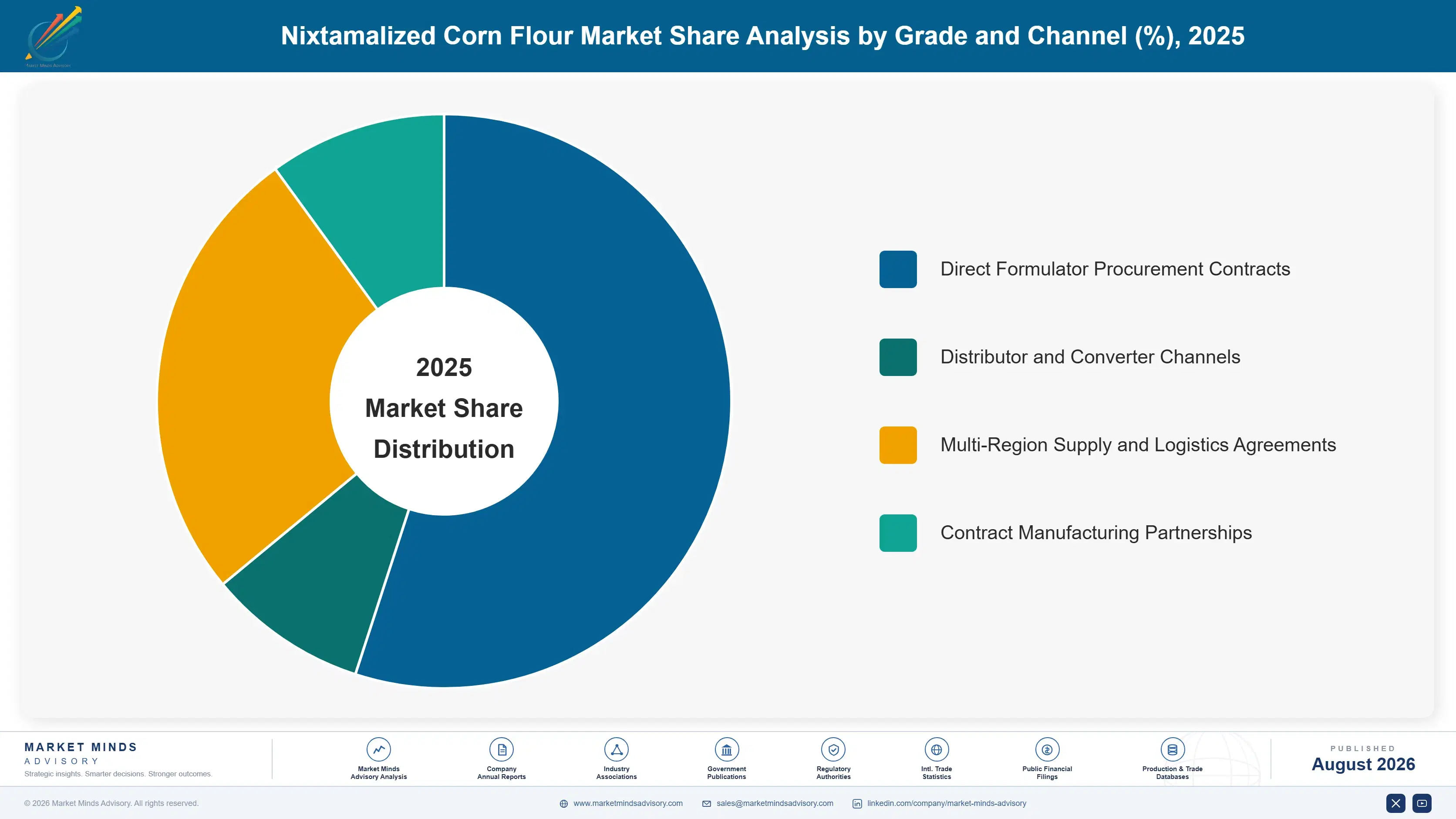
Volume is classified here by end application, since specification tightness and price tolerance differ sharply between a tortilla plant buying by the truckload and a gluten-free formulator buying by the pallet. Corn variety, milling route and distribution channel are each handled separately in the framework below, because one flour grade commonly serves several applications at once.
nixtamalized-corn-flour-market-market-share-analysis-1787555950575

Gluten-Free and Specialty Formats

Growing at 8.7%, half again the market rate, this segment covers baking mixes, snack formulations, prepared foods and retail flour sold on gluten-free credentials rather than on any Mexican culinary association. Nixtamalized corn flour delivers flavour and texture that rice and tapioca blends genuinely cannot match, which is why formulators pay well above tortilla plant pricing for it. Particle size distribution and moisture are specified tightly, because the flour behaves unpredictably in formulations that were never designed around it. Millers organised entirely around tortilla volume rarely meet those specifications consistently, and the customers notice quickly and switch. Distribution runs through importers and ingredient distributors rather than the direct bulk relationships tortilla supply uses
CAGR 8.7%

Tortilla Chips and Snacks

Chip and snack manufacture is the application that converted to dry flour earliest and most completely, because frying demands moisture and particle consistency that a daily wet masa grind cannot deliver at industrial line speeds. Growth at 6.2% follows snack consumption expanding well beyond its original demographic across North American and increasingly European markets. Buyers are large, sophisticated and contract annually on specification rather than relationship. Colour consistency matters more than most outsiders expect, since a visible batch variation across a bag of chips reads to the consumer as a quality failure. Frying oil interaction and expansion behaviour both depend on particle distribution, which makes this a measurement business rather than a relationship one. Annual contracts turn on held specification.
CAGR 6.2%
Full segment breakdown across 6 segments available in the complete report.

Regional Architecture and Country Demand Map

Latin America holds 38% of value because this is where nixtamalized maize is eaten daily, far above the standard regional band and stated here as an exception. North America follows at 32% on tortilla and chip consumption that has expanded well beyond its original demographic base.

Latin America

At 38% this region sits far above the standard band, for the straightforward reason that nixtamalized maize is a daily staple across Mexico and Central America rather than a specialty ingredient. Mexico alone accounts for most of it, and roughly 47% of national tortilla output still comes from fresh masa ground at neighbourhood mills. Gruma and Grupo Minsa dominate dry flour supply. Effluent enforcement across Mexican cities is the mechanism converting the remaining fresh masa volume. Guatemalan, Honduran and Salvadoran consumption is proportionally high. Growth at 5.0% reflects conversion rather than any rise in per capita eating. Effluent treatment capability increasingly separates millers who can keep operating from those who cannot.
Share: 38% | CAGR: 5.0% (2026 to 2036)

North America

Tortilla and tortilla chip consumption expanded well beyond the Hispanic demographic that established it, and wraps, chips and Mexican-format meals are now ordinary items across mainstream retail and foodservice. Chip manufacture converted to dry flour early because frying demands consistency a daily wet grind cannot supply. Gruma's Azteca Milling operations and Cargill hold substantial positions supplying industrial customers. American white corn contracting is well organised through identity-preserved programmes. Growth at 6.2% sits above the market rate and rests on continuing mainstream adoption rather than demographic change. Canadian demand follows the same mainstream adoption pattern at smaller volume. Retail packaged flour is proportionally more significant here than in any other region, and it carries better margin than bulk supply.
Share: 32% | CAGR: 6.2% (2026 to 2036)
Regional intelligence for 5 additional markets available in the complete report: Western Europe, East Asia, South Asia and Pacific, Middle East and Africa, Eastern Europe. Contact sales@marketmindsadvisory.com.
nixtamalized-corn-flour-market-country-cagr-analysis-1787555951089

Where Masa Flour Margin Sits

Four moves matter in a staple food whose conversion driver turned out to be environmental enforcement rather than any consumer preference. Two concern capturing volume as small mills are pushed off the traditional route, and the other two concern the segments and sourcing decisions that determine whether any of that volume arrives at an acceptable margin.

Track effluent enforcement and sell into it

Nejayote leaves the process near pH 12 and roughly twelve kilolitres of water pass through each tonne of maize, which a tortilleria handling a few hundred kilogrammes daily cannot treat at any realistic cost. Municipal enforcement across Mexican and Central American cities is therefore converting fresh masa volume steadily. Millers who track enforcement schedules city by city and place commercial effort ahead of them capture that conversion. Those waiting for customers to arrive get whichever ones their competitors did not reach first. Enforcement schedules are public and almost nobody reads them.
Market Impact: Converts part of the 47% on fresh masa

Build specification capability for gluten-free formulators

Gluten-free and specialty formats grow at 8.7% and pay well above tortilla plant pricing, but they specify particle size distribution and moisture far more tightly, because the flour behaves unpredictably in formulations never designed around maize. Millers running to tortilla specifications miss those windows and lose the accounts quickly. Adding classification and moisture control is modest capital against a segment growing half again as fast as the market and carrying materially better margin than any bulk tortilla contract. The buyers order in pallets through distributors rather than truckloads directly, which is a channel most millers have simply never built.
Market Impact: Serves a segment now growing at 8.7% annually

Contract white corn acreage before planting decisions

White food-grade maize trades around 18% above yellow feed corn in a market too thin to hedge with standard futures instruments, and farmers plant it only against contracted demand because no liquid outlet exists otherwise. Multi-season grower contracts with identity preservation lock acreage before planting rather than bidding for grain afterwards. Millers buying on the spot market during a tight year discover that the premium is not the problem; finding food-grade white corn at all becomes the problem instead. Contracting has to precede planting decisions by a full season. Storage and transport must preserve identity too.
Market Impact: Manages an 18% premium on food grade corn

Sell shelf stability into export markets deliberately

Fresh masa cannot travel, so every export market is a dry flour market by default, and British growth at 8.8% leads every country here. Those buyers pay for consistent specification and long shelf life rather than for authenticity, and they order in pallet rather than truckload quantities through distributors. Millers organised around domestic bulk contracts often decline that business as too small to handle, which hands the fastest-growing geographies to competitors willing to build the channel. Those markets pay for shelf life and held specification rather than for authenticity, which suits an industrial miller rather well.
Market Impact: Follows demand that is growing at 8.8% yearly

Who Controls the Margin Pool

Five millers hold 64% of dry flour supply, measured on tonnage of dry nixtamalized flour supplied, the basis used throughout this section. That is high concentration for a staple food and it reflects what a nixtamalization line actually requires: cooking and steeping capacity, effluent treatment, and white corn sourcing depth. None of those is available to a small operator, which is precisely why the traditional route stayed wet.
Competition runs on four dimensions. White corn sourcing and identity-preserved contracting, since the grain cannot be bought reliably on any spot market during a tight season. Effluent treatment capability, which has become a licence to operate rather than a simple cost line. Specification control for chip and gluten-free customers who buy on measurement rather than relationship. And distribution reach into export markets ordering in pallets rather than truckloads.

Rankings shift toward millers building gluten-free and export channels and toward whoever captures fresh masa conversion as enforcement proceeds city by city. Latin American incumbents hold the staple volume securely and face flat per capita consumption behind it. North American millers hold the industrial chip accounts. Neither group has properly built the specialty channel yet, and it is growing fastest of everything here.
nixtamalized-corn-flour-market-company-positioning-matrix-1787555951607

Competitive Moat and Risk Dimensions

GRUMA

Moat: Integrated milling across continents

The company operates nixtamalization milling across Mexican, American and European sites with white corn sourcing depth and effluent capability at every one, which places it in the domestic staple market and the export channel simultaneously. Scale in identity-preserved grain contracting is genuinely difficult to replicate, since it means committing to acreage before farmers make planting decisions each season.
GRUMA

Risk: Specialty channel underdeveloped relative

Gluten-free and specialty formats grow at 8.7% and demand particle and moisture specifications that bulk tortilla milling does not routinely deliver, and the buyers order in pallets through distributors rather than in truckloads. Smaller millers built around those requirements serve them better. Scale is an advantage in staple volume and something closer to a handicap in small-lot specialty supply.
GRUPO MINSA

Moat: Mexican staple market depth

The company holds substantial position across Mexican tortilla manufacture where the staple volume genuinely sits, with distribution reaching the smaller producers most exposed to effluent enforcement as it converts them off fresh masa. Proximity to that conversion is worth more than any product advantage, because the volume moves to whoever is already calling on the customer.
GRUPO MINSA

Risk: Concentration in one converting market

Mexican per capita tortilla consumption is flat, so growth depends entirely on conversion from fresh masa rather than on any rising demand, and conversion proceeds at whatever pace enforcement sets. Export and specialty channels growing at 8.7% and 8.8% sit largely outside the current position. Competitors with international milling capture that growth without needing conversion at all.

Players Tracked

Prominent Players

Gruma
Grupo Minsa
Cargill
Bunge
Harinera del Valle

Other Key Players

Didion Milling
Life Line Foods
Valley Grain Products
Molinos Anahuac
Grupo Altex
Bob's Red Mill
Semo Milling
Maizoro
Grupo Trimex
C.H. Guenther and Son
Harinas Elizondo
Molinos del Fenix
Agroinsa
Ingredion
Limagrain Ingredients

Recent Developments

MARCH 2025

A Mexican municipality began enforcing tortilleria discharge limits

A large Mexican municipality began enforcing alkaline discharge limits on small tortillerias operating fresh nixtamal, requiring treatment or a switch to dry flour. This was a regulatory enforcement action rather than any commercial transaction involving millers or equipment suppliers. Compliance deadlines were set locally rather than nationally.
Signal: Enforcement converts fresh masa volume faster than four decades of convenience marketing ever managed to achieve
AUGUST 2025

A miller commissioned classification capacity for specialty grades

A North American miller commissioned particle classification and moisture control capacity aimed at gluten-free formulators specifying tolerances that standard tortilla grade milling does not reliably hold. This was organic capital investment rather than any acquisition, merger or partnership with another company. Existing milling lines were adapted rather than replaced.
Signal: Specification capability rather than milling scale is what separates access to the fastest growing segment here
NOVEMBER 2025

A miller expanded identity-preserved white corn contracting

A miller expanded multi-season identity-preserved contracting with white maize growers, locking acreage ahead of planting decisions rather than competing for grain after harvest. This was a commercial supply arrangement rather than any equity investment or joint venture with the growers involved. Identity preservation was maintained through storage and transport.
Signal: White corn availability rather than its price is the real exposure, and contracting has to precede planting

What Drives Miller Economics

White food-grade maize accounts for roughly 66% of production cost and trades around 18% above yellow feed corn. Energy for cooking, steeping and drying adds around 14%, since the process heats large water volumes and then removes the moisture again. Lime is cheap. Effluent treatment now runs to a meaningful line item wherever it is done properly.
White corn availability tightened during 2022 and 2023 as acreage shifted toward yellow on relative returns, and USDA grain reporting shows the food-grade premium widening through that period. Gruma noted maize cost pressure across its operations in its Annual Report 2022. Millers holding identity-preserved contracts secured supply while those buying spot competed for a genuinely limited pool, and several reduced production rather than pay the clearing price.

The disadvantage falls on millers without grower contracting depth, and it shows as availability rather than as a cost gap. White food-grade maize cannot be bought reliably on a spot market that barely exists in tight years, so a miller without contracted acreage stops running. Smaller regional millers feel this hardest, since contracting requires committing to volume before anyone knows what the season will bring.
nixtamalized-corn-flour-market-cost-volatility-analysis-1787555951803

Contract white maize acreage ahead of grower planting decisions

Farmers plant white food-grade corn only against contracted demand, because no liquid outlet exists if the food buyer walks away. Multi-season identity-preserved contracts lock acreage before planting rather than bidding for grain afterwards. Millers buying spot in a tight year find that availability rather than the premium is what actually stops production lines. Premiums are modest against a curtailment.

Treat effluent capacity as licence to operate, not overhead

Nejayote at around pH 12 is now attracting municipal enforcement that previously ignored it, and treatment capacity is what allows a mill to keep running through an enforcement round. Millers who have invested also gain the converting volume from small operators who have not. The cost line and the growth opportunity are the same investment.

Recover heat across cooking, steeping and drying stages

Energy at roughly 14% of cost is spent heating large water volumes and then evaporating that same moisture away again, which is an obvious place for recovery and a commonly neglected one. Exchanging heat between the drying exhaust and incoming steep water cuts a meaningful share. Payback runs short at industrial scale and lengthens quickly at smaller throughput.

Portfolio Architecture for Margin Defence

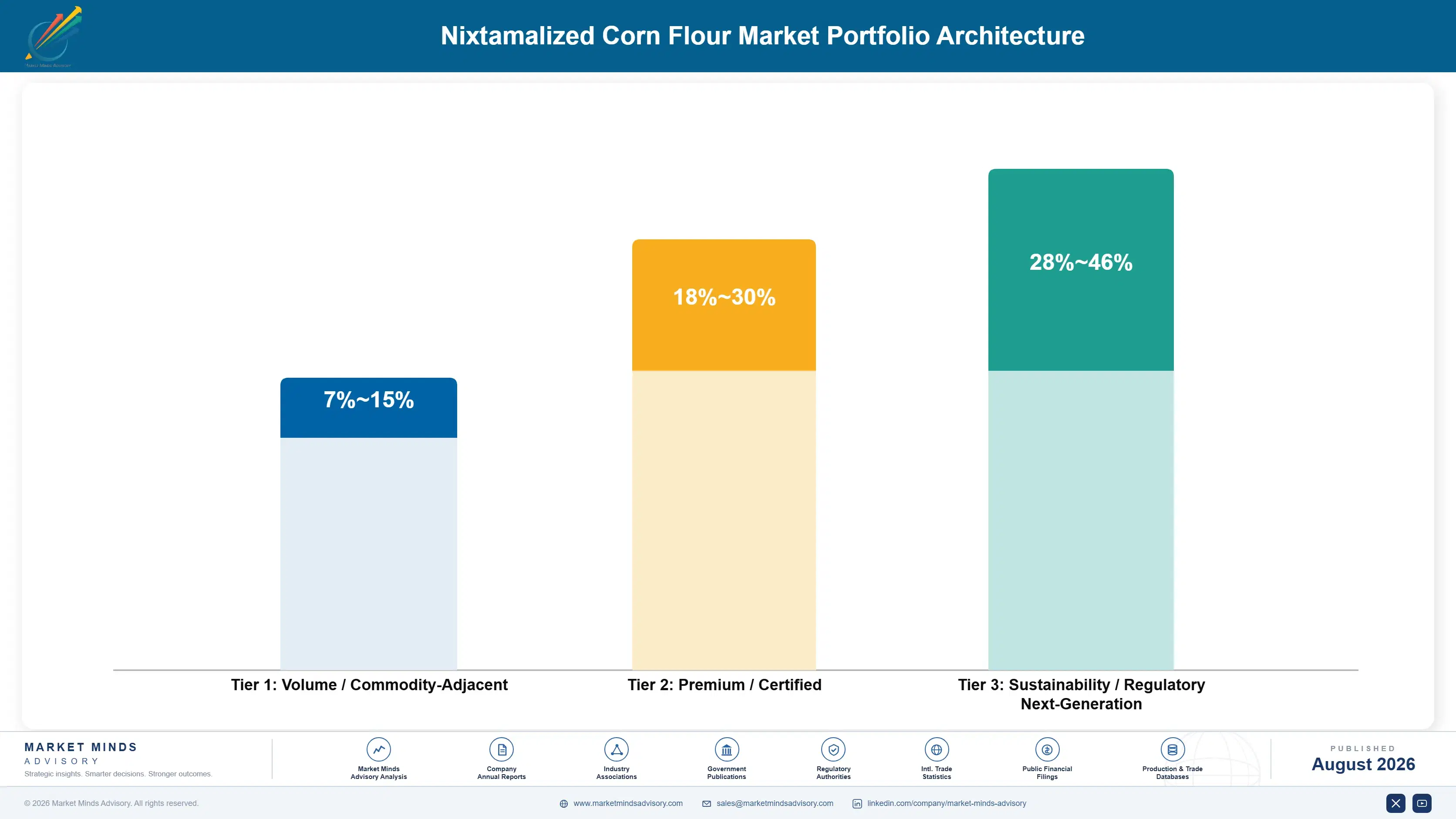
Margin separates on specification and channel rather than on milling scale, which is not what a staple food business usually looks like. Bulk tortilla flour sold to large manufacturers runs at gross margins in the high single digits, competed on delivered cost with corn passed through. Chip and snack grades run better on consistency requirements that narrow the qualified field. Retail packaged flour runs better again. Gluten-free and specialty grades run highest, because formulators buy measurement rather than tonnage.
The tension is that staple volume fills the mill while specialty grades earn the return, and serving the latter requires classification capability and pallet-scale distribution that a truckload business has never needed. Millers weighted toward bulk face flat per capita consumption and conversion volume that arrives at bulk pricing. Building specialty capability from those margins is slow, and the segment is growing at nearly twice the market rate meanwhile.

High-value pools sit in gluten-free formulator supply, export channels and retail packaged flour. Bulk tortilla contracts are where corn cost pass-through and delivered price decide everything and nothing else matters at all. A miller with no specialty position competes entirely on corn purchasing and freight.

Volume / Commodity-Adjacent

Bulk tortilla flour sold to large manufacturers on delivered cost with maize passed through directly. The eight-point range separates millers with contracted white corn acreage and heat recovery from those buying grain and energy at prevailing rates.
Gross Margin: 7%-15%

Premium / Certified

Chip and snack grades plus retail packaged flour where consistency, colour and moisture control narrow the qualified supplier field considerably. The twelve-point spread reflects specification capability rather than any difference in the underlying maize.
Gross Margin: 18%-30%

Sustainability / Regulatory / Next-Generation

Gluten-free formulator grades, organic and non-genetically-modified identity-preserved supply, and specialty export formats. The eighteen-point range is wide because certification, particle specification and distribution format all vary substantially between individual buyers.
Gross Margin: 28%-46%
nixtamalized-corn-flour-market-portfolio-architecture-1787555952297

High-value Sub-segments and Strategic Watch-out

Gluten-Free Formulator Supply

Compounding at 8.7% on flavour and texture that rice and tapioca blends genuinely cannot match. Particle and moisture specifications are tight and buyers switch quickly when a miller misses them, which rewards classification capability over scale. Distributor channel access is the real practical barrier here.
Gross Margin: 30%-46%

Export and International Channels

British growth at 8.8% leads every country here, and fresh masa cannot travel so every export market is a dry flour market. Pallet-scale distribution through importers is the capability most bulk millers have never chosen to build. Shelf life rather than authenticity is what buyers pay for.
Gross Margin: 24%-38%

Converted Fresh Masa Volume

Volume arriving as effluent enforcement pushes small tortillerias off wet nixtamal, roughly 47% of output still sitting there. It arrives at bulk pricing, so capture it on distribution proximity rather than on any margin expectation. Enforcement timing alone decides when each city's volume actually moves.
Gross Margin: 9%-18%

Bulk Tortilla Manufacturing

The mill volume, competed on delivered cost with maize passed through and nothing else differentiating anybody. Manage this for white corn contracting depth and energy recovery rather than for margin that will not improve. Per capita consumption in core markets has been flat for years.
Gross Margin: 7%-15%

How Staple Demand Renews

Demand renews with daily eating in the core markets, which produces the steadiest annuity in food ingredients and almost no growth alongside it. Mexican per capita tortilla consumption is flat and has been for years, so the volume a miller gains has to come from somewhere else rather than from anybody eating more. That makes conversion from fresh masa the entire domestic growth mechanism, and it explains why enforcement schedules matter more here than consumer research ever will.
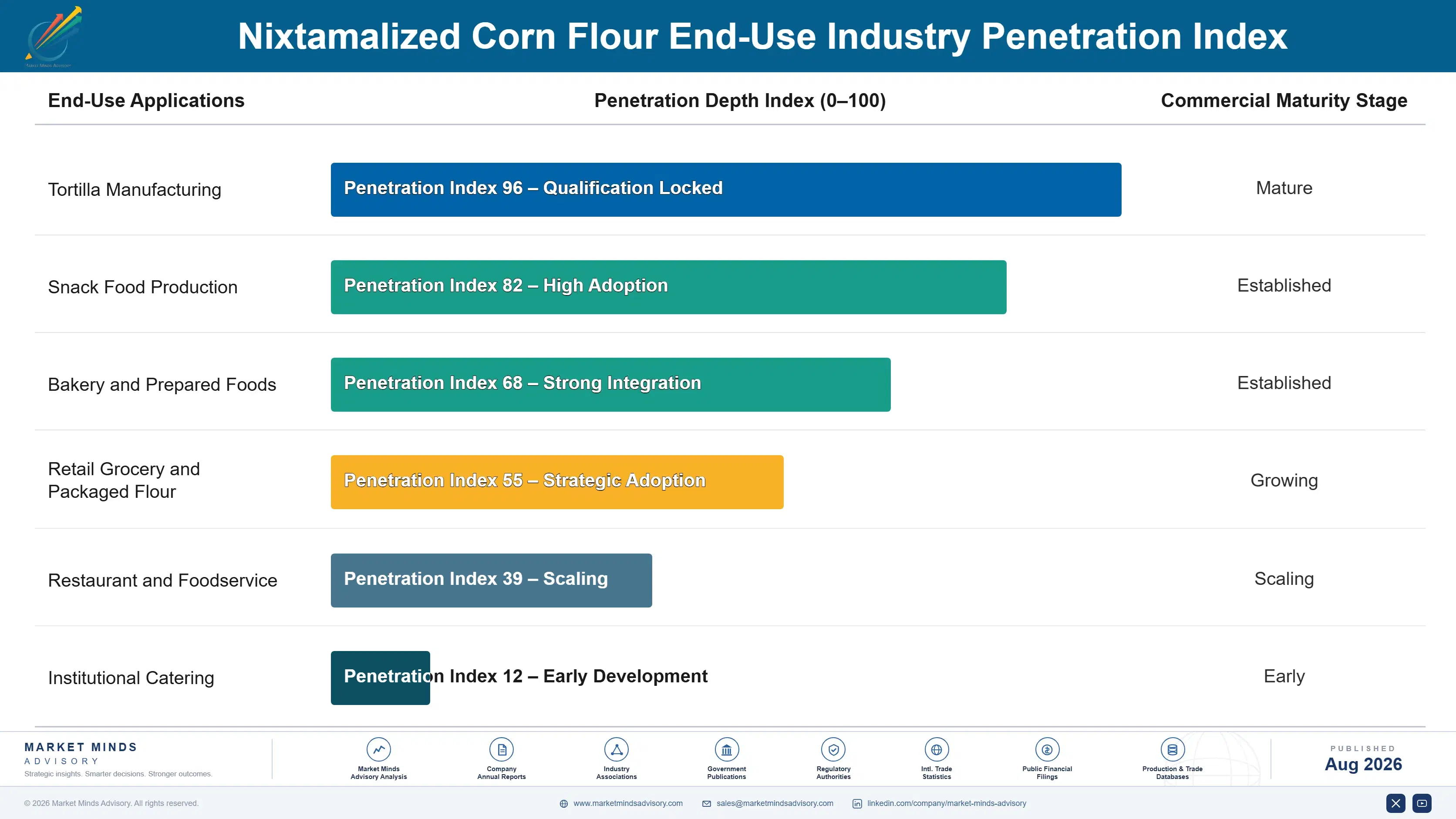
Adoption depth varies sharply by vertical. Chip and snack manufacturers converted to dry flour completely and cannot go back, because industrial line speeds demand consistency a wet grind cannot supply, which makes those accounts durable and specification-driven. Gluten-free formulators embed the flour in recipes that would require reformulation to change. Tortillerias converting under enforcement pressure are the least committed of all, and will revert if enforcement lapses.

The buyer profile changed most in the specialty and export channels. Domestic staple supply is a procurement conversation about delivered cost per tonne. Gluten-free and international buyers are product developers and category managers who ask about particle distribution, certification and shelf life, and who have never heard of a tortilleria.
nixtamalized-corn-flour-market-end-use-penetration-index-1787555952783

Where To Place The Bet

These are among the four positions where our research anticipates prominent divergence between winners and laggards over the coming forecast period. Each is grounded in the demand model, the regulatory perimeter, and the announced capacity pipeline.
01 / ENFORCEMENT LED CONVERSION

Follow the drain inspector, not the consumer survey

Nejayote leaves nixtamalization near pH 12 with roughly twelve kilolitres of water passing through every tonne of maize, and a tortilleria handling a few hundred kilogrammes daily cannot treat that at any cost it could possibly absorb. Municipal enforcement across Mexican and Central American cities is converting fresh masa volume faster than four decades of convenience marketing ever managed. Millers who track enforcement schedules city by city and place commercial effort ahead of them will capture that volume before competitors even notice it moved.
02 / SPECIALTY SPECIFICATION CAPABILITY

Mill to measurement for the gluten-free channel

Gluten-free and specialty formats compound at 8.7%, well above the market rate, and pay considerably more than any bulk tortilla contract because formulators are buying a measured particle distribution and moisture profile rather than simply buying tonnage of flour. Millers running to ordinary tortilla specifications miss those windows repeatedly and lose the accounts within a season or two. Classification and moisture control together represent quite modest capital against a segment currently growing at nearly twice the rate of everything else in this market.
03 / WHITE MAIZE CONTRACTING

Lock acreage before farmers decide what to plant

White food-grade maize trades around 18% above yellow feed corn in a market far too thin to hedge with standard futures instruments, and growers plant it only against contracted demand because no liquid outlet exists if the food buyer disappears on them. Multi-season identity-preserved contracts secure acreage ahead of planting rather than competing for grain after harvest. Millers buying spot during a tight year discover that finding food-grade white corn at all, not paying the premium, is what actually halts production.
04 / EXPORT CHANNEL BUILDING

Serve pallets abroad, not only truckloads at home

Fresh masa cannot travel, which makes every single export market a dry flour market by default, and British country growth at 8.8% currently leads this entire market on casual dining and supermarket adoption together. Those buyers order in pallet quantities through importers and distributors rather than in the truckload volumes domestic contracts involve. Millers organised around bulk supply routinely decline that business as too small to bother with, handing the fastest-growing geographies straight to competitors willing to build a channel.

Engagement Snapshot From the Field

A live engagement with an industry participant carrying material or product regulatory and market exposure ahead of a defining policy shift, showing how our research translates into a defensible multi-year portfolio strategy.
MARKET MINDS ADVISORY · CLIENT ENGAGEMENT SUMMARY
Nixtamalized Corn Flour Producer Strategic Portfolio Review and Transition Roadmap 2026·Investment Scenario on Nixtamalized Corn Flour Exposure Evaluation 2025-26
CLIENT PROFILE
A regional nixtamalized corn flour miller producing around 140,000 tonnes annually (client-reported, unverified by MMA), supplying tortilla manufacturers and distributors across two Latin American markets. White maize was purchased largely on spot terms. Effluent treatment met existing permits. No specialty or export channel existed anywhere in the business. Distribution ran direct to tortilla manufacturers only.
STRATEGIC CHALLENGE
Volume had been flat for four years against flat per capita consumption, and management proposed a capacity expansion to win share on price from regional competitors. Nobody had examined where growth in this market was actually occurring, or whether price competition could deliver any of it profitably. The question went unexamined entirely.
MMA APPROACH
MMA sized fresh masa conversion volume by city against municipal effluent enforcement schedules rather than treating conversion as a uniform national trend. Gluten-free and export channel requirements were costed against the client's existing milling capability. White maize sourcing exposure was quantified across recent tight seasons and compared with contracted competitors.
KEY FINDINGS
  1. Three cities within existing distribution reach were scheduled for effluent enforcement inside eighteen months, representing conversion volume larger than the proposed capacity expansion would have added.
  2. Gluten-free formulators in two export markets specified particle distributions the client could hold with classification equipment costing well under the expansion budget under consideration.
  3. Spot white maize purchasing had forced two production curtailments in three years, while contracted competitors ran continuously and took the volume the client could not supply.
  4. Price competition against regional millers had never moved share in either market, because tortilla manufacturers switch on supply reliability rather than on delivered cost per tonne.
CLIENT PROFILE
A regional nixtamalized corn flour miller producing around 140,000 tonnes annually (client-reported, unverified by MMA), supplying tortilla manufacturers and distributors across two Latin American markets. White maize was purchased largely on spot terms. Effluent treatment met existing permits. No specialty or export channel existed anywhere in the business. Distribution ran direct to tortilla manufacturers only.
STRATEGIC CHALLENGE
Volume had been flat for four years against flat per capita consumption, and management proposed a capacity expansion to win share on price from regional competitors. Nobody had examined where growth in this market was actually occurring, or whether price competition could deliver any of it profitably. The question went unexamined entirely.
MMA APPROACH
MMA sized fresh masa conversion volume by city against municipal effluent enforcement schedules rather than treating conversion as a uniform national trend. Gluten-free and export channel requirements were costed against the client's existing milling capability. White maize sourcing exposure was quantified across recent tight seasons and compared with contracted competitors.
KEY FINDINGS
  1. Three cities within existing distribution reach were scheduled for effluent enforcement inside eighteen months, representing conversion volume larger than the proposed capacity expansion would have added.
  2. Gluten-free formulators in two export markets specified particle distributions the client could hold with classification equipment costing well under the expansion budget under consideration.
  3. Spot white maize purchasing had forced two production curtailments in three years, while contracted competitors ran continuously and took the volume the client could not supply.
  4. Price competition against regional millers had never moved share in either market, because tortilla manufacturers switch on supply reliability rather than on delivered cost per tonne.
RECOMMENDED STRATEGY
Phase 1: Phase one: shelve the capacity expansion and direct commercial effort at the three cities facing effluent enforcement, ahead of the deadlines rather than after them. Phase 2: Phase two: install particle classification and moisture control capacity, then pursue the identified gluten-free formulator accounts across both of the export markets. Phase 3: Phase three: move white maize purchasing onto multi-season identity-preserved grower contracts, accepting a modest premium in exchange for continuous running.
OUTCOME
Conversion volume from two enforcement cities filled existing capacity without any expansion. Classification equipment is commissioned and one gluten-free account has qualified. Maize contracting now covers most requirements, and the client reports no curtailments and materially better margin mix (client-reported, unverified by MMA). Capital spending fell well below the shelved plan.

Frequently Asked Questions

Foundational context covering the market sizes, CAGR, scope, country, region and competition that inform every finding below. This section is provided to cover basics and most often pre-purchase conversations, answered from the MMA Primary Research Dataset.

What is the current size of the Nixtamalized Corn Flour Market?

The market was valued at USD 6.8 billion in 2025, rising to an estimated USD 7.19 billion in 2026. Latin America holds the largest regional share at 38% of value.

How large will the Nixtamalized Corn Flour Market be by 2036?

MMA forecasts USD 12.64 billion by 2036 under the base case, an expansion multiple of 1.76 times the 2026 value. That represents USD 5.45 billion of incremental value.

What is the CAGR for the Nixtamalized Corn Flour Market 2026 to 2036?

The base case runs at 5.8% compound annual growth between 2026 and 2036, with a bull case at 7.0% and a bear case at 4.6%. Historical growth from 2020 to 2025 was 4.8%.

Which segment is growing fastest?

Gluten-free and specialty formats lead at 8.7%, half again the market rate, on texture that rice and tapioca blends cannot match. Chips and snacks follow at 6.2%.

Who are the major companies in the Nixtamalized Corn Flour Market?

Gruma, Grupo Minsa, Cargill, Bunge and Harinera del Valle hold 64% of dry flour supply. White corn sourcing and effluent capability rather than milling skill sustain those positions.

Which country is growing fastest?

The United Kingdom leads at 8.8%, driven by Mexican-format casual dining, supermarket meal kits and wrap consumption that has become entirely routine rather than exotic.

Report Segmentation Architecture

The full report scope spans multiple orthogonal segmentation dimensions, with cross-tabulated demand data provided for each dimension pair. Coverage extends further to regional breakdowns, trend trajectories, and the competitive detail needed to support segment-level decision-making.

By Application

  • Tortillas and Flatbreads
  • Tortilla Chips and Snacks
  • Tamales and Traditional Foods
  • Industrial Food Ingredients
  • Gluten-Free and Specialty Formats
  • Foodservice and Institutional

By End-Use Industry

  • Tortilla Manufacturing
  • Snack Food Production
  • Bakery and Prepared Foods
  • Retail Grocery and Packaged Flour
  • Restaurant and Foodservice
  • Institutional Catering

By Grade and Channel

  • Bulk Industrial Supply
  • Identity-Preserved and Organic
  • Retail Packaged Flour
  • Export and Distributor Channel
  • Specialty Classified Grades

By Region

  • North America
  • Western Europe
  • East Asia
  • South Asia and Pacific
  • Latin America
  • Middle East and Africa
  • Eastern Europe

Scope, Methodology, and Coverage

Every figure in this report is reproducible from documented input assumptions. The scope below maps the historical period, the forecast horizon, the segmentation dimensions, and the countries covered, alongside the underlying primary and qualitative methodology.
Historical Period
2020 to 2025
Forecast Period
2026 to 2036
Base Year
2025 (USD billions; MMA Primary Research Dataset, August 2026)
Market Definition
The market comprises nixtamalized corn flour, the dry alkaline-cooked maize flour commonly known as masa harina, supplied in bulk industrial, identity-preserved, retail packaged, export and specialty classified grades across tortillas and flatbreads, tortilla chips and snacks, tamales and traditional foods, industrial food ingredients, gluten-free and specialty formats, and foodservice and institutional channels. Value is measured at miller level on tonnage of dry flour supplied. Fresh wet masa produced at tortillerias, precooked non-nixtamalized corn flour for arepas, ordinary corn meal and grits, corn starch derivatives, and finished tortillas or chips fall outside scope.
Quantitative Units
USD billions (current prices); thousand tonnes dry flour supplied; USD per tonne by grade and channel
Segmentation Dimensions
By Application; By End-Use Industry; By Grade and Channel; By Region
Regions Covered
North America, Western Europe, East Asia, South Asia and Pacific, Latin America, Middle East and Africa, Eastern Europe
Countries Covered
Mexico, Guatemala, Honduras, El Salvador, Nicaragua, Costa Rica, Colombia, Brazil, United States, Canada, United Kingdom, Spain, Germany, Netherlands, France, Italy, Ireland, Poland, Czechia, Romania, China, Japan, South Korea, India, Australia, New Zealand, Philippines, United Arab Emirates, Saudi Arabia, South Africa
Key Companies Profiled
Gruma, Grupo Minsa, Cargill, Bunge, Harinera del Valle, Didion Milling, Life Line Foods, Valley Grain Products, Molinos Anahuac, Grupo Altex, Bob's Red Mill, Semo Milling, Maizoro, Grupo Trimex, C.H. Guenther and Son, Harinas Elizondo, Molinos del Fenix, Agroinsa, Ingredion, Limagrain Ingredients
Quantitative Methodology
Primary survey, n=3,800 respondents, Q4 2025, six countries; demand-side model with trade association cross-validation
Qualitative Methodology
47 expert interviews, Q4 2025; applied to validate demand model assumptions, identify emerging dynamics, and assess competitive positioning
Report Format
PDF and XLSX data workbook (Word format preview document)
Publisher
Market Minds Advisory
Report Code
MMA-2026-AGR-147
Published
August 2026
Contact
sales@marketmindsadvisory.com | www.marketmindsadvisory.com

Purchase the full Nixtamalized Corn Flour Market Report (2026 to 2036).

The full report sizes the global nixtamalized corn flour market to 2036 across six applications and seven regions, measured on tonnage of dry flour at miller level. It models fresh masa conversion against municipal effluent enforcement rather than consumer preference, which is the correction most forecasting in this category needs. Competitive analysis covers 20 millers on one consistent tonnage basis, with moat and risk assessment for the two leaders. White food-grade maize sourcing exposure is quantified against identity-preserved contracting depth. Four quantified revenue levers close the analysis.
Six-application segment sizing with individual growth rates
Fresh masa conversion modelled against municipal effluent enforcement
White food-grade maize exposure quantified by contracting depth
Export and gluten-free channels sized separately from staple volume
Twenty-miller competitive map on one consistent tonnage basis
Four quantified revenue levers with commercial impact ranges

Built For The People Who Decide

From boardroom strategy to bench-side execution, this report is read cover-to-cover by leaders shaping the next decade of their industry, turning demand scenarios, market dynamics and valuation benchmarks into decisions.
CXOs/ Presidents/ VPs/ Managers
M&A and Corporate Development
Strategy Teams and R&D Heads
Procurement and Product Directors
Regulatory and Compliance Leaders
Investor Relations and Equity Analysts