Market Minds Advisory
Nickel Mining Market

Nickel Mining Market: Battery-Grade Sulfate Demand Is Redrawing a Century-Old Stainless Steel Feedstock Business

Electric vehicle battery precursor demand is pulling nickel mining investment toward high-purity sulfate-grade output faster than conventional stainless steel feedstock producers can retool their laterite processing routes to match it.

Lead Analyst

David Horsley

Published

September 2026

Make Smarter Decisions with Customized Research Insights

Request a free sample report and evaluate market opportunities, growth trends, and competitive dynamics relevant to your business needs.

2025 MARKET VALUE$42.5BMarket Size 2025
2036 FORECAST VALUE$87.6BBase Case , 2026 to 2036
CAGR 2026 TO 20366.8 %Bull 8.0% / Bear 5.6%
INCREMENTAL OPPORTUNITY$42.2BNet 10- year value creation
EXPANSION MULTIPLE1.93x2036 value over 2026 base
Strategic Levers
M&A Pipeline
Regional Outlook
Country Rankings
Competitive Intelligence
Segmental Deep-dive
Call-Us : 91 93563 13602

Executive Snapshot and Market Trajectory

Nickel mining is shifting from a stainless steel feedstock business into a battery precursor supply chain as electric vehicle demand pulls investment toward high-purity nickel sulfate output that conventional laterite processing routes cannot easily deliver at comparable scale.
Nickel sulfate is pulling capital investment fastest as battery precursor manufacturers require consistently high-purity nickel that traditional ferronickel and nickel pig iron production streams were never designed to supply at scale. Class 1 refined nickel follows closely behind, driven by both battery and premium stainless steel applications competing for the same limited supply. South Asia and Pacific commands an outsized share of global mined output, anchored overwhelmingly by Indonesia's dominant laterite ore production.
Thirty six percent of category revenue concentrates among five miners, leaving considerable share open to smaller regional operators competing on price in conventional ferronickel and nickel pig iron segments. A product mix transition toward battery-grade sulfate and Class 1 refined nickel, combined with expanding EV battery precursor capacity across Asia, is reshaping which miners win the largest multi-year offtake contracts over the coming decade.
Market Definition
The market comprises the extraction, processing, and sale of nickel ore and intermediate nickel products including Class 1 refined nickel, nickel pig iron, ferronickel, nickel sulfate, nickel matte, and nickel concentrate. It excludes downstream battery cell manufacturing, finished stainless steel products, and nickel-based specialty alloy fabrication sold as separate downstream categories.
Base Year Value
$42.5B in 2025 (MMA Primary Research Dataset, August 2026)
Forecast Period
2026 to 2036, eleven discrete annual values
CAGR
6.8% base case. Bull 8.0%. Bear 5.6%.
Fastest Growth Segment
Nickel Sulfate: 12.5% CAGR
Fastest Growth Country
Indonesia: 11.5% CAGR
Fastest Growth Region
South Asia and Pacific: 8.9% CAGR
Largest Region
South Asia and Pacific: 38% of 2025 global value
Market Leaders
Vale S.A., MMC Norilsk Nickel PJSC, PT Vale Indonesia Tbk, Glencore plc, Sumitomo Metal Mining Co., Ltd. Source: MMA Analysis based on company annual reports.
Primary Survey
n=3,800 procurement and R&D decision-makers, Q4 2025, six countries
Methodology
Demand-side build-up, cross-validated against public data, 47 expert interviews

Nickel Mining Market Forecast Scenarios

nickel-mining-market-size-forecast-scenario-1787302352232
Between 2020 and 2025 the market grew at a historical pace of 5.8 percent as steady stainless steel demand continued alongside an early wave of battery precursor capacity investment concentrated in Indonesia, a transition that has since broadened well beyond its original stainless steel origins into electric vehicle supply chains across most producing regions worldwide.
The base case rests on three commercial mechanisms holding together over the decade: expanding electric vehicle battery precursor manufacturing capacity across Asia requiring consistent nickel sulfate supply tied directly to mine output, Indonesian high-pressure acid leaching capacity additions converting laterite ore into battery-grade intermediate products at growing scale, and stainless steel producers maintaining steady baseline demand that continues anchoring the category's largest volume segment across most established markets.
A bull scenario hinges on electric vehicle adoption accelerating faster than current industry roadmaps suggest, pulling forward battery-grade nickel sulfate demand considerably ahead of current supply schedules. The bear case centers on electric vehicle demand growth slowing relative to current expectations, deferring the battery-grade capacity investment that the fastest-growing segment of the market currently depends on most heavily.

A Stainless Steel Feedstock Meets a Battery Supply Chain

Three forces are converging on this century-old commodity category at once: a large installed base of conventional ferronickel and nickel pig iron capacity still anchoring stainless steel feedstock revenue, a fast-scaling battery-grade sulfate segment paying materially higher prices per ton of contained nickel, and Indonesian high-pressure acid leaching capacity pulling laterite ore processing toward battery precursor output that historically represented a minor share of total mined volume.
MARKET CONCENTRATIONCR5 36%top five miners hold roughly a third of category revenue
AVERAGE REALIZED PRICE$17,400/tonblended average realized price across all nickel product forms
LEADING PRODUCING COUNTRYIndonesia, 52% sharelargest single-country share of global mined nickel output today
BATTERY-GRADE REVENUE SHARE26% of revenueproportion of category revenue tied to battery-grade output
RESERVE LIFE35 to 45 yearstypical estimated mine life across major producing operations worldwide
ENERGY COST SHARE39% of COGSsmelting and refining energy proportion of total production cost
Commercially, the market increasingly splits along end-use application rather than pure production scale. Battery precursor manufacturers evaluate miners on purity consistency, traceability documentation, and long-term offtake reliability, while stainless steel producers still purchase largely on price and delivery volume across a much shorter procurement cycle overall.
Over the next decade, purity consistency and supply chain traceability will matter as much as raw production cost competitiveness. Miners who move fastest to scale battery-grade sulfate capacity and secure long-term precursor manufacturer offtake agreements will capture a disproportionate share of the largest EV supply chain contracts before conventional stainless-steel-focused competitors can close that credibility gap.
"Nickel used to be a stainless steel story that occasionally got interesting during a price spike. Now it's a battery supply chain story, and the miners still thinking purely in ferronickel terms are going to find themselves negotiating from a weaker position."
Director, Metals and Mining Practice · MMA Metals and Mining Practice &mid

Market Trends

Battery Precursor Demand Reshapes Product Mix

Electric vehicle battery precursor manufacturers require consistently high-purity nickel sulfate that traditional ferronickel and nickel pig iron production streams, optimized for stainless steel feedstock, were never designed to supply at the purity levels battery chemistry demands. Several major Indonesian producers have disclosed high-pressure acid leaching capacity expansion programs specifically citing battery precursor demand as the primary investment driver rather than stainless steel feedstock growth. This has pulled mining capital investment toward laterite processing routes capable of delivering battery-grade intermediate products, a technology pathway that barely existed at commercial scale a decade ago.
Market Impact: Ties to 1 in 4 EVs
Indonesian Processing Capacity Scales Up Rapidly

Indonesia has continued approving and commissioning new high-pressure acid leaching and rotary kiln electric furnace processing facilities at a pace that has meaningfully expanded the country's share of global intermediate nickel product output beyond its already dominant position in raw ore mining. Several major processing facility announcements have continued across the country in recent years, each representing incremental battery-grade and stainless-steel-grade capacity that did not previously exist within the category's traditional production base. This capacity buildout has reshaped global nickel trade flows, since intermediate product exports increasingly substitute for raw ore shipments that Indonesia has restricted since 2020.
Market Impact: Anchors 68% in stainless steel

Market Opportunities and Growth Drivers

Electric Vehicle Adoption Sustains Sulfate Demand Growth

Electric vehicle production has continued expanding across major automotive manufacturing regions, and nickel-rich battery chemistries used in a substantial share of new EV models require nickel sulfate as a direct precursor input, creating demand growth that did not exist at comparable scale within the category's historical stainless-steel-dominated demand base. Several major battery manufacturers have disclosed long-term nickel sulfate offtake agreements specifically tied to their own EV battery production capacity expansion plans. This demand base has proven durable even during periods of stainless steel demand softness, since battery precursor contracts typically run on multi-year fixed-volume terms.
Market Impact: Concentrates over 50% in 1 nation

Stainless Steel Production Sustains Baseline Volume Demand

Global stainless steel production has continued growing steadily across major manufacturing regions, and nickel remains an essential alloying input for austenitic stainless steel grades that represent the majority of global stainless steel output by volume. Roughly 68 percent of primary nickel consumption still flows into stainless steel production according to industry association tracking reviewed for this report, sustaining a durable baseline demand floor beneath the faster-growing battery segment. This baseline demand has provided miners with revenue stability even during periods when battery-grade pricing has experienced sharper volatility tied to EV adoption sentiment shifts.
Market Impact: Ties 39% of cost to energy

Market Restraints and Challenges

Indonesian Export Policy Concentrates Supply Chain Risk

Indonesia's ban on raw nickel ore exports, combined with its growing dominance in intermediate product processing, has concentrated an increasing share of global nickel supply chain risk within a single national jurisdiction whose policy decisions can materially affect global pricing and availability. The root cause is that Indonesia's laterite ore reserves and processing capacity investment have scaled faster than comparable development in any other producing region, leaving global buyers with limited near-term diversification options. The commercial impact falls hardest on downstream manufacturers dependent on Indonesian intermediate product supply. Buyers are mitigating this through long-term offtake agreements and diversified sourcing.
Market Impact: Lifts sulfate share to 26% of reven

Energy Cost Volatility Compresses Processing Margin

Nickel smelting and refining, particularly high-pressure acid leaching and rotary kiln electric furnace processing, require substantial energy input, leaving processors directly exposed to electricity and coal price swings that affect broader industrial energy markets, with limited ability to pass through sudden cost increases on already-signed offtake contracts. The root cause is that nickel processing carries comparatively thin margin over energy cost in conventional ferronickel and nickel pig iron segments, forcing processors to compete primarily on production efficiency even as underlying energy costs move independently of what the finished product can command. Processors are mitigating this through captive power investment.
Market Impact: Adds capacity at 5-plus facilities
4 additional market trends, 3 additional growth drivers, and 3 additional restraints and challenges are covered in the full report. Contact sales@marketmindsadvisory.com to access the complete intelligence.

Segment CAGR and Growth Architecture

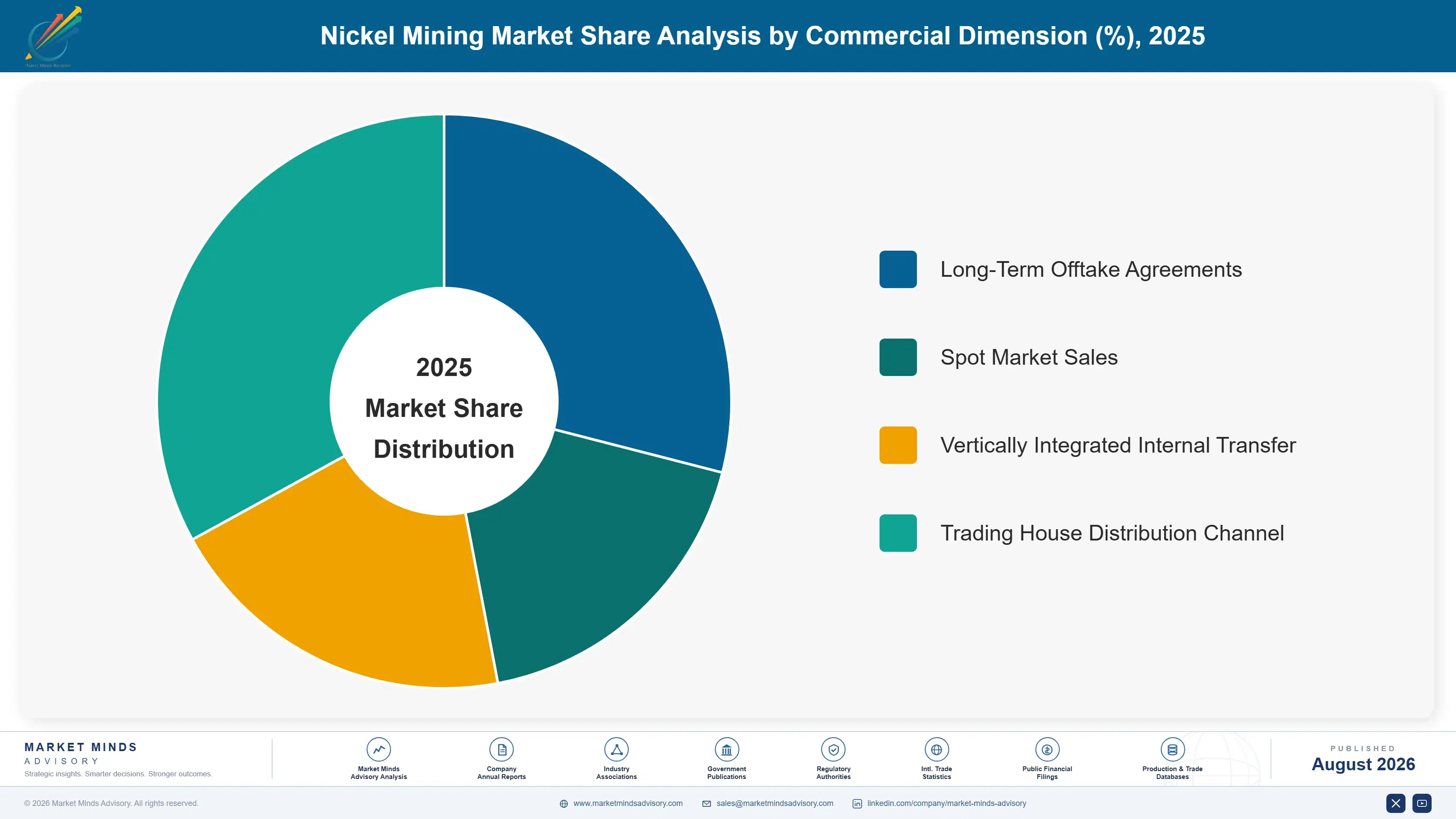
Segmentation follows product form, the dimension buyers use to specify nickel grade and purity for a given battery or stainless steel application. Nickel sulfate is treated as a distinct category given its fundamentally different purity requirements and buyer base relative to ferronickel and nickel pig iron sold separately, since buyers evaluate each differently.
nickel-mining-market-market-share-analysis-1787302352765

Nickel Sulfate

Nickel sulfate is the fastest-growing product category, engineered as a high-purity intermediate compound serving as the direct precursor input for battery cathode active material production across nickel-rich EV battery chemistries. Demand concentrates among battery precursor manufacturers in China and South Korea, where consistent purity and traceable supply chain documentation matter more than raw production cost alone. Production capacity for this specialized product form remains constrained by the high-pressure acid leaching and refining expertise required to consistently hit battery-grade purity specifications, a barrier that differs from conventional ferronickel production experience most established miners already possess. Suppliers with proven purity consistency and long-term offtake relationships are winning a disproportionate share of new battery manufacturer contracts, since buyers increasingly evaluate supply chain traceability as heavily as delivered price.
CAGR 12.5%

Class 1 Refined Nickel

Class 1 refined nickel, defined by its minimum 99.8 percent purity specification, forms the second-fastest-growing category as both battery precursor manufacturers and premium stainless steel producers compete for the same limited high-purity supply pool. Demand concentrates among buyers requiring flexibility to serve either battery or premium alloy applications from a single refined product form, avoiding the specialization risk that dedicated battery-grade-only production carries. Growth tracks the broader purity upgrade trend closely, since Class 1 production increasingly commands a premium over lower-purity ferronickel and nickel pig iron given its dual-market flexibility. Suppliers with proven refining capability across multiple end-use specifications hold a meaningful advantage over single-purpose producers attempting to compete for this more broadly applicable product category.
CAGR 9.5%
Full segment breakdown across 6 segments available in the complete report.

Regional Architecture and Country Demand Map

South Asia and Pacific commands an outsized share of global mined output given Indonesia's dominant laterite ore production, a genuine structural concentration this report notes explicitly, while the region also posts the fastest regional growth on continued processing capacity expansion.

North America

Canada anchors the region's demand overwhelmingly, home to the established Sudbury and Voisey's Bay operations that have defined North American nickel mining for decades of continuous sulfide ore extraction and refining investment. Domestic battery precursor manufacturing capacity investment, supported by critical minerals policy incentives, continues pulling additional processing demand toward domestically mined nickel across several announced facilities nationwide. The United States hosts limited primary nickel mining capacity but sustains growing demand for battery-grade supply tied to its expanding domestic EV manufacturing base. Mexico's smaller mining sector contributes modestly to regional supply, tied primarily to niche laterite deposits near its northern border.
Share: 22% | CAGR: 6.2% (2026 to 2036)

Western Europe

Out-of-band note: Western Europe's 8 percent share falls below the standard 18 to 26 percent band because primary nickel ore mining within the region itself is minimal, with Western Europe relying almost entirely on imported ore and intermediate products for its stainless steel and battery base. Finland hosts the region's most notable nickel mining and processing operations, anchored around established sulfide deposits serving both stainless steel and growing battery precursor demand. Greece and other Balkan-adjacent markets host smaller laterite deposits contributing modestly to regional supply. Germany and France sustain substantial downstream demand tied to their automotive and stainless steel sectors despite minimal domestic mining, and the region's battery buildout continues deepening reliance on imported nickel.
Share: 8% | CAGR: 5.2% (2026 to 2036)
Regional intelligence for 5 additional markets available in the complete report: East Asia, South Asia and Pacific, Latin America, Middle East and Africa, Eastern Europe. Contact sales@marketmindsadvisory.com.
nickel-mining-market-country-cagr-analysis-1787302353271

Where Miners Can Defend Category Margin

As conventional ferronickel pricing compresses under stainless steel demand cyclicality, miners are shifting commercial strategy toward battery-grade purity, long-term offtake agreements, and processing integration to defend margin across the fastest-growing EV supply chain segments over the coming decade, rewarding early movers considerably.

Scale Battery-Grade Sulfate Capacity Early

Miners who scale nickel sulfate production capacity ahead of broader industry adoption are winning a disproportionate share of battery precursor manufacturer contracts, since buyers increasingly demand proven purity consistency before committing to a long-term supplier relationship ahead of their own downstream capacity commitments already made. Miners with established sulfate production scale report win rates roughly 2x higher than competitors still building out battery-grade capacity without comparable purity track records. This lever requires substantial upfront processing investment but converts into a durable competitive advantage that later entrants cannot replicate quickly across the industry.
Market Impact: Doubles battery contract win rate t

Secure Long-Term Precursor Agreements Fast

Miners who secure long-term offtake agreements directly with battery precursor manufacturers are locking in predictable demand ahead of broader market competition for the same limited battery-grade supply, since precursor manufacturers increasingly prefer suppliers with proven multi-year delivery reliability over spot-market purchasing arrangements across their networks. Miners with established precursor manufacturer partnerships report meaningfully higher revenue predictability, in several cases exceeding 30 percent higher contracted share, than competitors relying entirely on spot market sales. This lever requires sustained relationship investment but converts into a durable, multi-year volume advantage.
Market Impact: Wins over 30% more contracted volum

Develop Deep Acid Leaching Expertise

Miners who develop specialized high-pressure acid leaching processing expertise ahead of broader industry adoption are winning a disproportionate share of the fastest-growing battery-grade contracts, since buyers strongly prefer suppliers with demonstrated processing reliability over conventional pyrometallurgical producers lacking comparable technical depth built up over time. Miners with proven acid leaching expertise report new-contract win rates roughly 3x higher than competitors offering only conventional ferronickel and nickel pig iron production today across the industry. This lever requires meaningful upfront processing investment but converts into a durable, multi-year revenue relationship worth defending.
Market Impact: Triples battery-grade win rate to 3

Establish Vertically Integrated Refining Early

Miners who establish vertically integrated smelting and refining capacity, rather than selling raw ore or basic intermediate products to third-party processors, are capturing a substantially larger share of the value chain margin from ore extraction through finished battery-grade or stainless-steel-grade product delivered. Miners with vertically integrated refining positions report margin roughly 25 percent higher than comparable operators reliant on third-party processing arrangements for similar total mined volume. This lever requires substantial capital commitment but delivers outsized margin predictability once established across the operator's portfolio.
Market Impact: Lifts integrated margin roughly 25%

Who Controls the Margin Pool

The top five miners hold roughly 36 percent of revenue on a company-revenue basis, a moderately concentrated structure reflecting how conventional ferronickel and nickel pig iron segments remain accessible to numerous regional operators even as battery-grade sulfate and Class 1 refined nickel concentrate among a narrower set of integrated producers with proven processing credentials. The gap between Vale and Norilsk Nickel, two of the largest players, and the broader field remains meaningful giv
Current competitive activity centers on three fronts: battery-grade sulfate production capacity races to secure the largest precursor manufacturer contracts, long-term offtake agreement expansion designed to lock in predictable multi-year demand, and vertically integrated refining investment intended to capture a larger share of value chain margin.

Pressure is building from Indonesian and Chinese-backed integrated producers, who are moving up the value chain from raw ore and basic intermediate product supply into battery-grade sulfate and Class 1 refined nickel production that historically only established Western and Japanese specialists could reliably provide. Several have already won reference contracts with major battery manufacturers, evidence that could accelerate their share gains faster than established incumbents currently expect.
nickel-mining-market-company-positioning-matrix-1787302353791

Competitive Moat and Risk Dimensions

VALE S.A.

Moat: Broadest Integrated Global Portfolio

Vale operates one of the industry's broadest integrated nickel mining and refining portfolios spanning multiple continents and product forms, giving it customer relationships across nearly every end-use application that narrower single-region competitors cannot easily match without comparable decades of asset investment behind them.
VALE S.A.

Risk: Legacy Asset Cost Structure

Vale's mature, geographically diversified asset base carries higher operating costs than newer, purpose-built Indonesian battery-grade facilities, potentially limiting its cost competitiveness in the fastest-growing sulfate segment relative to lower-cost integrated Indonesian producers entering the market today.
MMC NORILSK NICKEL PJSC

Moat: Deepest High-Grade Ore Reserves

Norilsk Nickel controls some of the world's highest-grade sulfide nickel ore reserves, giving it a lasting cost advantage in production economics that lower-grade laterite-dependent competitors cannot replicate without comparable geological endowment built over decades of exploration investment.
MMC NORILSK NICKEL PJSC

Risk: Geopolitical Market Access Risk

Norilsk Nickel faces meaningful market access constraints in certain Western jurisdictions tied to broader geopolitical sanctions, forcing a redirection of export flows toward Asian buyers that may command less favorable pricing terms than previously accessible Western markets historically offered.

Players Tracked

Prominent Players

Vale S.A.
MMC Norilsk Nickel PJSC
PT Vale Indonesia Tbk
Glencore plc
Sumitomo Metal Mining Co., Ltd.

Other Key Players

PT Aneka Tambang Tbk
Anglo American plc
South32 Limited
BHP Group Limited
Eramet SA
IGO Limited
Panoramic Resources Limited
Sherritt International Corporation
Nickel Asia Corporation
First Quantum Minerals Ltd.
Jinchuan Group International Resources Co. Ltd.
Tsingshan Holding Group Co., Ltd.
PT Harita Nickel
Wanbao Mining Ltd.
Lundin Mining Corporation

Recent Developments

FEBRUARY 2025

Vale Launches New High-Pressure Acid Leaching Facility With Battery-Grade Certification

Vale introduced an organic capacity expansion, commissioning a new high-pressure acid leaching facility certified for battery-grade nickel sulfate production, designed to serve precursor manufacturer demand without requiring customers to source separately from third-party processors elsewhere.
Signal: Established integrated miners are investin
JULY 2025

PT Vale Indonesia Signs Multi-Year Offtake Agreement With Major Battery Precursor Manufacturer

PT Vale Indonesia signed a multi-year offtake agreement, not an acquisition or joint venture, with a major battery precursor manufacturer to supply nickel sulfate across the customer's expanding production network, securing predictable order revenue tied directly to that specific expansion schedule.
Signal: Battery precursor manufacturers are increa
DECEMBER 2025

Glencore Acquires Specialty Nickel Refining and Purification Technology Company

Glencore completed the acquisition of a specialty nickel refining and purification technology company, adding proprietary battery-grade purification capability rather than continuing to rely on third-party refiners for its integrated nickel product lines going forward across regions.
Signal: Established integrated miners are acquirin

Smelting and Refining Energy Exposure

Electricity and coal-fired process energy together account for roughly 39 percent of cost of goods sold across the category, with labor, sulfuric acid, and equipment maintenance making up most of the remainder of total production cost across most operations. Energy supply concentrates among domestic grid and captive power generation arrangements that vary considerably by producing country worldwide.
Energy costs tightened meaningfully during 2022, when several producers disclosed in earnings materials that global energy market volatility tied to broader geopolitical supply disruptions pushed processing costs higher across their smelting and refining operations that specific year. Several smaller processors disclosed margin compression during this period as energy cost increases outpaced the nickel price gains that would normally offset higher processing costs incurred.

Exposure varies by producer scale and energy integration. Larger integrated producers with captive power generation or long-term energy supply agreements absorbed the volatility with comparatively limited disruption, while smaller processors reliant entirely on spot-market grid electricity faced sharper cost swings that occasionally opened share for better-hedged competitors during the tightest energy market quarters of the cycle.
nickel-mining-market-cost-volatility-analysis-1787302353985

Secure Long-Term Captive Power Generation

Leading producers are increasingly investing in captive coal-fired or renewable power generation capacity directly serving their processing facilities, trading upfront capital investment for meaningfully greater cost certainty during periods of tight regional energy market volatility across producing countries and export markets.

Diversify Processing Route Energy Intensity

Producers are evaluating hybrid processing routes that balance energy-intensive pyrometallurgical smelting against hydrometallurgical leaching approaches, reducing overall energy exposure while maintaining flexibility to serve both stainless steel and battery-grade markets simultaneously across regions.

Invest In Energy Efficiency Process Upgrades

Several of the largest producers have invested in furnace and leaching circuit efficiency upgrades that reduce energy consumption per ton of finished product, insulating a meaningful share of production cost from broader energy market pricing pressure and volatility.

Portfolio Architecture for Margin Defence

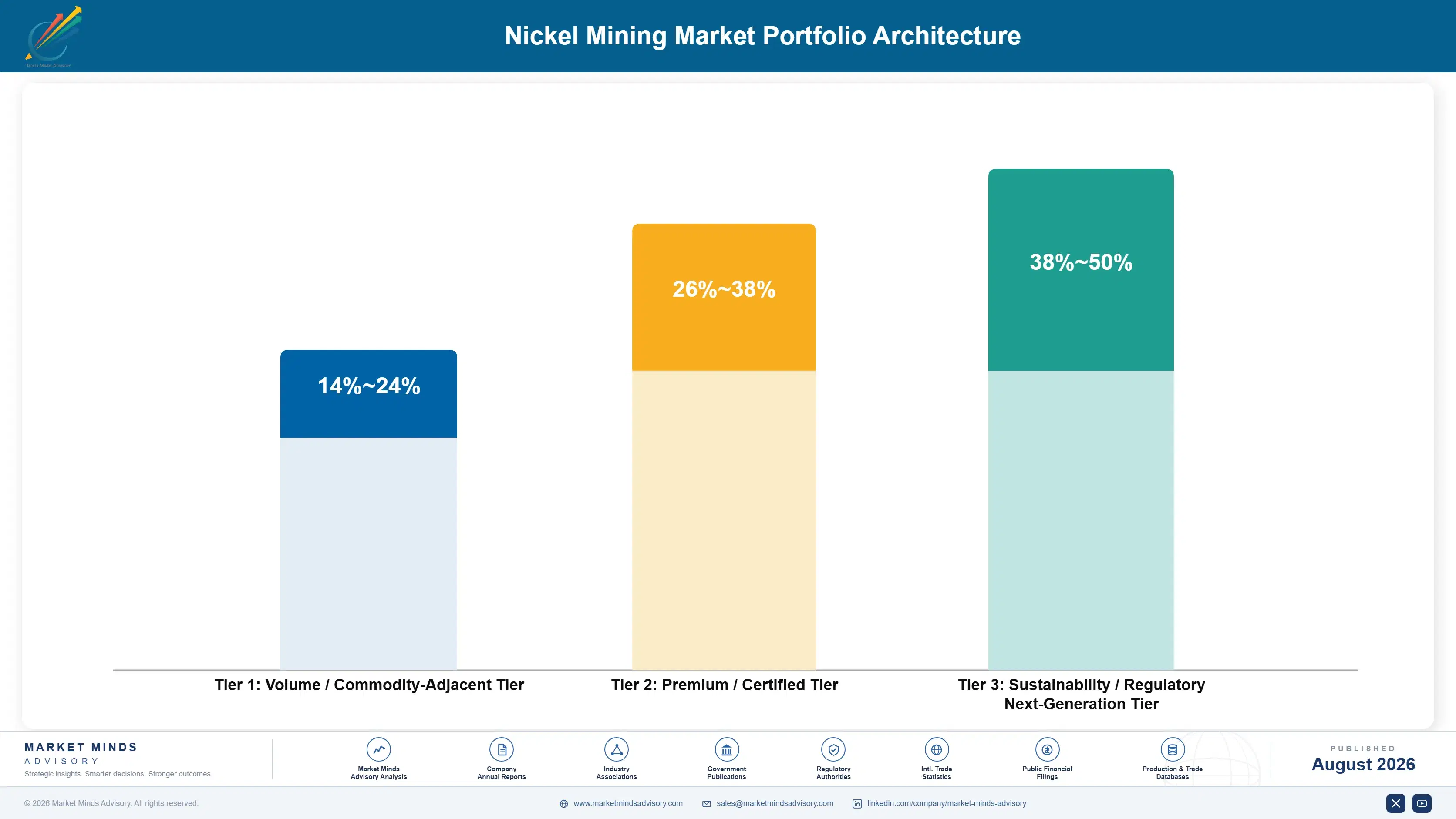
The market splits into three commercial tiers with distinct margin economics. Conventional nickel pig iron and ferronickel for stainless steel feedstock competes largely on price and delivery volume across a mature global replacement channel, Class 1 refined nickel carries meaningfully higher margin given its dual-market flexibility, and battery-grade nickel sulfate with verified purity documentation commands the highest margin given its specification requirements and constrained qualified suppl
The tension between volume and premium positioning shapes how miners allocate processing investment: conventional ferronickel and nickel pig iron still represent meaningful shipment volume across established stainless steel supply chains, but nearly all incremental profit growth over the forecast period concentrates in battery-grade sulfate and Class 1 refined nickel, where leading miners increasingly direct processing capacity and purity documentation investment.

High-value margin pools concentrate specifically in nickel sulfate serving the current EV battery precursor buildout and in Class 1 refined nickel serving buyers who value dual-market flexibility. Both pools reward miners who invest ahead of demand in processing technology and purity consistency rather than those who compete purely on conventional ferronickel price.

Volume / Commodity-Adjacent Tier

Conventional nickel pig iron and ferronickel for stainless steel feedstock sold largely on price and delivery volume across a mature global replacement channel serving established stainless steel producers worldwide.
Gross Margin: 14-24%

Premium / Certified Tier

Class 1 refined nickel with dual-market flexibility, commanding meaningful premiums tied directly to purity consistency and delivery reliability across both battery and alloy applications and geographies.
Gross Margin: 26-38%

Sustainability / Regulatory / Next-Generation Tier

Battery-grade nickel sulfate with verified purity documentation, carrying the category's highest margins given tightened specifications and a constrained pool of qualified suppliers.
Gross Margin: 38-50%
nickel-mining-market-portfolio-architecture-1787302354486

Long-Cycle Mining Meets Fast-Moving Battery Demand

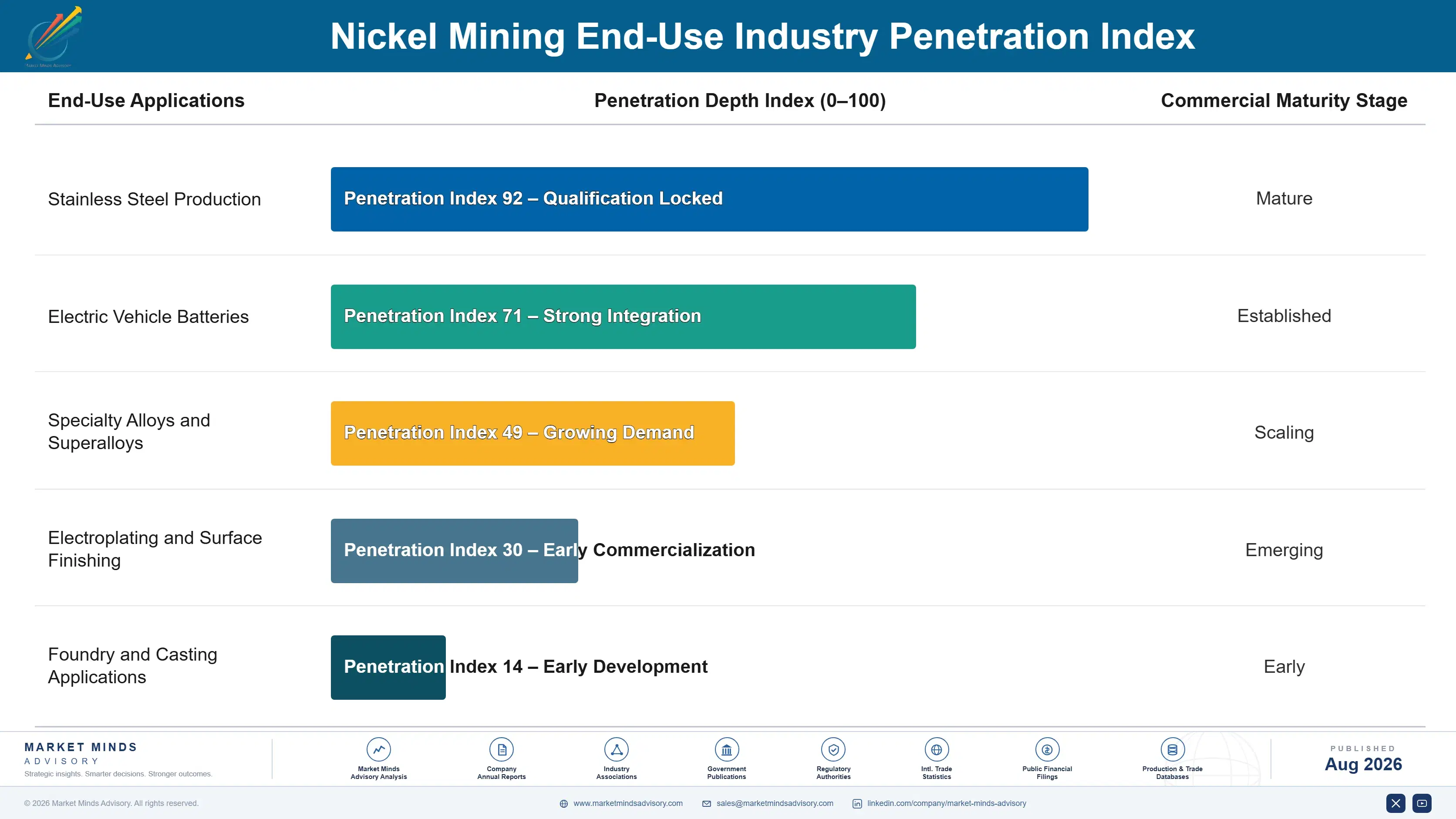
Nickel mining behaves as a genuine long-cycle capital business, generating steady multi-decade production revenue across established reserve bases rather than a short-cycle relationship, reflecting the category's exceptionally long mine life and reserve development timelines across most major producing operations worldwide.
Adoption depth varies sharply by end-use vertical. Battery precursor manufacturers show the fastest purity-driven purchasing cycle given rapid EV supply chain demand growth, stainless steel producers remain the most stable-cycling segment given their established multi-decade procurement relationships, and specialty alloy manufacturers sit between the two, tied more closely to niche performance specifications than to pure commodity price alone.

A generational shift in buyer profile is underway as battery manufacturer procurement teams increasingly include dedicated supply chain traceability and purity verification specialists rather than pure commodity buyers trained under an older price-only sourcing model. Precursor manufacturer procurement teams are also reshaping how miners must present purity documentation earlier in the offtake negotiation process, well before a supply agreement is finalized.
nickel-mining-market-end-use-penetration-index-1787302354974

Where This Market Goes Next

These are among the four positions where our research anticipates prominent divergence between winners and laggards over the coming forecast period. Each is grounded in the demand model, the regulatory perimeter, and the announced capacity pipeline.
01 / BATTERY-GRADE CAPACITY SCALE

Sulfate production will decide who captures EV supply chain growth

Battery precursor manufacturers reward miners who scale nickel sulfate production capacity first, because purity consistency requirements make manufacturers deeply reluctant to commit to unproven suppliers during a major battery capacity buildout. Miners who invested in battery-grade processing early are already winning a disproportionate share of new precursor manufacturer contracts across major producing regions. This gap should widen rather than narrow as leading miners accumulate purity track records that later entrants cannot replicate quickly regardless of how much capital they eventually commit to catching up.
02 / OFFTAKE AGREEMENT STRATEGY

Long-term contracts are winning the fastest-growing accounts

Battery precursor manufacturers increasingly prefer securing nickel sulfate supply through long-term offtake agreements rather than spot-market purchasing, rewarding miners who invest in dedicated production capacity ahead of formal procurement processes across multiple facilities. Miners with established offtake relationships are already reporting meaningfully higher contracted revenue predictability than competitors relying on spot market sales. Miners who underinvest in long-term relationship building risk losing volume to more committed competitors regardless of underlying resource quality differences across their broader portfolios and regions.
03 / VERTICAL REFINING INTEGRATION

Value chain control is reshaping margin capture

Miners increasingly prefer capturing a larger share of value chain margin through vertically integrated smelting and refining capacity rather than selling raw ore or basic intermediate products to third-party processors across their operations and export routes. Miners with integrated refining positions report margin meaningfully higher than competitors reliant on third-party processing arrangements for comparable mined volume today. This trend should continue as more miners pursue processing capacity investment requiring sustained capital commitment rather than continued reliance on external refiners going forward.
04 / INDONESIAN SUPPLY CONCENTRATION

Geographic diversification is becoming a genuine strategic priority

Battery manufacturers and downstream buyers increasingly weigh supply chain geographic diversification as heavily as pure cost competitiveness, given the concentration risk inherent in Indonesia's dominant share of global nickel supply across most product categories. Buyers who secure supply relationships across multiple producing countries report meaningfully lower supply disruption exposure than competitors reliant on single-country sourcing. This diversification trend should continue as more buyers pursue multi-region sourcing strategies requiring sustained relationship investment across several producing jurisdictions simultaneously and continuously.

Engagement Snapshot From the Field

A live engagement with an industry participant carrying material or product regulatory and market exposure ahead of a defining policy shift, showing how our research translates into a defensible multi-year portfolio strategy.
MARKET MINDS ADVISORY · CLIENT ENGAGEMENT SUMMARY
Nickel Mining Producer Strategic Portfolio Review and Transition Roadmap 2026·Investment Scenario on Nickel Mining Exposure Evaluation 2025-26
CLIENT PROFILE
The client is a regional battery precursor manufacturer operating multiple production facilities, historically reliant on a single primary nickel sulfate supplier representing substantial annual procurement spend across its operations and supply agreements (client-reported, unverified by MMA). The company needed to diversify its supply base ahead of planned capacity expansion commitments to downstream battery cell customers.
STRATEGIC CHALLENGE
Leadership needed to select additional nickel sulfate suppliers capable of meeting purity specifications while completing supply diversification within a compressed timeline set by capacity expansion commitments already made to several major battery cell customers across regions.
MMA APPROACH
MMA benchmarked candidate nickel sulfate suppliers against purity consistency data, geographic diversification value, and total cost of ownership including logistics, modeled expected supply security under three distinct sourcing scenarios, and recommended a supplier diversification and phased contracting sequence prioritized by timeline.
KEY FINDINGS
  1. Only four of twelve candidate suppliers evaluated offered purity consistency meeting the client's battery-grade specifications without significant additional refining investment needed upfront.
  2. Delivered cost varied by roughly 14 percent across candidate suppliers, a meaningful factor given the client's thin production margin structure already in place.
  3. Geographic diversification value varied significantly across candidate suppliers, materially affecting which suppliers could realistically reduce the client's single-country concentration risk exposure.
  4. Modeled supply security differences across candidate suppliers translated into a meaningful risk reduction impact across the client's expansion program (client-reported, unverified by MMA).
CLIENT PROFILE
The client is a regional battery precursor manufacturer operating multiple production facilities, historically reliant on a single primary nickel sulfate supplier representing substantial annual procurement spend across its operations and supply agreements (client-reported, unverified by MMA). The company needed to diversify its supply base ahead of planned capacity expansion commitments to downstream battery cell customers.
STRATEGIC CHALLENGE
Leadership needed to select additional nickel sulfate suppliers capable of meeting purity specifications while completing supply diversification within a compressed timeline set by capacity expansion commitments already made to several major battery cell customers across regions.
MMA APPROACH
MMA benchmarked candidate nickel sulfate suppliers against purity consistency data, geographic diversification value, and total cost of ownership including logistics, modeled expected supply security under three distinct sourcing scenarios, and recommended a supplier diversification and phased contracting sequence prioritized by timeline.
KEY FINDINGS
  1. Only four of twelve candidate suppliers evaluated offered purity consistency meeting the client's battery-grade specifications without significant additional refining investment needed upfront.
  2. Delivered cost varied by roughly 14 percent across candidate suppliers, a meaningful factor given the client's thin production margin structure already in place.
  3. Geographic diversification value varied significantly across candidate suppliers, materially affecting which suppliers could realistically reduce the client's single-country concentration risk exposure.
  4. Modeled supply security differences across candidate suppliers translated into a meaningful risk reduction impact across the client's expansion program (client-reported, unverified by MMA).
RECOMMENDED STRATEGY
Phase 1: Phase 1 (Months 1-3): Complete supplier evaluation and finalize diversification selection based on purity and geography fit overall. Phase 2: Phase 2 (Months 4-9): Execute contract transition and volume ramp-up across the client's priority supplier relationships identified first. Phase 3: Phase 3 (Months 10-13): Complete remaining supplier onboarding and establish ongoing purity and reliability monitoring across the full network.
OUTCOME
Thirteen months into the engagement, the client reported successful supply diversification meeting all expansion timeline commitments with purity and reliability performance matching modeled projections across every onboarded supplier and facility (client-reported, unverified by MMA), validating MMA's supplier selection recommendation fully.

Frequently Asked Questions

Foundational context covering the market sizes, CAGR, scope, country, region and competition that inform every finding below. This section is provided to cover basics and most often pre-purchase conversations, answered from the MMA Primary Research Dataset.

What is the current size of the Nickel Mining Market?

The market is valued at approximately 42.5 billion dollars in 2025, expanding to roughly 45.39 billion dollars in 2026 as EV battery precursor demand continues driving mining investment worldwide.

How large will the Nickel Mining Market be by 2036?

MMA forecasts the market reaching approximately 87.63 billion dollars by 2036, roughly 1.93 times its 2026 value, driven primarily by expanding battery-grade sulfate and Class 1 refined nickel demand.

What is the CAGR for the Nickel Mining Market 2026 to 2036?

The base-case compound annual growth rate is 6.8 percent, with a bull scenario of 8.0 percent and a bear scenario of 5.6 percent depending on electric vehicle adoption pace.

Which segment is growing fastest?

Nickel sulfate is growing fastest at a 12.5 percent CAGR, roughly 1.84 times the overall market rate, driven by electric vehicle battery precursor demand requiring high-purity supply.

Who are the major companies in the Nickel Mining Market?

Vale S.A., MMC Norilsk Nickel PJSC, PT Vale Indonesia Tbk, Glencore plc, and Sumitomo Metal Mining Co., Ltd. lead the market, together holding roughly 36 percent of revenue.

Which country is growing fastest?

Indonesia is the fastest-growing country at an 11.5 percent CAGR, driven by rapid high-pressure acid leaching processing capacity expansion and its dominant laterite ore reserves.

Report Segmentation Architecture

The full report scope spans multiple orthogonal segmentation dimensions, with cross-tabulated demand data provided for each dimension pair. Coverage extends further to regional breakdowns, trend trajectories, and the competitive detail needed to support segment-level decision-making.

By Product Form

  • Class 1 Refined Nickel
  • Nickel Pig Iron
  • Ferronickel
  • Nickel Sulfate
  • Nickel Matte and Intermediate Products
  • Nickel Concentrate

By End-Use Industry

  • Stainless Steel Production
  • Electric Vehicle Batteries
  • Specialty Alloys and Superalloys
  • Electroplating and Surface Finishing
  • Foundry and Casting Applications

By Commercial Dimension

  • Long-Term Offtake Agreements
  • Spot Market Sales
  • Vertically Integrated Internal Transfer
  • Trading House Distribution Channel

By Region

  • North America
  • Western Europe
  • East Asia
  • South Asia and Pacific
  • Latin America
  • Middle East and Africa
  • Eastern Europe

Scope, Methodology, and Coverage

Every figure in this report is reproducible from documented input assumptions. The scope below maps the historical period, the forecast horizon, the segmentation dimensions, and the countries covered, alongside the underlying primary and qualitative methodology.
Historical Period
2020 to 2025
Forecast Period
2026 to 2036
Base Year
2025 (USD billions; MMA Primary Research Dataset, August 2026)
Market Definition
The market covers the extraction, processing, and sale of nickel ore and intermediate nickel products including Class 1 refined nickel, nickel pig iron, ferronickel, nickel sulfate, nickel matte, and nickel concentrate. Downstream battery cell manufacturing, finished stainless steel products, and nickel-based specialty alloy fabrication are excluded.
Quantitative Units
USD billions (current prices); metric tons of contained nickel where cited
Segmentation Dimensions
By Product Form; By End-Use Industry; By Commercial Dimension; By Region
Regions Covered
North America, Western Europe, East Asia, South Asia and Pacific, Latin America, Middle East and Africa, Eastern Europe
Countries Covered
Indonesia, Philippines, Australia, New Caledonia, Canada, USA, Mexico, Brazil, Cuba, Colombia, Russia, Poland, Finland, Germany, France, Greece, China, Japan, South Korea, Madagascar, South Africa, and additional markets relevant to this sector
Key Companies Profiled
Vale S.A., MMC Norilsk Nickel PJSC, PT Vale Indonesia Tbk, Glencore plc, Sumitomo Metal Mining Co., Ltd., PT Aneka Tambang Tbk, Anglo American plc, South32 Limited, BHP Group Limited, Eramet SA, IGO Limited, Panoramic Resources Limited, Sherritt International Corporation, Nickel Asia Corporation, First Quantum Minerals Ltd., Jinchuan Group International Resources Co. Ltd., Tsingshan Holding Group Co., Ltd., PT Harita Nickel, Wanbao Mining Ltd., Lundin Mining Corporation
Quantitative Methodology
Primary survey, n=3,800 respondents, Q4 2025, six countries; demand-side model with trade association cross-validation
Qualitative Methodology
47 expert interviews, Q4 2025; applied to validate demand model assumptions, identify emerging dynamics, and assess competitive positioning
Report Format
PDF and XLSX data workbook (Word format preview document)
Publisher
Market Minds Advisory
Report Code
MMA-2026-CHM-651
Published
August 2026
Contact
sales@marketmindsadvisory.com | www.marketmindsadvisory.com

Purchase the full Nickel Mining Market Report (2026 to 2036).

The full report delivers a complete quantitative and strategic assessment of the nickel mining market across all seven regions and more than twenty countries covered in this study. It includes detailed segment-level forecasts through 2036, competitive benchmarking across twenty profiled miners, and primary research drawn from 3,800 survey respondents and 47 expert interviews conducted in Q4 2025. Buyers receive editable data tables and full regional narrative detail beyond the two regions previewed in this summary document. A dedicated appendix covers Indonesian processing policy and battery-grade purity specification standards by market.
Fully editable Excel data tables and models
All seven full regional narratives fully included
Twenty full company competitive profiles included
Indonesian policy and specification appendix included fully
Segment-level 2026-2036 detailed annual forecasts
Full primary survey and expert interview data included fully

Built For The People Who Decide

From boardroom strategy to bench-side execution, this report is read cover-to-cover by leaders shaping the next decade of their industry, turning demand scenarios, market dynamics and valuation benchmarks into decisions.
CXOs/ Presidents/ VPs/ Managers
M&A and Corporate Development
Strategy Teams and R&D Heads
Procurement and Product Directors
Regulatory and Compliance Leaders
Investor Relations and Equity Analysts