Market Minds Advisory
Nickel Cobalt Manganese Market

Nickel Cobalt Manganese Market: Trends and Forecast 2026 to 2036

High-nickel cathode chemistry adoption is accelerating as automakers chase longer electric vehicle range, even as cobalt price volatility and Indonesia's export processing mandates reshape precursor material sourcing strategies across the global battery supply chain.

Lead Analyst

Bilal Shaikh

Published

September 2026

Make Smarter Decisions with Customized Research Insights

Request a free sample report and evaluate market opportunities, growth trends, and competitive dynamics relevant to your business needs.

2025 MARKET VALUE$19.5BMarket Size 2025
2036 FORECAST VALUE$58.5BBase Case , 2026 to 2036
CAGR 2026 TO 203610.5 %Bull 11.7% / Bear 9.3%
INCREMENTAL OPPORTUNITY$36.9BNet 10- year value creation
EXPANSION MULTIPLE2.71x2036 value over 2026 base
Strategic Levers
M&A Pipeline
Regional Outlook
Country Rankings
Competitive Intelligence
Segmental Deep-dive
Call-Us : 91 93563 13602

Executive Snapshot and Market Trajectory

Nickel cobalt manganese cathode material demand is shifting toward high-nickel formulations as electric vehicle manufacturers prioritize energy density and driving range over the cost stability that balanced nickel-cobalt-manganese chemistries traditionally offered, reshaping precursor sourcing strategies and formal qualification standards across the global battery supply chain.
Commercial pressure now concentrates on precursor material integration and cobalt supply diversification, since battery manufacturers increasingly specify suppliers holding vertically integrated nickel and cobalt processing over those dependent on spot market purchasing. High-nickel NCM 811 cathode material is the fastest-growing chemistry, driven by automaker range requirements spreading across major platform programmes. East Asia and North America together account for the largest share of global demand, reflecting concentrated battery cell manufacturing and cathode material processing capacity.
Competitive intensity concentrates among a handful of integrated cathode material producers holding proprietary precursor formulation chemistry and long-term nickel and cobalt offtake agreements, leaving smaller regional producers dependent on volatile spot market feedstock purchasing patterns. Indonesia's nickel processing investment adds further complexity, since precursor material producers increasingly locate new capacity near nickel ore sources rather than near battery cell manufacturing customers and their assembly plants.
Market Definition
The Nickel Cobalt Manganese Market covers NCM precursor and cathode active material used in lithium-ion battery cells across all nickel-to-cobalt-to-manganese ratio formulations. It excludes finished battery cells, other cathode chemistries such as lithium iron phosphate, and raw nickel, cobalt, or manganese ore and refined metal not processed into battery precursor form.
Base Year Value
$19.5B in 2025 (MMA Primary Research Dataset, August 2026)
Forecast Period
2026 to 2036, eleven discrete annual values
CAGR
10.5% base case. Bull 11.7%. Bear 9.3%.
Fastest Growth Segment
NCM 811 (High-Nickel Cathode): 14.0% CAGR
Fastest Growth Country
Indonesia: 15.0% CAGR
Fastest Growth Region
South Asia and Pacific: 12.5% CAGR
Largest Region
East Asia: 43% of 2025 global value
Market Leaders
Leading participants include Zhejiang Huayou Cobalt, Umicore, GEM Co, Ecopro BM, and L&F Co. Source: MMA Primary Research Dataset, July 2026.
Primary Survey
n=3,800 procurement and R&D decision-makers, Q4 2025, six countries
Methodology
Demand-side build-up, cross-validated against public data, 47 expert interviews

Nickel Cobalt Manganese Market Forecast Scenarios

nickel-cobalt-manganese-market-trends-size-forecast-scenario-1787555051424
Between 2020 and 2025 the market grew at an estimated 9.5% annual pace, driven by rapid electric vehicle production growth even as cobalt price volatility periodically strained precursor material producer margins during 2021 and 2022. Balanced NCM chemistry dominated the period, since automakers prioritized proven battery performance over the energy density gains high-nickel formulations offered before extensive real-world validation.
The base case assumes 10.5% annual growth to 2036, driven by three mechanisms: electric vehicle range competition pushing automakers toward high-nickel NCM 811 and beyond chemistries offering superior energy density, Indonesia's nickel processing capacity expansion reducing feedstock costs for precursor material producers locating capacity nearby, and battery recycling infrastructure maturation creating a growing secondary nickel and cobalt supply stream. Balanced NCM chemistry retains cost advantages for standard-range vehicle applications, but its share of total cathode material demand is declining as high-nickel formulations expand.
The bull case centers on electric vehicle production growth accelerating faster than current automaker guidance suggests, pushing growth toward 11.7%. The bear risk is cobalt and nickel price volatility disrupting precursor material margins, which would slow capacity expansion investment and cathode material qualification timelines further, holding growth closer to 9.3% through the full forecast window.

Energy Density Race Reshapes Cathode Chemistry

The Nickel Cobalt Manganese Market sits at the center of the lithium-ion battery cathode supply chain, where precursor formulation and metal sourcing follow battery cell manufacturer specifications more than raw production volume alone. Electric vehicle battery manufacturers and energy storage system integrators together represent the largest buyer categories, each imposing increasingly specific energy density and cycle life requirements.
MARKET CONCENTRATION52%Share held by five largest cathode producers combined
AVERAGE SELLING PRICE$14 per kgTypical cost battery manufacturers pay per kilogram material
TOP PRODUCING COUNTRY58%Current share of global output from China currently
CAPACITY UTILIZATION72%Average operating rate across high-nickel cathode production lines currently
FEEDSTOCK COST SHARE62%Portion of production cost from nickel and cobalt inputs
RECYCLED CONTENT SHARE12%Portion of feedstock sourced from battery recycling streams
Balanced NCM chemistry remains a significant category for standard-range vehicle applications, prized for cost stability and proven long-term performance across established battery platforms. High-nickel NCM 811 and beyond formulations carry a meaningful cost premium tied to processing complexity, yet automakers pursuing longer driving range are specifying these formulations fast enough that precursor producers are investing in nickel processing capacity ahead of confirmed long-term volume commitments from major automotive platform programmes.
Producer concentration remains moderate to high, with a handful of integrated precursor and cathode material producers holding proprietary formulation chemistry and long-term metal offtake agreements that smaller regional producers cannot easily replicate. Capacity utilization runs tighter in high-nickel production lines than in balanced chemistry manufacturing, reflecting the lag between installed high-nickel capacity and accelerating electric vehicle range-driven demand across major automotive markets.
"Automakers keep asking for more range, and the fastest lever left is pushing nickel content higher in the cathode, which is why precursor chemistry has quietly become the most contested part of the battery supply chain."
Senior Analyst, Battery Materials and Energy Storage Practice · MMA Chemicals and Materials Practice · August 2026

Market Trends

High-Nickel Cathode Adoption Accelerates Across EV Platforms

Automakers are converting from balanced NCM chemistry to high-nickel NCM 811 and beyond formulations as electric vehicle range competition intensifies across major automotive markets, since higher nickel content delivers meaningfully greater energy density per unit of battery pack weight and volume. Precursor producers report high-nickel formulation orders tied to new vehicle platform launches growing meaningfully faster than orders tied to established balanced chemistry platforms nearing end of production life. The shift is concentrated among premium and long-range vehicle segments where automakers can justify the additional processing cost, while cost-sensitive vehicle segments continue specifying balanced chemistry.
Market Impact: Range competition adds 18% demand
Indonesia Nickel Processing Investment Reshapes Precursor Geography

Precursor material producers are increasingly locating new processing capacity in Indonesia rather than traditional East Asian manufacturing hubs, driven by Indonesia's vast nickel ore reserves and export restrictions on unprocessed ore that incentivize domestic downstream processing investment instead. These integrated Indonesian facilities can produce nickel intermediate products at lower feedstock cost than facilities importing nickel from separate ore-producing countries, commanding a meaningful cost advantage that is reshaping where new precursor capacity investment concentrates globally. Adoption is concentrated among large integrated producers with the capital to build processing infrastructure in Indonesia, while smaller producers continue relying on imported nickel intermediate products.
Market Impact: Indonesian reserves support 7-year visibility

Market Opportunities and Growth Drivers

Electric Vehicle Range Competition Drives High-Nickel Chemistry Demand

Automakers competing on electric vehicle driving range increasingly specify high-nickel NCM cathode chemistry, since higher nickel content delivers greater energy density that translates directly into longer range without proportionally increasing battery pack size or weight. This directly increases demand for high-nickel precursor material capable of meeting the thermal stability and cycle life specifications automakers require alongside the energy density gains. Precursor producers unable to meet these processing requirements risk losing qualification for new vehicle platform programmes entirely, pushing capital toward high-nickel capacity faster than overall battery demand growth alone would otherwise justify economically.
Market Impact: Cobalt volatility adds $2 to $5

Indonesia Nickel Reserve Development Sustains Feedstock Availability

Indonesia holds the world's largest nickel ore reserves, and continued government investment in downstream processing infrastructure is sustaining nickel intermediate product supply growth that precursor material producers depend on for cathode material manufacturing across their global processing operations and facilities. This sustained feedstock development gives precursor producers with Indonesian processing relationships multi-year supply visibility that producers dependent on other nickel-producing regions facing resource depletion or political instability cannot match. Producers integrated into Indonesian nickel processing capture cost advantages that non-integrated competitors purchasing nickel intermediate products on spot markets cannot easily replicate.
Market Impact: Qualification adds 8 to 14 months

Market Restraints and Challenges

Cobalt Price Volatility Complicates Precursor Cost Forecasting

Cobalt prices remain notably more volatile than nickel or manganese given the metal's geographic supply concentration in the Democratic Republic of Congo and periodic political and logistics disruptions affecting export volumes from that single dominant source. For precursor producers without long-term cobalt supply contracts, this volatility makes cost forecasting difficult and periodically compresses margins when cobalt prices spike unexpectedly during supply disruptions. Some producers are addressing this by reducing cobalt content through nickel-rich, low-cobalt formulations, though these formulations require additional thermal stability engineering to maintain safety performance comparable to higher-cobalt chemistries.
Market Impact: High-nickel formulations gain 9 points share

High-Nickel Processing Complexity Raises Qualification Barriers

High-nickel cathode formulations require more sophisticated thermal stability engineering and quality control processes than balanced chemistry, since higher nickel content increases thermal runaway risk that automakers require extensive safety testing to validate before qualifying a supplier for vehicle platform programmes. This creates a substantial qualification barrier for producers without established high-nickel processing expertise, effectively excluding smaller regional producers from the fastest-growing segment of the market regardless of their balanced chemistry manufacturing capability. Industry associations are developing standardized testing protocols to reduce qualification timelines, though automaker-specific requirements still vary considerably across platform programmes.
Market Impact: Indonesian processing capacity grows 22% annually
3 additional market trends, 4 additional growth drivers, and 2 additional restraints and challenges are covered in the full report. Contact sales@marketmindsadvisory.com to access the complete intelligence.

Segment CAGR and Growth Architecture

The market divides into six chemistry-based segments spanning nickel content ratios and structural formats used across global battery manufacturing. NCM 811 and single-crystal NCM serve energy-density-driven premium demand, while NCM 622, NCM 111/532, NCM precursor material, and NCMA formulations serve broader automotive and energy storage applications across diverse battery cell manufacturing customer segments worldwide.
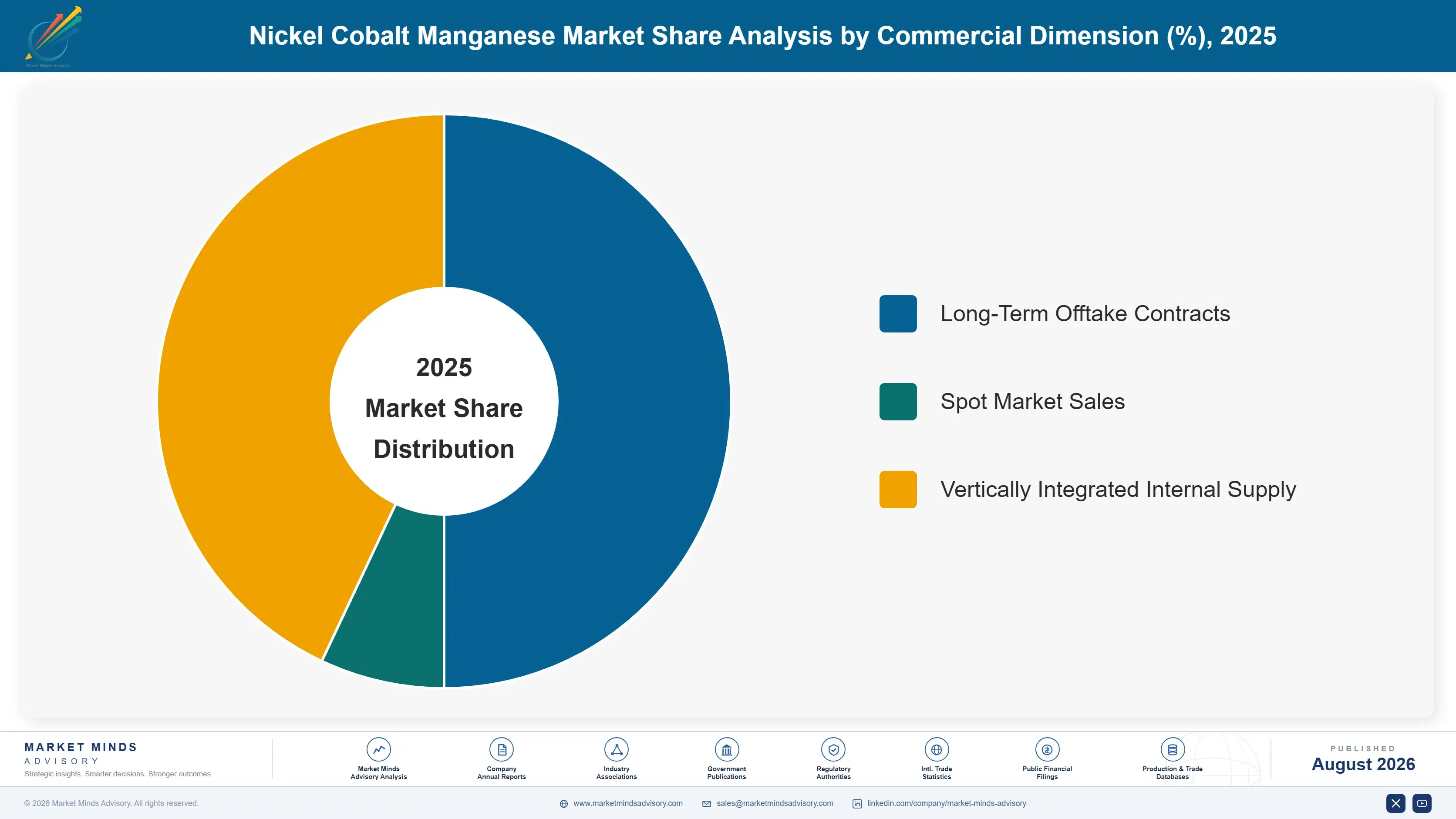
nickel-cobalt-manganese-market-trends-market-share-analysis-1787555051982

NCM 811 (High-Nickel Cathode)

NCM 811 and beyond high-nickel formulations are converting fastest as automakers pursuing longer electric vehicle driving range specify cathode chemistry delivering greater energy density per unit of battery pack weight than balanced nickel-cobalt-manganese ratios can achieve at comparable cost. These formulations command a meaningful price premium given the additional thermal stability engineering and quality control required to manage higher nickel content's greater reactivity, yet increasingly appear as a qualification requirement rather than an optional upgrade in premium electric vehicle platform programmes. Precursor producer investment in high-nickel processing capacity has accelerated well ahead of confirmed volume commitments, reflecting expectations that automaker range competition will pull demand higher across the coming decade and beyond.
CAGR 14.0%

Single-Crystal NCM

Single-crystal NCM is the second-fastest-growing segment, favored for its superior structural stability and longer cycle life compared to conventional polycrystalline cathode particles that degrade faster under repeated charge and discharge cycling in demanding automotive and industrial applications worldwide today and consistently. Single-crystal formulations require more sophisticated synthesis processes and tighter quality control than polycrystalline alternatives, commanding a meaningful price premium that battery manufacturers increasingly accept given the durability and safety benefits for premium vehicle applications. Cost sensitivity limits single-crystal penetration into cost-competitive vehicle segments, but premium and commercial vehicle manufacturers requiring extended battery lifespan are increasingly specifying single-crystal NCM as standard practice across their platform programmes and broader product applications.
CAGR 12.0%
Full segment breakdown across 6 segments available in the complete report.

Regional Architecture and Country Demand Map

Regional demand tracks battery cell manufacturing concentration rather than population or income levels. East Asia dominates given China, South Korea, and Japan's overwhelming share of global cathode material production capacity, while North America and Western Europe sustain demand through emerging domestic battery supply chain investment.

North America

United States battery manufacturing investment, driven by Inflation Reduction Act incentives requiring domestic content for tax credit eligibility, is rapidly building new cathode material processing capacity that did not exist domestically five years ago and continues expanding steadily nationwide. Canada's nickel and cobalt mining sector, combined with government critical minerals strategy investment, positions the country as a growing feedstock and processing hub supporting North American battery supply chain localization efforts and initiatives. Mexico's expanding automotive manufacturing sector adds secondary demand tied to battery pack assembly operations and component sourcing. Domestic content requirements are accelerating precursor material qualification investment faster than the region's overall electric vehicle production growth alone would justify.
Share: 22% | CAGR: 9.5% (2026 to 2036)

Western Europe

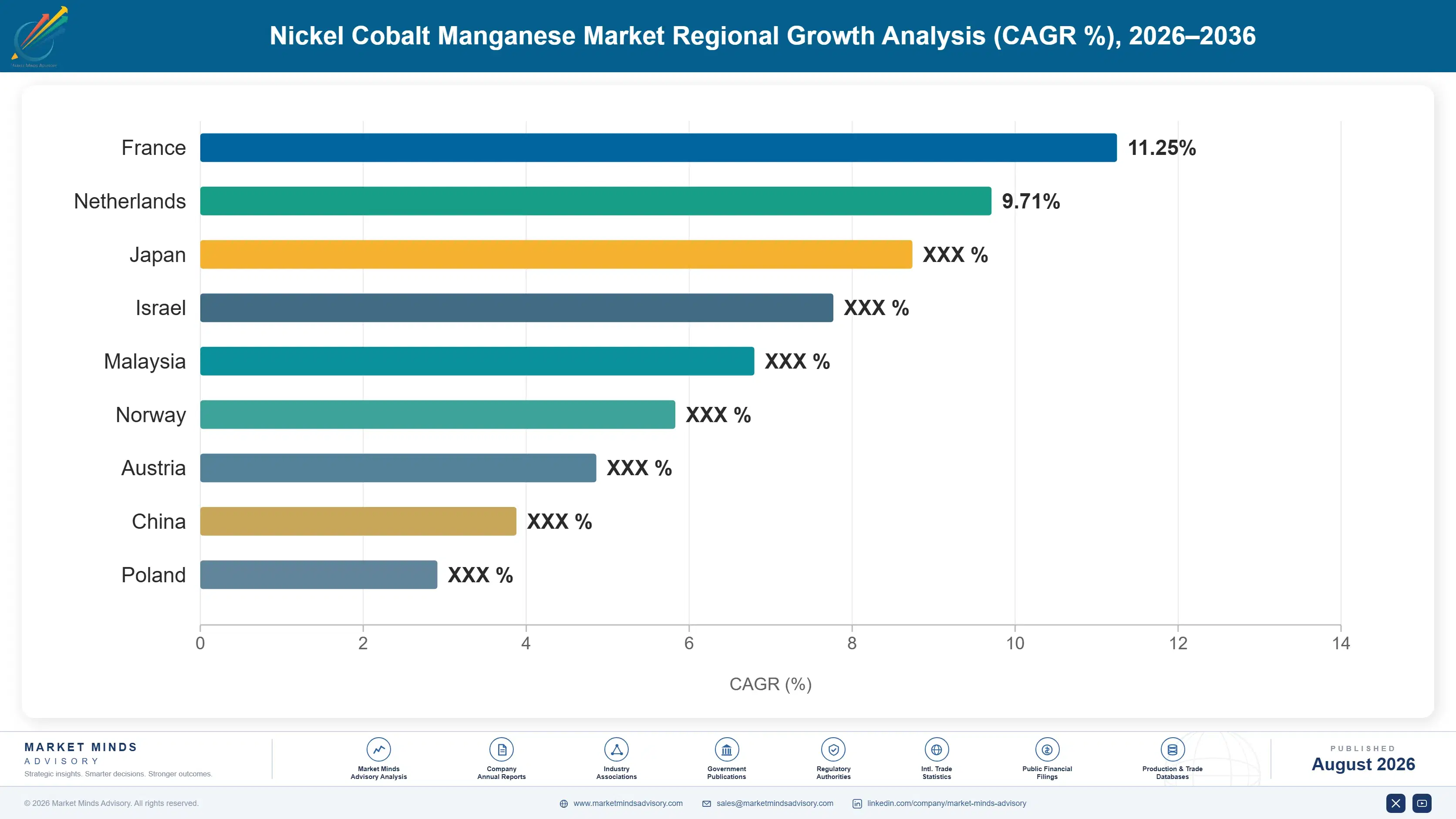
Germany's automotive manufacturing base anchors Western European demand, with major automakers investing in domestic battery cell and cathode material production to reduce dependence on East Asian supply chains amid growing supply chain security concerns and geopolitical uncertainty worldwide today and consistently. France's battery gigafactory investment, supported by European Union critical raw materials policy, is building new cathode material processing capacity across multiple planned facilities and joint ventures with established Asian producers. The Nordic region's growing battery manufacturing cluster, anchored by Northvolt's operations, adds meaningful demand despite recent financial challenges facing some regional battery manufacturers. European Union raw materials policy is pushing precursor sourcing diversification away from single-country dependence and reliance.
Share: 18% | CAGR: 9.0% (2026 to 2036)
Regional intelligence for 5 additional markets available in the complete report: East Asia, South Asia and Pacific, Latin America, Middle East and Africa, Eastern Europe. Contact sales@marketmindsadvisory.com.
nickel-cobalt-manganese-market-trends-country-cagr-analysis-1787555052490

Where Producers Can Capture Chemistry Margin

Producers face a widening gap between balanced NCM chemistry pricing and the high-nickel formulation, thermal engineering, and metal offtake integration capabilities that automakers pursuing longer range now demand. Four levers stand out for capturing margin above baseline precursor manufacturing economics: high-nickel formulation development, single-crystal synthesis capability, metal offtake integration, and direct battery manufacturer contract structuring across supply chains.

High-Nickel Formulation Development and Thermal Engineering

Producers holding proven high-nickel formulation chemistry with validated thermal stability can charge a premium averaging 18 to 26% above balanced NCM chemistry, since automakers pursuing longer electric vehicle range value validated safety performance over unit cost alone entirely. Developing this chemistry requires sustained R&D investment, typically three to five years to reach commercial qualification, but formulators who achieve it capture disproportionate share of new premium vehicle platform business. Producers lacking high-nickel expertise increasingly compete only on price for standard-range vehicle applications, ceding the highest-margin qualified business entirely to specialized formulators.
Market Impact: High-nickel formulation adds 18 to 26% pricing power

Single-Crystal Synthesis and Quality Control Capability

Producers holding single-crystal synthesis capability can capture a premium averaging 15 to 22% above conventional polycrystalline cathode material, since battery manufacturers value the superior cycle life and structural stability these formulations deliver for premium and commercial vehicle applications requiring extended battery lifespan, durability, and safety. This capability requires meaningful capital investment in specialized synthesis equipment and quality control infrastructure, but producers who build it gain access to a growing customer base largely inaccessible to conventional polycrystalline suppliers. Competitors without single-crystal capability are effectively excluded from this expanding premium segment entirely.
Market Impact: Single-crystal capability adds 15 to 22% premium pricing

Nickel and Cobalt Offtake Integration Agreements

Producers securing long-term nickel and cobalt offtake agreements directly with mining operations can improve gross margin by roughly 10 to 15 percentage points by eliminating intermediary trading markups while gaining feedstock price stability that spot-market-dependent competitors cannot match during metal price volatility and disruption. This integration requires substantial capital investment and long-term relationship building with mining companies, but producers who achieve it capture disproportionate share of large battery manufacturer contracts requiring supply security guarantees. Competitors without offtake integration remain exposed to feedstock cost volatility that erodes margin unpredictably over time.
Market Impact: Offtake integration improves margin by 10 to 15 points

Direct Battery Manufacturer Contract Structuring and Negotiation

Producers negotiating multi-year direct contracts with major battery cell manufacturers, bypassing trading intermediaries entirely, can improve gross margin by roughly 8 to 12 percentage points by eliminating intermediary markup while offering manufacturers price stability and firm supply continuity guarantees over the full multi-year contract term itself and consistently over time. These direct arrangements typically require minimum volume commitments spanning three to five years, favoring larger producers with the balance sheet capacity to guarantee uninterrupted supply that smaller regional competitors cannot credibly match given more limited production capacity and working capital.
Market Impact: Direct contracts improve margin by 8 to 12 points

Who Controls the Margin Pool

Concentration remains moderate to high: the top five producers hold 52% combined share on a revenue basis, evaluated consistently across producers regardless of whether they compete primarily in balanced chemistry or high-nickel formulations. Zhejiang Huayou Cobalt leads on scale and integrated nickel and cobalt processing, followed by Umicore, whose recycling and sustainability positioning gives it customer relationships that pure precursor producers cannot easily replicate.
Competitive activity currently centers on high-nickel formulation investment, as producers race to qualify chemistry against automaker range requirements tightening faster than standard-range platform demand. Several mid-tier producers have announced new single-crystal synthesis capacity, while others are pursuing nickel and cobalt offtake integration instead, betting that feedstock security will prove more durable than formulation chemistry alone as a differentiator.

Emerging pressure comes from Indonesian-integrated producers who have scaled nickel processing capacity rapidly and are now underpricing East Asian competitors dependent on imported nickel intermediate products. Rankings could shift meaningfully if major automakers standardize cathode chemistry specifications around a smaller set of approved formulations, since that would commoditize a capability several mid-tier producers currently treat as differentiated, accelerating consolidation among producers lacking sufficient feedstock scale.
nickel-cobalt-manganese-market-trends-company-positioning-matrix-1787555053012

Competitive Moat and Risk Dimensions

ZHEJIANG HUAYOU COBALT

Moat: Integrated Nickel and Cobalt Processing

Zhejiang Huayou Cobalt controls nickel and cobalt refining alongside precursor manufacturing, giving it feedstock cost and supply security advantages that feedstock-purchasing competitors cannot match during metal price volatility. This integration also lets Huayou respond faster to automaker chemistry requirement changes by adjusting internal metal allocation between different precursor formulations, a flexibility competitors dependent on external metal purchasing lack.
ZHEJIANG HUAYOU COBALT

Risk: Chinese Regulatory and Trade Exposure

Huayou's concentrated Chinese manufacturing base exposes it to trade policy risk as Western automakers face growing pressure to diversify battery supply chains away from Chinese-origin materials under domestic content and national security regulations. Competitors with manufacturing presence in North America, Europe, or allied nations face less exposure to this specific regulatory risk even if their production costs run higher.
UMICORE

Moat: Recycling and Sustainability Positioning

Umicore has built industry-leading battery material recycling capability that lets it offer automakers documented recycled content and lower carbon footprint credentials increasingly required under European Union battery regulation, a capability most competitors lack at comparable scale. This positioning creates genuine customer stickiness, since automakers who have built compliance strategies around Umicore's recycled content face switching costs finding an alternative.
UMICORE

Risk: Higher Cost Base Than Peers

Umicore's European manufacturing footprint carries higher labor and energy costs than Asian competitors manufacturing in China, South Korea, or increasingly Indonesia, limiting its ability to compete purely on price for cost-sensitive standard-range vehicle applications. This cost disadvantage could widen if Asian competitors continue scaling capacity faster than Umicore's more measured European expansion strategy.

Players Tracked

Prominent Players

Zhejiang Huayou Cobalt
Umicore
GEM Co
Ecopro BM
L&F Co

Other Key Players

Ronbay Technology
Beijing Easpring Material Technology
Ningbo Shanshan Co
XTC New Energy Materials
CNGR Advanced Material
Sumitomo Metal Mining
BASF
POSCO Future M
LG Chem
Vale Base Metals
Glencore
Sherritt International
Norilsk Nickel
Jinchuan Group
Eramet

Recent Developments

FEBRUARY 2025

Zhejiang Huayou Cobalt commissioned an expanded integrated nickel processing facility in Indonesia, adding dedicated capacity for precursor material production feeding its cathode manufacturing operations across multiple facilities. The expansion responds to rising qualification requests from battery manufacturers seeking feedstock cost advantages tied to Indonesian nickel ore proximity and reserves.
Signal: Signals accelerating producer investment in Indonesian integration well ahead of confirmed long-term volume commitments industry-wide today.
SEPTEMBER 2025

Umicore signed a multi-year supply agreement with a major European automaker to provide high-nickel cathode material incorporating recycled battery content across multiple vehicle platforms and production lines nationwide and abroad internationally, securing volume commitments that support continued recycling infrastructure investment through the automaker's electrification roadmap.
Signal: Confirms automakers locking in recycled-content cathode supply well ahead of tightening European Union battery regulation deadlines.
MAY 2025

Ecopro BM expanded single-crystal NCM production capacity at its South Korean facility to meet rising demand from premium electric vehicle platforms requiring extended battery cycle life, addressing automaker specifications for longer vehicle ownership periods and warranty coverage terms across multiple international markets and global regions.
Signal: Shows producers investing in single-crystal capability to meet automaker durability and warranty requirements much more consistently.

Nickel and Cobalt Feedstock Cost Exposure

Nickel and cobalt account for roughly 62% of production cost across NCM cathode formulations, sourced primarily from Indonesian nickel processing operations and Democratic Republic of Congo cobalt mining, with manganese contributing a smaller and more stable cost share given its broader geographic supply distribution. High-nickel formulations carry proportionally greater nickel cost exposure than balanced chemistry given their higher nickel content ratios.
Cobalt prices spiked sharply during 2021 and 2022 as global battery demand growth outpaced Democratic Republic of Congo mining capacity expansion, a volatility event documented in USGS mineral commodity summary reports. Producers without long-term cobalt supply contracts absorbed cost increases directly, while those holding fixed-price offtake agreements passed through smaller increases to battery manufacturers, illustrating how contract structure shapes margin resilience during feedstock price shocks across the cathode material supply chain.

Smaller regional producers lacking scale to negotiate favorable metal offtake contracts face a real competitive disadvantage against integrated players like Zhejiang Huayou Cobalt, who control nickel and cobalt processing internally. This exposure varies by geography too: Indonesian-integrated producers benefit from lower nickel feedstock costs than East Asian competitors importing nickel intermediate products from separate processing operations.
nickel-cobalt-manganese-market-trends-cost-volatility-analysis-1787555053208

Long-Term Metal Offtake Contracts With Price Collars

Producers increasingly negotiate multi-year nickel and cobalt offtake contracts with price collars that cap upside exposure during metal spikes while sharing some downside benefit with mining partners during periods of falling prices. This reduces earnings volatility for producers lacking the balance sheet to absorb sudden cost increases without passing them through to battery manufacturers immediately.

Diversifying Cobalt Sourcing Beyond DRC Dependence

Several producers are qualifying secondary cobalt sources outside the Democratic Republic of Congo, including emerging Indonesian and Australian nickel-cobalt co-product streams, to reduce dependence on a single dominant supplying country and its associated political and logistics risks. This diversification lowers single-source risk and improves negotiating position during periodic contract renewal cycles across multiple regions.

Low-Cobalt and Cobalt-Free Formulation Development

Producers are developing nickel-rich, low-cobalt, and cobalt-free cathode formulations to reduce dependence on volatile and geographically concentrated cobalt feedstock entirely across their product portfolios and manufacturing operations. This approach requires additional thermal stability engineering to compensate for cobalt's structural stabilization role, but reduces long-term exposure to Democratic Republic of Congo supply risk and price volatility.

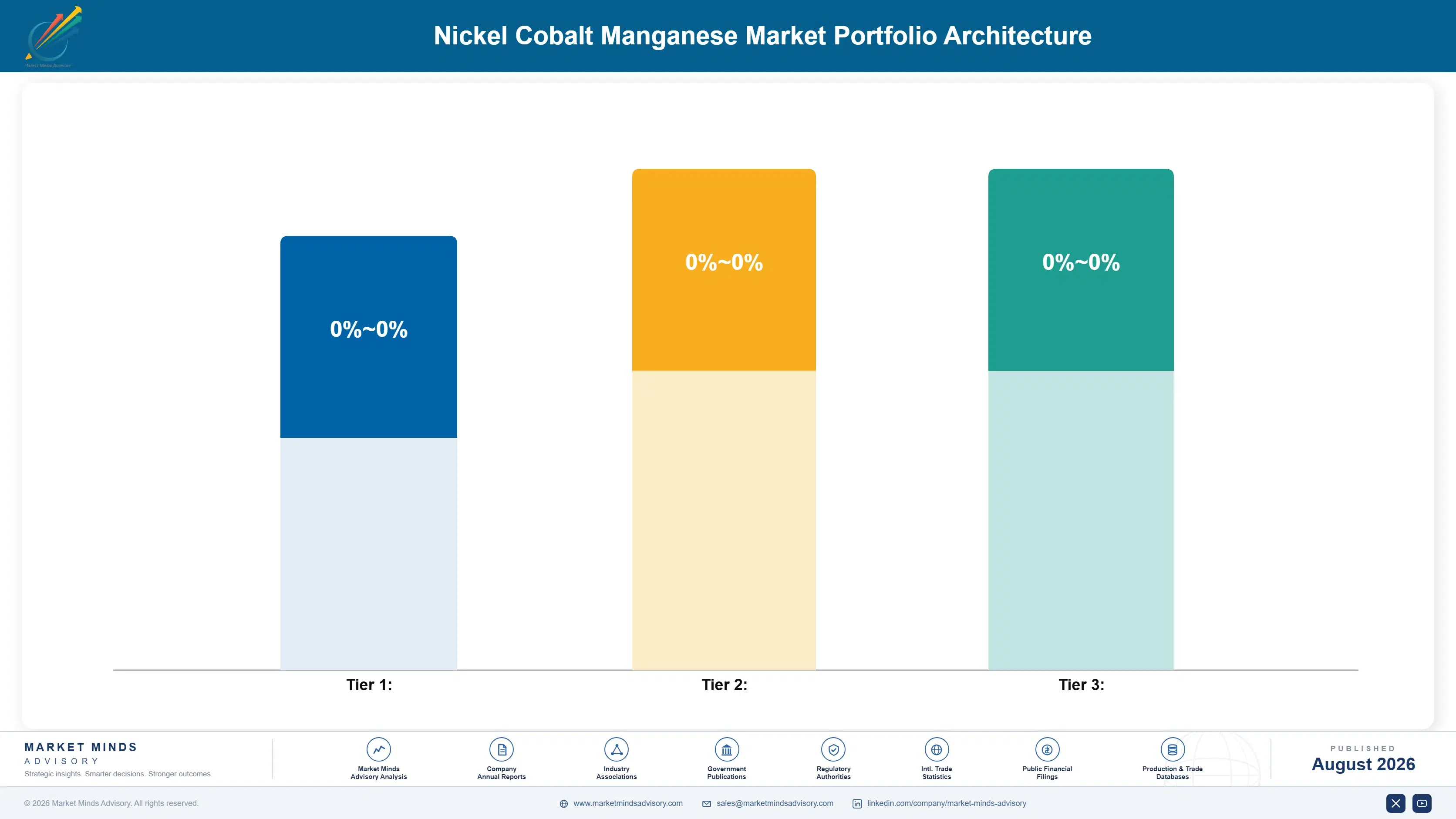
Portfolio Architecture for Margin Defence

Portfolio economics split sharply along a balanced-versus-high-nickel axis across the industry. Balanced NCM chemistry competes on proven performance and cost stability, with gross margins compressed by nickel and cobalt price volatility and thin differentiation among established formulators. High-nickel and single-crystal formulations carry meaningfully higher margins, reflecting thermal engineering investment, metal offtake integration, and the qualification-required status these formats now hold among automakers pursuing longer electric vehicle range.
The tension between balanced and high-nickel chemistry is intensifying as automaker range competition pulls demand toward specialized formulations faster than thermal engineering and offtake capacity can scale industry-wide across most producer networks. Producers over-indexed on balanced chemistry face margin erosion as that segment shrinks toward a smaller, standard-range core, while those who invested early in high-nickel formulation and metal integration are capturing a disproportionate share of the industry's expanding premium revenue pool relative to overall production volume.

High-value margin pools concentrate in high-nickel and single-crystal formulations serving premium and long-range electric vehicle platforms, where thermal engineering barriers and qualification-required status limit competitive entry from smaller regional producers. A second, smaller pool sits in metal offtake integration serving battery manufacturers seeking feedstock security that spot-market-dependent producers cannot provide.

Balanced NCM chemistry sold primarily on proven performance and cost stability to standard-range electric vehicle manufacturers, where thin margins reflect limited differentiation and intense price competition among established regional formulators serving cost-sensitive platform programmes.
Gross Margin

High-nickel and single-crystal formulations commanding qualification-required status among automakers pursuing longer electric vehicle range, where thermal engineering investment and metal offtake integration support meaningfully higher margins than balanced chemistry alternatives across most applications.
Gross Margin

Emerging cobalt-free and next-generation cathode chemistry technologies still scaling commercially, commanding the highest margins as producers price in scarcity value ahead of broader industry-wide adoption and formal automaker qualification processes.
Gross Margin
nickel-cobalt-manganese-market-trends-portfolio-architecture-1787555053708

High-value Sub-segments and Strategic Watch-out

High-Nickel Formulations for Premium EV Platforms

High-nickel and single-crystal formulations serving premium and long-range electric vehicle platforms combine the fastest segment growth with the highest margins in the portfolio, driven by qualification-required status limiting new entrant competition. Producers holding early thermal engineering capability are best positioned to capture this expanding high-value pool.

Metal Offtake Integration for Feedstock Security

Metal offtake integration serving battery manufacturers seeking feedstock security combines strong growth with above-average margins tied to sustained capital investment in long-term mining sector relationships. This segment benefits from metal price volatility expanding faster than integrated processing capacity across most producing regions currently and consistently.

Balanced NCM Chemistry for Standard-Range Vehicles

Balanced NCM chemistry remains the volume core of the market, serving cost-sensitive standard-range electric vehicle manufacturers not yet facing premium range competition pressure. Growth is slow and margins are thin, but the segment still represents the largest single share of total unit volume shipped across the industry currently.

NCM Precursor Material for Cathode Manufacturing

NCM precursor material serves a foundational niche within cathode manufacturing supply chains, facing steady but modest demand growth tied to broader cathode material production trends and cycles. Producers should monitor whether precursor margins compress as more cathode manufacturers integrate backward into precursor production themselves over time.

Recurring Demand From Platform Qualification

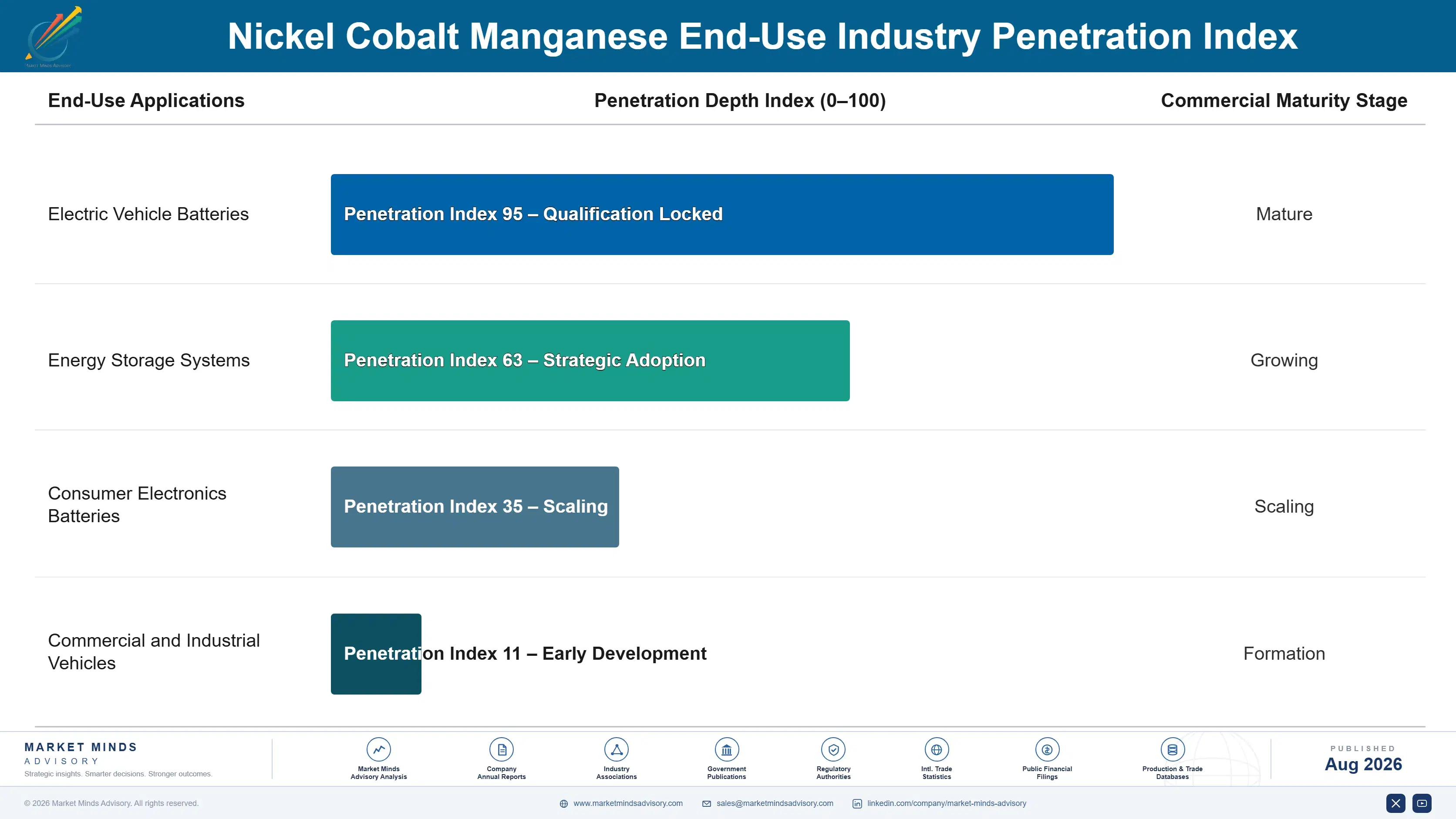
NCM cathode material demand behaves like an annuity for producers holding qualified supplier status on active vehicle platform programmes, since automakers rarely requalify cathode suppliers once a formulation is validated against specific safety, energy density, and cycle life requirements. Multi-year supply agreements, once established, tend to persist through an entire vehicle platform's production lifecycle, giving incumbent producers durable, recurring revenue streams across their qualified customer base.
Stickiness varies meaningfully by end-use vertical: automakers rarely switch cathode suppliers mid-platform given the extensive safety requalification testing required, while energy storage system integrators switch more readily based on price and delivery timeline. Consumer electronics battery manufacturers sit between these extremes, valuing consistency but willing to test new suppliers when new product generations require different energy density specifications across their broader product portfolio.

Buyer profiles are shifting generationally as procurement decisions move from purchasing agents focused purely on unit cost toward battery engineers weighing thermal safety validation alongside price. This generational shift favors producers who can speak credibly to formulation chemistry and thermal stability testing rather than cost alone, reshaping which sales relationships and technical capabilities matter most in winning and retaining large automaker accounts.
nickel-cobalt-manganese-market-trends-end-use-penetration-index-1787555054195

MMA Verdict on Producer Priorities

These are among the four positions where our research anticipates prominent divergence between winners and laggards over the coming forecast period. Each is grounded in the demand model, the regulatory perimeter, and the announced capacity pipeline.
01 / HIGH-NICKEL FORMULATION PRIORITY

Invest in High-Nickel Chemistry Before Range Deadlines Bind

Producers without validated high-nickel formulation chemistry are losing new vehicle platform business to competitors who invested early, not in some future qualification cycle several years away from today's automaker range requirements. The premium high-nickel formulators command, averaging 18 to 26% above balanced chemistry, will only widen as automaker range competition intensifies through 2030 and beyond, rewarding early movers substantially. Delaying high-nickel investment past 2027 risks permanent exclusion from the fastest-growing and highest-margin segment of the entire market for years to come.
02 / METAL OFFTAKE INTEGRATION

Secure Nickel and Cobalt Offtake Before Volatility Compounds

Producers without long-term metal offtake agreements are ceding margin to competitors who invested in mining relationships ahead of confirmed metal price volatility, since spot-market dependence exposes producers to cost swings that integrated competitors avoid entirely and consistently. This integration improves gross margin by 10 to 15 percentage points while providing feedstock security that battery manufacturers increasingly require from strategic suppliers across their global operations. Producers who secure offtake agreements now will capture volume that spot-market-dependent competitors cannot economically match going forward.
03 / SINGLE-CRYSTAL CAPABILITY EXPANSION

Build Single-Crystal Synthesis to Capture Durability Premium

Battery manufacturers increasingly specify single-crystal cathode chemistry for premium and commercial vehicle applications requiring extended cycle life, and producers who build this synthesis capability are capturing meaningful pricing premiums while raising switching costs for existing customer accounts substantially. This capability gap is currently underexploited by all but the largest producers serving this fragmented and still-consolidating industry landscape today, leaving real margin on the table. Building dedicated synthesis infrastructure now positions producers ahead of competitors relying on conventional polycrystalline chemistry alone.
04 / INDONESIAN INTEGRATION PRIORITY

Deepen Integration With Indonesian Nickel Processing Operations

Indonesia holds the world's largest nickel reserves and is rapidly becoming the industry's preferred processing location given export restrictions on unprocessed ore, and producers without meaningful Indonesian integration are ceding cost advantages to competitors positioned closer to this vast feedstock base and its reserves. Early movers securing processing capacity and metal relationships in Indonesia now will hold a durable cost and supply security advantage over competitors entering once regional capacity consolidation is further along. This window will likely close within several years.

Engagement Snapshot From the Field

A live engagement with an industry participant carrying material or product regulatory and market exposure ahead of a defining policy shift, showing how our research translates into a defensible multi-year portfolio strategy.
MARKET MINDS ADVISORY · CLIENT ENGAGEMENT SUMMARY
Nickel Cobalt Manganese Producer Strategic Portfolio Review and Transition Roadmap 2026·Investment Scenario on Nickel Cobalt Manganese Exposure Evaluation 2025-26
CLIENT PROFILE
The client is the battery division of a global automaker developing a new electric vehicle platform targeting extended driving range, sourcing NCM cathode material for an estimated 200,000 vehicles annually once production ramps to full capacity. Facing pressure to diversify supply beyond a single established Chinese cathode supplier, the division's procurement team needed an independent assessment of high-nickel formulation suppliers ahead of a major platform sourcing decision.
STRATEGIC CHALLENGE
The division faced a choice between continuing to source high-nickel cathode material from its established Chinese supplier or qualifying additional suppliers in South Korea and Indonesia to reduce geographic concentration risk amid growing trade policy uncertainty. Internal procurement and engineering teams disagreed on timing, and the division lacked independent data comparing supplier formulation capabilities and true multi-year cost and risk impact.
MMA APPROACH
MMA conducted supplier capability benchmarking across five high-nickel cathode producers, modeled three-year cost and supply security scenarios under different trade policy assumptions, and interviewed battery engineers at two comparable automakers regarding their own supplier diversification experience. The engagement combined primary survey data with direct producer interviews to produce a supplier qualification and diversification framework.
KEY FINDINGS
  1. Qualifying two additional suppliers would add an estimated 6% to blended procurement cost initially, expected to narrow within two years (client-reported, unverified by MMA).
  2. Two of five benchmarked suppliers already held validated high-nickel formulation chemistry meeting the division's thermal safety specifications, while three required additional testing.
  3. Supply concentration modeling showed a meaningful trade policy exposure risk emerging within eighteen months if the division delayed diversification past its platform launch timeline.
  4. Battery engineers at both interviewed comparable automakers indicated diversification improved negotiating leverage on pricing more than initially expected during their own qualification processes.
CLIENT PROFILE
The client is the battery division of a global automaker developing a new electric vehicle platform targeting extended driving range, sourcing NCM cathode material for an estimated 200,000 vehicles annually once production ramps to full capacity. Facing pressure to diversify supply beyond a single established Chinese cathode supplier, the division's procurement team needed an independent assessment of high-nickel formulation suppliers ahead of a major platform sourcing decision.
STRATEGIC CHALLENGE
The division faced a choice between continuing to source high-nickel cathode material from its established Chinese supplier or qualifying additional suppliers in South Korea and Indonesia to reduce geographic concentration risk amid growing trade policy uncertainty. Internal procurement and engineering teams disagreed on timing, and the division lacked independent data comparing supplier formulation capabilities and true multi-year cost and risk impact.
MMA APPROACH
MMA conducted supplier capability benchmarking across five high-nickel cathode producers, modeled three-year cost and supply security scenarios under different trade policy assumptions, and interviewed battery engineers at two comparable automakers regarding their own supplier diversification experience. The engagement combined primary survey data with direct producer interviews to produce a supplier qualification and diversification framework.
KEY FINDINGS
  1. Qualifying two additional suppliers would add an estimated 6% to blended procurement cost initially, expected to narrow within two years (client-reported, unverified by MMA).
  2. Two of five benchmarked suppliers already held validated high-nickel formulation chemistry meeting the division's thermal safety specifications, while three required additional testing.
  3. Supply concentration modeling showed a meaningful trade policy exposure risk emerging within eighteen months if the division delayed diversification past its platform launch timeline.
  4. Battery engineers at both interviewed comparable automakers indicated diversification improved negotiating leverage on pricing more than initially expected during their own qualification processes.
RECOMMENDED STRATEGY
Phase 1: Phase one: qualify two additional high-nickel cathode suppliers within twelve months, prioritizing candidates with proven South Korean and Indonesian processing capacity. Phase 2: Phase two: shift 35% of procurement volume to the newly qualified suppliers within twenty-four months, reducing single-supplier concentration risk substantially. Phase 3: Phase three: renegotiate all supplier contracts at eighteen months to capture competitive pricing as diversified sourcing strengthens the division's negotiating position.
OUTCOME
The client qualified two additional cathode suppliers within fourteen months, ahead of its original platform launch timeline, and reported a lower-than-expected 4% blended cost increase as supplier competition intensified across the newly diversified supply base spanning three separate countries and continents (client-reported, unverified by MMA).

Frequently Asked Questions

Foundational context covering the market sizes, CAGR, scope, country, region and competition that inform every finding below. This section is provided to cover basics and most often pre-purchase conversations, answered from the MMA Primary Research Dataset.

What is the current size of the Nickel Cobalt Manganese Market?

The Nickel Cobalt Manganese Market is valued at $19.5 billion in 2025. This figure reflects global demand across all NCM cathode and precursor chemistry ratios used in lithium-ion batteries.

How large will the Nickel Cobalt Manganese Market be by 2036?

The market is projected to reach $58.5 billion by 2036. Growth is driven primarily by electric vehicle range competition pushing automakers toward high-nickel cathode chemistry.

What is the CAGR for the Nickel Cobalt Manganese Market 2026 to 2036?

The market is forecast to grow at a 10.5% compound annual growth rate between 2026 and 2036. Bull and bear scenarios range from 11.7% to 9.3% depending on EV production pacing.

Which segment is growing fastest?

NCM 811 high-nickel cathode material is the fastest-growing segment, expanding at a 14.0% CAGR, well above the overall market rate. Automaker range competition is the primary driver of this growth.

Who are the major companies in the Nickel Cobalt Manganese Market?

Leading participants include Zhejiang Huayou Cobalt, Umicore, GEM Co, Ecopro BM, and L&F Co. Together these five producers hold approximately 52% of global market share on a revenue basis.

Which country is growing fastest?

Indonesia is the fastest-growing country market, expanding at a 15.0% CAGR. Vast nickel reserves and export processing mandates are driving rapid integrated precursor capacity investment.

Report Segmentation Architecture

The full report scope spans multiple orthogonal segmentation dimensions, with cross-tabulated demand data provided for each dimension pair. Coverage extends further to regional breakdowns, trend trajectories, and the competitive detail needed to support segment-level decision-making.

By Primary Market Dimension

  • NCM 811 (High-Nickel Cathode)
  • Single-Crystal NCM
  • NCM 622
  • NCM 111/532 (Balanced Chemistry)
  • NCM Precursor (pCAM)
  • NCMA (Nickel Cobalt Manganese Aluminum)

By End-Use Industry

  • Electric Vehicle Batteries
  • Energy Storage Systems
  • Consumer Electronics Batteries
  • Commercial and Industrial Vehicles

By Commercial Dimension

  • Long-Term Offtake Contracts
  • Spot Market Sales
  • Vertically Integrated Internal Supply

By Region

  • North America
  • Western Europe
  • East Asia
  • South Asia and Pacific
  • Latin America
  • Middle East and Africa
  • Eastern Europe

Scope, Methodology, and Coverage

Every figure in this report is reproducible from documented input assumptions. The scope below maps the historical period, the forecast horizon, the segmentation dimensions, and the countries covered, alongside the underlying primary and qualitative methodology.
Historical Period
2020 to 2025
Forecast Period
2026 to 2036
Base Year
2025 (USD billions; MMA Primary Research Dataset, August 2026)
Market Definition
The Nickel Cobalt Manganese Market covers NCM precursor and cathode active material used in lithium-ion battery cells across all nickel-to-cobalt-to-manganese ratio formulations. It excludes finished battery cells, other cathode chemistries such as lithium iron phosphate, and raw nickel, cobalt, or manganese ore and refined metal not processed into battery precursor form.
Quantitative Units
USD billions (current prices); metric tons of NCM equivalent for volume-referenced segment discussion where applicable
Segmentation Dimensions
By Primary Market Dimension; By End-Use Industry; By Commercial Dimension; By Region
Regions Covered
North America, Western Europe, East Asia, South Asia and Pacific, Latin America, Middle East and Africa, Eastern Europe
Countries Covered
USA, Canada, Mexico, Germany, France, Sweden, UK, China, Japan, South Korea, India, Australia, Indonesia, Chile, Brazil, Argentina, DRC, Morocco, Saudi Arabia, UAE, South Africa, Poland, Hungary, Czech Republic, Russia, and additional markets relevant to this sector
Key Companies Profiled
Zhejiang Huayou Cobalt, Umicore, GEM Co, Ecopro BM, L&F Co, Ronbay Technology, Beijing Easpring Material Technology, Ningbo Shanshan Co, XTC New Energy Materials, CNGR Advanced Material, Sumitomo Metal Mining, BASF, POSCO Future M, LG Chem, Vale Base Metals, Glencore, Sherritt International, Norilsk Nickel, Jinchuan Group, Eramet
Quantitative Methodology
Primary survey, n=3,800 respondents, Q4 2025, six countries; demand-side model with trade association cross-validation
Qualitative Methodology
47 expert interviews, Q4 2025; applied to validate demand model assumptions, identify emerging dynamics, and assess competitive positioning
Report Format
PDF and XLSX data workbook (Word format preview document)
Publisher
Market Minds Advisory
Report Code
MMA-2026-CHM-232
Published
August 2026
Contact
sales@marketmindsadvisory.com | www.marketmindsadvisory.com

Purchase the full Nickel Cobalt Manganese Market Report (2026 to 2036).

This report provides a comprehensive ten-year forecast of the global Nickel Cobalt Manganese Market. Coverage spans NCM 811, single-crystal, NCM 622, balanced chemistry, precursor material, and NCMA formulations across all seven world regions. Deliverables include segment-level and regional sizing to 2036, competitive benchmarking of twenty profiled producers on a consistent revenue basis, and feedstock cost exposure analysis. A strategic verdict identifies where producers should concentrate formulation and integration investment over the coming decade. The report draws on primary survey data, expert interviews, and company disclosures rather than secondary aggregation.
Ten-year market sizing across seven world regions
Segment-level CAGR and market share benchmarking
Competitive profiling of twenty leading producers
High-nickel formulation and thermal safety pathway analysis
Feedstock cost exposure and mitigation strategies
Strategic verdict on capital allocation priorities

Built For The People Who Decide

From boardroom strategy to bench-side execution, this report is read cover-to-cover by leaders shaping the next decade of their industry, turning demand scenarios, market dynamics and valuation benchmarks into decisions.
CXOs/ Presidents/ VPs/ Managers
M&A and Corporate Development
Strategy Teams and R&D Heads
Procurement and Product Directors
Regulatory and Compliance Leaders
Investor Relations and Equity Analysts