Market Minds Advisory
Nickel Acetate Market

Nickel Acetate Market: Anodising seal substitution, metal cost pass-through and precursor growth to 2036

Almost half of this salt goes into sealing anodised aluminium, and the regulatory pressure on nickel compounds means that application is being designed out one production line at a time.

Lead Analyst

Bilal Shaikh

Published

September 2026

Make Smarter Decisions with Customized Research Insights

Request a free sample report and evaluate market opportunities, growth trends, and competitive dynamics relevant to your business needs.

2025 MARKET VALUE$0.2BMarket Size 2025
2036 FORECAST VALUE$0.3BBase Case , 2026 to 2036
CAGR 2026 TO 20364.6 %Bull 5.8% / Bear 3.4%
INCREMENTAL OPPORTUNITY$0.1BNet 10- year value creation
EXPANSION MULTIPLE1.57x2036 value over 2026 base
Strategic Levers
M&A Pipeline
Regional Outlook
Country Rankings
Competitive Intelligence
Segmental Deep-dive
Call-Us : 91 93563 13602

Executive Snapshot and Market Trajectory

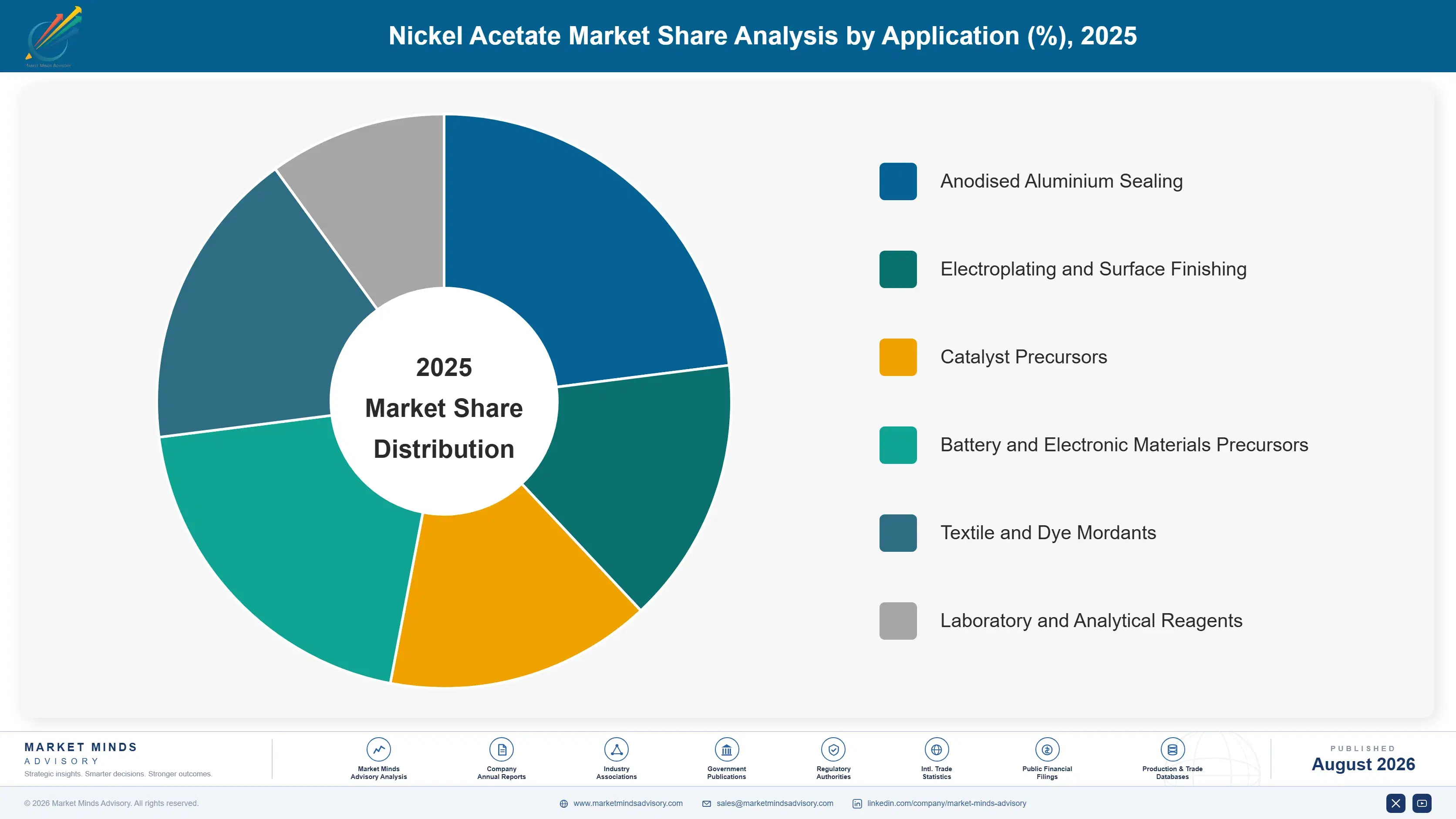
Around 48% of this salt seals anodised aluminium, and nickel compounds carry carcinogen and skin sensitiser classifications in Europe that keep the application under sustained substitution pressure. Nickel-free sealing has taken roughly 16% of European lines. The direction is one way, and it is slow. Corrosion testing sets the pace.
Battery and electronic materials precursors grow at 6.9%, half again the market rate of 4.6%, on thin film deposition, catalyst preparation and specialty electronic chemistries where nickel acetate's solubility and clean decomposition matter more than its price does. East Asia holds 38% of value because aluminium extrusion and anodising capacity concentrate there in volumes nowhere else approaches. Catalyst precursors follow closely at 6.0%. Precursor purity is where the margin sits.
Nickel metal accounts for roughly 71% of production cost, which makes this a pass-through business wearing a specialty chemical label. Indonesian supply expansion has held nickel prices low since 2023, easing input cost while capping what producers can charge. Five producers hold 34% of supply, and none of them controls the variable that matters most. Supplying the nickel-free sealing chemistry is the only real defence available. Producers watch extrusion volumes instead of Brussels and Jakarta.
Market Definition
This report covers nickel acetate, principally the tetrahydrate, supplied in commercial and reagent grades across anodised aluminium sealing, electroplating and surface finishing, catalyst precursors, battery and electronic materials precursors, textile and dye mordants, and laboratory and analytical reagents. Value is measured at producer level on tonnage of nickel acetate tetrahydrate supplied. Excluded are other nickel salts including sulphate, chloride, carbonate and nitrate, nickel metal and powders, formulated plating and sealing baths sold as complete products, and nickel catalysts sold in finished supported form.
Base Year Value
$0.2B in 2025 (MMA Primary Research Dataset, August 2026)
Forecast Period
2026 to 2036, eleven discrete annual values
CAGR
4.6% base case. Bull 5.8%. Bear 3.4%.
Fastest Growth Segment
Battery and Electronic Materials Precursors: 6.9% CAGR
Fastest Growth Country
India: 7.4% CAGR
Fastest Growth Region
South Asia and Pacific: 6.6% CAGR
Largest Region
East Asia: 38% of 2025 global value
Market Leaders
Umicore, Shepherd Chemical Company, Jinchuan Group, Coremax Corporation and Hunan Brunp lead the market. Source: MMA Primary Research Dataset, July 2026.
Primary Survey
n=3,800 procurement and R&D decision-makers, Q4 2025, six countries
Methodology
Demand-side build-up, cross-validated against public data, 47 expert interviews

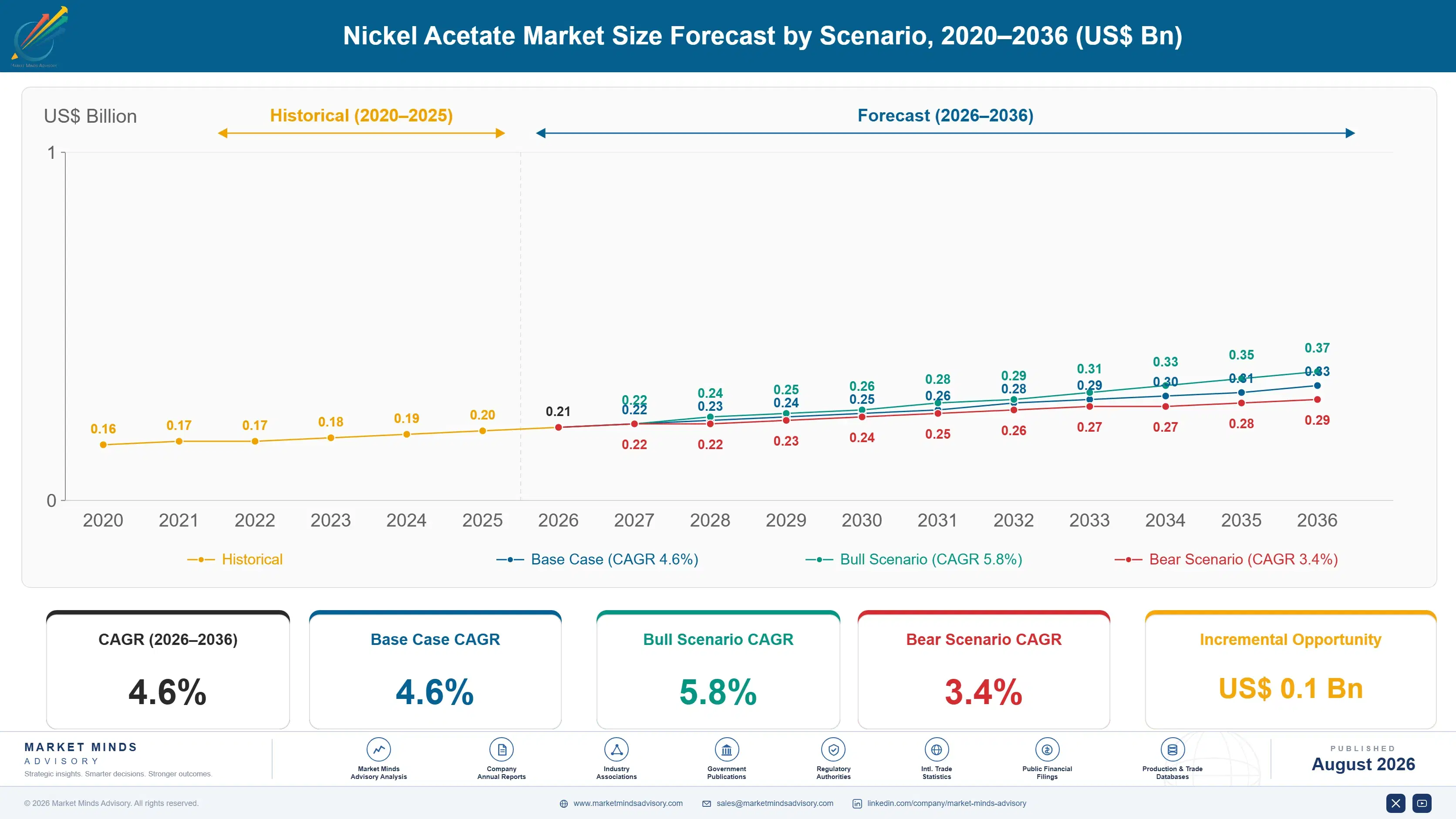
Nickel Acetate Market Forecast Scenarios

nickel-acetate-market-trends-size-forecast-scenario-1787555930420
Growth ran at 3.8% between 2020 and 2025 and it was governed by two things happening at once in opposite directions. Architectural and consumer electronics anodising volumes expanded steadily, particularly across Asian markets, while European sealing lines began converting to nickel-free chemistries under regulatory pressure. Nickel price movement meanwhile made reported value considerably more volatile than the underlying tonnage ever was.
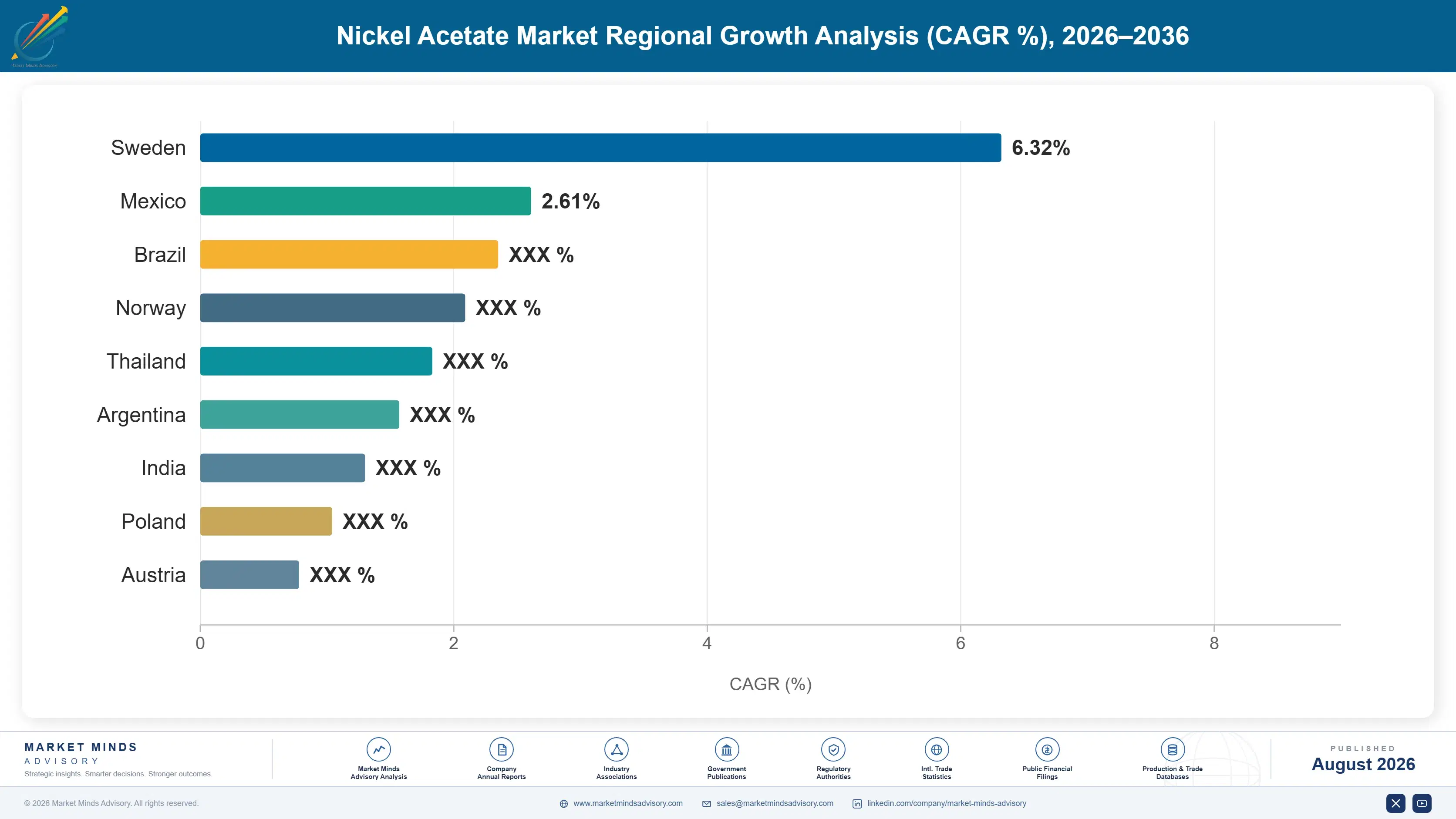
The 4.6% base case rests on three mechanisms. Asian aluminium extrusion and anodising growth, which continues expanding the sealing application faster than European conversion shrinks it. Battery and electronic materials precursors at 6.9%, where solubility and clean thermal decomposition matter more than price. And Indian growth at 7.4%, the fastest of any country, on construction aluminium and electronics manufacturing expanding together. New Asian capacity operates under no nickel restriction at all.
The 5.8% bull case is nickel-free sealing stalling on corrosion test performance, which has repeatedly failed to match hot nickel sealing under salt spray conditions. The 3.4% bear case is European authorisation tightening further on nickel compounds, which would accelerate conversion beyond the current 16% and set a precedent other jurisdictions follow. Other jurisdictions have historically followed European substance classifications with a lag.

A Salt Decided Elsewhere

Nickel acetate is a small salt whose commercial fate gets decided in rooms where nobody is discussing nickel acetate. Around 48% of volume goes into sealing anodised aluminium, closing the pore structure of the oxide layer in a near-boiling bath at about 96 degrees, and it does that job better than anything else found so far. Nickel compounds also carry carcinogen and skin sensitiser classifications under European rules, which places the whole application inside a regulatory process aimed at nickel generally rather than at this salt specifically.
TOP-FIVE CONCENTRATION34%Combined position across supply held by the leading salt producers
ANODISING SEAL APPLICATION SHARE48%Portion of volume consumed sealing anodised aluminium surfaces
NICKEL INPUT COST SHARE71%Portion of production cost attributable to the metal input
NICKEL-FREE SEAL PENETRATION16%Share of anodising lines converted away from nickel chemistry
SEALING BATH TEMPERATURE96 COperating point required for hot sealing of anodised coatings
EUROPEAN VOLUME SHARE18%Portion of demand sitting inside the tightest regulatory jurisdiction
Conversion away has been slower than the regulatory direction implies, and the reason is technical rather than commercial. Nickel-free sealing chemistries based on rare earth salts and silicates seal adequately but have repeatedly underperformed hot nickel sealing on salt spray corrosion testing, which architectural specifications treat as pass or fail. Roughly 16% of European lines have converted. Anodisers outside Europe have converted far less, because nothing compels them to.
The other governing fact is cost. Nickel metal represents around 71% of production cost, so this is a pass-through business wearing a specialty label, and Indonesian supply expansion has set the price since 2023.
"Producers here spend their time watching aluminium extrusion volumes when they should be watching two things they cannot influence at all: what Europe decides about nickel compounds generally, and what Indonesia does to the metal price. The salt itself is the least interesting variable in its own market."
Director, Metal Salts and Surface Treatment Chemicals Practice · MMA Chemicals and Materials Practice · August 2026

Market Trends

Nickel-free sealing advances slowly against corrosion test performance

European regulatory pressure on nickel compounds has pushed anodisers toward rare earth and silicate sealing chemistries, and roughly 16% of European lines have converted so far. Progress is slow because the alternatives seal adequately but have repeatedly underperformed hot nickel sealing under salt spray corrosion testing, which architectural specifications treat as a pass or fail criterion rather than a comparative measure. Commercially this gives producers a longer runway than the regulatory direction suggests, though the direction itself has never reversed and conversion continues line by line. Equipment replacement cycles set the pace more than policy does.
Market Impact: Indian demand compounds at 7.4%
Precursor demand grows on solubility rather than on price

Battery materials work, thin film deposition, catalyst preparation and specialty electronic chemistries all use nickel acetate as a precursor because it dissolves cleanly in both water and organic solvents and decomposes to oxide without leaving halide or sulphate residues behind. Growth at 6.9% is the fastest here and the buyers are indifferent to price at these volumes. Purity specifications run far tighter than plating grade demands, and reaching them requires recrystallisation capability that commodity salt producers have generally not built or maintained. Volumes are small and qualification runs deep across production campaigns.
Market Impact: Serves 38% East Asian value share

Market Opportunities and Growth Drivers

Asian aluminium extrusion expands the sealing application steadily

Chinese, Indian and Southeast Asian aluminium extrusion for building facades, window systems and consumer electronics housings continues expanding, and anodised finishes require sealing regardless of where the extrusion happens. Indian growth at 7.4% leads every country in this market and rests on construction activity and electronics assembly growing together. None of that capacity operates under European nickel restrictions, so conversion pressure is effectively absent. The volume being added outside Europe currently exceeds the volume being converted inside it by a comfortable margin. Domestic salt producers serve most of that capacity locally.
Market Impact: Places 48% of demand under review

Consumer electronics anodising demands consistent seal quality

Anodised aluminium housings on phones, laptops and audio equipment require finish consistency that architectural work never demands, since a visible colour variation or seal defect on a consumer device is a rejected part rather than an acceptable tolerance. That raises purity requirements on the sealing salt and rewards producers with tight impurity control. Volumes are concentrated among a small number of Asian contract manufacturers who qualify suppliers carefully and change them rarely. Price sensitivity is genuinely lower than in architectural anodising work. Colour consistency across a production batch is the recurring technical demand.
Market Impact: Metal drives 71% of cost

Market Restraints and Challenges

Nickel compound classification threatens the largest application

Nickel compounds carry carcinogen and skin sensitiser classifications under European rules, and the resulting authorisation and substitution pressure applies to the category rather than to nickel acetate specifically. The root cause is toxicological work on nickel exposure generally, which no producer of this salt can influence or argue against on its own behalf. Commercially it puts 48% of demand under permanent review in the tightest jurisdiction. Producers are qualifying rare earth and silicate alternatives themselves rather than waiting to lose the volume outright. Losing a converted line ends that demand rather than reducing it.
Market Impact: Converts 16% of European lines

Metal price movement passes through faster than contracts adjust

Nickel accounts for roughly 71% of production cost, and the metal is exchange traded with a demonstrated capacity to become untradeable rather than merely expensive, as the 2022 squeeze showed when trading halted and executed trades were cancelled. The root cause is that a small salt business sits downstream of a global metal market it has no influence over. Commercially, annual customer contracts cannot absorb that. Producers are moving toward metal-indexed pricing with short reset periods, which customers accept reluctantly. Indonesian supply expansion has since pushed the metal price down sharply.
Market Impact: Segment compounds at 6.9% annually
3 additional market trends, 4 additional growth drivers, and 2 additional restraints and challenges are covered in the full report. Contact sales@marketmindsadvisory.com to access the complete intelligence.

Segment CAGR and Growth Architecture

Volume is classified here by end application, since purity requirement and price tolerance differ enormously between an anodising line consuming tonnes each month and a precursor customer buying kilogrammes. Hydrate form, supply channel and grade specification are handled separately in the framework below, because the same base material serves several different applications after purification.
nickel-acetate-market-trends-market-share-analysis-1787555930980

Battery and Electronic Materials Precursors

Growing at 6.9%, half again the market rate, this segment covers nickel acetate used as a precursor in thin film deposition, catalyst preparation, battery materials research and specialty electronic chemistries. The acetate is chosen over sulphate or chloride because it dissolves cleanly in water and organic solvents alike and decomposes to nickel oxide without leaving halide or sulphate residues that would poison the finished material. Buyers at these volumes are effectively indifferent to price. Purity specifications run far tighter than plating grade, which requires recrystallisation and impurity control capability that most commodity salt producers never built or have since allowed to lapse. Qualification depth makes these positions unusually durable once they are actually won.
CAGR 6.9%

Catalyst Precursors

Nickel acetate serves as a soluble starting point for supported nickel catalysts used in hydrogenation, reforming and various fine chemical syntheses, where impregnation from an acetate solution gives better metal dispersion across the support than harsher salts achieve. Growth at 6.0% follows catalyst manufacturing rather than any development in nickel chemistry itself. Volumes per customer are moderate and qualification is thorough, since a catalyst manufacturer validating a precursor commits to it across production campaigns. Trace metal impurities matter greatly because they carry through into the finished catalyst and affect its selectivity. Requalifying a precursor means repeating catalyst performance testing across a full campaign, which nobody undertakes to save money on a modest input line.
CAGR 6.0%
Full segment breakdown across 6 segments available in the complete report.

Regional Architecture and Country Demand Map

East Asia holds 38% of value because aluminium extrusion and anodising capacity concentrate there, well above the standard regional band and noted here as an exception. North America follows at 19% on surface finishing and precursor demand, also outside its usual band and stated here as an exception.

East Asia

At 38% this region sits well above the standard band, and the reason is that Chinese aluminium extrusion and anodising capacity operates at a scale nothing elsewhere approaches, covering building systems, window frames and consumer electronics housings together. Chinese producers including Jinchuan and several regional salt makers supply most of that demand domestically at prices international producers do not attempt to match. Japanese and Korean producers hold the tighter purity positions serving electronics anodising and precursor applications. Nickel-free sealing conversion is minimal here since no regulation requires it. Growth at 5.6% tracks extrusion volume. Taiwanese electronics anodising is technically demanding and buys on impurity control. Precursor grade capability across the region is improving steadily as battery materials work expands.
Share: 38% | CAGR: 5.6% (2026 to 2036)

North America

At 19% this region sits below the standard band, because architectural anodising capacity is smaller than in Asia and a considerable share of finished anodised product is imported rather than processed domestically. Surface finishing and electroplating demand is proportionally stronger than architectural sealing. Shepherd Chemical holds a long-established position in nickel salts serving both plating and precursor customers. Battery materials research demand has grown with domestic cell manufacturing investment. Growth at 4.0% sits below the market rate and follows industrial finishing activity rather than any construction cycle. Canadian and Mexican finishing operations buy through the same suppliers under cross-border arrangements. Regulatory pressure on nickel compounds is present but considerably weaker than the European position.
Share: 19% | CAGR: 4.0% (2026 to 2036)
Regional intelligence for 5 additional markets available in the complete report: Western Europe, South Asia and Pacific, Latin America, Middle East and Africa, Eastern Europe. Contact sales@marketmindsadvisory.com.
nickel-acetate-market-trends-country-cagr-analysis-1787555931494

Where This Salt Still Earns

Four moves matter for a producer whose largest application sits under regulatory review and whose cost base is set by a metal exchange it cannot influence. Two concern managing the sealing business honestly rather than hopefully, and the other two concern building positions in applications where purity rather than price decides who actually supplies them.

Qualify nickel-free chemistries rather than defending the seal

Roughly 16% of European anodising lines have converted away from nickel sealing and the direction has never reversed, even though corrosion test performance keeps the pace slow. A producer who qualifies rare earth and silicate sealing chemistries themselves keeps the customer relationship when the line converts, instead of losing both the volume and the account together. The alternative is defending an application that regulation will eventually take. Several European producers have already made this move and it costs less than the volume at risk. Losing the sealing volume usually takes the plating business with it.
Market Impact: Protects against 16% and rising line conversions today

Build recrystallisation capability for precursor purity

Battery, electronic and catalyst precursor customers specify trace metal limits far tighter than plating grade requires, and reaching them needs recrystallisation and impurity control that most commodity salt producers never built. Those segments grow at 6.9% and 6.0% respectively, and buyers at those volumes are effectively indifferent to price. A producer with purity capability sells into demand that regulation is not threatening, at margins the anodising business has never approached. The capital involved is modest against the position it buys. Qualification takes time and the resulting positions are unusually durable.
Market Impact: Serves segments growing at 6.9% and 6.0% respectively

Index customer pricing to the metal, not the calendar

Nickel at roughly 71% of production cost means annual fixed pricing transfers the entire exposure of a globally traded metal onto a small salt producer. The 2022 squeeze demonstrated that the input can become untradeable rather than simply expensive, which no contract term anticipated. Indexing to published nickel benchmarks with monthly or quarterly reset removes the exposure. Customers resist because their own anodising contracts run annually, which makes this a negotiation rather than a formality, and it is worth having. Working capital exposure improves alongside the margin volatility. Distributors accept indexed terms far more readily.
Market Impact: Removes exposure sitting on 71% of total cost

Follow Asian extrusion growth rather than European volume

Anodising capacity being added across India, Southeast Asia and the Gulf operates under no nickel restriction at all, and that new volume currently exceeds what European conversion removes by a comfortable margin. Indian growth at 7.4% leads the market. Producers organised around European and North American customers are serving the two regions where the application is shrinking or flat, while the growth sits with extruders they have never called on and distributors they do not use. Distribution reach and local technical support matter more than production cost in those markets, since extruders there expect application help on site.
Market Impact: Follows demand now growing at 7.4% each year

Who Controls the Margin Pool

Five producers hold 34% of supply, measured on tonnage of nickel acetate tetrahydrate supplied, the basis used throughout this section. Concentration is modest because the chemistry is straightforward and the barrier is purity rather than process, so regional producers serve regional demand wherever nickel feedstock is available. What separates participants is impurity control and access to nickel units, not any reaction skill.
Competition runs on three dimensions. Purity capability, which decides whether a producer can serve precursor and electronics customers or is confined to anodising lines. Nickel feedstock access, since the metal accounts for 71% of cost and integrated producers hold a permanent advantage that no purchasing skill closes. And regulatory positioning in Europe, where holding an alternative sealing chemistry keeps accounts that conversion would otherwise remove entirely from the supplier.

Rankings shift toward producers with precursor purity capability and toward Chinese and Indian participants sited alongside extrusion demand as it expands. European producers face a shrinking home application and are adapting by qualifying substitute chemistries themselves. Integrated nickel producers hold cost positions that merchant salt makers cannot approach at all, and that gap widens whenever metal prices move sharply.
nickel-acetate-market-trends-company-positioning-matrix-1787555932005

Competitive Moat and Risk Dimensions

UMICORE

Moat: Nickel chemistry breadth and purity

The company operates across nickel and other metal chemistries with purity capability serving catalyst, electronic and battery precursor customers rather than only surface finishing, which places it in the segments growing fastest and least exposed to regulatory substitution. Recycling and refining integration also gives it nickel unit access that merchant salt producers must buy on open markets.
UMICORE

Risk: European application shrinking underneath

European anodising sealing volume is converting away from nickel at roughly 16% of lines and rising, and Europe is where this position is strongest. Growth meanwhile sits in Asian extrusion markets where regional producers hold cost advantages. Serving the precursor segments compensates only partially, since those volumes are small against the sealing tonnage being lost.
JINCHUAN GROUP

Moat: Integrated nickel unit access

Nickel represents roughly 71% of production cost, and integration back into nickel mining and refining converts that into a cost position no merchant salt producer can approach through purchasing skill. The company also sits inside the largest anodising market in the world, which removes freight and gives direct access to extrusion customers as they add capacity.
JINCHUAN GROUP

Risk: Purity limits on precursor grades

Precursor and electronics customers specify trace metal limits well beyond plating grade, and reaching them needs recrystallisation capability that volume-oriented production has generally not required. Those segments grow at 6.9% and 6.0% while anodising grows more slowly. Japanese and European producers hold those qualifications and defend them on specification rather than on delivered price.

Players Tracked

Prominent Players

Umicore
Shepherd Chemical Company
Jinchuan Group
Coremax Corporation
Hunan Brunp

Other Key Players

American Elements
Sumitomo Metal Mining
Nihon Kagaku Sangyo
Vale
Norilsk Nickel
Guangxi Yinyi Technology
Jiangsu Kaida Chemical
Shandong Jinling Group
Faci
Strem Chemicals
GHTech
Hunan Jinhui
Zhejiang Kingway
Chengdu Best New Materials
Merck KGaA

Recent Developments

FEBRUARY 2025

A European anodiser converted architectural lines to nickel-free sealing

A European architectural anodising operation completed conversion of several production lines to rare earth based sealing chemistry, following salt spray corrosion validation against the specifications its facade customers apply. This was an internal process change rather than any commercial transaction between chemical producers. Facade specifications governed the timing.
Signal: Conversion proceeds line by line as equipment cycles, which makes the trend slow, continuous and effectively irreversible
JULY 2025

A salt producer commissioned recrystallisation capacity for precursor grades

A nickel salt producer commissioned recrystallisation and impurity control capacity targeting battery, catalyst and electronic precursor customers whose trace metal specifications exceed anything plating grade production reaches. This was organic capital investment rather than any acquisition, merger or joint venture arrangement. Existing crystalliser capacity was adapted.
Signal: Purity capability is becoming the dividing line between producers with growth and those tied to sealing volume
DECEMBER 2025

An Indian extruder commissioned anodising capacity for construction systems

An Indian aluminium extruder commissioned additional anodising capacity serving window and facade system demand, operating conventional hot nickel sealing since no domestic regulation restricts it. This was organic capacity investment rather than any partnership or acquisition involving a chemical supplier. Facade system demand drove the timing entirely.
Signal: New capacity outside Europe still specifies nickel sealing, which currently adds more volume than European conversion removes

What Governs Producer Margin

Nickel units account for roughly 71% of production cost, arriving as metal, carbonate or hydroxide depending on the producer's route and integration. Acetic acid adds around 9% and is comparatively stable. Reaction energy, crystallisation and drying take most of the remainder, and recrystallisation for precursor grades adds cost disproportionate to the volume it serves. Conversion margin is thin throughout.
Nickel became untradeable rather than merely expensive during the March 2022 exchange squeeze, when trading halted and executed trades were cancelled, and prices have since fallen substantially as Indonesian supply expanded through 2023 and 2024. Vale recorded nickel price weakness across its base metals operations in its Annual Report 2024. Salt producers on annual fixed contracts gained on the way down and had been badly exposed on the way up.

The disadvantage falls on merchant producers without nickel integration, and it appears as margin volatility rather than as a persistent cost gap. An integrated producer transfers nickel internally and prices the salt against the market, while a merchant buyer funds metal at spot and sells against annual contracts. Smaller regional producers feel this most, since they lack both integration and the purchasing scale to secure favourable terms.
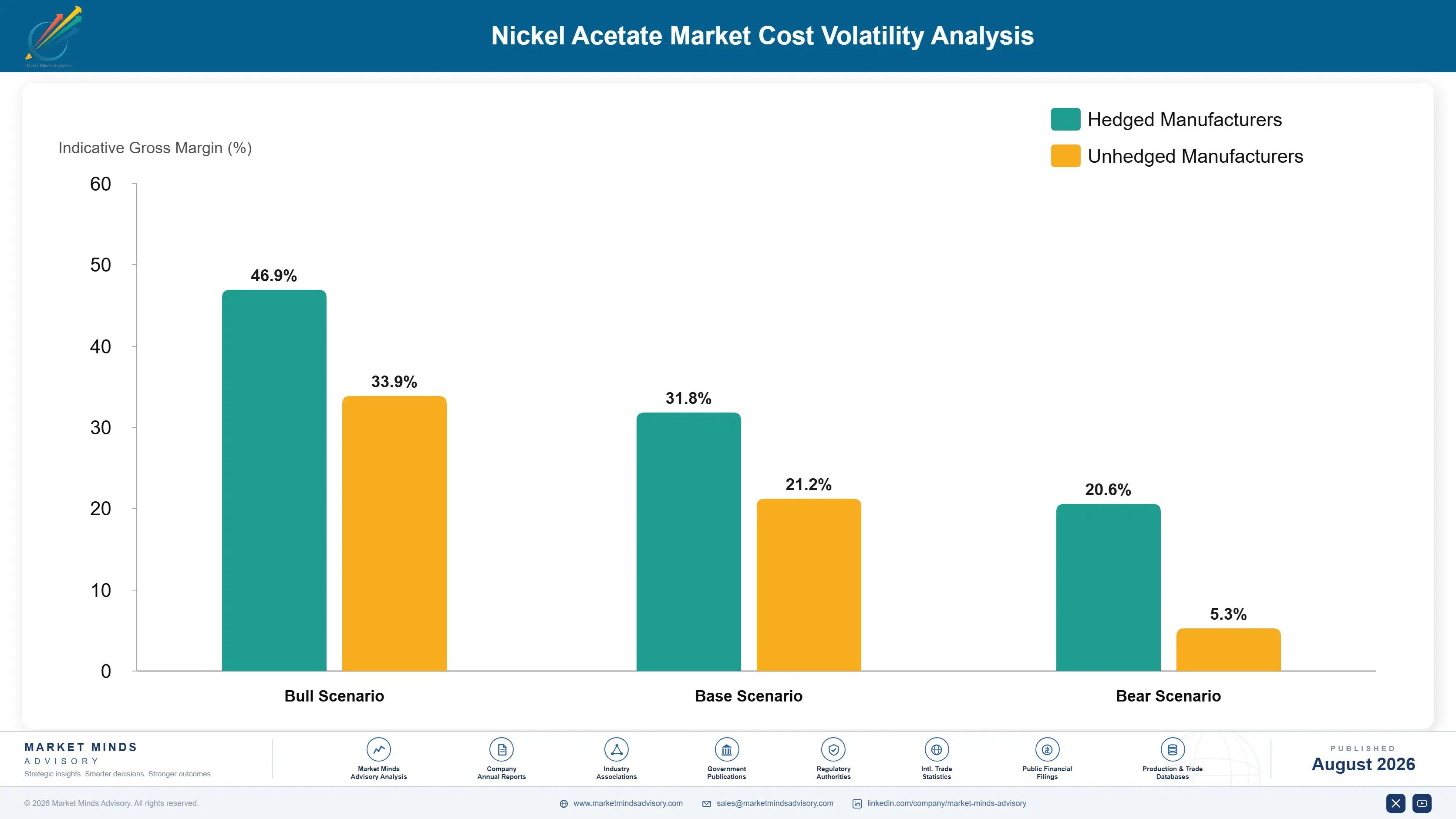
nickel-acetate-market-trends-cost-volatility-analysis-1787555932201

Index salt pricing to published nickel benchmarks with short resets

Metal at 71% of cost makes annual fixed pricing an unhedged position on a globally traded commodity that has demonstrated it can stop trading altogether. Monthly or quarterly indexed reset transfers the exposure back where it belongs. Anodising customers resist because their own contracts run annually, so this needs negotiating rather than announcing. Distributors accept indexing more readily.

Secure nickel units through offtake rather than spot purchasing

Merchant producers funding metal at spot while selling against fixed contracts carry the volatility twice over, in price and in working capital. Multi-year offtake with a refiner stabilises both, at a modest premium over average spot. The 2022 squeeze showed that availability rather than price is the exposure that actually stops production. Availability is the exposure that actually stops production.

Load recrystallisation capacity across multiple precursor accounts

Purification for precursor grades costs more per tonne than the anodising business would ever justify, and a single customer rarely provides enough throughput to amortise it. Spreading the capacity across catalyst, battery and electronic accounts changes the economics considerably. Producers running purification for one qualified customer carry capital that better-loaded competitors recover easily. Utilisation decides whether the investment pays back.

Portfolio Architecture for Margin Defence

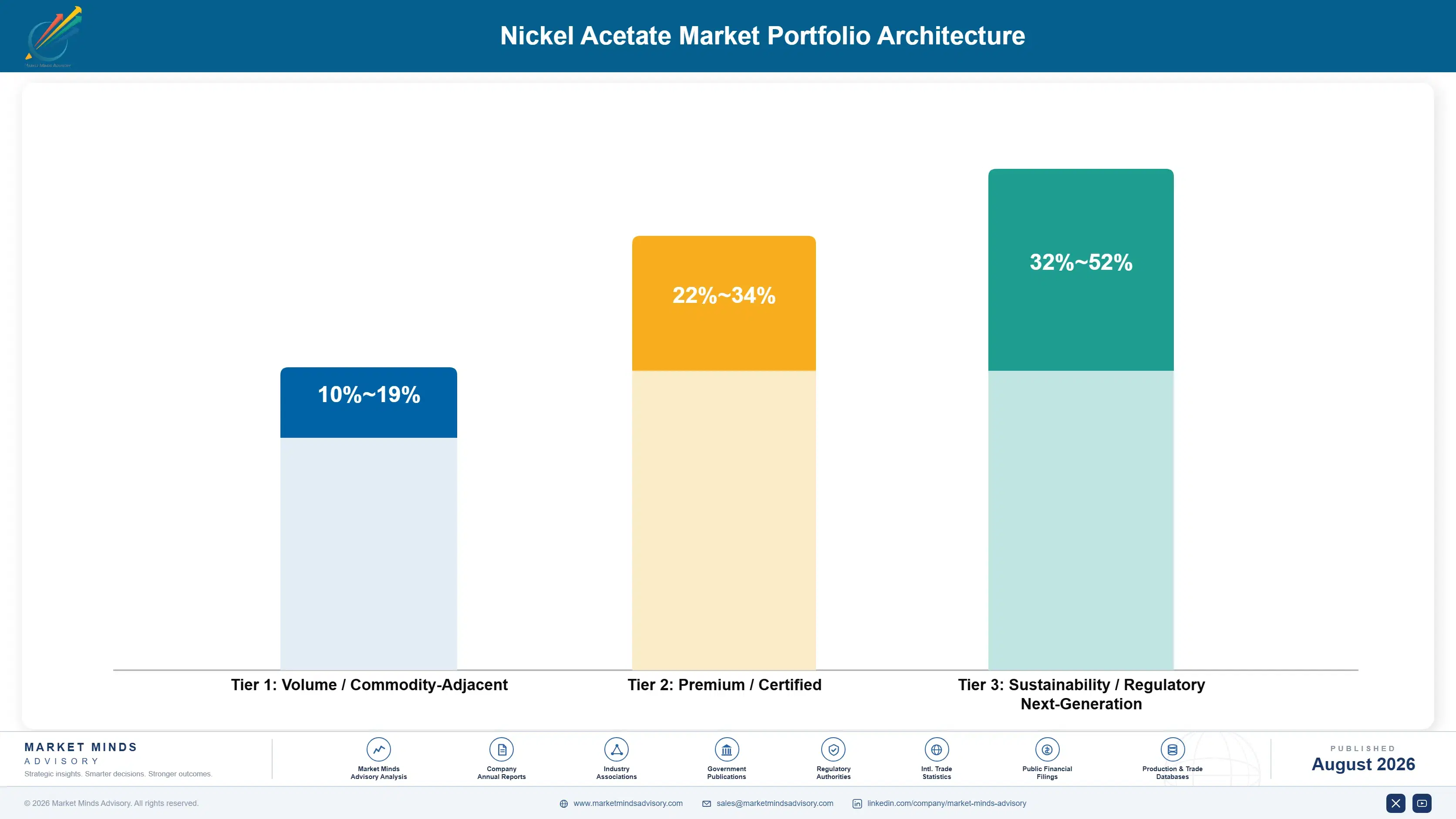
Margin here separates on purity and on nickel integration rather than on scale, since the reaction itself is elementary and any competent operation can run it. Anodising sealing grade sold into extrusion operations runs at gross margins in the low teens against regional producers with local nickel access. Electroplating and industrial finishing grades run modestly better on consistency requirements. Catalyst and electronic precursor grades run considerably higher, because trace metal specifications narrow the qualified field to very few suppliers.
The tension is that sealing volume fills the crystallisers while precursor grades earn the returns, and the sealing volume is precisely what European regulation is removing. Producers weighted toward anodising face a shrinking application and thin margins simultaneously, which is an uncomfortable position from which to fund purification capital. Several have deferred that investment and are now watching precursor qualifications go to competitors who did not defer it.

High-value pools sit in precursor grades, in electronics anodising where finish consistency matters, and in Asian extrusion growth. European architectural sealing is where the volume is being designed out one line at a time. The volume being added in Asia currently exceeds it, which buys time rather than solving anything.

Volume / Commodity-Adjacent

Anodising sealing grade sold into architectural extrusion operations on delivered price. The nine-point range separates producers with nickel integration or local supply from merchant buyers funding metal at spot against fixed contracts.
Gross Margin: 10%-19%

Premium / Certified

Electroplating, industrial finishing and consumer electronics anodising grades where impurity control affects finish consistency directly. The twelve-point spread reflects purity capability rather than any difference in the underlying reaction chemistry.
Gross Margin: 22%-34%

Sustainability / Regulatory / Next-Generation

Catalyst, battery and electronic precursor grades with trace metal specifications well beyond plating requirements. The twenty-point range is wide because qualification depth and specification tightness vary enormously between individual customers and applications.
Gross Margin: 32%-52%
nickel-acetate-market-trends-portfolio-architecture-1787555932702

High-value Sub-segments and Strategic Watch-out

Precursor Purity Grades

Compounding at 6.9% on thin film, battery and catalyst demand where clean decomposition matters and price barely registers. Recrystallisation capability is the qualifying barrier, and most commodity producers have never built or maintained it. Buyers in this segment barely notice the price that they actually pay.
Gross Margin: 34%-52%

Electronics Anodising Supply

Consumer device housings demand finish consistency that architectural work never requires, since a visible defect is a rejected part. Qualification runs deep and suppliers change rarely, which makes these positions unusually durable once won. Impurity control rather than delivered cost is what decides who qualifies here.
Gross Margin: 24%-34%

Architectural Sealing Volume

Around 48% of the market and the piece European regulation is removing at roughly 16% of lines and climbing. Manage this for Asian growth and nickel cost pass-through rather than for any European defence. Conversion removes whole lines permanently rather than reducing their demand gradually.
Gross Margin: 10%-19%

Nickel-Free Alternative Chemistry

Rare earth and silicate sealing that producers can supply themselves rather than lose the account entirely. The wide range reflects an immature competitive field where pricing has not settled and corrosion performance still varies. Supplying it is the only thing that keeps the account through conversion.
Gross Margin: 18%-38%

How Salt Demand Renews

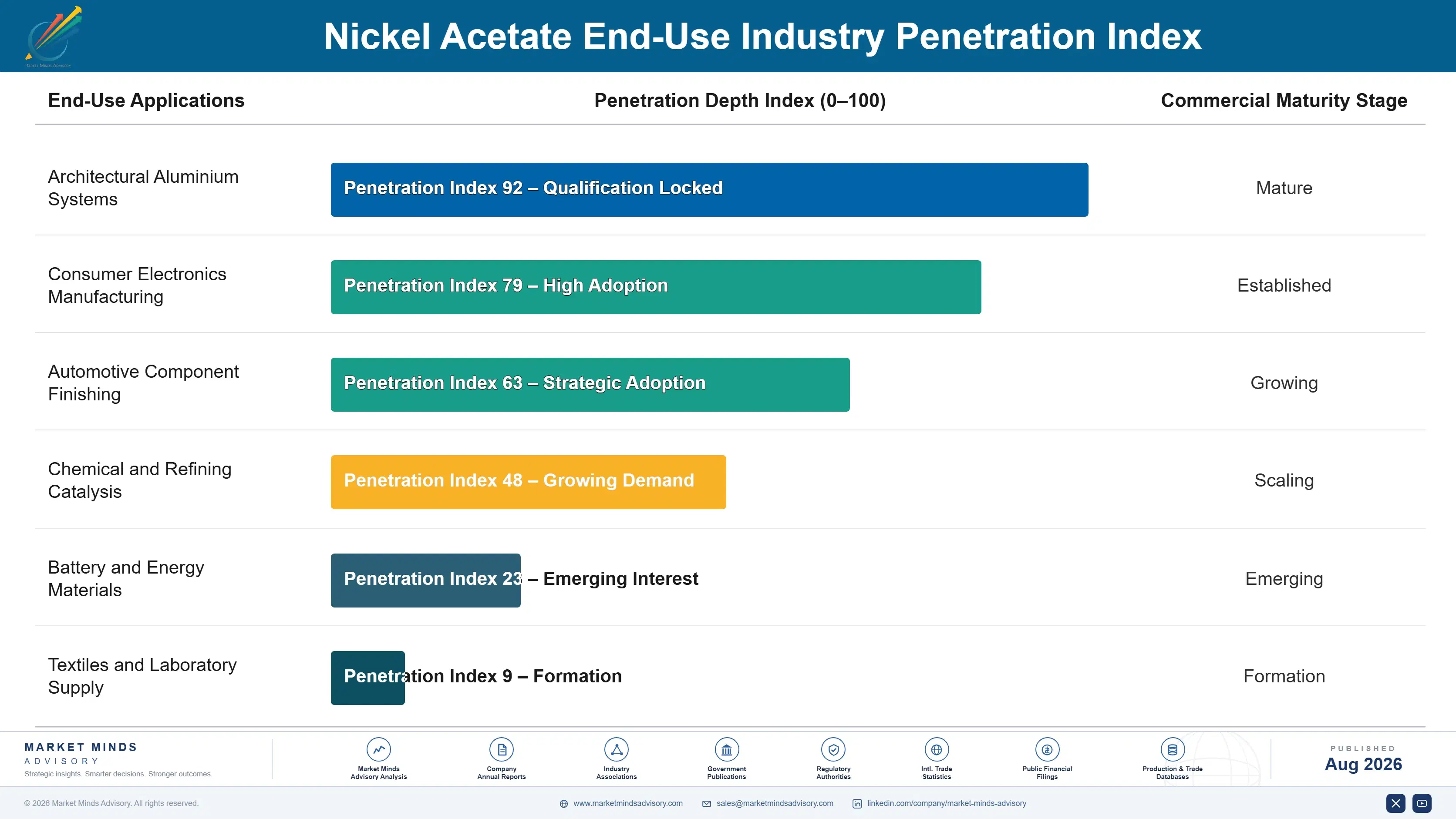
Demand renews as bath consumption inside operating finishing lines, which produces a steady annuity tied to production hours rather than to any purchasing decision. An anodising line running near 96 degrees consumes sealing salt continuously and reorders on a predictable cycle, so the revenue arrives whether or not anyone is thinking about it. That reliability is precisely why regulatory substitution matters so much: losing a line does not reduce demand gradually, it ends it.
Adoption depth varies sharply by vertical and it follows how much a defect costs. Consumer electronics anodising qualifies suppliers thoroughly and changes them rarely, because a visible finish defect is a scrapped housing. Catalyst and precursor customers validate across production campaigns and switch even less readily. Architectural anodising treats sealing salt as a consumable purchased on delivered price, and those accounts move whenever a competitor quotes lower.

The buyer has moved partly from purchasing toward environmental and regulatory affairs, at least in Europe. Sealing salt was a consumables decision made by a line manager. It now involves people assessing substance classification and substitution obligations, and those people are not persuaded by corrosion test data alone.
nickel-acetate-market-trends-end-use-penetration-index-1787555933188

Where To Place The Bet

These are among the four positions where our research anticipates prominent divergence between winners and laggards over the coming forecast period. Each is grounded in the demand model, the regulatory perimeter, and the announced capacity pipeline.
01 / SUBSTITUTE CHEMISTRY QUALIFICATION

Supply the replacement before somebody else does

Roughly 16% of European anodising lines have already converted away from nickel sealing and the regulatory direction driving that has never once reversed, even though corrosion test performance keeps the actual pace considerably slower than the rhetoric implies. A producer who qualifies rare earth and silicate sealing chemistries keeps the customer relationship through conversion instead of losing the volume and the account at the same moment. Several European producers have made exactly this move and it costs materially less than the tonnage at risk.
02 / PRECURSOR PURITY INVESTMENT

Build recrystallisation before the sealing volume goes

Catalyst, battery and electronic precursor customers specify trace metal limits far tighter than any plating grade requires, and reaching those limits demands recrystallisation and impurity control that most commodity salt producers have never built or have quietly allowed to lapse. Those segments compound at 6.9% and 6.0% while buyers remain effectively indifferent to price at the volumes involved. Funding that capital from a shrinking sealing business gets harder every year, which argues strongly for doing it now rather than later.
03 / METAL EXPOSURE MANAGEMENT

Index to nickel rather than to the contract calendar

Nickel represents roughly 71% of production cost and the 2022 exchange squeeze demonstrated that the input can become untradeable rather than merely expensive, with trading halted and executed transactions cancelled outright. Annual fixed pricing therefore hands a small salt producer an unhedged position on a globally traded metal it has no ability to influence. Monthly or quarterly indexed reset moves that exposure back toward the party genuinely able to absorb it, and customers will negotiate the terms rather than simply refusing outright.
04 / ASIAN EXTRUSION COVERAGE

Sell where anodising capacity is still being built

Anodising capacity being added across India, Southeast Asia and the Gulf operates under no nickel restriction whatsoever, and that new volume currently exceeds what European conversion removes by a comfortable and persistent margin. Indian country growth at 7.4% leads this entire market on construction extrusion and electronics assembly together. Producers organised around European and North American accounts are covering the two regions where this application is flat or shrinking, while the growth sits with extruders they have never called on.

Engagement Snapshot From the Field

A live engagement with an industry participant carrying material or product regulatory and market exposure ahead of a defining policy shift, showing how our research translates into a defensible multi-year portfolio strategy.
MARKET MINDS ADVISORY · CLIENT ENGAGEMENT SUMMARY
Nickel Acetate Producer Strategic Portfolio Review and Transition Roadmap 2026·Investment Scenario on Nickel Acetate Exposure Evaluation 2025-26
CLIENT PROFILE
A European nickel salt producer with annual revenue around EUR 46 million (client-reported, unverified by MMA), supplying anodising sealing and plating grades across European and North African markets. Precursor purity capability did not exist. Nickel was purchased entirely on spot terms. Customer contracts were annual and fixed price throughout. Distribution reached into North Africa directly.
STRATEGIC CHALLENGE
Sealing volume had declined for three consecutive years (client-reported, unverified by MMA) as European anodisers converted to nickel-free chemistry, and management proposed price reductions to slow it. Nobody had asked whether converted lines ever return, or what the business would consist of in a decade. Neither question had been asked.
MMA APPROACH
MMA separated volume decline into conversion loss, competitive loss and end-market softness rather than treating it as one problem. Recrystallisation investment was modelled against precursor customer requirements and realistic qualification timelines. Nickel purchasing exposure was quantified across the contract book, and alternative sealing chemistry supply was assessed as a retention option.
KEY FINDINGS
  1. Every line lost to nickel-free conversion was permanent, which meant price reduction could not recover any of it and would simply reduce margin on the volume still remaining.
  2. Two catalyst manufacturers within existing distribution reach were importing precursor grade material the client could produce with modest recrystallisation investment on existing equipment.
  3. Fixed annual pricing against spot nickel purchasing had cost more in one adverse year than three years of the disputed price concessions would have amounted to in total.
  4. Rare earth sealing chemistry could be sourced and resold, retaining converted accounts at lower margin rather than losing them and the associated plating volume entirely.
CLIENT PROFILE
A European nickel salt producer with annual revenue around EUR 46 million (client-reported, unverified by MMA), supplying anodising sealing and plating grades across European and North African markets. Precursor purity capability did not exist. Nickel was purchased entirely on spot terms. Customer contracts were annual and fixed price throughout. Distribution reached into North Africa directly.
STRATEGIC CHALLENGE
Sealing volume had declined for three consecutive years (client-reported, unverified by MMA) as European anodisers converted to nickel-free chemistry, and management proposed price reductions to slow it. Nobody had asked whether converted lines ever return, or what the business would consist of in a decade. Neither question had been asked.
MMA APPROACH
MMA separated volume decline into conversion loss, competitive loss and end-market softness rather than treating it as one problem. Recrystallisation investment was modelled against precursor customer requirements and realistic qualification timelines. Nickel purchasing exposure was quantified across the contract book, and alternative sealing chemistry supply was assessed as a retention option.
KEY FINDINGS
  1. Every line lost to nickel-free conversion was permanent, which meant price reduction could not recover any of it and would simply reduce margin on the volume still remaining.
  2. Two catalyst manufacturers within existing distribution reach were importing precursor grade material the client could produce with modest recrystallisation investment on existing equipment.
  3. Fixed annual pricing against spot nickel purchasing had cost more in one adverse year than three years of the disputed price concessions would have amounted to in total.
  4. Rare earth sealing chemistry could be sourced and resold, retaining converted accounts at lower margin rather than losing them and the associated plating volume entirely.
RECOMMENDED STRATEGY
Phase 1: Phase one: stop discounting sealing volume against conversion losses that no price will recover, and hold margin on the remaining anodising accounts instead. Phase 2: Phase two: invest in recrystallisation capacity and pursue the two identified catalyst precursor qualifications, which are reachable within existing distribution arrangements. Phase 3: Phase three: move customer contracts onto quarterly nickel-indexed pricing and secure metal through refiner offtake rather than continuing to purchase entirely at spot.
OUTCOME
Sealing margin stabilised once discounting stopped, with volume declining as forecast. One catalyst precursor qualification completed during 2026 and the second is in progress. Nickel indexing now covers most of the contract book, and the client reports earnings improving despite continued sealing decline (client-reported, unverified by MMA).

Frequently Asked Questions

Foundational context covering the market sizes, CAGR, scope, country, region and competition that inform every finding below. This section is provided to cover basics and most often pre-purchase conversations, answered from the MMA Primary Research Dataset.

What is the current size of the Nickel Acetate Market?

The market was valued at USD 0.19 billion in 2025, rising to an estimated USD 0.20 billion in 2026. East Asia holds the largest regional share at 38% of value.

How large will the Nickel Acetate Market be by 2036?

MMA forecasts USD 0.31 billion by 2036 under the base case, an expansion multiple of 1.57 times the 2026 value. That represents USD 0.11 billion of incremental value.

What is the CAGR for the Nickel Acetate Market 2026 to 2036?

The base case runs at 4.6% compound annual growth between 2026 and 2036, with a bull case at 5.8% and a bear case at 3.4%. Historical growth from 2020 to 2025 was 3.8%.

Which segment is growing fastest?

Battery and electronic materials precursors lead at 6.9%, half again the market rate, on clean decomposition and solubility that harsher nickel salts cannot match. Catalyst precursors follow at 6.0%.

Who are the major companies in the Nickel Acetate Market?

Umicore, Shepherd Chemical, Jinchuan Group, Coremax and Hunan Brunp hold 34% of supply. Purity capability and nickel feedstock access rather than reaction skill sustain those positions.

Which country is growing fastest?

India leads at 7.4%, driven by construction aluminium extrusion for window and facade systems, alongside electronics assembly that is expanding under domestic manufacturing incentive programmes.

Report Segmentation Architecture

The full report scope spans multiple orthogonal segmentation dimensions, with cross-tabulated demand data provided for each dimension pair. Coverage extends further to regional breakdowns, trend trajectories, and the competitive detail needed to support segment-level decision-making.

By Application

  • Anodised Aluminium Sealing
  • Electroplating and Surface Finishing
  • Catalyst Precursors
  • Battery and Electronic Materials Precursors
  • Textile and Dye Mordants
  • Laboratory and Analytical Reagents

By End-Use Industry

  • Architectural Aluminium Systems
  • Consumer Electronics Manufacturing
  • Automotive Component Finishing
  • Chemical and Refining Catalysis
  • Battery and Energy Materials
  • Textiles and Laboratory Supply

By Grade and Channel

  • Technical Sealing Grade
  • Plating Bath Grade
  • High Purity Precursor Grade
  • Reagent and Analytical Grade
  • Chemical Distributor Supply

By Region

  • North America
  • Western Europe
  • East Asia
  • South Asia and Pacific
  • Latin America
  • Middle East and Africa
  • Eastern Europe

Scope, Methodology, and Coverage

Every figure in this report is reproducible from documented input assumptions. The scope below maps the historical period, the forecast horizon, the segmentation dimensions, and the countries covered, alongside the underlying primary and qualitative methodology.
Historical Period
2020 to 2025
Forecast Period
2026 to 2036
Base Year
2025 (USD billions; MMA Primary Research Dataset, August 2026)
Market Definition
The market comprises nickel acetate, principally the tetrahydrate salt, supplied in technical, plating, high purity precursor and reagent grades across anodised aluminium sealing, electroplating and surface finishing, catalyst precursors, battery and electronic materials precursors, textile and dye mordants, and laboratory and analytical reagents. Value is measured at producer level on tonnage of nickel acetate tetrahydrate supplied through direct and distributor channels. Other nickel salts including sulphate, chloride, carbonate and nitrate, nickel metal and powders, formulated plating and sealing baths sold as complete products, and finished supported nickel catalysts fall outside scope.
Quantitative Units
USD billions (current prices); tonnes of nickel acetate tetrahydrate; USD per tonne by grade and application
Segmentation Dimensions
By Application; By End-Use Industry; By Grade and Channel; By Region
Regions Covered
North America, Western Europe, East Asia, South Asia and Pacific, Latin America, Middle East and Africa, Eastern Europe
Countries Covered
China, Japan, South Korea, Taiwan, India, Vietnam, Thailand, Malaysia, Australia, United States, Canada, Mexico, Brazil, Argentina, Colombia, Germany, Italy, Spain, France, Netherlands, United Kingdom, Belgium, Poland, Czechia, Romania, Turkey, Saudi Arabia, United Arab Emirates, Egypt, South Africa
Key Companies Profiled
Umicore, Shepherd Chemical Company, Jinchuan Group, Coremax Corporation, Hunan Brunp, American Elements, Sumitomo Metal Mining, Nihon Kagaku Sangyo, Vale, Norilsk Nickel, Guangxi Yinyi Technology, Jiangsu Kaida Chemical, Shandong Jinling Group, Faci, Strem Chemicals, GHTech, Hunan Jinhui, Zhejiang Kingway, Chengdu Best New Materials, Merck KGaA
Quantitative Methodology
Primary survey, n=3,800 respondents, Q4 2025, six countries; demand-side model with trade association cross-validation
Qualitative Methodology
47 expert interviews, Q4 2025; applied to validate demand model assumptions, identify emerging dynamics, and assess competitive positioning
Report Format
PDF and XLSX data workbook (Word format preview document)
Publisher
Market Minds Advisory
Report Code
MMA-2026-CHM-745
Published
August 2026
Contact
sales@marketmindsadvisory.com | www.marketmindsadvisory.com

Purchase the full Nickel Acetate Market Report (2026 to 2036).

The full report sizes the global nickel acetate market to 2036 across six applications and seven regions, measured on tonnage of tetrahydrate supplied at producer level. It tracks nickel-free sealing conversion line by line against the corrosion test performance that governs its pace, and separates the shrinking European application from Asian extrusion growth. Competitive analysis covers 20 producers on one consistent tonnage basis, with moat and risk assessment for the two leaders. Nickel cost pass-through is modelled against contract structure across the customer base. Four quantified revenue levers close the analysis.
Six-application segment sizing with individual growth rates
Nickel-free sealing conversion tracked by region and specification
Metal cost pass-through modelled against customer contract structure
Precursor purity requirements mapped against producer capability
Twenty-producer competitive map on one consistent tonnage basis
Four quantified revenue levers with commercial impact ranges

Built For The People Who Decide

From boardroom strategy to bench-side execution, this report is read cover-to-cover by leaders shaping the next decade of their industry, turning demand scenarios, market dynamics and valuation benchmarks into decisions.
CXOs/ Presidents/ VPs/ Managers
M&A and Corporate Development
Strategy Teams and R&D Heads
Procurement and Product Directors
Regulatory and Compliance Leaders
Investor Relations and Equity Analysts