Market Minds Advisory
NFC Tag ICs Market

NFC Tag ICs Market: NFC Tag ICs Market. Sensor Integration and Brand Authentication Redefine a Commodity Chip Category

Smart packaging authentication and embedded sensor tagging are pulling NFC tag ICs away from commodity pricing, forcing chipmakers to defend margin through memory depth and cryptographic feature differentiation rather than unit volume alone.

Lead Analyst

Published

September 2026

Make Smarter Decisions with Customized Research Insights

Request a free sample report and evaluate market opportunities, growth trends, and competitive dynamics relevant to your business needs.

2025 MARKET VALUE$2.1BMarket Size 2025
2036 FORECAST VALUE$7.0BBase Case , 2026 to 2036
CAGR 2026 TO 203611.5 %Bull 12.7% / Bear 10.3%
INCREMENTAL OPPORTUNITY$4.6BNet 10- year value creation
EXPANSION MULTIPLE2.97x2036 value over 2026 base
Strategic Levers
M&A Pipeline
Regional Outlook
Country Rankings
Competitive Intelligence
Segmental Deep-dive
Call-Us : 91 93563 13602

Executive Snapshot and Market Trajectory.

Brand owners are embedding NFC tag ICs into packaging to fight counterfeiting and enable consumer authentication scans, turning what was once a low-margin identification chip into a specified feature buyers now name explicitly in procurement contracts across pharmaceuticals and luxury goods alike.
Sensor-integrated tag ICs, capable of logging temperature or tamper events without an onboard battery, are the fastest-growing category, pulled forward by pharmaceutical cold chain compliance rules and luxury goods authentication programs that pay a real premium for cryptographic depth. Retail apparel tagging remains the largest single volume driver, but per-unit pricing keeps falling as Chinese fabrication capacity expands and competition among high-volume suppliers intensifies across nearly every price tier this decade.
NXP Semiconductors holds the clearest technology lead through its NTAG and MIFARE chip families, though STMicroelectronics and Infineon are both closing the gap fast in secure element integration and certified cryptographic performance. Regulatory pressure, particularly EU Digital Product Passport requirements taking effect later this decade, is pushing packaging converters toward embedded chip identifiers rather than printed barcodes, a shift favoring incumbents with proven certification records over newer low-cost entrants still building compliance credentials from scratch.
Market Definition
The NFC tag IC market covers passive and battery-assisted near field communication integrated circuits embedded in tags, labels, and inlays for identification, authentication, and short-range data exchange. It excludes NFC-enabled smartphone controller chips, RFID ICs operating outside the 13.56 MHz NFC band, and the tag substrates or inlays sold without an embedded IC.
Base Year Value
$2.1B in 2025 (MMA Primary Research Dataset, September 2026)
Forecast Period
2026 to 2036, eleven discrete annual values
CAGR
11.5% base case. Bull 12.7%. Bear 10.3%.
Fastest Growth Segment
Sensor-Integrated NFC Tag ICs: 15.2% CAGR
Fastest Growth Country
India: 14.3% CAGR
Fastest Growth Region
South Asia and Pacific: 13.5% CAGR
Largest Region
East Asia: 28% of 2025 global value
Market Leaders
NXP Semiconductors, STMicroelectronics, Infineon Technologies, ams OSRAM, and EM Microelectronic-Marin lead the competitive landscape.
Primary Survey
n=3,800 procurement and R&D decision-makers, Q4 2025, six countries
Methodology
Demand-side build-up, cross-validated against public data, 47 expert interviews

NFC Tag ICs Market Forecast Scenarios

nfc-tag-ics-market-size-forecast-scenario-1790005034993
The NFC tag IC market compounded at roughly 10.5 percent between 2020 and 2025, a period defined by pandemic-driven contactless payment adoption followed by a slower, steadier expansion into smart packaging and retail asset tracking once the initial contactless payment surge normalized across most developed consumer markets worldwide, leaving a broader and more durable base of demand behind it.
MMA's base case assumes 11.5 percent annual growth through 2036, anchored by three commercial mechanisms: expanding brand authentication mandates across pharmaceuticals and luxury goods, EU Digital Product Passport rules pushing packaging converters toward embedded identifiers instead of printed codes, and continued unit cost declines that widen NFC tagging's addressable use cases across mid-value consumer goods categories previously priced out of the technology entirely until fairly recently in the category's history.
The bull case centers on accelerated Digital Product Passport enforcement pulling forward converter demand well ahead of the current adoption curve across the European Union. The bear case is fabrication capacity oversupply from expanding Chinese foundry output, which could compress average selling prices faster than volume growth can offset across the broader commodity tag segment through the back half of the decade.

Memory Depth and Certification Now Set NFC Tag IC Pricing

NFC tag ICs sit at the intersection of two very different demand drivers: high-volume, low-margin retail and logistics tagging, and low-volume, high-margin brand authentication and sensor applications. That split is widening rather than narrowing, and it is reshaping how chipmakers allocate fabrication capacity across their product portfolios and how they price each tier of the business separately.
MARKET CONCENTRATIONCR5 58%top five suppliers hold majority of global unit shipments
AVERAGE SELLING PRICE$0.09basic tag IC price, secure variants command sharp premium
TOP PRODUCING COUNTRY SHAREChina 34%leads global fabrication and assembly output by wide margin
FOUNDRY UTILIZATION RATE81%mature node capacity running near practical ceiling levels currently
TRADE INTENSITY68%of output crosses a border before reaching final packaging
WAFER COST SHARE44% of COGSsilicon wafer input remains largest single cost component
Mature-node fabrication keeps unit costs low enough that basic tag ICs now sell for pennies apiece, which has made near-universal retail apparel and logistics tagging economically viable across most product categories worldwide. But that same cost structure caps upside for suppliers competing purely on price, pushing the more capable players toward memory depth, cryptographic certification, and sensor integration instead of unit volume.
Certification cycles are lengthening as pharmaceutical and luxury goods brands demand tamper-evident, cryptographically signed chip identities rather than simple serial numbers printed at the factory. Suppliers that can clear these certification hurdles quickly are capturing a disproportionate share of the higher-margin authentication segment, while commodity suppliers increasingly compete on razor-thin margins in undifferentiated retail tagging volume with little room left to maneuver on price or feature set.
"Nobody pays a premium for an NFC chip that just says hello to a phone anymore. They pay for the chip that can prove the bottle it's glued to hasn't been opened."
Senior Analyst, Semiconductor and Connected Packaging Practice · MMA Technology Practice · September 2026

Market Trends

EU Digital Product Passport Mandate Reshapes Chip Specification

The European Union's Digital Product Passport regulation, phasing in for textiles and batteries starting in 2027, requires embedded, machine-readable product identifiers that survive the full supply chain. Printed QR codes cannot meet the durability and tamper-evidence requirements the regulation specifies for certain product categories, which is pushing packaging converters toward NFC tag ICs as the compliant default. Early adopters among apparel brands are already specifying chip requirements eighteen to twenty-four months ahead of the compliance deadline, giving suppliers with certified cryptographic capability a meaningful lead-time advantage over competitors still building out compliance documentation and testing infrastructure.
Market Impact: Protects 48 billion dollars annually
Pharmaceutical Cold Chain Sensor Tagging Expands Rapidly

Battery-free temperature-logging NFC tag ICs are moving from pilot programs into standard specification for temperature-sensitive vaccine and biologic shipments, driven by stricter cold chain documentation requirements from national health authorities. A single sensor-integrated tag can log a continuous temperature history readable by any NFC-enabled smartphone at the point of delivery, replacing paper-based chain-of-custody logs that pharmaceutical distributors have relied on for decades. Several major pharmaceutical distributors have begun mandating sensor tag inclusion in supplier contracts covering biologics shipments, a requirement that barely existed in procurement language five years ago and is now spreading quickly across adjacent categories.
Market Impact: Adds 340 million NFC-enabled cards

Market Opportunities and Growth Drivers

Brand Authentication Programs Scale Across Luxury Goods Sector

Counterfeiting costs the global luxury goods industry tens of billions of dollars annually, and NFC-enabled authentication has become the clearest scalable countermeasure available to brand owners today. LVMH's Aura blockchain platform and similar programs from competing luxury conglomerates now rely on embedded NFC tag ICs to link individual physical items to verifiable digital ownership records consumers can check directly at any retail counter. Adoption has moved beyond flagship product lines into broader collections as tag costs fall, and several fashion houses have committed to full-line authentication tagging within the next three product cycles.
Market Impact: Cuts tag pricing 15 percent

Contactless Payment Infrastructure Upgrades Sustain Dual-Interface Demand

Dual-interface payment card issuance continues expanding across emerging markets where card infrastructure is still being built out, sustaining steady baseline demand for secure element NFC tag ICs even as smartphone-based payment adoption grows in parallel. India's RuPay card scheme and several Southeast Asian national payment networks have mandated NFC capability on all newly issued cards starting this year, a regulatory push that guarantees multi-year volume regardless of how quickly mobile wallet adoption ultimately displaces physical cards. Card issuers value the predictability this segment offers compared with the more cyclical demand patterns seen in retail tagging categories.
Market Impact: Adds 4 to 6 months

Market Restraints and Challenges

Fabrication Overcapacity Compresses Commodity Tag Pricing Sharply

Expanding mature-node wafer capacity across Chinese foundries has pushed basic NFC tag IC pricing down by roughly 15 percent over the past two years, a decline rooted in overinvestment during the 2021 to 2022 semiconductor shortage that left the industry with more capacity than current commodity demand can absorb. The impact falls hardest on suppliers without a differentiated secure or sensor product line, and several smaller Taiwanese and Korean suppliers have already exited the basic tag segment. Larger suppliers are mitigating exposure by shifting fabrication mix toward higher-margin secure element products.
Market Impact: Covers 4.3 billion textile units

Fragmented Global Data Privacy Rules Slow Sensor Tag Rollout

Sensor-integrated tag ICs that log and transmit product condition data raise data governance questions that vary significantly by jurisdiction, and the root cause is that no single international standard yet governs what tag-collected data counts as personal information subject to privacy regulation. This forces suppliers to certify products separately for the EU, United States, and various Asian markets, adding real cost and slowing rollout timelines industry-wide. Some chipmakers are mitigating the friction by designing configurable firmware that lets converters disable data logging features for jurisdictions with stricter consent requirements, trading some functionality for faster market entry in regulation-heavy regions.
Market Impact: Cuts excursion incidents 27 percent
3 additional market trends, 4 additional growth drivers, and 2 additional restraints and challenges are covered in the full report. Contact sales@marketmindsadvisory.com to access the complete intelligence.

Segment CAGR and Growth Architecture

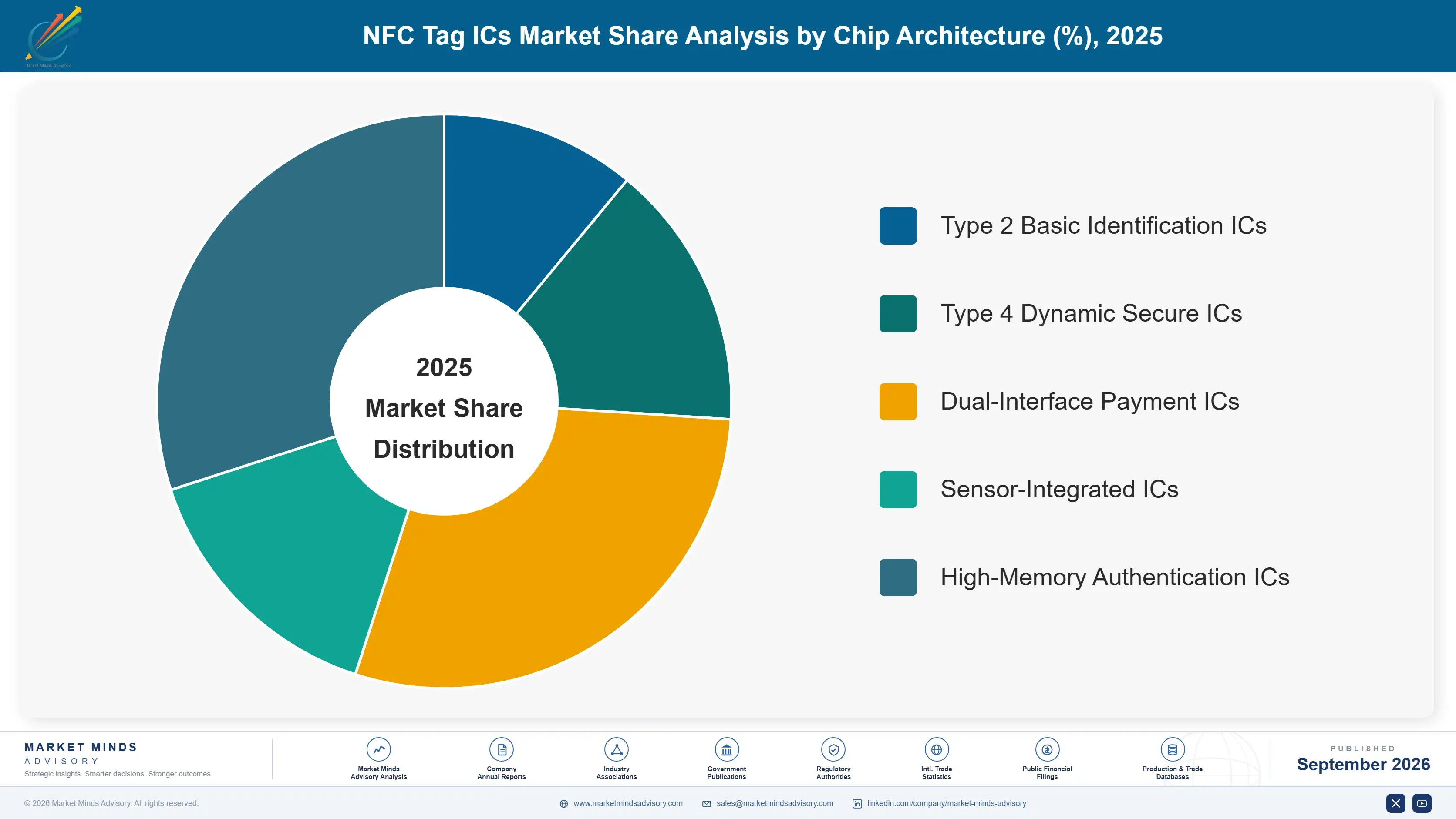
Five architectures cover the market: basic Type 2 identification chips, dynamic Type 4 secure chips, dual-interface payment chips, sensor-integrated chips, and high-memory authentication chips. Classification follows chip architecture and onboard feature set alone, not end-use application, keeping the hierarchy consistent and unambiguous across every downstream commercial discussion found throughout this report and its appendices.
nfc-tag-ics-market-market-share-analysis-1790005035564

Sensor-Integrated NFC Tag ICs

Battery-free sensor tag ICs that log temperature, humidity, or tamper events without external power are the fastest-growing chip architecture in the market, at a 15.2 percent CAGR against a base rate of 11.5 percent. Pharmaceutical cold chain compliance and luxury goods tamper detection are the two primary demand pulls, and both are scaling faster than the retail identification tagging that historically dominated volume. Manufacturing these chips requires tighter process control than basic identification ICs, since the onboard sensor circuitry must survive the same passive, battery-free power harvesting constraints as the communication function itself. NXP, ams OSRAM, and EM Microelectronic all now offer dedicated sensor tag product lines, and each has expanded that lineup within the past eighteen months.
CAGR 15.2%

High-Memory Brand Authentication ICs

High-memory chips built for cryptographically signed brand authentication carry the second-fastest growth rate, at 13.9 percent, driven by counterfeiting losses that luxury and pharmaceutical brands are increasingly unwilling to absorb passively any longer. These chips carry expanded onboard memory to store certificate chains and ownership records well beyond what a basic identification tag requires, which raises unit cost but also raises the switching cost once a brand commits to a supplier's certification framework. STMicroelectronics and Infineon have both prioritized this category in recent product roadmaps, positioning it as their primary vehicle for margin expansion as basic tag pricing continues compressing under fabrication overcapacity pressure across the broader commodity segment worldwide.
CAGR 13.9%
Full segment breakdown across 5 segments available in the complete report.

Regional Architecture and Country Demand Map

East Asia leads NFC tag IC demand by a clear margin, anchored by China's concentration of apparel and consumer electronics tagging assembly and a deep base of mature-node wafer fabrication capacity, well ahead of North America's brand authentication and payment chip design and certification activity.

East Asia

China anchors this region's lead through sheer manufacturing scale: the apparel, footwear, and consumer electronics assembly base that ships from Guangdong and Zhejiang provinces embeds NFC tags at volumes no other region approaches. Foundries in Taiwan and mainland China supply mature-node wafer capacity for the majority of basic and mid-tier tag ICs consumed globally, giving the region a durable cost advantage independent of local demand alone. Japan's pharmaceutical cold chain sensor tagging adoption and South Korea's dual-interface payment card rollout add further volume beyond China's base. Enterprise brand authentication demand is scaling fastest in China's tier one cities, where luxury goods counterfeiting concerns have pushed retailers toward embedded chip verification at the point of sale.
Share: 28% | CAGR: 12.5% (2026 to 2036)

North America

Design and certification leadership, not manufacturing volume, defines North America's position. NXP Semiconductors and most of its secure element certification infrastructure sit in the United States, giving the region outsized influence over which cryptographic standards the rest of the industry ultimately adopts. Pharmaceutical cold chain compliance rules from the FDA are pushing sensor tag adoption across biologics distribution faster than in most other regions. Retailers including major apparel and grocery chains have committed to item-level NFC tagging pilots at a pace that outstrips comparable European rollouts. Canada's smaller but growing luxury goods authentication market adds incremental volume, while Mexico's expanding electronics assembly base is beginning to source tag ICs locally rather than importing finished tagged products.
Share: 26% | CAGR: 11.0% (2026 to 2036)
Regional intelligence for 5 additional markets available in the complete report: Western Europe, South Asia and Pacific, Latin America, Middle East and Africa, Eastern Europe. Contact sales@marketmindsadvisory.com.
nfc-tag-ics-market-country-cagr-analysis-1790005036102

Where NFC Tag IC Margin Actually Concentrates

Unit volume no longer predicts margin in this fast-moving category anymore. The chips capturing disproportionate profit are the ones embedding sensor logging, cryptographic certification, or payment security, features that commodity tag suppliers simply cannot replicate without a genuine multi-year investment cycle in fabrication and testing infrastructure that most of them still fully lack today.

Cryptographic Certification as a Pricing Gate

Suppliers that clear EU Digital Product Passport and pharmaceutical anti-counterfeiting certification requirements can charge 3 to 5 times the price of an uncertified basic tag IC for what is often a similar physical chip footprint. The certification process itself, typically twelve to eighteen months including third-party audit, functions as a real barrier that keeps low-cost entrants from capturing this segment even when their manufacturing costs are comparable to certified incumbents. NXP and STMicroelectronics have both built dedicated certification teams specifically to compress this timeline advantage relative to smaller competitors still navigating the process for the first time.
Market Impact: Certified chips price 3 to 5 times higher today

Sensor Data Licensing Beyond the Chip Sale

Vendors that pair sensor-integrated tag ICs with a cloud data platform for reading and storing temperature or tamper logs are converting a one-time chip sale into a recurring software subscription attached to the hardware itself. Early adopters among cold chain logistics providers are paying roughly 2 to 4 dollars per shipment in monthly data subscription fees on top of the original chip cost, a revenue layer that barely existed three years ago and is now becoming a standard commercial offering among the leading sensor tag suppliers competing for pharmaceutical distribution contracts.
Market Impact: Adds 2 to 4 dollars per shipment monthly

Long-Term Foundry Capacity Agreements Reduce Volatility

Larger suppliers are locking in multi-year wafer capacity commitments with Taiwanese and Chinese foundries that smooth utilization and protect margin during industry-wide oversupply cycles like the one currently compressing commodity tag pricing across the entire sector. These agreements typically guarantee 70 to 80 percent minimum capacity utilization in exchange for below-list pricing, a trade that smaller suppliers without comparable purchasing scale generally cannot access on similar terms, leaving them more exposed to spot-market wafer pricing swings that can erode already thin commodity margins within a single fiscal quarter or two.
Market Impact: Locks in 70 to 80 percent capacity utilization

Bundled Inlay and Converter Partnership Revenue

Chipmakers that pre-integrate their ICs into finished tag inlays through exclusive converter partnerships capture a larger share of the final tag price than those selling bare die alone to independent converters in the open market. This approach adds roughly 20 to 25 percent to per-unit revenue by eliminating a layer of converter markup that would otherwise accrue entirely to a third party downstream. ams OSRAM and EM Microelectronic have both expanded exclusive inlay partnerships over the past two years specifically to capture more of this downstream value before it reaches the final tag customer.
Market Impact: Adds 20 to 25 percent per-unit revenue gain

Who Controls the Margin Pool

At 58 percent, CR5 concentration sits meaningfully above the fragmented commodity chip categories this market sometimes gets lumped in with. NXP Semiconductors leads by a wide margin through its NTAG and MIFARE franchises, but STMicroelectronics and Infineon have both closed the technology gap in secure element integration, narrowing what was once a larger distance to the leader.
Current competitive activity centers on certification speed, sensor integration depth, and converter partnership exclusivity rather than raw unit pricing. Suppliers are racing to clear EU Digital Product Passport certification ahead of the 2027 deadline, since early certification confers a real lead-time advantage as converters lock in supplier relationships years in advance. Several vendors have also begun publishing sensor accuracy specifications previously kept confidential, a shift competitors are now matching.

The next competitive shift is coming from Chinese domestic suppliers, led by Fudan Microelectronics, building certified secure element capability that could challenge Western incumbents on price within certified categories. That threat remains contained to commodity and mid-tier segments for now, since certification credibility with European and American brand owners takes years to establish. Smaller specialty sensor tag makers focused on a single vertical are proving harder for larger diversified suppliers to displace quickly.
nfc-tag-ics-market-company-positioning-matrix-1790005036629

Competitive Moat and Risk Dimensions

NXP SEMICONDUCTORS

Moat: NTAG and MIFARE franchise depth

NXP's decades-long presence in the NFC standards process gives it influence over protocol evolution that smaller suppliers cannot match, and its NTAG and MIFARE product families are the reference implementation most converters design against first. That default-choice position creates real switching costs once a converter has qualified its production line around NXP's chip specifications and packaging tolerances.
NXP SEMICONDUCTORS

Risk: Broad exposure to commodity pricing

NXP's scale means a meaningful share of its NFC tag IC revenue still comes from basic identification chips facing the sharpest pricing pressure from Chinese fabrication overcapacity. Competitors with a narrower, higher-margin certified product mix are less exposed proportionally to the commodity segment's ongoing price compression than NXP's broader portfolio currently is.
STMICROELECTRONICS

Moat: Dual-interface payment certification strength

STMicroelectronics holds particularly deep certification credentials in dual-interface payment chips, a category with long qualification cycles that favor incumbents already approved by major card schemes. That approval status is difficult and slow for new entrants to replicate, giving STMicroelectronics durable share in a segment less exposed to commodity price competition than basic tagging.
STMICROELECTRONICS

Risk: Thinner sensor tag product line

STMicroelectronics has moved more slowly than NXP or ams OSRAM into sensor-integrated tag ICs, the fastest-growing category in this report, leaving it more reliant on payment and authentication chips for near-term growth. Competitors with earlier sensor tag commitments are capturing pharmaceutical cold chain design wins that STMicroelectronics is still pursuing.

Players Tracked

Prominent Players

NXP Semiconductors NV
STMicroelectronics NV
Infineon Technologies AG
ams OSRAM AG
EM Microelectronic-Marin SA

Other Key Players

Renesas Electronics Corporation
Texas Instruments Incorporated
onsemi Corporation
Melexis NV
Fudan Microelectronics Group Company Limited
Giesecke+Devrient GmbH
Thales Group
Identiv Inc
Impinj Inc
Alien Technology LLC
Nordic Semiconductor ASA
Huada Semiconductor Co Ltd
Toshiba Electronic Devices and Storage Corporation
Samsung Electro-Mechanics Co Ltd
Vizinex RFID LLC

Recent Developments

FEBRUARY 2026

NXP Launches Expanded Sensor Tag IC Product Line

NXP Semiconductors introduced an expanded family of battery-free sensor tag ICs targeting pharmaceutical cold chain and luxury goods authentication applications, adding temperature logging capability to its existing NTAG secure element architecture. The launch extends NXP's roadmap into a category where ams OSRAM had previously held an early lead.
Signal: Sensor integration is becoming table stakes across every major supplier's product roadmap and near-term pricing strategy
SEPTEMBER 2025

STMicroelectronics Expands Converter Partnership Network

STMicroelectronics signed exclusive inlay integration agreements with two major European packaging converters, pre-bundling its dual-interface chips directly into finished tag inlays ahead of anticipated Digital Product Passport demand. The agreements extend a relationship structure STMicroelectronics has used successfully in payment card chip distribution for years.
Signal: Exclusive converter partnerships are becoming the preferred distribution model for capturing downstream margin across the industry
MAY 2026

Infineon Acquires Cryptographic Certification Testing Firm

Infineon Technologies completed the acquisition of a specialized cryptographic certification testing firm to compress its internal certification timeline for EU Digital Product Passport compliance ahead of the 2027 deadline. The deal brings in-house testing capability that Infineon had previously outsourced entirely to third-party certification laboratories.
Signal: Certification speed is emerging as a directly acquirable competitive advantage across the entire semiconductor supplier industry

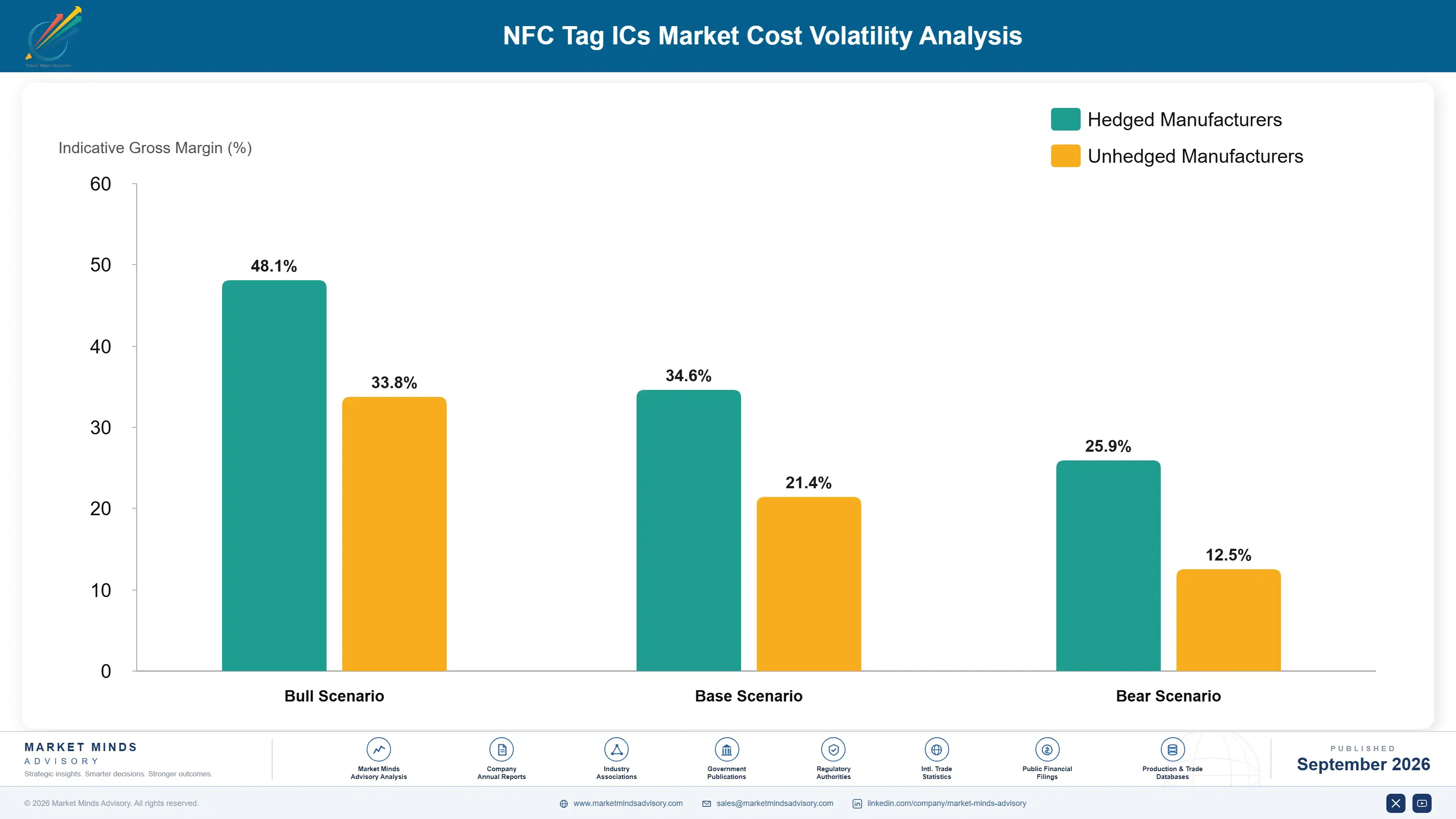
Wafer Supply and Certification Cost Exposure

Silicon wafer processing accounts for roughly 44 percent of NFC tag IC cost of goods sold, sourced almost entirely from mature-node foundries in Taiwan, mainland China, and Malaysia running well-depreciated 90 to 180 nanometer process lines. Assembly and packaging adds a further 18 to 22 percent, concentrated in the same East Asian countries that dominate wafer fabrication.
Wafer pricing volatility hit hardest during the 2021 to 2022 semiconductor shortage, when mature-node capacity was diverted toward higher-margin automotive and industrial chips, leaving NFC tag IC suppliers competing for scarce fabrication slots. TSMC's 2022 annual report cited mature-node capacity allocation decisions as a driver of extended lead times for lower-margin customers, and several tag IC suppliers disclosed multi-quarter order backlogs as a consequence through 2023.

Larger suppliers with long-standing foundry relationships absorbed the 2021 to 2022 shortage with far less disruption than smaller suppliers reliant on spot-market wafer purchases, a resilience gap that persists today. Certification exposure follows a similar pattern: suppliers pursuing Digital Product Passport compliance face six-figure testing costs per product family, a fixed burden falling harder on smaller suppliers without volume to amortize it.
nfc-tag-ics-market-cost-volatility-analysis-1790005036828

Multi-Year Foundry Capacity Agreements

Larger suppliers are securing multi-year mature-node wafer commitments with Taiwanese and Chinese foundries, locking in guaranteed capacity allocation and below-list pricing that shields them from spot-market volatility during industry-wide demand surges affecting the broader global semiconductor supply chain, unlike smaller rivals that remain fully exposed to unpredictable spot pricing swings almost every single quarter.

Second-Source Foundry Qualification Programs

Suppliers are increasingly qualifying two or more foundries for the same chip design specifically to avoid single-source dependency, a lesson drawn directly from the 2021 to 2022 shortage that left several tag IC makers unable to fulfill orders, and the practice is now spreading steadily to mid-sized suppliers previously reliant on a single foundry relationship.

Shared Certification Consortium Participation

Smaller suppliers are pooling resources through industry consortium certification programs to amortize the fixed cost of Digital Product Passport compliance testing across multiple participating members, a cost-sharing approach that individual smaller firms could rarely justify pursuing entirely alone, and consortium participation has grown steadily across the wider supplier base over the past full year.

Portfolio Architecture for Margin Defence

Margin architecture in NFC tag ICs splits sharply along certification lines. Basic identification chips compete almost entirely on price, holding gross margins around 30 to 40 percent as Chinese fabrication overcapacity keeps compressing unit pricing further each year. Certified and sensor-integrated chips hold materially higher margins, since certification credibility and cryptographic depth create real switching costs converters cannot easily walk away from once qualified.
The volume versus premium tension runs through the entire supplier base: commodity suppliers scale on unit count but face relentless price compression, while certified suppliers grow more slowly in volume terms but capture disproportionate profit per chip. High-value margin pools concentrate almost entirely in sensor-integrated and brand authentication categories rather than basic identification tagging, and that concentration is where the strongest suppliers are now directing the bulk of new fabrication and certification investment.

Regulatory-driven demand, particularly the EU Digital Product Passport mandate, is opening a genuinely new premium tier that barely existed five years ago and is difficult for late entrants to replicate quickly, since certification credibility takes years to establish with skeptical brand owners. Vendors positioned early in this category are compounding an advantage that commodity-focused competitors will find increasingly hard to close.

Volume / Commodity-Adjacent

Basic Type 2 identification chips sold at high volume into retail apparel and logistics tagging, competing almost entirely on unit price against Chinese mature-node fabrication capacity with little room for differentiation.
Gross Margin: 30-40%

Premium / Certified

Dual-interface payment and Type 4 secure chips carrying card scheme and financial regulatory certification, where qualification cycles and switching costs give incumbent suppliers durable, defensible pricing power over new entrants.
Gross Margin: 48-58%

Sustainability / Regulatory / Next-Generation

Sensor-integrated and high-memory authentication chips tied to Digital Product Passport compliance and brand anti-counterfeiting programs, the fastest-compounding and highest-margin tier in the market as certification-driven demand continues expanding steadily year over year.
Gross Margin: 55-65%
nfc-tag-ics-market-portfolio-architecture-1790005037344

High-value Sub-segments and Strategic Watch-out

The highest-value, fastest-growing pool in the market, converting a commodity identification chip into a recurring premium product line as pharmaceutical cold chain and luxury goods authentication demand continues to scale rapidly across nearly every major geography this report tracks, a trend MMA expects to persist through 2036.

High-value and growing steadily as counterfeiting losses push more luxury and pharmaceutical brands toward embedded verification, though lengthy certification cycles slow the pace of new supplier entry into this increasingly attractive and profitable category, keeping competitive intensity comparatively lower than in commodity tiers for now.

The volume core of the market, generating the bulk of all unit shipments but facing the steepest ongoing price compression as Chinese fabrication overcapacity pushes commodity pricing steadily lower with each successive fiscal quarter across nearly every product line and customer segment currently served worldwide.

The clearest strategic watch-out for Western incumbents, as suppliers like Fudan Microelectronics build certified secure element capability that could eventually challenge established leaders on price within certified categories they currently dominate almost entirely, a shift genuinely worth monitoring closely over the coming several years ahead.

Why NFC Tag IC Revenue Compounds

NFC tag IC revenue increasingly behaves like an annuity business in its certified segments rather than a one-time chip sale. Once a converter qualifies its production line around a supplier's certified chip specification, switching costs rise sharply, and renewal rates for certified supply agreements now commonly exceed 85 percent, turning what used to be a commodity component purchase into a durable, multi-year relationship.
Adoption depth varies significantly by end-use vertical. Pharmaceutical cold chain programs show the deepest stickiness, since enrolled distributors rely on continuous temperature logging data that regulators actively require for compliance documentation. Luxury goods authentication runs nearly as sticky, tied to consumer-facing verification experiences brands rarely redesign, while basic retail apparel tagging remains largely transactional and shows minimal loyalty to any single chip supplier.

Buyer profiles are shifting generationally as well. Younger packaging engineers entering the converter industry now expect embedded digital identity as a baseline design requirement rather than a novel feature, while procurement has moved from pure component buyers toward brand protection and compliance teams, who evaluate suppliers on certification credibility rather than unit price alone. This buyer shift is steadily raising the evidentiary bar every chip supplier must clear.
nfc-tag-ics-market-end-use-penetration-index-1790005037839

Where NFC Tag IC Value Concentrates

These are among the four positions where our research anticipates prominent divergence between winners and laggards over the coming forecast period. Each is grounded in the demand model, the regulatory perimeter, and the announced capacity pipeline.
01 / CERTIFICATION SPEED PRIORITY

Compress certification timelines well ahead of the 2027 compliance deadline

EU Digital Product Passport certification is becoming the clearest dividing line between commodity and premium suppliers in this market, and the vendors clearing certification earliest are locking in converter relationships years ahead of when the mandate actually takes effect. Waiting until closer to the 2027 deadline concedes a lead-time advantage that competitors are actively building right now through dedicated certification teams and acquired testing capability. Suppliers should treat certification as a near-term capital priority, not a compliance afterthought scheduled for later in the roadmap.
02 / SENSOR INTEGRATION INVESTMENT

Build sensor tag capability before pharmaceutical demand fully matures

Sensor-integrated tag ICs are the fastest-growing chip architecture in this market, and pharmaceutical cold chain compliance is pulling that demand forward faster than most suppliers' current product roadmaps anticipated when they were drafted. Vendors without a credible sensor tag offering today are already losing design wins to NXP, ams OSRAM, and EM Microelectronic, all of which expanded dedicated sensor product lines within the past eighteen months. Building this capability now, rather than reacting once demand fully matures, is the clearer path to durable share.
03 / CONVERTER PARTNERSHIP STRUCTURE

Pursue exclusive inlay partnerships to capture downstream tag margin

Chipmakers selling bare die alone are leaving a meaningful share of final tag price on the table for converters to capture instead, a gap that exclusive inlay partnerships close directly by integrating the chip into the finished product earlier in the value chain. STMicroelectronics and ams OSRAM have both moved decisively on this structure over the past two years, and the approach is proving especially valuable in the certified and sensor-integrated segments where converter relationships are already stickier. Suppliers still selling bare die exclusively should reassess this positioning soon.
04 / WAFER SUPPLY RESILIENCE

Diversify foundry relationships before the next capacity cycle turns

The 2021 to 2022 semiconductor shortage exposed how exposed suppliers without multi-year foundry commitments were to capacity reallocation toward higher-margin automotive and industrial chip categories, a risk that has not disappeared even though the acute shortage has passed. Second-source qualification and longer-term capacity agreements are the clearest defenses against a repeat scenario, and larger suppliers have already moved decisively on both fronts while many smaller suppliers remain exposed to spot-market volatility. Building this resilience now, before the next cycle turns, is materially cheaper than reacting during a genuine shortage.

Engagement Snapshot From the Field

A live engagement with an industry participant carrying material or product regulatory and market exposure ahead of a defining policy shift, showing how our research translates into a defensible multi-year portfolio strategy.
MARKET MINDS ADVISORY · CLIENT ENGAGEMENT SUMMARY
NFC Tag ICs Producer Strategic Portfolio Review and Transition Roadmap 2026·Investment Scenario on NFC Tag ICs Exposure Evaluation 2025-26
CLIENT PROFILE
A global luxury goods conglomerate spanning fashion, leather goods, and watchmaking divisions engaged MMA to evaluate NFC tag IC suppliers ahead of a group-wide product authentication rollout. The client had piloted authentication tagging in two brand divisions independently and sought a single group-level supplier framework to standardize procurement, certification requirements, and consumer-facing verification experience across roughly a dozen constituent brands.
STRATEGIC CHALLENGE
Each brand division had developed its own pilot relationship with a different chip supplier, creating inconsistent certification standards and consumer verification experiences across the group's portfolio. Leadership needed a framework that preserved each brand's distinct authentication design language while consolidating supplier relationships enough to secure meaningful volume pricing and consistent cryptographic security standards group-wide.
MMA APPROACH
MMA benchmarked candidate suppliers against a weighted scorecard covering cryptographic certification depth, memory capacity headroom, unit cost at projected group volume, and existing luxury sector deployment track record. The team conducted structured interviews with supplier certification teams and cross-referenced disclosed deployment data against MMA's primary survey dataset covering comparable brand authentication programs.
KEY FINDINGS
  1. The supplier offering the lowest per-unit chip price ranked last once certification support and memory headroom for future feature expansion were fully factored into the scoring.
  2. Suppliers with existing luxury sector deployment experience cut projected rollout timelines by roughly five months compared with suppliers new to the authentication tagging category.
  3. Certification depth varied significantly across candidate suppliers, directly affecting how quickly each brand division could launch consumer-facing verification features after chip selection.
  4. Group-level volume consolidation across the dozen brand divisions secured meaningful unit pricing improvements that no single division could have negotiated independently on its own.
CLIENT PROFILE
A global luxury goods conglomerate spanning fashion, leather goods, and watchmaking divisions engaged MMA to evaluate NFC tag IC suppliers ahead of a group-wide product authentication rollout. The client had piloted authentication tagging in two brand divisions independently and sought a single group-level supplier framework to standardize procurement, certification requirements, and consumer-facing verification experience across roughly a dozen constituent brands.
STRATEGIC CHALLENGE
Each brand division had developed its own pilot relationship with a different chip supplier, creating inconsistent certification standards and consumer verification experiences across the group's portfolio. Leadership needed a framework that preserved each brand's distinct authentication design language while consolidating supplier relationships enough to secure meaningful volume pricing and consistent cryptographic security standards group-wide.
MMA APPROACH
MMA benchmarked candidate suppliers against a weighted scorecard covering cryptographic certification depth, memory capacity headroom, unit cost at projected group volume, and existing luxury sector deployment track record. The team conducted structured interviews with supplier certification teams and cross-referenced disclosed deployment data against MMA's primary survey dataset covering comparable brand authentication programs.
KEY FINDINGS
  1. The supplier offering the lowest per-unit chip price ranked last once certification support and memory headroom for future feature expansion were fully factored into the scoring.
  2. Suppliers with existing luxury sector deployment experience cut projected rollout timelines by roughly five months compared with suppliers new to the authentication tagging category.
  3. Certification depth varied significantly across candidate suppliers, directly affecting how quickly each brand division could launch consumer-facing verification features after chip selection.
  4. Group-level volume consolidation across the dozen brand divisions secured meaningful unit pricing improvements that no single division could have negotiated independently on its own.
RECOMMENDED STRATEGY
Phase 1: Phase one selected a single primary chip supplier and standardized certification requirements across three pilot brand divisions within the first ninety days. Phase 2: Phase two extended the standardized framework to the remaining brand divisions over a nine-month rollout window with dedicated supplier support. Phase 3: Phase three launched consumer-facing verification features group-wide and began evaluating sensor-integrated chips for select high-value product categories across multiple divisions simultaneously.
OUTCOME
The conglomerate reported a 34 percent reduction in group-wide chip procurement costs following supplier consolidation, alongside a 22 percent increase in consumer verification scan engagement across newly tagged product lines (client-reported, unverified by MMA). Rollout timeline across all brand divisions came in roughly four months ahead of the original group-wide schedule.

Frequently Asked Questions

Foundational context covering the market sizes, CAGR, scope, country, region and competition that inform every finding below. This section is provided to cover basics and most often pre-purchase conversations, answered from the MMA Primary Research Dataset.

What is the current size of the NFC Tag ICs Market?

The global NFC tag IC market reached 2.1 billion dollars in 2025. Growth is concentrated in sensor-integrated and brand authentication chips rather than basic identification tagging.

How large will the NFC Tag ICs Market be by 2036?

MMA projects the market will reach 6.95 billion dollars by 2036, up from 2.34 billion dollars in 2026. That represents a 2.97 times expansion over the ten-year forecast window.

What is the CAGR for the NFC Tag ICs Market 2026 to 2036?

The base case compound annual growth rate is 11.5 percent. MMA's bull scenario projects 12.7 percent, while the bear scenario projects 10.3 percent over the same forecast period.

Which segment is growing fastest?

Sensor-Integrated NFC Tag ICs are the fastest-growing segment at a 15.2 percent CAGR, roughly 1.32 times the overall market rate, driven by cold chain and authentication demand.

Who are the major companies in the NFC Tag ICs Market?

NXP Semiconductors, STMicroelectronics, Infineon Technologies, ams OSRAM, and EM Microelectronic-Marin lead the competitive landscape. The top five hold roughly 58 percent of global revenue combined.

Which country is growing fastest?

India leads country-level growth at a 14.3 percent CAGR, helped by a national payment scheme mandate requiring NFC capability on all newly issued payment cards nationwide.

Report Segmentation Architecture

The full report scope spans multiple orthogonal segmentation dimensions, with cross-tabulated demand data provided for each dimension pair. Coverage extends further to regional breakdowns, trend trajectories, and the competitive detail needed to support segment-level decision-making.

By Chip Architecture

  • Type 2 Basic Identification ICs
  • Type 4 Dynamic Secure ICs
  • Dual-Interface Payment ICs
  • Sensor-Integrated ICs
  • High-Memory Authentication ICs

By End-Use Industry

  • Retail and Apparel
  • Pharmaceuticals and Healthcare
  • Banking and Payments
  • Luxury Goods and Cosmetics
  • Logistics and Supply Chain
  • Consumer Electronics

By Commercial Dimension

  • Direct Chip Sale to Converters
  • Bundled Inlay Partnership Model
  • Cloud Data Subscription Attachment
  • OEM Direct Integration Contracts
  • Distributor Channel Sales

By Region

  • North America
  • Western Europe
  • East Asia
  • South Asia and Pacific
  • Latin America
  • Middle East and Africa
  • Eastern Europe

Scope, Methodology, and Coverage

Every figure in this report is reproducible from documented input assumptions. The scope below maps the historical period, the forecast horizon, the segmentation dimensions, and the countries covered, alongside the underlying primary and qualitative methodology.
Historical Period
2020 to 2025
Forecast Period
2026 to 2036
Base Year
2025 (USD billions; MMA Primary Research Dataset, September 2026)
Market Definition
The NFC tag IC market covers passive and battery-assisted near field communication integrated circuits embedded in tags, labels, and inlays operating in the 13.56 MHz NFC band for identification, authentication, and short-range data exchange. It excludes NFC controller chips built into smartphones and readers, RFID ICs operating outside the NFC frequency band, and tag substrates sold without an embedded IC.
Quantitative Units
USD Billion
Segmentation Dimensions
By Chip Architecture, By End-Use Industry, By Commercial Dimension, By Region
Regions Covered
North America, Western Europe, East Asia, South Asia and Pacific, Latin America, Middle East and Africa, Eastern Europe
Countries Covered
United States, China, Japan, South Korea, India, Germany, France, Brazil, United Arab Emirates, Poland
Key Companies Profiled
NXP Semiconductors NV, STMicroelectronics NV, Infineon Technologies AG, ams OSRAM AG, EM Microelectronic-Marin SA, Renesas Electronics Corporation, Texas Instruments Incorporated, onsemi Corporation, Melexis NV, Fudan Microelectronics Group Company Limited, Giesecke+Devrient GmbH, Thales Group, Identiv Inc, Impinj Inc, Alien Technology LLC, Nordic Semiconductor ASA, Huada Semiconductor Co Ltd, Toshiba Electronic Devices and Storage Corporation, Samsung Electro-Mechanics Co Ltd, Vizinex RFID LLC
Quantitative Methodology
Primary survey, n=3,800 respondents, Q4 2025, six countries; demand-side model with trade association cross-validation
Qualitative Methodology
47 expert interviews, Q4 2025; applied to validate demand model assumptions, identify emerging dynamics, and assess competitive positioning
Report Format
PDF and XLSX data workbook (Word format preview document)
Publisher
Market Minds Advisory
Report Code
MMA-2026-TEC-617
Published
September 2026
Contact
sales@marketmindsadvisory.com | www.marketmindsadvisory.com

Purchase the full NFC Tag ICs Market Report (2026 to 2036).

This report provides a comprehensive analysis of the global NFC tag IC market, covering historical performance from 2020 to 2025 and a detailed forecast through 2036. It examines segmentation by chip architecture, end-use industry, and commercial model, alongside regional demand dynamics across all seven MMA-tracked geographies. The analysis includes competitive benchmarking of twenty leading suppliers, input cost exposure, portfolio margin architecture, and strategic recommendations grounded in primary survey data. Findings draw on MMA's proprietary quantitative survey and expert interview programs conducted in the fourth quarter of 2025.
Segment-level revenue forecasts through the year 2036
Competitive benchmarking of twenty leading market suppliers
Regional demand analysis across all seven geographies
Input cost exposure and mitigation strategy review
Portfolio margin architecture and pricing tier analysis
Strategic verdict with actionable commercial recommendations included

Built For The People Who Decide

From boardroom strategy to bench-side execution, this report is read cover-to-cover by leaders shaping the next decade of their industry, turning demand scenarios, market dynamics and valuation benchmarks into decisions.
CXOs/ Presidents/ VPs/ Managers
M&A and Corporate Development
Strategy Teams and R&D Heads
Procurement and Product Directors
Regulatory and Compliance Leaders
Investor Relations and Equity Analysts