Market Minds Advisory
Next Generation Molecular Assay Market

Next Generation Molecular Assay Market: Platform Choice as the Diagnostic Strategy Decision

Oncology and infectious disease labs increasingly specify sequencing depth and multiplexing capacity over turnaround time, point-of-care platforms compress diagnostic workflows into single visits, and assay suppliers without validated companion diagnostic claims lose pharma contracts outright.

Lead Analyst

Alice Ballenger

Published

September 2026

Make Smarter Decisions with Customized Research Insights

Request a free sample report and evaluate market opportunities, growth trends, and competitive dynamics relevant to your business needs.

2025 MARKET VALUE$7.8BMarket Size 2025
2036 FORECAST VALUE$25.1BBase Case , 2026 to 2036
CAGR 2026 TO 203611.2 %Bull 12.6% / Bear 9.8%
INCREMENTAL OPPORTUNITY$16.4BNet 10- year value creation
EXPANSION MULTIPLE2.89x2036 value over 2026 base
Strategic Levers
M&A Pipeline
Regional Outlook
Country Rankings
Competitive Intelligence
Segmental Deep-dive
Call-Us : 91 93563 13602

Executive Snapshot and Market Trajectory

Laboratories increasingly treat molecular assay platform choice as a diagnostic strategy decision rather than an instrument purchase, since sequencing depth and multiplexing capacity now determine which clinical questions a lab can even attempt to answer, not simply how fast it answers them, reshaping capital budgeting across pathology departments broadly.
CRISPR-based diagnostic assays lead growth at 16.5%, roughly 1.47 times the overall rate, as point-of-care platforms move genuinely novel detection chemistry from research settings into regulatory-cleared clinical use across infectious disease and oncology applications where speed and accuracy both matter. East Asia now holds the largest regional share at 26%, driven by China's national genomic sequencing initiatives and rapidly scaling domestic molecular diagnostics manufacturing capacity across multiple provinces and municipalities nationwide.
Competitive intensity runs high at 52% held by five suppliers, since platform development requires enormous capital investment and regulatory approval depth that concentrates share around established global platforms rather than fragmenting across regional specialists the way simpler diagnostic categories often do. Labs increasingly select suppliers on validated clinical evidence and companion diagnostic partnerships rather than instrument price alone across most major procurement decisions made today.
Market Definition
Base Year Value
$7.8B in 2025 (MMA Primary Research Dataset, August 2026)
Forecast Period
2026 to 2036, eleven discrete annual values
CAGR
11.2% base case. Bull 12.6%. Bear 9.8%.
Fastest Growth Segment
CRISPR-Based Diagnostic Assays: 16.5% CAGR
Fastest Growth Country
China: 13.5% CAGR
Fastest Growth Region
South Asia and Pacific: 13.2% CAGR
Largest Region
East Asia: 26% of 2025 global value
Market Leaders
Primary Survey
n=3,800 procurement and R&D decision-makers, Q4 2025, six countries
Methodology
Demand-side build-up, cross-validated against public data, 47 expert interviews

Next Generation Molecular Assay Market Forecast Scenarios

next-generation-molecular-assay-market-size-forecast-scenario-1787300473348
Between 2020 and 2025 the market grew at an estimated 9.7% annually, accelerating sharply through the pandemic as PCR testing infrastructure scaled globally before moderating as demand normalized, though the installed base and trained workforce it left behind kept driving oncology and infectious disease adoption well beyond pre-pandemic levels across most major healthcare systems worldwide.
Three mechanisms carry the base case to 11.2%. First, oncology liquid biopsy and companion diagnostic adoption keeps expanding as targeted therapies increasingly require molecular confirmation before prescription is even authorized. Second, point-of-care molecular platforms are displacing traditional send-out laboratory testing as decentralized testing infrastructure matures across hospital networks. Third, pharmaceutical companies keep embedding molecular assay requirements directly into clinical trial protocols, creating captive demand independent of general healthcare spending cycles and broader diagnostic reimbursement trends.
The bull case at 12.6% assumes accelerating regulatory clearance for novel detection chemistries pulls forward CRISPR-based and next-generation sequencing adoption faster than currently planned across major regulated markets. The bear case at 9.8% assumes reimbursement pressure on molecular diagnostics tightens across major payers, slowing adoption of premium assay formats in favor of established lower-cost testing methods.

Clinical Evidence as the Purchasing Gate

Next generation molecular assays sit at the center of precision medicine economics for any laboratory moving beyond simple pathogen detection toward genomic and companion diagnostic testing, since platform sensitivity and multiplexing capacity directly determine which clinical questions a lab can address at all. Regulatory clearance depth, not raw processing speed, increasingly separates competing suppliers across major procurement decisions and hospital system-wide procurement contracts nationw
MARKET CONCENTRATION (CR5)52%Five suppliers hold high share across regulated global platforms
AVERAGE TURNAROUND TIME1 to 4 hoursTypical point-of-care result delivery duration for common panels
TOP PRODUCING COUNTRY SHARE23%United States supplies largest share of installed platform capacity
INSTRUMENT REFRESH CYCLE5 to 7 yearsMolecular platforms typically operate before major hardware replacement
REAGENT COST SHARE38-48% of COGSEnzymes and specialty reagents weigh heavily on production costs
TRADE INTENSITY36% cross-borderAssay components frequently cross borders before final kit assembly
Commercially, the category behaves like a specialized life sciences instrumentation business wrapped inside a broader clinical laboratory relationship. Suppliers bundle instrument placements with proprietary reagent consumables and software analytics under multi-year reagent rental agreements, which locks laboratories into a single supplier's platform rather than encouraging assay-by-assay shopping on price alone. Switching platforms requires costly requalification against clinical validation and accreditation standards across the entire laboratory.
Over the next decade, expect point-of-care molecular testing to keep displacing traditional send-out laboratory workflows, as decentralized platforms mature and regulatory pathways for novel chemistries continue expanding across major regulated markets. Artificial intelligence-assisted result interpretation will also become more common, letting smaller laboratories interpret complex genomic results without specialized bioinformatics staff on hand at every shift.
"The instrument is basically a loss leader now. Whoever owns the reagent stream and the clinical evidence behind it owns the lab relationship for a decade."
Director, Molecular Diagnostics and Precision Medicine Practice · MMA Healthcare

Market Trends

Liquid Biopsy Adoption Expands Companion Diagnostic Testing

Oncology treatment protocols increasingly require molecular confirmation of specific tumor mutations before authorizing targeted therapies, and liquid biopsy testing lets clinicians obtain that confirmation from a blood draw rather than an invasive tissue biopsy procedure. Roche and Thermo Fisher have both expanded companion diagnostic partnerships with major pharmaceutical developers, embedding molecular assay requirements directly into clinical trial and post-approval treatment protocols. Guardant Health and Foundation Medicine have both published expanding clinical evidence supporting liquid biopsy as a viable alternative to tissue biopsy. The shift is turning assay validation into a prerequisite for drug approval itself, not a downstream diagnostic afterthought.
Market Impact: Adds 200 biomarker-linked approvals
Point-of-Care Molecular Platforms Displace Send-Out Testing

Hospitals and urgent care facilities are increasingly deploying compact molecular platforms capable of delivering results within hours rather than sending samples to centralized reference laboratories that add days to clinical decision-making timelines. Cepheid and Abbott have both expanded point-of-care platform menus to cover a broader range of infectious disease and respiratory panel testing beyond their original core applications. Decentralizing testing this way changes clinical workflow economics fundamentally, since same-visit results let physicians make treatment decisions immediately rather than scheduling a follow-up appointment once laboratory results eventually return several days later than expected.
Market Impact: Sustains 15,000 surveillance labs yearly

Market Opportunities and Growth Drivers

Targeted Therapy Approvals Require Molecular Confirmation

Regulatory agencies increasingly approve cancer drugs with companion diagnostic requirements built directly into the prescribing label, meaning a patient cannot legally receive the therapy without first testing positive for a specific molecular biomarker. The FDA has approved a rapidly growing list of biomarker-linked oncology therapies over the past several years, and each approval creates mandatory testing volume independent of broader healthcare spending trends. That regulatory structure gives molecular diagnostic suppliers a uniquely captive demand base, since physicians cannot simply choose to skip testing even when budget pressure exists elsewhere in the treatment pathway.
Market Impact: Delays reimbursement 2 to 4 years

Infectious Disease Surveillance Programs Sustain Testing Volume

National public health agencies have maintained expanded molecular testing infrastructure built during the pandemic, repurposing that capacity toward routine respiratory panel testing, antimicrobial resistance surveillance, and outbreak preparedness programs. The World Health Organization has encouraged member states to sustain genomic surveillance capability rather than dismantling pandemic-era infrastructure entirely, citing the value of early outbreak detection. That sustained public health investment gives suppliers a demand floor independent of clinical testing volume alone, particularly in markets that built substantial new molecular testing capacity for the first time during the pandemic response period.
Market Impact: Limits adoption to 35% of labs

Market Restraints and Challenges

Reimbursement Complexity Slows Novel Assay Adoption

Payers frequently classify next generation molecular assays as investigational before establishing permanent reimbursement codes, creating a gap during which laboratories must absorb testing cost or restrict access to patients able to pay directly. The root cause is evidentiary lag: payers typically require published outcomes data demonstrating clinical utility before committing to reimbursement, and generating that evidence takes years after a test reaches market. That gap discourages smaller laboratories from adopting novel assays proactively, concentrating early adoption among academic centers with research funding to absorb interim cost. Suppliers are responding by funding health-economic outcomes studies earlier in the commercialization timeline.
Market Impact: Expands liquid biopsy use 35% yearly

Bioinformatics Complexity Limits Smaller Laboratory Adoption

Next generation sequencing and complex multiplex assays generate data volumes and interpretive complexity that smaller community laboratories often lack the specialized staff to analyze reliably without external support. The root cause is workforce gap: qualified bioinformaticians and molecular pathologists remain in short supply relative to expanding testing demand, particularly outside major academic medical centers and metropolitan areas. That gap concentrates advanced testing capability among a smaller number of large reference laboratories rather than distributing it broadly. Suppliers are responding with cloud-based interpretation software and artificial intelligence tools designed to lower the expertise barrier.
Market Impact: Cuts diagnostic turnaround 70%
3 additional market trends, 4 additional growth drivers, and 2 additional restraints and challenges are covered in the full report. Contact sales@marketmindsadvisory.com to access the complete intelligence.

Segment CAGR and Growth Architecture

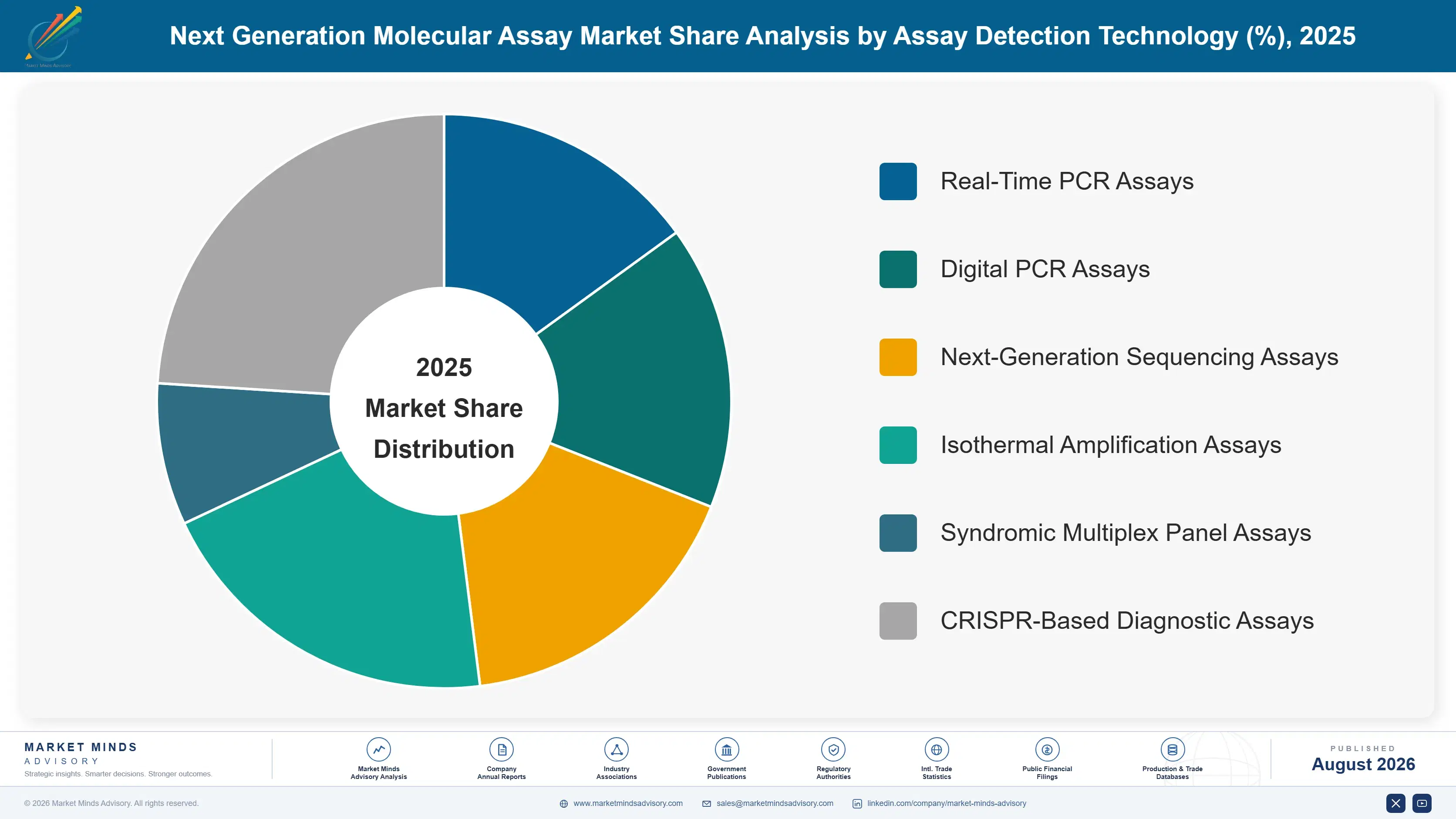
Segmentation follows assay detection technology, a single molecular-chemistry logic spanning real-time PCR, digital PCR, next-generation sequencing, isothermal amplification, syndromic multiplex panels, and CRISPR-based assays. Each technology carries distinct sensitivity, throughput, and regulatory pathway, so commercial position tracks the detection chemistry rather than the specific disease category it happens to test for at any given time.
next-generation-molecular-assay-market-market-share-analysis-1787300473881

CRISPR-Based Diagnostic Assays

CRISPR-based diagnostic assays grow fastest at 16.5%, about 1.47 times the overall market rate, as detection chemistries like SHERLOCK and DETECTR move from academic research settings into regulatory-cleared clinical use across infectious disease and, increasingly, oncology screening applications. The technology's genuinely novel mechanism, using programmable nucleases to detect specific genetic sequences directly without amplification cycling, offers speed and simplicity advantages that traditional PCR-based methods cannot easily match. Sherlock Biosciences and Mammoth Biosciences have both advanced clinical validation programs targeting point-of-care applications, and several major diagnostic companies have begun licensing or acquiring CRISPR diagnostic intellectual property to secure early positioning in this still-nascent but rapidly maturing diagnostic category across most major markets worldwide.
CAGR 16.5%

Next-Generation Sequencing-Based Assays

Next-generation sequencing-based assays grow second-fastest at 13.8%, driven by expanding oncology liquid biopsy and comprehensive genomic profiling applications that require simultaneous analysis of hundreds of genetic markers rather than testing one target at a time. Illumina and Thermo Fisher have both expanded clinical sequencing platform capacity and companion diagnostic partnerships with pharmaceutical developers embedding sequencing requirements directly into targeted therapy prescribing protocols. Falling sequencing costs per genome have made comprehensive testing economically viable for a broader range of clinical applications, and hospital systems increasingly specify sequencing-based panels as the default standard for complex oncology cases rather than reserving comprehensive testing for only the most exceptional and genuinely complex clinical circumstances.
CAGR 13.8%
Full segment breakdown across 6 segments available in the complete report.

Regional Architecture and Country Demand Map

East Asia leads at 26% of global value on China's national genomic sequencing initiatives and manufacturing scale, followed by North America at 25% and Western Europe at 22% on established clinical evidence infrastructure. Remaining regions together account for the balance of overall global demand today.

North America

United States academic medical centers and reference laboratories anchor North American demand, where FDA companion diagnostic approvals and extensive Medicare coverage for molecular oncology testing sustain a deeply established clinical evidence infrastructure that newer markets are still building. Illumina, Thermo Fisher, and Guardant Health all maintain their primary commercial and research operations domestically, giving the region first access to newly developed detection chemistries and clinical validation data. Canada's provincial health systems adopt comparable technology at a more measured pace tied to centralized budget approval processes. Growth of 11.8% outpaces the global rate as companion diagnostic requirements keep expanding alongside a steady pipeline of newly approved targeted oncology therapies reaching clinical practice.
Share: 25% | CAGR: 11.8% (2026 to 2036)

Western Europe

Germany and the United Kingdom host extensive national health service molecular testing infrastructure that pioneered many current companion diagnostic and genomic screening protocols now adopted globally, sustaining steady demand across a mature and well-established clinical laboratory network. France's national genomic medicine plan has expanded sequencing access considerably since its initial launch, though implementation pace varies across regional health authorities. The European Union's in vitro diagnostic regulation has tightened approval requirements considerably, slowing new assay introduction even as underlying clinical demand keeps growing steadily. Growth of 9.7% trails the global average because the region's testing infrastructure is already highly developed, leaving less headroom for further adoption-driven expansion than newer regional markets enjoy.
Share: 22% | CAGR: 9.7% (2026 to 2036)
Regional intelligence for 5 additional markets available in the complete report: East Asia, South Asia and Pacific, Latin America, Middle East and Africa, Eastern Europe. Contact sales@marketmindsadvisory.com.
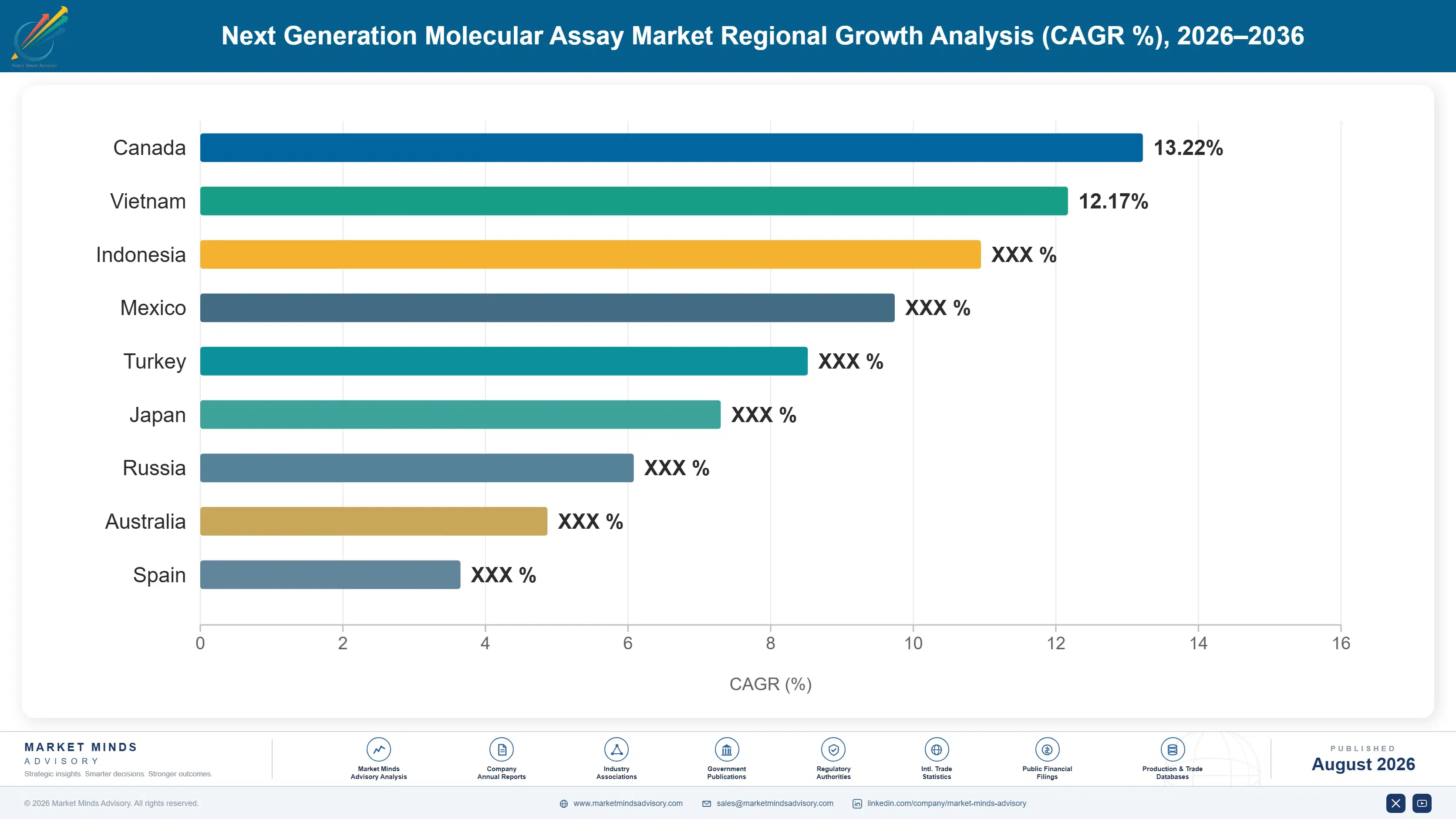
next-generation-molecular-assay-market-country-cagr-analysis-1787300474403

Where Assay Suppliers Can Defend Margin

Suppliers can defend margin against commoditized instrument pricing in several distinct ways beyond simply placing more platforms into laboratories worldwide. The four levers below identify genuine commercial advantage: companion diagnostic partnership, reagent rental lock-in, health-economic evidence generation, and manufacturing positioned ahead of national genomic program rollouts across major regulated markets and their evolving procurement cycles.

Secure Companion Diagnostic Partnerships With Pharma

Pharmaceutical companies increasingly need a validated companion diagnostic before a targeted therapy can even reach regulatory approval, and securing that partnership early locks in captive testing volume tied directly to the drug's prescribing label for years. Suppliers with proven companion diagnostic development capability can charge premiums of 30% to 50% over standalone assay pricing, since pharmaceutical partners value regulatory certainty more than incremental development cost. Roche and Thermo Fisher have both built durable pharmaceutical partnership pipelines around this exact structure, capturing captive testing volume years before a therapy even reaches market.
Market Impact: Commands a durable 30% to 50% price premium

Lock In Reagent Rental Agreements With Laboratories

Selling bare instruments alone commoditizes quickly, since competing platforms often meet similar throughput specifications within a given price band across most conventional applications. Suppliers that place instruments under multi-year reagent rental agreements, charging a recurring per-test fee of roughly 15 to 40 dollars, convert a one-time equipment sale into a recurring revenue relationship locked to the laboratory's testing volume. Abbott and Illumina have both scaled this razor-and-blade strategy successfully across their largest reference laboratory accounts, compounding switching cost advantage over time as testing volume grows steadily across each connected laboratory account.
Market Impact: Adds roughly 25 dollars per completed test run

Fund Health-Economic Outcomes Studies Proactively Early

Payers increasingly demand documented cost-offset evidence before granting permanent reimbursement codes for novel molecular assays, not just analytical validation data on sensitivity and specificity alone. Suppliers that fund independent health-economic studies quantifying avoided downstream treatment cost, typically showing savings of 50,000 to 200,000 dollars per avoided ineffective therapy course, move faster through payer coverage decisions than competitors relying on clinical trial data alone. Illumina's published cost-offset studies have directly informed several national reimbursement decisions across multiple regulated markets, giving it a repeatable playbook competitors are now actively racing to copy quickly.
Market Impact: Cuts payer coverage decision time nearly 40% overall

Position Manufacturing Ahead of National Genomic Programs

Manufacturing capacity for sequencing consumables and reagents has repeatedly struggled to keep pace with sudden national genomic program demand spikes, creating temporary shortages that reward suppliers who invested ahead of the program announcement rather than reactively scrambling afterward. Suppliers with pre-positioned manufacturing and local regulatory approval in newly launching markets can capture premium pricing of 15% to 25% during the transition scramble, since ministries facing hard program deadlines cannot wait for new capacity elsewhere. BGI and MGI Tech have both timed capacity expansions to anticipate announced national genomic programs well ahead of formal launch dates.
Market Impact: Captures a durable 15% to 25% price premium

Who Controls the Margin Pool

Concentration runs high at 52% held by the top five suppliers, evaluated on revenue from molecular assay platform and reagent product lines specifically. Roche and Abbott lead on global scale and companion diagnostic partnership depth, while Thermo Fisher, Illumina, and QIAGEN compete across different detection technologies and application specialties. The gap between leader and challenger is meaningful, since platform development and regulatory approval alone can take many years to complete.
Competitive activity currently runs along three dimensions. Companion diagnostic partnership matters most, as suppliers race to embed molecular assay requirements directly into pharmaceutical prescribing protocols. Reagent rental lock-in runs a close second, converting one-time instrument sales into recurring per-test revenue relationships. Point-of-care platform expansion is the third, decentralizing testing away from traditional reference laboratory workflows.

Pressure is building from two directions. Chinese domestic sequencing manufacturers are scaling rapidly and narrowing the technology gap on conventional platforms, threatening incumbents' share in price-sensitive emerging markets. Meanwhile CRISPR diagnostic startups are commercializing genuinely novel detection chemistries that could bypass traditional PCR-based approaches entirely. Rankings will shift toward suppliers combining defensible clinical evidence with genuine next-generation chemistry differentiation across every major detection category.
next-generation-molecular-assay-market-company-positioning-matrix-1787300474923

Competitive Moat and Risk Dimensions

F. HOFFMANN-LA ROCHE LTD

Moat: Companion Diagnostic Pipeline Depth

Roche holds one of the industry's deepest companion diagnostic partnership portfolios, embedding molecular assay requirements directly into pharmaceutical prescribing labels across dozens of approved targeted therapies. That pipeline depth gives Roche captive testing volume that materializes years before competitors can respond with genuinely comparable competing offerings.
F. HOFFMANN-LA ROCHE LTD

Risk: Exposure to Pharma Partnership Concentration

Roche's companion diagnostic revenue depends heavily on a relatively concentrated set of pharmaceutical partnerships, and losing a major partnership or facing a competing diagnostic's approval could meaningfully affect testing volume tied to that specific therapy. That concentration creates revenue risk smaller diversified competitors do not carry.
ABBOTT LABORATORIES

Moat: Point-of-Care Platform Installed Base

Abbott has built one of the industry's most widely deployed point-of-care molecular platforms, creating a durable reagent revenue stream tied directly to its installed equipment base across hospitals and urgent care facilities. That installed base advantage compounds over time as more facilities standardize on its testing menu.
ABBOTT LABORATORIES

Risk: Menu Expansion Pace Lags Competitors

Abbott's point-of-care menu expansion has moved more slowly than some competitors racing to add novel infectious disease and companion diagnostic panels, risking gradual share erosion if customers seek broader testing capability elsewhere on the same installed platform, particularly in fast-evolving infectious disease and respiratory testing categories.

Key Players

F. Hoffmann-La Roche Ltd
Abbott Laboratories
Thermo Fisher Scientific Inc.
Illumina, Inc.
QIAGEN N.V.

Others

Danaher Corporation
Bio-Rad Laboratories, Inc.
bioMerieux SA
Hologic, Inc.
Becton, Dickinson and Company
DiaSorin S.p.A.
Bio-Techne Corporation
Agilent Technologies, Inc.
Twist Bioscience Corporation
Pacific Biosciences of California, Inc.
Oxford Nanopore Technologies plc
MGI Tech Co., Ltd.
BGI Genomics Co., Ltd.
Sansure Biotech Inc.
Luminex Corporation

Recent Developments

APRIL 2025

Roche receives approval for expanded companion diagnostic indication

Roche received regulatory approval expanding its existing companion diagnostic assay to cover an additional cancer type alongside a newly approved targeted therapy from a major pharmaceutical partner. This was a regulatory approval milestone, not a corporate transaction, extending Roche's companion diagnostic revenue base meaningfully across the broader oncology franchise.
Signal: Shows leading suppliers continuing to expand captive testing volume through companion diagnostic label extensions steadily over time.
OCTOBER 2024

Illumina acquires liquid biopsy technology developer

Illumina acquired a privately held liquid biopsy technology developer specializing in ultra-sensitive circulating tumor DNA detection for an undisclosed sum. The acquisition was a full corporate purchase, not a licensing arrangement or joint venture, giving Illumina direct ownership of the underlying detection technology and its associated patents.
Signal: Indicates sequencing platform suppliers increasingly prefer owning liquid biopsy technology outright rather than partnering externally with rivals.
JANUARY 2025

Abbott and a national health service sign point-of-care testing agreement

Abbott signed a multi-year supply agreement to deploy point-of-care molecular testing platforms across a major national health service's emergency and urgent care departments nationwide. The arrangement was a supply agreement, not an acquisition or joint venture, extending Abbott's public health system distribution reach considerably across the country.
Signal: Signals national health systems increasingly prioritize decentralized point-of-care testing over centralized reference laboratory workflows entirely now.

Enzyme and Reagent Feedstock Exposure

Specialty enzymes, fluorescent probes, and proprietary reagent chemistries together account for roughly 38% to 48% of assay system COGS, sourced primarily from biochemical suppliers in the United States and Germany and from specialty reagent manufacturers concentrated in Japan and the United States. Consumable plasticware and microfluidic components add a further 10% to 15%, sourced from precision plastics manufacturers across multiple qualified regions.
Enzyme and specialty reagent prices rose meaningfully through 2024 as demand from expanding sequencing and PCR testing volume outpaced production capacity at several major biochemical suppliers, according to trade data. Thermo Fisher's 2024 annual report disclosed higher input costs attributable to specialty reagent inflation, noting that enzyme sourcing cost rose meaningfully faster than the company could pass through to laboratory customers without meaningful margin compression across its diagnostics segment.

Smaller specialty assay developers carry more exposure than the largest diversified suppliers, since they lack the purchasing scale to negotiate favorable long-term enzyme supply contracts with primary biochemical producers. Suppliers sourcing proprietary reagents from a concentrated set of manufacturers face additional exposure to capacity constraints, while diversified suppliers absorb volatility more predictably across their broader supply chain.
next-generation-molecular-assay-market-cost-volatility-analysis-1787300475119

Lock Enzyme Pricing Through Multi-Year Contracts

Specialty enzymes are the largest single volatile input across most molecular assay product lines and increasingly competed for by expanding sequencing and PCR testing demand. Multi-year supply agreements with fixed or collared pricing, common practice among larger diversified suppliers, smooth quarter-to-quarter volatility and let commercial teams quote laboratory contracts with genuine confidence rather than repricing constantly against spot markets.

Diversify Reagent Sourcing Across Manufacturers

Reliance on a single reagent manufacturer concentrates both price and availability risk unnecessarily across an entire assay product line. Qualifying secondary reagent suppliers across multiple regions, even at modestly higher unit cost, protects continuity when any single manufacturer faces capacity outage or a sudden demand spike from competing life sciences research and diagnostic testing applications alike.

Vertically Integrate Enzyme Production Capability

Suppliers that bring enzyme production in-house rather than purchasing finished reagents capture manufacturing margin previously paid to a third party while gaining direct visibility into actual material consumption and lead times. That integration also shortens delivery timelines meaningfully during periods of tight global enzyme supply and rising research and clinical testing demand simultaneously worldwide.

Portfolio Architecture for Margin Defence

The portfolio splits into three tiers with substantial margin separation tied to clinical evidence and regulatory approval depth. Volume tier products carry standard real-time PCR panels for routine infectious disease testing, competing largely on price. Premium certified products carry companion diagnostic and sequencing-based assays backed by documented clinical utility data. Sustainability and next-generation products, including CRISPR-based detection systems, attract the sector's most active
The tension between volume and premium runs through nearly every supplier's product roadmap. Volume products fund the manufacturing scale and distribution network premium products eventually depend on, yet volume margins keep compressing as domestic Chinese manufacturers scale aggressively on conventional PCR panels. Suppliers that under-invest in premium companion diagnostic capability risk commoditization, while those chasing premium exclusively struggle to fund the manufacturing base for routine testing demand.

High-value margin pools concentrate specifically in oncology companion diagnostic and comprehensive sequencing categories where clinical and financial stakes carry the largest weight, and where documented evidence commands genuine pricing power. Routine infectious disease testing generates steadier volume but thinner margin, since that segment competes against a wider set of lower-cost regional suppliers with adequate but unremarkable analytical performance.

Volume / Commodity-Adjacent Tier

Standard real-time PCR panels for routine infectious disease testing, competing largely on price against a crowded field of regional manufacturers offering broadly comparable sensitivity, specificity, and turnaround time across broadly comparable panel offerings.
Gross Margin: 18-28%

Premium / Certified Tier

Companion diagnostic and sequencing-based assays backed by documented clinical utility data and formal regulatory qualification, commanding meaningful pricing premiums over conventional equivalents across most regulated developed and increasingly emerging healthcare markets globally.
Gross Margin: 38-52%

Sustainability / Regulatory / Next-Generation Tier

CRISPR-based and point-of-care detection systems still scaling across clinical settings, targeting diagnostic speed and accessibility that conventional laboratory-bound platforms simply cannot achieve consistently across comparable clinical testing scenarios in most healthcare settings today.
Gross Margin: 30-48%
next-generation-molecular-assay-market-portfolio-architecture-1787300475611

High-value Sub-segments and Strategic Watch-out

CRISPR-Based Point-of-Care Detection

High value and high growth, driven by novel detection chemistry moving from research into regulatory-cleared clinical use, with intellectual property and validation barriers protecting early movers from new entrant competition on the largest hospital and reference laboratory accounts nationwide and increasingly internationally across major regulated healthcare markets as well.
Gross Margin: 30-48%

Oncology Companion Diagnostic Assays

High value with moderate growth, anchored by expanding targeted therapy approvals requiring molecular confirmation, where documented clinical evidence increasingly decides vendor qualification for lucrative pharmaceutical partnership contracts across the full drug development and post-approval commercialization lifecycle spanning many years of active therapy use and follow-up monitoring.
Gross Margin: 38-52%

Routine Infectious Disease PCR Panels

The category's largest volume base by unit count, competing on price against a crowded field of regional suppliers, generating steady but thin margin as routine testing demand matures across most developed and increasingly price-sensitive emerging markets worldwide, from Latin America to Southeast Asia and increasingly parts of Africa.
Gross Margin: 18-28%

Legacy Single-Target PCR Assays

Strategic watch-out where multiplexed panel testing threatens to displace single-target assays across most clinical applications, creating genuine technology risk for suppliers slow to transition product portfolios toward multiplexed formats quickly enough before losing meaningful share to more agile multiplexing competitors across nearly every affected clinical category.
Gross Margin: 12-20%

Platform Lock-In Economics of Testing

Molecular assay demand behaves like an annuity once a laboratory standardizes on a platform, since reagent rental agreements typically run three to five years and switching platforms requires costly requalification against clinical validation and accreditation standards. That structure rewards incumbency heavily: a supplier that wins the initial platform placement keeps the reagent revenue stream through multiple contract renewal cycles unless a competitor demonstrates a decisive clinical or eco
Adoption depth varies sharply by end-use vertical. Academic medical centers and major cancer centers have adopted next-generation sequencing and companion diagnostic testing almost universally, since clinical complexity there justifies the infrastructure investment. Community hospitals and smaller regional laboratories lag well behind, treating advanced molecular testing as optional or send-out rather than in-house standard, partly because testing volume is genuinely lower and partly because specialized staff remain scarce.

Buyer profiles have shifted generationally. Procurement decisions that once sat primarily with individual pathologists now route through centralized laboratory system procurement and precision medicine committees at larger health systems, rewarding suppliers able to present integrated clinical evidence rather than relationship selling alone. Younger molecular pathologists entering leadership roles treat companion diagnostic and sequencing capability as a baseline institutional expectation rather than a discretionary choice.
next-generation-molecular-assay-market-end-use-penetration-index-1787300476100

MMA's Read on Molecular Diagnostics

These are among the four positions where our research anticipates prominent divergence between winners and laggards over the coming forecast period. Each is grounded in the demand model, the regulatory perimeter, and the announced capacity pipeline.
01 / COMPANION DIAGNOSTIC STRATEGY

Pharma partnerships will separate winners from commoditized instrument sellers

Bare molecular instruments are becoming commoditized across most conventional applications, which means suppliers competing solely on throughput or price rather than a companion diagnostic pipeline will see margin compress steadily over the next several years across most testing categories. Companion diagnostic partnerships create captive testing volume tied directly to a drug's prescribing label, a demand source competitors cannot easily replicate without years of pharmaceutical relationship building. Suppliers that secure these partnerships now, before rivals establish comparable pipelines, will hold accounts competitors cannot easily dislodge.
02 / POINT-OF-CARE PLATFORM STRATEGY

Decentralized testing platforms will define share gains through 2036

Hospitals and urgent care facilities increasingly demand same-visit molecular results rather than accepting multi-day reference laboratory turnaround times that delay clinical decision-making meaningfully across most acute care settings. Suppliers without proven point-of-care platforms increasingly lose bids among health systems prioritizing decentralized testing, regardless of reputation built in traditional laboratory instrumentation over decades of prior operation. Those investing in compact, rapid-turnaround platforms now, ahead of competitors still selling centralized laboratory systems, will capture disproportionate share as decentralization keeps accelerating nationwide and internationally.
03 / NEXT-GENERATION CHEMISTRY INVESTMENT

CRISPR-based detection will justify the next platform transition cycle

CRISPR-based diagnostic chemistry offers speed and simplicity advantages that traditional PCR-based methods cannot easily match, and each new regulatory clearance expands the addressable clinical application base meaningfully. Suppliers still selling exclusively PCR-based platforms will struggle to justify premium pricing against next-generation chemistry competitors once clinical validation data accumulates further. The suppliers investing now in CRISPR and adjacent novel detection technologies are building the platform that will define competitive position for the next decade of diagnostic testing across most clinical specialties.
04 / REIMBURSEMENT EVIDENCE BUILDING

Health-economic data generation will decide which assays reach patients

Payers increasingly require documented cost-offset evidence before granting permanent reimbursement codes for novel molecular assays, which means suppliers without proactive health-economic study investment increasingly face adoption delays that erode their first-mover technology advantage over time. Suppliers funding independent outcomes research now, ahead of formal reimbursement code creation, will capture share before competitors even recognize the evidentiary bar has risen meaningfully. Those still relying solely on analytical validation data will find market access increasingly difficult to secure going forward across most regulated markets.

Engagement Snapshot From the Field

A live engagement with an industry participant carrying material or product regulatory and market exposure ahead of a defining policy shift, showing how our research translates into a defensible multi-year portfolio strategy.
MARKET MINDS ADVISORY · CLIENT ENGAGEMENT SUMMARY
Next Generation Molecular Assay Producer Strategic Portfolio Review and Transition Roadmap 2026·Investment Scenario on Next Generation Molecular Assay Exposure Evaluation 2025-26
CLIENT PROFILE
A regional cancer treatment network operating six oncology clinics across a mid-sized metropolitan area, reporting approximately 380 million dollars in annual revenue, approached MMA while evaluating whether to bring comprehensive genomic profiling in-house or continue sending samples to an external reference laboratory for sequencing-based testing at every one of its six clinic locations (client-reported, unverified by MMA).
STRATEGIC CHALLENGE
Leadership faced a build-versus-buy decision complicated by uncertain future testing volume and rapidly evolving sequencing technology that risked obsolescence before capital investment paid back. Clinical leadership wanted faster turnaround and greater control over testing quality, while finance needed a defensible multi-year cost comparison before committing capital to an in-house sequencing platform.
MMA APPROACH
MMA modeled total cost of ownership for in-house sequencing against continued outsourcing across a five-year horizon, benchmarked turnaround time and clinical outcome impact from comparable cancer networks that had already made the transition, and assessed platform obsolescence risk given the accelerating pace of sequencing technology advancement across the broader molecular diagnostics industry.
KEY FINDINGS
  1. Projected testing volume would not reach the breakeven threshold for in-house sequencing until year three, later than leadership had initially assumed based on preliminary internal estimates.
  2. Faster turnaround from in-house testing measurably improved time to treatment initiation at comparable networks that had already completed a comparable in-house transition previously.
  3. A phased approach, starting with a smaller-footprint platform before scaling, reduced obsolescence risk considerably compared with an immediate full-scale investment (client-reported, unverified by MMA).
  4. Staffing the in-house program required recruiting specialized bioinformatics talent that proved harder to secure than the network's leadership had originally anticipated during planning.
CLIENT PROFILE
A regional cancer treatment network operating six oncology clinics across a mid-sized metropolitan area, reporting approximately 380 million dollars in annual revenue, approached MMA while evaluating whether to bring comprehensive genomic profiling in-house or continue sending samples to an external reference laboratory for sequencing-based testing at every one of its six clinic locations (client-reported, unverified by MMA).
STRATEGIC CHALLENGE
Leadership faced a build-versus-buy decision complicated by uncertain future testing volume and rapidly evolving sequencing technology that risked obsolescence before capital investment paid back. Clinical leadership wanted faster turnaround and greater control over testing quality, while finance needed a defensible multi-year cost comparison before committing capital to an in-house sequencing platform.
MMA APPROACH
MMA modeled total cost of ownership for in-house sequencing against continued outsourcing across a five-year horizon, benchmarked turnaround time and clinical outcome impact from comparable cancer networks that had already made the transition, and assessed platform obsolescence risk given the accelerating pace of sequencing technology advancement across the broader molecular diagnostics industry.
KEY FINDINGS
  1. Projected testing volume would not reach the breakeven threshold for in-house sequencing until year three, later than leadership had initially assumed based on preliminary internal estimates.
  2. Faster turnaround from in-house testing measurably improved time to treatment initiation at comparable networks that had already completed a comparable in-house transition previously.
  3. A phased approach, starting with a smaller-footprint platform before scaling, reduced obsolescence risk considerably compared with an immediate full-scale investment (client-reported, unverified by MMA).
  4. Staffing the in-house program required recruiting specialized bioinformatics talent that proved harder to secure than the network's leadership had originally anticipated during planning.
RECOMMENDED STRATEGY
Phase 1: Phase 1 (0 to 9 months): Deploy a smaller-footprint sequencing platform at the flagship clinic, continuing to outsource comprehensive profiling for remaining sites. Phase 2: Phase 2 (9 to 24 months): Expand in-house testing capacity as volume grows, recruiting additional bioinformatics staff ahead of anticipated demand. Phase 3: Phase 3 (24 to 48 months): Evaluate full network-wide in-house capability once volume projections and staffing pipeline are confirmed as sustainable.
OUTCOME
The network deployed the phased approach and reached its projected breakeven volume roughly on schedule, while turnaround time improvements measurably shortened time to treatment initiation for newly diagnosed patients. The bioinformatics staffing pipeline built during Phase 2 has since supported earlier-than-planned Phase 3 expansion (client-reported, unverified by MMA).

Frequently Asked Questions

Foundational context covering the market sizes, CAGR, scope, country, region and competition that inform every finding below. This section is provided to cover basics and most often pre-purchase conversations, answered from the MMA Primary Research Dataset.

What is the current size of the Next Generation Molecular Assay Market?

The market reached an estimated 7.8 billion dollars in 2025. That figure reflects global revenue across PCR, digital PCR, sequencing, isothermal, multiplex, and CRISPR-based assay technologies.

How large will the Next Generation Molecular Assay Market be by 2036?

MMA projects the market will reach approximately 25.1 billion dollars by 2036 under the base case scenario. That represents roughly 2.89 times the 2026 market value.

What is the CAGR for the Next Generation Molecular Assay Market 2026 to 2036?

The base case CAGR is 11.2% annually across the full ten-year forecast period. Bull and bear scenarios run 12.6% and 9.8% respectively, reflecting reimbursement and adoption uncertainty.

Which segment is growing fastest?

CRISPR-based diagnostic assays grow fastest at 16.5% CAGR, about 1.47 times the overall market rate. Novel detection chemistry moving into regulatory-cleared clinical use is the primary driver.

Who are the major companies in the Next Generation Molecular Assay Market?

Roche, Abbott, Thermo Fisher, Illumina, and QIAGEN lead the category by a consistent revenue basis. Together they hold roughly 52% of global molecular assay revenue.

Which country is growing fastest?

China leads national growth at an estimated 13.5% CAGR, driven by national genomic sequencing initiatives and rapidly scaling domestic manufacturing capacity. Government investment keeps intensifying.

Report Segmentation Architecture

The full report scope spans multiple orthogonal segmentation dimensions, with cross-tabulated demand data provided for each dimension pair. Coverage extends further to regional breakdowns, trend trajectories, and the competitive detail needed to support segment-level decision-making.

By Assay Detection Technology

  • Real-Time PCR Assays
  • Digital PCR Assays
  • Next-Generation Sequencing Assays
  • Isothermal Amplification Assays
  • Syndromic Multiplex Panel Assays
  • CRISPR-Based Diagnostic Assays

By End-Use Industry

  • Hospitals and Reference Laboratories
  • Academic and Cancer Research Centers
  • Pharmaceutical and Biotech Companies
  • Public Health and Surveillance Agencies
  • Point-of-Care and Urgent Care Settings

By Commercial Dimension

  • Instrument and Platform Sales
  • Reagent and Consumable Sales
  • Companion Diagnostic Partnership Revenue
  • Software and Bioinformatics Licensing

By Region

  • North America
  • Western Europe
  • East Asia
  • South Asia and Pacific
  • Latin America
  • Middle East and Africa
  • Eastern Europe

Scope, Methodology, and Coverage

Every figure in this report is reproducible from documented input assumptions. The scope below maps the historical period, the forecast horizon, the segmentation dimensions, and the countries covered, alongside the underlying primary and qualitative methodology.
Historical Period
2020 to 2025
Forecast Period
2026 to 2036
Base Year
2025 (USD billions; MMA Primary Research Dataset, August 2026)
Market Definition
The next generation molecular assay market covers real-time PCR, digital PCR, next-generation sequencing, isothermal amplification, syndromic multiplex panel, and CRISPR-based assay systems used for genomic and infectious disease diagnostic testing. It includes instrument placements, reagent consumables, and companion diagnostic partnerships. Standalone laboratory information systems, sample collection devices, and non-molecular diagnostic technologies are excluded.
Quantitative Units
USD billions (current prices); test volume where applicable
Segmentation Dimensions
By Assay Detection Technology; By End-Use Industry; By Commercial Dimension; By Region
Regions Covered
North America, Western Europe, East Asia, South Asia and Pacific, Latin America, Middle East and Africa, Eastern Europe
Countries Covered
USA, China, Germany, France, UK, Japan, South Korea, India, Australia, Canada, Brazil, Mexico, Indonesia, Vietnam, Thailand, Malaysia, UAE, Saudi Arabia, South Africa, Nigeria, Turkey, Poland, Netherlands, Italy, Spain, Sweden, Switzerland, Argentina, Colombia, Singapore, and additional markets relevant to this sector
Key Companies Profiled
F. Hoffmann-La Roche Ltd; Abbott Laboratories; Thermo Fisher Scientific Inc.; Illumina, Inc.; QIAGEN N.V.; Danaher Corporation; Bio-Rad Laboratories, Inc.; bioMerieux SA; Hologic, Inc.; Becton, Dickinson and Company; DiaSorin S.p.A.; Bio-Techne Corporation; Agilent Technologies, Inc.; Twist Bioscience Corporation; Pacific Biosciences of California, Inc.; Oxford Nanopore Technologies plc; MGI Tech Co., Ltd.; BGI Genomics Co., Ltd.; Sansure Biotech Inc.; Luminex Corporation
Quantitative Methodology
Primary survey, n=3,800 respondents, Q4 2025, six countries; demand-side model with trade association cross-validation
Qualitative Methodology
47 expert interviews, Q4 2025; applied to validate demand model assumptions, identify emerging dynamics, and assess competitive positioning
Report Format
PDF and XLSX data workbook (Word format preview document)
Publisher
Market Minds Advisory
Report Code
MMA-2026-HLT-107
Published
August 2026
Contact
sales@marketmindsadvisory.com | www.marketmindsadvisory.com

Purchase the full Next Generation Molecular Assay Market Report (2026 to 2036).

The full MMA Next Generation Molecular Assay report sizes the market across six technology categories, five end-use industries, four commercial contracting models, and seven regions through 2036. It profiles twenty participants on a consistent basis of molecular assay revenue, scoring the top five on companion diagnostic depth, point-of-care platform breadth, and clinical evidence generation. Scenario models quantify how targeted therapy approvals, decentralized testing adoption, and reagent price volatility move both demand and achievable pricing. The report also includes delivered cost modeling by technology category, a reimbursement policy tracker across major markets, and a supplier displacement risk assessment built for laboratories, suppliers, and investors.
Six-segment technology demand model through 2036
Reimbursement policy and coverage decision tracker
Companion diagnostic partnership competitive assessment tool
Point-of-care platform benchmarking dataset and analysis
Enzyme and reagent feedstock cost sensitivity model
Supplier displacement risk scoring by technology

Built For The People Who Decide

From boardroom strategy to bench-side execution, this report is read cover-to-cover by leaders shaping the next decade of their industry, turning demand scenarios, market dynamics and valuation benchmarks into decisions.
CXOs/ Presidents/ VPs/ Managers
M&A and Corporate Development
Strategy Teams and R&D Heads
Procurement and Product Directors
Regulatory and Compliance Leaders
Investor Relations and Equity Analysts