Market Minds Advisory
Next Generation Biomanufacturing Market

Next Generation Biomanufacturing Market: Flexible Platforms for a Reshoring Era

Biopharma manufacturers are racing to replace decades-old stainless-steel batch plants with continuous, software-optimized lines as biosecurity legislation pushes capacity away from Chinese contract manufacturers, forcing suppliers to prove reliability at commercial scale faster than usual.

Lead Analyst

Alice Ballenger

Published

September 2026

Make Smarter Decisions with Customized Research Insights

Request a free sample report and evaluate market opportunities, growth trends, and competitive dynamics relevant to your business needs.

2025 MARKET VALUE$9.4BMarket Size 2025
2036 FORECAST VALUE$39.7BBase Case , 2026 to 2036
CAGR 2026 TO 203614.0 %Bull 15.3% / Bear 12.7%
INCREMENTAL OPPORTUNITY$29.0BNet 10- year value creation
EXPANSION MULTIPLE3.71x2036 value over 2026 base
Strategic Levers
M&A Pipeline
Regional Outlook
Country Rankings
Competitive Intelligence
Segmental Deep-dive
Call-Us : 91 93563 13602

Executive Snapshot and Market Trajectory

Continuous bioprocessing and AI-driven process optimization are moving from pilot lines into commercial-scale biologics manufacturing faster than most industry veterans expected, and capacity location decisions now hinge as much on biosecurity policy and supply chain resilience as on the underlying processing technology's raw throughput or cost advantages.
AI-driven process optimization software is growing fastest at roughly 1.39 times the market average as manufacturers seek to squeeze more yield from existing bioreactor capacity without new capital expenditure, while continuous bioprocessing platforms follow closely on batch-to-continuous conversion demand. North America holds the largest share of global spending because United States biosecurity legislation is redirecting biologics manufacturing capacity away from Chinese contract manufacturers, and capacity expansion is running at a pace few regions can match.
Five suppliers, Sartorius, Cytiva, Thermo Fisher, Merck KGaA, and Repligen, hold under half of global revenue in a market still fragmented enough for specialized technology providers to compete on validated performance. Biosecure Act provisions and equivalent policy proposals in the European Union are reshaping which contract manufacturers biopharma developers can specify, favoring suppliers with United States and allied-country manufacturing footprints over Chinese CDMOs that face mounting political and regulatory exclusion risk.
Market Definition
The next generation biomanufacturing market covers single-use bioreactor systems, continuous bioprocessing platforms, precision fermentation systems, cell-free synthesis platforms, AI-driven process optimization software, and modular and mobile manufacturing units used to produce biologics, cell and gene therapies, and fermentation-derived products. It excludes conventional stainless-steel batch bioprocessing equipment, finished biologic drug products, and general laboratory instrumentation.
Base Year Value
$9.4B in 2025 (MMA Primary Research Dataset, August 2026)
Forecast Period
2026 to 2036, eleven discrete annual values
CAGR
14.0% base case. Bull 15.3%. Bear 12.7%.
Fastest Growth Segment
AI-Driven Process Optimization Software: 19.5% CAGR
Fastest Growth Country
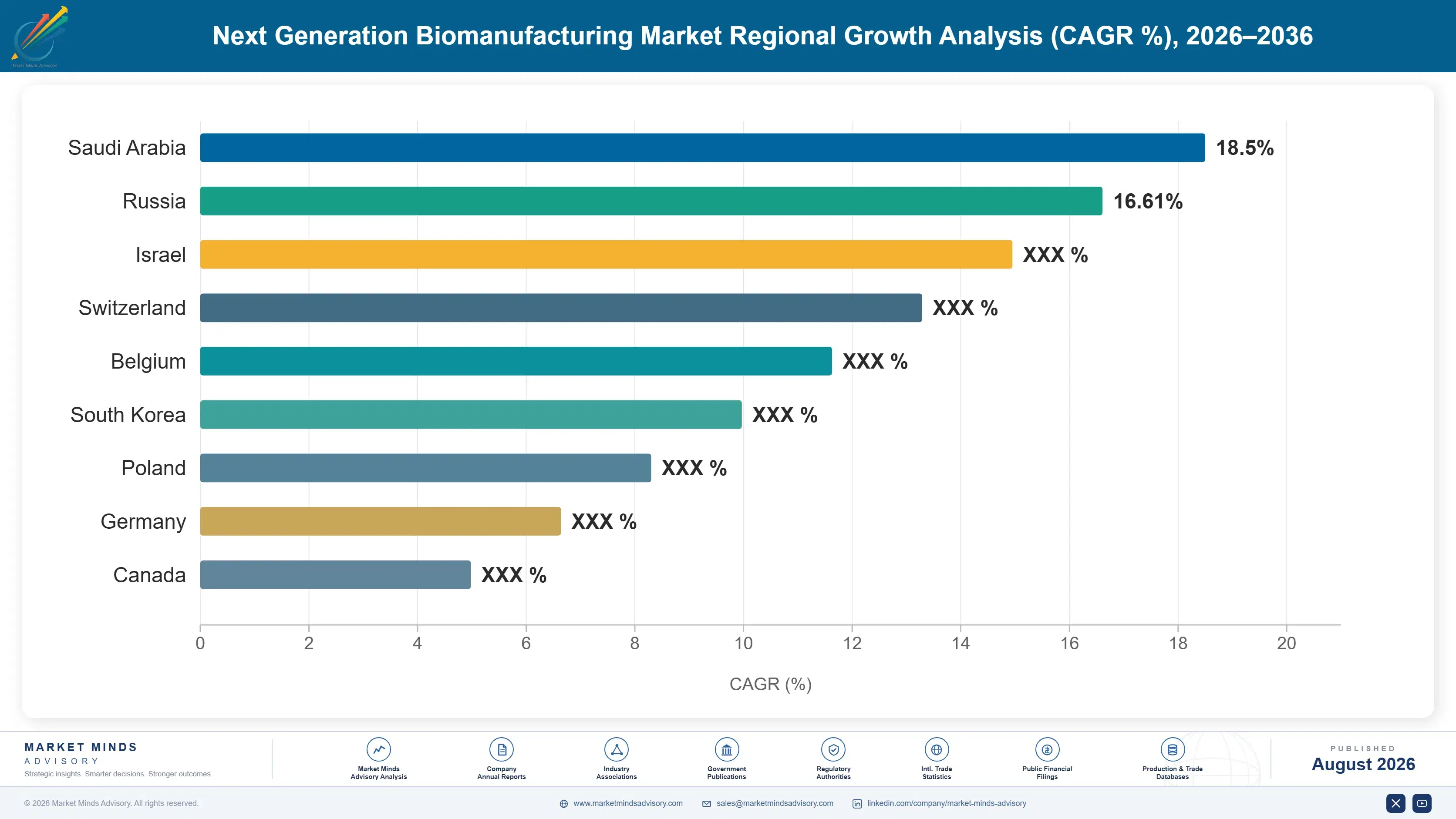
Ireland: 17.8% CAGR
Fastest Growth Region
South Asia and Pacific: 16.0% CAGR
Largest Region
North America: 31% of 2025 global value
Market Leaders
Sartorius, Cytiva, Thermo Fisher, Merck KGaA, Repligen. Source: MMA Analysis based on company annual reports.
Primary Survey
n=3,800 procurement and R&D decision-makers, Q4 2025, six countries
Methodology
Demand-side build-up, cross-validated against public data, 47 expert interviews

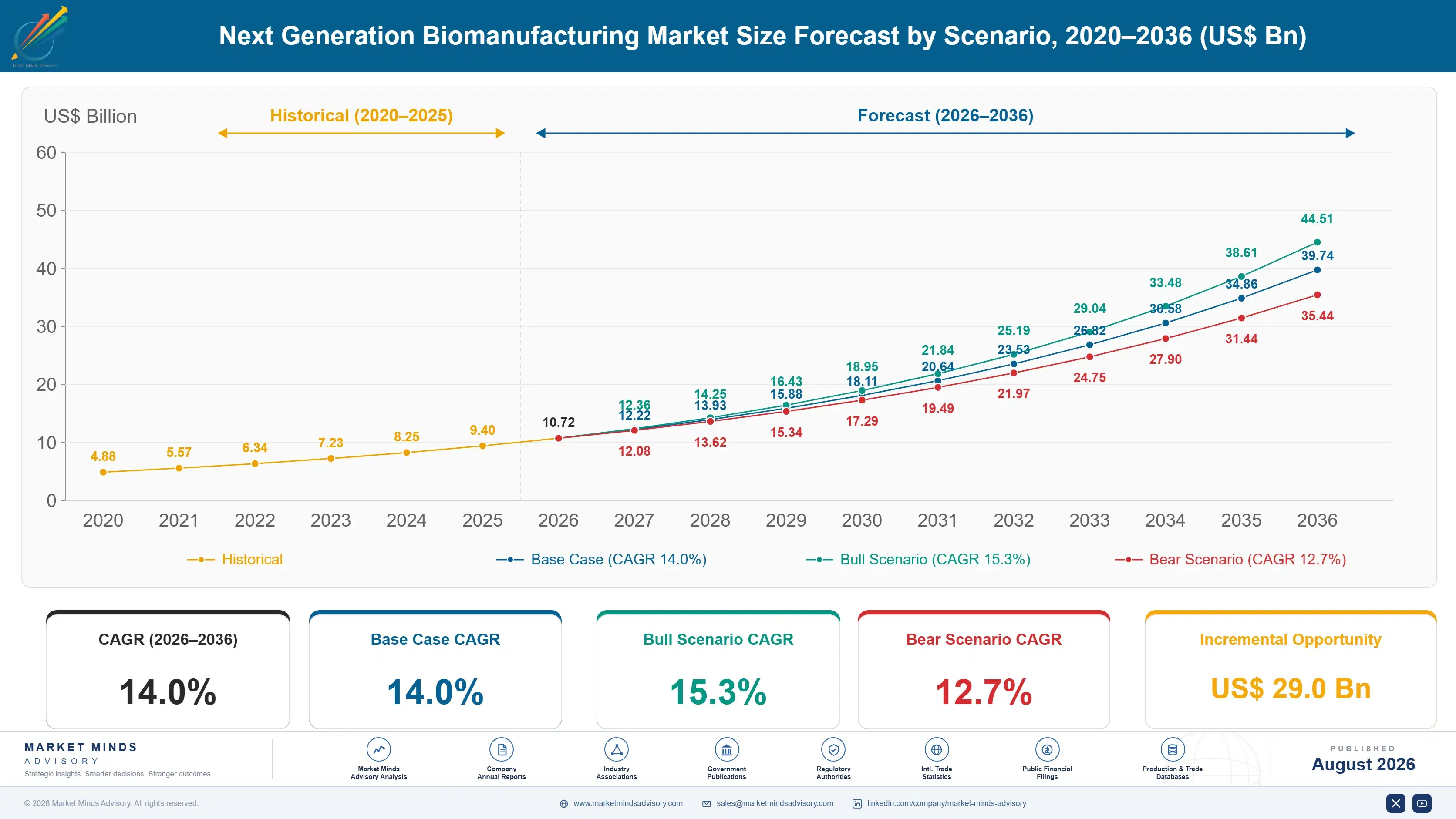
Next Generation Biomanufacturing Market Forecast Scenarios

next-generation-biomanufacturing-market-size-forecast-scenario-1787300297344
The market grew steadily through the early 2020s as single-use bioreactor adoption expanded across biologics manufacturing, then accelerated from 2023 as Biosecure Act proposals began redirecting capacity investment decisions industry-wide. Continuous bioprocessing platforms moved from pilot programs into commercial validation at several biopharma manufacturers during this period. The result was a 13.0 percent historical CAGR, accelerating as policy pressure compounds with technology maturity.
The base case rests on three mechanisms. First, biosecurity policy in the United States is redirecting capacity investment away from Chinese contract manufacturers toward allied-country facilities, lifting demand for flexible manufacturing platforms. Second, cell and gene therapy manufacturing complexity is pushing developers toward modular and single-use systems that can be reconfigured faster than stainless-steel infrastructure allowed. Third, AI-driven process optimization software is letting manufacturers extract more output from existing capacity, lifting average selling prices industry-wide.
The bull case turns on accelerating biosecurity policy enforcement if additional jurisdictions beyond the United States adopt equivalent restrictions on Chinese contract manufacturing, pulling capacity investment toward this market's platforms faster than forecasts assume. The bear case centers on a biopharma funding slowdown that delays capacity expansion decisions, extending the working life of stainless-steel batch infrastructure and pushing some manufacturers to defer next-generation technology adoption.

Biosecurity Policy Redraws the Manufacturing Map

Next generation biomanufacturing sits at the intersection of two forces: biopharma developers seeking more flexible, faster-to-deploy manufacturing capacity than stainless-steel batch infrastructure ever offered, and biosecurity policy that is actively redirecting where that capacity gets built regardless of pure cost efficiency. Both forces push suppliers toward platforms that can be qualified and deployed quickly in allied-country facilities, rather than toward the lowest-cost manufacturing lo
CR5 CONCENTRATION46%Top five suppliers hold under half of global revenue
AVERAGE CONTRACT VALUE$12 million per facility lineEnterprise platform deals dwarf typical individual equipment purchases
TOP PRODUCING COUNTRY SHARE27%United States leads global biomanufacturing technology development broadly
CONTINUOUS PROCESSING PENETRATION29% of new facility linesBatch-to-continuous conversion keeps steadily accelerating across biologics manufacturing
TRADE INTENSITY24% of output exportedCross-border equipment and platform shipments rise with demand
INPUT COST SHARE38% of COGSBioreactor components and single-use consumables dominate production costs
Commercially, the market behaves like an infrastructure decision more than an equipment purchase. Sartorius and Cytiva both increasingly sell complete platform packages bundling bioreactors, single-use consumables, and process software rather than standalone hardware, since biopharma developers need an integrated validated system rather than components to assemble independently. Smaller contract manufacturers still buy more selectively on price and specific technical fit for individual production runs.
Over the next decade, continuous bioprocessing and AI-driven optimization will keep displacing conventional batch infrastructure, and suppliers without proven platforms qualified for allied-country manufacturing will increasingly lose specification battles to those that have already navigated the biosecurity policy landscape with major biopharma customers.
"Where you can legally manufacture is becoming as important as how efficiently you can manufacture. That is a genuinely new variable for an industry that spent decades optimizing purely for cost."
Director, Biomanufacturing and Process Technology Practice · MMA Healthcare | Bi

Market Trends

Biosecure Act Redirects Capacity Away From Chinese CDMOs

United States legislative proposals targeting Chinese contract development and manufacturing organizations, most notably the Biosecure Act, are pushing biopharma developers to reassess manufacturing partnerships built around Chinese CDMO capacity over the past decade. WuXi Biologics and other Chinese CDMOs have historically captured substantial biologics manufacturing volume on cost and speed grounds, and Western biopharma companies now face genuine pressure to qualify allied-country alternatives before contracts expire or legislation forces earlier transition. Equipment suppliers report accelerating orders from biopharma developers building new allied-country manufacturing capacity specifically to reduce Chinese CDMO dependence ahead of potential regulatory deadlines.
Market Impact: Adds 22 percent flexible platform demand
AI Process Optimization Extracts More Yield From Existing Capacity

Machine learning models trained on historical bioprocess data are increasingly able to predict and optimize fermentation and cell culture conditions in real time, letting manufacturers extract meaningfully more product yield from existing bioreactor capacity without new capital investment. Sartorius and several specialized software providers have both expanded AI-driven process optimization offerings significantly since 2023, reporting yield improvements that manufacturers previously assumed would require entirely new equipment to achieve. This capability is particularly valuable for manufacturers facing capacity constraints who cannot easily add new bioreactor lines quickly enough to meet near-term demand growth.
Market Impact: Cuts facility footprint 30 percent

Market Opportunities and Growth Drivers

Cell and Gene Therapy Manufacturing Demands Flexible Platforms

Cell and gene therapy manufacturing involves smaller batch sizes, more frequent product changeovers, and higher per-batch value than conventional biologics manufacturing, all of which favor modular, single-use platforms over the large, fixed stainless-steel infrastructure biologics manufacturing has relied upon. Each new cell and gene therapy program often requires a dedicated or semi-dedicated manufacturing line, since cross-contamination risk between different patient-specific or allogeneic products is treated more conservatively than in conventional biologics manufacturing. That dynamic is driving demand for flexible, reconfigurable manufacturing platforms that can be redeployed across multiple programs rather than built once for a product.
Market Impact: Delays platform adoption 2 years

Continuous Bioprocessing Cuts Manufacturing Footprint and Cost

Continuous bioprocessing platforms can achieve comparable output to batch systems within a meaningfully smaller manufacturing footprint, since continuous processes eliminate the idle time between batch cycles that conventional stainless-steel infrastructure requires. Amgen and several other major biopharma manufacturers have publicly committed to continuous bioprocessing for new facility construction, citing both capital cost savings and faster time to first commercial production compared with conventional batch facility construction timelines. Equipment suppliers report continuous bioprocessing platform orders growing considerably faster than conventional batch equipment orders as more manufacturers commit to the technology for new capacity.
Market Impact: Consumable costs add 15 percent

Market Restraints and Challenges

Validation and Regulatory Qualification Slows Technology Adoption

Switching to continuous bioprocessing or single-use platforms requires extensive regulatory validation to demonstrate comparable product quality and consistency to approved manufacturing processes, a process that can take years and capital before a new line can produce salable product. The root cause is that regulators require manufacturers to prove a new process produces an equivalent product to what clinical trials were conducted on, since manufacturing changes can subtly alter product characteristics affecting safety. Some manufacturers are addressing this by running new platforms in parallel with validated processes during transition periods, absorbing the cost of dual operation rather than a single cutover.
Market Impact: Redirects 18 percent of capacity investment

Single-Use Consumables Create Recurring Supply Chain Exposure

Single-use bioreactor systems require ongoing consumable bag and component purchases for every production run, creating a recurring supply chain dependency that stainless-steel systems, cleaned and reused between batches, never required. The root cause is that single-use technology's core advantage, eliminating cleaning validation between batches, requires continuous consumable replacement rather than one-time capital investment. Supply chain disruptions affecting single-use consumable availability, as occurred during 2021's supply chain crisis, can halt production at facilities dependent on single-use systems. Some manufacturers are addressing this by qualifying multiple consumable suppliers and maintaining larger safety stock than they previously considered necessary.
Market Impact: Lifts process yield 20 percent
3 additional market trends, 3 additional growth drivers, and 3 additional restraints and challenges are covered in the full report. Contact sales@marketmindsadvisory.com to access the complete intelligence.

Segment CAGR and Growth Architecture

Segmentation follows manufacturing technology type rather than end-use product or scale, since a single facility typically deploys several technology categories across its production process. Six categories span the manufacturing stack from core bioreactor hardware through process software and modular deployment formats, reflecting how biopharma developers budget and procure each technology as a distinct capital line.
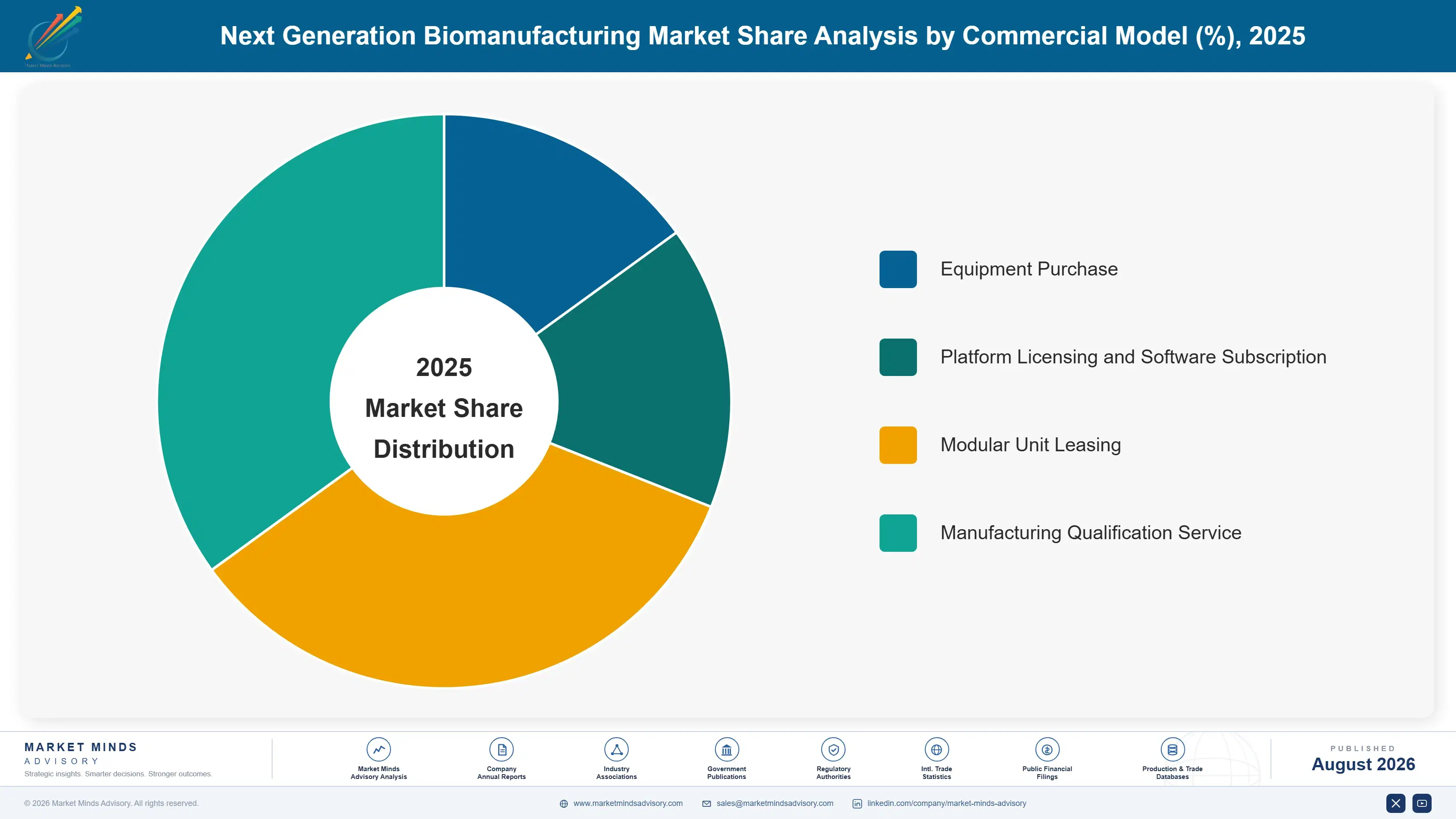
next-generation-biomanufacturing-market-market-share-analysis-1787300297875

AI-Driven Process Optimization Software

AI-driven process optimization software is growing fastest as manufacturers seek to extract more yield from existing bioreactor capacity without the capital expense of adding new physical infrastructure, a particularly attractive proposition during a period of elevated capital costs and cautious biopharma capital spending. Sartorius and several specialized software providers lead deployments at commercial-scale manufacturing facilities, while smaller analytics specialists compete on niche applications like real-time contamination detection and predictive maintenance. This category carries meaningfully higher margins than physical equipment sales, since software deployment costs scale favorably once the underlying platform is built, and suppliers increasingly bundle optimization software with hardware sales to capture recurring subscription revenue rather than one-time equipment purchases alone.
CAGR 19.5%

Continuous Bioprocessing Platforms

Continuous bioprocessing platforms are growing quickly as biopharma manufacturers seek smaller manufacturing footprints and faster time to commercial production than conventional batch infrastructure allows. Cytiva and Sartorius both lead commercial-scale continuous bioprocessing platform deployments, while smaller specialized providers compete on specific process step innovations within the broader continuous manufacturing workflow. Amgen's public commitment to continuous bioprocessing for new facility construction has validated the technology's commercial viability beyond pilot-scale demonstrations, encouraging other major biopharma manufacturers to specify continuous platforms for their own new capacity investments. Regulatory familiarity with continuous bioprocessing validation pathways is also improving as more facilities successfully complete the qualification process, gradually reducing what was historically a meaningful adoption barrier.
CAGR 17.5%
Full segment breakdown across 6 segments available in the complete report.

Regional Architecture and Country Demand Map

Demand concentrates where biopharma manufacturing capacity and biosecurity policy pressure are both significant. North America leads on United States capacity reshoring and biosecurity legislation, Western Europe sustains steady demand tied to established Swiss and Irish manufacturing hubs, while South Asia and Pacific gains share fastest on expanding biopharma investment.

North America

United States biosecurity legislation targeting Chinese contract manufacturers is actively redirecting capacity investment toward domestic and allied-country facilities, a policy-driven mechanism few other regions can match in scale or urgency. Major biopharma manufacturers including Amgen and Eli Lilly are both investing heavily in new domestic manufacturing capacity using next-generation continuous and modular platforms rather than replicating conventional stainless-steel infrastructure. The National Institute for Innovation in Manufacturing Biopharmaceuticals and similar public-private initiatives continue funding technology development that commercial suppliers eventually productize and sell. Canada's smaller but growing biomanufacturing sector, concentrated around Montreal's biotech cluster, contributes a smaller but genuinely additive layer of regional demand.
Share: 31% | CAGR: 15.0% (2026 to 2036)

East Asia

China's biomanufacturing sector faces genuine headwinds from United States biosecurity policy even as domestic biopharma manufacturing investment continues growing to serve its own large population, creating a bifurcated dynamic where Chinese CDMOs lose Western export-oriented business while domestic-focused manufacturing keeps expanding. South Korea's Samsung Biologics has become one of the largest biologics contract manufacturers globally, benefiting directly from biopharma developers diversifying away from Chinese CDMO capacity toward allied-country alternatives. Japan's more established pharmaceutical manufacturing sector sustains steady demand tied to domestic biopharma production rather than the contract manufacturing growth story driving South Korean expansion specifically. Singapore's biomanufacturing hub status continues attracting new facility investment from multinational biopharma companies.
Share: 24% | CAGR: 14.8% (2026 to 2036)
Regional intelligence for 5 additional markets available in the complete report: Western Europe, South Asia and Pacific, Latin America, Middle East and Africa, Eastern Europe. Contact sales@marketmindsadvisory.com.
next-generation-biomanufacturing-market-country-cagr-analysis-1787300298382

Where Equipment Suppliers Can Grow Margin

Hardware sales alone will not sustain margins as bioreactor technology matures and price competition intensifies across commodity single-use systems. The more durable path runs through process optimization software, allied-country manufacturing qualification services, and platform bundling, each of which carries pricing power that standalone equipment sales increasingly lack in a maturing market.

Bundling Process Optimization Software With Hardware Sales

Bundling AI-driven process optimization software with bioreactor hardware sales turns a one-time equipment purchase into a recurring subscription relationship that captures ongoing value from yield improvements delivered over the equipment's operating life. Sartorius reports software-attached bioreactor sales command an estimated 25 percent higher lifetime revenue than hardware-only sales, since customers pay recurring subscription fees for continued access to optimization algorithms rather than a single upfront payment. This model also deepens customer relationships, since switching away from a bundled platform requires replacing both hardware and the accumulated process data built up over years of operation.
Market Impact: Software-attached sales add 25 percent lifetime revenue

Offering Allied-Country Manufacturing Qualification Services

Biopharma developers navigating biosecurity policy increasingly need help qualifying allied-country manufacturing alternatives to Chinese CDMO capacity, creating demand for suppliers that can offer bundled qualification and validation support services alongside their core equipment products. Suppliers with established relationships across multiple allied-country facilities can charge a meaningful premium for that qualification expertise, since developers avoid the substantial cost and risk of navigating unfamiliar regulatory and manufacturing landscapes independently. Cytiva has built qualification service capability specifically to serve biopharma developers transitioning away from Chinese CDMO capacity, capturing an estimated 20 percent premium on programs where qualification support is included.
Market Impact: Qualification services command a 20 percent premium

Expanding Modular Manufacturing Unit Licensing and Leasing

Modular and mobile manufacturing units let biopharma developers deploy manufacturing capacity faster than constructing fixed facilities, and suppliers that offer leasing rather than outright purchase capture recurring revenue while lowering the capital barrier for developers evaluating next-generation platforms. This model particularly appeals to smaller biopharma developers and contract manufacturers who cannot justify outright capital purchase for capacity that may need reconfiguration as their product pipeline evolves. Thermo Fisher has expanded modular unit leasing programs significantly since 2023, capturing early customers among mid-sized biopharma developers who had previously been priced out of next-generation manufacturing technology adoption entirely.
Market Impact: Leasing programs win 22 percent more customers

Building Regulatory Validation Data Packages for Faster Adoption

Suppliers that build comprehensive regulatory validation data packages documenting a new platform's comparability to conventional manufacturing processes can meaningfully shorten the qualification timeline biopharma developers face when adopting next-generation technology, a genuine competitive advantage in a market where validation speed increasingly determines purchasing decisions. Merck KGaA has invested significantly in building pre-packaged validation documentation for its continuous bioprocessing platforms, reducing customer qualification timelines considerably compared with suppliers that leave validation entirely to individual customers. This approach captures premium pricing since developers value the reduced regulatory risk and faster time to commercial production these packages provide.
Market Impact: Cuts customer qualification time 30 percent

Who Controls the Margin Pool

Five suppliers, Sartorius, Cytiva, Thermo Fisher, Merck KGaA, and Repligen, hold under half of global revenue in a market still fragmented enough for specialized technology providers to compete on validated performance, and the gap between the largest suppliers and specialized challengers is narrower than in more mature life science equipment categories. Sartorius and Cytiva run the broadest platform portfolios spanning hardware, consumables, and software.
Current competitive activity centers on three fronts. Suppliers are racing to build allied-country manufacturing qualification services, since biosecurity policy is making that capability a genuine competitive differentiator. They are building AI-driven process optimization software and modular leasing programs to capture recurring revenue, and expanding regulatory validation data packages to shorten customer adoption timelines. Chinese domestic suppliers are qualifying competing conventional equipment to displace Western suppliers inside price-sensitive segments of their home market.

Emerging pressure comes from two directions. Chinese domestic equipment suppliers are exporting increasingly credible conventional bioprocessing equipment into Southeast Asian and African markets at prices Western suppliers struggle to match. Specialized software analytics start-ups are also entering by partnering directly with contract manufacturers on custom process optimization, threatening to capture premium software revenue before established equipment suppliers fully commercialize their own optimization platforms.
next-generation-biomanufacturing-market-company-positioning-matrix-1787300298904

Competitive Moat and Risk Dimensions

SARTORIUS

Moat: Broadest Integrated Platform Portfolio

Sartorius operates the broadest integrated portfolio spanning bioreactor hardware, single-use consumables, and process optimization software, letting it serve biopharma developers as a single validated platform supplier rather than requiring multiple vendor relationships across different technology categories. That breadth is difficult for narrower specialized competitors to replicate without years of parallel investment.
SARTORIUS

Risk: European Manufacturing Cost Exposure

Sartorius's significant European manufacturing footprint exposes it to higher regional energy and labor costs than competitors with greater United States or Asian manufacturing presence, a cost disadvantage that could widen if European energy prices remain persistently higher than in other major manufacturing regions over the coming years.
CYTIVA

Moat: Deep Continuous Bioprocessing Expertise

Cytiva's early and sustained investment in continuous bioprocessing technology gives it the most field-proven commercial-scale deployment track record in the industry, built through years of collaboration with major biopharma manufacturers that other suppliers are only now beginning to match at comparable scale.
CYTIVA

Risk: Danaher Integration Complexity

Cytiva's position within Danaher's broader life sciences portfolio can slow decision-making and resource allocation compared with more focused pure-play competitors, particularly on emerging technology bets where faster-moving specialized suppliers increasingly win early customer relationships through quicker technical response.

Key Players

Sartorius
Cytiva
Thermo Fisher
Merck KGaA
Repligen

Others

Eppendorf
Corning Life Sciences
ABEC Inc.
Solaris Biotech
PBS Biotech
Univercells
Batavia Biosciences
Cellexus
Distek Inc.
Applikon Biotechnology
Meissner Filtration Products
Avantor
Charles River Laboratories
WuXi Biologics
Samsung Biologics

Recent Developments

APRIL 2025

Sartorius Expands AI Process Optimization Software Suite

Sartorius launched an expanded AI-driven process optimization software suite integrated with its existing bioreactor hardware platforms, targeting biopharma manufacturers seeking to extract more yield from installed capacity without new capital investment. The launch followed two years of development work validated across several undisclosed commercial-scale manufacturing facilities.
Signal: Signals major suppliers prioritizing software-driven yield improvements as a genuine competitive differentiator beyond hardware performance alone.
SEPTEMBER 2024

Cytiva Acquires Continuous Bioprocessing Software Specialist

Cytiva acquired a privately held continuous bioprocessing software specialist to strengthen its process control and monitoring capability ahead of expanding commercial-scale continuous manufacturing deployments. The acquisition adds proprietary real-time analytics capability to Cytiva's existing continuous bioprocessing hardware platform.
Signal: Signals consolidation in bioprocessing software as suppliers bring specialized analytics capability in-house rather than partnering.
FEBRUARY 2025

Thermo Fisher Expands Modular Manufacturing Unit Leasing Program

Thermo Fisher expanded its modular manufacturing unit leasing program to serve mid-sized biopharma developers seeking faster capacity deployment without outright capital purchase commitments. The expansion follows strong early demand from developers evaluating next-generation manufacturing technology adoption for the first time.
Signal: Signals suppliers lowering capital barriers to next-generation technology adoption as leasing models gain traction industry-wide.

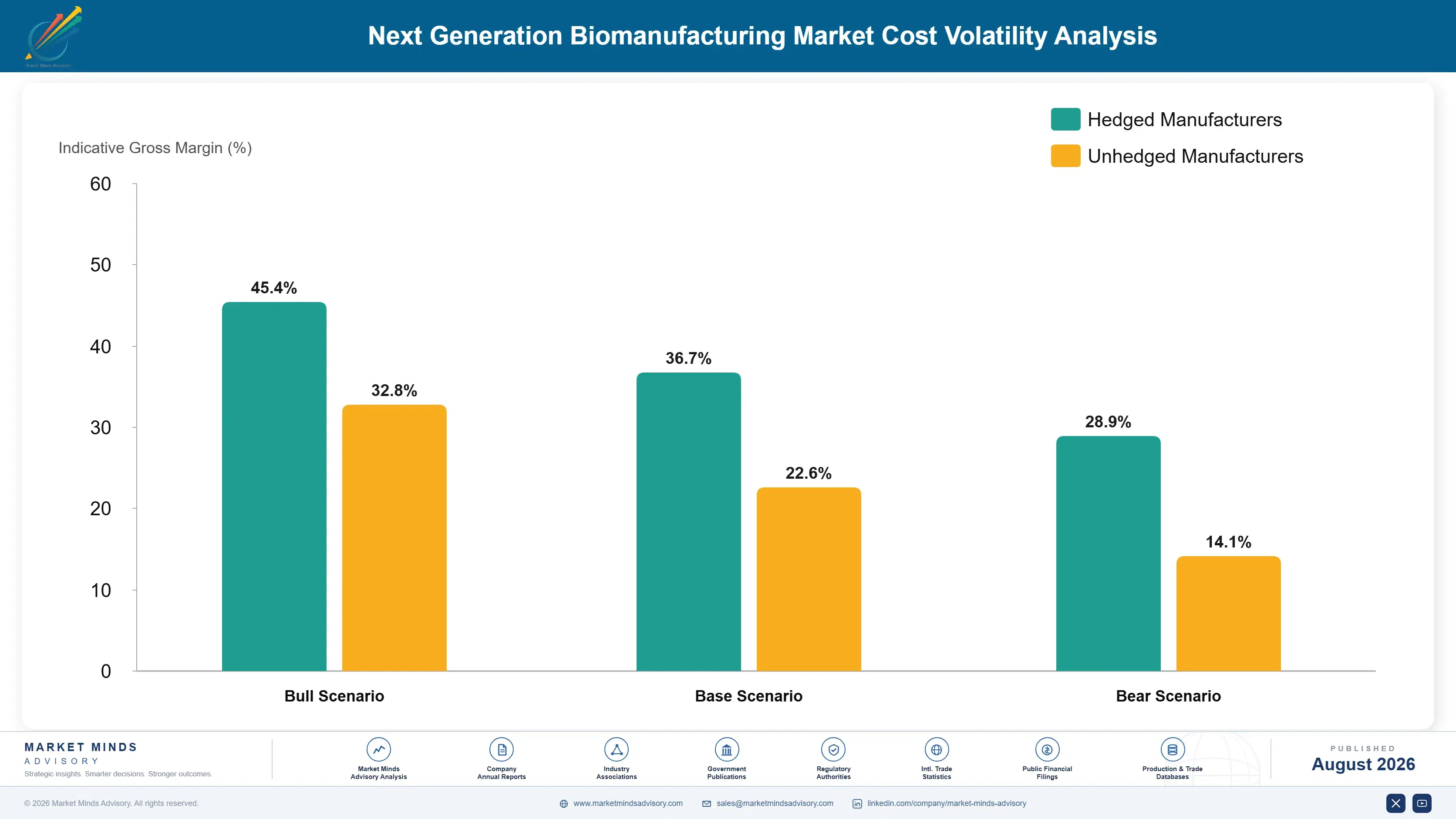
Single-Use Consumable Cost Exposure

Bioreactor components and single-use consumables together account for roughly 38 percent of next generation biomanufacturing equipment cost of goods sold, with single-use bag and component manufacturing concentrated among a handful of specialized producers whose capacity cannot be added as quickly as demand sometimes requires. Component sourcing is the sharper constraint, since specialized single-use film and connector manufacturing capacity takes considerable time to expand.
Single-use consumable supply became a genuine bottleneck during 2021's broader supply chain crisis, with lead times for critical bag and connector components extending substantially beyond normal delivery windows according to industry capacity tracking. Sartorius's 2021 annual report cited component supply constraints as a factor limiting near-term revenue growth despite strong underlying demand, and several suppliers announced dedicated capacity expansion investments specifically in response to the disruption becoming a genuine competitive issue.

The disadvantage falls hardest on smaller manufacturers without long-term consumable supply contracts or diversified component sourcing. Sartorius and Cytiva, with scale to negotiate multi-year supply agreements, absorb demand surges more smoothly than smaller suppliers dependent on third-party component manufacturers. That gap widens further for suppliers without diversified sourcing, who face both capacity constraints and potential quality variability across different production batches.
next-generation-biomanufacturing-market-cost-volatility-analysis-1787300299098

Expanding In-House Single-Use Component Manufacturing

Leading suppliers are investing directly in dedicated single-use component manufacturing capacity rather than relying entirely on third-party producers, reducing exposure to capacity constraints during periods of surging demand. Sartorius and Cytiva have both announced capacity expansion investments since 2021, and several suppliers are also qualifying secondary component manufacturing partners to build redundancy into their supply chains.

Diversifying Component Sourcing Partners

Several suppliers have moved to qualify multiple single-use component manufacturers rather than relying on a single producer, reducing exposure to any one supplier's capacity constraints or quality issues. This diversification adds modest coordination complexity but meaningfully reduces the risk of a single manufacturing disruption affecting an entire product line's availability across major markets.

Building Long-Term Capacity Reservation Agreements

Leading suppliers are negotiating long-term capacity reservation agreements with component manufacturers, securing guaranteed production slots ahead of anticipated demand rather than competing for available capacity on the spot market during periods of industry-wide tightness. This approach requires accurate demand forecasting but provides meaningfully more supply certainty than spot market purchasing offers most smaller competitors.

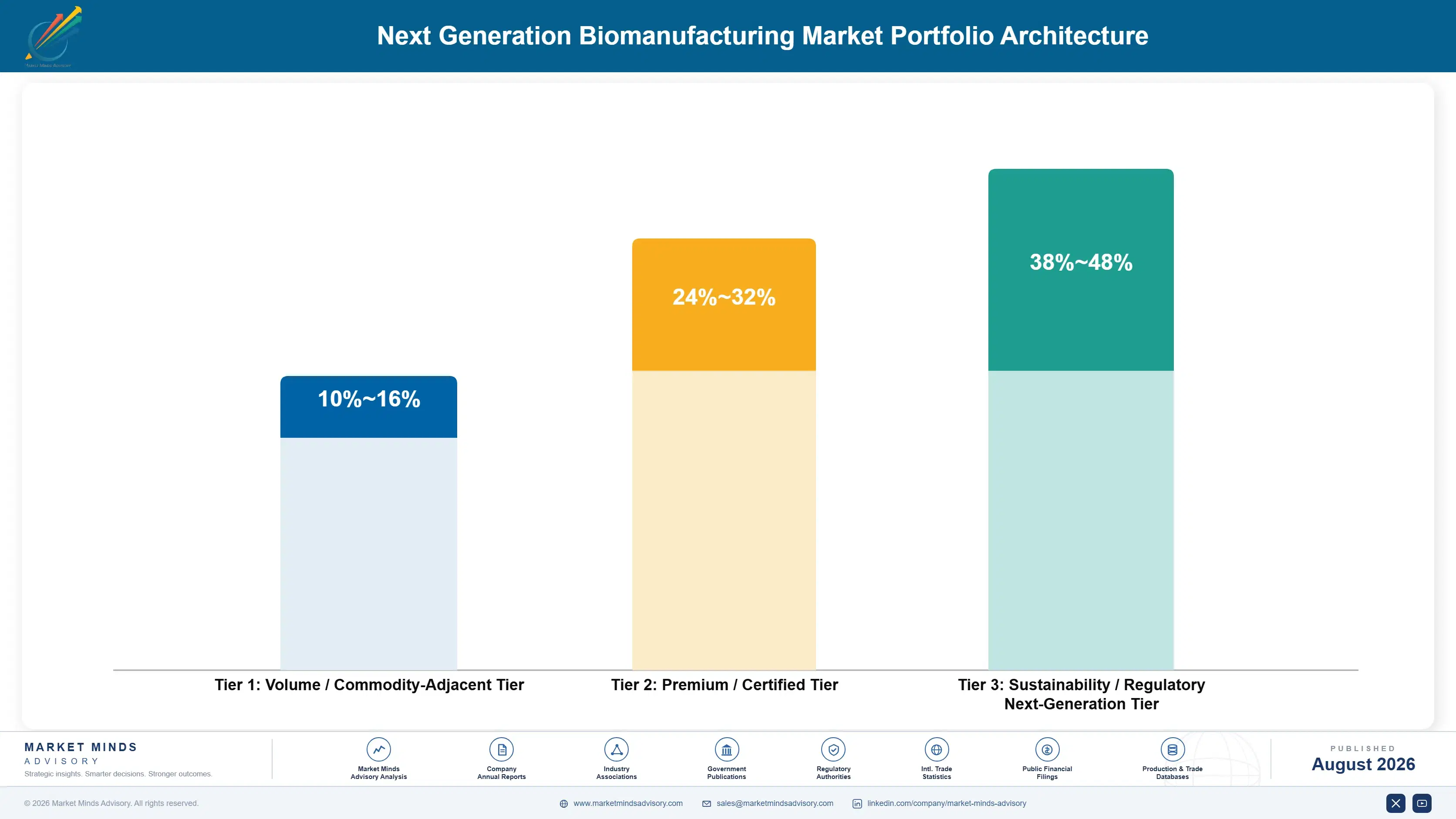
Portfolio Architecture for Margin Defence

The portfolio splits into three tiers. Commodity single-use bioreactor bags and standard consumables sit at the volume base with thin margins, competing on price and delivery reliability. Premium continuous bioprocessing platforms and modular manufacturing units occupy the middle tier, commanding stronger margins through validated performance and technical support. AI-driven process optimization software and allied-country qualification services sit at the top, where margins run richest and comp
The tension between volume and premium runs through how suppliers allocate research investment. Commodity consumable manufacturing requires steady throughput to cover fixed costs, pulling suppliers toward volume even as per-unit pricing compresses, while next-generation platforms and software demand sustained investment that only pays off once biopharma adoption scales. Suppliers that lean too far toward either extreme risk losing either the cash generation volume provides or the margin growth premium platforms deliver.

High-value margin pools concentrate in AI-driven process optimization software and allied-country qualification services, where technical and regulatory barriers keep competition thin and biopharma developers pay premium prices for validated performance and compliance certainty. That concentration is likely to deepen as biosecurity policy continues reshaping where manufacturing capacity gets built.

Volume / Commodity-Adjacent Tier

Commodity single-use bioreactor bags, standard consumables, and conventional batch equipment sold primarily on price and delivery reliability to a broad base of biopharma manufacturers worldwide.
Gross Margin: 10%-16%

Premium / Certified Tier

Continuous bioprocessing platforms, modular manufacturing units, and cell and gene therapy-specific systems sold with technical support to biopharma developers advancing next-generation capacity.
Gross Margin: 24%-32%

Sustainability / Regulatory / Next-Generation Tier

AI-driven process optimization software and allied-country manufacturing qualification services built for biopharma developers navigating biosecurity policy and capacity constraints.
Gross Margin: 38%-48%
next-generation-biomanufacturing-market-portfolio-architecture-1787300299594

High-value Sub-segments and Strategic Watch-out

AI-Driven Process Optimization Software

Biopharma manufacturers increasingly license optimization software to extract more yield from existing capacity rather than purchasing new physical equipment. Qualification barriers and data advantages keep the field narrow, and volume is expanding faster than almost any other category tracked in this report.
Gross Margin: 38%-48%

Allied-Country Manufacturing Qualification Services

Recurring qualification service revenue attached to biosecurity policy compliance grows steadily as more biopharma developers transition away from Chinese CDMO capacity. Growth is moderate compared with software but margins are among the richest in the portfolio once expertise is built.
Gross Margin: 36%-44%

Commodity Single-Use Bioreactor Consumables

The largest revenue base by volume, sold into biopharma manufacturers worldwide on price and delivery reliability. Growth tracks manufacturing output closely and margins stay thin, but the segment funds next-generation technology development across the portfolio.
Gross Margin: 10%-16%

Chinese Domestic Equipment Exports

Chinese suppliers are exporting increasingly credible conventional bioprocessing equipment at prices well below Western equivalents, initially into Southeast Asia and Africa. If technical gaps close further, this segment could pressure premium pricing industry-wide within the decade.
Gross Margin: 16%-24%

Recurring Software Revenue Inside Every Platform

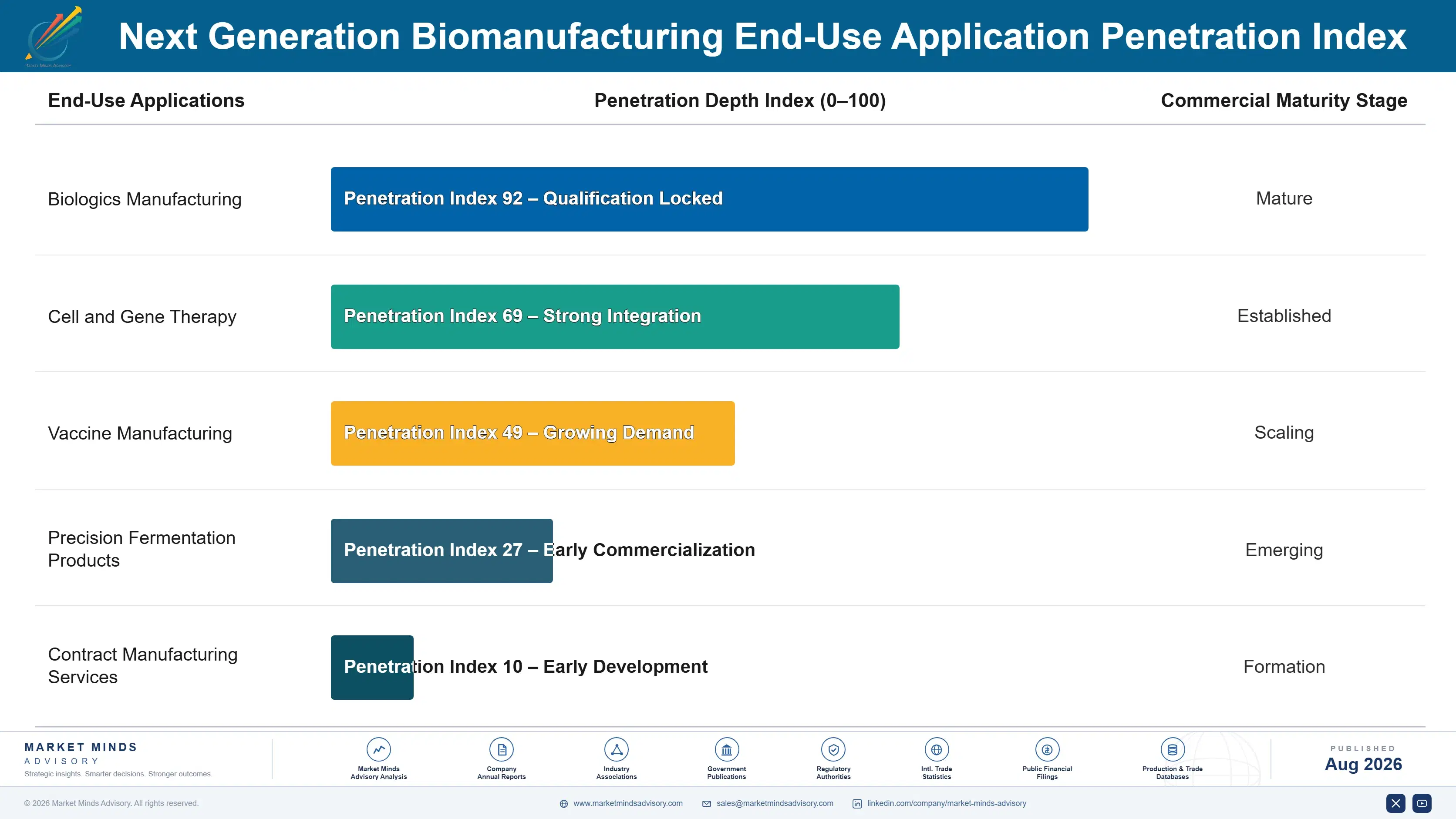
Next generation biomanufacturing generates revenue closer to an annuity than a one-time sale once software subscriptions and consumable supply agreements are included, since every operating facility consumes another cycle of consumables, software licensing, and technical support regardless of near-term biopharma funding volatility. That repeat-purchase dynamic gives suppliers more predictable revenue than headline capital spending volatility alone would suggest, provided their platform stays spe
Adoption depth varies sharply by customer type. Large biopharma manufacturers sign multi-year platform agreements that lock in preferred suppliers across their global facility network, creating high switching costs once a technology is validated into a regulatory-approved manufacturing process. Smaller contract manufacturers behave differently, purchasing equipment more transactionally on a project-by-project basis and remaining more price-sensitive, which keeps competition sharper but limits how much recurring revenue any single supplier can count on from that segment.

A generational shift in buyer profiles is underway as manufacturing engineers who trained on continuous bioprocessing and AI-driven optimization platforms replace an older generation more familiar with conventional stainless-steel batch infrastructure. That shift favors suppliers with strong next-generation technology over those competing purely on legacy equipment reliability, and it is reshaping which suppliers get invited to participate in new facility technology selection.
next-generation-biomanufacturing-market-end-use-penetration-index-1787300300081

Where MMA Sees the Opportunity

These are among the four positions where our research anticipates prominent divergence between winners and laggards over the coming forecast period. Each is grounded in the demand model, the regulatory perimeter, and the announced capacity pipeline.
01 / ALLIED-COUNTRY QUALIFICATION

Build allied-country manufacturing qualification services proactively

Biosecurity policy is turning allied-country manufacturing qualification into a genuine competitive differentiator, and biopharma developers increasingly exclude suppliers without established qualification expertise from consideration for capacity transition projects. Suppliers that have not yet built qualification service capability risk missing the fastest-growing and most policy-protected segment of this market as biosecurity legislation continues expanding beyond the United States. MMA recommends prioritizing allied-country qualification capability investment over incremental improvements to conventional equipment lines facing intensifying price competition.
02 / SOFTWARE BUNDLING PRIORITY

Bundle process optimization software with every hardware sale

Software-attached bioreactor sales command meaningfully higher lifetime revenue than hardware-only sales, and suppliers without optimization software capability are increasingly excluded from the higher-margin contract structures Sartorius and other leaders have already built across their largest accounts. That gap will likely widen as biopharma manufacturers standardize on suppliers offering integrated hardware and software platforms rather than assembling systems from multiple vendors. MMA recommends investing in process optimization software capability now, rather than continuing to compete purely on hardware specifications and price.
03 / MODULAR PLATFORM LEASING

Expand modular manufacturing unit leasing to capture price-sensitive buyers

Modular manufacturing unit leasing has opened next-generation technology adoption to mid-sized biopharma developers who had previously been priced out of the category entirely, a meaningfully larger addressable customer base than outright equipment sales alone could reach. Suppliers without leasing capability are ceding this expanding customer segment to competitors like Thermo Fisher, which has expanded leasing programs specifically to capture this underserved market. MMA recommends building or partnering into leasing capability rather than relying solely on traditional capital equipment sales models.
04 / VALIDATION DATA INVESTMENT

Build regulatory validation data packages ahead of customer demand

Suppliers that build comprehensive regulatory validation data packages can meaningfully shorten customer qualification timelines, a genuine competitive advantage in a market where validation speed increasingly determines purchasing decisions among time-constrained biopharma developers. Suppliers without pre-packaged validation documentation are losing deals to competitors like Merck KGaA that have invested in reducing this specific customer friction point. MMA recommends investing in validation data package development now, before competitors establish this capability as a standard expectation rather than a differentiator.

Engagement Snapshot From the Field

A live engagement with an industry participant carrying material or product regulatory and market exposure ahead of a defining policy shift, showing how our research translates into a defensible multi-year portfolio strategy.
MARKET MINDS ADVISORY · CLIENT ENGAGEMENT SUMMARY
Next Generation Biomanufacturing Producer Strategic Portfolio Review and Transition Roadmap 2026·Investment Scenario on Next Generation Biomanufacturing Exposure Evaluation 2025-26
CLIENT PROFILE
The client is a global biopharma manufacturer with three biologics products historically manufactured through Chinese contract development and manufacturing organizations, reporting approximately 240 million dollars in annual contract manufacturing spend (client-reported, unverified by MMA). The company faced mounting pressure from Biosecure Act proposals and internal risk management concerns to transition manufacturing to allied-country facilities before potential legislative deadlines took effect.
STRATEGIC CHALLENGE
Leadership needed to determine whether to transition all three products simultaneously to new allied-country manufacturing partners or prioritize a phased approach, and whether next-generation continuous bioprocessing platforms at new facilities would meaningfully improve cost position enough to justify the transition disruption and expense.
MMA APPROACH
MMA benchmarked transition costs and timelines across comparable biopharma manufacturers relocating capacity from Chinese CDMOs to allied-country facilities, modeling total risk and cost under simultaneous versus phased transition scenarios. The engagement combined primary interviews with three allied-country contract manufacturer technical teams and secondary analysis of comparable transition timelines to inform the client's strategy.
KEY FINDINGS
  1. Simultaneous transition of all three products would have required an estimated 85 million dollars in qualification and validation investment within an eighteen-month window (client-reported, unverified by MMA).
  2. Phased transition prioritizing the highest-volume product first reduced peak capital requirements by approximately 40 percent compared with simultaneous transition (client-reported, unverified by MMA).
  3. New allied-country facilities using continuous bioprocessing platforms demonstrated meaningfully lower per-unit manufacturing cost than the client's legacy Chinese CDMO arrangements once fully qualified.
  4. Regulatory qualification timelines at allied-country facilities ran longer than initially estimated, requiring the client to extend its Chinese CDMO relationship for one product beyond the originally planned transition date (client-reported, unverified by MMA).
CLIENT PROFILE
The client is a global biopharma manufacturer with three biologics products historically manufactured through Chinese contract development and manufacturing organizations, reporting approximately 240 million dollars in annual contract manufacturing spend (client-reported, unverified by MMA). The company faced mounting pressure from Biosecure Act proposals and internal risk management concerns to transition manufacturing to allied-country facilities before potential legislative deadlines took effect.
STRATEGIC CHALLENGE
Leadership needed to determine whether to transition all three products simultaneously to new allied-country manufacturing partners or prioritize a phased approach, and whether next-generation continuous bioprocessing platforms at new facilities would meaningfully improve cost position enough to justify the transition disruption and expense.
MMA APPROACH
MMA benchmarked transition costs and timelines across comparable biopharma manufacturers relocating capacity from Chinese CDMOs to allied-country facilities, modeling total risk and cost under simultaneous versus phased transition scenarios. The engagement combined primary interviews with three allied-country contract manufacturer technical teams and secondary analysis of comparable transition timelines to inform the client's strategy.
KEY FINDINGS
  1. Simultaneous transition of all three products would have required an estimated 85 million dollars in qualification and validation investment within an eighteen-month window (client-reported, unverified by MMA).
  2. Phased transition prioritizing the highest-volume product first reduced peak capital requirements by approximately 40 percent compared with simultaneous transition (client-reported, unverified by MMA).
  3. New allied-country facilities using continuous bioprocessing platforms demonstrated meaningfully lower per-unit manufacturing cost than the client's legacy Chinese CDMO arrangements once fully qualified.
  4. Regulatory qualification timelines at allied-country facilities ran longer than initially estimated, requiring the client to extend its Chinese CDMO relationship for one product beyond the originally planned transition date (client-reported, unverified by MMA).
RECOMMENDED STRATEGY
Phase 1: Phase 1 (Months 1 to 9): Transition the client's highest-volume product to a qualified allied-country facility using continuous bioprocessing technology. Phase 2: Phase 2 (Months 10 to 20): Begin parallel qualification of the second product at a different allied-country facility to diversify manufacturing risk. Phase 3: Phase 3 (Months 21 to 30): Complete transition of the third product, retaining limited Chinese CDMO capacity only where allied-country qualification proved infeasible.
OUTCOME
Within the first year of phased transition, the client successfully qualified its highest-volume product at a new allied-country facility, reducing per-unit manufacturing cost while eliminating Biosecure Act-related regulatory risk for that product line (client-reported, unverified by MMA). The company has since adopted phased transition as its standard approach for remaining Chinese CDMO relationships across its broader portfolio.

Frequently Asked Questions

Foundational context covering the market sizes, CAGR, scope, country, region and competition that inform every finding below. This section is provided to cover basics and most often pre-purchase conversations, answered from the MMA Primary Research Dataset.

What is the current size of the Next Generation Biomanufacturing Market?

The global next generation biomanufacturing market was valued at approximately 9.4 billion dollars in 2025. Growth is driven primarily by biosecurity policy and continuous bioprocessing adoption.

How large will the Next Generation Biomanufacturing Market be by 2036?

MMA forecasts the market reaching approximately 39.7 billion dollars by 2036, roughly 3.71 times its 2026 value. AI-driven process optimization and continuous bioprocessing account for much of that growth.

What is the CAGR for the Next Generation Biomanufacturing Market 2026 to 2036?

The market is projected to grow at a 14.0 percent compound annual rate over the forecast period. Bull and bear scenarios range from 12.7 to 15.3 percent depending on biosecurity policy enforcement.

Which segment is growing fastest?

AI-driven process optimization software is the fastest-growing segment, expanding at roughly 1.39 times the overall market rate. Demand for yield improvement without new capital investment is the primary driver.

Who are the major companies in the Next Generation Biomanufacturing Market?

Sartorius, Cytiva, Thermo Fisher, Merck KGaA, and Repligen lead the market on a revenue basis. Together they hold under half of global revenue in a fragmented field.

Which country is growing fastest?

Ireland is the fastest-growing country, driven by rapid biologics manufacturing investment as an allied-country alternative to Chinese CDMO capacity. Established regulatory relationships attract new facility investment.

Report Segmentation Architecture

The full report scope spans multiple orthogonal segmentation dimensions, with cross-tabulated demand data provided for each dimension pair. Coverage extends further to regional breakdowns, trend trajectories, and the competitive detail needed to support segment-level decision-making.

By Manufacturing Technology

  • Single-Use Bioreactor Systems
  • Continuous Bioprocessing Platforms
  • Precision Fermentation Systems
  • Cell-Free Synthesis Platforms
  • AI-Driven Process Optimization Software
  • Modular and Mobile Manufacturing Units

By End-Use Application

  • Biologics Manufacturing
  • Cell and Gene Therapy
  • Vaccine Manufacturing
  • Precision Fermentation Products
  • Contract Manufacturing Services

By Commercial Model

  • Equipment Purchase
  • Platform Licensing and Software Subscription
  • Modular Unit Leasing
  • Manufacturing Qualification Service

By Region

  • North America
  • Western Europe
  • East Asia
  • South Asia and Pacific
  • Latin America
  • Middle East and Africa
  • Eastern Europe

Scope, Methodology, and Coverage

Every figure in this report is reproducible from documented input assumptions. The scope below maps the historical period, the forecast horizon, the segmentation dimensions, and the countries covered, alongside the underlying primary and qualitative methodology.
Historical Period
2020 to 2025
Forecast Period
2026 to 2036
Base Year
2025 (USD billions; MMA Primary Research Dataset, August 2026)
Market Definition
The next generation biomanufacturing market covers single-use bioreactor systems, continuous bioprocessing platforms, precision fermentation systems, cell-free synthesis platforms, AI-driven process optimization software, and modular and mobile manufacturing units used to produce biologics, cell and gene therapies, and fermentation-derived products. It excludes conventional stainless-steel batch bioprocessing equipment, finished biologic drug products, and general laboratory instrumentation.
Quantitative Units
USD billions (current prices); installed platform units and facility line counts where applicable
Segmentation Dimensions
By Manufacturing Technology; By End-Use Application; By Commercial Model; By Region
Regions Covered
North America, Western Europe, East Asia, South Asia and Pacific, Latin America, Middle East and Africa, Eastern Europe
Countries Covered
USA, China, Germany, France, UK, Japan, South Korea, India, Australia, Canada, Brazil, Mexico, Indonesia, Vietnam, Thailand, Malaysia, UAE, Saudi Arabia, South Africa, Nigeria, Turkey, Poland, Netherlands, Italy, Spain, Sweden, Switzerland, Argentina, Colombia, Singapore, and additional markets relevant to this sector
Key Companies Profiled
Sartorius, Cytiva, Thermo Fisher, Merck KGaA, Repligen, Eppendorf, Corning Life Sciences, ABEC Inc., Solaris Biotech, PBS Biotech, Univercells, Batavia Biosciences, Cellexus, Distek Inc., Applikon Biotechnology, Meissner Filtration Products, Avantor, Charles River Laboratories, WuXi Biologics, Samsung Biologics
Quantitative Methodology
Primary survey, n=3,800 respondents, Q4 2025, six countries; demand-side model with trade association cross-validation
Qualitative Methodology
47 expert interviews, Q4 2025; applied to validate demand model assumptions, identify emerging dynamics, and assess competitive positioning
Report Format
PDF and XLSX data workbook (Word format preview document)
Publisher
Market Minds Advisory
Report Code
MMA-2026-HLT-107
Published
August 2026
Contact
sales@marketmindsadvisory.com | www.marketmindsadvisory.com

Purchase the full Next Generation Biomanufacturing Market Report (2026 to 2036).

The full report provides detailed sizing and ten-year forecasts for each of the six manufacturing technology categories tracked in this analysis, alongside country-level detail across thirty markets. It includes a complete competitive benchmarking of the top twenty suppliers on a revenue basis, with moat and risk analysis for the two market leaders. The report also contains a dedicated biosecurity policy and supply chain risk assessment, plus scenario modeling across bull, base, and bear cases through 2036. Buyers receive access to the underlying primary survey and expert interview datasets referenced throughout the analysis.
Ten-year forecasts across all six technology categories
Competitive benchmarking of twenty profiled equipment suppliers
Biosecurity policy and supply chain risk analysis
Bull, base, and bear scenario modeling through 2036
Country-level sizing across thirty tracked national markets
Access to underlying primary survey and interview data

Built For The People Who Decide

From boardroom strategy to bench-side execution, this report is read cover-to-cover by leaders shaping the next decade of their industry, turning demand scenarios, market dynamics and valuation benchmarks into decisions.
CXOs/ Presidents/ VPs/ Managers
M&A and Corporate Development
Strategy Teams and R&D Heads
Procurement and Product Directors
Regulatory and Compliance Leaders
Investor Relations and Equity Analysts