Market Minds Advisory
Neurodiverse Workforce Productivity Tools Market

Neurodiverse Workforce Productivity Tools Market: Neurodiverse Workforce Productivity Tools: Disclosure Barriers, Assessment Bottlenecks and Where the Spending Really Goes

Most employees who would benefit never ask, because asking means disclosing, which is why tools deployed to everybody reach far more people than any request-based adjustment process has ever managed.

Lead Analyst

Published

September 2026

Make Smarter Decisions with Customized Research Insights

Request a free sample report and evaluate market opportunities, growth trends, and competitive dynamics relevant to your business needs.

2025 MARKET VALUE$1.4BMarket Size 2025
2036 FORECAST VALUE$7.2BBase Case , 2026 to 2036
CAGR 2026 TO 203616.0 %Bull 17.2% / Bear 14.8%
INCREMENTAL OPPORTUNITY$5.5BNet 10- year value creation
EXPANSION MULTIPLE4.41x2036 value over 2026 base
Strategic Levers
M&A Pipeline
Regional Outlook
Country Rankings
Competitive Intelligence
Segmental Deep-dive
Call-Us : 91 93563 13602

Executive Snapshot and Market Trajectory.

Around 16% of employees identify as neurodivergent in confidential surveys and only about 38% of those ask for anything through a formal process. The gap is disclosure, not availability, and it shapes every purchasing decision in this market. Any design that waits for a request reaches a minority.
Employers respond by buying process rather than product. Workplace adjustment management platforms grow at 24.0%, half again the market rate of 16.0%, because failing to make a reasonable adjustment is a legal exposure while providing one is administration. Assessment follows at 22.0% on waiting times near 14 weeks. Western Europe takes 34% of value, driven by a British statutory duty and a government funding scheme with no equivalent anywhere.
Concentration is very low at roughly 21% across the top five on measured attributable revenue, and the field is being compressed from above. Reading support, dictation, focus modes and meeting transcription now ship inside mainstream productivity software at no additional cost, which removes the entry-level specialist product. Around 57% of spending goes to services rather than software. What remains chargeable is practitioner expertise and the documented record. Bundled software supplies neither of those things.
Market Definition
This market covers software and services supporting neurodivergent employees in the workplace, spanning reading, writing and literacy support, focus, task and executive function tools, meeting capture and recall support, workplace adjustment management platforms, screening, assessment and needs analysis, and sensory and environment management. Revenue is measured as software subscription and attributable service value where deployed for workplace neurodiversity support. Clinical diagnosis and treatment, educational assistive technology sold to schools, general accessibility compliance auditing and recruitment platforms are excluded.
Base Year Value
$1.4B in 2025 (MMA Primary Research Dataset, September 2026)
Forecast Period
2026 to 2036, eleven discrete annual values
CAGR
16.0% base case. Bull 17.2%. Bear 14.8%.
Fastest Growth Segment
Workplace Adjustment Management Platforms: 24.0% CAGR
Fastest Growth Country
India: 21.4% CAGR
Fastest Growth Region
South Asia and Pacific: 18.2% CAGR
Largest Region
Western Europe: 34% of 2025 global value
Market Leaders
Microsoft, Texthelp, Grammarly, Otter.ai and Lexxic lead on measured revenue attributable to workplace neurodiversity support. Source: MMA Primary Research Dataset, July 2026.
Primary Survey
n=3,800 procurement and R&D decision-makers, Q4 2025, six countries
Methodology
Demand-side build-up, cross-validated against public data, 47 expert interviews

Neurodiverse Workforce Productivity Tools Market Forecast Scenarios

neurodiverse-workforce-productivity-tools-market-size-forecast-scenario-1788421790363
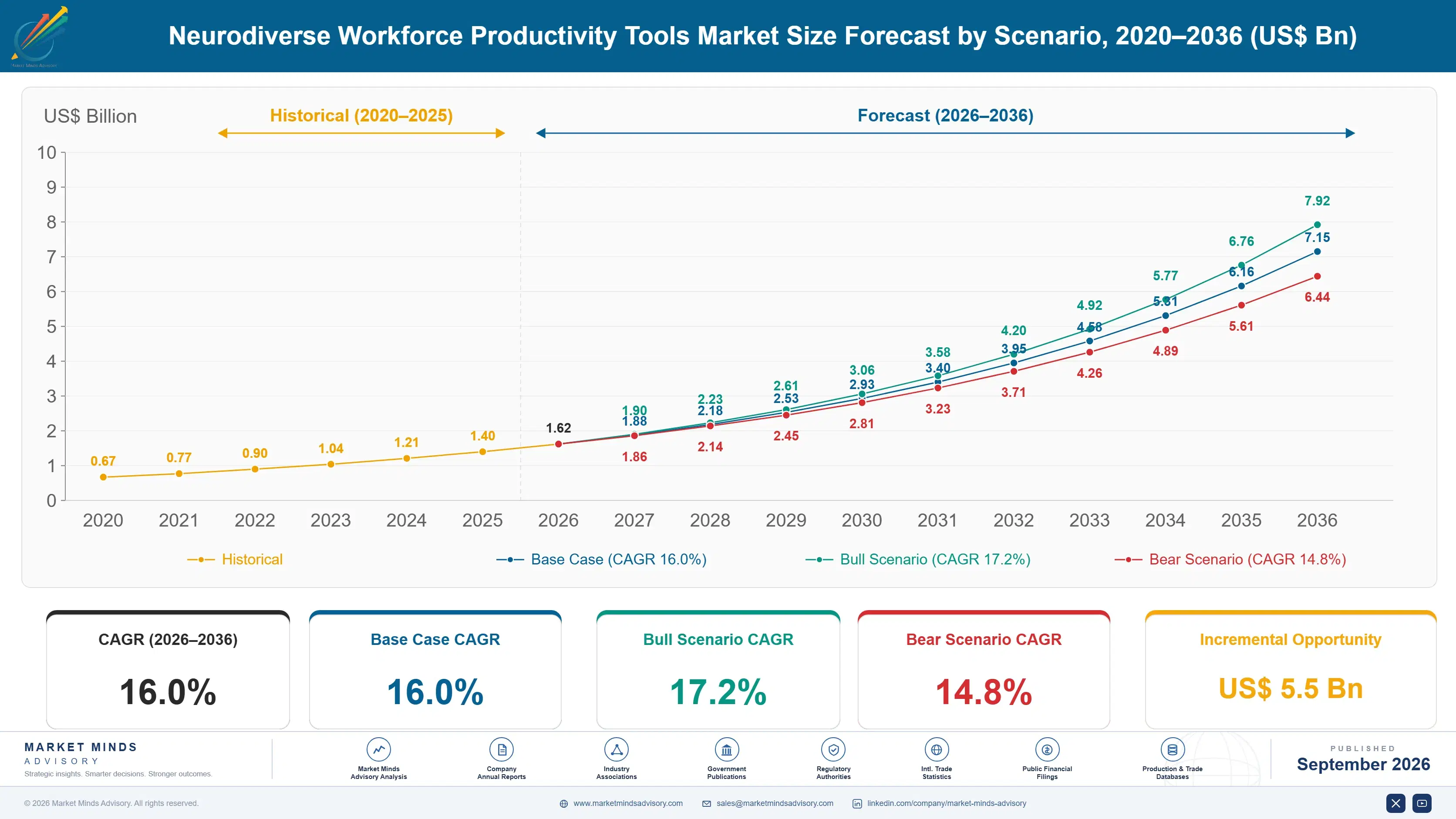
Growth ran at 14.8% from 2020 to 2025 and remote working changed the category more than any product did. Employees working from home controlled their own environment, used captions and transcription without asking, and found support an office never offered. Return-to-office policies then removed much of that autonomy, pushing the conversation into formal requests most organisations could not handle at scale.
The base case at 16.0% rests on three mechanisms. Employment law in several jurisdictions requires employers to make reasonable adjustments, and exposure sits with the employer whether or not an employee asked correctly, which makes the record a risk artefact. Assessment capacity is genuinely scarce, with waiting times near 14 weeks, and employers are paying to shorten them. Third, retention economics are becoming explicit as employers measure the cost of losing people who could have been supported.
The bull case at 17.2% assumes universal deployment of supportive tooling becomes standard practice rather than a request-driven adjustment, which would multiply the addressable population without changing the legal position. The bear case at 14.8% is that mainstream productivity software absorbs most of the functionality at no cost, leaving specialists with assessment services and an administration platform. Absorption is already underway.

Nobody Asks, Which Changes Everything

The defining feature of this market is that the people it serves largely do not put their hands up. Roughly 16% of employees identify as neurodivergent when asked confidentially, and only about 38% of those request support through a formal channel, since doing so means telling an employer something they may reasonably fear will be held against them. Any design depending on a request reaches a minority of those it was built for.
TOP FIVE CONCENTRATION21%Highly fragmented across specialists and mainstream productivity vendors
WORKFORCE NEURODIVERGENT SHARE16%Employees identifying as neurodivergent in confidential workplace surveys
ADJUSTMENT DISCLOSURE RATE38%Proportion who request support through a formal workplace process
ASSESSMENT WAITING TIME14 weeksTypical delay before a workplace needs assessment completes
SERVICES SHARE OF SPEND57%Portion paid for assessment and support rather than software
COST PER SUPPORTED EMPLOYEEUSD 640Annual outlay per employee across tools and assessment
Employers have started drawing the obvious conclusion, which is that tools available to everybody reach far more people than tools available on application. Captions, transcription, reading support and focus modes deployed as standard capability require no disclosure. That is better for employees and cheaper to administer, and it removes the specialist purchase, since these features ship inside software already licensed.
What remains chargeable sits in process and expertise. Around 57% of spending goes to assessment, needs analysis and support services rather than to software, since establishing what an individual needs requires a qualified practitioner and there are too few. Waiting times near 14 weeks are the practical bottleneck in most organisations. Employers also buy adjustment platforms to hold a documented record, which is a legal artefact.
"The most effective thing an employer can do costs almost nothing and sells almost nothing: turn on the features they have already paid for and stop making people ask. The commercial market lives in assessment capacity and in the paperwork that proves an adjustment was actually made."
Director, Workplace Technology and Inclusion Practice · MMA Technology Practice · September 2026

Market Trends

Universal Deployment Replaces Request-Based Adjustment Provision

Support delivered only on request reaches roughly 38% of the people who would benefit, because disclosure carries a perceived career cost that no policy statement removes. Employers enabling captions, transcription, reading support and focus tooling as standard capability for everybody reach the whole workforce without anyone identifying themselves. Adoption measured this way runs several times higher than request-driven provision. It is better practice and it is also a smaller commercial opportunity, since the capability increasingly comes bundled with software the organisation already licenses rather than purchased separately. Employees benefit and specialists earn less from it.
Market Impact: Applies across 4 legal jurisdictions
Mainstream Software Absorbs the Specialist Product Layer

Reading support, dictation, live captions, meeting transcription and summarisation, focus modes and task extraction now ship inside the productivity suites and assistant tools most organisations already pay for. That removes the entry-level specialist purchase entirely and compresses what independent vendors can charge for equivalent functionality. Specialists have responded by moving toward assessment, adjustment administration and support services, which is where 57% of spending already sits. The pattern closely resembles what happened to standalone accessibility tools a decade earlier, and the outcome was the same. Depth advantages rarely survive a procurement comparison against something already paid for.
Market Impact: Waiting times reach 14 weeks

Market Opportunities and Growth Drivers

Employment Law Places the Obligation on the Employer

Equality and disability employment legislation across the United Kingdom, European Union, United States and Australia requires employers to make reasonable adjustments, and the duty is triggered by knowledge rather than by a correctly submitted request. An employer aware that someone is struggling carries exposure whether or not a form was completed. That converts adjustment provision from a welfare programme into a documented risk management process, which is why adjustment management platforms grow at 24.0%. The buyer is employment counsel or human resources risk rather than a wellbeing function. Exposure runs whether or not a form was completed.
Market Impact: Reaches only 38% of employees

Assessment Capacity Constrains Everything Further Downstream

Establishing what an individual needs requires a qualified workplace needs assessor or occupational psychologist, and there are not enough practitioners to meet demand at current growth rates. Waiting times near 14 weeks are common and considerably longer in some markets, during which the employee continues struggling and the employer's exposure continues running. Employers are paying premium rates to shorten those queues, which is why screening and assessment grows at 22.0%. Structured self-assessment tools reduce the load without replacing the practitioner judgment that adjustments ultimately rest on. Providers are turning work away rather than competing for it.
Market Impact: Absorbs 6 tool categories free

Market Restraints and Challenges

Disclosure Fear Limits Reach However Good the Provision

Only about 38% of neurodivergent employees request support through a formal process, and the reason is a well-founded concern that disclosure will affect how they are perceived in performance and promotion decisions. The root cause is organisational culture rather than any deficiency in the tools or the policy. Commercially this caps request-driven provision at a fraction of the addressable population regardless of what is offered. The effective mitigation is universal deployment that requires no disclosure at all, which serves employees better and generates less specialist revenue. That trade-off is uncomfortable and it is real.
Market Impact: Reaches beyond 38% requesting support

Bundled Functionality Removes the Specialist Price Point

Reading support, transcription, captions, dictation and focus tooling now ship inside productivity software organisations already license, which makes an equivalent specialist purchase difficult to justify to a procurement team. The root cause is that these capabilities became generally useful rather than remaining specialised. Commercially it compresses the software layer toward zero for anything a mainstream suite provides. Specialists mitigate by moving toward assessment, adjustment administration and evidence, and by building depth in capabilities that general-purpose tooling does not attempt to cover. Depth in narrow capability and in languages the suites cover poorly is what remains chargeable here.
Market Impact: Absorbs 6 core tool categories
3 additional market trends, 4 additional growth drivers, and 2 additional restraints and challenges are covered in the full report. Contact sales@marketmindsadvisory.com to access the complete intelligence.

Segment CAGR and Growth Architecture

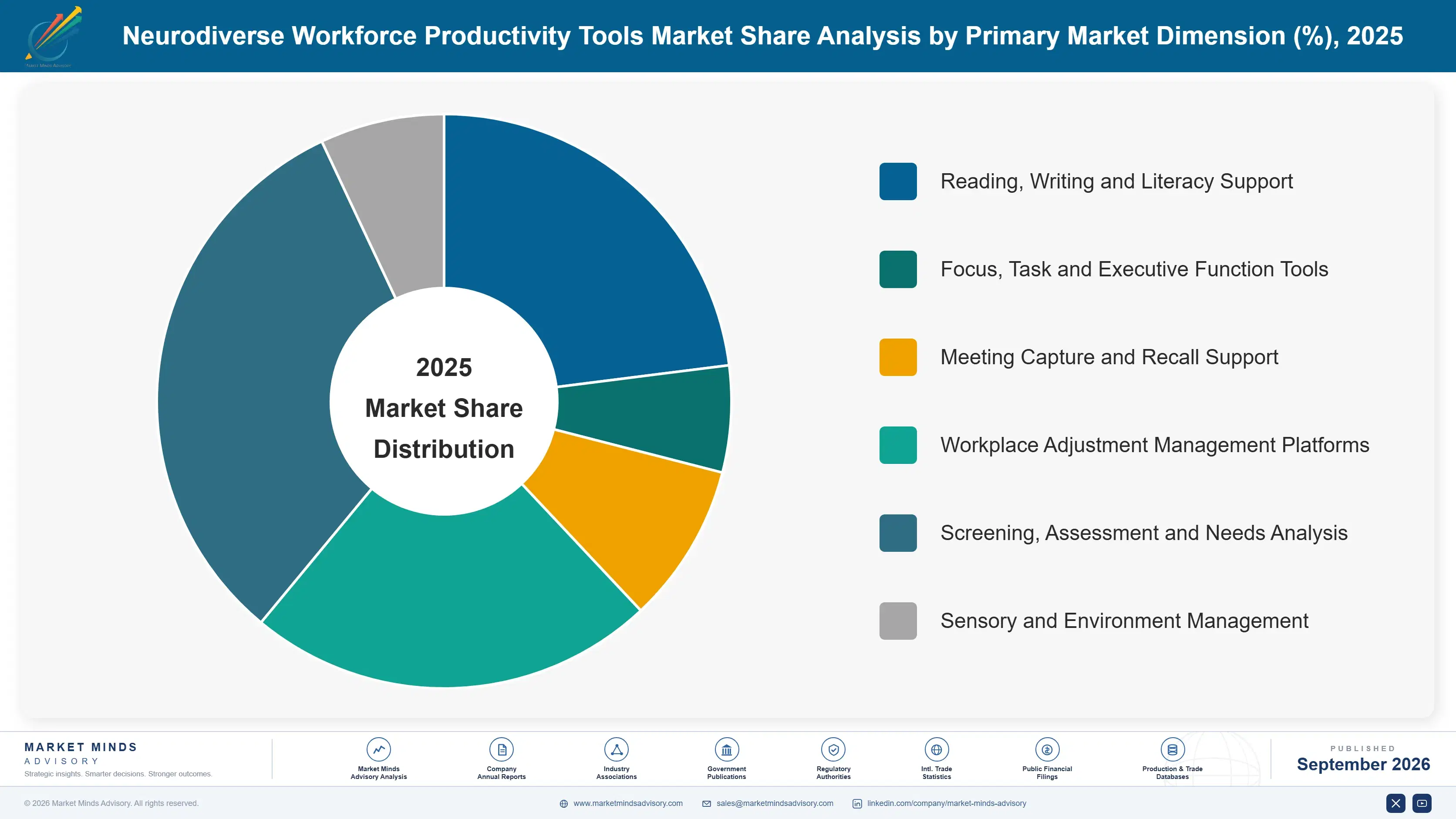
Segmentation follows what is being purchased, since some of this market is software that mainstream suites are steadily absorbing and some is expertise and process that they cannot supply. The layers requiring a qualified practitioner or producing a legal record are growing fastest, while the tool layers are being compressed from above. Practitioner supply governs the rest.
neurodiverse-workforce-productivity-tools-market-market-share-analysis-1788421790901

Workplace Adjustment Management Platforms

Adjustment management platforms grow fastest at 24.0%, half again the market rate of 16.0%, and what they sell is evidence rather than assistance. Employment law across several jurisdictions places a duty on employers to make reasonable adjustments once they are aware of a need, and a documented record of what was requested, assessed, agreed and provided is the artefact that demonstrates the duty was met. The buyer is typically employment counsel or a human resources risk function rather than a wellbeing team, which changes both the budget and the urgency. These platforms also route assessment referrals and track completion, which addresses the waiting time bottleneck administratively even where it cannot shorten it.
CAGR 24.0%

Screening, Assessment and Needs Analysis

Assessment grows at 22.0% and is constrained by practitioner supply rather than by demand. Establishing what an individual needs at work requires a qualified workplace needs assessor, and waiting times near 14 weeks are common while the employee continues struggling and the employer's exposure continues accruing. Employers pay premium rates to shorten those queues, and providers with practitioner capacity are the constraint on their own growth. Structured screening and self-assessment tools reduce the practitioner load and cannot replace the judgment that a defensible adjustment recommendation rests on, which keeps this a services business rather than a software one. Providers are constrained by their own capacity rather than by demand. Demand exceeds capacity everywhere.
CAGR 22.0%
Full segment breakdown across 6 segments available in the complete report.

Regional Architecture and Country Demand Map

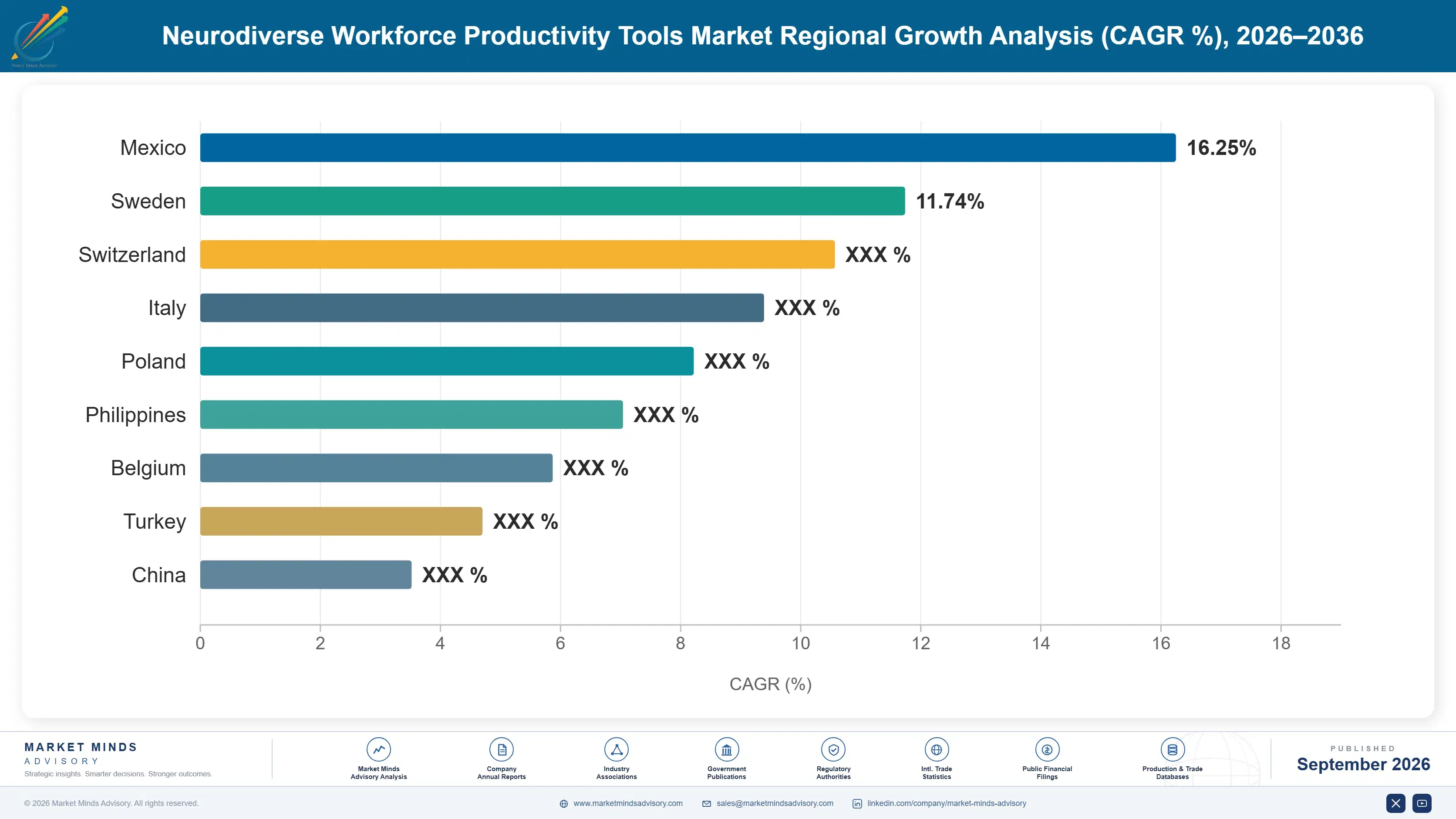
Demand follows legal duty and funding availability rather than workforce size. Countries where employers carry an enforceable adjustment obligation, or where public funding pays for workplace assistive technology, buy substantially more than countries where provision is voluntary. Workforce size alone predicts very little indeed. Duty and funding decide it.

Western Europe

Western Europe holds 34%, above the regional band, and the justification is specific rather than cultural: the United Kingdom combines an enforceable statutory duty to make reasonable adjustments with a government scheme that funds workplace assistive technology and assessment directly, which exists at that scale nowhere else. Most of the specialist vendor base is British for the same reason. Irish and Dutch employers apply comparable practice under European employment law. German and Nordic organisations approach it through works council agreements and occupational health rather than through procurement, which produces different buying behaviour and slower adoption of platforms. Regional growth at 14.4% is the slowest major market, since practice is established and funded routes cap pricing.
Share: 34% | CAGR: 14.4% (2026 to 2036)

North America

American demand is driven by employment law exposure rather than by any funding scheme, since accommodation obligations sit with the employer and litigation is a genuine risk. Large technology, financial services and professional services firms have the most developed programmes, often initiated by legal rather than by human resources. Canadian provincial accessibility legislation creates comparable duties with more prescriptive documentation expectations. The absence of public funding means employers carry the full cost, which pushes them toward universal deployment of bundled capability and away from individually purchased specialist tools. Regional growth at 15.2% reflects legal exposure driving adoption rather than any funding availability, and employers therefore weigh cost far more carefully than British ones do.
Share: 31% | CAGR: 15.2% (2026 to 2036)
Regional intelligence for 5 additional markets available in the complete report: East Asia, South Asia and Pacific, Latin America, Middle East and Africa, Eastern Europe. Contact sales@marketmindsadvisory.com.
neurodiverse-workforce-productivity-tools-market-country-cagr-analysis-1788421791433

Where This Market Can Charge

Mainstream productivity software is absorbing the tool layer and will keep doing so, which leaves the commercially durable positions in practitioner capacity, in the documented record employers need for legal reasons, and in the languages and workplace contexts that general-purpose software does not attempt to serve. Everything else is being given away by somebody larger.

Sell the Adjustment Record to Legal Not Wellbeing

Employment law places an adjustment duty on employers triggered by awareness rather than by a correctly filed request, which makes a documented record of assessment and provision a risk artefact rather than an administrative one. Vendors selling adjustment platforms to employment counsel and human resources risk functions achieve contract values around 3 times those available from wellbeing budgets, and the sales cycle is shorter because the exposure is concrete. Wellbeing budgets are discretionary and reprioritised constantly. Legal risk budgets are neither. Concrete exposure funds faster than good intentions. Discretionary budgets do not survive cost reviews.
Market Impact: Achieves 3 times the wellbeing budget contract value

Build Practitioner Capacity as the Actual Product

Assessment waiting times near 14 weeks are the binding constraint in almost every organisation, and no software resolves a shortage of qualified assessors. Providers investing in practitioner recruitment, training and structured methodology grow faster than those adding features, because they can accept work competitors have to decline. Assessment already represents the majority of the 57% services share of spending. It is a professional services business with software attached rather than the reverse, and vendors who understood that early have grown considerably faster. It is a professional services business with software attached.
Market Impact: Shortens the current 14 week assessment waiting time

Deploy Universally Rather Than On Request

Request-based provision reaches roughly 38% of the people who would benefit because disclosure carries a perceived cost that no policy statement removes. Vendors and employers deploying supportive capability to everyone reach several times that population and avoid the disclosure barrier entirely. Commercially it favours enterprise-wide licensing over individual allocation, which raises deal size while reducing per-user price. It also produces genuinely better outcomes for employees, which is not always true of the commercially attractive option in this market. Better outcomes and better economics rarely align this clearly. Here they do.
Market Impact: Reaches far beyond the 38% who currently disclose

Build Depth Where Mainstream Tools Do Not Go

General-purpose productivity software covers reading support, transcription and focus tooling in major languages and stops there. It does not handle workplace-specific executive function support, structured task decomposition for complex professional work, or the many languages where its coverage is thin. Specialists building depth in those areas hold positions that bundling has not reached and probably will not, and they command roughly 4 times the price per user of commodity functionality. Competing feature for feature against a bundled suite is a contest nobody wins. Feature comparison against a bundled suite is unwinnable.
Market Impact: Commands 4 times the commodity price per user

Who Controls the Margin Pool

Concentration is very low at roughly 21% across the top five on measured attributable revenue, reflecting a market with no agreed boundary and three different kinds of participant. Mainstream productivity vendors capture usage without selling anything specific to this purpose. Specialist software vendors hold deep capability in narrow areas. Assessment and support service providers hold the practitioner capacity that everything downstream depends on. Few of them meet in a competitive evaluation.
Competition runs on three dimensions. Practitioner capacity is first among service providers, since waiting times decide who wins work rather than methodology. Second is evidential credibility for adjustment platforms, which are bought to demonstrate a legal duty was met and therefore evaluated by counsel. Third is language and workplace context coverage, where mainstream tooling is strong in major languages and thin elsewhere.

Two pressures are reshaping the field. Bundled functionality inside productivity suites keeps removing product categories from specialist reach, and there is no sign of that stopping. Meanwhile employment law developments are strengthening the documented adjustment record as a purchase, which favours platform and service providers over tool vendors. Rankings will move toward providers holding assessment capacity and evidential platforms rather than those holding the better individual product.
neurodiverse-workforce-productivity-tools-market-company-positioning-matrix-1788421791960

Competitive Moat and Risk Dimensions

MICROSOFT

Moat: Bundled capability at no cost

Microsoft delivers reading support, live captions, transcription, dictation and focus tooling inside software organisations already license, which removes both the purchase decision and the disclosure barrier at once. That reach exceeds anything a specialist can achieve through request-based provision. Continued investment in assistant capability keeps extending what arrives bundled, which compresses the specialist layer further with each release cycle.
MICROSOFT

Risk: No assessment or adjustment process

The company supplies capability rather than the practitioner judgment that establishes what an individual actually needs, and it holds none of the assessment capacity where 57% of spending sits. Adjustment record-keeping for legal purposes is likewise outside what it provides. Organisations therefore still need specialist providers alongside it, which limits how far bundling can absorb this market.
TEXTHELP

Moat: Literacy support depth and history

Texthelp built literacy and reading support over decades, with depth in workplace and educational contexts that general-purpose tools have not attempted to match. Its established position with employers and public sector organisations, particularly in the United Kingdom, gives it access to a funded procurement route unavailable elsewhere. Language and workplace-specific capability extends beyond what bundled functionality provides.
TEXTHELP

Risk: Core categories being bundled away

Reading support and text-to-speech, the company's foundation, are exactly the capabilities now shipping inside productivity suites at no additional cost, which compresses pricing regardless of depth advantage. Defending on capability requires buyers to evaluate carefully rather than accept adequate bundled functionality. Moving toward assessment and adjustment platforms means competing in services and legal-facing software instead.

Players Tracked

Prominent Players

Microsoft
Texthelp
Grammarly
Otter.ai
Lexxic

Other Key Players

Claro Software
Dolphin Computer Access
ReadSpeaker
Kurzweil Education
MatchWare
Glean
Caption.Ed
Brain in Hand
Tiimo
Cognassist
Genius Within
Auticon
Uptimize
Google
Apple

Recent Developments

JUNE 2025

Employers shift from request-based adjustment to universal tool deployment

Several large employers enabled captions, transcription and reading support across their entire workforce rather than provisioning them individually on request, citing disclosure reluctance rather than cost as the reason. The change used existing software licences rather than requiring any new procurement decision. Individual provisioning continued for specialist needs alongside it.
Signal: Universal deployment reaches far more people than request-based provision does, and it generates considerably less specialist revenue.
FEBRUARY 2025

Assessment providers expand practitioner capacity against sustained waiting times

Workplace needs assessment providers recruited and trained additional practitioners in response to waiting times that had extended well beyond employer tolerance. The expansion was organic capacity building rather than acquisition, and providers reported turning away work throughout the preceding year. Training pipelines remained the constraint on expansion.
Signal: Practitioner supply rather than demand is what limits growth across the majority of this market by value.
OCTOBER 2025

Employment tribunals reinforce documentation expectations on reasonable adjustments

Decisions in several jurisdictions turned on whether employers could evidence what was requested, assessed and provided rather than on the adequacy of the adjustment itself. The rulings restated existing obligations rather than establishing any new duty on employers. Documentation adequacy was the deciding factor throughout.
Signal: The documented record has become the artefact employers buy, which reframes these platforms as legal rather than operational.

What Delivering This Support Costs

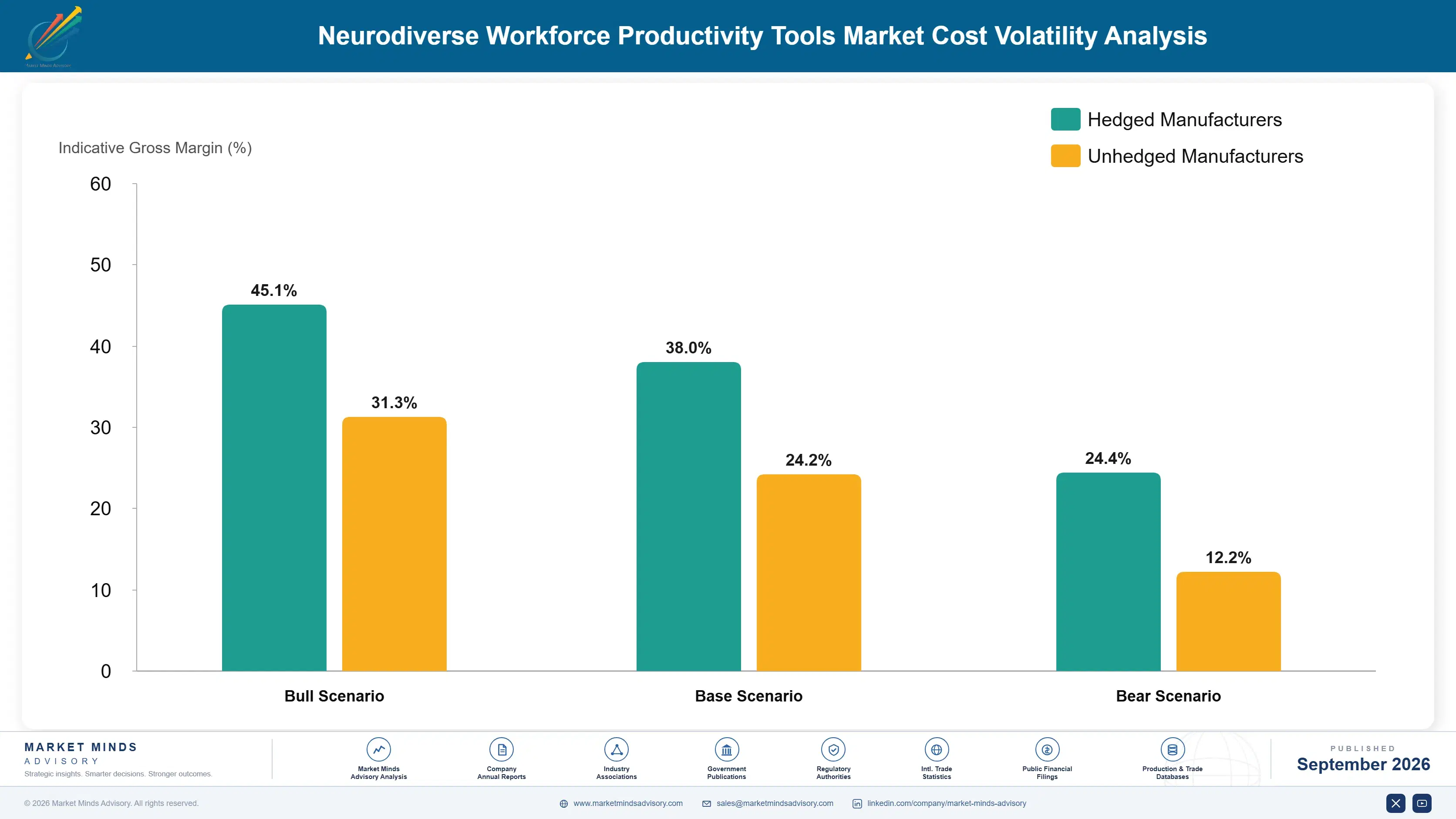
Cost structure looks like professional services rather than software, which surprises investors reading the category name. Practitioner time for assessment and follow-up support runs between 44% and 58% of cost, the range reflecting how much structured screening precedes a practitioner session. Software engineering and hosting take roughly 19%, training and quality supervision 12%, and administration the balance. Practitioner supply rather than technology governs growth.
Practitioner cost has been the sharpest pressure. Qualified workplace needs assessors and occupational psychologists are in short supply, and providers competed for the same small pool through 2024 and 2025 while demand grew faster than training pipelines could fill. Office for National Statistics earnings data for the United Kingdom documents the wage movement in related professional occupations. Providers holding fixed-price employer contracts absorbed the increase themselves rather than reopening agreements.

Exposure varies by business model rather than by scale. Providers using employed practitioners carry wage and utilisation risk directly. Those using associate networks flex more easily and pay a premium per session. Software-only vendors avoid the exposure entirely and address the shrinking 43% of spending that is not services. Smaller providers compete for practitioners without the training capability to develop their own.
neurodiverse-workforce-productivity-tools-market-cost-volatility-analysis-1788421792159

Use structured screening before practitioner sessions

A large part of an assessment session is establishing context that a well-designed structured screening process can gather beforehand. Front-loading it cuts practitioner time by roughly 35% per assessment without reducing the quality of the recommendation. Screening must inform rather than replace professional judgment, which is what separates a defensible recommendation from an automated one.

Train practitioners rather than recruiting them

Competing for a small pool of qualified assessors raises cost for everyone and changes nothing at industry level. Providers running their own training and supervision build capacity competitors cannot bid away. The investment takes two years to produce independent practitioners, which is why so few providers commit to it during periods of strong demand.

Index employer contracts to practitioner cost

Fixed-price multi-year assessment contracts signed against current practitioner rates transfer wage inflation risk to the party least able to influence it. Indexed pricing against published professional earnings data moves that exposure to employers who absorb it easily across a large workforce. Buyers accept it when the alternative is a fixed price carrying a visible risk premium.

Portfolio Architecture for Margin Defence

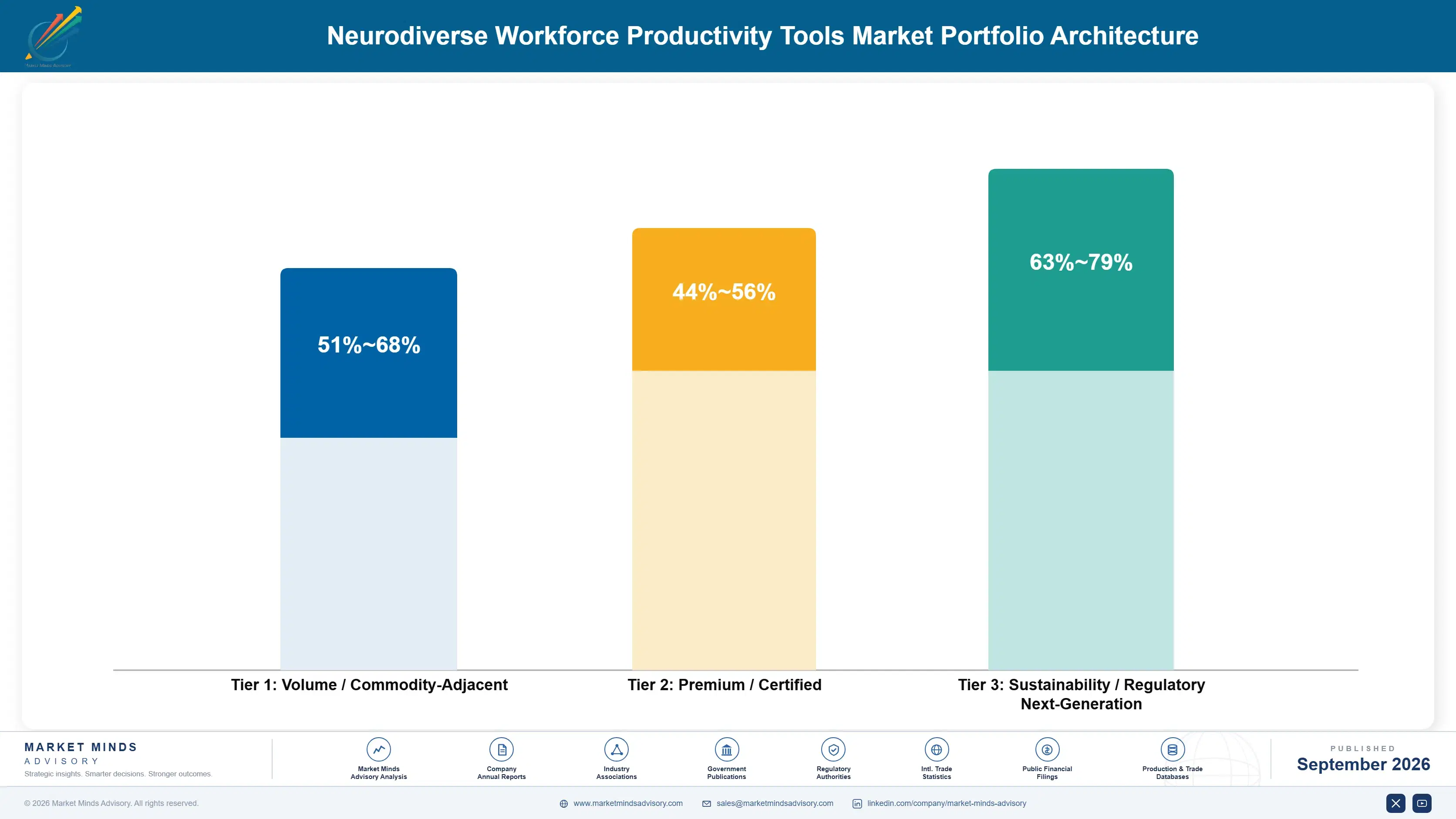
Margin architecture separates on whether a competitor can supply the same thing at no cost. Reading support, transcription and focus tooling now ship inside licensed productivity software, which caps what any specialist can charge for equivalent functionality regardless of how much better it is. Assessment and adjustment platforms carry no such ceiling, because practitioner judgment and a legally defensible record are not features that a productivity suite is going to add.
The volume tension is between software scale and services capacity. Software reaches an entire workforce at negligible marginal cost and is being commoditised from above. Services reach one person at a time, cannot scale beyond practitioner availability, and generate 57% of the spending. Software-led providers compete against free bundled capability; services-led ones cannot grow faster than they train assessors.

High-value revenue concentrates in assessment services and in adjustment platforms bought for legal defensibility. Both share the property that the buyer is managing a concrete exposure rather than purchasing a productivity improvement. Tool subscriptions occupy the volume position, generate the workforce reach that makes universal deployment effective, and are the part mainstream vendors are absorbing without charging for it.

Volume / Commodity-Adjacent

Reading, writing, transcription and focus tools sold as workplace subscriptions. The wide range separates vendors with genuine depth beyond bundled functionality from those competing directly against free alternatives. Pricing pressure here is severe and is not going to ease.
Gross Margin: 51-68%

Premium / Certified

Assessment, needs analysis and ongoing support delivered by qualified practitioners. Margin is constrained by practitioner wage cost and utilisation rather than by competitive pricing, since demand exceeds available capacity everywhere. Growth is limited by training pipelines rather than by sales effort.
Gross Margin: 44-56%

Sustainability / Regulatory / Next-Generation

Adjustment management platforms producing the documented evidence employment law expects, sold to legal and human resources risk budgets. The widest range in the portfolio, reflecting how much assessment coordination is bundled. Highest margin and the least exposed to bundled competition.
Gross Margin: 63-79%
neurodiverse-workforce-productivity-tools-market-portfolio-architecture-1788421792664

High-value Sub-segments and Strategic Watch-out

Adjustment Management Platforms

High value and high growth together, because the record they produce is what demonstrates a legal duty was met rather than a productivity benefit delivered. The margin range reflects assessment coordination content. Employment counsel rather than wellbeing functions hold the budget, which makes it considerably more durable through cost reviews.
Gross Margin: 68-79%

Workplace Assessment Services

High value with strong growth and a hard capacity ceiling, since qualified practitioners cannot be recruited faster than they are trained. The range reflects employed against associate delivery models. Waiting times near 14 weeks mean providers turn work away, which is an unusual and uncomfortable growth constraint.
Gross Margin: 42-56%

Assistive Tool Subscriptions

The volume core of user reach and the most exposed part commercially, competing against capability bundled into software organisations already license. It delivers the universal availability that removes the disclosure barrier. Vendors need the reach and are progressively less able to charge for it. The compression is one directional.
Gross Margin: 48-66%

Bundled Productivity Suite Capability

The strategic watch-out, carried at zero because it displaces specialist revenue rather than generating any. Each release extends what arrives at no additional cost inside licensed software. Specialists assuming their depth advantage protects the category are repeating what standalone accessibility tool vendors assumed a decade ago.
Gross Margin: 0-0%

How This Spending Repeats

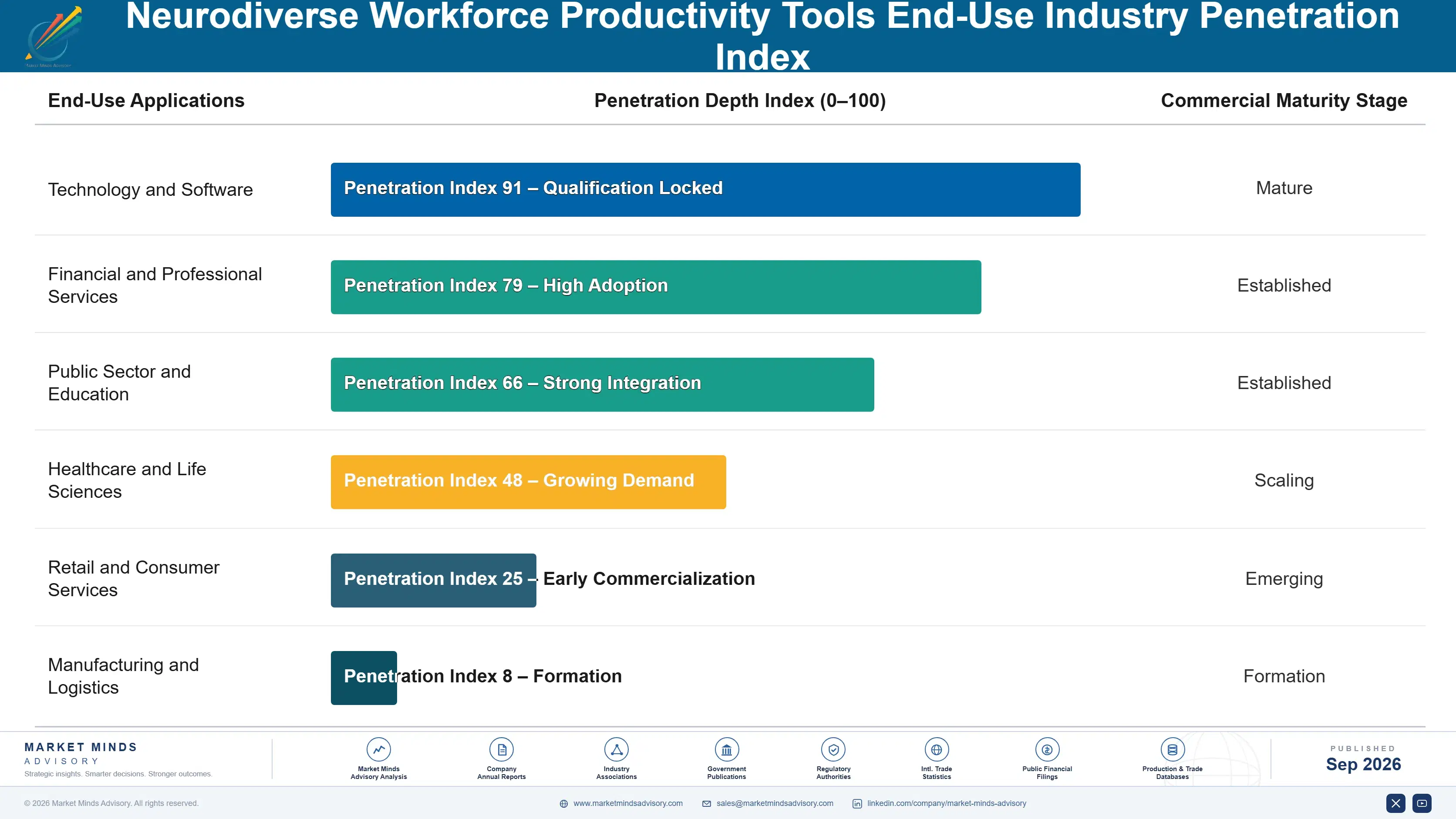
Recurrence differs completely between the two halves of this market. Tool subscriptions renew annually across a whole workforce and are increasingly questioned at renewal because bundled alternatives exist. Assessment is episodic, triggered by a new employee, a role change or a difficulty that surfaced, and it recurs across an organisation rather than for an individual. Adjustment platforms renew reliably, since the record they hold must persist and cannot be reconstructed later.
Adoption depth varies sharply by employer type. Technology and professional services firms deploy widely and use assessment intensively, partly because their workforces are more likely to disclose. Financial services buy adjustment platforms for documentation and tools more cautiously. Public sector employers in markets with funding schemes use assessment heavily. Manufacturing and logistics employers adopt little, since the tooling assumes desk-based work.

The buyer has moved from wellbeing toward legal and human resources risk. Early purchases were made by diversity and wellbeing functions with small discretionary budgets and an inclusion argument. Today an employment counsel or human resources risk lead buys the adjustment record against a documented obligation, and finance funds assessment against retention arithmetic. Vendors presenting an inclusion case address a budget most organisations have cut.
neurodiverse-workforce-productivity-tools-market-end-use-penetration-index-1788421793156

What This Market Rewards

These are among the four positions where our research anticipates prominent divergence between winners and laggards over the coming forecast period. Each is grounded in the demand model, the regulatory perimeter, and the announced capacity pipeline.
01 / LEGAL BUDGET POSITIONING

Sell the documented record, not the inclusion argument

Employment law places an adjustment duty on employers triggered by awareness rather than by a correctly submitted request, which makes the record of what was assessed and provided a risk artefact rather than an administrative convenience. Vendors selling to employment counsel and human resources risk achieve contract values around 3 times those available from wellbeing budgets, and the cycle is shorter because the exposure is concrete. Wellbeing budgets are discretionary and have been cut repeatedly across the past two years.
02 / PRACTITIONER CAPACITY BUILDING

Train assessors, because software cannot substitute for them

Assessment waiting times near 14 weeks are the binding constraint in almost every organisation, and no feature release anywhere resolves a genuine shortage of qualified practitioners. Providers running their own training and supervision pathways build capacity competitors cannot bid away, and they can accept work that others must decline. It takes roughly two years to produce an independent practitioner, which is precisely why so few providers commit to it while demand is strong and recruiting somebody else's assessor looks quicker.
03 / UNIVERSAL PROVISION DESIGN

Remove the need to ask, because most people will not

Request-based provision reaches only about 38% of the employees who would benefit, and the reason is a well-founded concern that disclosure affects how someone is perceived in promotion and performance decisions. Deploying supportive capability to everybody removes that barrier completely and reaches several times as many people as any request process does. It favours enterprise-wide licensing over individual allocation, which raises deal size while reducing the per-user price, and it also happens to be considerably better for the employees actually involved.
04 / NON-BUNDLED CAPABILITY DEPTH

Build where productivity suites are not going

General-purpose productivity software now covers reading support, transcription and focus tooling in the major languages at no additional cost, and competing feature for feature against a bundled suite is a contest that nobody has ever won. Workplace-specific executive function support, structured decomposition of complex professional work, and coverage in the many languages those suites handle poorly all sit outside what bundling addresses. Specialists holding those positions command roughly 4 times the price per user that any commodity functionality can sustain.

Engagement Snapshot From the Field

A live engagement with an industry participant carrying material or product regulatory and market exposure ahead of a defining policy shift, showing how our research translates into a defensible multi-year portfolio strategy.
MARKET MINDS ADVISORY · CLIENT ENGAGEMENT SUMMARY
Neurodiverse Workforce Productivity Tools Producer Strategic Portfolio Review and Transition Roadmap 2026·Investment Scenario on Neurodiverse Workforce Productivity Tools Exposure Evaluation 2025-26
CLIENT PROFILE
A global professional services firm employing roughly 46,000 people across 28 countries (client-reported, unverified by MMA), operating a workplace adjustment process that had processed 1,340 requests in the preceding year. Assistive software was licensed individually on approval, and workplace needs assessments were commissioned from three separate external providers with no central coordination or shared record.
STRATEGIC CHALLENGE
An internal survey indicated roughly 15% of employees identified as neurodivergent while formal requests covered under 3% of the workforce (client-reported, unverified by MMA). Assessment waiting times had reached 19 weeks, two employment claims had cited delayed adjustments, and the programme budget of USD 4.1 million was being questioned because nobody could demonstrate what it achieved.
MMA APPROACH
MMA analysed the request pipeline by stage rather than by volume, which the firm had never done, to establish where time and people were being lost. We interviewed 26 employees who had requested adjustments, nine who had considered it and not proceeded, four providers and the employment law team. Vendor evaluation weighted assessment capacity and evidential record-keeping ahead of software capability entirely.
KEY FINDINGS
  1. Roughly 71% of approved software licences covered capability already available inside the firm's existing productivity suite, and most recipients did not know that.
  2. Employees who considered requesting and did not proceed cited concern about partner perception in promotion decisions, not any doubt about whether support would be granted.
  3. Both employment claims turned on delay and documentation rather than on the adequacy of the eventual adjustment, which was not what the programme had been designed to guard against.
  4. Assessment demand was concentrated in three months following annual performance reviews, yet provider capacity had been contracted evenly across the whole year regardless of that pattern.
CLIENT PROFILE
A global professional services firm employing roughly 46,000 people across 28 countries (client-reported, unverified by MMA), operating a workplace adjustment process that had processed 1,340 requests in the preceding year. Assistive software was licensed individually on approval, and workplace needs assessments were commissioned from three separate external providers with no central coordination or shared record.
STRATEGIC CHALLENGE
An internal survey indicated roughly 15% of employees identified as neurodivergent while formal requests covered under 3% of the workforce (client-reported, unverified by MMA). Assessment waiting times had reached 19 weeks, two employment claims had cited delayed adjustments, and the programme budget of USD 4.1 million was being questioned because nobody could demonstrate what it achieved.
MMA APPROACH
MMA analysed the request pipeline by stage rather than by volume, which the firm had never done, to establish where time and people were being lost. We interviewed 26 employees who had requested adjustments, nine who had considered it and not proceeded, four providers and the employment law team. Vendor evaluation weighted assessment capacity and evidential record-keeping ahead of software capability entirely.
KEY FINDINGS
  1. Roughly 71% of approved software licences covered capability already available inside the firm's existing productivity suite, and most recipients did not know that.
  2. Employees who considered requesting and did not proceed cited concern about partner perception in promotion decisions, not any doubt about whether support would be granted.
  3. Both employment claims turned on delay and documentation rather than on the adequacy of the eventual adjustment, which was not what the programme had been designed to guard against.
  4. Assessment demand was concentrated in three months following annual performance reviews, yet provider capacity had been contracted evenly across the whole year regardless of that pattern.
RECOMMENDED STRATEGY
Phase 1: Enable existing productivity suite capability firmwide immediately, removing the need to request the support that roughly seven in ten approvals were actually granting. Phase 2: Contract assessment capacity against the seasonal demand pattern rather than evenly, and consolidate to two providers with committed turnaround terms. Phase 3: Implement an adjustment management platform holding a documented record, and place ownership with employment counsel rather than with the wellbeing function.
OUTCOME
Formal requests fell by roughly 40% while measured use of supportive capability rose sharply across the firm, and assessment waiting times shortened to seven weeks (client-reported, unverified by MMA). Programme cost fell to USD 2.8 million with the documented record now maintained centrally by the employment law team.

Frequently Asked Questions

Foundational context covering the market sizes, CAGR, scope, country, region and competition that inform every finding below. This section is provided to cover basics and most often pre-purchase conversations, answered from the MMA Primary Research Dataset.

What is the current size of the Neurodiverse Workforce Productivity Tools Market?

The market was worth USD 1.4 billion in 2025 and reaches USD 1.62 billion in 2026. Roughly 57% of that spending goes to assessment and support services rather than software.

How large will the Neurodiverse Workforce Productivity Tools Market be by 2036?

MMA forecasts USD 7.15 billion by 2036, an expansion of 4.41 times over the forecast period. That represents USD 5.53 billion of incremental annual revenue against 2026.

What is the CAGR for the Neurodiverse Workforce Productivity Tools Market 2026 to 2036?

The base case is 16.0% compound annual growth, with a bull case at 17.2% and a bear case at 14.8%. How far mainstream software absorbs the tool layer separates the scenarios.

Which segment is growing fastest?

Workplace adjustment management platforms grow at 24.0%, half again the market rate of 16.0%. Employment law makes a documented adjustment record a risk artefact rather than an administrative convenience.

Who are the major companies in the Neurodiverse Workforce Productivity Tools Market?

Microsoft, Texthelp, Grammarly, Otter.ai and Lexxic lead on measured attributable revenue. Together they hold roughly 21%, which reflects a market with no agreed boundary and three different participant types.

Which country is growing fastest?

India grows fastest at 21.4%, because global capability centres employing large professional workforces apply the inclusion standards of parent organisations headquartered elsewhere, bringing adjustment practice with them.

Report Segmentation Architecture

The full report scope spans multiple orthogonal segmentation dimensions, with cross-tabulated demand data provided for each dimension pair. Coverage extends further to regional breakdowns, trend trajectories, and the competitive detail needed to support segment-level decision-making.

By Primary Market Dimension

  • Reading, Writing and Literacy Support
  • Focus, Task and Executive Function Tools
  • Meeting Capture and Recall Support
  • Workplace Adjustment Management Platforms
  • Screening, Assessment and Needs Analysis
  • Sensory and Environment Management

By End-Use Industry

  • Technology and Software
  • Financial and Professional Services
  • Public Sector and Education
  • Healthcare and Life Sciences
  • Retail and Consumer Services
  • Manufacturing and Logistics

By Commercial Dimension

  • Enterprise Wide Licensing
  • Individual Adjustment Provisioning
  • Assessment Service Contracts
  • Public Funding Schemes
  • Employer Legal and Risk Budgets
  • Reseller and Consultancy Channels

By Region

  • Western Europe
  • North America
  • East Asia
  • South Asia and Pacific
  • Latin America
  • Middle East and Africa
  • Eastern Europe

Scope, Methodology, and Coverage

Every figure in this report is reproducible from documented input assumptions. The scope below maps the historical period, the forecast horizon, the segmentation dimensions, and the countries covered, alongside the underlying primary and qualitative methodology.
Historical Period
2020 to 2025
Forecast Period
2026 to 2036
Base Year
2025 (USD billions; MMA Primary Research Dataset, September 2026)
Market Definition
This market covers software and services supporting neurodivergent employees in the workplace, spanning reading, writing and literacy support, focus, task and executive function tools, meeting capture and recall support, workplace adjustment management platforms, screening, assessment and needs analysis, and sensory and environment management. Revenue is measured as software subscription and directly attributable assessment and support service value where deployed for workplace neurodiversity support. Clinical diagnosis and treatment, medication, educational assistive technology sold into schools and universities, general digital accessibility compliance auditing, and recruitment and candidate screening platforms are excluded.
Quantitative Units
USD billions, software subscription and attributable service revenue
Segmentation Dimensions
Support function, employer industry, commercial model, region
Regions Covered
Western Europe, North America, East Asia, South Asia and Pacific, Latin America, Middle East and Africa, Eastern Europe
Countries Covered
United Kingdom, Ireland, Germany, Netherlands, France, Sweden, Denmark, Spain, Italy, Poland, Czechia, United States, Canada, Japan, South Korea, Taiwan, Singapore, India, Australia, New Zealand, Brazil, Mexico, Chile, United Arab Emirates, Saudi Arabia, South Africa
Key Companies Profiled
Microsoft, Texthelp, Grammarly, Otter.ai, Lexxic, Claro Software, Dolphin Computer Access, ReadSpeaker, Kurzweil Education, MatchWare, Glean, Caption.Ed, Brain in Hand, Tiimo, Cognassist, Genius Within, Auticon, Uptimize, Google, Apple
Quantitative Methodology
Primary survey, n=3,800 respondents, Q4 2025, six countries; demand-side model with trade association cross-validation
Qualitative Methodology
47 expert interviews, Q4 2025; applied to validate demand model assumptions, identify emerging dynamics, and assess competitive positioning
Report Format
PDF and XLSX data workbook (Word format preview document)
Publisher
Market Minds Advisory
Report Code
MMA-2026-TEC-871
Published
September 2026
Contact
sales@marketmindsadvisory.com | www.marketmindsadvisory.com

Purchase the full Neurodiverse Workforce Productivity Tools Market Report (2026 to 2036).

The full MMA report examines why disclosure reluctance rather than product availability governs this market, and where employers are actually spending as a result. It sizes the market to 2036 across six support functions, seven regions and 26 countries, with segment growth rates and regional demand mechanisms set out in full. Competitive analysis covers 20 participants assessed on measured attributable revenue, including moat and risk assessment for the two leaders. The report quantifies delivery cost structure, practitioner capacity economics and margin architecture across three portfolio tiers. It closes with four strategic verdicts and an anonymised professional services firm engagement.
Six support functions sized to 2036
Seven regions with demand mechanism analysis
Twenty participants on consistent revenue basis
Assessment capacity and disclosure rate benchmarks
Margin architecture across three portfolio tiers
Anonymised professional services adjustment programme engagement

Built For The People Who Decide

From boardroom strategy to bench-side execution, this report is read cover-to-cover by leaders shaping the next decade of their industry, turning demand scenarios, market dynamics and valuation benchmarks into decisions.
CXOs/ Presidents/ VPs/ Managers
M&A and Corporate Development
Strategy Teams and R&D Heads
Procurement and Product Directors
Regulatory and Compliance Leaders
Investor Relations and Equity Analysts