Market Minds Advisory
Net-Zero Apartment Multi-Zone Thermostats Market

Net-Zero Apartment Multi-Zone Thermostats Market: Net-Zero Apartment Multi-Zone Thermostats Market. Zone-Level Climate Control for the Decarbonized Multifamily Building

Multifamily developers race to meet net-zero building mandates as zone-level thermostat controls become the deciding factor separating compliant buildings from costly retrofits, reshaping procurement decisions across new construction and existing apartment portfolios alike.

Lead Analyst

Published

September 2026

Make Smarter Decisions with Customized Research Insights

Request a free sample report and evaluate market opportunities, growth trends, and competitive dynamics relevant to your business needs.

2025 MARKET VALUE$2.1BMarket Size 2025
2036 FORECAST VALUE$6.3BBase Case , 2026 to 2036
CAGR 2026 TO 203610.5 %Bull 11.7% / Bear 9.3%
INCREMENTAL OPPORTUNITY$4.0BNet 10- year value creation
EXPANSION MULTIPLE2.72x2036 value over 2026 base
Strategic Levers
M&A Pipeline
Regional Outlook
Country Rankings
Competitive Intelligence
Segmental Deep-dive
Call-Us : 91 93563 13602

Executive Snapshot and Market Trajectory.

Zone-level thermostat controls have become the single most contested line item in net-zero apartment specification, with developers weighing upfront hardware cost against long-term utility compliance penalties that now run into six figures annually for large portfolios that repeatedly miss mandated building performance thresholds each reporting cycle.
Rising state and municipal building performance mandates are pushing multifamily developers toward granular zone control rather than single-thermostat systems, with cloud-based analytics now attaching to roughly four in ten new installations across major metro markets. Demand concentrates in dense multifamily construction markets where energy codes carry real financial penalties for non-compliance, and where utility demand-response programs offer developers a second revenue stream tied directly to zone-level data granularity that single-zone systems simply cannot provide.
Established building automation suppliers compete against newer software-first entrants offering tenant-facing mobile apps and utility demand-response integration bundled directly into the thermostat platform itself. Regulatory pressure from state energy codes and utility decarbonization targets is reshaping product roadmaps faster than in prior HVAC control generations, forcing incumbents to add analytics capability they previously outsourced to third-party software partners entirely, eroding a longstanding vendor divide across the industry.
Market Definition
This report covers multi-zone thermostat hardware, sensor and damper actuator modules, and cloud-based HVAC management software sold into net-zero and high-performance multifamily apartment buildings. It excludes single-zone residential thermostats, commercial office HVAC controls, and standalone smart home hub products not integrated with zone climate management.
Base Year Value
$2.1B in 2025 (MMA Primary Research Dataset, September 2026)
Forecast Period
2026 to 2036, eleven discrete annual values
CAGR
10.5% base case. Bull 11.7%. Bear 9.3%.
Fastest Growth Segment
Cloud-Based HVAC Management Software and Analytics: 16.5% CAGR
Fastest Growth Country
South Korea: 14.5% CAGR
Fastest Growth Region
South Asia and Pacific: 12.5% CAGR
Largest Region
North America: 32% of 2025 global value
Market Leaders
Led by Honeywell International, Johnson Controls, Siemens AG, Schneider Electric, and Resideo Technologies. Source: MMA Primary Research Dataset, July 2026.
Primary Survey
n=3,800 procurement and R&D decision-makers, Q4 2025, six countries
Methodology
Demand-side build-up, cross-validated against public data, 47 expert interviews

Net-Zero Apartment Multi-Zone Thermostats Market Forecast Scenarios

net-zero-apartment-multi-zone-thermostats-market-size-forecast-scenario-1788426884796
The 2020 to 2025 period saw multi-zone thermostat adoption move from a luxury apartment feature to a code-driven necessity as states adopted stricter building performance standards. Early demand concentrated among premium developers before mandates broadened the buyer base, producing a historical CAGR of roughly 9.7 percent as installation volume climbed steadily through each successive building code cycle.
The base case assumes continued expansion of state building performance mandates, growing utility demand-response program enrollment, and rising retrofit activity across existing multifamily stock built before current energy codes took effect. Developers increasingly specify zone-level control as a baseline requirement rather than a premium upgrade, cloud analytics attach rates climb as utilities tie rebate eligibility to verified zone-level data reporting, and installer networks scale to meet retrofit demand across older buildings nationwide.
A bull scenario assumes accelerated federal building electrification incentives push adoption past current utility program timelines, materially compressing the payback period for cautious developers weighing the upgrade. The bear case centers on construction financing costs staying elevated long enough that new multifamily starts slow meaningfully, delaying the retrofit wave utilities and municipalities are counting on to meet portfolio-wide emissions targets on schedule.

Where Building Codes Meet Zone-Level Control

Multi-zone thermostat demand traces directly to building code cycles rather than general HVAC replacement patterns, which makes this market unusually sensitive to legislative calendars and municipal rulemaking schedules. A single state adopting stricter multifamily performance standards can shift installer order books within a single fiscal quarter, a dynamic rare in most building products categories where replacement demand follows equipment age instead of policy timing.
MARKET CONCENTRATIONCR5 48%top five suppliers hold a moderate combined revenue share
AVERAGE SELLING PRICE$340/zoneinstalled cost per zone including sensors and controller hardware
TOP PRODUCING COUNTRYChina 31%share of global thermostat hardware manufacturing output currently
RETROFIT ATTACH RATE38%existing buildings adding zone control systems each year
SOFTWARE ATTACH RATE41%new installations bundled with cloud based analytics platforms
REPLACEMENT CYCLE LENGTH9 yearstypical service life before a full system replacement occurs
Hardware margins have compressed as component costs standardized across suppliers, pushing vendors toward recurring software and analytics revenue instead of one-time equipment sales. Cloud-based zone management platforms now generate ongoing subscription revenue per building, and the suppliers capturing this attach rate are pulling ahead of pure hardware competitors on total account value and customer retention over multi-year building lifecycles.
Retrofit demand across older multifamily stock represents the larger long-term opportunity relative to new construction, since existing buildings vastly outnumber the annual pace of new unit delivery. Utilities increasingly tie demand-response rebate eligibility to verified zone-level data reporting, giving building owners a direct financial reason to upgrade beyond simple code compliance, and installers are building specialized retrofit crews to capture this widening opportunity.
"The winners here won't be the best thermostat makers, they'll be the best data platforms wearing a thermostat as a sensor. Hardware is becoming the least interesting part of this market."
Director, Building Automation and Energy Systems Practice · MMA Construction and Industrial Equipment Practice · September 2026

Market Trends

Building Performance Standards Mandate Zone-Level Monitoring

New York's Local Law 97 and California's Title 24 energy code both now require granular, zone-level energy reporting for multifamily buildings above defined size thresholds, moving zone thermostats from optional upgrade to compliance necessity. Developers who once specified single-zone systems for cost reasons now face penalties for non-compliance that exceed the incremental hardware cost many times over across a typical building's operating lifetime. Nine additional states have introduced comparable legislation since 2023, and industry analysts expect at least six more to adopt similar frameworks before 2028, broadening the addressable retrofit base well beyond current early-adopter metro markets.
Market Impact: 179D deduction reaches $5 per foot

Utility Demand-Response Programs Reward Zone-Level Data Granularity

Major utilities including ConEd and Pacific Gas and Electric now offer enhanced demand-response rebates to buildings that report zone-level load data rather than whole-building aggregates, since granular data lets utilities dispatch more precise curtailment requests during peak demand events. This has turned data reporting capability into a direct revenue stream for building owners rather than a compliance cost, changing the purchase conversation from cost avoidance to revenue generation. Enrollment in these enhanced programs has grown steadily as utilities expand eligible categories, and adoption is expected to accelerate as more utilities follow the enhanced-tier rebate model nationally.
Market Impact: ESG capital funds 30 percent

Market Opportunities and Growth Drivers

Federal Tax Credits Accelerate Multifamily Electrification Retrofits

The Inflation Reduction Act's Section 179D commercial building deduction, expanded in 2023, now allows multifamily building owners to claim up to $5 per square foot for qualifying energy efficiency retrofits that include zone-level HVAC controls. This has materially shortened payback periods for retrofit projects that previously struggled to clear internal capital budgeting hurdles at typical apartment ownership groups managing tight operating margins. Several large real estate investment trusts have publicly committed to portfolio-wide retrofit programs explicitly citing the deduction as the financial mechanism that made the underlying business case work at scale.
Market Impact: Wiring adds 2 to 3x cost

Institutional Investors Demand ESG Reporting From Portfolio Buildings

Real estate investment trusts and pension fund owners increasingly require portfolio companies to report granular building energy performance data to satisfy ESG disclosure commitments made to their own institutional investors and lenders across every reporting cycle. Zone-level thermostat data provides the auditable, building-by-building evidence these reports require, unlike whole-building estimates that regulators and auditors increasingly view with skepticism given historical accuracy problems. This has pushed procurement decisions up the organizational chain from property managers to asset management and sustainability teams who control much larger capital budgets and multi-year vendor contracts.
Market Impact: Wait times extend 6 weeks

Market Restraints and Challenges

Retrofit Wiring Costs Exceed Hardware Purchase Price

Older multifamily buildings often lack the low-voltage wiring infrastructure zone thermostats require, meaning retrofit projects frequently spend two to three times the thermostat hardware cost on wiring and wall repair labor alone. The root cause is that most buildings constructed before 2005 used centralized single-zone HVAC systems never designed for zone-level control, so retrofitting means running entirely new low-voltage cable through occupied units, a disruptive proposition for owners. Suppliers are increasingly developing wireless zone sensor kits that eliminate most wiring runs, and several installers now offer financing that spreads the wiring cost across the retrofit budget over multiple years.
Market Impact: Local Law 97 fines exceed $268

Skilled Installer Shortage Slows Retrofit Project Timelines

Multi-zone thermostat installation requires HVAC technicians trained in both traditional ductwork and building automation software configuration, a combination in short supply as experienced technicians retire faster than trade schools graduate replacements. The shortage stems from HVAC trade programs historically focusing on mechanical skills rather than networked control systems, leaving a training gap that manufacturers are only now beginning to address through certification programs. Several major suppliers have launched in-house installer certification academies, and some are partnering with community colleges to build dedicated building automation curricula that address the underlying skills gap directly.
Market Impact: Enhanced rebates add $45 per zone
3 additional market trends, 4 additional growth drivers, and 2 additional restraints and challenges are covered in the full report. Contact sales@marketmindsadvisory.com to access the complete intelligence.

Segment CAGR and Growth Architecture

Six segments span the multi-zone thermostat value chain from wireless hardware controllers and sensor modules through cloud analytics software, utility integration services, and professional installation and commissioning work. Cloud-based analytics and utility demand-response integration are pulling ahead of hardware-only segments as recurring software revenue becomes the primary margin driver shaping supplier strategy across the industry.
net-zero-apartment-multi-zone-thermostats-market-market-share-analysis-1788426885332

Cloud-Based HVAC Management Software and Analytics

Cloud-based analytics platforms have become the fastest-growing segment in this market, expanding at roughly 16.5 percent annually as building owners recognize that subscription software revenue, not hardware margin, now determines long-term account profitability across a building's entire operating lifecycle. Utilities' enhanced demand-response rebate programs require verified zone-level reporting that only cloud platforms can provide reliably at scale, giving software vendors direct leverage in renewal conversations with property management firms nationwide and internationally across every major metro market. Suppliers that historically sold only hardware are racing to acquire or build analytics capability, since building owners increasingly refuse to sign multi-year contracts with vendors lacking a credible software roadmap and dedicated support team on permanent staff.
CAGR 16.5%

Utility Demand-Response Integration Services

Utility demand-response integration services are growing at roughly 14.0 percent annually as more utilities expand enhanced rebate tiers tied directly to zone-level data granularity rather than whole-building estimates across their entire service territories nationwide today. This segment sits between hardware and software, handling the technical integration work of connecting building thermostat networks to utility dispatch systems, a task requiring specialized protocol expertise most property managers lack internally and cannot easily hire for on short notice. Independent integration specialists and manufacturer service arms both compete here, and the segment benefits directly from utility program expansion since every enrolled building represents a recurring service contract renewed annually alongside the rebate cycle itself.
CAGR 14.0%
Full segment breakdown across 7 segments available in the complete report.

Regional Architecture and Country Demand Map

North America and East Asia together anchor global demand, driven respectively by code-mandated zone reporting in leading US states and dense multifamily construction pipelines across China and South Korea's major metropolitan regions, with Western Europe following close behind on EU building energy directive compliance schedules.

North America

New York's Local Law 97 and California's Title 24 code have made North America the region where multi-zone thermostat demand is most directly legislated rather than merely encouraged by policy. Building owners across major metros face escalating penalties tied to whole-building emissions intensity, and zone-level reporting has become the practical way to both meet reporting requirements and identify which units drive excess consumption. Nine additional states have introduced comparable performance standards since 2023, and utility demand-response programs from ConEd and Pacific Gas and Electric now offer meaningful rebates tied to verified zone-level data. Retrofit specialists have scaled quickly here to serve older multifamily stock that predates current energy codes entirely.
Share: 32% | CAGR: 11.5% (2026 to 2036)

Western Europe

Western Europe's demand rests on the EU Energy Performance of Buildings Directive, which requires member states to phase in stricter multifamily performance standards through the current decade. Germany and France lead adoption as national building codes translate the directive into binding requirements, while smaller markets lag as implementation timelines vary considerably by member state and enforcement capacity. Retrofit activity dominates over new construction here since much of the regional apartment stock predates modern energy codes by several decades, requiring extensive wiring work alongside thermostat installation itself. Regional utilities have been slower than North American counterparts to build demand-response rebate programs, which somewhat tempers the software attach rate compared with the leading US metro markets.
Share: 20% | CAGR: 9.0% (2026 to 2036)
Regional intelligence for 5 additional markets available in the complete report: East Asia, South Asia and Pacific, Latin America, Middle East and Africa, Eastern Europe. Contact sales@marketmindsadvisory.com.
net-zero-apartment-multi-zone-thermostats-market-country-cagr-analysis-1788426885899

Paths to Margin Beyond Hardware Sales

Suppliers face a clear choice between competing on hardware price alone or building recurring revenue through software, certification, and service channels that compound steadily over a building's entire multi-year operating lifecycle. The suppliers capturing analytics attach rates and utility integration contracts are pulling well ahead on total account value far beyond the initial installation sale.

Cloud Analytics Subscriptions Compounding Account Value

Suppliers that bundle cloud-based zone management software with hardware installation capture recurring subscription revenue that compounds annually rather than a single upfront hardware sale. Buildings that adopt full analytics suites generate roughly 35 percent more total account revenue over a five-year period than hardware-only installations, since subscription fees continue well past the initial installation and renewal rates run high among engaged facilities teams. This dynamic rewards suppliers who invest in interface design and ongoing feature development rather than treating software as an afterthought bolted onto commodity hardware, since renewal decisions increasingly hinge on software quality rather than thermostat reliability alone.
Market Impact: Analytics bundling adds 35 percent more account revenue

Utility Rebate Program Integration Creates New Revenue

Suppliers that build direct integration with utility demand-response dispatch systems position themselves to capture a share of the rebate value building owners receive for participating, rather than leaving that revenue entirely on the table. Integration-capable suppliers report contract values roughly 20 percent higher than competitors lacking utility program connectivity, since building owners increasingly select vendors who can guarantee rebate eligibility rather than handling integration themselves through a separate contractor. This favors suppliers with dedicated utility relations teams over pure hardware manufacturers, who typically lack the regulatory and technical expertise integration work demands across dozens of distinct utility program requirements nationally.
Market Impact: Utility integration adds 20 percent more contract value

Green Building Certification Driving Premium Specification

Developers pursuing LEED or equivalent green building certification for new multifamily projects award meaningful credit for zone-level energy monitoring, giving certified-compatible suppliers a premium specification advantage over generic thermostat vendors. Suppliers whose products carry recognized certification compatibility command roughly 15 percent pricing premiums on new construction projects where certification credit factors into the developer's marketing strategy and eventual building valuation at sale. This lever rewards suppliers who invest early in certification body relationships and documentation processes, since certification requirements change periodically and staying current requires dedicated regulatory affairs staff most smaller competitors cannot justify maintaining.
Market Impact: Certification compatibility commands a 15 percent price premium

Retrofit Financing Programs Reaching Stalled Projects

Suppliers offering financing programs that spread wiring and installation costs across a building's retrofit budget over multiple years capture projects that would otherwise stall on upfront capital constraints alone. Financing-enabled suppliers close roughly 25 percent more retrofit deals than competitors requiring full upfront payment, since building owners managing tight operating budgets often lack the capital reserves for a large one-time infrastructure expense mid-year. This favors larger suppliers with balance sheet capacity to offer financing directly, or those with established banking partnerships, over smaller regional installers who cannot extend credit terms to their apartment building customers.
Market Impact: Financing programs close 25 percent more retrofit deals

Who Controls the Margin Pool

CR5 of 48 percent reflects a moderately concentrated competitive field where five established suppliers hold roughly half of global revenue, leaving a meaningful gap for challengers. Honeywell and Johnson Controls lead ahead of the next tier of competitors, whose combined share still trails the top two by a wide margin in most markets. Revenue is the evaluation basis used consistently throughout this section, since installed unit counts are not uniformly disclosed across competitors.
Current competitive activity centers on analytics platform acquisitions, as hardware-only suppliers race to add cloud capability rather than build it internally over years. Several mid-tier competitors have announced utility integration partnerships this year, recognizing demand-response connectivity is quickly becoming a baseline requirement rather than a differentiator. Certification body relationships have also become a battleground, as suppliers seek green building credit compatibility to win specification battles.

Emerging pressure comes from software-first entrants without legacy hardware manufacturing, who can iterate analytics features faster than incumbents burdened by longer product cycles. These challengers lack the installer network scale incumbents built over decades, but partnership models with independent HVAC contractors are closing that gap. Rankings could shift if a well-funded entrant successfully partners with a major installer network at national scale.
net-zero-apartment-multi-zone-thermostats-market-company-positioning-matrix-1788426886424

Competitive Moat and Risk Dimensions

HONEYWELL INTERNATIONAL INC

Moat: Installer Network Depth

Honeywell's decades-old contractor training and certification program spans thousands of HVAC installers nationwide, giving it distribution reach that newer analytics-focused entrants cannot replicate quickly. Building owners default to Honeywell specification simply because a qualified installer is almost always available locally within days, unlike competitors requiring specialized certified technicians who are scarce in most secondary metro markets.
HONEYWELL INTERNATIONAL INC

Risk: Legacy Software Architecture

Honeywell's cloud analytics platform was built on top of older hardware firmware never designed for modern subscription software, creating integration friction that slows new feature rollout compared with software-first competitors. This has occasionally cost Honeywell specification wins on projects where building owners prioritized a smoother mobile app experience over installer network breadth.
JOHNSON CONTROLS INTERNATIONAL

Moat: Building Automation Integration

Johnson Controls sells zone thermostats as part of a broader building automation suite already installed in many multifamily properties, letting it cross-sell into existing accounts rather than winning standalone competitive bids. This bundled relationship makes switching costly, since owners would need to replace an entire integrated automation platform, sensors, and controllers across a portfolio.
JOHNSON CONTROLS INTERNATIONAL

Risk: Slower Product Iteration Speed

Johnson Controls' enterprise sales cycle and large existing customer base make it slower to iterate new analytics features than smaller, more nimble competitors focused exclusively on the multifamily zone thermostat niche. Feature requests specific to apartment operators sometimes lose priority against broader commercial building automation roadmap demands.

Players Tracked

Prominent Players

Honeywell International Inc
Johnson Controls International
Siemens AG
Schneider Electric SE
Resideo Technologies Inc

Other Key Players

Ecobee Inc
Emerson Electric Co
Trane Technologies plc
Carrier Global Corporation
Legrand SA
ABB Ltd
Distech Controls Inc
KMC Controls Inc
Delta Controls Inc
Lennox International Inc
Daikin Industries Ltd
Mitsubishi Electric Corporation
Ingersoll Rand Inc
Building Robotics Inc
Bosch Building Technologies

Recent Developments

APRIL 2026

Honeywell Acquires Cloud Analytics Startup for Multifamily Building Platform

Honeywell completed the acquisition of a building analytics software startup specializing in multifamily zone-level energy reporting, adding cloud dashboard and utility integration capability the company previously lacked. The deal closes a longstanding gap between Honeywell's installer scale and its comparatively basic analytics offering, positioning it against software-first entrants.
Signal: Hardware incumbents are increasingly buying analytics capability rather than spending years building it slowly internally from scratch.
FEBRUARY 2026

Johnson Controls Signs Supply Agreement With National Apartment REIT

Johnson Controls signed a multi-year supply agreement with a national apartment real estate investment trust to install zone-level thermostats across its multifamily portfolio, replacing an incumbent's aging single-zone hardware. The agreement was a supply deal rather than an acquisition or joint venture, reflecting the REIT's preference for one vendor.
Signal: Large real estate investment trusts are consolidating vendor relationships rather than splitting purchases across multiple suppliers annually.
DECEMBER 2025

Schneider Electric Launches Utility Demand-Response Integration Suite

Schneider Electric launched a dedicated demand-response integration product connecting its zone thermostat platform directly to major North American utility dispatch systems, an organic expansion rather than an acquisition. The launch responds to building owners seeking enhanced rebate eligibility without hiring a separate integration specialist to manage the utility relationship.
Signal: Suppliers are increasingly building utility integration capability internally rather than relying on third-party specialist integration partners.

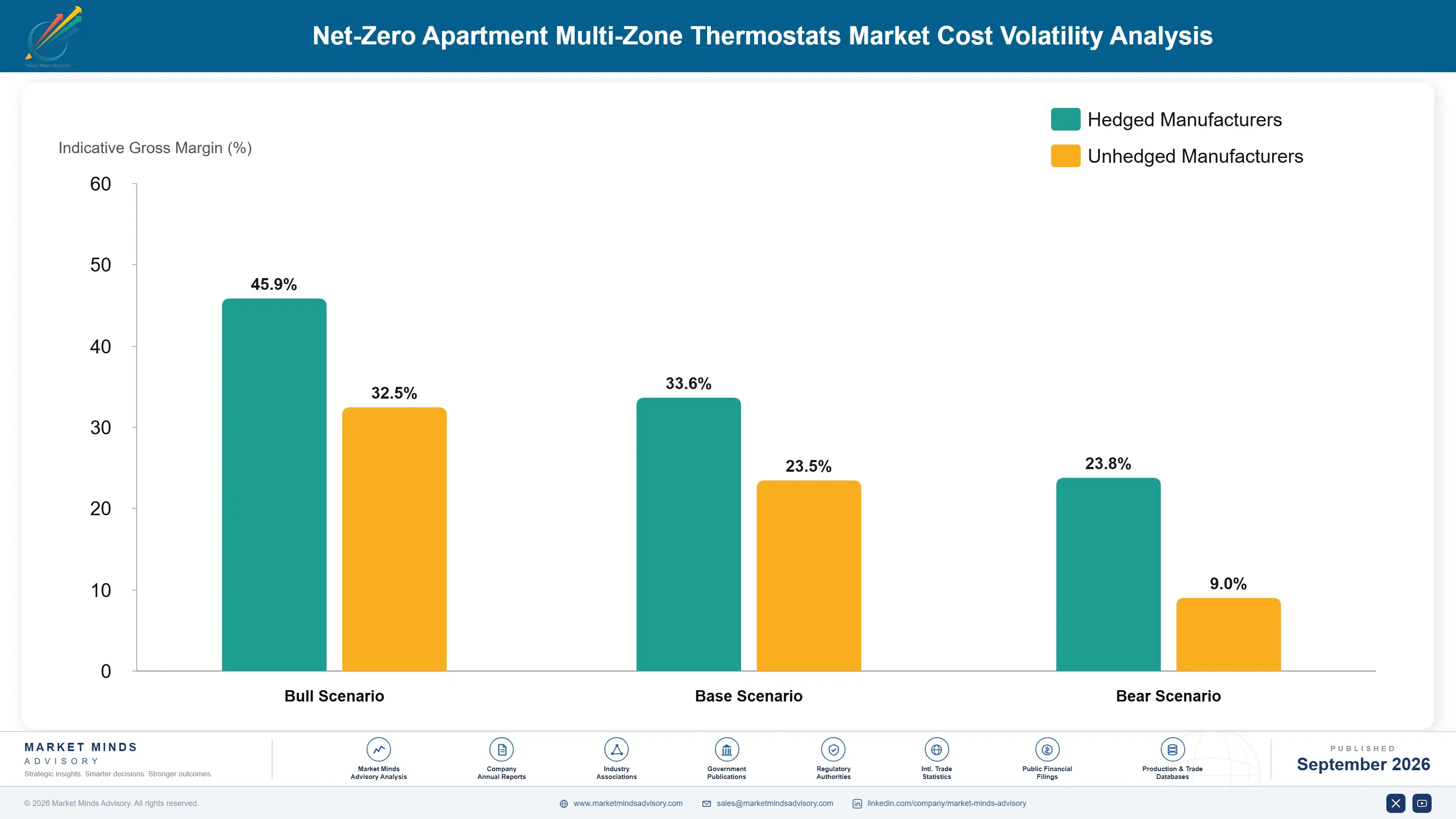
Semiconductor and Copper Input Cost Exposure

Semiconductor components, primarily microcontrollers and wireless communication chips, represent roughly 35 percent of thermostat hardware cost of goods sold, sourced predominantly from Taiwanese and South Korean fabrication facilities. Copper wiring and connector materials add another 18 percent, sourced through global commodity markets rather than any single dominant supplier, exposing manufacturers to price swings tied to broader industrial demand cycles.
The 2021 to 2022 global semiconductor shortage, documented extensively in IEA and industry supply chain reporting, extended thermostat delivery lead times from roughly four weeks to over twenty weeks at the shortage's peak. Several suppliers reported production delays that pushed committed installation schedules back by entire building construction phases, forcing some developers to temporarily install lower-specification single-zone systems as stopgap measures while awaiting proper multi-zone hardware delivery. The episode pushed most major suppliers to diversify component sourcing.

Smaller regional installers and suppliers lacking direct semiconductor supply relationships face the steepest exposure, since they typically buy through distributors at spot prices rather than negotiated multi-year contracts. Large incumbents like Honeywell and Johnson Controls negotiate direct wafer allocation agreements with chip foundries, insulating them from the worst price volatility that smaller competitors absorb directly, a durable cost advantage during any future shortage cycle.
net-zero-apartment-multi-zone-thermostats-market-cost-volatility-analysis-1788426886621

Diversify Semiconductor Sourcing Across Multiple Regions

Leading suppliers now qualify components from at least two independent semiconductor fabrication regions rather than relying on a single geographic source, reducing exposure to any single country's export controls or facility-level disruptions entirely. This dual-sourcing approach adds modest qualification cost upfront but has prevented delivery delays during several subsequent regional supply disruptions since 2022.

Negotiate Multi-Year Wafer Allocation Contracts

Larger suppliers increasingly negotiate multi-year wafer allocation agreements directly with chip foundries rather than buying through distributors at spot prices, locking in both volume and price predictability years ahead of any actual future need. Smaller competitors are forming buying consortiums to access similar negotiated terms collectively, since none can match incumbent purchase volume alone.

Portfolio Architecture for Margin Defence

Three tiers structure this market's margin economics, from volume hardware sold on price to certified premium systems and next-generation sustainability offerings that command the widest margins across the industry. Volume tier competition remains intense on unit price alone, while certified and sustainability tiers reward suppliers with analytics and integration capability that hardware-only competitors cannot easily replicate at comparable cost.
Tension between volume and premium tiers plays out most visibly in the retrofit segment, where budget-constrained owners often choose baseline hardware despite the long-term cost of forgoing analytics revenue entirely over the building's remaining service life. Premium tier buyers, largely new construction developers and REITs pursuing certification credit, are willing to pay considerably more for integrated software and utility connectivity bundled into a single accountable vendor relationship.

High-value margin pools concentrate overwhelmingly in the sustainability and regulatory tier, where utility rebate integration and certification compatibility both command premium pricing well above ordinary commodity hardware margins across most major markets. Suppliers positioning exclusively in the volume tier face the greatest long-term margin compression as component costs standardize further and price competition intensifies among an expanding field of low-cost hardware manufacturers entering the space.

Volume / Commodity-Adjacent

Standardized single-zone and basic multi-zone hardware competing primarily on unit price with minimal analytics bundling, sold largely to cost-sensitive affordable housing operators and budget-constrained municipal retrofit programs across older buildings.
Gross Margin: 22-30%

Premium / Certified

Zone thermostat systems bundled with cloud analytics and certification compatibility, sold to developers pursuing green building credit on new premium construction and institutional owners upgrading existing portfolios for competitive positioning.
Gross Margin: 35-45%

Sustainability / Regulatory / Next-Generation

Utility demand-response integration and advanced analytics platforms sold as compliance and revenue-generating infrastructure to institutional building owners facing ESG reporting mandates and escalating regulatory penalty exposure across major metro markets.
Gross Margin: 48-58%
net-zero-apartment-multi-zone-thermostats-market-portfolio-architecture-1788426887115

High-value Sub-segments and Strategic Watch-out

Cloud-Based HVAC Management Software and Analytics

Cloud-based HVAC management software and analytics combines the fastest growth rate in the entire market with premium subscription pricing, making it the clearest high-value high-growth opportunity for suppliers with the patient capital needed to build platform capability rather than rely purely on commodity hardware sales alone.

Utility Demand-Response Integration Services

Utility demand-response integration services offer strong margins tied to enhanced rebate programs, though growth trails the software segment since it depends on utility program expansion timelines rather than pure supplier-driven adoption alone, making this a high-value but moderate-growth opportunity worth watching closely for further acceleration.

Wireless Multi-Zone Thermostat Hardware

Wireless multi-zone thermostat hardware remains the volume core of this market, generating steady if unspectacular revenue as the entry point most building owners specify first before considering analytics or utility integration add-ons that suppliers hope to attach later during subsequent contract renewal cycles across the building.

Retrofit Wiring and Installation Labor

Retrofit wiring and installation labor represents a strategic watch-out given persistent skilled installer shortages that could cap growth regardless of underlying demand strength, making installer capacity expansion a critical constraint suppliers must address collectively or risk leaving substantial retrofit demand unmet for years to come.

Subscriptions Turn Hardware Into Recurring Revenue

Once a building owner adopts a cloud-based zone management platform, switching suppliers means re-wiring sensors and retraining building staff, a cost few owners choose to absorb voluntarily. This creates an annuity dynamic uncommon in traditional HVAC hardware, where subscription renewal rates now regularly exceed ninety percent among owners who adopted analytics within the first year of installation.
Adoption depth varies sharply by end-use vertical: luxury and mid-market apartment operators adopt full analytics suites quickly, while affordable housing operators often install baseline hardware without the software layer due to budget constraints. Student housing and senior living segments show intermediate adoption, driven less by cost sensitivity and more by facilities staff turnover, which slows the training investment needed to use advanced zone management features effectively.

A generational shift is underway as younger facilities managers who grew up with smartphone apps expect building systems to work the same way, pushing incumbent suppliers to redesign decades-old interfaces. Procurement authority is also shifting from maintenance departments toward sustainability officers who evaluate purchases on emissions reporting capability rather than raw hardware reliability, changing who suppliers need to court during the sales cycle.
net-zero-apartment-multi-zone-thermostats-market-end-use-penetration-index-1788426887604

Where Analytics Wins Zone Control

These are among the four positions where our research anticipates prominent divergence between winners and laggards over the coming forecast period. Each is grounded in the demand model, the regulatory perimeter, and the announced capacity pipeline.
01 / SOFTWARE PLATFORM INVESTMENT

Build or acquire analytics capability before hardware margins compress further

Suppliers still selling zone thermostats as standalone hardware are ceding the most durable and profitable revenue stream in this entire market to competitors who bundle cloud analytics from day one. The gap will widen further as utility rebate programs increasingly require verified zone-level data that only software-enabled platforms can reliably deliver at meaningful scale across large building portfolios. MMA expects hardware-only suppliers to lose specification battles on premium new construction projects within the next three to four years unless they acquire or build credible analytics capability soon.
02 / UTILITY PROGRAM INTEGRATION

Prioritize demand-response integration before rebate programs standardize around fewer vendors

Utility demand-response integration is quickly becoming table stakes rather than a differentiator, and suppliers who wait risk losing specification battles to competitors already embedded in utility rebate program certification lists nationwide. Early movers are capturing a disproportionate share of enhanced rebate-eligible installations, building relationships with utility program administrators that latecomers will struggle to replicate quickly once lists close. MMA views this window as narrowing steadily over the next two to three years as major utilities finalize preferred vendor lists across most of their service territories.
03 / RETROFIT CHANNEL DEVELOPMENT

Build dedicated retrofit installer capacity ahead of accelerating code deadlines

Retrofit demand across older multifamily stock will outpace new construction volume for the remainder of this decade, yet installer capacity constraints threaten to cap how quickly suppliers can capture that opportunity fully. Suppliers building dedicated retrofit crews and financing partnerships now will be positioned to capture disproportionate share as state code deadlines approach and owners scramble to comply on schedule. MMA recommends suppliers invest in installer training academies immediately rather than waiting for retrofit demand to fully materialize before committing meaningful capital.
04 / CERTIFICATION BODY RELATIONSHIPS

Secure green building certification compatibility to command premium new-build pricing

Certification compatibility is becoming a meaningful pricing lever on premium new construction projects, yet many suppliers still treat certification body relationships as an afterthought rather than a genuine strategic priority. Developers pursuing green building credit increasingly specify certified-compatible hardware first and negotiate price second, reversing the traditional sales conversation suppliers have long been accustomed to leading themselves. MMA expects certification compatibility to become a baseline requirement rather than a differentiator within the next several years across most major developed apartment construction markets.

Engagement Snapshot From the Field

A live engagement with an industry participant carrying material or product regulatory and market exposure ahead of a defining policy shift, showing how our research translates into a defensible multi-year portfolio strategy.
MARKET MINDS ADVISORY · CLIENT ENGAGEMENT SUMMARY
Net-Zero Apartment Multi-Zone Thermostats Producer Strategic Portfolio Review and Transition Roadmap 2026·Investment Scenario on Net-Zero Apartment Multi-Zone Thermostats Exposure Evaluation 2025-26
CLIENT PROFILE
The client operates a portfolio of roughly 40 multifamily properties across three US states, primarily older buildings constructed before 2005 that lacked zone-level HVAC infrastructure. Facing escalating compliance penalties under a state building performance mandate, the REIT sought guidance on prioritizing which properties to retrofit first given constrained annual capital budgets and limited internal engineering staff capacity to manage multiple simultaneous vendor projects.
STRATEGIC CHALLENGE
The client needed to sequence a multi-year retrofit program across dozens of properties without a clear framework for prioritization, risking both wasted capital on low-penalty buildings and continued fines on high-exposure properties left until later phases of the program. Internal teams lacked confidence in vendor selection criteria and timeline planning.
MMA APPROACH
MMA conducted a building-by-building penalty exposure analysis combined with a vendor capability assessment across the five leading zone thermostat suppliers serving the client's target states and metro markets. The engagement produced a prioritized retrofit sequence and vendor shortlist tied to projected penalty avoidance and utility rebate eligibility timelines for each individual property in the portfolio.
KEY FINDINGS
  1. Twelve of forty properties accounted for roughly 70 percent of projected penalty exposure over the next five years across the portfolio (client-reported, unverified by MMA).
  2. Properties retrofitted with utility integration capability recovered installation cost through rebates within 18 months on average across the sample (client-reported, unverified by MMA).
  3. Vendor lead times varied by up to 14 weeks across the five suppliers evaluated during the assessment period for this engagement (client-reported, unverified by MMA).
  4. Bundled analytics installations reduced average tenant complaint volume related to climate control by roughly 22 percent across the sample (client-reported, unverified by MMA).
CLIENT PROFILE
The client operates a portfolio of roughly 40 multifamily properties across three US states, primarily older buildings constructed before 2005 that lacked zone-level HVAC infrastructure. Facing escalating compliance penalties under a state building performance mandate, the REIT sought guidance on prioritizing which properties to retrofit first given constrained annual capital budgets and limited internal engineering staff capacity to manage multiple simultaneous vendor projects.
STRATEGIC CHALLENGE
The client needed to sequence a multi-year retrofit program across dozens of properties without a clear framework for prioritization, risking both wasted capital on low-penalty buildings and continued fines on high-exposure properties left until later phases of the program. Internal teams lacked confidence in vendor selection criteria and timeline planning.
MMA APPROACH
MMA conducted a building-by-building penalty exposure analysis combined with a vendor capability assessment across the five leading zone thermostat suppliers serving the client's target states and metro markets. The engagement produced a prioritized retrofit sequence and vendor shortlist tied to projected penalty avoidance and utility rebate eligibility timelines for each individual property in the portfolio.
KEY FINDINGS
  1. Twelve of forty properties accounted for roughly 70 percent of projected penalty exposure over the next five years across the portfolio (client-reported, unverified by MMA).
  2. Properties retrofitted with utility integration capability recovered installation cost through rebates within 18 months on average across the sample (client-reported, unverified by MMA).
  3. Vendor lead times varied by up to 14 weeks across the five suppliers evaluated during the assessment period for this engagement (client-reported, unverified by MMA).
  4. Bundled analytics installations reduced average tenant complaint volume related to climate control by roughly 22 percent across the sample (client-reported, unverified by MMA).
RECOMMENDED STRATEGY
Phase 1: Phase one prioritizes the twelve highest-penalty-exposure properties for a full retrofit within the first eighteen months of the overall program. Phase 2: Phase two extends retrofit work to mid-exposure properties while negotiating a portfolio-wide vendor supply agreement for better long-term pricing leverage. Phase 3: Phase three addresses remaining lower-exposure properties opportunistically alongside already scheduled capital improvement cycles planned across the entire apartment portfolio going forward.
OUTCOME
The client began phase one retrofits within six months of the engagement, reporting early penalty exposure reduction consistent with projections (client-reported, unverified by MMA). The prioritization framework was subsequently adopted for the client's next portfolio acquisition due diligence process, extending its use beyond the original retrofit program scope.

Frequently Asked Questions

Foundational context covering the market sizes, CAGR, scope, country, region and competition that inform every finding below. This section is provided to cover basics and most often pre-purchase conversations, answered from the MMA Primary Research Dataset.

What is the current size of the Net-Zero Apartment Multi-Zone Thermostats Market?

The global net-zero apartment multi-zone thermostats market is valued at $2.1 billion in 2025. Growth is driven primarily by state building performance mandates and rising multifamily retrofit activity.

How large will the Net-Zero Apartment Multi-Zone Thermostats Market be by 2036?

The market is projected to reach $6.3 billion by 2036. This reflects sustained demand from both new construction specification and an accelerating multifamily retrofit wave.

What is the CAGR for the Net-Zero Apartment Multi-Zone Thermostats Market 2026 to 2036?

The market is expected to grow at a compound annual rate of 10.5 percent between 2026 and 2036. Bull and bear scenarios range from 9.3 to 11.7 percent.

Which segment is growing fastest?

Cloud-Based HVAC Management Software and Analytics leads at roughly 16.5 percent annually, about 1.57 times the overall market rate. Utility rebate programs requiring verified zone-level data are the primary growth catalyst.

Who are the major companies in the Net-Zero Apartment Multi-Zone Thermostats Market?

Honeywell International, Johnson Controls, Siemens, Schneider Electric, and Resideo Technologies lead the competitive field. Together the top five suppliers hold 48 percent combined revenue share.

Which country is growing fastest?

South Korea leads at roughly 14.5 percent annually, driven by smart apartment complexes bundling zone thermostats as a standard developer amenity rather than a premium upgrade option.

Report Segmentation Architecture

The full report scope spans multiple orthogonal segmentation dimensions, with cross-tabulated demand data provided for each dimension pair. Coverage extends further to regional breakdowns, trend trajectories, and the competitive detail needed to support segment-level decision-making.
  • Wireless Multi-Zone Thermostat Controllers
  • Zone Sensor and Damper Actuator Modules
  • Cloud-Based HVAC Management Software and Analytics
  • Professional Installation and Commissioning Services
  • Retrofit Multi-Zone Upgrade Kits
  • Utility Demand-Response Integration Services
  • Market-Rate Multifamily Apartment Developers
  • Affordable Housing Operators
  • Student Housing Operators
  • Senior Living Facility Operators
  • New Construction Specification Channel
  • Retrofit and Upgrade Channel
  • Utility Rebate Program Channel
  • Certification and Compliance Services

By Region

  • North America
  • Western Europe
  • East Asia
  • South Asia and Pacific
  • Latin America
  • Middle East and Africa
  • Eastern Europe

Scope, Methodology, and Coverage

Every figure in this report is reproducible from documented input assumptions. The scope below maps the historical period, the forecast horizon, the segmentation dimensions, and the countries covered, alongside the underlying primary and qualitative methodology.
Historical Period
2020 to 2025
Forecast Period
2026 to 2036
Base Year
2025 (USD billions; MMA Primary Research Dataset, September 2026)
Market Definition
This report covers multi-zone thermostat hardware, sensor and damper actuator modules, and cloud-based HVAC management software sold into net-zero and high-performance multifamily apartment buildings. It excludes single-zone residential thermostats, commercial office HVAC controls, and standalone smart home hub products not integrated with zone climate management.
Quantitative Units
USD billions (current prices)
Segmentation Dimensions
By Process and Product Stage; By End-Use Industry; By Commercial Dimension; By Region
Regions Covered
North America, Western Europe, East Asia, South Asia and Pacific, Latin America, Middle East and Africa, Eastern Europe
Countries Covered
USA, China, Germany, France, UK, Japan, South Korea, India, Australia, Canada, Brazil, Mexico, Indonesia, Vietnam, Thailand, Malaysia, UAE, Saudi Arabia, South Africa, Nigeria, Turkey, Poland, Netherlands, Italy, Spain, Sweden, Switzerland, Argentina, Colombia, Singapore, and additional markets relevant to this sector
Key Companies Profiled
Honeywell International Inc, Johnson Controls International, Siemens AG, Schneider Electric SE, Resideo Technologies Inc, Ecobee Inc, Emerson Electric Co, Trane Technologies plc, Carrier Global Corporation, Legrand SA, ABB Ltd, Distech Controls Inc, KMC Controls Inc, Delta Controls Inc, Lennox International Inc, Daikin Industries Ltd, Mitsubishi Electric Corporation, Ingersoll Rand Inc, Building Robotics Inc, Bosch Building Technologies
Quantitative Methodology
Primary survey, n=3,800 respondents, Q4 2025, six countries; demand-side model with trade association cross-validation
Qualitative Methodology
47 expert interviews, Q4 2025; applied to validate demand model assumptions, identify emerging dynamics, and assess competitive positioning
Report Format
PDF and XLSX data workbook (Word format preview document)
Publisher
Market Minds Advisory
Report Code
MMA-2026-CON-205
Published
September 2026
Contact
sales@marketmindsadvisory.com | www.marketmindsadvisory.com

Purchase the full Net-Zero Apartment Multi-Zone Thermostats Market Report (2026 to 2036).

This report delivers a complete assessment of the global net-zero apartment multi-zone thermostats market, covering demand drivers across hardware, cloud analytics, and utility integration services through 2036. It quantifies segment-level growth rates, regional demand concentration, and competitive positioning among twenty leading building automation suppliers. The analysis draws on primary survey data from 3,800 respondents and 47 expert interviews conducted in the fourth quarter of 2025. Readers gain a clear view of where retrofit demand concentrates and which suppliers are best positioned to capture emerging utility rebate revenue.
Ten-year market sizing and growth forecasts
Segment-level CAGR and demand growth analysis
Competitive benchmarking of twenty leading suppliers
Regional demand architecture across seven regions
Input cost and semiconductor supply risk assessment
Strategic revenue lever identification for suppliers

Built For The People Who Decide

From boardroom strategy to bench-side execution, this report is read cover-to-cover by leaders shaping the next decade of their industry, turning demand scenarios, market dynamics and valuation benchmarks into decisions.
CXOs/ Presidents/ VPs/ Managers
M&A and Corporate Development
Strategy Teams and R&D Heads
Procurement and Product Directors
Regulatory and Compliance Leaders
Investor Relations and Equity Analysts