Market Minds Advisory
Neck Pillows Market

Neck Pillows Market: Neck Pillows: Airport Impulse Economics, Clinical Reimbursement And Two Businesses That Share A Shape

One version is bought in a departure lounge for twenty dollars and abandoned in a hotel room, and the other is prescribed by a physiotherapist and used every night for years.

Lead Analyst

Published

September 2026

Make Smarter Decisions with Customized Research Insights

Request a free sample report and evaluate market opportunities, growth trends, and competitive dynamics relevant to your business needs.

2025 MARKET VALUE$1.9BMarket Size 2025
2036 FORECAST VALUE$3.8BBase Case , 2026 to 2036
CAGR 2026 TO 20366.4 %Bull 7.6% / Bear 5.2%
INCREMENTAL OPPORTUNITY$1.7BNet 10- year value creation
EXPANSION MULTIPLE1.86x2036 value over 2026 base
Strategic Levers
M&A Pipeline
Regional Outlook
Country Rankings
Competitive Intelligence
Segmental Deep-dive
Call-Us : 91 93563 13602

Executive Snapshot and Market Trajectory.

Two entirely different products share a shape and a heading. A travel pillow is an impulse purchase made in a departure lounge, used once badly and frequently left behind. A clinical support pillow is prescribed, fitted and used nightly for years. Nothing else about them is comparable.
Clinical and orthopaedic support pillows grow fastest at 9.6%, because a physiotherapist or clinician recommending one reaches a buyer who follows the advice, keeps the product and replaces it on schedule. Reimbursement covers part of the cost in several markets. That is an entirely different customer from somebody choosing between four identical foam rings at an airport gate. One of those is a relationship worth building and the other is simply a transaction.
Concentration is remarkably low at 24% and there is nothing protecting anybody. Moulded foam is not difficult, private label arrives instantly, and the travel end competes almost entirely on where the product is physically standing when a traveller walks past it feeling anxious about a long flight. Placement decides the travel half entirely, and a recommendation decides the clinical one, and neither has anything to do with the product.
Market Definition
Revenue from pillows and supports designed to position or support the cervical spine and neck, covering travel and portable neck pillows, clinical and orthopaedic support pillows, memory foam and specialist material pillows, inflatable and packable formats, therapeutic heated and cooling variants, and children and specialised anatomy products. Excludes general bed pillows without cervical positioning function, mattresses and sleep systems, cervical collars and braces prescribed as medical devices, and furniture headrests fitted to seating.
Base Year Value
$1.9B in 2025 (MMA Primary Research Dataset, August 2026)
Forecast Period
2026 to 2036, eleven discrete annual values
CAGR
6.4% base case. Bull 7.6%. Bear 5.2%.
Fastest Growth Segment
Clinical and Orthopaedic Support Pillows: 9.6% CAGR
Fastest Growth Country
India: 8.6% CAGR
Fastest Growth Region
South Asia and Pacific: 8.6% CAGR
Largest Region
East Asia: 28% of 2025 global value
Market Leaders
Tempur Sealy International, Cabeau, Trtl, Therapedic International and Purple Innovation lead on neck support product revenue across travel and clinical channels. Source: company annual reports and MMA Primary Research Dataset, July 2026.
Primary Survey
n=3,800 procurement and R&D decision-makers, Q4 2025, six countries
Methodology
Demand-side build-up, cross-validated against public data, 47 expert interviews

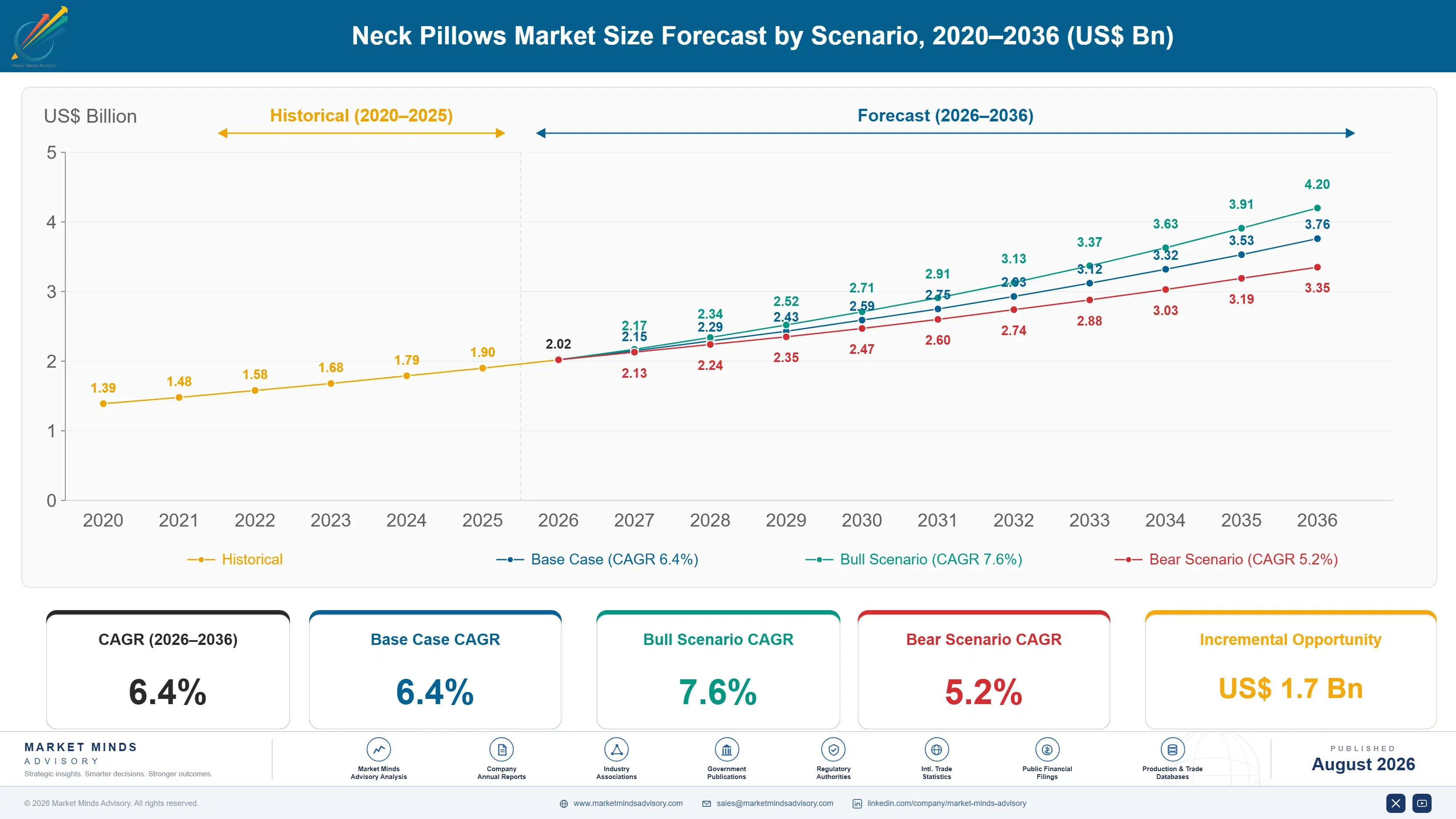
Neck Pillows Market Forecast Scenarios

neck-pillows-market-size-forecast-scenario-1788167826030
The 2020 to 2025 period stopped travel entirely and then restarted it, which exposed how much of this depended on a departure lounge. Travel volume collapse removed most impulse purchasing while clinical and home sleep demand held up and in places grew. Recovery restored the travel occasion but not the pricing. Revenue compounded near 5.1%, with the clinical half doing considerably more of the work than the visible half did.
Three mechanisms carry the base case. Clinical recommendation continues expanding as musculoskeletal presentations rise with desk and device posture across every developed market. Reimbursement coverage for orthopaedic sleep supports is broadening in several health systems. And travel volumes recovering across Asia and the Middle East restore the impulse occasion in the regions where passenger growth is actually happening. None of the three depends on travel retail pricing recovering anywhere at all.
The bull catalyst is broader reimbursement recognition for cervical support in musculoskeletal care pathways, which would move a discretionary purchase into funded provision. The bear risk is airline and airport retail contraction: the travel half depends entirely on physical presence at a gate, and any reduction in that footprint removes an occasion no online channel replaces.

Two Businesses, One Shape

Nothing about this market makes sense until the two halves are separated. A travel pillow is bought at a gate for around 2.7 times what the identical product costs elsewhere, by somebody anxious about a long flight who had not thought about it before. Roughly 43% of those purchases are discarded or abandoned afterwards, which tells you how much consideration went into the decision.
MARKET CONCENTRATION CR524%Share of category revenue held by the leading manufacturers
TRAVEL PILLOW ABANDONMENT43%Share of travel purchases discarded or left behind after use
CLINICAL REPLACEMENT INTERVAL2.8 yearsTypical period before an orthopaedic support pillow is replaced
AIRPORT RETAIL PREMIUM2.7 timesDeparture lounge price against the same product elsewhere
CLINICAL RECOMMENDATION CONVERSION61%Share of recommended patients who purchase the suggested product
PRIVATE LABEL VOLUME SHARE38%Portion of travel format volume sold under retailer brands
The clinical half behaves in every respect like a different industry. A physiotherapist, chiropractor or sleep clinician recommends a specific product, 61% of recommended patients buy it, and they replace it on roughly a 2.8 year cycle because it works. Reimbursement covers part of the cost in several health systems. Nobody abandons one of these in a hotel room, and the recommendation costs the manufacturer nothing in marketing.
Concentration at 24% reflects an absence of anything defensible in either half. Moulded foam and inflatable bladders are straightforward manufacturing, private label reaches 38% of travel volume, and the travel end competes on physical placement rather than on product. The clinical end competes on clinician relationships, evidence and fitting support, which is a genuinely different capability that very few participants have built.
"The travel business is a shelf position at a gate and the clinical business is a relationship with a physiotherapist. Companies keep trying to run both with one sales organisation and it works about as well as you would expect."
Director, Consumer Comfort and Sleep Practice · MMA Consumer Comfort and Sleep Products Practice · August 2026

Market Trends

Clinical Recommendation Reaches Buyers Advertising Never Will

A clinician recommending a specific cervical support converts 61% of the patients they suggest it to, which is a rate no consumer marketing in this category approaches. The recommendation arrives from somebody the patient already trusts about their neck, at the moment they are describing the problem it addresses. Manufacturers who built clinician relationships, evidence and fitting support hold a channel that no amount of retail investment reaches, and it costs almost nothing to maintain once established. Nobody anywhere buys any consumer advertising that converts three patients in every five.
Market Impact: Grows at 9.6% against 6.4%

Travel Volume Recovery Restored Occasion But Not Pricing

Passenger numbers returned across most routes while departure lounge pricing did not fully recover, as travellers who had gone years without buying one proved less willing to pay 2.7 times the online price for a foam ring. Private label reached 38% of travel volume during the same period and has not retreated. The occasion came back and the margin that made it worthwhile did not, which several participants organised entirely around airport retail have found uncomfortable. A recovered occasion at compressed pricing is a considerably worse business than it was.
Market Impact: Replaces on a 2.8 year cycle

Market Opportunities and Growth Drivers

Desk And Device Posture Expands Clinical Presentation Volume

Cervical complaints associated with prolonged desk work and device use have risen steadily across every developed market, and each presentation is an occasion where a clinician may recommend a support product. Clinical pillows accordingly grow at 9.6% against a market rate of 6.4%. The demand arrives through a healthcare pathway rather than through any retail decision, which makes it considerably more predictable and entirely disconnected from advertising or promotional activity. Nobody in this category has to persuade a patient of anything, because the clinician has already done that part of the work.
Market Impact: Faces private label at 38%

Reimbursement Coverage Converts Discretionary Into Funded Purchase

Several health systems now cover part of the cost of orthopaedic sleep supports where a clinician has recommended one, which removes the price consideration that stops many patients acting on advice they received. A funded product is purchased at a rate a discretionary one never matches. Coverage remains patchy and is broadening, and manufacturers who have engaged with reimbursement bodies are reaching patients competitors simply cannot afford to serve. A patient who takes clinical advice and then cannot afford the product is a conversion nobody records, and reimbursement removes exactly that loss.
Market Impact: Depends on 43% abandoned purchases

Market Restraints and Challenges

The Travel Half Has No Defensible Position At All

Moulded foam and inflatable bladders are straightforward manufacturing, private label reaches 38% of travel volume, and a traveller at a gate chooses between products they cannot meaningfully distinguish. The root cause is that the product is simple and the purchase is unconsidered. Commercially it means the travel half competes on physical placement rather than on anything a manufacturer controls. Mitigation runs through airport concession relationships, packability engineering, brand recognition and airline partnership rather than product development. A product that nobody compares is a product that nobody can differentiate either at all.
Market Impact: Converts 61% of recommended patients

Airport Retail Footprint Determines Half The Category

The travel occasion depends entirely on a product being physically visible at a gate when an anxious traveller walks past, and no online channel replaces that moment because the purchase is not planned. The root cause is that nobody sets out to buy a travel pillow in advance. Commercially it makes concession footprint the binding constraint. Mitigation runs through airline in-flight retail, hotel and lounge placement, gift positioning ahead of departure, and clinical channel development that removes the dependence entirely. Nobody plans this purchase and no website has ever changed that.
Market Impact: Prices at 2.7 times elsewhere
4 additional market trends, 3 additional growth drivers, and 2 additional restraints and challenges are covered in the full report. Contact sales@marketmindsadvisory.com to access the complete intelligence.

Segment CAGR and Growth Architecture

Segmentation follows product purpose, because a travel accessory and a clinical support are different products sold to different buyers through entirely different channels. Six categories describe the market completely, from inflatable formats bought for packability through to clinical supports recommended by a practitioner and replaced on a predictable schedule for many years afterwards without complaint.
neck-pillows-market-market-share-analysis-1788167826587

Clinical and Orthopaedic Support Pillows

The fastest category grows at 9.6%, half again the market rate of 6.4%, and it grows through a healthcare pathway rather than through any retail decision. A clinician recommending a specific product converts 61% of the patients they suggest it to, because the recommendation arrives from somebody the patient already trusts about exactly that problem. Replacement runs on a 2.8 year cycle and reimbursement covers part of the cost in several health systems. Nobody abandons one of these in a hotel room, and the channel costs the manufacturer almost nothing to maintain once clinician relationships have actually been established. The two halves of this market barely resemble each other at all.
CAGR 9.6%

Memory Foam and Specialist Material Pillows

Specialist material pillows grow at 7.8% and sit awkwardly between the two halves of this category, which is both their opportunity and their difficulty. Material claims around temperature regulation, pressure distribution and durability support pricing that basic foam cannot, and they reach consumers who research a purchase rather than making it at a gate. They lack the clinical recommendation that converts at 61% and the impulse placement that drives travel volume. Participants here compete on brand and material story in a market where a consumer can rarely verify either claim before buying. Sitting between two channels that each work for different reasons is a difficult place to build anything durable from.
CAGR 7.8%
Full segment breakdown across 6 segments available in the complete report.

Regional Architecture and Country Demand Map

Demand splits between travel volume and clinical pathway development, which follow different things entirely. East Asia leads on passenger growth and manufacturing scale, with North America strongest on clinical channels and South Asia growing fastest overall. The two halves of this category follow entirely different things.

East Asia

The largest share at 28% combines the fastest passenger growth anywhere with manufacturing capacity that supplies almost every travel pillow sold globally regardless of whose brand appears on it. Chinese production dominates the travel format at every price point. Japanese and Korean consumers purchase specialist sleep products at rates no other market approaches, with material and ergonomic claims taken considerably more seriously than in the West. Airport retail here is more developed and better merchandised than in most other regions. Manufacturing almost every travel pillow sold anywhere while also being the fastest growing passenger market is an unusual combination, and it gives regional participants a cost position that importing brands cannot match on their own terms.
Share: 28% | CAGR: 7.4% (2026 to 2036)

North America

Clinical channels are more developed here than anywhere, with chiropractic, physiotherapy and sleep practice recommendation reaching patients at scale and reimbursement coverage broadening across several plan types. Travel volume is large and airport retail pricing has been under pressure since recovery. Private label penetration in travel formats is substantial and retailer driven. The gap between the two halves of this category is starkest in this market, and participants generally serve one of them well and the other badly. Serving one half of this category well and the other badly is the characteristic failure here, and it happens because the two require sales organisations that share almost no capability with one another at all.
Share: 26% | CAGR: 6.0% (2026 to 2036)
Regional intelligence for 5 additional markets available in the complete report: Western Europe, South Asia and Pacific, Latin America, Middle East and Africa, Eastern Europe. Contact sales@marketmindsadvisory.com.
neck-pillows-market-country-cagr-analysis-1788167827106

Where Neck Pillow Margin Sits

Four levers work on channel access, recommendation and placement rather than on product design, which competitors copy within a season and consumers cannot evaluate anyway. Clinical relationships, reimbursement access, airline partnership and packability engineering each address a specific buyer occasion directly. None of the four requires a better pillow than anybody else already makes today.

Build Clinician Relationships Rather Than Consumer Awareness

A clinician recommendation converts 61% of the patients who receive it, which no consumer marketing in this category comes close to matching at any spending level. Building those relationships requires clinical evidence, fitting support and a field capability that consumer organisations rarely maintain. It costs perhaps 2 million dollars to establish properly across a market and almost nothing to sustain afterwards. Participants competing for retail attention are spending against a channel that converts a fraction as well. A 61% conversion rate is not something that any advertising money ever buys.
Market Impact: Converts 61% of the whole recommended patient base

Pursue Reimbursement Listing Where Coverage Exists

Several health systems now fund part of the cost of clinician-recommended orthopaedic supports, and a funded product is purchased at a rate a discretionary one never reaches. Listing requires evidence submission and administrative work rather than any product change at all. The process typically takes 18 months and removes the price objection that stops patients acting on advice. Very few participants have engaged with reimbursement bodies, which leaves the funded position largely unclaimed in most markets. An 18 month listing process is short against a permanently funded market position afterwards.
Market Impact: Takes roughly 18 months to secure a listing

Partner With Airlines Rather Than Airport Concessions

Airport concession costs are high and rising while an airline reaches the same traveller through in-flight retail, loyalty programmes and pre-departure communication at a fraction of that expense. The airline also reaches them before the anxious gate moment rather than during it. Concession fees typically consume 25 to 35 percent of retail value in major airports. Participants organised entirely around gate placement are paying the most expensive rent in retail for an unconsidered purchase. Nobody at all should be paying premium gate rent for a purchase that nobody ever planned anyway.
Market Impact: Avoids roughly 30% paid in airport concession fees

Engineer Packability Above Everything Else Entirely

A travel pillow that will not compress into hand luggage gets abandoned, and 43% of travel purchases are discarded or left behind after a single use. Packability, weight and attachment to a bag handle determine whether the product survives a trip and gets used again on the next one. Repeat purchase among travellers who kept their pillow runs several times higher. Almost every participant still designs for shelf appearance rather than for what happens after the flight lands. What happens after the flight decides whether there is a next purchase.
Market Impact: Reduces the 43% travel pillow abandonment rate directly

Who Controls the Margin Pool

Concentration is remarkably low at around 24% across the five largest participants measured on neck support product revenue, and it is low because the category is two unrelated businesses with almost no shared capability. Travel formats compete on airport placement and price against private label at 38% of volume. Clinical products compete on evidence and practitioner relationships that no retail organisation possesses.
Competition runs on channel access, recommendation credibility and placement. Channel access decides whether a participant reaches a traveller at a gate or a patient in a consulting room. Recommendation credibility decides clinical conversion and cannot be purchased with advertising. Placement decides travel volume entirely, since nobody plans this purchase and the product must be physically present at the moment of anxiety.

Pressure is arriving from private label in travel and from specialist sleep brands in clinical. Retailers introduce own label into travel formats whenever they choose, and the product gives them no reason not to. Specialist sleep participants hold material credibility and clinician relationships together. Rankings will shift toward participants with genuine clinical channel capability, since that is the half that converts, retains and replaces on schedule.
neck-pillows-market-company-positioning-matrix-1788167827626

Competitive Moat and Risk Dimensions

TEMPUR SEALY INTERNATIONAL

Moat: Material credibility across sleep categories

Tempur Sealy holds material and comfort credibility built across mattress and sleep categories that transfers directly into cervical support, which is unusual where most participants have no basis for any performance claim. Specialist sleep retail distribution reaches consumers who research rather than impulse buy. Scale across sleep products funds material development a pillow specialist could never justify.
TEMPUR SEALY INTERNATIONAL

Risk: Limited clinical channel presence

Clinical recommendation converts at rates no retail channel approaches, and building practitioner relationships requires field capability and evidence work that a consumer sleep organisation has little reason to hold. Reimbursement listing requires administrative engagement outside normal commercial practice. Specialist clinical participants reach the patient before any retail consideration begins at all.
CABEAU

Moat: Travel specialisation and packability design

Cabeau focuses entirely on travel comfort rather than treating it as one application among many, which shows in packability engineering, attachment design and understanding of what survives an actual trip. Airport and travel retail relationships are established and difficult for a generalist to replicate quickly. Brand recognition among frequent travellers supports pricing above the private label alternatives sitting beside it.
CABEAU

Risk: Concentration in the travel occasion

Specialising in travel concentrates exposure to airport concession costs, passenger volume cycles and private label at 38% of format volume, all of which move independently of anything the company does. The clinical half grows faster and converts far better. Entering it requires evidence and practitioner capability that a travel accessory organisation has never needed.

Players Tracked

Prominent Players

Tempur Sealy International
Cabeau
Trtl
Therapedic International
Purple Innovation

Other Key Players

Sleep Number
Coop Home Goods
Nap Queen
Ostrichpillow
Huzi Design
MLILY
Sissel
Chiroflow
Core Products International
Mediflow
Bcozzy
Travelrest
Turtl Ergo
Sunrising Bedding
Wamsutta

Recent Developments

MAY 2024

Health system extended coverage to clinician recommended sleep supports

A national health system extended partial reimbursement to orthopaedic sleep support products where a qualified clinician has recommended them as part of a musculoskeletal care pathway, removing the price barrier that had prevented many patients from acting. This was a coverage decision rather than any commercial arrangement between manufacturers.
Signal: Reimbursement converts a discretionary purchase into a funded one across whole patient populations all at once.
OCTOBER 2024

Airport retailer expanded private label across travel comfort products

An airport retail operator expanded its own label range across travel comfort products including neck supports, taking shelf space in a category where a traveller cannot meaningfully distinguish one moulded foam product from another. This was a retailer merchandising decision rather than any transaction between brand manufacturers.
Signal: Private label in travel formats works because nobody at a gate ever compares anything at all.
JANUARY 2025

Airline added comfort products to in-flight retail programme

An airline added travel comfort products to its in-flight retail and pre-departure purchase programme, reaching passengers before and during the flight rather than competing for attention at a gate concession. This was a commercial retail arrangement rather than any acquisition or joint venture between the parties involved.
Signal: Reaching the traveller through the airline entirely avoids paying the most expensive rent anywhere in retail.

What A Neck Pillow Costs

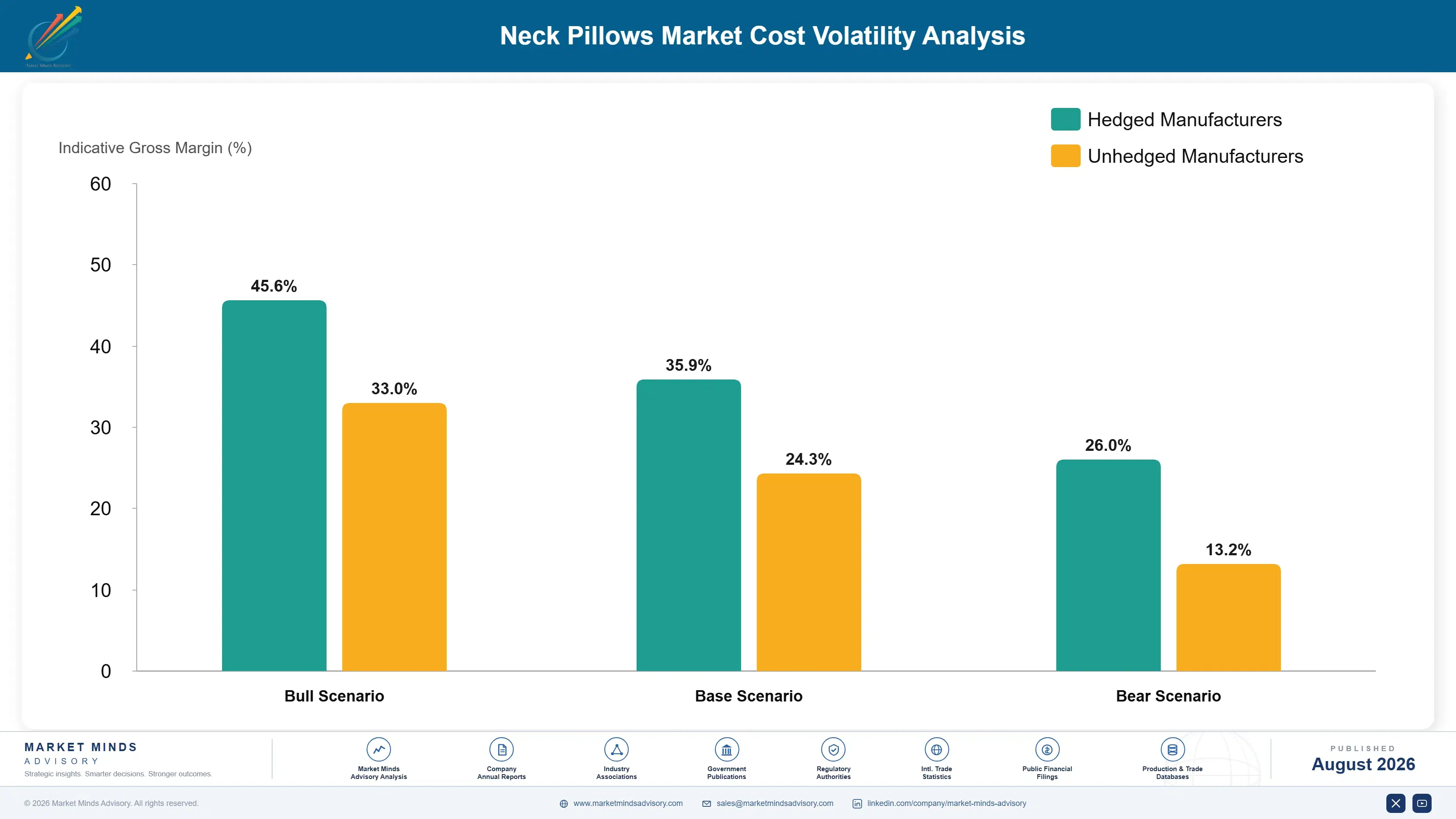
Cost divides four ways and the product itself is remarkably cheap. Retail margin and concession fees absorb roughly 44% of shelf price in airport channels, materials and moulding near 21%, packaging and logistics near 19%, and brand and marketing support the remaining 16%. A moulded foam pillow costs a few dollars and sells at a considerable multiple, which explains the private label pressure and the airport pricing together.
Polyurethane foam and viscoelastic material pricing moved with petrochemical feedstock across recent years, and freight cost mattered more still given that these are bulky lightweight products to move. Tempur Sealy and Purple Innovation have both discussed material and freight cost across recent reporting periods. Airport concession fees have risen faster than either and now represent the single largest cost line in the travel half of this category.

Exposure varies by channel rather than by geography. Airport-dependent participants carry concession fees consuming a third of retail value on a product they cannot price much higher. Clinical channel participants carry evidence and field cost instead, recovered across replacement cycles and reimbursement. Online and specialist retail participants sit between the two, carrying acquisition cost against a considered purchase that at least involves some comparison.
neck-pillows-market-cost-volatility-analysis-1788167827823

Airline retail replacing airport concession dependence

Concession fees consume roughly a third of retail value in major airports and continue rising with passenger volumes. Airline in-flight and pre-departure retail reaches the same traveller at a fraction of that cost and earlier in the journey. Very few participants have pursued airline programmes seriously, which leaves an obvious cost advantage sitting unclaimed in most markets.

Compression packaging reducing freight cost per unit

Neck pillows are bulky and light, which makes freight cost disproportionate to product value on every unit shipped anywhere. Vacuum compression and roll packaging reduce shipping volume substantially at fairly modest packaging cost. Participants who never redesigned for compression are paying to move air across oceans on every single container that they ever fill.

Clinical evidence funding replacing consumer marketing spend

Brand and marketing support absorbs roughly a sixth of retail value in pursuit of a consumer who does not compare products at a gate anyway. Clinical evidence and practitioner support cost less and convert at rates advertising never approaches. Redirecting that spending is arithmetic rather than strategy, and remarkably few participants have run the calculation properly.

Portfolio Architecture for Margin Defence

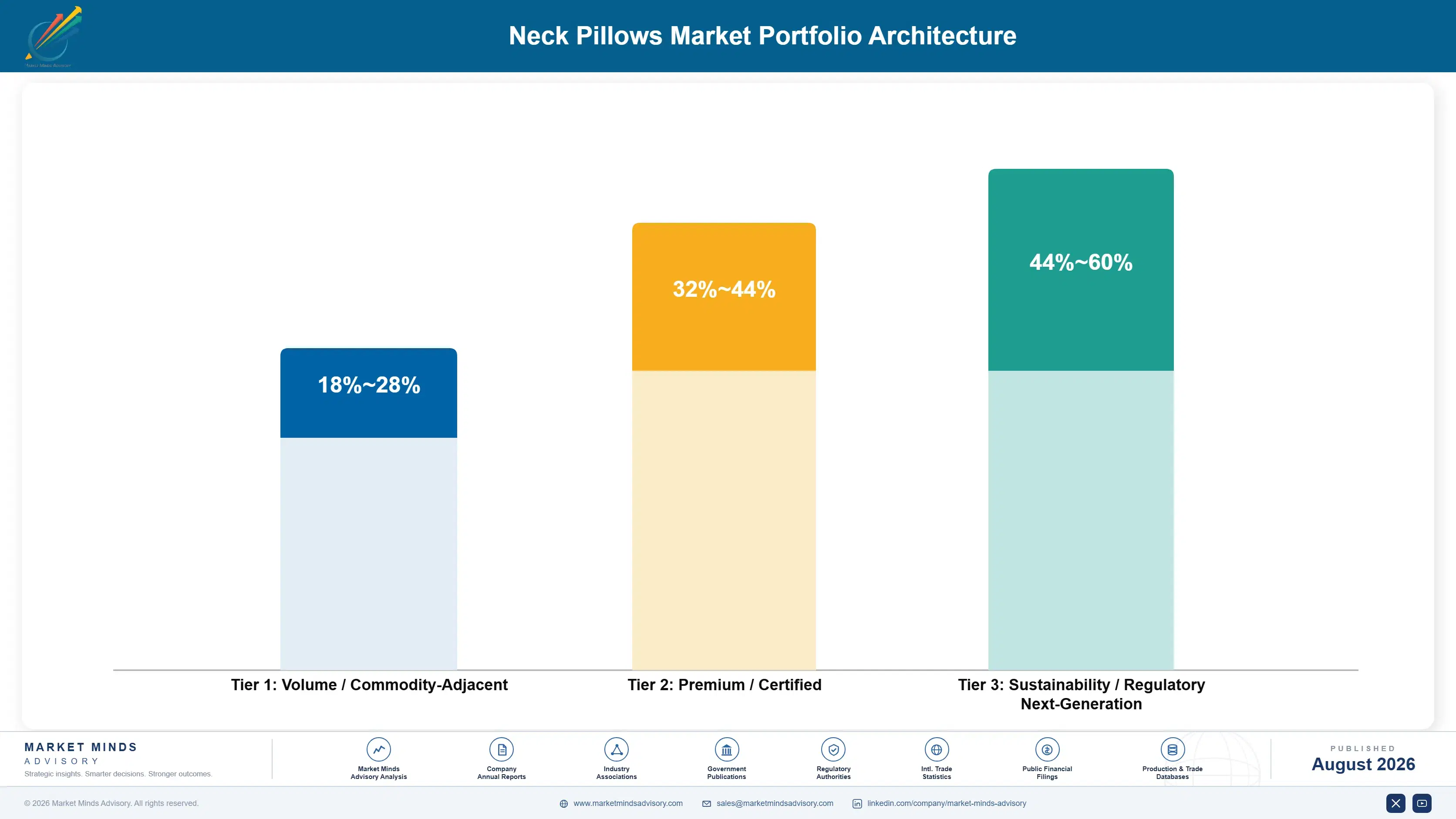
The portfolio separates by whether anybody recommended the product. Travel formats are the volume core and the weaker position: bought unconsidered at a gate, competing against private label at 38% of volume, carrying concession fees that consume a third of retail value, and abandoned by 43% of purchasers after a single use. Everything about that half of the category works against the seller.
Margin concentrates in clinical and orthopaedic supports. A practitioner recommendation converts 61% of patients, replacement runs on a 2.8 year cycle, reimbursement covers part of the cost in several systems, and the channel costs almost nothing to maintain once relationships exist. It is a smaller half of the category and comfortably the better one to be in. Nobody abandons a product a doctor recommended.

The overlooked pool is airline partnership. Concession fees are the largest cost in the travel half, an airline reaches the same passenger through in-flight retail and pre-departure communication at a fraction of the cost, and it reaches them before the anxious gate moment rather than during it. Almost nobody has pursued this seriously. The cost advantage is sitting there unclaimed.

Volume / Commodity-Adjacent

Basic moulded foam and inflatable travel formats sold through airport concession and private label supply. Range spans ten points because concession terms and manufacturing scale decide outcomes entirely in this tier.
Gross Margin: 18-28%

Premium / Certified

Memory foam and specialist material pillows, branded travel formats and therapeutic heated or cooling variants. Range spans twelve points because brand strength and channel mix vary considerably between participants here.
Gross Margin: 32-44%

Sustainability / Regulatory / Next-Generation

Clinical and orthopaedic supports, reimbursed products and practitioner-recommended specialist anatomy ranges. Range spans sixteen points because reimbursement listing and evidence position separate participants sharply. Very few participants here hold any reimbursement listings.
Gross Margin: 44-60%
neck-pillows-market-portfolio-architecture-1788167828324

High-value Sub-segments and Strategic Watch-out

Clinical and Orthopaedic Support Pillows

High value and high growth at 9.6%, converting 61% of recommended patients through a channel that costs almost nothing to maintain. The fourteen point range separates participants holding reimbursement listings from those relying on practitioner goodwill without any funding attached. Nobody abandons one of these.
Gross Margin: 46-60%

Memory Foam and Specialist Material Pillows

High value with moderate growth at 7.8%, reaching consumers who research a purchase rather than making it at a gate. The twelve point range reflects material credibility, since a claim a buyer cannot verify supports very different pricing depending on brand. Comparison happens before purchase here.
Gross Margin: 34-46%

Travel and Portable Neck Pillows

The volume core and the weaker half by every commercial measure available. Concession fees consuming a third of retail value, private label at nearly two fifths of volume, and more than four in ten purchases abandoned after one use. Nothing about this position is worth defending.
Gross Margin: 18-28%

Airport Concession Dependence

The strategic watch-out rather than a growth pool. Half this category depends on physical presence at a gate, concession costs keep rising, and no online channel replaces an unplanned purchase made by an anxious traveller. Half this category rests on a shelf at a gate.
Gross Margin: Variable

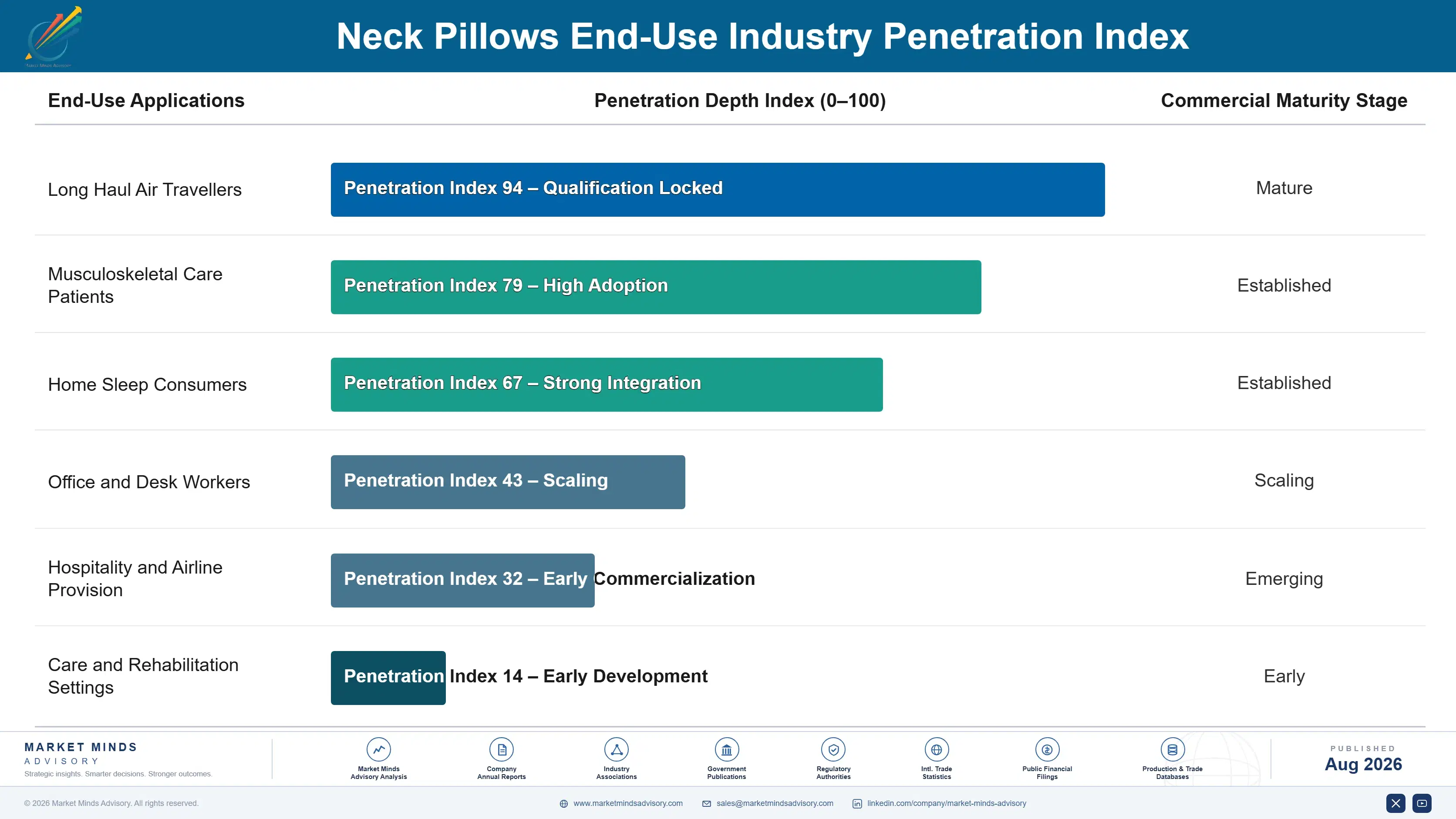
Why Clinical Buyers Return

One half of this category has annuity economics and the other has none whatever. A clinical support recommended by a practitioner is used nightly, replaced on a 2.8 year cycle and frequently repurchased in the same specification because the patient can feel the difference. A travel pillow is used once, discarded 43% of the time and generates no relationship with anybody at all. The same shape produces two completely different commercial structures.
Stickiness depends entirely on whether somebody recommended it. Clinical buyers return because the product works and the practitioner relationship persists, and switching means questioning advice they accepted from a professional. Specialist material buyers show moderate retention where the product genuinely performed. Travel buyers have no stickiness whatever, purchasing whatever is standing in front of them at a gate on the day of a long flight.

The buyer has diverged rather than changed. Travel purchasers have become more price sensitive and more willing to take private label since the recovery, which has removed pricing headroom permanently. Clinical patients arrive through a healthcare pathway that has been broadening as musculoskeletal presentation rises. Participants organised around one of those buyers find the other genuinely difficult to serve with the same capability.
neck-pillows-market-end-use-penetration-index-1788167828811

Where Participants Should Commit

These are among the four positions where our research anticipates prominent divergence between winners and laggards over the coming forecast period. Each is grounded in the demand model, the regulatory perimeter, and the announced capacity pipeline.
01 / CLINICAL CHANNEL BUILDING

A recommendation converts where advertising never does

A clinician recommending a specific cervical support converts around 61% of the patients who receive that recommendation, which no consumer marketing anywhere in this category comes close to matching at any level of spending whatsoever. Building those relationships requires clinical evidence, fitting support and a genuine field capability that consumer organisations very rarely maintain internally at all. It costs perhaps two million dollars to establish it properly across a market and almost nothing at all to sustain afterwards each year.
02 / REIMBURSEMENT LISTING PURSUIT

A funded product is bought at an entirely different rate

Several health systems now fund a part of the cost of clinician-recommended orthopaedic supports, and a properly funded product is purchased at a rate that a discretionary one has never once approached anywhere at all. Listing requires evidence submission and administrative work only, rather than any change to the product itself whatsoever at all. The whole process typically takes eighteen months and removes the price objection that stops patients acting on advice a professional has already given directly to them.
03 / AIRLINE CHANNEL SUBSTITUTION

Stop paying the most expensive rent in retail

Airport concession costs now consume between twenty-five and thirty-five percent of retail value in major airports and they continue rising steadily, while an airline can reach exactly the same traveller through in-flight retail, loyalty programmes and pre-departure communication for a small fraction of that cost. The airline also reaches them well before the anxious gate moment rather than during it at all. Participants who are organised entirely around gate placement are paying premium rent for a completely unconsidered purchase indeed.
04 / PACKABILITY DESIGN ENGINEERING

Design for the return journey, not the shelf

A travel pillow that will not compress down into hand luggage gets abandoned, and around 43% of travel purchases are discarded or simply left behind after just a single use of them. Packability, weight and the attachment to a bag handle all determine whether the product survives a trip and gets used again on the next trip afterwards too. Repeat purchase among travellers who have actually kept their pillow runs several times higher than among those who simply did not.

Engagement Snapshot From the Field

A live engagement with an industry participant carrying material or product regulatory and market exposure ahead of a defining policy shift, showing how our research translates into a defensible multi-year portfolio strategy.
MARKET MINDS ADVISORY · CLIENT ENGAGEMENT SUMMARY
Neck Pillows Producer Strategic Portfolio Review and Transition Roadmap 2026·Investment Scenario on Neck Pillows Exposure Evaluation 2025-26
CLIENT PROFILE
A travel comfort brand selling neck pillows through airport concessions and online retail across four markets, with a small specialist material range and no clinical channel presence at all. Revenue had grown with passenger recovery while margin declined across the same period, and management attributed the decline to private label pressure rather than to the concession fees it was paying.
STRATEGIC CHALLENGE
The board needed to establish how much margin airport concession costs were consuming relative to private label pressure, and whether pursuing airline retail partnerships justified disrupting established concession relationships. It also faced a decision on entering clinical channels, which the commercial organisation regarded as a different industry requiring capability it had never built.
MMA APPROACH
MMA rebuilt margin by channel across three years, separating concession fees from price competition for the first time. It modelled airline retail partnership and clinical channel development against continued concession dependence. Expert interviews with airlines, airport retailers, physiotherapists and reimbursement bodies established where this product is recommended and where it is merely displayed.
KEY FINDINGS
  1. Concession fees consumed roughly twice as much margin as private label price competition did, and the two had never been reported separately to the board at all.
  2. Two airlines had approached the client about in-flight retail and been declined by a sales team organised entirely around airport concession relationships.
  3. Physiotherapists interviewed recommended cervical supports regularly and named two rival brands, neither of which had any consumer presence at all the client recognised.
  4. The client's specialist material range converted well online where buyers compared products, and was invisible in the concession environment where nobody compares anything.
CLIENT PROFILE
A travel comfort brand selling neck pillows through airport concessions and online retail across four markets, with a small specialist material range and no clinical channel presence at all. Revenue had grown with passenger recovery while margin declined across the same period, and management attributed the decline to private label pressure rather than to the concession fees it was paying.
STRATEGIC CHALLENGE
The board needed to establish how much margin airport concession costs were consuming relative to private label pressure, and whether pursuing airline retail partnerships justified disrupting established concession relationships. It also faced a decision on entering clinical channels, which the commercial organisation regarded as a different industry requiring capability it had never built.
MMA APPROACH
MMA rebuilt margin by channel across three years, separating concession fees from price competition for the first time. It modelled airline retail partnership and clinical channel development against continued concession dependence. Expert interviews with airlines, airport retailers, physiotherapists and reimbursement bodies established where this product is recommended and where it is merely displayed.
KEY FINDINGS
  1. Concession fees consumed roughly twice as much margin as private label price competition did, and the two had never been reported separately to the board at all.
  2. Two airlines had approached the client about in-flight retail and been declined by a sales team organised entirely around airport concession relationships.
  3. Physiotherapists interviewed recommended cervical supports regularly and named two rival brands, neither of which had any consumer presence at all the client recognised.
  4. The client's specialist material range converted well online where buyers compared products, and was invisible in the concession environment where nobody compares anything.
RECOMMENDED STRATEGY
Phase 1: Phase one: accept both airline retail approaches and rebalance concession exposure toward airports where fees remain proportionate to realised value. Phase 2: Phase two: build a clinical evidence package and a small practitioner field capability, targeting physiotherapy and chiropractic recommendation channels directly instead. Phase 3: Phase three: move specialist material products toward online and specialist retail where comparison happens rather than onto any concession shelves at all.
OUTCOME
The client reported margin recovering 4.6 points within four quarters as airline retail replaced two concession contracts (client-reported, unverified by MMA). Clinical evidence work began with two large practitioner groups. Specialist material products moved channel, and concession volume fell as planned without any overall revenue loss.

Frequently Asked Questions

Foundational context covering the market sizes, CAGR, scope, country, region and competition that inform every finding below. This section is provided to cover basics and most often pre-purchase conversations, answered from the MMA Primary Research Dataset.

What is the current size of the Neck Pillows Market?

The market is valued at USD 1.9 billion in 2025, measured as revenue from pillows and supports designed to position or support the cervical spine.

How large will the Neck Pillows Market be by 2036?

MMA forecasts USD 3.76 billion by 2036, up from USD 2.02 billion in 2026. That represents incremental revenue of USD 1.74 billion and an expansion multiple of 1.86 times.

What is the CAGR for the Neck Pillows Market 2026 to 2036?

The base case CAGR is 6.4%, with a bull case of 7.6% and a bear case of 5.2%. Clinical channel growth supplies the largest part of that.

Which segment is growing fastest?

Clinical and orthopaedic support pillows grow at 9.6%, half again the market rate of 6.4%, because practitioner recommendation converts a majority of the patients receiving it.

Who are the major companies in the Neck Pillows Market?

Tempur Sealy International, Cabeau, Trtl, Therapedic International and Purple Innovation lead on category revenue, holding only around 24% between them across a very fragmented market.

Which country is growing fastest?

India grows fastest at 8.6%, driven by passenger volumes rising faster than any other market and long-haul travel reaching a considerably larger part of the population.

Report Segmentation Architecture

The full report scope spans multiple orthogonal segmentation dimensions, with cross-tabulated demand data provided for each dimension pair. Coverage extends further to regional breakdowns, trend trajectories, and the competitive detail needed to support segment-level decision-making.

By Product Purpose

  • Travel and Portable Neck Pillows
  • Clinical and Orthopaedic Support Pillows
  • Memory Foam and Specialist Material Pillows
  • Inflatable and Packable Formats
  • Therapeutic Heated and Cooling Variants
  • Children and Specialised Anatomy Products

By End-Use Industry

  • Long Haul Air Travellers
  • Musculoskeletal Care Patients
  • Home Sleep Consumers
  • Office and Desk Workers
  • Hospitality and Airline Provision
  • Care and Rehabilitation Settings

By Commercial Dimension

  • Airport Concession Retail
  • Airline In-Flight Programmes
  • Clinical and Practitioner Channels
  • Specialist Sleep Retail
  • Online Direct Sales
  • Private Label Manufacture

By Region

  • East Asia
  • North America
  • Western Europe
  • South Asia and Pacific
  • Latin America
  • Middle East and Africa
  • Eastern Europe

Scope, Methodology, and Coverage

Every figure in this report is reproducible from documented input assumptions. The scope below maps the historical period, the forecast horizon, the segmentation dimensions, and the countries covered, alongside the underlying primary and qualitative methodology.
Historical Period
2020 to 2025
Forecast Period
2026 to 2036
Base Year
2025 (USD billions; MMA Primary Research Dataset, August 2026)
Market Definition
Revenue from pillows and supports designed to position or support the cervical spine and neck, spanning travel and portable neck pillows, clinical and orthopaedic support pillows, memory foam and specialist material pillows, inflatable and packable formats, therapeutic heated and cooling variants, and children and specialised anatomy products. Airport concession retail, airline in-flight programmes, clinical and practitioner channels, specialist sleep retail, online direct sales and private label manufacture are all included. General bed pillows without cervical positioning function, mattresses and sleep systems, cervical collars and braces prescribed as medical devices, and furniture headrests fitted to seating are excluded.
Quantitative Units
USD billions, neck support product revenue at manufacturer level
Segmentation Dimensions
Product purpose, user setting, distribution channel, region
Regions Covered
East Asia, North America, Western Europe, South Asia and Pacific, Latin America, Middle East and Africa, Eastern Europe
Countries Covered
China, Japan, South Korea, United States, Canada, United Kingdom, Germany, France, India, Australia, Brazil, Mexico, United Arab Emirates, Poland
Key Companies Profiled
Tempur Sealy International, Cabeau, Trtl, Therapedic International, Purple Innovation, Sleep Number, Ostrichpillow, Core Products International, Sissel, MLILY
Quantitative Methodology
Primary survey, n=3,800 respondents, Q4 2025, six countries; demand-side model with trade association cross-validation
Qualitative Methodology
47 expert interviews, Q4 2025; applied to validate demand model assumptions, identify emerging dynamics, and assess competitive positioning
Report Format
PDF and XLSX data workbook (Word format preview document)
Publisher
Market Minds Advisory
Report Code
MMA-2026-MED-171
Published
August 2026
Contact
sales@marketmindsadvisory.com | www.marketmindsadvisory.com

Purchase the full Neck Pillows Market Report (2026 to 2036).

The full report separates two businesses that share a shape and are almost always analysed as though they were one. It quantifies clinical recommendation conversion against consumer marketing effectiveness, measures airport concession cost against realised retail value, and assesses reimbursement listing as the mechanism converting a discretionary purchase into a funded one. Segment analysis covers all six product purposes, with particular attention to clinical supports where conversion, retention and replacement all behave completely differently. Competitive assessment ranks twenty participants on neck support product revenue across both halves.
Six product purpose segmentation with growth rates
Clinical conversion compared against consumer marketing effectiveness
Twenty participant assessment on neck support revenue
Airport concession cost measured against realised retail value
Reimbursement coverage mapped across major health systems
Travel abandonment rates assessed against packability design

Built For The People Who Decide

From boardroom strategy to bench-side execution, this report is read cover-to-cover by leaders shaping the next decade of their industry, turning demand scenarios, market dynamics and valuation benchmarks into decisions.
CXOs/ Presidents/ VPs/ Managers
M&A and Corporate Development
Strategy Teams and R&D Heads
Procurement and Product Directors
Regulatory and Compliance Leaders
Investor Relations and Equity Analysts