Market Minds Advisory
Natural Pet Food Market

Natural Pet Food Market: Pet Humanization and the Fresh-Food Disruption

Natural pet food sits between decades-old grain-free kibble brands defending grocery shelf space and refrigerated subscription services shipping human-grade meals direct to consumers, a shift redrawing who actually owns the pet-owner relationship.

Lead Analyst

Lisa Gevelber

Published

September 2026

Make Smarter Decisions with Customized Research Insights

Request a free sample report and evaluate market opportunities, growth trends, and competitive dynamics relevant to your business needs.

2025 MARKET VALUE$21.8BMarket Size 2025
2036 FORECAST VALUE$48.8BBase Case , 2026 to 2036
CAGR 2026 TO 20367.6 %Bull 8.8% / Bear 6.4%
INCREMENTAL OPPORTUNITY$25.3BNet 10- year value creation
EXPANSION MULTIPLE2.08x2036 value over 2026 base
Strategic Levers
M&A Pipeline
Regional Outlook
Country Rankings
Competitive Intelligence
Segmental Deep-dive
Call-Us : 91 93563 13602

Executive Snapshot and Market Trajectory

Natural pet food has stopped being a niche grocery aisle and become the default frame through which an entire generation of pet owners buys food. Grain-free kibble built that shift, but refrigerated subscription meals are where the category's energy now genuinely sits.
Freeze-dried and raw formats are growing fastest as owners increasingly treat pet nutrition the way they treat their own, prioritizing minimal processing over shelf stability. North America anchors global demand on sheer pet ownership scale and premiumization depth, while China's rapidly expanding urban pet ownership base is closing the gap faster than any other market tracked in this report. Legacy kibble brands are racing to acquire that same subscription capability rather than build it themselves. Neither trend shows any sign of slowing.
Twenty companies compete across a market split between legacy kibble brands defending grocery and pet specialty retail share and direct-to-consumer subscription challengers who never needed a retail relationship at all. Rising human-grade meat input cost genuinely compresses margin faster for smaller challengers than for diversified incumbents with broader sourcing scale. Legacy incumbents with diversified sourcing scale are absorbing that pressure more easily than smaller challengers.
Market Definition
The market covers natural pet food products, including grain-free and limited-ingredient kibble, wet and canned food, freeze-dried and raw formats, fresh refrigerated subscription meals, and natural treats, marketed with minimal artificial additives for dogs and cats. Conventional mass-market pet food and pet supplements sold separately from food are excluded.
Base Year Value
$21.8B in 2025 (MMA Primary Research Dataset, August 2026)
Forecast Period
2026 to 2036, eleven discrete annual values
CAGR
7.6% base case. Bull 8.8%. Bear 6.4%.
Fastest Growth Segment
Freeze-Dried and Raw Natural Pet Food: 11.2% CAGR
Fastest Growth Country
China: 10.6% CAGR
Fastest Growth Region
South Asia and Pacific: 9.8% CAGR
Largest Region
North America: 32% of 2025 global value
Market Leaders
Blue Buffalo, Freshpet Inc, The Farmer's Dog, Merrick Pet Care, Open Farm. Source: MMA Analysis based on company annual reports.
Primary Survey
n=3,800 procurement and R&D decision-makers, Q4 2025, six countries
Methodology
Demand-side build-up, cross-validated against public data, 47 expert interviews

Natural Pet Food Market Forecast Scenarios

natural-pet-food-market-trends-size-forecast-scenario-1787555187724
Between 2020 and 2025 the market grew near 6.6% a year, accelerated by pandemic-era pet adoption surges that expanded the addressable owner base meaningfully before growth normalised somewhat as adoption rates settled back toward historical trend lines across most major markets. Fresh subscription models barely existed at scale in 2020, making their contribution to growth increasingly visible by the period's end.
The base case carries the market to 7.6% CAGR on three mechanisms: continued premiumization as pet humanization deepens across younger owner cohorts, fresh refrigerated subscription models expanding direct-to-consumer distribution beyond what retail shelf space alone could support, and rising urban pet ownership across China and other Asian markets creating an entirely new premium buyer base. None of these three mechanisms depends on any single retailer's category decision. Each mechanism moves largely on its own timeline.
The bull case at 8.8% assumes faster subscription model adoption pulls volume away from conventional kibble faster than currently modelled. The bear case at 6.4% assumes rising human-grade input costs force price increases that slow premiumization among more price-sensitive owner segments. Both scenarios assume pet ownership rates themselves stay roughly stable rather than swinging sharply either way.

Grocery Shelf Meets the Subscription Fridge

Three forces shape this market at once, and each moves on its own separate adoption curve. Pet humanization keeps deepening across successive generations of owners, direct-to-consumer subscription models are pulling distribution away from retail shelf space entirely, and rising urban pet ownership in Asia is creating a genuinely new premium buyer base largely independent of Western category trends.
DTC CHANNEL SHARE24%share of category volume sold direct to consumer
AVERAGE SELLING PRICEUSD 3.80/lbblended retail price across natural pet food formats
TOP BRAND SHARE14%largest single brand share of category retail revenue
INPUT COST SHARE58% of COGShuman-grade meat and protein cost across premium formats
SUBSCRIPTION RETENTION83%typical annual retention rate for fresh subscription services
HHI CONCENTRATION430a moderately concentrated category dominated by early movers
Commercially, the market behaves like two overlapping businesses wearing one category label. Legacy kibble brands compete on retail shelf placement and grocery buyer relationships built over decades, while fresh subscription challengers compete on direct customer acquisition cost and retention economics that traditional retail brands have never needed to manage. Few companies have historically built genuine strength across both commercial models simultaneously.
Over the next decade, subscription model economics and Asian premium market entry will decide winners more than incremental kibble reformulation ever could. Brands investing early in direct-to-consumer capability and Asian distribution will capture growth that retail-only incumbents cannot easily replicate without rebuilding their entire commercial model. Retail shelf space will keep mattering, but it will not be where the category's next decade of growth is decided.
"Kibble brands spent a decade fighting over grain-free labeling claims. The real fight moved to whose app the owner opens every week, and most legacy brands don't have one."
Director, Consumer Products and Pet Care Practice · MMA Agriculture and Consumer Products Practice · August 2026

Market Trends

Refrigerated Subscription Models Disrupt Traditional Kibble Distribution

Fresh, human-grade refrigerated pet food delivered through direct-to-consumer subscription has expanded rapidly over recent years, led by brands including The Farmer's Dog and Nom Nom, both bypassing traditional pet specialty and grocery retail entirely. This model captures customer data and repeat purchase behaviour that retail-channel brands cannot access without rebuilding their entire model, letting subscription companies personalise formulations and pricing at an individual pet level. Legacy kibble manufacturers have responded by acquiring smaller fresh-food startups rather than building comparable capability internally. Retention rates for established subscription services regularly exceed rates seen in most other consumer subscription categories.
Market Impact: Adds USD 2.4 billion by 2030
Functional and Health-Specific Formulations Gain Retail Share

Formulations targeting specific health outcomes, including gut health, joint support, and skin and coat condition, have expanded meaningfully across both kibble and treat categories as owners increasingly treat pet nutrition as a health intervention rather than simple feeding. Veterinary-adjacent marketing and ingredient transparency around probiotics, specific protein sources, and omega fatty acids now command real premiums over standard natural formulations lacking comparable functional claims. Brands substantiating these claims through actual clinical or veterinary partnership evidence are differentiating from competitors making similar claims without comparable backing. This shift mirrors functional food trends already well established in human nutrition retail.
Market Impact: Adds 24% share via DTC channels

Market Opportunities and Growth Drivers

Pet Humanization Deepens Across Younger Owner Generations

Younger pet owners increasingly treat pets as family members rather than animals to be fed economically, a shift that has driven premiumization across nearly every consumer pet category over the past decade. This generational shift shows no sign of reversing, since younger cohorts entering pet ownership for the first time have shown even stronger premiumization preferences than the generation before them. Owners increasingly research ingredient sourcing and manufacturing transparency before purchase, rewarding brands that can substantiate natural and human-grade claims credibly. This driver extends beyond food into treats and fresh subscription formats mirroring how owners think about their own diets.
Market Impact: Raises compliance cost 20%

E-Commerce and Subscription Growth Expands DTC Distribution

Online retail and subscription commerce have expanded pet food distribution well beyond what traditional grocery and pet specialty retail shelf space alone could support, letting smaller and newer brands reach consumers without the capital required to win major retail listings. Subscription models specifically let fresh and freeze-dried brands manage cold-chain logistics directly to the consumer's door rather than depending on retail cold storage infrastructure that most stores simply do not have. This channel shift has proven especially valuable for brands targeting specific health conditions or breed sizes that broad retail assortments cannot accommodate profitably.
Market Impact: Cuts premium margin 300 basis points

Market Restraints and Challenges

Raw and Freeze-Dried Formats Face Food Safety Scrutiny

Raw and freeze-dried pet food formats carry genuine bacterial contamination risk given minimal processing, and regulators including the US FDA have issued repeated advisories around salmonella and listeria risk specifically in raw pet food categories. The root cause is the same minimal-processing positioning that makes these formats appealing to owners seeking less industrially processed nutrition, since reducing contamination risk typically requires processing steps that compromise that exact positioning. Brands are responding by investing in high-pressure processing and enhanced testing protocols that reduce risk while preserving much of the raw positioning owners specifically seek in this category.
Market Impact: Adds USD 1.8B in DTC sales

Rising Human-Grade Input Costs Compress Premium Margins

Human-grade meat and protein sourcing costs substantially more than rendered or byproduct meal used in conventional pet food, and that cost gap has widened as human food price inflation has affected the same protein supply chains premium pet food brands depend on directly. The root cause is straightforward input competition, since human-grade sourcing means premium pet food brands compete directly with human food processors for the same protein supply. Smaller subscription challengers without diversified sourcing scale absorb this pressure more directly than larger incumbents with broader supplier relationships and purchasing leverage across categories.
Market Impact: Lifts functional segment price 15%
3 additional market trends, 4 additional growth drivers, and 2 additional restraints and challenges are covered in the full report. Contact sales@marketmindsadvisory.com to access the complete intelligence.

Segment CAGR and Growth Architecture

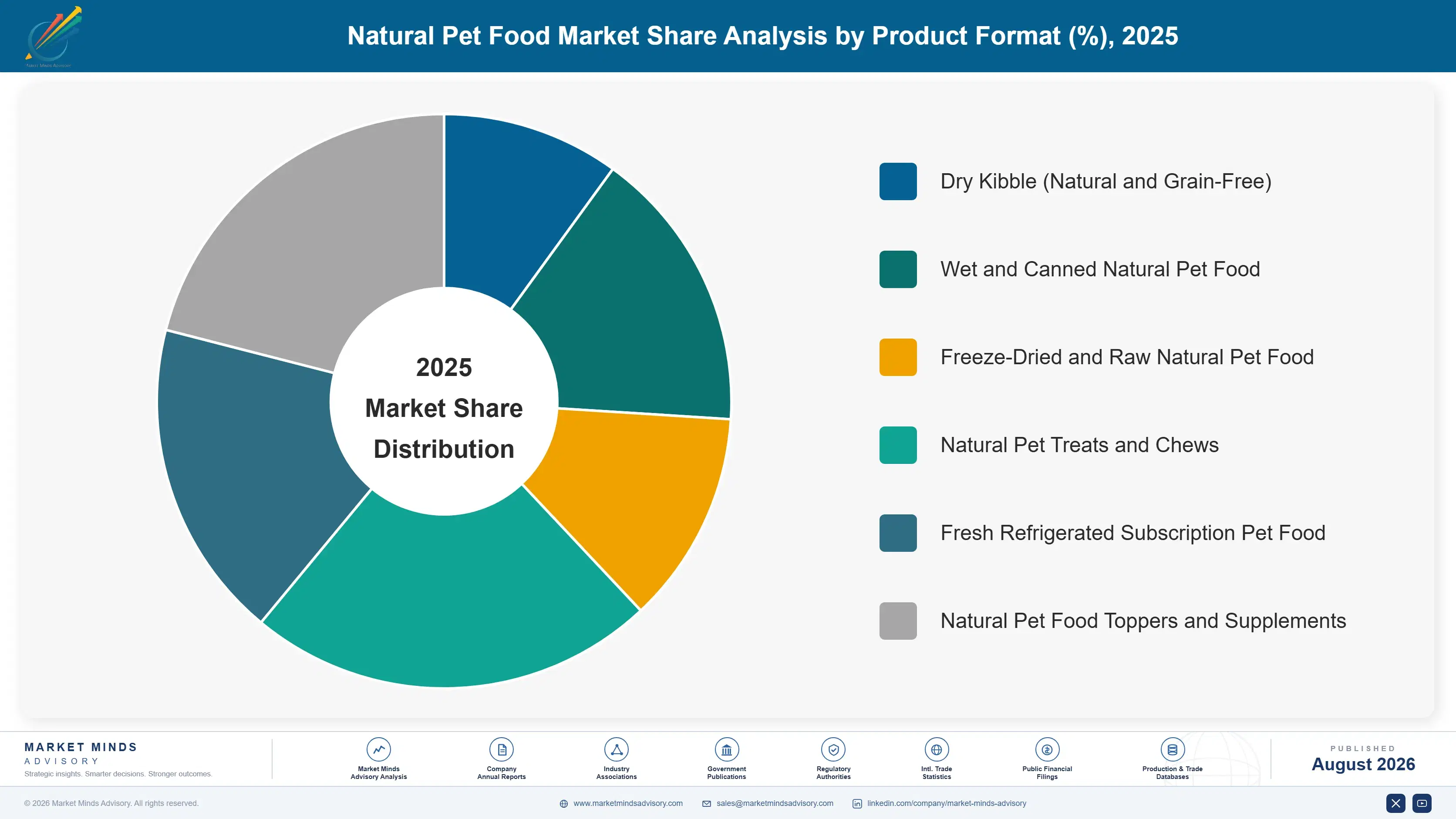
Segmentation follows product format, the single commercial logic determining processing method, distribution channel, and price positioning. Dry kibble dominates by volume, while freeze-dried, raw, and fresh subscription formats are growing fastest on premiumization and direct-to-consumer expansion. Treats and toppers each carry distinct retail placement strategies of their own. Buyer qualification pathways vary meaningfully across each of these six categories.
natural-pet-food-market-trends-market-share-analysis-1787555188263

Freeze-Dried and Raw Natural Pet Food

Freeze-dried and raw natural pet food grows fastest at 11.2%, about 1.47 times the overall 7.6% rate, as owners increasingly seek minimally processed nutrition mirroring their own dietary preferences. Brands including Stella and Chewy's and Primal Pet Foods have expanded distribution from specialty pet retail into mainstream grocery and mass channels as consumer familiarity with the format grows. Food safety scrutiny around bacterial contamination risk has pushed several producers toward high-pressure processing techniques that reduce risk while preserving much of the minimally processed positioning owners specifically value in this category. Premium pricing well above conventional kibble reflects both higher input cost and genuine specification differentiation that owners increasingly research and understand before purchase.
CAGR 11.2%

Fresh Refrigerated Subscription Pet Food

Fresh refrigerated subscription pet food grows second-fastest at 10.5%, led by The Farmer's Dog, Nom Nom, and Ollie, all delivering human-grade meals customised to individual pet weight and health needs through direct-to-consumer subscription. This model captures customer data and repeat purchase behaviour that traditional retail brands cannot access without rebuilding their model, and annual retention rates regularly exceed 83%, considerably higher than typical consumer subscription categories. Cold-chain logistics investment represents a genuine barrier to entry that protects established players from casual new entrants lacking comparable distribution infrastructure. Legacy kibble manufacturers increasingly acquire rather than build competing subscription capability internally. These brands increasingly partner with veterinary networks to expand acquisition beyond pure digital advertising.
CAGR 10.5%
Full segment breakdown across 6 segments available in the complete report.

Regional Architecture and Country Demand Map

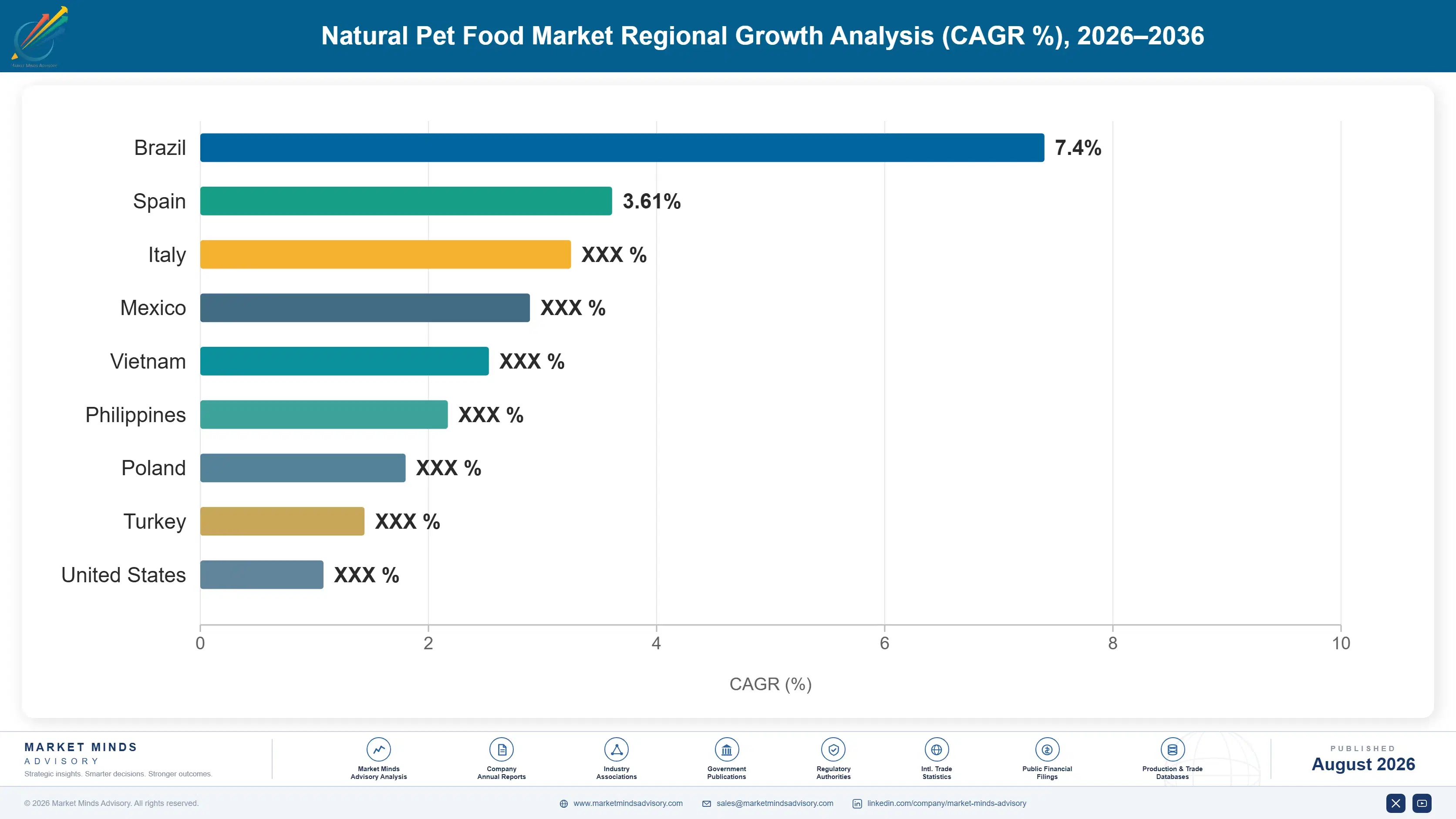
North America leads on pet ownership scale and premiumization depth, Western Europe follows on established retail infrastructure, and South Asia and Pacific posts the fastest regional growth on rising urban pet ownership across India and Southeast Asia, a market still in its early stages of category development.

North America

The world's largest pet ownership base and deepest premiumization trend explain North America's 32% share and 8.2% growth, both the largest and among the fastest of any region tracked here. Blue Buffalo, Freshpet, and The Farmer's Dog all anchor operations directly in the American market, which remains the global testing ground for new formats before international expansion. Fresh subscription models have reached deeper market penetration here than anywhere else globally, supported by cold-chain delivery infrastructure that took years to build out nationally. Growth here tracks continued premiumization and subscription model expansion more than any new pet ownership growth, since American pet ownership rates are already broadly mature relative to other regions.
Share: 32% | CAGR: 8.2% (2026 to 2036)

Western Europe

Established natural pet food retail infrastructure explains Western Europe's 24% share, though its 6.0% growth trails East Asia and South Asia given a more mature category base overall. German, French, and British pet specialty retailers have carried natural and grain-free formulations for over a decade, giving the category deeper retail penetration than in most emerging markets. Fresh subscription models are expanding steadily but from a smaller base than in North America, constrained partly by more fragmented cold-chain logistics across multiple national markets rather than one unified delivery infrastructure. Growth here should continue tracking gradual premiumization and subscription model expansion across the region's largest markets specifically. Retailers here increasingly expand fresh and natural sections directly to compete with subscription entrants.
Share: 24% | CAGR: 6.0% (2026 to 2036)
Regional intelligence for 5 additional markets available in the complete report: East Asia, South Asia and Pacific, Latin America, Middle East and Africa, Eastern Europe. Contact sales@marketmindsadvisory.com.
natural-pet-food-market-trends-country-cagr-analysis-1787555188784

Where Brands Can Defend Category Share

Premiumization sets a durable demand floor for this category, but four commercial moves let brands capture more value above that floor regardless of channel, and regardless of how quickly the subscription model trend ultimately reshapes retail distribution nationally. Brands combining several of these moves at once are pulling ahead of single-strategy competitors industry-wide. nationally.

Launch Direct-to-Consumer Subscription Ahead of Competitors

Brands building subscription capability early are capturing customer data and repeat purchase relationships that retail-only competitors cannot access without rebuilding their model, and annual retention rates exceeding 83% for established subscription services demonstrate genuine customer loyalty once acquired. This approach requires real investment in cold-chain logistics and direct customer acquisition capability distinct from traditional retail sales, but early movers are securing customer relationships that later entrants find considerably harder to win once a household establishes its subscription routine. Competitors entering later find households reluctant to switch once a subscription routine and feeding schedule are already established.
Market Impact: Captures roughly 83% annual subscription retention rate overall

Substantiate Functional Health Claims With Clinical Evidence

Brands backing functional formulations with actual veterinary or clinical partnership evidence are capturing the roughly 15% price premium that functional positioning commands, while competitors making similar claims without comparable substantiation increasingly face skeptical, better-informed consumers. This approach requires genuine investment in research partnerships rather than marketing claims alone, but it builds credibility that is considerably harder for competitors to replicate quickly. Early movers in specific health categories like gut and joint health are establishing category leadership positions difficult to displace. Category leadership in a specific health claim compounds over time as clinical evidence accumulates ahead of competitors.
Market Impact: Captures roughly a 15% functional formulation price premium

Invest in High-Pressure Processing to Address Safety Scrutiny

Brands investing in high-pressure processing technology reduce the bacterial contamination risk associated with raw and freeze-dried formats while preserving much of the minimally processed positioning that owners specifically seek in this category. This technology investment requires meaningful capital, roughly 20% above conventional processing cost, but it addresses the single largest regulatory and reputational risk facing this fast-growing segment. Brands completing this investment ahead of any adverse safety event position themselves considerably better than competitors reacting only after regulatory scrutiny intensifies. Competitors reacting only after an adverse event will find consumer trust considerably harder to rebuild than to protect in advance.
Market Impact: Cuts bacterial contamination risk by roughly 90% overall

Enter Asian Markets Through Premium Positioning Early

Brands entering China and other rapidly growing Asian pet food markets through premium positioning, rather than competing on price against domestic mass-market brands, are capturing status-conscious urban consumers willing to pay meaningfully more for imported or internationally recognised natural pet food. This approach requires genuine investment in local distribution and regulatory compliance specific to each market, and early entrants securing partnerships across 3 to 5 major Chinese cities are building brand recognition considerably faster than domestic competitors entering the premium tier later. This head start compounds into recognition later entrants cannot easily buy back once local leaders are established.
Market Impact: Wins an outsized share of 9.8% regional growth

Who Controls the Margin Pool

Concentration sits at a moderate CR5 of 38%, measured consistently across all participants on US retail natural pet food sales revenue. Blue Buffalo and Freshpet lead on retail shelf depth and fresh subscription pioneering respectively, and the gap to The Farmer's Dog and other direct-to-consumer challengers reflects distribution model differences rather than any single differentiating product formulation advantage. Neither leader has yet fully closed the other's distribution-model advantage.
Competitive activity today runs along three lines: direct-to-consumer subscription launches targeting the fastest-growing distribution channel, functional health formulation development backed by clinical evidence, and Asian market entry through premium positioning. Legacy kibble manufacturers increasingly acquire smaller fresh and raw food startups rather than building comparable direct-to-consumer capability internally, given the customer acquisition expertise required.

Pressure is building from subscription-native challengers who never depended on retail relationships in the first place, while legacy incumbents race to acquire that same direct-to-consumer capability through acquisition rather than internal development. Any brand still relying purely on traditional retail distribution without direct-to-consumer or Asian market investment faces a widening growth disadvantage that shelf placement alone cannot offset. That widening gap should keep accelerating as subscription and international investment compound further.
natural-pet-food-market-trends-company-positioning-matrix-1787555189301

Competitive Moat and Risk Dimensions

BLUE BUFFALO

Moat: Deepest retail shelf penetration

Blue Buffalo, owned by General Mills, holds the deepest grocery and pet specialty retail shelf presence of any natural pet food brand, built over more than two decades of category-defining marketing around grain-free and natural positioning. Its parent company's distribution scale and marketing budget also let it acquire smaller innovative brands rather than building every new format internally from scratch.
BLUE BUFFALO

Risk: Slower direct-to-consumer pivot

Blue Buffalo's retail-centric heritage has made its direct-to-consumer subscription pivot slower than purpose-built challengers like The Farmer's Dog, who designed their entire business model around subscription economics from inception. This lag risks ceding the fastest-growing distribution channel in the category to competitors with a genuine multi-year head start in customer data and retention capability.
FRESHPET INC

Moat: Fresh refrigerated category pioneer

Freshpet built the refrigerated fresh pet food category largely from scratch, establishing proprietary in-store refrigeration infrastructure across thousands of retail locations that competitors would need years and substantial capital to replicate. Its hybrid retail-and-fresh model gives it distribution reach that pure subscription challengers lack entirely.
FRESHPET INC

Risk: Capital-intensive infrastructure model

Freshpet's proprietary refrigeration infrastructure requires substantial ongoing capital investment that pure subscription competitors avoid entirely by shipping directly to consumers instead. Slower-than-expected same-store sales growth in any given period could strain the capital efficiency of this infrastructure-heavy model relative to asset-light subscription competitors. Any prolonged retail traffic slowdown would pressure the model's economics more directly than an asset-light rival.

Players Tracked

Prominent Players

Blue Buffalo
Freshpet Inc
The Farmer's Dog
Merrick Pet Care
Open Farm

Other Key Players

Wellness Pet Company
Nom Nom
Ollie
Nulo Inc
Instinct (Nature's Variety)
Stella and Chewy's
Primal Pet Foods
Champion Petfoods
Fromm Family Foods
Tiki Pet
Solid Gold Pet
PetPlate
A Pup Above
JustFoodForDogs
Wild Earth

Recent Developments

FEBRUARY 2025

Freshpet opens new manufacturing facility

Freshpet opened a new fresh pet food manufacturing facility to expand production capacity ahead of continued retail and direct-to-consumer demand growth. The project was an organic capacity expansion funded through the company's existing capital programme, not an acquisition or joint venture, targeting national distribution expansion specifically.
Signal: Established fresh pet food players keep investing directly in proprietary infrastructure rather than outsourcing production to contract manufacturers.
OCTOBER 2024

The Farmer's Dog signs veterinary clinic partnership programme

The Farmer's Dog signed a partnership agreement with a network of veterinary clinics to offer trial subscriptions through veterinary referral. The arrangement was a commercial marketing partnership, not an equity transaction or joint venture, and expanded the brand's customer acquisition channels beyond direct digital marketing.
Signal: Subscription brands are increasingly diversifying customer acquisition beyond digital advertising into trusted veterinary clinic referral channels.
JUNE 2025

General Mills acquires fresh and raw pet food startup

General Mills, parent of Blue Buffalo, acquired a smaller fresh and raw pet food startup outright, a genuine acquisition rather than a joint venture or minority stake, adding direct-to-consumer subscription capability to its natural pet food portfolio. Terms of the transaction were not separately disclosed by either company.
Signal: Legacy pet food conglomerates are acquiring subscription capability rather than building it internally from the ground up.

Human-Grade Protein and Sourcing Cost

Human-grade meat and protein sourcing runs 58% of cost of goods sold across premium natural pet food formats, competing directly with human food processors for the same supply chains rather than using rendered byproduct material common in conventional pet food. Packaging, cold-chain logistics, and quality testing add a further 20% to 26%, with the remainder covering distribution and marketing cost.
The 2022 protein price inflation showed how directly that exposure translates into margin. Global meat and poultry prices rose sharply that year as feed costs increased following disruption to grain export markets, and USDA data recorded protein input costs climbing meaningfully across the period. Premium natural pet food brands sourcing human-grade protein absorbed a disproportionate share of that increase given their direct competition with human food buyers for the same supply.

Exposure separates brands cleanly by sourcing scale and diversification. Larger incumbents with diversified supplier relationships across multiple protein sources and geographies absorbed that shock more effectively than smaller subscription challengers dependent on narrower supplier relationships. That gap has hardened into a durable disadvantage for smaller brands without the purchasing scale to negotiate favourable long-term protein contracts.
natural-pet-food-market-trends-cost-volatility-analysis-1787555189495

Diversify protein sourcing across multiple suppliers

Brands sourcing protein from multiple suppliers and geographies reduce exposure to localized supply disruption or price spikes in any single source. This diversification requires additional supplier relationship management but has proven valuable during recent protein price volatility affecting the broader human and pet food supply chain simultaneously. Several larger brands now treat this as standard procurement practice.

Secure long-dated protein supply contracts

Locking multi-year protein pricing and volume commitments removes much of the spot-market volatility that follows any single supply disruption or feed cost shock. This approach has become increasingly standard among larger natural pet food brands with the purchasing scale to negotiate favourable forward terms with meat and poultry suppliers. This has proven valuable during recent feed-cost-driven protein volatility.

Pass through cost increases via premium tier pricing

Brands with strong premiumization positioning can pass through input cost increases more easily than value-tier natural brands competing closer to conventional pet food pricing, since premium buyers show less price sensitivity overall. This flexibility gives diversified brands a cushion that single-tier competitors lack during cost volatility. This flexibility helps most during sustained input cost pressure.

Portfolio Architecture for Margin Defence

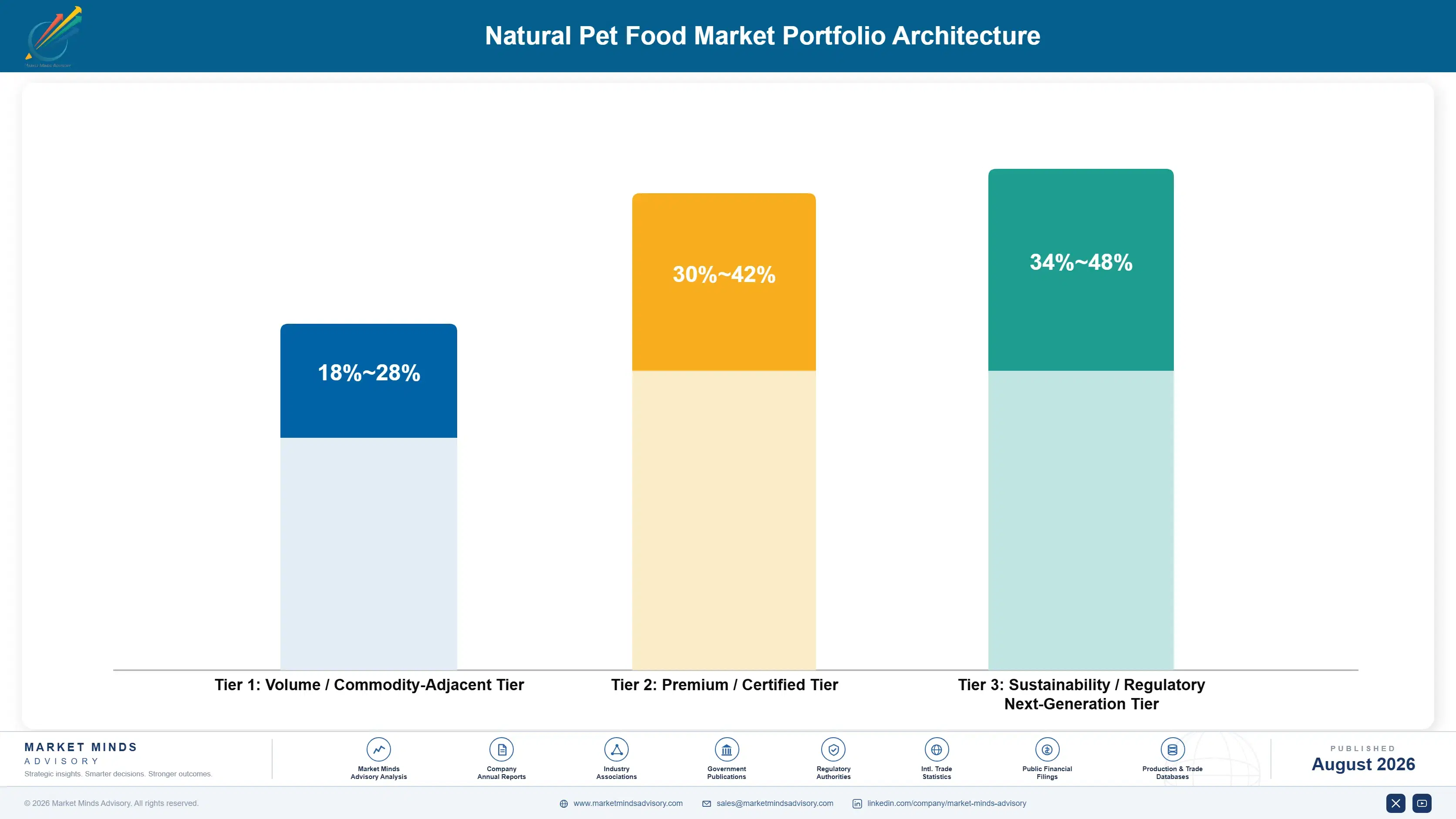
The portfolio splits into three tiers with real margin separation tied to processing method and distribution model rather than raw ingredient cost alone. Conventional grain-free kibble competes largely on retail price and shelf visibility, while fresh subscription and freeze-dried formats earn meaningfully more on distribution model and processing differentiation that value-tier kibble cannot easily replicate at any price point.
The tension between retail volume and subscription growth runs through every brand's investment decision each year. Conventional kibble volume still dwarfs fresh and freeze-dried categories by absolute tonnage, yet margin and growth increasingly concentrate in subscription and premium raw formats that require cold-chain infrastructure and direct customer relationships most retail-only brands have not built. That infrastructure gap, more than any difference in underlying formulation, is what separates the tiers most sharply today.

High-value pools concentrate specifically where distribution model or processing differentiation limits substitutable supply: fresh subscription formats commanding real premiums for customer data and retention economics, and freeze-dried and raw formats rewarding brands who invested in food safety processing ahead of any adverse regulatory event. Brands without early investment in either area increasingly find themselves confined to the thinnest-margin retail tier.

Volume / Commodity-Adjacent Tier

Conventional grain-free and limited-ingredient kibble sold largely on retail price and shelf visibility against benchmark natural pet food pricing. Producers here compete on distribution reach and formulation claims far more than on any brand storytelling.
Gross Margin: 18-28%

Premium / Certified Tier

Freeze-dried and raw natural pet food commanding real premiums for minimal processing and food safety certification investment beyond conventional formats. Buyers researching food safety credentials increasingly reward brands with visible processing transparency.
Gross Margin: 30-42%

Sustainability / Regulatory / Next-Generation Tier

Fresh refrigerated subscription meals and functional health formulations meeting evolving direct-to-consumer distribution and clinical evidence requirements. Retail buyers and subscription platforms both treat this tier as its own distinct category rather than folding it into standard pet food.
Gross Margin: 34-48%
natural-pet-food-market-trends-portfolio-architecture-1787555189997

High-value Sub-segments and Strategic Watch-out

Fresh Refrigerated Subscription Pet Food

High value and strong growth at 10.5% CAGR, anchored by direct-to-consumer distribution and retention economics exceeding 83% annually. Margins remain wide as brands work through cold-chain infrastructure investment specific to this newer distribution model. Early movers are locking in household relationships before slower competitors even launch comparable subscription offers.
Gross Margin: 34-46%

Freeze-Dried and Raw Natural Pet Food

High value and the fastest-growing segment at 11.2% CAGR, rewarding brands who invested in high-pressure processing and food safety certification ahead of regulatory scrutiny. Premium pricing reflects genuine input cost and processing differentiation. Visible processing transparency remains a durable advantage that value-tier competitors cannot easily replicate quickly.
Gross Margin: 30-42%

Conventional Grain-Free Kibble

The volume core of the market, competing on retail price and shelf visibility against benchmark natural pet food pricing across grocery and specialty channels. Growth tracks broader premiumization trends with limited differentiation beyond formulation claims. Producers here compete almost entirely on formulation claims and promotional pricing rather than distribution innovation.
Gross Margin: 18-28%

Retail-Only Legacy Brands

The strategic watch-out. Brands dependent purely on traditional retail distribution without direct-to-consumer or Asian market investment face a widening growth disadvantage against competitors capturing subscription and international expansion opportunity, and retail-only positioning alone no longer holds up against these two powerful forces reshaping the category today.
Gross Margin: 14-24%

Subscription Loyalty and Retail Renewal Cycles

Demand here runs on a mix of recurring subscription billing and periodic retail repurchase rather than long-term institutional contracts, since nearly all buyers are individual pet owners rather than commercial accounts. Subscription renewal happens automatically each delivery cycle, giving brands with strong retention economics a compounding advantage that retail repurchase, dependent on repeated in-store decisions, cannot match as easily. Brands with weaker retention data face real disadvantage negotiating renewed retail shelf placement each cycle.
Adoption depth varies sharply by channel and format. Subscription customers show the strongest loyalty once onboarded, with annual retention rates exceeding 83% for established services, while conventional kibble buyers switch more readily based on retail promotion and price. Freeze-dried and raw buyers sit closer to subscription customers in loyalty, valuing consistent quality and food safety credibility over promotional pricing alone.

Buyer profiles have shifted generationally as pet ownership moved from a practical household decision toward an identity-linked lifestyle choice across younger cohorts specifically. Younger owners increasingly weigh ingredient transparency and direct brand relationship alongside price, a shift that favours brands investing in subscription and functional formulation over those competing purely on retail shelf presence.
natural-pet-food-market-trends-end-use-penetration-index-1787555190482

Where Distribution Model Decides Outcomes

These are among the four positions where our research anticipates prominent divergence between winners and laggards over the coming forecast period. Each is grounded in the demand model, the regulatory perimeter, and the announced capacity pipeline.
01 / SUBSCRIPTION MODEL TRANSITION

Direct-to-consumer capability will keep separating winners from legacy brands

Brands building subscription capability early are capturing customer data and repeat purchase relationships that retail-only competitors cannot access without rebuilding their model, and annual retention rates exceeding 83% demonstrate genuine loyalty once a household adopts the model. This shift favours brands willing to invest in cold-chain logistics and direct customer acquisition over those relying purely on retail shelf presence built over prior decades, though neither current leader has yet built an insurmountable lead over the other. Expect continued acquisition activity as legacy brands buy subscription capability rather than build it internally from scratch.
02 / FOOD SAFETY CERTIFICATION RACE

Early processing investment will protect the raw and freeze-dried segment's growth

Raw and freeze-dried formats carry genuine bacterial contamination risk that regulators have flagged repeatedly, and brands investing in high-pressure processing ahead of any adverse safety event protect both consumer trust and their own growth trajectory in this fast-expanding segment. Competitors who delay this investment risk a single contamination incident undermining consumer confidence across the entire category, not just their own brand specifically. Expect continued investment concentrating among brands treating food safety as a strategic priority rather than a reactive compliance cost.
03 / ASIAN PREMIUM MARKET ENTRY

Early Chinese market entrants will build durable brand recognition advantages

China's rapidly expanding urban pet ownership base represents the single largest incremental growth opportunity in this entire market, and brands entering through premium positioning now are building status-conscious consumer recognition that later entrants will find considerably harder to replicate once category leaders are established. This opportunity depends on genuine local distribution and regulatory investment rather than simple product export, and domestic Chinese competitors are also racing to build comparable premium credibility of their own. Expect continued brand investment concentrating specifically in China as urban pet ownership keeps expanding.
04 / INPUT COST DIVERSIFICATION

Diversified protein sourcing will protect brand margins through volatility

Brands with diversified protein sourcing across multiple suppliers and geographies absorbed the 2022 protein price shock considerably better than smaller, narrowly sourced subscription challengers, and that advantage persists through every subsequent input cost cycle. Smaller brands without comparable purchasing scale face a widening margin disadvantage unless they secure long-term supply contracts of their own, and this gap will keep widening as protein markets remain volatile across future commodity cycles. Expect continued consolidation pressure on brands unable to match larger competitors' sourcing diversification and purchasing leverage.

Engagement Snapshot From the Field

A live engagement with an industry participant carrying material or product regulatory and market exposure ahead of a defining policy shift, showing how our research translates into a defensible multi-year portfolio strategy.
MARKET MINDS ADVISORY · CLIENT ENGAGEMENT SUMMARY
Natural Pet Food Producer Strategic Portfolio Review and Transition Roadmap 2026·Investment Scenario on Natural Pet Food Exposure Evaluation 2025-26
CLIENT PROFILE
A fresh refrigerated subscription pet food company operating primarily across North America approached MMA while evaluating entry into East Asian markets. The client reported annual subscription revenue near USD 180 million, with no existing international distribution or regulatory presence outside its home market (client-reported, unverified by MMA). Management had identified China as its top international priority but had not yet committed resources to the region.
STRATEGIC CHALLENGE
Management wanted to enter China given its rapidly expanding urban pet ownership base, but lacked experience navigating local food safety regulation, cold-chain logistics, or competing against domestic premium brands already building local recognition. The growth team wanted to launch quickly to capture first-mover advantage, while operations worried that rushing entry without proper regulatory groundwork could create serious compliance and reputational risk.
MMA APPROACH
MMA benchmarked the client's product formulation and cold-chain model against Chinese food safety regulatory requirements and existing domestic and international competitor positioning. We also assessed partnership options with established local distributors versus building independent cold-chain infrastructure, modelling the cost and timeline tradeoffs of each entry approach specifically for the client's subscription model.
KEY FINDINGS
  1. The client's existing formulation required meaningful reformulation to satisfy Chinese pet food import regulation, a longer compliance timeline than management had originally assumed (client-reported, unverified by MMA).
  2. Partnering with an established local cold-chain distributor reduced launch timeline substantially compared with building independent infrastructure from scratch. than the fully independent build the growth team had initially proposed pursuing alone.
  3. Premium positioning against domestic Chinese brands proved viable given strong consumer preference for internationally recognised natural pet food specifically. provided the client invested adequately in local marketing and distribution support.
  4. A phased city-by-city launch reduced execution risk considerably compared with the nationwide rollout the growth team had originally proposed. while still preserving meaningful upside for later national expansion.
CLIENT PROFILE
A fresh refrigerated subscription pet food company operating primarily across North America approached MMA while evaluating entry into East Asian markets. The client reported annual subscription revenue near USD 180 million, with no existing international distribution or regulatory presence outside its home market (client-reported, unverified by MMA). Management had identified China as its top international priority but had not yet committed resources to the region.
STRATEGIC CHALLENGE
Management wanted to enter China given its rapidly expanding urban pet ownership base, but lacked experience navigating local food safety regulation, cold-chain logistics, or competing against domestic premium brands already building local recognition. The growth team wanted to launch quickly to capture first-mover advantage, while operations worried that rushing entry without proper regulatory groundwork could create serious compliance and reputational risk.
MMA APPROACH
MMA benchmarked the client's product formulation and cold-chain model against Chinese food safety regulatory requirements and existing domestic and international competitor positioning. We also assessed partnership options with established local distributors versus building independent cold-chain infrastructure, modelling the cost and timeline tradeoffs of each entry approach specifically for the client's subscription model.
KEY FINDINGS
  1. The client's existing formulation required meaningful reformulation to satisfy Chinese pet food import regulation, a longer compliance timeline than management had originally assumed (client-reported, unverified by MMA).
  2. Partnering with an established local cold-chain distributor reduced launch timeline substantially compared with building independent infrastructure from scratch. than the fully independent build the growth team had initially proposed pursuing alone.
  3. Premium positioning against domestic Chinese brands proved viable given strong consumer preference for internationally recognised natural pet food specifically. provided the client invested adequately in local marketing and distribution support.
  4. A phased city-by-city launch reduced execution risk considerably compared with the nationwide rollout the growth team had originally proposed. while still preserving meaningful upside for later national expansion.
RECOMMENDED STRATEGY
Phase 1: Phase 1 (0 to 6 months): Complete regulatory reformulation and secure a local cold-chain distribution partnership in one major city. Phase 2: Phase 2 (6 to 18 months): Launch premium-positioned subscription service in that city while building brand recognition through content marketing. Phase 3: Phase 3 (18 to 36 months): Expand sequentially into additional major Chinese cities based on the initial launch's performance data.
OUTCOME
The client completed regulatory reformulation and launched its first Chinese city market within the planned timeline, avoiding the compliance delays several competitors faced attempting faster entry. The phased approach also secured a reported distribution partnership covering three additional cities within its first year of operation (client-reported, unverified by MMA).

Frequently Asked Questions

Foundational context covering the market sizes, CAGR, scope, country, region and competition that inform every finding below. This section is provided to cover basics and most often pre-purchase conversations, answered from the MMA Primary Research Dataset.

What is the current size of the Natural Pet Food Market?

The natural pet food market reached USD 21.8 billion in 2025. This figure covers grain-free kibble, wet food, freeze-dried, fresh subscription, and natural treats globally.

How large will the Natural Pet Food Market be by 2036?

The market is projected to reach USD 48.80 billion by 2036 under the base case scenario. That represents a 2.08 times expansion over the 2026 starting value.

What is the CAGR for the Natural Pet Food Market 2026 to 2036?

The base case CAGR is 7.6%, with a bull case of 8.8% and a bear case of 6.4%. Subscription model adoption and input cost pressure drive most of the variance.

Which segment is growing fastest?

Freeze-dried and raw natural pet food grows fastest at 11.2% CAGR, about 1.47 times the overall market rate. Owner preference for minimally processed nutrition drives this growth directly.

Who are the major companies in the Natural Pet Food Market?

Leading brands include Blue Buffalo, Freshpet Inc, The Farmer's Dog, Merrick Pet Care, and Open Farm. These five hold roughly 38% combined market share overall.

Which country is growing fastest?

China posts the fastest national growth at 10.6% CAGR, driven by rapidly expanding urban pet ownership and premiumization preference. Status-conscious consumer demand anchors most of this growth.

Report Segmentation Architecture

The full report scope spans multiple orthogonal segmentation dimensions, with cross-tabulated demand data provided for each dimension pair. Coverage extends further to regional breakdowns, trend trajectories, and the competitive detail needed to support segment-level decision-making.

By Product Format

  • Dry Kibble (Natural and Grain-Free)
  • Wet and Canned Natural Pet Food
  • Freeze-Dried and Raw Natural Pet Food
  • Natural Pet Treats and Chews
  • Fresh Refrigerated Subscription Pet Food
  • Natural Pet Food Toppers and Supplements

By End-Use Pet Type

  • Dogs
  • Cats
  • Small Mammals
  • Other Companion Animals

By Commercial Dimension

  • Grocery and Mass Retail
  • Pet Specialty Retail
  • Direct-to-Consumer Subscription
  • E-Commerce Marketplace

By Region

  • North America
  • Western Europe
  • East Asia
  • South Asia and Pacific
  • Latin America
  • Middle East and Africa
  • Eastern Europe

Scope, Methodology, and Coverage

Every figure in this report is reproducible from documented input assumptions. The scope below maps the historical period, the forecast horizon, the segmentation dimensions, and the countries covered, alongside the underlying primary and qualitative methodology.
Historical Period
2020 to 2025
Forecast Period
2026 to 2036
Base Year
2025 (USD billions; MMA Primary Research Dataset, August 2026)
Market Definition
This market comprises natural pet food products, including grain-free and limited-ingredient kibble, wet and canned food, freeze-dried and raw formats, fresh refrigerated subscription meals, and natural treats, marketed with minimal artificial additives for dogs and cats. Conventional mass-market pet food and pet supplements sold separately from food are excluded from this scope.
Quantitative Units
USD billions (current prices); metric tonnes of product volume where applicable
Segmentation Dimensions
By Product Format; By End-Use Pet Type; By Commercial Dimension; By Region
Regions Covered
North America, Western Europe, East Asia, South Asia and Pacific, Latin America, Middle East and Africa, Eastern Europe
Countries Covered
USA, China, Germany, France, UK, Japan, South Korea, India, Australia, Canada, Brazil, Mexico, Indonesia, Vietnam, Thailand, Malaysia, UAE, Saudi Arabia, South Africa, Nigeria, Turkey, Poland, Netherlands, Italy, Spain, Sweden, Switzerland, Argentina, Colombia, Singapore, and additional markets relevant to this sector
Key Companies Profiled
Blue Buffalo, Freshpet Inc, The Farmer's Dog, Merrick Pet Care, Open Farm, Wellness Pet Company, Nom Nom, Ollie, Nulo Inc, Instinct (Nature's Variety), Stella and Chewy's, Primal Pet Foods, Champion Petfoods, Fromm Family Foods, Tiki Pet, Solid Gold Pet, PetPlate, A Pup Above, JustFoodForDogs, Wild Earth
Quantitative Methodology
Primary survey, n=3,800 respondents, Q4 2025, six countries; demand-side model with trade association cross-validation
Qualitative Methodology
47 expert interviews, Q4 2025; applied to validate demand model assumptions, identify emerging dynamics, and assess competitive positioning
Report Format
PDF and XLSX data workbook (Word format preview document)
Publisher
Market Minds Advisory
Report Code
MMA-2026-AGR-268
Published
August 2026
Contact
sales@marketmindsadvisory.com | www.marketmindsadvisory.com

Purchase the full Natural Pet Food Market Report (2026 to 2036).

The full MMA Natural Pet Food report sizes the market across six product format segments, four end-use pet types, four commercial channels, and seven regions through 2036. It profiles twenty brands on a consistent basis of natural pet food retail sales revenue, scoring each on subscription readiness, food safety certification, and Asian market entry depth. Scenario models quantify how subscription adoption, functional formulation trends, and input cost volatility move both demand and realised pricing. The report also includes delivered-cost modelling by protein source, a food safety compliance screen, and subscription retention economics built for brand strategy, retail, and investment teams.
Six-segment product format demand breakdown detail
Protein delivered-cost bridge modelling review detail
Food safety compliance screening framework detail
Brand subscription readiness benchmarking review detail
Asian market entry economics deep detail
Functional formulation pricing trend analysis review

Built For The People Who Decide

From boardroom strategy to bench-side execution, this report is read cover-to-cover by leaders shaping the next decade of their industry, turning demand scenarios, market dynamics and valuation benchmarks into decisions.
CXOs/ Presidents/ VPs/ Managers
M&A and Corporate Development
Strategy Teams and R&D Heads
Procurement and Product Directors
Regulatory and Compliance Leaders
Investor Relations and Equity Analysts