Natural Food Colors Market Size, Share and Forecast 2026 to 2036: Global Industry Analysis and Opportunity Assessment

Natural Food Colors Market Size, Share and Forecast 2026 to 2036: Global Industry Analysis and Opportunity Assessment

Natural Food Colors Market Executive Summary

The global natural food colors market is entering a transition cycle that looks very different from the one that shaped the industry ten years ago. Earlier demand came largely from premium organic brands and specialty food producers targeting a small health-conscious consumer base. That is no longer the case. Today, multinational beverage companies, dairy processors, confectionery manufacturers, bakery groups, and quick-service restaurant chains are all reformulating portfolios around cleaner ingredient declarations and reduced dependence on synthetic additives.

Natural pigments derived from beetroot, spirulina, turmeric, paprika, chlorophyll, anthocyanins, annatto, safflower, butterfly pea flower, and fermentation-based sources are steadily replacing petroleum-derived synthetic dyes across mainstream packaged foods. The change is not ideological. It is commercial. Food companies increasingly understand that ingredient labels influence purchasing behaviour almost as strongly as pricing and branding in several retail categories.

Consumer attention around artificial additives has intensified across North America and Europe. Retailers have responded by tightening private-label standards. Regulators are moving more slowly, but directionally the pressure is obvious. Several global food companies now treat synthetic dye replacement as a long-cycle reputational risk issue rather than a narrow compliance exercise.

The market’s next stage will be shaped less by awareness and more by formulation science. Stability under heat, acidity, oxidation, UV exposure, and extended shelf-life conditions remains the central technical challenge. Natural pigments still struggle to replicate the consistency and intensity of synthetic alternatives in certain applications, especially bright blues, greens, and highly acidic beverages. Suppliers that solve those stability problems without compromising clean-label positioning will capture disproportionate value through the next decade.

Natural food colors now sit at the intersection of food science, agricultural supply chains, consumer perception, regulatory pressure, and retail procurement strategy. That combination is pushing the category into a much larger commercial arena than most ingredient suppliers expected five years ago.

Natural Food Colors Market Overview: Executive Intelligence Brief

The natural food colors market enters 2026 at an estimated value of $2.94 billion and is projected to expand at a compound annual growth rate of 8.8% through 2036. Growth remains concentrated in beverages, dairy products, confectionery, bakery, plant-based foods, and functional nutrition categories where visual differentiation materially influences purchasing decisions.

The market’s current expansion phase assumes continued synthetic dye replacement across developed markets, stronger clean-label penetration in emerging economies, and rising investment in fermentation-derived and algae-derived pigment systems.

Natural Food Colors Market Size Trajectory
CategoryMarket Intelligence
Market Size 2025$2.71 billion base year valuation
Forecast Period2026 to 2036
Market CAGR8.8% base case
Fastest Growth SegmentSpirulina and algae-derived blue pigments: 12.6% CAGR
Largest Product CategoryCarotenoids and paprika extracts
Fastest Growth ApplicationFunctional beverages and sports nutrition
Fastest Growth RegionAsia Pacific: 10.4% CAGR
Largest Regional MarketEurope: 34% of global demand
Fastest Growth CountryIndia: 11.8% CAGR
Key CompaniesOterra, Sensient Technologies, dsm-firmenich, Givaudan, DDW The Color House
Primary Surveyn=2,900 procurement, formulation, and product-development executives across six countries
Research MethodologyDemand-side analysis cross-validated against processed food output, beverage production, retail clean-label penetration, ingredient trade data, and product launch tracking

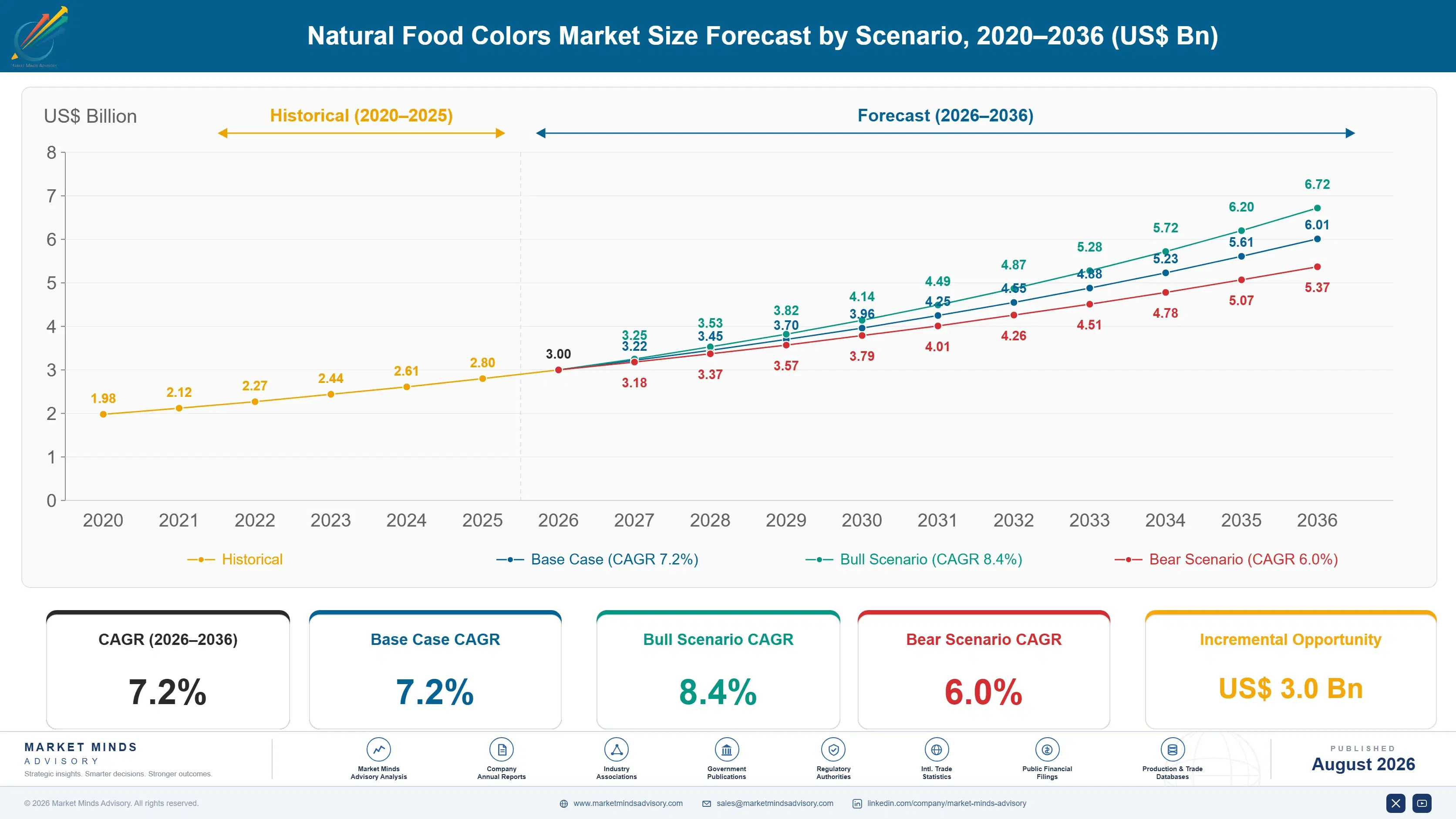
Natural Food Colors Market Forecast Scenarios, 2020–2036 (USD Billion)

Natural Food Colors Market Size Forecast by Scenario

The base-case scenario projects the market reaching approximately $6.8 billion by 2036. Bull-case conditions push the industry above $7.5 billion, primarily if retailer-driven synthetic dye removal accelerates faster than current reformulation pipelines imply.

The market is not expanding evenly. Some categories are approaching maturity. Others are still in early adoption mode. Beverage applications continue pulling the largest innovation budgets because colour stability directly affects shelf appeal and premium positioning in sports drinks, energy beverages, hydration products, kombucha, functional nutrition, and flavoured sparkling water.

Blue pigments remain the most commercially important gap in the market. Synthetic Blue 1 continues to outperform natural alternatives on cost, stability, and processing simplicity. Yet food companies increasingly want replacement pathways because blue products command unusually high visual visibility at retail. Spirulina-based systems and fermentation-derived pigments therefore continue attracting disproportionate investment.

Base-case projections indicate the natural food colors market will more than double through 2036 as multinational food manufacturers continue transitioning away from artificial additives across mainstream packaged-food portfolios.

Three assumptions define the forecast trajectory.

First, global beverage companies continue removing artificial dyes from products positioned around hydration, wellness, sports performance, and children-focused nutrition.

Second, advances in encapsulation technology improve the heat and pH stability profile of natural pigments, particularly in acidic beverage systems and baked products.

Third, private-label retailers continue tightening ingredient standards across Europe and North America, effectively accelerating reformulation cycles ahead of formal regulation.

The market still faces technical barriers. Natural pigments remain more expensive than synthetic alternatives across several applications, and agricultural volatility continues affecting supply consistency. Even so, procurement direction is increasingly one-way. Large food manufacturers are investing around the assumption that synthetic additive exposure becomes commercially harder to defend through the next decade.

Natural Food Colors Market Trends

Clean Label Has Moved Into Mainstream Food Manufacturing

The clean-label conversation is no longer confined to premium grocery shelves.

Mass-market food companies increasingly view artificial dyes as incompatible with modern consumer expectations, particularly in categories associated with health, children, wellness, and natural positioning. Reformulation activity that once focused on niche brands now affects multinational portfolios generating billions in annual revenue.

Children’s snacks, yogurt drinks, gummies, plant-based beverages, sports nutrition, and flavoured waters are moving fastest. Visual appearance remains commercially essential in all of those categories, which places natural colour systems directly inside core product-development budgets rather than peripheral ingredient spending.

MMA interviews conducted during Q4 2025 showed that procurement managers now evaluate colour suppliers on three dimensions simultaneously: ingredient transparency, stability performance, and retailer acceptance. Five years ago, cost still dominated the discussion.

That shift matters because it changes how pricing power develops inside the category.

Stability Science Is Becoming More Valuable Than Pigment Ownership

Owning agricultural supply no longer guarantees competitive advantage.

Food manufacturers increasingly care about how pigments behave under thermal processing, UV exposure, oxidation stress, shelf-life conditions, and acidity variation. Two suppliers may offer similar raw pigment sources while delivering completely different performance inside finished products.

That dynamic is pushing value toward formulation expertise, emulsion systems, encapsulation capability, and application-specific blending technology.

Several multinational ingredient producers are now positioning themselves less as colour suppliers and more as formulation partners. Beverage producers especially want integrated support around shelf-life optimisation and colour stability rather than standalone pigment procurement.

Blue Remains the Industry’s Most Important Technical Challenge

Natural blue pigments continue attracting disproportionate industry investment because synthetic Blue 1 remains difficult to replace economically at industrial scale.

Spirulina-derived systems have improved substantially, but stability under heat and acidic conditions still limits broader application flexibility. Beverage manufacturers remain particularly sensitive because visual degradation becomes obvious on retail shelves.

The next major breakthrough may come from fermentation-derived pigment platforms rather than agricultural extraction alone. Fermentation systems offer better consistency potential and lower dependence on seasonal crop variation, though scale economics still need improvement.

Retailers Are Acting Faster Than Regulators

Large retailers increasingly maintain ingredient restrictions that exceed formal regulatory requirements.

European supermarket groups already pressure suppliers to eliminate certain synthetic additives even where legal restrictions remain limited. North American retailers are gradually following the same direction, particularly across private-label categories.

Food manufacturers understand the commercial risk. Losing retailer acceptance can become more damaging than facing regulatory scrutiny. That reality is accelerating reformulation timelines across packaged-food portfolios.

Natural Food Colors Market Growth Drivers

Beverage Reformulation Cycles Continue Accelerating

Beverages represent the single largest growth engine for natural food colours through the forecast period.

Sports drinks, flavoured sparkling waters, kombucha, electrolyte beverages, energy drinks, flavoured dairy beverages, and functional wellness drinks all depend heavily on visual appeal. Consumers associate bright and stable colours with flavour intensity and freshness perception, which makes pigment performance commercially important.

Global product-launch tracking shows that clean-label beverage introductions increased sharply between 2021 and 2025. Food companies increasingly position natural ingredients as part of broader wellness branding rather than isolated technical features.

Anthocyanins, spirulina extracts, paprika blends, beta-carotene systems, and turmeric-derived yellows are therefore seeing rising commercial adoption across beverage applications.

Regulatory Pressure Around Synthetic Additives

Regulatory scrutiny surrounding synthetic food additives continues intensifying, especially in products marketed toward children.

California’s recent actions on selected additives triggered broader board-level discussions across multinational food companies operating in North America. Europe remains more advanced in retailer-driven reformulation, but North American momentum has clearly accelerated.

The important commercial point is timing. Reformulation cycles often begin years before regulation formally changes. Food manufacturers prefer gradual transitions over abrupt portfolio redesigns.

That means ingredient suppliers capable of supporting long-cycle reformulation programmes today are likely securing revenue streams that extend through the next decade.

Functional Nutrition Expansion

Functional foods and beverages continue generating strong demand for natural ingredient systems.

Consumers purchasing protein drinks, collagen beverages, electrolyte powders, immunity gummies, probiotic shots, and wellness snacks generally expect ingredient transparency alongside health positioning. Artificial dyes weaken that positioning.

Natural colour adoption therefore becomes part of broader premiumisation strategy rather than a narrow additive decision.

Functional nutrition also tolerates higher ingredient costs better than mainstream packaged foods, which improves supplier margin potential.

Plant-Based Foods Need Better Colour Systems

Plant-based meat, dairy alternatives, and vegan confectionery products increasingly depend on natural pigments to improve visual familiarity and consumer acceptance.

Colour remains psychologically important in plant-based categories. Meat analogues need realistic browning behaviour. Dairy alternatives need creamy visual profiles. Vegan confectionery still requires vibrant colour intensity without animal-derived ingredients such as carmine.

That requirement is pushing innovation around beet-derived reds, paprika blends, turmeric systems, algae-derived blues, and fermentation-based alternatives.

Natural Food Colors Market Segmentation

Segment CAGR Comparison and Value Pools

Natural Food Colors Market Segment CAGR

Carotenoids and Paprika Extracts

Carotenoid-based systems currently represent the market’s largest revenue pool.

Paprika oleoresin, beta-carotene, annatto, and turmeric extracts dominate dairy, snacks, bakery, sauces, processed cheese, and savoury applications where yellow and orange tones remain commercially important.

The category benefits from relatively mature processing economics and broad regulatory acceptance across global food markets.

Spirulina and Algae-Derived Pigments

Spirulina-based blue systems represent the market’s fastest-growing segment with projected CAGR above 12%.

The category remains technically demanding. Stability under acidity and heat exposure still limits some applications, but confectionery, frozen desserts, powdered beverages, and sports drinks continue driving procurement growth.

Capacity additions across India, China, and the United States are improving supply availability, though purity consistency remains uneven among smaller producers.

Anthocyanins

Anthocyanins derived from black carrot, purple sweet potato, grape skin, elderberry, and berry sources continue gaining share in acidic beverage systems.

The segment’s commercial advantage comes from shade flexibility. Anthocyanins can produce red, purple, or pink profiles depending on formulation conditions.

Beverage companies increasingly prefer anthocyanin systems for premium wellness-oriented products because the source ingredients align naturally with health-focused branding.

Chlorophyll and Green Pigments

Green remains a relatively smaller but commercially interesting category.

Matcha beverages, plant-based nutrition products, mint confectionery, and wellness-focused food launches continue supporting chlorophyll demand. Stability limitations still restrict broader application use, particularly under light exposure conditions.

Natural Food Colors Market Regional Analysis

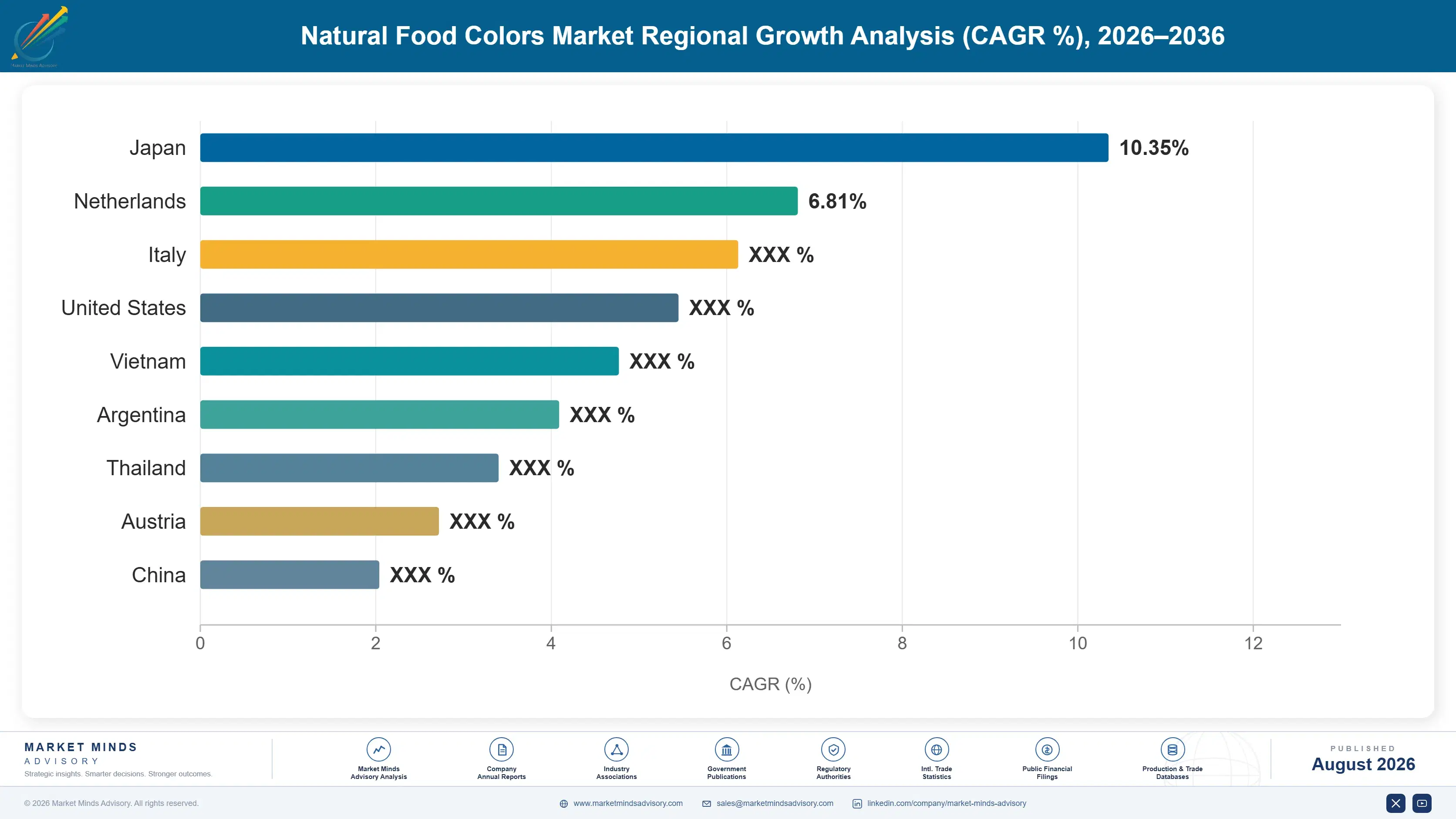
Natural Food Colors Market Regional CAGR

Europe Remains the Global Demand Leader

Europe accounts for approximately one-third of global natural food colours demand.

The region combines high clean-label penetration, retailer-driven ingredient restrictions, mature organic-food markets, and strong consumer awareness around artificial additives. Germany, France, the United Kingdom, Italy, and the Netherlands continue leading reformulation activity across dairy, bakery, confectionery, and beverage categories.

Retailers play an unusually powerful role in Europe. Several supermarket groups effectively shape formulation standards through private-label procurement policies that move faster than regulation itself.

Western European consumers also demonstrate higher willingness to pay for ingredient transparency than most other regions, which supports stronger pricing for clean-label products.

North America Is Moving Through a Faster Reformulation Cycle

North America entered the clean-label transition later than Europe, but reformulation momentum has accelerated rapidly during the last three years.

The United States market is seeing especially strong movement in children’s snacks, flavoured beverages, sports nutrition, gummies, and plant-based foods. Several multinational food companies now treat artificial dye exposure as a reputational risk issue rather than simply a compliance question.

Beverage applications remain central to regional growth. Functional hydration products, energy beverages, and wellness drinks continue generating heavy demand for natural pigment systems.

Asia Pacific Delivers the Fastest Growth

Asia Pacific compounds above 10% annually through the forecast period.

India and China are simultaneously expanding consumption and manufacturing capacity. India benefits from agricultural feedstock availability and lower extraction costs for turmeric, paprika, and spirulina systems. China continues scaling industrial pigment processing infrastructure while increasing domestic clean-label adoption.

Japan and South Korea remain high-value formulation markets where visual precision and premium food presentation continue supporting natural colour adoption.

Southeast Asia is becoming increasingly important as regional beverage production expands.

Natural Food Colors Market Regional Share Donut

Latin America Benefits From Agricultural Supply Strength

Latin America plays a dual role inside the market.

The region supplies several agricultural raw materials while also expanding packaged-food demand. Mexico and Brazil remain particularly relevant because of growing beverage manufacturing activity and rising retailer clean-label positioning.

Paprika and annatto supply chains across Latin America continue supporting global ingredient availability.

Natural Food Colors Market Country Rankings

Natural Food Colors Market Competitive Landscape

Who Controls the Margin Pool

The top five producers control slightly above half of global market revenue.

Scale matters because multinational food companies increasingly require application support, regulatory documentation, formulation assistance, and consistent global supply capability alongside raw pigments themselves.

Large suppliers therefore possess advantages that smaller extractors often struggle to replicate.

The market nevertheless remains fragmented below the top tier. Regional ingredient processors compete aggressively on price, especially in lower-complexity colour categories where formulation requirements remain less demanding.

The competitive divide increasingly centres on technical capability rather than raw extraction volume alone.

Oterra

Oterra maintains one of the broadest natural pigment portfolios globally, with strong positioning across beverages, confectionery, dairy, and bakery applications.

The company benefits from application-specific formulation expertise and established multinational customer relationships.

Its largest exposure comes from agricultural supply volatility affecting raw-material pricing consistency.

Sensient Technologies

Sensient remains particularly strong in beverage applications where colour stability and formulation support carry high commercial importance.

The company has invested heavily in emulsion systems and stability optimisation technologies targeting acidic beverage conditions.

North American pricing pressure remains the primary commercial challenge.

dsm-firmenich

dsm-firmenich combines formulation capability with broad food-industry relationships across nutrition and specialty ingredients.

The company continues investing aggressively in next-generation clean-label technologies, though innovation spending intensity remains high.

DDW The Color House

DDW maintains strong positioning in caramel and brown colour systems used across beverages and processed foods.

The company benefits from deep category specialisation rather than broad portfolio scale.

Natural Food Colors Market Share by Company

Natural Food Colors Market Share Analysis

Top Five Players Cumulative Share

Natural Food Colors Market Share, 2026

The market still leaves substantial room for regional specialists, particularly in lower-cost extraction and agricultural sourcing operations. Even so, multinational food companies increasingly prefer suppliers capable of supporting global reformulation programmes with consistent regulatory documentation and application support.

Natural Food Colors Market Competitive Bubble

Strategic Position Matrix

Strategic Position Matrix: Top 5 Players

CompanyCompetitive AdvantageKey RiskStrategic Position
Chr. Hansen (now Novonesis)Fermentation capabilities, global regulatory approvals, carmine supply chain depthCarmine volumes face vegan/halal headwinds; fermentation investments require capital disciplineFormulation leader across multiple pigment classes
Sensient TechnologiesApplication breadth, US distribution depth, color matching technology platformHeavier synthetic dye exposure than European peers; reformulation margin pressure in transition periodNorth America premium reformulation beneficiary
GNT GroupEXBERRY plant-concentrate platform, traceability model, European retail relationshipsPrivate/family ownership limits capital access for large-scale expansionClean-label specification standard setter
DDW (D.D. Williamson)Caramel and plant-based color depth, beverage application expertise, global manufacturing footprintCaramel color faces separate regulatory pressure under acrylamide concernsBeverage and brewing segment anchor
Oterra (fmr. Chr. Hansen Natural Colors)Standalone natural color focus post-demerger, extraction technology, customer base from parentPost-demerger integration and brand establishment in progressEmerging independent platform player

Key Companies Profiled in This Report

  • Chr. Hansen / Novonesis
  • Sensient Technologies
  • GNT Group
  • DDW (D.D. Williamson)
  • Oterra
  • Symrise
  • Roha Group
  • Döhler
  • LycoRed
  • Kalsec
  • Givaudan (acquired Naturex)
  • IFC Solutions
  • San-Ei Gen FFI
  • Phytolon
  • Biocon Colors
Recent Developments
JANUARY 2025: FDA Begins Enforcement Timeline for Red No. 3 Phase-Out The FDA’s revocation of Red No. 3 (erythrosine) in ingested drugs and ingested cosmetics, originally ordered in 2023, began generating active reformulation timelines across confectionery, maraschino cherry, and canned fruit manufacturers. Companies with reformulation timelines beyond 2027 face distribution risk as major retailers move to enforce their own natural-color purchasing policies.
MARCH 2025: California AB 418 Enforcement Date Confirmed for January 2027 California’s Department of Public Health confirmed enforcement of AB 418 beginning January 1, 2027, covering Red No. 3, Green No. 3, Brominated Vegetable Oil, Potassium Bromate, and Propylparaben. CPG manufacturers supplying California retail are now operating on a compressed reformulation deadline, accelerating demand for anthocyanin, carotenoid, and spirulina-based alternatives in applications previously using synthetic dyes.
OCTOBER 2024: Novonesis Completes Integration of Chr. Hansen Natural Colors into Oterra Following the Chr. Hansen and Novozymes merger that created Novonesis, the natural colors division was separated into Oterra as a standalone company. This demerger created a dedicated natural food colors platform with an independent management team, balance sheet, and investment agenda. Oterra’s carmine, carotenoid, and plant-based pigment portfolio serves over 1,400 customers across 80 countries.
JUNE 2024: GNT Group Opens Expanded Extraction Facility in the Netherlands GNT expanded its Mierlo facility to increase EXBERRY concentrate production capacity by approximately 35%. The expansion targeted red and purple plant concentrates from black carrot, elderberry, and red cabbage, responding to European retailer demand for traceable, non-extracted natural colorants. Capital expenditure was not disclosed; GNT remains family-owned.

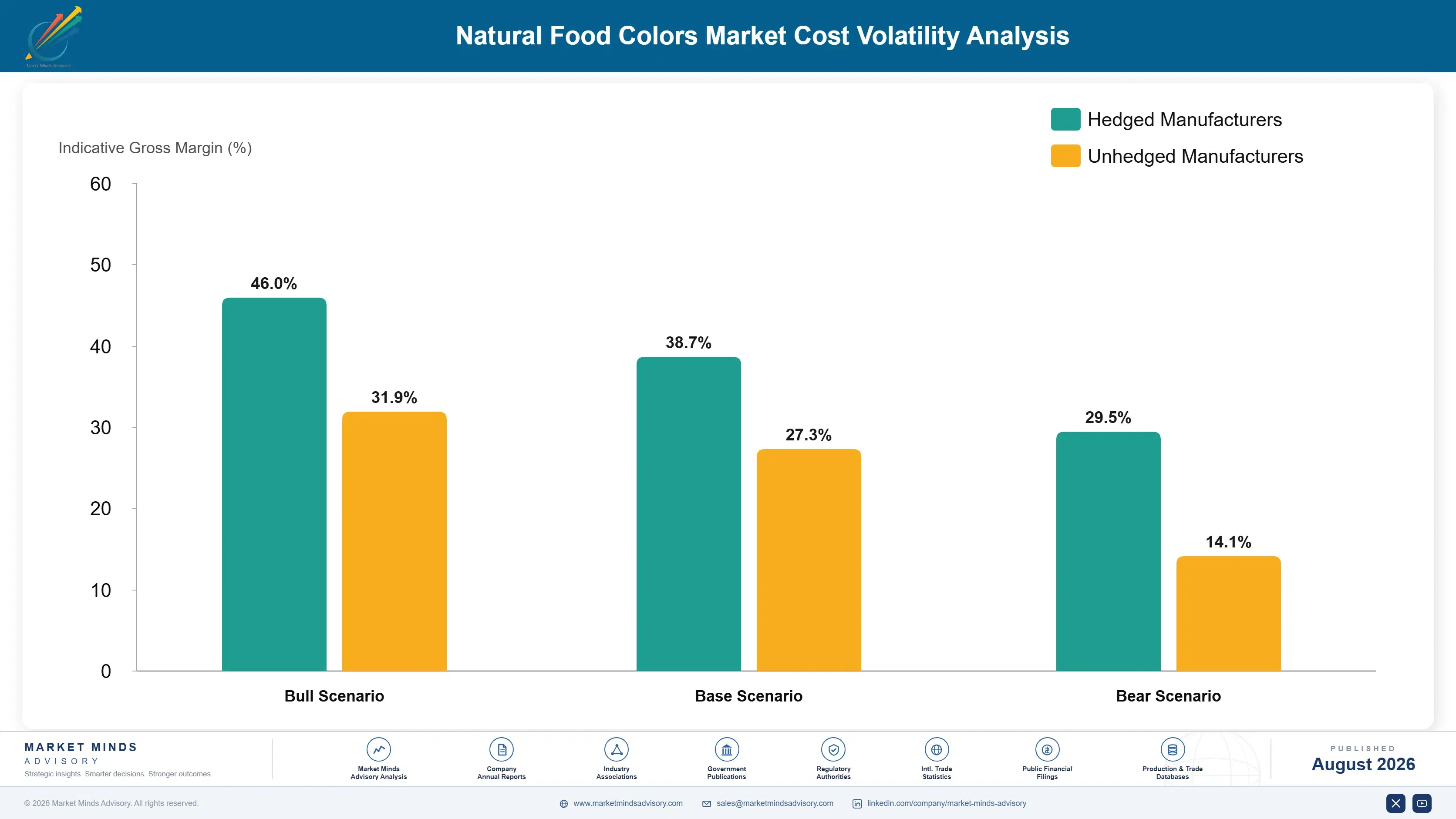
Natural Food Colors Market Input Cost Risk and Margin Defence Strategies

Natural colorant cost stacks are dominated by agricultural raw material inputs, extraction solvent costs, energy for concentration and drying, and quality testing. Unlike synthetic dyes, where feedstock is petroleum-based and price-tracked daily on commodity exchanges, natural colorant inputs are agricultural commodities with seasonal variation, yield risk, and geographic concentration.

Turmeric pricing moved within a 45% band in the 2023 to 2025 period per Indian Spices Board export data, reflecting yield variability in Andhra Pradesh and Tamil Nadu growing regions. Annatto seed supply from Peru and Brazil sees 20 to 35% annual price variation tied to weather cycles. Elderberry concentrate prices, concentrated in Central Europe and Chile, moved 28% in 2024 following a late-season frost event in Poland.

Natural Food Colors Market Margin Sensitivity

Risk Mitigation Mechanisms

Multi-Origin Sourcing for Critical Raw Materials

GNT sources black carrot from Turkey, Chile, and the Netherlands. Sensient maintains dual-origin sourcing for turmeric across India and Peru. Producers with single-origin dependencies for key pigment classes carry 15 to 25% more gross margin volatility than multi-origin peers, based on historical price band analysis across five raw material categories.

Forward Purchasing and Cooperative Farming Agreements

Roha Group and Kalsec both operate direct farmer contracts in India for turmeric and paprika respectively, with forward pricing across one to two growing seasons. These arrangements reduce spot price exposure and give producers visibility into quality and volume at harvest. The investment required is relationship capital and agronomist staffing, not balance sheet capital.

Fermentation as a Hedge Against Agricultural Price Volatility

For riboflavin, beta-carotene, and emerging pigment classes, fermentation routes decouple the cost stack from agricultural commodity cycles entirely. The trade-off is higher fixed costs and longer capital cycles. Companies building fermentation capacity are effectively buying agricultural price insurance at the cost of capital intensity.

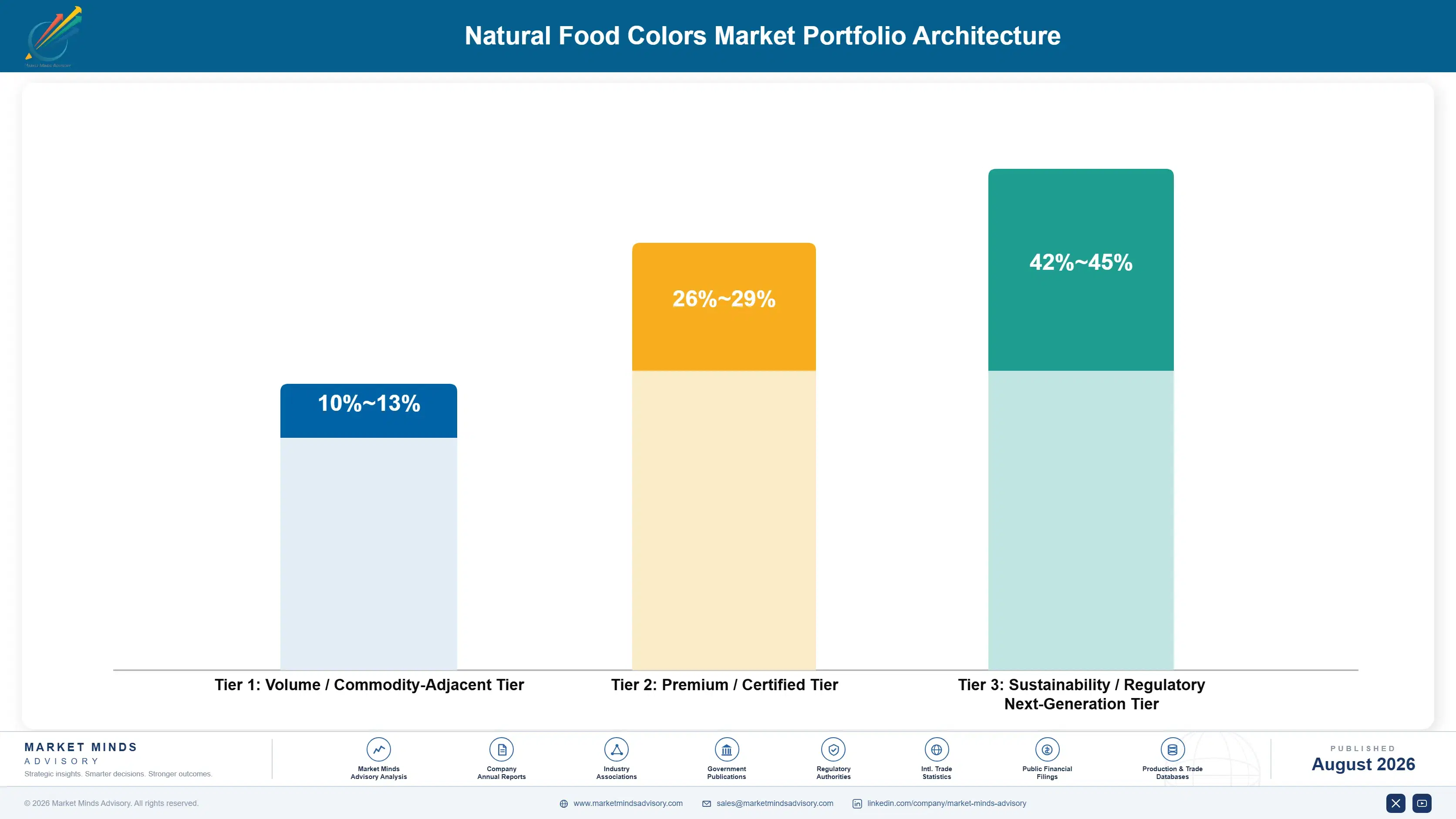
Natural Food Colors Market Portfolio Margin Profile

Demand Architecture

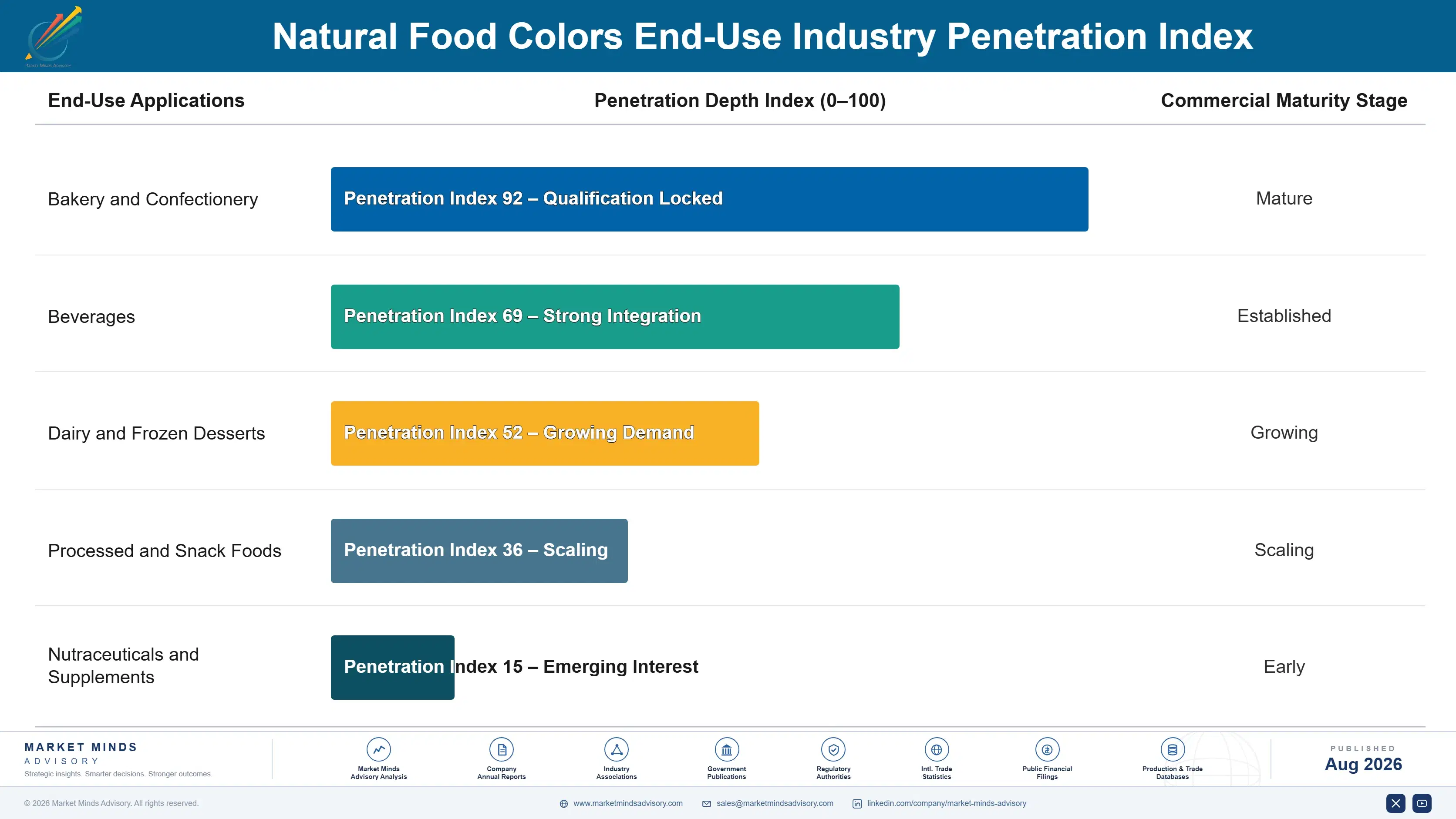
End-Use Penetration and Annuity Economics

Natural food colors behave like annuity revenue streams in applications where the colorant is embedded in a validated formulation. Once a supplier’s anthocyanin system passes application trials and is written into a food manufacturer’s master specification, re-qualification of an alternative supplier typically costs the customer 6 to 14 months of development time and carries sensory panel, stability, and regulatory review costs that procurement managers routinely cite as a reason to avoid switching even when spot pricing favors an alternative. MMA’s Q4 2025 primary survey found that 67% of food technologists responsible for color sourcing decisions rated “re-qualification cost and timeline” as the primary barrier to supplier switching, ahead of price (21%) and supply reliability (12%).

The annuity logic works most powerfully in the beverage and confectionery segments, where color formulation is application-specific and the margin on the colorant is a small fraction of the finished product value — creating very little price incentive for procurement to invest in a re-qualification. It works least well in commodity bakery and snack applications, where standardised extract grades are interchangeable between suppliers and switching costs are minimal. Producers who deliberately concentrate their development investment in the high-switching-cost application segments capture a disproportionate share of the recurring revenue economics.

Buyer profile evolution matters here. Food R&D directors who have joined major manufacturers since 2019 carry formulation training that embeds sustainability metrics into ingredient selection — not as an afterthought, but as a gating criterion in supplier qualification. MMA’s survey shows that 58% of R&D decision-makers in this cohort will not shortlist a color supplier without a verified crop origin and traceability system, compared to 22% among those hired before 2015.

image 10 Market Minds Advisory

MMA Strategic Verdict

Four Calls That Define the Decade

01 / NATURAL BLUE SUPPLY WILL REMAIN TIGHT THROUGH 2030

Demand for stable natural blue systems will continue outpacing reliable industrial supply.

The limitation is not consumer interest. It is scalable formulation stability.

02 / RETAIL PROCUREMENT WILL OUTPACE REGULATION

Retail ingredient restrictions across Europe and North America will continue forcing reformulation ahead of formal regulatory changes.

Private-label standards increasingly shape supplier behaviour faster than government policy.

03 / FERMENTATION TECHNOLOGY CHANGES INDUSTRY ECONICS

Fermentation-derived pigments could materially reduce agricultural volatility exposure by the early 2030s.

That shift would alter margin distribution across the market.

04 / APPLICATION SCIENCE BECOMES THE REAL COMPETITIVE MOAT

Owning pigment sources alone will not defend profitability long term.

Suppliers with formulation expertise, shelf-life optimisation capability, beverage stability technology, and multinational regulatory support will capture the strongest margins through the forecast period.

Frequently Asked Questions

  • What is the current size of the Natural Food Colors Market?

The global natural food colors market reached approximately $2.71 billion in 2025.

  • How large will the market become by 2036?

The market is projected to reach roughly $6.8 billion by 2036 under the base-case scenario.

  • What is the CAGR between 2026 and 2036?

The base-case CAGR is estimated at 8.8%.

  • Which segment is growing fastest?

Spirulina and algae-derived blue pigments represent the fastest-growing segment with CAGR above 12%.

  • Which region dominates the market?

Europe currently leads global demand due to strong clean-label adoption and retailer-driven reformulation activity.

  • Which country is growing fastest?

India is projected to record the highest country-level growth rate due to expanding processed-food production and ingredient manufacturing investment.

  • What is the biggest technical challenge in the industry?

Colour stability under acidic, thermal, and UV-exposure conditions remains the market’s most important technical barrier, particularly for natural blue systems.

Report Segmentation Architecture

By Product Type

  • Anthocyanins
  • Carotenoids
  • Spirulina Extract
  • Curcumin
  • Chlorophyll
  • Annatto
  • Carmine Alternatives
  • Butterfly Pea Flower Extract
  • Natural Caramel Colours

By Application

  • Beverages
  • Dairy Products
  • Bakery and Confectionery
  • Snacks and Savoury Foods
  • Functional Nutrition
  • Meat Products
  • Plant-Based Foods
  • Sauces and Dressings

By Source

  • Plant-Based
  • Algae-Based
  • Mineral-Based
  • Fermentation-Derived

By Region

  • North America
  • Europe
  • Asia Pacific
  • Latin America
  • Middle East and Africa

Report Scope

CategoryScope
Historical Period2020 to 2025
Forecast Period2026 to 2036
Base Year2025
Quantitative UnitsUSD Million and Kilotonnes
Regions CoveredNorth America, Europe, Asia Pacific, Latin America, Middle East and Africa
Countries CoveredUnited States, Canada, Germany, France, United Kingdom, Italy, Spain, Netherlands, China, Japan, India, South Korea, Australia, Brazil, Mexico, UAE, Saudi Arabia
Key Companies ProfiledOterra, Sensient Technologies, dsm-firmenich, Givaudan, DDW The Color House, Döhler, Chr. Hansen
Quantitative MethodologyDemand-side modelling, processed-food production analysis, beverage output tracking, retail product-launch analysis, ingredient trade-flow validation
Qualitative MethodologyInterviews with procurement managers, food scientists, formulation experts, and retail category leaders across six countries
Report FormatPDF report with Excel forecast appendix
PublisherMarket Minds Advisory
PublishedApril 2026