Market Minds Advisory
Natural Flavor Market

Natural Flavor Market: Provenance economics, fermentation routes and the creation cost of a low win rate, to 2036

Natural is a legal statement about where a molecule came from rather than what it is, and precision fermentation has quietly turned that definition into the most valuable arbitrage in food ingredients.

Lead Analyst

Lisa Gevelber

Published

September 2026

Make Smarter Decisions with Customized Research Insights

Request a free sample report and evaluate market opportunities, growth trends, and competitive dynamics relevant to your business needs.

2025 MARKET VALUE$13.2BMarket Size 2025
2036 FORECAST VALUE$26.7BBase Case , 2026 to 2036
CAGR 2026 TO 20366.6 %Bull 7.8% / Bear 5.4%
INCREMENTAL OPPORTUNITY$12.6BNet 10- year value creation
EXPANSION MULTIPLE1.89x2036 value over 2026 base
Strategic Levers
M&A Pipeline
Regional Outlook
Country Rankings
Competitive Intelligence
Segmental Deep-dive
Call-Us : 91 93563 13602

Executive Snapshot and Market Trajectory

Natural is a regulatory claim about provenance, not a description of a molecule. Fermentation-produced vanillin is chemically identical to the bean-derived version, legally natural in both major jurisdictions, and costs a fraction of what vanilla beans command. That gap is reshaping the industry quietly. Very quietly indeed.
Plant-based protein and meat alternative flavours grow at 9.9%, half again the market rate of 6.6%, because pea and soy proteins carry bitter and green off-notes that demand the hardest masking work anyone currently pays for. That work prices at roughly 3.4 times conventional beverage flavour. East Asia holds 28% of value on food manufacturing scale. North America follows at 26% on retailer ingredient policies. Each protein source needs its own development work.
Five houses hold 58% of this market, which is unusual concentration for an ingredient business, and the reason is a creation model rather than any production advantage. Only around 14% of submitted flavour briefs reach commercial production, so creation cost is largely sunk against work that never sells. Absorbing that requires scale nobody small can reach. Chinese and Indian houses are now building the same apparatus.
Market Definition
This report covers natural flavours meeting the regulatory definitions applying in their markets of sale, including extracts, essential oils, distillates, enzymatically and fermentation-derived molecules and compounded natural flavour systems, across beverages, dairy and frozen desserts, bakery and confectionery, savoury snacks and culinary, nutraceuticals and supplements, and plant-based protein and meat alternatives. Value is measured at flavour creation house level. Excluded are artificial and nature-identical flavours declared as such, fragrances, colours, sweeteners including natural high-intensity types, and food acids or seasonings sold without flavour creation content.
Base Year Value
$13.2B in 2025 (MMA Primary Research Dataset, August 2026)
Forecast Period
2026 to 2036, eleven discrete annual values
CAGR
6.6% base case. Bull 7.8%. Bear 5.4%.
Fastest Growth Segment
Plant-Based Protein and Meat Alternatives: 9.9% CAGR
Fastest Growth Country
India: 9.8% CAGR
Fastest Growth Region
South Asia and Pacific: 8.6% CAGR
Largest Region
East Asia: 28% of 2025 global value
Market Leaders
Givaudan, DSM-Firmenich, International Flavors and Fragrances, Symrise and Takasago International lead the market. Source: MMA Primary Research Dataset, July 2026.
Primary Survey
n=3,800 procurement and R&D decision-makers, Q4 2025, six countries
Methodology
Demand-side build-up, cross-validated against public data, 47 expert interviews

Natural Flavor Extract Market Forecast Scenarios

natural-flavor-extract-market-size-forecast-scenario-1787555875371
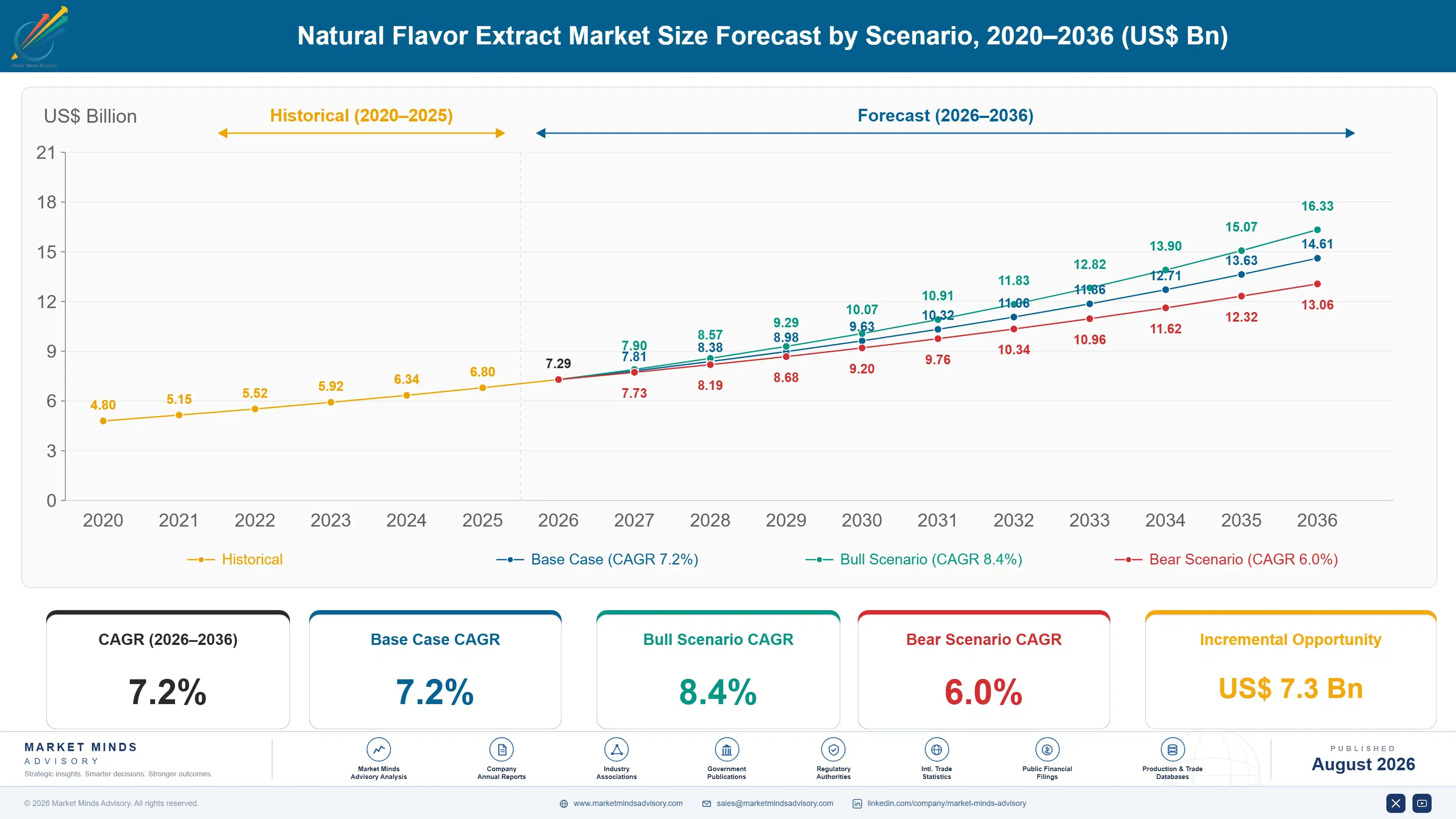
Natural flavor extract demand grew steadily from 2020 to 2025, with a modest slowdown during pandemic-era supply disruption followed by accelerating clean-label reformulation demand from 2023 onward. The market grew at a 6.2% historical CAGR, trailing the forecast pace as fermentation-derived capacity only scaled meaningfully in the final two years. Brands report growing confidence in multi-year botanical sourcing contracts.
The base case carries natural flavor extract to a 7.2% CAGR through 2036 on three mechanisms. First, food and beverage brands keep expanding clean-label reformulation across mainstream product lines, not premium tiers alone. Second, fermentation-derived flavor producers keep scaling biotech capacity to meet consistency and cost demands that botanical extraction cannot match. Third, regulatory pressure against synthetic additives keeps pushing manufacturers toward documented natural sourcing worldwide. Together these mechanisms reinforce each other across multiple consumer categories.
The bull case, 8.4%, assumes reformulation momentum accelerates faster than currently projected as more brands commit to full natural-only ingredient lists. The bear case, 6.0%, assumes agricultural feedstock cost volatility and synthetic flavor price competition cap reformulation economics, keeping growth concentrated in premium categories alone. Either outcome depends heavily on relative feedstock and fermentation input pricing.

Provenance Is The Product

The word natural in this market carries a legal meaning about where a molecule originated, not a claim about what the molecule is. Vanillin produced by fermenting ferulic acid is the identical compound found in a vanilla bean, qualifies as natural under both major regulatory frameworks, and costs a small fraction of the bean route where prices have run near 190 times the fermentation equivalent. Every flavour house understands this. Very few consumers do, and the gap between those two facts is where a great deal of value now sits.
TOP-FIVE CONCENTRATION58%Combined position across supply held by the leading flavour houses
FERMENTATION ROUTE SHARE23%Portion of natural molecules produced by precision fermentation
NATURAL VANILLIN COST RATIO190xBean-derived premium over the equivalent fermentation-produced natural molecule
FORMULATION WIN RATE14%Share of submitted flavour briefs that reach commercial production
CITRUS BY-PRODUCT DEPENDENCE71%Share of citrus oils arriving from juice processing residue
PLANT PROTEIN MASKING PREMIUM3.4xPricing above conventional beverage work for off-note masking
Agricultural supply is what makes fermentation attractive rather than merely cheaper. Around 71% of citrus oils arrive as a by-product of juice processing, which means supply follows juice consumption and citrus disease rather than flavour demand, and both have been moving unfavourably. Vanilla prices have swung by an order of magnitude within single cycles. A flavour house committing to a formulation needs the raw material to exist in five years, and increasingly it cannot promise that from a field.
Concentration at 58% across five houses reflects a creation model rather than manufacturing scale. Only around 14% of submitted briefs reach production, so most creation work is written off entirely.
"The industry sells provenance and buys chemistry, and it has become very good at not drawing attention to the distinction. Fermentation is the best thing that has happened to natural flavour supply in thirty years, and almost nobody in marketing wants to explain why."
Principal, Flavours and Speciality Ingredients Practice · MMA Food and Agriculture Ingredients Practice · August 2026

Market Trends

Precision fermentation displaces agricultural extraction for key molecules

Fermentation and enzymatic routes now produce around 23% of natural flavour molecules, and the share keeps climbing because the output qualifies as natural under both major regulatory frameworks while escaping agricultural supply entirely. Vanillin is the clearest case, with bean-derived material running near 190 times the fermentation cost during price peaks. Nootkatone, valencene and various dairy lactones follow the same path. Commercially this converts an unpredictable agricultural input into a manufactured one with known cost and reliable availability, which changes what a flavour house can commit to. Customers increasingly ask for that guarantee before awarding briefs.
Market Impact: Indian demand compounds at 9.8%
Plant protein masking becomes the hardest paid flavour work

Pea, soy and fava proteins carry bitter, green and beany off-notes that persist through processing and defeat simple flavour addition, requiring masking systems built specifically for each protein source and each finished format. That work prices at roughly 3.4 times conventional beverage flavour and grows at 9.9%, the fastest rate in this market. Success depends on sensory panel depth and on understanding protein chemistry rather than on any flavour library. Houses without dedicated plant protein capability lose these briefs consistently, and the briefs are increasing. Each protein source behaves differently and needs separate work.
Market Impact: Drives 26% North American value share

Market Opportunities and Growth Drivers

Asian packaged food adopts natural declaration at scale

Domestic packaged food brands across China, India and Southeast Asia have moved toward natural flavour declarations as middle-income purchasing rises and retail formats display ingredient panels prominently. Indian growth at 9.8% leads every country in this market, supported by a domestic botanical extraction base that already operates at commercial scale. The volumes involved are large enough that even partial conversion moves global demand meaningfully. Local flavour houses compete hard on price while international houses hold the technically demanding briefs, particularly in beverages and dairy. Application centres are being built locally to shorten development cycles.
Market Impact: Supplies 71% from juice residue

Retailer and brand policies exclude artificial flavour declarations

Major retailers and brand owners have adopted ingredient policies excluding artificial flavour declarations across own-label and branded ranges, driven by consumer research rather than by any regulation prohibiting the materials. Once a policy applies, reformulation is mandatory rather than optional and the flavour house is engaged regardless of cost. That converts a marketing preference into committed purchasing across entire portfolios simultaneously. The effect has been strongest in North America and Western Europe and is now spreading through Asian retail as international formats expand. Own-label ranges convert first and branded ranges follow closely behind them.
Market Impact: Only 14% of briefs convert

Market Restraints and Challenges

Citrus supply shrinks as juice consumption and groves decline

Around 71% of citrus oils arrive as a by-product of juice processing, so availability tracks juice consumption rather than flavour demand, and juice volumes have been falling for years across developed markets. Citrus greening disease has compounded it by reducing Florida and Brazilian grove output substantially. The root cause is that nobody presses oranges to make flavour. Commercially this leaves the most widely used natural flavour family with shrinking and uncontrollable supply. Houses are qualifying alternative origins and developing fermentation routes for key citrus molecules. Sensory validation across a new origin takes real time to complete.
Market Impact: Produces 23% of natural molecules

Low brief conversion sinks creation cost across the industry

Only around 14% of submitted flavour briefs reach commercial production, meaning the great majority of creation work, sensory panel time and sample production is written off entirely. The root cause is that food manufacturers solicit multiple houses per brief and cancel projects routinely as marketing plans change. Commercially this makes creation a fixed cost absorbed across won business, which is precisely why five houses hold 58% of the market. Houses are responding with digital formulation prediction tools that reduce physical iteration cycles considerably. Losing rate itself is set by the customer, not the flavour work.
Market Impact: Prices at 3.4 times conventional work
4 additional market trends, 3 additional growth drivers, and 2 additional restraints and challenges are covered in the full report. Contact sales@marketmindsadvisory.com to access the complete intelligence.

Segment CAGR and Growth Architecture

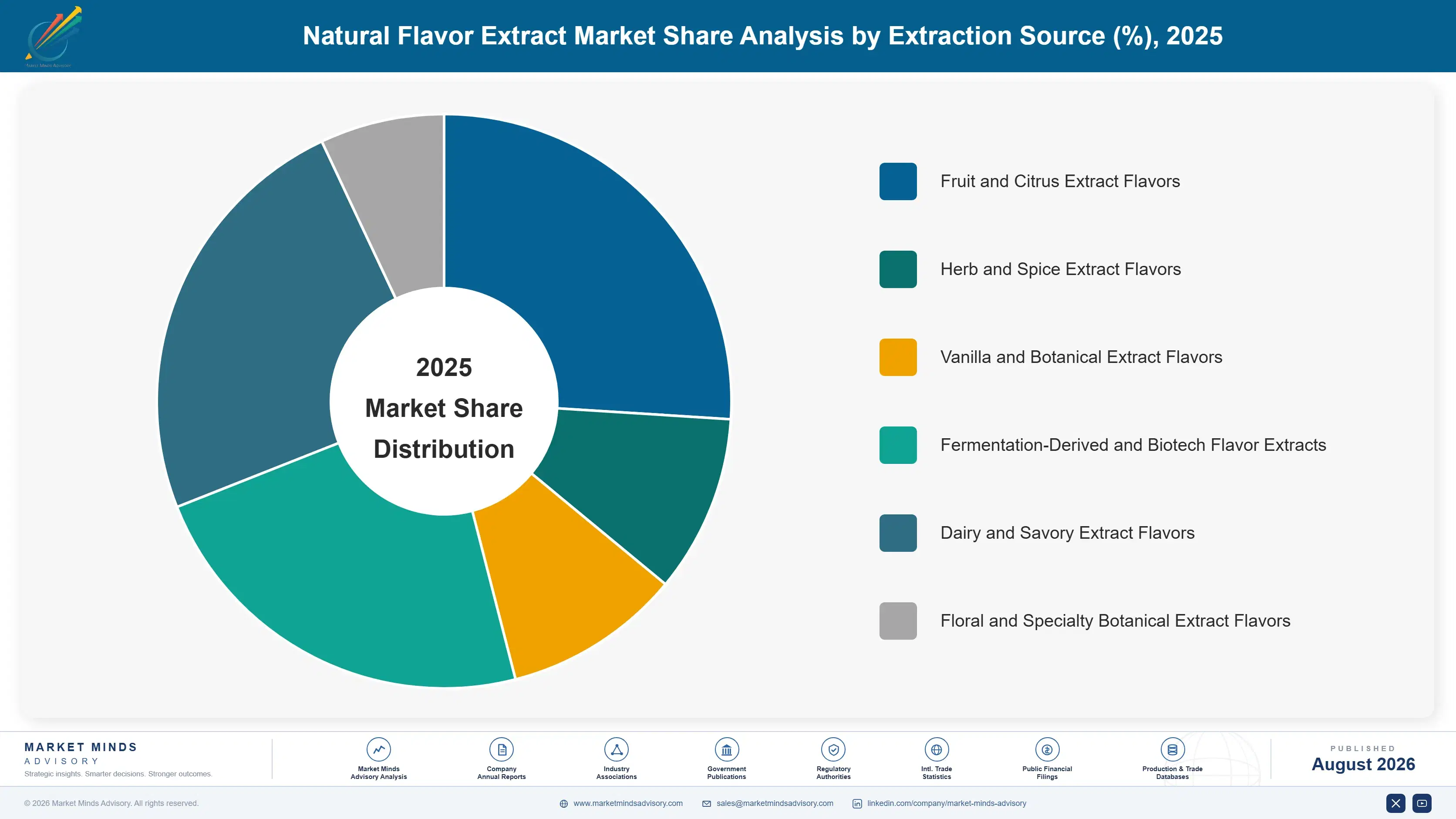
Value is classified here by end application, since the flavour problem being solved and the price a manufacturer will pay differ enormously between a soft drink and a pea protein burger. Flavour chemistry, production route and commercial arrangement are handled separately in the framework below, because most applications draw on several routes at once.
natural-flavor-extract-market-market-share-analysis-1787555875906

Plant-Based Protein and Meat Alternatives

Growing at 9.9%, half again the market rate, this is the hardest flavour work currently commissioned and it prices accordingly at roughly 3.4 times conventional beverage development. Pea, soy and fava proteins carry bitter, green and beany notes that persist through processing and cannot be covered by simply adding flavour on top. Masking systems have to be built for each specific protein source and each finished format, which makes the work genuinely bespoke rather than library-based. Sensory panel depth and protein chemistry understanding decide who wins these briefs, and houses without dedicated capability lose them consistently and repeatedly. Extrusion and high-moisture processing add further complications that a beverage brief never presents.
CAGR 9.9%

Nutraceuticals and Supplements

Supplement formats carry actives that taste actively unpleasant, including botanicals, amino acids, vitamins and mineral salts, and the entire category is positioned on natural credentials that an artificial declaration would contradict visibly on the panel. Growth at 8.4% follows category expansion alongside a continuing shift from capsules toward gummies, powders and ready-to-drink formats where the consumer actually tastes the product. Cost tolerance is high because finished product margins are substantial. Masking bitterness from a concentrated active without adding sweetener is the recurring technical demand across almost every brief here. Regulatory documentation matters more here than in most food categories, since supplement claims attract scrutiny that ordinary packaged food avoids. Format proliferation keeps generating new briefs from existing customers.
CAGR 8.4%
Full segment breakdown across 6 segments available in the complete report.

Regional Architecture and Country Demand Map

East Asia holds 28% of value on packaged food manufacturing scale that no other region approaches, with its domestic brands converting to natural flavour declarations rapidly. North America follows at 26% on retailer ingredient policies that made conversion mandatory across the shelf rather than optional.

East Asia

Chinese packaged food and beverage manufacturing operates at a scale that makes this the largest regional pool of flavour value, and domestic brands have adopted natural declarations rapidly as middle-income purchasing rises. Local houses including Huabao and Apple Flavor compete aggressively on price while international houses hold technically demanding beverage and dairy briefs. Japanese houses Takasago and T. Hasegawa hold deep positions in savoury and umami work that Western houses have never matched. Korean processed food demand is sophisticated and growing. Growth at 7.6% reflects domestic brand conversion rather than any regulation. Chinese houses are opening application centres with sensory panels to contest technically demanding briefs directly. Regional taste preferences differ enough that remote development rarely succeeds.
Share: 28% | CAGR: 7.6% (2026 to 2036)

North America

Retailer and brand owner ingredient policies made artificial flavour declaration commercially untenable across large parts of the packaged food shelf, which converted reformulation from a marketing choice into a mandatory programme. Plant-based protein flavour work is more advanced here than anywhere, with the hardest and best-paid briefs concentrated in this region. Citrus supply from Florida has fallen substantially through greening disease, pushing sourcing toward Brazil and Mexico. Growth at 6.2% sits slightly below the market rate because the conversion driving the last decade is now largely complete across major categories. Canadian and Mexican manufacture follows the same retailer policies through cross-border supply relationships. Nutraceutical format proliferation is generating a steady flow of masking briefs across the region.
Share: 26% | CAGR: 6.2% (2026 to 2036)
Regional intelligence for 5 additional markets available in the complete report: Western Europe, South Asia and Pacific, Latin America, Middle East and Africa, Eastern Europe. Contact sales@marketmindsadvisory.com.
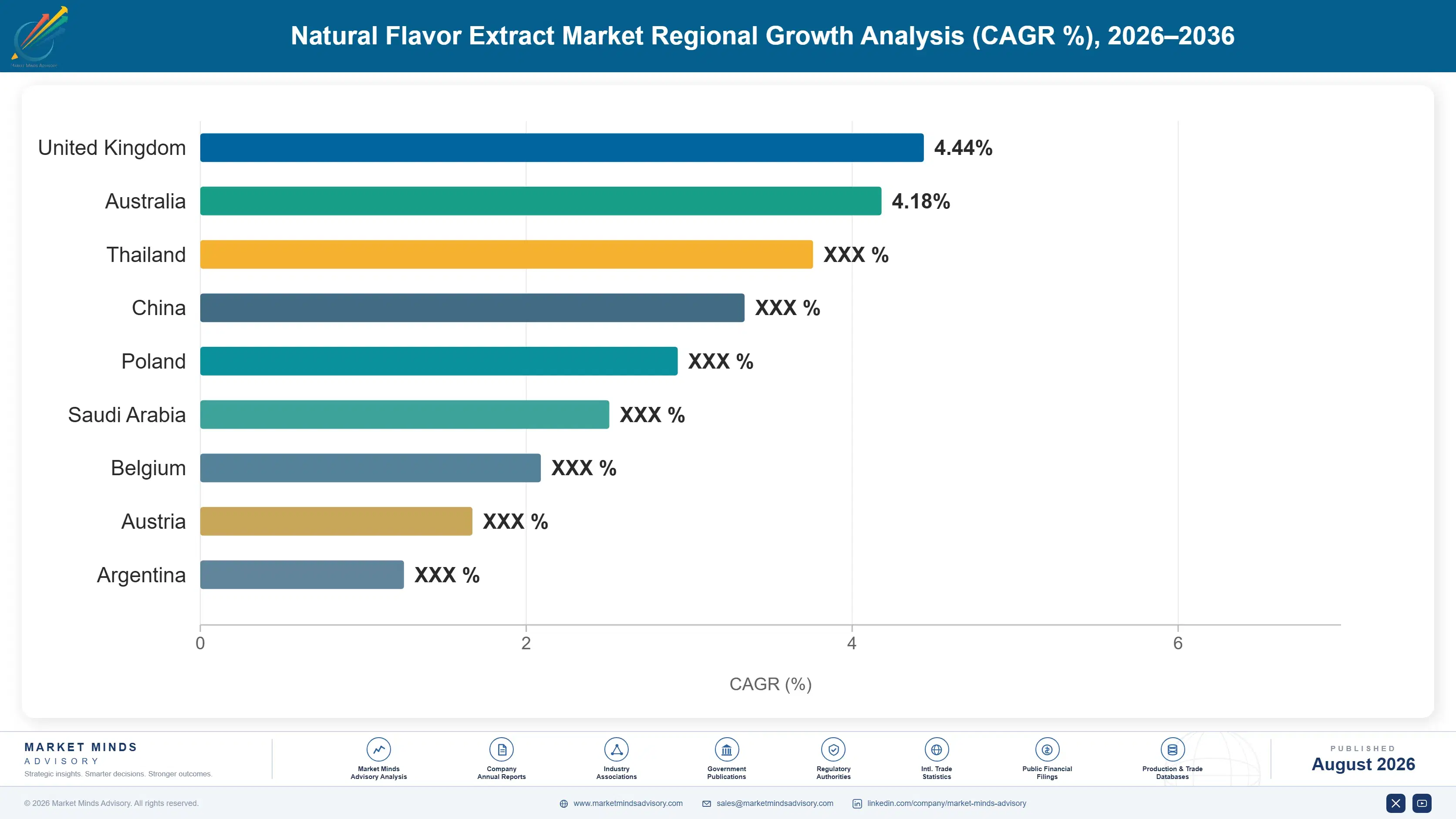
natural-flavor-extract-market-country-cagr-analysis-1787555876418

Where Flavour Value Actually Accrues

Four moves matter in a business that sells provenance, buys chemistry, and writes off the great majority of the development work it actually performs. Two concern the production routes reshaping supply economics underneath the whole industry, and two concern the creation model that explains why just five houses hold most of this particular market.

Build fermentation routes for supply-constrained molecules

Fermentation now produces around 23% of natural molecules and the case is strongest exactly where agriculture is least reliable. Bean vanillin has traded near 190 times the fermentation cost, citrus oils depend on declining juice volumes, and vanilla prices swing by an order of magnitude within a cycle. A house able to guarantee a molecule's availability and cost across a five-year formulation commitment wins business that agricultural sourcing cannot support. The regulatory position is already established in both major jurisdictions. Customers increasingly ask for supply guarantees before awarding briefs at all.
Market Impact: Covers 23% of natural molecules and still rising

Cut creation cost through predictive formulation tools

Only around 14% of submitted briefs reach production, so most sensory panel time, sample production and iteration cost is written off completely. Digital formulation prediction reduces physical iteration cycles substantially before any sample gets made, which lowers the cost of losing rather than the frequency. That matters more than win rate improvement, because brief cancellation is driven by the customer's marketing plans and not by flavour quality at all. Scale in this model is a genuine advantage rather than an incidental one. Smaller houses benefit most, since they carry the same overhead across less won revenue.
Market Impact: Reduces cost across the 86% of losing briefs

Staff plant protein masking as a dedicated discipline

Plant protein flavour work prices at roughly 3.4 times conventional beverage development and grows at 9.9%, the fastest rate here, because bitter and green off-notes from pea, soy and fava proteins defeat ordinary flavour addition entirely. Winning requires protein chemistry understanding and deep sensory panel work rather than any existing flavour library. Houses treating this as a variant of beverage development lose the briefs consistently. The capability takes years to build and the demand is expanding faster than the supply of people who can do it. Extrusion and high-moisture processing add further difficulty again.
Market Impact: Wins work priced 3.4 times conventional beverage development

Secure citrus origins ahead of continued grove decline

Around 71% of citrus oils arrive as juice processing residue, which ties supply to falling juice consumption and to greening disease that has cut Florida output severely. The most widely used natural flavour family therefore has shrinking and uncontrollable supply. Qualifying Brazilian, Mexican and Mediterranean origins alongside fermentation routes for key citrus molecules protects formulations already committed to customers. Houses discovering the constraint when a customer reorders are managing a reformulation rather than a purchase. The same botanical from a different origin does not taste identical, so qualification requires sensory validation that takes genuine time to complete.
Market Impact: Protects supply that is 71% dependent on by-product

Who Controls the Margin Pool

Five houses hold 58% of this market, measured on flavour revenue at creation house level, the basis used throughout this section. That is unusual concentration for an ingredient business and it follows the creation model rather than any manufacturing scale. With only around 14% of briefs converting, creation cost is absorbed across won business, and a small house cannot carry that arithmetic for long.
Competition runs on four dimensions. Creation capability and sensory panel depth, which decide who wins the technically demanding briefs where margin actually sits. Application centre proximity, since regional taste development cannot be performed remotely with any reliability at all. Production route breadth spanning extraction, distillation and fermentation together. And regulatory documentation, because natural is a provenance claim requiring traceable substantiation in every single market of sale.

Rankings shift toward houses with genuine fermentation capability and dedicated plant protein teams rather than general creation strength. Chinese and Indian houses are moving up from price competition into technical work, building application centres and sensory panels of their own. Japanese houses hold savoury and umami positions Western competitors have never seriously contested, and that particular gap persists.
natural-flavor-extract-market-company-positioning-matrix-1787555876934

Competitive Moat and Risk Dimensions

GIVAUDAN

Moat: Creation scale and breadth

The largest creation organisation in the industry absorbs the cost of a 14% brief conversion rate more comfortably than anyone, which lets it pursue briefs smaller houses cannot afford to lose. Application centres across every major region support the local taste development that cannot be done remotely, and production route breadth spans extraction, distillation and fermentation together.
GIVAUDAN

Risk: Cost structure against regional houses

Chinese and Indian houses compete effectively on price for less demanding briefs while building technical capability steadily, and much packaged food work does not require the full creation apparatus. Growth is concentrated in exactly the regions where those competitors are strongest. Defending share on capability works only where the brief is genuinely difficult to execute well.
SYMRISE

Moat: Backward integration into naturals

The company holds unusual depth in natural raw material sourcing and processing rather than only in flavour creation, which matters increasingly as citrus, vanilla and botanical supply becomes less reliable. That integration supports supply commitments across multi-year formulations that competitors sourcing on merchant terms cannot always match with confidence.
SYMRISE

Risk: Agricultural exposure through integration

Backward integration into naturals concentrates exposure to exactly the agricultural volatility that fermentation routes are designed to escape, including citrus greening, vanilla price cycles and weather across botanical origins. Houses weighted toward fermentation convert that volatility into a manufactured cost. The integration advantage narrows as more molecules move to fermentation production.

Players Tracked

Prominent Players

Givaudan
DSM-Firmenich
International Flavors and Fragrances
Symrise
Takasago International

Other Key Players

Mane
Robertet
Sensient Technologies
T. Hasegawa
Kerry Group
Bell Flavors and Fragrances
Huabao International
Apple Flavor and Fragrance Group
Synergy Flavours
Prova
Treatt
Döhler
Ungerer and Company
Blue California
Wanxiang International

Recent Developments

MARCH 2025

A flavour house commissioned fermentation capacity for natural molecules

A leading flavour house commissioned precision fermentation capacity producing natural-labelled aroma molecules previously sourced from agricultural extraction, citing supply reliability rather than cost as the primary rationale. This was organic capital investment rather than any acquisition or joint venture arrangement. Customer supply commitments followed the announcement.
Signal: Supply predictability rather than cost is now the stated reason for fermentation, which changes how customers evaluate it
AUGUST 2025

A Chinese house opened a beverage application centre

A Chinese flavour house opened a dedicated beverage application centre with sensory panel facilities, targeting technically demanding briefs previously awarded to international houses by domestic brand owners. This was organic investment rather than any partnership, acquisition or merger with another company. Local sensory expertise was the stated advantage.
Signal: Regional houses are building the creation apparatus that concentration has historically protected, which erodes the technical premium
NOVEMBER 2025

A protein manufacturer selected a dedicated masking partner

A plant protein manufacturer awarded a multi-year flavour development agreement covering masking systems across several protein sources and finished formats, following competitive sensory evaluation. This was a supply and development agreement rather than any equity investment or joint venture between the parties. Several formats were covered under one agreement.
Signal: Plant protein masking is consolidating around houses with dedicated capability rather than being spread across general suppliers

What Drives Creation Economics

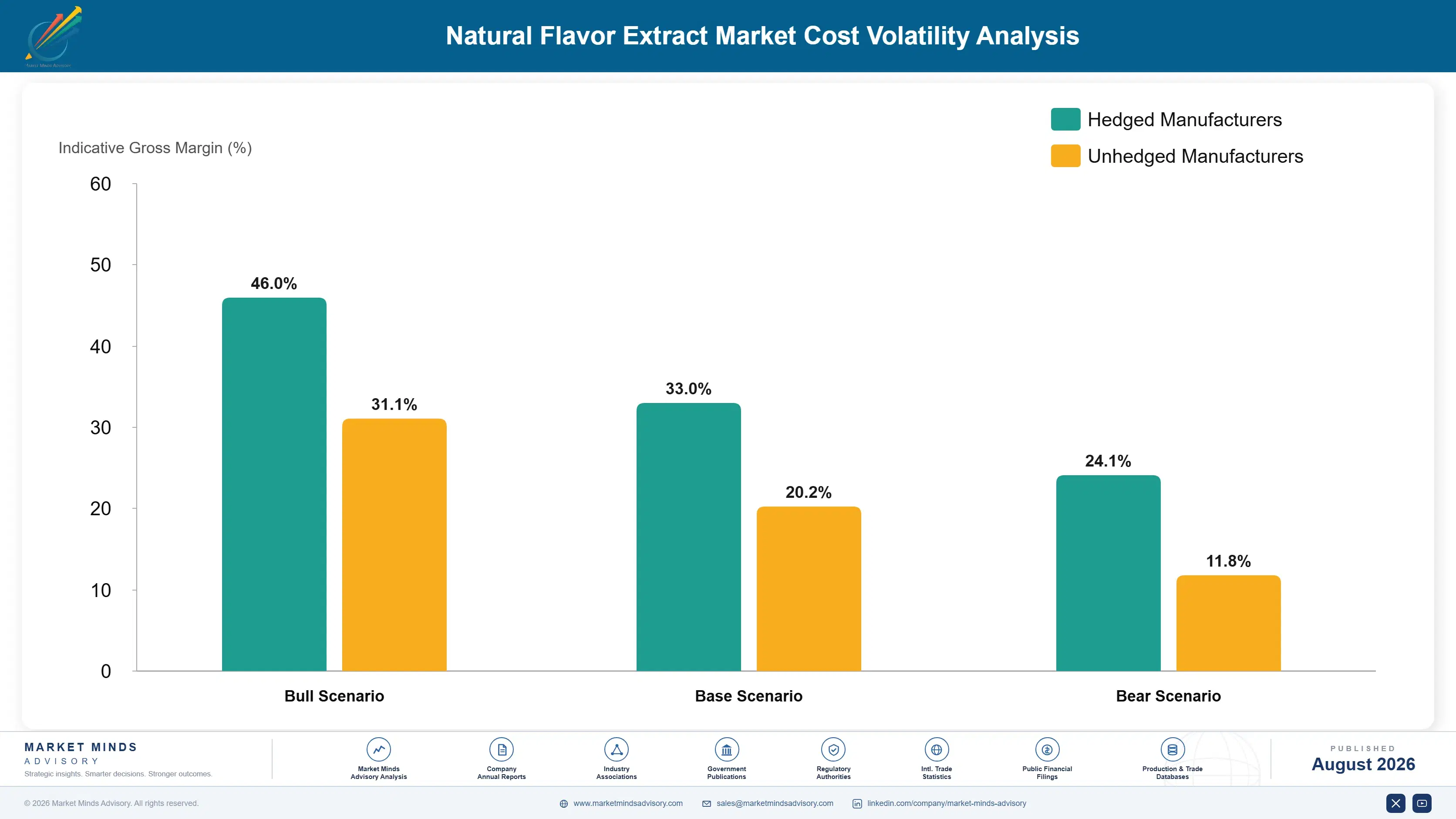
Raw materials account for roughly 41% of cost and creation and application overhead for around 29%, which is an unusual structure for an ingredient business and explains a great deal about it. Citrus oils, vanilla, mint and botanical extracts dominate the material side and every one is agricultural. Sensory panels, application centres and development chemists dominate the overhead side, and that cost is incurred whether or not a brief converts.
Vanilla prices moved by roughly an order of magnitude across the cycle following Madagascar cyclone damage, and citrus oil availability tightened as greening disease reduced Florida output substantially over the same period. Symrise noted raw material cost and availability pressure across its flavour operations in its Annual Report 2022. Houses holding fixed-price customer agreements absorbed most of it, since a food manufacturer prices a product for a year at minimum.

The disadvantage falls hardest on smaller houses and it operates through the brief conversion rate rather than through purchasing. A house winning the same 14% of briefs as a larger competitor spreads identical creation cost across far less won revenue. Backward-integrated houses face a different exposure, carrying agricultural volatility directly while fermentation-weighted competitors convert it into a manufactured cost.
natural-flavor-extract-market-cost-volatility-analysis-1787555877128

Move supply-constrained molecules onto fermentation routes

Vanilla, citrus and several botanical molecules carry agricultural volatility that no purchasing arrangement removes, since the exposure is weather and disease rather than price negotiation. Fermentation converts an unpredictable input into a manufactured one with known cost. The regulatory position is already established in both major jurisdictions, which removes the objection customers raise most often.

Reduce physical iteration with predictive formulation modelling

Creation and application overhead runs near 29% of cost and most of it is spent on briefs that never convert to production. Digital formulation prediction cuts physical sample cycles substantially before anything reaches a sensory panel. That lowers the cost of losing rather than the frequency of losing, which is the variable a flavour house can actually control.

Contract botanical origins across multiple growing regions

Citrus, vanilla and mint each concentrate in a small number of origins where weather and disease move availability without warning. Multi-origin qualification takes time and sensory validation, because the same botanical from a different region does not taste identical. Doing that work before a disruption is what separates continuity from an emergency reformulation programme.

Portfolio Architecture for Margin Defence

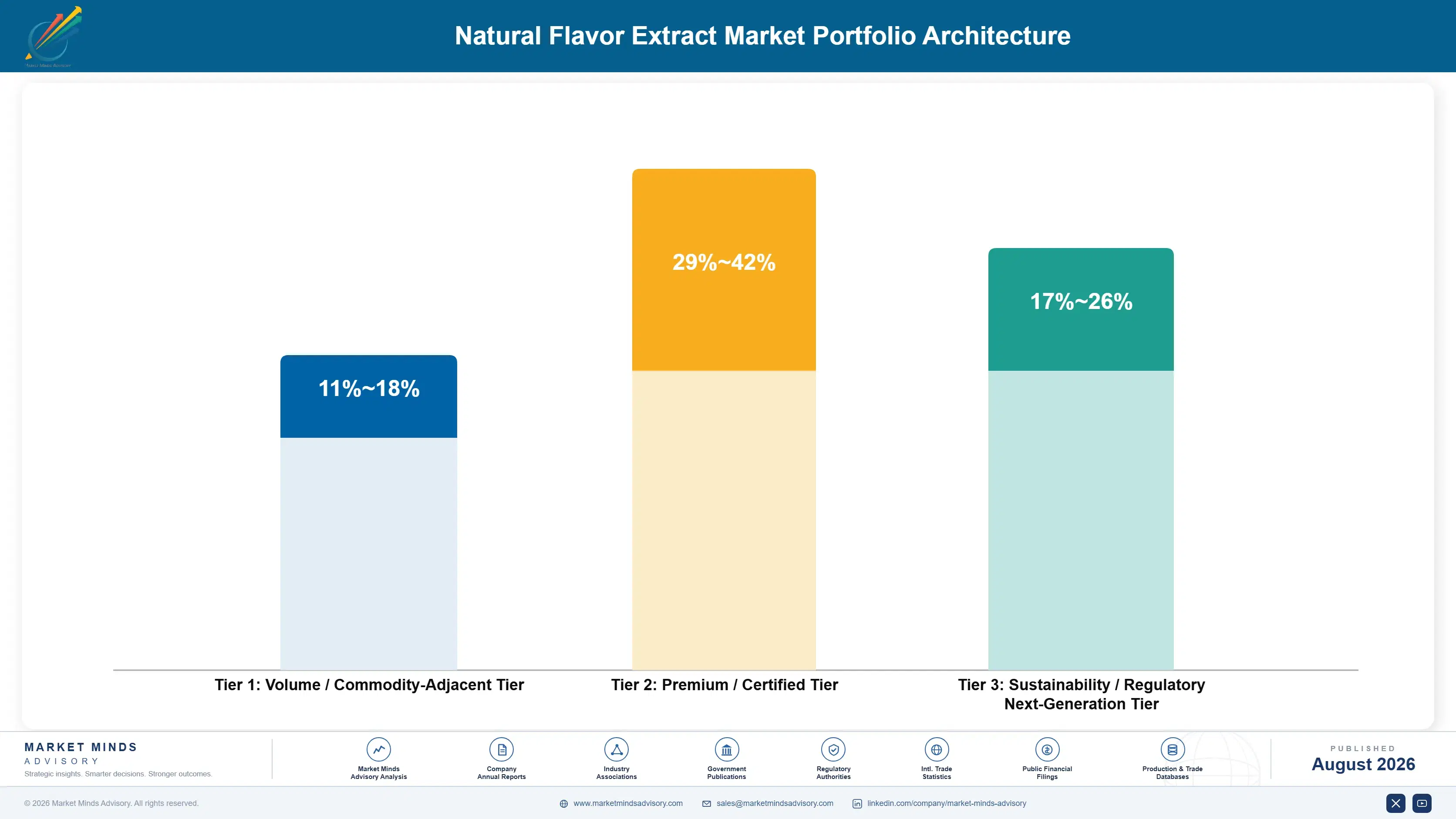
Margin here tracks brief difficulty rather than volume, which is why the industry looks nothing like other ingredient businesses on the numbers. Commodity extract and essential oil supply runs at gross margins in the high teens against traders and regional processors. Standard compounded flavour systems for established categories run considerably better. Plant protein masking, nutraceutical bitterness work and any brief requiring genuine sensory development run higher again, because few competitors can execute them at all.
The tension is that volume categories fund the creation apparatus while difficult briefs justify it, and the two pull in opposite directions on where a house puts its best people. Beverage and dairy volume pays the bills and rarely stretches anyone. Plant protein and nutraceutical work stretches everyone and arrives in smaller quantities. Houses that staff for volume find themselves losing the briefs that would have justified their premium. That staffing choice compounds quietly over several years.

High-value pools sit in plant protein masking, nutraceutical formats and fermentation-secured molecules where supply certainty is itself the product. Commodity extract supply is where regional processors compete hardest and where creation capability earns nothing at all. Traders and regional processors have taken most of it already.

Volume / Commodity-Adjacent

Commodity extracts, essential oils and simple flavour systems sold against traders and regional processors. The ten-point range separates houses with backward integration and origin contracts from those buying botanical material entirely on merchant terms.
Gross Margin: 16%-26%

Premium / Certified

Compounded natural flavour systems for established beverage, dairy and savoury categories with application support. The fourteen-point spread reflects how much local application and sensory work a house actually provides rather than any difference in materials.
Gross Margin: 32%-46%

Sustainability / Regulatory / Next-Generation

Plant protein masking, nutraceutical bitterness work and fermentation-secured molecules sold on supply certainty. The twenty-two-point range is wide because few houses can execute this work and pricing reflects scarcity of capability rather than any cost basis.
Gross Margin: 44%-66%
natural-flavor-extract-market-portfolio-architecture-1787555877626

High-value Sub-segments and Strategic Watch-out

Plant Protein Masking

Compounding at 9.9% and pricing near 3.4 times conventional beverage work, because pea and soy off-notes defeat ordinary flavour addition. Capability takes years to build and demand is expanding faster than the people who can do it. Each individual protein source needs its own separate development work.
Gross Margin: 48%-66%

Fermentation-Secured Molecules

Around 23% of natural molecules and climbing, sold increasingly on guaranteed availability rather than on cost. A five-year formulation commitment needs the raw material to exist, and a field cannot promise that reliably. Regulatory acceptance is already settled across both of the two major jurisdictions.
Gross Margin: 42%-58%

Beverage and Dairy Volume

The revenue base funding the creation apparatus, competed on application support and relationship rather than on any technical difficulty. Regional houses are contesting it hardest and winning steadily on price in Asian markets. Application support rather than any technical chemistry decides who actually holds it.
Gross Margin: 30%-42%

Commodity Extract Supply

Essential oils and simple extracts where creation capability earns nothing and traders compete directly. Citrus exposure here is acute, with 71% of oils arriving as juice residue from a shrinking processing base. Creation capability earns almost nothing whatever within this particular tier of commodity supply.
Gross Margin: 16%-26%

How Flavour Revenue Renews

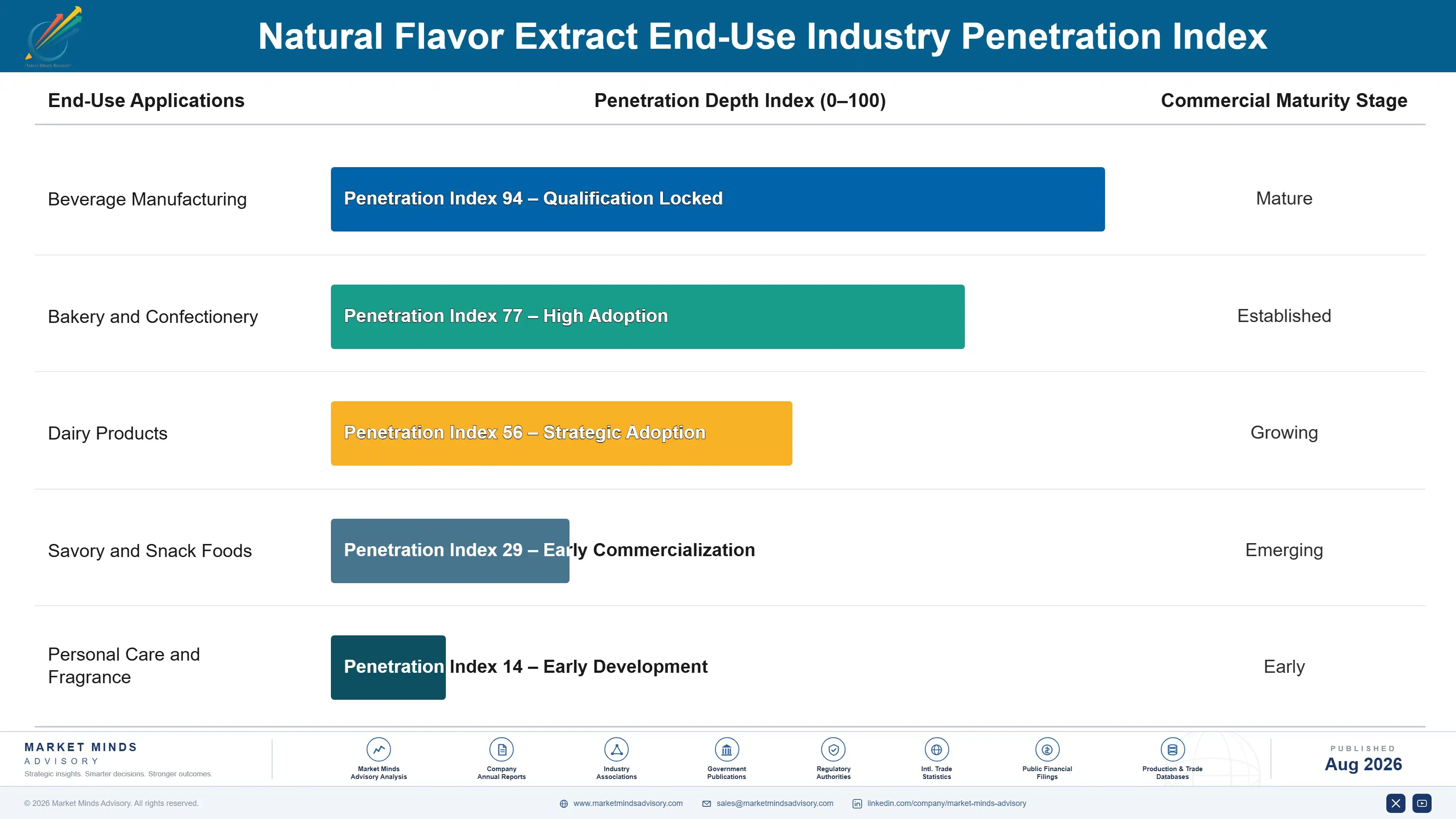
Flavour is the purest annuity in food ingredients, because a formulation that wins a brief gets purchased in every batch for as long as the product exists and nobody reopens it without a reason. A single win can generate revenue for a decade with no further selling. That is precisely why houses tolerate a 14% conversion rate on briefs, and why losing one hurts far more than the immediate development cost suggests.
Adoption depth varies sharply by vertical and it follows how central taste is to the product. Beverages and confectionery are almost entirely flavour-defined, so the relationship runs deep and switching risks the product itself. Dairy and bakery sit in between. Plant protein products depend on masking so completely that the flavour house effectively holds the formulation, which is an unusually strong position that few houses have built deliberately.

The buyer has broadened from product development toward regulatory and procurement together. Flavour selection was a development chemist's decision made on sensory preference. It now involves regulatory affairs checking provenance substantiation for each market of sale, and procurement testing whether a second house could match the profile.
natural-flavor-extract-market-end-use-penetration-index-1787555878113

Where To Place The Bet

These are among the four positions where our research anticipates prominent divergence between winners and laggards over the coming forecast period. Each is grounded in the demand model, the regulatory perimeter, and the announced capacity pipeline.
01 / FERMENTATION ROUTE BUILDING

Manufacture the molecules agriculture can no longer guarantee

Fermentation already produces around 23% of natural flavour molecules and the case is strongest exactly where agricultural supply has become least reliable, including vanillin at roughly 190 times the fermentation cost during price peaks and citrus oils tied to declining juice volumes. A house that can guarantee both availability and cost across a five-year formulation commitment wins business that agricultural sourcing simply cannot support any longer. The regulatory position is already settled in both major jurisdictions, which removes the objection customers raise first.
02 / CREATION COST MANAGEMENT

Lower the cost of losing, not the losing rate

Only around 14% of submitted flavour briefs reach commercial production, and cancellation is driven by the customer's shifting marketing plans rather than by anything wrong with the flavour work itself. Chasing a higher conversion rate therefore targets a variable the house does not control in any meaningful way. Predictive formulation modelling cuts physical iteration cycles before samples get made, which reduces what each loss costs and makes the whole creation model considerably more defensible at smaller scale than it currently appears to be.
03 / PROTEIN MASKING CAPABILITY

Staff plant protein work as its own discipline

Plant protein masking prices at roughly 3.4 times conventional beverage development and grows at 9.9%, the fastest rate in this market, because bitter and green notes from pea, soy and fava proteins persist through processing and defeat ordinary flavour addition entirely. Winning requires protein chemistry understanding and deep sensory panel work rather than any existing flavour library to draw from. Houses treating it as a beverage variant lose these briefs consistently, and the briefs keep increasing in both number and value.
04 / ORIGIN CONTINUITY PLANNING

Qualify citrus origins before the next supply failure

Roughly 71% of citrus oils arrive as a by-product of juice processing, which ties the most widely used natural flavour family to falling juice consumption and to greening disease that has already cut Florida grove output severely over recent years. The same botanical from a different origin does not taste identical, so qualification requires sensory validation that takes real time to complete properly. A house discovering the constraint when a customer reorders is running a reformulation programme rather than a purchase.

Engagement Snapshot From the Field

A live engagement with an industry participant carrying material or product regulatory and market exposure ahead of a defining policy shift, showing how our research translates into a defensible multi-year portfolio strategy.
MARKET MINDS ADVISORY · CLIENT ENGAGEMENT SUMMARY
Natural Flavor Producer Strategic Portfolio Review and Transition Roadmap 2026·Investment Scenario on Natural Flavor Exposure Evaluation 2025-26
CLIENT PROFILE
A mid-sized flavour house with annual revenue around EUR 210 million (client-reported, unverified by MMA), serving beverage, dairy and confectionery customers across European and selected Asian markets. Creation capability was solid in established categories. No fermentation production existed anywhere in the business, and plant protein briefs were being declined routinely. Growth had been flat for three years.
STRATEGIC CHALLENGE
Brief conversion had fallen below the industry average and management attributed it to pricing pressure from larger houses. Nobody had examined which briefs were being lost and why, or whether the declined plant protein work represented the growth the business was otherwise failing to find anywhere. That question had never been examined properly.
MMA APPROACH
MMA reconstructed two years of brief outcomes by category, difficulty and competitor won, rather than accepting the pricing explanation at face value. Plant protein capability requirements were costed against realistic build timelines. Agricultural exposure across the raw material portfolio was mapped, with fermentation sourcing options assessed for the most volatile molecules involved.
KEY FINDINGS
  1. Losses concentrated in technically demanding briefs rather than price-competitive ones, which meant the pricing explanation was wrong and the capability explanation had never been tested at all.
  2. Declined plant protein briefs over two years represented more potential revenue than the entire confectionery portfolio generated, at roughly three times the typical development margin.
  3. Vanilla and citrus exposure sat entirely on agricultural sourcing, leaving the house unable to make the multi-year supply commitments larger competitors were offering customers directly.
  4. Creation cost per brief exceeded the industry benchmark substantially because iteration cycles ran long, with almost no predictive modelling used before physical sampling began.
CLIENT PROFILE
A mid-sized flavour house with annual revenue around EUR 210 million (client-reported, unverified by MMA), serving beverage, dairy and confectionery customers across European and selected Asian markets. Creation capability was solid in established categories. No fermentation production existed anywhere in the business, and plant protein briefs were being declined routinely. Growth had been flat for three years.
STRATEGIC CHALLENGE
Brief conversion had fallen below the industry average and management attributed it to pricing pressure from larger houses. Nobody had examined which briefs were being lost and why, or whether the declined plant protein work represented the growth the business was otherwise failing to find anywhere. That question had never been examined properly.
MMA APPROACH
MMA reconstructed two years of brief outcomes by category, difficulty and competitor won, rather than accepting the pricing explanation at face value. Plant protein capability requirements were costed against realistic build timelines. Agricultural exposure across the raw material portfolio was mapped, with fermentation sourcing options assessed for the most volatile molecules involved.
KEY FINDINGS
  1. Losses concentrated in technically demanding briefs rather than price-competitive ones, which meant the pricing explanation was wrong and the capability explanation had never been tested at all.
  2. Declined plant protein briefs over two years represented more potential revenue than the entire confectionery portfolio generated, at roughly three times the typical development margin.
  3. Vanilla and citrus exposure sat entirely on agricultural sourcing, leaving the house unable to make the multi-year supply commitments larger competitors were offering customers directly.
  4. Creation cost per brief exceeded the industry benchmark substantially because iteration cycles ran long, with almost no predictive modelling used before physical sampling began.
RECOMMENDED STRATEGY
Phase 1: Phase one: build a dedicated plant protein masking team with its own sensory panel, accepting an eighteen-month period before it wins consistently. Phase 2: Phase two: contract fermentation-sourced vanillin and key citrus molecules from third parties rather than building capacity, securing supply commitments without the capital. Phase 3: Phase three: introduce predictive formulation modelling to cut iteration cycles, targeting creation cost per brief rather than the conversion rate itself.
OUTCOME
The plant protein team is staffed and has won three briefs ahead of schedule. Fermentation-sourced molecules now support multi-year commitments on two major accounts previously at risk. Creation cost per brief has fallen, and the client reports overall conversion improving without any change to pricing (client-reported, unverified by MMA).

Frequently Asked Questions

Foundational context covering the market sizes, CAGR, scope, country, region and competition that inform every finding below. This section is provided to cover basics and most often pre-purchase conversations, answered from the MMA Primary Research Dataset.

What is the current size of the Natural Flavor Market?

The market was valued at USD 13.2 billion in 2025, rising to an estimated USD 14.07 billion in 2026. East Asia holds the largest regional share at 28% of value.

How large will the Natural Flavor Market be by 2036?

MMA forecasts USD 26.66 billion by 2036 under the base case, an expansion multiple of 1.89 times the 2026 value. That represents USD 12.59 billion of incremental value.

What is the CAGR for the Natural Flavor Market 2026 to 2036?

The base case runs at 6.6% compound annual growth between 2026 and 2036, with a bull case at 7.8% and a bear case at 5.4%. Historical growth from 2020 to 2025 was 5.6%.

Which segment is growing fastest?

Plant-based protein and meat alternatives lead at 9.9%, half again the market rate, because protein off-notes require masking that prices near 3.4 times conventional work. Nutraceuticals follow at 8.4%.

Who are the major companies in the Natural Flavor Market?

Givaudan, DSM-Firmenich, International Flavors and Fragrances, Symrise and Takasago International hold 58% of the market between them. Creation scale rather than manufacturing capability sustains that unusual concentration.

Which country is growing fastest?

India leads at 9.8%, driven by packaged food expansion, by domestic brands adopting natural declarations, and by a botanical extraction base already operating at genuine commercial scale.

Report Segmentation Architecture

The full report scope spans multiple orthogonal segmentation dimensions, with cross-tabulated demand data provided for each dimension pair. Coverage extends further to regional breakdowns, trend trajectories, and the competitive detail needed to support segment-level decision-making.

By Flavour Type

  • Essential Oils and Distillates
  • Botanical Extracts and Oleoresins
  • Fermentation-Derived Molecules
  • Enzymatically Modified Flavours
  • Compounded Natural Systems
  • Natural Masking Agents

By End-Use Industry

  • Beverages
  • Dairy and Frozen Desserts
  • Bakery and Confectionery
  • Savoury Snacks and Culinary
  • Nutraceuticals and Supplements
  • Plant-Based Protein and Meat Alternatives

By Commercial Arrangement

  • Brief-Based Custom Creation
  • Catalogue Flavour Supply
  • Multi-Year Formulation Agreements
  • Distributor and Regional Channel
  • Toll Extraction and Contract Manufacture

By Region

  • North America
  • Western Europe
  • East Asia
  • South Asia and Pacific
  • Latin America
  • Middle East and Africa
  • Eastern Europe

Scope, Methodology, and Coverage

Every figure in this report is reproducible from documented input assumptions. The scope below maps the historical period, the forecast horizon, the segmentation dimensions, and the countries covered, alongside the underlying primary and qualitative methodology.
Historical Period
2020 to 2025
Forecast Period
2026 to 2036
Base Year
2025 (USD billions; MMA Primary Research Dataset, August 2026)
Market Definition
The market comprises natural flavours meeting the regulatory definitions applying in their markets of sale, including essential oils and distillates, botanical extracts and oleoresins, fermentation-derived molecules, enzymatically modified flavours, compounded natural systems and natural masking agents, supplied across beverages, dairy and frozen desserts, bakery and confectionery, savoury snacks and culinary, nutraceuticals and supplements, and plant-based protein and meat alternatives. Value is measured at flavour creation house level across custom, catalogue and contract arrangements. Artificial and nature-identical flavours declared as such, fragrances, colours, sweeteners, and seasonings sold without flavour creation content fall outside scope.
Quantitative Units
USD billions (current prices); tonnes of flavour supplied; USD per kilogramme by application and complexity
Segmentation Dimensions
By Flavour Type; By End-Use Industry; By Commercial Arrangement; By Region
Regions Covered
North America, Western Europe, East Asia, South Asia and Pacific, Latin America, Middle East and Africa, Eastern Europe
Countries Covered
China, Japan, South Korea, Taiwan, India, Indonesia, Thailand, Vietnam, Australia, United States, Canada, Mexico, Brazil, Argentina, Colombia, Chile, Germany, France, Switzerland, Netherlands, Spain, Italy, United Kingdom, Poland, Romania, Czechia, Saudi Arabia, United Arab Emirates, Egypt, South Africa
Key Companies Profiled
Givaudan, DSM-Firmenich, International Flavors and Fragrances, Symrise, Takasago International, Mane, Robertet, Sensient Technologies, T. Hasegawa, Kerry Group, Bell Flavors and Fragrances, Huabao International, Apple Flavor and Fragrance Group, Synergy Flavours, Prova, Treatt, Döhler, Ungerer and Company, Blue California, Wanxiang International
Quantitative Methodology
Primary survey, n=3,800 respondents, Q4 2025, six countries; demand-side model with trade association cross-validation
Qualitative Methodology
47 expert interviews, Q4 2025; applied to validate demand model assumptions, identify emerging dynamics, and assess competitive positioning
Report Format
PDF and XLSX data workbook (Word format preview document)
Publisher
Market Minds Advisory
Report Code
MMA-2026-AGR-133
Published
August 2026
Contact
sales@marketmindsadvisory.com | www.marketmindsadvisory.com

Purchase the full Natural Flavor Market Report (2026 to 2036).

The full report sizes the global natural flavour market to 2036 across six applications and seven regions, measured at flavour creation house level. It treats natural as the provenance claim it legally is and quantifies how fermentation routes are displacing agricultural extraction across supply-constrained molecules. Competitive analysis covers 20 houses on one consistent revenue basis, with moat and risk assessment for the two leaders. Brief conversion economics are modelled explicitly, since creation cost absorbed across won business explains the industry's unusual concentration. Four quantified revenue levers close the analysis.
Six-application segment sizing with individual growth rates
Fermentation displacement mapped molecule by molecule against agricultural routes
Brief conversion economics modelled across creation and application overhead
Citrus and vanilla supply exposure quantified by origin
Twenty-house competitive map on one consistent revenue basis
Four quantified revenue levers with commercial impact ranges

Built For The People Who Decide

From boardroom strategy to bench-side execution, this report is read cover-to-cover by leaders shaping the next decade of their industry, turning demand scenarios, market dynamics and valuation benchmarks into decisions.
CXOs/ Presidents/ VPs/ Managers
M&A and Corporate Development
Strategy Teams and R&D Heads
Procurement and Product Directors
Regulatory and Compliance Leaders
Investor Relations and Equity Analysts