Market Minds Advisory
Nanocrystal Packaging Coating Market

Nanocrystal Packaging Coating Market: Cellulose Nanocrystal Barriers and Sustainable Coating Technology

Extended producer responsibility regulation targeting petroleum-based barrier coatings is pulling brand owners toward nanocrystalline cellulose alternatives, forcing conventional coating suppliers to prove cost parity before scale manufacturing genuinely exists at commercial volume.

Lead Analyst

Bilal Shaikh

Published

September 2026

Make Smarter Decisions with Customized Research Insights

Request a free sample report and evaluate market opportunities, growth trends, and competitive dynamics relevant to your business needs.

2025 MARKET VALUE$0.4BMarket Size 2025
2036 FORECAST VALUE$1.9BBase Case , 2026 to 2036
CAGR 2026 TO 203615.5 %Bull 16.9% / Bear 14.0%
INCREMENTAL OPPORTUNITY$1.5BNet 10- year value creation
EXPANSION MULTIPLE4.24x2036 value over 2026 base
Strategic Levers
M&A Pipeline
Regional Outlook
Country Rankings
Competitive Intelligence
Segmental Deep-dive
Call-Us : 91 93563 13602

Executive Snapshot and Market Trajectory

Extended producer responsibility regulation targeting petroleum-based barrier coatings is pulling brand owners toward nanocrystalline cellulose alternatives, forcing conventional coating suppliers to prove cost parity before scale manufacturing genuinely exists across most major markets, a shift few conventional suppliers anticipated when the category was purely petroleum-based.
Antimicrobial nanocrystal coatings are growing fastest as food safety and extended shelf life demand accelerates, with commercialization concentrating in North America and East Asia, where dedicated cellulose nanocrystal production capacity and rapidly scaling packaging manufacturing infrastructure sustain the deepest coating adoption volume of any regions tracked, well ahead of every other region tracked in this study, where dedicated production capacity sustains category depth few other regions can match at comparable scale.
Competition remains genuinely fragmented across a mix of specialty biomaterials pioneers and diversified forest products conglomerates entering nanocrystal coating development, while manufacturing scale-up economics and brand owner performance validation reshape which companies capture the fastest-growing, most commercially credible segments of this nascent category within an already fragmented, price-sensitive competitive landscape, forcing even well-capitalized entrants to defend early positioning against fast-moving forest products conglomerates entering adjacent categories that they had rarely needed to build before now.
Market Definition
This market covers nanocrystalline coating technologies applied to packaging substrates for barrier, antimicrobial, and protective performance, primarily cellulose nanocrystal and related bio-based nanomaterial formulations. It excludes conventional petroleum-based barrier coatings, nanoparticle additives incorporated directly into substrate materials, and non-packaging nanocrystal applications entirely.
Base Year Value
$0.4B in 2025 (MMA Primary Research Dataset, August 2026)
Forecast Period
2026 to 2036, eleven discrete annual values
CAGR
15.5% base case. Bull 16.9%. Bear 14.0%.
Fastest Growth Segment
Antimicrobial Nanocrystal Coatings: 19.5% CAGR
Fastest Growth Country
China: 18.2% CAGR
Fastest Growth Region
South Asia and Pacific: 17.5% CAGR
Largest Region
North America: 29% of 2025 global value
Market Leaders
CelluForce Inc., Stora Enso Oyj, UPM-Kymmene Corporation, Borregaard ASA, Michelman Inc. Source: MMA Analysis based on company annual reports.
Primary Survey
n=3,800 procurement and R&D decision-makers, Q4 2025, six countries
Methodology
Demand-side build-up, cross-validated against public data, 47 expert interviews

Nanocrystal Packaging Coating Market Forecast Scenarios

nanocrystal-packaging-coating-market-size-forecast-scenario-1787308051281
Nanocrystal packaging coating spending grew at roughly 14.0% annually between 2020 and 2025, as early commercial pilot programmes and growing brand owner sustainability commitments drove initial adoption from a genuinely small base across leading packaging innovation markets tracked, a pattern that has held steady even as individual coating functions diverged meaningfully in adoption trajectory nationally.
The base case assumes continued manufacturing scale-up progress, expanding brand owner performance validation, and growing regulatory pressure on petroleum-based barrier alternatives, sustaining a 15.5% blended annual growth rate through 2036 as production economics gradually approach cost parity with conventional coating technologies. These three mechanisms reinforce each other: scale-up lowers cost, validation lifts confidence, and tightening regulation sustains durable demand growth broadly across most major markets tracked across most major regulated national markets tracked in this study.
A bull scenario assumes faster-than-expected manufacturing cost reduction pulls nanocrystal coatings into mainstream packaging specification well ahead of current projections. The bear case centers on persistent scale-up cost challenges that could meaningfully slow broader commercial adoption beyond early premium sustainability-focused applications, lifting growth toward 16.9% if cost reduction accelerates. The bear case pulls growth down toward 14.0% instead if scale-up challenges persist longer than expected.

Sustainable Barrier Technology Meets Scale-Up Reality

The nanocrystal packaging coating market sits at the convergence of genuine sustainability regulatory pressure and a still-maturing manufacturing scale-up challenge, a combination pulling this nascent bio-based materials category from laboratory and pilot demonstration into early commercial packaging specification across a growing number of brand owner programmes, a shift accelerating faster than most conventional coating suppliers originally expected when planning multi-year investment budgets.
MARKET CONCENTRATIONCR5 24%share held by the five largest nanocrystal coating suppliers combined
AVERAGE COATING PRICE PREMIUM165%premium nanocrystal barrier coatings command over conventional petroleum-based alternatives
LEADING COUNTRY SHAREUnited States 22%of global category spending in a single production market
PILOT-TO-COMMERCIAL CONVERSION RATE34%of pilot programmes advancing to full commercial packaging specification
MANUFACTURING CAPACITY UTILISATION58%average operating capacity across dedicated cellulose nanocrystal production facilities globally
BARRIER PERFORMANCE PARITY RATE71%of tested applications achieving barrier performance comparable to conventional coatings
Commercially, this market splits between early-stage pilot and demonstration-scale coating applications sold at premium pricing to sustainability-focused brand owners, and a still-developing pathway toward broader commercial specification that depends heavily on continued manufacturing cost reduction across most major production facilities tracked, leaving slower-moving pilot-only producers increasingly confined to research revenue rather than sustained commercial volume nationwide as this bifurcation continues deepening across most packaging categories tracked.
Over the next decade, continued manufacturing scale-up investment, tightening petroleum-based coating regulation, and accumulating brand owner performance validation data will keep pulling packaging specification toward nanocrystal barrier technology across most major sustainability-focused packaging categories and customer segments tracked in this study, reshaping research, manufacturing, and commercial investment priorities across nearly every major nanocrystal coating producer globally across research, manufacturing, and commercial planning alike nationwide.
"Every brand owner wants the sustainability story. The question that actually determines a purchase order is whether the coating survives a shelf-life test without cracking, and that answer is still being written."
Director, Sustainable Materials and Packaging Innovation Practice · MMA Chemical

Market Trends

Manufacturing Scale-Up Investment Accelerates Cost Reduction

Continued capital investment in dedicated cellulose nanocrystal production capacity continues driving meaningful manufacturing cost reduction, as leading producers move beyond pilot-scale demonstration facilities toward genuine commercial production volume that begins approaching cost parity with conventional petroleum-based barrier coating alternatives. Industry data indicates dedicated production capacity has expanded considerably over the past several years as multiple producers commissioned new commercial-scale facilities, directly expanding available supply for brand owner commercial specification programmes. This shift is pulling coating formulators without dedicated nanocrystal sourcing relationships to invest rapidly or risk missing this genuinely emerging category entirely.
Market Impact: Expands regulated addressable marke

Brand Owner Sustainability Commitments Drive Pilot Programmes

Major consumer goods and food packaging brand owners continue launching pilot and demonstration programmes evaluating nanocrystal barrier coatings against formal packaging sustainability commitments, reflecting genuine corporate pressure to reduce petroleum-based material dependency across their broader packaging portfolios. Survey data collected from major brand owner sustainability disclosures confirms a meaningful share of leading consumer goods companies have launched formal bio-based barrier coating evaluation programmes within the past several years. This trend is pulling coating suppliers to expand pilot programme capacity to meet growing brand owner evaluation demand nationally across most major consumer product categories tracked in this report broadly.
Market Impact: Expands LCA-driven demand 19 percen

Market Opportunities and Growth Drivers

Tightening Global Petroleum Coating Regulation Broadly

Extended producer responsibility regulation and tightening restrictions on certain petroleum-based barrier coating chemistries, including some fluorinated compounds used historically in grease-resistant packaging coatings, continue driving brand owner interest in bio-based nanocrystal alternatives across most major regulated consumer markets tracked in this study. National regulatory data confirms restrictions on specific conventional barrier coating chemistries have expanded meaningfully across several major jurisdictions over the past several years, directly expanding the addressable market for compliant bio-based alternatives. This driver is expected to keep sustaining above-average adoption growth through the coming decade broadly nationally.
Market Impact: Costs run 165 percent above convent

Growing Brand Owner Life-Cycle Assessment Requirements

Continued expansion of formal life-cycle assessment and carbon footprint disclosure requirements among major consumer goods companies continues driving demand for demonstrably bio-based, renewable barrier coating alternatives that improve packaging sustainability metrics compared to conventional petroleum-derived coating technologies used historically across most packaging categories. Corporate sustainability reporting data confirms life-cycle assessment requirements have expanded considerably across major consumer goods companies over the past several years. This driver is expected to keep sustaining meaningful demand growth as sustainability reporting requirements continue tightening broadly nationally, particularly as investor and regulator scrutiny of packaging sustainability claims continues intensifying nationally.
Market Impact: Validation delays adoption 18 month

Market Restraints and Challenges

Manufacturing Scale-Up Costs Limit Price Competitiveness

Persistent manufacturing scale-up cost challenges continue limiting nanocrystal coating price competitiveness against conventional petroleum-based barrier alternatives, as production processes have not yet achieved the manufacturing scale and process efficiency that decades-established conventional coating technologies benefit from currently. The root cause is that cellulose nanocrystal production requires specialized extraction and processing infrastructure that remains genuinely capital-intensive relative to established petrochemical coating manufacturing processes built out over many decades. This pressure disproportionately affects smaller producers lacking capital access for continued scale-up investment. Producers are responding by pursuing strategic partnerships and external investment to fund continued manufacturing scale-up.
Market Impact: Production capacity grew 38 percent

Limited Performance Validation Slows Commercial Adoption

Persistent limitations in long-term performance validation data continue slowing broader commercial adoption, as brand owners require extensive shelf-life and barrier performance testing before committing to full commercial specification changes affecting established packaging supply chains and consumer-facing product quality. The underlying cause is that nanocrystal coating technology remains genuinely new enough that comprehensive long-term performance data across diverse packaging applications simply does not yet exist at the scale conventional coatings have accumulated. This constraint disproportionately affects applications with the most demanding shelf-life requirements. Suppliers are responding by expanding pilot testing programmes to accumulate needed performance validation data.
Market Impact: Pilot programmes expanded 41 percen
3 additional market trends, 4 additional growth drivers, and 3 additional restraints and challenges are covered in the full report. Contact sales@marketmindsadvisory.com to access the complete intelligence.

Segment CAGR and Growth Architecture

This market segments by coating function spanning oxygen barrier coatings, moisture barrier coatings, antimicrobial coatings, UV-protective coatings, heat-seal enhancement coatings, and grease and oil resistance coatings used across sustainability-focused packaging applications broadly nationwide and internationally through multiple pilot programmes, commercial specification channels, and research collaboration agreements spanning food, beverage, and consumer goods brand owners.
nanocrystal-packaging-coating-market-market-share-analysis-1787308051858

Antimicrobial Nanocrystal Coatings

Antimicrobial nanocrystal coatings are the fastest-growing segment as food safety regulation and extended shelf life demand continue expanding across most major food packaging markets, driving strong interest in coating technology that inhibits microbial growth without relying on conventional chemical preservative additives used historically across the broader packaging industry. Leading producers have invested heavily in silver-nanoparticle-enhanced and inherently antimicrobial cellulose nanocrystal formulations that demonstrate genuine efficacy against common foodborne pathogens in accelerated shelf-life testing programmes conducted by major food processors. This segment commands substantial premium pricing reflecting both the specialized formulation development required and food processor willingness to pay for demonstrated shelf-life extension performance. Producers are pursuing expanded antimicrobial product development specifically to compete for this fastest-growing segment nationwide and internationally.
CAGR 19.5%

Oxygen Barrier Nanocrystal Coatings

Oxygen barrier nanocrystal coatings are growing considerably faster than the broader market as brand owners continue seeking bio-based alternatives to conventional ethylene vinyl alcohol and metallized foil barrier structures used extensively across food and beverage packaging applications tracked in this study. Leading producers have invested significantly in crystalline structure optimization that maximizes oxygen barrier performance while maintaining the coating's genuinely bio-based, compostable material profile that conventional barrier alternatives cannot match. This segment benefits from genuine crossover with the broader consumer sustainability trend that sustains investment even during periods of broader economic uncertainty affecting more discretionary packaging categories. Producers are investing heavily in barrier performance optimization specifically to compete for this genuinely differentiated segment nationwide.
CAGR 17.8%
Full segment breakdown across 6 segments available in the complete report.

Regional Architecture and Country Demand Map

North America and East Asia lead global nanocrystal coating commercialization given concentrated dedicated production capacity and rapidly scaling packaging manufacturing infrastructure, while Western Europe sustains strong regulatory-driven adoption broadly across most categories tracked in this study and abroad, well beyond the leading markets alone today.

North America

The United States anchors North American demand through concentrated dedicated cellulose nanocrystal production capacity and extensive brand owner sustainability commitment programmes that sustain the deepest coating pilot and commercial adoption activity of any national market tracked in this study. Canada contributes substantial additional demand given its status as home to some of the world's largest dedicated cellulose nanocrystal production facilities, reflecting the country's forest products industry expertise and early research investment in this technology area. Brand owner pilot programme activity has accelerated meaningfully across the region as major consumer goods companies continue formalizing packaging sustainability commitments. Manufacturing scale-up investment continues expanding across several major domestic production facilities, creating a genuinely concentrated but steadily maturing supply landscape.
Share: 29% | CAGR: 15.5% (2026 to 2036)

Western Europe

Germany and the Nordic countries anchor Western European demand through comparatively mature packaging sustainability regulatory frameworks and substantial forest products industry investment in nanocellulose research and early commercialization, reflecting the region's broader circular economy policy emphasis across member states over the past several years. The United Kingdom maintains steady demand through its own evolving plastic packaging tax framework, which has directly incentivized bio-based coating adoption among domestic converters and brand owners alike. France and the Netherlands show comparatively strong pilot programme activity despite more modest domestic production capacity, reflecting strong brand owner sustainability commitment culture across major consumer goods headquarters located within these countries. Italy and Spain contribute additional pilot activity, both showing steady brand owner interest nationally.
Share: 24% | CAGR: 14.1% (2026 to 2036)
Regional intelligence for 5 additional markets available in the complete report: East Asia, South Asia and Pacific, Latin America, Middle East and Africa, Eastern Europe. Contact sales@marketmindsadvisory.com.
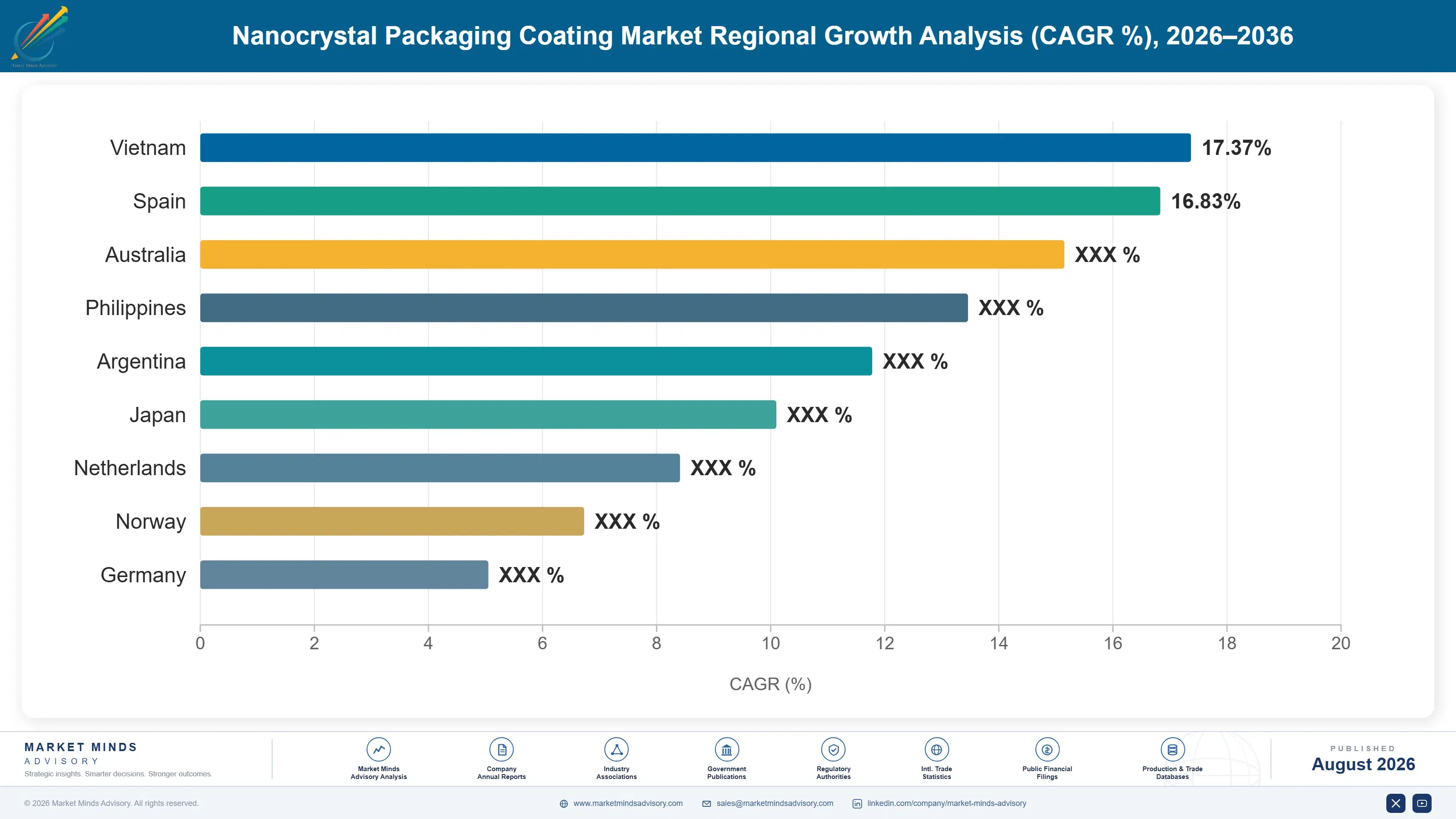
nanocrystal-packaging-coating-market-country-cagr-analysis-1787308052372

Manufacturing Scale-Up and Brand Partnership Strategy

Producers are shifting commercial strategy toward manufacturing scale-up investment, direct brand owner pilot partnership, and performance validation research, capturing early commercial revenue that laboratory-scale demonstration alone increasingly cannot sustain across regulation-tightening major consumer markets globally and beyond, from dedicated biomaterials specialists to diversified forest products conglomerates entering this nascent category across nearly every major category nationwide.

Manufacturing Scale-Up Capital Investment Programme Strategy

Producers are investing in dedicated commercial-scale cellulose nanocrystal production facilities that move beyond pilot demonstration capacity, capturing meaningful manufacturing cost reduction that positions their products for broader commercial specification competitiveness against conventional petroleum-based coating alternatives. This lever requires substantial capital investment in specialized extraction and processing infrastructure, but successfully scaled facilities capture durable, long-term cost leadership positioning within this genuinely capital-intensive category. Producers report scale-up investment improving unit production cost by roughly 31% compared to pilot-scale demonstration facilities across most major production facilities tracked in this report broadly and internationally.
Market Impact: Improves unit production cost by ro

Direct Brand Owner Pilot Partnership Programme Strategy

Producers are building direct pilot partnership relationships with major consumer goods and food packaging brand owners, co-developing customized coating formulations that meet specific sustainability and performance requirements while securing pathway agreements toward future commercial specification volume that spot-market coating sales traditionally never provided. This lever requires meaningful technical collaboration investment without immediate commercial-scale return, but successfully established partnerships generate durable, long-term commercial specification pathways. Producers report pilot partnership strategies improving commercial conversion rates by roughly 33% compared to unstructured market approaches across most partnership regions tracked in this study overall.
Market Impact: Improves commercial conversion rate

Performance Validation Research Investment Strategy Programme

Producers are investing in extensive shelf-life and barrier performance validation research that generates the long-term performance data brand owners require before committing to full commercial packaging specification changes, capturing credibility that unvalidated competitors cannot demonstrate to risk-averse packaging procurement organizations. This lever requires meaningful research investment without immediate commercial return, but successfully validated performance data accelerates broader commercial adoption considerably. Producers report performance validation investment improving brand owner conversion timelines by roughly 27% compared to unvalidated product offerings nationally across most partnership regions and application categories tracked in this study.
Market Impact: Improves conversion timelines by ro

Strategic Forest Products Partnership Investment Strategy

Smaller nanocrystal coating developers are pursuing strategic partnerships and investment relationships with established forest products conglomerates, gaining access to feedstock supply, manufacturing infrastructure, and distribution relationships that standalone biomaterials startups cannot easily build independently within a reasonable commercial timeframe. This lever requires meaningful equity or partnership structuring investment, but successfully established partnerships accelerate commercial scale-up considerably compared to fully independent development pathways. Producers report strategic partnership strategies improving scale-up timeline by roughly 29% compared to independent development approaches nationally across most partnership regions and category diversification efforts tracked and internationally.
Market Impact: Improves scale-up timeline by rough

Who Controls the Margin Pool

The top five producers control roughly 24% of global category spending, a genuinely fragmented concentration reflecting this nascent category's mix of specialty biomaterials pioneers still scaling production and diversified forest products conglomerates entering nanocrystal coating development through internal research programmes and strategic partnerships, and this concentration level has held roughly steady even as newer well-funded entrants keep testing the category's commercial boundaries.
Current competitive activity centers on manufacturing scale-up capital investment, direct brand owner pilot partnership building, and performance validation research, as producers pursue genuinely different strategic emphases depending on whether they compete primarily as dedicated biomaterials specialists or diversified forest products companies entering this emerging category across most major manufacturing regions and pilot pathways tracked in this study across most emerging application areas.

Emerging pressure comes from major diversified chemicals and coatings companies exploring nanocrystal formulation development through internal research programmes, alongside growing East Asian government-backed investment in domestic nanocellulose production capacity that could eventually reshape which companies lead the fastest-growing commercial specification segments specifically, forcing established leaders to respond with acquisitions and scale-up investment rather than organic capability alone within the fastest-growing commercial pathways tracked.
nanocrystal-packaging-coating-market-company-positioning-matrix-1787308052902

Competitive Moat and Risk Dimensions

CELLUFORCE INC.

Moat: Largest Dedicated CNC Production Scale

CelluForce maintains the world's largest dedicated cellulose nanocrystal production capacity built through pioneering multi-decade research and demonstration-scale investment, giving it manufacturing scale and technical expertise that newer entrants would need years of comparable capital investment to replicate at similar commercial volume nationwide today and internationally broadly.
CELLUFORCE INC.

Risk: Scale-Up Manufacturing Cost Challenge

CelluForce faces meaningful exposure to persistent manufacturing scale-up cost challenges that have historically limited nanocrystal coating cost competitiveness against conventional barrier materials, and continued difficulty achieving further cost reduction could meaningfully constrain the company's ability to expand beyond premium sustainability-focused applications currently over time nationally.
MICHELMAN INC.

Moat: Extensive Packaging Coating Relationships

Michelman benefits from extensive existing packaging coating customer relationships and formulation expertise accumulated over decades of conventional coating supply, giving it faster nanocrystal technology commercialization pathways that dedicated biomaterials startups lacking comparable customer access cannot easily replicate nationwide and abroad, reflecting years of dedicated customer relationship investment.
MICHELMAN INC.

Risk: Customer Adoption Timeline Uncertainty

Michelman faces meaningful exposure to slower customer adoption timelines given genuine unfamiliarity with nanocrystal coating performance among conventional packaging converters, and continued adoption delays could meaningfully slow the company's ability to monetize its early nanocrystal formulation research investment relative to projections over time nationally overall.

Players Tracked

Prominent Players

CelluForce Inc.
Stora Enso Oyj
UPM-Kymmene Corporation
Borregaard ASA
Michelman Inc.

Other Key Players

Melodea Ltd.
American Process Inc.
Sappi Limited
Kemira Oyj
Nippon Paper Industries Co., Ltd.
BASF SE
Tetra Pak International S.A.
Sonoco Products Company
Blue Goose Biorefineries Inc.
Fiberlean Technologies Limited
Kruger Biomaterials Inc.
Suzano S.A.
West Fraser Timber Co. Ltd.
Rayonier Advanced Materials Inc.
Nanollose Limited

Recent Developments

MARCH 2026

CelluForce Announces Commercial-Scale Facility Expansion

CelluForce announced expanded commercial-scale cellulose nanocrystal production capacity at its Canadian facility, broadening supply availability to meet growing brand owner pilot and early commercial specification demand across major North American packaging accounts nationwide, following months of internal capital planning and engineering coordination broadly and beyond today.
Signal: Reflects continued large producer investme
OCTOBER 2025

Michelman Signs Pilot Partnership With Major Food Brand

Michelman entered a multi-year pilot partnership agreement with a major food and beverage brand owner to develop customized antimicrobial nanocrystal barrier coating formulations for the company's expanding sustainable packaging portfolio under newly established performance targets following an extended technical evaluation process between both companies' formulation teams.
Signal: Indicates growing direct brand owner engag
JANUARY 2026

Stora Enso Launches Nanocrystal Barrier Coating Product Line

Stora Enso launched a new nanocrystal barrier coating product line targeting food packaging brand owners seeking bio-based alternatives to conventional petroleum barrier structures, positioning the product range to compete for growing sustainability-driven demand nationally following months of internal product development and pilot customer testing today.
Signal: Signals diversified forest products conglo

Wood Pulp Feedstock and Extraction Processing Exposure

Wood pulp feedstock, specialized acid hydrolysis extraction processing, and purification infrastructure together represent roughly 58% of cost of goods sold for nanocrystal coating producers, with feedstock sourced from a concentrated group of forest products suppliers whose output tracks broader timber and pulp market conditions, where limited redundancy across processing capacity shapes long-term sourcing strategy for most producers regardless of scale.
Wood pulp and specialty chemical extraction costs rose meaningfully during 2021 and 2022 amid broader forest products and chemical supply chain disruption, with company annual reports from major producers confirming elevated processing costs persisted through much of 2022 before moderating gradually through 2023 and 2024 to date, according to company annual reports and national statistical office commentary tracking forest products market conditions closely, with 2022 marking the peak of disruption across most producing regions tracked in this study.

Producers without vertically integrated forest products sourcing or dedicated extraction processing infrastructure face materially higher input cost exposure and manufacturing complexity than better-capitalized competitors, creating a durable cost stability advantage for larger companies able to invest in dedicated processing infrastructure, particularly as brand owners increasingly require verified reliable supply chain commitments from qualified suppliers nationally.
nanocrystal-packaging-coating-market-cost-volatility-analysis-1787308053097

Vertical Integration Into Forest Products Sourcing

Larger producers affiliated with established forest products conglomerates benefit from internal wood pulp sourcing relationships that insulate extraction processing costs from open-market volatility, a genuine durable advantage that standalone biomaterials startups generally cannot access without comparable integration nationwide, a mitigation strategy requiring substantial procurement sophistication most smaller biomaterials startups cannot access easily without comparable forest products affiliation.

Extraction Process Efficiency Investment Strategy

Producers are investing in advanced acid hydrolysis and purification process technology that improves extraction yield and reduces processing costs per unit of finished nanocrystal material, gradually closing the cost gap with conventional coating manufacturing processes over time across most major production facilities tracked in this report, positioning better-capitalized producers favorably as broader commercial specification demand continues expanding nationally.

Long-Term Feedstock Supply Contracts

Producers are locking in multi-year wood pulp feedstock supply contracts with forest products suppliers, stabilizing input costs and securing reliable supply volume ahead of anticipated manufacturing scale-up requirements across expanding production facilities across most major manufacturing regions and expansion timelines tracked broadly, reducing exposure to spot-market feedstock price swings that periodically disrupt smaller, less-capitalized competitors nationwide.

Portfolio Architecture for Margin Defence

This market organizes into three commercial tiers spanning early-stage pilot and demonstration coatings at the volume end, standard commercial specification coatings in the middle tier, and premium performance-validated coatings capturing the strongest margins at the top of the portfolio architecture given accumulated validation credibility, a structure that increasingly mirrors the broader industry's shift toward validation-driven premiumization across most major production regions today.
Pilot and commercial tiers pull producers in genuinely different directions: pilot-stage coatings sustain research relationships and technology validation at minimal near-term margin, while commercial specification and premium validated coatings deliver materially stronger margins that increasingly fund the manufacturing scale-up investment this nascent category requires, forcing many producers to run genuinely distinct commercial and research teams for each tier simultaneously broadly.

The highest-value pools concentrate around performance-validated antimicrobial and oxygen barrier coatings sold to brand owners with accumulated shelf-life confidence, where validation credibility and manufacturing scale together sustain premium pricing power that early pilot-stage coatings simply cannot match across comparable commercial volume, making these categories the clearest strategic priority for producers planning multi-year capital investment across the industry and across the wider category today.

Volume / Commodity-Adjacent Tier

Early-stage pilot and demonstration coatings sold at minimal margin to brand owners evaluating technology feasibility across most major categories broadly, competing primarily on relationship depth and technical collaboration rather than pricing or delivery reliability.
Gross Margin: 8-16%

Premium / Certified Tier

Standard commercial specification coatings sold under initial performance validation to sustainability-focused packaging accounts nationally today, typically requiring accumulated shelf-life testing data that early pilot-stage producers rarely possess yet across most categories broadly.
Gross Margin: 22-30%

Sustainability / Regulatory / Next-Generation Tier

Premium performance-validated antimicrobial and barrier coatings commanding the strongest credibility premium available across the industry today, typically sold under long-term supply agreements tied directly to brand owner sustainability commitments and validated performance.
Gross Margin: 34-42%
nanocrystal-packaging-coating-market-portfolio-architecture-1787308053589

High-value Sub-segments and Strategic Watch-out

Antimicrobial Nanocrystal Coatings

The fastest-growing and highest-margin segment, combining strong food safety demand momentum with genuine brand owner willingness to pay premium pricing for demonstrated performance broadly, drawing intense producer research investment and rapidly expanding pilot partnership activity across the industry nationwide today, drawing sustained investment across most major producers tracked.
Gross Margin: 34-42%

Oxygen Barrier Nanocrystal Coatings

Strong margins and steady growth driven by brand owners seeking bio-based alternatives to conventional barrier structures across most major food packaging categories nationwide, particularly among food and beverage brand owners facing tightening extended producer responsibility regulation and internationally today, with adoption spreading steadily across additional brand owner categories.
Gross Margin: 30-38%

Moisture Barrier Nanocrystal Coatings

The volume core segment sustaining broad pilot programme distribution even as premium categories increasingly capture disproportionate industry profit growth nationally overall, even as producers increasingly redirect incremental investment toward faster-growing antimicrobial and barrier categories instead overall broadly, anchoring baseline producer revenue across most product portfolios broadly.
Gross Margin: 20-28%

Heat-Seal Enhancement Nanocrystal Coatings

A strategic watch-out segment facing genuine technical validation challenges, requiring producers to demonstrate consistent seal integrity before broader commercial adoption expands, particularly across applications where seal integrity failures carry the highest packaging performance consequences and abroad currently, requiring careful investment prioritization across the coming several years.
Gross Margin: 16-24%

Pilot-to-Commercial Conversion Streams

Winning a brand owner pilot partnership functions as an annuity anchor across the technology validation period: securing pilot inclusion generates recurring evaluation revenue while building toward eventual commercial specification volume, and losing that pilot relationship to a competing formulation can eliminate a producer's pathway to that brand owner's future commercial packaging portfolio almost entirely within a single technology evaluation cycle affecting broader multi-year supply relatio
Adoption depth varies considerably by end-use vertical: premium food and beverage brand owners with strong sustainability positioning adopt nanocrystal coatings earliest given clear brand differentiation value, while general industrial and value-tier packaging customers more often wait for demonstrated cost parity before considering broader adoption, a pattern that continues shifting gradually as manufacturing scale-up and performance validation accumulate across most packaging categories broadly.

A generational shift is underway as younger packaging engineers and sustainability officers enter procurement roles expecting bio-based barrier alternatives as standard technology consideration, gradually normalizing a category that older procurement generations historically dismissed as unproven laboratory technology lacking commercial track record, a shift producers slow to recognize risk finding themselves increasingly disconnected from where procurement decision-making is heading.
nanocrystal-packaging-coating-market-end-use-penetration-index-1787308054082

Where Nanocrystal Coating Economics Are Heading

These are among the four positions where our research anticipates prominent divergence between winners and laggards over the coming forecast period. Each is grounded in the demand model, the regulatory perimeter, and the announced capacity pipeline.
01 / MANUFACTURING SCALE-UP RACE

Production cost reduction will separate commercially viable leaders

Producers investing in commercial-scale manufacturing capacity are capturing disproportionate share of the fastest-growing, highest-margin premium segments where genuine cost competitiveness increasingly determines which companies can move beyond pilot-stage demonstration into sustained commercial specification volume. Companies without meaningful scale-up investment risk remaining confined to research-stage revenue indefinitely. Expect manufacturing scale-up progress to become the single most important determinant of commercial viability for producers seeking sustainable positioning through the coming decade, well ahead of producers relying purely on pilot-stage demonstration volume alone.
02 / BRAND PARTNERSHIP INVESTMENT

Pilot partnerships will determine commercial specification pathways

Producers building direct brand owner pilot partnerships are capturing disproportionate share of the pathway toward commercial specification volume, where accumulated performance validation and relationship depth increasingly determine which suppliers win eventual full commercial packaging contracts over unvalidated competitors. Companies without meaningful partnership investment risk missing the narrow window during which brand owners actively evaluate emerging barrier technology alternatives. Expect partnership depth to become an increasingly important determinant of commercial conversion success, particularly within the narrow window during which brand owners actively evaluate emerging alternatives.
03 / PERFORMANCE VALIDATION ADVANTAGE

Accumulated shelf-life data will build durable competitive credibility

Producers investing in extensive performance validation research are building durable competitive credibility that unvalidated competitors cannot quickly replicate, since brand owners genuinely require years of accumulated shelf-life data before committing established supply chains to unproven barrier technology alternatives. This advantage compounds further as validated producers accumulate additional application-specific performance data across expanding customer relationships. Expect performance validation depth to become an increasingly important determinant of long-term competitive positioning within this maturing category across most major food safety and sustainability-driven applications tracked.
04 / FOREST PRODUCTS CONSOLIDATION

Diversified conglomerates will increasingly absorb independent innovators

Diversified forest products conglomerates entering nanocrystal coating development through internal research and strategic partnerships are increasingly positioned to absorb smaller independent biomaterials innovators lacking comparable capital access for continued manufacturing scale-up investment. This consolidation trajectory reflects the genuinely capital-intensive nature of commercial-scale nanocrystal production that favors well-capitalized diversified companies over standalone startups. Expect continued acquisition and partnership activity targeting promising independent nanocrystal coating innovators throughout the coming several years across most major biomaterials innovation markets tracked in this study, reflecting the genuine capital intensity of this emerging category.

Engagement Snapshot From the Field

A live engagement with an industry participant carrying material or product regulatory and market exposure ahead of a defining policy shift, showing how our research translates into a defensible multi-year portfolio strategy.
MARKET MINDS ADVISORY · CLIENT ENGAGEMENT SUMMARY
Nanocrystal Packaging Coating Producer Strategic Portfolio Review and Transition Roadmap 2026·Investment Scenario on Nanocrystal Packaging Coating Exposure Evaluation 2025-26
CLIENT PROFILE
The client is an early-stage nanocrystal coating startup generating projected annual revenue of approximately $12 million (client-reported, unverified by MMA) upon successful brand partnership expansion. Leadership sought guidance on prioritizing which brand owner categories to pursue for pilot partnerships ahead of a critical Series B fundraising milestone, running through the following two fiscal quarters ahead of the funding milestone.
STRATEGIC CHALLENGE
The client had secured several small pilot agreements but lacked a clear strategy for converting pilot relationships into the sustained commercial specification volume investors would view as validating the company's path to profitability within a reasonable timeframe with investors evaluating the company's next funding round, given genuinely limited internal resources for pursuing every possible brand owner category simultaneously.
MMA APPROACH
MMA's team benchmarked comparable biomaterials startup partnership strategies, modeled projected pilot-to-commercial conversion timelines under various brand owner category prioritization scenarios, and assessed the client's existing formulation performance data relative to specific application requirements across target categories, drawing on primary interview data gathered from brand owner sustainability procurement teams across the client's core target categories nationwide.
KEY FINDINGS
  1. Food and beverage brand owners with formal packaging sustainability commitments showed meaningfully faster pilot-to-commercial conversion timelines than general industrial packaging customers lacking comparable sustainability mandates.
  2. The client's existing antimicrobial formulation performance data was strongest relative to competitors, suggesting this application category offered the clearest near-term commercial conversion opportunity.
  3. Brand owners already engaged in multiple pilot programmes with competing suppliers showed lower conversion probability than brand owners newly entering nanocrystal coating evaluation for the first time.
  4. A focused strategy targeting a small number of high-probability antimicrobial pilot partnerships reduced projected resource requirements considerably compared to pursuing broad category diversification simultaneously.
CLIENT PROFILE
The client is an early-stage nanocrystal coating startup generating projected annual revenue of approximately $12 million (client-reported, unverified by MMA) upon successful brand partnership expansion. Leadership sought guidance on prioritizing which brand owner categories to pursue for pilot partnerships ahead of a critical Series B fundraising milestone, running through the following two fiscal quarters ahead of the funding milestone.
STRATEGIC CHALLENGE
The client had secured several small pilot agreements but lacked a clear strategy for converting pilot relationships into the sustained commercial specification volume investors would view as validating the company's path to profitability within a reasonable timeframe with investors evaluating the company's next funding round, given genuinely limited internal resources for pursuing every possible brand owner category simultaneously.
MMA APPROACH
MMA's team benchmarked comparable biomaterials startup partnership strategies, modeled projected pilot-to-commercial conversion timelines under various brand owner category prioritization scenarios, and assessed the client's existing formulation performance data relative to specific application requirements across target categories, drawing on primary interview data gathered from brand owner sustainability procurement teams across the client's core target categories nationwide.
KEY FINDINGS
  1. Food and beverage brand owners with formal packaging sustainability commitments showed meaningfully faster pilot-to-commercial conversion timelines than general industrial packaging customers lacking comparable sustainability mandates.
  2. The client's existing antimicrobial formulation performance data was strongest relative to competitors, suggesting this application category offered the clearest near-term commercial conversion opportunity.
  3. Brand owners already engaged in multiple pilot programmes with competing suppliers showed lower conversion probability than brand owners newly entering nanocrystal coating evaluation for the first time.
  4. A focused strategy targeting a small number of high-probability antimicrobial pilot partnerships reduced projected resource requirements considerably compared to pursuing broad category diversification simultaneously.
RECOMMENDED STRATEGY
Phase 1: Phase 1 (Months 1-6): Prioritize antimicrobial pilot partnerships with food and beverage brand owners lacking existing competitor relationships and validate formulation performance against category requirements. Phase 2: Phase 2 (Months 7-14): Deepen priority pilot relationships toward formal commercial specification commitments and volume agreements while monitoring early conversion signals closely. Phase 3: Phase 3 (Months 15-24): Expand successful antimicrobial partnerships into adjacent barrier coating categories based on results achieved and broader competitive market feedback gathered along the way.
OUTCOME
The client secured expanded pilot partnerships within its priority antimicrobial category and advanced two relationships toward commercial specification discussions within the recommended timeline, supporting its subsequent funding milestone (client-reported, unverified by MMA), exceeding the client's original internal projections modestly during the following two fiscal quarters after implementation.

Frequently Asked Questions

Foundational context covering the market sizes, CAGR, scope, country, region and competition that inform every finding below. This section is provided to cover basics and most often pre-purchase conversations, answered from the MMA Primary Research Dataset.

What is the current size of the Nanocrystal Packaging Coating Market?

The market was valued at approximately $0.4 billion in 2025. This includes cellulose nanocrystal and related bio-based barrier and antimicrobial packaging coatings globally and abroad worldwide.

How large will the Nanocrystal Packaging Coating Market be by 2036?

The market is projected to reach approximately $1.95 billion by 2036, up from about $0.46 billion in 2026. This reflects rapid manufacturing scale-up and adoption growth.

What is the CAGR for the Nanocrystal Packaging Coating Market 2026 to 2036?

The market is expected to grow at a compound annual growth rate of 15.5% between 2026 and 2036. This reflects nascent-stage commercialization accelerating from a genuinely small base.

Which segment is growing fastest?

Antimicrobial nanocrystal coatings are the fastest-growing segment, expanding at approximately 19.5% annually, well above the market's 15.5% blended growth rate. This reflects strong food safety demand.

Who are the major companies in the Nanocrystal Packaging Coating Market?

Leading companies include CelluForce, Stora Enso, UPM-Kymmene, Borregaard, and Michelman. Together these five producers account for roughly 24% of global category spending across most regions.

Which country is growing fastest?

China is the fastest-growing major country at an estimated 18.2% CAGR, driven by its rapidly scaling packaging manufacturing infrastructure and materials investment and abroad nationwide.

Report Segmentation Architecture

The full report scope spans multiple orthogonal segmentation dimensions, with cross-tabulated demand data provided for each dimension pair. Coverage extends further to regional breakdowns, trend trajectories, and the competitive detail needed to support segment-level decision-making.

By Coating Function

  • Oxygen Barrier Coatings
  • Moisture Barrier Coatings
  • Antimicrobial Coatings
  • UV-Protective Coatings
  • Heat-Seal Enhancement Coatings
  • Grease and Oil Resistance Coatings

By End-Use Industry

  • Food and Beverage Packaging
  • Pharmaceutical and Healthcare Packaging
  • Consumer Goods Packaging
  • Industrial and Shipping Packaging
  • Cosmetics and Personal Care Packaging

By Commercial Dimension

  • Direct Brand Owner Pilot Partnerships
  • Commercial Specification Supply Contracts
  • Packaging Converter Distribution Channels
  • Research and Development Collaboration Agreements

By Region

  • North America
  • Western Europe
  • East Asia
  • South Asia and Pacific
  • Latin America
  • Middle East and Africa
  • Eastern Europe

Scope, Methodology, and Coverage

Every figure in this report is reproducible from documented input assumptions. The scope below maps the historical period, the forecast horizon, the segmentation dimensions, and the countries covered, alongside the underlying primary and qualitative methodology.
Historical Period
2020 to 2025
Forecast Period
2026 to 2036
Base Year
2025 (USD billions; MMA Primary Research Dataset, August 2026)
Market Definition
This report covers nanocrystalline coating technologies applied to packaging substrates for barrier, antimicrobial, and protective performance, primarily cellulose nanocrystal and related bio-based nanomaterial formulations. It excludes conventional petroleum-based barrier coatings, nanoparticle additives incorporated directly into substrate materials, and non-packaging nanocrystal applications entirely.
Quantitative Units
USD billions (current prices); production volume in metric tons; average selling price per coating application
Segmentation Dimensions
By Coating Function; By End-Use Industry; By Commercial Dimension; By Region
Regions Covered
North America, Western Europe, East Asia, South Asia and Pacific, Latin America, Middle East and Africa, Eastern Europe
Countries Covered
USA, China, Germany, France, UK, Japan, South Korea, India, Australia, Canada, Brazil, Mexico, Indonesia, Vietnam, Thailand, Malaysia, UAE, Saudi Arabia, South Africa, Nigeria, Turkey, Poland, Netherlands, Italy, Spain, Sweden, Switzerland, Argentina, Colombia, Singapore, and additional markets relevant to this sector
Key Companies Profiled
CelluForce Inc., Stora Enso Oyj, UPM-Kymmene Corporation, Borregaard ASA, Michelman Inc., Melodea Ltd., American Process Inc., Sappi Limited, Kemira Oyj, Nippon Paper Industries Co., Ltd., BASF SE, Tetra Pak International S.A., Sonoco Products Company, Blue Goose Biorefineries Inc., Fiberlean Technologies Limited, Kruger Biomaterials Inc., Suzano S.A., West Fraser Timber Co. Ltd., Rayonier Advanced Materials Inc., Nanollose Limited
Quantitative Methodology
Primary survey, n=3,800 respondents, Q4 2025, six countries; demand-side model with trade association cross-validation
Qualitative Methodology
47 expert interviews, Q4 2025; applied to validate demand model assumptions, identify emerging dynamics, and assess competitive positioning
Report Format
PDF and XLSX data workbook (Word format preview document)
Publisher
Market Minds Advisory
Report Code
MMA-2026-CHM-141
Published
August 2026
Contact
sales@marketmindsadvisory.com | www.marketmindsadvisory.com

Purchase the full Nanocrystal Packaging Coating Market Report (2026 to 2036).

The full report provides detailed coating-function segmentation, country-level production capacity and regulatory analysis, and channel distribution tracking across major global packaging innovation markets covered in this study. It includes producer-level competitive benchmarking based on manufacturing scale-up progress and brand partnership depth, alongside detailed performance validation commentary. Subscribers receive quarterly updates tracking new pilot programmes and manufacturing capacity announcements as they occur. A companion dataset provides production capacity estimates by country for detailed market sizing purposes, including scenario modeling for manufacturing scale-up investment and brand partnership development planning.
Coating-function segmentation breakdown by category type
Country-level production capacity and regulatory analysis
Distribution channel tracking and benchmarking service
Producer competitive benchmarking scorecards and overview
Quarterly pilot programme and capacity update service
Production capacity dataset segmented by country region

Built For The People Who Decide

From boardroom strategy to bench-side execution, this report is read cover-to-cover by leaders shaping the next decade of their industry, turning demand scenarios, market dynamics and valuation benchmarks into decisions.
CXOs/ Presidents/ VPs/ Managers
M&A and Corporate Development
Strategy Teams and R&D Heads
Procurement and Product Directors
Regulatory and Compliance Leaders
Investor Relations and Equity Analysts