Market Minds Advisory
Nano Enabled Packaging Market

Nano Enabled Packaging Market: Migration Rules, Barrier Without Layers and the Word Brand Owners Will Not Print

A material authorised for food contact in conventional form is not authorised in nano form, which means the regulatory pathway restarts from zero for every particle size a converter decides to use.

Lead Analyst

Bilal Shaikh

Published

September 2026

Make Smarter Decisions with Customized Research Insights

Request a free sample report and evaluate market opportunities, growth trends, and competitive dynamics relevant to your business needs.

2025 MARKET VALUE$1.4BMarket Size 2025
2036 FORECAST VALUE$5.3BBase Case , 2026 to 2036
CAGR 2026 TO 203612.8 %Bull 14.0% / Bear 11.6%
INCREMENTAL OPPORTUNITY$3.7BNet 10- year value creation
EXPANSION MULTIPLE3.33x2036 value over 2026 base
Strategic Levers
M&A Pipeline
Regional Outlook
Country Rankings
Competitive Intelligence
Segmental Deep-dive
Call-Us : 91 93563 13602

Executive Snapshot and Market Trajectory

European food contact rules treat a nanoparticle as a different substance from the same material at conventional scale, so prior authorisation counts for nothing. That single provision explains why a technology with genuine performance advantages has commercialised so unevenly across applications. Physics was never the obstacle here.
Nanocellulose coatings compound at 19.2%, exactly 1.50 times the market, because they are derived from wood pulp and carry a food safety argument the metal oxide systems cannot make. East Asia holds 33% of demand, well above the usual band, on Japanese transparent barrier film leadership Neither position was built recently. Chinese production capacity has no equivalent anywhere else. Toppan and Dai Nippon still supply the world's reference barrier products directly from Japanese plants today.
Five suppliers hold 31%. The competitive question is not who can disperse a nanoparticle, which is now routine, but who holds migration data and food contact authorisation for the specific particle and polymer combination a customer wants. That evidence takes years and never transfers. An authorisation covers one particle in one polymer at one loading, which makes dossier holdings a genuine competitive asset rather than a compliance expense.
Market Definition
The market covers packaging materials incorporating engineered nanoscale components for functional purpose, spanning nanoclay barrier composites, nanocellulose coatings and films, nano-metal oxide antimicrobial systems, thin-film nano barrier coatings, nano-enabled sensing and indicator systems, and nano-additive light barrier systems. Conventional micron-scale fillers, standard metallised films, packaging electronics without nanoscale components and nanomaterial production sold outside packaging are excluded.
Base Year Value
$1.4B in 2025 (MMA Primary Research Dataset, August 2026)
Forecast Period
2026 to 2036, eleven discrete annual values
CAGR
12.8% base case. Bull 14.0%. Bear 11.6%.
Fastest Growth Segment
Nanocellulose Coatings and Films: 19.2% CAGR
Fastest Growth Country
India: 15.6% CAGR
Fastest Growth Region
South Asia and Pacific: 14.8% CAGR
Largest Region
East Asia: 33% of 2025 global value
Market Leaders
Toppan Holdings, Amcor, Dai Nippon Printing, Mitsubishi Chemical Group, BASF. Source: MMA Analysis based on company annual reports.
Primary Survey
n=3,800 procurement and R&D decision-makers, Q4 2025, six countries
Methodology
Demand-side build-up, cross-validated against public data, 47 expert interviews

Nano Enabled Packaging Market Forecast Scenarios

nano-enabled-packaging-market-size-forecast-scenario-1787307938080
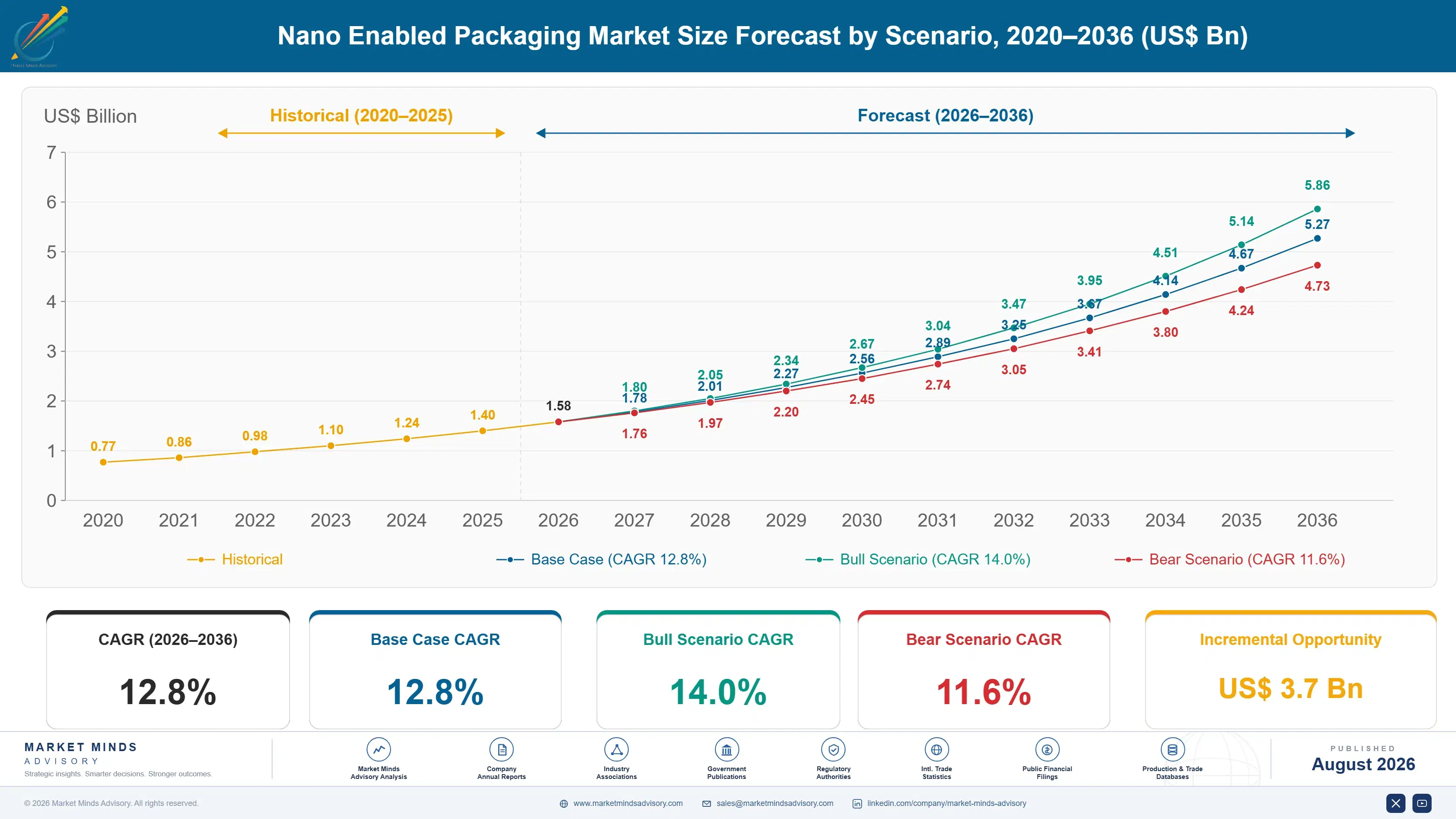
Growth ran at an implied 11.0% across 2020 to 2025 and it came almost entirely from barrier applications rather than from the antimicrobial and sensing concepts that dominated earlier expectations. Recyclability requirements arriving from 2022 gave nanoclay and thin-film barrier a commercial argument they had lacked, since both raise barrier without adding an incompatible layer.
The base case at 12.8% rests on three mechanisms. Mono-material recyclable structures need barrier performance that a single polymer cannot deliver alone, and nanoscale barrier supplies it without breaking recyclability. Nanocellulose carries a food safety story derived from wood pulp that shortens the authorisation path considerably. And transparent high-barrier films keep displacing aluminium foil where visibility matters commercially. All three mechanisms are pulling in the same direction, which has not been true of this category at any earlier point.
The bull case at 14.0% assumes European authorisation of several further nano-form substances for food contact, which would open applications currently blocked at the regulatory rather than the technical stage. The bear case at 11.6% follows from migration concerns tightening authorisation further, and from brand owners continuing to avoid any consumer-facing reference to nanotechnology in food packaging.

Performance Nobody Wants to Put on the Label

The technology works. Nanoclay platelets dispersed in a polymer create a tortuous diffusion path that can cut oxygen transmission by a factor of 38 without adding a separate barrier layer, and thin-film aluminium oxide coatings do something comparable while staying transparent. What has held commercialisation back is not physics but a regulatory principle almost nobody outside the industry knows about.
TOP FIVE CONCENTRATION31%Combined share held by the five largest global suppliers
FOOD CONTACT AUTHORISATION TIME44 monthsTypical elapsed period from dossier submission to European authorisation
BARRIER IMPROVEMENT FACTOR38 timesOxygen transmission reduction achievable through nanoscale barrier layers
MIGRATION DETECTION THRESHOLD10 parts per billionAnalytical sensitivity now expected in food contact migration studies
CONSUMER-FACING DISCLOSURE RATE4% of productsShare of packaging referencing nanotechnology anywhere on the pack
MONO-MATERIAL COMPATIBLE SHARE62% of applicationsNanoscale barrier work supporting recyclable single-polymer structure conversion
European food contact regulation treats a substance at nanoscale as a distinct substance requiring its own authorisation. A material safely used for decades at conventional particle size starts the assessment process from the beginning if a converter reduces it below the threshold. Typical elapsed time from dossier to authorisation runs around 44 months, and the resulting approval covers one specific particle, in one specific polymer, at one specific loading.
There is a communications problem underneath the regulatory one. Only about 4% of nano-enabled packaging references the technology anywhere on the pack, because brand owners have concluded that explaining nanotechnology to a food shopper carries far more downside than upside. That silence is rational and it also slows the category, since nobody is building consumer familiarity.
"The most commercially successful nanomaterial in packaging is the one where the particle stays firmly locked in the polymer and never goes anywhere near the food. That is not a coincidence, and every supplier chasing an active migrating system should think carefully about why."
Director, Advanced Packaging Materials and Barrier Technology Practice · MMA Adv

Market Trends

Recyclable Mono-Material Structures Create the Barrier Opening

European Packaging and Packaging Waste Regulation recyclability requirements are pushing brands toward single-polymer structures, which sacrifices the barrier that multilayer laminates delivered through incompatible layers. Nanoscale barrier solves that directly: dispersed platelets or a thin oxide coating raise barrier performance without introducing a polymer the recycling stream cannot handle. Roughly 62% of current nano barrier work supports mono-material conversion rather than conventional laminate improvement. That application did not exist commercially five years ago and it now drives the majority of genuine adoption in the category. Sustainability functions rather than packaging teams now specify it.
Market Impact: Barrier improvement reaching 38 tim
Nanocellulose Carries a Regulatory Story Metal Oxides Cannot

Nanocellulose is produced from wood pulp by mechanical or enzymatic fibrillation, which means the starting material has a long food contact history and the safety argument begins from a far more comfortable position than any engineered metal oxide. It delivers useful oxygen barrier and mechanical reinforcement, and it composts. Scandinavian and Japanese pulp producers have built genuine production capacity. The segment compounds at 19.2% against a market at 12.8%, and its advantage is regulatory and reputational rather than any superiority in raw barrier performance. Humidity performance remains the honest weakness.
Market Impact: Shelf life extended 30 to 50%

Market Opportunities and Growth Drivers

Transparent High-Barrier Films Displace Aluminium Foil

Aluminium foil delivers excellent barrier and blocks the product entirely from view, which brands increasingly find commercially unacceptable in categories where appearance sells. Vapour-deposited aluminium oxide and silicon oxide coatings only nanometres thick deliver comparable oxygen and moisture barrier while remaining transparent, and they survive retort and microwave use where foil does not. Japanese producers led this development and still hold the reference products. Foil also complicates recycling and metal detection in food plants, giving three separate reasons for conversion beyond the visual argument alone. Japanese producers still hold the reference products.
Market Impact: Authorisation taking 44 months

Shelf Life Extension Reduces Food Waste Measurably

Retailers and brand owners face waste reduction commitments and the arithmetic of food waste is unforgiving: a product discarded after distribution wastes everything invested in producing it. Nanoscale barrier extends shelf life materially in oxygen-sensitive categories including coffee, cheese, cured meats and nuts, frequently by 30 to 50%. That gain reduces returns, widens distribution radius and permits smaller safety margins on date coding. The commercial case is made on waste and distribution economics rather than on packaging performance, which reaches a different budget holder entirely. That budget holder rarely attends packaging meetings.
Market Impact: Disclosure on only 4% of packs

Market Restraints and Challenges

Nano-Form Authorisation Restarts the Regulatory Process Entirely

European food contact regulation treats a nanoscale substance as distinct from the same material at conventional size, so decades of safe use at micron scale confer no authorisation at all. The root cause is a genuine scientific one: particle size alters surface reactivity and biological behaviour enough that regulators will not extrapolate. Typical dossier to authorisation runs around 44 months and covers one particle in one polymer at one loading. Suppliers mitigate by concentrating on non-migrating bound systems and on nanocellulose, where the safety argument starts from a better place.
Market Impact: Mono-material work at 62% of applic

Brand Owners Refuse Consumer-Facing Nanotechnology Disclosure

Only about 4% of nano-enabled packaging mentions the technology anywhere on the pack. The root cause is a straightforward commercial judgement: explaining nanotechnology to a food shopper offers negligible upside and considerable risk if a campaign group takes an interest. That silence keeps consumer familiarity at zero and prevents the category building the acceptance that would ease regulatory caution. Suppliers mitigate by selling on function rather than technology, describing barrier performance and shelf life gain without naming the mechanism delivering them. Function sells perfectly well without the mechanism attached to it.
Market Impact: Nanocellulose compounding at 19.2%
4 additional market trends, 3 additional growth drivers, and 2 additional restraints and challenges are covered in the full report. Contact sales@marketmindsadvisory.com to access the complete intelligence.

Segment CAGR and Growth Architecture

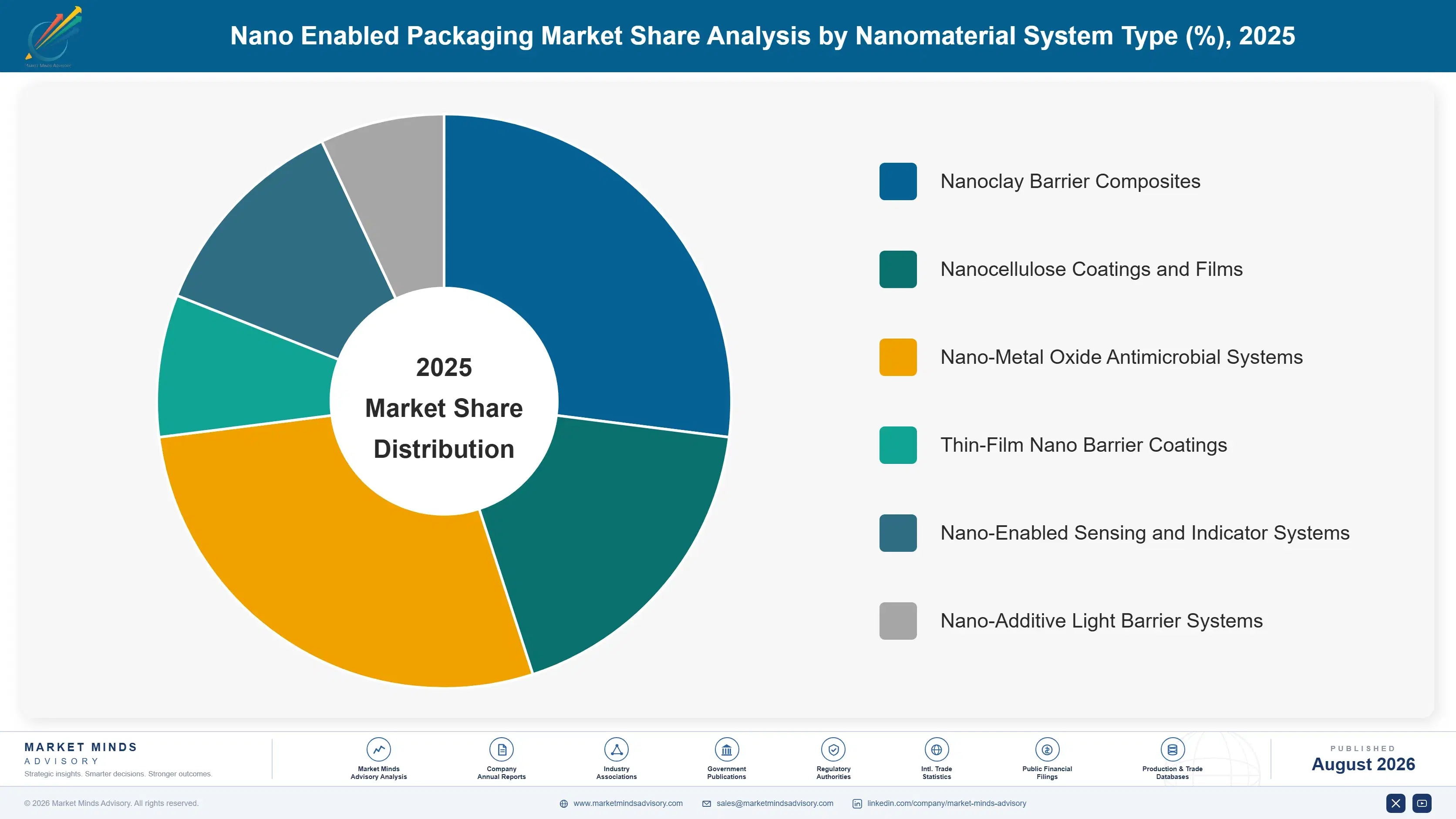
Segmentation follows nanomaterial system type, because the material determines the regulatory pathway, the migration question and the functional benefit together. A bound nanoclay platelet and a deliberately migrating silver ion sit at opposite ends of the food contact assessment, and no supplier is credible across both by default. Material choice decides the whole pathway.
nano-enabled-packaging-market-market-share-analysis-1787307938615

Nanocellulose Coatings and Films

Nanocellulose compounds at 19.2%, exactly 1.50 times the market rate, and its advantage is regulatory rather than technical. Produced from wood pulp by mechanical or enzymatic fibrillation, it begins the food safety conversation from a starting material with a very long contact history, which shortens dossier work that engineered metal oxides face in full. It delivers genuine oxygen barrier, mechanical reinforcement and grease resistance, and it composts at end of life. Scandinavian and Japanese pulp producers have built real production capacity behind it. Barrier performance under high humidity remains the honest weakness, since cellulose absorbs moisture, and coating formulation work to address that is where most current development effort sits.
CAGR 19.2%

Thin-Film Nano Barrier Coatings

Vapour-deposited aluminium oxide and silicon oxide coatings grow at 14.6% by giving brands foil-level barrier with full transparency. The deposited layer is only nanometres thick, adds negligible weight and does not compromise recyclability the way an aluminium layer does. It also survives microwave heating and passes metal detection in food plants, both of which foil fails. Japanese producers pioneered the technology and still hold the reference products, with deposition uniformity across web width being the difficult manufacturing problem rather than the chemistry itself. Capital intensity is high, since vacuum deposition equipment is expensive and slow, which keeps the supplier field narrow and pricing firmer than most barrier technologies achieve. Capacity expansion is a major decision.
CAGR 14.6%
Full segment breakdown across 6 segments available in the complete report.

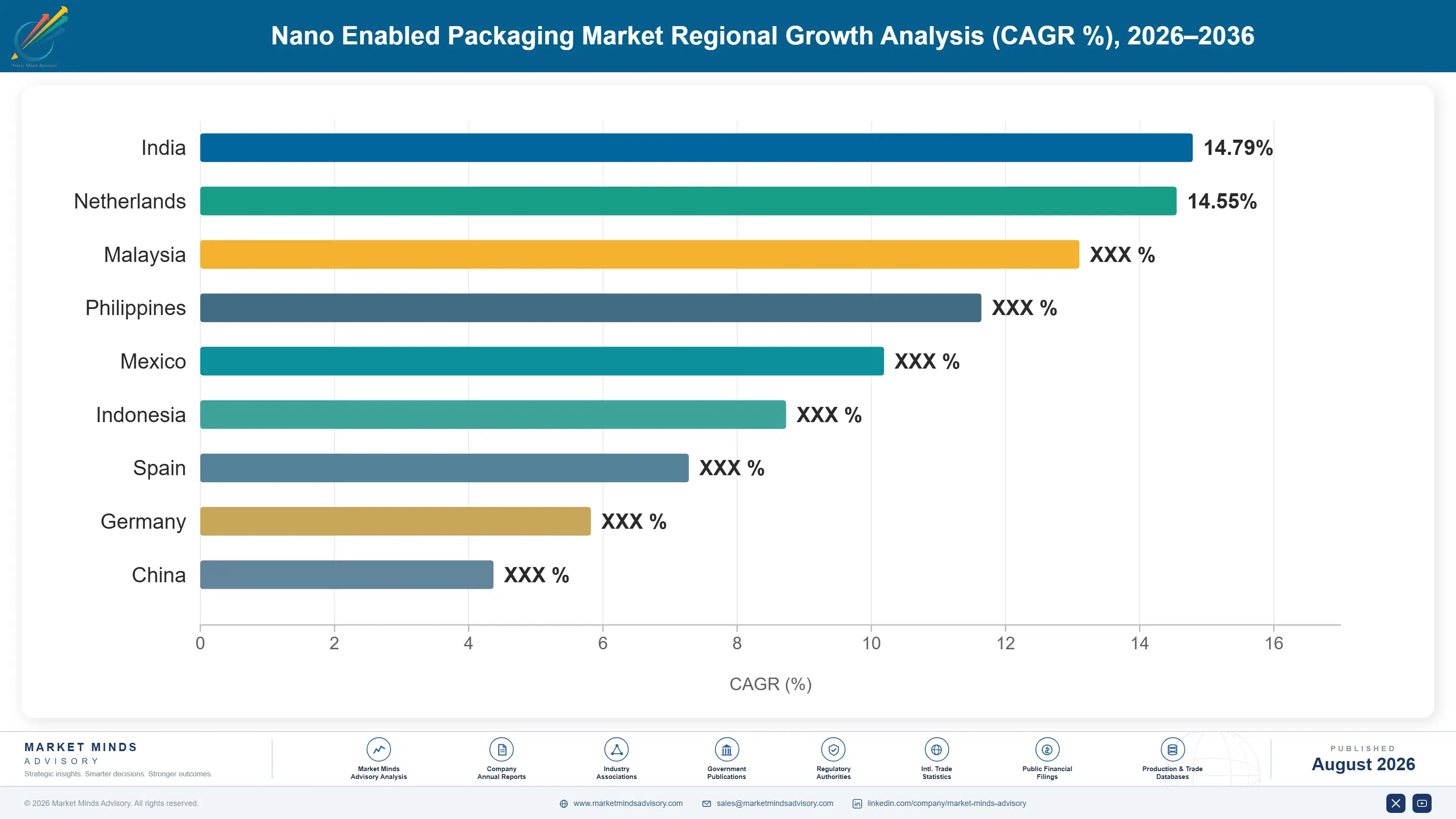
Regional Architecture and Country Demand Map

Demand concentrates where advanced converting capability and regulatory tolerance coincide, which is a narrower set of places than packaging consumption alone would suggest. Production capability in barrier deposition and nanomaterial supply is even more geographically concentrated than the demand itself. Deposition capability in particular sits in remarkably few places.

East Asia

East Asia holds 33% of global demand. Note: this exceeds the standard regional band because Japanese producers developed transparent vapour-deposited barrier films and still hold the reference products worldwide, while Chinese nanomaterial production capacity has no equivalent in any other region. Toppan and Dai Nippon Printing supply transparent high-barrier films into food, pharmaceutical and electronics applications globally from Japanese plants. Chinese nanoclay and nano-oxide production serves both domestic converters and export, at costs Western producers cannot match. Korean demand concentrates in electronics packaging where barrier requirements are extreme. Japanese retort and microwaveable food formats have driven transparent barrier adoption further than any other consumer market. Regional growth of 13.8% reflects both production leadership and genuine domestic application depth.
Share: 33% | CAGR: 13.8% (2026 to 2036)

North America

North America accounts for 24% of demand and grows at 12.2%. Food and Drug Administration food contact notification is generally faster and more predictable than European authorisation, which has let several nano barrier and additive systems reach commercial use here ahead of Europe. Shelf life extension is the dominant commercial argument, driven by distribution distances that are longer than in most regions and by retailer waste reduction commitments. Pharmaceutical and medical device packaging accounts for a disproportionate share of the higher-value work, since barrier requirements there are absolute and cost sensitivity is lower. Consumer-facing disclosure is avoided as consistently as elsewhere, with brands describing function rather than naming the technology.
Share: 24% | CAGR: 12.2% (2026 to 2036)
Regional intelligence for 5 additional markets available in the complete report: Western Europe, South Asia and Pacific, Latin America, Middle East and Africa, Eastern Europe. Contact sales@marketmindsadvisory.com.
nano-enabled-packaging-market-country-cagr-analysis-1787307939138

Selling Function Without Naming the Technology

Commercial success here depends on avoiding two traps: an authorisation pathway that restarts for every particle size, and a consumer conversation nobody wants to have. The positions that work sell measurable performance, keep the particle bound in the matrix, and never require the word to appear on a pack. All four avoid the migration conversation.

Position Barrier as the Enabler of Recyclable Structures

Mono-material conversion fails on barrier, because a single polymer cannot deliver what a multilayer laminate did through incompatible layers. Nanoscale barrier resolves that without adding anything the recycling stream rejects, and 62% of current nano barrier work now supports exactly this conversion. Selling into a sustainability mandate rather than a packaging performance discussion reaches a budget holder with a deadline rather than a cost target. Structures sold on this basis carry premiums of roughly 22 to 34% over conventional mono-material film without the barrier layer. Deadlines beat cost targets. Nothing else closes that gap.
Market Impact: Barrier structures priced 22 to 34%

Build Authorisation Dossiers as a Defensible Asset

European authorisation for a nano-form substance takes around 44 months and covers one particle, in one polymer, at one loading. That is usually treated as a cost of entry and it is better understood as a moat. A supplier holding authorisation for a specific combination can quote work that competitors cannot approach for nearly four years regardless of their technical capability. Dossier investment should therefore be directed at combinations with the widest commercial applicability rather than at whatever a first customer happened to request. Timing beats technical merit here. Sequencing matters more than spending.
Market Impact: Authorisation blocking every rival

Favour Bound Systems Over Deliberately Migrating Ones

The nanomaterials that have commercialised successfully are those where the particle stays locked in the polymer and never reaches the food. Antimicrobial systems work by releasing ions, which is precisely the behaviour regulators scrutinise hardest, and their growth at 9.6% sits well below the market rate as a result. Directing development toward bound barrier and reinforcement systems avoids the hardest regulatory conversation entirely. It is a less exciting technical story and a considerably better commercial one, with authorisation timelines running months rather than years shorter. Regulators do not extrapolate. Surface reactivity changes with size.
Market Impact: Bound systems now growing above 14.

Sell Shelf Life Into Waste Reduction Budgets

Nanoscale barrier extends shelf life by 30 to 50% in oxygen-sensitive categories, which reduces returns, widens distribution radius and permits tighter date coding. Presented as packaging performance that is a cost increase to be justified. Presented as waste reduction it reaches a retailer or brand function holding a public commitment and a separate budget. The arithmetic favours the seller: a product discarded after distribution wastes everything invested in making and moving it, which dwarfs any packaging cost difference by a wide margin. Presentation decides which budget hears it. The arithmetic favours the seller.
Market Impact: Shelf life gains reaching a full 50

Who Controls the Margin Pool

Five suppliers hold 31% of the market measured on nano-enabled packaging material revenue, the basis applied consistently through this section. Concentration reflects capital intensity in deposition coating and the cost of authorisation dossiers rather than any scale advantage in converting. Toppan Holdings and Amcor lead, from quite different positions. Converting scale confers remarkably little here.
Competition operates on three dimensions. Food contact authorisation holdings decide which particle and polymer combinations a supplier can commercialise in a given jurisdiction. Deposition coating capacity decides participation in transparent high-barrier work, where vacuum equipment is expensive and slow. And nanomaterial supply security decides whether a converter controls its input or depends on a specialty producer with limited capacity. None of the three is quickly acquired.

Two pressures will reshape position. Nanocellulose producers coming from the pulp industry rather than from packaging hold a regulatory advantage that packaging incumbents cannot replicate by investment. Against that, Chinese nanomaterial capacity is lowering input costs across the category. Rankings will move toward suppliers pairing authorisation holdings with genuine deposition capacity. Very few hold both today, and the pulp producers moving into the category are approaching it from a direction packaging incumbents cannot easily follow.
nano-enabled-packaging-market-company-positioning-matrix-1787307939660

Competitive Moat and Risk Dimensions

TOPPAN HOLDINGS

Moat: Transparent barrier film leadership

Toppan developed transparent vapour-deposited barrier film and its products remain the global reference in applications requiring foil-level barrier with product visibility. Deposition uniformity across web width is the genuinely difficult manufacturing problem in this technology, and decades of process refinement are not something a competitor replicates by purchasing equipment.
TOPPAN HOLDINGS

Risk: Capital intensity of deposition

Vacuum deposition equipment is expensive and runs slowly, which caps output and makes capacity expansion a major capital decision rather than an incremental one. Nanocellulose and dispersed platelet systems achieve useful barrier through far cheaper processes, and where the application does not demand absolute barrier those alternatives compete on delivered cost the deposition route cannot match.
AMCOR

Moat: Converting reach and brand access

Amcor combines global converting capacity with direct relationships at the multinational brand owners who decide packaging specification, which matters because nano barrier is sold into recyclability mandates held at group level rather than at individual plants. That access lets the company present barrier as the enabler of a mono-material conversion programme rather than as a film upgrade.
AMCOR

Risk: Dependence on external nanomaterials

The company converts rather than produces the nanomaterials involved, which leaves input supply and authorisation holdings partly in others' hands. Suppliers holding food contact authorisation for a specific particle and polymer combination control which structures can be commercialised, and a converter without those holdings competes on conversion capability in a category where the material carries the differentiation.

Players Tracked

Prominent Players

Toppan Holdings
Amcor
Dai Nippon Printing
Mitsubishi Chemical Group
BASF

Other Key Players

Sealed Air
Constantia Flexibles
Sonoco Products Company
Honeywell
Avery Dennison
Stora Enso
UPM
Borregaard
Nippon Paper Industries
Oji Holdings
Kuraray
Toray Industries
Nanocyl
Evonik Industries
CelluComp

Recent Developments

JANUARY 2025

Mono-material barrier conversions expand across European brand portfolios

Brand owners extended recyclable single-polymer packaging conversions into categories requiring genuine oxygen barrier, using nanoscale barrier layers to preserve shelf life without compromising recyclability. This reflects sustainability programme execution rather than any corporate transaction between suppliers. Barrier is the enabling technology rather than an upgrade.
Signal: Recyclability mandates rather than perform
MAY 2025

Nanocellulose production capacity expands at Nordic pulp producers

Scandinavian pulp producers commissioned additional microfibrillated and nanofibrillated cellulose capacity, targeting barrier coating and reinforcement applications in packaging. These were organic capital investments rather than acquisitions, and they bring a pulp industry safety argument into a packaging materials contest. Barrier and reinforcement are the target applications.
Signal: A material derived from wood pulp starts i
SEPTEMBER 2025

Food contact authorisation timelines lengthen for engineered nanoparticles

European authorisation reviews for nano-form food contact substances continued extending as migration data requirements tightened, with analytical sensitivity expectations reaching parts per billion. These were regulatory review practice developments rather than rule changes or commercial actions. Incumbents holding granted authorisations benefit from every further extension of the review timeline.
Signal: The regulatory barrier is rising rather th

Particles, Vacuum and Dossier Overhead

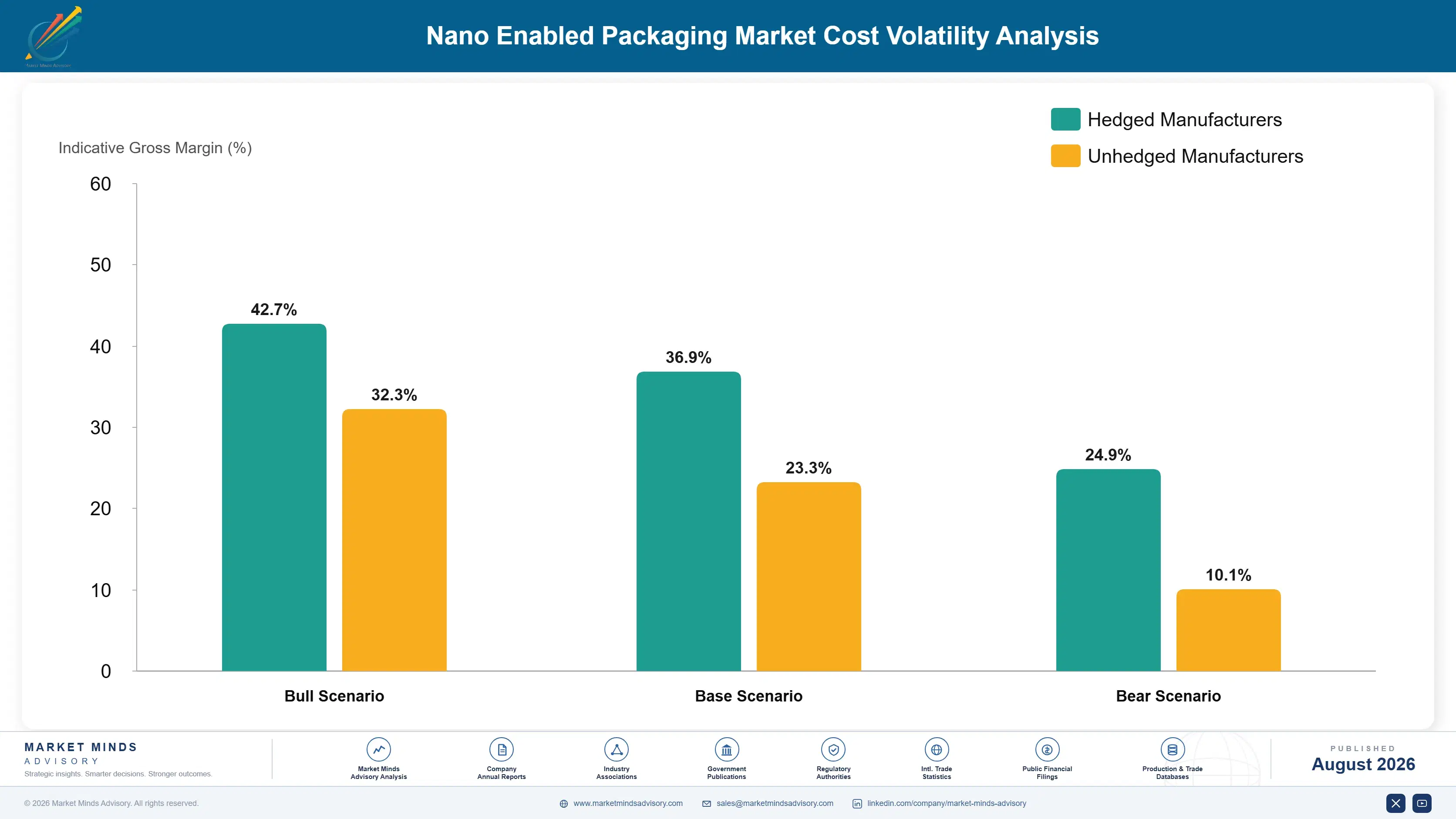
Base polymer film accounts for roughly 38% of cost of goods, with the nanomaterial itself running between 9% and 22% depending on system type. Deposition coating carries a quite different structure, where vacuum equipment depreciation and energy dominate at around 31% and the deposited material is almost negligible by mass. Regulatory affairs, migration testing and authorisation maintenance sit largely outside cost of goods.
Speciality nanomaterial pricing moved sharply through 2022 and 2023 as European energy disruption raised production costs for metal oxides and processed clays, and International Energy Agency reporting across that period documents the underlying movement. Vacuum deposition is energy-intensive and European operators absorbed increases that Japanese and Chinese competitors did not face equally. Company annual reports covering advanced packaging materials segments disclose the resulting margin pressure through several quarters.

Exposure divides by process route rather than by scale. Deposition coaters carry high fixed cost and energy exposure, which punishes them badly at low utilisation but gives strong operating leverage when demand is firm. Dispersed platelet and nanocellulose routes carry lower fixed cost and higher material cost, which flattens the exposure. The disadvantage falls hardest on European deposition operators competing against Japanese and Chinese capacity on delivered cost.
nano-enabled-packaging-market-cost-volatility-analysis-1787307939859

Secure nanomaterial supply through long-term agreements

Speciality nanomaterial production capacity is narrow and concentrated, so a converter buying on spot faces both price volatility and genuine availability risk. Multi-year agreements with named producers stabilise both, and they matter more than usual here because a change of material source may require the authorisation dossier to be revisited, which is a far larger consequence than a price movement.

Run deposition capacity at high utilisation deliberately

Vacuum coating carries high fixed cost and low variable cost, so utilisation determines unit economics far more than material pricing does. Filling capacity with lower-margin industrial and technical film work outside peak food and pharmaceutical demand protects the cost base for the higher-value applications, which is the same logic that governs any capital-intensive process.

Direct dossier investment at broadly applicable combinations

An authorisation covers one particle in one polymer at one loading, and dossiers cost time rather than only money at around 44 months each. Choosing combinations with the widest commercial applicability rather than responding to whichever customer asks first converts a compliance expense into a competitive asset that blocks rivals for years. Sequencing matters more than spending.

Portfolio Architecture for Margin Defence

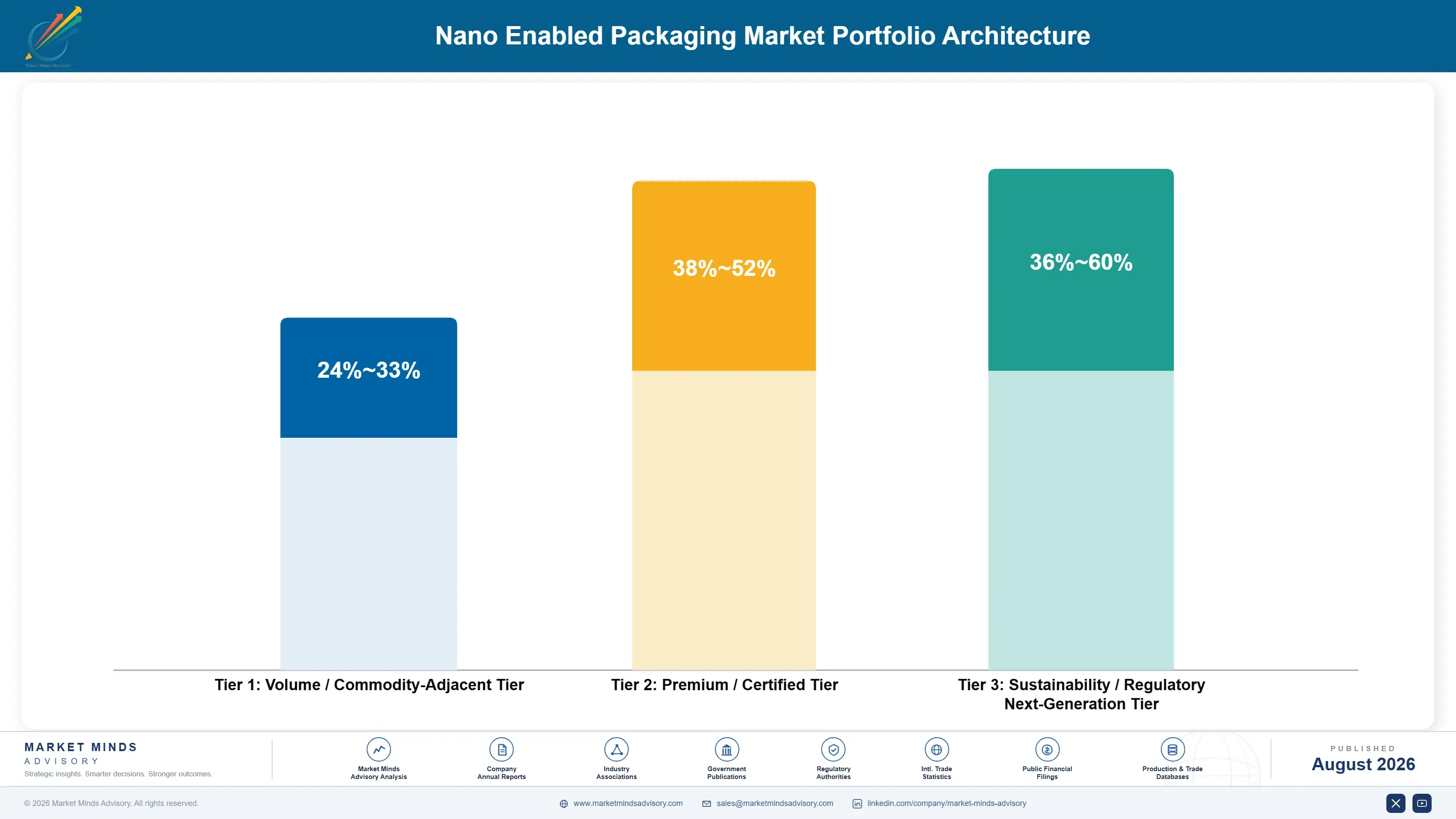
The portfolio separates on where the particle ends up. Bound systems where the nanomaterial stays locked in the polymer face a manageable regulatory pathway and have commercialised steadily. Migrating systems, principally antimicrobials that work by releasing ions, face the hardest assessment precisely because the mechanism requires the thing regulators worry about. Nanocellulose sits apart, carrying a pulp-derived safety argument neither group can make. Where the particle ends up draws the whol
The tension is that the most commercially interesting functional claims tend to require migration. An antimicrobial that never reaches the food surface does nothing useful, and a freshness indicator must respond to what is happening inside the pack. Suppliers repeatedly rediscover that the technically exciting applications are the commercially blocked ones, and that barrier, which is dull, is where the revenue actually is. Barrier is dull and it pays. Suppliers rediscover this repeatedly and usually late.

High-value pools concentrate where absolute barrier is required and cost sensitivity is low. Pharmaceutical packaging, electronics and premium food all qualify, and each rewards deposition capability rather than dispersion formulation. Dispersion formulation is not the differentiator in any of them. Deposition capability rather than formulation wins them.

Volume / Commodity-Adjacent Tier

Nanoclay and nano-additive filled films providing incremental barrier, stiffness or light protection in mainstream food and consumer packaging. Competes against conventional filled and coated films on delivered cost, with modest performance differentiation available.
Gross Margin: 24-33%

Premium / Certified Tier

Vapour-deposited transparent barrier films and authorised nano barrier systems for pharmaceutical, electronics and premium food applications. Capital intensity in deposition and held food contact authorisations both restrict the field of suppliers able to quote.
Gross Margin: 38-52%

Sustainability / Regulatory / Next-Generation Tier

Nanocellulose coatings and barrier systems enabling recyclable mono-material conversion. The wide margin range reflects the gap between established deposition work and nanocellulose applications where production capacity and humidity performance are both still maturing.
Gross Margin: 36-60%
nano-enabled-packaging-market-portfolio-architecture-1787307940357

High-value Sub-segments and Strategic Watch-out

Nanocellulose Barrier Coatings

Compounding at 19.2% on a food safety argument derived from wood pulp that engineered particles cannot make. Barrier performance under high humidity remains the honest weakness, and coating formulation work to address it is where most current development effort now sits. Pulp producers hold the advantage.
Gross Margin: 42-60%

Transparent Deposition Barrier Films

Growing at 14.6% by delivering foil-level barrier with full product visibility, plus microwave compatibility and metal detection performance that foil fails. Deposition uniformity across web width keeps the supplier field narrow and pricing firmer than most barrier technologies achieve. Capital intensity keeps entrants out. Vacuum equipment is slow.
Gross Margin: 40-52%

Nanoclay Filled Barrier Films

The volume core at 12.2%, competing against conventional filled and coated films on delivered cost with modest performance differentiation. Run for converting utilisation and customer access rather than for margin, which the incremental barrier gain does not command. Conventional coated films compete directly. Utilisation is the point.
Gross Margin: 24-33%

Migrating Antimicrobial Systems

The watch-out at 9.6%, well below the market rate. These work by releasing metal ions into the product, which is exactly the behaviour European authorisation scrutinises hardest, so the mechanism that makes them useful also blocks them. The mechanism is the obstacle. Growth sits below the market.
Gross Margin: 20-46%

Locked In by the Authorisation

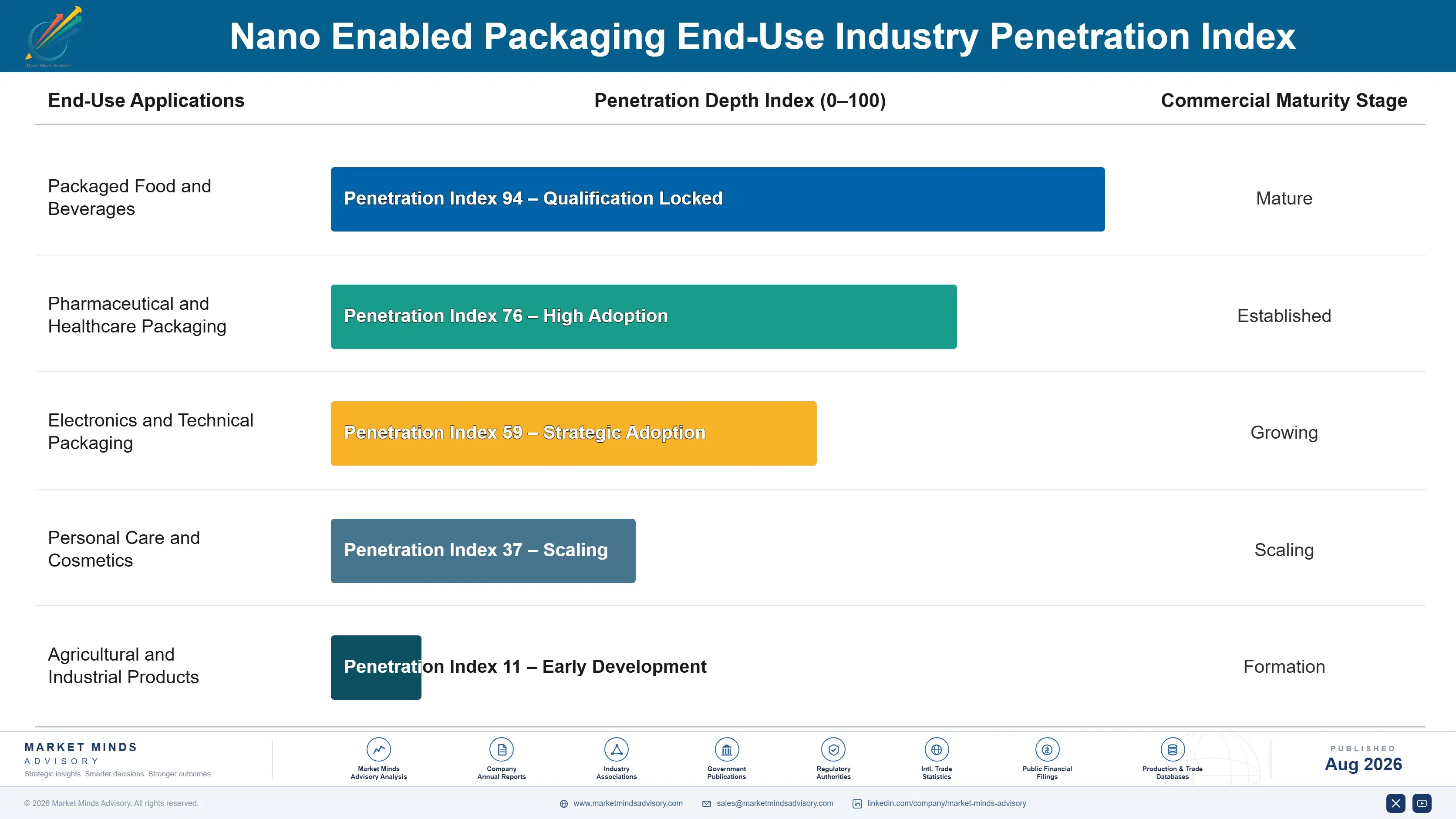
Recurring revenue here rests on regulatory holdings rather than on contracts. An authorisation covers one particle, in one polymer, at one loading, and a brand owner that has qualified a structure on that basis cannot substitute an alternative without confirming the replacement carries equivalent standing. With authorisation running around 44 months, a supplier holding the relevant dossier is protected for years rather than for a contract term. Regulatory holdings are the lock.
Depth varies sharply by application. Pharmaceutical packaging buys deepest, since barrier requirements are absolute and qualification is documented in a regulatory file. Premium food buys deeply where shelf life carries direct commercial value. Mainstream food packaging buys shallowly and switches readily, treating incremental barrier as a cost. Electronics buys narrowly but at high specification, valuing moisture barrier above everything else. Requirement severity rather than customer size sets depth.

The buying population has shifted away from packaging technical functions. Nano barrier is now most often specified by a sustainability team holding a recyclability deadline, and that participant evaluates whether the structure survives a recycling stream rather than assessing the barrier physics at all. Barrier physics rarely enters that conversation at all.
nano-enabled-packaging-market-end-use-penetration-index-1787307940846

Where Nano Materials Actually Sell

These are among the four positions where our research anticipates prominent divergence between winners and laggards over the coming forecast period. Each is grounded in the demand model, the regulatory perimeter, and the announced capacity pipeline.
01 / RECYCLABILITY BARRIER ENABLEMENT

Barrier is the reason mono-material conversions succeed or stall

Single-polymer structures cannot deliver the barrier that multilayer laminates achieved through incompatible layers, and that gap is what stops recyclability conversions in oxygen-sensitive categories. Nanoscale barrier closes that gap without adding anything the recycling stream rejects, and roughly 62% of all current nano barrier work now supports exactly this conversion. Selling into a sustainability mandate reaches a budget holder working to a deadline rather than to a cost target, and structures sold on that basis carry premiums of 22 to 34%.
02 / AUTHORISATION AS MOAT

Forty-four months of regulatory work blocks every competitor

European food contact rules treat a nanoscale substance as distinct from the same material at conventional size, so an authorisation covers one particle in one polymer at one loading and takes around 44 months to obtain. Most suppliers treat that as a cost of entry when it is far better understood as a durable competitive barrier. Dossier investment directed at broadly applicable combinations, rather than at whatever a first customer happened to request, converts compliance spending into a genuinely durable competitive asset.
03 / MIGRATION AVOIDANCE DISCIPLINE

The exciting applications are precisely the blocked ones

Every nanomaterial that has commercialised successfully in packaging keeps the particle firmly bound in the polymer, where it never reaches the food at all. Antimicrobial systems work by deliberately releasing metal ions, which is exactly the behaviour that regulators scrutinise hardest of all, and they consequently grow at just 9.6% against a market compounding at 12.8%. Development directed at bound barrier and reinforcement systems avoids the hardest assessment entirely, which makes for a duller technical story and a considerably better commercial one.
04 / SILENT VALUE COMMUNICATION

Sell the shelf life gain and never mention the mechanism

Only about 4% of nano-enabled packaging references the technology anywhere on the pack, because brand owners judge that explaining nanotechnology to a food shopper carries risk and no upside. Suppliers should follow that logic rather than fight it, selling a 30 to 50% shelf life extension into a waste reduction budget where a discarded product wastes everything invested in producing and distributing it. The function sells perfectly well on its own; the mechanism behind it never needs naming at all.

Engagement Snapshot From the Field

A live engagement with an industry participant carrying material or product regulatory and market exposure ahead of a defining policy shift, showing how our research translates into a defensible multi-year portfolio strategy.
MARKET MINDS ADVISORY · CLIENT ENGAGEMENT SUMMARY
Nano Enabled Packaging Producer Strategic Portfolio Review and Transition Roadmap 2026·Investment Scenario on Nano Enabled Packaging Exposure Evaluation 2025-26
CLIENT PROFILE
A packaged food manufacturer with roughly USD 4.8 billion in revenue (client-reported, unverified by MMA), operating across coffee, snacks and chilled categories in European and North American markets. The company had committed publicly to fully recyclable packaging by 2030 and had converted about 41% of its portfolio (client-reported, unverified by MMA), with the remainder blocked on barrier performance in oxygen-sensitive lines.
STRATEGIC CHALLENGE
Coffee and nut categories could not convert to mono-material structures without unacceptable shelf life loss, and the packaging team had concluded the commitment was undeliverable for roughly a third of the portfolio. Procurement had tested three barrier options on price and rejected all of them as too expensive against the conventional laminates they replaced.
MMA APPROACH
MMA rebuilt the comparison to include distribution and waste costs alongside packaging cost, then mapped supplier food contact authorisation holdings against the specific polymer and barrier combinations the client's structures required in both jurisdictions. Shelf life testing data from suppliers was normalised to comparable conditions. Nanocellulose humidity limits were assessed by category.
KEY FINDINGS
  1. Two of the three rejected barrier options had been compared on packaging cost alone, and both showed positive economics once returns, waste and extended distribution radius were included in the calculation.
  2. Only one supplier held European food contact authorisation for the specific particle and polymer combination the client's coffee structure needed, and that supplier had not been invited to quote at all.
  3. Shelf life claims from the three suppliers had been tested under different humidity and temperature conditions, making the comparison procurement ran effectively meaningless as presented.
  4. Nanocellulose options were viable for the nut category but not for coffee, where humidity sensitivity would have compromised barrier performance across the required shelf life.
CLIENT PROFILE
A packaged food manufacturer with roughly USD 4.8 billion in revenue (client-reported, unverified by MMA), operating across coffee, snacks and chilled categories in European and North American markets. The company had committed publicly to fully recyclable packaging by 2030 and had converted about 41% of its portfolio (client-reported, unverified by MMA), with the remainder blocked on barrier performance in oxygen-sensitive lines.
STRATEGIC CHALLENGE
Coffee and nut categories could not convert to mono-material structures without unacceptable shelf life loss, and the packaging team had concluded the commitment was undeliverable for roughly a third of the portfolio. Procurement had tested three barrier options on price and rejected all of them as too expensive against the conventional laminates they replaced.
MMA APPROACH
MMA rebuilt the comparison to include distribution and waste costs alongside packaging cost, then mapped supplier food contact authorisation holdings against the specific polymer and barrier combinations the client's structures required in both jurisdictions. Shelf life testing data from suppliers was normalised to comparable conditions. Nanocellulose humidity limits were assessed by category.
KEY FINDINGS
  1. Two of the three rejected barrier options had been compared on packaging cost alone, and both showed positive economics once returns, waste and extended distribution radius were included in the calculation.
  2. Only one supplier held European food contact authorisation for the specific particle and polymer combination the client's coffee structure needed, and that supplier had not been invited to quote at all.
  3. Shelf life claims from the three suppliers had been tested under different humidity and temperature conditions, making the comparison procurement ran effectively meaningless as presented.
  4. Nanocellulose options were viable for the nut category but not for coffee, where humidity sensitivity would have compromised barrier performance across the required shelf life.
RECOMMENDED STRATEGY
Phase 1: Phase 1 (months 1 to 6): Rebuild barrier evaluation on total cost including waste and distribution, and requalify the two wrongly rejected options. Phase 2: Phase 2 (months 6 to 18): Qualify the authorisation-holding supplier for coffee structures and secure multi-year supply against that dossier position. Phase 3: Phase 3 (months 18 to 30): Convert nut and snack categories to nanocellulose barrier where humidity conditions permit adequate performance.
OUTCOME
Recyclable portfolio coverage reached 74% within two years against the previous 41% (client-reported, unverified by MMA). Packaging cost rose by approximately USD 11 million annually while waste and returns fell by roughly USD 19 million (client-reported, unverified by MMA). The coffee structure conversion was secured under a five-year supply agreement tied to the supplier's authorisation holding.

Frequently Asked Questions

Foundational context covering the market sizes, CAGR, scope, country, region and competition that inform every finding below. This section is provided to cover basics and most often pre-purchase conversations, answered from the MMA Primary Research Dataset.

What is the current size of the Nano Enabled Packaging Market?

The global market was worth USD 1.42 billion in 2025, reaching USD 1.6 billion in 2026. East Asia holds the largest regional share at 33% of demand.

How large will the Nano Enabled Packaging Market be by 2036?

MMA forecasts USD 5.34 billion by 2036, an expansion multiple of 3.33 times the 2026 base. That represents roughly USD 3.74 billion of incremental value.

What is the CAGR for the Nano Enabled Packaging Market 2026 to 2036?

The base case compounds at 12.8% annually, with a bull case of 14.0% and a bear case of 11.6%. Historical growth from 2020 to 2025 ran at 11.0%.

Which segment is growing fastest?

Nanocellulose coatings and films compound at 19.2%, exactly 1.50 times the market rate. Wood pulp origin gives them a food contact safety argument engineered particles cannot make.

Who are the major companies in the Nano Enabled Packaging Market?

Toppan Holdings, Amcor, Dai Nippon Printing, Mitsubishi Chemical Group and BASF hold a combined 31% of the market. Japanese producers hold the reference products in transparent barrier film.

Which country is growing fastest?

India compounds at 15.6%, ahead of every other national market. Ambient temperature and humidity destroy shelf life in conventional packaging, making barrier improvement commercially valuable.

Report Segmentation Architecture

The full report scope spans multiple orthogonal segmentation dimensions, with cross-tabulated demand data provided for each dimension pair. Coverage extends further to regional breakdowns, trend trajectories, and the competitive detail needed to support segment-level decision-making.

By Nanomaterial System Type

  • Nanoclay Barrier Composites
  • Nanocellulose Coatings and Films
  • Nano-Metal Oxide Antimicrobial Systems
  • Thin-Film Nano Barrier Coatings
  • Nano-Enabled Sensing and Indicator Systems
  • Nano-Additive Light Barrier Systems

By End-Use Industry

  • Packaged Food and Beverages
  • Pharmaceutical and Healthcare Packaging
  • Electronics and Technical Packaging
  • Personal Care and Cosmetics
  • Agricultural and Industrial Products

By Commercial Dimension

  • Direct Brand Owner Specification
  • Converter Material Supply
  • Licensed Technology and Formulation
  • Sustainability Programme Procurement

By Region

  • North America
  • Western Europe
  • East Asia
  • South Asia and Pacific
  • Latin America
  • Middle East and Africa
  • Eastern Europe

Scope, Methodology, and Coverage

Every figure in this report is reproducible from documented input assumptions. The scope below maps the historical period, the forecast horizon, the segmentation dimensions, and the countries covered, alongside the underlying primary and qualitative methodology.
Historical Period
2020 to 2025
Forecast Period
2026 to 2036
Base Year
2025 (USD billions; MMA Primary Research Dataset, August 2026)
Market Definition
The market covers packaging materials incorporating engineered nanoscale components for a functional purpose, spanning nanoclay barrier composites, nanocellulose coatings and films, nano-metal oxide antimicrobial systems, vapour-deposited thin-film nano barrier coatings, nano-enabled sensing and indicator systems, and nano-additive light barrier systems. Conventional micron-scale fillers, standard aluminium metallised films, packaging electronics without nanoscale functional components and nanomaterial production sold outside packaging applications are excluded. Sizing is measured at material supplier revenue in current prices.
Quantitative Units
USD billions (current prices); square metres of nano-enabled material and barrier transmission rates where applicable
Segmentation Dimensions
By Nanomaterial System Type; By End-Use Industry; By Commercial Dimension; By Region
Regions Covered
North America, Western Europe, East Asia, South Asia and Pacific, Latin America, Middle East and Africa, Eastern Europe
Countries Covered
USA, China, Germany, France, UK, Japan, South Korea, India, Australia, Canada, Brazil, Mexico, Indonesia, Vietnam, Thailand, Malaysia, UAE, Saudi Arabia, South Africa, Nigeria, Turkey, Poland, Netherlands, Italy, Spain, Sweden, Switzerland, Argentina, Colombia, Singapore, and additional markets relevant to this sector
Key Companies Profiled
Toppan Holdings, Amcor, Dai Nippon Printing, Mitsubishi Chemical Group, BASF, Sealed Air, Constantia Flexibles, Sonoco Products Company, Honeywell, Avery Dennison, Stora Enso, UPM, Borregaard, Nippon Paper Industries, Oji Holdings, Kuraray, Toray Industries, Nanocyl, Evonik Industries, CelluComp
Quantitative Methodology
Primary survey, n=3,800 respondents, Q4 2025, six countries; demand-side model with trade association cross-validation
Qualitative Methodology
47 expert interviews, Q4 2025; applied to validate demand model assumptions, identify emerging dynamics, and assess competitive positioning
Report Format
PDF and XLSX data workbook (Word format preview document)
Publisher
Market Minds Advisory
Report Code
MMA-2026-PAC-696
Published
August 2026
Contact
sales@marketmindsadvisory.com | www.marketmindsadvisory.com

Purchase the full Nano Enabled Packaging Market Report (2026 to 2036).

The full report sizes nano enabled packaging across six material system types, three commercial dimensions and seven regions, with annual forecasts to 2036 under base, bull and bear scenarios. Food contact authorisation holdings are mapped supplier by supplier against particle and polymer combinations, showing which structures can actually be commercialised in each jurisdiction today. Mono-material conversion barrier requirements are quantified by product category, identifying where nanoscale barrier is the enabling technology rather than an upgrade. Migration assessment requirements are compared across regulatory frameworks. Twenty suppliers are profiled on a consistent material revenue basis.
Food contact authorisation holdings mapped by particle and polymer
Mono-material barrier requirements quantified by product category
Migration assessment requirements compared across regulatory frameworks
Deposition coating capacity assessed by region and web width
Shelf life extension data normalised to comparable test conditions
Nanocellulose humidity performance benchmarked against alternatives

Built For The People Who Decide

From boardroom strategy to bench-side execution, this report is read cover-to-cover by leaders shaping the next decade of their industry, turning demand scenarios, market dynamics and valuation benchmarks into decisions.
CXOs/ Presidents/ VPs/ Managers
M&A and Corporate Development
Strategy Teams and R&D Heads
Procurement and Product Directors
Regulatory and Compliance Leaders
Investor Relations and Equity Analysts