Market Minds Advisory
N-Propyl Acetate Market

N-Propyl Acetate Market: Finished toluene substitution, retained solvent limits and recovery displacement to 2036

The substitution that built this market is now roughly nine tenths complete, and very little forecasting in the industry has registered that the growth it generated is finishing with it.

Lead Analyst

Bilal Shaikh

Published

September 2026

Make Smarter Decisions with Customized Research Insights

Request a free sample report and evaluate market opportunities, growth trends, and competitive dynamics relevant to your business needs.

2025 MARKET VALUE$0.7BMarket Size 2025
2036 FORECAST VALUE$1.1BBase Case , 2026 to 2036
CAGR 2026 TO 20364.8 %Bull 6.0% / Bear 3.6%
INCREMENTAL OPPORTUNITY$0.4BNet 10- year value creation
EXPANSION MULTIPLE1.60x2036 value over 2026 base
Strategic Levers
M&A Pipeline
Regional Outlook
Country Rankings
Competitive Intelligence
Segmental Deep-dive
Call-Us : 91 93563 13602

Executive Snapshot and Market Trajectory

Brand owners banned toluene from food packaging inks and regulation followed across most major markets, and that elimination is now roughly 91% complete. This solvent was among the principal beneficiaries. The substitution driving a decade of growth has largely finished, and demand has to come from somewhere else now.
Low-retention food contact grades grow at 7.2%, half again the market rate of 4.8%, because laminates must hold residual solvent below around 5 milligrammes per square metre or the residue migrates through the film into food and taints it. East Asia holds 30% of value on flexible packaging printing volume nothing elsewhere approaches. Packaging inks take 58% of total demand. Industrial coatings grow far more slowly at 3.4%.
Five producers hold 42% of supply and that concentration follows propanol and acetic acid access rather than any esterification advantage, since the reaction itself is elementary chemistry any competent operation runs. The demand mechanism nobody models properly is recovery: large rotogravure operations recapture and redistil around 82% of everything they use, which keeps virgin demand growing well below printed film volume. Packaging output overstates the addressable market badly. That gap widens with every recovery installation.
Market Definition
This report covers n-propyl acetate supplied as a solvent across printing, coatings, adhesive, cosmetic and speciality applications, spanning flexible packaging inks, industrial coatings, adhesives and laminating, low-retention food contact grades, cosmetics and personal care, and bio-based and renewable grades. Value is measured at producer level on tonnage supplied. Excluded are other acetate esters sold as alternatives, n-propanol and acetic acid sold as products, formulated inks and coatings, and recovered solvent traded between printing operations.
Base Year Value
$0.7B in 2025 (MMA Primary Research Dataset, August 2026)
Forecast Period
2026 to 2036, eleven discrete annual values
CAGR
4.8% base case. Bull 6.0%. Bear 3.6%.
Fastest Growth Segment
Low-Retention Food Contact Grades: 7.2% CAGR
Fastest Growth Country
India: 8.0% CAGR
Fastest Growth Region
South Asia and Pacific: 6.8% CAGR
Largest Region
East Asia: 30% of 2025 global value
Market Leaders
Eastman Chemical, Dow, BASF, Celanese and Jiangsu Baichuan High-tech lead the market. Source: MMA Primary Research Dataset, July 2026.
Primary Survey
n=3,800 procurement and R&D decision-makers, Q4 2025, six countries
Methodology
Demand-side build-up, cross-validated against public data, 47 expert interviews

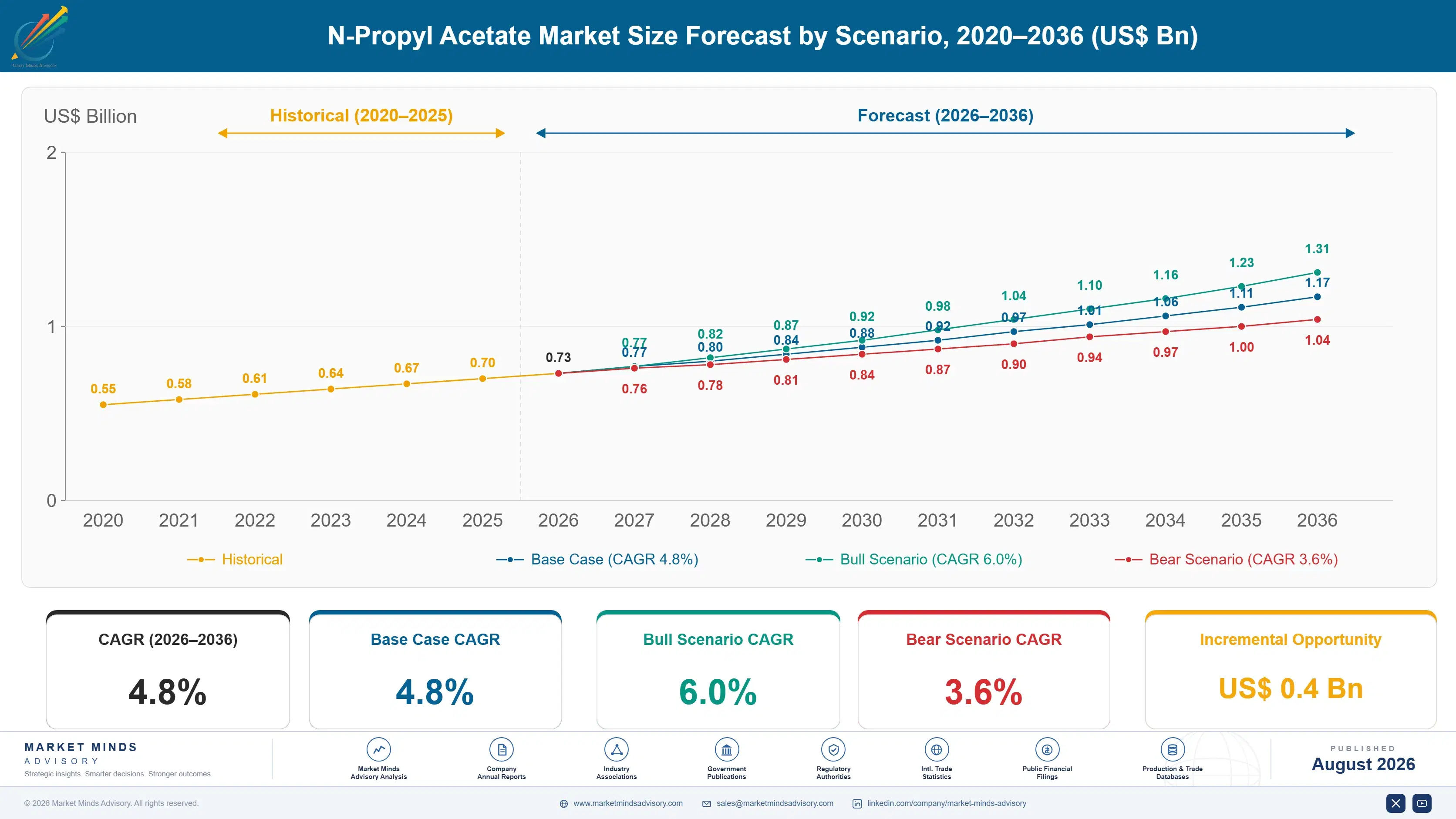
N-Propyl Acetate Market Forecast Scenarios

n-propyl-acetate-market-trends-size-forecast-scenario-1787555817509
Growth ran at 3.8% between 2020 and 2025 and toluene substitution carried most of it. Brand owners banned toluene from food packaging inks on migration and toxicity grounds and regulators followed across most major markets, which forced ink formulators toward acetate esters delivering comparable evaporation rate and solvency without the problem. That conversion is now roughly 91% complete, and the growth it generated is finishing alongside it.
The 4.8% base case rests on three mechanisms. Flexible packaging printing volume keeps expanding with packaged food consumption across Asian and Latin American markets where penetration remains below developed norms. Low-retention food contact grades keep taking share at 7.2% as brand owners treat taint as a recall matter. And bio-based grades keep growing at 6.6% as brand owners specify renewable content in packaging. Packaged food penetration there remains well below developed norms.
The 6.0% bull case is water-based ink adoption stalling on the high-speed non-absorbent film applications where it has never performed adequately, which would preserve solvent demand indefinitely. The 3.6% bear case is gravure solvent recovery improving beyond 82%, since every recovery gain removes virgin demand permanently rather than deferring it to any later period. Recovery rates keep improving with equipment investment.

The Substitution That Finished

A decade of growth in this solvent came from a substitution that has now largely run its course. Brand owners including the largest food manufacturers banned toluene from packaging inks on migration and toxicity grounds, regulators followed across most major markets, and formulators moved to acetate esters delivering comparable evaporation rate and solvency without the problem. That elimination stands at roughly 91% complete. The conversion demand is therefore finishing, and forecasts extrapolating the historical rate are projecting a driver that has almost stopped operating.
TOP-FIVE CONCENTRATION42%Combined position across ester solvent supply held by leading producers
PACKAGING INK APPLICATION SHARE58%Portion of volume consumed printing flexible packaging films
RETAINED SOLVENT LIMIT5 mgResidue per square metre food packaging laminates must not exceed
TOLUENE ELIMINATION PROGRESS91%Share of food packaging inks now formulated without any toluene
FEEDSTOCK COST SHARE66%Portion of production cost attributable to propanol and acetic acid
GRAVURE SOLVENT RECOVERY RATE82%Portion recaptured and redistilled inside large rotogravure printing operations
What continues is a specification requirement that shapes the whole market. Food packaging laminates must retain no more than around 5 milligrammes of residual solvent per square metre, because residue migrates through the film into food and produces taint that brand owners treat as a recall event rather than a quality complaint. Meeting that limit depends on solvent purity, evaporation profile and dryer performance together, and it favours grades manufactured specifically for the application over general industrial material.
The demand mechanism most analysis omits is recovery. Large rotogravure operations recapture and redistil around 82% of the solvent they use, because losing it is expensive and emissions permits require capture anyway. Every improvement removes virgin demand permanently.
"Everybody in this market grew on toluene coming out of food packaging inks and most of them are still forecasting as though that continues. It is ninety per cent finished. The growth from here has to come from specification, not substitution."
Director, Solvents and Printing Chemicals Practice · MMA Chemicals and Materials Practice · August 2026

Market Trends

Toluene substitution completes and its growth ends with it

Food manufacturers banned toluene from packaging inks on migration and toxicity grounds and regulators followed across most major markets, which drove a decade of conversion toward acetate esters delivering comparable performance. That elimination now stands at roughly 91% complete across food packaging applications. The remaining volume sits in geographies and applications where enforcement is weakest and conversion hardest. Commercially this means the largest single growth driver in this solvent's recent history is finishing, and producers extrapolating historical rates are forecasting a mechanism that has almost stopped generating new demand for anybody.
Market Impact: Takes 58% of total demand
Retained solvent limits favour purpose-manufactured grades

Food packaging laminates must hold residual solvent below around 5 milligrammes per square metre, because residue migrates through the film and produces taint that brand owners treat as a recall matter rather than a quality issue. Meeting that limit depends on solvent purity, evaporation profile consistency and dryer performance together, and impurities with higher boiling points are exactly what remains behind. Low-retention grades manufactured specifically for the application compound at 7.2% and command premiums that general industrial material never will, because the printer cannot risk a taint event. Requalifying a grade means fresh retained solvent testing nobody undertakes casually.
Market Impact: Segment compounds at 6.6% annually

Market Opportunities and Growth Drivers

Flexible packaging printing expands with Asian food consumption

Packaged food consumption keeps rising across Asian, Latin American and African markets where penetration remains well below developed norms, and almost all of that packaging is printed flexible film requiring solvent-based ink on non-absorbent substrates at high speed. Indian growth at 8.0% is the fastest of any country here and rests on modern retail expansion and packaged food adoption rather than on any technical development. The demand follows food consumption and urbanisation directly, which makes it unusually predictable and entirely insensitive to anything happening in solvent chemistry. Printed film volume is the whole mechanism, and it keeps rising.
Market Impact: Recaptures 82% of consumption

Brand owners specify renewable content in packaging materials

Food and consumer goods manufacturers increasingly carry packaging sustainability commitments that reach into ink and solvent composition alongside the film itself, and bio-derived propanol and acetic acid routes permit a chemically identical ester with renewable carbon content. Growth at 6.6% follows brand owner specification rather than any regulatory requirement or performance difference. The material costs more and performs identically, which makes it a pure positioning purchase that some buyers fund willingly and others decline entirely. Mass balance certification is how most of it reaches the market in practice. Physically segregated renewable supply remains rare and costly.
Market Impact: Holds coatings growth at 3.4%

Market Restraints and Challenges

Solvent recovery removes virgin demand permanently

Large rotogravure printing operations recapture and redistil around 82% of the solvent they consume, driven by both the cost of losing it and emissions permits requiring capture regardless. The root cause is that solvent-based printing generates concentrated vapour streams that condensation and carbon adsorption handle efficiently, unlike diffuse industrial emissions. Commercially this means virgin demand grows well below printed volume and every recovery improvement removes demand rather than deferring it. Producers modelling from packaging output consistently overstate their addressable market, and recovery rates continue improving with equipment investment. Emission permits ensure the trend continues regardless of solvent price.
Market Impact: Reaches 91% toluene elimination

Water-based inks displace solvent where substrates permit

Water-based flexographic inks eliminate solvent entirely and work well on absorbent substrates and at moderate line speeds, which has taken paper and board printing almost completely. The root cause of their limitation is drying energy, since water carries far more latent heat than an ester and non-absorbent film at high speed simply cannot be dried fast enough. Commercially that boundary has been stable for years and defines where solvent inks remain necessary. Producers are responding by concentrating on high-speed film applications rather than contesting segments water-based inks have already won.
Market Impact: Meets a 5 milligramme retention limit
3 additional market trends, 4 additional growth drivers, and 2 additional restraints and challenges are covered in the full report. Contact sales@marketmindsadvisory.com to access the complete intelligence.

Segment CAGR and Growth Architecture

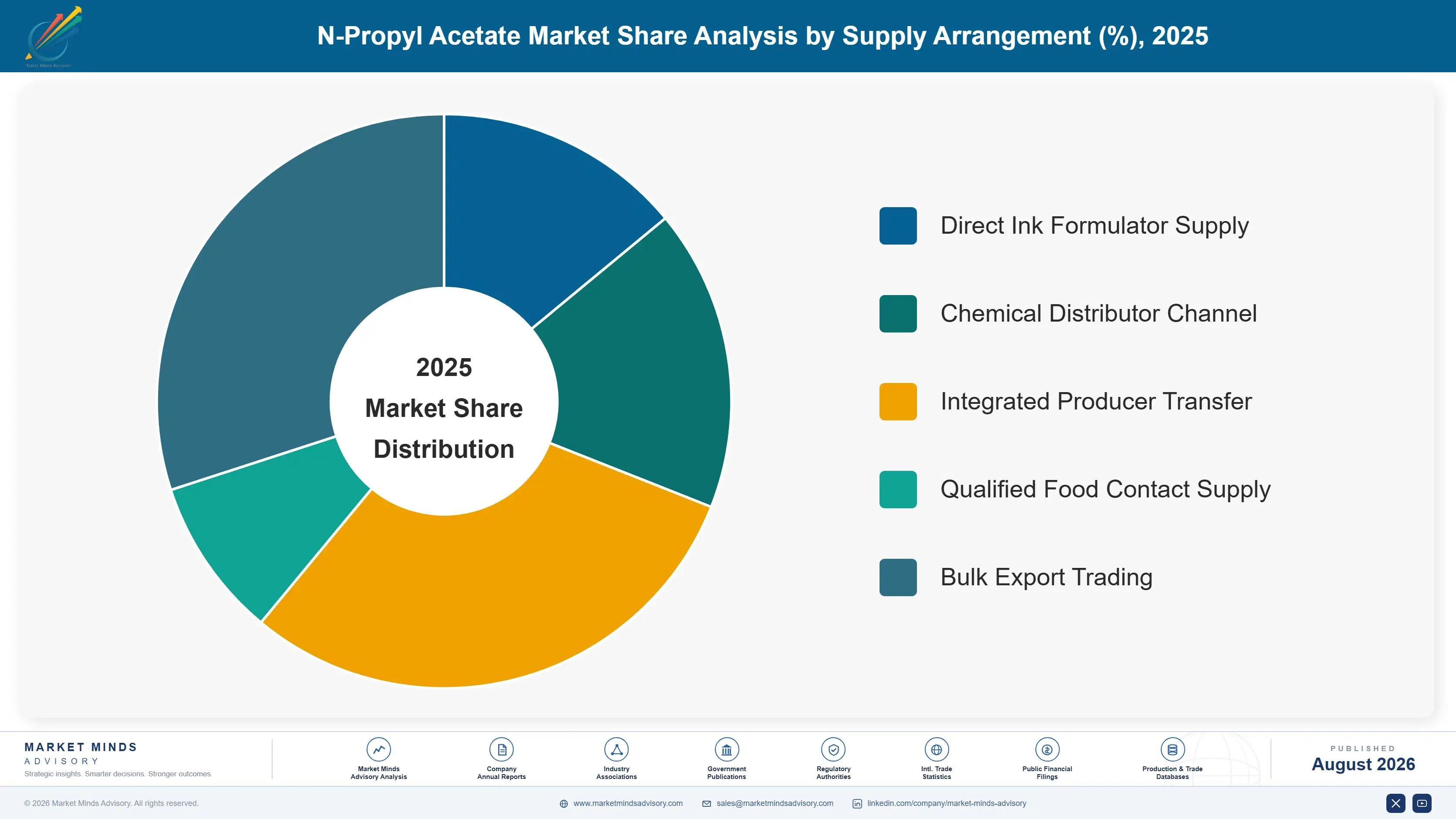
Volume is classified here by application and grade, since food contact purity requirements separate a genuinely premium business from ordinary industrial supply of the identical molecule. Production route, supply arrangement and geography are each handled separately in the framework below, because a single grade routinely serves several different applications without any modification at all.
n-propyl-acetate-market-trends-market-share-analysis-1787555818037

Low-Retention Food Contact Grades

Growing at 7.2%, half again the market rate, these grades exist because a food packaging laminate must retain less than around 5 milligrammes of residual solvent per square metre and higher boiling impurities are precisely what stays behind after drying. Residue migrates through the film into the food and produces taint that a brand owner treats as a recall event rather than a complaint, which makes the specification non-negotiable rather than preferred. Printers pay premiums that general industrial material never commands, because the alternative risk is unacceptable to their customers. Requalification means retained solvent testing across a converter's process, which nobody undertakes to save a few dollars per tonne. Qualification, once won, is durable.
CAGR 7.2%

Bio-Based and Renewable Grades

Bio-derived propanol and acetic acid routes produce an ester chemically identical to the petrochemical product with renewable carbon content that brand owner packaging commitments increasingly specify. Growth at 6.6% follows those commitments rather than any regulatory requirement or performance advantage, which makes it a positioning purchase some buyers fund willingly and others decline outright. Most volume reaches the market through mass balance certification rather than physically segregated supply, which is commercially sensible and periodically controversial with consumers who assume otherwise. Producers without certification lose specifications on a criterion that has nothing whatever to do with the molecule they supply. Establishing chain of custody takes time that cannot be compressed once a customer asks.
CAGR 6.6%
Full segment breakdown across 6 segments available in the complete report.

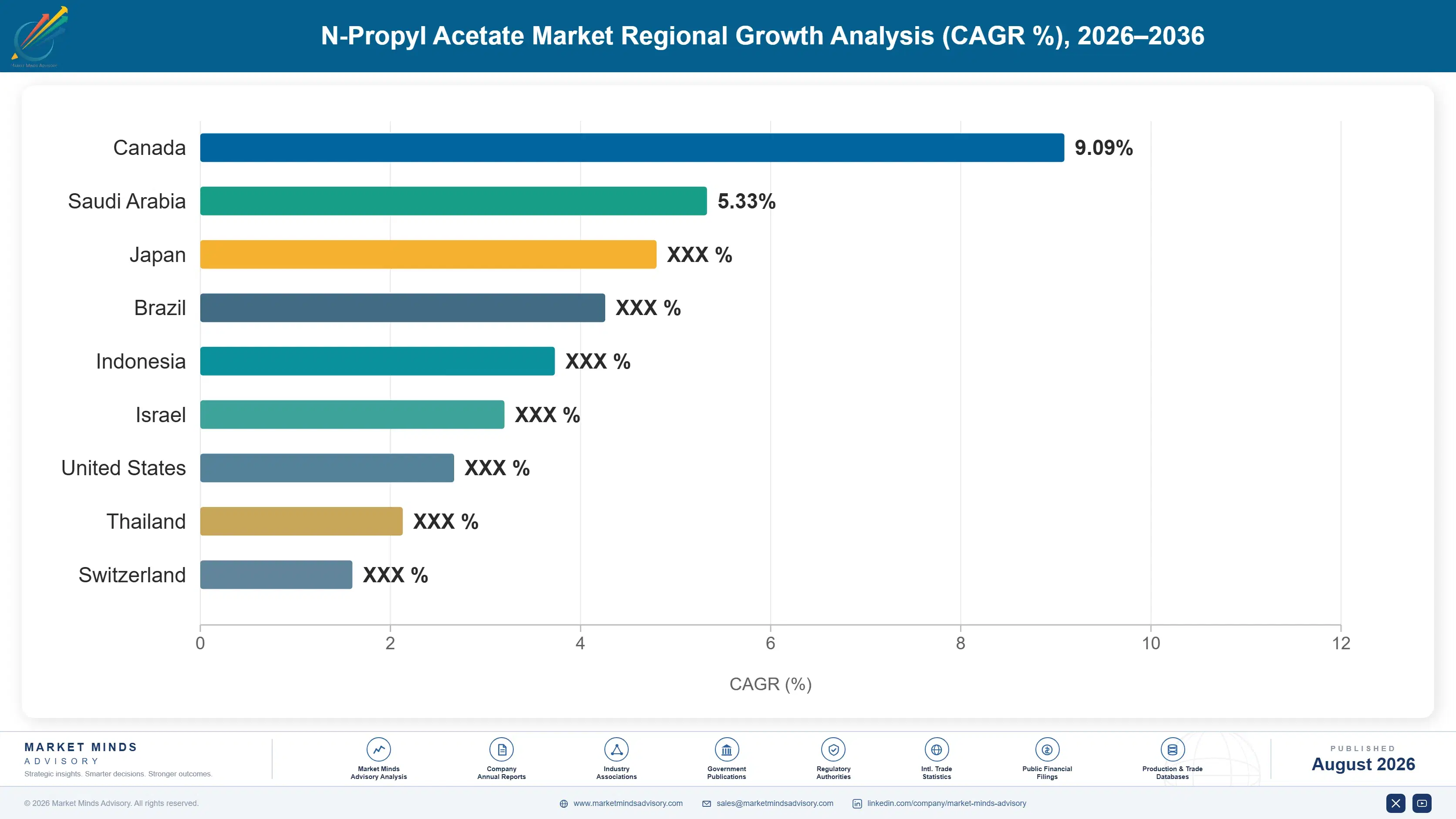
Regional Architecture and Country Demand Map

East Asia holds 30% of value on flexible packaging printing volume that nothing elsewhere approaches in scale. North America follows at 22% on food packaging where retained solvent specifications are enforced most strictly of anywhere. Printed flexible film volume decides this whole map almost entirely.

East Asia

Chinese flexible packaging printing operates at a volume nothing elsewhere approaches, driven by packaged food consumption that continues expanding across a very large population and by export packaging manufacture serving global brand owners. Domestic producers supply most regional demand at prices international producers do not attempt to match on industrial grades. Japanese and Korean producers hold the deepest capability in low-retention food contact grades where purity and evaporation consistency decide qualification. Gravure recovery is well established across larger Chinese operations. Growth at 5.8% combines packaging volume expansion with a steady shift toward higher specification grades. Export packaging manufacture adds volume beyond domestic food consumption alone. Toluene conversion is largely complete in coastal manufacturing.
Share: 30% | CAGR: 5.8% (2026 to 2036)

North America

Retained solvent specifications are enforced most strictly here through brand owner requirements rather than regulation, with the largest food manufacturers treating taint as a recall matter and auditing their packaging suppliers accordingly. That makes low-retention grades a qualification requirement rather than a preference across the food packaging segment. Toluene elimination is effectively complete, which removes the growth driver that shaped the last decade. Water-based inks have taken paper and board printing almost entirely. Growth at 4.2% sits close to the market average and reflects packaging volume rather than any conversion demand remaining. Mexican converters serving American brand owners inherit the same specifications directly. Renewable content requirements are spreading through brand owner packaging commitments faster than through any regulation.
Share: 22% | CAGR: 4.2% (2026 to 2036)
Regional intelligence for 5 additional markets available in the complete report: Western Europe, South Asia and Pacific, Latin America, Middle East and Africa, Eastern Europe. Contact sales@marketmindsadvisory.com.
n-propyl-acetate-market-trends-country-cagr-analysis-1787555818551

Where Ester Margin Actually Sits

Four moves matter in a solvent whose defining growth driver has almost finished and whose largest customers already recapture most of what they actually buy. Two concern the specification that cannot be compromised at any price, and two concern where printed volume is still genuinely expanding. Extrapolating the historical substitution growth rate is not among them.

Sell purity against the retention limit directly

Food packaging laminates must retain below around 5 milligrammes of residual solvent per square metre, and higher boiling impurities are exactly what remains after drying and then migrates into food. A brand owner treats taint as a recall event rather than a quality complaint, which makes the specification non-negotiable and the printer extremely unwilling to economise. Low-retention grades compound at 7.2% and command premiums general industrial material never approaches. Producers selling on price into food packaging are competing for the segment least interested in price. Competing on delivered price into food packaging misreads the customer entirely.
Market Impact: Serves grades compounding at 7.2% every single year

Model virgin demand net of recovery, not gross

Large rotogravure operations recapture and redistil around 82% of the solvent they consume, driven by cost and by emissions permits requiring capture in any case. Virgin demand therefore grows well below printed film volume, and every recovery improvement removes demand permanently rather than deferring it anywhere. Producers modelling addressable market from packaging output consistently overstate it, sometimes substantially. Building capacity against printed volume forecasts in regions where recovery is already standard is a straightforward and entirely avoidable error that several producers have made. Recovery rates keep improving with equipment investment, which compounds the error over time.
Market Impact: Adjusts virgin demand for an 82% recovery rate

Follow packaged food into unconverted markets

Toluene elimination stands at roughly 91% globally and the remaining conversion sits in markets where enforcement is weakest and packaged food penetration is rising fastest, principally across Africa, parts of Southeast Asia and Latin America. Those geographies offer both substitution demand and volume growth simultaneously, which no developed market still does. Indian growth at 8.0% leads the table. Producers organised entirely around developed market food packaging are serving demand where conversion finished and recovery suppresses what remains. Distribution reach and food contact qualification both matter in those geographies, since converters there serve multinational brand owners applying developed specifications locally.
Market Impact: Captures the remaining 9% of toluene conversion demand

Certify renewable grades before brand owners require them

Bio-derived propanol and acetic acid routes produce a chemically identical ester carrying renewable content that brand owner packaging commitments increasingly specify, and the material costs more while performing exactly the same. Growth at 6.6% follows those commitments rather than regulation. Mass balance certification is how most volume reaches the market, and establishing that chain of custody takes time a producer cannot compress once a customer asks. Producers without certification lose specifications to competitors holding it, on a criterion that has nothing to do with the molecule. Certification cost is modest against the specification volume it protects.
Market Impact: Protects a segment compounding at 6.6% every year

Who Controls the Margin Pool

Five producers hold 42% of supply, measured on tonnage supplied at producer level, the basis used throughout this section. That concentration follows access to n-propanol and acetic acid representing 66% of production cost rather than any esterification advantage, since the reaction is elementary chemistry that any competent operation runs. Propanol availability in particular is more constrained than the acetic acid alongside it.
Competition runs on three dimensions. Feedstock integration, which decides cost position far more than operating skill ever will. Purity capability for low-retention food contact grades, where a printer cannot risk a taint event and pays accordingly for certainty. And renewable certification, which brand owner packaging commitments increasingly require regardless of any performance consideration whatsoever. Price competes hardest in industrial coatings and general solvent applications where the molecule is genuinely interchangeable.

Rankings shift as recovery displaces virgin volume across developed markets while unconverted geographies still offer real substitution demand, which favours producers positioned across both rather than concentrated in either alone. Chinese producers dominate industrial grade volume on feedstock cost that nobody matches. Japanese producers hold food contact positions that purity requirements defend effectively against price competition.
n-propyl-acetate-market-trends-company-positioning-matrix-1787555819069

Competitive Moat and Risk Dimensions

EASTMAN CHEMICAL

Moat: Acetyl chain integration depth

Eastman produces acetic acid and acetyl derivatives at scale, which covers a substantial part of the 66% feedstock burden this ester carries and converts integration into a cost position merchant buyers cannot approach. The company also holds purity capability serving food contact applications where retained solvent specifications rather than price govern qualification entirely.
EASTMAN CHEMICAL

Risk: Developed market recovery displacement

Positions concentrate in developed markets where gravure recovery is standard and captures around 82% of consumption, which suppresses virgin demand well below printed volume growth. Toluene conversion has also finished in those geographies. Producers weighted toward Asian and African packaging expansion access growth that recovery has not yet reduced anywhere.
JIANGSU BAICHUAN HIGH-TECH

Moat: Chinese cost and volume position

The company operates inside the largest flexible packaging printing market anywhere with domestic feedstock access and freight proximity that international producers cannot match on industrial grade material. Chinese packaging volume continues expanding while developed markets mature, which places the position inside the demand rather than shipping toward it.
JIANGSU BAICHUAN HIGH-TECH

Risk: Food contact purity limitations

Low-retention food contact grades demand purity and evaporation consistency that industrial grade production does not reach, and those grades compound at 7.2% while industrial volume grows far more slowly. Brand owner audits of packaging suppliers increasingly reach solvent specification. Japanese and Western producers hold those qualifications and defend them on specification rather than on any price.

Players Tracked

Prominent Players

Eastman Chemical
Dow
BASF
Celanese
Jiangsu Baichuan High-tech

Other Key Players

INEOS
LyondellBasell
Sasol
OQ Chemicals
Daicel Corporation
Resonac Holdings
Kanto Chemical
Jubilant Ingrevia
Laxmi Organic Industries
Shandong Jinyimeng
Yankuang Group
Ercros
Wacker Chemie
Godavari Biorefineries
Sekab

Recent Developments

MARCH 2025

A brand owner extended retained solvent auditing to ink suppliers

A global food manufacturer extended packaging supplier auditing to cover solvent specification and retained residue testing at the converter, following taint incidents attributed to ink drying performance. This was a procurement and quality requirement rather than any commercial transaction between chemical producers. Testing protocols were specified rather than negotiated.
Signal: Brand owner auditing now reaches solvent grade selection, which converts purity from a printer preference into a requirement
AUGUST 2025

A European converter completed gravure solvent recovery installation

A European flexible packaging converter completed solvent recapture and redistillation across its rotogravure lines, driven by emission permit requirements and by the cost of losing material. This was capital investment rather than any transaction with solvent producers or suppliers. Regional emission rules made the capture requirement unavoidable in any case.
Signal: Every recovery installation removes virgin demand permanently, which producers modelling from printed volume alone consistently miss
DECEMBER 2025

An Indian producer commissioned bio-based acetate ester capacity

An Indian producer commissioned capacity for acetate esters from bio-derived feedstock, targeting brand owners whose packaging commitments specify renewable content regardless of any performance difference. This was organic capital investment rather than any partnership or acquisition arrangement. Capacity targets both domestic and export packaging customers.
Signal: Renewable certification is becoming a specification requirement rather than a marketing claim, and chain of custody takes time

What Moves Producer Cost

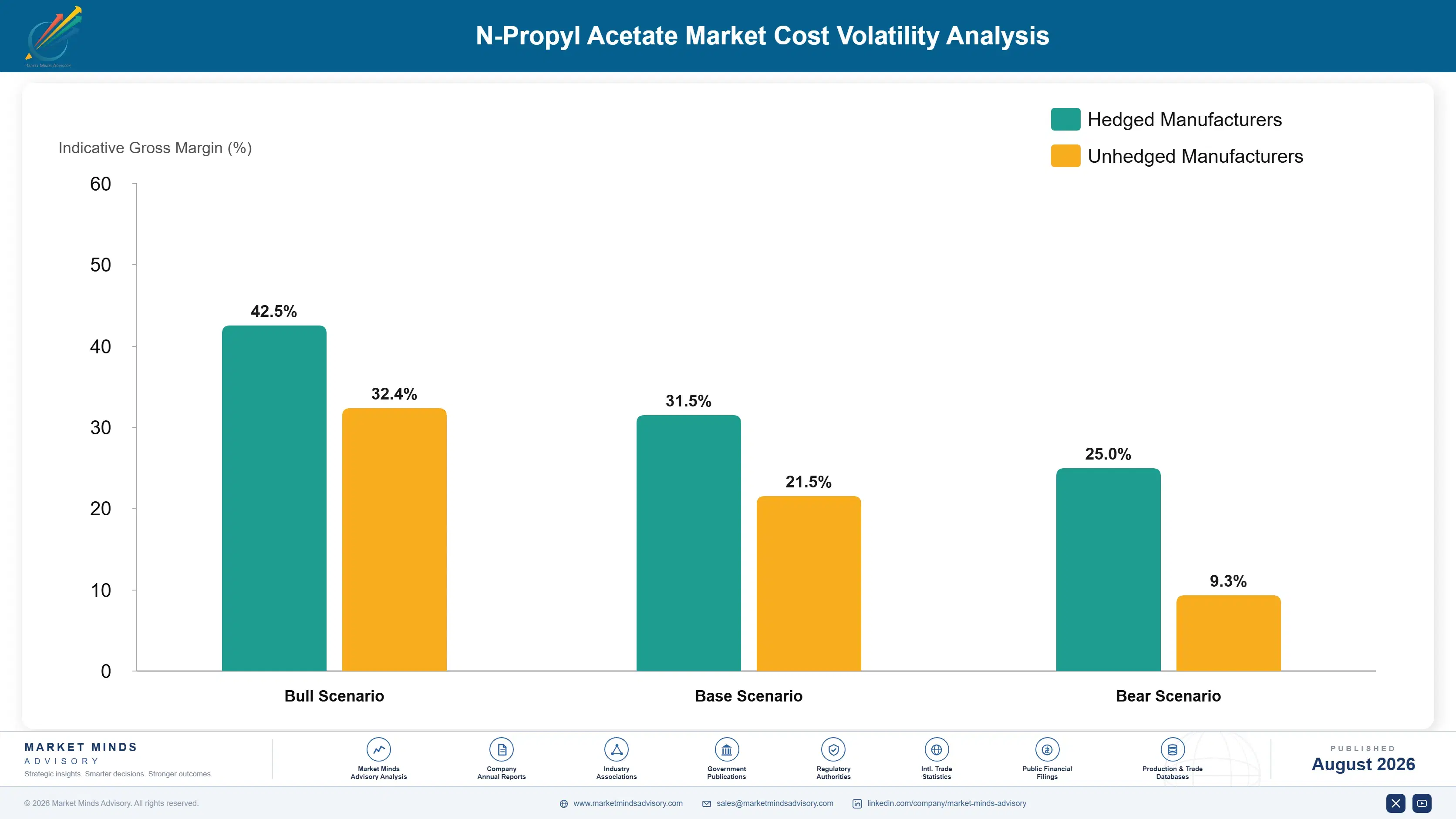
N-propanol and acetic acid together account for around 66% of production cost, which is high even for an ester and leaves very little conversion margin to absorb movement. Propanol is produced by oxo synthesis from ethylene and its availability is more constrained than acetic acid alongside it. Esterification energy and distillation are modest. Purification to food contact grade adds cost disproportionate to the volume involved.
Propanol and acetic acid prices moved sharply through 2021 and 2022 on petrochemical feedstock and European energy costs, and IEA data show European industrial gas far above Asian levels throughout. Eastman recorded raw material and energy cost pressure across its chemical intermediates operations in its Annual Report 2022. Producers holding annual contracts with ink formulators absorbed most of that movement, since a formulator prices for a season.

Propanol availability rather than price is the exposure that actually matters and it is rarely discussed. Oxo synthesis capacity producing n-propanol is limited and much of it is directed toward other derivatives, which means a producer without integration or a firm contract can find the feedstock unavailable rather than merely expensive. That distinction matters enormously during a supply disruption, when price is negotiable and availability is not.
n-propyl-acetate-market-trends-cost-volatility-analysis-1787555819263

Contract propanol supply rather than buying on merchant terms

Oxo synthesis capacity producing n-propanol is limited and frequently directed toward other derivatives, which means availability rather than price is the genuine exposure for anybody without integration. A supply interruption stops esterification entirely rather than raising cost. Firm multi-year contracts secure allocation when merchant material simply is not obtainable at any price at all.

Index ink formulator contracts to published acetyl benchmarks

Feedstock at 66% of cost leaves conversion margin far too thin to absorb petrochemical movement, and annual fixed pricing transfers that exposure entirely to the producer. Indexing to published acetic acid and propanol benchmarks with quarterly reset removes it. Ink formulators resist because their own printer contracts are seasonal, which makes this a genuine negotiation rather than any formality.

Load purification capacity across food contact grade demand

Food contact purification adds cost disproportionate to volume and requires utilisation that a single customer rarely provides. Loading the capacity across multiple food packaging accounts and adjacent high purity applications spreads that cost considerably. Producers running purification for one qualified customer carry capital that better-loaded competitors amortise across a wider grade portfolio entirely. Utilisation decides whether the investment pays.

Portfolio Architecture for Margin Defence

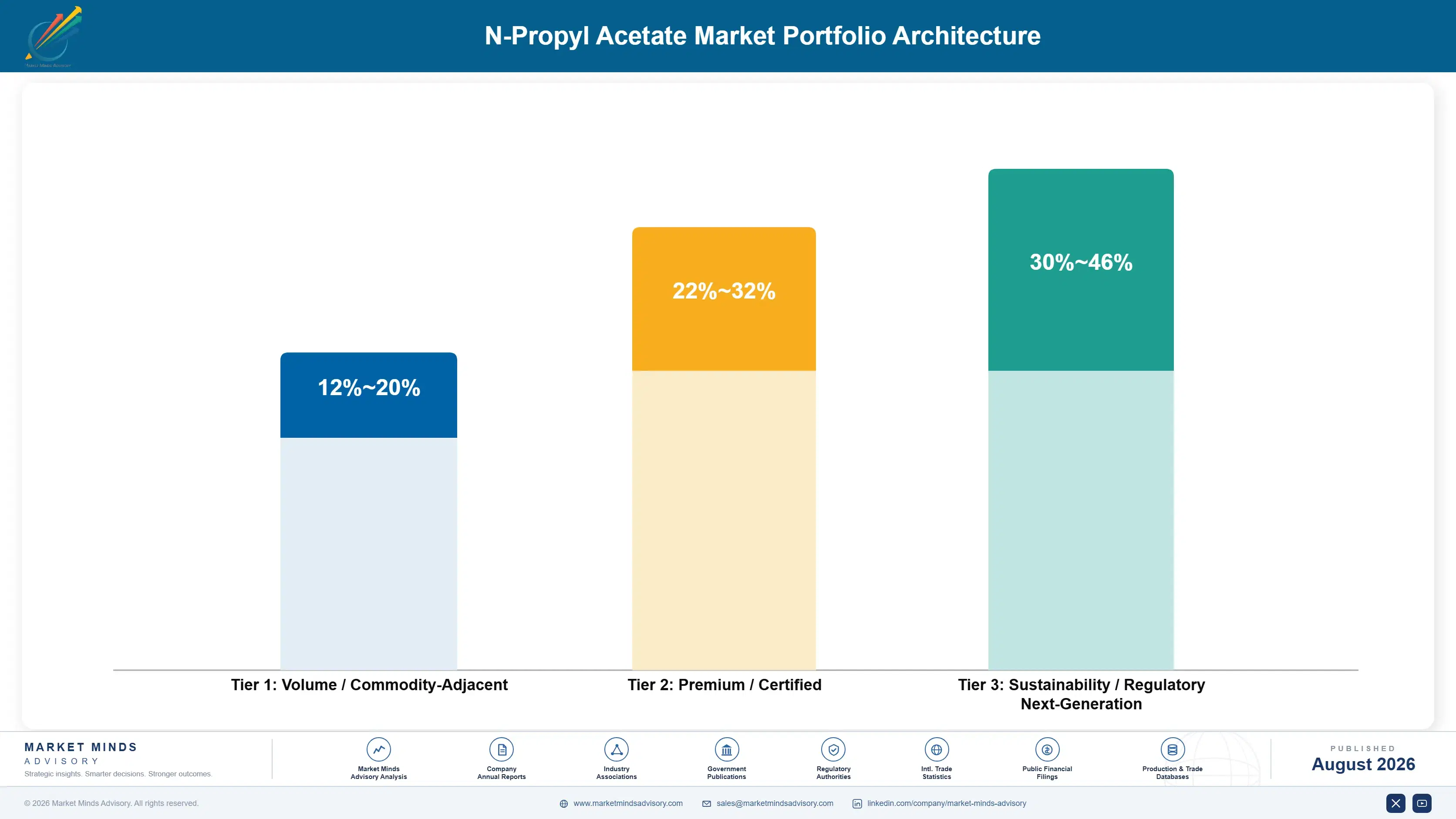
Margin here tracks purity qualification rather than production scale, because esterification is elementary chemistry and feedstock access rather than skill determines cost. Industrial coatings and general solvent grades run at gross margins in the low teens against producers with better propanol integration. Adhesive and laminating grades run somewhat better on consistency requirements. Low-retention food contact and certified renewable grades run considerably higher, because a printer cannot risk taint and a brand owner will not accept uncertified material.
The tension is that industrial volume fills the reactors while food contact grades earn the returns, and moving between them requires purification capital and customer qualification rather than any chemistry change. Producers weighted toward industrial supply face recovery displacement and mature demand simultaneously, and funding purification from that revenue is uncomfortable. Several have found the industrial business consuming attention that food contact qualification required, which shows up as losing specifications they could have held.

High-value pools sit in low-retention food contact grades, renewable certification and unconverted geographies. Only the last of those three is where industrial volume currently is. Reactor capacity by itself defends very little against recovered solvent and an elementary reaction.

Volume / Commodity-Adjacent

Industrial coatings and general solvent grades competing on delivered price against producers with better propanol and acetic acid integration. The eight-point range separates integrated producers from those buying both feedstocks entirely on merchant terms each quarter.
Gross Margin: 12%-20%

Premium / Certified

Adhesive, laminating and cosmetic grades where consistency, odour and evaporation profile matter beyond simple solvency. The ten-point spread reflects purification capability, since impurity control separates competent producers from those selling general industrial material.
Gross Margin: 22%-32%

Sustainability / Regulatory / Next-Generation

Low-retention food contact grades and certified renewable material. The sixteen-point range is wide because a printer facing recall risk and a brand owner with a sustainability commitment both price against consequences rather than against any competing molecule.
Gross Margin: 30%-46%
n-propyl-acetate-market-trends-portfolio-architecture-1787555819759

High-value Sub-segments and Strategic Watch-out

Low-Retention Food Contact Grades

Compounding at 7.2% against a 5 milligramme retention limit, where residue migrates through the film into food and produces taint a brand owner treats as a recall event. Printers will not economise on that specification at any price. Requalification testing deters any casual switching entirely.
Gross Margin: 32%-46%

Certified Renewable Supply

Growing at 6.6% on brand owner packaging commitments rather than on performance or regulation, with mass balance certification taking time that no producer can compress once a customer has actually asked for it. The premium depends on someone continuing to care. Mass balance dominates over segregated supply.
Gross Margin: 30%-42%

Industrial Coatings Volume

The reactor volume, competed on feedstock integration and facing water-based displacement wherever substrates and line speeds permit it. Manage this for propanol contracting and plant utilisation rather than for any margin recovery that will not arrive. Feedstock contracting matters far more than anything else does here.
Gross Margin: 12%-20%

Unconverted Toluene Markets

Roughly 9% of food packaging ink still uses toluene, concentrated where enforcement has been weakest and where packaged food penetration is rising fastest. Substitution demand and underlying volume growth arrive together only in those geographies now. Distribution reach largely decides who actually captures any of it.
Gross Margin: 18%-30%

How Ester Demand Renews

Demand renews continuously with printing output and is reduced continuously by recovery, which produces a net figure that neither printed volume nor consumption alone describes. A gravure operation consumes solvent every hour it runs and recaptures around 82% of it, so virgin purchases reflect losses rather than usage. That distinction is invisible in packaging statistics and decisive in solvent forecasting, and it explains why producers extrapolating from printed film volume overstate their market.
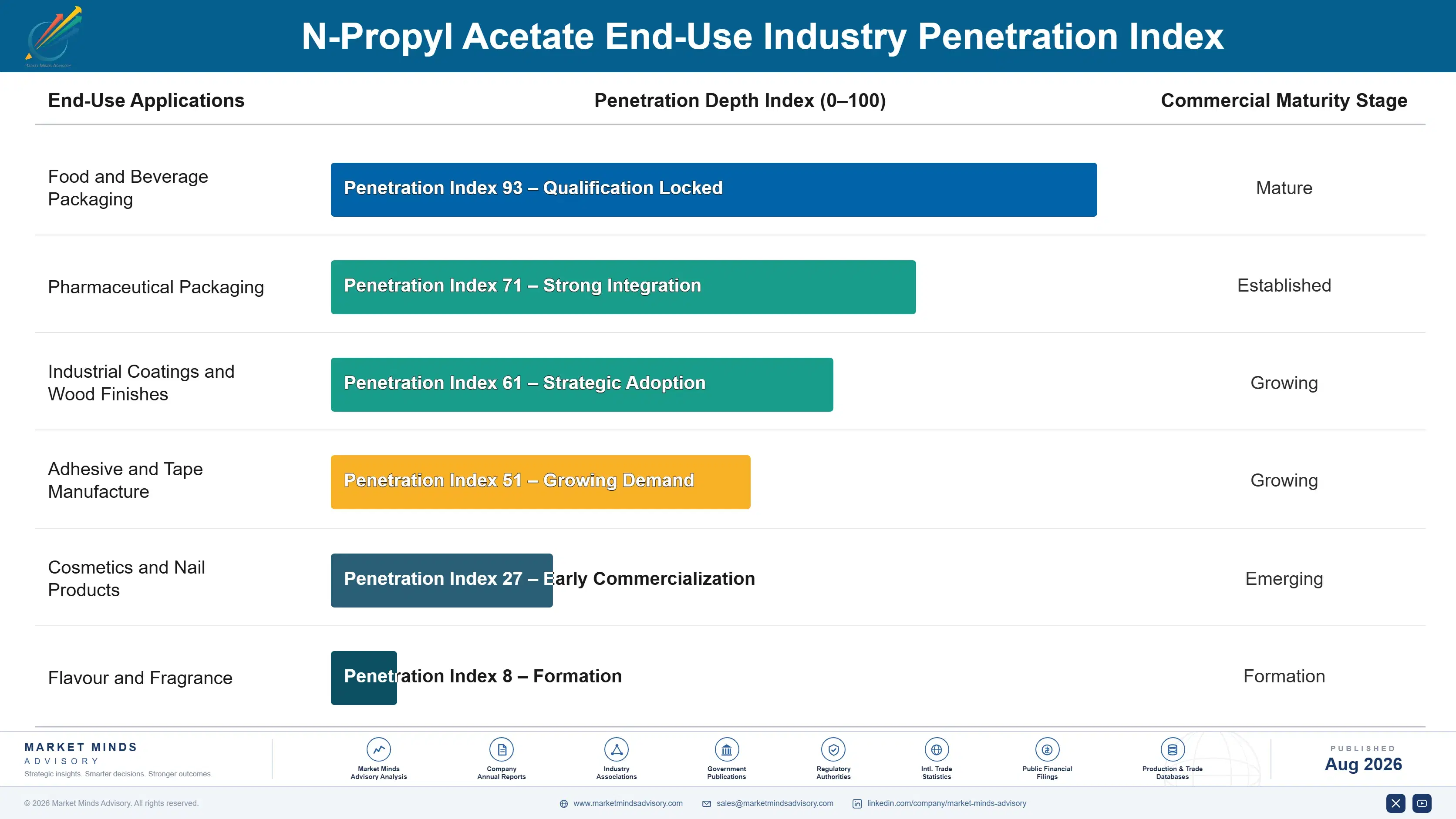
Stickiness runs through qualification rather than relationship. A food contact grade qualified into a converter's process and audited by that converter's brand owner customer is difficult to displace, because requalification means retained solvent testing and a taint risk nobody accepts casually. Industrial grades change supplier on delivered price at every contract, since the molecule is identical and nothing distinguishes it.

The specifier has moved upstream from the printer to the brand owner, which most producers have not adjusted to. Solvent selection sat with ink formulators weighing evaporation rate and cost. It now involves food manufacturers auditing packaging suppliers on retained solvent and renewable content, and those people never speak to a solvent producer directly.
n-propyl-acetate-market-trends-end-use-penetration-index-1787555820256

Where To Place The Bet

These are among the four positions where our research anticipates prominent divergence between winners and laggards over the coming forecast period. Each is grounded in the demand model, the regulatory perimeter, and the announced capacity pipeline.
01 / RETENTION SPECIFICATION SELLING

Price against recall risk, not against competitors

Food packaging laminates must retain below roughly 5 milligrammes of residual solvent per square metre, and the higher boiling impurities in general industrial material are precisely what remains behind after drying and subsequently migrates into the food. A brand owner treats resulting taint as a product recall rather than a quality complaint, which makes the specification entirely non-negotiable for any printer serving them. Low-retention grades compound at 7.2% and command premiums general material never approaches, and producers selling on price are courting the least price-sensitive segment available.
02 / RECOVERY ADJUSTED FORECASTING

Subtract recovery before sizing any capacity

Large rotogravure printing operations recapture and redistil around 82% of the solvent they consume, driven both by the cost of losing it and by emission permits that require capture in any event. Virgin demand therefore grows substantially below printed film volume, and every recovery installation removes demand permanently rather than deferring it to some later period. Producers modelling their addressable market from packaging output overstate it consistently, and building capacity against printed volume in regions where recovery is already standard is entirely avoidable.
03 / UNCONVERTED MARKET ENTRY

Go where toluene is still being replaced

Toluene elimination from food packaging inks stands at roughly 91% globally, and the remaining conversion sits precisely in markets where enforcement has been weakest and where packaged food penetration is rising fastest, principally across Africa, parts of Southeast Asia and Latin America. Those geographies offer substitution demand and underlying volume growth simultaneously, which no developed market has offered for several years now. Indian growth at 8.0% leads the table, and producers organised around developed food packaging are serving finished conversion.
04 / RENEWABLE CERTIFICATION TIMING

Establish chain of custody before customers ask

Bio-derived propanol and acetic acid routes yield a chemically identical ester carrying renewable content that brand owner packaging commitments increasingly specify, and the material costs more while performing in exactly the same way. Growth at 6.6% follows those commitments rather than any regulation or performance advantage anybody can demonstrate. Mass balance certification is how most volume actually reaches the market, and establishing that chain of custody takes time a producer simply cannot compress once a customer has already asked for it.

Engagement Snapshot From the Field

A live engagement with an industry participant carrying material or product regulatory and market exposure ahead of a defining policy shift, showing how our research translates into a defensible multi-year portfolio strategy.
MARKET MINDS ADVISORY · CLIENT ENGAGEMENT SUMMARY
N-Propyl Acetate Producer Strategic Portfolio Review and Transition Roadmap 2026·Investment Scenario on N-Propyl Acetate Exposure Evaluation 2025-26
CLIENT PROFILE
A European acetate ester producer with annual revenue around EUR 84 million (client-reported, unverified by MMA), supplying industrial coatings, adhesive and general solvent grades across European markets from a single site. Food contact purification capability was limited. No renewable certification existed anywhere in the portfolio. Propanol was purchased entirely on merchant terms without any firm supply contract.
STRATEGIC CHALLENGE
Volume had declined for two consecutive years (client-reported, unverified by MMA) as customers installed solvent recovery and toluene conversion finished across the region. Management proposed price reductions to defend industrial volume. Nobody had asked whether that industrial demand could be defended at all, given recovery displacement and a genuine feedstock cost disadvantage.
MMA APPROACH
MMA separated the client's volume decline into recovery displacement, conversion completion and competitive loss rather than accepting one explanation for all of it. Food contact purification investment was modelled against qualification timelines and premium pricing. Renewable certification requirements were mapped across the customer base, and propanol availability risk was assessed against merchant purchasing.
KEY FINDINGS
  1. Recovery installation at customer sites explained most of the volume decline, which meant price reduction would have sacrificed margin without recovering any of the lost tonnage.
  2. Food contact purification was achievable with modest investment from the client's existing distillation train, and premiums there ran well above anything industrial grades command.
  3. Two brand owner customers had begun requiring renewable content certification the client could not supply, and specifications were moving to certified competitors as a result.
  4. Merchant propanol purchasing had left the client without allocation during a recent supply interruption, which cost more in lost production than any contract premium would have.
CLIENT PROFILE
A European acetate ester producer with annual revenue around EUR 84 million (client-reported, unverified by MMA), supplying industrial coatings, adhesive and general solvent grades across European markets from a single site. Food contact purification capability was limited. No renewable certification existed anywhere in the portfolio. Propanol was purchased entirely on merchant terms without any firm supply contract.
STRATEGIC CHALLENGE
Volume had declined for two consecutive years (client-reported, unverified by MMA) as customers installed solvent recovery and toluene conversion finished across the region. Management proposed price reductions to defend industrial volume. Nobody had asked whether that industrial demand could be defended at all, given recovery displacement and a genuine feedstock cost disadvantage.
MMA APPROACH
MMA separated the client's volume decline into recovery displacement, conversion completion and competitive loss rather than accepting one explanation for all of it. Food contact purification investment was modelled against qualification timelines and premium pricing. Renewable certification requirements were mapped across the customer base, and propanol availability risk was assessed against merchant purchasing.
KEY FINDINGS
  1. Recovery installation at customer sites explained most of the volume decline, which meant price reduction would have sacrificed margin without recovering any of the lost tonnage.
  2. Food contact purification was achievable with modest investment from the client's existing distillation train, and premiums there ran well above anything industrial grades command.
  3. Two brand owner customers had begun requiring renewable content certification the client could not supply, and specifications were moving to certified competitors as a result.
  4. Merchant propanol purchasing had left the client without allocation during a recent supply interruption, which cost more in lost production than any contract premium would have.
RECOMMENDED STRATEGY
Phase 1: Phase one: abandon industrial price defence and commit purification investment for low-retention food contact grades where premiums are genuine and recovery matters less. Phase 2: Phase two: establish mass balance renewable certification promptly, before any further brand owner specifications move across to competitors already holding it. Phase 3: Phase three: contract propanol supply firmly rather than buying merchant, since availability rather than price is the real exposure during any interruption.
OUTCOME
Purification investment is commissioned and two food contact qualifications are now complete. Renewable certification was obtained during 2026 and recovered one lost specification directly. Propanol is contracted, and the client reports gross margin improving despite continued industrial volume decline (client-reported, unverified by MMA). Industrial pricing was left untouched throughout.

Frequently Asked Questions

Foundational context covering the market sizes, CAGR, scope, country, region and competition that inform every finding below. This section is provided to cover basics and most often pre-purchase conversations, answered from the MMA Primary Research Dataset.

What is the current size of the N-Propyl Acetate Market?

The market was valued at USD 0.68 billion in 2025, rising to an estimated USD 0.71 billion in 2026. East Asia holds the largest regional share at 30% of value.

How large will the N-Propyl Acetate Market be by 2036?

MMA forecasts USD 1.14 billion by 2036 under the base case, an expansion multiple of 1.60 times the 2026 value. That represents USD 0.43 billion of incremental value.

What is the CAGR for the N-Propyl Acetate Market 2026 to 2036?

The base case runs at 4.8% compound annual growth between 2026 and 2036, with a bull case at 6.0% and a bear case at 3.6%. Historical growth from 2020 to 2025 was 3.8%.

Which segment is growing fastest?

Low-retention food contact grades lead at 7.2%, half again the market rate, because laminates must hold residue below 5 milligrammes per square metre. Renewable grades follow at 6.6%.

Who are the major companies in the N-Propyl Acetate Market?

Eastman Chemical, Dow, BASF, Celanese and Jiangsu Baichuan High-tech hold 42% of supply between them. Feedstock integration rather than any esterification advantage sustains those positions, since the reaction is elementary.

Which country is growing fastest?

India leads at 8.0%, driven by modern retail expansion and packaged food adoption from a base well below developed market penetration levels. Solvent recovery is also less established there.

Report Segmentation Architecture

The full report scope spans multiple orthogonal segmentation dimensions, with cross-tabulated demand data provided for each dimension pair. Coverage extends further to regional breakdowns, trend trajectories, and the competitive detail needed to support segment-level decision-making.

By Application and Grade

  • Flexible Packaging Inks
  • Industrial Coatings
  • Adhesives and Laminating
  • Low-Retention Food Contact Grades
  • Cosmetics and Personal Care
  • Bio-Based and Renewable Grades

By End-Use Industry

  • Food and Beverage Packaging
  • Pharmaceutical Packaging
  • Industrial Coatings and Wood Finishes
  • Adhesive and Tape Manufacture
  • Cosmetics and Nail Products
  • Flavour and Fragrance

By Supply Arrangement

  • Direct Ink Formulator Supply
  • Chemical Distributor Channel
  • Integrated Producer Transfer
  • Qualified Food Contact Supply
  • Bulk Export Trading

By Region

  • North America
  • Western Europe
  • East Asia
  • South Asia and Pacific
  • Latin America
  • Middle East and Africa
  • Eastern Europe

Scope, Methodology, and Coverage

Every figure in this report is reproducible from documented input assumptions. The scope below maps the historical period, the forecast horizon, the segmentation dimensions, and the countries covered, alongside the underlying primary and qualitative methodology.
Historical Period
2020 to 2025
Forecast Period
2026 to 2036
Base Year
2025 (USD billions; MMA Primary Research Dataset, August 2026)
Market Definition
The market comprises n-propyl acetate supplied as a solvent across printing, coating, adhesive, cosmetic and speciality applications, covering flexible packaging inks, industrial coatings, adhesives and laminating, low-retention food contact grades, cosmetics and personal care, and bio-based and renewable grades. Value is measured at producer level on tonnage supplied through direct, distributor, integrated and export channels. Other acetate esters sold as alternatives, n-propanol and acetic acid sold as products in their own right, formulated inks and coatings, and recovered solvent traded between printing operations fall outside scope.
Quantitative Units
USD billions (current prices); thousand tonnes supplied annually; USD per tonne by application grade
Segmentation Dimensions
By Application and Grade; By End-Use Industry; By Supply Arrangement; By Region
Regions Covered
North America, Western Europe, East Asia, South Asia and Pacific, Latin America, Middle East and Africa, Eastern Europe
Countries Covered
China, Japan, South Korea, Taiwan, India, Indonesia, Vietnam, Thailand, Australia, United States, Canada, Mexico, Germany, Netherlands, Belgium, France, Italy, Spain, United Kingdom, Sweden, Poland, Romania, Czechia, Hungary, Brazil, Argentina, Colombia, Saudi Arabia, Egypt, South Africa
Key Companies Profiled
Eastman Chemical, Dow, BASF, Celanese, Jiangsu Baichuan High-tech, INEOS, LyondellBasell, Sasol, OQ Chemicals, Daicel Corporation, Resonac Holdings, Kanto Chemical, Jubilant Ingrevia, Laxmi Organic Industries, Shandong Jinyimeng, Yankuang Group, Ercros, Wacker Chemie, Godavari Biorefineries, Sekab
Quantitative Methodology
Primary survey, n=3,800 respondents, Q4 2025, six countries; demand-side model with trade association cross-validation
Qualitative Methodology
47 expert interviews, Q4 2025; applied to validate demand model assumptions, identify emerging dynamics, and assess competitive positioning
Report Format
PDF and XLSX data workbook (Word format preview document)
Publisher
Market Minds Advisory
Report Code
MMA-2026-CHM-701
Published
August 2026
Contact
sales@marketmindsadvisory.com | www.marketmindsadvisory.com

Purchase the full N-Propyl Acetate Market Report (2026 to 2036).

The full report sizes the global n-propyl acetate market to 2036 across six applications and grades and seven regions, measured on tonnage supplied at producer level. It treats toluene substitution as a finished driver rather than a continuing one and models virgin demand net of gravure recovery throughout. Competitive analysis covers 20 participants evaluated on tonnage supplied, with moat and risk assessment for the two leaders. Retained solvent specifications are quantified as a qualification barrier separating food contact supply from ordinary industrial material. Four quantified revenue levers close the analysis.
Six-grade segment sizing with segment-level growth rates
Seven-region share and growth breakdown to 2036
Twenty-participant competitive map on one tonnage basis
Virgin demand modelled net of gravure solvent recovery rates
Toluene conversion progress mapped by geography and enforcement
Four quantified revenue levers with commercial impact ranges

Built For The People Who Decide

From boardroom strategy to bench-side execution, this report is read cover-to-cover by leaders shaping the next decade of their industry, turning demand scenarios, market dynamics and valuation benchmarks into decisions.
CXOs/ Presidents/ VPs/ Managers
M&A and Corporate Development
Strategy Teams and R&D Heads
Procurement and Product Directors
Regulatory and Compliance Leaders
Investor Relations and Equity Analysts