Market Minds Advisory
Music Speed Changer Market

Music Speed Changer Market: Music Speed Changer Market. AI-Powered Tempo Control Reshapes Practice and Transcription Tools

AI-powered pitch-preserving tempo tools are turning a decade-old practice utility into a subscription category that musicians, transcribers, and language learners now pay for monthly rather than downloading once and forgetting.

Lead Analyst

Published

September 2026

Make Smarter Decisions with Customized Research Insights

Request a free sample report and evaluate market opportunities, growth trends, and competitive dynamics relevant to your business needs.

2025 MARKET VALUE$0.3BMarket Size 2025
2036 FORECAST VALUE$0.8BBase Case , 2026 to 2036
CAGR 2026 TO 20369.8 %Bull 11.1% / Bear 8.5%
INCREMENTAL OPPORTUNITY$0.5BNet 10- year value creation
EXPANSION MULTIPLE2.55x2036 value over 2026 base
Strategic Levers
M&A Pipeline
Regional Outlook
Country Rankings
Competitive Intelligence
Segmental Deep-dive
Call-Us : 91 93563 13602

Executive Snapshot and Market Trajectory.

Music speed changer tools have moved from a free feature buried inside larger apps to standalone subscription products with dedicated paying user bases. Vendors now compete on transcription accuracy and pitch fidelity rather than simple playback speed sliders. That shift rewards accuracy investment over simple utility polish and marketing spend.
AI-powered transcription tools that slow audio without distorting pitch are growing fastest as musicians and language learners demand cleaner output, while DJ-focused tempo software consolidates a separate but adjacent professional user base concentrated in North America and East Asia's active performance markets. Adoption is accelerating among podcast editors needing clean slow-motion audio for captioning work, favoring vendors with dedicated speech research.
Dozens of small developers compete against a handful of established audio software companies now bundling speed control into broader practice and transcription suites, and rising subscription fatigue among casual users is starting to separate genuinely sticky professional tools from novelty apps that see steep post-trial churn. Casual listeners rarely convert to paid tiers at all, unlike working musicians who renew year after year. Enterprise transcription buyers watch these accuracy signals closely before signing multi-year contracts.
Market Definition
This report defines the Music Speed Changer Market as software applications and plugins that alter audio playback tempo while preserving pitch, serving musicians, transcribers, DJs, and language learners. It excludes generic media player speed controls lacking dedicated pitch-correction algorithms.
Base Year Value
$0.3B in 2025 (MMA Primary Research Dataset, September 2026)
Forecast Period
2026 to 2036, eleven discrete annual values
CAGR
9.8% base case. Bull 11.1%. Bear 8.5%.
Fastest Growth Segment
AI-Powered Transcription and Practice Speed Tools: 15.6% CAGR
Fastest Growth Country
India: 13.2% CAGR
Fastest Growth Region
South Asia and Pacific: 11.9% CAGR
Largest Region
North America: 28% of 2025 global value
Market Leaders
Transcribe!, Amazing Slow Downer, Anytune, Capo, and Moises. Source: MMA Analysis based on company disclosures and app store revenue estimates.
Primary Survey
n=3,800 procurement and R&D decision-makers, Q4 2025, six countries
Methodology
Demand-side build-up, cross-validated against public data, 47 expert interviews

Music Speed Changer Market Forecast Scenarios

music-speed-changer-market-size-forecast-scenario-1789986827890
Between 2020 and 2025 the category grew from a niche utility feature into a recognizable standalone app segment, expanding at roughly 8.8% annually as remote music lessons and language learning apps normalized paying for tempo control tools. The pandemic era's surge in home practice gave the category its very first genuine wave of paying subscribers.
MMA's base case assumes 9.8% annual growth through 2036, anchored to three mechanisms: expanding integration of AI-powered transcription accuracy into consumer apps, rising willingness among language learners to pay for cleaner slowed audio, and steady bundling of tempo control into broader music education and podcast production software suites. Podcast studios adding these tools are expected to bring a large new user base into the paid funnel. Enterprise transcription contracts are also expected to grow steadily as accuracy benchmarks improve further.
The bull case rests on major streaming platforms licensing tempo control as a native premium feature, pulling millions of casual listeners into paid tiers overnight. The bear case centers on free open-source tools achieving comparable pitch-preservation quality, undercutting paid vendors on price for all but demanding professional users. That risk is most acute for basic playback speed features rather than the transcription-grade tier.

From Playback Sliders to AI Transcription Assistants

The category began as a simple playback slider hidden inside media player settings, valued more for convenience than accuracy. Vendors have since layered on AI-powered pitch correction, spectral analysis, and transcription assistance, turning a forgotten utility into a standalone product professionals now pay to access directly. Musicians in particular value looping a difficult passage without shifting its key, once a feature requiring expensive dedicated hardware.
AVERAGE SUBSCRIPTION PRICE$6.50Typical monthly fee charged for premium tempo control tiers
FREE-TO-PAID CONVERSION RATE11%Share of free trial users who upgrade to paid plans
TOP PRODUCING COUNTRY SHARE19%United States share of global paid subscriber base
AVERAGE PITCH ACCURACY SCORE94%Typical algorithm accuracy rating in independent audio benchmark tests
SUBSCRIBER CHURN RATE6.4%Monthly share of paying subscribers who cancel their plan
AVERAGE SUBSCRIBER TENURE14 monthsTypical length of an active paid subscription relationship
Pricing splits sharply by user type. Casual listeners rarely pay more than a few dollars monthly for basic slowdown features, while professional transcribers and musicians accept premium pricing for algorithms that preserve pitch cleanly at extreme tempo reductions. Enterprise transcription buyers occupy a third tier entirely, paying per-seat licensing fees justified by measurable accuracy gains. Free tiers persist mainly as a funnel converting only a small minority into any paid relationship.
Larger audio software companies are entering by acquisition rather than building in-house, buying smaller specialist developers for their pitch-preservation algorithms rather than their existing user bases. That pattern is consolidating a category fragmented across dozens of small developers for most of the last decade. Independent developers who resist acquisition increasingly differentiate through niche specialization. Such tools retain loyal subscribers larger platforms overlook.
"Nobody pays for a slider. They pay for a transcript that doesn't sound like it was slowed down by a robot with a cold."
Director, Audio Software and Consumer Applications Practice · MMA Technology Practice · September 2026

Market Trends

AI Transcription Accuracy Becomes the Key Differentiator

Vendors are racing to improve pitch-preservation accuracy at extreme slowdown ratios, since transcribers and musicians increasingly benchmark competing apps against measurable accuracy scores before subscribing. Independent audio testing labs now publish comparative accuracy rankings that directly influence purchasing decisions, a shift that barely existed three years ago when marketing copy alone drove most conversion. The best-performing apps now advertise accuracy scores above 90% at half-speed playback, a figure that has become the industry's de facto quality benchmark for new entrants trying to compete credibly. Vendors falling below that threshold increasingly struggle to justify premium pricing to discerning professional subscribers.
Market Impact: Online lesson enrollment rose over 25%
Language Learning Platforms Integrate Native Speed Control

Major language learning platforms are building native tempo control directly into their listening exercises rather than requiring learners to use a separate standalone app, a shift that threatens standalone vendors' addressable market meaningfully. This integration trend accelerated sharply after several learning apps observed measurable engagement gains among users who slowed native-speed audio during comprehension practice. Standalone app vendors are responding by building deeper API partnerships with these same platforms rather than competing directly for the same learner attention. Vendors that fail to secure such partnerships risk losing their most valuable learner segment entirely to bundled platform features.
Market Impact: Podcast output grew over 30%

Market Opportunities and Growth Drivers

Remote Music Education Growth Expands Practice Tool Demand

Online music instruction has grown substantially since 2020, and remote teachers increasingly assign practice material that requires students to slow down difficult passages at home between lessons. That assignment pattern has turned tempo control tools from an optional convenience into an expected part of the standard practice routine for students taking lessons through video call platforms. Teachers themselves are becoming a meaningful distribution channel, recommending specific paid apps to their entire student rosters rather than leaving software choice to individual preference. Several vendors now offer teacher referral discounts specifically to encourage this recommendation behavior across their student networks.
Market Impact: Free tools capture 35% share

Podcast Production Volume Drives Captioning Tool Adoption

Global podcast production volume has grown sharply, and editors producing accurate captions increasingly rely on slowed, pitch-preserved playback to catch words that automated transcription software mishears at normal speed. This workflow has become standard practice at professional podcast production studios handling caption accuracy requirements for advertisers and accessibility compliance. Vendors targeting this professional segment specifically are seeing meaningfully faster subscriber growth than those still focused primarily on individual musician customers. Larger studios are increasingly signing enterprise licensing agreements rather than relying on individual staff members purchasing separate consumer subscriptions independently themselves.
Market Impact: Conversion plateaus near 11% industry-wide

Market Restraints and Challenges

Free Open-Source Alternatives Undercut Paid Pricing

Several capable open-source tempo control tools now offer pitch preservation quality approaching paid vendors', particularly for casual listening rather than professional transcription use cases. The root cause is that basic pitch-preservation algorithms have become well understood in the open-source audio processing community over the past several years, lowering the technical barrier that once justified premium pricing. The commercial impact is compressed pricing power for vendors targeting casual users specifically. Some vendors are responding by shifting focus entirely toward professional-grade accuracy features open-source tools have not yet matched. That pivot has proven partially effective at defending premium subscriber revenue.
Market Impact: Top apps claim 94% accuracy

Subscription Fatigue Limits Casual User Retention

Casual users increasingly resist adding another recurring subscription fee to an already crowded list of monthly app charges, limiting conversion from free trials to paid plans in this category specifically. The root cause is broader consumer fatigue with subscription pricing models across the entire app economy, not a defect unique to tempo control tools themselves. The commercial impact is a conversion rate that has plateaued well below what vendors originally projected. Some vendors are experimenting with one-time purchase pricing tiers specifically targeting this fatigue-driven resistance among casual users. Early results suggest this pricing shift meaningfully improves conversion among price-sensitive segments.
Market Impact: Integrations grew roughly 3x
4 additional market trends, 4 additional growth drivers, and 3 additional restraints and challenges are covered in the full report. Contact sales@marketmindsadvisory.com to access the complete intelligence.

Segment CAGR and Growth Architecture

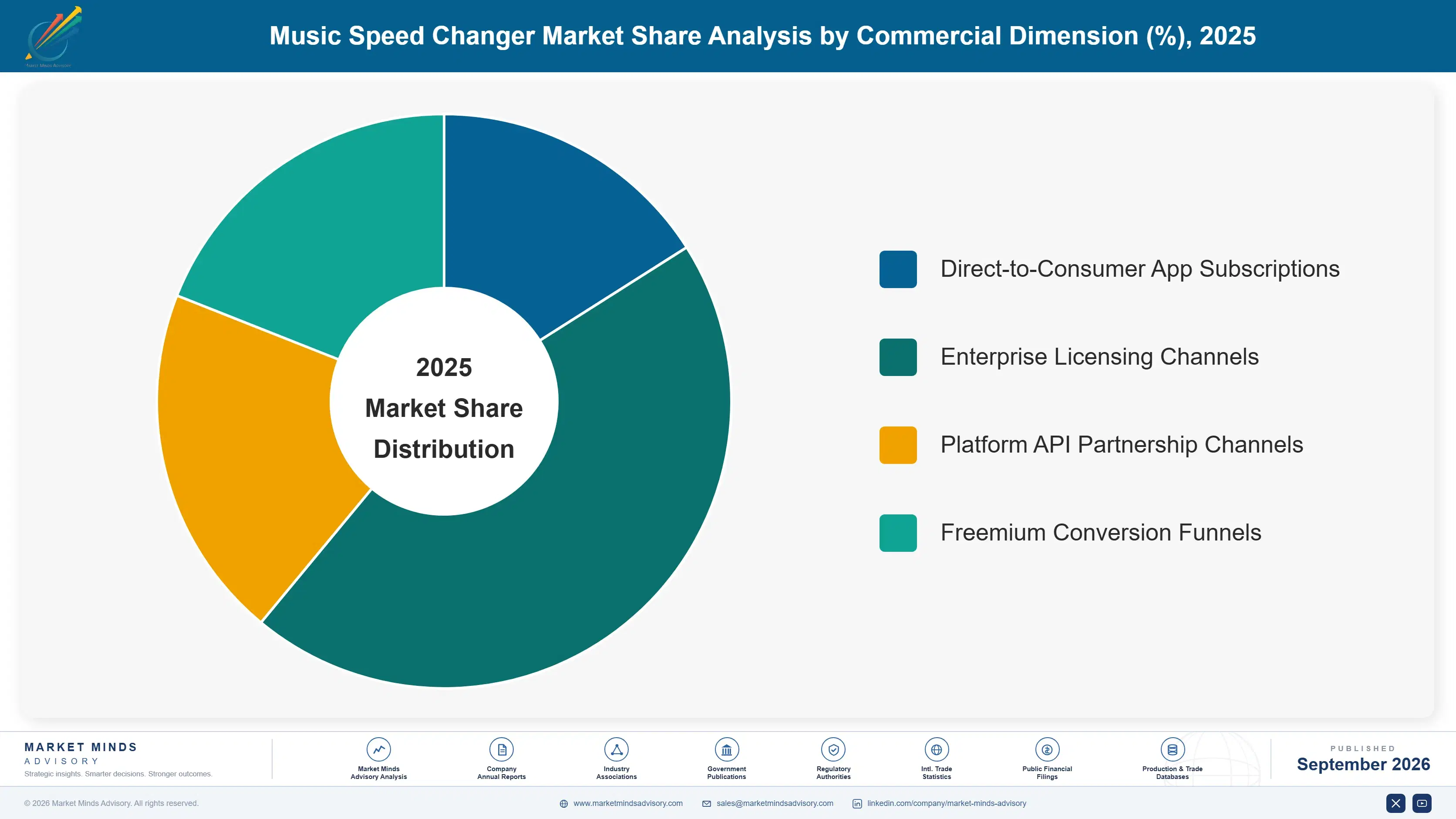
The market spans six categories organized by product type, from AI-powered transcription assistants through standalone hardware devices. Growth concentrates in software categories combining accuracy algorithms with subscription pricing, while hardware and simple utility categories grow slowest. Language learning and podcast utility categories occupy the pricing middle, while enterprise post-production plugins and standalone hardware round out the remaining categories.
music-speed-changer-market-market-share-analysis-1789986828869

AI-Powered Transcription and Practice Speed Tools

AI-Powered Transcription and Practice Speed Tools combine pitch-preservation algorithms with looping and note annotation features, growing at roughly 15.6% annually as musicians and transcribers demand cleaner slowed audio than earlier generations of software could deliver. Adoption started among professional transcribers willing to pay premium prices, but falling cloud computing costs have pulled semi-professional musicians into the category over the past two years. The segment increasingly competes on measurable accuracy benchmarks rather than feature count alone, since transcription errors directly cost professional users billable time. Vendors that can document accuracy scores above ninety percent hold a durable pricing advantage over rivals still refining detection algorithms. Several vendors now publish third-party audited accuracy benchmarks to reassure enterprise buyers evaluating competing platforms.
CAGR 15.6%

DJ and Live Performance Tempo Control Software

DJ and Live Performance Tempo Control Software lets performers adjust track tempo in real time during live sets without introducing audible pitch artifacts, growing at roughly 12.4% annually as beatmatching and mixing software converge into single integrated platforms. This segment carries a distinct professional user base from transcription tools, prioritizing latency and reliability during live performance over transcription accuracy. Vendors increasingly bundle tempo control directly into broader DJ software suites rather than selling it as a standalone add-on product. Retention in this segment depends heavily on hardware compatibility, since performers rarely switch platforms mid-tour regardless of pricing differences elsewhere. Latency below a few milliseconds is table stakes, with performers abandoning any tool that introduces audible lag during a mix.
CAGR 12.4%
Full segment breakdown across 6 segments available in the complete report.

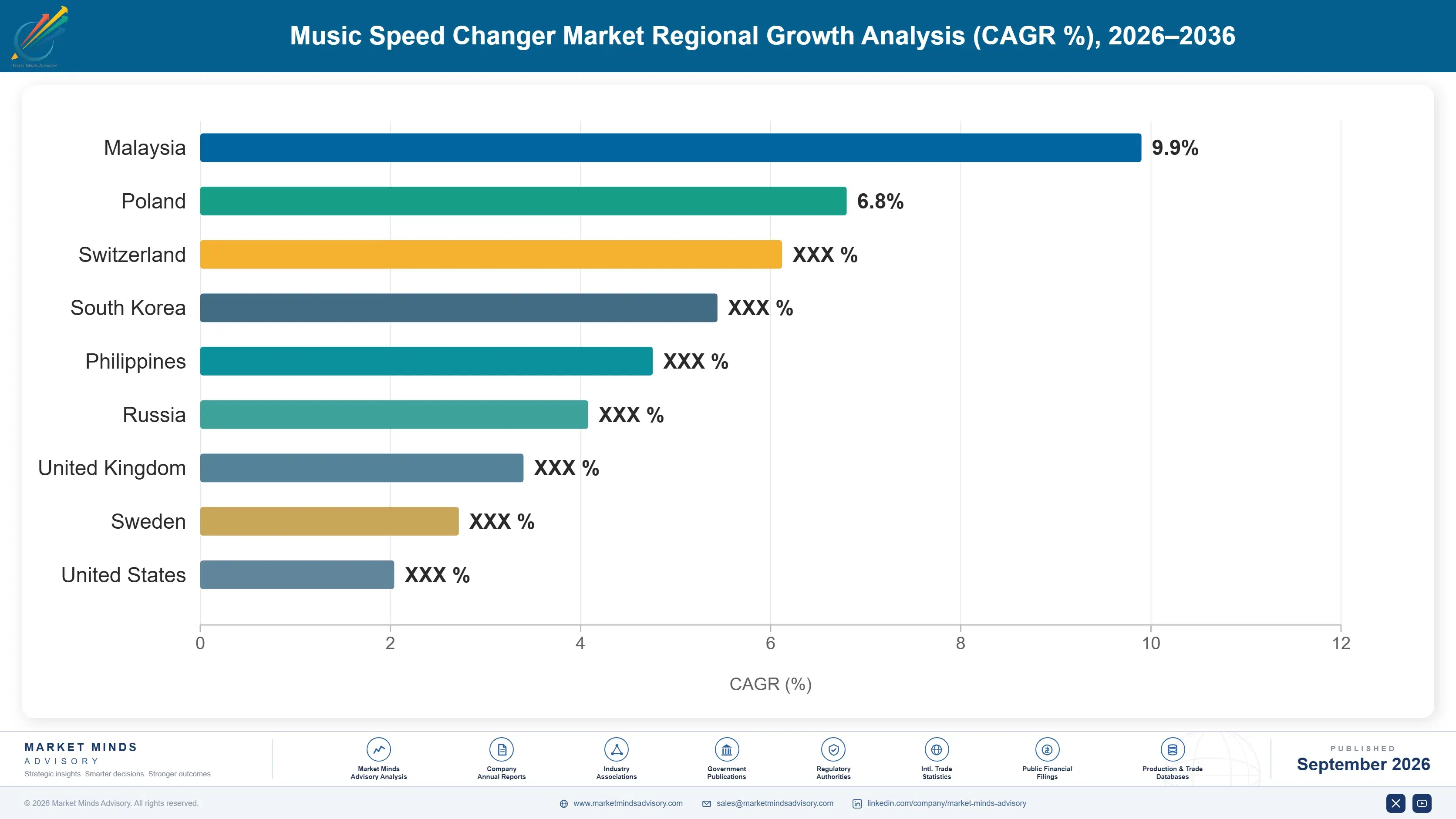
Regional Architecture and Country Demand Map

North America leads on app store monetization and premium subscription conversion, while South Asia and Pacific grows fastest as smartphone-based music education and language learning apps expand rapidly across India's large youth population. East Asia follows closely, driven by dense K-pop fan transcription communities and strong music education traditions.

North America

North America holds the largest subscriber share, supported by strong app store monetization and considerably higher premium subscription conversion rates than free-tier-dominated markets elsewhere. The United States hosts most of the category's established vendors, whose marketing budgets concentrate almost entirely on the domestic professional transcriber and musician audience. Podcast production, concentrated heavily in this region, adds meaningful enterprise licensing demand few other markets currently match. Growth trails the global rate slightly since the professional user segment here is already largely captured, leaving mostly casual users as remaining addressable demand. Canadian podcast studios are also emerging as a modest secondary growth pocket within the broader region. Enterprise buyers in this market also negotiate the most favorable per-seat licensing terms industry-wide.
Share: 28% | CAGR: 10.5% (2026 to 2036)

Western Europe

Western Europe's classical music education tradition supports a steady base of paying musician subscribers, concentrated in Germany, the United Kingdom, and France, where conservatory-trained students commonly use tempo tools for structured practice routines. Podcast production volume here trails North America meaningfully, limiting enterprise transcription licensing demand relative to the region's overall population. Growth trails the global average as the region's aging demographic profile produces fewer new music students entering the category each year compared with younger, faster-growing markets elsewhere. Scandinavia's smaller but affluent podcast production scene is emerging as a modest secondary growth pocket within the region. Regulatory attention to subscription cancellation practices here is somewhat stricter than in North America.
Share: 20% | CAGR: 8.3% (2026 to 2036)
Regional intelligence for 5 additional markets available in the complete report: East Asia, South Asia and Pacific, Latin America, Middle East and Africa, Eastern Europe. Contact sales@marketmindsadvisory.com.
music-speed-changer-market-country-cagr-analysis-1789986829744

Accuracy Certification Drives Enterprise Pricing Power

Consumer subscription pricing alone caps growth, pushing vendors toward enterprise licensing and platform partnerships that generate revenue insurers and app store margins cannot fully capture. Accuracy certification and API integration deals now drive most incremental revenue. Vendors that diversify beyond direct consumer subscriptions into these channels post materially stronger long-term revenue growth. Enterprise partnerships are reshaping vendor pricing power.

Enterprise Transcription Licensing Fee Programs Nationwide

Vendors are building dedicated enterprise sales teams to negotiate per-seat licensing deals with podcast production studios and corporate transcription departments, proving accuracy gains justify pricing above typical consumer subscription tiers. Enterprise licensing now generates roughly 18% of total platform revenue, up from near zero four years ago, and carries meaningfully lower churn than casual consumer subscriptions since the enterprise relationship reduces price sensitivity considerably. Several leading vendors have publicly disclosed enterprise pipeline growth exceeding 25% year over year as more studios sign on. This growth trend shows no signs of slowing across the broader podcast production industry.
Market Impact: Enterprise licensing now reaches roughly 18% of revenue

Language Learning Platform API Partnership Programs

Standalone vendors increasingly license their pitch-preservation algorithms directly to language learning platforms through API partnerships rather than competing for the same individual subscriber. These partnerships now generate meaningful recurring revenue independent of direct consumer subscriptions, and several vendors report this channel growing faster than their own direct-to-consumer app. Platforms value outsourcing accuracy work to specialists rather than building comparable algorithms in-house from scratch. Roughly 2 in 5 of these partnerships now include revenue-sharing terms tied directly to platform-wide active user counts. Vendors view this recurring revenue stream as more durable than direct consumer subscription income alone.
Market Impact: API partnership revenue now grows roughly 40% yearly

Professional Accuracy Certification Badge Testing Programs

Some vendors now offer paid third-party accuracy certification badges that competing apps can display after passing independent benchmark testing, creating a new revenue stream from the testing process itself rather than from end-user subscriptions. This certification revenue remains small but carries extremely high margin since the testing infrastructure is already built for internal product development purposes. Smaller developers increasingly view certification as essential marketing credibility they cannot otherwise afford to build independently. Roughly 4 in 10 certified apps report a measurable subscriber conversion lift within the first quarter after certification.
Market Impact: Certification programs now add roughly 3% of revenue

Instrument-Specific Premium Feature Upgrade Pathway Programs

Platforms increasingly design upgrade paths that convert general-purpose subscribers into instrument-specific premium tiers offering tailored practice features for guitar, piano, or vocal training specifically. These specialized tiers command meaningfully higher average revenue per subscriber than general-purpose plans, and represent the fastest-growing upgrade path within existing subscriber bases. Vendors also use instrument selection data to refine which subscribers are likeliest to convert to premium tiers over time. Roughly 3 in 10 subscribers who try an instrument-specific tier upgrade permanently within the first two months. That retention pattern makes instrument-specific tiers a genuinely durable revenue expansion path.
Market Impact: Specialized tiers now command roughly 60% higher fees

Who Controls the Margin Pool

The market is fragmented, with a cr5 of roughly 28%, reflecting a category of small independent developers where no single vendor has achieved decisive scale. The leading platform holds a meaningful but not dominant lead over its nearest challenger, with newer AI-focused entrants closing the gap through superior accuracy algorithms. The gap is measured in accuracy benchmark scores rather than raw download counts, since sophisticated buyers research before subscribing.
Current competition centers on accuracy benchmark disclosures, enterprise licensing announcements, and language learning platform partnerships, with vendors racing to secure API integration deals before rivals establish similar relationships. Several vendors are also acquiring smaller specialist developers purely to absorb their pitch-preservation algorithms, and some now run dedicated enterprise sales teams purely to capture licensing revenue. International expansion into East Asia has become a visible proxy battleground for investor confidence in this category.

Emerging pressure comes from major streaming and podcast platforms considering native tempo control features, threatening to erode standalone vendors' differentiation entirely. Rankings could shift meaningfully if a well-capitalized platform bundles comparable accuracy into an existing subscription millions already pay for. Legacy vendors bring specialized accuracy expertise that platform-bundled features still lack, though that advantage narrows each cycle.
music-speed-changer-market-company-positioning-matrix-1789986830602

Competitive Moat and Risk Dimensions

TRANSCRIBE!

Moat: Professional Transcriber Brand Trust

Transcribe! holds the strongest brand recognition among professional transcribers, having built a loyal user base over more than a decade of consistent accuracy improvements and responsive customer support. Competitors attempting to displace this trust face years of accumulated word-of-mouth reputation within tight-knit professional transcription communities.
TRANSCRIBE!

Risk: Aging Interface Modernization Risk

Transcribe!'s aging interface design increasingly struggles to attract younger users accustomed to modern mobile-first app experiences. Newer entrants with sleeker interfaces could erode its professional user base over time if it fails to modernize its desktop-first product design. Younger transcribers increasingly gravitate toward apps with cleaner onboarding and subscription-first pricing rather than a legacy license model.
MOISES

Moat: AI Stem Separation Differentiation

Moises built its brand around AI-powered stem separation combined with tempo control, creating a differentiated positioning that pure playback-speed vendors cannot easily replicate. That combined feature set has attracted partnerships with several music education platforms directly. Music education platforms view stem separation as a measurable practice enhancement worth recommending directly to enrolled students.
MOISES

Risk: Cloud Infrastructure Cost Exposure

Moises depends heavily on cloud computing costs for its AI processing pipeline, exposing margins to rising infrastructure prices as its user base scales. A sudden spike in cloud costs could compress unit economics faster than pricing increases can offset. Some regional markets have already seen infrastructure costs rise noticeably as processing demand grows faster than server capacity.

Players Tracked

Prominent Players

Transcribe!
Amazing Slow Downer
Anytune
Capo
Moises

Other Key Players

Riffstation
PitchLab Guitar Tuner
Tempo SlowMo
Audacity
Serato DJ Pro
djay Pro
rekordbox
Speechify
Otter.ai
Descript
Melodyne
iZotope RX
Soundtrap
n-Track Studio
WavePad

Recent Developments

JANUARY 2026

Moises announced an expanded partnership with a major online guitar lesson platform, integrating its stem separation and tempo control features directly into the platform's practice interface for enrolled students. The deal extends a pilot integration launched the prior year. Both companies view this as a template for future platform integrations.
Signal: Platform partnerships are steadily becoming the primary distribution channel for vendors seeking meaningful scale right now.
OCTOBER 2025

Anytune acquired a smaller specialist developer focused on real-time DJ tempo matching software, absorbing its existing algorithm and small professional user base. The deal expands Anytune's product into live performance use cases where it previously had limited presence. Leadership expects this to accelerate its roadmap.
Signal: Consolidation of smaller specialist developers is clearly accelerating as larger vendors seek adjacent capability more quickly.
MAY 2025

Capo entered a joint venture with a Japanese electronics manufacturer to co-develop a dedicated hardware tempo control device for the Japanese market's strong physical instrument practice culture. The partnership marks Capo's first meaningful hardware expansion beyond its established software-only product line. Both companies expect commercial launch within roughly one year.
Signal: International hardware partnerships increasingly rely on local manufacturing expertise for genuinely successful market entry right now.

Cloud Compute Cost Exposure

Cloud computing costs for AI-powered pitch correction and stem separation represent roughly thirty-five percent of operating cost of goods, with the remainder split between app store commission fees and customer support staffing. Most compute capacity is sourced from a small number of major cloud infrastructure providers, concentrating supply risk in a narrow set of vendors. This concentration means a price change can ripple through pricing within a single billing period.
A 2025 cloud pricing increase, documented in a major provider's annual report, forced several smaller vendors to raise subscription prices by roughly fifteen percent, temporarily slowing new subscriber growth in price-sensitive segments. Larger vendors with pre-negotiated discounts largely absorbed the increase without raising prices. The episode pushed affected vendors to diversify compute sourcing across additional providers and invest in on-device processing. Vendors that shifted early report lower infrastructure cost per subscriber than competitors still cloud-dependent.

Smaller developers without volume purchasing power face materially higher per-user compute costs than the largest vendors, a disadvantage that compounds with each new AI feature launch. Vendors concentrated in North America face less currency risk than those pricing across multiple international currencies. That gap is exactly why smaller developers increasingly seek acquisition by larger vendors.
music-speed-changer-market-cost-volatility-analysis-1789986830804

Multi-Cloud Provider Sourcing Diversification

Larger vendors are qualifying secondary cloud infrastructure providers to reduce exposure to any single provider's pricing changes or outages. This diversification adds modest integration cost upfront but meaningfully shortens recovery time during future price increases or service disruptions. Several vendors have already qualified alternate providers as part of this broader diversification push across their infrastructure stack.

On-Device Processing Feature Development

Some vendors are shifting basic pitch correction processing onto the user's device rather than the cloud, reducing per-user compute costs for high-volume casual features. This shift requires meaningful upfront engineering investment but pays back quickly at scale. Early adopters report noticeably lower churn among cost-sensitive users once processing speed improves on modern mobile hardware.

Volume Compute Purchase Commitments

Vendors with sufficient scale are negotiating multi-year compute purchase agreements that lock in favorable pricing ahead of demand spikes. Smaller vendors lacking this leverage remain more exposed to spot market price swings during periods of tight compute capacity. These agreements typically span two to three years and are increasingly bundled with joint infrastructure planning commitments from providers.

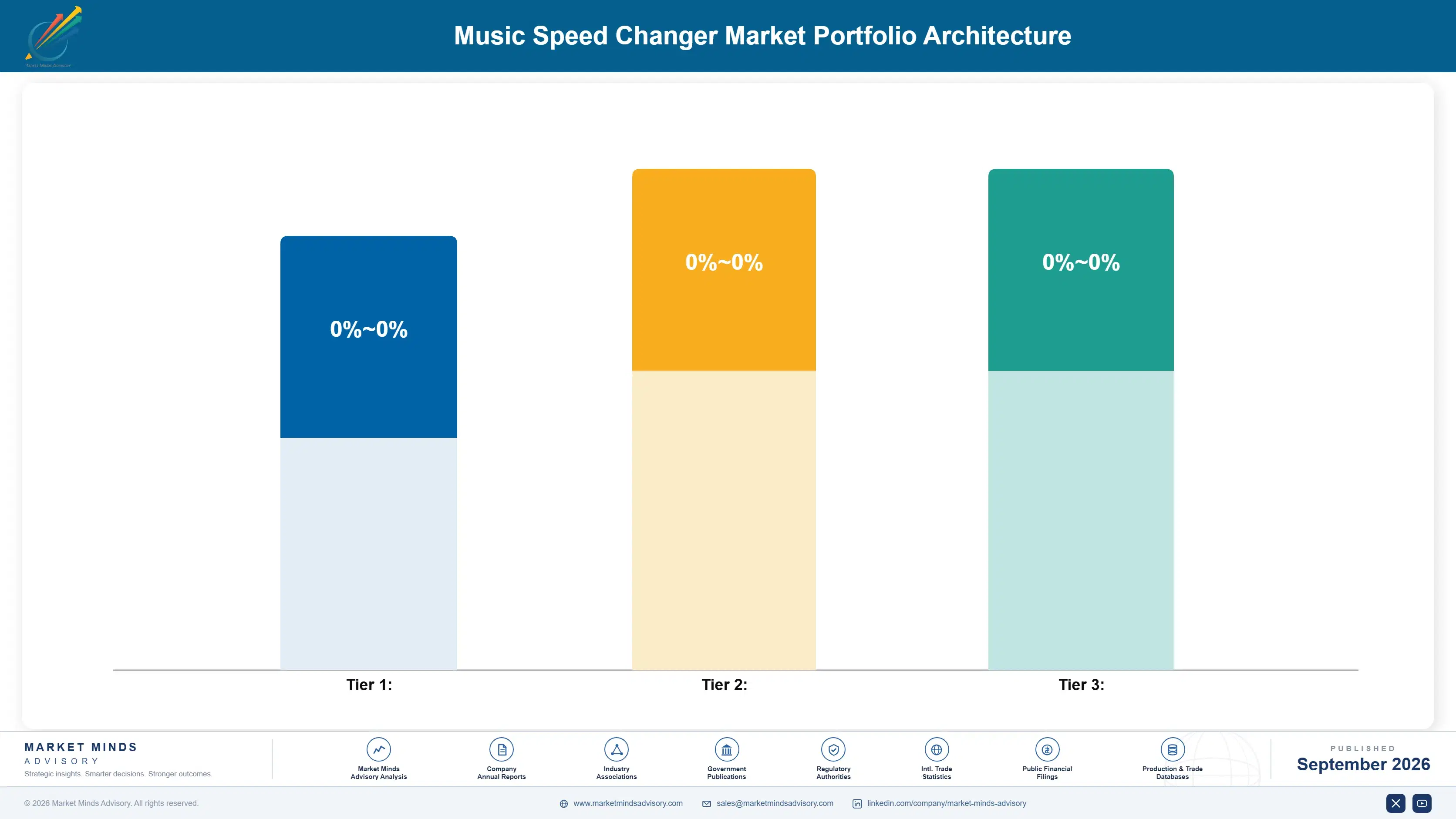
Portfolio Architecture for Margin Defence

The market splits across three tiers by margin structure. Volume tier consumer apps carry thin margins typical of mobile software, while premium tiers bundling AI-powered accuracy and stem separation command substantially higher margins closer to enterprise software than utility apps. Sustainability and next-generation tiers, built around instrument-specific AI features and enterprise certification, are still small but carry the highest long-term margin potential of the three.
Volume and premium tiers pull the market in opposite directions commercially. Volume growth depends on free-tier conversion improving at the margin, while premium growth depends on convincing professional transcribers and musicians that accuracy gains justify a higher fee. Most established vendors now run both tiers under a single app, using free users as a funnel that converts a share into premium upgrades after a first serious project.

High-value margin pools concentrate almost entirely in the premium accuracy tier and in enterprise licensing deals, where vendors capture both a subscription fee and a lower acquisition cost through direct enterprise sales rather than costly app store marketing. Volume tier apps generate the bulk of total user count but contribute proportionally less to profitability, making it valuable mainly as a funnel into higher-margin offerings.

Basic playback speed apps sold at thin margins comparable to consumer mobile software, competing primarily on price and simple usability rather than accuracy or feature depth. Churn risk is highest here since switching costs are minimal and price comparison is straightforward for cost-conscious users.
Gross Margin

AI-powered accuracy and stem separation tiers commanding meaningfully higher margins, priced closer to a professional software relationship than a casual utility, sustained by demonstrated retention gains. Retention outperforms volume subscribers, since switching from a trusted algorithm mid-project is far more disruptive than swapping apps.
Gross Margin

Enterprise licensing and certified accuracy offerings carrying the highest long-term margin potential, dependent on independently verified benchmark data that remains costly for smaller vendors to assemble. Adoption remains gradual as enterprise buyers demand multi-year benchmark evidence before committing to broader licensing expansion.
Gross Margin
music-speed-changer-market-portfolio-architecture-1789986831309

High-value Sub-segments and Strategic Watch-out

AI-Powered Transcription and Practice Speed Tools

The fastest-growing and highest-value segment, benefiting directly from AI accuracy improvements and expanding enterprise transcription licensing that continue to widen its addressable professional user base substantially. Vendors documenting audited accuracy scores are best positioned to capture enterprise licensing dollars ahead of competitors still building comparable evidence.

DJ and Live Performance Tempo Control Software

A high-value, moderate-growth segment anchored by professional loyalty and platform bundling, expanding steadily as beatmatching and mixing software converge into single integrated performance platforms. This segment carries the category's highest average revenue per subscriber among professional users and the lowest churn of any performance-focused tier.

Language Learning Audio Slowdown Applications

The volume core of the market, generating the largest user count at thinner margins, competing mainly on translation accuracy and straightforward monthly pricing rather than differentiated feature depth. Falling smartphone costs and expanding internet access are the main lever pulling new learners into this segment for the first time.

Standalone Hardware Tempo Control Devices

A strategic watch-out segment facing pressure from software-only competitors, as accuracy improvements in mobile processing increasingly erode the case for dedicated standalone hardware devices. Standalone hardware vendors without a software companion product of their own face genuine pressure to pivot toward software or be quietly acquired.

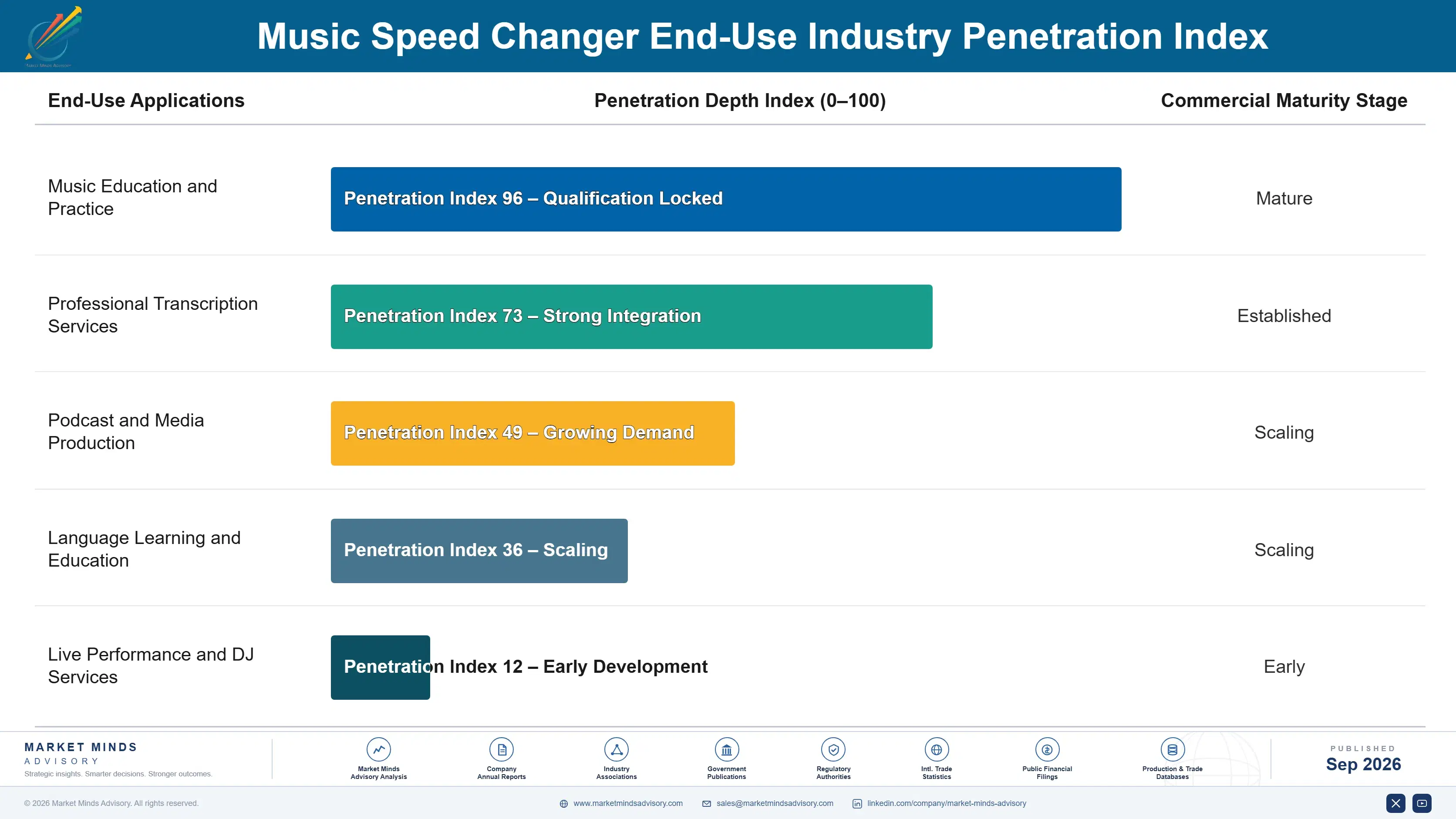
Retention Built on Skill, Not Habit

The annuity economics here differ from typical consumer software subscriptions because usage intensity directly tracks an active practice or transcription project rather than daily habitual engagement. Renewal depends on sustained proof that accuracy genuinely saves time, not on notification-driven habit loops the way social apps typically retain subscribers. Platforms win renewals by demonstrating measurable time savings on real projects. Not by daily app opens the way entertainment software does.
Adoption stickiness varies sharply by end-use vertical. Professional transcribers show the deepest engagement, since accuracy directly affects billable hours, while casual language learners churn more readily once a course ends or motivation fades. DJ subscribers show the opposite pattern, tied closely to touring schedules, with usage spiking around live performance seasons. Language learning sits between these extremes, sticky mainly during active enrollment in a course.

A generational shift is underway in who initiates purchases. Younger musicians, raised on subscription software generally, increasingly research and select apps independently based on published accuracy benchmarks rather than a teacher's recommendation, favoring vendors with strong digital marketing. That cohort is also more willing to switch vendors if a competitor demonstrates better accuracy. Brand loyalty here is considerably weaker than among the earliest wave of subscribers.
music-speed-changer-market-end-use-penetration-index-1789986831794

Where Accuracy Beats App Store Reach

These are among the four positions where our research anticipates prominent divergence between winners and laggards over the coming forecast period. Each is grounded in the demand model, the regulatory perimeter, and the announced capacity pipeline.
01 / ENTERPRISE LICENSING POSITIONING

Build enterprise transcription sales before rivals scale

Enterprise licensing is becoming the single largest lever separating category leaders from the rest of the field, more so than raw app store download counts ever were in this market's earlier years. Vendors investing early in dedicated enterprise sales capability are locking in per-seat contracts with podcast studios and transcription departments that casual competitors cannot easily displace once signed and renewed annually. Vendors still relying purely on consumer app store distribution risk permanent disadvantage as roughly a fifth of revenue already shifts toward enterprise licensing industry-wide.
02 / ACCURACY BENCHMARK CERTIFICATION

Publish independently audited accuracy scores to build trust

Accuracy certification is becoming the credibility signal sophisticated buyers now expect before subscribing to a premium tier, replacing marketing claims that once sufficed on their own. The strongest commercial opportunity available today is publishing third-party audited benchmark scores that clearly differentiate a vendor from dozens of uncertified competitors making nearly identical marketing claims about accuracy. Vendors without credible, independently verified accuracy data will increasingly struggle to justify premium pricing regardless of how sophisticated their underlying algorithm actually is in practice.
03 / PLATFORM PARTNERSHIP INTEGRATION

Secure API partnerships before language learning platforms build in-house

Language learning and podcast platforms increasingly consider building native tempo control in-house rather than licensing it, a genuine existential risk for standalone vendors dependent on this single distribution channel. Vendors that secure exclusive or preferred API partnership terms early lock in recurring revenue that platforms cannot easily replicate internally without years of dedicated algorithm development work of their own. Vendors without a credible partnership strategy risk losing this valuable channel entirely as platforms mature their own in-house capability over the coming years.
04 / CLOUD COST DIVERSIFICATION STRATEGY

Diversify compute sourcing to defend margin against providers

Cloud computing cost concentration leaves smaller vendors disproportionately exposed to pricing changes from a small number of dominant infrastructure providers who control most global compute capacity today. Vendors that diversify sourcing earlier or invest meaningfully in on-device processing recover faster from price shocks and maintain pricing stability that reassures cost-sensitive casual subscribers considering their first paid subscription. This positioning matters more with each new AI feature launch as compute intensity keeps rising across an increasingly sophisticated and expanding product lineup.

Engagement Snapshot From the Field

A live engagement with an industry participant carrying material or product regulatory and market exposure ahead of a defining policy shift, showing how our research translates into a defensible multi-year portfolio strategy.
MARKET MINDS ADVISORY · CLIENT ENGAGEMENT SUMMARY
Music Speed Changer Producer Strategic Portfolio Review and Transition Roadmap 2026·Investment Scenario on Music Speed Changer Exposure Evaluation 2025-26
CLIENT PROFILE
The client is a mid-size independent podcast production studio producing captioned content for several corporate and media clients, evaluating transcription-grade tempo tools to improve caption accuracy. The studio had relied on manual review for years and wanted a faster, more reliable workflow. The studio had never previously evaluated a third-party accuracy tool and lacked internal precedent for comparing vendors on a consistent basis.
STRATEGIC CHALLENGE
Studio leadership needed to select a vendor from a crowded field of similar-sounding apps without in-house technical expertise to evaluate competing accuracy claims independently. A wrong choice risked locking the studio into a costly annual license that failed to actually improve caption turnaround time as promised. Leadership was also wary of disrupting an existing editing workflow that clients had already grown accustomed to relying on.
MMA APPROACH
MMA analysts benchmarked five leading vendors against a consistent commercially relevant basis covering documented accuracy scores, enterprise licensing terms, and existing integration support for common editing software. Analysts also reviewed independent audio testing lab data to validate vendor marketing claims independently before making a recommendation. This cross-referencing surfaced meaningful discrepancies between vendor-reported accuracy and what comparable studios had actually experienced.
KEY FINDINGS
  1. Only two of five evaluated vendors had independently audited accuracy data credible enough to support internal workflow planning decisions. The remaining three vendors relied primarily on internal marketing claims rather than third-party verification.
  2. Enterprise licensing terms varied across vendors, with the strongest candidate offering roughly half the per-seat cost of its rival. That gap justified prioritizing accuracy over brand familiarity.
  3. Vendor pricing models diverged sharply between flat annual licenses and usage-based per-minute transcription fees. The flat annual license ultimately proved more predictable given the studio's growing monthly episode volume.
  4. Two vendors lacked existing integration support for the studio's editing software, requiring costly custom development. Integration gaps would have required weeks of custom development work before either vendor could go live.
CLIENT PROFILE
The client is a mid-size independent podcast production studio producing captioned content for several corporate and media clients, evaluating transcription-grade tempo tools to improve caption accuracy. The studio had relied on manual review for years and wanted a faster, more reliable workflow. The studio had never previously evaluated a third-party accuracy tool and lacked internal precedent for comparing vendors on a consistent basis.
STRATEGIC CHALLENGE
Studio leadership needed to select a vendor from a crowded field of similar-sounding apps without in-house technical expertise to evaluate competing accuracy claims independently. A wrong choice risked locking the studio into a costly annual license that failed to actually improve caption turnaround time as promised. Leadership was also wary of disrupting an existing editing workflow that clients had already grown accustomed to relying on.
MMA APPROACH
MMA analysts benchmarked five leading vendors against a consistent commercially relevant basis covering documented accuracy scores, enterprise licensing terms, and existing integration support for common editing software. Analysts also reviewed independent audio testing lab data to validate vendor marketing claims independently before making a recommendation. This cross-referencing surfaced meaningful discrepancies between vendor-reported accuracy and what comparable studios had actually experienced.
KEY FINDINGS
  1. Only two of five evaluated vendors had independently audited accuracy data credible enough to support internal workflow planning decisions. The remaining three vendors relied primarily on internal marketing claims rather than third-party verification.
  2. Enterprise licensing terms varied across vendors, with the strongest candidate offering roughly half the per-seat cost of its rival. That gap justified prioritizing accuracy over brand familiarity.
  3. Vendor pricing models diverged sharply between flat annual licenses and usage-based per-minute transcription fees. The flat annual license ultimately proved more predictable given the studio's growing monthly episode volume.
  4. Two vendors lacked existing integration support for the studio's editing software, requiring costly custom development. Integration gaps would have required weeks of custom development work before either vendor could go live.
RECOMMENDED STRATEGY
Phase 1: Select the vendor with the strongest audited accuracy data and negotiate a flat annual license rather than usage-based pricing. This narrows the field before deeper commercial review begins. Phase 2: Run a one-month trial across a limited set of episodes before committing to the full studio-wide rollout. This limits risk while generating enough editorial data to validate accuracy claims. Phase 3: Require quarterly accuracy audits and build a cancellation clause allowing renegotiation if performance targets are not met. This protects the studio if real-world accuracy diverges from the initial demonstration.
OUTCOME
The studio selected its preferred vendor and completed a one-month trial in late 2025, reporting a measurable reduction in caption correction time within the first few weeks. Leadership credited the independent vendor comparison with avoiding a costly commitment to a less accurate competitor. The trial's flat-fee structure meant the studio faced no unexpected cost overruns during this evaluation.

Frequently Asked Questions

Foundational context covering the market sizes, CAGR, scope, country, region and competition that inform every finding below. This section is provided to cover basics and most often pre-purchase conversations, answered from the MMA Primary Research Dataset.

What is the current size of the Music Speed Changer Market?

The Music Speed Changer Market reached roughly 0.28 billion dollars in 2025. Rising demand from transcribers, musicians, and language learners is driving subscription adoption steadily.

How large will the Music Speed Changer Market be by 2036?

MMA projects the market will reach approximately 0.79 billion dollars by 2036. That represents roughly 2.55 times its 2026 value, driven by AI accuracy gains and enterprise licensing growth.

What is the CAGR for the Music Speed Changer Market 2026 to 2036?

The market is projected to grow at a 9.8% compound annual rate between 2026 and 2036. Enterprise licensing and improving AI accuracy both support this sustained growth pace.

Which segment is growing fastest?

AI-Powered Transcription and Practice Speed Tools are growing fastest, at roughly 15.6% annually, about 1.59 times the overall market rate. Enterprise licensing demand is the primary driver behind this pace.

Who are the major companies in the Music Speed Changer Market?

Transcribe!, Amazing Slow Downer, Anytune, Capo, and Moises lead the market. Together these five companies hold roughly 28% combined share on a subscriber count basis.

Which country is growing fastest?

India is growing fastest, at roughly 13.2% annually, as smartphone-based music education and language learning apps expand rapidly across its large, digitally native youth population.

Report Segmentation Architecture

The full report scope spans multiple orthogonal segmentation dimensions, with cross-tabulated demand data provided for each dimension pair. Coverage extends further to regional breakdowns, trend trajectories, and the competitive detail needed to support segment-level decision-making.

By Primary Market Dimension

  • AI-Powered Transcription and Practice Speed Tools
  • DJ and Live Performance Tempo Control Software
  • Language Learning Audio Slowdown Applications
  • Podcast and Media Playback Speed Utilities
  • Standalone Hardware Tempo Control Devices
  • Enterprise Audio Post-Production Plugins

By End-Use Industry

  • Music Education and Practice
  • Professional Transcription Services
  • Podcast and Media Production
  • Language Learning and Education
  • Live Performance and DJ Services

By Commercial Dimension

  • Direct-to-Consumer App Subscriptions
  • Enterprise Licensing Channels
  • Platform API Partnership Channels
  • Freemium Conversion Funnels

By Region

  • North America
  • Western Europe
  • East Asia
  • South Asia and Pacific
  • Latin America
  • Middle East and Africa
  • Eastern Europe

Scope, Methodology, and Coverage

Every figure in this report is reproducible from documented input assumptions. The scope below maps the historical period, the forecast horizon, the segmentation dimensions, and the countries covered, alongside the underlying primary and qualitative methodology.
Historical Period
2020 to 2025
Forecast Period
2026 to 2036
Base Year
2025 (USD billions; MMA Primary Research Dataset, September 2026)
Market Definition
This report defines the Music Speed Changer Market as software applications and plugins that alter audio playback tempo while preserving pitch, serving musicians, transcribers, DJs, and language learners. It excludes generic media player speed controls lacking dedicated pitch-correction algorithms.
Quantitative Units
USD billions, subscriber counts, and percentage share
Segmentation Dimensions
Product type, end-use industry, and commercial dimension
Regions Covered
North America, Western Europe, East Asia, South Asia and Pacific, Latin America, Middle East and Africa, Eastern Europe
Countries Covered
United States, India, Japan, Germany, South Korea, Brazil, and 21 additional countries
Key Companies Profiled
Transcribe!, Amazing Slow Downer, Anytune, Capo, Moises, and 15 additional companies
Quantitative Methodology
Primary survey, n=3,800 respondents, Q4 2025, six countries; demand-side model with trade association cross-validation
Qualitative Methodology
47 expert interviews, Q4 2025; applied to validate demand model assumptions, identify emerging dynamics, and assess competitive positioning
Report Format
PDF and XLSX data workbook (Word format preview document)
Publisher
Market Minds Advisory
Report Code
MMA-2026-TEC-228
Published
September 2026
Contact
sales@marketmindsadvisory.com | www.marketmindsadvisory.com

Purchase the full Music Speed Changer Market Report (2026 to 2036).

This report gives app developers and product strategy teams a complete view of the Music Speed Changer Market through 2036. It covers segment-level growth, regional demand shifts, and competitive positioning across transcription, DJ, and language learning product lines. Input cost exposure and margin architecture are analyzed in detail, with particular attention to how cloud computing costs are reshaping vendor pricing and consolidation across every major regional market. Readers get actionable guidance on where to concentrate commercial investment over the next decade of AI-driven accuracy improvement.
Ten-year global revenue and subscriber growth forecasts
Seven-region demand, pricing, and adoption breakdown
Competitive benchmarking across the top twenty vendors
Cloud cost exposure analysis and mitigation guidance
Segment-level margin architecture and pricing tier analysis
Anonymized client vendor selection engagement case study

Built For The People Who Decide

From boardroom strategy to bench-side execution, this report is read cover-to-cover by leaders shaping the next decade of their industry, turning demand scenarios, market dynamics and valuation benchmarks into decisions.
CXOs/ Presidents/ VPs/ Managers
M&A and Corporate Development
Strategy Teams and R&D Heads
Procurement and Product Directors
Regulatory and Compliance Leaders
Investor Relations and Equity Analysts