Market Minds Advisory
Multivitamin Melt Market

Multivitamin Melt Market: Dose ceilings, absorption reality and the formats that escape both to 2036

A strip that anybody will actually tolerate carries about thirty milligrams of active, and a genuine multivitamin needs several hundred once minerals are included, which nobody explains on the packaging.

Lead Analyst

Lisa Gevelber

Published

September 2026

Make Smarter Decisions with Customized Research Insights

Request a free sample report and evaluate market opportunities, growth trends, and competitive dynamics relevant to your business needs.

2025 MARKET VALUE$1.9BMarket Size 2025
2036 FORECAST VALUE$6.3BBase Case , 2026 to 2036
CAGR 2026 TO 203611.6 %Bull 12.9% / Bear 10.3%
INCREMENTAL OPPORTUNITY$4.2BNet 10- year value creation
EXPANSION MULTIPLE3.00x2036 value over 2026 base
Strategic Levers
M&A Pipeline
Regional Outlook
Country Rankings
Competitive Intelligence
Segmental Deep-dive
Call-Us : 91 93563 13602

Executive Snapshot and Market Trajectory

An oral film a person will actually tolerate carries around 30 milligrams of active, while a genuine multivitamin needs several hundred once minerals are counted. Most products in this category are therefore substantially underdosed against a tablet, and consumers are not told. Nobody has published that comparison. Somebody eventually will.
Oral thin film strips grow at 17.4%, half again the market rate of 11.6%, because roughly 40% of adults report difficulty or aversion swallowing tablets and that suppresses supplement adherence directly. North America holds 31% of value on supplement culture and permissive claim rules. Around 78% of film production is contract manufactured by specialists. A product somebody actually takes beats a technically better one they keep avoiding entirely.
Five manufacturers hold just 21% of category value and the fragmentation reflects brands rather than capability, since almost everybody uses the same narrow base of contract coating operations. The uncomfortable technical fact is that fat-soluble vitamins achieve no meaningful sublingual absorption at all, because they require lipid digestion and bile that a strip on the tongue cannot provide. Chemistry rather than formulation decides that, and no film changes it. Nobody has said so publicly.
Market Definition
This report covers vitamin and mineral supplements formulated in rapidly dissolving oral formats, spanning oral thin film strips, orally disintegrating tablets, dissolvable powder sticks, melt gummy formats, effervescent melt formats, and lipid-encapsulated film systems. Value is measured at manufacturer level on retail sales. Excluded are conventional tablets, capsules and softgels, liquid supplements requiring measurement, prescription oral film medicines, single-nutrient products without multivitamin positioning, and functional food and beverage.
Base Year Value
$1.9B in 2025 (MMA Primary Research Dataset, August 2026)
Forecast Period
2026 to 2036, eleven discrete annual values
CAGR
11.6% base case. Bull 12.9%. Bear 10.3%.
Fastest Growth Segment
Oral Thin Film Strips: 17.4% CAGR
Fastest Growth Country
India: 15.4% CAGR
Fastest Growth Region
South Asia and Pacific: 13.8% CAGR
Largest Region
North America: 31% of 2025 global value
Market Leaders
Bayer, Church and Dwight, Nestle Health Science, Haleon and Pharmavite lead the market. Source: MMA Primary Research Dataset, July 2026.
Primary Survey
n=3,800 procurement and R&D decision-makers, Q4 2025, six countries
Methodology
Demand-side build-up, cross-validated against public data, 47 expert interviews

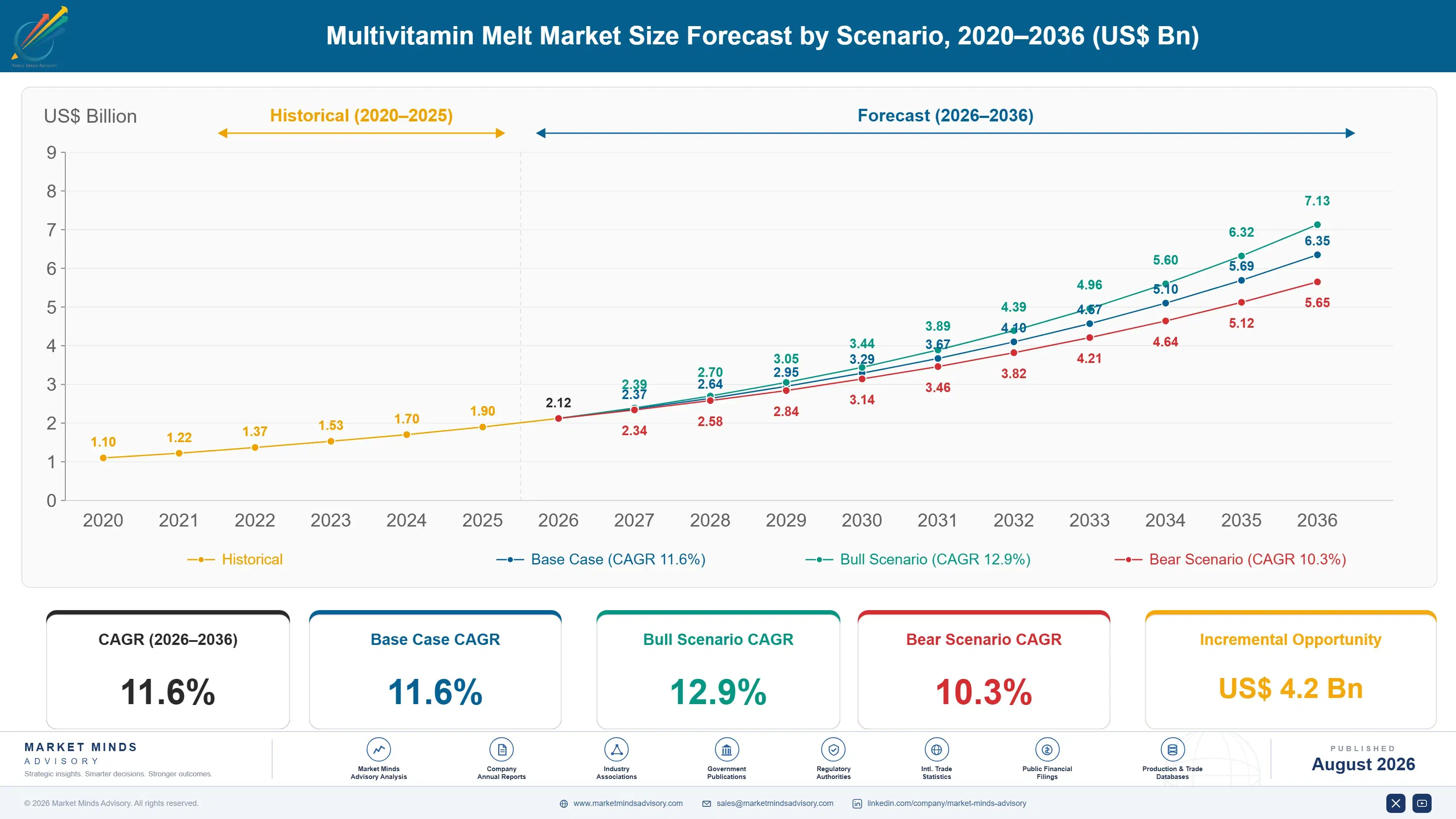
Multivitamin Melt Market Forecast Scenarios

multivitamin-melt-market-size-forecast-scenario-1787555756339
Growth ran at 10.2% between 2020 and 2025 and format convenience drove nearly all of it. Consumer interest in supplements expanded broadly through the period and melt formats captured a disproportionate share of new entrants, helped considerably by social commerce where a dissolving strip demonstrates well on video. Dosing limitations and absorption realities received almost no attention from anybody selling or buying.
The 11.6% base case rests on three mechanisms. Difficulty swallowing tablets affects around 40% of adults and suppresses adherence in a way melt formats genuinely solve regardless of any dose limitation. Powder stick formats keep growing at 15.6% because they escape the dose ceiling entirely and can carry the minerals films cannot. And Asian markets keep adopting rapidly where oral film and jelly formats already have decades of consumer familiarity behind them.
The 12.9% bull case is lipid-encapsulated film systems solving fat-soluble delivery credibly, which would let a strip make claims it currently cannot support at all. The 10.3% bear case is regulatory or media attention to underdosing, since most melt products deliver a fraction of a tablet's nutrient content and that comparison has not yet been made publicly by anybody.

What A Strip Cannot Carry

This category has a physical ceiling that almost nobody selling into it discusses. An oral thin film that a person will place on their tongue without objection carries roughly 30 milligrams of active substance, because beyond that the strip becomes too thick, too large or too unpleasant to use. A complete multivitamin requires several hundred milligrams once calcium, magnesium and the other minerals are counted. The arithmetic does not work, so most products carrying the multivitamin description deliver a fraction of a tablet.
TOP-FIVE CONCENTRATION21%Combined position across melt format supply held by leading manufacturers
PILL SWALLOWING DIFFICULTY RATE40%Portion of adults reporting trouble taking conventional tablets
MAXIMUM FILM ACTIVE LOAD30 mgActive substance a tolerable oral strip can physically carry
FAT-SOLUBLE SUBLINGUAL ABSORPTION0Meaningful uptake achieved for oil dependent vitamins this way
CONTRACT MANUFACTURING SHARE78%Portion of film production outsourced to specialist coating operations
INGREDIENT COST SHARE34%Portion of manufacturer cost attributable to actives and film base
The absorption story is similarly uneven and equally unexplained. Sublingual and buccal delivery genuinely bypasses first-pass metabolism for some actives, and vitamin B12 in particular has decades of evidence behind it. Fat-soluble vitamins including A, D, E and K require lipid digestion and bile salts to be absorbed at all, and a film dissolving on the tongue provides neither. For those nutrients the format achieves nothing beyond convenience, which marketing rarely confines itself to.
What the category genuinely solves is real and worth respecting. Around 40% of adults report difficulty or aversion swallowing tablets, and that suppresses supplement adherence more than any formulation shortcoming. A product somebody actually takes beats a better one they avoid.
"The honest pitch here is that people take these because they can, not because they absorb better. That is a genuinely good argument and the industry keeps reaching past it toward bioavailability claims that half the vitamins in the product cannot support."
Principal, Consumer Nutrition and Delivery Formats Practice · MMA Healthcare Practice · August 2026

Market Trends

Dose ceilings force honest reformulation or quiet underdosing

A tolerable oral strip carries around 30 milligrams of active, and a complete multivitamin requires several hundred once minerals are included, which means the format physically cannot deliver what its name implies. Most products resolve that by including trace quantities of many nutrients or by omitting minerals entirely, and neither approach is disclosed in terms a consumer would understand. Powder stick formats escape the ceiling completely because a stick carries grams rather than milligrams. Commercially the category faces a choice between reformulating toward what films genuinely do well and continuing to sell a comparison nobody has yet made publicly.
Market Impact: Addresses 40% reporting difficulty
Powder sticks solve what films physically cannot

A dissolvable powder stick carries grams of material rather than milligrams, which removes the dose ceiling entirely and permits genuine multivitamin and mineral content in a format that still requires no swallowing of tablets. Growth at 15.6% follows brands recognising that the convenience benefit and the dose requirement can both be satisfied at once. Sticks also avoid the fat-soluble absorption problem, since the material is swallowed and digested normally rather than relying on sublingual uptake that oil-dependent vitamins cannot achieve. The format is less visually striking than a dissolving film and considerably more honest.
Market Impact: Drives 15.4% Indian growth

Market Opportunities and Growth Drivers

Swallowing difficulty suppresses adherence across large populations

Around 40% of adults report difficulty or genuine aversion swallowing tablets, which affects older people, children and a substantial group with no clinical diagnosis who simply dislike it. That difficulty suppresses supplement adherence far more than any formulation deficiency does, because a product left in a cupboard delivers nothing at all regardless of how well it was designed. Melt formats address the problem directly and honestly. This is the category's strongest and most defensible argument, and it requires no absorption claim, no comparison to tablets and no explanation a regulator could challenge.
Market Impact: Delivers 0 sublingual fat-soluble uptake

Asian familiarity with film and jelly formats accelerates adoption

Japanese and Korean consumers have used oral films, jelly sticks and dissolving formats across decades for medicines, breath products and supplements, which removes the novelty barrier that Western markets are still working through. That familiarity translates into faster trial and higher repeat rates when new products launch. Chinese and Southeast Asian adoption follows similar patterns supported by social commerce where the format demonstrates well. Indian growth at 15.4% is the fastest of any country here and rests on a very large population, rising supplement adoption and genuine cultural aversion to swallowing tablets.
Market Impact: Outsources 78% of film production

Market Restraints and Challenges

Fat-soluble vitamins achieve nothing through sublingual delivery

Vitamins A, D, E and K require lipid digestion, bile salts and intestinal absorption to enter the bloodstream, and a film dissolving on the tongue provides none of those conditions. The root cause is chemistry rather than formulation skill, and no amount of film engineering changes what those molecules need. Commercially this means products marketing sublingual bioavailability across a full vitamin spectrum are making a claim that applies to perhaps half their contents. Manufacturers are responding with lipid-encapsulated film systems that carry the vitamins into normal digestion, which works and costs considerably more.
Market Impact: Caps films at 30 milligrams

Contract manufacturing concentration limits real differentiation

Around 78% of oral film production is outsourced to a narrow base of specialist coating and drying operations, because the process requires equipment and know-how that brand owners rarely possess. The root cause is that film casting demands uniform thickness, controlled drying and active distribution that ordinary supplement manufacturing cannot achieve. Commercially this means competing brands frequently ship near-identical product from the same lines with different packaging. Brands are responding by investing in proprietary formulations, exclusive supply arrangements and lipid systems that fewer contract manufacturers can produce. Marketing carries the whole differentiation burden.
Market Impact: Segment compounds at 15.6% annually
3 additional market trends, 4 additional growth drivers, and 2 additional restraints and challenges are covered in the full report. Contact sales@marketmindsadvisory.com to access the complete intelligence.

Segment CAGR and Growth Architecture

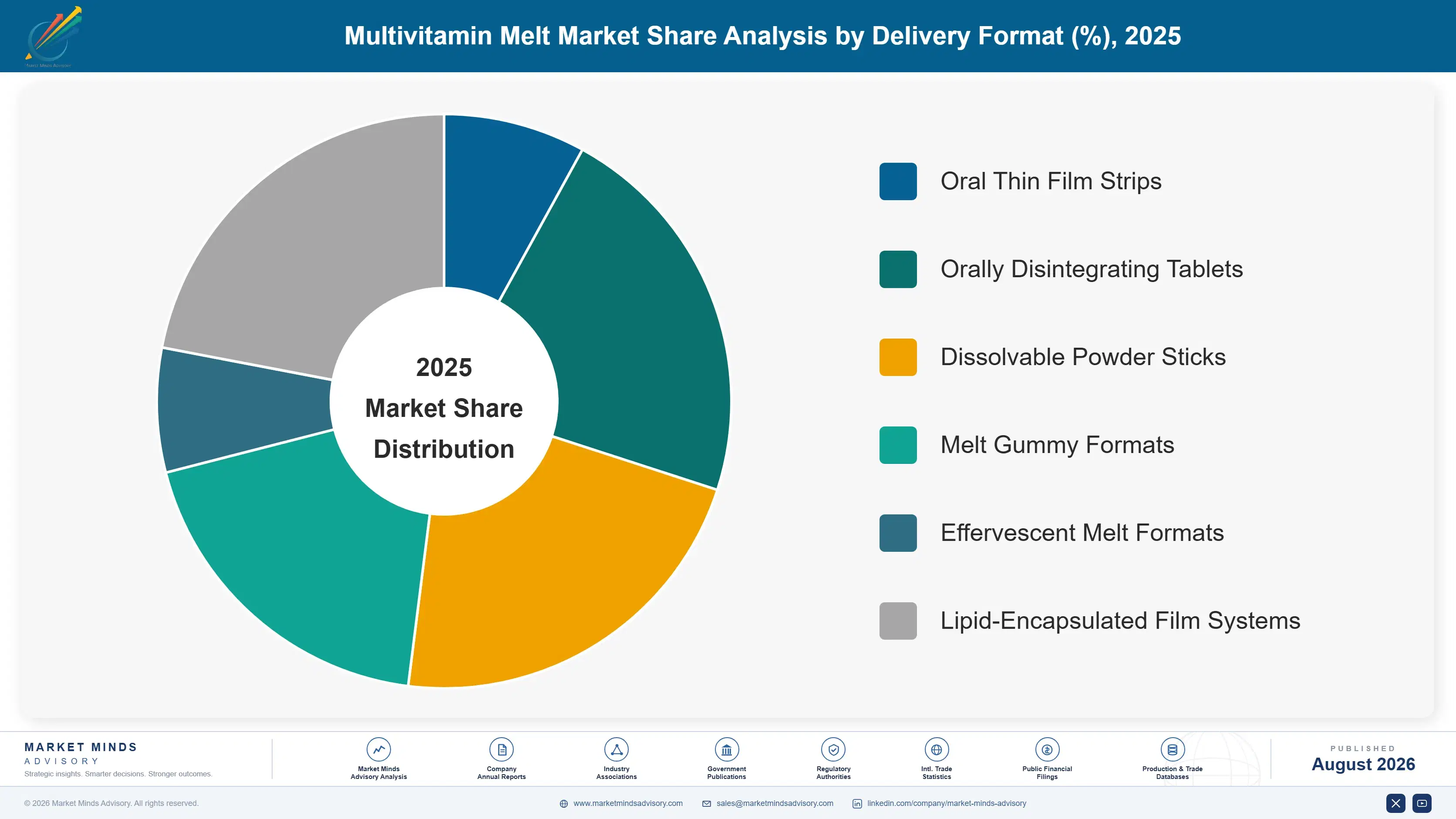
Products are classified here by delivery format, since that determines the dose a product can carry, the absorption route available and what a brand may honestly claim. Nutrient composition, consumer segment and distribution channel are handled separately in the framework, because one format carries many different formulations without changing. Format decides the honest claim.
multivitamin-melt-market-market-share-analysis-1787555756910

Oral Thin Film Strips

Growing at 17.4%, half again the market rate, film strips are the format that defines this category in consumers' minds and the one with the tightest physical limits. A strip anybody will tolerate carries around 30 milligrams of active, which permits meaningful doses of vitamin B12 and a few other water-soluble nutrients and excludes minerals entirely. Sublingual absorption genuinely works for some actives and achieves nothing for fat-soluble vitamins requiring bile and lipid digestion. The format demonstrates beautifully on video, which explains a great deal of the growth. The honest commercial position is convenience and adherence rather than any absorption advantage across a full spectrum. Video demonstrates it beautifully. Convenience is the honest claim.
CAGR 17.4%

Dissolvable Powder Sticks

A powder stick carries grams rather than milligrams, which removes the dose ceiling that constrains films entirely and permits genuine multivitamin and mineral content while still requiring nobody to swallow a tablet. Growth at 15.6% follows brands recognising that convenience and adequate dosing need not be traded against each other. The material is swallowed and digested normally, which sidesteps the fat-soluble absorption problem rather than pretending to solve it. Sticks demonstrate less dramatically than a dissolving film and deliver considerably more nutrient, which is an awkward marketing position and a technically superior product for most multivitamin applications. It demonstrates less dramatically and delivers considerably more nutrient, which is an awkward marketing position and a better product.
CAGR 15.6%
Full segment breakdown across 6 segments available in the complete report.

Regional Architecture and Country Demand Map

North America holds 31% of value on supplement culture and claim rules permitting brands to describe what a product does. East Asia follows on decades of familiarity with film and jelly formats. Novelty barriers differ enormously between the two. Familiarity rather than income decides adoption speed here.

North America

Supplement consumption per head is the highest anywhere and structure and function claim rules let brands describe what a product is intended to do, which is a commercial advantage no other major market grants. Social commerce has been unusually effective for this category, since a dissolving strip demonstrates on video in a way a tablet never will. That has produced rapid launch activity and considerable brand fragmentation. Contract manufacturing capacity is concentrated and most brands share suppliers. Growth at 11.2% sits close to the market average and reflects a market where adoption is advanced relative to elsewhere. Brand fragmentation followed the launch activity directly. Most brands share suppliers. Differentiation is thin.
Share: 31% | CAGR: 11.2% (2026 to 2036)

East Asia

Japanese and Korean consumers have used oral films, jelly sticks and dissolving formats for decades across medicines, breath products and supplements, which removes the novelty barrier Western markets are still working through and produces faster trial with better repeat rates. Japanese contract manufacturing capability in film casting is among the most technically advanced anywhere. Chinese adoption is expanding rapidly through social commerce and urban health spending. Korean beauty and wellness positioning drives format innovation. Growth at 12.6% combines existing familiarity with expanding consumption across a very large population base. Japanese contract manufacturing in film casting is among the most technically advanced anywhere in the world. Novelty is not a barrier.
Share: 25% | CAGR: 12.6% (2026 to 2036)
Regional intelligence for 5 additional markets available in the complete report: Western Europe, South Asia and Pacific, Latin America, Middle East and Africa, Eastern Europe. Contact sales@marketmindsadvisory.com.
multivitamin-melt-market-country-cagr-analysis-1787555757444

Where Melt Format Margin Sits

Four moves matter in a category whose central format cannot physically carry what its name implies and whose absorption claims apply to about half its contents. Two are about being honest profitably, and two are about the formats that escape the constraints entirely. Making broader bioavailability claims is not among them. Claims invite scrutiny.

Sell adherence rather than absorption claims

Around 40% of adults report difficulty or aversion swallowing tablets, and that suppresses supplement adherence more than any formulation shortcoming ever could, because a product left in a cupboard delivers nothing whatever. Melt formats solve that directly and the argument requires no absorption claim, no tablet comparison and nothing a regulator could challenge. Brands reaching past it toward sublingual bioavailability are making claims that apply to perhaps half their contents and inviting scrutiny they do not need. The honest argument is also the stronger one commercially. Honesty is commercially stronger.
Market Impact: Addresses the full 40% reporting difficulty with tablets

Move multivitamin claims into powder stick formats

A film carries around 30 milligrams and a genuine multivitamin needs several hundred once minerals are counted, which means the flagship product in this category cannot deliver what its name promises. Powder sticks carry grams, escape the ceiling completely and still require nobody to swallow a tablet. Growth at 15.6% reflects brands working this out. Keeping the multivitamin claim on films while moving the actual full-spectrum product into sticks resolves a contradiction that will eventually be noticed publicly by somebody, and moving first is considerably better than moving afterwards. Moving first beats moving after.
Market Impact: Escapes a hard 30 milligram film dose ceiling

Develop lipid systems for fat-soluble vitamins

Vitamins A, D, E and K require lipid digestion and bile salts and achieve essentially nothing through sublingual delivery, which is chemistry rather than any formulation failure anybody could engineer around. Lipid-encapsulated systems carry those vitamins into normal digestion rather than pretending sublingual uptake occurs, which works and costs more. Brands holding a genuine technical answer to a problem competitors are quietly ignoring have a position worth defending properly. Lipid systems use normal digestion instead, which is the only route those molecules accept. Roughly 4 of the thirteen essential vitamins are fat-soluble and unreachable sublingually.
Market Impact: Solves a 0 percent fat-soluble absorption problem entirely

Secure exclusive contract manufacturing capacity now

Around 78% of film production runs through a narrow base of specialist coating operations, which means competing brands frequently ship near-identical product from identical lines with different packaging on it. Differentiation through formulation is therefore largely illusory across much of the category. Exclusive supply arrangements, proprietary formulation development and investment in lipid or multilayer capability that fewer manufacturers can produce all create genuine separation. Brands relying on standard contract offerings are competing entirely on marketing spend against products that are functionally identical to their own. Marketing cannot buy separation. Sharing lines shares products.
Market Impact: Escapes the shared 78% of contract coating capacity

Who Controls the Margin Pool

Five manufacturers hold just 21% of category value, measured on retail sales at manufacturer level, the basis used throughout this section. That fragmentation reflects brands rather than manufacturing capability, since around 78% of film production runs through a narrow base of specialist contract coaters and competing products frequently originate on the same lines. The gap between leaders and everybody else is distribution reach rather than any formulation advantage. Shared lines produce most of it.
Competition runs on three dimensions. Distribution and shelf access, since a melt product must be encountered to be tried. Format credibility with consumers who have reasonable questions about whether a strip can deliver anything. And proprietary formulation or exclusive manufacturing access, which is the only genuine differentiation available. Price competes moderately given premium positioning across the category. Consumers reasonably ask whether a strip delivers anything.

Rankings shift as established manufacturers acquire fast-growing brands, which has happened repeatedly in adjacent supplement categories. Powder stick formats favour manufacturers with conventional blending capability rather than film specialists. Any public attention to underdosing would redistribute positions toward brands that had already reformulated honestly. Reformulated brands would benefit most.
multivitamin-melt-market-company-positioning-matrix-1787555757969

Competitive Moat and Risk Dimensions

BAYER

Moat: Vitamin category distribution reach

Bayer holds pharmacy and grocery distribution across most developed markets built over decades of conventional vitamin supply, which matters enormously in a category where a novel format must be physically encountered before anybody will try it. That reach converts a modest formulation position into shelf presence that fast-growing brands spend years attempting to reach.
BAYER

Risk: Conventional format cannibalisation

A large conventional tablet and capsule business makes it awkward to promote melt formats as solving a swallowing problem those products create, since the argument devalues the larger portfolio directly. Specialist melt brands make that case without any internal difficulty. In a category built on tablet aversion, that constraint carries genuine commercial cost.
CHURCH AND DWIGHT

Moat: Consumer format innovation record

Church and Dwight has repeatedly commercialised novel consumer health formats and holds the marketing capability to explain a new delivery mechanism to consumers who did not know they wanted one. In a category where the product must be understood before it is tried, that communication capability matters more than formulation depth does.
CHURCH AND DWIGHT

Risk: Shared contract manufacturing base

Like most participants the company relies on specialist contract coaters producing near-identical film for competing brands, which means marketing carries the entire differentiation burden. Competitors with exclusive capacity or proprietary lipid systems hold product separation that no communication investment replicates. That exposure grows as the category matures and consumers compare.

Players Tracked

Prominent Players

Bayer
Church and Dwight
Nestle Health Science
Haleon
Pharmavite

Other Key Players

Reckitt
Amway
Herbalife
Blackmores
Swisse Wellness
Otsuka Holdings
Rohto Pharmaceutical
Aquestive Therapeutics
IntelGenx
LTS Lohmann Therapie-Systeme
tesa Labtec
ARx
Catalent
Lonza
Bausch Health

Recent Developments

FEBRUARY 2025

A brand moved its multivitamin claim from film to powder sticks

A supplement brand relaunched its full spectrum multivitamin in dissolvable powder stick format while retaining films for single-nutrient products, acknowledging that film dose ceilings cannot support complete multivitamin content. This was a product portfolio decision rather than any commercial transaction. Competitors have not followed yet.
Signal: A brand publicly matching format to what it can actually deliver sets a standard competitors will eventually have to meet
AUGUST 2025

A contract manufacturer introduced lipid-encapsulated film capability

A specialist oral film contract manufacturer commissioned lipid encapsulation capability enabling fat-soluble vitamin delivery through normal digestion rather than relying on sublingual uptake those molecules cannot achieve. This was a capital investment rather than any partnership or acquisition arrangement. Sublingual uptake was never achievable for those molecules at all.
Signal: Solving fat-soluble delivery properly narrows the contract manufacturing field, which finally creates genuine product separation somewhere
NOVEMBER 2025

A consumer publication compared melt and tablet nutrient content

A consumer testing organisation published a comparison of nutrient content between melt format multivitamins and conventional tablets, finding substantially lower delivered quantities across most melt products examined. This was independent testing rather than any commercial or regulatory action. No brand had disclosed the difference. Comparisons will follow.
Signal: Published dose comparisons are the category's most obvious vulnerability and the first one has now appeared publicly

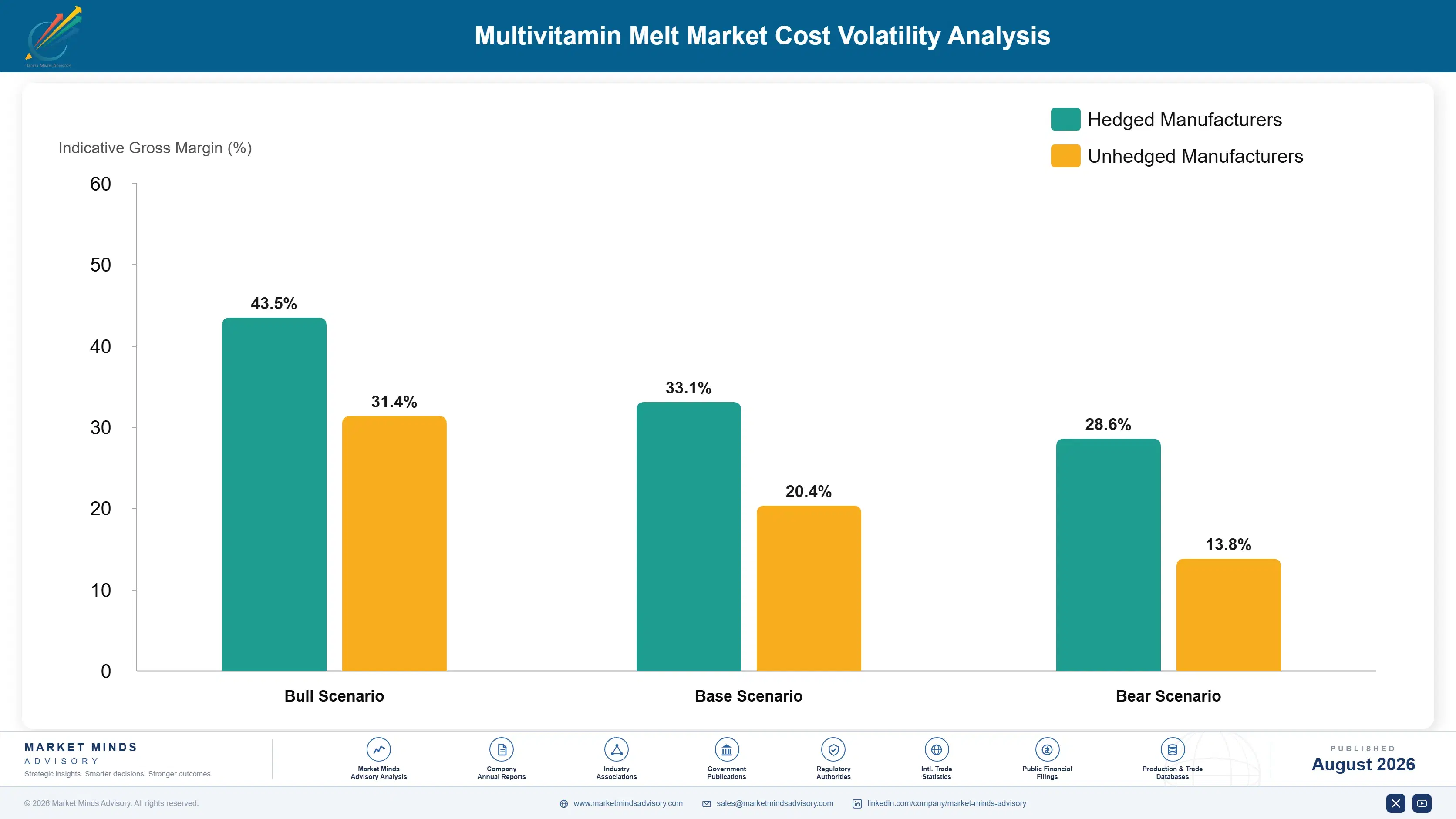
What Moves Manufacturer Cost

Actives and film-forming base account for around 34% of manufacturer cost, which is lower than most supplement formats because a film contains very little material by weight. Contract manufacturing conversion is the dominant cost line and reflects specialist coating capability rather than commodity processing. Packaging is substantial relative to product weight given individual strip wrapping. Marketing sits outside cost of goods and dominates the profit and loss entirely.
Vitamin active prices moved through 2021 and 2022 on Chinese production disruption and freight costs, and USDA and trade data record the movement across those periods. Haleon noted input cost and supply pressure across its consumer health operations in its Annual Report 2022. Brands on retailer price agreements absorbed most of it, since a chain sets shelf pricing for a period. Active costs moved regardless of retail negotiations.

Contract manufacturing capacity rather than ingredients is what actually constrains this category and it appears as a conversion charge that looks unremarkable. Specialist coating operations are few, capacity is finite and allocation during surges goes to whoever committed volume. Brands without contracted capacity discover during a successful launch that they cannot obtain product at all.
multivitamin-melt-market-cost-volatility-analysis-1787555758165

Contract film capacity ahead of any launch demand

Specialist coating operations are few and their capacity is finite, with allocation during demand surges going to brands holding committed volume rather than to whoever needs product most urgently. A successful launch that cannot obtain supply damages a brand permanently and has ended several outright. Committing capacity before demand appears costs working capital and buys the ability to serve success.

Match format to dose requirement before formulating

A film carries around 30 milligrams and a complete multivitamin needs several hundred, which means the format decision should follow the nutrient specification rather than preceding it. Brands choosing film first and then reducing content build a product that fails any published comparison. Sticks solve full spectrum needs and films serve single nutrients, and matching costs nothing.

Qualify second contract manufacturers for continuity

A brand dependent on one specialist coater has no alternative if that operation loses capacity, changes ownership or prioritises a larger customer during a shortage. Qualifying a second manufacturer costs development time and stability testing and delivers continuity worth considerably more than any unit price concession. Brands that discovered this during recent capacity constraints generally restructured their supply arrangements afterwards.

Portfolio Architecture for Margin Defence

Margin here tracks format credibility and manufacturing access rather than ingredient cost, because a film contains very little material and the price a consumer pays reflects convenience and belief. Standard film products run at gross margins in the high forties against competitors shipping near-identical product from the same contract lines. Powder sticks and disintegrating tablets run somewhat better on dose credibility. Lipid-encapsulated systems and exclusively manufactured formulations run considerably higher, on genuine technical separation competitors cannot obtain. Belief carries the price here.
The tension is that films carry the category's identity while sticks carry the honest multivitamin proposition, and moving the flagship claim between formats risks confusing a consumer who came for the dissolving strip. Several brands have resolved it by keeping films for single nutrients and moving full spectrum into sticks, which is technically correct and commercially awkward to explain. Others have simply continued underdosing films, which works until somebody publishes a comparison.

High-value pools sit in lipid-encapsulated systems, exclusive manufacturing access and honest format matching. None of the three depends on making broader absorption claims. Marketing spend alone defends very little where products are functionally identical.

Volume / Commodity-Adjacent

Standard oral film products manufactured on shared contract capacity where competing brands ship functionally identical strips in different packaging. The ten-point range separates brands with committed capacity and better retail terms from those buying spot conversion at premium rates.
Gross Margin: 42%-52%

Premium / Certified

Powder sticks, disintegrating tablets and melt gummies where genuine dose delivery and format credibility support pricing beyond convenience alone. The twelve-point spread reflects brand strength, since identical formulations sell very differently depending on who is selling them.
Gross Margin: 52%-64%

Sustainability / Regulatory / Next-Generation

Lipid-encapsulated film systems, exclusively manufactured formulations and clinically supported delivery claims. The fourteen-point range is wide because these price against genuine technical scarcity rather than against any comparable product a consumer could find.
Gross Margin: 60%-74%
multivitamin-melt-market-portfolio-architecture-1787555758667

High-value Sub-segments and Strategic Watch-out

Lipid-Encapsulated Film Systems

Fat-soluble vitamins achieve nothing through sublingual delivery because they need bile and lipid digestion, and lipid encapsulation solves that properly rather than ignoring it. Very few contract manufacturers can produce it at all. That scarcity is exactly what makes the position genuinely defensible over time.
Gross Margin: 62%-74%

Powder Stick Full Spectrum

Compounding at 15.6% and escaping the 30 milligram ceiling entirely, which permits genuine multivitamin content without asking anybody to swallow a tablet. Less striking on video and considerably more honest. Somebody will eventually publish the dose comparison that films cannot survive at all. Sticks survive it.
Gross Margin: 54%-66%

Standard Contract Film Product

The category volume, produced on shared lines where competing brands ship near-identical strips in different packaging entirely. Manage for capacity commitment and retail terms rather than for any formulation differentiation. Capacity commitment rather than formulation is what actually protects a brand here. Nothing else does.
Gross Margin: 42%-52%

Exclusive Manufacturing Access

Around 78% of film production runs through a narrow specialist base, which means most differentiation is illusory. Exclusive arrangements and proprietary capability create separation that marketing spend simply cannot buy. Most claimed differentiation across this category is currently entirely illusory. Exclusivity fixes that. Nobody escapes it.
Gross Margin: 58%-70%

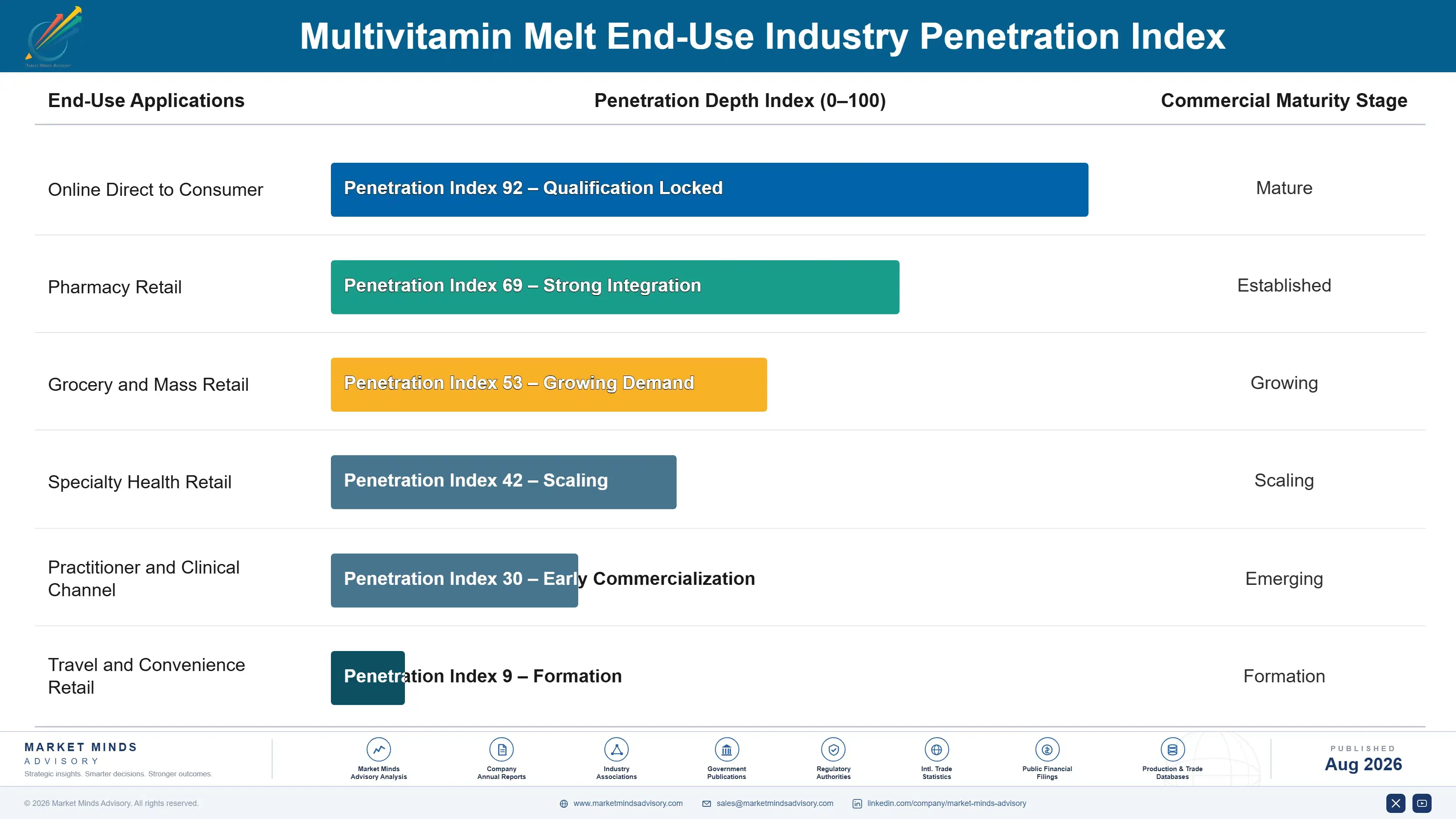
How Melt Demand Renews

Demand renews monthly at the repurchase and adherence decides everything. A consumer who takes the product daily buys again and one who stops does not, which makes this a category where the format advantage translates directly into commercial performance rather than merely into a marketing claim. That is genuinely unusual in supplements, where most formats retain badly because people simply stop taking them and never articulate why.
Stickiness follows the swallowing problem rather than the brand. A consumer who switched to melts because tablets were difficult has a reason to stay in the format and considerably less reason to stay with a particular brand, since products from shared contract lines are functionally interchangeable. Brands holding proprietary formulations or lipid systems retain better because switching genuinely changes what the consumer receives.

The buyer arrives through social discovery far more than through pharmacy recommendation, which distinguishes this category from most of consumer health. A dissolving strip demonstrates on video in a way a tablet cannot, and that has driven adoption among younger consumers who encounter supplements through content rather than through a pharmacist. Those buyers are also more likely to compare products publicly.
multivitamin-melt-market-end-use-penetration-index-1787555759154

Where To Place The Bet

These are among the four positions where our research anticipates prominent divergence between winners and laggards over the coming forecast period. Each is grounded in the demand model, the regulatory perimeter, and the announced capacity pipeline.
01 / ADHERENCE ARGUMENT FOCUS

Sell what people will actually take daily

Around 40% of adults report difficulty or genuine aversion swallowing tablets, and that suppresses supplement adherence far more than any formulation deficiency ever could, since a product sitting unopened in a cupboard delivers precisely nothing regardless of how well it was designed. Melt formats address that directly and honestly, and the argument requires no absorption claim, no tablet comparison and nothing that a regulator or a journalist could reasonably challenge. Brands reaching past it toward sublingual bioavailability invite scrutiny they genuinely do not need.
02 / FORMAT DOSE MATCHING

Put the multivitamin where the dose fits

An oral film that anybody will tolerate carries around 30 milligrams of active substance, while a complete multivitamin requires several hundred once calcium, magnesium and the other minerals are properly counted, which means the flagship product in this category physically cannot deliver what its name promises. Powder sticks carry grams, escape the ceiling entirely and still ask nobody to swallow a tablet. Keeping films for single nutrients and moving full spectrum into sticks resolves a contradiction that somebody will eventually publish.
03 / LIPID DELIVERY INVESTMENT

Solve fat-soluble delivery competitors are ignoring

Vitamins A, D, E and K require lipid digestion and bile salts to be absorbed at all, and a film dissolving on the tongue provides neither condition, which is chemistry rather than any formulation failure that better engineering could address. Lipid-encapsulated systems carry those vitamins into normal digestion rather than pretending sublingual uptake happens, which works properly and costs considerably more to produce. That capability also narrows the contract manufacturing field, creating genuine product separation in a category where almost none currently exists.
04 / MANUFACTURING ACCESS SECURITY

Own the capacity your competitors are sharing

Roughly 78% of oral film production runs through a narrow base of specialist coating operations, which means competing brands frequently ship functionally identical strips from identical production lines in different packaging with different stories attached. Differentiation through formulation is therefore largely illusory across much of this category today. Exclusive supply arrangements, proprietary formulation development and investment in lipid or multilayer capability that far fewer manufacturers can produce all create genuine separation that no amount of marketing spend can ever purchase.

Engagement Snapshot From the Field

A live engagement with an industry participant carrying material or product regulatory and market exposure ahead of a defining policy shift, showing how our research translates into a defensible multi-year portfolio strategy.
MARKET MINDS ADVISORY · CLIENT ENGAGEMENT SUMMARY
Multivitamin Melt Producer Strategic Portfolio Review and Transition Roadmap 2026·Investment Scenario on Multivitamin Melt Exposure Evaluation 2025-26
CLIENT PROFILE
A North American supplement brand with annual revenue around USD 48 million (client-reported, unverified by MMA), selling oral film multivitamins and single-nutrient strips through online and specialty retail. All production ran through one specialist contract coater. Marketing emphasised sublingual bioavailability across the full range. No powder or lipid formats existed. Capacity was never contracted formally.
STRATEGIC CHALLENGE
A capacity allocation shortfall had caused stockouts during a growth period (client-reported, unverified by MMA) and management proposed increasing marketing spend once supply recovered. Nobody had examined whether the multivitamin product could support the claims being made for it, which left the brand exposed to a comparison anybody could publish.
MMA APPROACH
MMA assessed the client's multivitamin nutrient content against conventional tablet equivalents and against the physical dose ceiling of the film format. Absorption claims were evaluated nutrient by nutrient rather than accepting a general sublingual position. Contract capacity security was reviewed, and powder stick economics were modelled against the existing film portfolio.
KEY FINDINGS
  1. The client's multivitamin film delivered a small fraction of conventional tablet nutrient content and contained no minerals at all, which no consumer communication disclosed in comprehensible terms.
  2. Sublingual bioavailability claims applied credibly to vitamin B12 and one other active, and to none of the fat-soluble vitamins the product also contained and promoted.
  3. Single-source contract dependence had caused the stockout directly, and no second manufacturer had ever been qualified against the client's formulations at any point.
  4. Powder stick manufacture was widely available, escaped the dose ceiling entirely and would have supported a genuine multivitamin claim the film could never carry.
CLIENT PROFILE
A North American supplement brand with annual revenue around USD 48 million (client-reported, unverified by MMA), selling oral film multivitamins and single-nutrient strips through online and specialty retail. All production ran through one specialist contract coater. Marketing emphasised sublingual bioavailability across the full range. No powder or lipid formats existed. Capacity was never contracted formally.
STRATEGIC CHALLENGE
A capacity allocation shortfall had caused stockouts during a growth period (client-reported, unverified by MMA) and management proposed increasing marketing spend once supply recovered. Nobody had examined whether the multivitamin product could support the claims being made for it, which left the brand exposed to a comparison anybody could publish.
MMA APPROACH
MMA assessed the client's multivitamin nutrient content against conventional tablet equivalents and against the physical dose ceiling of the film format. Absorption claims were evaluated nutrient by nutrient rather than accepting a general sublingual position. Contract capacity security was reviewed, and powder stick economics were modelled against the existing film portfolio.
KEY FINDINGS
  1. The client's multivitamin film delivered a small fraction of conventional tablet nutrient content and contained no minerals at all, which no consumer communication disclosed in comprehensible terms.
  2. Sublingual bioavailability claims applied credibly to vitamin B12 and one other active, and to none of the fat-soluble vitamins the product also contained and promoted.
  3. Single-source contract dependence had caused the stockout directly, and no second manufacturer had ever been qualified against the client's formulations at any point.
  4. Powder stick manufacture was widely available, escaped the dose ceiling entirely and would have supported a genuine multivitamin claim the film could never carry.
RECOMMENDED STRATEGY
Phase 1: Phase one: move the multivitamin claim to a powder stick format and reposition films around single nutrients where the dose and absorption arguments genuinely hold. Phase 2: Phase two: qualify a second contract manufacturer immediately, since single-source dependence directly caused the stockout that prompted this entire review. Phase 3: Phase three: replace all the general sublingual claims with nutrient-specific communication that survives public scrutiny rather than actively inviting it.
OUTCOME
Powder stick multivitamins launched in late 2026 alongside repositioned single-nutrient films. A second contract manufacturer is qualified and supplying. Claims were revised nutrient by nutrient, and the client reports repeat purchase improving on the reformulated range (client-reported, unverified by MMA). Stockouts have not recurred since.

Frequently Asked Questions

Foundational context covering the market sizes, CAGR, scope, country, region and competition that inform every finding below. This section is provided to cover basics and most often pre-purchase conversations, answered from the MMA Primary Research Dataset.

What is the current size of the Multivitamin Melt Market?

The market was valued at USD 1.9 billion in 2025, rising to an estimated USD 2.12 billion in 2026. North America holds the largest regional share at 31% of value.

How large will the Multivitamin Melt Market be by 2036?

MMA forecasts USD 6.35 billion by 2036 under the base case, an expansion multiple of 3.00 times the 2026 value. That represents USD 4.23 billion of incremental value.

What is the CAGR for the Multivitamin Melt Market 2026 to 2036?

The base case runs at 11.6% compound annual growth between 2026 and 2036, with a bull case at 12.9% and a bear case at 10.3%. Historical growth from 2020 to 2025 was 10.2%.

Which segment is growing fastest?

Oral thin film strips lead at 17.4%, half again the market rate, on convenience and adherence rather than absorption. Dissolvable powder sticks follow at 15.6%.

Who are the major companies in the Multivitamin Melt Market?

Bayer, Church and Dwight, Nestle Health Science, Haleon and Pharmavite hold just 21% between them. Distribution reach rather than any formulation advantage sustains those positions.

Which country is growing fastest?

India leads at 15.4%, on a very large population, rising supplement adoption and genuine cultural aversion to swallowing tablets that suppresses conventional format adherence considerably.

Report Segmentation Architecture

The full report scope spans multiple orthogonal segmentation dimensions, with cross-tabulated demand data provided for each dimension pair. Coverage extends further to regional breakdowns, trend trajectories, and the competitive detail needed to support segment-level decision-making.

By Delivery Format

  • Oral Thin Film Strips
  • Orally Disintegrating Tablets
  • Dissolvable Powder Sticks
  • Melt Gummy Formats
  • Effervescent Melt Formats
  • Lipid-Encapsulated Film Systems

By End-Use Industry

  • Online Direct to Consumer
  • Pharmacy Retail
  • Grocery and Mass Retail
  • Specialty Health Retail
  • Practitioner and Clinical Channel
  • Travel and Convenience Retail

By Consumer Segment

  • Adults With Swallowing Difficulty
  • Older Adults and Elderly
  • Children and Adolescents
  • Travel and Convenience Buyers
  • Athletic and Active Users

By Region

  • North America
  • Western Europe
  • East Asia
  • South Asia and Pacific
  • Latin America
  • Middle East and Africa
  • Eastern Europe

Scope, Methodology, and Coverage

Every figure in this report is reproducible from documented input assumptions. The scope below maps the historical period, the forecast horizon, the segmentation dimensions, and the countries covered, alongside the underlying primary and qualitative methodology.
Historical Period
2020 to 2025
Forecast Period
2026 to 2036
Base Year
2025 (USD billions; MMA Primary Research Dataset, August 2026)
Market Definition
The market comprises vitamin and mineral supplements formulated in rapidly dissolving oral formats across online, pharmacy, grocery, specialty, clinical and travel retail channels, covering oral thin film strips, orally disintegrating tablets, dissolvable powder sticks, melt gummy formats, effervescent melt formats, and lipid-encapsulated film systems. Value is measured at manufacturer level on retail sales. Conventional tablets, capsules and softgels, liquid supplements requiring measurement, prescription oral film medicines, single-nutrient products without multivitamin positioning, and functional food and beverage fall outside scope.
Quantitative Units
USD billions (current prices); million units sold annually; USD per unit by delivery format
Segmentation Dimensions
By Delivery Format; By End-Use Industry; By Consumer Segment; By Region
Regions Covered
North America, Western Europe, East Asia, South Asia and Pacific, Latin America, Middle East and Africa, Eastern Europe
Countries Covered
United States, Canada, Mexico, Brazil, Argentina, Colombia, Japan, South Korea, China, Taiwan, India, Australia, Indonesia, Thailand, Vietnam, United Kingdom, Germany, France, Netherlands, Sweden, Switzerland, Italy, Spain, Poland, Czechia, Romania, United Arab Emirates, Saudi Arabia, South Africa, Egypt
Key Companies Profiled
Bayer, Church and Dwight, Nestle Health Science, Haleon, Pharmavite, Reckitt, Amway, Herbalife, Blackmores, Swisse Wellness, Otsuka Holdings, Rohto Pharmaceutical, Aquestive Therapeutics, IntelGenx, LTS Lohmann Therapie-Systeme, tesa Labtec, ARx, Catalent, Lonza, Bausch Health
Quantitative Methodology
Primary survey, n=3,800 respondents, Q4 2025, six countries; demand-side model with trade association cross-validation
Qualitative Methodology
47 expert interviews, Q4 2025; applied to validate demand model assumptions, identify emerging dynamics, and assess competitive positioning
Report Format
PDF and XLSX data workbook (Word format preview document)
Publisher
Market Minds Advisory
Report Code
MMA-2026-HLT-091
Published
August 2026
Contact
sales@marketmindsadvisory.com | www.marketmindsadvisory.com

Purchase the full Multivitamin Melt Market Report (2026 to 2036).

The full report sizes the global multivitamin melt market to 2036 across six delivery formats and seven regions, measured on retail sales at manufacturer level. It quantifies the physical dose ceiling that constrains film formats and assesses sublingual absorption nutrient by nutrient rather than accepting a general claim. Competitive analysis covers 20 participants evaluated on retail sales value, with moat and risk assessment for the two leaders. Contract manufacturing concentration is measured, since shared capacity means most claimed differentiation is illusory across the category. Four quantified revenue levers close the analysis.
Six-format segment sizing with segment-level growth rates
Seven-region share and growth breakdown to 2036
Twenty-participant competitive map on one retail basis
Dose ceilings quantified against genuine multivitamin nutrient requirements
Sublingual absorption assessed nutrient by nutrient rather than generally
Four quantified revenue levers with commercial impact ranges

Built For The People Who Decide

From boardroom strategy to bench-side execution, this report is read cover-to-cover by leaders shaping the next decade of their industry, turning demand scenarios, market dynamics and valuation benchmarks into decisions.
CXOs/ Presidents/ VPs/ Managers
M&A and Corporate Development
Strategy Teams and R&D Heads
Procurement and Product Directors
Regulatory and Compliance Leaders
Investor Relations and Equity Analysts