Market Minds Advisory
Multistage Electric Submersible Pump Market

Multistage Electric Submersible Pump Market: Multistage Electric Submersible Pump Market: Run Life Is The Whole Product

Everybody calls this a pump market and four in ten failures happen in the cable. The workover costs six times the equipment, which is why run life is the only number anybody watches.

Lead Analyst

Published

September 2026

Make Smarter Decisions with Customized Research Insights

Request a free sample report and evaluate market opportunities, growth trends, and competitive dynamics relevant to your business needs.

2025 MARKET VALUE$4.8BMarket Size 2025
2036 FORECAST VALUE$11.7BBase Case , 2026 to 2036
CAGR 2026 TO 20368.4 %Bull 9.6% / Bear 7.2%
INCREMENTAL OPPORTUNITY$6.5BNet 10- year value creation
EXPANSION MULTIPLE2.24x2036 value over 2026 base
Strategic Levers
M&A Pipeline
Regional Outlook
Country Rankings
Competitive Intelligence
Segmental Deep-dive
Call-Us : 91 93563 13602

Executive Snapshot and Market Trajectory.

A pull and replace costs 6.4 times what the equipment is worth once the rig, the deferred production and the crew are counted, which makes run life the only measure that matters. Mean run life is 612 days and every operator tracks it to the exact day.
Geothermal and high-temperature systems grow at 12.6%, half again the market rate of 8.4%, because geothermal wells need lift at temperatures that destroy conventional elastomers and insulation, and the well count is rising while oilfield demand is not. Middle East and Africa holds 28% of demand, far outside its usual band, because high water cut mature fields across the Gulf run on electric lift almost exclusively. Nothing else lifts volumes of that size economically.
Concentration is extreme at 73% of installed running systems, because a failure costs an operator far more than the equipment and nobody experiments with an unproven supplier on a well producing revenue. The commercially interesting fact is that 41% of failures originate in cable, splice or motor lead rather than in the pump anybody was buying. The industry sells hydraulics and fails on electrical connections, which very few proposals mention.
Market Definition
The multistage electric submersible pump market covers downhole multistage centrifugal pump systems driven by submersible electric motors and powered through surface cable, supplied for artificial lift and fluid extraction, segmented by service duty across conventional oil artificial lift, unconventional well artificial lift, high gas-oil ratio and gassy well systems, water supply and irrigation systems, mine and industrial dewatering, and geothermal and high-temperature systems. Scope covers pumps, motors, seals, cable and surface equipment supplied as complete systems on sale or lease. Excluded are rod lift and beam pumping units, progressive cavity pumps, gas lift equipment, surface centrifugal pumps, and well intervention services supplied without any equipment.
Base Year Value
$4.8B in 2025 (MMA Primary Research Dataset, September 2026)
Forecast Period
2026 to 2036, eleven discrete annual values
CAGR
8.4% base case. Bull 9.6%. Bear 7.2%.
Fastest Growth Segment
Geothermal and High-Temperature Systems: 12.6% CAGR
Fastest Growth Country
India: 10.6% CAGR
Fastest Growth Region
South Asia and Pacific: 10.6% CAGR
Largest Region
Middle East and Africa: 28% of 2025 global value
Market Leaders
SLB, Baker Hughes, Halliburton, Borets and NOV. Source: MMA Analysis, July 2026.
Primary Survey
n=3,800 procurement and R&D decision-makers, Q4 2025, six countries
Methodology
Demand-side build-up, cross-validated against public data, 47 expert interviews

Multistage Electric Submersible Pump Market Forecast Scenarios

multistage-electric-submersible-pump-market-size-forecast-scenario-1788410848738
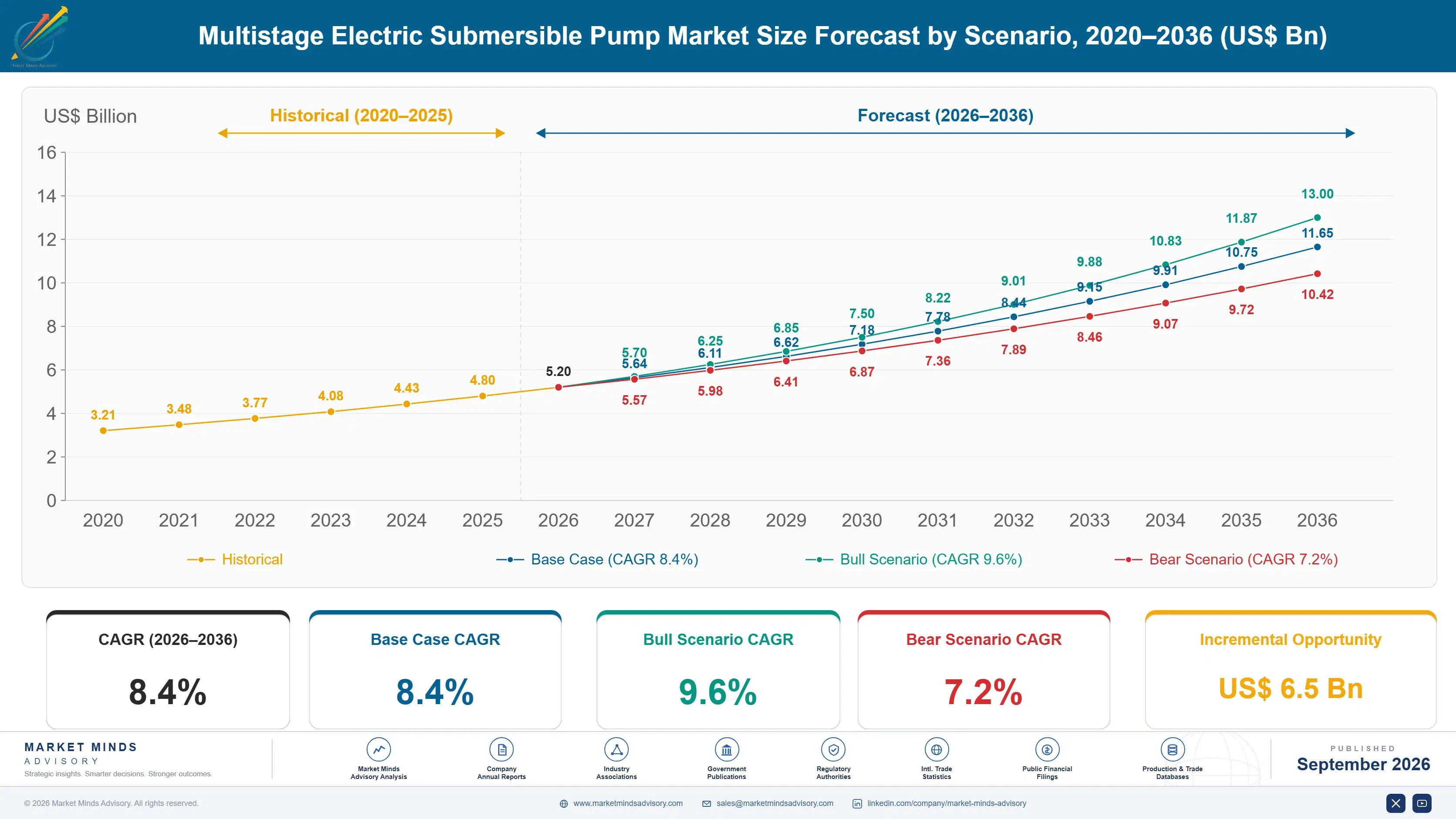
Between 2020 and 2025 the sector compounded at 7.0% and the composition shifted more than the total. Conventional oilfield installations grew slowly as mature fields watered out and required more lift per barrel, while unconventional applications expanded despite run lives that would have been unacceptable anywhere else. Water, dewatering and geothermal applications grew from small bases and attracted almost no attention from anybody.
The 8.4% base case rests on three mechanisms. Mature conventional fields keep watering out, which raises the volume of fluid that must be lifted per barrel of oil produced and therefore the pump population. Geothermal development is expanding and needs lift at temperatures conventional equipment cannot survive. And mine dewatering and water supply applications continue growing on entirely separate drivers. None of the three depends on oil prices or drilling activity rising.
The bull case at 9.6% turns on run life improvement in unconventional service, which would convert a marginal application into a mainstream one and multiply the installed population. The bear case at 7.2% is electrification of lift moving toward alternatives, since rod lift and progressive cavity systems compete directly in the smaller and gassier wells where electric submersible run lives are worst.

Six Times The Equipment Cost

Nothing about this market is decided by the price of the equipment. Pulling a failed system means a workover rig, killing the well, retrieving kilometres of tubing and cable and deferring production, which totals around 6.4 times the equipment cost. An operator therefore buys run life and treats purchase price as a rounding error, which is exactly the opposite of how most industrial pumps are bought.
TOP FIVE CONCENTRATION73%Share of installed running systems held by five suppliers
MEAN RUN LIFE612 daysAverage time a system operates before requiring intervention
WORKOVER COST MULTIPLE6.4 timesIntervention cost against the value of the equipment itself
ELECTRICAL FAILURE SHARE41%Portion of failures originating in cable, splice or motor lead
UNCONVENTIONAL RUN LIFE287 daysAverage operating period in shale wells before intervention required
SYSTEMS UNDER LEASE38%Portion of population supplied on rental rather than outright purchase
The failure mode is not where the industry's attention is. Around 41% of failures originate in the power cable, the splice or the motor lead extension rather than in the hydraulic stages, because a cable run kilometres downhole through clamps into a hot and corrosive environment fails in ways an impeller does not. This is described as a pump market and diagnosed as an electrical one.
Unconventional wells broke the run life assumptions this equipment was designed around. Shale production arrives with high gas fractions, sand and steeply declining rates, and mean run life in that service is 287 days against 612 across the whole population. Operators accept it because the alternatives lift less, and manufacturers have been adapting equipment designed for steady conventional production to a duty nobody envisaged.
"Every proposal I see leads with hydraulic efficiency and stage design, and four in ten of these systems come out of the ground because a cable splice failed. The supplier who genuinely solves the electrical side would own this market and nobody is trying."
Director, Artificial Lift Practice · MMA Energy Practice · September 2026

Market Trends

Geothermal demand needs temperatures oilfield equipment cannot survive

Geothermal wells require lift at temperatures that degrade conventional elastomers, insulation systems and motor windings designed for oilfield service, which makes this a materials problem rather than a hydraulic one. Well counts are rising as geothermal development expands across several regions, and the equipment population is small enough that a handful of projects moves the segment measurably. Growth runs at 12.6% against a market rate of 8.4%. Very few suppliers have qualified high temperature systems properly, and those that have face limited competition on the projects that specify them. Competition on those projects is limited.
Market Impact: Drives 28% of world demand
Water and dewatering demand grew while nobody watched

Mine dewatering, municipal water supply and industrial extraction all use the same multistage submersible architecture on duties that are gentler, cleaner and considerably more predictable than any oilfield application, which produces run lives measured in years rather than months. Mining operations pumping from deep pits and underground workings have become a genuine and steadily growing customer base. Oilfield suppliers organised around artificial lift accounts rarely reach these buyers at all, and specialist water pump manufacturers hold most of that position instead. The engineering transfers directly and the commercial organisation does not, which is a solvable problem nobody has solved.
Market Impact: Covers 38% of installed population

Market Opportunities and Growth Drivers

Mature fields lift more water for the same oil

Conventional reservoirs across the Gulf, Latin America and Eastern Europe produce at water cuts that have risen steadily for decades, which means the fluid volume that must be lifted per barrel of oil keeps increasing even where production is flat or declining. Electric submersible systems are the only lift method that moves those volumes economically at the rates these fields require. Middle East and Africa takes 28% of demand almost entirely on that basis, and the water cut trend runs in one direction only. Water cut runs in one direction only.
Market Impact: Halves run life to 287 days

Leasing shifted risk and changed who buys

Around 38% of the installed population is supplied on lease rather than outright purchase, under arrangements where the supplier carries the equipment cost and is paid for running days or barrels lifted. That aligns the supplier with run life rather than with unit sales, and it moves the purchasing conversation from a procurement department to an operations one. It also puts the supplier's capital in somebody else's well. Suppliers running that model behave entirely differently from those selling equipment. Suppliers running that model behave entirely differently from those still shipping equipment against purchase orders.
Market Impact: Causes 41% of all failures

Market Restraints and Challenges

Unconventional service halves the run life

Shale wells produce with high and variable gas fractions, entrained sand and steeply declining rates that force frequent speed changes, and mean run life in that duty falls to 287 days against 612 across the wider population. The root cause is that this equipment was designed for steady conventional production and the unconventional duty cycle is fundamentally hostile to it. Commercial impact is intervention costs that make electric lift marginal against alternatives. Participants are responding with gas handling stages, abrasion resistant materials, variable speed control strategies and downhole monitoring to predict failure.
Market Impact: Grows at 12.6% against 8.4%

The cable fails and nobody sells cable

Around 41% of system failures originate in the power cable, the splice or the motor lead extension, in components that are commercially treated as accessories to the pump rather than as the primary reliability risk they demonstrably are. The root cause is that a cable running kilometres downhole through clamps into heat and corrosive fluid is genuinely difficult to make survive. Commercial impact is run life limited by a component nobody optimises. Mitigation runs through improved insulation systems, better splice design, installation training and monitoring that detects insulation degradation before failure.
Market Impact: Runs years beyond 612 days
3 additional market trends, 4 additional growth drivers, and 2 additional restraints and challenges are covered in the full report. Contact sales@marketmindsadvisory.com to access the complete intelligence.

Segment CAGR and Growth Architecture

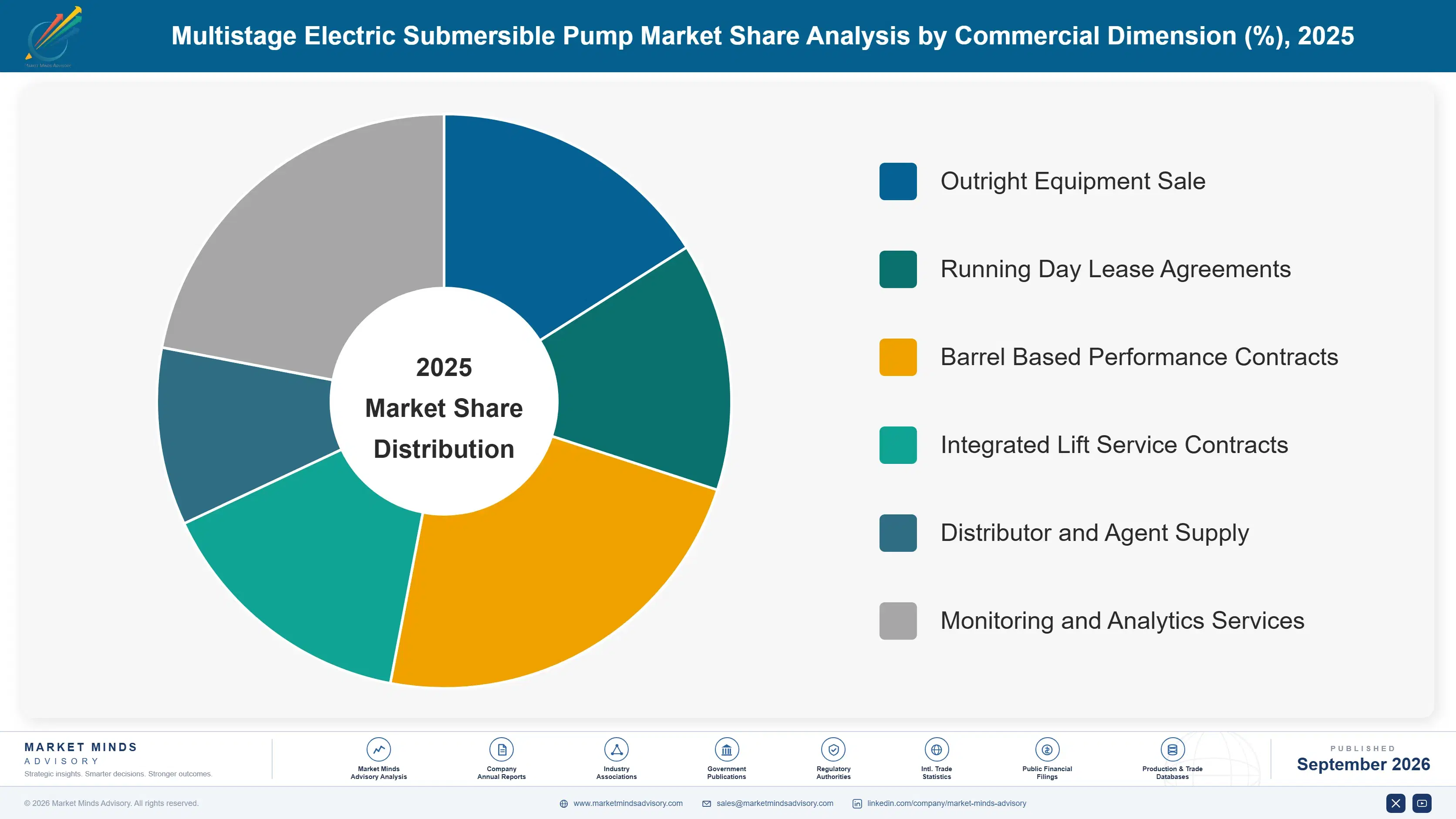
Segmentation follows service duty, the dimension on which run life, materials specification and commercial model all move together. Conventional oil lift carries the installed population on the longest run lives. Geothermal and gassy well systems carry the growth, because both demand equipment that survives conditions the standard product simply does not. Materials decide the hard ones.
multistage-electric-submersible-pump-market-market-share-analysis-1788410849273

Geothermal and High-Temperature Systems

Geothermal and high-temperature systems grow at 12.6%, half again the market rate of 8.4%, and the constraint is materials rather than hydraulics. Elastomer seals, cable insulation and motor winding systems designed for oilfield temperatures degrade rapidly in geothermal service, so the equipment requires different polymer chemistry, different insulation and frequently different metallurgy throughout. Well counts are rising as geothermal development expands across Indonesia, Kenya, Turkey, the United States and Iceland, and the installed population is small enough that a handful of projects moves the number. Very few suppliers have qualified high temperature systems properly, which leaves the ones that have facing limited competition on exactly the projects that specify them.
CAGR 12.6%

High Gas-Oil Ratio and Gassy Well Systems

High gas-oil ratio systems at 10.2% address the condition that kills more electric submersible installations than any other, which is gas breaking out of solution and entering the pump intake. A centrifugal stage handling gas loses head, cavitates and eventually gas locks entirely, and the motor overheats because the fluid it relies on for cooling stops flowing. Gas separators, gas handling stages and advanced intake designs all mitigate it and none eliminates it. Gassy conditions are becoming more common as reservoirs deplete and as unconventional production dominates new wells, which makes this an expanding problem rather than a niche one. Depleting reservoirs and unconventional production both make this condition steadily more common.
CAGR 10.2%
Full segment breakdown across 6 segments available in the complete report.

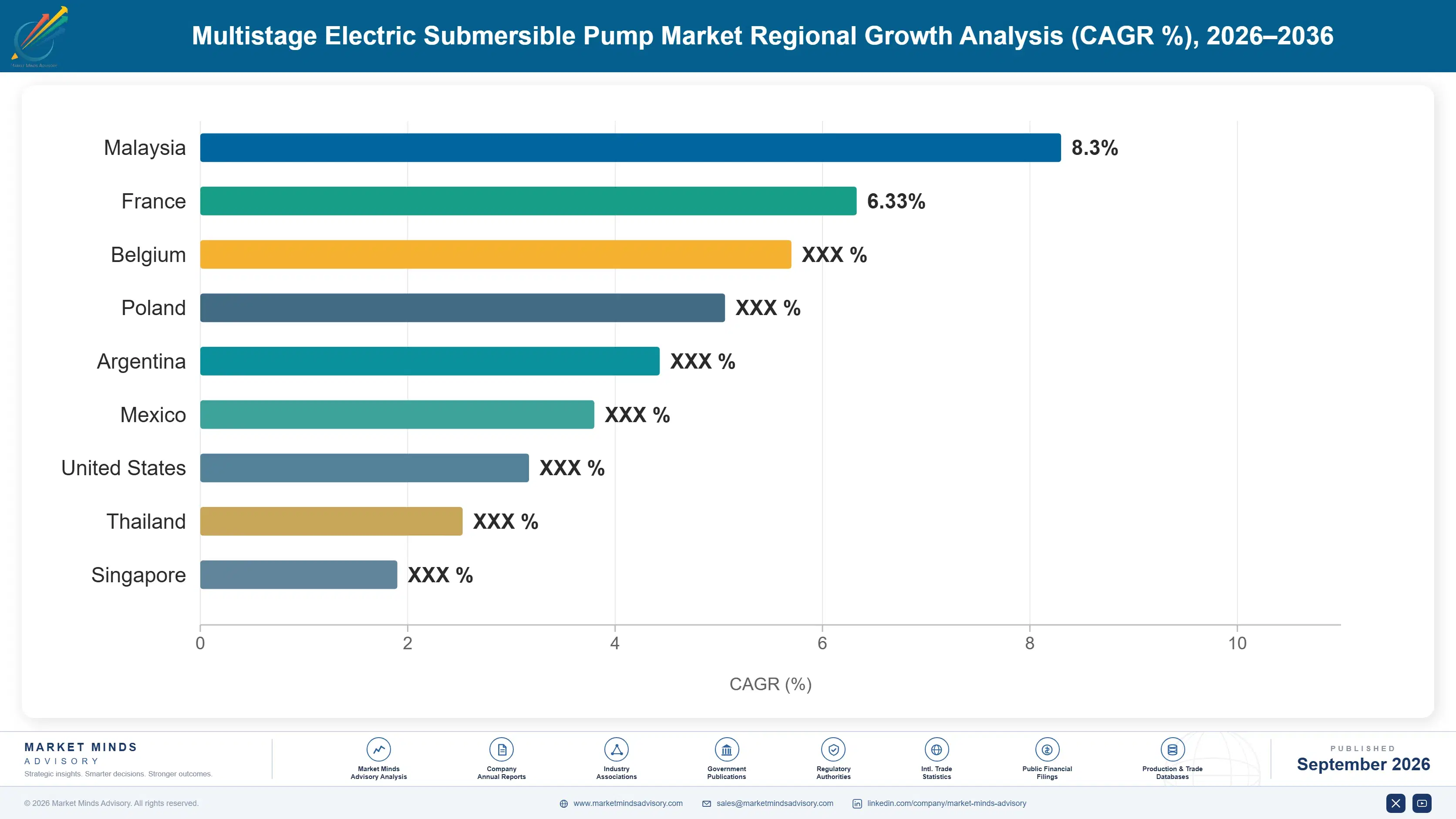
Regional Architecture and Country Demand Map

Middle East and Africa takes 28%, far outside its usual band, because high water cut Gulf fields run on electric lift almost exclusively. Latin America also sits far above band. Reservoir condition rather than production volume decides these positions entirely. Water cut and temperature decide this map between them.

Middle East and Africa

A 28% share far outside the usual band follows from water cut rather than from production volume. Gulf reservoirs have produced for decades and now lift enormous quantities of water for every barrel of oil, at rates that no other artificial lift method handles economically, which makes electric submersible systems the default rather than one option among several. Saudi, Kuwaiti, Omani and Iraqi installed populations are very large and growing. North African and West African operations add offshore and onshore demand. National oil company procurement favours suppliers with local service capability, since a failure needs a workover crew and equipment within days rather than weeks. Response time matters more than price here.
Share: 28% | CAGR: 8.8% (2026 to 2036)

North America

Unconventional production defines this region and it is the most difficult duty this equipment faces anywhere. Permian, Bakken and Eagle Ford wells produce with high gas fractions, sand and steeply declining rates that halve run life against conventional service, and operators accept the intervention cost because alternatives lift less. That produces high replacement volume from a population that fails often. Leasing penetration is highest here, which shifts equipment risk onto suppliers who are then paid for running days. Growth at 7.6% reflects a large installed base with poor run lives rather than any expansion in well count. Suppliers are paid for running days and carry the equipment risk themselves, which is unusual.
Share: 26% | CAGR: 7.6% (2026 to 2036)
Regional intelligence for 5 additional markets available in the complete report: Western Europe, East Asia, South Asia and Pacific, Latin America, Eastern Europe. Contact sales@marketmindsadvisory.com.
multistage-electric-submersible-pump-market-country-cagr-analysis-1788410849796

Four Moves On Run Life

None of these four is about hydraulic efficiency, because the intervention costs 6.4 times the equipment and nobody is optimising for pump curves. Each works on what actually ends a run: an electrical component nobody sells properly, a gas problem nobody solves, and duties this equipment was never designed for. None of it is hydraulic.

Sell the cable as the reliability product

Around 41% of failures originate in the power cable, the splice or the motor lead extension, and this industry treats all three as accessories priced alongside a pump that fails less often than they do. A supplier presenting insulation systems, splice design and installation quality as the primary reliability offering is addressing the actual failure mode rather than the one in the catalogue. It requires elevating a component the sales organisation currently discounts. Nobody in this market leads with the cable and the failure data has been public for years.
Market Impact: Addresses 41% of all of the system failures

Price on running days, not on equipment

Some 38% of the installed population already runs on lease arrangements where the supplier is paid for days operated or barrels lifted, which aligns everybody with run life instead of with unit shipments. That model moves the conversation from procurement to operations, and it lets a supplier confident in its reliability capture value that an equipment sale leaves entirely with the operator. It puts capital into somebody else's well, which is the genuine constraint. Suppliers with the best run life data have the strongest case for it. Data supports the case.
Market Impact: Extends a model that already covers 38% today

Qualify properly for high temperature service

Geothermal systems grow at 12.6% against a market rate of 8.4% and the barrier is materials qualification rather than hydraulic design, since elastomers, cable insulation and motor windings all need different chemistry to survive the temperatures involved. Very few suppliers have completed that work, which leaves those who have facing limited competition on projects that specify it. Qualification costs testing time and materials development rather than manufacturing investment. The well count is rising and the supplier list is not. Well counts are rising and the qualified supplier list is not. That is an unusually comfortable position.
Market Impact: Enters a segment now growing at 12.6% annually

Follow the architecture into water and mining

Mine dewatering, municipal water supply and industrial extraction use the same multistage submersible architecture on duties that are cleaner, gentler and far more predictable, producing run lives measured in years rather than the 612 days an oilfield population averages. Oilfield suppliers rarely call on mining or utility buyers at all, and specialist water manufacturers hold those positions by default rather than by any advantage. The engineering transfers directly and the commercial organisation does not, which is a solvable problem. Only the sales organisation needs building. Nobody is calling on mining buyers.
Market Impact: Serves duties running far beyond the 612 days

Who Controls the Margin Pool

CR5 stands at 73% of installed running systems, which is the only comparable basis since equipment revenue mixes sale and lease in proportions no supplier discloses. Concentration is extreme because a failure costs an operator several times the equipment value, and nobody trials an unproven supplier on a producing well when the downside is a workover and weeks of deferred production.
Competition runs on documented run life, local service capability and commercial model. Run life data decides selection, because operators track it obsessively and share it within organisations. Service capability decides who can respond when a system fails, since a workover cannot wait for equipment to arrive from another continent. Commercial model decides who carries the risk. Hydraulic design differentiates far less than the technical literature suggests.

Rankings will move on whoever addresses the electrical failure mode credibly, because 41% of failures sit in components the whole industry treats as accessories. That is an open position nobody occupies. The pressure comes from a reliability problem rather than from competitors, and solving it would be worth more than any hydraulic improvement available. Nobody occupies that position and the data has been public for years.
multistage-electric-submersible-pump-market-company-positioning-matrix-1788410850317

Competitive Moat and Risk Dimensions

SLB

Moat: Run life data at scale

Decades of installed systems across every major producing region generate failure and run life data at a scale no competitor can match, which supports engineering improvement and the credibility that decides selection on a producing well. That dataset compounds with every installation. A newer supplier cannot demonstrate reliability it has not yet accumulated.
SLB

Risk: Unconventional run life stays poor

Mean run life in shale service is 287 days against 612 across the population, and no supplier has solved the gas, sand and duty cycle problems that cause it despite years of development. Scale in a poor application means carrying a large share of an industry-wide reliability problem. Operators frustrated by intervention costs increasingly consider alternative lift methods.
BORETS

Moat: High water cut experience

Long experience with very high water cut mature field applications, developed on the largest installed populations of that type anywhere, gives the company genuine capability in exactly the duty that dominates Gulf and Eastern European demand. Manufacturing cost is well below the integrated service groups on comparable equipment. That combination suits national oil company procurement particularly well.
BORETS

Risk: Limited reach in restricted markets

Commercial and political constraints limit access to several markets where the company's technical capability would otherwise compete strongly, and those restrictions are outside any commercial influence. Growth means concentrating on the markets that remain accessible, where competitors with fewer constraints are also present. Technical capability provides no answer to a restriction on where it can be sold.

Players Tracked

Prominent Players

SLB
Baker Hughes
Halliburton
Borets
NOV

Other Key Players

Weatherford International
ChampionX
Novomet
Grundfos
Xylem
Franklin Electric
Levare
Sulzer
Flowserve
KSB
Ebara Corporation
Canadian Advanced ESP
Alkhorayef Petroleum
Jereh Group
Kerui Group

Recent Developments

JANUARY 2025

Operators published failure analysis pointing at electrical components

Aggregated failure analysis across several large installed populations attributed a substantial majority of premature failures to power cable, splice and motor lead components rather than to pump or motor hydraulics. Suppliers had historically reported failures by system rather than by component, which had obscured where the reliability problem actually originated.
Signal: Reporting failures by system rather than component hid the real problem for a very long time.
MAY 2025

Geothermal projects specified high temperature qualified systems

Several geothermal developments specified electric submersible systems qualified for sustained high temperature operation, requiring elastomer, insulation and motor winding materials well beyond conventional oilfield temperature ratings. Only a very small number of suppliers held that qualification, which limited competition on every one of those awards considerably.
Signal: Materials qualification rather than pump design decided who was able to bid this work at all.
SEPTEMBER 2025

Lease arrangements extended into unconventional applications

Suppliers extended running day and barrel-based lease arrangements into unconventional wells where run lives are shortest, accepting equipment risk in precisely the application least suited to carrying any of it. The arrangements price that risk explicitly rather than leaving the operator to absorb intervention cost after every failure.
Signal: Somebody has finally priced the reliability problem instead of arguing about whose fault each failure was.

Alloys, Copper And Elastomers

Corrosion resistant alloys for stages, shafts and housings account for roughly 31% of system cost, copper for motor windings and power cable around 24%, and elastomers for seals and cable insulation a further 13%. Precision machining of stages makes up most of the remainder. Materials dominate and the specification follows well chemistry rather than cost.
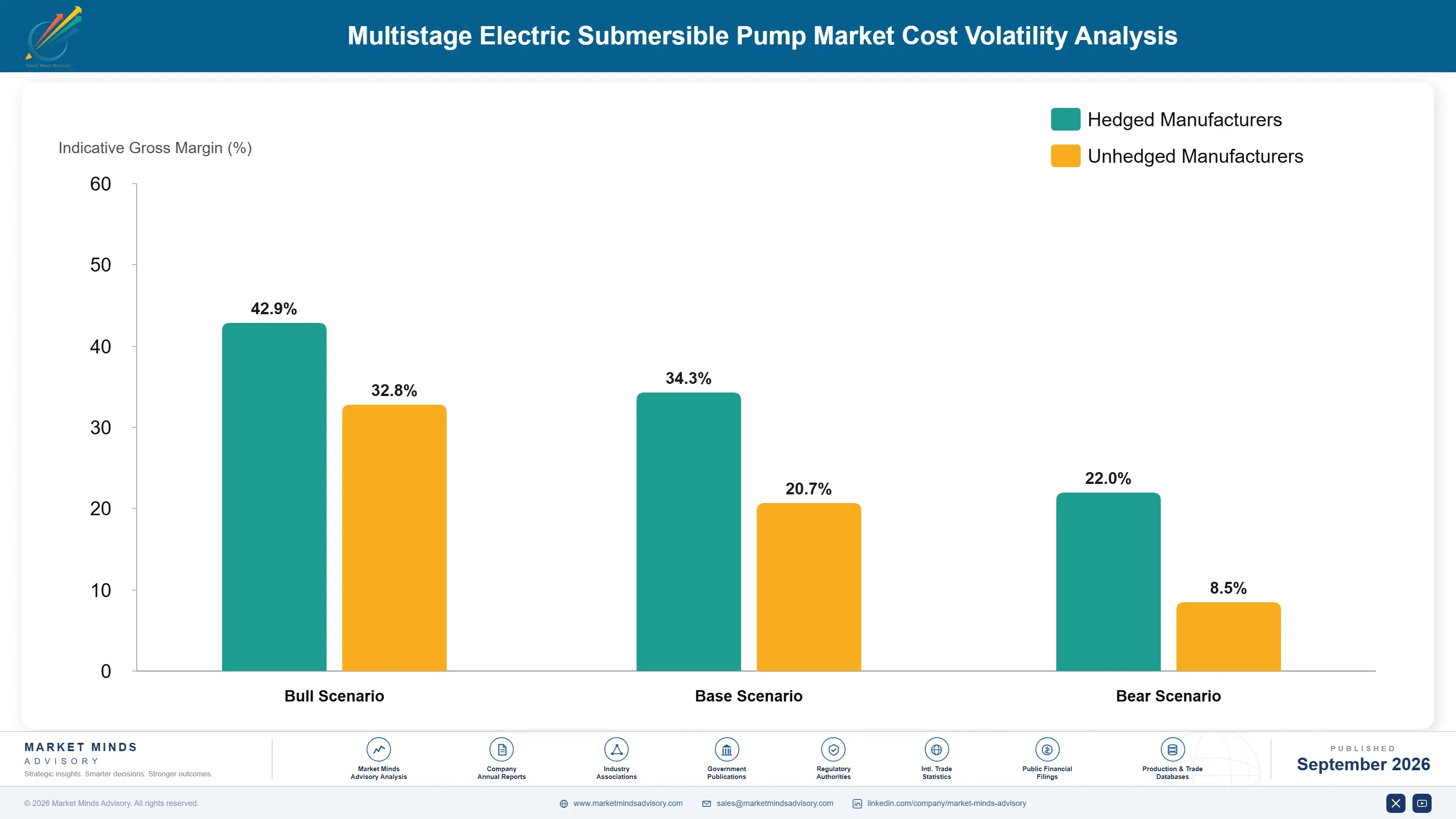
Copper pricing moved sharply through recent years on electrification demand across every sector at once, which US Geological Survey mineral commodity reporting recorded across the period. A system carrying kilometres of power cable is unusually exposed to that, and suppliers holding forward positions and escalation terms on lease agreements protected margin. Those on fixed price supply contracts running years absorbed the movement across a product where copper content cannot be reduced.

The disadvantage falls on service network density rather than on materials purchasing. A supplier with workshops and inventory near the field can respond to a failure within days while one shipping from another continent cannot, and an operator losing production values that difference at far more than any equipment price. Building that network costs capital in locations that only pay off with installed population behind them.
multistage-electric-submersible-pump-market-cost-volatility-analysis-1788410850512

Index long supply agreements to copper

Copper is 24% of system cost and a system carries kilometres of power cable, while supply agreements with national oil companies frequently run several years at fixed pricing. Escalation terms cost a negotiation and remove an exposure that cannot be engineered out, since copper content follows the electrical requirement. Suppliers on fixed terms absorbed the last movement entirely.

Qualify alternative elastomers before the well needs them

Seals and cable insulation are 13% of cost and their chemistry determines whether a system survives a given well temperature and fluid composition, which means qualification rather than price decides availability. Testing alternative compounds before a project specifies them costs laboratory time and opens applications otherwise closed. Suppliers qualifying reactively arrive after the specification has already excluded them.

Site service capacity against installed population

Response time to a failure is worth more to an operator than any equipment price difference, and it depends entirely on workshop and inventory proximity to the field. Service capital only pays off where installed population justifies it, which makes network expansion a sequencing decision. Suppliers building service ahead of population carry cost the volume never supports.

Portfolio Architecture for Margin Defence

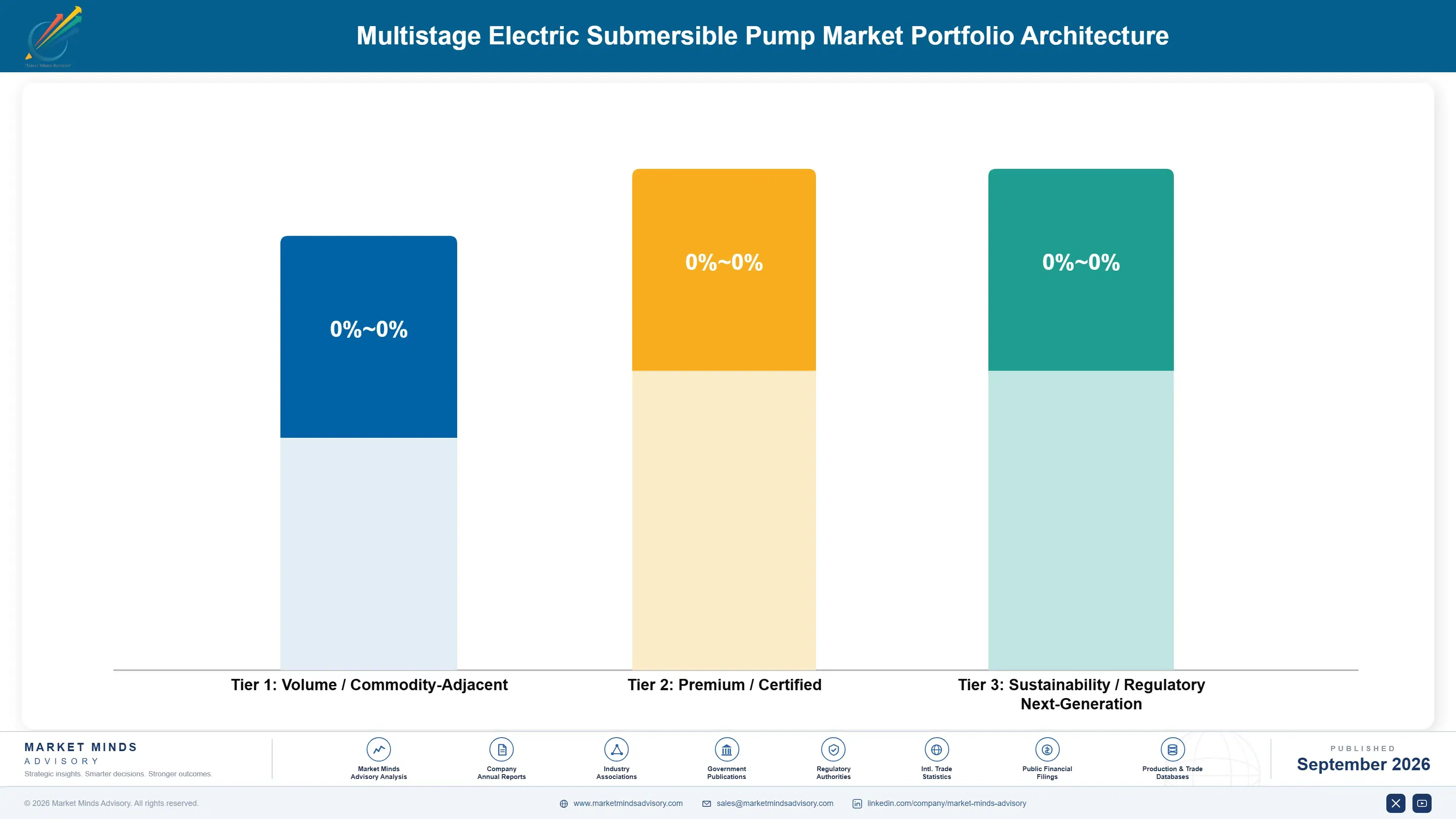
Margin here follows commercial model rather than equipment, which the product catalogues obscure completely. An outright equipment sale transfers all reliability risk to the operator and prices accordingly, competing against comparable systems on a purchase order. A lease priced on running days keeps the risk with the supplier and earns considerably more where run life is genuinely good, which is a bet on data rather than on hardware.
Volume and premium pull against each other through the service network rather than the factory. Conventional oilfield installations carry the population density that makes local workshops, inventory and crews economic in a given region, and that presence is what allows a supplier to respond to any failure within days. Serving only the specialised high margin applications leaves a service network without the volume to sustain it.

High-value pools sit in high temperature systems, in gas handling capability and in cable and splice reliability nobody prices as a product. The third is the largest and least contested: 41% of failures originate there, the components are sold as accessories, and a supplier genuinely solving it would improve run life more than any hydraulic development available anywhere.

Volume / Commodity-Adjacent

Standard conventional lift systems sold outright into established applications where several suppliers hold qualification and comparable run life records. Competition is on price and delivery. The 9 point spread reflects manufacturing scale and whether stages are machined internally.
Gross Margin: 16 to 25%

Premium / Certified

Gas handling systems, abrasion resistant configurations and systems supplied with monitoring into difficult wells where run life records decide selection. Documented reliability rather than price supports the margin. The 9 point spread reflects local service capability and response time in the region.
Gross Margin: 30 to 39%

Sustainability / Regulatory / Next-Generation

High temperature geothermal systems, running day lease arrangements and integrated monitoring with failure prediction. Margins are high because qualification and reliability data are both genuinely scarce. The 18 point spread separates equipment lease returns from monitoring and analytics service revenue.
Gross Margin: 40 to 58%
multistage-electric-submersible-pump-market-portfolio-architecture-1788410851007

High-value Sub-segments and Strategic Watch-out

Geothermal and High-Temperature Systems

High value and high growth at 12.6%. Materials qualification rather than hydraulic design decides who can bid, and very few suppliers have completed it properly. The 8 point spread reflects whether elastomer and insulation systems are developed internally or purchased in. Very few have qualified.
Gross Margin: 44 to 52%

High Gas-Oil Ratio and Gassy Well Systems

High value with strong growth at 10.2%. Gas breaking out at the intake causes more failures than anything else and no design eliminates it entirely. The 8 point spread reflects whether gas separation is integrated or supplied as a bolt-on component. Gas locking ends runs.
Gross Margin: 36 to 44%

Conventional Oil Artificial Lift

The volume core. It earns modestly and it carries the installed population that makes local service workshops and inventory economic in any given region. The 9 point spread reflects manufacturing scale and service network density rather than any product difference. Density decides response. Scale matters here.
Gross Margin: 18 to 27%

Unconventional Well Artificial Lift

The strategic watch-out. Run life of 287 days makes intervention economics marginal and operators frustrated by it increasingly consider alternative lift methods entirely. The 22 point spread separates lease arrangements pricing the risk from outright sales leaving it with the operator. Alternatives are being considered.
Gross Margin: 12 to 34%

Six Hundred And Twelve Days

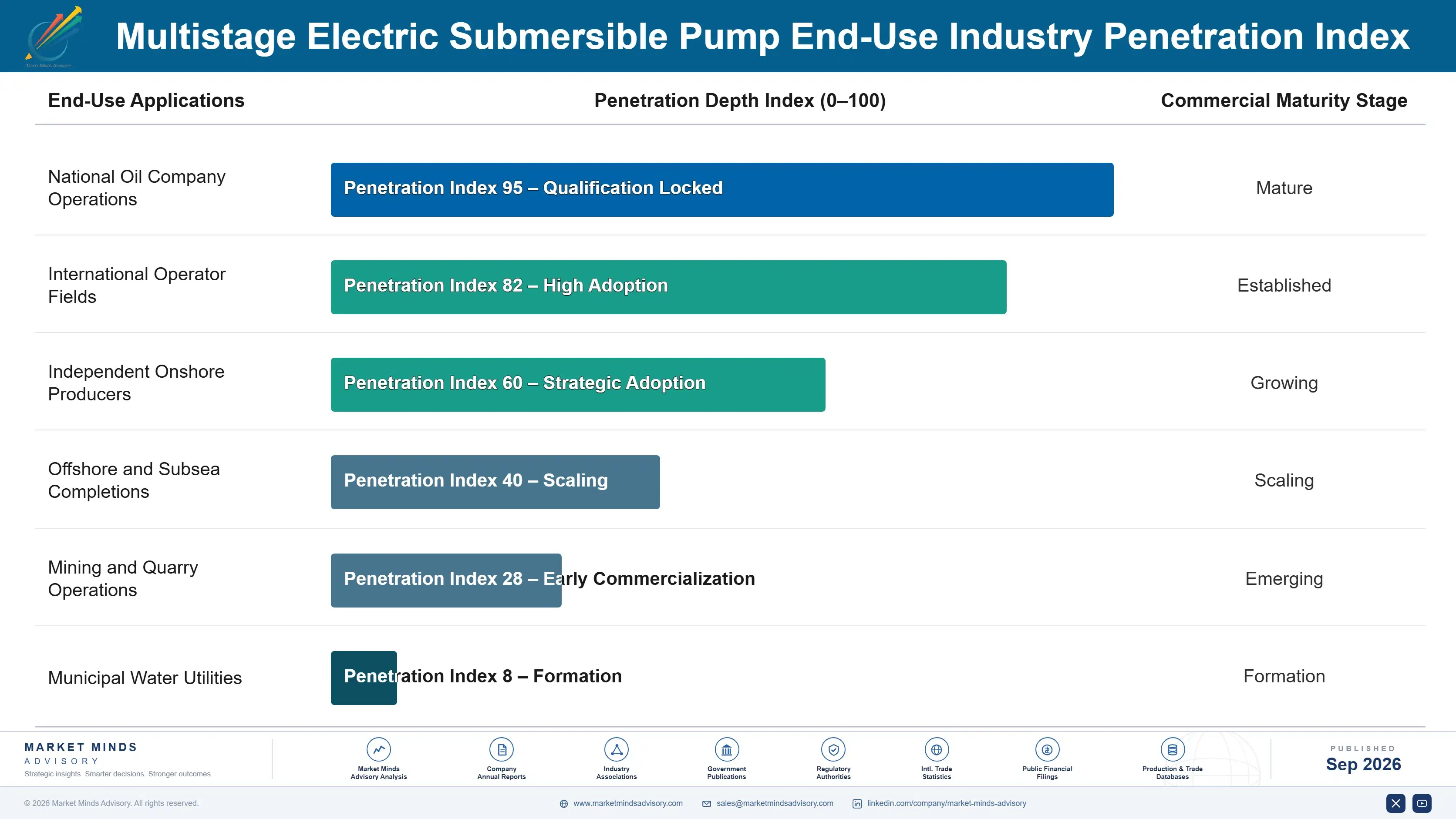
The annuity here is a failure rate and it arrives whether anybody sells anything. A system runs 612 days on average and then requires replacement, which across a large installed population produces demand that follows from physics rather than from any commercial activity. A supplier holding position on a field captures that replacement automatically, because changing supplier means accepting unproven run life on a producing well.
Stickiness varies enormously by whether run life data exists for that specific field. An operator with three years of records showing one supplier performing better in a particular reservoir will not experiment, and that lock strengthens with every installation. A new field with no history is genuinely open, and the competition for those first installations is fierce because whoever wins them accumulates the data everybody else lacks.

Buyer profiles have shifted from procurement toward production engineering and increasingly toward operations analytics, and proposals have not entirely followed. A procurement buyer compared equipment specifications and price. A production engineer asks what run life this configuration achieved in wells resembling theirs, and an analytics team asks what the monitoring data will tell them before a failure. Neither question is answered by a datasheet.
multistage-electric-submersible-pump-market-end-use-penetration-index-1788410851494

What Ends A Run

These are among the four positions where our research anticipates prominent divergence between winners and laggards over the coming forecast period. Each is grounded in the demand model, the regulatory perimeter, and the announced capacity pipeline.
01 / ELECTRICAL RELIABILITY FOCUS

Lead with the cable, not the impeller

Around 41% of system failures originate in the power cable, the splice or the motor lead extension, and this entire industry treats all three as accessories priced alongside a pump that demonstrably fails less often than any of them do. A supplier presenting insulation systems, splice design and installation quality as its primary reliability offering is addressing the failure mode that actually ends runs rather than the one in the product catalogue. Nobody leads with the cable, and the failure data supporting this has been publicly available for years.
02 / RUNNING DAY COMMERCIAL MODEL

Get paid for days, not for equipment

Some 38% of the installed population already operates under lease arrangements where the supplier is paid for days operated or barrels lifted rather than for hardware shipped, which aligns everybody involved with run life instead of with unit volume. That model moves the conversation out of procurement and into operations, and it lets a supplier genuinely confident in its reliability capture value an equipment sale leaves entirely with the operator. It puts capital in somebody else's well, which is the real constraint.
03 / HIGH TEMPERATURE QUALIFICATION

Do the materials work before the tender

Geothermal and high temperature systems grow at 12.6% against a market rate of 8.4%, and the barrier is materials qualification rather than hydraulic design, since elastomers, cable insulation and motor windings all require different chemistry to survive the temperatures involved. Very few suppliers have completed that work, which leaves the ones who have facing genuinely limited competition on every project specifying it. Qualification costs testing time and materials development rather than any manufacturing investment at all, and the well count keeps rising.
04 / WATER APPLICATION EXTENSION

The same machine works in a mine

Mine dewatering, municipal water supply and industrial extraction all use the identical multistage submersible architecture on duties that are cleaner, gentler and far more predictable, producing run lives measured in years rather than the 612 days an oilfield population averages. Oilfield suppliers rarely call on mining or utility buyers at all, and specialist water pump manufacturers hold those positions by default rather than through any genuine advantage. The engineering transfers directly and only the commercial organisation does not, which is entirely solvable.

Engagement Snapshot From the Field

A live engagement with an industry participant carrying material or product regulatory and market exposure ahead of a defining policy shift, showing how our research translates into a defensible multi-year portfolio strategy.
MARKET MINDS ADVISORY · CLIENT ENGAGEMENT SUMMARY
Multistage Electric Submersible Pump Producer Strategic Portfolio Review and Transition Roadmap 2026·Investment Scenario on Multistage Electric Submersible Pump Exposure Evaluation 2025-26
CLIENT PROFILE
An artificial lift equipment supplier providing electric submersible systems across three producing regions, with annual revenue in the low hundreds of millions of dollars and run life records slightly behind the two largest competitors in comparable wells (client-reported, unverified by MMA). Selection losses were consistently attributed to that gap. Nobody had properly analysed the underlying cause.
STRATEGIC CHALLENGE
The client lost tenders on documented run life and had responded by investing heavily in hydraulic design and stage metallurgy, which improved pump performance and moved the run life numbers very little. Management needed to understand why the engineering investment was not translating into the reliability metric that decided every award.
MMA APPROACH
MMA analysed failure records across the client's installed population by failed component rather than by system, comparing the distribution against competitors where data was available. Forty-seven expert interviews with production engineers, workover crews, cable manufacturers and competing suppliers established what actually ended runs and where the engineering effort had been directed.
KEY FINDINGS
  1. Electrical components caused 44% of the client's failures against 38% for the best performing competitor, and hydraulic failure rates were already broadly comparable between the two of them.
  2. The client sourced cable and splice kits from third parties on price, while its leading competitor manufactured both and treated them as engineered products.
  3. Installation quality varied significantly by crew and no training programme existed, despite splice failures concentrating heavily in a small number of specific field operations.
  4. Geothermal qualification was absent from the client's range entirely, and 3 projects in its regions had specified it during the period reviewed.
CLIENT PROFILE
An artificial lift equipment supplier providing electric submersible systems across three producing regions, with annual revenue in the low hundreds of millions of dollars and run life records slightly behind the two largest competitors in comparable wells (client-reported, unverified by MMA). Selection losses were consistently attributed to that gap. Nobody had properly analysed the underlying cause.
STRATEGIC CHALLENGE
The client lost tenders on documented run life and had responded by investing heavily in hydraulic design and stage metallurgy, which improved pump performance and moved the run life numbers very little. Management needed to understand why the engineering investment was not translating into the reliability metric that decided every award.
MMA APPROACH
MMA analysed failure records across the client's installed population by failed component rather than by system, comparing the distribution against competitors where data was available. Forty-seven expert interviews with production engineers, workover crews, cable manufacturers and competing suppliers established what actually ended runs and where the engineering effort had been directed.
KEY FINDINGS
  1. Electrical components caused 44% of the client's failures against 38% for the best performing competitor, and hydraulic failure rates were already broadly comparable between the two of them.
  2. The client sourced cable and splice kits from third parties on price, while its leading competitor manufactured both and treated them as engineered products.
  3. Installation quality varied significantly by crew and no training programme existed, despite splice failures concentrating heavily in a small number of specific field operations.
  4. Geothermal qualification was absent from the client's range entirely, and 3 projects in its regions had specified it during the period reviewed.
RECOMMENDED STRATEGY
Phase 1: Phase one: redirect engineering investment from hydraulics to cable, splice and motor lead systems, since electrical components cause most of the run life gap. Phase 2: Phase two: build an installation training and certification programme for crews, since splice failures concentrate exactly where installation practice varies most. Phase 3: Phase three: qualify elastomer and insulation systems for high temperature service, since geothermal projects are specifying it and the client cannot bid.
OUTCOME
Within six quarters electrical failures had fallen materially and mean run life closed most of the gap to the leading competitor (client-reported, unverified by MMA). Hydraulic development spending was reduced. High temperature qualification is under way and no bid has yet been submitted. Two lease contracts were won on the improved records.

Frequently Asked Questions

Foundational context covering the market sizes, CAGR, scope, country, region and competition that inform every finding below. This section is provided to cover basics and most often pre-purchase conversations, answered from the MMA Primary Research Dataset.

What is the current size of the Multistage Electric Submersible Pump Market?

The global multistage electric submersible pump market was valued at USD 4.8 billion in 2025, covering downhole systems for artificial lift and fluid extraction. The 2026 figure reaches USD 5.20 billion.

How large will the Multistage Electric Submersible Pump Market be by 2036?

MMA forecasts USD 11.65 billion by 2036, an increase of USD 6.45 billion over the 2026 base. That represents an expansion multiple of 2.24 times across the forecast period.

What is the CAGR for the Multistage Electric Submersible Pump Market 2026 to 2036?

The base case compound annual growth rate is 8.4%, with a bull case at 9.6% and a bear case at 7.2%. Historical growth between 2020 and 2025 ran at 7.0%.

Which segment is growing fastest?

Geothermal and high-temperature systems grow at 12.6%, half again the market rate of 8.4%, because materials qualification limits who can supply them. Gassy well systems follow at 10.2%.

Who are the major companies in the Multistage Electric Submersible Pump Market?

SLB, Baker Hughes, Halliburton, Borets and NOV lead on installed running systems, with combined CR5 of 73%. Concentration is extreme because failure costs operators several times equipment value.

Which country is growing fastest?

India grows fastest at 10.6%, across mature onshore lift, agricultural water supply and industrial extraction happening together. South Asia and Pacific leads regionally at 10.6%.

Report Segmentation Architecture

The full report scope spans multiple orthogonal segmentation dimensions, with cross-tabulated demand data provided for each dimension pair. Coverage extends further to regional breakdowns, trend trajectories, and the competitive detail needed to support segment-level decision-making.

By Service Duty

  • Conventional Oil Artificial Lift
  • Unconventional Well Artificial Lift
  • High Gas-Oil Ratio and Gassy Well Systems
  • Water Supply and Irrigation Systems
  • Mine and Industrial Dewatering
  • Geothermal and High-Temperature Systems

By End-Use Industry

  • National Oil Company Operations
  • International Operator Fields
  • Independent Onshore Producers
  • Offshore and Subsea Completions
  • Mining and Quarry Operations
  • Municipal Water Utilities

By Commercial Dimension

  • Outright Equipment Sale
  • Running Day Lease Agreements
  • Barrel Based Performance Contracts
  • Integrated Lift Service Contracts
  • Distributor and Agent Supply
  • Monitoring and Analytics Services

By Region

  • North America
  • Western Europe
  • East Asia
  • South Asia and Pacific
  • Latin America
  • Middle East and Africa
  • Eastern Europe

Scope, Methodology, and Coverage

Every figure in this report is reproducible from documented input assumptions. The scope below maps the historical period, the forecast horizon, the segmentation dimensions, and the countries covered, alongside the underlying primary and qualitative methodology.
Historical Period
2020 to 2025
Forecast Period
2026 to 2036
Base Year
2025 (USD billions; MMA Primary Research Dataset, September 2026)
Market Definition
The multistage electric submersible pump market covers downhole multistage centrifugal pump systems driven by submersible electric motors and powered through surface cable, supplied for artificial lift and fluid extraction, segmented by service duty across conventional oil artificial lift, unconventional well artificial lift, high gas-oil ratio and gassy well systems, water supply and irrigation systems, mine and industrial dewatering, and geothermal and high-temperature systems. Scope covers pumps, motors, seals, cable and surface equipment supplied as complete systems on sale or lease. Excluded are rod lift and beam pumping units, progressive cavity pumps, gas lift equipment, surface centrifugal pumps, and well intervention services supplied without any equipment.
Quantitative Units
USD billion, 2025 base year, 2026 to 2036 forecast period
Segmentation Dimensions
Service duty, operator type, commercial model, region
Regions Covered
North America, Western Europe, East Asia, South Asia and Pacific, Latin America, Middle East and Africa, Eastern Europe
Countries Covered
United States, Canada, United Kingdom, Norway, Romania, Kazakhstan, Poland, Turkey, China, Indonesia, Malaysia, India, Australia, Brazil, Colombia, Saudi Arabia, Oman, Kenya
Key Companies Profiled
20 companies across integrated service groups, lift specialists and water pump manufacturers
Quantitative Methodology
Primary survey, n=3,800 respondents, Q4 2025, six countries; demand-side model with trade association cross-validation
Qualitative Methodology
47 expert interviews, Q4 2025; applied to validate demand model assumptions, identify emerging dynamics, and assess competitive positioning
Report Format
PDF and XLSX data workbook (Word format preview document)
Publisher
Market Minds Advisory
Report Code
MMA-2026-ENE-451
Published
September 2026
Contact
sales@marketmindsadvisory.com | www.marketmindsadvisory.com

Purchase the full Multistage Electric Submersible Pump Market Report (2026 to 2036).

The full MMA report on the multistage electric submersible pump market runs to detailed duty and regional models across the 2026 to 2036 forecast period, with system cost benchmarks separated by materials specification and service duty. It profiles 20 companies on a consistent installed running systems basis, covering integrated service groups, lift specialists and water pump manufacturers. Run life is analysed by failed component and by well type rather than reported at system level. Regional chapters cover the seven MMA regions with country-level detail on the eighteen markets surveyed. Primary research draws on a quantitative survey of 3,800 respondents across six countries and 47 expert interviews conducted in Q4 2025.
System cost benchmarks by materials specification and service duty
Run life analysed by failed component rather than system
Lease and running day commercial models compared against outright sale
Twenty company profiles on consistent installed running systems basis
High temperature qualification status mapped by supplier and application
Seven regional chapters with eighteen country detail tables

Built For The People Who Decide

From boardroom strategy to bench-side execution, this report is read cover-to-cover by leaders shaping the next decade of their industry, turning demand scenarios, market dynamics and valuation benchmarks into decisions.
CXOs/ Presidents/ VPs/ Managers
M&A and Corporate Development
Strategy Teams and R&D Heads
Procurement and Product Directors
Regulatory and Compliance Leaders
Investor Relations and Equity Analysts