Market Minds Advisory
Multihead Weigher Market in Western Europe

Multihead Weigher Market in Western Europe: Vision-Guided Precision Meets Fresh Food Packaging Demand

Vision-inspection integration and fresh protein packaging line demand are reshaping multihead weigher specifications across Western Europe, forcing manufacturers to defend standard snack-line volume while chasing certified high-precision retrofit contracts from major processors.

Lead Analyst

Bilal Shaikh

Published

September 2026

Make Smarter Decisions with Customized Research Insights

Request a free sample report and evaluate market opportunities, growth trends, and competitive dynamics relevant to your business needs.

2025 MARKET VALUE$1.4BMarket Size 2025
2036 FORECAST VALUE$2.8BBase Case , 2026 to 2036
CAGR 2026 TO 20366.5 %Bull 7.8% / Bear 5.2%
INCREMENTAL OPPORTUNITY$1.3BNet 10- year value creation
EXPANSION MULTIPLE1.88x2036 value over 2026 base
Strategic Levers
M&A Pipeline
Regional Outlook
Country Rankings
Competitive Intelligence
Segmental Deep-dive
Call-Us : 91 93563 13602

Executive Snapshot and Market Trajectory

Multihead weighers have stopped being purely mechanical portioning equipment across Western European processing lines and packaging halls. Vision inspection integration now determines fill accuracy verification as much as the weighing mechanism itself, which has quietly reshaped how processors specify new equipment lines across the entire category this decade and beyond.
Ishida and Yamato Scale continue supplying the bulk standard multihead weighers that snack and confectionery lines have relied on for decades, since cost-per-unit economics still govern most general packaging applications regardless of technology cycles elsewhere in the industry and its evolving product lines. Weighers integrated with vision inspection systems are capturing disproportionate growth as fresh food and protein processors specify automated quality verification that manual inspection cannot deliver consistently at scale.
Multivac and Bizerba are investing specifically in weigher designs engineered for sticky and irregular products, betting that fresh protein and prepared food packaging growth sustains premium pricing for years across most product categories and end markets served today. Manufacturers without specialty handling capability increasingly find themselves confined to price-competitive standard contracts rather than the higher-margin specialty programs processors increasingly prefer for new production lines.
Market Definition
The multihead weigher market covers standard multihead weighers, high-speed variants, specialty weighers for sticky or irregular products, vision-inspection integrated systems, non-food application weighers, and refurbished retrofit systems sold for food, pharmaceutical, and general packaging applications. It excludes single-head checkweighers, bulk flow metering systems, and standalone vision inspection equipment sold independent of weighing mechanisms.
Base Year Value
$1.4B in 2025 (MMA Primary Research Dataset, August 2026)
Forecast Period
2026 to 2036, eleven discrete annual values
CAGR
6.5% base case. Bull 7.8%. Bear 5.2%.
Fastest Growth Segment
Multihead Weighers Integrated with Vision Inspection Systems: 10.0% CAGR
Fastest Growth Country
Germany: 8.0% CAGR
Fastest Growth Region
South Asia and Pacific: 8.5% CAGR
Largest Region
Western Europe: 26% of 2025 global value
Market Leaders
Ishida Co Ltd, Multivac Group, Yamato Scale, Bizerba SE, Marel. Source: MMA Analysis based on company annual reports.
Primary Survey
n=3,800 procurement and R&D decision-makers, Q4 2025, six countries
Methodology
Demand-side build-up, cross-validated against public data, 47 expert interviews

Multihead Weigher Market Forecast Scenarios

multihead-weigher-market-in-western-europe-size-forecast-scenario-1787554463547
Between 2020 and 2025 the market grew at roughly 5.5 percent a year, as steady snack and confectionery packaging demand combined with early vision inspection adoption to lift overall volume modestly above the flat growth pattern the category had shown through most of the previous decade, setting the stage for the acceleration now underway across specialty grades today.
The base case assumes 6.5 percent annual growth to 2036, built on three mechanisms: fresh protein and prepared food processors scaling vision-integrated weigher demand across Western European packaging lines and facilities, specialty designs for sticky and irregular products expanding as fresh food packaging conversion accelerates across most producer categories, and standard weigher replacement demand holding steady as older equipment reaches end of service life across established snack and confectionery producers specifically.
A bull case near 7.8 percent depends on vision inspection integration accelerating faster than currently planned across major European food processors and packaging lines nationwide. The bear case near 5.2 percent assumes capital equipment spending softens amid a cyclical food industry downturn, delaying weigher upgrades and pressuring manufacturers reliant on that discretionary channel specifically each quarter.

Inspection Accuracy, Not Throughput, Now Sets Price

Multihead weighers sit at an unusual crossroads between mature mechanical engineering and emerging vision-guided automation, and that split now defines competitive strategy across the category. Standard weighers for snack and confectionery lines behave like a mature commodity, priced on delivered unit cost with margins that reward manufacturing scale above all else consistently across most producers.
MARKET CONCENTRATIONCR5 55%Top five manufacturers hold substantial combined regional market share
AVERAGE SELLING PRICE€45,000/unitBlended price varies sharply by head count and vision integration
TOP PRODUCING COUNTRY SHAREGermany 34%Leading producer nation supplies bulk precision weighing equipment
CAPACITY UTILIZATION72%Utilization reflects steady but not fully stretched output
FEEDSTOCK COST SHARE38%Precision sensors and steel components dominate input cost structure
REPLACEMENT CYCLE LENGTH8 to 12 yearsCycle length tracks equipment depreciation and technology refresh
Vision-inspection integrated systems occupy the opposite end of the spectrum, where fill accuracy verification now matters as much as basic weighing function and processors treat inspection data as a quality assurance variable rather than a procurement line item. Specialty designs for sticky and irregular products sit further out still, commanding premium pricing tied directly to handling performance that standard weigher mechanisms cannot reliably guarantee.
Uptime guarantees and retrofit compatibility increasingly shape total cost of ownership conversations with food processors, who now evaluate weigher suppliers on service infrastructure rather than delivered price alone in most contract negotiations. Manufacturers able to document faster changeover times and lower unplanned downtime are winning contract renewals even at a price premium, a shift that favors established players with genuine service networks over low-cost regional entrants and new market participants.
"Buying a weigher used to mean buying scale accuracy. Now it means buying a vision system and a service contract, and fresh food processors are the ones writing that specification."
Practice Lead, Food Processing and Packaging Automation · MMA Construction and Industrial Equipment Practice · August 2026

Market Trends

Vision Inspection Integration Redefines Weigher Specifications

Fresh food and protein processors are pushing vision inspection integration requirements well beyond the standards that satisfied dry snack packaging lines a decade ago, since fill accuracy verification now carries genuine food safety and brand protection weight. Processors increasingly specify inspection performance directly in equipment procurement contracts rather than treating vision systems as an optional add-on, giving manufacturers with proven integration track records a genuine seat at the table during line design. This shift is compressing the addressable supplier pool, since qualifying a new vision-integrated weigher for food safety compliance now takes considerable validation testing.
Market Impact: Adds 4 percent automation-driven demand

Fresh Protein Packaging Growth Drives Specialty Design Demand

Fresh meat, poultry, and prepared food processors are converting packaging lines toward automated weighing at a pace that has surprised even established standard weigher manufacturers who spent decades focused primarily on dry snack and confectionery customers exclusively. Sticky and irregular product handling requires weigher bucket designs and vibration profiles that standard mechanisms cannot reliably replicate without significant engineering modification and redesign work. This shift is compressing margins for legacy standard equipment manufacturers who have not invested in specialty handling capability, forcing rapid product development across the industry and its major suppliers.
Market Impact: Adds 3 percent compliance-driven demand

Market Opportunities and Growth Drivers

Labor Cost Pressure Sustains Automation Investment

Rising labor costs across Western European food processing facilities continue pushing manufacturers toward automated weighing and packaging lines that reduce dependence on manual portioning staff. Processors increasingly calculate automation payback periods against escalating wage costs and chronic labor shortages in food manufacturing roles, making weigher investment a genuine cost avoidance decision rather than a discretionary capital upgrade. This creates a genuinely stable demand driver, since labor cost pressure has proven durably persistent rather than cyclical, sustaining automation investment even during broader capital spending slowdowns across the food manufacturing sector specifically.
Market Impact: Margins compress 5 to 8 percent

Packaging Regulation Sustains Accuracy Compliance Demand

European Union packaged goods regulations mandate weight accuracy tolerances that require documented calibration and verification systems, making precision weighing equipment a genuine compliance requirement rather than a discretionary quality choice processors could substitute freely without penalty across most operations. Regulatory enforcement inspections increasingly check documented weighing accuracy records directly, giving processors strong incentive to invest in verifiable weighing systems with audit trail capability and traceability documentation. This creates predictable replacement demand tied to regulatory compliance cycles rather than purely discretionary equipment upgrade decisions that could shift quickly with budget conditions.
Market Impact: Reduces new unit sales 6 percent

Market Restraints and Challenges

Steel and Sensor Cost Volatility Pressures Manufacturer Margins

Precision sensor and stainless steel component prices swing with global electronics and metals market cycles, and since these components represent the dominant cost input for weigher manufacturing, margin compression follows every upstream price spike almost immediately. The root cause is limited substitutability: food-grade hygiene and precision tolerance requirements limit how far manufacturers can shift component sourcing without losing certification or accuracy performance. The commercial impact falls hardest on smaller regional manufacturers lacking long-term component supply contracts. Larger players are exploring vertical integration into sensor production and multi-year indexed supply agreements to dampen this exposure.
Market Impact: Vision-integrated demand grows 32 percent

Extended Equipment Life Reduces Replacement Frequency

Multihead weighers carry genuinely long service lives when properly maintained, and processors increasingly extend equipment lifespans through component refurbishment rather than full replacement, directly reducing new unit sales volume across most installed equipment fleets. The root cause is durable engineering: well-maintained mechanical weighing systems can operate reliably well beyond typical depreciation schedules without significant performance degradation. The commercial impact concentrates among manufacturers relying primarily on new equipment sales rather than service and retrofit revenue. Manufacturers are mitigating this by expanding retrofit and upgrade service offerings that capture value from the existing installed equipment base.
Market Impact: Adds 24 percent specialty design demand
3 additional market trends, 4 additional growth drivers, and 3 additional restraints and challenges are covered in the full report. Contact sales@marketmindsadvisory.com to access the complete intelligence.

Segment CAGR and Growth Architecture

The market divides into six categories by design and integration type, spanning standard multihead weighers, high-speed variants, specialty weighers for sticky or irregular products, vision-inspection integrated systems, non-food application weighers, and refurbished retrofit systems, each addressing distinct throughput and accuracy requirements across food, pharmaceutical, and general packaging applications with differentiated pricing and margin structures.
multihead-weigher-market-in-western-europe-market-share-analysis-1787554464080

Multihead Weighers Integrated with Vision Inspection Systems

Vision-inspection integrated weighers lead category growth as fresh food and protein processors scale automated quality verification demand across Western European packaging lines, each requiring fill accuracy documentation that manual inspection cannot reliably replicate at production speed. Processors increasingly specify inspection performance directly in equipment procurement contracts, treating vision integration as a genuine food safety and brand protection requirement rather than an optional add-on feature. Manufacturers with proven integration capability command pricing flexibility that standard-only competitors cannot match, since qualification for food safety compliance requires documented performance testing that takes considerable validation time. This segment's growth trajectory increasingly tracks food safety regulatory cycles rather than traditional equipment replacement patterns, a genuine decoupling from the category's historical demand drivers.
CAGR 10.0%

Multihead Weighers for Sticky and Irregular Products

Specialty weighers for sticky and irregular products remain the second-fastest-growing category, driven almost entirely by fresh meat, poultry, and prepared food packaging conversion across Western European processing lines where standard weigher mechanisms cannot reliably handle product characteristics. Processors increasingly specify bucket design and vibration profile requirements directly in equipment contracts, treating handling performance as a genuine yield variable rather than a commodity mechanical feature. Engineering development for new specialty designs takes considerable time given the product-specific customization required, creating a genuine barrier that protects established specialty manufacturers from generic standard equipment producers. Demand growth here tracks fresh food packaging conversion cycles closely, giving this segment more consumer trend exposure than the steadier vision-integrated category.
CAGR 8.0%
Full segment breakdown across 6 segments available in the complete report.

Regional Architecture and Country Demand Map

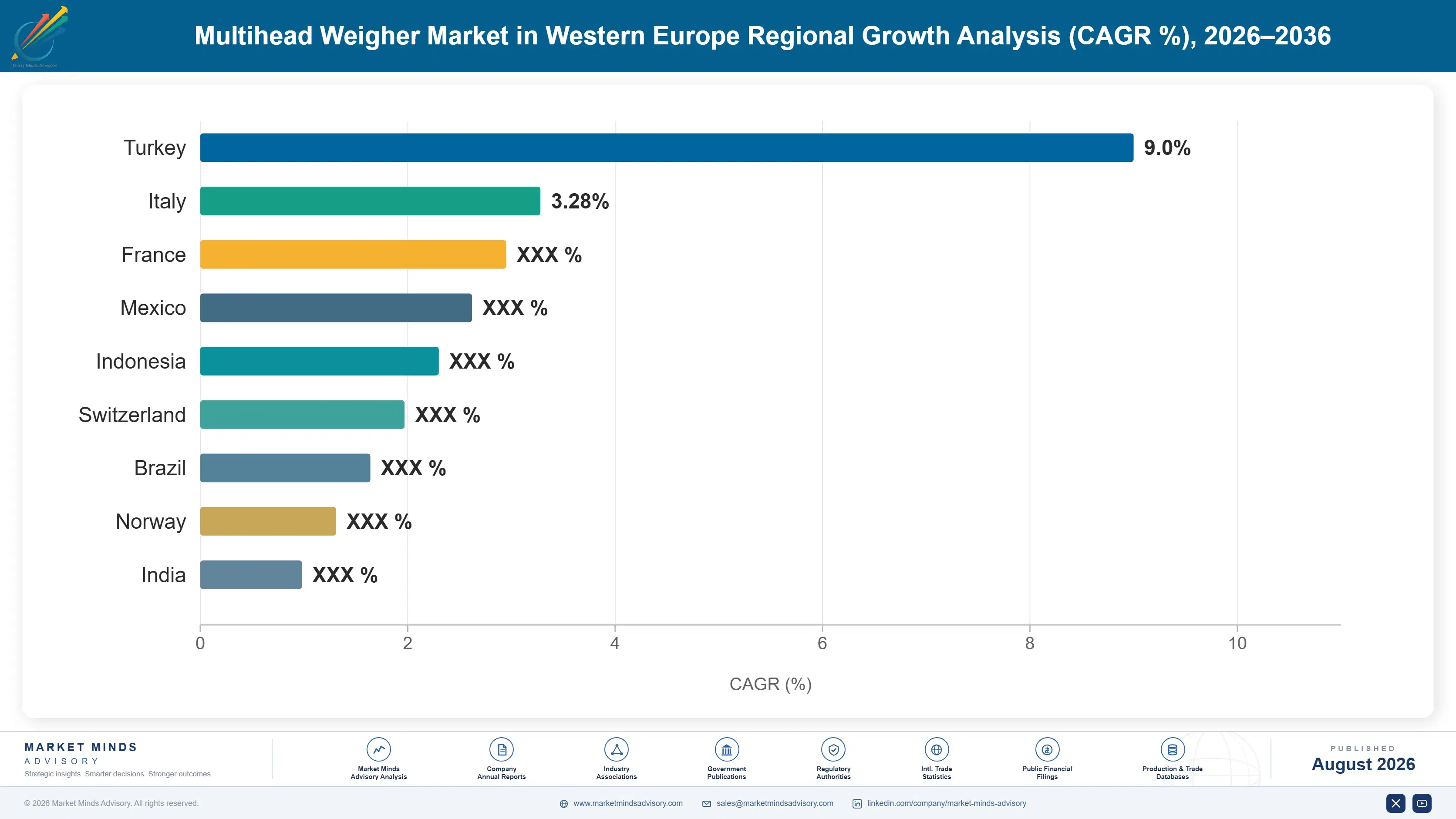
Western Europe leads on Germany's concentrated food processing equipment manufacturing base and dense fresh food packaging infrastructure across the entire region, while South Asia and Pacific posts the fastest growth as food processing automation investment accelerates sharply across India and Southeast Asia specifically each year.

Western Europe

Germany hosts the world's densest concentration of multihead weigher manufacturing capability, anchored by Multivac and Bizerba, giving the region genuine technical leadership that shapes global product development roadmaps beyond its own borders and industry standards. The region's dense fresh food and prepared meal packaging infrastructure, among the most automated globally, sustains steady vision-integrated weigher demand tied to strict European food safety labeling and traceability requirements across most member states. France and the Netherlands' large-scale food processing sectors add further specialty weigher demand tied to dairy and prepared food packaging conversion. Growth trails the fastest-growing regions because market penetration for both standard and vision-integrated formats already sits near saturation across most major Western European food processing facilities.
Share: 26% | CAGR: 5.0% (2026 to 2036)

North America

US food processing automation investment, accelerated by persistent labor shortages in manufacturing roles, is driving sustained demand for both standard and vision-integrated weighing systems across snack and fresh food packaging lines nationwide each year without exception. Canadian processors add further volume tied to established food manufacturing hubs serving both domestic and export markets across multiple provinces and territories. The region's fresh protein packaging sector, expanding alongside changing consumer preferences toward convenience foods, sustains growing specialty weigher demand independent of standard equipment replacement cycles entirely and permanently. Major equipment distributors maintain close service relationships with domestic manufacturers, sustaining steady demand for retrofit and upgrade services alongside new equipment sales across the installed base.
Share: 24% | CAGR: 6.0% (2026 to 2036)
Regional intelligence for 5 additional markets available in the complete report: East Asia, South Asia and Pacific, Latin America, Middle East and Africa, Eastern Europe. Contact sales@marketmindsadvisory.com.
multihead-weigher-market-in-western-europe-country-cagr-analysis-1787554464601

Where Manufacturers Capture Precision Value

Standard equipment volume no longer determines profitability in this category. Manufacturers capturing outsized returns are the ones layering vision inspection integration, specialty handling engineering, and retrofit service capability onto commodity mechanical platforms, converting what was once a one-time equipment sale into recurring service relationships with food and pharmaceutical processors specifically across each fiscal cycle.

Vision Inspection Integration and Compliance Contracts

Manufacturers that integrate vision inspection capability into weigher platforms capture roughly 28 percent higher unit pricing than standard mechanical-only equipment, because inspection creates a genuine compliance value that processors need for food safety documentation and cannot easily replicate with standalone systems purchased separately. Processors increasingly sign multi-year service agreements that bundle inspection calibration and support with equipment purchase, giving committed manufacturers predictable revenue visibility years into the future. This model has proven especially effective for manufacturers with existing fresh food processor relationships, since qualification history transfers across new packaging line installations.
Market Impact: Adds roughly 28 percent vision integration pricing premium

Specialty Handling Engineering for Fresh Products

Manufacturers with proven specialty bucket and vibration engineering for sticky and irregular products command 20 to 30 percent price premiums over standard weigher platforms, since fresh food processors pay directly for handling performance that reduces product damage and giveaway loss across the packaging line. This premium tier is expanding fastest in fresh meat and prepared food packaging applications, where handling precision directly determines packaging line yield and product quality. Manufacturers with proven engineering track records across multiple product categories are increasingly securing preferred supplier status with major fresh food processors navigating packaging conversion.
Market Impact: Captures 20 to 30 percent specialty handling premium

Retrofit and Service Contract Recurring Revenue

Manufacturers bundling equipment sales with recurring retrofit and service contracts capture 15 to 20 percent higher account-level revenue than equipment-only sales, particularly as processors extend equipment lifespans through component refurbishment rather than full replacement across most facilities, product lines, and processing halls. This service layer generates recurring revenue independent of new equipment sales cycles, smoothing the historical lumpiness of capital equipment purchasing that has long characterized the category and its manufacturers. Manufacturers with dedicated service networks are increasingly capturing this recurring revenue that would otherwise flow to independent third-party service providers.
Market Impact: Adds 15 to 20 percent recurring service revenue

Who Controls the Margin Pool

Global revenue concentration sits substantial at a 55 percent CR5, reflecting a market where precision engineering and service networks matter more than manufacturing scale alone in the specialty tiers. Ishida leads on breadth across standard and vision-integrated channels globally, while Multivac commands outsized share within specialty fresh food packaging line integration. The gap between leader and mid-tier challengers has narrowed as regional manufacturers scale certified standard production, though engineering depth still separates the top five from smaller players.
Current activity centers on vision inspection bundling and specialty handling engineering rather than commodity price competition. Leading players sign multi-year service agreements with major food processors that lock in volume years ahead, while mid-tier competitors invest in retrofit capability to differentiate on installed base economics. Regional manufacturers have expanded standard equipment capacity aggressively, pressuring pricing in general commodity segments.

Emerging pressure comes from Asian equipment manufacturers scaling standard production capacity fast enough to challenge multinational technical leadership within general packaging applications. Rankings could shift if a leading player secures exclusive integration partnerships with major fresh food processors that lock competitors out of that fast-growing segment. Consolidation among mid-tier commodity manufacturers also looks likely as engineering costs rise.
multihead-weigher-market-in-western-europe-company-positioning-matrix-1787554465126

Competitive Moat and Risk Dimensions

ISHIDA CO LTD

Moat: Broadest Global Installed Base

Ishida's global installed base spans tens of thousands of food and pharmaceutical packaging lines, giving it a service and parts network density that smaller competitors cannot replicate without years of capital investment. This reach lets Ishida bundle equipment sales with broader service contracts, deepening account stickiness and raising genuine switching costs for processors considering alternative suppliers.
ISHIDA CO LTD

Risk: Standard Segment Margin Pressure

Ishida's broad standard equipment exposure leaves it vulnerable to Asian manufacturers scaling low-cost commodity production, particularly in price-sensitive snack packaging tenders where technical differentiation matters less than delivered cost and freight terms. Sustained commodity price pressure could compress blended margins across the broader portfolio over time.
MULTIVAC GROUP

Moat: Integrated Packaging Line Expertise

Multivac's integrated packaging line offering, combining weighing with broader wrapping and sealing systems, gives it a technical lead in fresh food processor relationships that took years to build. This specialization commands premium pricing and protects incumbent share from standalone weigher competitors lacking comparable systems integration depth.
MULTIVAC GROUP

Risk: Fresh Food Segment Dependence

Multivac's revenue concentration in fresh food packaging line integration leaves it more exposed than diversified rivals to any slowdown in fresh food capital spending, such as processors deferring line upgrades during margin pressure periods. A broader standard equipment base would cushion that cyclical exposure more effectively.

Players Tracked

Prominent Players

Ishida Co Ltd
Multivac Group
Yamato Scale
Bizerba SE
Marel

Other Key Players

Loma Systems
Mettler-Toledo
CEIA
Minebea Intec
Espera-Werke
TNA Solutions
Heat and Control Inc
Key Technology
Rovema
Cabinplant
Weightpack
Autopac Ltd
All-Fill Inc
Nichrome India
Repak

Recent Developments

JANUARY 2026

Multivac Launches Integrated Vision Inspection Weigher Line

Multivac launched a new integrated vision inspection weigher line designed specifically for fresh protein and prepared food packaging applications across Western European processing facilities and export markets. The launch responds directly to processor demand for combined weighing and inspection systems that reduce equipment footprint and integration complexity.
Signal: Signals equipment manufacturers converging weighing and inspection functions into single integrated systems for fresh food applications.
SEPTEMBER 2025

Bizerba Signs Fresh Food Processor Service Agreement

Bizerba entered a multi-year service agreement with a major European fresh food processor to provide specialty weighing equipment and ongoing calibration support across multiple production facilities nationwide and beyond. The agreement reflects growing processor preference for bundled equipment and service relationships covering multiple packaging lines.
Signal: Signals processors consolidating equipment and service relationships under fewer vendor partnerships to simplify maintenance management overall.
MAY 2025

Yamato Scale Expands High-Speed Weigher Production Capacity

Yamato Scale completed an organic expansion of its high-speed multihead weigher production capacity in Japan, adding assembly lines dedicated to export markets across Europe, North America, and beyond its home region entirely. The expansion strengthens Yamato's position serving growing global demand for high-throughput packaging equipment.
Signal: Signals Japanese manufacturers scaling export capacity to capture growing Western demand for high-speed packaging automation systems.

Precision Sensor Costs Shape Manufacturer Margins

Precision sensors and stainless steel components together represent roughly 38 percent of cost of goods sold for weigher manufacturers, with the balance split across electronics, software, and assembly labor costs. Load cell and sensor supply traces mostly to Japanese and German precision electronics manufacturers, while stainless steel derives from broader global metals market cycles and pricing benchmarks.
The 2025 semiconductor component shortage, driven by broader electronics supply chain disruption, pushed precision load cell prices up roughly 18 percent within two quarters, according to named company annual report disclosures from major manufacturers. Manufacturers without long-term indexed component supply contracts absorbed the spike directly into margins, while those with locked annual pricing agreements passed only modest increases through to food processors. The episode pushed several manufacturers to diversify sensor sourcing across multiple regional suppliers.

Smaller regional manufacturers lacking multi-year indexed component contracts face genuinely sharper margin swings than multinational competitors who negotiate volume-based pricing locks with major sensor suppliers directly. This exposure varies meaningfully by geography too, since manufacturers serving food safety compliance markets face additional certification retesting costs when switching components that general industrial manufacturers largely avoid, compounding the disadvantage for undiversified regional players.
multihead-weigher-market-in-western-europe-cost-volatility-analysis-1787554465331

Diversify Precision Sensor Sourcing Across Regions

Manufacturers are qualifying secondary load cell and sensor suppliers across multiple regions worldwide rather than relying entirely on single-source component contracts, reducing exposure to any single supply chain disruption entirely and permanently. This diversification adds modest engineering validation complexity but has proven worth the cost given repeated component shortage episodes across recent years overall.

Negotiate Multi-Year Indexed Component Supply Agreements

Large manufacturers increasingly lock in multi-year sensor and electronics component pricing agreements indexed to published market benchmarks, trading some negotiating leverage on price for genuine predictability in annual budgeting. Smaller players lacking sufficient purchase volume to negotiate favorable index terms remain exposed to spot market pricing, widening the margin gap between scaled and regional competitors.

Portfolio Architecture for Margin Defence

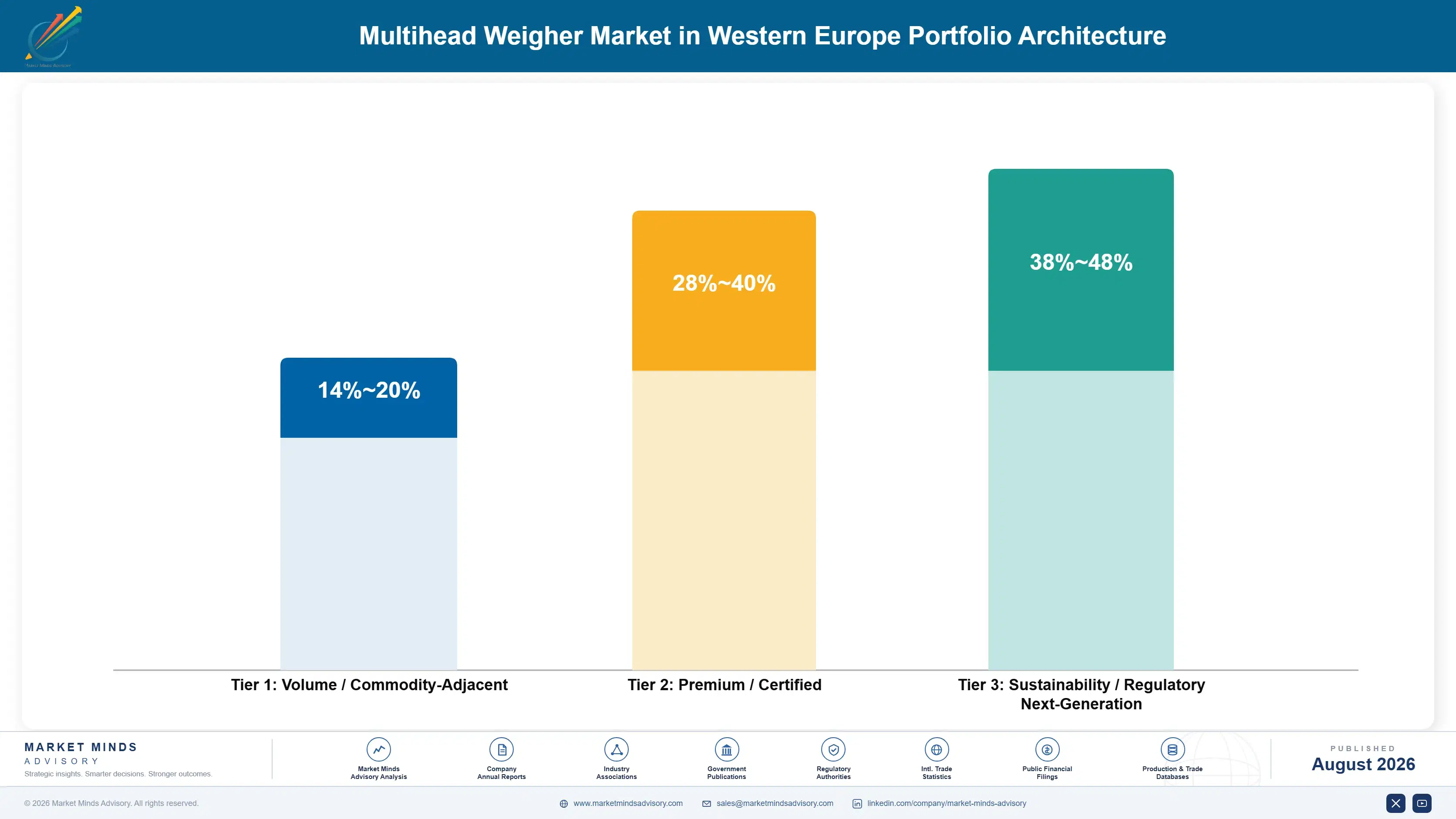
Portfolio economics split cleanly along three tiers, with gross margins ranging from the mid-teens for standard mechanical weighers to well above 40 percent for vision-integrated and specialty formulations sold into premium fresh food and pharmaceutical channels. Standard products compete almost entirely on delivered cost per unit, since snack and confectionery buyers treat them as interchangeable products purchased through bid-based tender processes that repeat periodically across most large accounts.
Specialty formulations capture disproportionate value because vision integration barriers and specialty handling engineering genuinely limit competitive entry, letting incumbents sustain pricing power that standard products cannot match at all. The tension between volume and premium tiers plays out most visibly in fresh food accounts, where processors balance capital cost pressure against food safety compliance and handling performance requirements demanded by major retailers.

High-value pools concentrate specifically in vision-integrated and specialty handling applications, where inspection accuracy and product-specific engineering command the steepest premiums available anywhere in the category. Regulatory-driven compliance formulations remain a smaller but scaling tier as food safety mandates convert what was once a niche requirement into a genuine growth pool for early-mover specialty manufacturers positioning ahead of demand.

Volume / Commodity-Adjacent

Standard multihead weighers sold through bid-based snack and confectionery tenders where delivered cost per unit is the dominant purchasing criterion. Competitive intensity is highest here, with margin protection resting almost entirely on manufacturing scale.
Gross Margin: 14-20%

Premium / Certified

Vision-integrated weighers carrying food safety compliance certification, sold primarily into fresh food and prepared meal accounts across the region. Certification barriers protect pricing power against commodity substitution from uncertified competitors in the broader market.
Gross Margin: 28-40%

Sustainability / Regulatory / Next-Generation

Specialty handling weighers for sticky and irregular products, plus emerging AI-driven inspection chemistries used across multiple applications. Smaller in absolute volume today but scaling fast as fresh food packaging conversion accelerates across major markets.
Gross Margin: 38-48%
multihead-weigher-market-in-western-europe-portfolio-architecture-1787554465840

High-value Sub-segments and Strategic Watch-out

Vision-Integrated Fresh Food Applications

High-value and high-growth given accelerating fresh food packaging conversion globally and expanding food safety compliance mandates specifically across most major markets today and well into the future. Applications here command the category's steepest margins, and demand is compounding as conversion scales worldwide each year without exception.
Gross Margin: 38-48%

Specialty Sticky Product Handling Contracts

High-value with moderate but steady growth as fresh meat and prepared food processors continue converting toward automated weighing under multi-year equipment agreements signed years in advance of production launch. Margins here remain attractive though growth trails the vision tier since specialty penetration is already substantial among leading processors.
Gross Margin: 28-38%

Standard Snack and Confectionery Equipment

Volume core segment representing the largest absolute revenue base across snack and confectionery packaging accounts worldwide, though margins stay thin given bid-based procurement practices repeated periodically across most markets and regions. This tier anchors total category volume even as growth concentrates elsewhere in the portfolio.
Gross Margin: 14-20%

Extended Equipment Life Substitution Exposure

Strategic watch-out as extended equipment lifespans reduce new unit replacement frequency across most installed fleets and product categories, since manufacturers reliant on new sales alone risk revenue erosion across their installed base and customer relationships. This tier could shift material share toward service-oriented competitors within several years.
Gross Margin: 18-30%

Annuity Demand, Line-Integration Loyalty

Multihead weigher purchasing behaves like an annuity once a manufacturer completes processor qualification, since consumption tracks packaging line installation cycles rather than discretionary demand that swings with economic conditions broadly. Processors rarely switch suppliers mid-installation given the integration costs and line downtime risk involved, giving incumbent manufacturers genuinely durable revenue visibility years into the future once an account is won.
Adoption stickiness varies meaningfully by end-use vertical. Fresh food and pharmaceutical accounts show the deepest entrenchment, since processors rarely requalify an alternate equipment supplier absent a specific performance failure or compliance breakdown mid-deployment. Snack and confectionery accounts switch more readily, chasing modest price concessions at contract renewal since performance specifications there are less stringent than fresh food or compliance-driven applications.

Generational buyer shifts are underway as younger plant engineering and procurement staff, more comfortable evaluating vision system data and total cost of ownership models, replace veteran purchasing managers who prioritized price and supplier familiarity above all else. This transition favors manufacturers with genuine vision integration and service capability, and it is gradually eroding the advantage long held by legacy suppliers whose relationships rested mainly on tenure rather than differentiated product capability.
multihead-weigher-market-in-western-europe-end-use-penetration-index-1787554466331

Where to Compete in Weighing

These are among the four positions where our research anticipates prominent divergence between winners and laggards over the coming forecast period. Each is grounded in the demand model, the regulatory perimeter, and the announced capacity pipeline.
01 / VISION INTEGRATION INVESTMENT

Bundle Vision Inspection Into Every New Platform

Manufacturers still selling mechanical-only weighers are ceding the highest-margin part of this market to competitors bundling vision inspection with weighing hardware across most new platform launches. That integrated model captures roughly 28 percent higher pricing and creates genuine compliance value that processors need for food safety documentation and traceability. Any manufacturer without a vision integration roadmap by 2028 risks permanent exclusion from the largest fresh food and pharmaceutical accounts, where processors now expect inspection built directly into the weighing platform.
02 / SPECIALTY HANDLING ENGINEERING PRIORITY

Invest in Specialty Design Before Fresh Food Scales

Specialty bucket and vibration engineering for sticky products is becoming a genuine competitive moat, not a niche customization request, and manufacturers delaying that investment will find themselves locked out of the fastest-growing fresh food segment entirely within a few years. Specialty designs already command 20 to 30 percent price premiums, and that gap will widen as fresh protein packaging conversion accelerates further across the region. Mid-sized manufacturers lacking engineering depth should partner with specialty design firms rather than build capability from scratch.
03 / RETROFIT SERVICE EXPANSION

Build Retrofit Revenue Before Equipment Sales Slow

Selling equipment once and walking away is leaving genuine revenue on the table, since processors increasingly extend equipment life through refurbishment rather than full replacement across most installed fleets and product lines. Manufacturers bundling retrofit and service contracts capture 15 to 20 percent higher account-level revenue, and that model smooths the historical lumpiness of capital equipment sales considerably across most accounts. Manufacturers without service capability should build it now, since the installed equipment base keeps growing every single year without exception.
04 / COMPONENT SOURCING DIVERSIFICATION

Diversify Sensor Sourcing Before Shortages Repeat

Precision sensor supply chains are volatile enough that manufacturers relying on single component suppliers face genuine margin risk within the next several electronics cycles ahead of most current forecasts and market projections available today across the industry. Manufacturers still dependent on single-source component contracts should diversify supplier relationships now, rather than waiting for the next shortage to force a costly and disruptive reactive response later on down the road indefinitely. Waiting risks ceding margin entirely to better-diversified competitors positioning right now.

Engagement Snapshot From the Field

A live engagement with an industry participant carrying material or product regulatory and market exposure ahead of a defining policy shift, showing how our research translates into a defensible multi-year portfolio strategy.
MARKET MINDS ADVISORY · CLIENT ENGAGEMENT SUMMARY
Multihead Weigher in Western Europe Producer Strategic Portfolio Review and Transition Roadmap 2026·Investment Scenario on Multihead Weigher in Western Europe Exposure Evaluation 2025-26
CLIENT PROFILE
The client operates a mid-sized fresh meat processing facility in southern Germany, supplying both retail case-ready and foodservice channels across multiple countries. Facing rising labor costs and tightening food safety labeling requirements, leadership sought an independent evaluation of its packaging line automation strategy ahead of a multi-year equipment procurement decision covering its primary production facility.
STRATEGIC CHALLENGE
The client's existing manual portioning process struggled to meet both throughput targets and documented fill accuracy requirements simultaneously, but leadership lacked clarity on whether a full vision-integrated weigher system justified the capital cost compared to a standard weigher paired with separate inspection equipment across the entire production facility overall each shift.
MMA APPROACH
MMA benchmarked both equipment configurations against comparable fresh food processing facilities, modeled total cost of ownership including integration and maintenance costs under both scenarios, and interviewed engineering staff at two peer facilities directly to surface real-world performance tradeoffs that sat well beyond the headline equipment pricing comparison presented by vendors.
KEY FINDINGS
  1. The integrated vision-weigher system cost meaningfully more upfront but eliminated separate inspection equipment footprint and reduced total integration complexity across the packaging line.
  2. Peer facilities using separate standalone systems reported more frequent calibration conflicts between weighing and inspection equipment compared to integrated system users across multiple production shifts.
  3. The integrated system's single-vendor service relationship simplified maintenance scheduling considerably compared to coordinating two separate equipment vendors for routine service calls and repairs.
  4. Total cost of ownership favored the integrated system once reduced integration complexity and simplified maintenance were factored against the higher upfront equipment cost.
CLIENT PROFILE
The client operates a mid-sized fresh meat processing facility in southern Germany, supplying both retail case-ready and foodservice channels across multiple countries. Facing rising labor costs and tightening food safety labeling requirements, leadership sought an independent evaluation of its packaging line automation strategy ahead of a multi-year equipment procurement decision covering its primary production facility.
STRATEGIC CHALLENGE
The client's existing manual portioning process struggled to meet both throughput targets and documented fill accuracy requirements simultaneously, but leadership lacked clarity on whether a full vision-integrated weigher system justified the capital cost compared to a standard weigher paired with separate inspection equipment across the entire production facility overall each shift.
MMA APPROACH
MMA benchmarked both equipment configurations against comparable fresh food processing facilities, modeled total cost of ownership including integration and maintenance costs under both scenarios, and interviewed engineering staff at two peer facilities directly to surface real-world performance tradeoffs that sat well beyond the headline equipment pricing comparison presented by vendors.
KEY FINDINGS
  1. The integrated vision-weigher system cost meaningfully more upfront but eliminated separate inspection equipment footprint and reduced total integration complexity across the packaging line.
  2. Peer facilities using separate standalone systems reported more frequent calibration conflicts between weighing and inspection equipment compared to integrated system users across multiple production shifts.
  3. The integrated system's single-vendor service relationship simplified maintenance scheduling considerably compared to coordinating two separate equipment vendors for routine service calls and repairs.
  4. Total cost of ownership favored the integrated system once reduced integration complexity and simplified maintenance were factored against the higher upfront equipment cost.
RECOMMENDED STRATEGY
Phase 1: Select the fully integrated vision-weigher system for the primary production facility despite the higher upfront capital investment it requires overall. Phase 2: Negotiate a bundled service agreement covering both weighing and inspection calibration under a single vendor relationship and long-term service contract. Phase 3: Phase the equipment rollout across production lines to manage capital spending while validating performance on the first installed line thoroughly.
OUTCOME
The client selected the integrated vision-weigher system, securing a bundled service agreement (client-reported, unverified by MMA) that reduced projected annual maintenance costs by approximately 15 percent versus separate vendor coordination. The phased rollout proceeded on schedule, and fill accuracy documentation compliance improved measurably following installation.

Frequently Asked Questions

Foundational context covering the market sizes, CAGR, scope, country, region and competition that inform every finding below. This section is provided to cover basics and most often pre-purchase conversations, answered from the MMA Primary Research Dataset.

What is the current size of the Multihead Weigher Market in Western Europe?

The global market reached an estimated 1.4 billion dollars in 2025. Growth is driven mainly by vision inspection integration and fresh food packaging conversion worldwide.

How large will the Multihead Weigher Market in Western Europe be by 2036?

The market is projected to reach approximately 2.80 billion dollars by 2036. That represents a 1.88 times expansion over the eleven-year forecast period from 2026 onward.

What is the CAGR for the Multihead Weigher Market in Western Europe 2026 to 2036?

The market is forecast to grow at a 6.5 percent compound annual rate through 2036. Bull and bear scenarios range from 5.2 to 7.8 percent depending on automation investment pace.

Which segment is growing fastest?

Multihead weighers integrated with vision inspection systems lead growth at a 10.0 percent CAGR, roughly 1.5 times the overall market rate. Food safety compliance demand drives this outsized pace.

Who are the major companies in the Multihead Weigher Market in Western Europe?

Ishida, Multivac, Yamato Scale, Bizerba, and Marel lead the competitive field worldwide today. Together they hold a 55 percent combined revenue share across the market.

Which country is growing fastest?

Germany leads country-level growth at an 8.0 percent CAGR, outpacing the global average meaningfully. Concentrated food processing equipment manufacturing and fresh food automation both underpin that pace.

Report Segmentation Architecture

The full report scope spans multiple orthogonal segmentation dimensions, with cross-tabulated demand data provided for each dimension pair. Coverage extends further to regional breakdowns, trend trajectories, and the competitive detail needed to support segment-level decision-making.

By Design and Integration Type

  • Standard Multihead Weighers
  • High-Speed Multihead Weighers
  • Specialty Weighers for Sticky Products
  • Vision-Inspection Integrated Systems
  • Non-Food Application Weighers
  • Refurbished Retrofit Systems

By End-Use Industry

  • Snack and Confectionery
  • Fresh Meat and Poultry
  • Prepared and Convenience Foods
  • Pharmaceutical and Nutraceutical
  • General Industrial and Hardware

By Commercial Dimension

  • Direct Processor Supply Contracts
  • Distributor and Channel Sales
  • Retrofit and Service Agreements
  • Equipment Leasing Arrangements

By Region

  • Western Europe
  • North America
  • East Asia
  • South Asia and Pacific
  • Latin America
  • Middle East and Africa
  • Eastern Europe

Scope, Methodology, and Coverage

Every figure in this report is reproducible from documented input assumptions. The scope below maps the historical period, the forecast horizon, the segmentation dimensions, and the countries covered, alongside the underlying primary and qualitative methodology.
Historical Period
2020 to 2025
Forecast Period
2026 to 2036
Base Year
2025 (USD billions; MMA Primary Research Dataset, August 2026)
Market Definition
This report covers multihead weighing equipment sold for food, pharmaceutical, and general packaging applications, including standard weighers, high-speed variants, specialty weighers for sticky or irregular products, vision-inspection integrated systems, and refurbished retrofit systems. It excludes single-head checkweighers, bulk flow metering systems, and standalone vision inspection equipment sold independent of weighing mechanisms.
Quantitative Units
USD billions (current prices)
Segmentation Dimensions
By Design and Integration Type; By End-Use Industry; By Commercial Dimension; By Region
Regions Covered
Western Europe, North America, East Asia, South Asia and Pacific, Latin America, Middle East and Africa, Eastern Europe
Countries Covered
USA, China, Germany, France, UK, Japan, South Korea, India, Australia, Canada, Brazil, Mexico, Indonesia, Vietnam, Thailand, Malaysia, UAE, Saudi Arabia, South Africa, Nigeria, Turkey, Poland, Netherlands, Italy, Spain, Sweden, Switzerland, Argentina, Colombia, Singapore, and additional markets relevant to this sector
Key Companies Profiled
Ishida Co Ltd, Multivac Group, Yamato Scale, Bizerba SE, Marel, Loma Systems, Mettler-Toledo, CEIA, Minebea Intec, Espera-Werke, TNA Solutions, Heat and Control Inc, Key Technology, Rovema, Cabinplant, Weightpack, Autopac Ltd, All-Fill Inc, Nichrome India, Repak
Quantitative Methodology
Primary survey, n=3,800 respondents, Q4 2025, six countries; demand-side model with trade association cross-validation
Qualitative Methodology
47 expert interviews, Q4 2025; applied to validate demand model assumptions, identify emerging dynamics, and assess competitive positioning
Report Format
PDF and XLSX data workbook (Word format preview document)
Publisher
Market Minds Advisory
Report Code
MMA-2026-CON-105
Published
August 2026
Contact
sales@marketmindsadvisory.com | www.marketmindsadvisory.com

Purchase the full Multihead Weigher Market in Western Europe Report (2026 to 2036).

This report provides comprehensive market intelligence on the multihead weigher market, covering sizing, segmentation, competitive positioning, and regional dynamics through 2036. It draws on primary survey data, expert interviews, and company disclosures to quantify demand drivers across snack, fresh food, pharmaceutical, and general packaging end-use verticals worldwide. The analysis includes detailed competitive profiling of leading manufacturers, input cost exposure assessment, and actionable revenue lever guidance for participants navigating vision integration barriers and specialty engineering demands. Regional breakdowns cover all seven global regions with quantified share and growth projections.
Full ten-year market sizing and forecast data
Detailed segmentation across six design integration categories
Competitive profiling of top twenty industry participants
Regional analysis across all seven global regions
Input cost and precision sensor volatility risk assessment
Strategic revenue lever and portfolio tier analysis

Built For The People Who Decide

From boardroom strategy to bench-side execution, this report is read cover-to-cover by leaders shaping the next decade of their industry, turning demand scenarios, market dynamics and valuation benchmarks into decisions.
CXOs/ Presidents/ VPs/ Managers
M&A and Corporate Development
Strategy Teams and R&D Heads
Procurement and Product Directors
Regulatory and Compliance Leaders
Investor Relations and Equity Analysts