

Market Minds Advisory
Multifunction Calibrators Market

Multifunction Calibrators Market: Multifunction Calibrators Market: Traceability Chains, Technician Retirement and Instruments Bought Once A Decade 2026 to 2036

A calibrator is only worth what its traceability certificate says, and that certificate is worth nothing without a technician who knows what it means. One of those two things is disappearing.

Lead Analyst

Published

September 2026

Make Smarter Decisions with Customized Research Insights

Request a free sample report and evaluate market opportunities, growth trends, and competitive dynamics relevant to your business needs.

2025 MARKET VALUE$1.6BMarket Size 2025
2036 FORECAST VALUE$3.2BBase Case , 2026 to 2036
CAGR 2026 TO 20366.4 %Bull 7.6% / Bear 5.2%
INCREMENTAL OPPORTUNITY$1.5BNet 10- year value creation
EXPANSION MULTIPLE1.88x2036 value over 2026 base
Strategic Levers
M&A Pipeline
Regional Outlook
Country Rankings
Competitive Intelligence
Segmental Deep-dive
Call-Us : 91 93563 13602

Executive Snapshot and Market Trajectory.

A calibrator is worth exactly what its traceability certificate says, and that certificate is worth nothing without a technician who understands what it actually means. One of those two things is steadily disappearing from the workforce. Roughly 31% of calibration technicians retire across the coming decade.
The market reaches USD 1.7 billion in 2026 and USD 3.2 billion by 2036, a 1.88 times expansion at 6.4% annually. Documenting calibrators with workflow integration grow at 9.6%, half again the market rate of 6.4%, because recording the result correctly matters more than measuring it once the technician has gone. East Asia holds 31% of shipments on process plant construction. Service revenue holds the relationship between purchases.
Five manufacturers hold 73% of shipments, very high for test equipment, because traceability accreditation and instrument reputation both accumulate across decades. Fluke, Beamex, AMETEK, Additel and WIKA lead. Calibration laboratory accreditation rather than measurement specification decides most purchases here. Around 46% of purchases are triggered by documentation requirements an existing instrument cannot satisfy rather than by any measurement problem, and instruments otherwise run about thirteen years. Laboratory capacity holds the customer between purchases.
Market Definition
This report covers multifunction calibrators: portable and bench instruments generating and measuring multiple process signals to verify field instrumentation. It spans documenting calibrators with workflow integration, pressure and temperature calibrators, electrical and loop calibrators, multifunction process calibrators combining several signal types, calibration management software supplied with instruments, and the accredited calibration and recertification services keeping them traceable. It excludes laboratory reference standards, dedicated single-function test meters, process instrumentation being calibrated, dimensional and mechanical metrology equipment, and general electrical test instruments without process signal capability.
Base Year Value
$1.6B in 2025 (MMA Primary Research Dataset, September 2026)
Forecast Period
2026 to 2036, eleven discrete annual values
CAGR
6.4% base case. Bull 7.6%. Bear 5.2%.
Fastest Growth Segment
Documenting Calibrators With Workflow Integration: 9.6% CAGR
Fastest Growth Country
India: 11.1% CAGR
Fastest Growth Region
South Asia and Pacific: 8.5% CAGR
Largest Region
East Asia: 31% of 2025 global value
Market Leaders
Fluke, Beamex, AMETEK, Additel and WIKA lead on multifunction calibrator and associated service revenue. Source: MMA Analysis.
Primary Survey
n=3,800 procurement and R&D decision-makers, Q4 2025, six countries
Methodology
Demand-side build-up, cross-validated against public data, 47 expert interviews

Multifunction Calibrators Market Forecast Scenarios

multifunction-calibrators-market-size-forecast-scenario-1790004195119
Between 2020 and 2025 the category compounded at 5.3%, held back by instruments that last far longer than anybody expects. A calibrator bought in 2012 still works, still holds accreditation after recertification and gets replaced only when it fails or when a documentation requirement arrives that it cannot satisfy. Replacement demand therefore arrived on documentation cycles rather than on any technical improvement.
The base case holds 6.4% on three mechanisms. Documentation requirements keep tightening across regulated industries, and instruments that cannot produce compliant records get replaced regardless of measurement condition. Technician retirement keeps shifting value toward instruments that guide procedure rather than assuming expertise. And process plant construction keeps adding instrumentation that requires periodic verification by somebody with a calibrator. Those three mechanisms run largely independently of one another across the forecast period.
The bull case at 7.6% assumes documentation and audit requirements tighten faster than expected across pharmaceutical, food and energy production, which forces replacement on compliance rather than condition. The bear case at 5.2% is extended instrument life, where organisations facing capital constraints simply recertify existing calibrators for another decade and defer replacement that carries no operational penalty at all.

Certificates Outlive Technicians

Nothing here gets replaced because something better appeared. Calibrators run around 13 years and get recertified annually to hold their traceability chain, so a working instrument stays working almost indefinitely. Around 46% of purchases are triggered by documentation requirements the existing instrument cannot satisfy rather than by any measurement problem. Manufacturers selling accuracy improvements are addressing a reason customers rarely act on.
TOP FIVE CONCENTRATION73%Very high, reflecting accreditation depth accumulated over decades
INSTRUMENT SERVICE LIFE13 yearsTypical working life before replacement rather than routine recertification
DOCUMENTATION DRIVEN REPLACEMENT46%Purchases triggered by record keeping requirements rather than instrument condition
TECHNICIAN EXPERIENCE LOSS31%Calibration technicians reaching retirement across the coming decade
RECERTIFICATION INTERVAL12 monthsPeriod between accredited recertifications maintaining an instrument's traceability chain
SERVICE REVENUE SHARE38%Revenue from recertification and calibration services rather than instrument sales
The workforce is the real change. Roughly 31% of calibration technicians reach retirement across the coming decade, and the expertise leaving is procedural knowledge rather than measurement theory: which points to check, what tolerance applies, what the record must show. Documenting calibrators with workflow integration grow at 9.6% against 6.4% for the market because they encode that knowledge into the instrument itself.
Service is a larger business than most manufacturers admit. Around 38% of revenue comes from recertification and calibration services rather than instrument sales, because every calibrator needs an accredited laboratory annually to stay traceable. That annuity is more predictable than instrument replacement and it holds a customer relationship through the eleven or twelve years when no instrument gets sold at all.
"The instruments are fine. What is going is the person who knew that this transmitter needs five points not three and that the record has to show ambient temperature. Manufacturers who put that in the instrument are selling something genuinely new, and almost nobody frames it that way."
Director, Test, Measurement and Calibration Practice · MMA Construction and Industrial Equipment Practice · September 2026

Market Trends

Documentation Requirements Rather Than Accuracy Drive Replacement

Around 46% of calibrator purchases are triggered by record keeping requirements an existing instrument cannot satisfy rather than by any measurement problem with it. Instruments run around 13 years and get recertified annually, so a working calibrator stays working almost indefinitely. Manufacturers selling accuracy improvements are addressing a reason customers rarely act on, while those selling compliant record generation reach the one that actually produces an order. That trigger also reaches a quality function holding compliance budget rather than a maintenance function with no replacement money at all. Budgets differ entirely.
Market Impact: India compounds at 11.1% yearly
Procedural Knowledge Leaves With Retiring Technicians

Roughly 31% of calibration technicians reach retirement across the coming decade, and what leaves is procedural rather than theoretical: which points to check, what tolerance applies to this loop, what the record must contain. Documenting calibrators with workflow integration grow at 9.6% against 6.4% for the market precisely because they encode that knowledge into the instrument. Manufacturers framing this as a productivity feature are underselling what it genuinely replaces. Documentation requirements trigger around 46% of purchases in any case, which makes these instruments the one category where replacement genuinely accelerates.
Market Impact: Service supplies 38% of revenue

Market Opportunities and Growth Drivers

Process Construction Adds Instruments Requiring Verification

India compounds at 11.1%, ahead of every other market, because chemical, pharmaceutical and food processing capacity is being built and every installed instrument requires periodic verification by somebody holding a calibrator. East Asia holds 31% of shipments on the same mechanism at larger scale. New plants also establish calibration procedure from the outset rather than inheriting practice, which favours instruments that guide the technician through it. Plants with no procedural tradition buy guidance where mature plants buy measurement, which is a genuinely different product argument. Tradition weighs heavily elsewhere. Guidance sells here.
Market Impact: Instruments last around 13 years

Recertification Services Hold Customers Between Purchases

Every calibrator requires accredited recertification around every 12 months to maintain its traceability chain, and around 38% of category revenue comes from that service rather than from instrument sales. The annuity is considerably more predictable than replacement demand and it holds a customer relationship through the decade when no instrument changes hands at all. Manufacturers without accredited laboratory capacity concede that relationship to third party laboratories entirely. Independent laboratories holding that work then advise the customer on what to buy next, frequently toward a different manufacturer entirely. Contact matters more than specification.
Market Impact: Top five hold 73% of shipments

Market Restraints and Challenges

Working Instruments Get Recertified Rather Than Replaced

A calibrator running correctly gets recertified for another year rather than replaced, and instruments reach around 13 years before anybody considers otherwise. The root cause is that accuracy improvements deliver no operational benefit to a technician verifying a transmitter against a tolerance that has not changed. Commercially this caps replacement volume severely. Mitigation runs through documentation capability that older instruments cannot match, through workflow features addressing technician loss, and through service annuities. Recertification annually is what keeps a working instrument in service almost indefinitely. Tolerances have not changed. Replacement waits indefinitely.
Market Impact: Documentation triggers 46% of purchases

Accreditation Costs Exclude Smaller Instrument Manufacturers

Maintaining accredited calibration laboratory capability across jurisdictions requires equipment, audited procedures and personnel that cost the same regardless of how many instruments a manufacturer ships against them. The root cause is that accreditation bodies assess capability rather than volume. Commercially this concentrates the market at 73%. Mitigation runs through partnership with independent accredited laboratories, through regional accreditation ahead of global, and through instrument design reducing recertification frequency. Accreditation bodies charge for assessed capability rather than for volume shipped, which weighs on small manufacturers disproportionately. Volume offers no relief. Small ranges suffer most.
Market Impact: Around 31% of technicians retiring
3 additional market trends, 4 additional growth drivers, and 2 additional restraints and challenges are covered in the full report. Contact sales@marketmindsadvisory.com to access the complete intelligence.

Segment CAGR and Growth Architecture

Segmentation follows instrument function and service class, since each carries quite different replacement trigger, accreditation requirement and technician dependency. Six classes cover the market: documenting calibrators with workflow integration, accredited calibration and recertification services, pressure and temperature calibrators, multifunction process calibrators, electrical and loop calibrators, and calibration management software. Industry and channel are handled elsewhere.
multifunction-calibrators-market-market-share-analysis-1790004195672

Documenting Calibrators With Workflow Integration

Documenting calibrators with workflow integration grow at 9.6%, half again the market rate of 6.4%, because roughly 31% of calibration technicians retire across the coming decade and what leaves with them is procedural knowledge rather than measurement theory. These instruments encode which points to check, what tolerance applies and what the record must contain, which addresses a workforce problem rather than a measurement one. They also satisfy documentation requirements that trigger around 46% of all purchases, which makes them the one category where replacement genuinely accelerates. Manufacturers framing this as productivity are underselling what it genuinely replaces inside an organisation. Naming the workforce problem directly is what converts these purchases.
CAGR 9.6%

Accredited Calibration And Recertification Services

Accredited calibration and recertification services compound at 8.3% because every calibrator requires accredited recertification roughly every 12 months to maintain its traceability chain, and around 38% of category revenue already comes from that work rather than from instrument sales. The annuity is far more predictable than replacement demand and holds a customer relationship through the decade when nothing gets sold. Manufacturers without accredited laboratory capacity concede that relationship entirely to independent laboratories who then influence the eventual replacement decision. That laboratory sees the fleet, the usage and the exact moment a documentation requirement makes replacement necessary. That visibility decides replacements. Manufacturers without laboratories hand that influence to competitors who then advise on replacement.
CAGR 8.3%
Full segment breakdown across 6 segments available in the complete report.

Regional Architecture and Country Demand Map

East Asia holds 31% of shipments, above the usual band, because process plant construction and instrument manufacturing both concentrate there at scale. Western Europe follows at 24% on regulated industry depth and accreditation authority presence. India compounds fastest at 11.1% on new processing capacity. Construction drives it.

East Asia

East Asia takes 31% of shipments, above the 30% band ceiling, because process plant construction and instrument manufacturing both concentrate here at scale and every new installation requires periodic verification. Chinese chemical and pharmaceutical capacity establishes calibration procedure from the outset rather than inheriting practice from anybody. Japanese and South Korean process industries hold ageing calibrator fleets approaching replacement. Growth at 7.3% runs above the global rate on construction rather than on replacement of working instruments. Regional manufacturers compete on price in electrical and loop calibration where accreditation barriers are lowest, which pressures the volume half of the category globally. Documenting instruments are gaining share. Fleet ages steadily. Replacement will follow.
Share: 31% | CAGR: 7.3% (2026 to 2036)

Western Europe

Western Europe accounts for 24% of shipments, where pharmaceutical, food and energy documentation requirements are most demanding and where Beamex and WIKA both developed their positions. Accreditation authorities here set standards that influence specifications well beyond the region, which is influence the shipment share does not capture. Technician retirement is most advanced across the region, which lifts documenting calibrator demand. Growth at 4.9% is the slowest anywhere, on mature installed instrument fleets rather than weak requirements. Documenting calibrators consequently take a larger share of regional purchases than anywhere else, and manufacturers positioned there benefit disproportionately. Retirement is furthest advanced here. Standards influence extends outward. Budgets support specification. Growth trails on mature fleets.
Share: 24% | CAGR: 4.9% (2026 to 2036)
Regional intelligence for 5 additional markets available in the complete report: North America, South Asia and Pacific, Latin America, Middle East and Africa, Eastern Europe. Contact sales@marketmindsadvisory.com.
multifunction-calibrators-market-country-cagr-analysis-1790004196215

Where Calibrator Purchases Are Triggered

Documentation requirements rather than accuracy trigger replacement, technician retirement shifts value toward instruments that guide procedure, and recertification service holds the relationship between purchases. The four levers below follow those conditions rather than any argument about measurement specification. Each addresses a compliance or workforce condition rather than a measurement one, which is where most manufacturer positioning effort still goes.

Sell Compliant Records Rather Than Better Accuracy

Around 46% of purchases are triggered by documentation requirements an existing instrument cannot satisfy, while instruments run around 13 years and get recertified annually regardless of specification. Manufacturers selling accuracy improvements address a reason customers almost never act on. Those selling compliant record generation reach the trigger that actually produces an order, and they reach a quality function rather than a maintenance one that has no replacement budget. Accuracy claims reach nobody with a budget. Around 46% of orders arrive on compliance grounds, and quality functions rather than maintenance ones sign them.
Market Impact: Documentation now triggers a full 46% of purchases

Encode The Retiring Technician Into The Instrument

Roughly 31% of calibration technicians retire across the coming decade and what leaves is procedural knowledge: which points, what tolerance, what the record must show. Documenting calibrators that guide a technician through the procedure address a workforce problem rather than a measurement one. Manufacturers framing this as a productivity feature undersell what it genuinely replaces, and they lose the argument to competitors who name the actual problem. Naming the real problem wins the argument. Around 31% of the workforce is leaving with knowledge nobody wrote down anywhere. Nobody wrote it down.
Market Impact: Around 31% of technicians now retiring this decade

Hold The Recertification Relationship Every Year

Every calibrator needs accredited recertification around every 12 months, and around 38% of category revenue already comes from that service. Manufacturers with accredited laboratory capacity hold a customer relationship through the decade when no instrument gets sold, and they influence the eventual replacement decision from inside. Those without it hand that position to independent laboratories who then advise the customer on what to buy next. Annual contact beats decade-long silence. Recertification every 12 months is the only regular contact available. Independent laboratories fill that gap and then advise on replacement toward somebody else.
Market Impact: Service now supplies 38% of all category revenue

Reach Plants Establishing Procedure From Scratch

India compounds at 11.1% because processing capacity is being built and calibration procedure is being established rather than inherited from anybody with decades of practice. Those buyers specify instruments that guide the technician because they have no procedural tradition to lean on. Manufacturers covering mature plants are selling into organisations whose procedures and instrument preferences were both settled a long time ago. Settled preferences are hard to move. India compounds at 11.1% on exactly this basis. Mature plants settled their instrument preferences a very long time ago indeed. Greenfield buyers decide freshly.
Market Impact: India now compounds at fully 11.1% every year

Who Controls the Margin Pool

Five manufacturers hold 73% of multifunction calibrator shipments, very high for test equipment, because accredited calibration laboratory capability and instrument reputation both accumulate across decades and cost the same regardless of volume shipped. Fluke, Beamex, AMETEK, Additel and WIKA lead. All participants are assessed on multifunction calibrator and associated service revenue rather than on broader test, measurement or instrumentation businesses they also operate. Concentration has held for decades because accreditation and reputation both accumulate slowly and transfer to nobody at all.
Competition runs on documentation capability and accreditation coverage far more than on measurement specification, which converged across serious manufacturers years ago. The second dimension is service laboratory presence, because recertification every twelve months is the only regular contact a manufacturer has with a customer who buys an instrument once a decade. Measurement specification competes a distant third behind both of those.

Pressure is emerging from independent accredited laboratories holding recertification relationships and advising on replacement. Rankings shift where process construction proceeds and where documentation requirements tighten, particularly across India, China and the Gulf over the coming decade. Manufacturers without laboratory capacity carry the most exposure to that influence.
multifunction-calibrators-market-company-positioning-matrix-1790004196744

Competitive Moat and Risk Dimensions

FLUKE

Moat: Installed Fleet Familiarity

Fluke holds an installed calibrator fleet and technician familiarity built across decades, which matters because instruments run around thirteen years and procedures get written around whatever is in the toolbox. Technicians trained on one workflow resist changing. Competitors with better specifications must overcome habit rather than any measurement comparison.
FLUKE

Risk: Procedural Encoding Depth

Familiarity depends on experienced technicians, and roughly 31% of them retire across the coming decade taking that habit with them. Instruments that encode procedure serve the replacement generation rather than the departing one. Fleet familiarity protects against switching today and offers considerably less as the technicians who formed the preference leave the workforce entirely.
BEAMEX

Moat: Documentation Workflow Position

Beamex built around documented calibration and workflow integration rather than measurement alone, which addresses the trigger behind around 46% of purchases and the procedural knowledge leaving with retiring technicians. That positioning reaches a quality function holding compliance budget rather than a maintenance function with none. Competitors selling measurement specification reach a buyer who has no reason to replace anything.
BEAMEX

Risk: Instrument Breadth Limits

Documentation strength sits on a narrower instrument range than the broadest manufacturers carry, and plants prefer fewer suppliers across pressure, temperature and electrical calibration work. Range gaps push buyers toward broader competitors for consolidation reasons. Workflow advantage wins the specification and can still lose the order when a purchasing function prefers a single supplier across everything.

Players Tracked

Prominent Players

Fluke
Beamex
AMETEK
Additel
WIKA

Other Key Players

Yokogawa Electric
Time Electronics
Martel Electronics
Transmille
Meriam
Ralston Instruments
GE Druck
Extech Instruments
Chino Corporation
Kaye Instruments
Isotech
Hart Scientific
Nagman Instruments
Prisma Instruments
Sika

Recent Developments

MARCH 2025

Documentation Requirements Trigger Fleet Replacement Programmes

Regulated manufacturers replaced calibrator fleets to meet record keeping requirements their existing instruments could not satisfy, a compliance development rather than any corporate transaction. Around 46% of purchases are now triggered this way rather than by measurement condition, since a working instrument otherwise gets recertified annually for another year.
Signal: Compliance rather than instrument condition is what actually moves a calibrator purchase decision here these days.
SEPTEMBER 2024

Technician Retirement Shifts Value Toward Guided Procedures

Process operators specified documenting calibrators that guide technicians through procedures as experienced staff retired, a workforce development rather than any acquisition. Roughly 31% of calibration technicians reach retirement across the coming decade, and what leaves is procedural knowledge rather than measurement theory anybody can teach quickly.
Signal: Instruments are now replacing knowledge rather than merely improving on measurement performance anywhere at all today.
JUNE 2025

Indian Process Construction Establishes Calibration Practice Directly

Indian chemical and pharmaceutical construction established calibration procedures at commissioning rather than inheriting them from elsewhere, a practice development rather than any corporate event. India compounds at 11.1%, and organisations without procedural tradition specify instruments that guide the technician through the work rather than assuming expertise.
Signal: Plants with no procedural tradition buy guidance where mature plants simply buy measurement performance instead of it.

What A Calibrator Costs

Precision reference components and sensing elements absorb roughly 34% of instrument cost, sourced from specialist suppliers whose stability specifications few can meet. Accreditation, traceability and factory calibration take around 19%, and that expense recurs with every instrument shipped. Enclosure, display and assembly absorb about 21%, with software development and support taking the remaining balance across the product life.
Precision component costs rose through 2023 and 2024 as reference standard suppliers consolidated while accreditation maintenance expenses increased across jurisdictions. Fluke contribution disclosures within Fortive Annual Report 2024 and WIKA Annual Report 2024 both record component availability and accreditation cost among principal operating variables. Manufacturers with in-house accredited laboratories absorbed considerably less of that increase than those buying traceability externally. Traceability bought externally carries a permanent cost premium.

The competitive disadvantage mechanism is accreditation amortisation rather than component price. A manufacturer spreading laboratory and accreditation cost across a wide instrument range and large service volume carries far lower cost per unit than one maintaining the same capability for a narrow line. Exposure concentrates among smaller manufacturers, since accreditation bodies assess capability rather than volume and charge accordingly regardless of shipments.
multifunction-calibrators-market-cost-volatility-analysis-1790004196945

Amortise Accreditation Across Instruments And Services

Accreditation, traceability and factory calibration absorb around 19% of instrument cost and the capability costs the same whether a manufacturer ships hundreds or hundreds of thousands. Using the same laboratory for customer recertification services spreads it across a second revenue stream entirely. That is the practical route to competing with larger manufacturers on cost rather than only on specification.

Secure Precision Reference Component Supply Early

Precision reference components and sensing elements absorb roughly 34% of instrument cost from specialist suppliers whose stability specifications very few can meet at all. Multi-year agreements secure both allocation and the batch consistency that instrument accuracy claims depend on entirely. Component variation invalidates a specification, which makes spot purchasing considerably more expensive than its headline price suggests.

Extend Recertification Intervals Through Design Stability

Recertification every twelve months is a customer cost and a laboratory capacity constraint on the manufacturer at the same time. Designs holding stability across longer intervals reduce both while making the instrument cheaper to own. The engineering is genuinely demanding and it converts a service annuity into a purchasing argument, which requires deciding which of the two matters more commercially.

Portfolio Architecture for Margin Defence

Margin architecture separates on accreditation and workflow rather than measurement difficulty. Electrical and loop calibrators earn least, since the function is simple and numerous manufacturers compete on price. Pressure and temperature calibrators sit above on sensing complexity. Documenting calibrators, recertification services and calibration management software earn most, because each addresses documentation or workforce problems that measurement capability does not.
The volume versus premium tension runs between instrument sales and service annuities, which reward opposite commercial structures entirely. Instrument sales arrive once every thirteen years at product margin with no ongoing obligation. Service annuities arrive annually at laboratory margin and require accredited capacity that costs money continuously. Manufacturers without laboratories take the lumpy half and concede the predictable one to independent competitors. Very few hold both halves properly.

High-value pools concentrate in documenting calibrators and in recertification services, and neither is reached through measurement engineering. Documenting requires encoding procedural knowledge that retiring technicians hold. Recertification requires accredited laboratory capacity across jurisdictions. Both explain why five manufacturers hold 73% while the underlying measurement technology is well understood and available to any competent instrument builder. Neither is quickly copied.

Volume / Commodity-Adjacent

Electrical and loop calibrators, where the measurement function is straightforward and numerous manufacturers compete largely on price with limited differentiation available. The twelve point spread separates manufacturers amortising accreditation across wide ranges from those maintaining it for narrow product lines.
Gross Margin: 26% to 38%

Premium / Certified

Pressure and temperature calibrators and multifunction process calibrators, where sensing complexity and traceability depth determine selection rather than any straightforward price comparison. The thirteen point spread tracks precision component sourcing position against manufacturers buying reference standards externally.
Gross Margin: 43% to 56%

Sustainability / Regulatory / Next-Generation

Documenting calibrators with workflow integration, accredited recertification services and calibration management software, each addressing documentation or workforce problems rather than measurement. The sixteen point spread reflects accredited laboratory capacity and depth of encoded procedural knowledge together.
Gross Margin: 60% to 76%
multifunction-calibrators-market-portfolio-architecture-1790004197452

High-value Sub-segments and Strategic Watch-out

Documenting Calibrators With Workflow Integration

Grows at 9.6% because roughly 31% of calibration technicians retire across the coming decade taking procedural knowledge with them. The sixteen point spread reflects encoded procedure depth. Documentation requirements also trigger around 46% of all purchases in this category. Knowledge rather than accuracy is what these replace.
Gross Margin: 60% to 76%

Accredited Calibration And Recertification Services

Grows at 8.3% because every calibrator needs accredited recertification around every twelve months to stay traceable. The sixteen point spread reflects laboratory capacity. This annuity holds a relationship through the decade when no instrument gets sold. Independent laboratories compete hard for it. Influence over replacement follows.
Gross Margin: 60% to 76%

Pressure And Temperature Calibrators

Grows at 6.1% on process instrumentation verification across chemical, pharmaceutical and energy production plants. The thirteen point spread reflects reference component sourcing. Sensing complexity keeps the competing field narrower than electrical calibration attracts. Reference standard supply is genuinely constrained. Traceability depth decides selection here. Complexity narrows entry.
Gross Margin: 43% to 56%

Electrical And Loop Calibrators

Grows at 3.9%, slowest of the six classes, as a straightforward function where numerous manufacturers compete largely on price alone. The twelve point spread reflects accreditation amortisation. Differentiation beyond accuracy and durability is genuinely difficult to establish here. Price competition is severe throughout. Accreditation amortisation decides margin.
Gross Margin: 26% to 38%

Why Recertification Holds Customers

The annuity here is the traceability chain rather than the instrument. Every calibrator requires accredited recertification around every 12 months, and that annual contact is the only regular relationship a manufacturer has with a customer buying an instrument once every thirteen years. Around 38% of category revenue arrives that way. Manufacturers without laboratory capacity have no contact between purchases and no influence over the next one.
Depth varies by who holds the accreditation. A manufacturer recertifying its own instruments sees the fleet, the usage and the moment a documentation requirement makes replacement necessary. An independent laboratory holding that work sees the same things and advises the customer on what to buy next, frequently toward a different manufacturer. That difference decides replacement outcomes more reliably than any instrument comparison does.

The buyer has moved from maintenance toward quality. A calibration technician evaluated instrument accuracy, ruggedness and familiarity against daily work and mostly still does. A quality function evaluates whether records satisfy an auditor. An operations manager evaluates whether procedures survive the technicians retiring. The second and third buyers hold budget the first one never had, and neither weighs measurement specification heavily.
multifunction-calibrators-market-end-use-penetration-index-1790004197944

What Wins Calibrator Orders

These are among the four positions where our research anticipates prominent divergence between winners and laggards over the coming forecast period. Each is grounded in the demand model, the regulatory perimeter, and the announced capacity pipeline.
01 / COMPLIANCE TRIGGER TARGETING

Sell The Record, Not The Accuracy

Around 46% of calibrator purchases are triggered by documentation requirements that an existing instrument cannot satisfy, while instruments run around thirteen years and get recertified annually regardless of specification improvements elsewhere. Manufacturers selling accuracy address a reason customers almost never act upon in practice. Those selling compliant record generation reach the trigger that produces an order, and a quality function holding compliance budget rather than a maintenance one holding none to spend on anything on instrument replacement of any kind.
02 / PROCEDURAL KNOWLEDGE CAPTURE

Put The Retiring Technician Inside It

Roughly 31% of calibration technicians reach retirement across the coming decade and what leaves with them is procedural knowledge rather than measurement theory anybody can teach quickly. Documenting calibrators that guide a technician through which points, what tolerance and what the record requires address a workforce problem directly. Manufacturers framing this as a productivity feature undersell what it genuinely replaces and lose to competitors who name the real problem in front of the same buyer who understands the problem more accurately.
03 / SERVICE ANNUITY OWNERSHIP

Recertify Your Own Instruments Yourself

Every calibrator requires accredited recertification around every twelve months and around 38% of category revenue already comes from that work rather than from instrument sales. Manufacturers with accredited laboratory capacity hold a customer relationship through the decade when nothing gets sold and influence the eventual replacement from inside. Those without it hand that position to independent laboratories who then advise the same customer on what to buy next and usually toward somebody else entirely outside their view for the next cycle.
04 / GREENFIELD PRACTICE CAPTURE

Reach Plants With No Procedural Tradition

India compounds at 11.1% because processing capacity is being built and calibration procedure is being established from scratch rather than inherited from anybody holding decades of settled practice. Those buyers specify instruments that guide the technician because there is no procedural tradition available to lean on instead. Manufacturers covering mature plants sell into organisations whose procedures and instrument preferences were both settled a very long time ago and rarely get revisited by anybody involved and rarely reopened afterwards by anybody there.

Engagement Snapshot From the Field

A live engagement with an industry participant carrying material or product regulatory and market exposure ahead of a defining policy shift, showing how our research translates into a defensible multi-year portfolio strategy.
MARKET MINDS ADVISORY · CLIENT ENGAGEMENT SUMMARY
Multifunction Calibrators Producer Strategic Portfolio Review and Transition Roadmap 2026·Investment Scenario on Multifunction Calibrators Exposure Evaluation 2025-26
CLIENT PROFILE
A pharmaceutical manufacturer running an ageing calibrator fleet across several sites while facing an audit finding on calibration record completeness, and losing its two most experienced calibration technicians to retirement within the year. Management had approved a fleet replacement on instrument age, without connecting it to either the audit finding or the departures. Nobody had connected the three facts.
STRATEGIC CHALLENGE
Engineering wanted like-for-like replacement to keep technicians on familiar instruments. Quality wanted records that would satisfy the auditor. Nobody had connected the retirement of two technicians holding most of the site procedural knowledge, and the replacement specification had been written entirely around measurement performance. The specification addressed none of the problems the site actually had in front of it.
MMA APPROACH
MMA reviewed the audit finding against what the existing instruments could record, and documented what procedural knowledge the departing technicians held that existed nowhere else. We compared documenting calibrators against like-for-like replacement on both compliance and knowledge retention. Work drew on 47 expert interviews conducted in Q4 2025 with manufacturers, quality functions and calibration laboratories.
KEY FINDINGS
  1. The audit finding concerned record content rather than measurement accuracy, which like-for-like replacement would not have addressed in any way at all.
  2. Two departing technicians held calibration point selection and tolerance decisions for around 40% of site instruments that existed in no written procedure.
  3. Documenting calibrators would have captured that procedural knowledge before departure, at genuinely modest incremental instrument cost per unit (client-reported, unverified by MMA).
  4. Recertification was being handled by an independent laboratory that had already been actively recommending a different manufacturer for the eventual fleet replacement.
CLIENT PROFILE
A pharmaceutical manufacturer running an ageing calibrator fleet across several sites while facing an audit finding on calibration record completeness, and losing its two most experienced calibration technicians to retirement within the year. Management had approved a fleet replacement on instrument age, without connecting it to either the audit finding or the departures. Nobody had connected the three facts.
STRATEGIC CHALLENGE
Engineering wanted like-for-like replacement to keep technicians on familiar instruments. Quality wanted records that would satisfy the auditor. Nobody had connected the retirement of two technicians holding most of the site procedural knowledge, and the replacement specification had been written entirely around measurement performance. The specification addressed none of the problems the site actually had in front of it.
MMA APPROACH
MMA reviewed the audit finding against what the existing instruments could record, and documented what procedural knowledge the departing technicians held that existed nowhere else. We compared documenting calibrators against like-for-like replacement on both compliance and knowledge retention. Work drew on 47 expert interviews conducted in Q4 2025 with manufacturers, quality functions and calibration laboratories.
KEY FINDINGS
  1. The audit finding concerned record content rather than measurement accuracy, which like-for-like replacement would not have addressed in any way at all.
  2. Two departing technicians held calibration point selection and tolerance decisions for around 40% of site instruments that existed in no written procedure.
  3. Documenting calibrators would have captured that procedural knowledge before departure, at genuinely modest incremental instrument cost per unit (client-reported, unverified by MMA).
  4. Recertification was being handled by an independent laboratory that had already been actively recommending a different manufacturer for the eventual fleet replacement.
RECOMMENDED STRATEGY
Phase 1: Phase one: rewrite the replacement specification around record content and procedural guidance rather than around measurement performance the audit never questioned. Phase 2: Phase two: capture departing technician knowledge into documented calibration procedures on the new instruments before both of them actually leave. Phase 3: Phase three: review the recertification arrangement, since the laboratory holding it was already influencing replacement decisions toward a different manufacturer.
OUTCOME
The manufacturer respecified around documenting calibrators and captured procedural knowledge before the technicians departed (client-reported, unverified by MMA). The audit finding closed on record content, and calibration procedures survived the retirements intact. Replacement specifications are now written against record requirements rather than measurement performance, which outlasted the engagement.

Frequently Asked Questions

Foundational context covering the market sizes, CAGR, scope, country, region and competition that inform every finding below. This section is provided to cover basics and most often pre-purchase conversations, answered from the MMA Primary Research Dataset.

What is the current size of the Multifunction Calibrators Market?

Global value reaches USD 1.7 billion in 2026, measured as calibrator and associated service revenue across six classes. The 2025 base was USD 1.6 billion.

How large will the Multifunction Calibrators Market be by 2036?

The market reaches USD 3.2 billion by 2036, an increase of USD 1.5 billion across the forecast period. That represents 1.88 times expansion from the 2026 base.

What is the CAGR for the Multifunction Calibrators Market 2026 to 2036?

The base case runs at 6.4% annually, with a bull case at 7.6% if documentation requirements tighten faster and a bear case at 5.2% if organisations extend instrument life further.

Which segment is growing fastest?

Documenting calibrators with workflow integration grow at 9.6%, half again the market rate of 6.4%. Procedural knowledge is leaving with the calibration technicians who are retiring.

Who are the major companies in the Multifunction Calibrators Market?

Fluke, Beamex, AMETEK, Additel and WIKA lead on calibrator and service revenue, holding 73% between them. Yokogawa Electric and Transmille hold smaller positions in the category.

Which country is growing fastest?

India leads at 11.1%, because processing capacity is being built and calibration procedure established rather than inherited from settled practice. Vietnam and Saudi Arabia follow.

Report Segmentation Architecture

The full report scope spans multiple orthogonal segmentation dimensions, with cross-tabulated demand data provided for each dimension pair. Coverage extends further to regional breakdowns, trend trajectories, and the competitive detail needed to support segment-level decision-making.

By Instrument Function And Service Class

  • Documenting Calibrators With Workflow Integration
  • Accredited Calibration And Recertification Services
  • Multifunction Process Calibrators
  • Pressure And Temperature Calibrators
  • Calibration Management Software
  • Electrical And Loop Calibrators

By End-Use Industry

  • Pharmaceutical And Life Sciences Production
  • Chemicals And Petrochemicals
  • Oil, Gas And Refining
  • Food And Beverage Processing
  • Power Generation And Utilities
  • Aerospace And Defence Manufacturing

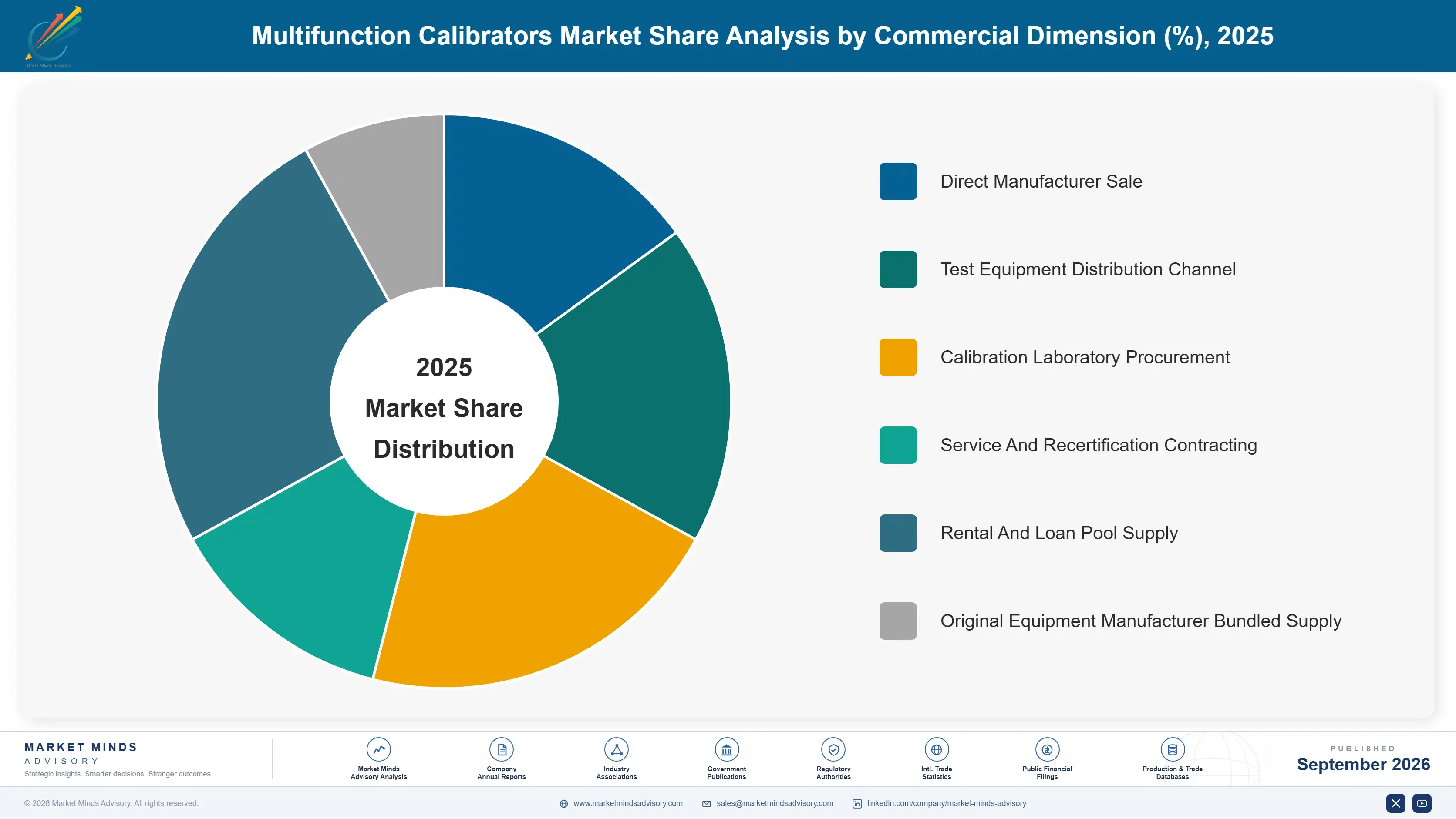
By Commercial Dimension

  • Direct Manufacturer Sale
  • Test Equipment Distribution Channel
  • Calibration Laboratory Procurement
  • Service And Recertification Contracting
  • Rental And Loan Pool Supply
  • Original Equipment Manufacturer Bundled Supply

By Region

  • North America
  • Western Europe
  • East Asia
  • South Asia and Pacific
  • Latin America
  • Middle East and Africa
  • Eastern Europe

Scope, Methodology, and Coverage

Every figure in this report is reproducible from documented input assumptions. The scope below maps the historical period, the forecast horizon, the segmentation dimensions, and the countries covered, alongside the underlying primary and qualitative methodology.
Historical Period
2020 to 2025
Forecast Period
2026 to 2036
Base Year
2025 (USD billions; MMA Primary Research Dataset, September 2026)
Market Definition
This report covers multifunction calibrators: portable and bench instruments generating and measuring multiple process signals to verify field instrumentation, spanning documenting calibrators with workflow integration, pressure and temperature calibrators, electrical and loop calibrators, multifunction process calibrators, calibration management software, and accredited calibration and recertification services. It excludes laboratory reference standards, single-function test meters, the instrumentation being calibrated, dimensional metrology equipment, and general electrical test instruments.
Quantitative Units
USD millions, calibrator and associated service revenue basis; instruments shipped; instrument service life in years; documentation-triggered share of purchases; technician retirement rates; recertification intervals in months; service share of category revenue.
Segmentation Dimensions
Instrument function and service class; end-use industry; commercial supply route; geography across seven regions.
Regions Covered
North America, Western Europe, East Asia, South Asia and Pacific, Latin America, Middle East and Africa, Eastern Europe
Countries Covered
China, Japan, South Korea, India, Singapore, Australia, Vietnam, Indonesia, Germany, Finland, Switzerland, United Kingdom, France, Italy, Poland, United States, Canada, Brazil, Saudi Arabia, South Africa.
Key Companies Profiled
Fluke, Beamex, AMETEK, Additel, WIKA, Yokogawa Electric, Time Electronics, Martel Electronics, Transmille, Meriam, Ralston Instruments, GE Druck, Kaye Instruments, Isotech, Nagman Instruments.
Quantitative Methodology
Primary survey, n=3,800 respondents, Q4 2025, six countries; demand-side model with trade association cross-validation
Qualitative Methodology
47 expert interviews, Q4 2025; applied to validate demand model assumptions, identify emerging dynamics, and assess competitive positioning
Report Format
PDF and XLSX data workbook (Word format preview document)
Publisher
Market Minds Advisory
Report Code
MMA-2026-CON-291
Published
September 2026
Contact
sales@marketmindsadvisory.com | www.marketmindsadvisory.com

Purchase the full Multifunction Calibrators Market Report (2026 to 2036).

This report sizes the global multifunction calibrators market from 2026 to 2036 across six instrument and service classes, six industries and seven regions. It explains why around 46% of purchases are triggered by documentation requirements rather than measurement condition, since instruments run around thirteen years and get recertified annually. Roughly 31% of calibration technicians retiring this decade is analysed as the workforce change shifting value toward instruments that encode procedure. Recertification services at around 38% of revenue are examined as the annuity holding customers between purchases. Regional analysis explains why East Asia holds 31% of shipments.
Six instrument and service classes sized to 2036
Documentation-triggered replacement quantified against instrument service life
Technician retirement analysed against procedural knowledge capture
Twenty named manufacturers assessed on calibrator revenue
Four revenue levers with quantified commercial impact
Anonymised pharmaceutical calibration engagement documented in full

Built For The People Who Decide

From boardroom strategy to bench-side execution, this report is read cover-to-cover by leaders shaping the next decade of their industry, turning demand scenarios, market dynamics and valuation benchmarks into decisions.
CXOs/ Presidents/ VPs/ Managers
M&A and Corporate Development
Strategy Teams and R&D Heads
Procurement and Product Directors
Regulatory and Compliance Leaders
Investor Relations and Equity Analysts