Market Minds Advisory
Multiflex Tubes Market

Multiflex Tubes Market: Barrier Layers, Squeeze Recovery and the Recyclability Deadline Nobody Is Ready For

A multilayer tube keeps toothpaste flavour intact for two years and cannot be recycled anywhere, and the brands that built their formats on it now have deadlines they cannot meet.

Lead Analyst

Bilal Shaikh

Published

September 2026

Make Smarter Decisions with Customized Research Insights

Request a free sample report and evaluate market opportunities, growth trends, and competitive dynamics relevant to your business needs.

2025 MARKET VALUE$4.2BMarket Size 2025
2036 FORECAST VALUE$8.5BBase Case , 2026 to 2036
CAGR 2026 TO 20366.6 %Bull 7.8% / Bear 5.4%
INCREMENTAL OPPORTUNITY$4.0BNet 10- year value creation
EXPANSION MULTIPLE1.90x2036 value over 2026 base
Strategic Levers
M&A Pipeline
Regional Outlook
Country Rankings
Competitive Intelligence
Segmental Deep-dive
Call-Us : 91 93563 13602

Executive Snapshot and Market Trajectory

A multilayer flexible tube is an engineering compromise that worked for fifty years. Layers of polyethylene around an EVOH or aluminium barrier give flavour retention, oxygen exclusion and the squeeze recovery consumers expect, and none of it survives a recycling sort. Penetration of recyclable construction sits at 23%.
Mono-material recyclable tubes compound at 9.9%, exactly 1.50 times the market, entirely on packaging waste rules rather than performance. East Asia holds 30% of demand on oral care and personal care manufacturing density. Resin runs near 54% of converter cost. Oral care is the largest volume and the least converted, because two year flavour retention is a requirement no mono-material design has matched. Barrier selection drives the rest.
Five converters hold 44%. Positions rest on brand qualification depth rather than on manufacturing, since a tube change touches filling line performance, decoration, shelf life and consumer squeeze behaviour all at once, which nobody undertakes casually. Regulation is the only thing opening those accounts. Brands have published commitments with dates attached, and those dates are when a decade-old supply position becomes contestable. Nobody begins a qualification they cannot finish before an announced deadline.
Market Definition
The market covers multilayer and monolayer extruded and laminate flexible tubes for consumer and industrial dispensing, spanning multilayer coextruded barrier tubes, aluminium barrier laminate tubes, mono-material recyclable tubes, monolayer polyethylene tubes, high-barrier pharmaceutical tubes, and post-consumer recycled content tubes. Rigid injection-moulded containers, aerosol cans, sachets and stick packs, and the closures fitted to tubes are excluded.
Base Year Value
$4.2B in 2025 (MMA Primary Research Dataset, August 2026)
Forecast Period
2026 to 2036, eleven discrete annual values
CAGR
6.6% base case. Bull 7.8%. Bear 5.4%.
Fastest Growth Segment
Mono-Material Recyclable Tubes: 9.9% CAGR
Fastest Growth Country
India: 9.4% CAGR
Fastest Growth Region
South Asia and Pacific: 8.8% CAGR
Largest Region
East Asia: 30% of 2025 global value
Market Leaders
Essel Propack, Albéa, Berry Global, Hoffmann Neopac, CCL Industries. Source: MMA Analysis based on company annual reports.
Primary Survey
n=3,800 procurement and R&D decision-makers, Q4 2025, six countries
Methodology
Demand-side build-up, cross-validated against public data, 47 expert interviews

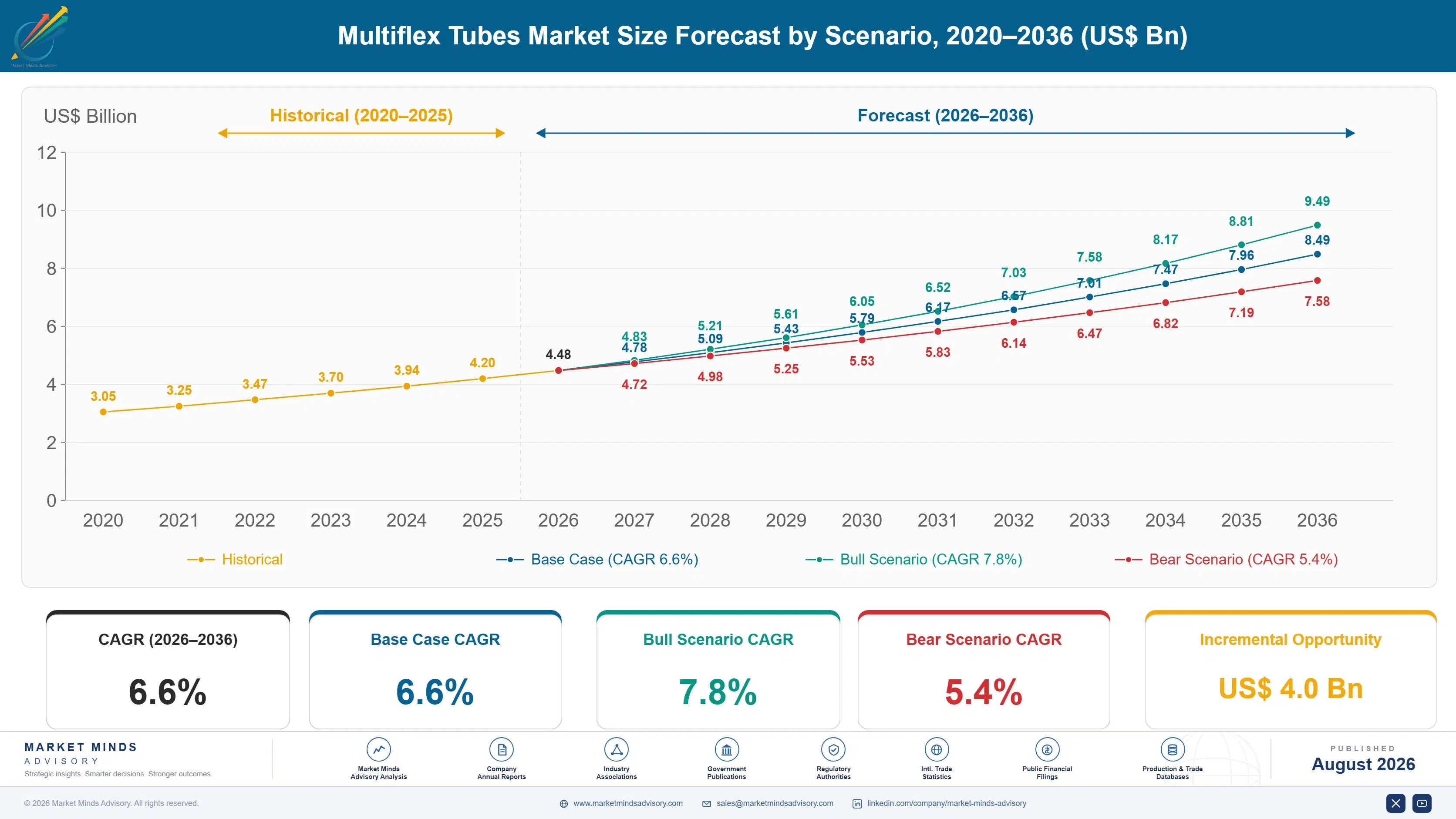
Multiflex Tubes Market Forecast Scenarios

multiflex-tubes-market-size-forecast-scenario-1787308602653
Growth ran at an implied 5.3% across 2020 to 2025, and personal care rather than oral care drove the difference. Skincare, haircare and cosmetic tube formats expanded quickly as brands moved away from jars and bottles, while oral care volumes grew broadly with population. Resin pricing swung hard mid-period and converters recovered it slowly. Mono-material conversion began late in the period and remains concentrated in personal care.
The base case at 6.6% rests on three mechanisms. Personal care format migration toward tubes continues as brands seek dispensing control and reduced product waste. Packaging waste regulation keeps forcing mono-material redesign across every developed market. And pharmaceutical and medical dispensing volumes keep growing, which carries the highest barrier requirements and the best margin in the category. Mono-material construction compounds at 9.9% against a market at 6.6%, and pharmaceutical tubes take further share.
The bull case at 7.8% assumes mono-material barrier performance closes enough of the gap for oral care conversion to begin at scale, which would move very large volumes quickly. The bear case at 5.4% follows from refill and concentrate formats displacing tubes in personal care, alongside regulatory deadlines slipping in the markets currently setting the pace.

Fifty Years of Layers Coming Undone

The multilayer tube solved a hard problem elegantly. Polyethylene gives the squeeze and recovery a consumer expects, an EVOH or aluminium layer stops oxygen and holds flavour for the 24 months an oral care product needs, and adhesive tie layers hold the whole thing together. Every one of those materials does a job the others cannot. Remove any one of them and the tube stops doing its job entirely.
TOP FIVE CONCENTRATION44%Combined share held by the five largest tube converters globally
RESIN COST SHARE54% of COGSPolymer and barrier material as a proportion of converter cost
ORAL CARE SHELF LIFE24 monthsFlavour and active retention period the barrier must deliver
MONO-MATERIAL PENETRATION23%Share of volume currently in recyclable single-polymer construction
FILLING LINE SPEED220 tubes per minuteThroughput that tube ovality and stiffness must support reliably
DECORATION COST SHARE18% of tube costPrinting and finishing as a proportion of delivered unit cost
That construction is also why the tube fails a recycling sort. Mixed polymers with a barrier layer cannot be processed in any mainstream stream, and packaging waste rules across Europe and several United States states now attach real cost to that. Mono-material designs compound at 9.9% and hold 23% of volume, mostly in personal care where barrier demands are gentler.
Oral care is the harder problem and the larger volume. Flavour retention over two years is a genuinely demanding barrier requirement, and single-polymer structures with coating or high-barrier grades have not fully closed it. Converters who solve it will move very large volumes quickly, because the brands involved have public commitments and no current answer to them. Fee exposure accrues every month they wait.
"Everybody in personal care has a recyclable tube now. Ask the same question about a toothpaste tube that has to hold mint flavour for two years and the room goes quiet."
Director, Dispensing and Flexible Tube Packaging Practice · MMA Rigid and Semi-R

Market Trends

Packaging Waste Rules Force Mono-Material Tube Redesign

Extended producer responsibility fees and recyclability requirements across Europe and several United States states put real cost onto multilayer tubes that no recycling stream can process. Brands with public commitments cannot wait for the technology to mature, so conversion is running ahead of what barrier performance alone would justify. Mono-material tubes compound at 9.9% against a market at 6.6%, and penetration sits at 23%, concentrated in personal care where the shelf life demands are considerably gentler than oral care imposes. Brands with 2027 and 2028 commitments have no time left to wait for barrier development to mature on its own.
Market Impact: Shelf life demands reaching 24 mont
Personal Care Formats Migrate From Jars to Tubes

Skincare, haircare and colour cosmetic brands keep moving product out of jars and bottles into tubes, because a tube dispenses controllably, protects contents from repeated finger contact and leaves far less product behind at the end. Consumers also read the format as more hygienic. That migration adds volume independently of category growth, and it brings decoration expectations from the beauty aisle with it, where print quality accounts for around 18% of delivered tube cost. Tube volumes in prestige beauty are small against oral care and carry several times the unit value, which changes what a converter should optimise for entirely.
Market Impact: Lines running 220 tubes minute

Market Opportunities and Growth Drivers

Pharmaceutical Dispensing Demands the Highest Barrier Grade

Topical pharmaceutical and medical device dispensing requires barrier performance well beyond consumer standards, with regulated stability data behind every claim and change control governing any modification to the pack. That combination produces the best margins in the category and the most durable positions, since requalifying a pharmaceutical tube involves regulatory filings rather than a purchasing decision. Converters holding pharmaceutical qualifications supply work that consumer-focused competitors cannot quote at all, whatever their manufacturing capability. Aluminium barrier laminate remains common here because its performance is documented and proven, and recyclability pressure has reached the segment far more slowly than consumer categories.
Market Impact: Barrier shortfall over 24 months

Brand Qualification Depth Locks In Incumbent Converters

Changing a tube supplier touches filling line performance at 220 tubes a minute, decoration matching against existing artwork, shelf life validation and the squeeze behaviour consumers have learned. Brands change reluctantly and only when something forces it. That protects incumbents strongly, and it means regulatory redesign is the one moment a competitor can realistically enter. Converters who anticipate those moments arrive with qualified structures while everyone else arrives with a development timeline nobody can accept. Nothing else opens the account, and the window closes as soon as the incumbent qualifies its own alternative structure.
Market Impact: Refill taking 4% of volume

Market Restraints and Challenges

Mono-Material Barrier Falls Short for Oral Care Volumes

Single-polymer structures have not matched multilayer flavour retention across the 24 months an oral care product requires, which keeps the largest volume category out of reach. The root cause is that one polymer must now provide barrier, squeeze and recovery simultaneously. Converters mitigate with high-barrier polyethylene grades, silicon oxide coating and thicker walls, each of which trades cost, clarity or squeeze feel. None fully closes the gap yet, and brands with public commitments are running out of time. Penetration sits at 23% and almost none of it is oral care.
Market Impact: Penetration currently at 23% volume

Refill and Concentrate Formats Bypass the Tube Entirely

Some personal care and oral care brands are moving to refill pouches, tablets and concentrates that remove the tube from the format completely rather than making it recyclable. The root cause is that a smaller pack is an easier sustainability story than a redesigned one. Converters mitigate by supplying refill-compatible tube systems, by pointing to consumer resistance beyond early adopters, and by competing on the product protection that concentrate formats genuinely sacrifice. Consumer resistance beyond early adopters has limited the format to roughly 4% of personal care volume so far, though the brands pushing it are large enough to matter.
Market Impact: Decoration at 18% of cost
3 additional market trends, 4 additional growth drivers, and 2 additional restraints and challenges are covered in the full report. Contact sales@marketmindsadvisory.com to access the complete intelligence.

Segment CAGR and Growth Architecture

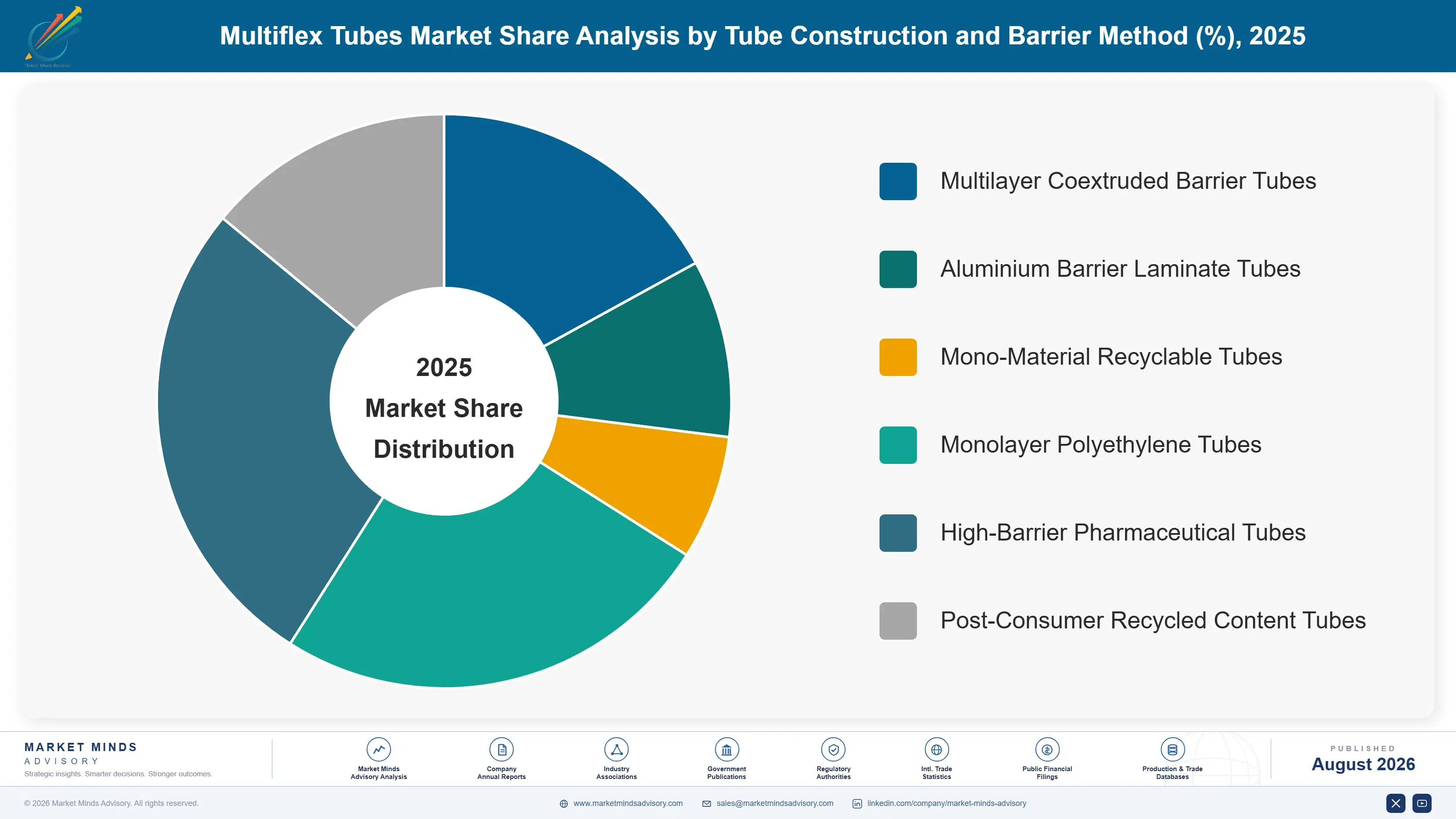
Segmentation follows tube construction and barrier method, because those together decide shelf life achievable, recyclability claim available and squeeze behaviour delivered. A brand choosing between multilayer and mono-material construction is trading proven barrier performance against a regulatory position it may have already committed to publicly. Six construction classes sit here, separated by barrier method rather than end use.
multiflex-tubes-market-market-share-analysis-1787308603181

Mono-Material Recyclable Tubes

Mono-material tubes compound at 9.9%, exactly 1.50 times the market, driven by packaging waste fees and brand commitments rather than by any performance gain. Single-polymer polyethylene construction enters existing recycling streams where multilayer laminates cannot, which is the whole argument. What gets traded away is barrier: one polymer must deliver oxygen exclusion, squeeze and recovery together, and high-barrier grades or coatings partly close the gap at added cost. Penetration sits at 23%, concentrated in personal care where shelf life demands are gentler. Oral care remains largely unconverted because two year flavour retention is a considerably harder requirement, and the converter who solves it will move very large volumes in a short time.
CAGR 9.9%

High-Barrier Pharmaceutical Tubes

Pharmaceutical tubes grow at 8.4% on topical drug and medical device dispensing volumes, and they carry the best margin in the category. Barrier requirements exceed consumer standards substantially, with regulated stability data supporting every shelf life claim and change control governing any modification. That regulatory framing is what makes the positions durable: requalifying a pharmaceutical tube means filings rather than a purchase decision, so brands change supplier almost never. Aluminium barrier laminate remains common here because its performance is proven and documented, and recyclability pressure has reached this segment far more slowly than consumer categories. Converters without pharmaceutical qualification cannot quote the work regardless of their manufacturing capability. That gate is worth more than any manufacturing advantage.
CAGR 8.4%
Full segment breakdown across 6 segments available in the complete report.

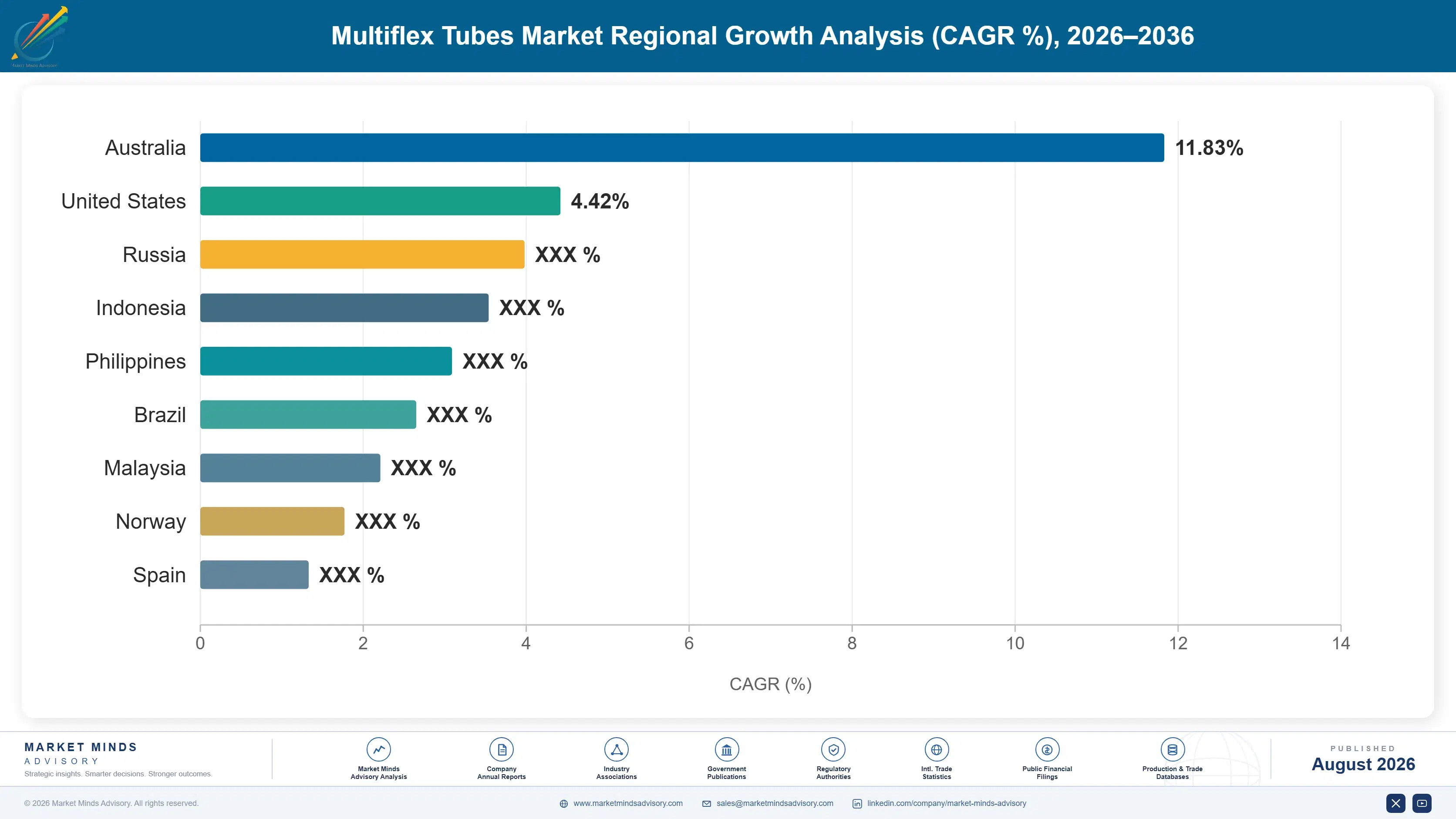
Regional Architecture and Country Demand Map

Demand follows personal care, oral care and pharmaceutical manufacturing density rather than consumption, since tubes are filled where products are made. Regulatory pressure then determines how fast each region converts to mono-material construction. East Asia leads on filling capacity and Western Europe on conversion pace.

East Asia

East Asia takes 30% of global demand, growing at 7.6%. Chinese personal care and oral care manufacturing is the largest concentration of tube filling capacity anywhere, serving both a vast domestic market and export production for international brands. Japanese and Korean cosmetic manufacturing drives demanding decoration and tube quality specifications, with Korean skincare formats in particular pushing tube design well beyond functional dispensing. Domestic converting capacity is extensive and technically capable on standard multilayer work. Mono-material conversion here lags Europe considerably, since domestic packaging waste rules have not yet attached the same cost to multilayer construction. Export production for international brands carries Western specifications, which pulls some regional capability upward ahead of local requirements.
Share: 30% | CAGR: 7.6% (2026 to 2036)

South Asia and Pacific

Fastest of the seven regions at 8.8%, with India compounding at 9.4%, South Asia and Pacific holds 12% of demand. Indian oral care and personal care manufacturing volumes are very large and growing, and the country also hosts substantial tube converting capacity that exports across Asia, Africa and the Middle East. Domestic brand proliferation in skincare and haircare adds format demand continuously. Australian manufacturing is small and specification-driven. Southeast Asian personal care production across Indonesia, Vietnam and Thailand is expanding as regional brands scale and international brands localise production. Indian converters compete internationally on cost and increasingly on capability, exporting tubes into markets where local converting never developed at scale.
Share: 12% | CAGR: 8.8% (2026 to 2036)
Regional intelligence for 5 additional markets available in the complete report: North America, Western Europe, Latin America, Middle East and Africa, Eastern Europe. Contact sales@marketmindsadvisory.com.
multiflex-tubes-market-country-cagr-analysis-1787308603706

Arriving Before the Deadline Bites

Tube accounts change hands rarely, because requalification touches filling lines, decoration, shelf life and consumer behaviour together. Every position worth holding here is about being ready when regulation forces a change. Four qualify, and the largest of them is still technically unsolved. The other three are about qualification, timing and reaching a buyer who is not packaging procurement at all.

Solve Oral Care Barrier in Single-Polymer Construction

Two year flavour retention is the requirement that keeps the largest tube volume in the world locked into multilayer construction, and no mono-material design has fully matched it. High-barrier polyethylene grades, silicon oxide coating and wall thickness each close part of the gap while trading cost, clarity or squeeze feel. Mono-material penetration is 23% and almost none of it is oral care. The converter who solves this reliably will move enormous volumes quickly, because the brands involved have public commitments and no current answer. Every month of delay is fee exposure the brand is already paying.
Market Impact: Mono-material penetration still onl

Hold Pharmaceutical Qualification as a Category Gate

Topical pharmaceutical tubes require regulated stability data and change control, which means requalification involves filings rather than a purchase order and brands effectively never switch. Pharmaceutical tubes grow at 8.4% and carry the best margin in the category. Converters holding those qualifications quote work that consumer-focused competitors cannot approach whatever their manufacturing capability, and the qualification itself takes years to build rather than being purchasable when the opportunity appears. Pharmaceutical tubes compound at 8.4%, and the qualification takes years rather than months to establish. Aluminium barrier laminate remains common here, since recyclability pressure arrived slowly.
Market Impact: Pharmaceutical tubes now compoundin

Map Brand Commitment Dates and Approach Early

Brands have published recyclable packaging commitments with dates attached, and those dates are the only moments when a tube account realistically opens. Converters who track commitment dates across brand owners and arrive twelve to eighteen months ahead with a qualified structure enter accounts that price never would. Filling lines running at 220 tubes a minute make late approaches worthless, since nobody starts a qualification they cannot finish before the deadline they have already announced publicly. Tracking those dates across target brand owners is the only realistic opening. Waiting for a tender means arriving after the incumbent has already qualified.
Market Impact: Filling lines running 220 tubes in

Compete on Decoration Where Beauty Brands Buy

Prestige personal care buys tubes on appearance as much as function, and decoration accounts for roughly 18% of delivered tube cost, which is where converters can differentiate without touching barrier construction. Print quality, finish effects and shape capability reach brand marketing rather than packaging procurement. That conversation carries no requalification burden at all, which makes it the fastest available route into an account whose barrier structure is not yet due for change. Shape capability and finish effects matter more here than barrier data ever will, and the account can then be extended into barrier work once the relationship exists.
Market Impact: Decoration at 18% of the delivered

Who Controls the Margin Pool

Five converters hold 44% measured on flexible tube revenue, the basis used throughout this section. Essel Propack and Albéa lead from different bases, the first on oral care volume and Asian manufacturing footprint, the second on personal care decoration and European regulatory positioning. The gap to the challenger group is narrow on standard multilayer and wide on both pharmaceutical and mono-material work.
Competition runs on three dimensions. Barrier construction capability decides who can serve oral care and pharmaceutical volumes. Decoration quality decides prestige personal care participation. And regulatory readiness decides who is standing there with a qualified mono-material structure when a brand commitment date arrives. None of the three is decided on manufacturing cost.

Two pressures are moving position. Mono-material conversion opens accounts that have not moved in a decade, which favours whoever qualified early. Meanwhile refill and concentrate formats threaten to remove the tube entirely from part of personal care. Rankings will shift toward converters holding barrier development capability alongside genuine decoration depth. Supplying the refill system is a better position than losing the format outright, and several converters have started developing it as a hedge rather than as a growth business in its own right.
multiflex-tubes-market-company-positioning-matrix-1787308604224

Competitive Moat and Risk Dimensions

ESSEL PROPACK

Moat: Oral care volume and footprint

Essel Propack supplies a very large share of global oral care tube volume from manufacturing sited close to the filling operations it serves across Asia, Europe and the Americas. Oral care is the largest application and the hardest to convert, and holding those relationships through the transition puts the company in front of the biggest volumes.
ESSEL PROPACK

Risk: Prestige decoration capability depth

Personal care and prestige beauty buy substantially on appearance, and decoration runs near 18% of delivered tube cost. Converters built around high-volume oral care efficiency compete at a disadvantage against those whose finishing capability was developed for beauty, particularly as personal care format migration continues to add volume.
ALBÉA

Moat: Personal care decoration breadth

Albéa developed deep finishing, shaping and print capability serving prestige beauty and personal care, which is where format migration from jars and bottles is adding volume fastest. That capability reaches brand marketing rather than packaging procurement, and it opens accounts without requiring any barrier requalification at all.
ALBÉA

Risk: Oral care barrier volume exposure

Oral care is the largest volume pool and the last to convert to mono-material, which means the eventual solution will move enormous business quickly. A converter positioned primarily in personal care participates less in that shift than one already supplying the oral care brands who must make it.

Players Tracked

Prominent Players

Essel Propack
Albéa
Berry Global
Hoffmann Neopac
CCL Industries

Other Key Players

Amcor
Huhtamaki
Montebello Packaging
Alltub Group
Linhardt
Tubex Group
Perfektup Ambalaj
IntraPac International
Unette Corporation
Antilla Propack
Kyodo Printing
Takemoto Packaging
Shanghai Jinhui Packaging
Sinicline Tube
Pirlo Group

Recent Developments

FEBRUARY 2025

Packaging fee schedules penalise multilayer tube construction directly

European and United States state producer responsibility programmes published fee structures that price non-recyclable multilayer tubes well above mono-material alternatives. These were regulatory implementation steps rather than commercial developments, and they set the conversion timetable brands must now work to. Brands began budgeting the fee gap rather than disputing it.
Signal: A published fee gap turns recyclable redes
JUNE 2025

Oral care mono-material trials fall short on flavour retention

Trials of single-polymer oral care tubes reported flavour and active retention below the 24 month requirement, keeping the largest volume category on multilayer construction. This reflects material testing rather than any transaction between the converters conducting it. Development shifted toward coatings and high-barrier grades. Plain single-polymer construction was set aside.
Signal: The largest tube volume in the world remai
OCTOBER 2025

Refill and concentrate formats expand in personal care ranges

Several personal care brands extended refill pouch and concentrate tablet ranges that remove the tube from the format rather than making it recyclable. This reflects brand format strategy rather than development among the converters supplying them. Several responded with refill-compatible systems instead. Consumer uptake remains limited outside early adopters.
Signal: A smaller pack is an easier sustainability

Polymer, Barrier Layers and Print

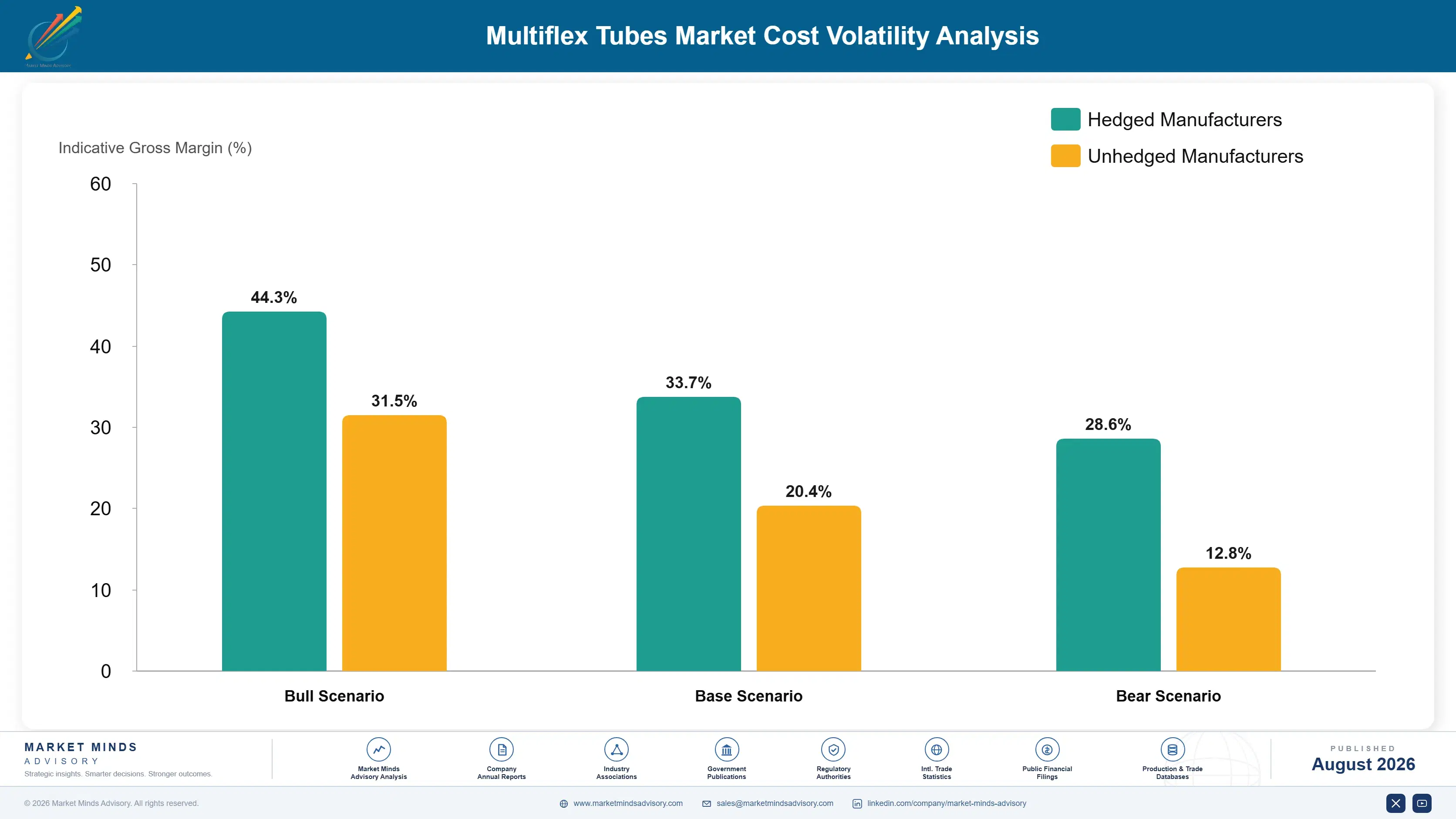
Polymer and barrier material account for roughly 54% of converter cost of goods, with EVOH and aluminium barrier layers carrying costs several times the polyethylene surrounding them. Decoration, inks and finishing add around 18% of delivered tube cost and rather more in prestige beauty work. Extrusion and forming energy, tooling amortisation and converting labour make up most of the remainder across a typical converter.
Polyethylene and EVOH pricing moved sharply through 2021 and 2022, and tube converters recovered it slowly because brand contracts reprice annually while polymer moves monthly. Company annual reports across the packaging groups disclose the resulting converting margin compression. Energy Information Administration data on petrochemical feedstock pricing documents the underlying movement, and European converters carried additional energy cost on extrusion through the same period. Aluminium moved on metal markets entirely separately.

Exposure divides by construction mix and by contract terms. Converters weighted toward aluminium barrier laminate carry metal price exposure that behaves quite differently from polymer. Those on annual fixed pricing fund every upward cycle until renewal. Mono-material work carries less barrier exposure and more high-barrier grade exposure, which moves on its own specialty supply dynamics rather than with commodity resin.
multiflex-tubes-market-cost-volatility-analysis-1787308604418

Separate barrier material indexation from commodity polymer

EVOH, aluminium and high-barrier polyethylene grades move on their own supply dynamics rather than tracking commodity polyethylene, so a contract indexed to general resin references misses most of the actual exposure. Indexing the barrier component separately, reset quarterly, matches pass-through to the cost that genuinely moves and brands accept the logic readily. General indexation misses most of it.

Amortise decoration tooling across committed volume terms

Prestige beauty decoration requires tooling and setup that converters frequently absorb to win the account, then fail to recover when the brand reformats after two seasons. Tying tooling amortisation to a committed volume term, rather than treating it as a cost of sale, protects margin on exactly the work that carries the best pricing in the category.

Price mono-material qualification learning into conversion projects

Scrap and line efficiency on recyclable structures run worse than multilayer through the qualification period as barrier and forming behaviour are characterised. Pricing that learning curve into conversion projects, rather than absorbing it to secure the change, protects margin on the fastest-growing part of the portfolio and brands accept it when the reason is explained.

Portfolio Architecture for Margin Defence

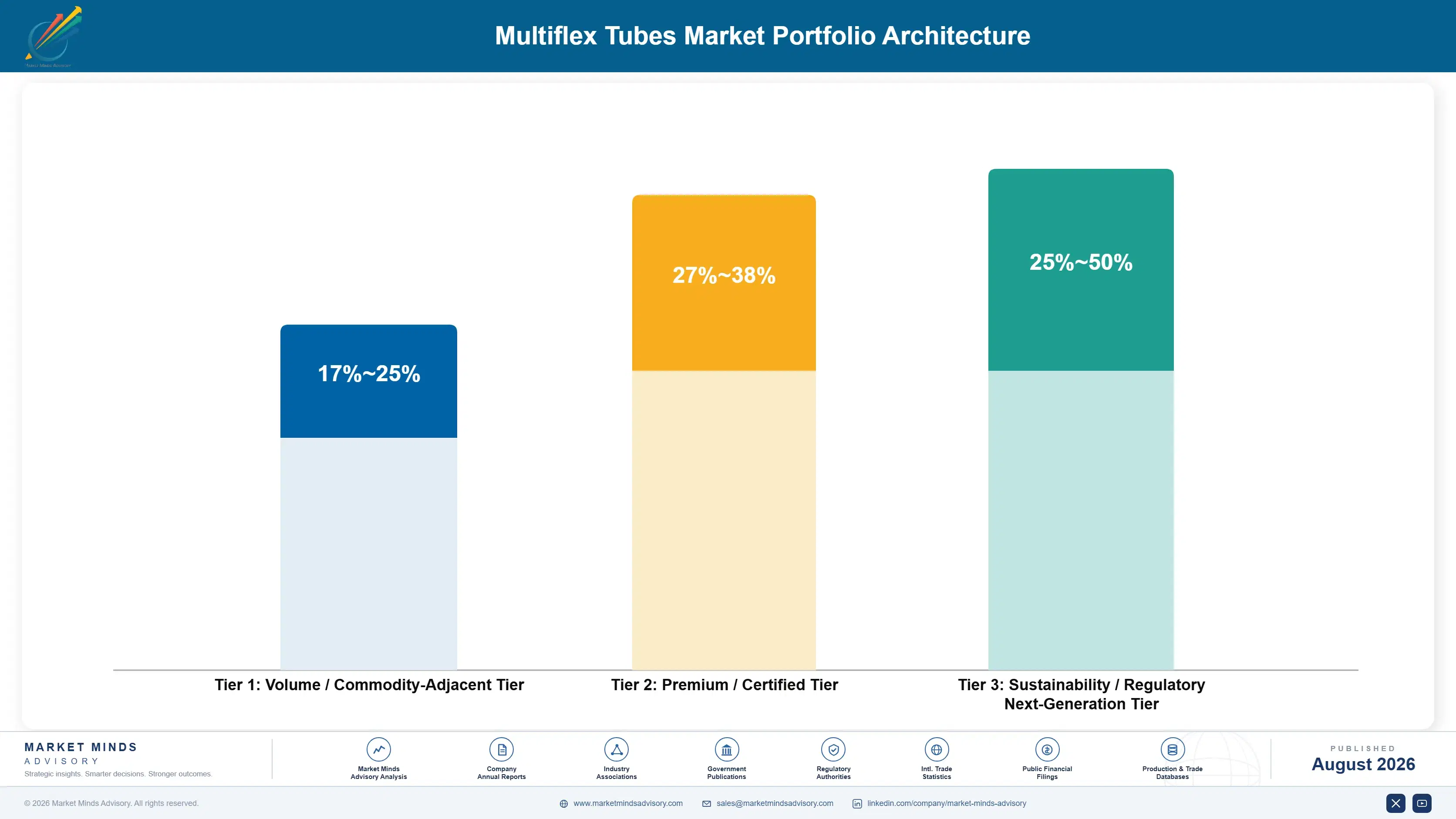
The portfolio separates on barrier requirement and on who is looking at the tube. Monolayer polyethylene tubes for low-barrier products are straightforward extrusion. Multilayer coextruded and aluminium laminate tubes carry the barrier work. Mono-material construction adds development difficulty against a regulatory clock. Pharmaceutical tubes add a qualification regime that sits outside packaging entirely.
The tension is between what regulation demands and what performance permits. Mono-material is where the growth and the fee relief sit, and it does not yet deliver oral care barrier. Multilayer performs and is being priced out deliberately. Converters cannot pick one, and the ones betting entirely on either side are exposed to a timeline nobody controls. Running both, and being honest about which products can convert today, is the position that holds.

High-value pools concentrate where the technical barrier is real. Pharmaceutical qualification, oral care mono-material development and prestige decoration capability all qualify, and none of them is decided on price per thousand tubes. What they share is a buyer who cannot switch quickly and a requirement that manufacturing scale alone does not satisfy. Price per thousand decides none of them.

Volume / Commodity-Adjacent Tier

Monolayer polyethylene tubes for low-barrier personal care and household products. Sold on price per thousand against basic dimensional and squeeze specifications that any established tube extruder can satisfy without difficulty.
Gross Margin: 17-25%

Premium / Certified Tier

Multilayer coextruded barrier tubes, aluminium barrier laminate and prestige decorated personal care formats. Barrier performance and finishing quality qualify the supplier, and brand requalification cost keeps incumbents in place for years.
Gross Margin: 27-38%

Sustainability / Regulatory / Next-Generation Tier

Mono-material recyclable construction, post-consumer recycled content tubes and high-barrier pharmaceutical formats. The wide margin range separates proven qualified structures from development work still carrying the full weight of its own learning cost.
Gross Margin: 25-50%
multiflex-tubes-market-portfolio-architecture-1787308604921

High-value Sub-segments and Strategic Watch-out

Mono-Material Recyclable Tubes

Compounding at 9.9% on packaging fees rather than performance, with penetration at 23% and concentrated almost entirely in personal care. Oral care barrier remains unsolved, and whoever closes it first will move very large volumes quickly. Fee exposure rather than technology is what sets the timetable here.
Gross Margin: 26-44%

High-Barrier Pharmaceutical Tubes

Growing at 8.4% with the best margin in the category and the most durable positions, since requalification means regulatory filings rather than purchase decisions. Recyclability pressure has reached this segment far more slowly than consumer categories. Qualification takes years to build and cannot be purchased when needed.
Gross Margin: 34-50%

Monolayer Polyethylene Tubes

The volume core at 4.1%, sold on price for low-barrier personal care and household products. Any established extruder supplies it, differentiation is minimal, and it exists mainly to carry extrusion utilisation across a converter. Price is realistically the only variable anybody involved ever discusses at all.
Gross Margin: 17-25%

Refill-Compatible Tube Systems

The strategic watch-out and the hedge together. Refill and concentrate formats threaten to remove the tube outright from part of personal care, and supplying the refill system is better than losing the format entirely. It is a hedge rather than a growth business in its own right.
Gross Margin: 22-40%

Filled Continuously Until Something Breaks

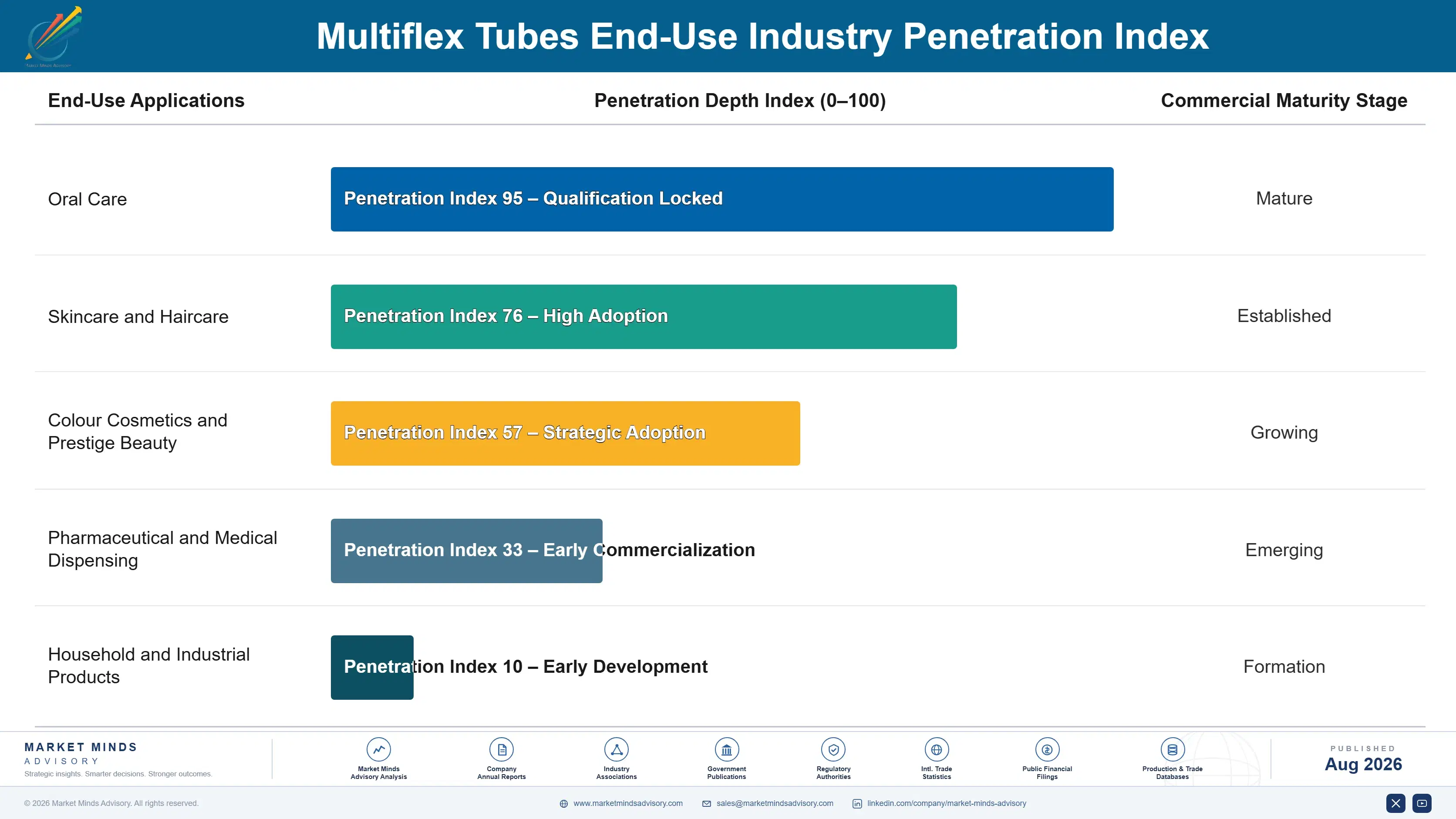
Demand is production-linked annuity revenue. A qualified tube runs on a filling line against the brand's manufacturing schedule and reorders without commercial process, which makes volumes predictable and incumbency valuable. The converter holds dimensional data, decoration files, shelf life validation and line performance history that a competitor would need a full qualification cycle to reproduce, on lines running 220 tubes a minute that nobody wants to stop. Incumbency here is worth more than
Depth varies by barrier demand and by decoration intensity. Oral care brands buy the largest volumes on the tightest barrier specifications. Prestige beauty buys smaller volumes at far higher unit value with demanding finishing. Pharmaceutical buys modest volumes at the best margin under regulatory change control. Household and mass personal care buys high volume on price with minimal barrier requirement.

The deciding population has widened. Tube specification sat with packaging engineering, judged on barrier and line performance. Packaging fee schedules brought sustainability and regulatory functions into it, and prestige format migration brought brand marketing in from the other direction, so a converter now has three conversations where it once had one. Each of those three groups weighs the decision differently.
multiflex-tubes-market-end-use-penetration-index-1787308605406

Where Tube Converters Win

These are among the four positions where our research anticipates prominent divergence between winners and laggards over the coming forecast period. Each is grounded in the demand model, the regulatory perimeter, and the announced capacity pipeline.
01 / ORAL CARE BARRIER DEVELOPMENT

The biggest volume in the category is still unsolved

Two year flavour and active retention keeps oral care locked into multilayer construction, and no mono-material design has fully matched it despite high-barrier grades, coatings and thicker walls. Penetration sits at 23% with almost none of it in oral care. The converter who closes that gap reliably will move enormous volumes in a short period, because the brands involved have public commitments and currently have no answer at all, and the fee exposure is accruing against them every month they wait.
02 / PHARMACEUTICAL QUALIFICATION GATE

Regulatory filings make switching practically impossible

Topical pharmaceutical tubes require regulated stability data and formal change control, so requalifying means filings rather than a purchase decision and brands effectively never move. That segment grows at 8.4% and carries the best margin available anywhere in the category. The qualification takes years to build and cannot be bought when an opportunity appears, which makes it the most durable commercial position available to any converter working here, and recyclability pressure has reached the segment far more slowly than consumer categories.
03 / COMMITMENT DATE MAPPING

Accounts open on published dates and close quickly

Brands have announced recyclable packaging commitments with dates attached, and those dates are the only realistic moments a tube account opens after a decade of stability. Converters tracking commitment dates and arriving twelve to eighteen months early with a qualified structure enter accounts price never would. Filling lines at 220 tubes a minute make late approaches worthless, since nobody begins a qualification they cannot finish in time, so the approach has to precede the deadline by more than a year to matter.
04 / DECORATION ROUTE ACCESS

Print quality opens the door barrier requalification keeps shut

Prestige personal care buys substantially on appearance, and decoration runs near 18% of delivered tube cost, which lets a converter differentiate without touching barrier construction at all. That conversation reaches brand marketing rather than packaging procurement, and it carries no requalification burden whatsoever for either side. It is by some distance the fastest available route into an account whose barrier structure is not yet due for any change, and the relationship can be extended into barrier work once it exists.

Engagement Snapshot From the Field

A live engagement with an industry participant carrying material or product regulatory and market exposure ahead of a defining policy shift, showing how our research translates into a defensible multi-year portfolio strategy.
MARKET MINDS ADVISORY · CLIENT ENGAGEMENT SUMMARY
Multiflex Tubes Producer Strategic Portfolio Review and Transition Roadmap 2026·Investment Scenario on Multiflex Tubes Exposure Evaluation 2025-26
CLIENT PROFILE
A haircare and skincare producer supplying retail across eleven European markets, filling roughly 180 million tubes annually across two owned plants and three contract fillers, with about EUR 940 million in revenue (client-reported, unverified by MMA). The full tube range used multilayer coextruded construction qualified between 2014 and 2020. No mono-material structure had been qualified anywhere in the range.
STRATEGIC CHALLENGE
The business had published a recyclable packaging commitment with a 2027 date and had made no material progress against it. Producer responsibility fees on multilayer construction were already rising, and an initial mono-material trial had failed on line efficiency, which had stalled the programme entirely for over a year. Nobody had revisited the trial design.
MMA APPROACH
MMA assessed the failed trial against filling line parameters at all five filling sites, then tested candidate mono-material structures for barrier, forming and line performance by product category. Shelf life requirements were reviewed product by product rather than applied uniformly across the entire range. Fee exposure at published rates was projected across the unconverted range to 2027.
KEY FINDINGS
  1. The failed trial had applied a single candidate structure across the whole range, including products whose shelf life requirements were far below what the structure was designed to satisfy at all.
  2. Shelf life requirements varied enormously across the portfolio, and 61% of volume needed barrier performance a mono-material structure could already deliver comfortably today.
  3. Line efficiency losses were concentrated at two contract fillers whose forming equipment was older, rather than being a property of the mono-material tube itself.
  4. Producer responsibility fee exposure on the unconverted range was projected to exceed EUR 4.2 million annually by 2027 at published rates (client-reported, unverified by MMA).
CLIENT PROFILE
A haircare and skincare producer supplying retail across eleven European markets, filling roughly 180 million tubes annually across two owned plants and three contract fillers, with about EUR 940 million in revenue (client-reported, unverified by MMA). The full tube range used multilayer coextruded construction qualified between 2014 and 2020. No mono-material structure had been qualified anywhere in the range.
STRATEGIC CHALLENGE
The business had published a recyclable packaging commitment with a 2027 date and had made no material progress against it. Producer responsibility fees on multilayer construction were already rising, and an initial mono-material trial had failed on line efficiency, which had stalled the programme entirely for over a year. Nobody had revisited the trial design.
MMA APPROACH
MMA assessed the failed trial against filling line parameters at all five filling sites, then tested candidate mono-material structures for barrier, forming and line performance by product category. Shelf life requirements were reviewed product by product rather than applied uniformly across the entire range. Fee exposure at published rates was projected across the unconverted range to 2027.
KEY FINDINGS
  1. The failed trial had applied a single candidate structure across the whole range, including products whose shelf life requirements were far below what the structure was designed to satisfy at all.
  2. Shelf life requirements varied enormously across the portfolio, and 61% of volume needed barrier performance a mono-material structure could already deliver comfortably today.
  3. Line efficiency losses were concentrated at two contract fillers whose forming equipment was older, rather than being a property of the mono-material tube itself.
  4. Producer responsibility fee exposure on the unconverted range was projected to exceed EUR 4.2 million annually by 2027 at published rates (client-reported, unverified by MMA).
RECOMMENDED STRATEGY
Phase 1: Phase 1 (months 1 to 5): Convert the 61% of volume whose barrier requirements the qualified mono-material structure already satisfies without modification. Phase 2: Phase 2 (months 5 to 14): Upgrade forming equipment at the two limiting contract fillers and extend conversion to their volume. Phase 3: Phase 3 (months 14 to 24): Develop a higher-barrier mono-material structure for the remaining products with longer shelf life claims.
OUTCOME
Fifty-eight percent of tube volume was running mono-material construction within ten months (client-reported, unverified by MMA). Projected producer responsibility fee exposure fell by approximately EUR 2.6 million annually, and line efficiency on converted products settled within 2% of the multilayer baseline (client-reported, unverified by MMA). Barrier requirements are now assessed per product rather than applied uniformly across the range.

Frequently Asked Questions

Foundational context covering the market sizes, CAGR, scope, country, region and competition that inform every finding below. This section is provided to cover basics and most often pre-purchase conversations, answered from the MMA Primary Research Dataset.

What is the current size of the Multiflex Tubes Market?

The global market was worth USD 4.2 billion in 2025, reaching USD 4.48 billion in 2026. East Asia holds the largest regional share at 30% of demand.

How large will the Multiflex Tubes Market be by 2036?

MMA forecasts USD 8.49 billion by 2036, an expansion multiple of 1.90 times the 2026 base. That represents roughly USD 4.01 billion of incremental value.

What is the CAGR for the Multiflex Tubes Market 2026 to 2036?

The base case compounds at 6.6% annually, with a bull case of 7.8% and a bear case of 5.4%. Historical growth from 2020 to 2025 ran at 5.3%.

Which segment is growing fastest?

Mono-material recyclable tubes compound at 9.9%, exactly 1.50 times the market rate. Packaging waste fee schedules rather than barrier performance drive that entire growth rate.

Who are the major companies in the Multiflex Tubes Market?

Essel Propack, Albéa, Berry Global, Hoffmann Neopac and CCL Industries hold a combined 44% of the market. Brand qualification depth rather than manufacturing scale sustains those positions.

Which country is growing fastest?

India compounds at 9.4%, ahead of every other national market. Large oral care and personal care manufacturing volumes plus export converting capacity together drive that.

Report Segmentation Architecture

The full report scope spans multiple orthogonal segmentation dimensions, with cross-tabulated demand data provided for each dimension pair. Coverage extends further to regional breakdowns, trend trajectories, and the competitive detail needed to support segment-level decision-making.

By Tube Construction and Barrier Method

  • Multilayer Coextruded Barrier Tubes
  • Aluminium Barrier Laminate Tubes
  • Mono-Material Recyclable Tubes
  • Monolayer Polyethylene Tubes
  • High-Barrier Pharmaceutical Tubes
  • Post-Consumer Recycled Content Tubes

By End-Use Industry

  • Oral Care
  • Skincare and Haircare
  • Colour Cosmetics and Prestige Beauty
  • Pharmaceutical and Medical Dispensing
  • Household and Industrial Products

By Commercial Dimension

  • Direct Supply to Brand Owners
  • Contract Filler and Co-Packer Channel
  • Private Label Retail Programmes
  • Distributor Channel for Smaller Brands

By Region

  • North America
  • Western Europe
  • East Asia
  • South Asia and Pacific
  • Latin America
  • Middle East and Africa
  • Eastern Europe

Scope, Methodology, and Coverage

Every figure in this report is reproducible from documented input assumptions. The scope below maps the historical period, the forecast horizon, the segmentation dimensions, and the countries covered, alongside the underlying primary and qualitative methodology.
Historical Period
2020 to 2025
Forecast Period
2026 to 2036
Base Year
2025 (USD billions; MMA Primary Research Dataset, August 2026)
Market Definition
The market covers multilayer and monolayer extruded and laminate flexible tubes used for consumer and industrial dispensing, spanning multilayer coextruded barrier tubes, aluminium barrier laminate tubes, mono-material recyclable tubes, monolayer polyethylene tubes, high-barrier pharmaceutical tubes, and post-consumer recycled content tubes, together with the decoration and finishing supplied on them. Rigid injection-moulded and blow-moulded containers, aerosol cans, sachets and stick packs, collapsible metal tubes, and the caps and closures fitted to tubes are excluded. Sizing is measured at converter revenue in current prices.
Quantitative Units
USD billions (current prices); tube units, barrier performance and shelf life in months where applicable
Segmentation Dimensions
By Tube Construction and Barrier Method; By End-Use Industry; By Commercial Dimension; By Region
Regions Covered
North America, Western Europe, East Asia, South Asia and Pacific, Latin America, Middle East and Africa, Eastern Europe
Countries Covered
USA, China, India, Germany, France, UK, Japan, South Korea, Italy, Canada, Brazil, Mexico, Indonesia, Vietnam, Thailand, Australia, UAE, Saudi Arabia, Egypt, South Africa, Turkey, Poland, Netherlands, Spain, Switzerland, Sweden, Argentina, Colombia, Philippines, Czech Republic, and additional markets relevant to this sector
Key Companies Profiled
Essel Propack, Albéa, Berry Global, Hoffmann Neopac, CCL Industries, Amcor, Huhtamaki, Montebello Packaging, Alltub Group, Linhardt, Tubex Group, Perfektup Ambalaj, IntraPac International, Unette Corporation, Antilla Propack, Kyodo Printing, Takemoto Packaging, Shanghai Jinhui Packaging, Sinicline Tube, Pirlo Group
Quantitative Methodology
Primary survey, n=3,800 respondents, Q4 2025, six countries; demand-side model with trade association cross-validation
Qualitative Methodology
47 expert interviews, Q4 2025; applied to validate demand model assumptions, identify emerging dynamics, and assess competitive positioning
Report Format
PDF and XLSX data workbook (Word format preview document)
Publisher
Market Minds Advisory
Report Code
MMA-2026-PAC-857
Published
August 2026
Contact
sales@marketmindsadvisory.com | www.marketmindsadvisory.com

Purchase the full Multiflex Tubes Market Report (2026 to 2036).

The full report sizes flexible tubes across six construction classes, three commercial dimensions and seven regions, with annual forecasts to 2036 under base, bull and bear scenarios. Mono-material barrier performance is compared against category shelf life requirements product by product, which is where conversion programmes succeed or stall. Brand recyclable packaging commitment dates are mapped against converter qualification readiness. Producer responsibility fee exposure is modelled by construction and by market. Pharmaceutical qualification depth is assessed across the converter base, since that gate excludes most of the field regardless of manufacturing capability, and twenty converters are profiled on a consistent flexible tube revenue basis.
Mono-material barrier compared against category shelf life requirements
Brand commitment dates mapped against converter qualification readiness
Producer responsibility fee exposure modelled by construction and market
Filling line performance assessed across tube construction types
Decoration cost structures compared across prestige and mass segments
Refill format substitution risk quantified by personal care category

Built For The People Who Decide

From boardroom strategy to bench-side execution, this report is read cover-to-cover by leaders shaping the next decade of their industry, turning demand scenarios, market dynamics and valuation benchmarks into decisions.
CXOs/ Presidents/ VPs/ Managers
M&A and Corporate Development
Strategy Teams and R&D Heads
Procurement and Product Directors
Regulatory and Compliance Leaders
Investor Relations and Equity Analysts