Market Minds Advisory
Multi-Part Labels Market

Multi-Part Labels Market: Trends and Forecast 2026 to 2036

Pharmaceutical serialization mandates and extended drug information requirements are pushing manufacturers toward booklet and multi-ply compliance labels, even as e-commerce logistics operators drive parallel demand for tamper-evident shipping labels across high-volume distribution networks.

Lead Analyst

Bilal Shaikh

Published

September 2026

Make Smarter Decisions with Customized Research Insights

Request a free sample report and evaluate market opportunities, growth trends, and competitive dynamics relevant to your business needs.

2025 MARKET VALUE$3.2BMarket Size 2025
2036 FORECAST VALUE$6.0BBase Case , 2026 to 2036
CAGR 2026 TO 20365.8 %Bull 7.0% / Bear 4.6%
INCREMENTAL OPPORTUNITY$2.6BNet 10- year value creation
EXPANSION MULTIPLE1.76x2036 value over 2026 base
Strategic Levers
M&A Pipeline
Regional Outlook
Country Rankings
Competitive Intelligence
Segmental Deep-dive
Call-Us : 91 93563 13602

Executive Snapshot and Market Trajectory

Multi-part label demand is shifting toward pharmaceutical compliance formats as extended drug information regulations require booklet and multi-ply labels carrying more content than single-panel labels can accommodate, reshaping converter specification standards and formal testing protocols across regulated healthcare packaging supply chains worldwide today and increasingly.
Commercial pressure now concentrates on regulatory compliance capability, since pharmaceutical manufacturers increasingly specify converters holding proven booklet label folding and content management expertise over general label printers. Pharmaceutical compliance labels are the fastest-growing format, driven by extended content requirements spreading across major drug markets facing serialization and patient information mandates. North America and Western Europe together account for the largest share of global demand, reflecting concentrated pharmaceutical manufacturing and e-commerce logistics infrastructure across both regions.
Competitive intensity concentrates among a handful of specialty converters holding pharmaceutical-grade printing certification and booklet label folding capability, leaving general logistics label supply more fragmented across regional converters nationwide and internationally. Tamper-evidence and serialization integration add further complexity, since switching label converters mid-programme requires extensive validation testing that pharmaceutical manufacturers avoid absent a compelling cost or capability justification for making the change across their packaging lines.
Market Definition
The Multi-Part Labels Market covers booklet, piggyback, coupon, and multi-ply pressure-sensitive labels combining two or more layers or panels for extended content, tamper evidence, or repositionable applications. It excludes single-panel labels, standard shipping labels without multi-ply construction, and folded package inserts not affixed as a label.
Base Year Value
$3.2B in 2025 (MMA Primary Research Dataset, August 2026)
Forecast Period
2026 to 2036, eleven discrete annual values
CAGR
5.8% base case. Bull 7.0%. Bear 4.6%.
Fastest Growth Segment
Pharmaceutical Compliance Labels: 8.5% CAGR
Fastest Growth Country
India: 9.5% CAGR
Fastest Growth Region
South Asia and Pacific: 8.0% CAGR
Largest Region
North America: 30% of 2025 global value
Market Leaders
Leading participants include CCL Industries, Multi-Color Corporation, Schreiner Group, Fedrigoni, and WS Packaging Group. Source: MMA Primary Research Dataset, July 2026.
Primary Survey
n=3,800 procurement and R&D decision-makers, Q4 2025, six countries
Methodology
Demand-side build-up, cross-validated against public data, 47 expert interviews

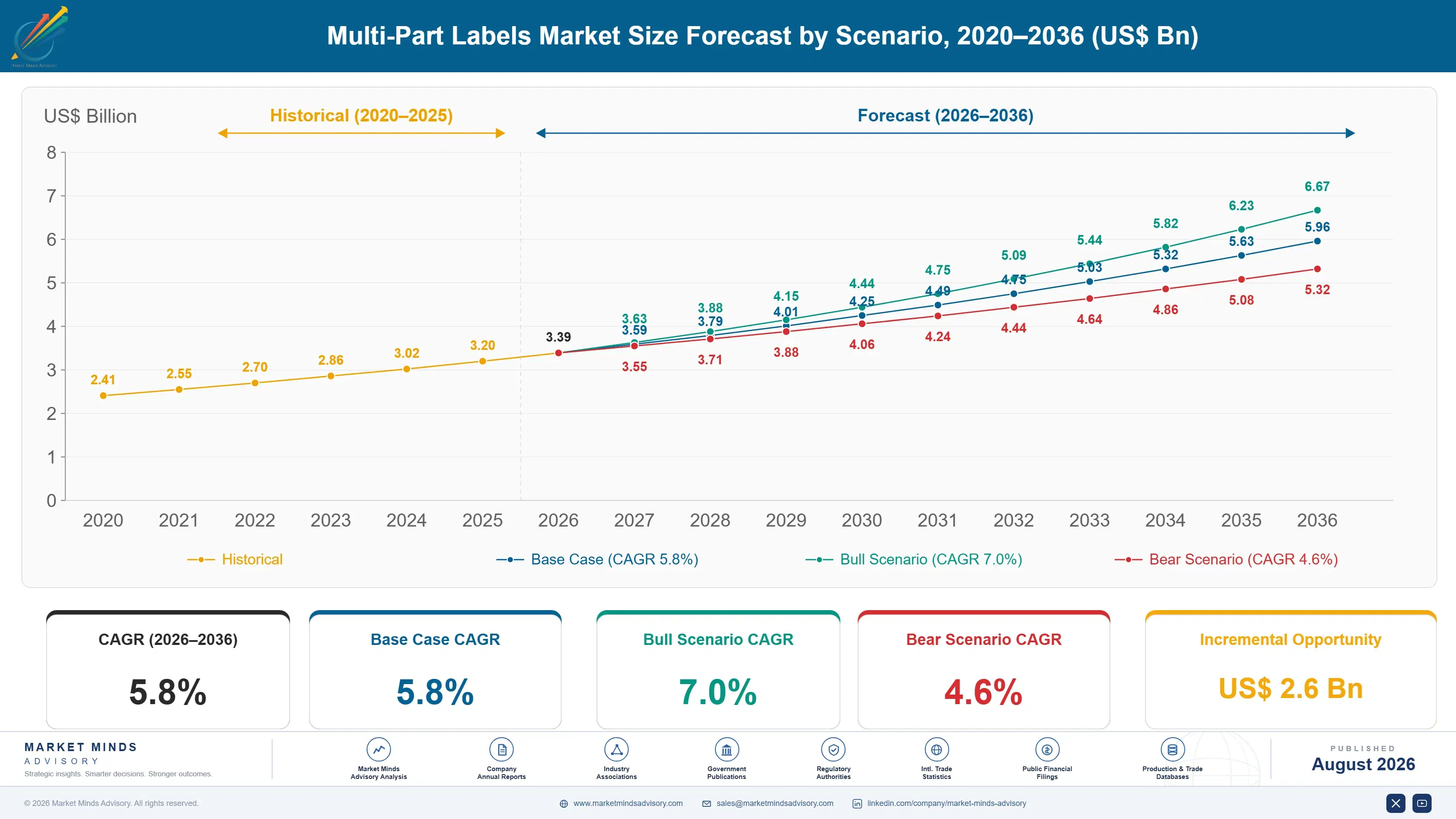
Multi-Part Labels Market Forecast Scenarios

multi-part-labels-market-size-forecast-scenario-1787555014570
Between 2020 and 2025 the market grew at an estimated 5.0% annual pace, held back by pandemic-related pharmaceutical manufacturing disruptions and delayed regulatory implementation timelines for extended content labeling requirements in several major drug markets. Standard piggyback and coupon labels dominated the period, since pharmaceutical serialization mandates in some jurisdictions faced enforcement delays that slowed booklet label adoption.
The base case assumes 5.8% annual growth to 2036, driven by three mechanisms: pharmaceutical serialization and extended patient information mandates expanding across additional national drug markets requiring booklet label formats, e-commerce logistics volume growth driving tamper-evident shipping label demand, and generic drug manufacturers in emerging markets adopting compliance labeling to access regulated export markets. Standard label formats retain their cost advantage for non-regulated consumer products, but their share of total multi-part label spending is declining as compliance-driven formats expand.
The bull case centers on additional national drug markets adopting extended patient information mandates faster than currently scheduled, pushing growth toward 7.0%. The bear risk is regulatory implementation delays in major pharmaceutical markets postponing booklet label mandate enforcement, which would slow conversion from standard to compliance label formats, holding growth closer to 4.6% through the forecast window.

Compliance Content Reshapes Label Converting Demand

The Multi-Part Labels Market sits at the intersection of packaging engineering and regulatory compliance, where label construction follows content volume and tamper-evidence requirements more than raw production volume alone. Pharmaceutical manufacturers and e-commerce logistics operators together represent the largest buyer categories, each imposing increasingly specific structural and content requirements on converters and their suppliers.
MARKET CONCENTRATION40%Share held by five largest label converters combined
AVERAGE SELLING PRICE$0.08 per unitTypical cost manufacturers pay per compliance label unit
TOP PRODUCING COUNTRY26%Current share of global output from the United States
CAPACITY UTILIZATION73%Average operating rate across booklet label production lines
FEEDSTOCK COST SHARE44%Portion of production cost from paper and film inputs
CONTENT CAPACITYUp to 20 panelsTypical maximum page count for extended booklet labels
Standard piggyback and coupon labels remain the workhorse formats for consumer promotions and general logistics, prized for lower unit cost and simpler converting processes across high-volume applications worldwide today. Booklet compliance labels carry a meaningful cost premium, yet pharmaceutical manufacturers facing extended patient information mandates are specifying these formats fast enough that converters are investing in specialized folding and content management equipment ahead of confirmed long-term volume commitments from major drug manufacturers.
Converter concentration remains moderate, with a handful of specialty label producers holding pharmaceutical-grade printing certification that smaller regional converters cannot easily replicate at comparable cost or quality. Capacity utilization runs tighter in booklet label production lines than in standard label converting, reflecting the lag between installed compliance-grade capacity and accelerating pharmaceutical serialization demand across major regulated drug markets globally.
"A booklet label sounds like a small packaging detail until you realize regulators are effectively mandating a folded pamphlet stuck to every package, and most converters weren't built to fold anything."
Senior Analyst, Packaging and Labeling Practice · MMA Packaging Practice · August 2026

Market Trends

Booklet Label Adoption Accelerates Across Extended Content Mandates

Pharmaceutical manufacturers are converting from standard single-panel labels to booklet formats capable of carrying twenty or more content panels as regulators in additional national markets adopt extended patient information requirements similar to those already established in the European Union and United States. Converters report booklet label orders tied to new drug launches growing meaningfully faster than orders tied to established products still using standard labels under grandfathered rules. The shift is concentrated among large pharmaceutical manufacturers with the capital to requalify packaging lines, while smaller generic manufacturers continue running standard labels until deadlines force conversion, creating a two-speed adoption pattern.
Market Impact: Serialization rules add 16% demand

Tamper-Evident Shipping Labels Expand With E-Commerce Growth

E-commerce logistics operators are increasingly specifying tamper-evident multi-part shipping labels that provide visual proof of package integrity throughout the delivery chain, driven by rising parcel theft concerns and retailer liability exposure for damaged or tampered shipments. These labels combine a visible outer layer with a hidden verification layer that reveals evidence of removal, commanding a meaningful price premium over standard shipping labels that logistics operators increasingly accept given loss prevention value. Adoption is concentrated among high-value electronics and luxury goods shippers, while lower-value commodity shipments continue using standard labels lacking tamper evidence.
Market Impact: E-commerce adds 9% label volume

Market Opportunities and Growth Drivers

Pharmaceutical Serialization Mandates Drive Compliance Label Demand

Regulatory serialization requirements under frameworks including the US Drug Supply Chain Security Act and the European Union Falsified Medicines Directive require pharmaceutical manufacturers to include unique identifiers and extended safety information on drug packaging, directly increasing demand for booklet and multi-ply labels capable of carrying this expanded content alongside required regulatory text across multiple languages. Manufacturers unable to meet these labeling requirements face direct market access restrictions in regulated jurisdictions, pushing capital toward compliance label qualification faster than overall pharmaceutical production growth alone would otherwise justify across their global operations.
Market Impact: Conversion costs $2 to $4M

E-Commerce Parcel Volume Growth Sustains Shipping Label Demand

Global e-commerce parcel volume continues expanding as online retail penetration rises across both established and emerging consumer markets, and each shipped parcel requires shipping labels increasingly incorporating tamper-evidence, tracking, and return authentication features beyond basic address information alone. This sustained volume growth gives multi-part shipping label converters multi-year demand visibility tied to both new e-commerce platform growth and existing retailer volume expansion across their logistics networks. Converters qualified to major logistics platform specifications command premium pricing over generic label suppliers, since integration testing discourages platforms from switching suppliers once qualified.
Market Impact: Fragmentation adds 15% cost

Market Restraints and Challenges

Booklet Label Conversion Costs Slow Smaller Manufacturer Adoption

Converting from standard single-panel labels to booklet formats requires specialized folding equipment and content management software that represents a substantial capital investment smaller pharmaceutical manufacturers and generic drug producers often struggle to justify given their lower production volumes relative to major branded drug manufacturers with greater scale. For manufacturers facing this cost barrier, delayed conversion risks losing market access in jurisdictions with approaching compliance deadlines, creating financial pressure that some manufacturers address by outsourcing packaging to contract manufacturers already holding booklet label capability rather than investing in equipment themselves directly.
Market Impact: Booklet labels gain 7 points share

Regulatory Fragmentation Across Markets Complicates Label Standardization

Pharmaceutical labeling requirements vary meaningfully across national jurisdictions in content format, language requirements, and physical construction specifications, forcing manufacturers selling into multiple markets to maintain distinct booklet label designs rather than a single standardized global format that would reduce converting complexity and cost substantially over time and expense. This fragmentation increases converter tooling and changeover costs for manufacturers serving multiple export markets simultaneously across their global supply chains. Industry associations are lobbying for greater international labeling harmonization, though progress remains slow given each jurisdiction's distinct regulatory sovereignty and patient safety priorities.
Market Impact: Tamper-evident label orders grow 12% annually
3 additional market trends, 4 additional growth drivers, and 2 additional restraints and challenges are covered in the full report. Contact sales@marketmindsadvisory.com to access the complete intelligence.

Segment CAGR and Growth Architecture

The market divides into six product-based segments spanning regulatory and commercial applications across global packaging systems. Pharmaceutical compliance labels and logistics shipping labels serve regulation-driven and volume-driven premium demand, while piggyback, two-part tamper-evident, coupon and promotional, and industrial multi-part labels serve broader commercial packaging needs across diverse manufacturing and retail sectors worldwide and consistently.
multi-part-labels-market-market-share-analysis-1787555015109

Pharmaceutical Compliance Labels

Pharmaceutical compliance labels are converting fastest as extended patient information mandates in additional national drug markets require booklet formats carrying content volumes that standard single-panel labels cannot accommodate within available packaging space or surface area constraints today. These labels command a meaningful price premium over standard formats given the specialized folding equipment and pharmaceutical-grade printing certification required, yet increasingly appear as a market access requirement rather than an optional upgrade for manufacturers selling into regulated jurisdictions. Converter investment in booklet folding capacity has accelerated well ahead of confirmed volume commitments, reflecting expectations that additional national markets adopting extended content mandates will pull demand higher across the coming decade and beyond.
CAGR 8.5%

Logistics and Shipping Multi-Part Labels

Logistics and shipping multi-part labels are the second-fastest-growing segment, driven by e-commerce parcel volume growth and rising retailer specification of tamper-evident and tracking-integrated shipping formats beyond basic address labels across most major logistics networks worldwide today and increasingly consistently over time. These labels increasingly incorporate hidden verification layers that reveal evidence of tampering, commanding a meaningful price premium over standard shipping labels that logistics operators accept given loss prevention and liability reduction value across their fulfillment operations. Cost sensitivity limits tamper-evident label penetration into low-value commodity shipments, but high-value electronics and luxury goods shippers are increasingly specifying these formats as standard practice across their distribution networks and customer service protocols.
CAGR 7.5%
Full segment breakdown across 6 segments available in the complete report.

Regional Architecture and Country Demand Map

Regional demand tracks pharmaceutical regulatory stringency and e-commerce logistics infrastructure rather than population or income levels alone. North America and Western Europe lead on established pharmaceutical compliance mandates and mature e-commerce fulfillment networks, while East Asia's manufacturing scale and India's pharmaceutical export growth reshape where new converting capacity gets built.

North America

United States pharmaceutical manufacturers drive the largest share of regional demand, converting to booklet compliance labels under Drug Supply Chain Security Act serialization requirements while simultaneously supporting the world's largest e-commerce logistics network requiring tamper-evident shipping labels across nationwide fulfillment centers. Canada's pharmaceutical manufacturing sector, though smaller than its southern neighbor, follows similar regulatory compliance timelines given close regulatory harmonization with US requirements and standards. Mexico's growing pharmaceutical manufacturing and e-commerce fulfillment sector contributes secondary regional demand tied to nearshoring investment trends and cross-border supply chain integration. Converter capacity investment in booklet folding equipment is concentrated domestically given the scale of the US regulated pharmaceutical market and its logistics infrastructure.
Share: 30% | CAGR: 5.5% (2026 to 2036)

Western Europe

Germany and France's substantial pharmaceutical manufacturing base anchors Western European demand, with European Union Falsified Medicines Directive requirements driving booklet label conversion across multiple national drug markets simultaneously under harmonized regulatory standards and enforcement timelines across the entire bloc. The Netherlands and Belgium serve as major pharmaceutical distribution and packaging hubs given their central European logistics infrastructure and port access to broader continental markets and customers. The United Kingdom's substantial e-commerce sector drives meaningful tamper-evident shipping label demand alongside its independent pharmaceutical regulatory framework following its departure from European Union harmonized rules. Converter consolidation has proceeded further here than in most other regions given mature market dynamics and competitive pressure.
Share: 24% | CAGR: 4.3% (2026 to 2036)
Regional intelligence for 5 additional markets available in the complete report: East Asia, South Asia and Pacific, Latin America, Middle East and Africa, Eastern Europe. Contact sales@marketmindsadvisory.com.
multi-part-labels-market-country-cagr-analysis-1787555015638

Where Converters Can Capture Compliance Margin

Converters face a widening gap between standard label pricing and the folding equipment, content management, and regulatory validation capabilities that pharmaceutical and e-commerce customers now demand. Four levers stand out for capturing margin above baseline label converting economics: booklet folding capability, tamper-evident engineering, regulatory validation services, and direct pharmaceutical manufacturer contract structuring across supply chains.

Booklet Folding and Content Management Capability

Converters holding specialized booklet folding equipment and content management software can charge a premium averaging 22 to 30% above standard single-panel labels, since pharmaceutical manufacturers value proven folding accuracy and content placement precision over unit cost alone. Building this capability requires meaningful capital investment in specialized folding machinery, typically twelve to eighteen months to install and validate, but converters who achieve it capture disproportionate share of new drug launch business. Generic label converters lacking folding capability increasingly compete only on price for standard applications, ceding the highest-margin compliance business entirely to specialized converters.
Market Impact: Folding capability adds 22 to 30% pricing power

Tamper-Evident Layer Engineering for Shipping Applications

Converters offering tamper-evident shipping label chemistry that combines visible and hidden verification layers can capture a premium averaging 15 to 22% above standard shipping labels, since e-commerce logistics operators increasingly require documented package integrity evidence for high-value shipments across their delivery networks. This capability requires meaningful research investment in adhesive and layer chemistry, but converters who build it gain access to a growing customer base among electronics and luxury goods shippers largely inaccessible to conventional label suppliers lacking this expertise. Competitors without tamper-evident capability are effectively excluded from this expanding segment entirely.
Market Impact: Tamper-evident engineering adds 15 to 22% pricing power

Regulatory Validation and Compliance Testing Services

Converters offering regulatory validation testing and documentation support alongside label supply capture an estimated 10 to 14% service fee on top of product pricing, since pharmaceutical manufacturers increasingly lack in-house regulatory affairs capacity to validate label compliance across multiple export markets independently and reliably and consistently. This bundled service model shortens customer market entry timelines meaningfully, creating a genuine competitive advantage for converters who invest in dedicated regulatory affairs staff and testing infrastructure on an ongoing basis. Deepening this relationship also raises switching costs substantially for manufacturers who have validated compliance.
Market Impact: Validation services add 10 to 14% total revenue

Direct Pharmaceutical Manufacturer Contract Structuring and Negotiation

Converters negotiating multi-year direct contracts with major pharmaceutical manufacturers, bypassing distributors entirely, can improve gross margin by roughly 6 to 10 percentage points by eliminating distributor markup while offering manufacturers price stability and firm supply continuity guarantees over the full multi-year contract term itself and quite consistently indeed. These direct arrangements typically require minimum volume commitments spanning two to four years, favoring larger converters with the balance sheet capacity to guarantee uninterrupted supply that smaller regional competitors cannot credibly match given more limited production capacity, working capital, and financial reserves.
Market Impact: Direct contracts improve margin by 6 to 10 points

Who Controls the Margin Pool

Concentration remains moderate: the top five converters hold 40% combined share on a revenue basis, evaluated consistently across producers regardless of whether they compete primarily in standard label formats or booklet compliance chemistry. CCL Industries leads on global scale and diversified label converting capability, followed by Schreiner Group, whose pharmaceutical and security label specialization gives it booklet folding expertise that general label converters cannot easily replicate.
Competitive activity currently centers on booklet folding capacity investment, as converters race to qualify equipment against tightening pharmaceutical serialization deadlines across additional national drug markets. Several mid-tier converters have announced new tamper-evident label production lines, while others are pursuing regulatory validation service partnerships instead, betting that compliance consulting will prove more durable than folding capacity alone as a differentiator.

Emerging pressure comes from Asian converters who have scaled standard label manufacturing capacity rapidly and are now underpricing Western competitors on general logistics applications. Rankings could shift meaningfully if pharmaceutical regulators standardize booklet label specifications around a smaller set of approved formats, since that would commoditize a capability several mid-tier converters currently treat as differentiated, accelerating consolidation among converters lacking sufficient folding scale.
multi-part-labels-market-company-positioning-matrix-1787555016178

Competitive Moat and Risk Dimensions

CCL INDUSTRIES

Moat: Diversified Global Converting Scale

CCL Industries operates the broadest label converting network globally, letting it serve multinational pharmaceutical and consumer product manufacturers from a single supplier relationship across multiple regions rather than requiring separate regional converters. This scale also gives CCL extensive negotiating leverage with paper and film feedstock suppliers, letting it maintain competitive pricing even as smaller converters absorb feedstock cost increases directly.
CCL INDUSTRIES

Risk: Slower Specialization in Niche Compliance

CCL's broad geographic and product portfolio can mean slower development of highly specialized booklet folding capability compared to focused competitors like Schreiner Group building deep pharmaceutical compliance expertise. Specialized competitors sometimes win pharmaceutical accounts based on demonstrated regulatory track record that CCL's more generalist positioning cannot always match on the most demanding compliance applications.
SCHREINER GROUP

Moat: Deep Pharmaceutical Compliance Expertise

Schreiner Group has built specialized booklet folding and pharmaceutical-grade printing expertise that lets it win regulated drug labeling business based on demonstrated regulatory track record rather than price alone, a capability generalist converters cannot easily replicate. This expertise creates genuine customer stickiness, since pharmaceutical manufacturers who have validated Schreiner's compliance capability face real switching costs in requalifying an alternative supplier.
SCHREINER GROUP

Risk: Limited Scale Outside Specialty Niche

Schreiner Group operates at meaningfully smaller scale than CCL Industries' diversified global operations, limiting its ability to compete on price for large-volume standard label contracts where scale economics matter more than compliance expertise. This scale disadvantage could widen if CCL continues expanding its own compliance label capability faster than Schreiner's more measured growth strategy.

Players Tracked

Prominent Players

CCL Industries
Multi-Color Corporation
Schreiner Group
Fedrigoni
WS Packaging Group

Other Key Players

Avery Dennison
UPM Raflatac
Herma GmbH
Skanem
Fuji Seal International
Brady Corporation
FLEXcon
Resource Label Group
Autajon Group
Faubel
Denny Bros
Inland Label and Marketing Services
Coveris
Constantia Flexibles
American Packaging Corporation

Recent Developments

JANUARY 2025

CCL Industries commissioned an expanded booklet label folding facility in Germany, adding dedicated capacity for pharmaceutical compliance formats meeting European Union Falsified Medicines Directive requirements. The expansion responds to rising qualification requests from multinational drug manufacturers converting from standard labels ahead of national implementation deadlines across additional member states.
Signal: Signals accelerating converter investment in compliance folding capacity ahead of confirmed regulatory enforcement across additional markets.
JULY 2025

Schreiner Group signed a multi-year supply agreement with a major global pharmaceutical manufacturer to provide booklet compliance labels across six national drug markets and multiple product lines, securing volume commitments that support continued regulatory validation investment through the manufacturer's ongoing product launch pipeline and expansion plans.
Signal: Confirms pharmaceutical manufacturers locking in compliance label supply well ahead of serialization deadlines across multiple national markets.
OCTOBER 2025

Multi-Color Corporation acquired a specialty tamper-evident label formulation business in the United States to strengthen its e-commerce logistics label capabilities across major fulfillment networks and distribution centers, extending its technical service model into a market where package integrity verification increasingly determines which supplier wins new contracts.
Signal: Shows converters diversifying beyond pharmaceutical compliance into e-commerce logistics label applications and adjacent customer segments broadly.

Paper and Film Feedstock Cost Exposure

Paper stock and polymer film account for roughly 44% of production cost across multi-part label formats, sourced primarily from pulp and paper mills in North America and Scandinavia and polymer film producers in Asia and the Middle East. Pharmaceutical-grade papers and films carry a higher cost share given the additional purity and traceability documentation required for regulated drug packaging applications.
Paper and pulp prices spiked notably during 2021 and 2022 as global supply chain disruption and pulp mill capacity constraints in North America limited paper stock availability, a volatility event documented in US Census Bureau paper industry reports. Converters without long-term paper supply contracts absorbed cost increases directly, while those holding fixed-price agreements passed through smaller increases to manufacturers, illustrating how contract structure shapes margin resilience during feedstock price shocks across the label converting supply chain.

Smaller regional converters lacking scale to negotiate favorable paper and film contracts face a real competitive disadvantage against integrated players like CCL Industries, who purchase feedstock at volumes commanding better pricing terms. This exposure varies by geography too: European converters face higher baseline energy costs embedded in paper manufacturing than competitors in North America benefiting from cheaper domestic pulp and energy inputs.
multi-part-labels-market-cost-volatility-analysis-1787555016378

Long-Term Paper Supply Contracts With Price Collars

Converters increasingly negotiate multi-year paper and film supply contracts with price collars that cap upside exposure during feedstock spikes while sharing some downside benefit with suppliers during periods of falling prices industry-wide. This reduces earnings volatility for converters lacking the balance sheet to absorb sudden cost increases without passing them through to manufacturers immediately.

Diversifying Paper and Film Sourcing Geographically

Several converters are qualifying secondary paper and polymer film suppliers outside their traditional sourcing base, including Southeast Asian and South American producers, to reduce dependence on any single region facing supply disruption or trade policy shifts over time. This diversification lowers single-source risk and improves negotiating position during periodic contract renewal cycles across multiple suppliers.

Vertical Integration Into Paper Converting Operations

Larger converters are pursuing vertical integration into paper coating and film lamination operations to secure feedstock supply and capture margin that independent buyers currently pay away to intermediaries and distributors each year consistently. This integration requires substantial capital investment but reduces exposure to spot market volatility that smaller feedstock-purchasing competitors cannot avoid as easily.

Portfolio Architecture for Margin Defence

Portfolio economics split sharply along a standard-versus-compliance axis across the industry. Standard piggyback and coupon labels compete almost entirely on unit cost, with gross margins compressed by paper price volatility and thin differentiation among regional converters. Booklet compliance and tamper-evident formats carry meaningfully higher margins, reflecting folding equipment investment, regulatory validation capability, and the qualification-required status these formats now hold among pharmaceutical and e-commerce customers.
The tension between standard and compliance formats is intensifying as pharmaceutical serialization mandates and e-commerce tamper-evidence requirements pull demand toward specialized formats faster than folding capacity can scale industry-wide across most converter networks. Converters over-indexed on standard labels face margin erosion as that segment shrinks toward a smaller, price-sensitive core, while those who invested early in booklet folding and tamper-evident engineering are capturing a disproportionate share of the industry's expanding premium revenue pool relative to overall production volume.

High-value margin pools concentrate in booklet compliance labels serving pharmaceutical manufacturers and tamper-evident formats serving high-value e-commerce shipments, where folding equipment barriers and qualification-required status limit competitive entry from smaller regional converters. A second, smaller pool sits in regulatory validation services serving pharmaceutical customers seeking compliance expertise that generic label converters cannot provide.

Standard piggyback and coupon labels sold primarily on unit cost to consumer and general logistics customers, where thin margins reflect limited differentiation and intense price competition among regional converters serving cost-sensitive accounts across most markets.
Gross Margin

Booklet compliance and tamper-evident formats commanding qualification-required status among pharmaceutical manufacturers and e-commerce logistics operators, where folding equipment investment and regulatory expertise support meaningfully higher margins than standard label alternatives.
Gross Margin

Emerging regulatory validation service partnerships and next-generation tamper-evident chemistry technologies still scaling commercially, commanding the highest margins as converters price in scarcity value ahead of broader industry-wide adoption and formal qualification.
Gross Margin
multi-part-labels-market-portfolio-architecture-1787555016887

High-value Sub-segments and Strategic Watch-out

Booklet Compliance Labels for Pharmaceutical Manufacturers

Booklet compliance labels serving pharmaceutical manufacturers combine the fastest segment growth with the highest margins in the portfolio, driven by qualification-required status limiting new entrant competition industry-wide. Converters holding early folding capability are best positioned to capture this expanding high-value pool fully and consistently over time.

Tamper-Evident Labels for High-Value E-Commerce

Tamper-evident shipping labels serving high-value electronics and luxury goods shippers combine strong growth with above-average margins tied to sustained adhesive and layer chemistry investment. This segment benefits from rising parcel theft concerns expanding faster than tamper-evident formulation capacity across most producing regions currently and consistently.

Standard Piggyback and Coupon Labels

Standard piggyback and coupon labels remain the volume core of the market, serving cost-sensitive consumer and general logistics customers not yet facing regulatory pressure to convert. Growth is slow and margins are thin, but the segment still represents the largest single share of total unit volume shipped across the industry.

Two-Part Industrial Multi-Part Labels

Two-part industrial multi-part labels serve a specialized niche within manufacturing and equipment identification applications, facing steady but modest demand growth tied to industrial production trends and cycles. Converters should monitor whether industrial label innovation keeps pace with the compliance chemistry advances driving broader market growth overall.

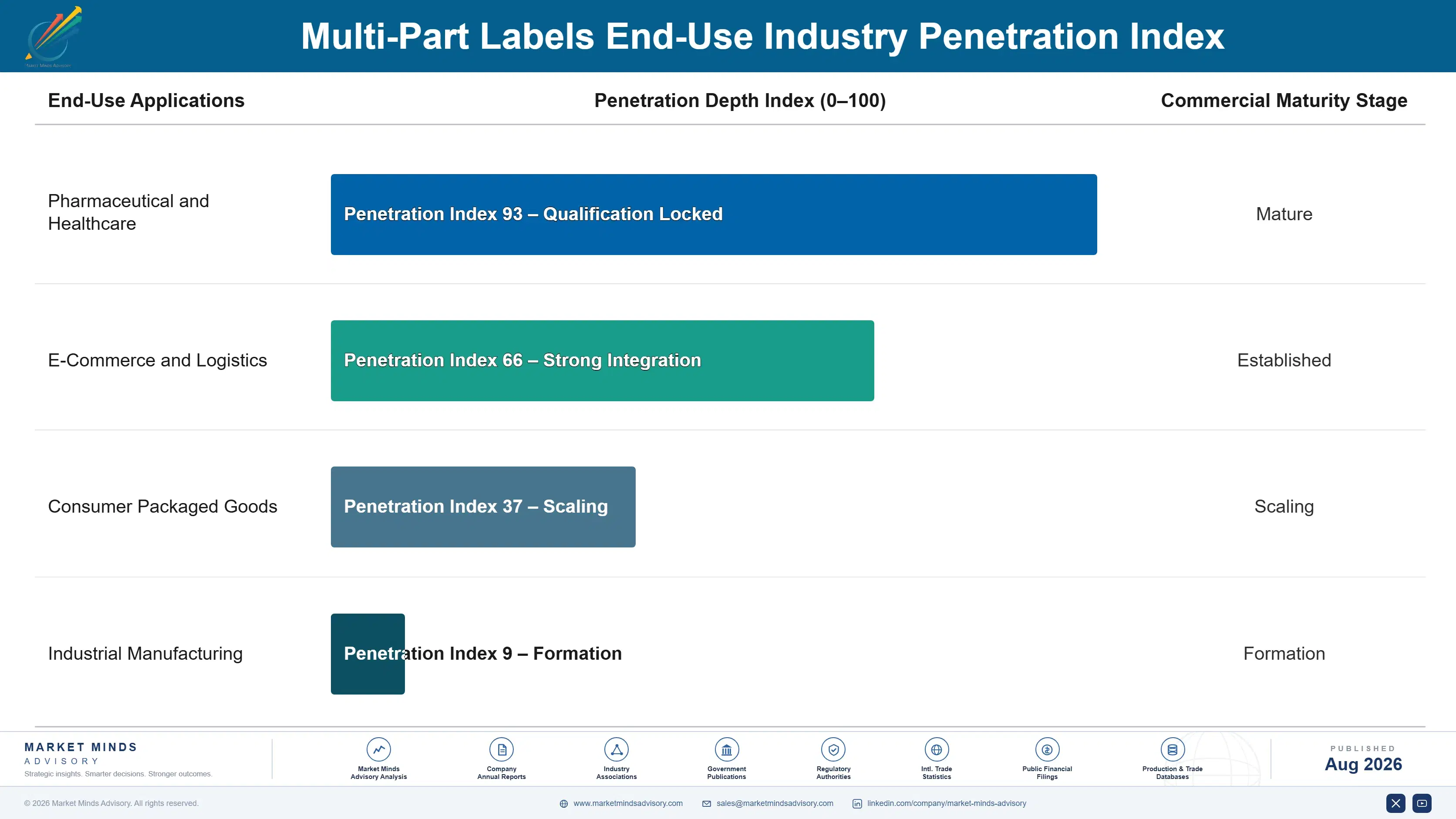
Recurring Demand Behind Compliance Contracts

Multi-part label demand behaves like an annuity for converters holding qualified supplier status with pharmaceutical manufacturers, since customers rarely requalify label suppliers once a booklet format is validated against specific regulatory content and folding specifications required by law. Multi-year supply agreements, once established, tend to persist through a drug product's entire market lifecycle, giving incumbent converters durable, recurring revenue streams across their qualified customer base.
Stickiness varies meaningfully by end-use vertical: pharmaceutical manufacturers rarely switch label converters mid-product-cycle given the extensive regulatory revalidation required, while e-commerce logistics operators switch more readily based on price and tamper-evident performance. Consumer product manufacturers sit between these extremes, valuing consistency but willing to test new converters when promotional coupon label campaigns require format changes across their broader marketing programmes.

Buyer profiles are shifting generationally as procurement decisions move from packaging managers focused purely on unit cost toward regulatory affairs officers weighing compliance validation alongside price. This generational shift favors converters who can speak credibly to folding accuracy and content management rather than cost alone, reshaping which sales relationships and technical capabilities matter most in winning and retaining large pharmaceutical accounts.
multi-part-labels-market-end-use-penetration-index-1787555017374

MMA Verdict on Converter Strategy

These are among the four positions where our research anticipates prominent divergence between winners and laggards over the coming forecast period. Each is grounded in the demand model, the regulatory perimeter, and the announced capacity pipeline.
01 / BOOKLET FOLDING INVESTMENT

Build Booklet Folding Capacity Before Deadlines Bind Manufacturers

Converters without booklet folding equipment are losing new drug launch business to competitors who invested early, not in some future compliance cycle several budget years away from today's regulatory reality. The premium folding-capable converters command, averaging 22 to 30% above standard labels, will only widen as additional national drug markets adopt extended content mandates through 2030 and beyond. Delaying folding equipment investment past 2027 risks permanent exclusion from the fastest-growing and highest-margin segment of the entire market for years to come.
02 / TAMPER-EVIDENT ENGINEERING PRIORITY

Build Tamper-Evident Capability Ahead of E-Commerce Growth

Converters without tamper-evident layer chemistry are ceding the high-value electronics and luxury goods shipping segment to competitors who invested in adhesive engineering ahead of confirmed e-commerce volume growth across major logistics platforms and retail partners. This capability commands a premium averaging 15 to 22% above standard shipping labels, rewarding converters who build tamper-evident capability ahead of rising parcel theft concerns and retailer liability exposure. Converters who invest now will capture volume that conventional shipping label suppliers cannot economically match going forward.
03 / REGULATORY VALIDATION EXPANSION

Deepen Regulatory Validation Services to Raise Switching Costs

Pharmaceutical manufacturers increasingly lack in-house regulatory affairs capacity to validate label compliance across multiple export markets independently, and converters who bundle validation services alongside label supply are capturing meaningful service fees while raising switching costs for existing customer accounts substantially. This capability gap is currently underexploited by all but the largest converters serving this fragmented and still-consolidating industry landscape today, leaving real margin on the table. Building dedicated regulatory affairs staff now positions converters ahead of competitors relying on customer-side validation.
04 / INDIAN MANUFACTURING PRIORITY

Deepen Presence in India Ahead of Generic Export Growth

India's pharmaceutical manufacturing and generic drug export sector represents the fastest-growing national market, and converters without meaningful regional presence are ceding share to competitors positioned closer to expanding generic manufacturing operations serving global export markets and regulatory bodies. Early movers securing folding capacity and customer relationships in India now will hold a durable cost and lead-time advantage over competitors entering once regional capacity consolidation is further along and better established across the country. This window will likely close within several years.

Engagement Snapshot From the Field

A live engagement with an industry participant carrying material or product regulatory and market exposure ahead of a defining policy shift, showing how our research translates into a defensible multi-year portfolio strategy.
MARKET MINDS ADVISORY · CLIENT ENGAGEMENT SUMMARY
Multi-Part Labels Producer Strategic Portfolio Review and Transition Roadmap 2026·Investment Scenario on Multi-Part Labels Exposure Evaluation 2025-26
CLIENT PROFILE
The client is a mid-size generic pharmaceutical manufacturer exporting products across twelve national markets from three manufacturing facilities, launching roughly 25 new generic drug products annually. Facing tightening extended patient information requirements in several export markets, the manufacturer's regulatory affairs team needed an independent assessment of booklet label converter options and cost impact ahead of a major export market expansion decision.
STRATEGIC CHALLENGE
The manufacturer faced a choice between continuing to use standard labels in markets without strict content mandates or converting to booklet compliance labels across all export markets to simplify its packaging operations and reduce regulatory risk. Internal regulatory and finance teams disagreed on timing, and the manufacturer lacked independent data comparing converter capabilities and true multi-market cost impact.
MMA APPROACH
MMA conducted converter capability benchmarking across five booklet label suppliers, modeled three-year cost scenarios under different export market expansion assumptions, and interviewed regulatory affairs officers at two comparable generic manufacturers regarding their own conversion experience. The engagement combined primary survey data with direct converter interviews to produce a conversion and supplier selection framework.
KEY FINDINGS
  1. Booklet compliance labels carried a 28% cost premium at the time of assessment, expected to narrow to roughly 18% within three years (client-reported, unverified by MMA).
  2. Two of five benchmarked converters already held folding qualification across all twelve of the client's target export markets, while three would require additional testing.
  3. Regulatory modeling showed a meaningful compliance gap emerging within twelve months if the client delayed conversion past its current export expansion decision timeline.
  4. Regulatory affairs officers at both interviewed comparable manufacturers indicated standardizing on booklet labels globally simplified packaging operations more than initially expected during transition.
CLIENT PROFILE
The client is a mid-size generic pharmaceutical manufacturer exporting products across twelve national markets from three manufacturing facilities, launching roughly 25 new generic drug products annually. Facing tightening extended patient information requirements in several export markets, the manufacturer's regulatory affairs team needed an independent assessment of booklet label converter options and cost impact ahead of a major export market expansion decision.
STRATEGIC CHALLENGE
The manufacturer faced a choice between continuing to use standard labels in markets without strict content mandates or converting to booklet compliance labels across all export markets to simplify its packaging operations and reduce regulatory risk. Internal regulatory and finance teams disagreed on timing, and the manufacturer lacked independent data comparing converter capabilities and true multi-market cost impact.
MMA APPROACH
MMA conducted converter capability benchmarking across five booklet label suppliers, modeled three-year cost scenarios under different export market expansion assumptions, and interviewed regulatory affairs officers at two comparable generic manufacturers regarding their own conversion experience. The engagement combined primary survey data with direct converter interviews to produce a conversion and supplier selection framework.
KEY FINDINGS
  1. Booklet compliance labels carried a 28% cost premium at the time of assessment, expected to narrow to roughly 18% within three years (client-reported, unverified by MMA).
  2. Two of five benchmarked converters already held folding qualification across all twelve of the client's target export markets, while three would require additional testing.
  3. Regulatory modeling showed a meaningful compliance gap emerging within twelve months if the client delayed conversion past its current export expansion decision timeline.
  4. Regulatory affairs officers at both interviewed comparable manufacturers indicated standardizing on booklet labels globally simplified packaging operations more than initially expected during transition.
RECOMMENDED STRATEGY
Phase 1: Phase one: convert 40% of export market packaging to booklet compliance labels within nine months, prioritizing markets with the nearest regulatory deadlines. Phase 2: Phase two: complete full conversion across remaining export markets within eighteen months, timed to align with the broader expansion initiative. Phase 3: Phase three: renegotiate booklet label supply contracts at twelve months to capture expected cost declines as converter capacity scales industry-wide.
OUTCOME
The client converted 100% of export market packaging to booklet compliance labels within fifteen months, ahead of its original expansion timeline, and reported a lower-than-expected 20% blended cost premium during the full transition period as converter competition intensified across all twelve target markets (client-reported, unverified by MMA).

Frequently Asked Questions

Foundational context covering the market sizes, CAGR, scope, country, region and competition that inform every finding below. This section is provided to cover basics and most often pre-purchase conversations, answered from the MMA Primary Research Dataset.

What is the current size of the Multi-Part Labels Market?

The Multi-Part Labels Market is valued at $3.2 billion in 2025. This figure reflects global demand across booklet, piggyback, tamper-evident, and coupon label formats worldwide.

How large will the Multi-Part Labels Market be by 2036?

The market is projected to reach $5.95 billion by 2036. Growth is driven primarily by pharmaceutical serialization mandates and e-commerce tamper-evident shipping label demand growth.

What is the CAGR for the Multi-Part Labels Market 2026 to 2036?

The market is forecast to grow at a 5.8% compound annual growth rate between 2026 and 2036. Bull and bear scenarios range from 7.0% to 4.6% depending on regulatory implementation pacing.

Which segment is growing fastest?

Pharmaceutical compliance labels are the fastest-growing segment, expanding at an 8.5% CAGR, well above the overall market rate. Extended patient information mandates are the primary driver of this growth.

Who are the major companies in the Multi-Part Labels Market?

Leading participants include CCL Industries, Multi-Color Corporation, Schreiner Group, Fedrigoni, and WS Packaging Group. Together these five converters hold approximately 40% of global market share on a revenue basis.

Which country is growing fastest?

India is the fastest-growing country market, expanding at a 9.5% CAGR. Expanding generic pharmaceutical manufacturing and export activity are steadily accelerating compliance label demand domestically.

Report Segmentation Architecture

The full report scope spans multiple orthogonal segmentation dimensions, with cross-tabulated demand data provided for each dimension pair. Coverage extends further to regional breakdowns, trend trajectories, and the competitive detail needed to support segment-level decision-making.

By Primary Market Dimension

  • Pharmaceutical Compliance Labels
  • Logistics and Shipping Multi-Part Labels
  • Piggyback/Repositionable Labels
  • Two-Part Tamper-Evident Labels
  • Coupon/Promotional Multi-Part Labels
  • Industrial Multi-Part Labels

By End-Use Industry

  • Pharmaceutical and Healthcare
  • E-Commerce and Logistics
  • Consumer Packaged Goods
  • Industrial Manufacturing

By Commercial Dimension

  • Direct Manufacturer Contracts
  • Distributor and Wholesale Channel
  • Regulatory Validation Consulting Bundled Services

By Region

  • North America
  • Western Europe
  • East Asia
  • South Asia and Pacific
  • Latin America
  • Middle East and Africa
  • Eastern Europe

Scope, Methodology, and Coverage

Every figure in this report is reproducible from documented input assumptions. The scope below maps the historical period, the forecast horizon, the segmentation dimensions, and the countries covered, alongside the underlying primary and qualitative methodology.
Historical Period
2020 to 2025
Forecast Period
2026 to 2036
Base Year
2025 (USD billions; MMA Primary Research Dataset, August 2026)
Market Definition
The Multi-Part Labels Market covers booklet, piggyback, coupon, and multi-ply pressure-sensitive labels combining two or more layers or panels for extended content, tamper evidence, or repositionable applications. It excludes single-panel labels, standard shipping labels without multi-ply construction, and folded package inserts not affixed as a label.
Quantitative Units
USD billions (current prices); million units for volume-referenced segment discussion where applicable
Segmentation Dimensions
By Primary Market Dimension; By End-Use Industry; By Commercial Dimension; By Region
Regions Covered
North America, Western Europe, East Asia, South Asia and Pacific, Latin America, Middle East and Africa, Eastern Europe
Countries Covered
USA, Canada, Mexico, Germany, France, Netherlands, Belgium, UK, China, Japan, South Korea, India, Australia, Indonesia, Vietnam, Brazil, Argentina, Colombia, UAE, Saudi Arabia, South Africa, Poland, Hungary, Czech Republic, Romania, and additional markets relevant to this sector
Key Companies Profiled
CCL Industries, Multi-Color Corporation, Schreiner Group, Fedrigoni, WS Packaging Group, Avery Dennison, UPM Raflatac, Herma GmbH, Skanem, Fuji Seal International, Brady Corporation, FLEXcon, Resource Label Group, Autajon Group, Faubel, Denny Bros, Inland Label and Marketing Services, Coveris, Constantia Flexibles, American Packaging Corporation
Quantitative Methodology
Primary survey, n=3,800 respondents, Q4 2025, six countries; demand-side model with trade association cross-validation
Qualitative Methodology
47 expert interviews, Q4 2025; applied to validate demand model assumptions, identify emerging dynamics, and assess competitive positioning
Report Format
PDF and XLSX data workbook (Word format preview document)
Publisher
Market Minds Advisory
Report Code
MMA-2026-PAC-230
Published
August 2026
Contact
sales@marketmindsadvisory.com | www.marketmindsadvisory.com

Purchase the full Multi-Part Labels Market Report (2026 to 2036).

This report provides a comprehensive ten-year forecast of the global Multi-Part Labels Market. Coverage spans booklet, piggyback, tamper-evident, coupon, and industrial label formats across all seven world regions. Deliverables include segment-level and regional sizing to 2036, competitive benchmarking of twenty profiled converters on a consistent revenue basis, and feedstock cost exposure analysis. A strategic verdict identifies where converters should concentrate folding and validation investment over the coming decade ahead. The report draws on primary survey data, expert interviews, and company disclosures rather than secondary aggregation.
Ten-year market sizing across seven world regions
Segment-level CAGR and market share benchmarking
Competitive profiling of twenty leading converters
Pharmaceutical compliance and regulatory pathway analysis
Feedstock cost exposure and mitigation strategies
Strategic verdict on capital allocation priorities

Built For The People Who Decide

From boardroom strategy to bench-side execution, this report is read cover-to-cover by leaders shaping the next decade of their industry, turning demand scenarios, market dynamics and valuation benchmarks into decisions.
CXOs/ Presidents/ VPs/ Managers
M&A and Corporate Development
Strategy Teams and R&D Heads
Procurement and Product Directors
Regulatory and Compliance Leaders
Investor Relations and Equity Analysts