Market Minds Advisory
Multi-Factor Authentication Market

Multi-Factor Authentication Market: Multi-Factor Authentication Market. Zero Trust Mandates Force a Password-Only Retirement Cycle

Rising credential-stuffing attacks and cyber insurance underwriting requirements are forcing enterprises still running password-only or SMS-based verification toward phishing-resistant passkey and hardware-key authentication before their next insurance policy renewal cycle arrives.

Lead Analyst

Published

September 2026

Make Smarter Decisions with Customized Research Insights

Request a free sample report and evaluate market opportunities, growth trends, and competitive dynamics relevant to your business needs.

2025 MARKET VALUE$21.4BMarket Size 2025
2036 FORECAST VALUE$105.4BBase Case , 2026 to 2036
CAGR 2026 TO 203615.6 %Bull 16.9% / Bear 14.3%
INCREMENTAL OPPORTUNITY$80.7BNet 10- year value creation
EXPANSION MULTIPLE4.26x2036 value over 2026 base
Strategic Levers
M&A Pipeline
Regional Outlook
Country Rankings
Competitive Intelligence
Segmental Deep-dive
Call-Us : 91 93563 13602

Executive Snapshot and Market Trajectory.

A stolen password alone no longer opens the door to most enterprise systems anywhere in the world, and that single shift has turned authentication from an IT afterthought into one of the most heavily scrutinized line items in any cybersecurity budget review conducted at any large organization today.
Zero-trust security architecture mandates, cyber insurance underwriting requirements, and financial services regulation together drive most enterprise demand, each pushing organizations toward phishing-resistant authentication methods rather than legacy SMS one-time codes vulnerable to SIM-swap and interception attacks. North America's concentrated cybersecurity vendor base and aggressive regulatory enforcement give the region an outsized role in global demand that exceeds its share of overall enterprise IT spending alone.
Five vendors hold under half of global revenue, a fragmented landscape reflecting how differently organizations approach authentication depending on whether they buy a standalone MFA product or adopt it bundled within a broader identity and access management platform entirely on its own. Rising adoption of passkey standards backed by major technology platforms is pushing buyers toward passwordless authentication entirely, a shift that favors vendors with mature FIDO2 support over legacy hardware token specialists.
Market Definition
The multi-factor authentication market covers software, hardware tokens, and biometric verification systems that require users to present two or more independent credentials before granting system access. It excludes single-factor password management tools and general identity governance software sold without an authentication verification component.
Base Year Value
$21.4B in 2025 (MMA Primary Research Dataset, September 2026)
Forecast Period
2026 to 2036, eleven discrete annual values
CAGR
15.6% base case. Bull 16.9%. Bear 14.3%.
Fastest Growth Segment
Passwordless FIDO2/Passkey Authentication: 24.1% CAGR
Fastest Growth Country
India: 19.8% CAGR
Fastest Growth Region
South Asia and Pacific: 17.6% CAGR
Largest Region
North America: 32% of 2025 global value
Market Leaders
Microsoft, Okta, Cisco Duo, Ping Identity, and RSA Security lead the market. Source: MMA Primary Research Dataset, July 2026.
Primary Survey
n=3,800 procurement and R&D decision-makers, Q4 2025, six countries
Methodology
Demand-side build-up, cross-validated against public data, 47 expert interviews

Multi-Factor Authentication Market Forecast Scenarios

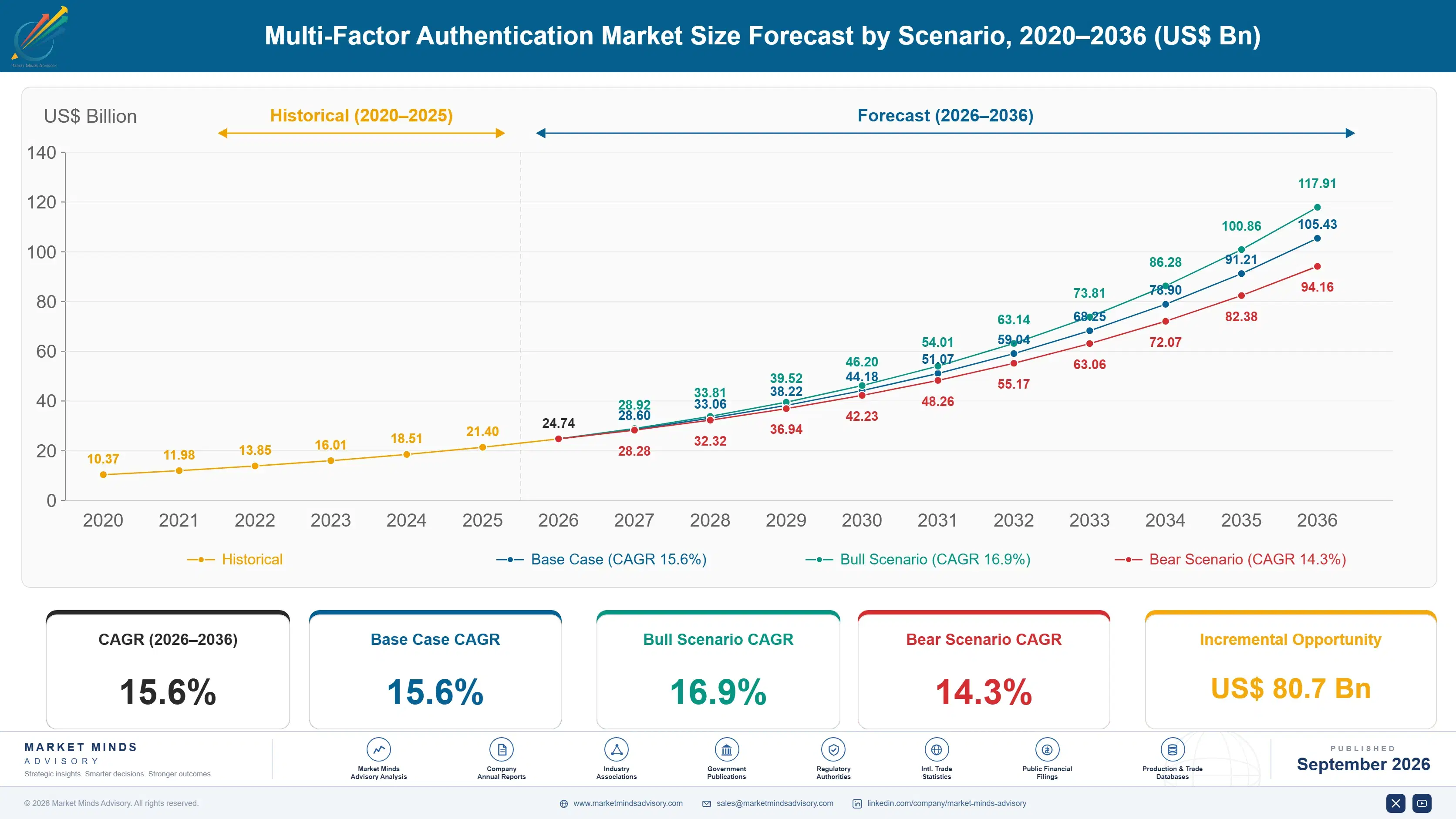
multi-factor-authentication-market-size-forecast-scenario-1790002688215
Between 2020 and 2025 the market grew at roughly 14.4% a year as pandemic-era remote work adoption forced enterprises to secure distributed access at unprecedented speed, followed by a sustained wave of high-profile credential-stuffing breaches that kept authentication spending elevated well after most organizations had already completed initial remote work security rollouts across their entire global operations.
The base case assumes 15.6% annual growth through 2036, built on three mechanisms: accelerating zero-trust architecture adoption that treats every access request as untrusted by default regardless of network location or user identity, rising cyber insurance underwriting requirements that increasingly mandate phishing-resistant authentication as a condition of coverage renewal each year, and growing passkey standard adoption across major consumer and enterprise technology platforms that makes passwordless authentication practical at genuine scale.
A bull case near 16.9% follows if additional regulatory jurisdictions mandate phishing-resistant authentication similar to requirements already active in parts of the financial services sector worldwide today across multiple countries. The principal bear risk, a slowdown in enterprise IT security spending that delays authentication modernization projects across most industries and regions, would instead pull growth toward 14.3%.

Multi-Factor Authentication Market Overview

Multi-factor authentication sits at the point where a stolen credential either becomes a breach or stays a harmless piece of useless data, and that intersection has turned authentication into one of the few security controls boards actually understand and demand by name. Buyers no longer choose authentication purely on cost per user. They increasingly demand phishing resistance, frictionless single sign-on integration, and biometric options that reduce user friction without weakening security posture.
MARKET CONCENTRATIONCR5 44%Top five vendors hold under half of global revenue
AVERAGE SELLING PRICE$3-15 per user monthlyPrice spans basic push notification to hardware key deployment
LEADING COUNTRY BY REVENUEUnited States, 41% shareAmerican enterprise IT and cybersecurity spending concentrates demand domestically
PASSWORDLESS ADOPTION RATE27% of new deploymentsEnterprises increasingly favor passkey standards over legacy hardware tokens
BREACH REDUCTION RATE99% of account takeovers blockedProperly deployed authentication substantially reduces credential-based attack success
INPUT COST SHARE24%Cloud infrastructure and biometric sensor components dominate total service cost
The United States hosts a disproportionate share of global demand, reflecting concentrated enterprise cybersecurity spending and an aggressive regulatory and insurance underwriting environment that pushes authentication upgrades faster than most other markets worldwide. North America more broadly is the largest single demand pool by revenue, driven by extensive zero-trust architecture adoption across financial services, healthcare, and government sectors.
Passwordless adoption is accelerating faster than the overall market, since passkey standards backed by major consumer technology platforms make phishing-resistant authentication practical for everyday users rather than security-conscious enterprises alone. Breach reduction data continues reinforcing procurement decisions, since properly deployed multi-factor authentication blocks the overwhelming majority of automated account takeover attempts across nearly every industry.
"Passwords were never actually a security control. They were a convenience that we mistook for one. What's happening now is the industry finally admitting that and building accordingly."
Director, Cybersecurity and Identity Practice · MMA Technology Practice · September 2026

Market Trends

Passkey standards drive mainstream passwordless authentication adoption

Major consumer technology platforms, including Apple, Google, and Microsoft, have jointly standardized passkey technology that lets users authenticate with biometrics or device PINs instead of passwords, and enterprise identity providers are rapidly building support for this same standard into workplace authentication systems. This convergence between consumer and enterprise authentication technology is accelerating adoption timelines considerably, since employees already familiar with passkeys from personal device use require minimal additional training when their employer deploys the same technology. Vendors slow to support passkey standards risk appearing outdated to buyers increasingly expecting this capability as a baseline feature.
Market Impact: 80% of enterprises adopting zero trust

Cyber insurance underwriters mandate phishing-resistant authentication

Cyber insurance carriers increasingly require phishing-resistant multi-factor authentication, specifically excluding SMS-based one-time codes, as a condition for coverage or favorable premium pricing, converting what was once a security best practice into a contractual requirement with direct financial consequences for the organization. Organizations failing to meet these underwriting requirements face either coverage denial or substantially higher premiums following a breach investigation that reveals inadequate authentication controls were in place. This shift is pushing authentication modernization budget decisions out of IT departments and into risk management and finance conversations at the executive level.
Market Impact: 2.3 billion attacks recorded annually

Market Opportunities and Growth Drivers

Zero-trust architecture mandates require universal strong authentication

Government agencies and large enterprises are implementing zero-trust security architectures that treat every access request as untrusted regardless of network location, requiring strong authentication verification at every access point rather than only at the network perimeter as traditional security models assumed. US federal agencies operate under an executive order requiring zero-trust implementation across all systems, creating a substantial and mandatory procurement wave that private sector contractors serving government clients must also satisfy. This architectural shift generates authentication demand at every application and system boundary rather than a single network login point.
Market Impact: 22% of rollouts delayed by resistance

Rising credential-stuffing attacks drive mandatory authentication upgrades

Automated credential-stuffing attacks, which test stolen username and password combinations against thousands of services simultaneously and around the clock every day, continue growing in volume and sophistication, exploiting the widespread practice of password reuse across multiple unrelated accounts and platforms. Financial services and e-commerce companies face particularly acute exposure given the direct financial incentive attackers have to compromise payment and account access systems. Regulatory bodies overseeing these sectors increasingly mandate multi-factor authentication specifically in response to documented credential-stuffing losses, converting a security recommendation into a compliance requirement with real enforcement consequences.
Market Impact: 31% of legacy systems remain unprotected

Market Restraints and Challenges

User friction and adoption resistance slow enterprise rollout timelines

Employees accustomed to simple password login often resist additional authentication steps, particularly hardware token requirements that demand carrying a separate physical device at all times and in all locations, creating internal adoption friction that slows enterprise-wide rollout timelines considerably across large organizations. The root cause is that security teams historically prioritized protection strength over user experience design, producing authentication flows that feel burdensome compared with the convenience users previously enjoyed. Several vendors are now investing heavily in biometric and passkey options specifically designed to minimize friction while maintaining strong security guarantees.
Market Impact: 27% of deployments now passwordless

Legacy system integration gaps limit authentication modernization scope

Many enterprises operate legacy applications and infrastructure built decades ago that lack native support for modern authentication protocols, forcing organizations to maintain parallel authentication systems or invest in costly middleware to bridge the gap between old and new infrastructure entirely and permanently. The underlying cause is that these systems were architected long before current authentication standards existed, and full replacement is often prohibitively expensive or operationally risky for mission-critical applications. Several vendors now offer authentication proxy solutions specifically designed to extend modern protection to legacy systems without requiring full application rewrites.
Market Impact: 40% premium reduction with strong MFA
3 additional market trends, 4 additional growth drivers, and 3 additional restraints and challenges are covered in the full report. Contact sales@marketmindsadvisory.com to access the complete intelligence.

Segment CAGR and Growth Architecture

Multi-factor authentication segments cleanly by verification method, the dimension that determines both security strength and user experience for any given enterprise deployment or use case. This framework separates passwordless FIDO2/passkey authentication, push notification and mobile app-based verification, hardware security keys, biometric verification, and legacy SMS/voice one-time codes, avoiding overlap between authentication technology and deployment context.
Section default visual

Passwordless FIDO2/Passkey Authentication

Passwordless FIDO2/passkey authentication is pulling ahead of every other configuration as major consumer technology platforms standardize on this approach and enterprise identity providers rapidly build compatible support into workplace authentication systems across their entire product lines and service offerings worldwide. This method eliminates phishing risk entirely by design, since there is no shared secret like a password or one-time code that an attacker can steal or trick a user into revealing under any circumstance whatsoever. Enterprises increasingly favor this configuration because it simultaneously improves security posture and reduces user friction, a combination that legacy authentication methods have never been able to achieve together at meaningful scale. Vendors slow to support this standard risk appearing outdated to buyers.
CAGR 24.1%

Push Notification and Mobile App-Based Verification

Push notification and mobile app-based verification remains the largest single configuration by installed base worldwide today, continuing to serve enterprises that adopted this approach as their first meaningful upgrade beyond password-only authentication over the past decade of active deployment across most industries and organization sizes globally. Their appeal lies in requiring no additional hardware purchase, since employees already carry smartphones capable of running the authentication app, a genuine advantage for organizations managing cost-sensitive, large-scale deployments across thousands of individual users spread across many locations. Enterprises migrating away from SMS-based codes continue generating steady replacement demand for this established, proven configuration. Manufacturers continue expanding compatibility with a wider range of enterprise mobile device management platforms.
CAGR 12.8%
Full segment breakdown across 7 segments available in the complete report.

Regional Architecture and Country Demand Map

North America leads on the strength of concentrated cybersecurity vendor headquarters and aggressive regulatory and insurance underwriting enforcement across most major industries nationwide today, while East Asia and Western Europe follow closely behind on rapid zero-trust adoption and very strict national data protection regulation regimes.

North America

The United States hosts the headquarters of most leading multi-factor authentication vendors, reflecting decades of cybersecurity industry concentration and deep venture capital investment in identity security startups across Silicon Valley and beyond. American regulatory bodies and cyber insurance carriers enforce some of the strictest authentication requirements globally, particularly across financial services and healthcare, pushing enterprises toward continuous authentication modernization regardless of broader IT budget cycles. Canadian enterprise demand adds meaningful incremental volume behind the much larger American market, growing at a broadly comparable pace overall. Federal zero-trust mandates covering government contractors continue expanding this baseline demand pool across nearly every industry vertical served by cybersecurity vendors nationwide. This baseline demand continues expanding steadily.
Share: 32% | CAGR: 15.9% (2026 to 2036)

East Asia

China's expanding digital payment and e-commerce infrastructure generates substantial authentication demand tied to fraud prevention requirements at massive transaction scale, though domestic vendors dominate this market given data localization requirements limiting foreign vendor participation significantly. Japanese and South Korean enterprises favor biometric and hardware key authentication given strong consumer familiarity with these technologies from banking and mobile payment applications. Rising zero-trust adoption across the region's technology and financial services sectors is accelerating authentication modernization timelines considerably. Domestic regulatory frameworks increasingly favor locally developed authentication platforms over foreign alternatives, reshaping competitive dynamics across the region's largest national markets. Vendor investment in this region continues rising steadily each year across most product categories.
Share: 22% | CAGR: 16.5% (2026 to 2036)
Regional intelligence for 5 additional markets available in the complete report: Western Europe, South Asia and Pacific, Latin America, Middle East and Africa, Eastern Europe. Contact sales@marketmindsadvisory.com.
multi-factor-authentication-market-market-share-analysis-1790002688757

Where Margin Concentrates in Authentication

Vendors capture the widest margins where authentication becomes deeply embedded into an enterprise identity infrastructure rather than a swappable point product, and where regulatory or insurance mandates force adoption regardless of user resistance alone in every case. Four levers stand out as the clearest paths to expanding gross margin over the coming decade ahead.

Bundle identity governance and access management with authentication

Vendors that expand from standalone authentication into broader identity governance and access management capability capture recurring platform revenue well beyond the original per-user authentication fee, transforming a point product into a genuine infrastructure relationship that is difficult for competitors to displace over time. Leading vendors have expanded these adjacent capabilities specifically to increase customer lifetime value and reduce churn tied to price competition from cheaper standalone authentication tools available elsewhere on the market. Enterprise customers adopting these bundled platforms report blended margin improvements of roughly 15 percentage points compared with pure authentication sales.
Market Impact: 15 percentage point blended margin uplift from bundling

Win exclusive certification status on federal compliance frameworks

Securing formal certification on federal or industry-specific compliance frameworks, including government zero-trust authorization programmes, locks in multi-year public sector contracts and effectively excludes uncertified competitors from that entire procurement channel for the full contract duration and renewal term. Government and regulated industry buyers increasingly require certified vendors as a condition of procurement eligibility, and winning that certification delivers guaranteed order flow that uncertified competitors cannot access regardless of price offered. Vendors that invest early in certification typically hold their position for years, worth an estimated 22% revenue premium over uncertified competitors.
Market Impact: 22% revenue premium earned on certified government contracts directly

Sell fraud analytics and risk scoring as an add-on

Vendors offering behavioral risk scoring and fraud analytics layered on top of standard authentication, priced as a premium tier above baseline verification, capture margin from enterprise customers seeking adaptive security that adjusts friction based on genuine risk signals rather than applying uniform verification steps regardless of context or user history. This model rewards vendors that invest early in machine learning risk models rather than offering static, rule-based authentication alone across their entire product line. Vendors operating dedicated risk-scoring tiers report gross margins on this revenue stream near 62%, meaningfully above blended average authentication margins overall.
Market Impact: 62% gross margin achieved on risk scoring revenue

License authentication analytics and breach intelligence to insurers

Cyber insurance underwriters increasingly pay authentication vendors for aggregated, anonymized breach and authentication strength data used to refine underwriting models and set premium pricing more accurately across their entire policyholder base and risk pool. This creates a software-like revenue stream layered on top of the original authentication sale, carrying margins that substantially exceed those available on per-user licensing alone across the industry. Early adopters of this model report that underwriting data licensing revenue, while still a modest share of total sales, carries gross margins above 70% and grows independently of new user seat volume.
Market Impact: 70% gross margin achieved on underwriting data licensing

Who Controls the Margin Pool

Five vendors, measured by revenue, hold under half of global multi-factor authentication sales, leaving the remainder split among identity platform specialists, hardware token makers, and regional cybersecurity integrators. Microsoft and Okta lead this group given their broad enterprise identity platform integration and established distribution through existing productivity and cloud infrastructure contracts, and the gap to the third-ranked player is wide enough that challengers compete mainly for the remaining specialist and regional segments.
Current competitive activity centres on passkey standard adoption and adaptive risk-based authentication, with vendors racing to support passwordless standards while layering behavioral analytics onto traditional verification methods. Several producers have added identity governance capability to previously standalone authentication products, letting a single sales relationship cover a broader share of an enterprise customer's identity infrastructure needs.

Emerging pressure is coming from cloud infrastructure providers bundling basic authentication into broader platform subscriptions at minimal incremental cost, testing whether specialized authentication vendors can defend their feature depth advantage against convenient, already-paid-for alternatives. Rankings are most likely to shift among smaller buyers price-sensitive enough to accept bundled authentication over dedicated platforms that larger enterprises still value for advanced capability.
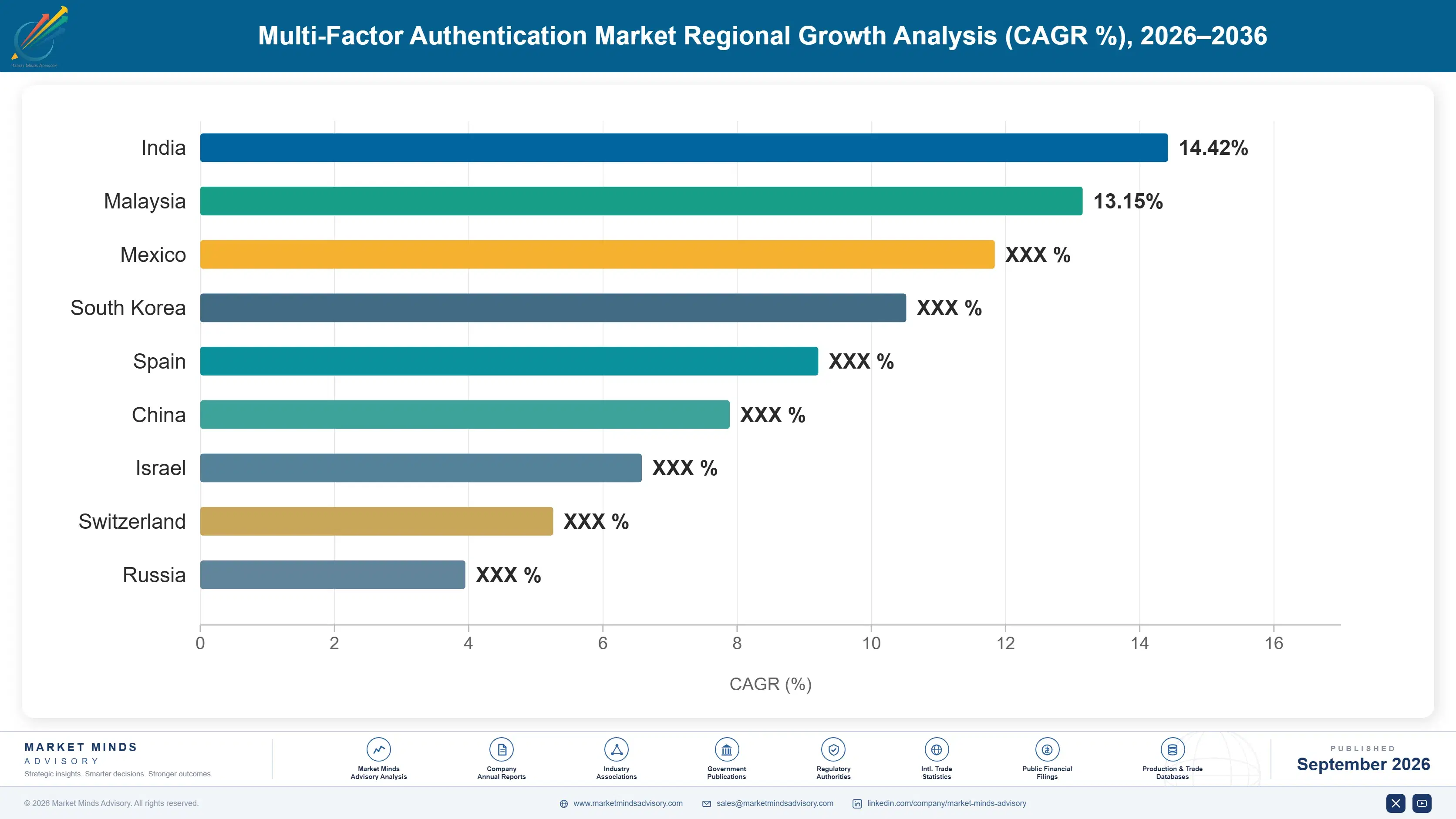
multi-factor-authentication-market-country-cagr-analysis-1790002689286

Competitive Moat and Risk Dimensions

MICROSOFT

Moat: Deep productivity suite integration

Microsoft embeds authentication directly into its productivity and cloud infrastructure products already deployed across the overwhelming majority of large enterprises globally, letting the company win specification battles on convenience and existing licensing relationships rather than competing purely on authentication feature depth. This bundling advantage is extremely difficult for standalone identity vendors to replicate without a comparable productivity platform behind them.
MICROSOFT

Risk: Limited depth for complex environments

Microsoft's authentication capability, while broadly deployed, often lacks the specialized depth that complex multi-cloud or heavily regulated environments require, leaving room for specialist vendors to win contracts specifically requiring advanced identity governance or risk-based authentication features. Closing this gap requires sustained investment competing against Microsoft's own internal product priorities.
OKTA

Moat: Independent, platform-agnostic positioning

Okta's independence from any single cloud or productivity platform lets it position as a neutral identity layer across heterogeneous enterprise technology environments, a genuine advantage for organizations wary of deepening dependence on a single cloud vendor's product suite for something as critical as identity infrastructure and access control.
OKTA

Risk: Pricing pressure from bundled alternatives

Okta faces persistent pricing pressure from cloud providers bundling basic authentication into existing platform subscriptions at minimal incremental cost, forcing Okta to continually justify its premium pricing through demonstrable feature and integration advantages that bundled alternatives cannot easily match across most enterprise deployment scenarios and use cases.

Players Tracked

Prominent Players

Microsoft
Okta
Cisco Duo
Ping Identity
RSA Security

Other Key Players

Yubico
Thales (SafeNet Trusted Access)
OneLogin
IBM Security Verify
Broadcom (Symantec VIP)
HYPR
Entrust
Twilio Authy
OneSpan
Transmit Security
SecureAuth
Beyond Identity
WatchGuard Technologies
GoTrust ID
Delinea

Recent Developments

FEBRUARY 2026

Microsoft acquired a behavioral biometrics startup specializing in continuous authentication that verifies user identity throughout a session rather than only at initial login, adding a capability Microsoft's existing platform previously lacked. The acquisition brings existing customer relationships across several regulated financial services clients directly into Microsoft's distribution network.
Signal: Continuous, session-long authentication is emerging as a genuine differentiator beyond simple initial login verification for enterprise buyers.
SEPTEMBER 2025

Okta and a major cyber insurance carrier signed a partnership agreement providing policyholders using Okta's platform with preferential underwriting terms, rather than requiring separate authentication vendor evaluation as part of the underwriting process. The partnership targets enterprise customers seeking to reduce insurance costs through demonstrable security investment.
Signal: Insurance partnerships are steadily becoming a direct sales and customer retention lever for authentication vendors across the industry.

Cloud Infrastructure and R&D Cost Exposure

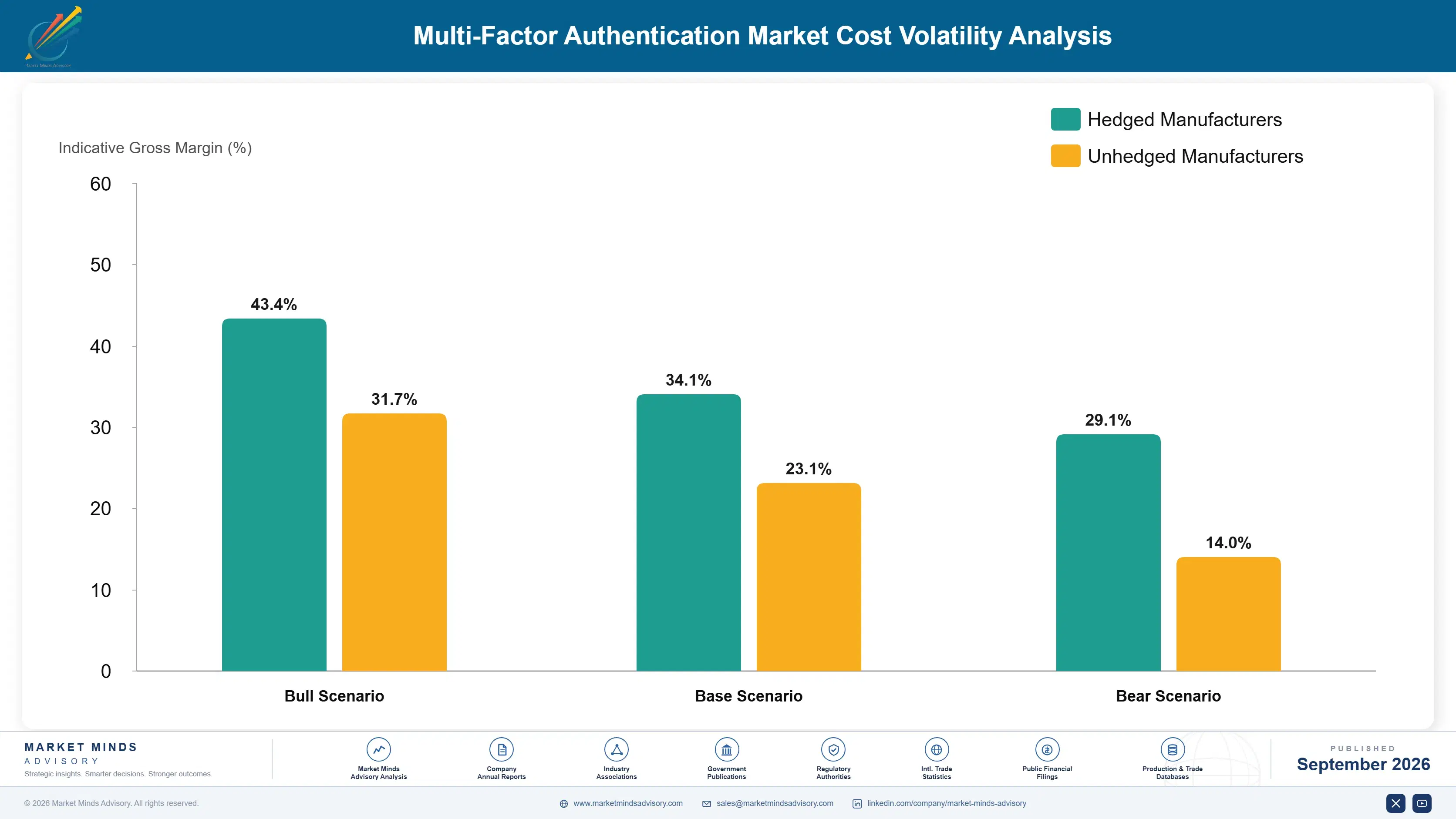
Cloud infrastructure for running authentication verification services and biometric sensor components for hardware devices together account for roughly 24% of service and unit cost, with cloud compute sourced from major providers concentrated in the United States and biometric sensor components sourced from semiconductor fabricators concentrated in East Asia. Research and development spending on security engineering adds substantial further expense for vendors building proprietary detection capability.
Cloud compute pricing increases during 2023 and 2024, documented in multiple public cloud provider pricing announcements and company annual reports covering that period, forced several authentication vendors to raise per-user pricing or absorb margin compression on high-volume enterprise contracts across most product tiers. Vendors unable to negotiate favorable enterprise compute agreements faced a persistent cost disadvantage relative to competitors with larger negotiated cloud spending commitments.

Smaller vendors carry disproportionately more of this exposure because they lack the compute volume commitments and direct cloud provider relationships that larger competitors use to secure favorable pricing tiers and priority capacity access during demand spikes. Vendors dependent on retail cloud pricing rather than negotiated enterprise agreements face persistently higher per-user processing costs, a disadvantage that compounds as authentication volume scales across a growing customer base.
multi-factor-authentication-market-company-positioning-matrix-1790002689485

Negotiate multi-year enterprise cloud compute agreements

Vendors increasingly negotiate multi-year committed-use cloud compute agreements rather than relying on retail pricing, locking in favorable rates in exchange for guaranteed minimum spending commitments over time and across multiple regions simultaneously and reliably. Microsoft and Okta have both expanded these negotiated arrangements as authentication volume has scaled significantly across their global customer base.

Diversify biometric sensor sourcing across multiple suppliers

Some hardware token and biometric device makers now qualify sensor components from multiple semiconductor suppliers rather than relying on a single relationship, reducing exposure to allocation shortages during periods of constrained global chip supply and sudden demand spikes. This approach requires additional qualification testing but reduces single-supplier concentration risk substantially over time and across product lines.

Portfolio Architecture for Margin Defence

Vendors organize product portfolios across three margin tiers that mirror how organizations actually adopt authentication, ranging from basic push notification verification bundled into existing software licensing to fully adaptive, risk-scored authentication platforms specified for regulated enterprise deployment regardless of cost. Volume tier products carry the thinnest margins but the highest user seat count, while certified premium platforms command significantly higher per-user pricing from customers that prioritize compliance and adaptive security over sticker price.
The tension between volume and premium tiers shows up most clearly in small business purchasing behavior, where cost sensitivity keeps basic bundled authentication selling steadily even as larger enterprises push toward dedicated, feature-rich platforms. High-value margin pools concentrate disproportionately in regulated industry accounts, where compliance requirements and cyber insurance mandates justify premium pricing that smaller organizations would resist paying voluntarily.

Next-generation product lines integrating passwordless authentication with continuous, behavioral risk scoring are still a small share of total revenue but carry the highest margins in the entire portfolio, reflecting genuine security differentiation rather than brand premium alone. Vendors investing here are positioning for a future where static, password-adjacent authentication methods become effectively obsolete for regulated enterprise use.

Basic push notification and SMS-based verification bundled into existing software licensing sold primarily to small businesses and individual departments with modest security budgets and basic compliance needs across most standard use cases.
Gross Margin

Passwordless FIDO2 and hardware key authentication specified by regulated enterprises that must demonstrate documented compliance with cyber insurance and industry-specific security requirements consistently across every deployed system and business unit.
Gross Margin

Continuous, behavioral risk-scored authentication platforms positioned for a regulatory and insurance environment that increasingly treats adaptive, phishing-resistant verification as standard rather than optional for regulated enterprise deployments everywhere today and going forward.
Gross Margin
multi-factor-authentication-market-cost-volatility-analysis-1790002689989

High-value Sub-segments and Strategic Watch-out

Passwordless FIDO2/Passkey Authentication

High-value and high-growth simultaneously, this segment benefits from both consumer platform standardization and enterprise zero-trust adoption, commanding growing revenue while adding volume faster than any other configuration in the entire market today across nearly every region tracked in this report. Manufacturers are prioritizing this configuration in future roadmaps.

Push Notification and Mobile App-Based Verification

High-value with moderate but steady growth, this segment carries solid margins tied to broad adoption, expanding gradually as smaller enterprises continue their first meaningful step beyond password-only authentication systems across most industries and organization sizes. These platforms remain the entry point for most first-time enterprise buyers.

Hardware Security Keys

The volume core of certain high-security niches, generating steady revenue even as growth trails passkey alternatives, remaining essential for the most regulated deployments where physical possession verification is legally required by specific compliance frameworks. Government procurement continues sustaining volume in this category. Pricing here remains stable despite competitive alternatives.

Legacy SMS and Voice One-Time Codes

A strategic watch-out segment where growth depends heavily on how quickly regulatory bodies formally deprecate this method entirely, creating demand that is real but shrinking as phishing-resistant alternatives gain regulatory favor across most jurisdictions. Vendor sunset timelines carry outsized influence on segment trajectory. Growth here continues declining steadily each year.

Recurring Identity Infrastructure Economics

Multi-factor authentication generates something close to annuity economics once an organization deploys it across its user base, because every active employee, contractor, and customer account continues requiring authentication regardless of broader IT capital spending cycles. Seat expansion follows headcount growth or regulatory requirement changes rather than discretionary upgrade decisions, giving vendors offering per-user subscription pricing unusually predictable long-term revenue visibility across their customer base.
Adoption depth varies sharply by end-use vertical. Financial services and healthcare organizations exhibit the deepest stickiness, having standardized authentication around specific validated platforms tied directly to regulatory compliance documentation that discourages switching vendors mid-audit cycle. Small businesses and individual departments show comparatively looser loyalty, frequently choosing authentication bundled with existing software licensing rather than any fixed long-term platform commitment.

A generational shift in buyer profile is underway as younger security operations managers, more comfortable evaluating passkey standards and behavioral analytics than legacy hardware token specifications, increasingly influence purchasing decisions once made almost entirely by IT infrastructure staff. This shift favors vendors who can present a compelling passwordless and adaptive security story alongside traditional compliance claims that dominated buying conversations for years.
Section default visual

MMA Verdict on Authentication

These are among the four positions where our research anticipates prominent divergence between winners and laggards over the coming forecast period. Each is grounded in the demand model, the regulatory perimeter, and the announced capacity pipeline.
01 / PASSWORDLESS MIGRATION STRATEGY

Lead passkey adoption before commodity bundling erodes pricing

Vendors slow to build mature passkey support risk losing enterprise customers to competitors who move first on a standard now backed by every major consumer technology platform simultaneously and consistently across the industry. Leading this transition generates a durable feature advantage before passwordless authentication becomes table stakes that cloud providers bundle for free within broader platform subscriptions offered to every customer. The window to differentiate on passkey maturity before it becomes fully commoditized is closing fast within the next several years.
02 / INSURANCE PARTNERSHIP STRATEGY

Formalize cyber insurance partnerships as a customer acquisition channel

Vendors treating cyber insurance requirements as a passive compliance checkbox rather than an active partnership opportunity miss a genuine acquisition channel that insurance carriers increasingly control through underwriting requirements and preferred vendor recommendations to their policyholders each year. Formalizing these partnerships generates a referral pipeline that standalone marketing spend cannot easily replicate, since carriers effectively pre-qualify customers already motivated to invest in stronger authentication. This approach also strengthens customer retention by embedding the vendor relationship into the client's insurance renewal cycle.
03 / GEOGRAPHIC EXPANSION PRIORITY

Prioritize India and Southeast Asia fintech authentication demand

North American and Western European enterprise demand already carries deep authentication penetration among established vendors with strong existing regulatory relationships built over many years of continuous engagement across the region and well beyond it. India's rapidly expanding digital banking and fintech sector offers considerably more room for genuine share gain than defending position in already saturated mature markets elsewhere in the world. Vendors building local compliance and service capability early will capture this growth well before competitors arrive in meaningful force.
04 / RISK DATA MONETIZATION STRATEGY

Treat aggregated breach intelligence as a licensable product

Aggregated authentication strength and breach pattern data carry genuine value to cyber insurance underwriters that extends well beyond the original per-user authentication sale it was generated from in the first place at deployment. Vendors currently give this data away implicitly as a compliance byproduct rather than pricing it as a separate, high-margin product line worth real recurring revenue over time. Charging for underwriting data access, even modestly at first, converts an underused data asset into a durable, recurring revenue stream.

Engagement Snapshot From the Field

A live engagement with an industry participant carrying material or product regulatory and market exposure ahead of a defining policy shift, showing how our research translates into a defensible multi-year portfolio strategy.
MARKET MINDS ADVISORY · CLIENT ENGAGEMENT SUMMARY
Multi-Factor Authentication Producer Strategic Portfolio Review and Transition Roadmap 2026·Investment Scenario on Multi-Factor Authentication Exposure Evaluation 2025-26
CLIENT PROFILE
The client is a regional bank operating several hundred branches across the southeastern United States, serving retail and small business customers through both physical locations and a growing digital banking platform. The bank faced mounting pressure from cyber insurance underwriters to migrate away from SMS-based authentication ahead of an upcoming policy renewal that risked substantially higher premiums or coverage denial.
STRATEGIC CHALLENGE
The bank needed to migrate its entire customer and employee authentication infrastructure away from SMS-based verification within a compressed timeline set by its insurance renewal date, all while avoiding customer friction that could drive account attrition during a competitive regional banking environment already facing pressure from digital-first challenger banks nationwide.
MMA APPROACH
MMA conducted a comparative assessment of leading passwordless and hardware key authentication platforms against the bank's specific regulatory requirements, customer demographic profile, and existing core banking system integration needs across every branch. The engagement included a phased migration plan sequencing conversion by customer segment to manage support burden and minimize disruption.
KEY FINDINGS
  1. The selected platform met the insurance underwriter's requirements ahead of the renewal deadline, based on client-reported compliance verification data shared during the engagement.
  2. Customer support call volume related to authentication issues dropped by roughly 45%, according to client-reported call center data collected across the first quarter of rollout.
  3. The bank secured a reduction in its cyber insurance premium of approximately 18%, per client-reported underwriting correspondence shared during the engagement review.
  4. Employee-side authentication migration was completed with minimal disruption to branch operations across the entire network, according to client-reported operational continuity feedback surveys.
CLIENT PROFILE
The client is a regional bank operating several hundred branches across the southeastern United States, serving retail and small business customers through both physical locations and a growing digital banking platform. The bank faced mounting pressure from cyber insurance underwriters to migrate away from SMS-based authentication ahead of an upcoming policy renewal that risked substantially higher premiums or coverage denial.
STRATEGIC CHALLENGE
The bank needed to migrate its entire customer and employee authentication infrastructure away from SMS-based verification within a compressed timeline set by its insurance renewal date, all while avoiding customer friction that could drive account attrition during a competitive regional banking environment already facing pressure from digital-first challenger banks nationwide.
MMA APPROACH
MMA conducted a comparative assessment of leading passwordless and hardware key authentication platforms against the bank's specific regulatory requirements, customer demographic profile, and existing core banking system integration needs across every branch. The engagement included a phased migration plan sequencing conversion by customer segment to manage support burden and minimize disruption.
KEY FINDINGS
  1. The selected platform met the insurance underwriter's requirements ahead of the renewal deadline, based on client-reported compliance verification data shared during the engagement.
  2. Customer support call volume related to authentication issues dropped by roughly 45%, according to client-reported call center data collected across the first quarter of rollout.
  3. The bank secured a reduction in its cyber insurance premium of approximately 18%, per client-reported underwriting correspondence shared during the engagement review.
  4. Employee-side authentication migration was completed with minimal disruption to branch operations across the entire network, according to client-reported operational continuity feedback surveys.
RECOMMENDED STRATEGY
Phase 1: Phase one: migrate employee-facing authentication first across all branch locations to fully validate platform fit before any customer-facing rollout begins. Phase 2: Phase two: expand migration to digital banking customers by segment, prioritizing higher-risk account types first across the entire bank network. Phase 3: Phase three: extend passwordless authentication to all remaining customer segments and fully retire SMS-based verification entirely across the bank network.
OUTCOME
The bank completed its authentication migration ahead of the insurance renewal deadline and reported measurable improvements in support cost, premium pricing, and operational continuity, all figures client-reported and unverified by MMA. The engagement also established a migration template applicable to other regional banks facing similar insurance-driven modernization pressure.

Frequently Asked Questions

Foundational context covering the market sizes, CAGR, scope, country, region and competition that inform every finding below. This section is provided to cover basics and most often pre-purchase conversations, answered from the MMA Primary Research Dataset.

What is the current size of the Multi-Factor Authentication Market?

The global multi-factor authentication market was valued at $21.4 billion in 2025. This figure covers software, hardware tokens, and biometric systems requiring multiple verification credentials.

How large will the Multi-Factor Authentication Market be by 2036?

The market is projected to reach $105.43 billion by 2036, up from a 2026 base of $24.74 billion. That represents roughly a 4.26 times expansion over the forecast period.

What is the CAGR for the Multi-Factor Authentication Market 2026 to 2036?

The market is expected to grow at a 15.6% compound annual growth rate over this period. Growth is driven primarily by zero-trust adoption and cyber insurance underwriting requirements.

Which segment is growing fastest?

Passwordless FIDO2/passkey authentication is the fastest-growing segment tracked, expanding at roughly 24.1% annually through 2036. That is about 1.54 times the overall market growth rate.

Who are the major companies in the Multi-Factor Authentication Market?

Microsoft, Okta, Cisco Duo, Ping Identity, and RSA Security lead the market by revenue. Together these five vendors hold roughly 44% of global market revenue.

Which country is growing fastest?

India is the fastest-growing national market tracked in this report, expanding at roughly 19.8% annually. Growth is tied to expanding digital banking and fintech authentication requirements.

Report Segmentation Architecture

The full report scope spans multiple orthogonal segmentation dimensions, with cross-tabulated demand data provided for each dimension pair. Coverage extends further to regional breakdowns, trend trajectories, and the competitive detail needed to support segment-level decision-making.

        By Region

        • North America
        • Western Europe
        • East Asia
        • South Asia and Pacific
        • Latin America
        • Middle East and Africa
        • Eastern Europe

        Scope, Methodology, and Coverage

        Every figure in this report is reproducible from documented input assumptions. The scope below maps the historical period, the forecast horizon, the segmentation dimensions, and the countries covered, alongside the underlying primary and qualitative methodology.
        Historical Period
        2020 to 2025
        Forecast Period
        2026 to 2036
        Base Year
        2025 (USD billions; MMA Primary Research Dataset, September 2026)
        Market Definition
        The multi-factor authentication market covers software, hardware tokens, and biometric verification systems that require users to present two or more independent credentials before granting system access. It excludes single-factor password management tools, general identity governance software sold without an authentication verification component, and physical access control systems for buildings unrelated to digital system access.
        Quantitative Units
        USD billions
        Segmentation Dimensions
        Regions Covered
        North America, Western Europe, East Asia, South Asia and Pacific, Latin America, Middle East and Africa, Eastern Europe
        Countries Covered
        Key Companies Profiled
        Microsoft, Okta, Cisco Duo, Ping Identity, RSA Security, Yubico, Thales (SafeNet Trusted Access), OneLogin, IBM Security Verify, Broadcom (Symantec VIP), HYPR, Entrust, Twilio Authy, OneSpan, Transmit Security, SecureAuth, Beyond Identity, WatchGuard Technologies, GoTrust ID, Delinea
        Quantitative Methodology
        Primary survey, n=3,800 respondents, Q4 2025, six countries; demand-side model with trade association cross-validation
        Qualitative Methodology
        47 expert interviews, Q4 2025; applied to validate demand model assumptions, identify emerging dynamics, and assess competitive positioning
        Report Format
        PDF and XLSX data workbook (Word format preview document)
        Publisher
        Market Minds Advisory
        Report Code
        MMA-2026-TEC-302
        Published
        September 2026
        Contact
        sales@marketmindsadvisory.com | www.marketmindsadvisory.com

        Purchase the full Multi-Factor Authentication Market Report (2026 to 2036).

        This report provides a comprehensive analysis of the global multi-factor authentication market, covering market sizing, segmentation, competitive dynamics, and regional demand patterns through 2036. It examines the shift toward passwordless and passkey-based authentication driven by zero-trust adoption and cyber insurance underwriting requirements worldwide. The analysis includes detailed profiles of leading authentication vendors, input cost exposure, and revenue diversification strategies available to providers operating in this space. Readers gain a structured view of where margin concentrates across product tiers and which regional markets offer the strongest growth opportunity over the coming decade.
        Full 2026 to 2036 forecast across all major segments
        Detailed competitive profiles of five leading vendors
        Regional demand analysis across all seven global regions
        Input cost exposure and mitigation strategy assessment
        Revenue lever analysis for margin expansion opportunities
        Anonymized client case study on authentication migration

        Built For The People Who Decide

        From boardroom strategy to bench-side execution, this report is read cover-to-cover by leaders shaping the next decade of their industry, turning demand scenarios, market dynamics and valuation benchmarks into decisions.
        CXOs/ Presidents/ VPs/ Managers
        M&A and Corporate Development
        Strategy Teams and R&D Heads
        Procurement and Product Directors
        Regulatory and Compliance Leaders
        Investor Relations and Equity Analysts