Market Minds Advisory
MS Polymer Market

MS Polymer Market: Construction Sealant Demand and Silane Feedstock Economics

Low-VOC construction sealant conversion and automotive structural bonding demand are pulling MS polymer consumption ahead of general adhesive and sealant spending, even as silane and polyether feedstock volatility squeeze producer margins nationwide.

Lead Analyst

Bilal Shaikh

Published

September 2026

Make Smarter Decisions with Customized Research Insights

Request a free sample report and evaluate market opportunities, growth trends, and competitive dynamics relevant to your business needs.

2025 MARKET VALUE$2.3BMarket Size 2025
2036 FORECAST VALUE$4.6BBase Case , 2026 to 2036
CAGR 2026 TO 20366.5 %Bull 7.8% / Bear 5.2%
INCREMENTAL OPPORTUNITY$2.2BNet 10- year value creation
EXPANSION MULTIPLE1.88x2036 value over 2026 base
Strategic Levers
M&A Pipeline
Regional Outlook
Country Rankings
Competitive Intelligence
Segmental Deep-dive
Call-Us : 91 93563 13602

Executive Snapshot and Market Trajectory

Low-VOC construction sealant conversion and automotive structural bonding demand are pulling MS polymer consumption ahead of general adhesive and sealant spending, forcing producers to scale silane-terminated resin capacity faster than traditional silicone sealant supply chains typically allow. Producers unprepared for this shift face mounting margin pressure ahead.
Automotive structural and panel bonding adhesives are pulling category growth fastest as vehicle manufacturers replace mechanical fasteners and welds with MS polymer bonding to reduce weight and improve crash energy absorption. East Asia leads global demand on concentrated construction and automotive manufacturing scale, while South Asia and Pacific expands fastest as India's construction and automotive sectors formalize low-VOC specification across newly organized manufacturing corridors. Automated tracking reinforces this trend broadly.
Competitive intensity concentrates among a moderate group of producers that control silane-terminated polyether synthesis technology and formulation libraries, leaving smaller regional formulators to compete mainly on blending and distribution services. Regulatory pressure over volatile organic compound emissions is intensifying across North America and Europe, while silane and polyether feedstock cost volatility forces producers to defend margin through vertical integration and long-term supply agreements. These pressures reshape producer competitiveness broadly across every major account today.
Market Definition
The MS polymer market covers silyl-modified polymer sealants and adhesives based on silane-terminated polyether resin chemistry, used in construction joint sealing, structural glazing, automotive bonding, and industrial assembly applications. It excludes traditional silicone sealants without silane-terminated polyether backbone chemistry, polyurethane sealants and adhesives, and epoxy structural adhesive systems with distinct curing chemistry.
Base Year Value
$2.3B in 2025 (MMA Primary Research Dataset, August 2026)
Forecast Period
2026 to 2036, eleven discrete annual values
CAGR
6.5% base case. Bull 7.8%. Bear 5.2%.
Fastest Growth Segment
Automotive Structural and Panel Bonding Adhesives: 9.0% CAGR
Fastest Growth Country
India: 8.5% CAGR
Fastest Growth Region
South Asia and Pacific: 8.3% CAGR
Largest Region
East Asia: 32% of 2025 global value
Market Leaders
Henkel AG, Sika AG, Kaneka Corporation, Wacker Chemie, H.B. Fuller. Source: MMA Analysis based on company annual reports.
Primary Survey
n=3,800 procurement and R&D decision-makers, Q4 2025, six countries
Methodology
Demand-side build-up, cross-validated against public data, 47 expert interviews

MS Polymer Market Forecast Scenarios

ms-polymer-market-trends-size-forecast-scenario-1787556537373
Between 2020 and 2025 the market grew at an estimated 5.6% historical CAGR, held back early by pandemic-era construction project deferral and 2021 silane price spikes, before low-VOC conversion and automotive bonding demand restored steadier momentum through 2024 into 2025, a pace consistent with growth-specialty chemical trends broadly. Producer capacity investment has since tracked demand more closely.
The base case assumes 6.5% CAGR through 2036, driven by three mechanisms: continued low-VOC construction sealant conversion as building codes tighten volatile organic compound emissions standards across major jurisdictions, sustained automotive structural bonding adoption as manufacturers pursue vehicle weight reduction and improved crash performance, and expanding organized construction and automotive manufacturing capacity across India and Southeast Asia introducing MS polymer specification to markets previously served by traditional silicone and polyurethane sealants alone.
The bull case, at 7.8%, hinges on faster automotive structural bonding adoption across North American and European vehicle platforms alongside accelerated Asian construction formalization. The bear case, at 5.2%, reflects a scenario where silane and polyether cost volatility persists, forcing producers to defer capacity investment and slowing conversion momentum among cost-sensitive regional formulators unable to absorb sustained input price pressure.

Silane Terminated Resin Economics and Low-VOC Conversion Demand

MS polymer demand now converges around three forces: low-VOC construction sealant conversion that satisfies tightening building code emissions standards, automotive structural bonding adoption that supports vehicle weight reduction and crash performance, and expanding organized construction and automotive manufacturing capacity across South Asia introducing MS polymer specification to markets previously served by traditional sealants alone. Producers that can guarantee formulation consistency and reliable bonding performance at scale are capturing specification contracts fastest.
CR5 CONCENTRATION52%top five producers hold a moderately consolidated production base
AVERAGE SELLING PRICEUSD 4.80/kilogramautomotive structural bonding grades command materially higher blended pricing
TOP PRODUCING COUNTRY SHAREJapan, 20%leads global resin synthesis capacity on formulation depth and scale
CAPACITY UTILISATION74%reflects steady demand from construction and automotive assembly programs
TRADE INTENSITY38%cross-border trade supports multinational construction and automotive supply chains
FEEDSTOCK COST SHARE46%silane and polyether inputs dominate resin manufacturing cost structure
Commercially, the category behaves less like a commodity chemical sale and more like a bonding performance partnership. Construction glaziers and automotive manufacturers qualify producers through extensive adhesion and durability testing before committing to full-scale specification, which is why the largest producers embed application chemists directly inside major construction and automotive platform development programs. Switching producers mid-specification is rare given the cost and risk of revalidating structural bonding performance.
Over the next decade, silane-terminated resin innovation, feedstock supply security, and continued construction and automotive expansion across Asia will determine which producers can defend margin as silane and polyether volatility squeezes companies already absorbing formulation capacity investment, rewarding producers with diversified feedstock sourcing and application chemistry depth across every major regional construction and automotive account today.
"An MS polymer sealant doesn't get judged on cure time alone. It gets judged on whether the structural bond survives twenty years of thermal cycling on a curtain wall, and that single failure mode decides who keeps the specification."
Director, Construction and Automotive Bonding Chemicals Practice · MMA Silyl-Modified Polymer Sealants and Adhesives Practice · August 2026

Market Trends

Low-VOC Building Codes Accelerate Sealant Conversion Broadly

Low-VOC building code tightening across North American and European jurisdictions has expanded rapidly since 2023, restricting solvent-based sealant formulations that push glaziers toward MS polymer systems capable of meeting stricter emissions standards without sacrificing structural bonding performance. More than a dozen major glazing contractors converted flagship curtain wall specification to MS polymer since 2023, each requiring extensive adhesion and durability validation before contractors commit to full-scale conversion. Producers offering pre-validated, low-VOC MS polymer systems are capturing specification share fastest, while producers with inconsistent VOC compliance face growing exclusion from regulated jurisdictions entirely.
Market Impact: Adds 10 percent structural volume growth
Automotive Weight Reduction Expands Structural Bonding Demand

Vehicle manufacturers have increasingly standardized MS polymer structural bonding to replace mechanical fasteners and spot welds rather than relying entirely on traditional joining methods as was common a decade ago. More than a dozen major automakers expanded MS polymer structural bonding specification across new vehicle platforms since 2023, pulling demand toward producers with dedicated automotive application depth rather than construction-only catalogs alone. This weight-driven demand is reshaping producer selection criteria, favoring companies that offer validated crash performance data over those competing purely on adhesive pricing alone. Automakers increasingly treat validated crash performance as a baseline requirement rather than optional.
Market Impact: Shifts 8 percent of industrial volume

Market Opportunities and Growth Drivers

Structural Glazing Demand Sustains High-Rise Specification Growth

Rising structural glazing specification across commercial high-rise construction has pulled demand toward MS polymer systems capable of meeting stricter weatherability and movement capability standards that traditional silicone sealants cannot reliably match at comparable cost. Producers report structural glazing volume growth of roughly 10% since 2022 across markets expanding high-rise commercial construction. This specification-driven demand is reshaping producer volume economics, rewarding producers with dedicated structural glazing engineering support over smaller regional houses still producing standard-grade sealant at commodity pricing nationwide and across export markets. Developers increasingly treat weatherability certification as a baseline requirement rather than an optional upgrade.
Market Impact: Raises input cost 15 to 23%

Marine and Industrial Assembly Demand Expands Specification

Rising marine and industrial equipment assembly demand has pulled buyers toward MS polymer bonding systems capable of meeting stricter chemical resistance and vibration durability standards that standard adhesives cannot satisfy at comparable production cost. Several major marine equipment manufacturers expanded MS polymer specification across hull and deck bonding applications since 2023, reshaping which producers win institutional distribution contracts. This industrial-driven demand favors producers with dedicated marine and industrial technical support over smaller regional houses still focused primarily on construction-only sales. Manufacturers increasingly treat chemical resistance data as a baseline procurement requirement.
Market Impact: Adds 10 to 16-month certification delays

Market Restraints and Challenges

Silane and Polyether Feedstock Cost Volatility Risk

Silane and polyether inputs together represent a substantial share of MS polymer manufacturing cost, and prices for both have swung sharply since 2021 amid broader specialty chemical market disruption and competing silicone industry demand for comparable silane-grade feedstock supply. The root cause: MS polymer producers sit downstream of globally traded specialty chemical markets with limited forward pricing visibility, leaving production cost exposed to macro shocks. This volatility compresses margin for producers on fixed-price multi-year construction and automotive contracts unable to pass through sudden cost spikes quickly. Some producers mitigate this through diversified sourcing.
Market Impact: Adds 145 million USD conversion volume

Structural Bonding Certification Raises Qualification Complexity

Tightening automotive structural bonding certification requirements have pushed producers toward extensive crash simulation and long-term durability testing, a process rooted in the fundamental engineering complexity of validating adhesive-bonded joints under crash and fatigue loading that requires substantial testing investment rather than incremental formulation adjustment. This creates genuine commercial friction for producers whose automotive contracts depend directly on certification breadth rather than production capacity alone. Producers are mitigating the exposure through dedicated crash testing research and phased certification programs, though fully closing the certification gap remains difficult given the specialized testing this category requires.
Market Impact: Adds 9 new automotive platform specifications
3 additional market trends, 3 additional growth drivers, and 4 additional restraints and challenges are covered in the full report. Contact sales@marketmindsadvisory.com to access the complete intelligence.

Segment CAGR and Growth Architecture

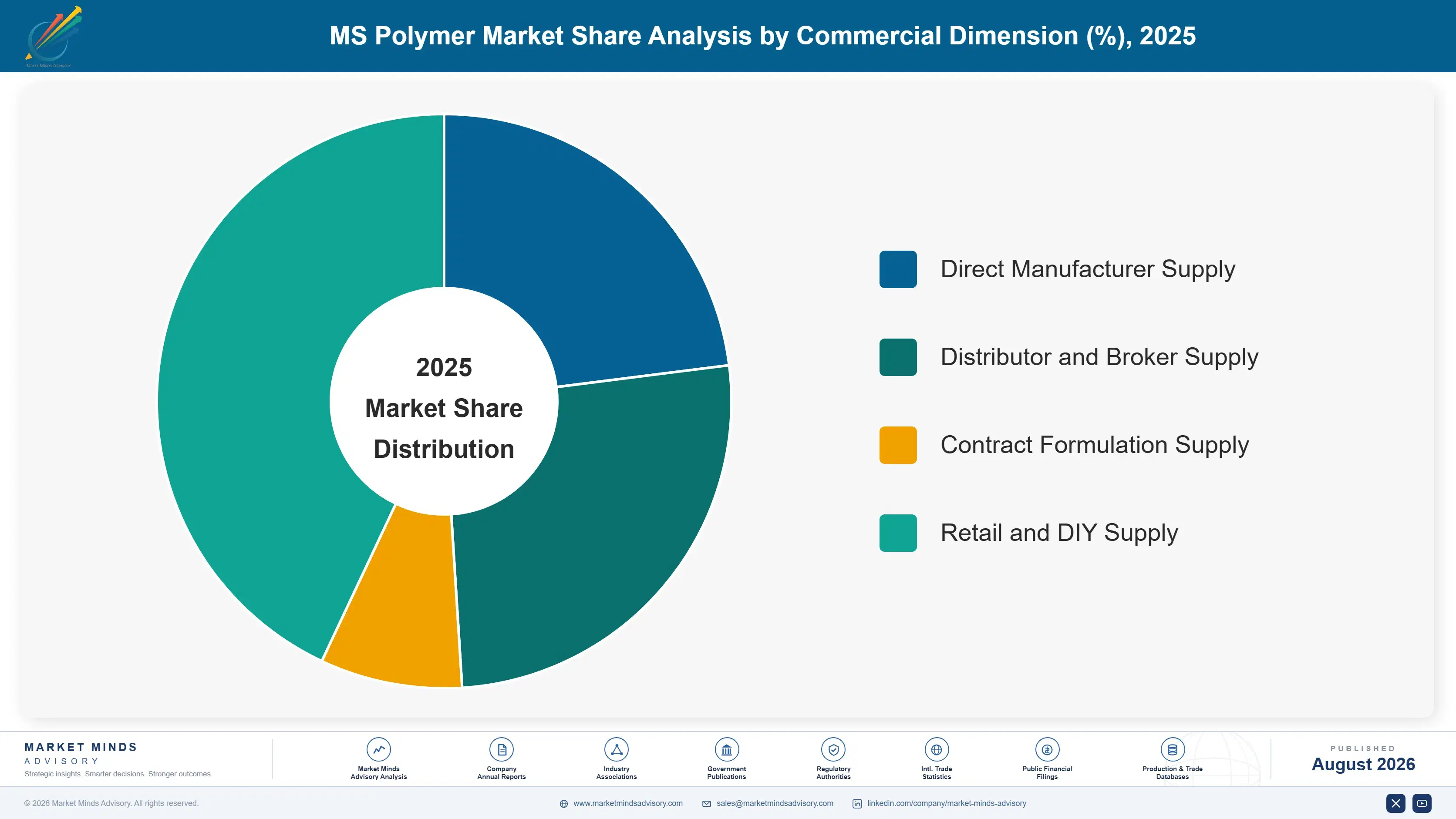
Segmentation follows end-use application within the MS polymer market, the classification producers and formulators both use for procurement and performance certification, spanning construction joint sealants, structural glazing adhesives, automotive structural and panel bonding, marine and industrial assembly, and flooring and expansion joint applications across five categories, rather than mixing application logic. Buyers rarely mix these in one procurement decision.
ms-polymer-market-trends-market-share-analysis-1787556537909

Automotive Structural and Panel Bonding Adhesives

Automotive structural and panel bonding adhesives represent the fastest-growing segment as vehicle manufacturers increasingly replace mechanical fasteners and spot welds with MS polymer bonding that reduces vehicle weight while improving crash energy distribution across the body structure. Formulation complexity is substantial, since bond line thickness, cure speed, and crash performance requirements vary meaningfully across vehicle platform and body material composition, requiring producers to maintain extensive application engineering capability tailored to individual automaker specifications. Producers with dedicated automotive bonding depth are capturing disproportionate platform contract share, commanding average selling prices well above standard construction-grade sealants. Demand concentrates among North American and European vehicle platforms first, with adoption spreading rapidly into Asian automotive manufacturing capacity worldwide.
CAGR 9.0%

Construction Joint Sealants

Construction joint sealants remain the largest segment as building envelope contractors continue specifying MS polymer for expansion joints, window perimeter sealing, and general construction bonding that satisfies tightening low-VOC building code requirements. This segment overlaps functionally with structural glazing adhesives in weatherproofing application but is defined specifically by its general joint-sealing role rather than load-bearing structural attachment, since buyers qualify producers on measurable movement capability and weatherability rather than structural load performance alone. Producers with established construction distribution scale continue capturing volume from cost-sensitive accounts across mature building materials markets. Growth is fastest in India and Southeast Asia, where organized construction manufacturing concentrates most heavily today. Early standardization advantage compounds steadily as code deadlines approach across jurisdictions.
CAGR 5.4%
Full segment breakdown across 5 segments available in the complete report.

Regional Architecture and Country Demand Map

East Asia leads global consumption on concentrated construction and automotive manufacturing scale, followed by North America and Western Europe on organized low-VOC regulation and automotive bonding adoption, with South Asia and Pacific expanding fastest as India's sectors scale rapidly. Latin America and Eastern Europe trail on smaller manufacturing bases.

North America

United States commercial construction and automotive manufacturers drive the bulk of regional demand, with producers expanding automotive structural bonding capacity as vehicle weight reduction programs scale across most major manufacturing plants nationwide today. Canada's smaller but steadily growing construction sealant sector mirrors United States specification trends closely, with a modest adoption lag concentrated mainly in eastern provinces. Commercial glazing contractors account for a rising share of regional procurement as low-VOC building code compliance requirements tighten across major metropolitan markets. Technical formulation support continues expanding across major construction and automotive relationships nationwide today. Distributor consolidation is also accelerating as larger regional players absorb smaller independent formulators nationwide today. This trend is most pronounced across Sun Belt manufacturing corridors.
Share: 23% | CAGR: 6.3% (2026 to 2036)

Western Europe

Germany and France anchor regional demand through well-established automotive and construction sectors that adopted MS polymer early given stringent European Union volatile organic compound regulation, giving regional producers deep formulation expertise other markets are only now developing. The United Kingdom's construction sector continues expanding low-VOC specification targeting sustainability-conscious developers willing to pay for documented emissions certification. Nordic markets show disproportionate demand for cold-climate-optimized formulations tied to regional structural glazing requirements. Producer qualification cycles in the region run longer than in North America given stricter European Union chemical registration and automotive crash certification requirements. Belgium and the Netherlands contribute meaningful automotive demand tied to regional vehicle assembly activity broadly. This pattern is most visible across major automotive manufacturing clusters.
Share: 19% | CAGR: 5.3% (2026 to 2036)
Regional intelligence for 5 additional markets available in the complete report: East Asia, South Asia and Pacific, Latin America, Middle East and Africa, Eastern Europe. Contact sales@marketmindsadvisory.com.
ms-polymer-market-trends-country-cagr-analysis-1787556538413

Where MS Polymer Producers Defend Bonding Margin

Producers are shifting from selling commodity sealant volume to selling documented bonding performance and application support, bundling durability testing services, application chemistry consultation, and long-term supply agreements into contracts that command materially higher margin than standard sealant supply alone, a transition rewarding technical depth over raw production scale. Speed to certification increasingly determines which producers win multi-year specification accounts.

Durability Testing Services as a Bundled Specification Offering

Producers that package dedicated durability and adhesion testing alongside resin supply are capturing 15 to 23% higher account-level margin than those selling commodity sealant alone, since construction and automotive buyers increasingly outsource validation work rather than build internal testing capability. This shift favors producers with dedicated application laboratories over smaller regional formulators lacking testing infrastructure. Henkel and Sika have both expanded dedicated bonding testing centers since 2023 specifically to capture this documentation-driven premium across major specification accounts. This dynamic is prompting more producers to expand dedicated application laboratories broadly. Adoption is expanding steadily.
Market Impact: Lifts account-level margin by 15 to 23 percent

Automotive Crash Performance Validation for Structural Bonding Programs

Offering pre-validated crash performance data alongside structural bonding adhesive supply lets producers compress automaker qualification timelines from a lengthy independent testing process to a bundled certification package, directly winning platform contracts ahead of competitors still completing individual crash testing. This lever works because automaker scorecards increasingly reward validated crash data, making certification depth a commercial differentiator rather than simply a supply arrangement. Producers offering this validation report contract win rates roughly 27% higher than those quoting standard adhesive supply alone. This edge compounds further as automaker scorecards increasingly reward validated crash performance data.
Market Impact: Lifts contract win rates by roughly 27 percent

Vertical Integration Into Silane-Terminated Resin Synthesis

Producers developing in-house silane-terminated resin synthesis capability are winning premium construction and automotive contracts from buyers seeking supply security amid feedstock volatility, capturing account-level pricing 13 to 21% above producers dependent entirely on external resin sourcing. This approach requires meaningful capital investment that most smaller regional formulators cannot easily fund, concentrating adoption among the largest, best-capitalized MS polymer producers currently operating in the category. Early movers report contract renewal rates meaningfully higher than producers still relying entirely on external procurement across major accounts. This integration advantage compounds further as silane volatility concerns intensify industrywide.
Market Impact: Commands a 13 to 21 percent integration premium

Regional Formulation Co-Location Near Construction and Automotive Hubs

Establishing MS polymer formulation capacity directly adjacent to major construction and automotive manufacturing clusters in China, India, or the American Sun Belt cuts logistics lead time from roughly 5 weeks to 6 days, a decisive advantage for construction and automotive buyers running just-in-time specification schedules that cannot absorb import delays. Producers with co-located capacity also reduce exposure to the ocean freight volatility that disrupted specialty chemical supply chains repeatedly between 2021 and 2023. This lever requires meaningful capital investment, concentrating adoption among the largest global producers rather than mid-sized regional players still serving customers through centralized export.
Market Impact: Cuts lead time from 5 weeks to 6 days

Who Controls the Margin Pool

The top five producers hold an estimated 52% combined share on a production capacity basis, a moderately consolidated market shaped by the technical complexity of silane-terminated resin synthesis and formulation know-how accumulated over decades. The gap between established leaders and mid-sized regional challengers is real but narrower than in more capital-intensive chemical categories, since formulation expertise can be built faster than heavy synthesis infrastructure with the right specialized investment.
Current competitive activity centers on three dimensions: racing to expand automotive structural bonding capability ahead of rising vehicle weight reduction demand, building durability testing depth to win construction specification loyalty, and establishing regional formulation capacity closer to Asian construction and automotive clusters to compress lead times against import-dependent competitors, a race shaping which producers win multi-year specification agreements.

Pressure is building from Asian producers developing lower-cost MS polymer formulations that could let smaller, more focused formulators challenge established players on price without matching their decades of accumulated bonding certification credibility. Regional producers are also gaining share in domestic specification contracts where local formulation knowledge and distribution reach matter more than global brand reputation, eroding the advantage multinational producers once held on technical scale alone.
ms-polymer-market-trends-company-positioning-matrix-1787556538929

Competitive Moat and Risk Dimensions

HENKEL AG

Moat: Dominant automotive bonding integration

Henkel's decades-old automotive customer relationships and structural bonding certification infrastructure give it crash validation and application engineering know-how that smaller producers cannot easily replicate, particularly for complex vehicle platform projects requiring extensive iterative crash testing across varying body material specifications nationwide. This accumulated certification depth remains difficult for newer entrants to replicate quickly.
HENKEL AG

Risk: High fixed testing cost base

Henkel's extensive crash testing and application engineering infrastructure creates a high fixed cost base that smaller, more focused regional competitors do not carry, a constraint that periodically compresses margin when automotive volume growth fails to keep pace with the capacity investment required to maintain testing scale.
KANEKA CORPORATION

Moat: Deep silane-terminated resin heritage

Kaneka's decades-old integration relationships across the MS polymer chemistry it originated give it formulation and synthesis advantages that newer entrants cannot replicate quickly, letting it command premium pricing on high-performance resins at technical depth regional producers cannot consistently match at comparable scale. This accumulated formulation depth remains difficult for competitors to replicate quickly.
KANEKA CORPORATION

Risk: Slower Western market expansion pace

Kaneka's concentrated Asian focus creates organizational inertia that slows its response to fast-moving North American and European automotive bonding trends, leaving openings for more Western-focused competitors to capture premium accounts before Kaneka fully commits regional expansion resources at comparable scale nationwide today. This regional imbalance leaves meaningful revenue exposed to slower-moving Western account cycles.

Players Tracked

Prominent Players

Henkel AG
Sika AG
Kaneka Corporation
Wacker Chemie
H.B. Fuller

Other Key Players

3M Company
Bostik SA
Dow Inc
Momentive Performance Materials
Shin-Etsu Chemical
Illinois Tool Works
Franklin International
Mapei SpA
ITW Devcon
Master Builders Solutions
Pidilite Industries
Fosroc International
Asian Paints PPG
Berger Paints Adhesives
Huntsman Corporation

Recent Developments

APRIL 2025

Henkel Expands Automotive Bonding Testing Capacity in Michigan

Henkel completed an expansion of its Michigan automotive bonding testing facility, adding dedicated crash simulation and durability testing lines to serve growing North American vehicle weight reduction demand and shorten regional lead times for automakers, with the expanded facility reaching full operational capacity during 2026 across multiple parallel testing lines.
Signal: Signals producers increasingly prioritizing domestic automotive testing capacity ahead of expanding structural bonding adoption nationwide across affected platforms.
SEPTEMBER 2024

Sika Divests Non-Core Roofing Membrane Assets

Sika AG divested a portfolio of non-core roofing membrane assets to a specialty building products buyer as part of portfolio rationalization, redirecting capital toward its core sealant and structural bonding platforms following several years of broader building materials portfolio expansion that diluted focus on core bonding strengths.
Signal: Indicates continued producer focus toward higher-margin bonding capability over diversified roofing membrane exposure amid tightening capital discipline.
JANUARY 2026

Kaneka Signs Long-Term Silane Supply Agreement

Kaneka Corporation signed a multi-year silane feedstock supply agreement with a major specialty chemical producer, locking in volume and partially insulating input pricing from spot market volatility tied to broader specialty chemical market disruption affecting MS polymer synthesis across several major Asian manufacturing sites worldwide.
Signal: Indicates producers favoring long-term feedstock supply agreements over spot purchasing to stabilize input cost exposure across multi-year contracts.

Silane and Polyether Exposure

Silane and polyether inputs together represent roughly 46% of cost of goods sold for a typical MS polymer producer, with silane alone accounting for close to a quarter of total input cost given its role as the primary terminal reactive group, a cost structure that leaves smaller producers particularly exposed to specialty chemical price swings. Producers with narrower feedstock diversification face particularly acute exposure during periods of tightened silane supply.
Silane prices rose an estimated 23% between 2021 and 2022 following broader specialty chemical market disruption tied to plant capacity constraints and competing silicone industry demand for comparable silane-grade feedstock, according to trade data tracked through the US Census Bureau and corroborated by producer annual report commentary on input cost pressure during the period, with several producers citing the disruption explicitly in investor communications as a material margin headwind.

Larger producers with diversified silane sourcing across multiple regions absorb volatility more effectively than smaller regional formulators dependent on single-origin supply contracts. This creates a lasting cost disadvantage for smaller players during disruption periods, pushing some toward increased use of alternative terminal chemistry despite the technical qualification work those alternatives require across affected production lines.
ms-polymer-market-trends-cost-volatility-analysis-1787556539123

Multi-Origin Silane Sourcing Diversification

Producers are qualifying silane origins across North America, Europe, and Asia alongside traditional supply relationships, reducing single-region concentration risk even though full substitution remains limited by reactive group purity requirements, a process several major producers accelerated significantly following the 2021 to 2022 silane price disruption that first exposed the category's sourcing vulnerability clearly. Adoption has accelerated meaningfully since 2023.

Alternative Terminal Chemistry Development

Several producers are investing in alternative low-cost terminal chemistry technology to reduce dependency on constrained legacy silane sourcing entirely, offering long-term cost stability and reduced supply risk once production scales, though current alternative systems remain meaningfully more expensive than traditional silane at present commercial volumes across most product lines. Adoption is accelerating steadily among larger producers.

Long-Term Supply Contracts With Specialty Chemical Producers

Several producers have signed multi-year supply agreements directly with silane and polyether producers, locking in volume and partially insulating pricing from spot market volatility during acute disruption periods tied to plant capacity shocks or competing silicone industry demand shifts, giving contracted producers materially more predictable input costs than competitors relying on spot purchasing. Renewal terms are extending further too.

Portfolio Architecture for Margin Defence

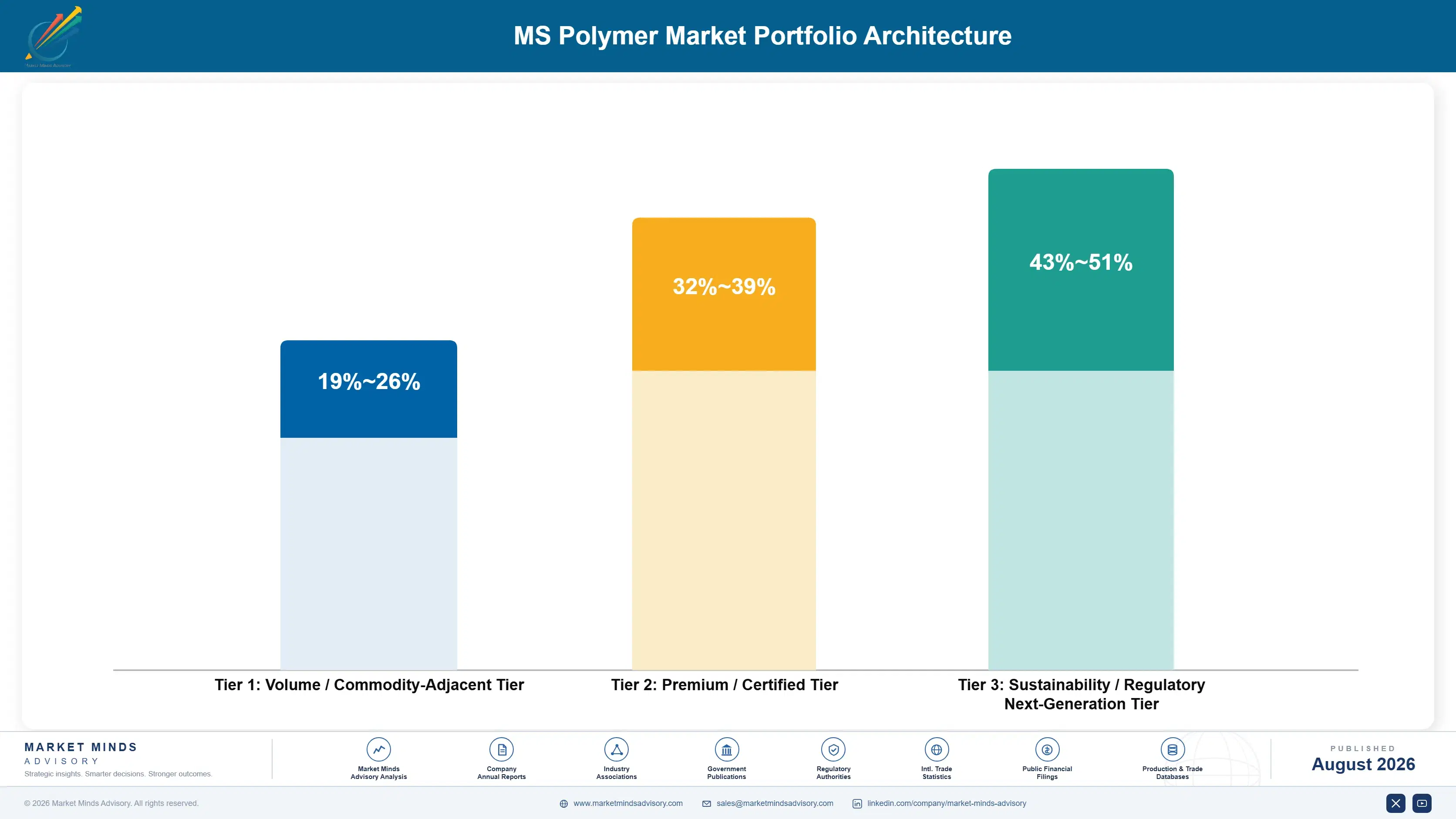
The portfolio splits across three tiers with materially different margin economics: volume-grade standard construction sealants carrying thin margins under intense price competition, certified structural glazing and marine-grade adhesives commanding a meaningful premium, and next-generation automotive structural bonding systems capturing the highest margins currently available in the category, a spread wide enough that certification investment strategy now matters more to producer profitability than raw production volume. Some producers are accelerating certification investment to capture this shift ahead of competitors.
The volume versus premium tension is acute right now because construction and automotive buyers increasingly demand certified, high-performance systems, compressing the addressable market for standard sealants faster than producers can shift capacity toward higher-value alternatives, leaving some producers holding underutilized legacy formulation lines across several manufacturing regions. Some producers are accelerating certification conversion to capture this shift ahead of competitors.

High-value margin pools concentrate specifically in automotive structural bonding for vehicle weight reduction programs and structural glazing systems carrying multi-jurisdiction certification, both of which command premium pricing tied to formulation complexity and testing depth rather than raw material cost alone, rewarding producers with diversified feedstock sourcing that invested early in application chemistry technology over those competing purely on scale.

Volume / Commodity-Adjacent Tier

Standard construction sealants sold primarily on price into mainstream joint sealing and general bonding applications, facing intense competitive pressure from traditional silicone alternatives and carrying thin, increasingly squeezed margins as buyers shift toward certified, higher-value systems.
Gross Margin: 19%-26%

Premium / Certified Tier

Structural glazing and marine-grade adhesives commanding premium pricing tied to documentation, regulatory compliance support, and validated weatherability and durability performance across demanding scenarios that commodity sealants cannot reliably match at comparable manufacturing scale.
Gross Margin: 32%-39%

Sustainability / Regulatory / Next-Generation Tier

Automotive structural bonding systems serving premium regulated and crash-critical applications at the highest technical complexity, commanding premium pricing tied to formulation engineering few competitors currently possess at meaningful commercial scale today worldwide.
Gross Margin: 43%-51%
ms-polymer-market-trends-portfolio-architecture-1787556539620

High-value Sub-segments and Strategic Watch-out

Automotive Structural Bonding Systems

Highest-value, fastest-growing segment driven by expanding vehicle weight reduction programs, commanding premium pricing on crash validation and formulation technology competitors cannot easily replicate, since building comparable certification credibility typically requires several more years of dedicated testing investment across multiple vehicle platforms. Adoption is spreading quickly across premium vehicle platforms nationwide.
Gross Margin: 44%-52%

Structural Glazing Certified Systems

High-value segment growing steadily as commercial developers extend regulatory compliance into documented weatherability targets, with margin supported by application engineering rather than raw technical complexity alone, favoring producers with strong regulatory affairs capability. Adoption concentrates among early high-rise developers. Regulatory tailwinds continue strengthening this position across major markets.
Gross Margin: 34%-42%

Standard Construction Joint Sealants

Volume core of the category, serving mainstream construction applications with stable but thin margins under sustained price competition among producers, where production scale and distribution efficiency matter more than technical sophistication for winning large-volume contracts across mature and expanding export markets today. Distribution efficiency matters most here.
Gross Margin: 20%-27%

Legacy Non-Certified Standard Sealants

Strategic watch-out segment facing steady, accelerating decline as low-VOC regulation and structural certification requirements both favor higher-value certified alternatives, leaving producers reliant on this tier exposed to shrinking addressable volume and thinning margin over time as jurisdictions complete their regulatory adoption programs across every major market worldwide.
Gross Margin: 11%-17%

Specification Relationships and Producer Loyalty

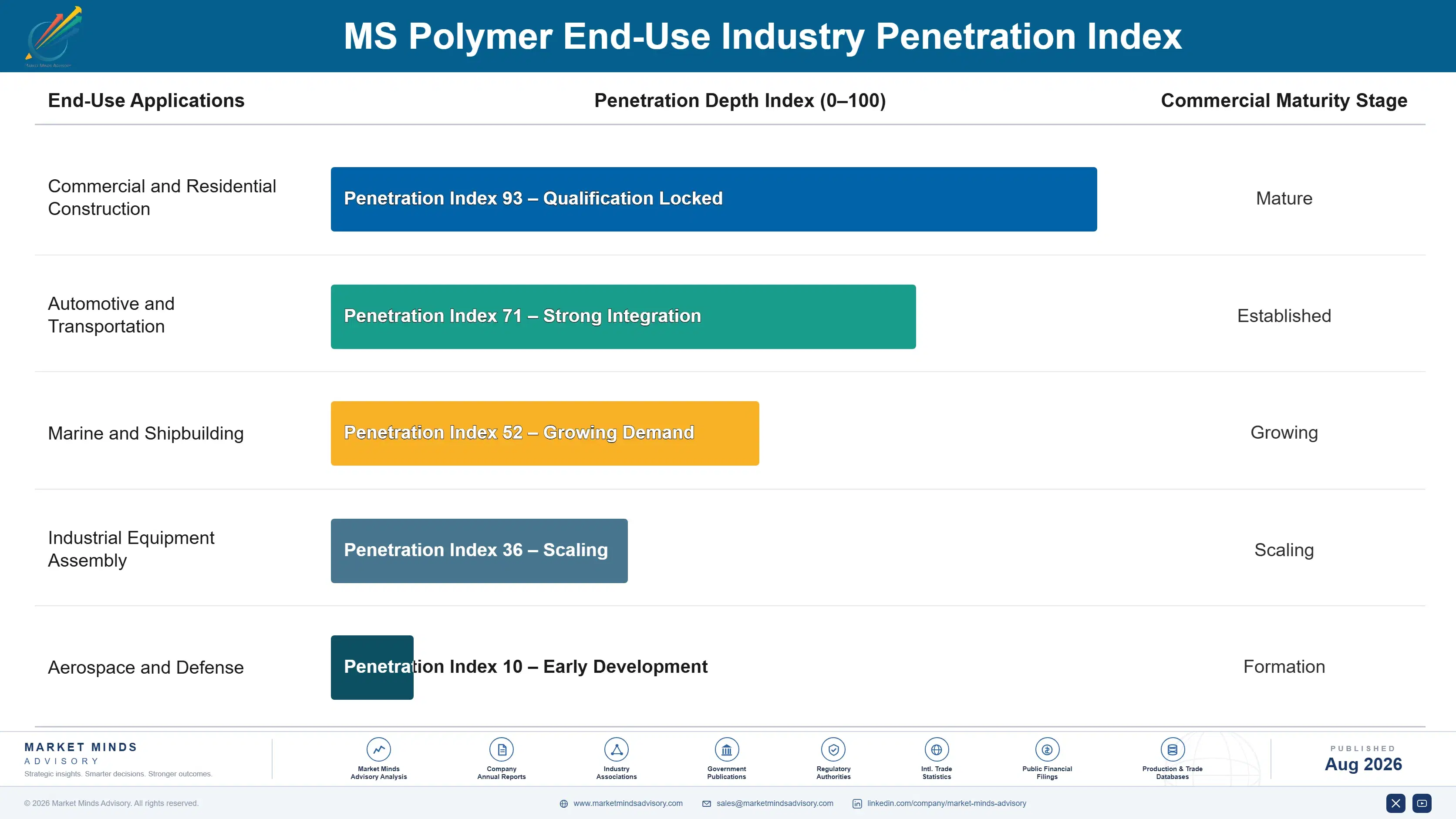
MS polymer demand behaves like an annuity once a producer wins a construction or automotive specification relationship, since buyers rarely re-qualify sealant or adhesive suppliers mid-program given the cost and risk of revalidating bonding and weatherability performance, giving incumbent producers multi-year revenue visibility on won accounts, a dynamic that makes initial specification wins disproportionately valuable relative to their first-year revenue alone. Renewal cycles typically span four to seven years tied to product reformulation and platform lifecycles.
Adoption depth varies sharply by end-use vertical: established North American and European automotive and structural glazing relationships show the deepest, most entrenched producer relationships given decades-long qualification stability, while emerging Indian and Southeast Asian construction and automotive categories remain more contestable as buyers actively experiment with new formulators during early specification development phases, when switching costs remain low and requirements have not yet been finalized.

A generational shift in buyer profiles is underway as younger construction and automotive engineering teams, increasingly focused on emissions compliance and lightweighting documentation, prioritize verified performance data and diversified feedstock sourcing over the decades-long supplier relationships and standard-grade specifications that defined procurement at legacy manufacturers still relying on outdated formulation practices.
ms-polymer-market-trends-end-use-penetration-index-1787556540113

Priorities for MS Polymer Producers

These are among the four positions where our research anticipates prominent divergence between winners and laggards over the coming forecast period. Each is grounded in the demand model, the regulatory perimeter, and the announced capacity pipeline.
01 / AUTOMOTIVE BONDING PRIORITY

Accelerate structural certification capacity ahead of demand

Producers still lacking documented automotive structural bonding certification face a shrinking addressable market as vehicle weight reduction programs and crash performance standards tighten simultaneously across major automotive manufacturing jurisdictions nationwide and internationally today. The window to pre-validate crash performance against expanding platform benchmarks is narrowing quickly as faster-moving competitors capture contracts ahead of producers still completing internal testing cycles. Producers that delay risk losing multi-year automotive relationships to faster-moving rivals carrying pre-certified portfolios into every renewal negotiation across every major account.
02 / FEEDSTOCK DIVERSIFICATION STRATEGY

Reduce silane concentration risk across supply regions

Single-region feedstock dependency has produced repeated price shocks tied to silane market volatility over the past several years, directly compressing margins for producers without diversified sourcing across North America, Europe, and Asia. Qualifying multiple silane origins reduces exposure meaningfully, though full substitution requires formulation validation since reactive group purity differs across sources. Producers that fail to diversify remain persistently vulnerable to the next feedstock disruption event affecting their primary supply base without a diversified strategy well ahead of the next disruption cycle.
03 / STRUCTURAL GLAZING INVESTMENT

Build weatherability certification ahead of consolidation demand

Structural glazing certified systems represent the fastest-growing and highest-margin construction segment, but require weatherability testing infrastructure and multi-jurisdiction validation that most commodity-focused producers currently lack entirely, particularly around durability certification integration work. Building this capability now positions producers to capture premium developer accounts before the segment fully matures and margins inevitably compress under intensifying competitive pressure from new entrants entering the category. Late entrants will face steeper technical catch-up costs, arriving after early movers have already locked in the accounts that matter most.
04 / REGIONAL CAPACITY PLACEMENT

Prioritize East Asian and South Asian production co-location

Concentrated construction and automotive manufacturing in China and rapid growth in India and Southeast Asia make co-located formulation production increasingly decisive for lead time performance and overall cost competitiveness. Producers still serving these markets through centralized export face a growing cost and speed disadvantage against regionally established competitors already operating co-located capacity closer to major construction and automotive clusters. Capital committed to regional capacity now compounds advantage steadily as construction and automotive production volume continues expanding through the forecast period.

Engagement Snapshot From the Field

A live engagement with an industry participant carrying material or product regulatory and market exposure ahead of a defining policy shift, showing how our research translates into a defensible multi-year portfolio strategy.
MARKET MINDS ADVISORY · CLIENT ENGAGEMENT SUMMARY
MS Polymer Producer Strategic Portfolio Review and Transition Roadmap 2026·Investment Scenario on MS Polymer Exposure Evaluation 2025-26
CLIENT PROFILE
The client is a mid-sized regional automotive Tier 1 supplier manufacturing body panel assemblies for several vehicle platforms across the American Midwest, with reported annual adhesive procurement volume exceeding 640 metric tons (client-reported, unverified by MMA) prior to engaging MMA for MS polymer supplier selection support ahead of a new lightweight platform launch. The client had not previously worked with an MS polymer producer at this scale.
STRATEGIC CHALLENGE
Facing a customer request to reduce body panel weight by adopting structural bonding for a new vehicle platform with a sixteen-month launch deadline, the client's existing adhesive suppliers had not yet validated crash performance data for the required bonding configuration, risking loss of the platform contract to better-prepared competitors if validation could not be completed on schedule.
MMA APPROACH
MMA conducted a supplier capability assessment across five candidate MS polymer producers, benchmarking crash validation depth, formulation testing history, and regional production capacity, then facilitated a structured qualification process that compressed the client's typical supplier evaluation timeline substantially against historical qualification cycles, drawing on MMA's primary survey and expert interview data throughout the engagement.
KEY FINDINGS
  1. Only two of five evaluated producers had pre-validated crash performance data ready for immediate qualification against the client's bonding configuration. This narrowed the client's viable supplier field considerably.
  2. Switching to a pre-validated structural bonding supplier reduced projected qualification timeline from an estimated fourteen months to under eight months. This compressed timeline preserved the platform launch schedule.
  3. Feedstock sourcing diversification among finalist producers correlated strongly with the pricing stability commitments the client required for multi-year contract terms. This informed the client's long-term contracting strategy.
  4. Bundled crash validation and regulatory compliance services materially reduced the client's internal engineering burden during the entire qualification transition period. This freed internal engineering resources for other priorities.
CLIENT PROFILE
The client is a mid-sized regional automotive Tier 1 supplier manufacturing body panel assemblies for several vehicle platforms across the American Midwest, with reported annual adhesive procurement volume exceeding 640 metric tons (client-reported, unverified by MMA) prior to engaging MMA for MS polymer supplier selection support ahead of a new lightweight platform launch. The client had not previously worked with an MS polymer producer at this scale.
STRATEGIC CHALLENGE
Facing a customer request to reduce body panel weight by adopting structural bonding for a new vehicle platform with a sixteen-month launch deadline, the client's existing adhesive suppliers had not yet validated crash performance data for the required bonding configuration, risking loss of the platform contract to better-prepared competitors if validation could not be completed on schedule.
MMA APPROACH
MMA conducted a supplier capability assessment across five candidate MS polymer producers, benchmarking crash validation depth, formulation testing history, and regional production capacity, then facilitated a structured qualification process that compressed the client's typical supplier evaluation timeline substantially against historical qualification cycles, drawing on MMA's primary survey and expert interview data throughout the engagement.
KEY FINDINGS
  1. Only two of five evaluated producers had pre-validated crash performance data ready for immediate qualification against the client's bonding configuration. This narrowed the client's viable supplier field considerably.
  2. Switching to a pre-validated structural bonding supplier reduced projected qualification timeline from an estimated fourteen months to under eight months. This compressed timeline preserved the platform launch schedule.
  3. Feedstock sourcing diversification among finalist producers correlated strongly with the pricing stability commitments the client required for multi-year contract terms. This informed the client's long-term contracting strategy.
  4. Bundled crash validation and regulatory compliance services materially reduced the client's internal engineering burden during the entire qualification transition period. This freed internal engineering resources for other priorities.
RECOMMENDED STRATEGY
Phase 1: Phase 1 (Months 1 to 2): Complete producer capability benchmarking and shortlist finalists based on crash validation readiness and sourcing diversification. Phase 2: Phase 2 (Months 3 to 8): Run parallel crash simulation and durability validation against the platform's tightened specification benchmarks. Validation milestones were reviewed monthly throughout. Phase 3: Phase 3 (Months 9 to 16): Execute phased production ramp and finalize long-term supply agreement with selected producer partner. Staff completed transition training throughout.
OUTCOME
The client completed structural bonding qualification and launched the platform within the customer's deadline, winning the contract representing a substantial expansion of the client's total annual adhesive volume (client-reported, unverified by MMA), while establishing a diversified two-supplier sourcing structure reducing future disruption risk across its full production portfolio going forward.

Frequently Asked Questions

Foundational context covering the market sizes, CAGR, scope, country, region and competition that inform every finding below. This section is provided to cover basics and most often pre-purchase conversations, answered from the MMA Primary Research Dataset.

What is the current size of the MS Polymer Market?

The global MS polymer market is valued at approximately USD 2.3 billion in 2025. This figure covers construction joint sealants, structural glazing adhesives, automotive structural bonding, and marine and industrial assembly applications.

How large will the MS Polymer Market be by 2036?

The market is projected to reach approximately USD 4.62 billion by 2036 under the base case scenario. This reflects sustained low-VOC conversion and automotive structural bonding demand.

What is the CAGR for the MS Polymer Market 2026 to 2036?

The base case CAGR is 6.5% across the 2026 to 2036 forecast period, reflecting strong regulatory-driven momentum. Bull and bear scenarios range from 5.2% to 7.8% depending on silane price stability.

Which segment is growing fastest?

Automotive structural and panel bonding adhesives are the fastest-growing segment at a 9.0% CAGR. This reflects vehicle manufacturers increasingly replacing mechanical fasteners with structural bonding worldwide.

Who are the major companies in the MS Polymer Market?

Leading producers include Henkel AG, Sika AG, Kaneka Corporation, Wacker Chemie, and HB Fuller. These five companies hold an estimated 52% combined market share on a production capacity basis.

Which country is growing fastest?

India leads growth at an estimated 8.5% CAGR, driven by expanding organized construction and automotive manufacturing formalization. Rising industrial investment is the primary growth engine.

Report Segmentation Architecture

The full report scope spans multiple orthogonal segmentation dimensions, with cross-tabulated demand data provided for each dimension pair. Coverage extends further to regional breakdowns, trend trajectories, and the competitive detail needed to support segment-level decision-making.

By End-Use Application

  • Construction Joint Sealants
  • Structural Glazing Adhesives
  • Automotive Structural and Panel Bonding
  • Marine and Industrial Assembly
  • Flooring and Expansion Joints

By End-Use Industry

  • Commercial and Residential Construction
  • Automotive and Transportation
  • Marine and Shipbuilding
  • Industrial Equipment Assembly
  • Aerospace and Defense

By Commercial Dimension

  • Direct Manufacturer Supply
  • Distributor and Broker Supply
  • Contract Formulation Supply
  • Retail and DIY Supply

By Region

  • North America
  • Western Europe
  • East Asia
  • South Asia and Pacific
  • Latin America
  • Middle East and Africa
  • Eastern Europe

Scope, Methodology, and Coverage

Every figure in this report is reproducible from documented input assumptions. The scope below maps the historical period, the forecast horizon, the segmentation dimensions, and the countries covered, alongside the underlying primary and qualitative methodology.
Historical Period
2020 to 2025
Forecast Period
2026 to 2036
Base Year
2025 (USD billions; MMA Primary Research Dataset, August 2026)
Market Definition
This report covers silyl-modified polymer sealants and adhesives based on silane-terminated polyether resin chemistry, used in construction joint sealing, structural glazing, automotive bonding, and industrial assembly applications. It excludes traditional silicone sealants without silane-terminated polyether backbone chemistry, polyurethane sealants and adhesives, and epoxy structural adhesive systems with distinct curing chemistry.
Quantitative Units
USD billions (current prices); metric tons for select segment analysis
Segmentation Dimensions
By End-Use Application; By End-Use Industry; By Commercial Dimension; By Region
Regions Covered
North America, Western Europe, East Asia, South Asia and Pacific, Latin America, Middle East and Africa, Eastern Europe
Countries Covered
USA, Canada, Germany, France, UK, China, Japan, South Korea, India, Australia, Brazil, Mexico, Thailand, Vietnam, UAE, Saudi Arabia, South Africa, Nigeria, Turkey, Poland, Hungary, Czechia, Romania, and additional markets relevant to this sector
Key Companies Profiled
Henkel AG, Sika AG, Kaneka Corporation, Wacker Chemie, H.B. Fuller, 3M Company, Bostik SA, Dow Inc, Momentive Performance Materials, Shin-Etsu Chemical, Illinois Tool Works, Franklin International, Mapei SpA, ITW Devcon, Master Builders Solutions, Pidilite Industries, Fosroc International, Asian Paints PPG, Berger Paints Adhesives, Huntsman Corporation
Quantitative Methodology
Primary survey, n=3,800 respondents, Q4 2025, six countries; demand-side model with trade association cross-validation
Qualitative Methodology
47 expert interviews, Q4 2025; applied to validate demand model assumptions, identify emerging dynamics, and assess competitive positioning
Report Format
PDF and XLSX data workbook (Word format preview document)
Publisher
Market Minds Advisory
Report Code
MMA-2026-CHM-325
Published
August 2026
Contact
sales@marketmindsadvisory.com | www.marketmindsadvisory.com

Purchase the full MS Polymer Market Report (2026 to 2036).

The full report delivers a complete quantitative and qualitative assessment of the global MS polymer market across all five end-use application segments and seven regions. It includes detailed producer profiles covering formulation capability, production capacity, and regulatory positioning for the twenty companies profiled. Analysts provide scenario-adjusted forecasts through 2036 alongside input cost sensitivity modeling tied to silane price volatility. Buyers receive access to underlying primary survey and expert interview data supporting all quantitative claims, along with an automotive structural bonding adoption tracker across major vehicle platform programs worldwide today.
Segment-level forecasts through 2036 across all five application categories
Seven-region demand, pricing, and CAGR breakdown tables
Twenty-company competitive profiling with moat and risk analysis
Silane and polyether supply risk assessment and mitigation pathways
Automotive structural bonding adoption tracker across major platforms
Quarterly market update subscription option for ongoing monitoring

Built For The People Who Decide

From boardroom strategy to bench-side execution, this report is read cover-to-cover by leaders shaping the next decade of their industry, turning demand scenarios, market dynamics and valuation benchmarks into decisions.
CXOs/ Presidents/ VPs/ Managers
M&A and Corporate Development
Strategy Teams and R&D Heads
Procurement and Product Directors
Regulatory and Compliance Leaders
Investor Relations and Equity Analysts