

Market Minds Advisory
MPLS-based Core Network Market

MPLS-based Core Network Market: MPLS-based Core Network Market. Hybrid Architectures Extend a Mature Technology's Life

Enterprises keep discovering that ripping out MPLS entirely creates reliability gaps SD-WAN alone cannot close for latency-sensitive traffic, turning hybrid coexistence rather than wholesale replacement into the dominant network architecture decision.

Lead Analyst

Published

September 2026

Make Smarter Decisions with Customized Research Insights

Request a free sample report and evaluate market opportunities, growth trends, and competitive dynamics relevant to your business needs.

2025 MARKET VALUE$12.6BMarket Size 2025
2036 FORECAST VALUE$22.5BBase Case , 2026 to 2036
CAGR 2026 TO 20365.4 %Bull 6.6% / Bear 4.2%
INCREMENTAL OPPORTUNITY$9.2BNet 10- year value creation
EXPANSION MULTIPLE1.69x2036 value over 2026 base
Strategic Levers
M&A Pipeline
Regional Outlook
Country Rankings
Competitive Intelligence
Segmental Deep-dive
Call-Us : 91 93563 13602

Executive Snapshot and Market Trajectory.

MPLS-based core networks have moved from the default enterprise WAN architecture to one layer within a hybrid network stack as SD-WAN adoption accelerates for cost-sensitive branch traffic. Network architects now specify which traffic classes stay on MPLS before finalizing a WAN redesign.
MPLS-to-SD-WAN hybrid transition services are growing fastest as enterprises retain MPLS for latency-sensitive applications while shifting bulk traffic to lower-cost internet transport, while managed MPLS services consolidate a separate but adjacent budget line concentrated in North America's dense enterprise WAN base and East Asia's expanding carrier infrastructure investment. Enterprises increasingly demand documented service-level guarantees for latency and jitter. That requirement barely existed as a standard procurement criterion five years ago.
Large network equipment vendors compete against a handful of specialized managed service providers now bundling MPLS into broader hybrid WAN platforms, and rising demand for measurable uptime and latency performance is starting to separate providers with genuine field-proven carrier-grade infrastructure from those still selling on bandwidth specifications alone. Providers that document concrete service-level performance are winning larger multi-year enterprise contracts that smaller unproven competitors increasingly cannot match on credibility in this maturing category today.
Market Definition
This report defines the MPLS-based Core Network Market as network equipment, managed services, and software that provision and operate multiprotocol label switching networks for enterprise and carrier wide area network connectivity. It excludes pure internet-based SD-WAN services without an underlying MPLS transport component and local area network switching equipment.
Base Year Value
$12.6B in 2025 (MMA Primary Research Dataset, September 2026)
Forecast Period
2026 to 2036, eleven discrete annual values
CAGR
5.4% base case. Bull 6.6%. Bear 4.2%.
Fastest Growth Segment
MPLS-to-SD-WAN Hybrid Transition Services: 9.8% CAGR
Fastest Growth Country
India: 8.4% CAGR
Fastest Growth Region
South Asia and Pacific: 7.4% CAGR
Largest Region
North America: 30% of 2025 global value
Market Leaders
Cisco Systems, Nokia, Juniper Networks, Huawei Technologies, and Ciena Corporation. Source: MMA Analysis based on company disclosures and deployed port count estimates.
Primary Survey
n=3,800 procurement and R&D decision-makers, Q4 2025, six countries
Methodology
Demand-side build-up, cross-validated against public data, 47 expert interviews

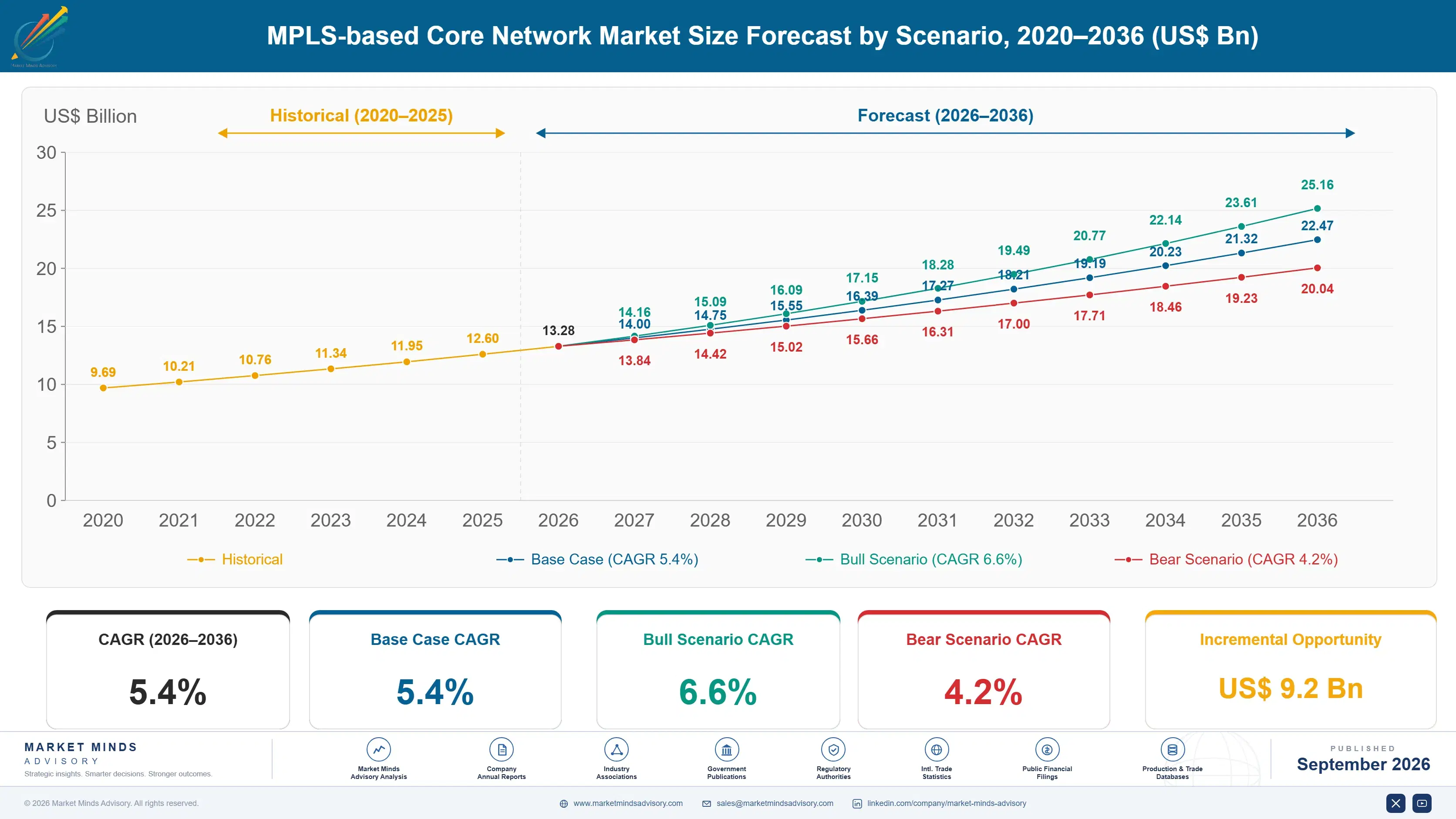
MPLS-based Core Network Market Forecast Scenarios

mpls-based-core-network-market-size-forecast-scenario-1789991875740
Between 2020 and 2025 the market grew modestly as SD-WAN adoption diverted a meaningful share of enterprise WAN spending away from pure MPLS deployments, netting roughly 4.8% annual growth as carriers repositioned MPLS as a premium latency-sensitive transport option rather than the default WAN architecture most enterprises had relied on for years. Several major carriers standardized on hybrid offerings during this period.
MMA's base case assumes 5.4% annual growth through 2036, anchored to three mechanisms: continued enterprise reliance on MPLS for latency-sensitive applications including voice and video that internet-based transport cannot reliably guarantee, expanding carrier infrastructure investment in emerging markets still building out core network capacity, and steady growth of hybrid transition services helping enterprises manage coexisting MPLS and SD-WAN architectures. Providers that can demonstrate documented service-level performance are winning larger enterprise accounts that smaller competitors increasingly cannot compete for.
The bull case rests on enterprise data volume growth outpacing internet transport capacity faster than currently planned, sustaining premium MPLS demand for guaranteed performance traffic. The bear case centers on SD-WAN and secure access service edge architectures maturing faster than expected, accelerating enterprise migration away from MPLS. That risk is most acute for providers concentrated heavily on pure MPLS transport.

From Default WAN to One Layer Among Several

MPLS core networks began as the default enterprise wide area network architecture valued mainly for guaranteed latency and reliability rather than genuine cost efficiency. Providers have since layered on hybrid SD-WAN integration, automated traffic engineering, and granular service-level reporting, turning a standalone transport technology into a design-critical component of broader hybrid network architectures that determines whether latency-sensitive applications perform reliably at all.
AVERAGE NETWORK LATENCY12msTypical round-trip latency across a provisioned MPLS core
SERVICE UPTIME RATE99.9%Typical share of contracted uptime delivered without disruption
TOP PRODUCING COUNTRY SHARE26%United States share of global MPLS core network revenue
HYBRID DEPLOYMENT RATE48%Share of enterprise WAN deployments now running hybrid architecture
AVERAGE CONTRACT RENEWAL RATE84%Share of enterprise customers renewing their annual service contract
CORE EQUIPMENT COST SHARE32%Share of deployment cost tied to core routing equipment
Pricing now varies sharply by service-level guarantee depth and traffic priority tier. Basic best-effort MPLS connectivity charges modest per-site fees, while guaranteed low-latency premium tiers command pricing that scales with documented uptime and jitter testing across diverse network conditions. Enterprises increasingly accept higher connectivity costs after a latency incident convinces IT leadership that service-level depth is genuinely worth paying for.
Large network equipment vendors are acquiring specialized managed service providers rather than building comparable hybrid network operations expertise in-house, buying operational know-how and existing enterprise relationships rather than deployed port count alone. That acquisition pattern is starting to squeeze independent boutique providers that lack the scale to invest in comparable network operations infrastructure their larger competitors now offer as a standard feature. Independent providers that survive increasingly specialize in niches larger platforms overlook.
"Nobody rips out MPLS because a sales rep promised savings. They keep it after a video conference drops mid-negotiation on the cheaper internet circuit next door."
Director, Enterprise Networking and WAN Infrastructure Practice · MMA Technology Practice · September 2026

Market Trends

Hybrid MPLS and SD-WAN Architectures Become Standard Deployment

Enterprises are increasingly deploying hybrid architectures that route latency-sensitive traffic over MPLS while shifting bulk internet-bound traffic to lower-cost SD-WAN transport, rather than choosing one technology exclusively across every office location. This shift accelerated sharply once several major enterprises publicly disclosed cost savings after adopting hybrid architectures instead of full MPLS replacement. Roughly 48% of enterprise WAN deployments now run hybrid architecture, up meaningfully from a smaller share just a few years ago. Providers lacking hybrid integration capability increasingly lose contracts to competitors with proven coexistence architecture and documented migration support.
Market Impact: Premium MPLS demand grew 6% yearly

Carriers Standardize on Documented Service-Level Guarantees

Carriers are increasingly offering documented service-level guarantees covering latency, jitter, and packet loss as a standard contractual feature rather than a premium add-on reserved for the largest enterprise accounts only. This shift reflects growing enterprise expectation that guaranteed performance justifies MPLS's price premium over commodity internet transport alternatives. Carriers lacking documented service-level reporting increasingly lose renewal negotiations to competitors that can demonstrate measurable performance data consistently. Roughly 26% of new enterprise contracts now specify documented latency guarantees, a pace that continues accelerating each year across major global carrier markets today.
Market Impact: Emerging market orders rose 9% yearly

Market Opportunities and Growth Drivers

Latency-Sensitive Applications Sustain Premium MPLS Demand

Voice, video conferencing, and real-time financial trading applications continue requiring guaranteed latency performance that best-effort internet transport cannot reliably deliver during periods of network congestion or peak demand. Enterprises increasingly qualify multiple MPLS providers per region to reduce single-source supply risk, a diversification pattern that expands the addressable provider base beyond incumbent relationships considerably. Providers with demonstrated service-level credentials increasingly capture design wins across multiple enterprise accounts simultaneously rather than single contracts. Some providers now maintain dedicated enterprise account teams purely to serve this growing qualification demand across every region.
Market Impact: standalone MPLS revenue declines 3% yearly

Emerging Market Carrier Infrastructure Investment Expands Demand

Carriers in emerging markets continue investing in core network infrastructure buildout as enterprise connectivity demand expands faster than existing infrastructure capacity can support reliably across growing urban centers. Carriers increasingly recognize that documented MPLS core reliability attracts multinational enterprise customers seeking consistent performance across regional office locations and time zones. Providers serving this segment report meaningfully stronger contract growth than those focused purely on mature developed markets already served. Several providers have hired dedicated emerging market expansion teams purely to serve this growing demand across major urban centers nationwide and internationally.
Market Impact: adds 32% to core equipment cost

Market Restraints and Challenges

SD-WAN Migration Continues Eroding Standalone MPLS Demand

Enterprises continue migrating cost-sensitive branch office connectivity from standalone MPLS to SD-WAN architectures, shrinking the addressable market for providers focused purely on pure MPLS transport products. The root cause is that SD-WAN offers meaningfully lower per-site connectivity costs for traffic that does not require guaranteed latency performance MPLS was originally designed to provide. The commercial impact is that standalone MPLS revenue continues declining even as total hybrid market value grows through combined architecture adoption. Some providers are responding by repositioning as hybrid architecture specialists rather than pure MPLS vendors going forward.
Market Impact: 48% of deployments run hybrid architecture

Core Equipment Costs Limit Smaller Carrier Expansion

Core routing equipment required for carrier-grade MPLS infrastructure remains expensive and requires specialized operational expertise, creating a genuine barrier for smaller regional carriers trying to expand core network capacity. The root cause is that carrier-grade routing hardware serves a relatively small global customer base concentrated among established equipment vendors, keeping unit costs high compared to more widely deployed networking equipment. The commercial impact is that roughly 32% of deployment cost now goes toward core equipment rather than operational service delivery. Some smaller carriers are responding by leasing core capacity from larger carriers rather than building their own infrastructure directly.
Market Impact: 26% of contracts specify latency guarantees
3 additional market trends, 4 additional growth drivers, and 2 additional restraints and challenges are covered in the full report. Contact sales@marketmindsadvisory.com to access the complete intelligence.

Segment CAGR and Growth Architecture

MPLS core networks segment by service function rather than end-use application, since a single enterprise typically deploys network equipment, managed services, and hybrid transition support together as complementary infrastructure layers rather than genuine substitutes for one another. MPLS-to-SD-WAN hybrid transition services are the fastest growing category as enterprises balance latency-sensitive traffic against cost pressure.
Section default visual

MPLS-to-SD-WAN Hybrid Transition Services

This segment covers consulting, integration, and managed services that help enterprises design and operate hybrid architectures combining MPLS and SD-WAN transport rather than migrating entirely to one technology. Demand is concentrated among large enterprises with complex multi-site WAN architectures seeking to optimize cost without sacrificing performance for latency-sensitive applications. Vendors in this segment differentiate on traffic classification accuracy determining which applications route over which transport, migration planning expertise minimizing service disruption during transition, and ongoing hybrid architecture management capability. Growth here outpaces every other segment because hybrid coexistence has become the default enterprise WAN strategy rather than a temporary transition phase. Vendors without this capability increasingly struggle to win the largest enterprise contracts available.
CAGR 9.8%

Managed MPLS Network Services

This segment covers fully outsourced MPLS network operations where a managed service provider handles network design, monitoring, and troubleshooting on behalf of the enterprise customer rather than the customer operating equipment internally. Demand comes from enterprises seeking to reduce internal networking staff requirements while maintaining guaranteed service-level performance for critical applications. Vendors compete on documented uptime track records, response time for network incident resolution, and depth of proactive monitoring capability that catches issues before they affect end users. Growth here trails the hybrid transition segment but remains well above the broader market average as enterprises continue outsourcing network operations. Enterprise buyers increasingly evaluate incident response depth above nominal pricing alone.
CAGR 7.2%
Full segment breakdown across 7 segments available in the complete report.

Regional Architecture and Country Demand Map

North America leads on the dense concentration of enterprise WAN spending and network equipment vendor headquarters, while South Asia and Pacific grows fastest as India's rapidly expanding enterprise network modernization continues scaling quickly and steadily across newly digitized business sectors nationwide and well beyond that too.

North America

The United States hosts the largest concentration of network equipment vendor headquarters and enterprise WAN spending worldwide, anchored by dense clusters of financial services and technology companies demanding guaranteed low-latency connectivity. Domestic carriers built their initial customer base almost entirely from local enterprise customers before expanding internationally, giving them a home-market advantage in renewal rates and hybrid architecture relationship depth. Canada contributes a smaller but growing share, anchored by its own financial services and energy sector connectivity demand. Domestic carriers increasingly bundle hybrid transition services directly into broader managed network subscriptions, reinforcing their position against smaller standalone competitors. Investment in domestic hybrid architecture continues accelerating across several major enterprise clusters.
Share: 30% | CAGR: 6.0% (2026 to 2036)

Western Europe

Germany, the United Kingdom, and France together account for most regional demand, driven by enterprise WAN spending across dense financial services and manufacturing sectors requiring documented latency guarantees. Data protection requirements under European Union frameworks shape network architecture decisions more directly here than in markets with lighter obligations, pushing carriers toward transparent service-level reporting practices. Adoption of hybrid MPLS and SD-WAN architecture trails North America by roughly a year on average, reflecting more conservative enterprise procurement cycles among established European carriers. Growth remains solid even so, as SD-WAN cost pressure spreads across the region. Regulatory sandboxes in several member states now help vendors test compliant deployments early. Several carriers are investing in unified service reporting to meet rising compliance expectations.
Share: 22% | CAGR: 4.0% (2026 to 2036)
Regional intelligence for 5 additional markets available in the complete report: East Asia, South Asia and Pacific, Latin America, Middle East and Africa, Eastern Europe. Contact sales@marketmindsadvisory.com.
mpls-based-core-network-market-market-share-analysis-1789991876278

Where Carriers Capture More Enterprise Revenue

Carriers are finding revenue growth less in one-time circuit provisioning fees and more in ongoing hybrid architecture management subscriptions, since enterprises who already trust a carrier with core network operations are genuinely and quite unusually reluctant to switch even when a competitor offers meaningfully lower pricing somewhere else entirely across the market. across the industry.

Documented Service-Level Certification Reporting Service Programs

Carriers are offering automated compliance reporting aligned to documented service-level guarantees as a premium tier, aimed at enterprises preparing for internal audit reviews or board-level connectivity reliability assessments each fiscal year. This certification package commands substantially higher contract values than standard connectivity tiers because it directly reduces audit preparation time and reliability risk exposure for enterprise customers under compliance pressure. Carriers offering this package report contract values roughly 1.8 times higher than customers on standard connectivity tiers, with stronger renewal rates. Renewal rates among certified accounts consistently exceed the broader customer base.
Market Impact: commands contract values roughly 1.8 times higher overall

Hybrid Architecture Managed Optimization Service Programs

Carriers are packaging ongoing traffic classification optimization and hybrid architecture tuning as premium subscription tiers layered on top of core connectivity, rather than leaving optimization entirely to the enterprise's own IT team to manage. Enterprises without dedicated network engineering staff need this managed capability to continuously balance traffic across MPLS and SD-WAN paths efficiently. Early adopters report attach rates around 24% among enterprise accounts within the first renewal cycle after launch. Retention on these managed accounts consistently exceeds the broader customer base across every region served. Application engineers also generate valuable customer insight carriers use to identify candidates.
Market Impact: adds roughly 24% attach rate among enterprise accounts

White-Label Network Management Platform Licensing Programs

Some carriers now license their proprietary hybrid architecture management software directly to smaller regional carriers building internal network operations capability, a distribution channel that bypasses direct managed service sales entirely. Early licensing deals report margins roughly 19 percentage points higher than comparable direct service contracts, since the underlying software development cost is already covered by the carrier's own platform investment. Smaller carriers value gaining proven management capability without building comparable expertise in-house. Carriers increasingly treat this licensing channel as a genuine second business line. These agreements typically span multiple years across a carrier's full customer base.
Market Impact: platform licensing revenue now grows roughly 14% yearly

Multi-Site Enterprise Fleet Consolidation Agreement Programs

Large enterprises running dozens of office locations across multiple regions need carrier agreements that consolidate monitoring, reporting, and incident response into a single unified relationship while still generating site-specific performance data for each location. Carriers offering this multi-site consolidation charge substantial premiums over single-site pricing, since the coordination infrastructure required to guarantee consistency across sites is considerably higher than most competitors have built well at scale. Customers adopting multi-site agreements increase average contract value by roughly 42% compared to single-site arrangements. These agreements typically span multiple years across a customer's full site portfolio.
Market Impact: increases contract value by roughly 42% per site

Who Controls the Margin Pool

The MPLS-based Core Network Market shows high concentration, with the top five vendors, evaluated on deployed port count, holding roughly 62% combined share. Cisco Systems and Nokia lead on core routing equipment scale and carrier infrastructure depth respectively, but the gap to Juniper Networks has narrowed sharply as it bundles hybrid architecture software into existing enterprise relationships customers never intended to procure separately. That shift alone is reshaping how enterprises evaluate vendors.
Current competitive activity centers on hybrid architecture management capability, with nearly every vendor racing to add SD-WAN integration to platforms previously limited to pure MPLS transport only and nothing else. Vendors are also investing heavily in documented service-level reporting, since enterprises increasingly treat measurable performance data as a baseline procurement requirement rather than an optional feature anymore.

Emerging pressure comes from secure access service edge platform vendors extending into hybrid WAN management, a fast-moving segment established MPLS incumbents were genuinely slow to anticipate. Rankings could shift meaningfully over the next several years if large network equipment vendors continue absorbing independent managed service providers through acquisition, particularly among mid-market enterprises unwilling to manage multiple carrier relationships simultaneously.
mpls-based-core-network-market-country-cagr-analysis-1789991876863

Competitive Moat and Risk Dimensions

CISCO SYSTEMS

Moat: Deepest Core Routing Installed Base

Cisco built the largest installed base of carrier-grade core routing equipment over decades of continuous product investment, creating switching costs and operational familiarity that newer entrants cannot replicate quickly. Large carriers already running Cisco infrastructure are reluctant to migrate given the operational risk of a full core network transition.
CISCO SYSTEMS

Risk: Slower Cloud-Native Innovation Pace

Cisco's hardware-centric legacy carries less cloud-native software agility than venture-backed SD-WAN competitors moving faster on software-defined architecture decisions, which keeps it winning core infrastructure deals while struggling to compete for software-first hybrid architecture contracts across every region. Enterprise buyers increasingly weigh this tradeoff when comparing platform vendors.
NOKIA

Moat: Deep Carrier Infrastructure Relationships

Nokia built deep, long-standing relationships with major global carriers through decades of telecom infrastructure supply, creating trust and operational integration depth that newer entrants cannot replicate without comparable carrier relationship history spanning multiple continents and regulatory environments. Retention among its largest carrier accounts consistently outperforms newer entrants.
NOKIA

Risk: Limited Enterprise Direct Sales Reach

Nokia's carrier-focused sales model carries less direct enterprise customer reach than competitors selling straight to large corporate accounts, which keeps it winning carrier infrastructure contracts while depending on carrier partners to reach enterprise end customers directly across most regional markets. Investors increasingly weigh this dependency when comparing vendor growth prospects.

Players Tracked

Prominent Players

Cisco Systems
Nokia
Juniper Networks
Huawei Technologies
Ciena Corporation

Other Key Players

AT&T Business
Verizon Business
Orange Business Services
NTT Communications
Tata Communications
Colt Technology Services
Telefonica Global Solutions
China Telecom Global
BT Global Services
Vodafone Business
Fortinet
Aryaka Networks
VMware SD-WAN
Silver Peak (HPE Aruba)
Versa Networks

Recent Developments

FEBRUARY 2026

Juniper Networks acquired a smaller SD-WAN orchestration startup to accelerate its hybrid architecture roadmap, adding traffic classification capability that would otherwise have taken its engineering team well over a year to build natively from scratch. The deal closed for an undisclosed sum and integrates fully within two quarters.
Signal: Core network vendors are increasingly buying hybrid architecture depth instead of slowly building it out fully.
AUGUST 2025

Ciena Corporation expanded its platform with native service-level reporting features aimed squarely at large multinational enterprise accounts, a segment it had previously served only through manual performance tracking methods. The rollout followed extensive customer feedback gathered across several large accounts. Financial terms were not disclosed.
Signal: Core network vendors are climbing directly into compliance reporting, a historically manual back-office function entirely today.
MAY 2025

Cisco Systems signed a multi-year technology partnership with a major cloud infrastructure provider to offer pre-integrated hybrid connectivity for enterprises migrating workloads to the cloud across multiple regions, formalizing a relationship that previously existed only informally between the two companies for years. Financial terms remain undisclosed publicly.
Signal: Cloud infrastructure providers are formalizing hybrid connectivity partnerships to speed enterprise adoption globally across every region.

Core Equipment and Talent Cost Exposure

Core routing equipment typically represents roughly 32% of a carrier's deployment cost of goods sold, since carrier-grade routing hardware demands considerably more redundancy engineering than enterprise-grade networking equipment ever required. Skilled network engineers capable of operating hybrid MPLS and SD-WAN architectures are the second largest input, sourced primarily from North American and Western European labor markets.
A major network equipment vendor's 2025 chip shortage, documented in the company's annual report, forced several smaller carriers to delay core equipment deployment by roughly two months, temporarily slowing capacity expansion for affected regional networks. Larger carriers with pre-negotiated volume contracts largely avoided the disruption entirely, widening the competitive gap. The episode pushed several affected carriers to diversify equipment vendor relationships they had previously treated as a secondary priority.

Smaller carriers without volume purchasing power face materially higher per-unit equipment costs than the largest three carriers, a disadvantage that compounds over time as scale advantages widen with each equipment generation. Carriers headquartered in regions with larger networking talent pools, including the United States and India, hold a durable talent advantage over competitors based primarily in regions where combined hybrid architecture expertise remains genuinely scarce.
mpls-based-core-network-market-company-positioning-matrix-1789991877060

Diversified Multi-Vendor Equipment Sourcing Agreements

Larger carriers are qualifying secondary equipment vendors to reduce exposure to any single supplier's pricing changes or capacity constraints during periods of tight availability. This diversification adds modest qualification cost upfront but meaningfully shortens recovery time during future component shortages. These qualification programs typically span several months per additional supplier. across every affected equipment category.

Long-Term Volume Purchase Commitments

Carriers with sufficient scale are negotiating multi-year equipment purchase agreements that lock in favorable pricing ahead of demand spikes across the networking equipment supply chain. Smaller carriers lacking this leverage remain more exposed to spot market price swings during periods of tight availability. These agreements typically span two to three years across major suppliers.

Distributed Engineering Hiring Across Lower-Cost Regions

Carriers are expanding network engineering teams in India and Eastern Europe to reduce blended labor costs while maintaining hybrid architecture operational reliability, a strategy that requires considerable investment in remote collaboration tooling and consistent operational practices across time zones. Several carriers now maintain dedicated distributed engineering offices. across multiple continents and time zones simultaneously.

Portfolio Architecture for Margin Defence

Section default visual

End-use penetration and the annuity logic.

Section default visual

Four calls that define the decade.

These are among the four positions where our research anticipates prominent divergence between winners and laggards over the coming forecast period. Each is grounded in the demand model, the regulatory perimeter, and the announced capacity pipeline.

Engagement Snapshot From the Field

A live engagement with an industry participant carrying material or product regulatory and market exposure ahead of a defining policy shift, showing how our research translates into a defensible multi-year portfolio strategy.
MARKET MINDS ADVISORY · CLIENT ENGAGEMENT SUMMARY
MPLS-based Core Network Producer Strategic Portfolio Review and Transition Roadmap 2026·Investment Scenario on MPLS-based Core Network Exposure Evaluation 2025-26
CLIENT PROFILE
STRATEGIC CHALLENGE
MMA APPROACH
KEY FINDINGS
    CLIENT PROFILE
    STRATEGIC CHALLENGE
    MMA APPROACH
    KEY FINDINGS
      RECOMMENDED STRATEGY
      OUTCOME

      Frequently Asked Questions

      Foundational context covering the market sizes, CAGR, scope, country, region and competition that inform every finding below. This section is provided to cover basics and most often pre-purchase conversations, answered from the MMA Primary Research Dataset.

      Report Segmentation Architecture

      The full report scope spans multiple orthogonal segmentation dimensions, with cross-tabulated demand data provided for each dimension pair. Coverage extends further to regional breakdowns, trend trajectories, and the competitive detail needed to support segment-level decision-making.

      By Region

      • North America
      • Western Europe
      • East Asia
      • South Asia and Pacific
      • Latin America
      • Middle East and Africa
      • Eastern Europe

      Scope, Methodology, and Coverage

      Every figure in this report is reproducible from documented input assumptions. The scope below maps the historical period, the forecast horizon, the segmentation dimensions, and the countries covered, alongside the underlying primary and qualitative methodology.
      Historical Period
      2020 to 2025
      Forecast Period
      2026 to 2036
      Base Year
      2025 (USD billions; MMA Primary Research Dataset, September 2026)
      Market Definition
      This report defines the MPLS-based Core Network Market as network equipment, managed services, and software that provision and operate multiprotocol label switching networks for enterprise and carrier wide area network connectivity. It excludes pure internet-based SD-WAN services without an underlying MPLS transport component and local area network switching equipment.
      Quantitative Units
      USD billions
      Segmentation Dimensions
      Regions Covered
      North America, Western Europe, East Asia, South Asia and Pacific, Latin America, Middle East and Africa, Eastern Europe
      Countries Covered
      Key Companies Profiled
      Cisco Systems, Nokia, Juniper Networks, Huawei Technologies, Ciena Corporation, AT&T Business, Verizon Business, Orange Business Services, NTT Communications, Tata Communications, Colt Technology Services, Telefonica Global Solutions, China Telecom Global, BT Global Services, Vodafone Business, Fortinet, Aryaka Networks, VMware SD-WAN, Silver Peak (HPE Aruba), Versa Networks
      Quantitative Methodology
      Primary survey, n=3,800 respondents, Q4 2025, six countries; demand-side model with trade association cross-validation
      Qualitative Methodology
      47 expert interviews, Q4 2025; applied to validate demand model assumptions, identify emerging dynamics, and assess competitive positioning
      Report Format
      PDF and XLSX data workbook (Word format preview document)
      Publisher
      Market Minds Advisory
      Report Code
      MMA-2026-TEC-248
      Published
      September 2026
      Contact
      sales@marketmindsadvisory.com | www.marketmindsadvisory.com

      Purchase the full MPLS-based Core Network Market Report (2026 to 2036).

      Built For The People Who Decide

      From boardroom strategy to bench-side execution, this report is read cover-to-cover by leaders shaping the next decade of their industry, turning demand scenarios, market dynamics and valuation benchmarks into decisions.
      CXOs/ Presidents/ VPs/ Managers
      M&A and Corporate Development
      Strategy Teams and R&D Heads
      Procurement and Product Directors
      Regulatory and Compliance Leaders
      Investor Relations and Equity Analysts