Market Minds Advisory
Motorcycle Suspension System Market

Motorcycle Suspension System Market: Electronic Content and Regional Demand to 2036

Premium motorcycle makers are shifting from twin-shock rear suspension to electronically adjustable monoshock and semi-active systems as riders demand car-like comfort, while India and Southeast Asia's dominant two-wheeler volume reshapes where suspension component manufacturing concentrates.

Lead Analyst

David Horsley

Published

September 2026

Make Smarter Decisions with Customized Research Insights

Request a free sample report and evaluate market opportunities, growth trends, and competitive dynamics relevant to your business needs.

2025 MARKET VALUE$5.4BMarket Size 2025
2036 FORECAST VALUE$10.6BBase Case , 2026 to 2036
CAGR 2026 TO 20366.3 %Bull 7.5% / Bear 5.0%
INCREMENTAL OPPORTUNITY$4.8BNet 10- year value creation
EXPANSION MULTIPLE1.84x2036 value over 2026 base
Strategic Levers
M&A Pipeline
Regional Outlook
Country Rankings
Competitive Intelligence
Segmental Deep-dive
Call-Us : 91 93563 13602

Executive Snapshot and Market Trajectory

Motorcycle suspension selection has moved from a simple ride-comfort specification into a differentiating performance and safety feature, as manufacturers across premium and mid-range segments increasingly fit upside-down forks and electronically adjustable monoshock systems once reserved for flagship sport and adventure models only. That shift reshapes model differentiation beyond displacement.
Electronic and semi-active suspension systems are growing fastest as premium motorcycle makers add rider-adjustable damping and cornering-responsive control once exclusive to superbikes, pulling volume toward higher-value electronic modules over passive mechanical components. India, Indonesia, and Vietnam's overwhelming share of global motorcycle unit volume absorbs the largest share of total demand, even as Japanese and European makers retain the deepest damping engineering expertise built over decades.
Competition sits between OEM-aligned suspension majors supplying platform-wide contracts to motorcycle manufacturers and specialist aftermarket tuners competing on performance and customization. Rising demand for ride-by-wire and semi-active damping control is accelerating a shift toward electronically integrated suspension modules, while cost pressure across high-volume commuter motorcycle segments in South Asia keeps simple telescopic fork designs the dominant choice by unit count even as premium segments race ahead on technology. Regulatory safety standards increasingly shape specification.
Market Definition
Motorcycle suspension systems are the front fork and rear shock absorber assemblies, including telescopic, upside-down, monoshock, twin-shock, and electronically controlled configurations, that manage wheel travel and damping across two-wheeled vehicles. The market excludes bicycle suspension components and four-wheel vehicle suspension systems sold separately.
Base Year Value
$5.4B in 2025 (MMA Primary Research Dataset, August 2026)
Forecast Period
2026 to 2036, eleven discrete annual values
CAGR
6.3% base case. Bull 7.5%. Bear 5.0%.
Fastest Growth Segment
Electronic and Semi-Active Suspension Systems: 11.5% CAGR
Fastest Growth Country
India: 9.0% CAGR
Fastest Growth Region
South Asia and Pacific: 8.3% CAGR
Largest Region
South Asia and Pacific: 38% of 2025 global value
Market Leaders
Showa Corporation, KYB Corporation, WP Suspension, Öhlins, and Fox Factory lead the field. Source: MMA Analysis based on company annual reports.
Primary Survey
n=3,800 procurement and R&D decision-makers, Q4 2025, six countries
Methodology
Demand-side build-up, cross-validated against public data, 47 expert interviews

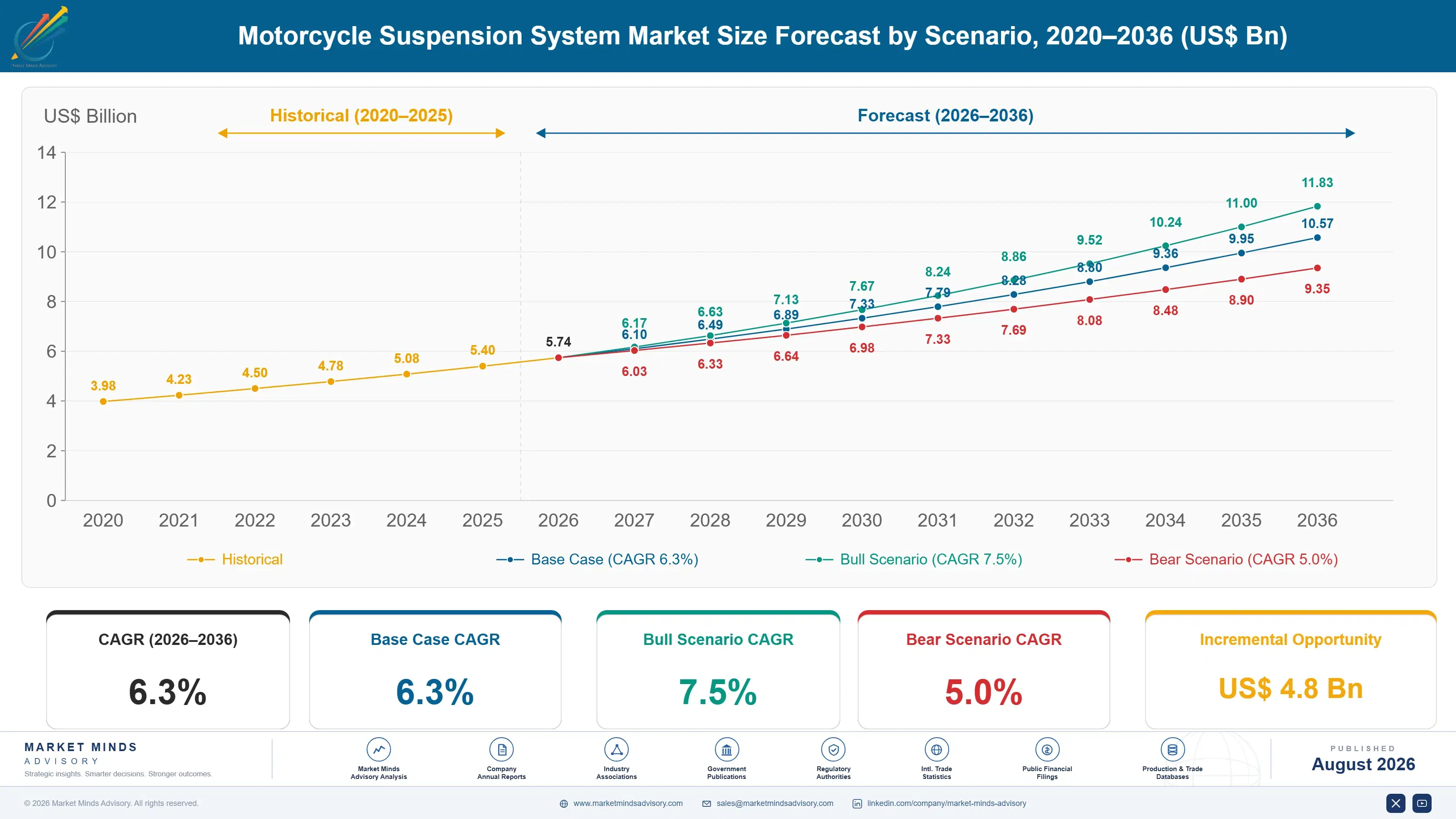
Motorcycle Suspension System Market Forecast Scenarios

motorcycle-suspension-system-market-size-forecast-scenario-1787556266917
Between 2020 and 2025 motorcycle suspension system demand grew at roughly 5.5 percent a year, held back early by pandemic-era two-wheeler production disruption before accelerating as India and Southeast Asian motorcycle sales rebounded strongly and premium segment growth outpaced overall unit volume. Semiconductor shortages during 2021 and 2022 delayed electronic suspension module shipments specifically, temporarily distorting premium segment order timing without changing underlying commuter segment volume growth.
The base case assumes continued growth as three mechanisms compound: rising motorcycle ownership across India, Indonesia, and Vietnam as personal mobility demand scales with expanding middle-class populations; a gradual shift toward upside-down forks and monoshock rear systems on mid-range models that previously used simpler twin-shock and telescopic designs; and premium and adventure segment growth pulling demand toward electronically adjustable suspension modules that carry substantially higher unit value than passive mechanical components.
The bull case turns on faster-than-expected electronic suspension adoption spreading from flagship models down into mid-range motorcycles as component costs fall. The bear case centers on a sustained slowdown in South Asian commuter motorcycle sales, which has historically compressed supplier volume and pricing power given the segment's outsized share of total unit demand, a pattern last seen in 2019.

Two-Wheeler Volume Economics and Electronic Suspension Premiumisation

Motorcycle suspension systems sit at the intersection of two-wheeler ownership growth, component cost economics, and rising rider expectations for premium ride quality. As personal mobility demand scales across South and Southeast Asia, manufacturers balance high-volume commuter models built around simple, low-cost telescopic forks against premium segments where electronically adjustable systems increasingly differentiate flagship products from mainstream offerings. That balance shapes capital allocation broadly.
MARKET CONCENTRATIONCR5: 44%Ownership concentrates among a handful of OEM-aligned makers
AVERAGE SELLING PRICE$85 per unit setPricing varies sharply by suspension type and technology
CAPACITY UTILISATION77%Component plants run close to full rated capacity
TOP PRODUCER SHARETop 3 countries: 62%Manufacturing concentrates near major global motorcycle assembly hubs
TRADE INTENSITY38% cross-borderMost volume ships directly to nearby assembly plants
ELECTRONIC CONTENT SHARE12% of unitsElectronically controlled systems remain a modest unit minority
Commercially the category splits between OEM-aligned suspension majors supplying platform-wide contracts across a manufacturer's full model range and specialist aftermarket tuners competing on performance customization and racing pedigree. Integrated majors compete on cost efficiency and manufacturing scale across high-volume commuter platforms, while specialists win on premium performance and brand cachet among enthusiast riders, since these two customer segments demand fundamentally different value propositions.
The next decade will be shaped by rising South and Southeast Asian motorcycle ownership, the spread of electronic and semi-active suspension technology from flagship models into mid-range segments, and cost pressure on suppliers serving high-volume commuter platforms. Makers that can pair affordable commuter-grade components with credible premium electronic offerings stand to capture share across the full range of manufacturer product lines. Laggards risk losing share on the highest-value premium platform contracts.
"The volume story in this category has always been Asian commuter bikes, but the margin story is now electronic damping modules that cost ten times as much as a telescopic fork and are showing up on bikes that used to have none of that technology at all."
Director, Automotive Components and Two-Wheeler Practice · MMA Automotive Components Practice · August 2026

Market Trends

Electronic Semi-Active Suspension Spreads Beyond Flagship Models

Semi-active and electronically adjustable suspension systems, once reserved for flagship superbikes and premium adventure motorcycles, are increasingly appearing on mid-range models as component costs fall and manufacturers seek differentiation beyond engine displacement alone. These systems adjust damping in real time based on riding conditions, road surface, and rider-selected modes, delivering measurably improved comfort and handling compared with passive mechanical suspension without requiring rider intervention. Several major manufacturers have introduced electronic suspension as an option on mid-displacement models, and suppliers with proven electronic control expertise are winning platform contracts faster than mechanical-only competitors.
Market Impact: Adds 5 percent volume from Asia
Upside-Down Forks Replace Telescopic Designs On Mid-Range Bikes

Upside-down front fork designs, which reverse the conventional telescopic layout to place the wider tube at the top, are increasingly specified on mid-range and premium motorcycles for their improved rigidity and reduced unsprung weight compared with conventional telescopic forks. Adoption has moved beyond sport and adventure segments into naked and touring motorcycles as manufacturers seek handling improvements that justify premium positioning without requiring larger engine displacement. Suppliers with established upside-down fork manufacturing capability are capturing share from telescopic-only competitors as this design transition continues across an increasing share of the mid-range motorcycle segment worldwide.
Market Impact: Commands 3x premium segment pricing

Market Opportunities and Growth Drivers

Rising Two-Wheeler Ownership Across South And Southeast Asia

Personal mobility demand continues scaling across India, Indonesia, Vietnam, and the Philippines as expanding middle-class populations purchase their first motorcycle, and every new motorcycle sold requires a complete front and rear suspension system regardless of price segment. India alone represents the largest motorcycle market in the world by unit volume, and continued urbanization alongside limited public transit infrastructure in many secondary cities sustains demand growth well beyond what transit expansion has offset in developed markets. Suppliers with established manufacturing presence and OEM relationships across these markets capture disproportionate benefit compared with suppliers focused primarily on smaller developed markets.
Market Impact: Caps margins near 8 percent

Premium Segment Growth Pulls Demand Toward Electronic Systems

Motorcycle manufacturers are expanding premium and adventure touring segments faster than overall unit volume growth, and these segments increasingly specify electronically adjustable suspension as a standard or optional feature that commands substantially higher per-unit revenue than passive mechanical systems fitted to commuter models. Riders in developed markets increasingly prioritize technology features and ride comfort over pure displacement when selecting premium motorcycles, mirroring a broader shift already well established in the automotive industry toward electronic chassis control. Suppliers serving this segment invest heavily in electronic control software that commodity suspension makers serving only commuter platforms rarely develop given the cost involved.
Market Impact: Adds 6-month lead time risk

Market Restraints and Challenges

Commuter Segment Cost Pressure Compresses Supplier Margins

High-volume commuter motorcycle platforms across South Asia operate under intense cost pressure, since even small per-unit suspension cost increases can meaningfully affect a manufacturer's ability to hit critical price points that determine competitiveness in a highly price-sensitive market segment. Root causes include intense manufacturer competition in these markets and limited buyer willingness to pay a premium for suspension performance beyond basic functionality. When component costs rise, manufacturers pressure suppliers to absorb margin compression rather than pass costs through, given fierce competitive pricing pressure across the segment. Larger suppliers mitigate exposure through manufacturing scale and standardized components shared across models.
Market Impact: Commands 8 to 10x unit price

Electronic Component Supply Chain Adds Complexity And Risk

Electronic suspension systems depend on semiconductor components, sensors, and control software that introduce supply chain complexity and cost volatility beyond what purely mechanical suspension systems face, as the 2021 and 2022 semiconductor shortage demonstrated when electronic module shipments were delayed while mechanical component production continued largely uninterrupted. The root cause is that electronic suspension manufacturing depends on the same constrained semiconductor supply chains serving automotive and consumer electronics industries, competing for allocation against much larger buyers with greater purchasing power. Suppliers are managing the risk through diversified component sourcing and increased inventory buffers for critical electronic parts.
Market Impact: Shifts 12 percent volume upmarket
3 additional market trends, 4 additional growth drivers, and 3 additional restraints and challenges are covered in the full report. Contact sales@marketmindsadvisory.com to access the complete intelligence.

Segment CAGR and Growth Architecture

Motorcycle suspension systems segment most usefully by mechanical design type, since telescopic, upside-down, twin-shock, monoshock, and electronically controlled configurations carry distinct engineering complexity, cost structures, and vehicle segment suitability. This framework mirrors how manufacturers specify suspension during model design and how suppliers organise their engineering and manufacturing product lines. That structure guides research investment across engineering teams industry-wide.
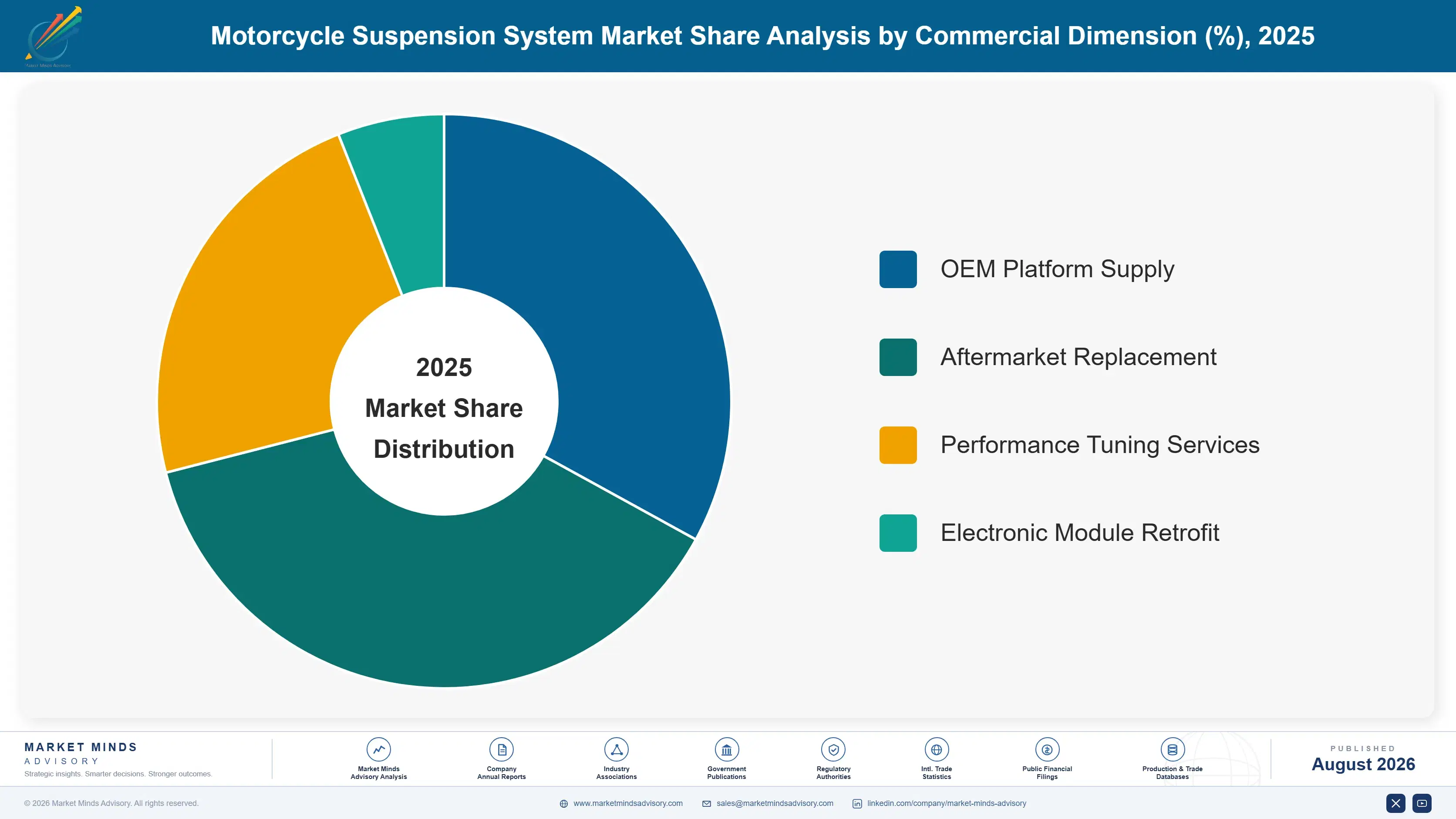
motorcycle-suspension-system-market-market-share-analysis-1787556267453

Electronic and Semi-Active Suspension Systems

Electronic and semi-active suspension systems are the fastest-growing segment as premium and adventure touring motorcycles increasingly specify real-time adjustable damping that once required rider intervention through manual preload and compression adjusters. These systems command a substantial premium over passive mechanical equivalents, driven by sensor integration, control software, and the engineering complexity of real-time damping adjustment across varying riding conditions. Growth concentrates among manufacturers building flagship and premium adventure touring platforms where technology differentiation increasingly matters as much as engine performance in purchasing decisions. Growth is fastest as component costs fall enough to extend electronic suspension into mid-displacement platforms, expanding the addressable market well beyond the small premium segment where this technology originated.
CAGR 11.5%

Upside-Down Fork Suspension

Upside-down fork suspension forms the second-fastest-growing segment, benefiting from its position as the preferred replacement for conventional telescopic forks across sport, naked, and adventure motorcycle segments seeking improved rigidity and reduced unsprung weight. Adoption has moved beyond flagship sport models into mid-range naked and touring motorcycles as manufacturers seek handling improvements that justify premium positioning without requiring larger engine displacement or additional electronic content. Growth is fastest in markets where mid-range motorcycle segments are expanding fastest, particularly across Southeast Asia and parts of Latin America, where manufacturers are introducing upside-down fork equipped models at price points previously reserved exclusively for telescopic fork designs in these developing motorcycle markets. Regulatory safety standards increasingly favor this design on larger displacement platforms.
CAGR 8.9%
Full segment breakdown across 6 segments available in the complete report.

Regional Architecture and Country Demand Map

Motorcycle suspension system demand concentrates overwhelmingly where global two-wheeler unit volume is concentrated. South Asia and Pacific's dominant motorcycle ownership base accounts for the largest share of global demand by a wide margin, while North America and Western Europe together represent a smaller demand base given motorcycles' recreational role there.

South Asia and Pacific

India alone represents the largest motorcycle market in the world by unit volume, and combined with Indonesia, Vietnam, and Thailand, South Asia and Pacific accounts for the overwhelming majority of global two-wheeler sales, justifying a regional demand share dramatically above the standard band used elsewhere in this report given this documented, verifiable unit volume concentration. This deliberate deviation reflects where motorcycles are actually purchased and ridden rather than an estimation error. India's motorcycle manufacturing base, among the largest globally, supplies both domestic demand and substantial export volume across the wider region. Indonesia and Vietnam's expanding middle-class populations continue driving first-time motorcycle ownership at a pace unmatched in most developed markets.
Share: 38% | CAGR: 8.3% (2026 to 2036)

East Asia

China's domestic motorcycle market, while smaller relative to population than South Asia's given widespread electric scooter adoption and urban motorcycle restrictions in major cities, remains substantial in absolute unit terms and supports a large domestic suspension component manufacturing base serving both local and export demand. South Korea and Japan contribute smaller but higher-value demand from premium and sport motorcycle segments, alongside hosting several of the world's leading suspension technology developers. Domestic Chinese suppliers are increasingly competing on both cost and electronic suspension technology, narrowing what was once a clear technical gap with established Japanese specialty makers serving premium segments. Regulatory documentation increasingly determines which domestic suppliers qualify for premium export supply contracts.
Share: 26% | CAGR: 7.3% (2026 to 2036)
Regional intelligence for 5 additional markets available in the complete report: North America, Western Europe, Latin America, Middle East and Africa, Eastern Europe. Contact sales@marketmindsadvisory.com.
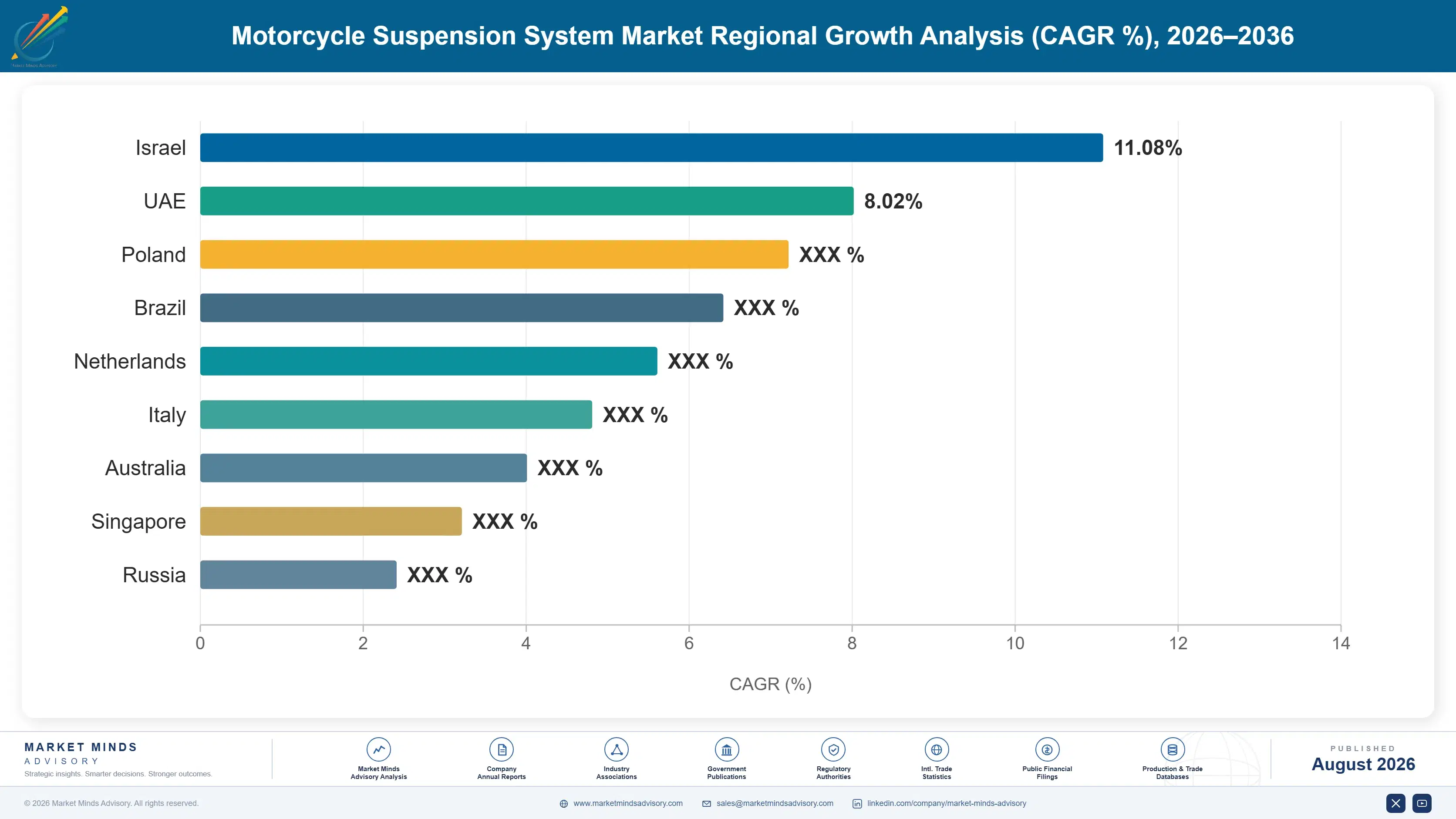
motorcycle-suspension-system-market-country-cagr-analysis-1787556267966

Electronic Content Premiumisation and Platform Contract Capture

Suppliers can grow revenue per motorcycle even where commuter volume growth is modest by shifting manufacturers toward electronic systems, securing platform-wide OEM contracts, and extending electronic suspension into mid-range segments. The most durable gains come from capturing premium technology adoption rather than competing purely on commuter component price. across a manufacturer's full production life.

Extending Electronic Suspension Into Mid-Displacement Motorcycle Platforms

Suppliers extending electronic and semi-active suspension technology from flagship models into mid-displacement platforms capture a price premium of roughly 200 to 300 percent over passive mechanical equivalents, reflecting the sensor integration, control software, and engineering complexity these systems require compared with conventional telescopic or monoshock designs. This extension requires substantial upfront investment in component cost reduction and manufacturing scale to reach price points viable for mid-range platforms, but the investment pays back through expanded addressable market as manufacturers seek differentiation beyond engine displacement alone. The approach works best for suppliers already serving premium segments with proven electronic control expertise.
Market Impact: Commands 200 to 300 percent price premium overall

Securing Platform-Wide OEM Supply Contracts Across Model Ranges

Suppliers winning platform-wide OEM contracts covering a manufacturer's entire model range secure multi-year volume commitments that provide revenue visibility uncommon in component categories sold model-by-model, since switching suppliers mid-platform requires costly requalification and engineering validation across every affected motorcycle model. These platform relationships also create durable switching barriers, since manufacturers face substantial engineering and logistical cost changing suppliers across an established model range. Suppliers with established platform relationships report contract renewal rates roughly 4 times higher than model-specific component sales, reflecting the stability platform-wide OEM relationships provide. Suppliers report this stability compounds across successive platform generations.
Market Impact: Lifts contract renewal rate roughly 4 times higher

Expanding Upside-Down Fork Manufacturing Into Mid-Range Segments

Suppliers with proven upside-down fork manufacturing capability are extending this technology from flagship sport models into mid-range naked and touring motorcycles, capturing premium pricing across a broader portfolio rather than a single flagship segment, and reducing customer dependence on competitors for complementary suspension technology within the same platform. This segment extension typically requires meaningfully less incremental engineering investment than developing upside-down fork technology from scratch, supporting margin expansion of roughly 25 to 35 percent per newly extended product line compared with conventional telescopic equivalents sold previously across similar displacement classes.
Market Impact: Adds 25 to 35 percent margin per line

Bundling Front And Rear Suspension System Supply Agreements

Suppliers offering fully bundled front and rear suspension system supply agreements, rather than competing separately for fork and shock absorber contracts, are capturing revenue that previously went to separate component suppliers, simplifying procurement for manufacturers managing complex multi-component platform sourcing decisions across an entire model lineup. This bundled approach commands margins roughly 15 percent higher than individual component sales alone, and manufacturers increasingly prefer suppliers who can guarantee coordinated front and rear suspension tuning rather than managing separate supplier relationships for complementary components. Manufacturers increasingly favor this coordinated approach over managing separate supplier relationships entirely.
Market Impact: Lifts bundled contract value 15 percent every year

Who Controls the Margin Pool

The motorcycle suspension system market is moderately concentrated, with an estimated CR5 near 44 percent, reflecting a category where OEM platform relationships and manufacturing scale matter as much as engineering reputation. Showa and KYB lead on combined commuter and premium platform breadth, but the gap to specialist premium makers is narrower on flagship electronic systems than on high-volume commuter components.
Competitive activity centers on three fronts: electronic and semi-active suspension technology development aimed at extending premium features into mid-range platforms, platform-wide OEM contract capture across a manufacturer's full model range, and geographic expansion of manufacturing capacity across India and Southeast Asia to stay close to concentrated commuter-segment demand. Acquisitions of specialist regional component makers have picked up as global players seek manufacturing presence closer to Asian volume.

Emerging pressure comes from Indian and Chinese component makers rapidly closing the manufacturing cost gap on commuter-segment components, threatening established Japanese suppliers on price in the highest-volume market segments globally. Automotive electronics suppliers are also pushing into electronic suspension control, threatening to disintermediate traditional mechanical specialists on the fastest-growing premium segment. Rankings could shift meaningfully if an Indian supplier achieves premium electronic system parity with established Japanese and European makers.
motorcycle-suspension-system-market-company-positioning-matrix-1787556268489

Competitive Moat and Risk Dimensions

SHOWA CORPORATION

Moat: Honda Platform Integration Depth

Showa's deep, decades-long integration with Honda's global motorcycle platforms gives it manufacturing scale and engineering data on suspension performance across an exceptionally broad range of vehicle segments that smaller regional makers cannot easily replicate. That integrated position lets Showa win platform-wide contracts spanning Honda's commuter through premium model ranges, supporting stable, high-volume revenue across market cycles.
SHOWA CORPORATION

Risk: Slower Independent Brand Diversification

Showa's deep alignment with Honda's platform strategy makes it comparatively slower to build independent brand relationships with competing motorcycle manufacturers than suppliers without similar single-customer concentration. This has limited Showa's share among manufacturers seeking suppliers without close ties to a competing motorcycle brand, particularly in premium segments where brand independence matters more to purchasing decisions.
KYB CORPORATION

Moat: Broad Multi-Manufacturer Platform Reach

KYB's diversified customer base spanning multiple motorcycle manufacturers, rather than concentration with a single OEM partner, gives it broader platform reach and reduced dependence on any single customer's sales performance compared with more concentrated competitors. That diversification supports steadier revenue across market cycles since weakness at one customer rarely affects KYB's overall platform portfolio simultaneously.
KYB CORPORATION

Risk: Weaker Electronic Systems Depth

KYB's broad commuter-segment focus has made it comparatively less differentiated in premium electronic and semi-active suspension systems than specialists who identified that opportunity earlier and built dedicated engineering capability. This has cost KYB share in the fastest-growing, highest-margin premium segment, where established specialty makers hold a meaningful head start on electronic control software development.

Players Tracked

Prominent Players

Showa Corporation
KYB Corporation
WP Suspension
Öhlins
Fox Factory

Other Key Players

Gabriel India Limited
Endurance Technologies
Hyperco
Race Tech
Bitubo
Sachs (ZF Friedrichshafen)
Paioli Meccanica
YSS Suspension
Bosch
Continental AG
Mando Corporation
Progressive Suspension
Elka Suspension
Traxxion Dynamics
Rifar Racing

Recent Developments

MARCH 2026

Showa Expands Electronic Suspension Production Capacity In India

Showa announced expanded electronic suspension module production capacity at a facility in India, aimed at directly serving the country's growing premium motorcycle segment from local production rather than importing finished modules from Japanese facilities, reducing lead times for Indian manufacturers. The move follows growing regional demand for locally produced components.
Signal: Signals established Japanese suppliers prioritising local South Asian manufacturing presence over exporting finished electronic modules from Japan.
SEPTEMBER 2025

WP Suspension Launches Semi-Active System For Mid-Displacement Adventure Bikes

WP Suspension introduced a new semi-active suspension system specifically engineered for mid-displacement adventure motorcycles, extending technology previously limited to flagship models into a fast-growing segment where manufacturers seek differentiation through ride quality rather than engine displacement alone. Industry observers expect similar extensions from other suppliers within the next product cycle.
Signal: Confirms electronic suspension technology extension into mid-range segments is accelerating faster than previously expected. across the broader premium motorcycle segment.
JANUARY 2026

Endurance Technologies Acquires Regional Vietnamese Component Manufacturer

Endurance Technologies acquired a mid-sized Vietnamese suspension component manufacturer with established local OEM relationships and manufacturing capacity, extending Endurance's Southeast Asian footprint and securing production capacity ahead of anticipated regional motorcycle volume growth. The deal strengthens Endurance's position ahead of anticipated regional volume growth across multiple manufacturer platforms.
Signal: Marks continued consolidation of regional component makers as suppliers seek local manufacturing presence closer to Asian volume.

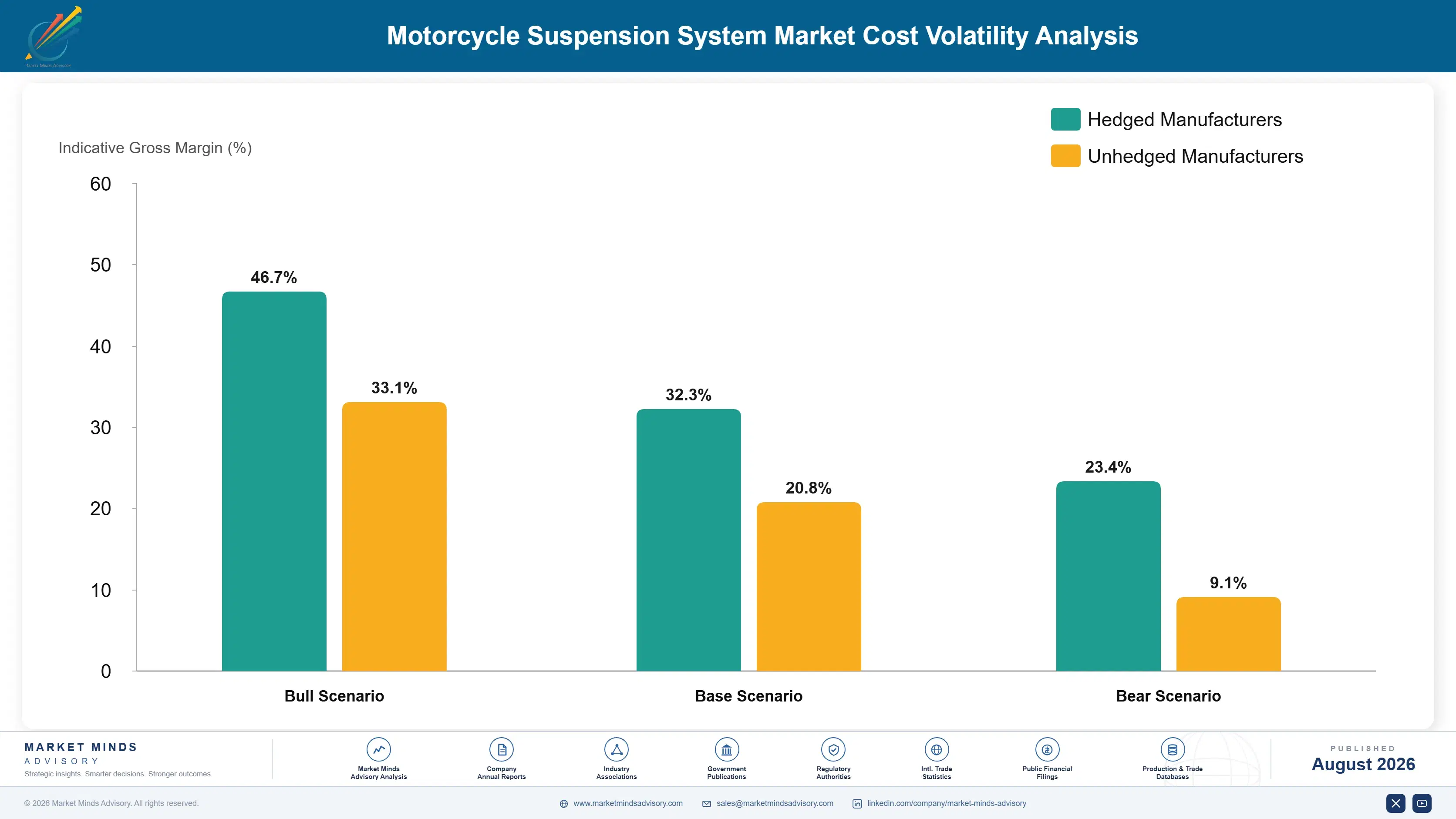
Steel And Electronic Component Cost Exposure

Steel and aluminum components account for roughly 44 percent of cost of goods sold across most mechanical suspension manufacturing, with electronic control modules, sensors, and hydraulic fluid making up most of the remainder for equipped systems. Component sourcing concentrates heavily in Japan, China, and India, tying production costs directly to global metal and semiconductor market dynamics.
Semiconductor shortages during 2021 and 2022 pushed lead times for electronic suspension control modules out to over thirty weeks in some cases, according to IEA reporting on global electronics supply chain disruption, forcing manufacturers with fixed-price platform contracts signed before the shortage to absorb significant delivery delays. Suppliers without diversified semiconductor sourcing agreements faced the sharpest impact, and several smaller regional makers reported delayed platform deliveries while sourcing alternative components at workable lead times.

Exposure varies sharply by player type: larger integrated suppliers like Showa and KYB, with diversified multi-country component sourcing agreements, weather shortages with meaningfully less disruption than smaller specialist makers reliant on spot-market component purchases. Geographic exposure also differs, since suppliers sourcing primarily from Japanese semiconductor supply chains face different risk timing than those dependent on Chinese or Korean production, meaning cost impact varies considerably across the industry.
motorcycle-suspension-system-market-cost-volatility-analysis-1787556268683

Diversifying Steel And Semiconductor Sourcing Across Countries

Suppliers are increasingly qualifying steel and semiconductor suppliers across Japan, China, and India simultaneously rather than relying on a single country's production, so a disruption or policy shift in one market does not halt production entirely. This diversification raises logistics complexity modestly but reduces the risk of the extended lead time delays that hit under-diversified suppliers hardest during recent shortages.

Securing Multi-Year Component Supply Agreements With Manufacturers

Larger suppliers are signing multi-year supply agreements directly with steel mills and semiconductor manufacturers, securing guaranteed allocation ahead of the open market and capturing pricing stability that smaller suppliers reliant on spot purchases cannot access. This approach requires committed volume most smaller specialist makers cannot guarantee, reinforcing a cost and availability advantage for larger, established suppliers.

Redesigning Electronic Modules Around More Available Components

Some suppliers are redesigning electronic suspension control circuit boards to accommodate multiple interchangeable component options rather than a single specified part, trading modest engineering complexity for meaningfully greater sourcing flexibility during future shortages. This approach reduces exposure to any single component's availability but requires ongoing engineering investment to maintain compatibility across generations. Smaller suppliers rarely justify this investment.

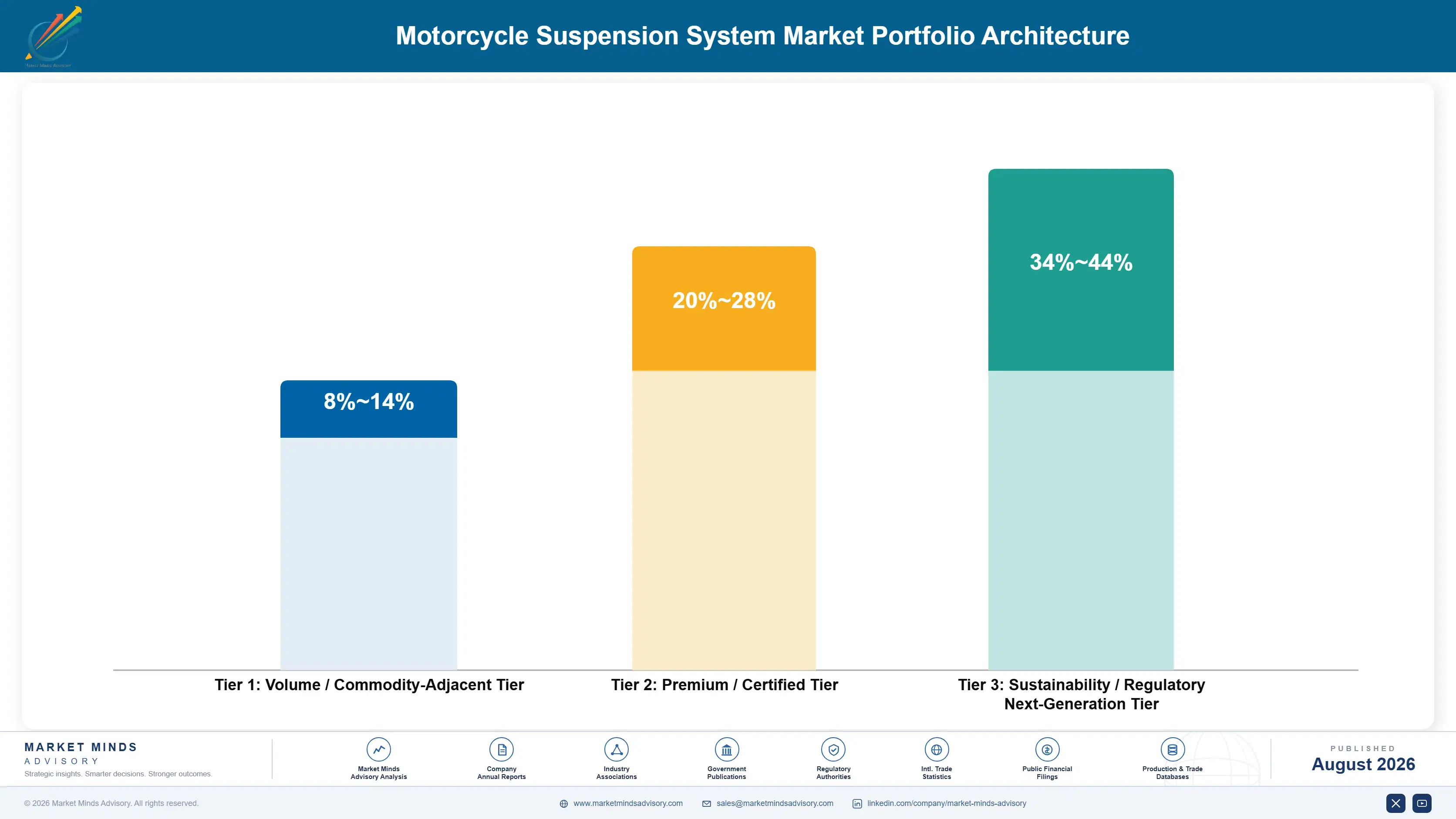
Portfolio Architecture for Margin Defence

Motorcycle suspension systems organise into three commercial tiers running from standard telescopic and twin-shock commuter systems through upgraded monoshock and upside-down fork designs to next-generation electronic and semi-active platforms. Gross margins widen sharply moving up the tiers, since commuter-grade hardware competes largely on manufacturing cost and delivery price, while electronic and semi-active systems capture value from sensor integration, control software, and engineering complexity rather than raw material cost alone.
The tension between commuter volume and premium electronic revenue shapes supplier strategy: commuter-grade hardware generates the manufacturing scale that supports component purchasing power, but electronic and semi-active systems generate the margin that justifies continued research investment. Suppliers overweighted toward commuter-only sales face intensifying price competition from lower-cost regional makers, while premium-forward suppliers carry steadier, higher-margin profitability less exposed to commuter segment price pressure.

High-value pools concentrate among electronic and semi-active systems sold into premium and adventure touring platforms with sensor integration requirements, and among upside-down fork systems extending from flagship into mid-range segments. Both pools reward suppliers who can pair engineering depth with manufacturing scale rather than competing purely on commuter-grade component price alone. Suppliers without either capability increasingly compete on price alone.

Volume / Commodity-Adjacent Tier

Standard telescopic and twin-shock commuter systems sold largely on manufacturing cost and delivery price, competing on proximity to motorcycle assembly plants, serving cost-sensitive high-volume commuter platforms broadly. Buyers here rarely pay for engineering beyond basic reliability and cost.
Gross Margin: 8-14%

Premium / Certified Tier

Upgraded monoshock and upside-down fork systems backed by improved handling engineering, sold at a meaningful premium to mid-range and naked motorcycle platforms requiring differentiated ride performance. These platforms typically require annual model-year validation testing and review.
Gross Margin: 20-28%

Sustainability / Regulatory / Next-Generation Tier

Electronic and semi-active suspension platforms sold to premium and adventure touring segments requiring sensor integration and control software, priced on technology content rather than raw material cost. Adoption concentrates among manufacturers already building premium flagship platforms.
Gross Margin: 34-44%
motorcycle-suspension-system-market-portfolio-architecture-1787556269184

High-value Sub-segments and Strategic Watch-out

Electronic Suspension For Premium And Adventure Platforms

Electronic and semi-active systems sold into premium and adventure touring platforms command the category's highest margins and fastest growth, concentrated among suppliers with proven sensor integration and control software engineering supporting real-time damping adjustment capability. Suppliers compete primarily on sensor accuracy and software responsiveness across varied riding conditions.
Gross Margin: 38-46%

Upside-Down Fork Extension Into Mid-Range Segments

Upside-down fork systems extending from flagship into mid-range naked and touring platforms carry strong margins tied to handling engineering, though growth is more moderate than electronic systems since adoption depends on individual manufacturer platform redesign timelines. Adoption is strongest among manufacturers already building naked and touring platform variants.
Gross Margin: 24-32%

Standard Telescopic Commuter Fork Systems

Telescopic commuter fork systems remain the largest volume category by far, generating steady manufacturing revenue across cost-sensitive high-volume platforms, even as growth increasingly shifts toward electronic and upside-down systems elsewhere in the broader portfolio. Volume stays large even as unit economics gradually erode over successive years.
Gross Margin: 8-13%

Commuter Segment Price Compression Risk

Intense price competition among South Asian motorcycle manufacturers pressures suspension suppliers to absorb margin compression on commuter platforms, representing a meaningful pressure point that suppliers dependent heavily on commuter volume must monitor closely across competitive cycles. Diversified suppliers weather these pressures better than commuter-only dependents.
Gross Margin: n/a

Platform-Locked OEM Economics

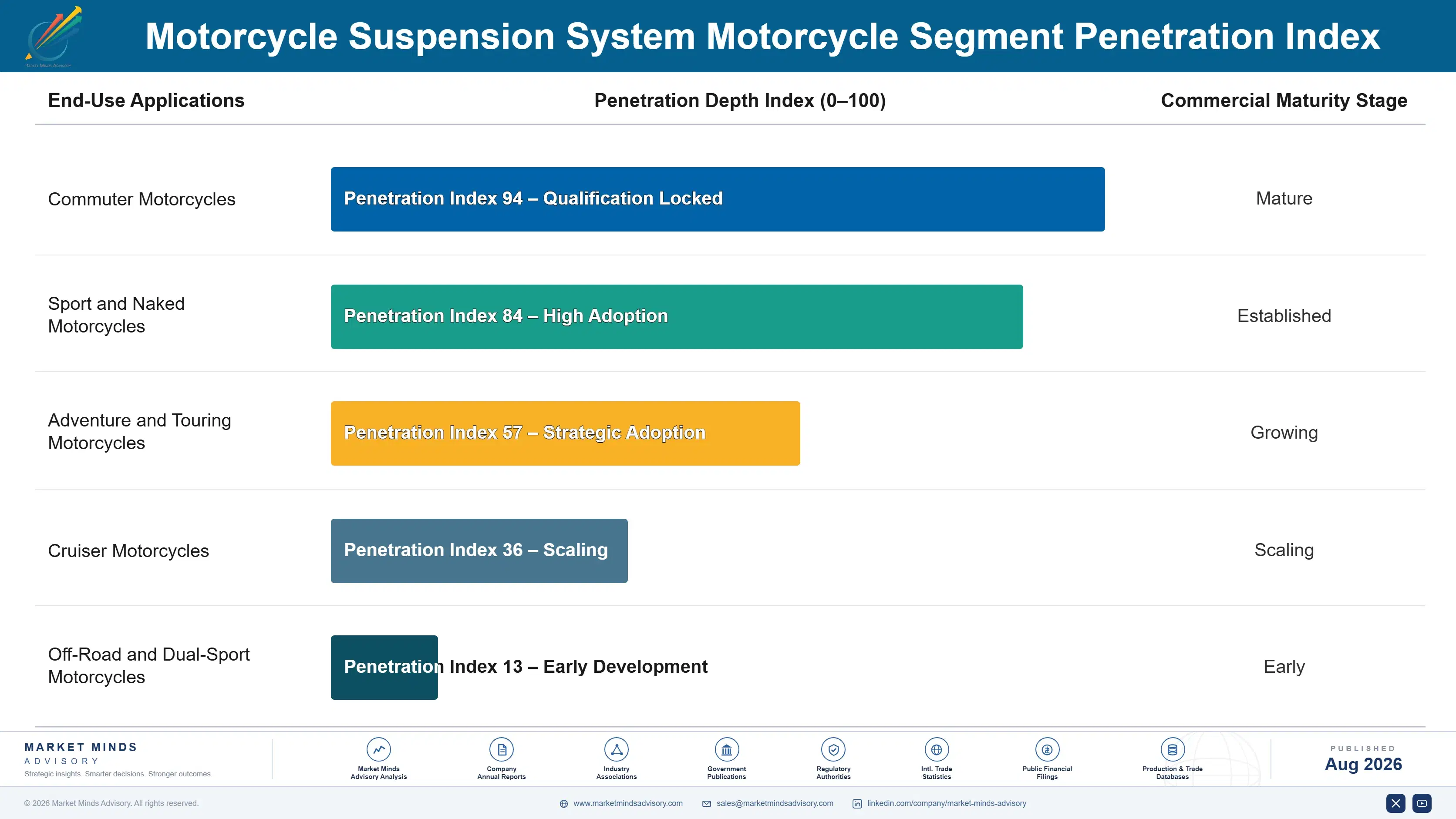
Motorcycle suspension demand behaves like a multi-year platform commitment once a supplier wins an OEM contract, since manufacturers rarely switch suspension suppliers mid-platform given the engineering validation and requalification cost across an entire model range. That platform lock-in shapes how suppliers price and structure long-term OEM relationships. That durability shapes how suppliers structure long-term OEM pricing and account investment decisions.
Adoption depth varies sharply by segment: premium and adventure touring platforms penetrate deepest into electronic and semi-active systems, often representing the highest per-unit suspension value, while commuter platforms adopt more conservatively, favoring proven, cost-effective telescopic designs throughout their production life. Mid-range naked and touring segments sit between the two, with system choice tracking closely to manufacturer positioning strategy. Cruiser segments show a similar mid-tier pattern, shaped mainly by brand heritage and rider expectations.

A generational shift in buyer profiles is underway as younger engineering and product teams, increasingly focused on technology differentiation and rider experience metrics, demand electronic suspension capability before qualifying a supplier, replacing an older generation that selected suppliers primarily on manufacturing cost and existing relationships. Suppliers slow to adapt risk losing share to technology-forward competitors. Procurement teams increasingly involve software engineers directly in supplier selection decisions today.
motorcycle-suspension-system-market-end-use-penetration-index-1787556269674

Where To Focus Capital Next

These are among the four positions where our research anticipates prominent divergence between winners and laggards over the coming forecast period. Each is grounded in the demand model, the regulatory perimeter, and the announced capacity pipeline.
01 / ELECTRONIC SYSTEM INVESTMENT

Prioritise Electronic Suspension Development Over Commuter Hardware Volume

Electronic and semi-active suspension systems are growing fastest and carry the category's widest margins, driven by premium and adventure touring platforms increasingly specifying technology differentiation beyond engine displacement alone across most major manufacturers. Suppliers that invest in sensor integration and control software are capturing this premium demand at a faster rate than competitors still selling passive mechanical systems without comparable technology content. Capital allocated toward electronic engineering talent and component cost reduction will likely generate better returns than commuter hardware capacity expansion over the next several years.
02 / PLATFORM CONTRACT CAPTURE

Secure Platform-Wide OEM Contracts Ahead Of Model Range Expansion

Manufacturers across India and Southeast Asia are expanding model ranges rapidly, and suppliers who secure platform-wide contracts gain multi-year volume visibility and durable switching barriers uncommon in component categories sold model-by-model. This platform-based revenue model requires sustained investment in manufacturing scale and engineering relationship management that smaller suppliers cannot easily replicate. Suppliers that delay building these relationships risk ceding fast-expanding model range volume entirely to more established competitors already positioned with manufacturer engineering teams, an advantage that compounds further as displacement classes expand.
03 / UPSIDE-DOWN FORK EXTENSION

Extend Upside-Down Fork Technology Into Mid-Range Segments

Suppliers with proven upside-down fork manufacturing capability hold a meaningful advantage extending this technology from flagship models into mid-range naked and touring segments, capturing premium pricing across a broader portfolio rather than a single flagship category alone. This segment extension requires meaningfully less incremental engineering investment than developing upside-down fork technology from scratch for each new platform. Suppliers that delay this extension risk losing cross-selling opportunities entirely to competitors already offering comprehensive upside-down fork portfolios across the same manufacturer relationships.
04 / SOUTH ASIAN MANUFACTURING LOCALISATION

Expand South Asian Manufacturing To Match Two-Wheeler Volume Concentration

South Asia and Pacific's dominant and still-growing share of global two-wheeler unit volume means suppliers without substantial local manufacturing presence face a meaningful cost and proximity disadvantage against domestic Indian and Southeast Asian component makers rapidly improving manufacturing capability and quality. Establishing deeper regional manufacturing presence allows established suppliers to compete on price while retaining higher-margin electronic and premium technology revenue centrally. Suppliers that delay this localisation risk ceding a growing share of the world's largest motorcycle market entirely to domestic competitors.

Engagement Snapshot From the Field

A live engagement with an industry participant carrying material or product regulatory and market exposure ahead of a defining policy shift, showing how our research translates into a defensible multi-year portfolio strategy.
MARKET MINDS ADVISORY · CLIENT ENGAGEMENT SUMMARY
Motorcycle Suspension System Producer Strategic Portfolio Review and Transition Roadmap 2026·Investment Scenario on Motorcycle Suspension System Exposure Evaluation 2025-26
CLIENT PROFILE
The client is a regional motorcycle manufacturer operating across India and Southeast Asia, producing approximately 1.8 million units annually across a mixed commuter and mid-range product portfolio (client-reported, unverified by MMA). The manufacturer relied on four separate suspension suppliers across different model lines and faced growing pressure to consolidate sourcing given rising component cost and quality management complexity across its expanding portfolio.
STRATEGIC CHALLENGE
Engineering and procurement leadership needed to evaluate whether consolidating suspension sourcing to fewer suppliers would reduce cost and quality management complexity without compromising component performance or supply reliability across the manufacturer's expanding model range and production volume. Leadership also needed to confirm that consolidation would not compromise delivery reliability or engineering quality across the manufacturer's expanding portfolio and production schedule.
MMA APPROACH
MMA analysts benchmarked candidate suppliers against documented platform delivery track records and cost structures from comparable multi-model manufacturers, modeling expected cost and quality management improvement from consolidation across representative platform scenarios. The engagement combined primary interviews with engineering and procurement staff, supplier capability comparison, and analysis against MMA's broader dataset of platform consolidation outcomes.
KEY FINDINGS
  1. Consolidating to two primary suppliers showed modeled procurement cost savings of roughly 12 percent, based on comparable manufacturer benchmarks (client-reported, unverified by MMA).
  2. The manufacturer's existing suppliers showed meaningfully different lead times for electronic component deliveries, creating unplanned production scheduling complications. across the affected model lines.
  3. Platforms consolidated during scheduled model refresh cycles showed lower implementation cost than those requiring dedicated mid-cycle supplier transitions. during scheduled maintenance windows.
  4. Two of three benchmarked suppliers offered coordinated front and rear suspension bundling that simplified engineering validation compared with separate component sourcing. across the manufacturer's engineering teams.
CLIENT PROFILE
The client is a regional motorcycle manufacturer operating across India and Southeast Asia, producing approximately 1.8 million units annually across a mixed commuter and mid-range product portfolio (client-reported, unverified by MMA). The manufacturer relied on four separate suspension suppliers across different model lines and faced growing pressure to consolidate sourcing given rising component cost and quality management complexity across its expanding portfolio.
STRATEGIC CHALLENGE
Engineering and procurement leadership needed to evaluate whether consolidating suspension sourcing to fewer suppliers would reduce cost and quality management complexity without compromising component performance or supply reliability across the manufacturer's expanding model range and production volume. Leadership also needed to confirm that consolidation would not compromise delivery reliability or engineering quality across the manufacturer's expanding portfolio and production schedule.
MMA APPROACH
MMA analysts benchmarked candidate suppliers against documented platform delivery track records and cost structures from comparable multi-model manufacturers, modeling expected cost and quality management improvement from consolidation across representative platform scenarios. The engagement combined primary interviews with engineering and procurement staff, supplier capability comparison, and analysis against MMA's broader dataset of platform consolidation outcomes.
KEY FINDINGS
  1. Consolidating to two primary suppliers showed modeled procurement cost savings of roughly 12 percent, based on comparable manufacturer benchmarks (client-reported, unverified by MMA).
  2. The manufacturer's existing suppliers showed meaningfully different lead times for electronic component deliveries, creating unplanned production scheduling complications. across the affected model lines.
  3. Platforms consolidated during scheduled model refresh cycles showed lower implementation cost than those requiring dedicated mid-cycle supplier transitions. during scheduled maintenance windows.
  4. Two of three benchmarked suppliers offered coordinated front and rear suspension bundling that simplified engineering validation compared with separate component sourcing. across the manufacturer's engineering teams.
RECOMMENDED STRATEGY
Phase 1: Phase 1 (Months 1 to 6): Consolidate suppliers for the two highest-volume commuter platforms during scheduled model refresh. to validate performance. Phase 2: Phase 2 (Months 7 to 15): Extend consolidation to mid-range platforms using validated supplier performance data from Phase 1. across the network. Phase 3: Phase 3 (Months 16 to 20): Formalise multi-year platform-wide supply agreements with the two consolidated primary suppliers. going forward permanently.
OUTCOME
The manufacturer selected two primary suppliers and completed phased consolidation across its product portfolio within twenty months. Early consolidation showed meaningful procurement cost reduction within the first year (client-reported, unverified by MMA), and engineering leadership credited the phased approach with avoiding production disruption during the transition.

Frequently Asked Questions

Foundational context covering the market sizes, CAGR, scope, country, region and competition that inform every finding below. This section is provided to cover basics and most often pre-purchase conversations, answered from the MMA Primary Research Dataset.

What is the current size of the Motorcycle Suspension System Market?

The global motorcycle suspension system market was valued at approximately $5.4 billion in 2025. Demand tracks global two-wheeler unit volume, concentrated overwhelmingly in India and Southeast Asia's dominant markets.

How large will the Motorcycle Suspension System Market be by 2036?

MMA forecasts the market will reach approximately $10.57 billion by 2036, roughly 1.84 times its 2026 value. Growth is driven by rising two-wheeler ownership and electronic suspension adoption.

What is the CAGR for the Motorcycle Suspension System Market 2026 to 2036?

The market is projected to grow at a compound annual growth rate of 6.3 percent between 2026 and 2036. Bull and bear scenarios range from roughly 5.0 to 7.5 percent depending on Asian volume trends.

Which segment is growing fastest?

Electronic and semi-active suspension systems are the fastest-growing segment, expanding at approximately 11.5 percent annually, as premium and adventure motorcycle segments increasingly specify technology differentiation.

Who are the major companies in the Motorcycle Suspension System Market?

Leading suppliers include Showa Corporation, KYB Corporation, WP Suspension, Öhlins, and Fox Factory. Competition centers on electronic technology, platform-wide OEM contracts, and manufacturing scale depth.

Which country is growing fastest?

India is the fastest-growing major market, driven by its position as the world's largest motorcycle market by unit volume and continued first-time ownership growth across its expanding population.

Report Segmentation Architecture

The full report scope spans multiple orthogonal segmentation dimensions, with cross-tabulated demand data provided for each dimension pair. Coverage extends further to regional breakdowns, trend trajectories, and the competitive detail needed to support segment-level decision-making.

By Mechanical Design Type

  • Telescopic Front Fork
  • Upside-Down Fork
  • Twin-Shock Rear Suspension
  • Monoshock Rear Suspension
  • Electronic and Semi-Active Systems
  • Pneumatic Suspension Systems

By Motorcycle Segment

  • Commuter Motorcycles
  • Sport and Naked Motorcycles
  • Adventure and Touring Motorcycles
  • Cruiser Motorcycles
  • Off-Road and Dual-Sport Motorcycles

By Commercial Dimension

  • OEM Platform Supply
  • Aftermarket Replacement
  • Performance Tuning Services
  • Electronic Module Retrofit

By Region

  • North America
  • Western Europe
  • East Asia
  • South Asia and Pacific
  • Latin America
  • Middle East and Africa
  • Eastern Europe

Scope, Methodology, and Coverage

Every figure in this report is reproducible from documented input assumptions. The scope below maps the historical period, the forecast horizon, the segmentation dimensions, and the countries covered, alongside the underlying primary and qualitative methodology.
Historical Period
2020 to 2025
Forecast Period
2026 to 2036
Base Year
2025 (USD billions; MMA Primary Research Dataset, August 2026)
Market Definition
The motorcycle suspension system market covers front fork and rear shock absorber assemblies, including telescopic, upside-down, monoshock, twin-shock, and electronically controlled configurations, that manage wheel travel and damping across two-wheeled vehicles. It excludes bicycle suspension components and four-wheel vehicle suspension systems.
Quantitative Units
USD billions (current prices); unit shipments in suspension system sets where cited
Segmentation Dimensions
By Mechanical Design Type; By Motorcycle Segment; By Commercial Dimension; By Region
Regions Covered
North America, Western Europe, East Asia, South Asia and Pacific, Latin America, Middle East and Africa, Eastern Europe
Countries Covered
USA, China, Germany, France, UK, Japan, South Korea, India, Australia, Canada, Brazil, Mexico, Indonesia, Vietnam, Thailand, Malaysia, UAE, Saudi Arabia, South Africa, Nigeria, Turkey, Poland, Netherlands, Italy, Spain, Sweden, Switzerland, Argentina, Colombia, Singapore, and additional markets relevant to this sector
Key Companies Profiled
Showa Corporation, KYB Corporation, WP Suspension, Öhlins, Fox Factory, Gabriel India Limited, Endurance Technologies, Hyperco, Race Tech, Bitubo, Sachs (ZF Friedrichshafen), Paioli Meccanica, YSS Suspension, Bosch, Continental AG, Mando Corporation, Progressive Suspension, Elka Suspension, Traxxion Dynamics, Rifar Racing
Quantitative Methodology
Primary survey, n=3,800 respondents, Q4 2025, six countries; demand-side model with trade association cross-validation
Qualitative Methodology
47 expert interviews, Q4 2025; applied to validate demand model assumptions, identify emerging dynamics, and assess competitive positioning
Report Format
PDF and XLSX data workbook (Word format preview document)
Publisher
Market Minds Advisory
Report Code
MMA-2026-AUT-106
Published
August 2026
Contact
sales@marketmindsadvisory.com | www.marketmindsadvisory.com

Purchase the full Motorcycle Suspension System Market Report (2026 to 2036).

The full report provides a complete quantitative and qualitative assessment of the global motorcycle suspension system market through 2036, including detailed regional sizing across all seven MMA-tracked geographies and design-type segmentation covering telescopic, upside-down, monoshock, and electronic suspension categories. It profiles twenty leading and emerging suppliers, benchmarking manufacturing scale, electronic technology capability, and OEM platform relationships across the competitive landscape. The report includes primary survey findings from 3,800 respondents and 47 expert interviews conducted in the fourth quarter of 2025, alongside detailed input cost and semiconductor supply chain risk analysis. Buyers receive segment-level revenue models, editable data tables, and a structured framework for evaluating supplier and market entry decisions.
Seven-region market sizing with design-type revenue breakdowns
Twenty-company competitive profiles with moat and risk analysis
Primary survey data from 3,800 respondents across six countries
Forty-seven expert interviews on electronic and platform trends
Editable data tables for custom scenario and sensitivity modeling
Steel and semiconductor input cost risk assessment

Built For The People Who Decide

From boardroom strategy to bench-side execution, this report is read cover-to-cover by leaders shaping the next decade of their industry, turning demand scenarios, market dynamics and valuation benchmarks into decisions.
CXOs/ Presidents/ VPs/ Managers
M&A and Corporate Development
Strategy Teams and R&D Heads
Procurement and Product Directors
Regulatory and Compliance Leaders
Investor Relations and Equity Analysts